






















30 C
Bangkok
Sunday, June 28, 2026
Home Blog Page 1836

Online Freedom Exhibit at TCDC Talks Memes, Pixels, Censorship

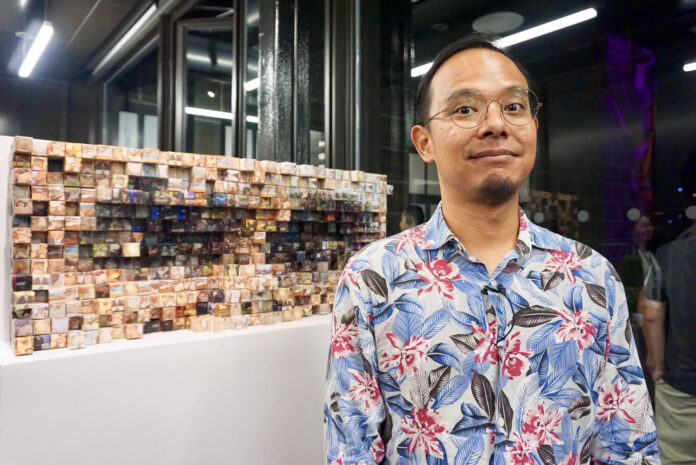
Wee Viraporn with his “Watch!” sculpture.

Top: Wee Viraporn with his “Watch!” sculpture.

BANGKOK — Through a pixelated sculpture of Prayuth’s eyes to a memeified event in Thai history, artists at an exhibition say the internet in Thailand is both a venue for freedom and a tool for surveillance.

A UNESCO-curated exhibition on Thai internet freedom launched Friday at a downtown design-hub to mark Universal Access to Information Day. Through six displays, ranging from hand-drawn infographics to documentaries, artists portray the Thainet as a double-edged sword, granting connectivity on one side but distortion and censorship on the other.

“We are watching what they’re doing but they are also watching us back,” artist Wee Viraporn said. “We will never have total freedom of expression or total freedom to monitor our government as long as it monitors our internet usage.”

LRG DSC04168

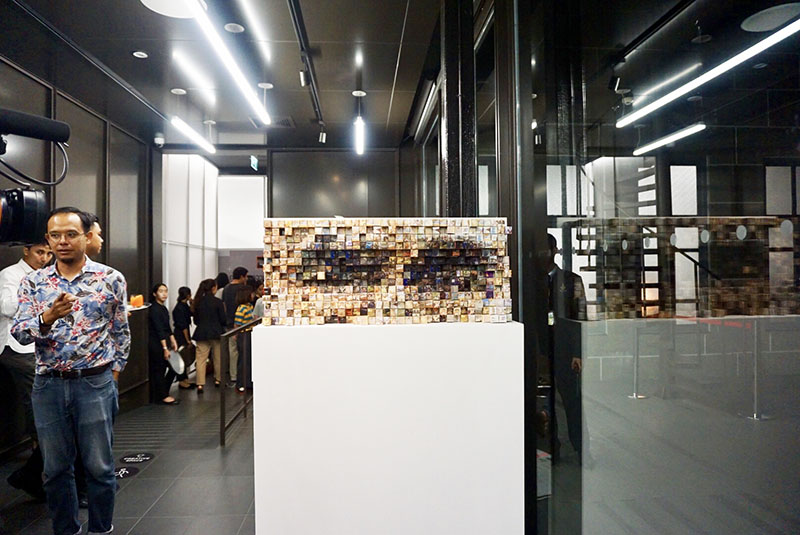
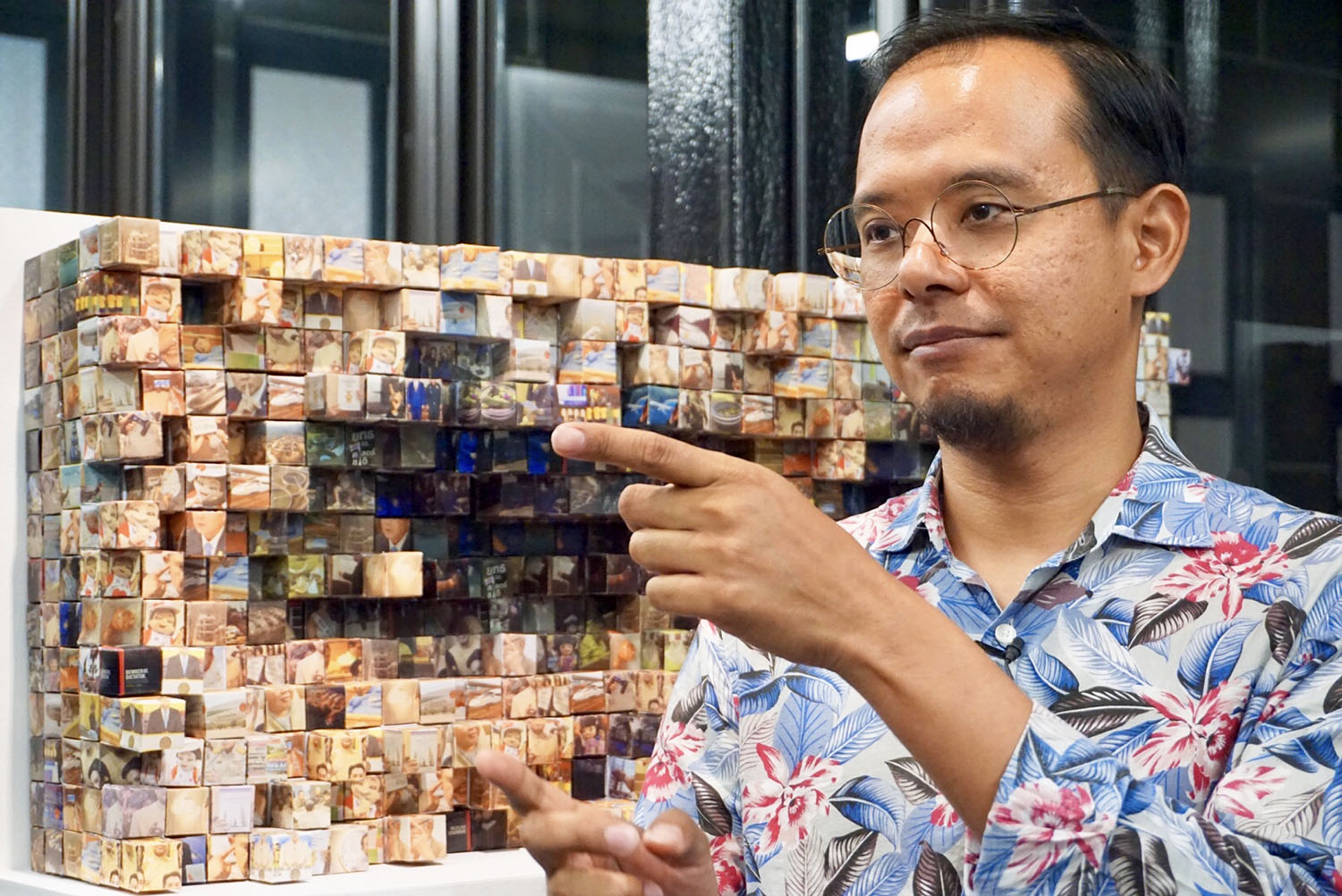
Wee created a sculpture titled “Watch!” to show this two-way surveillance. From afar, the mass of small cubes come together to resemble Gen. Prayuth Chan-ocha’s eyes. Up close, each cube is pasted with photos of news stories about unsavory actions of higher ups – from Gen. Prawit Wongsuwan’s undeclared luxury watches and the alleged killing of a black panther by a construction mogul to snoozing MPs and even Nong Kiew Koy, the junta mascot.

LRG DSC04175
“Friendship Ended With Mudasir Now Salman is my Best Friend” by Tewprai Bualoi.

Another artist, Tewprai Bualoi, 25, created “Friendship Ended With Mudasir Now Salman is my Best Friend,” named after the meme of the same name. Shots of memes such as the Soviet anthem and It’s Time to Stop are cut with quick flashes of historical footage to hint at a controversial event in Thai history.

“Thais use memes to talk about things that we can’t talk about because we’re being monitored by the state. So we use memes as language,” Tewprai said. Asked to reveal what event his video tries to portray, he was reticent.

“I want to try and talk about an event that isn’t usually talked about. If I told you, then I wouldn’t need to make this video meme!” Tewprai said.

Khaosod English’s live coverage of the Internet Universality Beyond Words opening.

In contrast to Tewpai’s coded work, Siriwat Pokrajen created “Internet Universality,” a short documentary about the broad interpretations and misuse of the Computer Crimes Act and the lese-majeste law. It features talks by Yingcheep Atchanond of iLaw, a legal reform advocacy.

While less political, the other three exhibits are informative about Thai internet use. Design student Nippita Pongern, 20, created three booklets’ worth of handmade illustrations and infographics about Thai internet usage and literacy in “My Virtual Playground.”

For example, through illustrations of rabbits, chickens and owls, one graphic shows that 60 percent of Thais spend a daily six hours on the internet.

LRG DSC04162
Nippita Pongern with her “My Virtual Playground” exhibit.

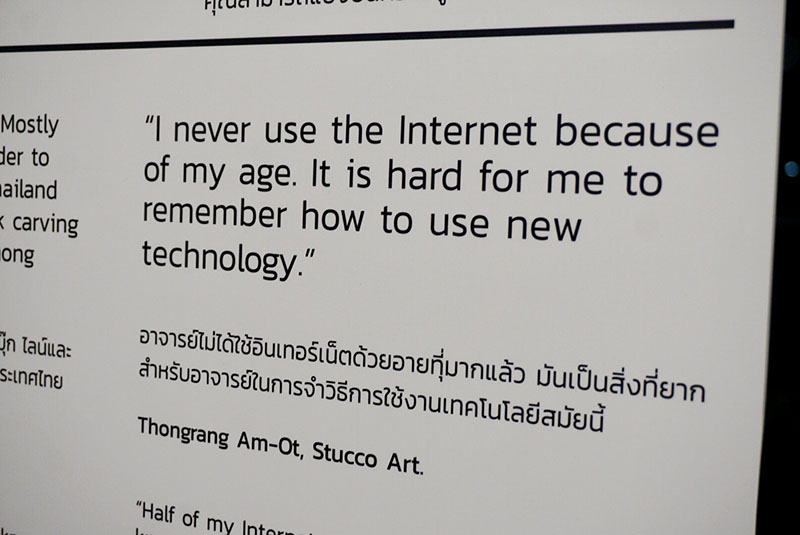
In “Artisan 4.0,” five students from the King Mongkut University of Technology Thonburi interviewed elderly craft artisans in Bangkok and Phetchaburi about the impact of the internet on their lives. While some said the internet helped them sell more products, others rejected its use.

Finally, there’s an exhibit of thirty booklets of the Thailand Wikipedia entry page, each in a different language. “Phasa+Thai(land): The Book of Languages” by Paphop Kerdsup shows that different information is consumed depending on the language used online. Visitors are encourage to parse the booklets for factual differences.

Internet Universality Beyond words runs 10:30am to 9pm every day except Monday through Oct. 14 on the fifth-floor hallway at the Thailand Creative and Design Center, or TCDC. The design space is located in Soi Charoen Krung 34 and can be reached from BTS Saphan Taksin and the Wat Muang Kae pier. Admission is free.
LRG DSC04188LRG DSC04143 LRG DSC04185 LRG DSC04130

LRG DSC04190
“Phasa+Thai(land): The Book of Languages” by Paphop Kerdsup.
LRG DSC04151
The “Artisan 4.0” exhibit.

Related stories:

Throw Coups, Deny Visas at Political Games Exhibit

Advertisement

Passenger’s Body Found in Pacific Lagoon After Plane Crash

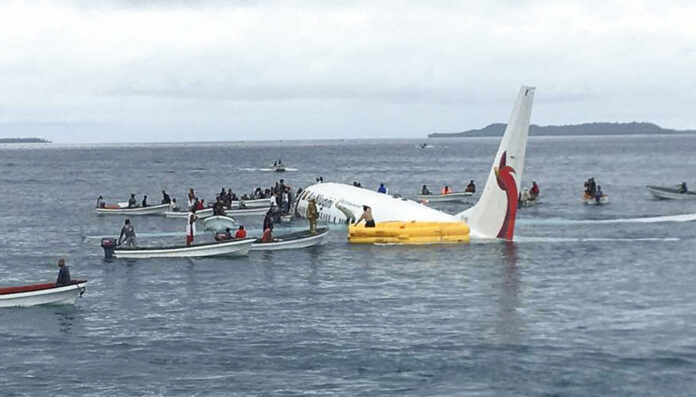
Local fishing boats move in to recover the passengers and crew of an Air Niugini flight Friday following the plane crashing into the sea on its approach to Chuuk International Airport in the Federated States of Micronesia. Photo: James Yaingeluo / Associated Press

CANBERRA, Australia — A passenger’s body has been found in the Pacific lagoon where a plane crash-landed last week near an island runway in Micronesia.

Air Niugini had initially said all 47 passengers and crew had survived when the Boeing 737 crashed near the Chuuk island runway on Friday.

The Papua New Guinea national carrier said on Saturday one passenger had not been accounted for but was witnessed reaching a rescue dinghy as U.S. Navy sailors and locals helped people escape the sinking plane.

But Air Niugini chief executive Tahawar Durrani said the man’s body was found by divers Monday. The airline said in a statement on Tuesday the man was Indonesian, but did not reveal his identity.

“Our outreach team is in touch with the man’s family and we are making arrangements to repatriate his body,” Durrani said in a statement.

Four passengers were in stable conditions at a Chuuk island hospital and will be taken soon to Guam for further treatment, Air Niugini said.

Hospital and aviation officials have not responded to requests for comment.

Flight PX73 from nearby Pohnpei island crashed about 145 meters (475 feet) from the Chuuk International Airport runway, the airline said.

What caused the crash remains unclear. The airline and U.S. Navy said the plane landed in the lagoon short of the runway. Some witnesses thought the plane overshot the runway.

A Papua New Guinea accident investigation team flew to Micronesia on Friday, the Post Courier newspaper reported.

Flight PX73 flies from Tokyo’s Narita International Airport to Papua New Guinea’s capital, Port Moresby, via Pohnpei and Chuuk.

Air Niugini has operated since 1973. Data from the Aviation Safety Network indicate the Indonesian passenger is Air Niugini’s first fatality in two decades.

Story: Rod McGuirk

Advertisement

Do Muoi, Former Vietnam Communist Party Chief, Dead at 101

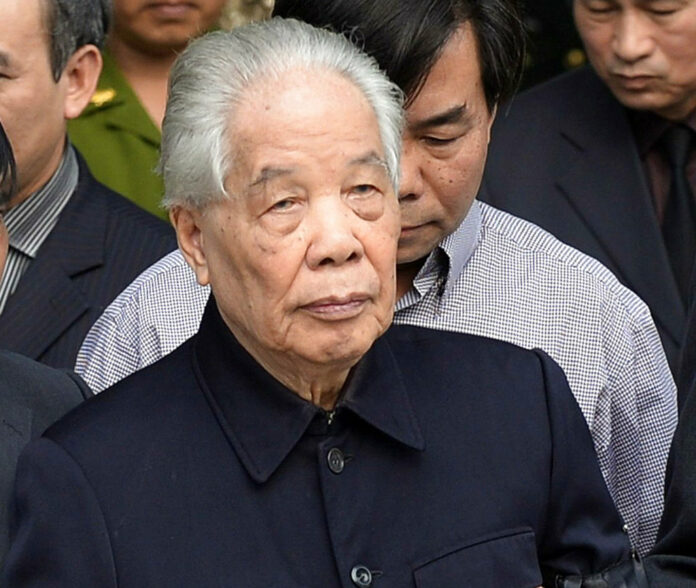
Former Communist Party Secretary General Do Muoi, front center, is helped to walk to pay respects to late Gen. Vo Nguyen Giap at the National Funeral House in 2013 in Hanoi, Vietnam. Photo: Hoang Dinh Nam / Associated Press

HANOI — Former General Secretary of the Communist Party of Vietnam Do Muoi, a committed communist, has died at age 101.

The government said in a announcement posted on its website that Muoi died late Monday night at the National Military Hospital 108 after battling a serious illness despite efforts by Vietnamese and foreign doctors to treat him.

Born Nguyen Duy Cong in suburban district of Thanh Tri in Hanoi in 1917, Muoi joined the Communist Party of Indochina, the former Communist Party of Vietnam at young age and rose through the ranks the party and government before becoming prime minister in 1988.

He served as the head of the Communist Party for more than 6 years before stepping down in 1997. No funeral arrangements have been announced.

Advertisement

Future Forward Party Plans to Raise 300M Baht for Election

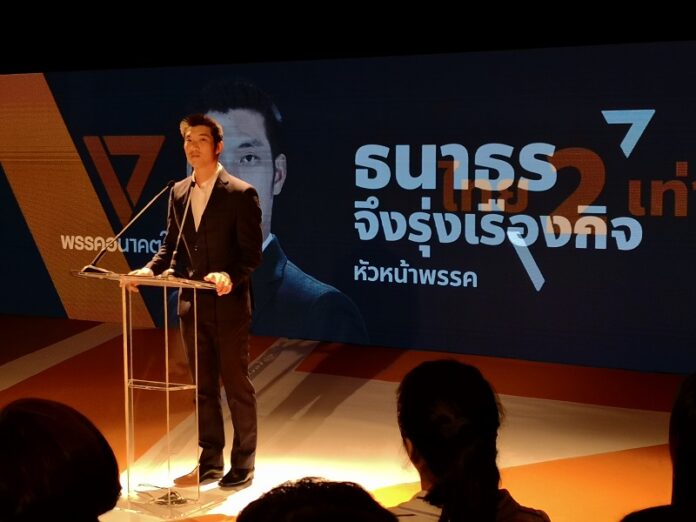
Future Forward leader Thanathorn Juangroongruangkit speaks in October at the party headquarters in Bangkok.

BANGKOK — Saying he’s ready to become prime minister, a billionaire-turned-politician on Monday urged people to become members of his party and pledged to raise hundreds of millions of baht for his election campaign.

Speaking at the Future Forward party headquarters in Bangkok, leader Thanathorn Juangroongruangkit said his movement plans to raise 300 million baht for its election campaign, currently scheduled for February 2019. He said the party aims to collect 100 baht on annual membership fees from each member and 2,000 baht from those willing to pay lifetime fees starting Saturday.

“We will definitely raise 300 million [baht] from the public… We will do our best to raise funds,” Thanathorn said Monday as the movement relaunched itself after the Election Commission last week legally recognized it as a political party. He said the party – which vows not to take the path of money politics – currently has 1,000 supporters.

Thanathorn added they would sell memorabilia such as teddy bears, totes and T-shirts at their headquarters on Petchaburi Road in Bangkok, but said selling political goods online is prohibited under election laws.

Asked how much the party had spent over the past seven months – with leaders attending meetings and conferences in the United States, Canada and soon Europe – Thanathorn just said to “wait until after January 2019,” adding that he planned to disclose the party’s ledger on a quarterly basis.

A founding member, who spoke on condition of anonymity for fear of creating conflict within the party, said leaders originally planned to collect a 200 baht annual membership fee, but that some founding members opposed, citing it was too much to shoulder for ordinary members.

“Paying 200 baht may sound little for the urban-middle class but not for ordinary folks,” the source said.

It added that the challenge for a party that vows not to rely on money to win votes continues when it invites people for talks in the provinces.

“There’s a need to pay at least for transportation fees and food. You can’t just invite them and offer nothing. They won’t come for the second time,” the source said.

While it’s common knowledge that former MPs in some big parties are given monthly retention fees of up to 100,000 baht a month, the source claimed to receive 25,000 baht a month from the party and that it’s not really sufficient to travel for meetings in other regions.

“When campaigning time comes, we need a budget to hire a car and some campaigning staff and it will costs money, the source said, adding that the party is still working out on the details.

“Maybe Thanathorn’s family is telling him to put a lid and not piggyback on the family’s coffer,” the source said Monday after the party meet the press. Despite his wealth, Thanathorn said he wouldn’t use that to fund his party, insisting instead on the opposite model.

Campaigning is a challenge for any new party, especially so for a party vowing not to spend money the “conventional” way by handing out cash and retention payments to canvassers.

“We tell them we don’t hand out cash. It’s about ideology,” said Palakorn Jirasophon, team leader for Bangkok and the surrounding provinces.

Thanathorn himself admitted Monday during the questions and answers session with reporters that unlike established political parties, Future Forward doesn’t have a constituency base.

Critics expect the party – which vows to transcend a decade-old political rift – to win some seats through the partylist system, as its strong social media presence has garnered the support of the young and urban middle class. However, Thanathorn remarked on something they lacked.

“We don’t have any constituency base… Every group is new group for us,” Thanathorn said. “Because we are a new party, it’s very difficult to say how many seats we will get.”

However, party spokesperson Pannika Wanich who had earlier boasted about how the party is popular on social media – twice topping as the top trending Thai-language hashtag on Twitter – insisted Future Forward is not just the young urban middle class hipsters or social media users.

“Our party is for everyone,” she said.

Thanathorn, 39, formerly served on the board of Matichon Group, the parent company of Khaosod English.

Advertisement

Rivals Left Fuming as Serving Ministers Join Pro-Junta Party

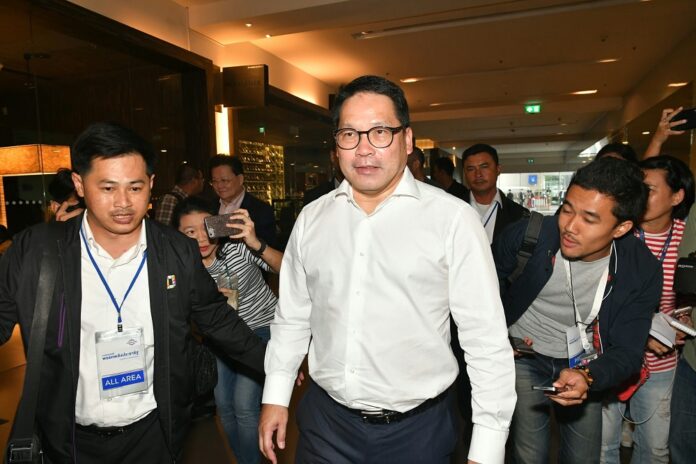
Industry Minister Uttama Savanayana arrives at Palang Pracharat Party executive meeting on Saturday.

BANGKOK — News of four ministers under junta chairman Prayuth Chan-ocha joining the rank of a pro-government party was met with a chorus of criticism from Pheu Thai and Democrat politicians.

Uttama Savanayana, Suvit Maesincee, Nuttapol Teepasuwan and Sontirat Sontijirawong confirmed their membership with Palang Pracharat Party on Saturday, even as they continued to serve in ministerial posts. Uttama was also elected leader of Palang Pracharat, widely seen as a proxy of the military regime.

Read: Pro-Junta Party Confident It Will Lead Next Govt

Pheu Thai spokesman Anusorn Iamsa-ard questioned how the election – slated to take place February – could be transparent if those in charge of organizing it are also involved.

“This is a competition where the referees have something to gain or lose,” Anusorn told reporters Sunday. “They are both athletes and rulekeepers at the same time. How can we have a fair election?”

Former Pheu Thai sec-gen Chawalit Wichayasuth went as far as calling it “the most biased election” in recent history.

Speaking to reporters Sunday, a senior Democrat Party official also warned that the next election won’t have any credibility if the four ministers exploit their public offices for their political interests.

“Exercising power for their own kind … will affect credibility in the election. The country will be damaged, and the election result won’t be accepted,” Ongart Klampaiboon said.

Founded in March, the party is recognized by many observers as the vehicle for junta leaders in the upcoming election. Its party name – Palang Pracharat – is a reference to the pracharat government initiative launched by Prayuth.

Advertisement

Urgently Needed: New Tesla Chairman, Must Be Able to Handle Conflicts, Debt

A file photo of Tesla CEO Elon Musk in his high time. Image: The Joe Rogan Experience / YouTube.

WASHINGTON  — It won’t be an easy job.

Whoever becomes the new chairman of Tesla Motors will face the formidable task of reining in Elon Musk, the charismatic, visionary chief executive with an impulsive streak, while also helping Musk achieve his dream of turning Tesla into a profitable, mass-market producer of environmentally-friendly electric cars.

Musk is giving up the chairman’s role under a settlement announced Saturday with the Securities and Exchange Commission. Besides a new chairman, Tesla was also ordered to appoint two new, independent members to its board. A more assertive board could provide the kind of tighter oversight that many legal experts, and Tesla investors, say is overdue for a company of Tesla’s market value.

The settlement stemmed from a lawsuit the SEC filed charging Musk with misleading investors in August with a tweet that said he had “funding secured” for taking the company private.

Yet a more forceful board, coupled with a domineering CEO like Musk, could create conflicts at a risky time for the company. Visionary CEOs such as Apple’s Steve Jobs and Twitter’s Jack Dorsey have been forced out by strong boards of directors, though both eventually returned to their companies.

Even with the settlement, Tesla faces a daunting array of challenges.

The Justice Department has opened its own investigation into Musk’s Aug. 7 tweet, in which he said he would take the company private at $420 a share. The SEC’s lawsuit charged that the tweet, which caused Tesla’s shares to jump, was misleading because he did not actually have the funding lined up for such a move.

Tesla is also under heavy pressure to turn a profit because it is burning through $1 billion in cash every three months and, as of the end of June, had just $2.2 billion in the bank.

Musk has said the company needs to produce 7,000 cars a week to make money, a target he aimed to reach in the July-September quarter. The company is likely to report production numbers this week and financial results from that quarter in early November.

Another concern: About $1.3 billion in Tesla debt is due to be repaid by March, including $230 million in November.

Some investors might want more than a new chairman. Tesla has no chief operating officer, a critical No. 2 executive in most companies. That’s a stark contrast to other startups, such as Facebook, where Mark Zuckerberg hired Sheryl Sandberg as a highly influential COO.

In the lawsuit filed Thursday by the SEC, the agency said it was seeking to remove Musk from Tesla management altogether. Many investors have argued that keeping Musk as CEO is critical at such a time.

“I do not doubt the value of Musk to Tesla,” John Coffee, a Columbia University law professor and corporate governance expert, said. “Without him, they are just a struggling start up that is burning cash at a hopeless rate and is facing a debt refunding crisis in the near future.

“Musk is an iconic entrepreneur but he needs adult supervision,” Coffee added.

That’s where the new board members come in. The current board, which includes Musk’s brother, Kimbal Musk, is widely seen as subservient to Musk. They have publicly expressed support for many recent moves, such as his rejection last week of an early SEC settlement offer.

“The board is truly the alpha chapter of the Elon Musk fan club,” said Erik Gordon, a professor at the University of Michigan’s Ross School of Business.

Teresa Goody, a former SEC attorney and founder of The Goody Group, a consulting firm, said that many startups begin with a powerful CEO who typically puts “friendlies” on the board.

As a company grows and becomes more sophisticated, Goody said, more independent directors are typically brought on board to provide better oversight.

“That’s happening a little later in the life cycle of the company in the case of Tesla,” she said.

Still, Elon Musk is different than many CEOs because he owns roughly 20 percent of the company’s stock. That gives him more influence.

“In a typical case, the CEO is a high-priced employee” of the board, Gordon said. “Musk will still be more powerful than the board chair.”

There will be other constraints on Musk’s behavior: As part of the SEC settlement, his tweets and other comments will have to be vetted by the company before they can be released to the public.

“This humiliation — that Elon can’t go outside unless he’s on a leash — that will bother him the most,” Gordon said. He called it an “extraordinary measure.”

Gordon thinks the SEC should have gone further and sought to add as many as four new board members and remove some old ones.

Still, Gordon said, “I think this experience has shown him that however smart he is, or however powerful he thinks he is, the government is also powerful too.”

Musk may want to keep a close eye on the new chairman, however. Musk himself was the chair of the board, after investing in the company, before firing the chief executive and taking over as CEO

___

AP Auto Writer Tom Krisher contributed to this story from Detroit.

Advertisement

DMK Chief Suspended Over Chinese Tourist Assault

In this undated image from video, an airport security guard gets physical with a Chinese tourist. Image: Guide Complaint / Facebook

BANGKOK — The president of the national airport regulator said top Don Mueang airport officials had been suspended Sunday after a security guard was filmed assaulting a Chinese tourist.

Nitinai Sirismatthakarn of the Airports of Thailand said the airport’s general manager and security chief received a 30-day suspension over last week’s incident, and that the guard is under an investigation that could cost him his job.

“It was an unnecessary act of violence,” he said. “Airport staff should not harm a passenger under any circumstance.”

He added that the results are expected in two weeks, and that the department would send an apology letter directly to the Chinese embassy on Monday.

The news spread Saturday on Thai media after a Facebook page which reports illegal activities by tour guides posted a video clip showing a man in security uniform throwing his fist at a Chinese-speaking man.

“A source in WeChat sent me this, saying that today a Don Mueang airport officer slapped a Chinese tourist in the face,” the admin wrote. “The clip was published in China and has been shared like millions of times.”

The post claimed the tourist was assaulted for refusing to pay an “extra service fee” to an immigration officer on top of what he had to pay for a visa on arrival.

It quickly drew the attention of airport authorities. Hours later, the airport’s general manager led a press briefing to apologize about the incident but denied that it was triggered by an illegal visa fee.

Wing Commander Suthirawat Suwanawat said the incident took place Thursday night after Thai Lion Air staff requested security personnel to control a hassle caused by the Chinese tourist, identified as Mei Ji.

He said Mei, who flew to Bangkok from Jakarta, was barred from entering the country as he could not present proof of accommodation and showed “inappropriate behavior” toward immigration staff.

Mei allegedly obstructed security personnel who responded to the scene and tried to run away before he was deported to Guangzhou. Suthirawat however acknowledged that the guard reacted in a way that seriously violated airport codes.

“We are deeply sorry about what happened, which negatively impacted Thailand’s reputation,” he said, adding that the airport would compensate Mei for damages.

Suthirawat then said he would request for his suspension, adding that he would travel to China to apologize to the victim in person.

Police Maj. Gen. Surachet Hakpan, a newly appointed immigration bureau commander, said he has received complaints that some staff have wrongly collected additional money from Chinese tourists by claiming to help fast track their visa applications. He said today that he put up a sign at the airport saying there’s no extra service fee to the visa.

Advertisement

Brew Yoga Meets Silent Disco Saturday in Bangkok

Photo: Brew Yoga Thailand Team / Courtesy

BANGKOK — Since last year, beer and yoga has become a way to heighten states of mind and body – and this week it’s going a step further.

On Saturday, an event will feature three types of therapies all together – yoga, beer and music – under the concept Silent Brew Yoga.

To put it simply, imagine brew yoga at a silent disco party. Those who sign up will get a pair of noise-isolating wireless LED headphones. The gadgets can dial into three channels of different instructors and DJs, who will play three different music genres: 90s Thai, deep house and EDM.

Attendees will be able to buy a variety of drinks will be available. Those who don’t drink alcohol can have kombucha, ginger ale, fresh orange juice, coconut juice and more.

The event, billed as being held in the country for the first time, is organized by Brew Yoga Thailand, according to founder Nipaporn “Whan” Audrach.

“I want silent brew yoga to approach more kind of people because [we’re] more than just a workout event,” Nipaporn said. “Thailand already has silent disco, silent yoga and brew yoga are already available in many cities around the world, but no one has combined them all together yet. I can say this is even the first time of the world.”

Attendees need no yoga experience. Tickets available online are 850 baht and include a brew yoga, zumba or cardio dance class, as well as food and beverages.

The event starts at 3pm on Saturday at the Helix Garden, located on the fifth floor of EmQuartier. The luxury shopping mall is connected to BTS Phrom Phong.

Brew yoga debuted last year in Bangkok, bringing yoga that tests body, mind and balance with a bottle of beer. It is inspired by Berlin-based event Bieryoga, which started the trend in 2015 and has since been picked up in cities such as Melbourne and Sydney.

Related stories:

Beer Yoga Returns to New Home at Wishbeer

Happy Workout! Beer Yoga Coming to Thailand

Watch People Party at ‘Silent Disco’ in Thonglor Club

Silent Disco Night Coming to Beam Thonglor

Advertisement

Gassy Cows Are Bad for the Planet; Could Seaweed Diet Help?

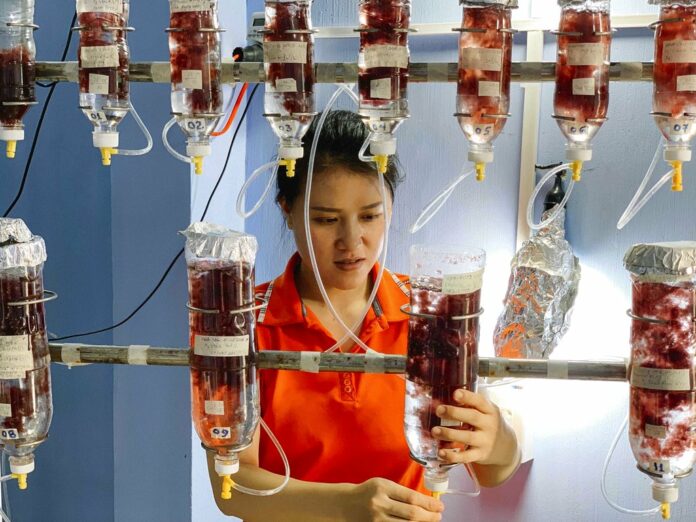
Australis Aquaculture employee Khanh Huynh checks on seaweed cultures Thursday near Ninh Hai, Vietnam. Photo: Associated Press

The smelly reality is that cows will always pass gas. But if farmers had more access to seaweed, cow flatulence might just stink a little less for the planet.

That’s the thesis of a New England-based aquaculture company which is launching a drive to become the worldwide leader in an emerging effort to thwart climate change by feeding seaweed to cows.

The concept of reducing livestock emissions by using seaweed as feed is the subject of ongoing scientific research, and early results are promising. University of California researchers have found that cows that eat seaweed appear to emit less methane, a greenhouse gas that contributes to global warming, when they belch and pass gas.

But one of the big challenges to implementing the seaweed solution is getting enough of the stuff to farmers, and the kind of seaweed that has shown results in cows isn’t commercially farmed.

Enter Australis Aquaculture of Greenfield, Massachusetts, which is in the midst of research at facilities in Vietnam and Portugal that is part of its push to become the first farm to produce the seaweed at commercial scale. The company calls the effort “Greener Grazing” and it expects to be operating at commercial scale in two years, said Josh Goldman, the company’s chief executive officer.

“If you could feed all the cows this seaweed, it would be the equivalent of taking all these cars off the road,” Goldman said. “Greener Grazing’s mission is to cultivate this, and accelerate scaling of this kind of seaweed.”

The type of algae in question is a red seaweed called Asparagopsis, and it grows wild in many parts of the world. Researchers from the University of California, Davis, found earlier this year that methane emissions were reduced by 24 to 58 percent in a dozen cows that ate one variety of the seaweed, depending on dose.

The seaweed constituted only a small percentage of the cows’ food, but researchers found that the dent it could make in emissions would be significant if it were available to farmers. The methane from cow’s burps makes up 25 percent of methane emissions in the U.S., according to the university. The seaweed interrupts the bacterial process of producing methane in their guts, Goldman said.

Challenges remain, said Ermias Kebreab, a professor of animal science at UC Davis. The seaweed needs more tests to determine if it would impact meat and milk quality from the animals.

The challenge of producing enough of the seaweed is staggering, leading Goldman to call it an “aquatic moonshot.” He estimated that the amount of seaweed needed to reach every cattle operation would be greater than the amount presently farmed in the world.

“We need to have a consistent product. We need to find a way to grow it in a more consistent way,” Kebreab said.

That’s exactly what Australis Aquaculture is working on. The company has collected different strains of Asparagopsis seaweed to establish a seed bank of seaweeds that can grow in different climates, Goldman said.

The next step will be to reproduce the seaweed on the company’s farms, Goldman said. Creating the seed bank will make it possible for farmers to grow the seaweed elsewhere, he said.

The effort has attracted the attention of the World Bank, said its senior aquaculture specialist Randall Brummett. He said scaling up farming of the seaweed in the developing world could make livestock operations more climate friendly and boost the economies of poorer nations.

Skeptics remain. The seaweed has yet to be proven palatable to cows, and the milk that they would yield hasn’t proven to be safe for human consumption, said Frank Mitloehner, a professor and air quality extension specialist in the animal science department at UC Davis.

“When you look at it a little deeper, some serious concerns have to be addressed before it can be considered a serious mitigation tool,” he said.

There’s also the question of whether it will find acceptance with farmers. Jenni Tilton-Flood, a dairy farmer at Flood Brothers Farm in Clinton, Maine, said she’d be willing to try it, but cost and availability are also important.

“As long as the nutrition would be valuable to our animals. We don’t just throw food at our cows. We have nutritionists for our cows,” she said. “If it can be a food source for livestock, that’s great.”

Story: Patrick Whittle

Advertisement

Macedonia: Referendum Approves Name Change, but Turnout Low

Supporters of a movement for voters to boycott the referendum, hold placards Sunday as they celebrate in central Skopje, Macedonia, after election officials gave low turnout figures. Photo: Thanassis Stavrakis / Associated Press

SKOPJE, Macedonia — A referendum on changing Macedonia’s name as part of a deal that would pave the way for NATO membership won overwhelming support Sunday, but low voter turnout highlighted the hurdles that still remain for the Balkan country to join the alliance.

Prime Minister Zoran Zaev had hoped for a strong show of support in the referendum on whether to accept a June deal with Greece changing the country’s name to North Macedonia. That would help him with the next step of winning parliamentary support for the required constitutional amendments.

Results from more than 97 percent of polling stations showed 91.3 percent of voters approving the deal. But turnout stood at just 36.8 percent, a far cry from the massive support the government had hoped for.

Opponents to the name change had called for a boycott of the vote and celebrated in the street outside Parliament when turnout figures were announced, chanting slogans and waving flags.

Nevertheless, Zaev declared the vote a success.

“The people made a great choice and said ‘yes’ to our future. It is time for lawmakers to follow the voice of the people and to provide support,” he said. “There will be no better agreement with Greece, nor an alternative for NATO and the EU.”

Zaev said he would seek to secure the required two-thirds majority of the 120-seat parliament by next week for the constitutional changes. If he fails, he said the only alternative would be to call early elections.

The deal with Greece has faced vociferous opposition from a sizeable portion of the population on both sides of the border, with detractors saying their respective governments conceded too much to the other side and damaged national interests and identity.

The referendum stirred strong interest in the West, with German Chancellor Angela Merkel and U.S. Defense Secretary Jim Mattis among a long line of foreign officials who visited Skopje ahead of the vote to urge Macedonians to back the deal.

Russia, however, is not keen on NATO expanding in a part of Europe once under its sphere of influence. Mattis said there was “no doubt” Moscow had funded groups inside Macedonia to campaign against the name change.

In Athens, the Greek foreign ministry noted the “contradictory” result of the referendum – overwhelming approval along with low turnout – and said careful moves were needed to “preserve the positive potential of the deal.”

The agreement faces more hurdles before it can be finalized. If the constitutional amendments are approved by Macedonia’s parliament, Greece will then also need to ratify it.

But Greek Prime Minister Alexis Tsipras faces political problems of his own. His governing coalition partner, right-wing Independent Greeks head Panos Kammenos, has vowed to vote against the deal, leaving Tsipras reliant on opposition parties and independent lawmakers to push it through.

The June agreement aims to resolve a dispute dating from Macedonia’s declaration of independence from Yugoslavia in the early 1990s. Greece, arguing its new northern neighbor’s name implied territorial ambitions on its own province of the same name, has blocked Macedonia’s efforts to join NATO since then.

Under the deal, the former Yugoslav republic would amend its name to North Macedonia and Greece would drop its objections to the country joining NATO.

Supporters, led by Zaev, had characterized Sunday’s vote as a linchpin of Macedonia’s future prosperity, the key to its ability to join international institutions. NATO and EU membership would be a major step for a country that less than two decades ago almost descended into civil war, when parts of its ethnic Albanian minority took up arms against the government, seeking greater rights.

But opponents painted Sunday’s vote as a clear failure.

“The fact is that the agreement with Greece did not receive a green light,” said Hristijan Mickoski, head of the opposition VMRO party. “This today is a defeat not only for the agreement with Greece, but for the crime of those who are in power.”

However, the government had called the referendum consultative and non-binding, meaning it could interpret the outcome as a fair reflection of public opinion regardless of how many people voted. If the referendum were binding, the Macedonian Constitution requires a minimum turnout of 50 percent of eligible voters to be valid.

The question posed to voters was: “Are you in favor of membership in NATO and European Union by accepting the deal between (the) Republic of Macedonia and Republic of Greece?”

Critics of the name change include President Gjorge Ivanov, who has called the agreement with Greece a “flagrant violation of sovereignty.”

Boycott supporters were jubilant.

“We don’t recognize any other Macedonia but Macedonia. No North Macedonia,” said Nevenka Ristovska, who was among opponents of the deal celebrating outside parliament, waving red-and-yellow Macedonian flags.

Story: Elena Becatoros, Konstantin Testorides

Advertisement

Hot News

LATEST NEWS

Bangkok
overcast clouds
30 ° C
31.6 °
30 °
75 %
4.7kmh
100 %
Sun
31 °
Mon
33 °
Tue
33 °
Wed
31 °
Thu
29 °