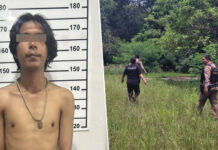
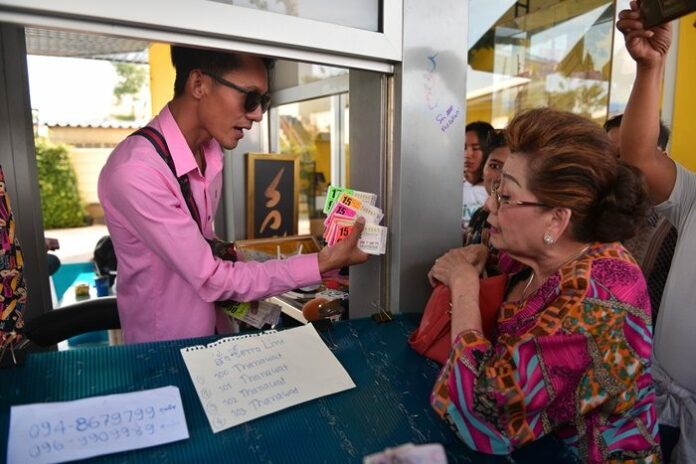
SAMUT SAKHON — Police on Sunday were seeking the arrest of a ticket seller thought to have doctored winning numbers for the national lottery.
The arrest warrant comes a day after Thanawat “Pete” Kumhaengpol, 35, allegedly confessed in a voice clip to falsifying winning tickets for the Sept. 1 jackpot.
“It was for fun. I doctored the [number] seven. Then I sent it for fun in Line,” Thanawat said in an online clip on Saturday. “When I woke again, it was on the news.”
Police Maj. Gen. Surachate Hakparn said Sunday that Thanawat could be charged with fraud, document forgery and breaking the Computer Crime Act.
Soon after the Sept. 1 jackpot was announced, Thanawat said he had sold 15 tickets through Line, and that they were all winning numbers. He told the press Thursday that his tickets had incorrect watermarks because they tore as customers fought over them.
Thanawat, a lotto ticket seller in a Samut Sakhon province gas station, was scrutinized after the Help Crime Victim Club Facebook page brought the matter to light. It questioned why the winnings had not been collected a week after the results were announced. The barcodes on Thanawat’s tickets did not produce winning numbers when checked with the Government Lottery Office.
“We came out to scrutinize this story because it’s very strange that one lottery ticket seller would have multiple 90 million baht jackpot tickets,” a Saturday morning post by the crime Facebook page read. “And more than that, some people are superstitious enough to believe that buying tickets from one seller is luckier than another.”
NEW YORK — Naomi Osaka walked to the net, the excitement of being a Grand Slam champion mixed with a bit of sadness.
She grew up rooting for Serena Williams, even did a report on her way back in third grade. Her dream was to play her idol at the U.S. Open.
So when she had actually done it, beating Williams 6-2, 6-4 on Saturday night to become the first Grand Slam singles champion from Japan, why was it so difficult?
“Because I know that, like, she really wanted to have the 24th Grand Slam, right?” Osaka said. “Everyone knows this. It’s on the commercials, it’s everywhere.
“When I step onto the court, I feel like a different person, right? I’m not a Serena fan. I’m just a tennis player playing another tennis player. But then when I hugged her at the net … I felt like a little kid again.”
Osaka teared up as she was finishing her answer, still overwhelmed as she juggled the idea of her winning and Williams losing.
Though her nerves on the tennis court don’t show it, it was a reminder of just how youthful the 20-year-old Osaka is. Not since Maria Sharapova was 19 in 2006 has the U.S. Open had a younger women’s champion.
The way Williams lost, of course, was what stood out most in the match. The arguments with chair umpire Carlos Ramos and the three code violations – one that gave Osaka a game for a 5-3 lead in the second set when Williams was trying to rally – will be what was most remembered.
But not for Osaka, who claimed to not even hear the interactions between Williams and Ramos. What will stay with her is the hug at the net afterward, and Williams’ kind words during the trophy presentation, when she asked a booing crowd to focus its intention on Osaka’s moment.
“So for me, I’m always going to remember the Serena that I love,” Osaka said. “It doesn’t change anything for me. She was really nice to me, like, at the net and on the podium. I don’t really see what would change.”
Osaka was nervous Saturday, making a few phone calls to her sister in Paris to calm her down. Even during the match, whenever she was faced with a tough spot, she kept telling herself to try to do what Williams would do.
Williams was certainly impressed.
“She was so focused,” the 36-year-old Williams said. “I think, you know, whenever I had a break point, she came up with some great serve. Honestly, there’s a lot I can learn from her from this match. I hope to learn a lot from that.”
It was that way throughout the tournament for Osaka, who won the second title of her career. She was mostly dominant, dropping only one set in her seven matches, and she saved 5 of 6 break points against Williams after erasing all 13 in the semifinals against Madison Keys.
That’s the kind of toughness Williams has so often shown in winning 23 Grand Slam singles titles, one shy of the record. It’s one of the things Osaka always admired about Williams, made her choose her as the topic of that report years ago.
“I colored it and everything,” Osaka said. “I said, ‘want to be like her.'”
Celebs sit for a photo op with junta leader and Prime Minister Gen. Prayuth Chan-ocha to promote one of his government television programs. From back left, they are Jaron 'Top' Sorat, Mayura 'Tuk' Sawetsila, Namthip 'Bee' Jongrachatawiboo, Thanaphad 'Film' Kawila. At front from the left are Cherprang Areekul, Prayuth and Nittha 'Mew' Jirayungyurn.
In its latest bid to appear popular – or at least less unpopular – the ruling junta this week enlisted a handful of A-listers to its cause.
On Tuesday, junta leader Gen. Prayuth Chan-ocha, who is prime minister, made strange hand signs with half a dozen celebrities including soap star Nittha “Mew” Jirayungyurn and BNK48 frontwoman Cherprang Areekul. They smiled alongside Prayuth to promote a government TV program pushing for “more reform.”
The junta must be hoping these celebs will draw viewers to its otherwise unpopular propaganda programs, and initial signs indicated that it paid off. When TV heartthrob Nadech Kugimiya went on all free TV stations on Aug. 11 as a guest host to promote the regime’s efforts to solve loan shark problems, ratings show that as many as 5.5 million viewers tuned in. Meanwhile Mew, appeared on air Aug. 25 to promote tourism in the north while as many as 6 million watched.
Celebrity endorsements are nothing new. Luxury watchmakers, cosmetic brands and shoe companies employ them in the hope consumers will associate products with their favorite stars and be tempted to emulate them.
In Juntaland, the “good and services” are neither new, nor have they been tested by market forces. The junta’s “products and services” are propaganda shoveled down the throat of Thai voters for four and a half years.
In a dictatorship such as our’s, the people have no choice between brands, so it’s not accurate to think of these junta-supporting TV stars as the same kinds of brand ambassadors.
Depending on one’s political point of view, everyone knows how good or bad the junta is, and I do not think there is a room to change those views. Those who oppose dictatorship will not be smitten by Prayuth surrounding himself with stars. In fact, the backlash has been swift, with people turning to social media to ask why these celebs can’t stand for freedom and democracy instead.
It’s hard to say if, deep down, these celebrities are pro- or anti-democratic. It’s likely they came under immense pressure to cooperate with the junta, and their job is to “act” for a living. The safest alternative very likely was to cooperate with the regime. (In the olden days, religious leaders were coopted in support of the state but people are no longer that religious today, especially the young.)
By doing so they further normalize the junta and encourage people to see it as likable and popular. This is the other side of censorship under military rule, where anything critical goes unseen and replaced by forced propaganda TV programs at 6pm every work day and every Friday at 8pm, on all free channels.
More likely, since it’s hard if not impossible to convert those who are against the junta, the military regime is looking to win the hearts and minds of young people who are just becoming politically aware or people who have so far been apolitical. That read of it was bolstered this week by junta appeals for young voters to get engaged and choose “good” politicians.
On the other hand, it could also be read as a desperate attempt by the junta to appear popular. Were they truly popular, they wouldn’t need help to begin with. They need these stars to help make military rule, or military repression, glamorous if not popular. I say good luck with that!
No matter how hard they try to repackage themselves with the help of these actors, military rule is still military rule. This is just more authoritarian pantomiming of democracy, but this time with professional help.
In a way, they belong together, for they both make a living out of acting. If the West wants to hear the junta being pro-democracy, it will say it is for democracy, even 99.9 percent democracy.
If you want to hear professional actors and actresses say they are for the military rule, they will do just that and give Prayuth the Siamese smile.
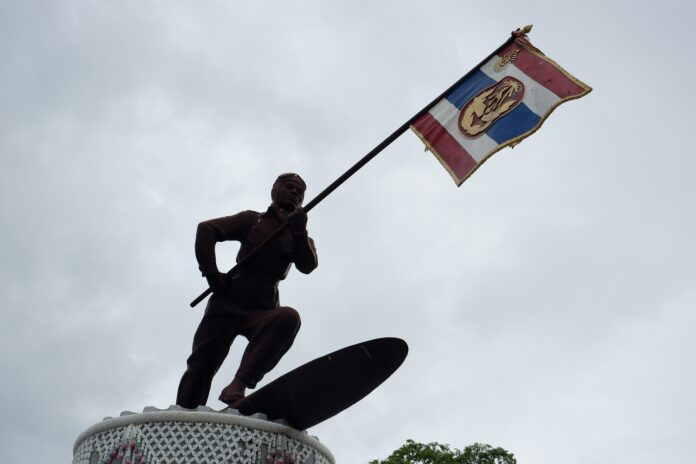
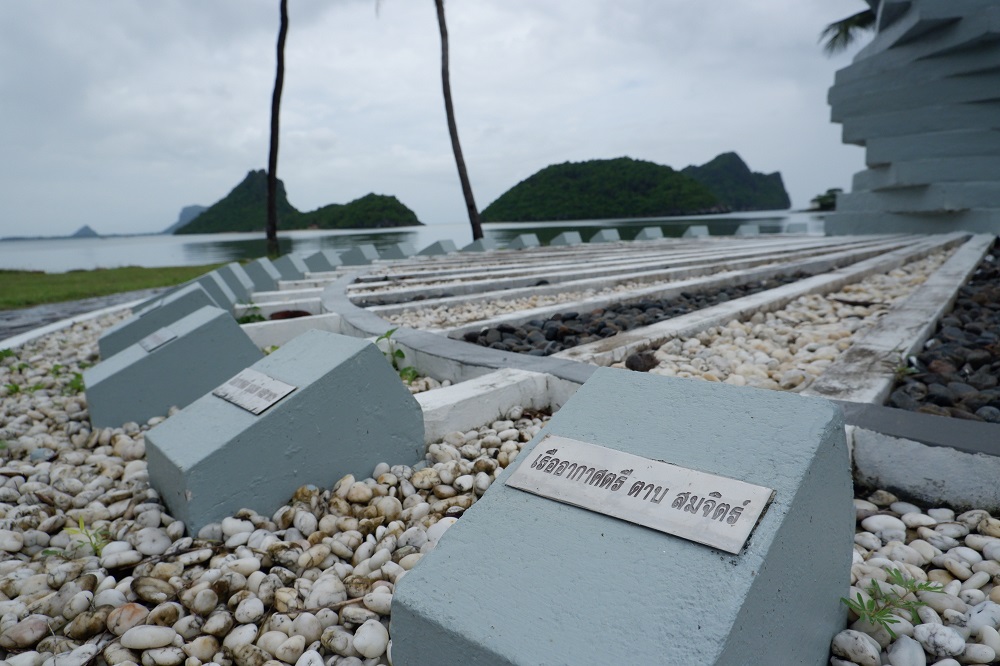
Above: A monument to the defenders at Wing 5 base in Prachuap Khiri Khan province.
In the darkness over the sea, air force lieutenant Srisak Sucharittham heard the enemies before he saw them.
It was 4am. Srisak and his friends had woken early to set out from their airbase to the nearby bay of Ao Manao. A senior officer was slated to visit their base, home of the Wing 5 Squadron, in the evening. So Srisak’s group went to catch fish for a welcome banquet.
Then he heard a sound: the rumble of engines. Unknown ships were entering the bay. Convinced something was amiss, they turned back and sounded the alarm. Dec. 8, 1941 had dawned on Thailand, bringing with it the flames of war.
“I was the first to see the barges. They were almost ashore, about 100 meters away,” Srisak said in an interview recorded before his death last year. “I ran to tell my wing commander to blow the emergency bugle and alert the wing.”
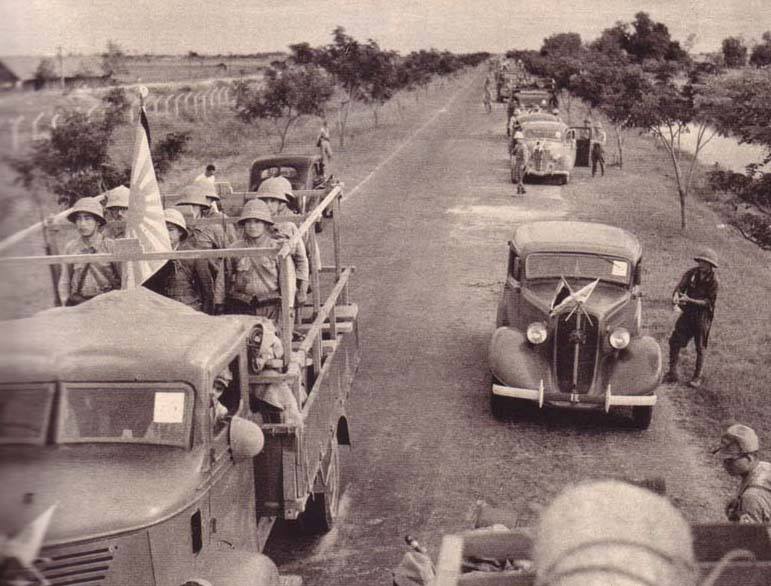
Less than four hours after crippling the US fleet at Pearl Harbor, tens of thousands of Japanese troops landed on Thai shores in their campaign to conquer Southeast Asia. Like the attack on Hawaii, the invasion caught the nation unprepared, and the Thai government led by Field Marshal Plaek Pibulsongkram quickly sought a ceasefire.
But while the rest of the country laid down arms, Srisak and a small band of 120 soldiers at the Ao Manao airbase resisted the invaders for 33 hours, unaware of Bangkok’s capitulation. Over a third would die by the end of the battle.
Distinguished by their courage in the face of overwhelming odds, they remain the only air force unit to be awarded with the Medal of Honor to date.
A DYING HISTORY
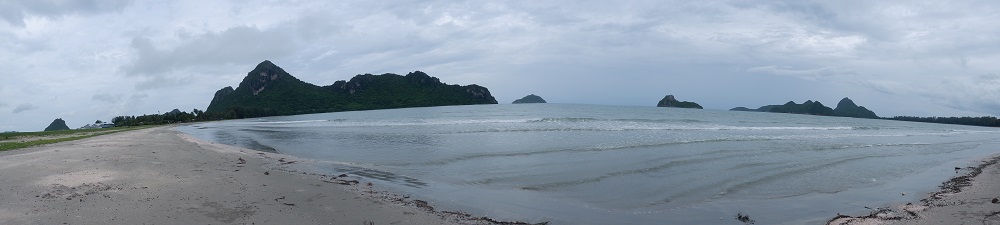
Rain was falling on a recent visit to Ao Manao – Lime Bay, in English – on a recent afternoon.
The bay stretches, from south to north in a long curve, with its northern reach curling eastward to end at the foot of Khao Lom Muak, a 300-meter limestone mountain that towers over the harbor.
The bay is now under the military jurisdiction of the Wing 5 base, the home of a squadron responsible for guarding the airspace over Prachuap Khiri Khan province. It sits on the western side of the Lom Muak peak.
There is only one air force-owned hotel on the beach. Driving north toward the bay from the hotel, one would pass a small hill on the left – Wua Ta Lueak – before the road starts to curve sharply along with the beach toward Lom Muak.
It’s here that the Japanese landed, in full view of these two flanking hills.
After passing through a checkpoint at the base entrance, the road runs north through the base, leading to the beach of another bay, Ao Prachuap. The road then continues along the coast toward the seaside town of Prachuap Khiri Khan.
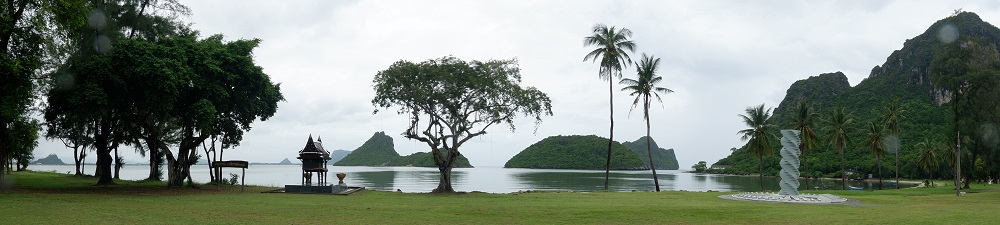
Unlike the wide expanse of the Ao Manao, the sea in Ao Prachuap is interrupted by a chain of three islands. From February to July every year, a midday low tide exposes a long shoal that connects the islands together with the mainland. But the sea in the two bays would have been at high tide that fateful December morning.
“It means the invading force could land their barges very close to the shore,” Sumalee Posri, a curator at the base’s war museum, said as she led a tour. “The Japanese must have done their research.”
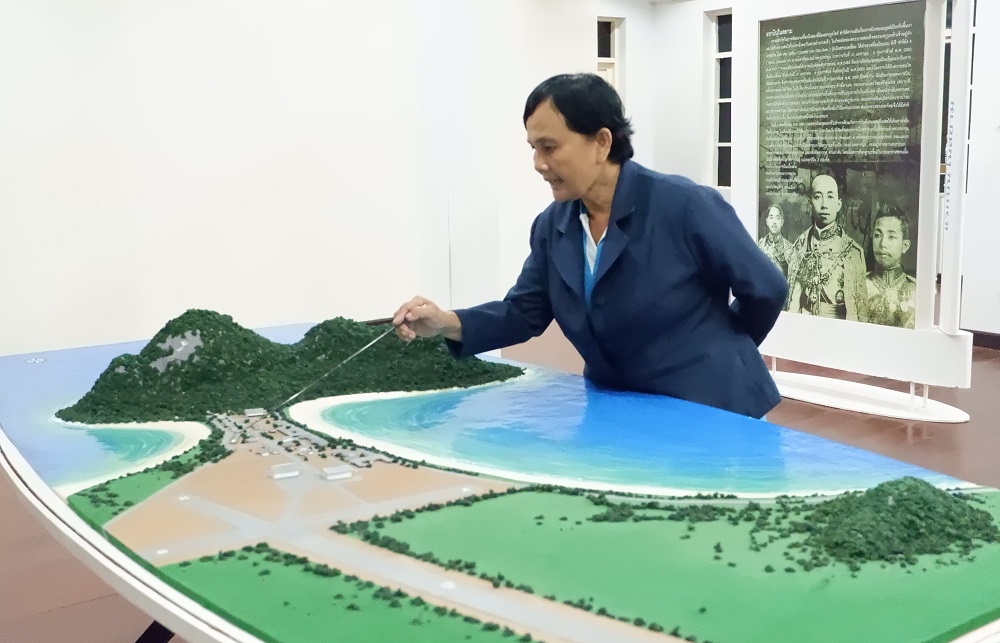
A curator of 47 years, Sumalee Porsri uses a diorama to describe how the battle unfolded.
Facing Ao Prachuap is a group of buildings and monuments forming the museum complex. They include a memorial honoring the airmen who died fighting the Japanese on this shore. Their enemies were buried in unmarked graves beneath the trees along the beach. A Thai styled shrine was erected for their souls.
Sumalee has been curating the museum for 47 years. In the early years of her career, she remembers families of the Japanese dead visiting the beach and lighting incense in rituals to bring their spirits home. Those pilgrimages trickled to a stop many years ago.
“Their relatives are probably dead by now,” Sumalee said.
Throughout her career, Sumalee has interviewed survivors of the battle to describe to visitors what happened that day. Some interviews were recorded and put on display at the museum. An invaluable anecdote, as many veterans have died.
“She’s supposed to retire five years ago, but we couldn’t find a replacement for her,” Wing 5 commander Col. Anirut Ruthrattorn said. “So we asked her to stay.”
Every year the battle is commemorated at the base. The veterans also attended the event, though their number had dwindled in recent years due to illness and deaths.
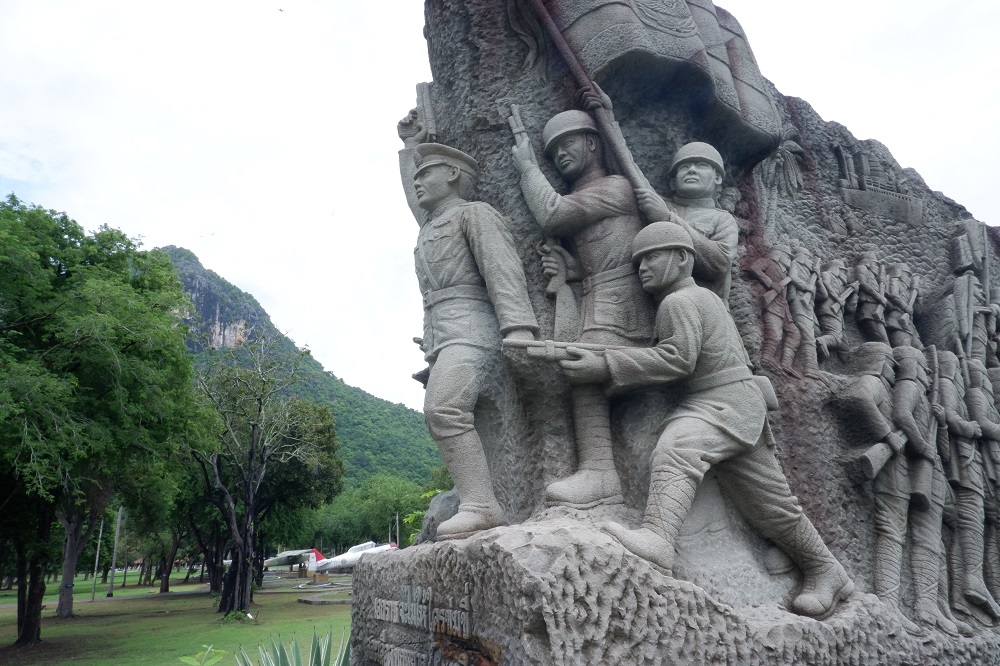
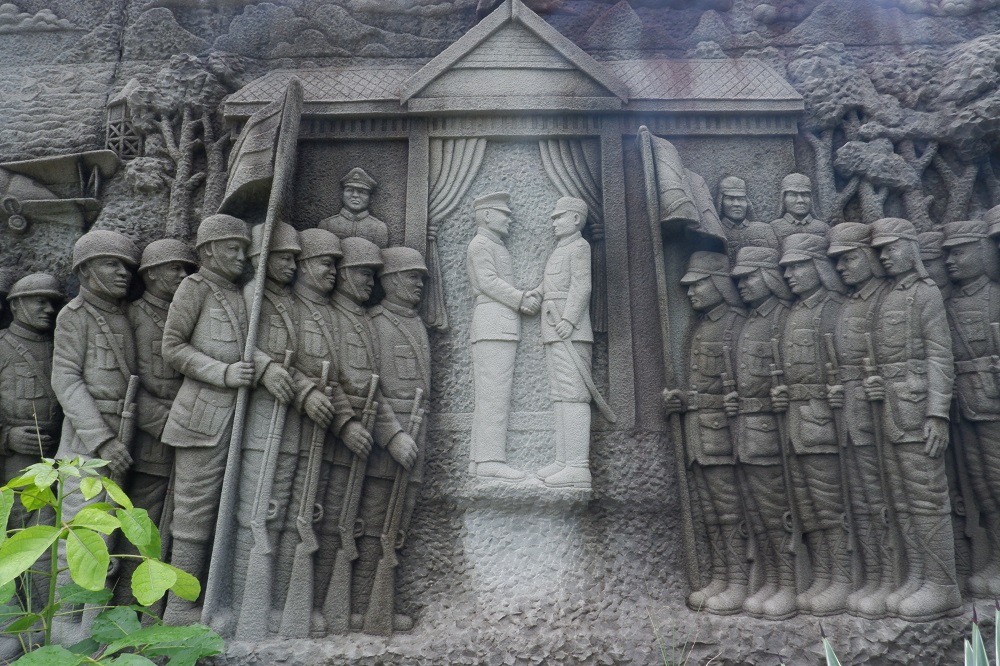
Scenes of the battle are depicted in a stone sculpture at Wing 5 base.
In the latest ceremony, only one was well enough to show up: Prachuap Chalardpad. He’s one of only three veterans still alive today. Other two are Suan Pongsiri and Choi Lodthanong. Srisak died in May 2017. He was 100.
In a recent visit to Choi’s family home in Sam Roi Yod district, the 98-year-old veteran was too unwell to answer a reporter’s questions. On a wall hangs a portrait of Choi as a young man in army uniform. Another shows him and other veterans at a gathering in Wing 5 base.
Despite the yearly fanfare at the base, the officials apparently overlooked its museums, which are now in disrepair. Visual effects meant to recreate the fighting no longer function. Several artifacts are missing. The air force hasn’t approved a maintenance fund for years, Sumalee explained.
ROAD TO WAR
The invasion in December 1941 came as a surprise to many Thais not because war at last came to Thailand. The government under autocrat Plaek Pibulsongkram spent months drumming up a militarist rhetoric, telling the population to prepare for war and sacrifice for their country.
The surprise was who Thailand would end up facing as the adversary. Many people expected to fight the Western powers – French or British, perhaps – not Japan.
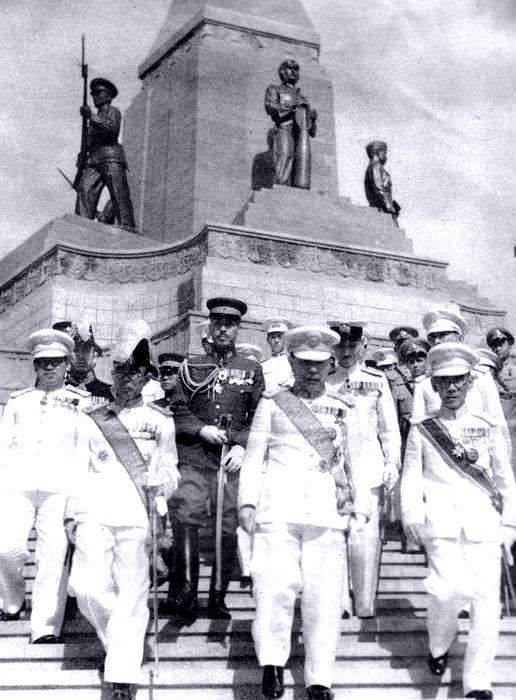
Thai and Japanese military officers attend an unveiling ceremony of Victory Monument in Bangkok, which marks Thailand’s victory over French Indochina, June 1942.
“Srisak once told me he knew war was coming, but he didn’t think it would be the Japanese,” Sumalee said. “Thailand and Japan were allies.”
Friendship between the two nations was forged after Thailand invaded French-held Indochina in 1941 to reclaim territories it lost half a century ago. After Thai armies won a series of victories, Japan – a superpower at the time – stepped in to mediate a ceasefire agreement, which carved up parts of Indochina and handed them over to Thailand.
That helping hand convinced much of the public that Thailand was better being aligned with Japan, who was calling on Asian nations to unite within its “Co-Prosperity Sphere” and rise up against the Western colonizers.
Leaders in the government and armed forces also had close ties to Japan, said Chalong Soontravanich, who teaches history at Chulalongkorn University. Japan not only trained Thailand’s corps of officers and pilots, but also sold the nation three submarines.
“I think the Thai armed forces were fully aware that Japan’s military might was vastly superior,” Chalong said in an interview in the century-old university, one of the buildings seized by the Japanese to house its troops in Bangkok during the war. “Japan was recognized as a superpower after its victory in the Russo-Japanese War.”
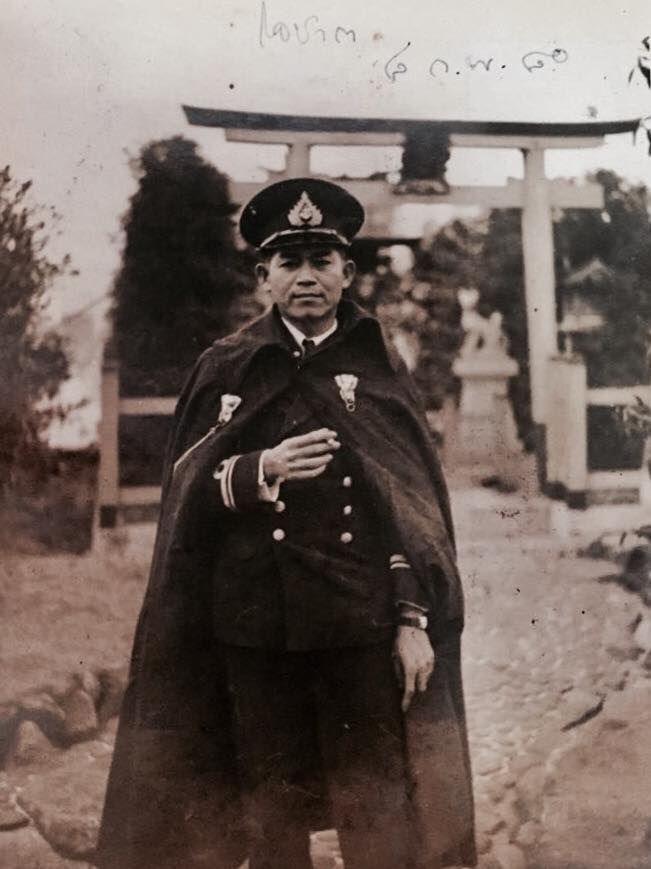
A Thai submarine officer during his training in Osaka, Feb. 8, 1940.
But behind the guise of cooperation, Japan plotted invasion. Agents posing as tourists rented fishing boats to survey the coasts and measure their depths. Japanese construction companies and pharmacies stockpiled materials for the invading armies, while photography workshops collected maps and pictures of strategic landmarks.
“There are many anecdotes about when the war broke out, these professionals changed from their gowns into army uniforms,” Chalong said. “I think the Thai authorities were aware that Japanese spies had infiltrated their country, but they couldn’t do anything.”
At the Wing 5 base, Sumalee recounted a story passed to her by a veteran. Like many other units, the squadron in Ao Manao was trained by Japanese pilots. After the training was completed, one Japanese instructor gave ominous parting words to his Thai students: We shall meet again.
THE INVASION
Wars and battles were probably the last thing on people’s minds on the eve of the invasion, because it was a time for festivities.
Fairs to observe Constitution Day – Dec. 10 – already kicked off early in some parts. The holiday marks the first formal charter installed after Plaek and other coupmakers overthrew absolute monarchy nine years earlier.
“When November came, all we talked about was the Constitution Day fair and Miss Thailand pageant,” Sorasai Paengsapa, a Chulalongkorn student at the time, wrote in his memoir. “We didn’t see any sign of war or enemy, north or south. The atmosphere was of joy.”
A view of Ao Manao.Memorials to the war dead stand on the Prachuap Bay side of the base.
But while Bangkok’s streets were full of lights and revelers, the small town of Prachuap Khiri Khan would have most likely slept through the night. It had no cinema or theatre. After all, it was little more than a stop on the rail line connecting the capital with the south, with an airbase to guard Thailand’s border with Burma, which lays just 20 kilometers west.
Unbeknownst to the Thais, a Japanese armada of battleships, cruisers and landing craft had left a port in Vietnam and sailed for Thailand two days earlier. On the night of Dec. 7, the invasion force somehow slipped past a Thai navy patrol, led by the HTMS Sri Ayudhya, and separated into seven fleets, each bound for provinces along Thailand’s gulf coast.
One such force anchored east of Lom Muak Hill, where 3,000 soldiers boarded landing barges to storm the beaches of Prachuap and Manao bays. The time was 4am.
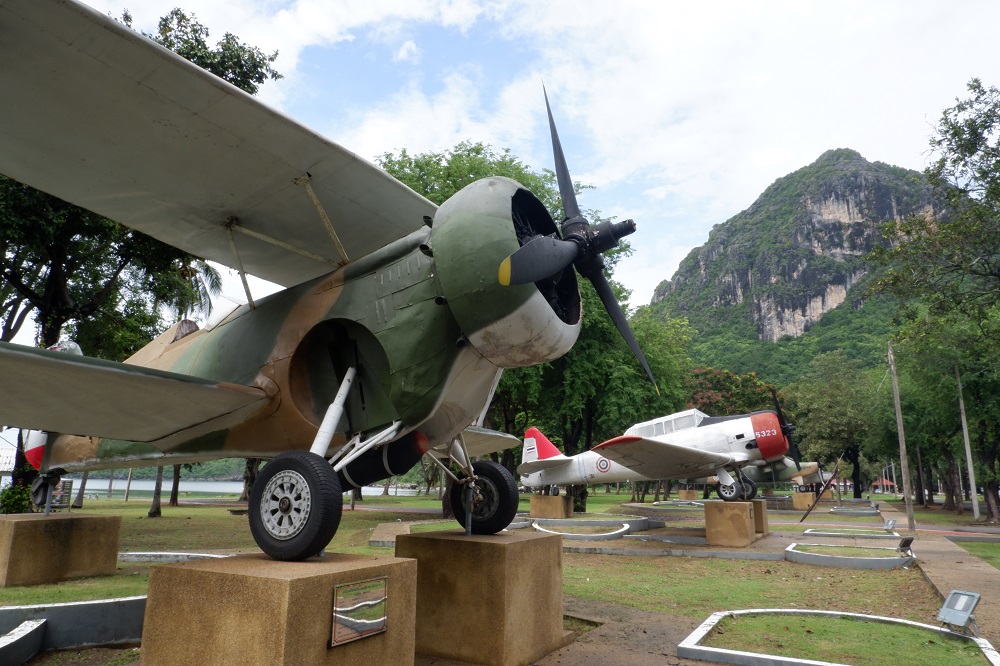
Plane replicas sit inside Wing 5 base.
In the dark, the Japanese infantry disembarked on Prachuap Beach and spread throughout the town before policemen at their station shot at them, waking the townspeople from their slumber.
Grabbing whatever firearms they could, the police and the residents sought cover along the town’s main street and fired at the Japanese. The road was later renamed Su Suek – Fighting a War – to mark the brief shootout. The invaders quickly defeated them, taking the town’s railway and telegraph station.
One objective was down. Another force was beating against rough December waves toward the second goal: the Wing 5 air base.
‘I DON’T KNOW HOW MANY DIED’
That’s when Srisak and his fishing group spotted the enemy. He alerted the commander, Maj. Prawat Chumsai, who ordered a fight.
Srisak and Prawat went back a long way. Srisak said in his recorded interview that he signed up for the air force after he saw a warplane land in his hometown of Chiang Mai as a young boy. It was the first time he ever saw a plane, and the sight left him fascinated. As he learned later, Prawat was the pilot of that plane.
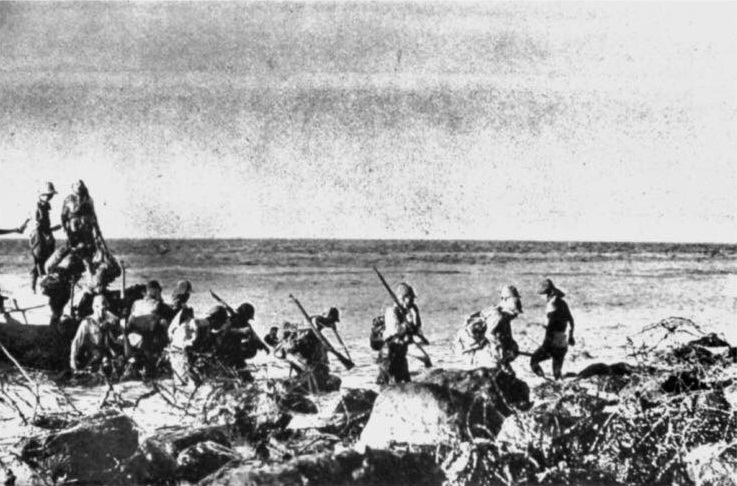
Japanese soldiers disembark on a beach in Pattani province, Dec. 8, 1941.
Apart from a handful of pilots, Prawat’s men were low-ranking troops belonging to arkatsayothin, an air force unit trained in infantry tactics to protect airfields from enemy attack.
Except for Prawat, who flew in missions during the Thai-Franco War, they had no combat experience. The base’s small arms consisted of only about 100 Arisakas, a bolt-action rifle made by Japan, as well as nine machine and submachine guns.
But they weren’t exactly caught off guard. Sensing war might come to Thailand, the garrison had staged combat drills and built basic defenses around the base. Machine gun nests were placed on Lom Muak and Wua Ta Lueak hills, offering a sweeping field of fire that covered the airstrip and Manao Bay.
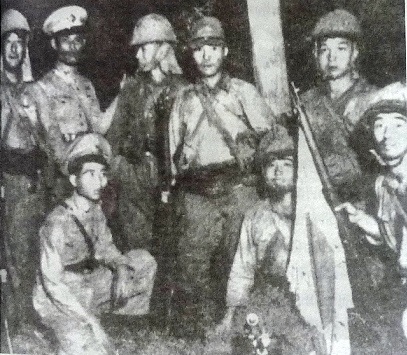
Japanese soldiers pose for a photo after landing in Samut Prakan province.
“We knew there would be a war. We already made preparations,” veteran Jong Maliwan says in a videotaped interview shown at the museum. “Whether it would be Japanese or farangs, we didn’t know. Back then, we slept on the beaches and monitored the bay.”
After hearing the horn blown by Prawat, the defenders rushed to their positions. One group manned a machine gun team on Wua Ta Lueak. Another set up defense inside the airbase. A small number of policemen and Boy Scouts also joined them.
And then they waited. It’s only after first wave of invaders left their landing vessels that they opened fire.
“We fired at them from our hiding spots on the shore. I don’t know how many of them died,” Jong recalled. “They attacked us, so we had to fight. We didn’t know who was who.”
The odds were initially in favor of the defenders. Using trees as cover, they sprayed gunfire at the Japanese, who were exposed as they waded in the water.
But the situation turned grim for the Thais. The attackers, determined to take the base, braved the hail of bullets and pushed ashore. More Japanese troops also moved south from Prachuap town and attacked. The base’s sentry post was soon overrun, along with its radio station.
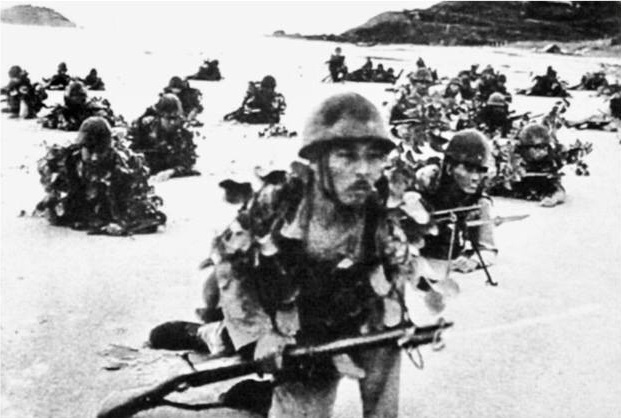
Japanese troops storm the beach of Songkhla, Dec. 8, 1941.
As the Japanese closed in on the airfield, the pilots tried to fly their aircraft away. They paid for it with their lives. Two pilots, Prom Chuwong and Jamnian Variyakul, were shot and killed as they were taxiing on the runway. Another was severely wounded, stabbed by a bayonet.
Only one pilot, Maen Prasongdee, managed to fly off with a Hawk-3, a bullet lodged in his back. He turned his US-built naval biplane north toward the capital to seek help, but his engines soon cut out and forced him to land in front of the king’s summer palace in Hua Hin.
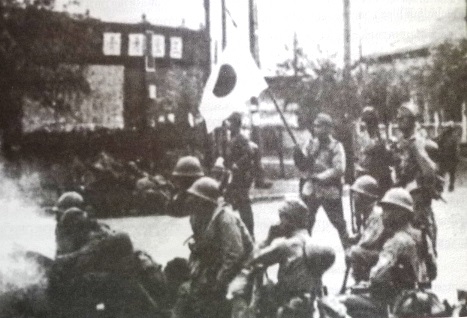
Japanese troops march through the town center of Songkhla, Dec. 8, 1941.
The base wasn’t only home to the fighting men, but also their families, who by then were cowering behind whatever shelter they could find. Two women – an officer’s wife and a housekeeper – were struck and killed by stray bullets. Some women and children had been moved up to Lom Muak hill, where they watched the hopeless battle unfold.
“When the Thai soldiers opened fire, we saw it,” Jamrern Sangkaew, an airman’s daughter who took shelter on the mountain, said in a 2012 interview. “There were splashes. The Japanese were falling down from their boat … the beach was soaked in blood.”
NO SURRENDER
The frontlines kept shrinking as more Japanese troops closed in. The fighting was so intense that bayonet brawls broke out in some places. Srisak recalled engaging in such fights three times.
Fatalities piled up, including a 15-year-old Boy Scout, Boonying Sirisathien, who was shot dead while racing from one foxhole to another with a supply of ammo.
Elsewhere, Japanese forces triumphed. Apart from Ao Manao, all the other beachheads had fallen. By late morning, they reached Bangkok’s outskirts after landing in the neighboring town of Samut Prakan.
Columns of Japanese vehicles head toward Bangkok on Dec. 8, 1941.
At about 10am, the cabinet convened an emergency meeting where they debated the course of action. After frontline briefings poured in – a report from Wing 5 mistakenly said they were under attack from “British-controlled Burmese troops” – the government concluded there was no point in more fighting.
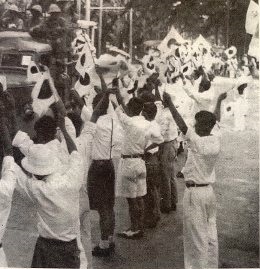
Japanese troops enter Bangkok in the afternoon of Dec. 8, 1941.
“We would manage to keep fighting for less than a year, and once we are defeated, militarily like this, our defeat will turn us into their slaves,” deputy prime minister Adul Aduldejjarus told the meeting. “We will become their colony, 100 percent.”
The meeting ended when Plaek agreed to call a ceasefire on the condition that Thailand would only allow “safe passage” to Japan – and not join or aid its wars against the Allies.
Under Japanese pressure, Plaek would later renege on that condition and declare war on the United States and Britain a month later.
The ceasefire was signed at 11:55am. Orders to stand down immediately went out to all fronts. Except for one place.
FRIENDS, NOT ENEMIES
Unaware of the order, the airmen of Wing 5 kept up their stubborn fight, though each hour that passed saw ground lost one yard at a time.
When it was clear they could not hold the base, wing commander Prawat ordered the buildings and fuel depot burned before retreating to make a last stand at the foot of Lom Muak Hill.
More than 14 hours had elapsed since the Japanese had made landfall. Fighting receded when night fell.
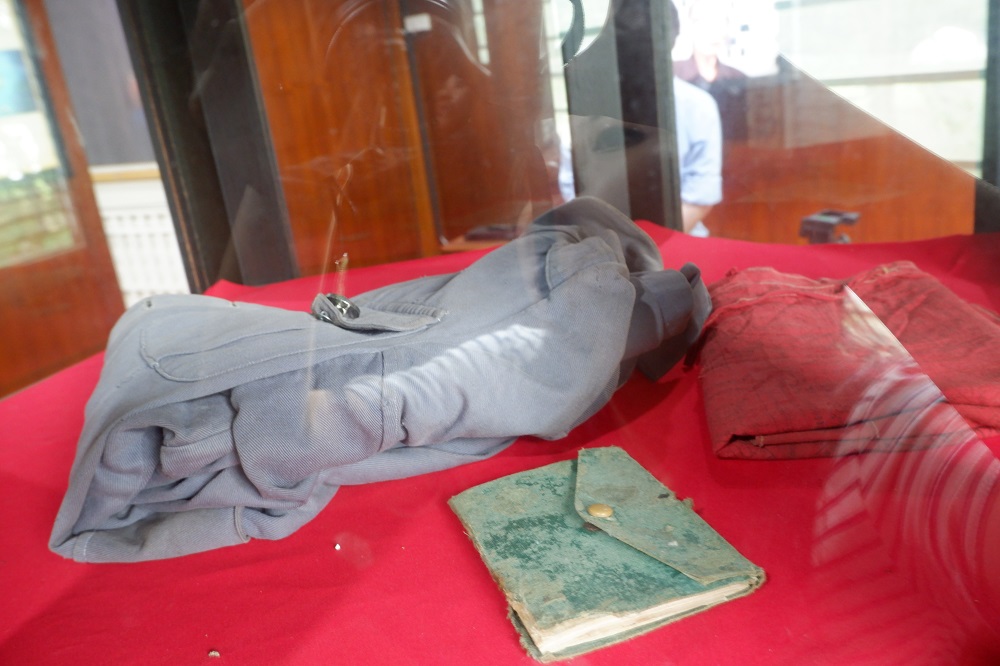
The uniform worn by Srisak Sucharittham – along with the amulet cloth or pa yan – on the day of the battle are displayed at the museum.
In the morning, Prawat must have realized that no help was coming. Nevertheless, an order went out at about 8am for the defenders to cheer news that the navy was almost there to relieve the siege. It wasn’t true, but Prawat hoped their cheering would scare the Japanese and delay their final assault.
But the Japanese did not attack. In his anecdote, Srisak recalled seeing someone in the Japanese trench suddenly raise his hand in a gesture of parley and walk toward the Thai side. Srisak guessed the officer was at least a lieutenant colonel, most likely the commander of the besieging force himself.
Shaking his hand, the enemy commander offered him an apology.
“He spoke in sketchy English. He said, ‘Sorry. Our enemies: Burma, English, American. Thailand, Nippon: friend. Tomodachi,’” Srisak said. He recognized the Japanese word for friend.
The officer then took out a sheet of paper. It was an order signed by the prime minister telling the Wing 5 force to lay down their arms. A formal ceasefire ceremony was held at noon inside the base, where Prawat exchanged bayonets with his Japanese counterpart.
Thirty-three hours after the first gunshot rang across Ao Manao, the battle was over.
A stone sculpture depicts the Dec. 9, 1941, armistice at Ao Manao.
EPILOGUE
Their defiance came with a cost. Of the 120 soldiers holding the base, 38 were killed, in addition to a policeman, a Boy Scout and two civilians. Japanese losses were estimated much higher, between 200 and 400 personnel.
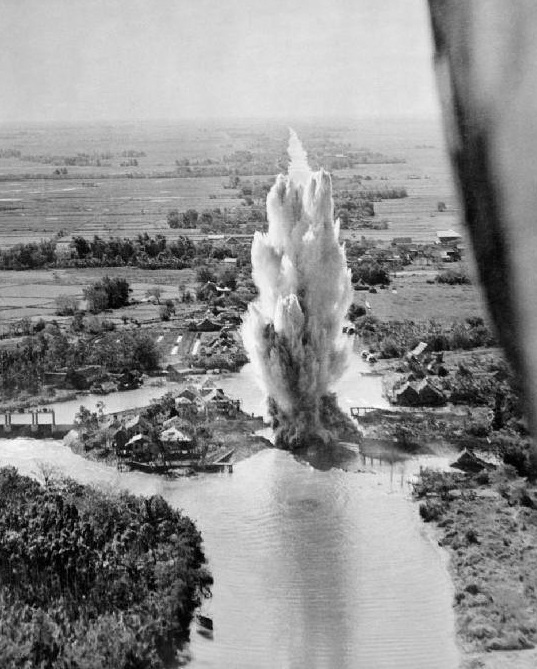
A floodgate in Ratchaburi province is struck by an Allied air raid in April, 1945.
Thailand would remain under Japanese occupation for four years until Japan surrendered to the Allied forces in September 1945. Throughout the war, more than 5,700 Thais lost their lives, many of them caught in Allied bombing campaigns.
Ao Manao wasn’t the last resistance offered, as an underground movement called Free Thais was formed soon after the invasion. At the risk of firing squads, the volunteers spied on Japanese troops’ movement, passed messages between Allied forces, rescued downed pilots and smuggled weapons to prepare for an uprising against Japanese invaders.
The echoes of the war are still heard today, as Thai work crews or scavengers still have to contend with unexploded ordnance dropped during the conflict.
“The Allies saw us as enemies, which wasn’t a surprising thing,” Chalong the historian said. “But it was still fortunate that Thailand didn’t suffer as much as many countries … because we were out of bombing range once the Japanese invaded Burma.”
Prawat and his band of soldiers have somehow escaped popular culture. While there have been movies, TV dramas and fictional written accounts of the Japanese invasion of Thailand, none of them depicted the battle of Ao Manao.
Names of the fallen airmen are inscribed at the foot of the memorial.
But the war is still remembered every year in Prachuap Khiri Khan, where a military parade is held every Dec. 8 on its anniversary. Air force commanders lay wreaths and the base’s battleflag – upon which its medal of honor was pinned – is brought out for display.
And the story is still retold to countless visitors to the war museum at the base, which opens to the public every weekend. Most of them come in busloads. In one recent Saturday, Sumalee the curator talked to a reporter during a lull between two tours: one for army officers from another base and the other for schoolchildren from Chumphon province.
“When you’re done taking photos, please gather around,” a schoolteacher said to the kids in front of the monument dedicated to the “heroes of Wing 5.”
Their guide today was another air force officer in the base. After the group of schoolchildren quieted, he began reciting the tale of heroism that the garrison here must have heard a hundred times.
Rapper Mac Miller performs on his Space Migration Tour IN 2013 at Festival Pier in Philadelphia. Photo: Owen Sweeney / Associated Press
LOS ANGELES — Mac Miller, the platinum hip-hop star whose rhymes vacillated from party raps to lyrics about depression and drug use, and earned kudos from the likes of Jay-Z and Chance the Rapper, died Friday at age 26.
Police and paramedics found Miller unresponsive at his home in Los Angeles and declared him dead shortly before noon, coroner’s spokeswoman Sarah Ardalani said. An autopsy will be required to determine the cause of death. His death was first reported by celebrity website TMZ.
“He was a bright light in this world for his family, friends and fans,” Miller’s family said in a statement.
Miller also drew headlines for his two-year relationship with singer Ariana Grande that ended earlier this year.
Police lines were pulled up and a coroner’s van left the cul-de-sac where Miller lived late Friday afternoon. About 10 news vans remained. Another rapper, Pittsburgh Slim, appeared and left flowers.
While Miller didn’t have a hit on Top 40 radio, he had a strong following on streaming networks and even had an album debut at No. 1 on the top 200 albums chart. He often alluded to his battles with addiction over the years and had collaborations with Kendrick Lamar, Lil Wayne and Ty Dolla $ign.
At the news of his death, Chance the Rapper tweeted: “I don’t know what to say Mac Miller took me on my second tour ever. But beyond helping me launch my career he was one of the sweetest guys I ever knew. Great man. I loved him for real. I’m completely broken. God bless him.”
J Cole said on Twitter: “This is a message for anybody in this game that’s going through something. If you don’t feel right, if you feel you have a substance problem, if you need a ear to vent to. If you uncomfortable talking to people around you. Please reach out to me.”
He released his fifth, full-length album “Swimming” last month, with Variety calling it “a simple, stately, poetic autobiography.” Rolling Stone called it “silky, deep vibe redolent of the L.A. alternative soul scene.” New Musical Express said it was “his best work in years.”
The album included the song “Come Back to Earth,” with Miller trying to chart his way through tough times: “In my own way, I feel like living some alternate reality/And I was drowning, but now I’m swimming through stressful waters to relief.”
He was due to start a tour at the end of next month that he promised would be special every night. On Thursday he tweeted: “I just wanna go on tour.”
Miller and Grande collaborated on her first top 10 hit, the multiplatinum, “The Way,” which propelled her from teen TV stardom to pop star, and they dated for two years before their relationship ended in May. She later called it a “toxic” relationship on Twitter.
Not long after he was charged with DUI and hit and run after police said he struck a power pole and fled the scene. His blood alcohol was reportedly twice the legal limit.
“I made a stupid mistake. I’m a human being,” Miller told Zane Lowe on Beats 1 on Apple Music in July. “But it was the best thing that could have happened. Best thing that could have happened. I needed that. I needed to run into that light pole and literally have the whole thing stop.”
The Pittsburgh native, born Malcolm McCormick, rose to fame with a frat-rap attitude in his mixtapes like “Best Day Ever” and his full-length album debut, 2011’s “Blue Slide Park.” His more goofy songs included “Nikes on My Feet,” ”Kool Aid & Frozen Pizza” and “Knock Knock.”
One of his biggest songs was the 2011 platinum-certified mixtape track “Donald Trump,” which prompted a feud with the future president. He asked his fans not to vote for Trump, who was flirting with the idea of running for president then, and publicly supported the Black Lives Matter movement.
In 2013, his sophomore effort, “Watching Movies with the Sound Off,” entered the Billboard 200 at No. 3. Miller sold more than 100,000 copies of the woozy, moody album, which features appearances or production work from Diplo, Flying Lotus, Earl Sweatshirt, Jay Electronica and Action Bronson. He also landed a reality series, “Mac Miller and the Most Dope Family,” in 2013, which ran for two seasons on MTV2.
Miller told The Associated Press that year that the album’s depth and quality reflected two years of warp-speed development, his move from Pittsburgh to Los Angeles and just how serious he was about the craft. “There was always a lot more to me than what people wanted to say, that’s the only thing that ever bothered me,” Miller said.
His 2016 release “The Divine Feminine” had contributions from Kendrick Lamar, Anderson .Paak, Cee-Lo Green and Grande. Pitchfork magazine called it “the most surprising, concise, and accomplished album of his career.”
Miller’s label, Warner Bros., released a statement calling him “a hugely gifted and inspiring artist, with a pioneering spirit and a sense of humor that touched everyone he met. Mac’s death is a devastating loss and cuts short a life and a talent of huge potential, where the possibilities felt limitless.”
Presidential candidate Jair Bolsonaro holds a little girl as he poses for photos with supporters during the National Social Liberal Party convention where he accepted the party's nomination in July in Rio de Janeiro, Brazil. Photo: Leo Correa / Associated Press
Ever since the stabbing of Julius Cesar in ancient Rome, assassination has been a fixture of political life around the world. But when political murder is captured on television – or now by citizen journalists via social media – the impact is often magnified, leaving a chilling effect that lasts for generations.
This week’s stabbing of a leading Brazilian presidential candidate, Jair Bolsonaro, at a campaign rally mirrors past assassination attempts that have jolted voters, forged martyrs and left a blood-stained mark on history.
Here’s a look at a few recent ones:
Colombia
Anti-corruption crusader Luis Carlos Galan was the first of three popular candidates killed in the country’s 1990 presidential election that took place against the backdrop of a drug-fueled bloodbath. He was shot to death by hit men at a rally near Bogota.
Cesar Gaviria was thrust into the national spotlight during Galan’s nationally televised funeral when one of the murdered candidate’s teenage sons tapped him as his father’s successor during an emotional eulogy. Gaviria was elected president nine months later, at age 42. During his four years in office he stepped up anti-narcotics cooperation with the United States and brought down infamous drug lord Pablo Escobar, who likely ordered Galan’s murder.
Mexico
In the spring of 1994 Mexicans watched in shock as presidential candidate Luis Colosio was shot at point blank range at a campaign rally in Tijuana. Colosio was a shoo-in for the presidency but in some ways his brutal slaying paved the way for a more democratic era in Mexico.
After Colosio’s death, his Institutional Revolutionary Party, which held a tight monopoly on power for seven decades, struggled to find a popular replacement amid internal frictions and ban on anyone who had held public office in the previous six months from running for the presidency. They eventually settled on Ernesto Zedillo, a U.S. educated technocrat who had served on Colossio’s campaign. Zedillo oversaw electoral reforms that made Mexico’s democracy more competitive, and eventually gave opposition parties the chance to win governorships as well as the country’s presidency.
Pakistan
The 2007 slaying of Benazir Bhutto at a campaign rally as she was seeking to become Pakistan’s prime minister for the third time touched off weeks of deadly rioting in the Muslim nation. Bhutto was killed in a combination shooting and suicide bombing just weeks after returning to Pakistan from exile. Her death made the self-styled “daughter of Pakistan” a martyr. Her husband, Asif Ali Zardari, was elected in her place and went about forcing the resignation of military ruler Pervez Musharraf.
Egypt
Egyptian President Anwar Sadat was presiding over a military parade in 1981 when in a matter of seconds, as fighter jets buzzed overhead, a cadre of soldiers clambered atop an artillery truck and opened fire on the grandstand where the icon of Arab nationalism was surrounded by foreign dignitaries. Shocking footage of the brazen assassination, payback for Sadat’s signing a peace deal with Israel, was broadcast around the world. It also became an early propaganda trophy for Islamic radicals who had penetrated the military to carry out a cleric’s order that Sadat be killed.
Israel
The assassination in 1995 of Prime Minister Yitzhak Rabin at the hands of a Jewish religious extremist ignited bitter divisions between liberals and conservatives in Israel that continue to this day. Rabin was walking to his car after speaking at a nighttime peace rally in Jerusalem when a far-right law student fired three shot in his direction. Footage of a Jew killing a fellow Jew traumatized Israel and was beamed across the globe.
During the days prior to the assassination, Israel’s current leader, Benjamin Netanyahu, had led huge rallies against the Oslo accords at which he depicted the Nobel Peace Prize-winning Rabin as a traitor.
Despite criticisms of that charged rhetoric, Netanyahu eked out a narrow victory in the elections following Rabin’s death and stalled on implementation of the accords. Some leaders, including former U.S. President Bill Clinton, believe that it Rabin had lived, peace between Israel and the Palestinians would have been achieved.
United States
For a time in the 1960s, American society seemed unhinged by political violence with the slayings of President John F. Kennedy, his brother Robert and civil rights leader Martin Luther King. Video footage of Kennedy’s motorcade as it drove slowly through Dallas marked an entire generation and has been the source of plenty of conspiracy theories since.
So much turmoil had a profound impact on America’s political psyche. Following the 1968 killings of King and Robert Kennedy, race riots engulfed many American cities, protests against the Vietnam War became more violent and a few radicals on the left decided to abandon non-violent protest in favor of what they called armed “resistance.” But the broadcast of King’s funeral also sparked more grief than violence, and fair housing legislation that had been the source of much bitterness was passed.
The Secret Service has had to guard almost every U.S. president since then against assassination plots or attempts. But the strength and composure demonstrated by Ronald Reagan – who memorably walked and joked his way into the hospital after he was shot leaving the Washington Hilton – cemented early in his presidency a reputation for toughness and coolness under fire.
Elon Musk, the billionaire entreprenuer, founder of SpaceX and Tesla Motors. Photo: JD Lasica/ Wikimedia Commons
Another executive departure, another controversy over the CEO’s behavior, another stock drop.
Another typical day at Tesla.
Although the details change, the pattern stays the same. This time, the executive departure is David Morton, chief accounting officer at Tesla Inc., who called it quits after just a month on the job. The controversy is over Elon Musk taking a hit off an apparent marijuana-tobacco joint during a podcast interview that made its rounds on YouTube. And the stock dropped more than 6 percent Friday to close at USD$263.24 a share – its lowest point since March of last year.
All of it comes as the electric automaker continues to struggle to convert itself from a money-losing boutique to a mass-production profit machine. It’s doing so while under investigation by the government and facing shareholder lawsuits after Musk revealed a plan to take the company private on Twitter, boosting the share price. The estimated $24 billion plan eventually was scrapped and the stock fell.
Tesla only has a few weeks left to deliver on Musk’s promise to post sustained profits starting in the third quarter after losing more than $700 million in the second quarter. Moody’s Investor Service downgraded the company’s debt into junk territory back in March, warning that Tesla won’t have cash to cover $3.7 billion for normal operations, capital expenses and debt that comes due early next year. Tesla has said cash from producing more Model 3 mass-market electric cars will pay the bills and drive profits.
Amid the mounting pressure, Musk must now dig himself out of a fresh controversy of his own making. About two hours into the YouTube video of “The Joe Rogan Experience,” the CEO accepts a sip of whiskey and a drag off a joint offered to him by Rogan, a comedian and podcast host who makes it a point to note that pot is legal in California.
Shortly after smoking, Musk – dressed in a black T-shirt that says “Occupy Mars” – looks at his phone and laughs, telling Rogan he is getting texts from friends asking why he’s smoking weed during the interview. Later, Musk says he doesn’t notice any effect from the joint.
“I’m not a regular smoker of weed,” he says. When Rogan asks how often he smokes it, Musk replies: “Almost never.” He knows a lot of people like weed, but “I don’t find that it is very good for productivity,” he tells Rogan.
Meanwhile, the company announced in a regulatory filing the departure of Morton, who is quoted by Tesla as stepping down due to the level of public scrutiny and the pace at the company but not over any disagreements with Tesla’s leadership or its financial reporting. This followed a report by Bloomberg on Friday that Gabrielle Toledano, head of human resources, would not return to Tesla after a leave of absence. And communications chief Sarah O’Brien confirmed to The Associated Press that her last day on the job was Wednesday. She wouldn’t give a reason for her departure, which she said has been in the works for two months.
Late Friday, replacements were named for Toledano and O’Brien, and Musk also promoted Vice President Jerome Guillen to president for automotive, overseeing all auto operations including the parts supply chain. He’ll report directly to Musk, the CEO said in a note to employees.
Paul Argenti, a Dartmouth College professor of corporate communication, said the latest controversy is not surprising.
“The behavior on YouTube is obviously in line with what we’ve seen in the past,” he said. But, he added, “You can’t go on like that forever. It catches up with you.”
Musk’s conduct has been questionable since the first-quarter earnings conference call when he criticized Wall Street analysts for asking “bonehead” questions about the company’s finances. Then he labeled a British diver who aided in the cave rescue of Thai soccer players a pedophile, and after apologizing, doubled-down on his accusation again this week in emails to Buzzfeed News.
But the most questionable action came when Musk tweeted Aug. 7 that he had secured funding to take the company private at $420 per share to get away from the short-term pressure of Wall Street. The tweets pushed the electric vehicle and solar panel maker’s stock price up 11 percent that day. But it subsequently fell when Musk revealed that funding wasn’t locked down.
On Aug. 24 Musk put out a statement saying the go-private deal was off, drawing scrutiny from the Securities and Exchange Commission.
Some analysts and investors have called on the board to replace Musk as CEO but keep him as chief product officer, or hiring a chief operating officer to handle daily operations. Messages were left Friday with board members, including lead director Antonio Gracias.
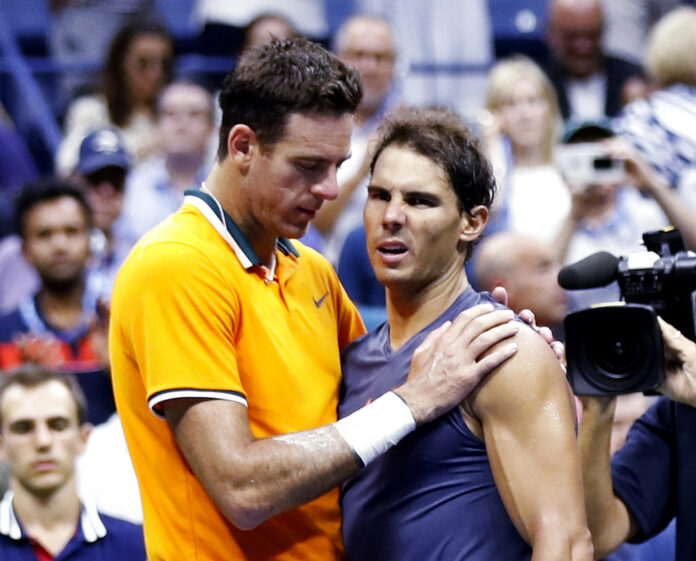
Juan Martin del Potro, of Argentina, talks with Rafael Nadal, of Spain, after Nadal retired from the match during the semifinals of the U.S. Open tennis tournament, Friday, Sept. 7, 2018, in New York. Photo: Adam Hunger / Associated Press
NEW YORK — Rafael Nadal felt the pain sear into his right knee early in his U.S. Open semifinal, on what he called “a bad movement.” It was a familiar pain, one that he’s dealt with off-and-on for years.
The defending champion looked up at his guest box and indicated something was wrong. He tried to continue. Eventually, he could not.
Nadal stopped playing after dropping the opening two sets Friday night, putting Juan Martin del Potro back in a Grand Slam final for the first time since winning the 2009 title at Flushing Meadows.
“That was not a tennis match at the end. Just one player playing, the other staying on one side of the court,” Nadal said. “I hate to retire, but staying one more set out there, playing like this, would be too much for me.”
On Sunday, No. 3 del Potro will face No. 6 Novak Djokovic, who advanced with an emphatic 6-3, 6-4, 6-2 victory over No. 21 Kei Nishikori in the second semifinal.
“I don’t know how it looked, but it felt really good,” said Djokovic, who reached his record-tying eighth final in New York as he aims for a third U.S. Open championship and 14th major title. “Great intensity, great focus, good game plan. Obviously easier said than done. You have to execute the shots.”
Del Potro was leading 7-6 (3), 6-2 after two hours of play when Nadal shook his head and said he had to retire, becoming the first man in the half-century professional era to do so during a semifinal or final at the U.S. Open.
“Of course, it’s not the best way to win a match,” said del Potro, who hugged Nadal when it was over. “I don’t like to see him suffering on court today. So I’m sad for him.”
The No. 1-ranked Nadal has a history of tendinitis in his knees, and he’s often cited that when withdrawing from tournaments. He was visited by a trainer at the changeover after the match’s seventh game and tape was applied below the joint.
At the next changeover, though, Nadal pulled off the tape.
After the third game of the second set, he had a medical timeout so the trainer could massage his right leg and once again apply tape. Nothing helped.
Nadal’s movement was clearly limited, and by the end, he was walking with a bit of a hitch in his gait between points. At one juncture, he approached the chair umpire to complain about a late call from a line judge and mentioned in passing that he was going to have to quit. Soon enough, he did just that.
Nadal said he didn’t know what kind of effects might have been lingering from his quarterfinal victory over Dominic Thiem, which lasted five sets and nearly five hours. He did have some knee issues earlier in the tournament, when he had it taped during his win against Karen Khachanov in the third round.
For del Potro, it was an odd way to return to an important summit. Nine years ago, he stunned Nadal in the semifinals, then Roger Federer in the final, to win the U.S. Open at age 20. He was considered a rising star at the time, but a series of wrist operations – one on his dominant right arm, and three on his left – slowed his career and kept him out of 2½ years’ worth of major tournaments.
He has returned to the height of his powers and the height of his sport, up to a career-best No. 3 in the rankings.
“It means a lot to me,” del Potro said. “I didn’t expect to get (to) another Grand Slam final.”
After nearly two weeks of heat in the 90s, it cooled to the 70s, although the humidity was still at about 70 percent. The lights in Arthur Ashe Stadium were on for the start of Nadal vs. del Potro, and they engaged in some terrific shotmaking during the first set.
A group of about a dozen of del Potro’s friends from Argentina would salute important points won by their guy, often breaking into choruses of “Ole, ole, ole, ole, del Po, del Po!” Thousands in the crowd would lend their voices to the song; yet others would try to drown them out with support for Nadal.
Those pals helped del Potro get through the toughest times, as he would need to repeatedly return to have surgery. He dealt with depression. He considered quitting his sport.
“I didn’t know,” he said, “if I will be a tennis player again or not.”
When Nadal missed a forehand wide, then put a backhand into the net, the opening set belonged to del Potro, who shook his fist and yelled, “Vamos!”
As del Potro continued forehands at more than 100 mph (160 kph) and serves at more than 130 mph (210 kph), and even making hay with his much-improved two-handed backhand, Nadal offered less and less resistance. It was clear something was wrong. He barely took any time between points while serving – and he’s known as one of the slowest guys on tour.
Afterward, he couldn’t say for sure how long he might be sidelined. Could be a week. Could be months. No way to know yet.
All that was certain at that point was that his bid for a fourth U.S. Open title, and second in a row, was gone. As was his try for an 18th Grand Slam trophy overall as he tries to catch up to Federer’s 20, the record for men.
This one goes into the books as a loss, only his fourth in 49 matches in 2018. As Nadal himself noted during a news conference that closed as he began to choke up, this was the second of those defeats that involved him quitting during a Grand Slam match because of an injury; the other was in the fifth set of his Australian Open quarterfinal.
To be sure, del Potro knows that sort of setback, given all of his own health woes. So, too, does Djokovic.
“I’ve been fighting with many, many problems to get (to) this moment,” del Potro said. “I’m here now.”
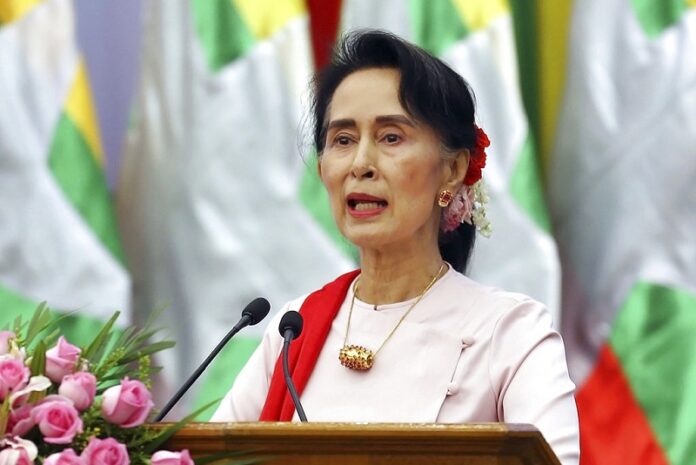
Myanmar's State Counsellor Aung San Suu Kyi delivers an opening speech during the Forum on Myanmar Democratic Transition in 2017 in Naypyitaw, Myanmar. Photo: Aung Shine Oo / Associated Press
NAYPYITAW — Myanmar’s government on Friday rejected an International Criminal Court ruling that it has jurisdiction to investigate allegations that Myanmar security forces violated international law by driving hundreds of thousands of Rohingya Muslims from their homes.
The office of Myanmar President Win Myint said Thursday’s decision by The Hague-based court was “the result of faulty procedure and is of dubious legal merit.”
It reiterated the government’s previously stated position that it has no obligation to respect the court’s ruling because it is not a party to the treaty that established the institution. It also listed points of law and evidentiary arguments in rejecting approval for the court to make a preliminary investigation.
A special U.N. commission on Monday recommended prosecuting senior Myanmar military officers for suspected genocide.
Because Myanmar is not a member of the international court, some legal experts had contended the court did not have jurisdiction.
But the argument that prevailed, made by court Prosecutor Fatou Bensouda, was that while the Rohingya were forced from their homes in Myanmar, part of the crime involved them being driven across the border into neighboring Bangladesh, which is a member of the court.
Myanmar’s statement Friday said the court’s decision “was the result of manifest bad faith, procedural irregularities and general lack of transparency.”
It challenged the factual basis of the ruling, contending that “The allegations of deportation cannot be further from the truth.”
“Myanmar reiterates that it has not deported any individuals in the areas of concern and in fact has worked hard in collaboration with Bangladesh to repatriate those displaced from their homes.”
Some 700,000 Rohingya crossed into Bangladesh after a brutal counterinsurgency campaign by Myanmar security forces. The report issued Monday by the three-member “fact-finding mission” working under a mandate from the U.N.-backed Human Rights Council alleged widespread rights violations, including rape, murder, torture and the burning of Rohingya homes and villages.
Myanmar denies any organized abuses and says the army’s operations were a response to attacks last August by an underground Rohingya insurgent group on Myanmar security personnel in Rakhine state.
Earlier this year, Myanmar signed agreements with Bangladesh and U.N. agencies concerning the repatriation of the Rohingya, but it has been dragging its feet in allowing access to U.N. representatives to ensure their safe return.
The Muslim Rohingya have long been treated as outsiders in Buddhist-majority Myanmar, even though their families have lived in the country for generations. Nearly all have been denied citizenship since 1982, effectively rendering them stateless, and they are also denied freedom of movement and other basic rights.
Earlier Friday, the top government spokesman addressed another issue that has drawn international criticism of Myanmar, the sentencing of two Reuters journalists to seven years in prison on charges of illegal possession of official documents.
Zaw Htay said at a news conference in the capital, Naypyitaw, that the court’s ruling Monday against Wa Lone and Kyaw Soe Oo was the prerogative of the judicial branch, and the government could not interfere.
The verdict and sentence caused international outrage. The prosecutors’ case was widely seen as based on fabricated evidence, and a key police witness undercut the case when he testified in a pre-trial hearing that the reporters had been set up. The reporters had been gathering evidence of a massacre by security forces of 10 Rohingya in a village in Rakhine state at the time of their arrest.
He also acknowledged that Myanmar had yet to develop adequate media freedoms, saying the country’s transition to full democracy has yet to be completed. The country was under military and military-backed rule for more than five decades until the National League for Democracy, led by Nobel Peace Prize laureate Aung San Suu Kyi, took power in 2016.
Suu Kyi has been criticized for failing to ensure fair treatment of the Rohingya and falling short in implementing democratic reforms.
A Tesco Lotus supermarket in 2017 in Koh Samui. Photo: Per Meistrup / Wikimedia Commons
BANGKOK — Only three of seven major supermarket operators were given scores on transparency and accountability in the first ever assessment made in Thailand by a rights organization and its partners.
Oxfam Thailand released a 38-page report and supermarket policy scorecard for the first time Wednesday, covering seven major retailers and chains in the country.
Makro, CP Fresh Mart and Tesco Lotus were respectively given 3, 1 and 1 points of a possible 10; while Big C, Foodland, Gourmet Market and Villa Market did not receive scores due to lack of data. The report, which looked at the treatment of workers, salaries and corporate social responsibility initiatives among others, took seven months to complete with the cooperation of the seven supermarket operators.
“In general, Thai supermarkets still have a low record of disclosing information to the public related to the origin of their food, human rights policies, labor and how they work with trade partners,” the report read, adding that supermarket goods needed to be traceable and that labor practices had to be made public.
The report said CP Fresh Mart had the good practice of introducing QR codes for its chicken meat, through which consumers could scan and access information including the standards of chicken farms and their environmental footprint.
Retailer Makro – also owned by CP Group – publicizes its policy of ensuring its trading partners’ workers are not exploited or discriminated against among others, the report said.
It added that the support for small scale producers is an area where some Thai supermarkets are on the right track.
The report said sourcing practices and fair deals are important. It said Tesco Lotus supported and bought all vegetables grown by rice farmers in the Thungkula rice field in Roi Et province to be sold at its supermarket across the northeastern region. The report added that this enabled farmers to earn an average of 5,000 baht extra per rice-crop cycle.
Oxfam stated that Tesco Lotus directly bought 200,000 tons of various local fruit from farmers in 2017 and educated them to reduce the use of chemicals in farming in collaboration with the agriculture ministry.
The promotion of women’s rights and equality gained the lowest score. Only Tesco Lotus was given a point, while the rest failed to register a score.
The report defended the lack of scores by stating that it doesn’t mean these supermarkets overlook women’s rights and gender equality, but that issues had to be brought up, made public and applied to their trading partners in the supply chain.
It also suggested that attempts should be made to buy produce from women farmer groups.
The report said there was room for the seven major supermarket operators to introduce corporate social responsibility programs.
This, it added, includes the introduction of fair trade, wages and ensuring appropriate working hours for workers throughout its chain of supply such as migrant workers. It also said they needed to introduce and make human rights impact assessments available to the public.