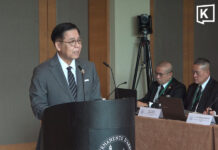
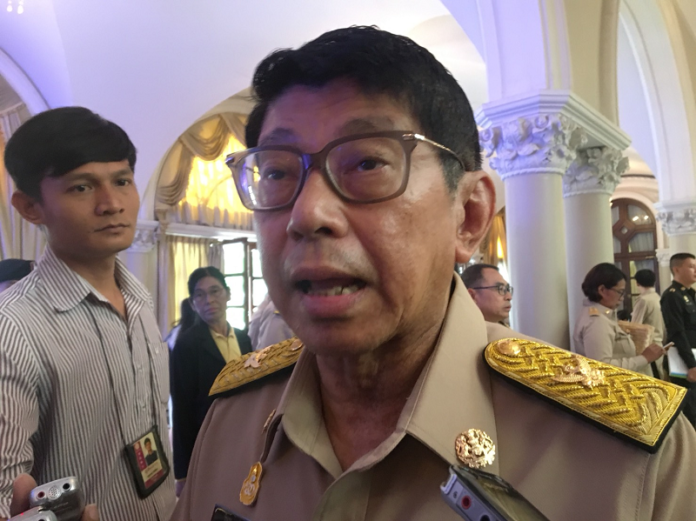
An undated photo of Deputy Prime Minister Wissanu Krue-ngam. Photo: Matichon
BANGKOK — Political campaigning may or may not be allowed in December, a deputy prime minister said Friday.
Wissanu Krea-ngam said the longstanding ban on political activity will also apply to social media platforms such as Line and Facebook. It will be in effect until restrictions are relaxed, a long-promised development he said would likely happen in December.
Wissanu said campaigning online or offline remains forbidden in the meantime and parties may only contact their members.
The deputy premier added that the junta and Election Commission are keeping close tabs on the matter, including attempts to perform stealth campaigning via social media.
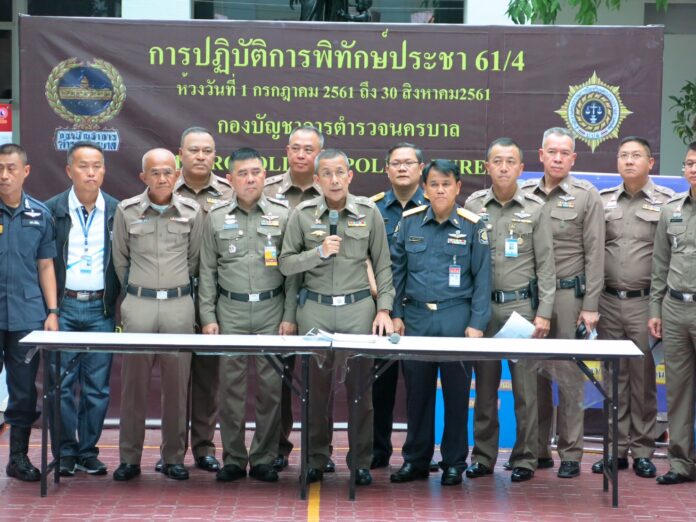
Police line up for a photo-op to take credit for drug arrests and seizures in a two month period in Bangkok.
BANGKOK — Police said Friday that more than 6,000 drug offenders were busted across the capital in the past two months, an apparent increase over just two years ago.
A deputy metro police chief said an operation that began in July and ended Thursday netted more than 13 million speed pills and 188 kilograms of meth. They also seized over 500 kilograms of marijuana and hemp, which are scheduled for legal medical use.
Maj. Gen. Ruchakorn Jornjewut said 6,392 drug offenders, both users and dealers, were also arrested.
As is routine, the numbers were announced without context or comparison. But those two months’ worth of arrests amounted to much of the total for all of 2016, according to data from the Narcotics Control Board.
It reported 9,924 drugs offenders arrested in Bangkok during those 12 months. Otherwise the reporting data shows drastic changes in recent years, with 6,988 drug-related arrests in the capital in 2015, itself a sharp drop from the 17,801 reported in 2013 and 12,349 of 2014.
National police spokesman Krissana Pattanacharoen could not be reached for comment Friday afternoon.
Update Sept. 14: JJ Green Market’s vendors must move out by Sunday, Sept. 16, according to Bangkok Metropolitan Administrative.
Update Sept. 12: JJ Green Market will stay openuntil October 12, according to the market representative.
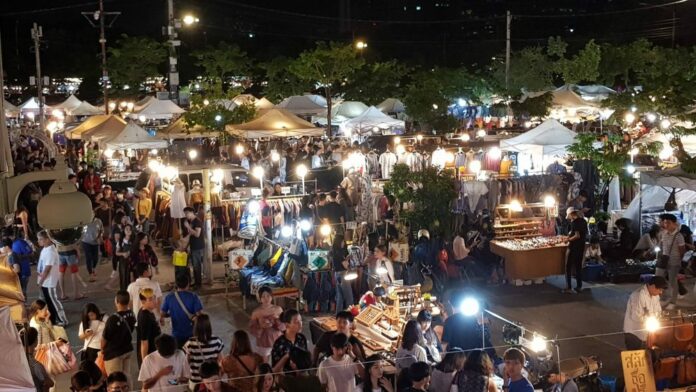
BANGKOK — After Sept. 13, not a single vendor will be found at a famous night market in the capital.
Four years after the Chatuchak Green night market, or JJ Green, opened to become a popular evening hangout, Bangkok Gov. Aswin Kwanmuang said Friday that all vendors will need to quit the property by Sept. 12 at the end of the market’s lease contract.
The deadline had been extended nearly two weeks; it was initially set to close today. The land is owned by the state railway.
The 21-rai (3.1 hectares) space will be returned to the Queen Sirikit Park Foundation for construction of a much larger park which will combine Wachirabenchathat Park (Suan Rodfai), Queen Sirikit Park and Chatuchak Park. The three parks combined will stretch over 727 rais (116 hectares.)
JJ Green, which opens at night Friday through Sunday, is an iconic flea market where hundreds of vendors sell genuine vintage items and secondhand clothes. The venue also offers street food stalls, restaurants and bars with live music.
Nick Kyrgios, of Australia, reacts against Pierre-Hugues Herbert, of France, during the second round of the U.S. Open tennis tournament, Thursday, Aug. 30, 2018, in New York. Photo: Seth Wenig / Associated Press
NEW YORK — Nick Kyrgios was losing big at the U.S. Open on Thursday, and barely even trying. Didn’t move while so-so serves flew by for aces. Casually put groundstrokes into the net. Double-faulted without caring.
The crowd began booing. The chair umpire, Mohamed Lahyani, decided to intervene. In an unusual sight for Grand Slam tennis, Lahyani clambered down out of his seat during a break between games, stood with hands on knees, and spoke with the 30th-seeded Kyrgios, saying, among other things, “I want to help you.”
It all seemed like an impromptu intervention for the mercurial Kyrgios, right out there on Court 17 at Flushing Meadows, and it raised questions about whether Lahyani overstepped his duties as someone who’s primarily there to keep score and keep order. Kyrgios went from trailing by a set and a break at the time to wresting control of the match – setting up a third-round showdown against Roger Federer – by coming back to beat Pierre-Hugues Herbert 4-6, 7-6 (6), 6-3, 6-0.
“This was not his job,” Herbert said, adding that he thinks Lahyani should be sanctioned in some way. “I don’t think he’s a coach, he’s an umpire, and he should stay on his chair for that.”
The U.S. Open’s referee and chief umpire were reviewing what happened, as was the Grand Slam Board. Chair umpires are never made available to the media, but tournament referee Brian Earley said Lahyani explained that he left his perch “to make sure he could communicate effectively” with Kyrgios in a noisy arena.
According to Earley, the official said he wanted to check whether Kyrgios needed medical attention and to warn the player that Lahyani “would need to take action” if the “seeming lack of interest in the match continued.”
During an occasionally confrontational and sarcastic exchange with reporters, Kyrgios laughed at the suggestion that he had received coaching or a pep talk from Lahyani.
“I mean, like, I don’t have a coach. I haven’t had a coach for, like, years. Of course he wasn’t coaching me. Like, what are you talking about?” Kyrgios said.
“He said he liked me. I’m not sure if that was encouragement. He just said that it’s not a good look,” Kyrgios said about his chat with Lahyani. “Look. I wasn’t feeling good. I know what I was doing out there wasn’t good. I wasn’t really listening to him, but I knew it wasn’t a good look.”
Kyrgios, a 23-year-old Australian, has run into trouble in the past for not giving his all during matches, even drawing a fine and suspension from the ATP men’s tour in 2016.
As Herbert put it: “Just sometimes he’s mentally not here.”
What there’s never been a doubt about, however, is Kyrgios’ talent and ability to entertain – when he puts his mind to it. He burst onto the scene by stunning Rafael Nadal as a teenager at Wimbledon in 2014, and he owns a victory over 20-time major champion Federer, too.
After reaching the third round by defeating Benoit Paire 7-5, 6-4, 6-4, Federer criticized Lahyani for going to talk to Kyrgios for as long as he did, and from as close as he did.
Normally, a chair umpire leans over from his or her post to speak to a seated player during a changeover.
“I don’t know what he said. I don’t care what he said. It was not just about, ‘How are you feeling?’ ‘Oh, I’m not feeling so well.’ Go back up to the chair. He was there for too long. It’s a conversation. Conversations can change your mindset. It can be a physio, a doctor, an umpire, for that matter,” Federer said. “That’s why it won’t happen again. I think everybody knows that.”
It was, to be sure, the most conversation-worthy topic on Day 4 at Flushing Meadows, where the most notable result was No. 2 seed Caroline Wozniacki’s 6-4, 6-2 loss to Lesia Tsurenko of Ukraine at night.
Wozniacki, who won the Australian Open in January and is a two-time finalist in New York, is the third top-10 woman already out of the draw, including No. 1 Simona Halep.
Past U.S. Open champions Novak Djokovic and Marin Cilic won at night, as did 2006 titlist Maria Sharapova, who took the last three games to beat Sorana Cirstea of Romania 6-2, 7-5 in a match that ended after midnight.
Djokovic wasted a third-set match point and was pushed to a fourth before defeating American Tennys Sandgren 6-1, 6-3, 6-7 (2), 6-2.
“I just lost it mentally,” Djokovic said about his issues in the third set. “Those things happen, I guess. I’m not happy with the way I lost that concentration and composure there.”
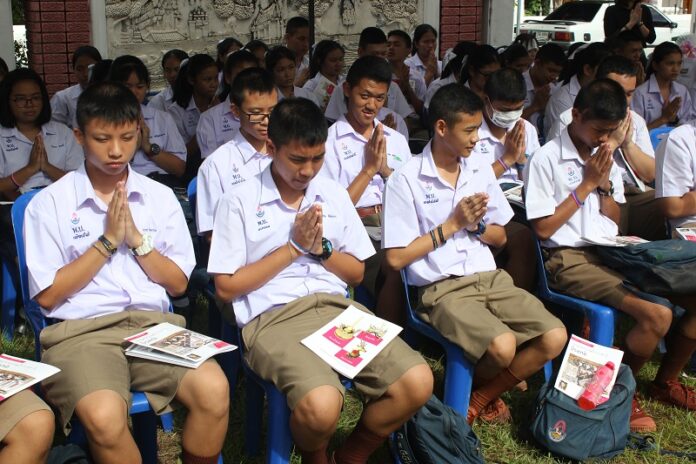
Students at a merit-making ceremony in June in Phetchaburi province.
BANGKOK — Affording privilege to Buddhism contradicts the principle of equal religious freedom, a UN envoy on freedom of religion said in Bangkok recently.
State promotion of one religion is discriminatory as it suppresses other beliefs, Ahmed Shaheed said in a interview on Aug. 20, following an appearance at the Foreign Correspondents’ Club of Thailand.
“It is contrary to equal rights for all religions. Because parents have a right to raise their children with any religion, which means you can’t have texts for [only] one religion. For school, it cannot teach them one religion,” Shaheed said about Buddhism being a mandatory subject in all schools.
Recently, the Education Ministry selected 13 committee members to develop only Buddhist teaching in education institutions. This new policy was officially announced on May 16.
Pathompong Bodhiprasiddhinand, director of Nanasamvara Centre for Buddhist Studies, said Thursday that it is important to teach Buddhism at Thailand’s schools and universities.
Pathompong said Buddhism has been part of the cultural heritage since the beginning.
“Without learning Buddhism deeply, how can a Thai touch deep into the heart of his or her own cultural heritage, which Thais have very much been proud of for many centuries?” he said.
He also believes Buddhist teachings are more consistent with empirical modern science than Christianity because they “promote critical or rational thinking and there is no … dogmatic teaching in Buddhism at all.”
He also believes that teaching Buddhism will reduce crime.
Still, the Buddhist education policy doesn’t account for the kingdom’s religious diversity, particularly in the majority Muslim south, which Shaheed expressed concern about. There were about 3 million Muslims in the 2015 census and nearly 800,000 Christians.
Pathompong said that the situation in the Deep South should be treated separately.
The government has been mindful of driving a wedge issue on religion and has resisted calls to legally enshrine Buddhism as the national religion, most recently in 2016.
But state promotion of Buddhism is pervasive. Every January on Children’s Day, young Thais sing a song instructing them to “first have religious faith.”
Shaheed said such promotion is tantamount to propaganda because “people are free to identify what they believe or don’t believe,” adding that religious freedom includes “the freedom not to have belief.”
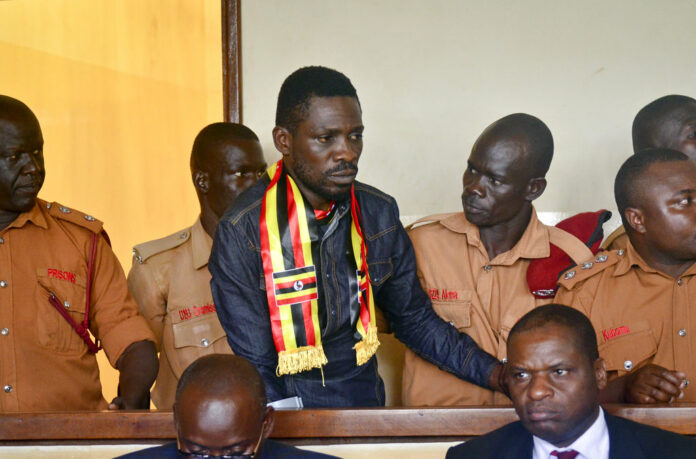
Ugandan pop star-turned-lawmaker Kyagulanyi Ssentamu, also known as Bobi Wine, center, arrives at a magistrate's court Aug. 23 in Gulu, northern Uganda. Photo: Associated Press
KAMPALA — A Ugandan pop star-turned-opposition lawmaker whose treason charge has outraged the country after he alleged torture in detention has been blocked from leaving for the United States for treatment, lawyers said late Thursday, while a colleague was stopped from traveling to India.
The police action has escalated a political dispute between the government of longtime President Yoweri Museveni and a youthful generation that fears he intends to rule for life after 32 years in power.
Bobi Wine, whose real name is Kyagulanyi Ssentamu, was stopped while trying to board a flight at the Entebbe airport and police did not explain why, lawyer Asuman Basalirwa told The Associated Press. He was checked into a hospital in the capital, Kampala, in a “worrying condition,” the lawyer said.
The 36-year-old was freed on bail on Monday but faced no travel restrictions after he and more than 30 other lawmakers were arrested over an incident in which the president’s motorcade was pelted with stones and Ssentamu’s driver was shot dead. A lawyer for the singer has called the charge false.
Ssentamu has emerged as a powerful opposition voice among youth frustrated by Museveni, especially after the constitution was changed last year to remove an age limit on the presidency. The singer won a parliament seat last year without the backing of a political party.
Dozens of global musicians including Chris Martin, Angelique Kidjo and Brian Eno last week issued an open letter condemning the treatment of Ssentamu, who in his first public appearance after his arrest had to walk with support and appeared to cry.
On Thursday, police “violently abducted” Ssentamu and put him into a police ambulance, another lawyer, Nicholas Opiyo, said on Twitter. Any doctor who treats the singer without his consent is violating his or her oath and “will be personally pursued,” he added.
Ssentamu’s wife, Barbara, said in a Facebook post that security forces “manhandled” her husband, who “groaned in pain” as he shouted for help.
Police did not immediately respond to a request for comment.
Authorities earlier on Thursday prevented another lawmaker, Francis Zaake, from boarding a plane to India, saying he was a suspect in a criminal case.
Government spokesman Ofwono Opondo said on Twitter that Zaake, who has not been charged with any crime, escaped police custody “and should be arrested at the earliest.”
After the outcry over Ssentamu’s treatment at the airport, Opondo said both he and Zaake can travel “after government doctors have examined them to ascertain their medical conditions.”
Both men had been hospitalized with serious injuries they said they sustained at the hands of security forces during detention.
The speaker of Uganda’s parliament, Rebecca Kadaga, in a letter to Museveni this week described Zaake as “gravely ill” and said Ssentamu “has visible signs of torture and beatings.”
The government has denied the allegations of torture.
Ssentamu is said to be suffering a kidney problem, according to his legal team, which cited a medical report by the hospital where he had been hospitalized.
The treason charges against Ssentamu and others have heightened concerns about a crackdown on the opposition in this East African nation and led to protests in the capital.
The 74-year-old Museveni, a close U.S. security ally, has held power since 1986. He has spoken in recent days about “unprincipled politicians taking advantage of our unemployed youth to lure them into riots and demonstrations.”
Pakistani protesters shout slogans Wednesday during a protest against the planned anti-Islam cartoon competitions, in Karachi, Pakistan. Photo: Fareed Khan / Associated Press
THE HAGUE, Netherlands — A Dutch anti-Islam lawmaker canceled a planned Prophet Muhammad cartoon contest Thursday following death threats and concerns other people could be put at risk.
“To avoid the risk of victims of Islamic violence, I have decided not to let the cartoon contest go ahead,” far-right opposition politician Geert Wilders said in a written statement.
Wilders, who for years has lived under round-the-clock protection because of death threats sparked by his fierce anti-Islam rhetoric, said he does not want others endangered by the contest he planned for November.
The planned contest sparked angry protests in Pakistan and a death threat this week from a 26-year-old man, reportedly a Pakistani, who was arrested Tuesday in The Hague.
Physical depictions of the prophet are forbidden in Islam and deeply offensive to Muslims.
“It’s not just about me,” Wilders said in the statement. Strong opponents of the event “see not only me, but the entire Netherlands as a target.”
The contest was to have been held at the tightly guarded offices of his Party for Freedom in the Dutch parliament building.
Earlier Thursday, a Dutch judge extended by two weeks the detention of the man who allegedly threatened to attack Wilders.
Prosecutors said in a statement that an investigating judge ordered the suspect held while he is investigated on charges of making a an extremist threat, making preparations for an extremist murder and incitement.
The Dutch government had been at pains to distance itself from the contest.
Prime Minister Mark Rutte last week questioned Wilders’ motive for organizing the contest.
“His aim is not to have a debate about Islam. His aim is to be provocative,” the prime minister said.
However, Rutte added that people in the Netherlands have far-reaching freedom of speech rights and the government did not intend to seek the contest’s cancellation.
In a clear indication of the anger Wilders had generated, thousands of hard-line Islamists marched toward Pakistan’s capital Thursday in protest.
Some 10,000 supporters of the Tehreek-i-Labaik group, which helped Imran Khan to become prime minister following last month’s national elections, set out on the march Wednesday, calling on Khan to cut diplomatic ties with the Netherlands.
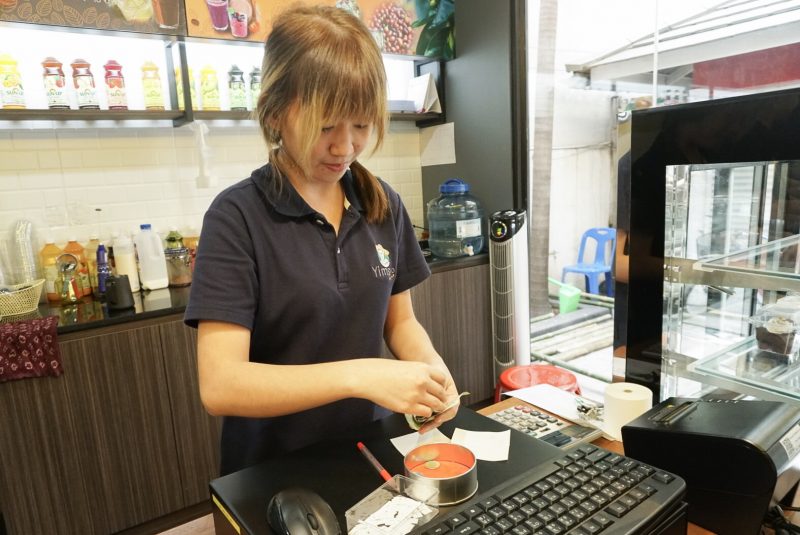
Kanyaporn Soongcharoen and Kanlayarak Aua-anantchai at a new branch of Yimsoo Cafe at Thammasat University, Tha Prachan campus.
BANGKOK — “I’m deaf but happy to take care of you. Please point the menu to order” a sign on the counter reads in English.
Behind it stands a barista-waitress, smiling mildly and waiting. A customer points to “eat in,” then “table no. 19” and finally “iced hazelnut macchiato.” Which each gesture, the barista taps onto a computer screen then turns it to show the customer that 55 baht needs to be paid.
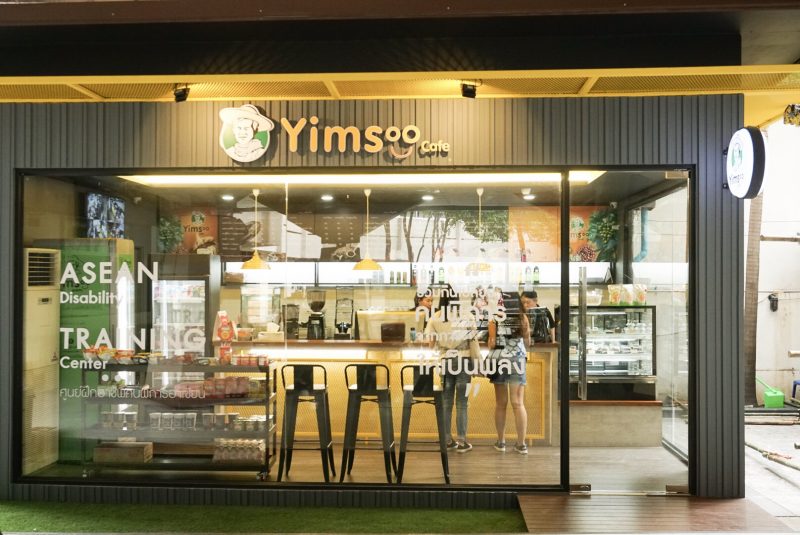
Yimsoo Cafe is a cafe staffed entirely by workers with impaired hearing. Most are deaf. Its founder wanted to create employment opportunities for people with disabilities who are too often shunned by employers, neglected by the government and left to rely on charity.
“I realized that the country has about 700,000 disabled people in working age, while only a little over 100,000 of them have a job. And most of them are self-employed,” Wiriya Namsiripongpun said.
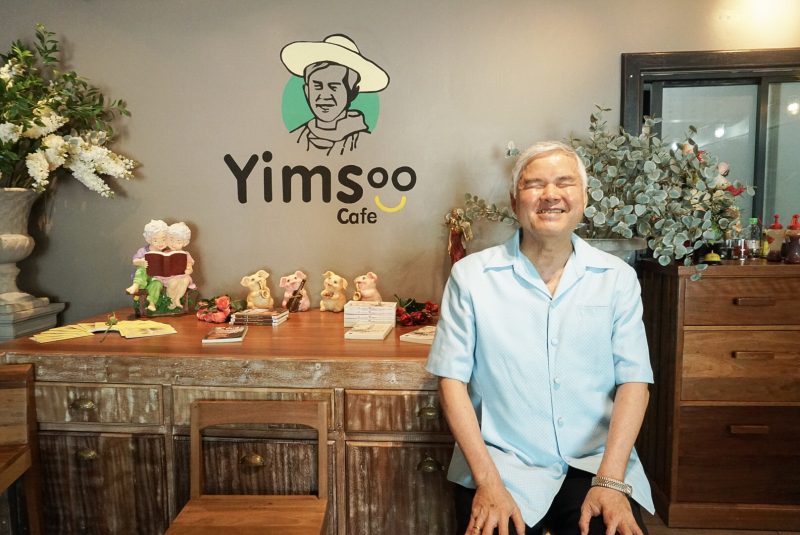
Wiriya can hear just fine – it’s his sight that is impaired. Blind in both eyes, he founded the cafe in December 2016. He’s also president of the Universal Foundation for Persons with Disabilities. Most people call him Ajarn Wiriya, as he is a law professor at Thammasat University.
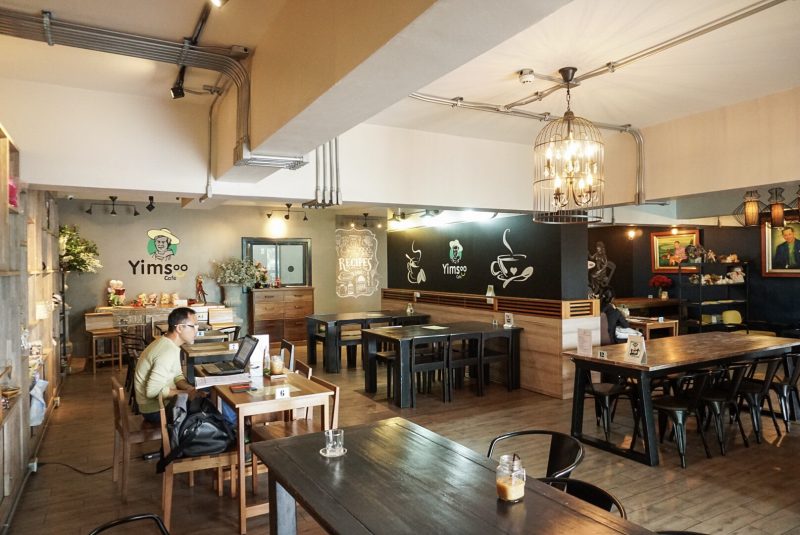
From the first branch which fills in the first floor of the foundation’s building near Bangkok’s Pinklao area, the cafe recently added a second location at Thammasat University’s Tha Prachan campus.
Equipped with a walking cane, 66-year-old Wiriya approached a table Wednesday to explain the cafe’s inspiration is rooted in the employment needs of Thais with disabilities, who struggle to land a job in the country.
Under a 2007 law, public and private organizations with more than 100 employees must hire one person with disabilities for every 100 without.
Compliance wins tax relief. But those who refuse must only contribute to a state rehabilitation fund. Most companies opt for the latter, Wiriya said.
Wiriya Namsiripongpun, Yimsoo Cafe founder and president of the Universal Foundation for Persons with Disabilities.
However, Wiriya opines that it’s best for organization to employ worker with disabilities, as the fund has proved little more than a government piggy bank. He cited an ongoing lawsuit lodged last year by the Council of Disabled People against the government after it withdrew 2 billion baht from the fund.
“We have disabled people’s rights on paper and money in the fund. But there is no organization to utilize the money for disabled people’s sake, so their rights aren’t real,” Wiriya said.
It’s been two years since Wiriya launched vocational training for disabled people, which ranges from farming mushrooms and crickets to cooking and brewing coffee, depending on where it is. The first session he started, Wiriya said, he invited 100 families. Only four signed up.
“Our biggest challenge is tackling beliefs in Thai society,” Wiriya said. “Majority of Thais still believe that disabled people lack capabilities. They were born disabled, or became disabled, because they had bad karma, so they have to repent it. The parents believe the same thing, so they don’t want their children to face more difficulties by working.”
Back at Yimsoo Cafe’s original branch in Soi Arun Amarin 39, employee Chutinan Phupuak said it was the first time she ever had a job. The 20-year-old said she learned about the position from a “good-hearing” friend.
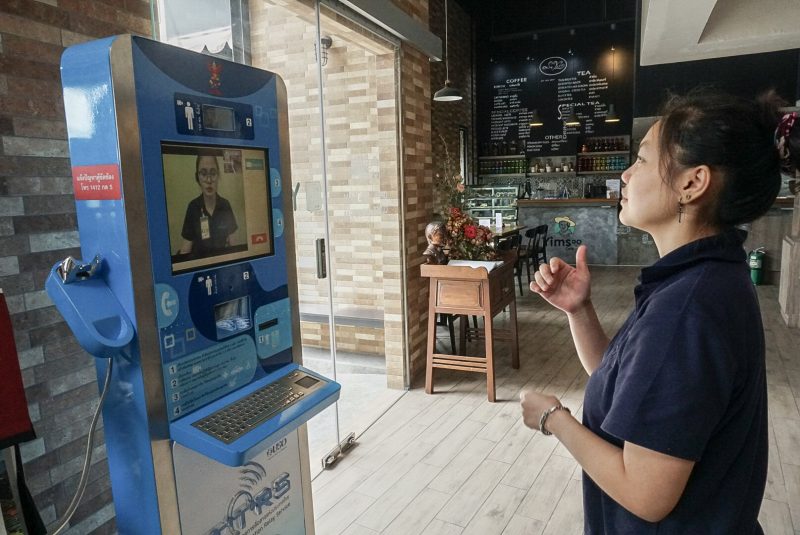
“It is sometimes hard communicating with customers, but I try to work hard and get the most out of the experience,” Chutinan said, signing her response to a question into the camera of a blue kiosk installed in the cafe.
The machine, operated by the same service behind the broadcast television sign language, relays messages by voice or sign to a human translator who appears on a video display.
Inside Yimsoo Cafe, Arun Amarin branch, Chutinan Phupuak performs hand signs to a translator via a machine
Another branch recently popped up on the ground floor of Thammasat’s law building. Though smaller than its mother branch, it’s much busier, packed with students, professors and school staff.
Inside, Kanyaporn Soongcharoen, who was born deaf, was stirring sweetened condensed milk in a bottle. Working up front, Kanlayarak “Nampetch” Aua-anantchai, who wears a hearing aid, handed change to a customer for a glass of iced cocoa.
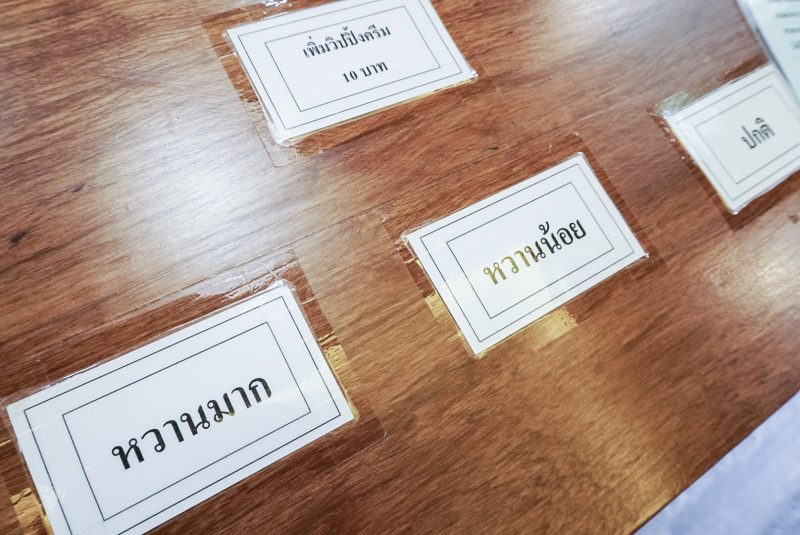
“Thank you ka,” she said over a counter topped by five paper labels. They read: “not sweet,” “very sweet,” “little sweet,” “normal sweet” and “add whipped cream for 10 baht.”
While communicating with Kanyaporn happens via writing and sign language, Nampetch can hear quite well with the help of the hearing aid. The 19-year-old woman studies business part time at Dhurakij Pundit University.
“It’s usually very busy in the morning before classes start, then again afternoon when the classes finish,” Nampetch said. “I like making every kind of drink, though making coffee is a bit more complicated.”
Wiriya said sometimes deaf people and partially deaf people are trained together so they can help each other learn. “But you may have to speak a little louder. If you verbally order ‘less sweet,’ they might hear only ‘sweet,’” Wiriya said, laughing.
All cafe staff earn a fixed salary of 12,000 baht per month. No educational background is required.
In the future, the cafe aims to add more branches and add sign language manuals to each branch so cafe-goers can try their hand at communicating with the staff.
“Customers can learn how to order “less sweet” drinks using sign language. This can become the cafe’s gimmick too,” Wiriya said.
Yimsoo Cafe has two branches. One is located in Soi Arun Amarin 39 and opens 7:30am to 6pm daily. The Thammasat University, Tha Prachan campus, branch is located in the Faculty of Law and opens 7:30am to 9pm on weekdays and 7:30am to 6pm on weekends.
Kanlayarak Aua-anantchai prepares change for a customerKanyaporn Soongcharoen makes a “less-sweet” latte
Yimsoo Cafe at Thammasat UniversityYimsoo Cafe on Soi Arun Amarin 39.
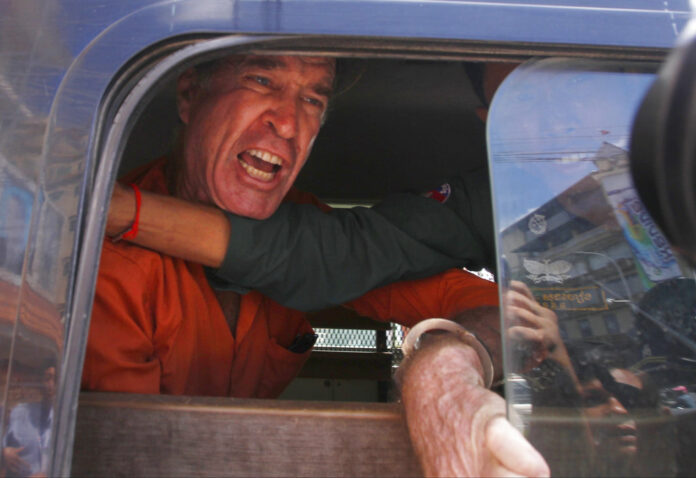
Australian filmmaker James Ricketson speaks from a prisoner van outside Phnom Penh Municipal Court last month in Phnom Penh, Cambodia. Photo: Heng Sinith / Associated Press
PHNOM PENH — An Australian filmmaker arrested after flying a drone to photograph a Cambodian opposition party rally last year was convicted of spying and sentenced to six years in prison Friday.
James Ricketson faced up to 10 years in prison on the charge of endangering national security. Almost two dozen jailed critics or opponents of Prime Minister Hun Sen’s government had been freed in recent weeks, raising hopes of leniency in Ricketson’s case.
Prosecutors have indicated he was suspected of working with the opposition party or had worked directly for a foreign power, though that country was never specified in court. The charge against him was tantamount in legal terms to espionage.
As the prison van left after the panel of judges delivered the verdict, Ricketson shouted to reporters the same question he often raised throughout his trial: “Who am I spying for?’
Before hearing the verdict, he told The Associated Press that based on the evidence and facts in the case, he should be set free.
Ricketson, 69, repeatedly insisted he had no political agenda and his work making documentary films was journalistic in nature. Character witnesses testified to his filmmaking work and financial generosity to several poor Cambodians.
The evidence presented against Ricketson appeared thin, but Cambodia’s courts are considered highly politicized and their rulings often tightly align with the ruling party’s agenda. A handful of personal emails seized from Ricketson suggested he was sympathetic to the country’s political opposition and critical of Hun Sen’s government, but revealed no sensitive or secret information. Several of his photos and videos showed security forces on duty, but only in publicly viewable situations.
“Since he arrived in Cambodia, the accused person has been collecting political, social and economic information about Cambodia and sending it to a foreign state,” prosecutor Sieng Sok said in his closing argument Wednesday. “He has kept collecting this information for 22 years, until the day he was arrested. The accused person was using his journalism job and helping poor Cambodians just to hide his real work, but in fact he is a spy and has been filming at the sites of the country’s security forces.”
The prosecutors had indicated Ricketson also was suspected of working with the opposition Cambodian National Rescue Party, which for a time had enough popularity among Cambodians to be a viable challenger to Hun Sen’s rule. The party’s dissolution by a court ruling last year assured Hun Sen’s party of its sweeping victory.
The leniency shown to opponents and critics following the July election followed a pattern of Hun Sen’s long rule, with a harsh crackdown on opponents and critics preceding the vote and clemency and conciliatory moves after a resounding victory.
Ricketson testified in his defense that he made contacts with the opposition party strictly for journalistic purposes while making a documentary film. He recounted a filmmaking career dating to the 1970s, and presented acclaimed Australian movie director Peter Weir to attest to his professionalism in the field.
Ricketson’s other character witnesses were several Cambodians, including his informally adopted daughter, who described how he had provided financial assistance to them and other poor members of Cambodian society.
Throughout his trial, Ricketson shouted brief but defiant remarks to reporters as he was led in and out of the court building for each hearing. He decried the paucity of evidence and repeatedly asked the taunting question of what country he was supposed to have been spying for.
At one point, however, he took a tried-and-true approach in trying to earn clemency by expressing contrition.
In a July 1 letter addressed to Hun Sen and published in a pro-government newspaper, he wrote: “May I please, respectfully, send my sincerest apologies to yourself and the Cambodian Government. I now realize that my statements I have made in the press and other media are disruptive and ill-informed. These statements were made from a place of foreign naivety and ignorance about the complexities and difficulties of governing Cambodia,” he wrote.
“I apologize unreservedly and without condition for any distress I may have caused as a result of my ignorance of Cambodian issues. If there is anything I can do to remedy my mistake, please let me know as I only want the best for you and Cambodia,” the letter said.
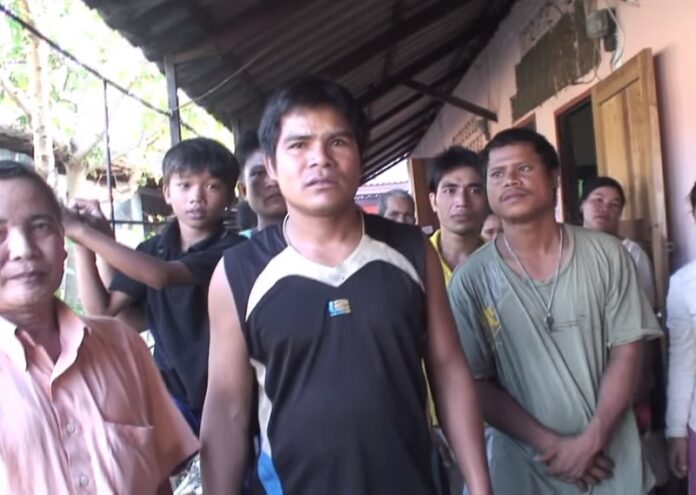
This undated image from video shows Montagnards in Vietnam. Image: Tribal Action Group / YouTube
BANGKOK — Nearly 200 asylum seekers from Vietnam and Cambodia face deportation and persecution back home, rights groups warned Thursday.
Human rights activist Pornpen Khongkachonkiet said 36 of 181 ethnic Montagnards have been charged with illegal entry at Nonthaburi Provincial Court and ordered to pay 5,000-baht fines. She said 22 are women – some with toddlers of 8 months – who would have their children taken away if they couldn’t pay the fine.
Ratsada Manooratsada, vice president of Human Rights Lawyers Association, said it took some time before the Montagnards – who are routinely persecuted in Vietnam – were provided an interpreter. The association sent two of its lawyers to defend the minority group.
Ratsada said on Thursday that some of the Montagnards carried UNHCR cards identifying themselves as “people of concern” who should be treated as asylum seekers, not criminals.
“We are trying to convince the court to consider Thailand’s international obligations on the rights of refugees and asylum seekers,” Ratsada said by phone.
Thailand does not recognize the status of refugees or asylum seekers and reserves the right to arrest and deport them at will.
On Thursday, New York-based Human Rights Watch called for the immediate release of the 181 people, saying they should be treated as refugees, as many possess the cards.
“Thailand’s frequent claims about improving refugee rights ring hollow when officials detain dozens of families who are protected under the mandate of the UN refugee agency,” Brad Adams, Asia director for Human Rights Watch said in a Thursday statement. “These Montagnards face harsh persecution if they are returned to Cambodia and Vietnam, which Thailand should not do under any circumstances.”
Phil Robertson, Human Rights Watch deputy director in Bangkok said by phone Thursday that these asylum seekers could receive prison sentences for illegally entering the kingdom before being deported to Cambodia and Vietnam. Robertson said the Montagnards either have refugee status confirmed by the UNHCR or are in the process of obtaining it.
He added that more than 50 of the 181 are minors and that children are being separated from their parents.
Human Rights Watch said they have fled religious and political persecution.
“Cambodia’s ethnic Jarai population, many of whom are Christian, have faced land confiscation and intensifying government pressure after Vietnamese Jarai fled into Cambodia’s Ratanakiri province,” it said in the same statement.
The Montagnards, who hail from Vietnam’s central highlands, have been persecuted since they lent support to the United States in the war fought there decades ago. Some have sought refuge in Cambodia, which has not cooperated with UN attempts to resettle them.