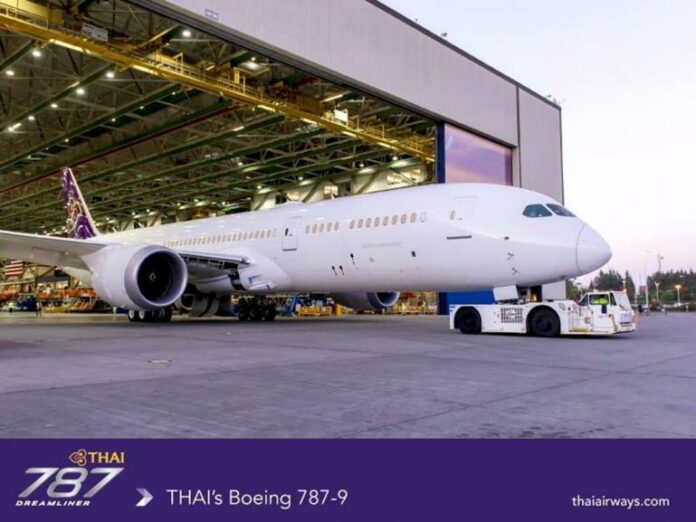
“Obese” passengers will no longer be allowed in Thai Airways’ business class on flights serviced by Boeing 787-9s, airline officials announced Friday, due to seatbelt limitations.
“Due to safety regulations, we reserve the right of booking tickets to passengers who have waists wider than 56 inches and passengers with lap-held infants,” said airline safety official Capt. Prathana Patthanasiri.
By obese, the airline means passengers with waistlines that exceed 56 inches, who cannot fit inside the seatbelts equipped in that jet’s business section. Those riding in the other classes can still be as wide as they please.
People planning to cradle their babies in business class must also opt for a coach ticket or pay for a baby seat instead since the new belts cannot accommodate lap-held infants.
Prathana said Thai Airways added two new Boeing 787-9s to its fleet in September that connect the capital to Auckland, New Zealand, and Taipei.
Thai Airways said it is complying with US Federal Aviation Administration regulations since business class seat belts on this model of plane are equipped with mandatory airbags.
Thai Airways said that obese passengers should consult booking staff to see if their particular flights allow them to sit in business class.
Versace has become the latest fashion house to eliminate fur from its collections, joining Gucci, Giorgio Arman, Hugo Boss among others. Photo: Luca Bruno / Associated Press
MILAN — Versace has become the latest fashion house to eliminate fur from its collections, joining Gucci, Giorgio Armani, Hugo Boss among others.
The Humane Society, which campaigns against the sale of fur, welcomed the decision Wednesday, noting that “Versace is a massively influential luxury brand that symbolizes excess and glamor.”
The group quoted an interview in the Economist Group’s “1843” magazine with designer Donatella Versace, who said: “Fur? I am out of that. I don’t want to kill animals to make fashion. It doesn’t feel right.
“Versace hasn’t said when it would phase fur out of their collections, but given the fashion cycle it wouldn’t be before the next winter season. Versace is joining a trend among fashion houses to make its collections more environmentally sustainable.
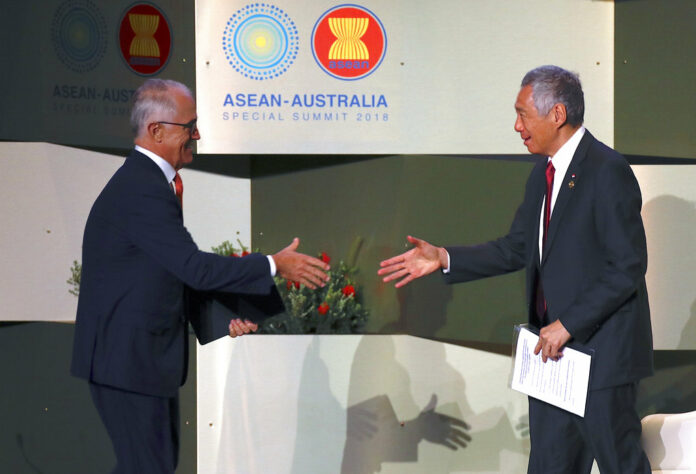
Australian Prime Minister Malcolm Turnbull, left, shakes hands with the Prime Minister of Singapore Lee Hsien Loong at the start of the Small-and-Medium sized Enterprises conference held in March during the one-off summit of 10-member Association of Southeast Asian Nations (ASEAN) on Friday in Sydney, Australia.
Photo: Dave Gray / Associated Press
CANBERRA, Australia — Southeast Asian leaders started gathering Friday for their first summit in Australia as the regional neighbors look for closer economic and security links and the host prime minister warned against trade protectionism.
The leaders of the Association of Southeast Asian Nations, or ASEAN, rarely meet outside their 10 member nations and the weekend summit in Sydney has caught the attention of protesters angered by human rights abuses in Southeast Asia.
Prime Minister Malcolm Turnbull has been criticized for welcoming some of the leaders to his hometown, including Myanmar leader Aung San Suu Kyi and Cambodian Prime Minister Hun Sen, who have been singled out by protesters. But Turnbull is looking at ASEAN for its potential to drive free trade in the Indo-Pacific region in a way that the major economies, the United States and China, cannot without creating suspicion and division.
The dual themes of the Sydney summit are security and posterity, with the threat to both posed by North Korea high on the agenda.
“Open markets, together with democracy, have been two of the most powerful forces in human history and they’ve led to worldwide growth and prosperity,” Turnbull told a business forum in Sydney on Friday. “We must face the world, not turn from it; embrace free trade, not retreat from it,” he added.
U.S. President Donald Trump sparked fears of a global trade war with his recent move to slap tariffs on imported steel and aluminum. Earlier this month, Turnbull said Trump had agreed to exempt Australian steel and aluminum from the new tariffs.
Singapore Prime Minister Lee Hsien Loong, the chairman of ASEAN this year, said he feared U.S. moves to protect domestic industries put countries “under pressure to retaliate.”
“If trust is broken and tit-for-tat trade wards break out, all countries, big or small, will suffer,” Lee told The Straits Times newspaper.
Trump has frustrated Australia’s free trade ambitions by withdrawing the United States from the Trans-Pacific Partnership. Turnbull used a visit to Washington in February to urge the United States to rejoin the trade pact and to speak against a growing sentiment of isolation in America.
Four ASEAN countries – Brunei, Malaysia, Singapore and Vietnam – are among the 11 who have signed up to the alternative Trans-Pacific Partnership.
ASEAN also offers Australia a different route to the goal of an Indo-Pacific free trade agreement through the proposed Regional Comprehensive Economic Partnership. The partnership would group ASEAN with six countries with which it already has free trade deals: Australia, China, India, Japan, South Korea and New Zealand.
Australia’s enhanced engagement with ASEAN is part of a strategy to look beyond the United States to seek frameworks to bolster security, stability and prosperity in the region, said John Blaxland, director of the Australian National University Southeast Asia Institute.
Such moves give “due deference to the United States, but it implicitly recognizes that the United States isn’t as big a player and reliable player as perhaps it once was,” Blaxland said.
Stronger ties with ASEAN come with their own pitfalls, however, including the need to strike a balance between seeking greater economic cooperation and pushing for social reforms in a region rife with authoritarian governments.
Human Rights Watch said most ASEAN governments deny their citizens basic liberties and fundamental freedoms. The New York-based rights group wants human rights on the agenda in Sydney.
“Australia’s failure to publicly raise human rights concerns at the summit would not only provide a propaganda coup to ASEAN’s most abusive leaders, it would embolden all the region’s leaders contemplating major crackdowns, jailing journalists, or dismantling democratic institutions,” Human Rights Watch Australian director Elaine Pearson said in a statement.
Yet criticism is something Southeast Asian leaders bristle at, and ASEAN itself works on the core principle that member nation’s won’t interfere in one another’s internal affairs.
Hun Sen, Cambodia’s long-serving leader who had a court dissolve the main opposition party last year, has threatened to hunt down and beat anyone who demonstrates against him in Sydney. While Philippines President Rodrigo Duterte, who has angered rights advocates with a crackdown on illegal drugs that has left thousands of mostly poor suspects dead since he took power in 2016, is expected to skip the summit altogether.
Suu Kyi, a Nobel Peace Prize laureate who has been heavily criticized for failing to take a stand against military abuses against the Muslim Rohingya minority, is expected stay on after the summit to visit the capital next week for an official state visit.
Amnesty International has accused ASEAN of being “shamefully silent” on Myanmar’s campaign to drive out Rohingya Muslims.
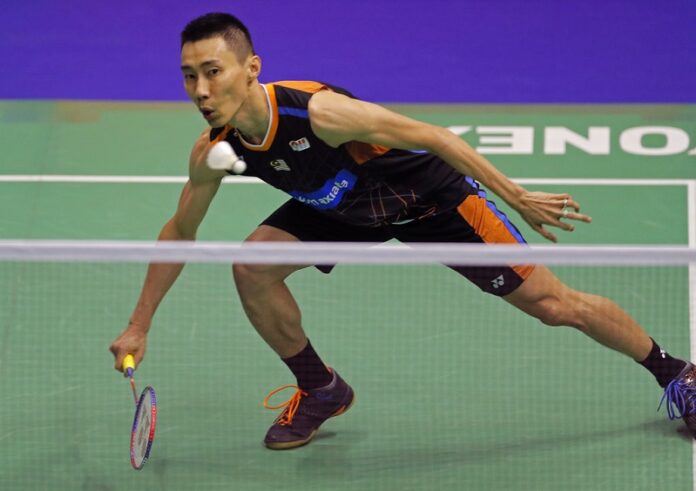
Lee Chong Wei of Malaysia returning a shot to Chen Long of China in the final of the men's singles during the Yonex-Sunrise Hong Kong Open Badminton Championships 2017 last year in Hong Kong. Photo: Vincent Yu / Associated Press
BIRMINGHAM, England — Badminton great Lee Chong Wei wants his world federation to give him similar treatment to that which has helped Roger Federer extend his tennis career.
The 35-year-old Chong Wei, defending his title at the All England Championships this week, says he’s “freaked out” by the Badminton World Federation’s new regulations which require the tour’s leading 15 players to compete in a minimum of 12 top tournaments to help promote the tour and sport.
When the quota is added to the Malaysian’s other commitments to his national association and to sponsors, his annual tournament total could rise to 19 – too many for health and longevity, he believes, in a career already extended at the highest level longer than most people expected.
“How can a top player cope? If the world body persists, the top players will not be able to give their best. They’ll eventually be burnt out,” Chong Wei said.
The 36-year-old Federer, by contrast, is allowed to play a reduced schedule if he has competed for 12 years on the ATP Tour, has played at least 600 matches, and is aged over 31. Because the Swiss superstar meets all three requirements, he has been able to take lengthy breaks which have helped to make the last 15 months one of the most successful spells of his career, with three Grand Slam titles.
When Chong Wei was asked if he would like the BWF to create similarly sympathetic rules for its longest-lasting players, he answered: “Yes, I really would. It makes complete sense.”
“But I don’t think it will happen. I sent a request to the BWF, explaining why this is too many tournaments for me, but I haven’t had a reply. And that was back in November.”
Asked if he felt this silence was disrespectful, Chong Wei said: “Yes.”
Other leading players support Chong Wei, including world champion Viktor Axesen of Denmark, two-time Olympic champion Lin Dan of China, and former women’s No. 1 Saina Nehwal of India.
Chong Wei does, however, have a significant consolation.
“I have decided I have to miss some of these tournaments, or I risk shortening my career,” he said. “But I have good support from my national association, the BAM (Badminton Association of Malaysia). They have agreed to pay my fines (for non-appearances) to the BWF. So that is what will happen.”
Thanathorn Juangroongruangkit speaks to reporters Thursday morning.
BANGKOK — Co-founders of the newly established Future Forward Party made it clear the party would support neither an unelected prime minister nor undemocratic elements Thursday in comments about the need to redeem Thailand from what they dubbed a “lost decade.”
Watched closely after the military government warned against violating its ban on political speech, billionaire Thanathorn Juangroongruangkit and law lecturer Piyabutr Saengkanokkul spoke in general terms about ending the deep polarization and the cycle of military coups as well as the fundamental stance of the party registered this morning, which in Thai is called Anakot Mai.
They said the party’s policies would be decided in a participatory manner by its members at a future date, but offered a caveat when pressed by journalists to answer more questions.
“If I talk more than this, we may not be able to move forward,” Thanathorn said at the Election Commission, where the party registered its name two hours after he held a news conference at another location.
Thanathorn’s family firm, Thai Summit Group, owns a large stake in Matichon Group, the parent company of Khaosod and Khaosod English. On Wednesday, he resigned from the company board.
Though the two are the most prominent and high-profile to sign on, a total of 26 people were listed as founding members.
Among the party founders are members who have previously campaigned for decentralization, LGBT rights, labor rights, closing income disparity and opportunity gaps, education reform, disability rights and better social welfare.
Thanathorn insisted his party would compete against all the others and not just offer itself as an niche alternative.
Thanathorn said he and his colleagues have not been able to reach out to rural areas due to the junta’s ban on political campaigning when asked about how his party would attract their votes.
The billionaire-turned-politician added that policies will be designed from the bottom-up, meaning party members would have a say and participate in a meaningful way in devising them.
This was echoed by Piyabutr, who as member of the Nitirat group of Thammasat law lecturers, is known for being a staunch opponent and critic of the lese majeste law. When asked by a reporter on Thursday about the party’s stance regarding the controversial law, Piyabutr said it would be arrived at by deliberation of all members on the issue – though he restated his personal opposition to it.
“This party doesn’t belong to [Thanathorn]. This party doesn’t belong to me. The party’s policy arise from the decision made together by party [members]… I can’t answer the question at the moment,” he said.
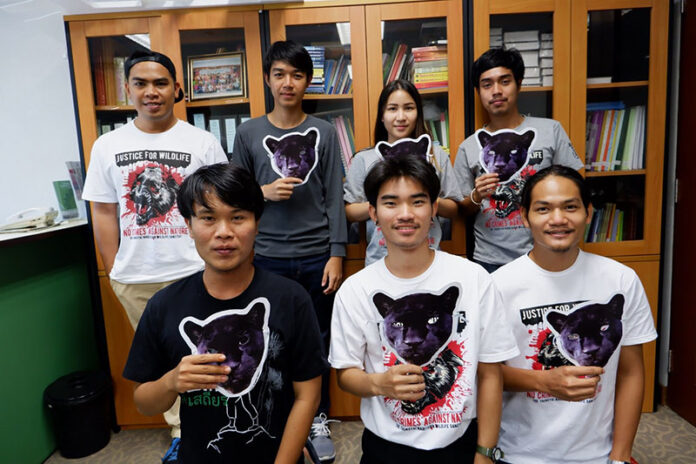
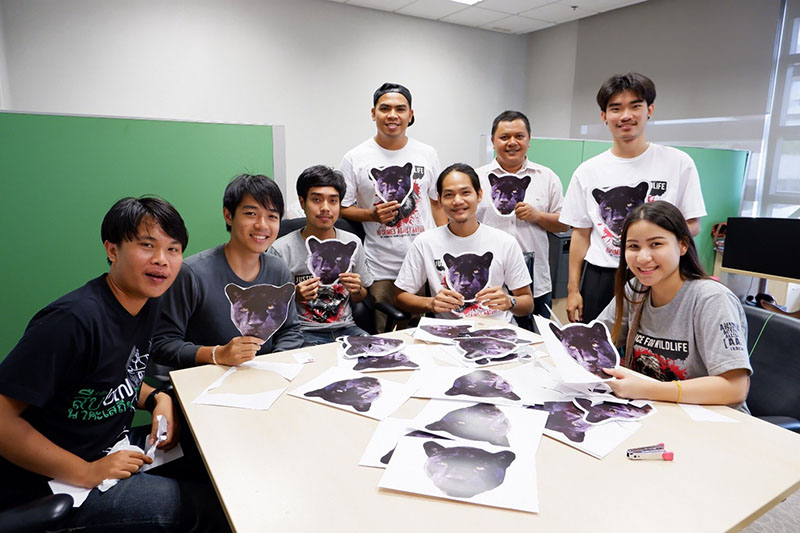
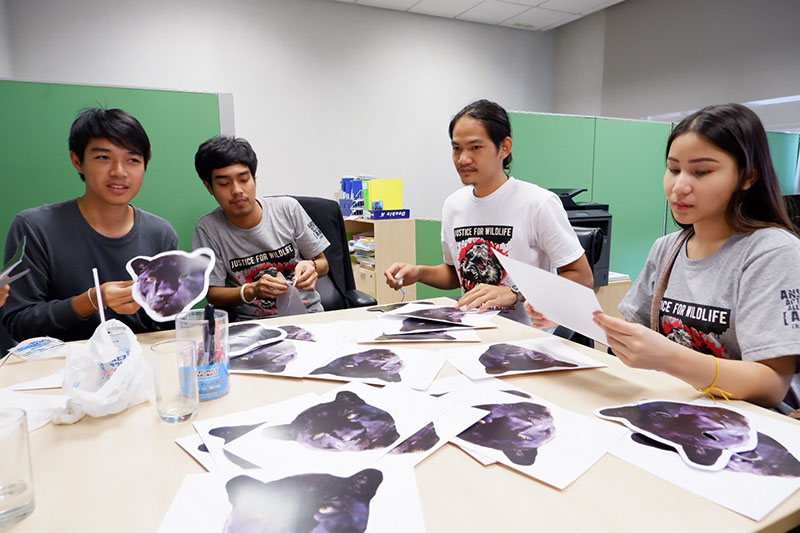
T’Challa members Wednesday at Rangsit University hold black panther masks they will use in their Sunday protest. Top row: Thatchapong Kaedum, Watcharapol Laiudee, Thanchanok Boonyarithikarn and Bannathat Phakdikit. Bottom row: Saksit Popangpum, Voramaet Buddeesuwan and Sarun Sanna.
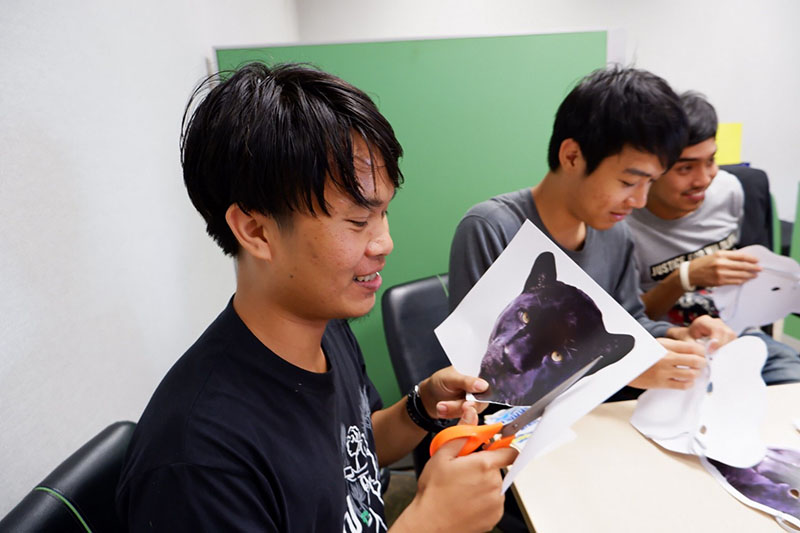
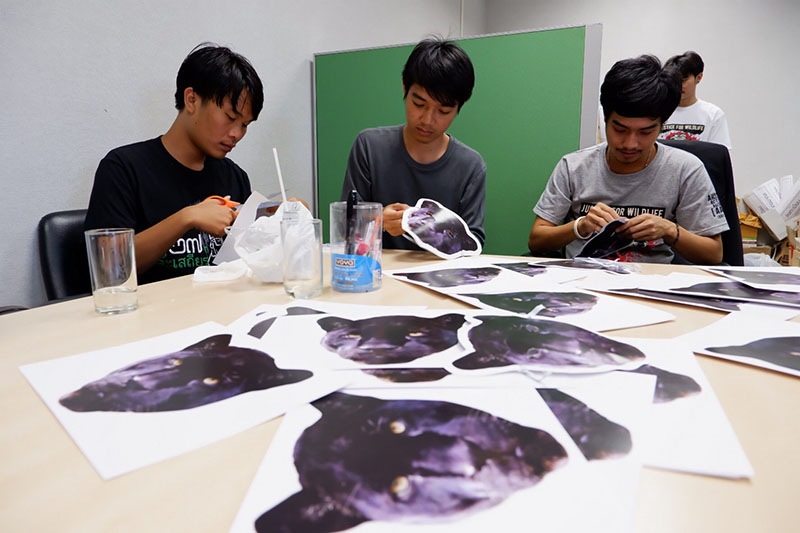
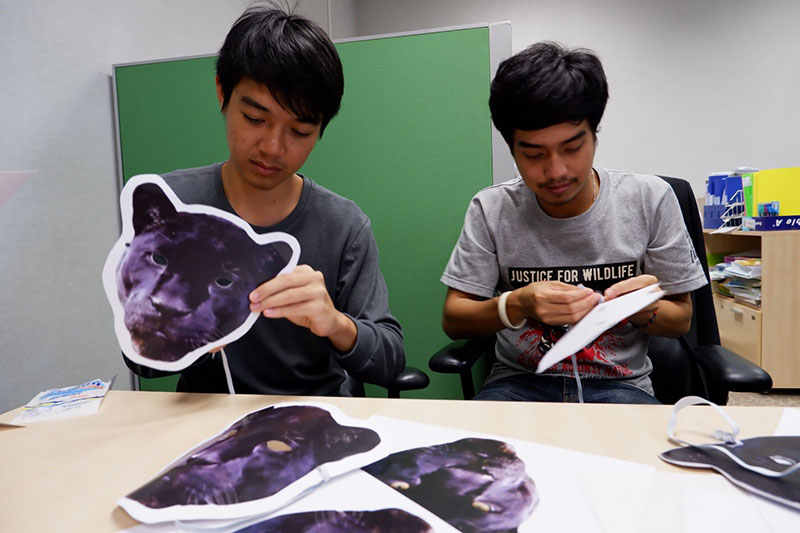
PATHUM THANI — Prim carefully cuts around the cheek of a black panther head on paper, while Mai ties a string to the back and Tor surfs on his iPad for the latest news updates Wednesday at Rangsit University.
The three are members of T’Challa, an environmental activist group of about 15, mostly students from Rangsit University, formed to protest the killing of a black panther, allegedly by Premchai Karnasuta of Italian-Thai Development.
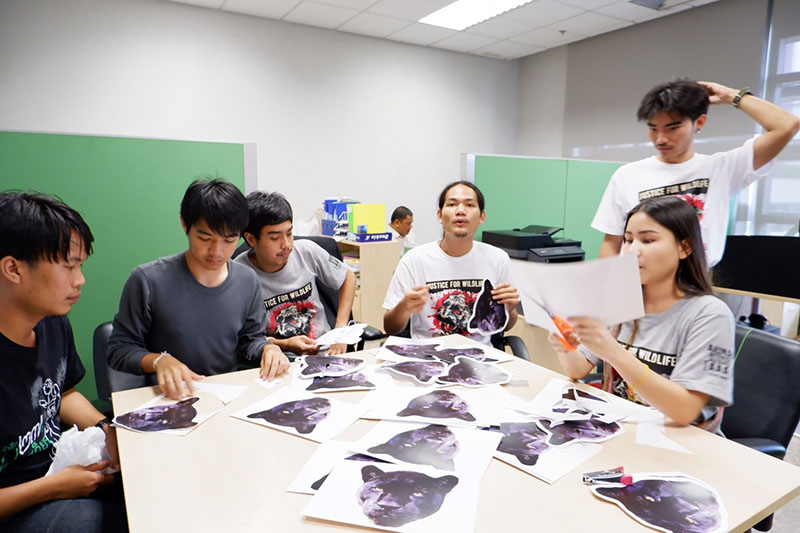
After their Wednesday classes, seven T’Challa members gathered in a multipurpose room on campus to plan for their next protest by cutting out masks while munching on crispy banana snacks and passing around photos of their past actions.
T’Challa is led by Thatchapong “Boy” Kaedum, 34, a master’s student in public administration and frequent environmental crusader.
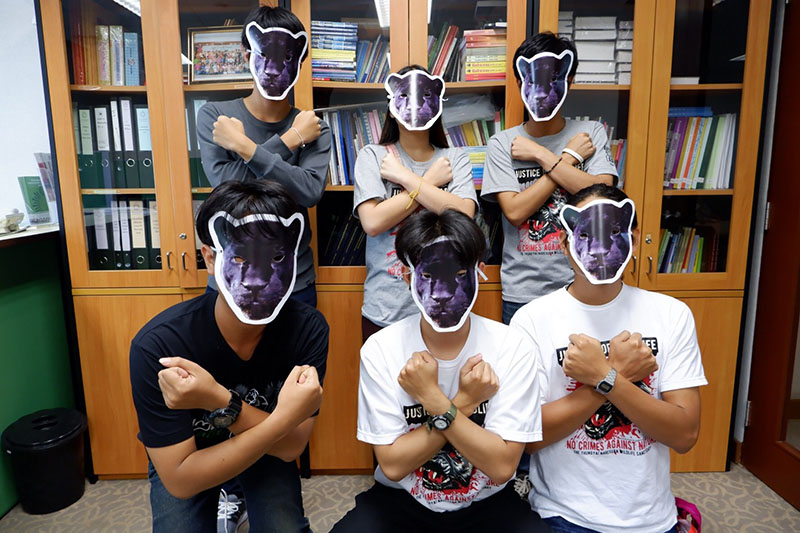
Members of T’Challa perform a crossed-arms salute Wednesday at Rangsit University.
“I just slept in front of the UN last month to protest the coal-powered plant issue,” Thatchapong said. “I mobilized these kids together. It’s for many their first time doing a protest, but they’re really giving it their all.”
T’Challa’s first protest was March 4 at the Bangkok Art and Culture Centre, where Boy said passers-by snatched up the 100 black panther masks they had prepared within 10 minutes. Buoyed by the reaction, they prepared 300 masks for their second protest on March 11 and brought in artists, poets and activists to an even bigger reception, Boy said.
The group’s third protest at the downtown cultural center this Sunday will be their largest yet, Boy says hopefully, as he passes around sheets of paper printed with the black cat head for the students to cut.
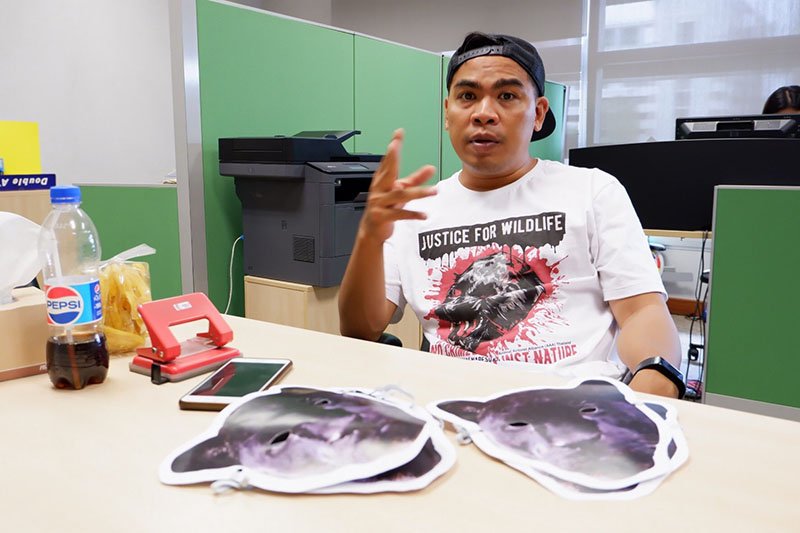
Saksith “Tor” Popangpum, 23
Of the seven T’Challa members present Wednesday at Rangsit University, Tor proved the weightiest speaker, firm on belief in his issues with a smoldering anger heating his words. T’Challa began when Tor, Boy and some friends said they could not stand idly by after seeing the high-ranking police official investigating the case bowing in deep deference to the wealthy and powerful suspect.
“If I had to turn myself in to the police and I wai’d him, would he wai me back?” Tor said, scoffing.
“When I go to report that I lost my ID card to the police, I get yelled at. This is just the ridiculous level of inequality in society. The 200,000 or so baht he posted for bail to him is like what 2 baht is to us. The justice system needs to be revolutionized.”
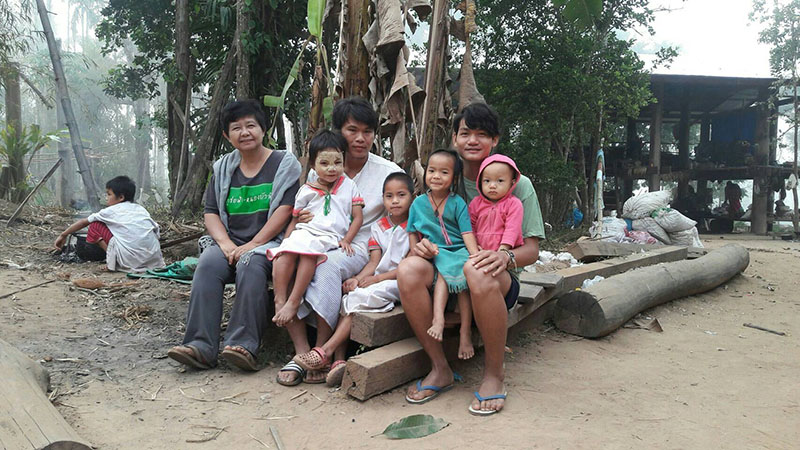
Saksit, in white and seated, and Sarun, in green and seated, on a visit to a Karen village in Thungyai Naresuan Wildlife Sanctuary in Tak in 2017. Photo: Watcharapol Laiudee / Courtesy
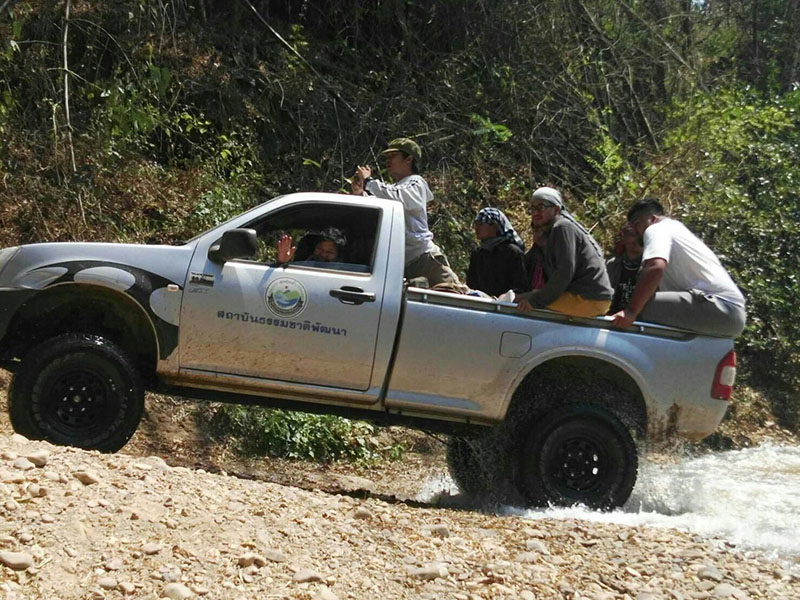
Tor, who writes speeches for the group, visited the Thung Yai Naresuan Wildlife Sanctuary, the same sanctuary where Premchai killed the black panther, last year on a trip to research Karen tribes living in Tak province.
“Premchai had the audacity to kill in Thungyai,” Tor said. “For us to go in, we had to fill out so many forms and go through many procedures.”
When asked whether he thought student activism could affect society, Tor simply said, “Today’s university students are the adults of tomorrow.” In the future, Tor said he hopes to become a local leader mobilizing people against state and corporation encroachment.
Saksit’s trip to Thungyai Naresuan Wildlife Sanctuary in Tak in 2017. Photo: Watcharapol Laiudee / Courtesy
He hoped that both expats and tourists would take up the black panther issue as well. “Farangs come for tourism because of our beautiful nature. So if we destroy nature, everything will be affected as well.”
“One animal life is equal to one human life,” Tor said. “I hope Thai people don’t let this issue go either.”
Watcharapol “Mai” Laiudee, 21
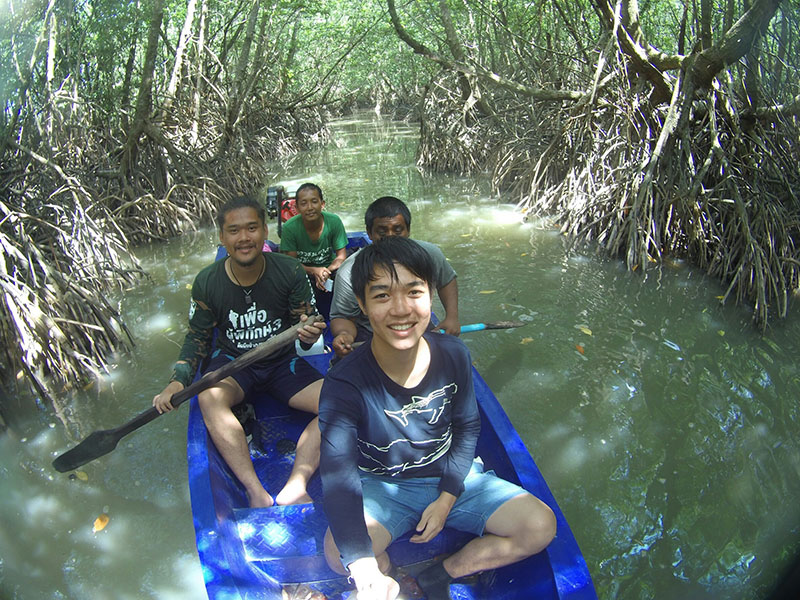
Mai also attended last year’s Thung Yai Naresuan trip. A nature lover, he talks passionately about how people should coexist with nature like the green khlongs and spidery mangrove forests he’s visited to connect with local communities.
From left to right: Saksit Popangpum, Watcharapol Laiudee and Bannathat Phakdikit.
“Hunting for rare animals shouldn’t ever happen at all. And destroying the natural ecosystem in one area will affect so many countries, not just Thailand,” the Khon Kaen native said. “Our motto is, ‘The black panther must not have died in vain.’”
Mai says visiting the places that are affected, such as Thungyai Naresuan, and talking to the people there has helped him understand how important the environment is.
Photo: Watcharapol Laiudee / Courtesy
“Thungyai Naresuan is not a tourist spot. Not just anyone can go in,” he said. “Even one death of a black panther disrupts the whole ecosystem.”
During anti-coal plant protests in February, Mai joined and bonded with some of the local residents and traveled by train with nothing but backpacks to visit them in Thepa district, Songkhla.
“They showed me the most beautiful, lush environment. A khlong connects villages lined with beaches and mangrove forests full of a rich ecosystem,” he said. “They showed me the spot where the coal plant would be built and therefore destroy everything.”
Thanchanok “Prim” Boonyarithikarn, 23
The only woman in the group, Prim was the most diligent about the day’s task, cutting mask after mask while her male classmates and compatriots traded anecdotes. She said she’s stayed awake till 3am cutting masks for previous protests.
This particular group of student activists usually goes by the name Sai Luy M. Rangsit, or The Bold of Rangsit U. But Sasin Chalermlarp, president of the nation’s most influential environmentalist group, the Seub Nakhasathien Foundation, advised them to go by “T’Challa” for this issue.
“So many injustices have happened in Thailand where people just forget about them. But finally, for this issue, the black panther is a tangible symbol,” Prim said. “We’re also really lucky that the ‘Black Panther’ film came out around this time.”
Prim is the student most excited to tie the movie to the movement. “In the film, T’Challa is the king of Wakanda, a country where they venerate the animal. So since we want to protect black panthers here too, I think it’s a perfect name.”
“And with these masks, everyone is T’Challa,” she said.
Sarun “Run” Sanna, 23: The Spokesman
The most articulate and verbose of the group is Run, who’s also the only electrical engineering student in the group.
“As you can see, when we meet up it’s not in a stressful environment, but we get our work done,” he said as his friends looked for more scissors to cut masks. The students usually discuss news and environmental and land rights issues from their own provinces at their meetings.
At previous T’Challa protests, Run played the panther in a mock killing skit and directed another semi-impromptu play in which everyone acted out a scene with Justice Bao, the enduring folklore figure about Song dynasty judge Justice Bao who is also the subject of a 1993 Chinese TV series which aired in Thailand.
“Justice Bao is a symbol of unstoppable pursuit of justice. This doesn’t happen in real life, so we wanted to act that out,” Run said, hinting that the group had a “surprise” planned for Sunday’s protest.
Their activist activities don’t interfere with their studies, since everyone uses their free time to participate, says the group’s de facto spokesman. Run says T’Challa, a group of around 10 Rangsit University students and five more from other universities, coordinate through Line.
“Sometimes we have FaceTime conference calls if we can’t meet in person,” Run said.
Watcharapol Laiudee and Bannathat Phakdikit string black panther masks.
“How very 4.0 of us,” Tor said, taking a shot at branding for the military government’s development campaign.
Bannathat “Gun” Phakdikit, 23, and Voramaet “Frank” Buddeesuwan, 22
While Gun and Frank mostly agreed with their friends’ points or sat by listening, they did offer some insightful comments.
“It’s not just the black panther that was killed. The law is also being killed,” said Gun, the only business student. The others except for Run major in social innovation.
Frank reiterated what one poet said at the previous protest that affected him.
“The law in our country is like a spider web,” Frank said. “The little people are like flies that get caught. The rich can just walk right through the webs without being affected.”
From left to right: Saksit Popangpum, Watcharapol Laiudee, Bannathat Phakdikit, Sarun Sanna, Voramaet Buddeesuwan and Thanchanok Boonyarithikarn.Watcharapol Laiudee, Bannathat Phakdikit, Sarun Sanna and Thanchanok Boonyarithikarn.Thatchapong “Boy” Kaedum Wednesday at Rangsit University.
Update: Sek Loso was granted bail during his appeal
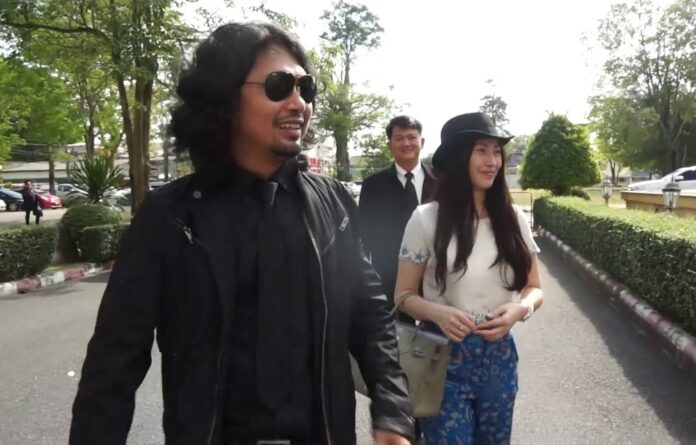
NAKHON SI THAMMARAT — A court in southern Thailand on Thursday sentenced a famed rock musician to five days in prison for firing a handgun in a temple late last year.
Seksan Sukpimai, aka Sek Loso, was seeking bail as of publication after the court found him guilty of illegally shooting his pistol into the night sky at a temple in Nakhon Si Thammarat province on Dec. 29. His lawyer said he will file an appeal.
Seksan, who’s famed for his music as much as his erratic behavior in recent days, refused to turn himself in. He was later arrested by police commandos at his Bangkok residence on New Year’s Eve.
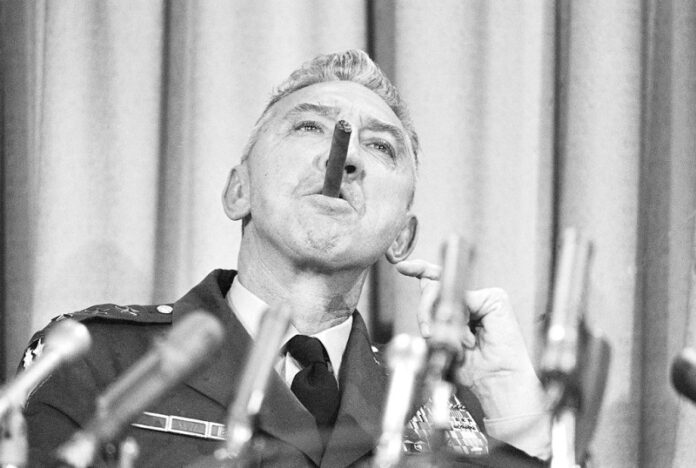
Lt. Gen. William R. Peers, head of the Army panel flying to Vietnam to investigate the initial probe into the alleged My Lai massacre, sights along his cigar during a preflight news conference in 1969 in the Pentagon. Photo: Associated Press
MY LAI, Vietnam — The shudder of artillery fire woke the boy at 5:30 a.m. Three American soldiers appeared at his family’s home a couple of hours later and forced the mother and five children into their bomb shelter, a structure most every Vietnamese home had during the war, to keep them safe.
One soldier set fire to the family’s thatched house while the others tossed grenades into the shelter. Protected under the torn bodies of his mother and his four siblings, 10-year-old Pham Thanh Cong was the only survivor.
It was March 16, 1968. The American soldiers of Charlie Company, sent on what they were told was a mission to confront a crack outfit of their Vietcong enemies, met no resistance, but over three to four hours killed 504 unarmed civilians, mostly women, children and elderly men, in My Lai and a neighboring community. Vietnamese refer to the greater village where the killings occurred as Son My.
“We started hearing the screaming and moaning from our neighbors, which were followed by gunfire and grenade explosions, then the screaming and moaning stopped, and my mother knew that the American soldiers had killed people,” Cong recalled this week. “I was covered with the flesh and hair of my mother and sisters and brother.”
Knocked unconscious with injuries to his head and wounds on his torso from grenade fragments, Cong was saved that afternoon when his father came to retrieve the bodies.
The My Lai massacre was the most notorious episode in modern U.S. military history, but not an aberration in America’s war in Vietnam.
The U.S. military’s own records, filed discreetly away for three decades, described 300 other cases of what could fairly be described as war crimes. My Lai was distinguished by the shocking one-day death toll, the stomach-churning photographs and the gruesome details exposed by a high-level U.S. Army inquiry.
An official policy of free-fire zones – from which civilians were supposed to leave upon being warned – and an unofficial code of “kill anything that moves” meant Vietnamese were constantly at risk.
Estimates of civilians killed during the U.S. ground war in Vietnam from 1965 to 1973 are generally 1 million to 2 million.
The average U.S. soldier could not be sure who the enemy was, rarely encountering one directly. They were targeted by land mines, booby traps, snipers. They were told to help, but the Vietnamese were rarely welcoming. Quang Ngai province, where My Lai is located, was a hive of communist military activity.
Two days before the massacre, a booby trap killed a sergeant, blinded a GI and wounded several others on a Charlie Company patrol.
Soldiers later testified to the U.S. Army investigating commission that the bloodletting began quickly when Lt. William L. Calley Jr. led Charlie Company’s first platoon into My Lai that morning. One elderly man was bayoneted to death; another man was thrown alive into a well and killed with a hand grenade. Women and children were herded into a drainage ditch and slaughtered. Women and girls were gang-raped.
“They went in with blood in their eyes and shot everything that moved,” recalled Hugh Thompson Jr., an army helicopter pilot who flew support for the mission in My Lai and – along with his two-man flight crew – are the only servicemen known to have actively intervened to try to stop the killing. They evacuated a handful of Vietnamese civilians on the point of being killed by his countrymen. Thompson also was one of several soldiers who became whistleblowers and eventually brought the outrage to public attention.
Calley was convicted in 1971 for the murders of 22 people during the rampage. He was sentenced to life in prison but served only three days because President Nixon ordered his sentence reduced. He served three years of house arrest.
Calley has avoided speaking about the matter with apparently just one exception. In 2009, at the urging of a friend, he spoke to the Kiwanis Club in Columbus, Georgia, near Fort Benning, where he had been court-martialed.
“There is not a day that goes by that I do not feel remorse for what happened that day in My Lai,” Calley said, according to an account of the meeting reported by the Columbus Ledger-Enquirer. “I feel remorse for the Vietnamese who were killed, for their families, for the American soldiers involved and their families. I am very sorry.” He said his mistake was following orders, which had been his defense when he was tried.
Fifty years after the massacre, and almost 43 years after the communist victory reunified Vietnam, most of the rancor is gone, at least publicly, between the nations. They normalized diplomatic relations in 1995, and the United States is now one of Vietnam’s top trading partners and investors. Cooperation on security and military matters has grown to the point where this month a U.S. Navy aircraft carrier made the first visit to a Vietnamese port since the war.
Cong, the young massacre survivor, went on to study and work in local government, and from 1992 until his retirement last year, he headed the My Lai museum, which sits in part of the area where the massacre occurred.
He said he cannot forget the atrocities but he’s willing to forgive the soldiers to build better relations between the two countries.
“We have had enough losses and suffering of war, and we just wish our children and grandchildren would not have to go through those experiences. We desire for peace, we want eternal peace,” he said.
Narathorn Soattiyung kicks saleng driver Juroon Meepan on Tuesday in a still image taken from a security camera in Bangkok’s Din Daeng district.
BANGKOK — A man was charged with assault Wednesday night for kicking an 82-year-old garbage picker senseless earlier this week.
Police arrested Narathorn “George” Soattiyung, 21, at about 11pm last night after a video which surfaced of him kicking Juroon Meepan, 82, unconscious the day before went viral.
Col. Kampol Rattanaprateep of Huai Khwang police said Thursday that Narathorn had confessed to attacking Jumpol out of rage.
“I did it because I was mad. He hit my motorbike and kept driving. He didn’t stop even when I called after him,” Narathorn said. “I fell over but he didn’t even ask how I was.”
The video was posted to online whistleblower page Queen of Spades at about 10pm last night and by this morning had been watched more than 2.5 million times. Many comments berated Narathorn’s behavior and accused him of having been playing on his phone while riding his bike.
The clip shows Juroon cycling his loaded saleng and Narathorn coming in the opposite direction on his scooter. They clip each other, causing Narathorn to go down in Yaek 2 Prachasongkroh in the Din Daeng district. After a few moments, Juroon resumes cycling. Narathorn gets his bike out of the road then approaches Juroon from behind and kicks him off the saleng, striking him several more time before a passerby pulls him away.
As of Thursday, Juroon remained hospitalized in stable condition. He says he can’t remember much about what happened. Narathorn apologized to Juroon’s daughter and agreed to pay for his medical expenses.
The daughter said that her father did not stop to see Narathorn’s condition after the collision because Narathorn had already gotten up. She said she could not forgive Narathorn on her father’s behalf.
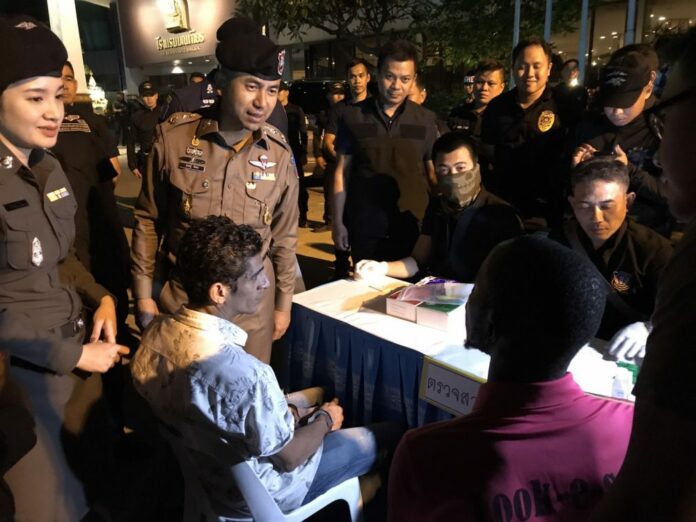
Tourist police and Bang Rak police on early Friday arrested foreigners who illegally entering the country, working without a permit and possessing drugs.
BANGKOK — More than 120 foreigners were arrested early Thursday morning in Bangkok’s Bang Rak area.
At about 1:30am, 122 foreigners were taken to the Bang Rak Police Station to hear charges of illegally entering the kingdom, overstaying their visas or possessing drugs.
Among them were nationals from Egypt, Russia, Laos, Myanmar, Cambodia, Vietnam, China, India, Iraq, Nigeria, Afghanistan and the Netherlands. Samples of their DNA will be taken and they will be blacklisted from re-entering for a period of time depending on their infractions, Tourist Police Deputy Commissioner Maj. Gen. Surachet Hakpal said.
Surachet said some of the foreigners worked illegally as language teachers, football players and priests.
The arrest is part of an ongoing effort police have called “X-Ray Outlaw Foreigner” to clamp down on foreign nationals involved in illegal activities. It began in early February at several venues with more than 300 foreigners arrested so far for entering the country illegally, working without a permit and testing positive for drugs.
Last month, 10 nationals from India and a number of African countries were arrested for various offenses at the Nana Hotel in Soi Sukhumvit 4, as part of a raid on “colored people”police called “Operation Black Eagle.”