Marcus Kingo and his daughter Susannah Kingo during their July vacation in Thailand. Photo: Marcus Kingo / Facebook
PHUKET — The internet Tuesday was singing the praises of a Swede who used his vacation time to clean up a Thai beach and encourage others to do the same.
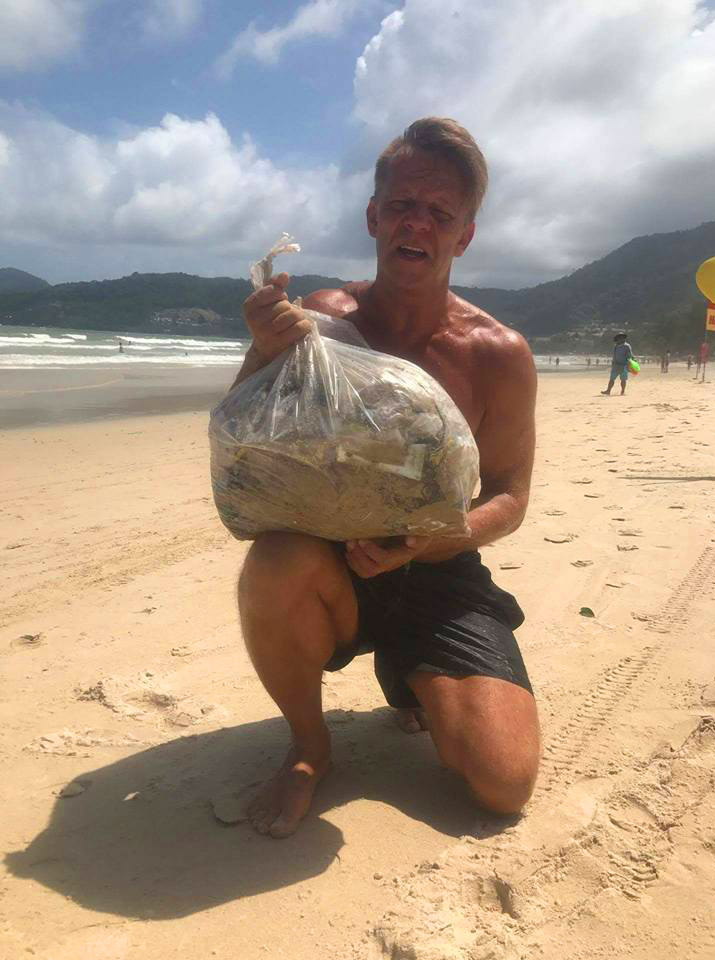
Marcus Kingo holds a bag of trash he picked up from Phuket’s Patong Beach. Photo: Marcus Kingo
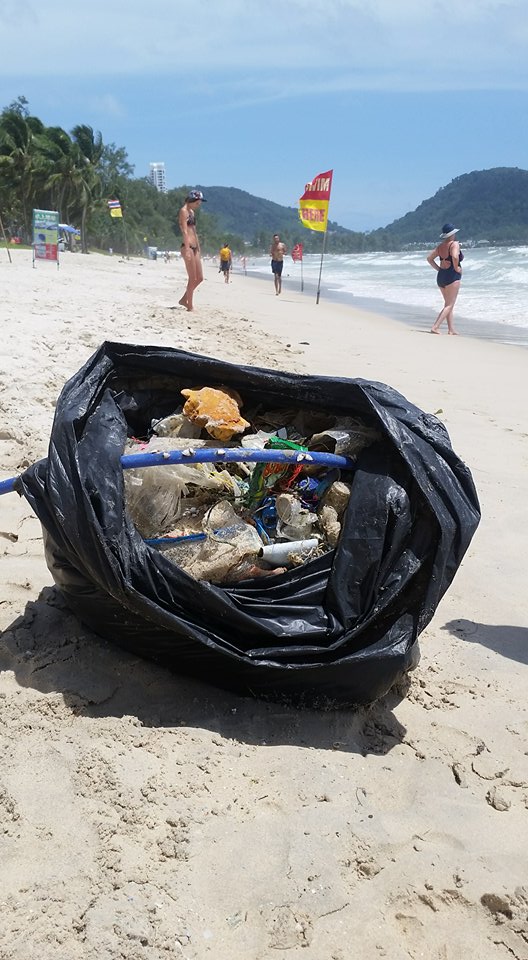
Marcus Kingo was being held up as a model tourist for a series of images posted online in which he and his 20-year-old daughter hauled trash from Patong Beach on Phuket. The images were posted Sunday to posted Sunday along with an appeal for other visitors to chip in.
“The first time we got to Phi Phi island beach, I remember looking at this beautiful beach with a gorgeous scenery, however when I looked on the shore I was sad to see all the garbage floating up on the beach from what I assume was mostly careless tourists. I was heart broken,” Kingo wrote Tuesday in reply to inquiries.
Kingo said that’s when he first grabbed a bag and started scooping up garbage. Soon, he said, others joined in, asking if they could help.
“It was nice to do something good,” he wrote.
One of the bags of trash Kingo gathered Sunday.
As of Tuesday, Kingo’s tale had been reshared across the Thai internets, where netizens have responded with praise.
“The country needs tourists like these. He even cares about the cleanliness of our beaches even more than some Thais who litter,” wrote the admin of Drama-addict, an online clearinghouse usually reserved for outrage.
Praise, however, wasn’t Kingo’s goal.
“It’s very important I did not do this to get praise for my self [sic],” he wrote. “I only wanted other tourists to do the same. To take one hour from their vacation to do something nice, that we all benefit from it.”
Big tech and startup expos can be great events, not just those for those involved in the tech space but also anyone with a general interest. Events like Techsauce, which unfolded over two days this past weekend in Bangkok, give startups exposure to potential partners and investors.
They also provide a venue for everyone in the industry to mingle and talk shop, possibly make deals and craft opportunities. And, of course, they give us observers an idea of how things have changed and where they are going. All of this and more was in play at this year’s Techsauce.
Low Ngai Yuen, executive director of the nonprofit Global Entrepreneurship Movement, speaks at the Techsauce Global Summit this past weekend at Bangkok’s Centara Grand.
While financial technology, or fintech, has been hot and continues to go strong in Asia, it’s digital consultancy and innovation consulting which really kicked into overdrive during the past year. We are seeing many more companies jump into that space. Even HUBBA Thailand – which many Bangkokians know as the company behind a number of trendy co-working spaces – is getting into the innovation consultancy market, which was touched on by company CEO Amarit Charoenphan when I spoke to him on Friday, the details of which can be heard in my podcast below.
The Techsauce Global Summit offered a lot to the local startup community in its fifth outing held Friday and Saturday at Centara Grand. The event has quickly solidified its place as a top-tier event in Thailand, attracting an impressive list of speakers to expound across its multiple stages. The exhibition hall was filled with startups, accelerators and some more established companies, mostly from Thailand but also drawn from the ASEAN region. The business matching corner of the event, though housed in a rickety two-level structure that reminded me of a poorly erected construction site, was constantly in use, filled with entrepreneurs, investors and senior managers from businesses trying to lay the groundwork for future deals.
While the event as a whole was well run, and brought in a great deal of talent, there were some ups and downs over the two days. But, overall, Techsauce was a positive event for entrepreneurs, investors and any business in general.
Attendees at the Techsauce Global Summit this past weekend at Bangkok’s Centara Grand.
For me, the real value for attendees was attending any number of the speaker sessions, panel discussions and fireside chats. The list of speakers was phenomenal. While many were based in Thailand, more than a fair share were brought in from not just the region but the globe. For anyone in attendance, the absolute value one could gain from attending any number of these sessions was fantastic.
There were a number of topics on the docket for the various stages. Some interesting panels on fintech delved into the future of cryptocurrency. A handful of talks I popped into touched on the importance of sales. And a lot of success stories were floated, some far more interesting than others.
One of the interesting sessions on the agenda was a workshop with Maqe CEO Andreas Holmer about innovating under changing circumstances. Holmer addressed methods corporations and startups can use to foster innovation internally. Techniques such as lean startup methodologies, design thinking and the sprint method are front and center with this model. I spoke to him on Saturday about what MAQE was focused on, which can be heard in my day-two podcast.
The main expo hall was filled with startups showing off their newest or prospective offerings. For the most part, companies were clustered into similar areas, such as lifestyle and urban tech. But it was very clear that fintech and business solutions dominated the floor. My only complaint was that some of the space was difficult to navigate as the layout created easily congested bottlenecks.
The business matching area at the Techsauce Global Summit this past weekend at Bangkok’s Centara Grand.
One of the interesting international organizations on the floor was Kuala Lumpur NGO Global Entrepreneurship Movement, or GEM. Gem was promoting their Colossus competition for companies to build solutions aimed at improving ASEAN countries and propelling them to first-world status. GEM is looking for ideas that span about every facet of the startup world — smart city, urban tech, fintech, even agriculture technology.
The business matching session was something a lot of people I had talked to beforehand were excited about. Think of it as speed dating for businesses and investors. The same methods apply: sit and pitch to each other before a bell rings, and you move on.
Despite this being part of the event that many people were looking forward to, and something Techsauce emphasized as a highlight, it felt like an afterthought. The business matching section was tucked into a corner behind an extremely loud stage. The space around that section was cramped, as though the designers didn’t anticipate a high volume of foot traffic, and the two-level structure, as I mentioned earlier, looked unsafe, at best.
That wasn’t just my opinion though, I talked to several participants with similar views.
One of which was Sivalee Anantachart a partner from Launchpad, or as she is better known in the Thai startup scene SoMA SoM. Her thoughts were:
“The area was in a corner and space was limited. It was noisy, as there was a stage nearby and when each round ends, there’s a loud buzz which almost sounds like a fire alarm,” said Sivalee. “Plus the metal rods look a bit unstable, and I was questioning the safety side of things. Other than that, it was great.”
Had there been some more thought put into planning the business matching activities it likely would have been the sole blemish on what was otherwise a well-run and organized event.
Overall, the Techsauce Global Summit was a first-rate event by global standards. It still feels a bit Thai-centric, but less so than last year. If that trend continues, I could see it becoming the must-attend event in Asia, or at the least a contender for that title.
Kings Canyon National Park. Image: Google. Right, Thiwadee Saengsuriyarit seen here in an undated photo. Photo: Methinee Meeluea / Facebook
FRESNO, California — American authorities on Tuesday were still searching for two Thais studying in the United States who went missing after their car fell off a cliff, the Thai foreign office said.
Busadee Santipitaks, a foreign affairs official, said the Thai consulate in Los Angeles was cooperating with local authorities to find Thiwadee Saengsuriyarit and her friend, identified only as Golf. The pair went missing Wednesday after their vehicle was found submerged in the river at the foot of a 150-meter-high cliff by the California State Route 180.
“The water is very fast-running and the geography is inaccessible, so authorities have not been able to investigate the area where the truck fell yet,” Busadee said.
The pair allegedly drove off a cliff on their way to Kings Canyon National Park, she said.
Methinee Meeluea, a friend of Thiwadee’s, publicized Thiwadee and Golf’s disappearance on a Facebook post Sunday, which had gone viral as of Tuesday morning.
“I don’t know what to do, or what can be done. I just want everyone, whether you know Min or not, to pray for her and her friend,” Methinee Meeluea wrote, referring to Thiwadee’s nickname. She says she does not know Golf’s real name. Methinee was reached for comment Tuesday, but did not reply.
Busadee said Thiwadee and Golf had not checked into their booked hotel accommodations as of Tuesday morning.
Thiwadee is a Master’s student in environmental studies at the University of South Florida.
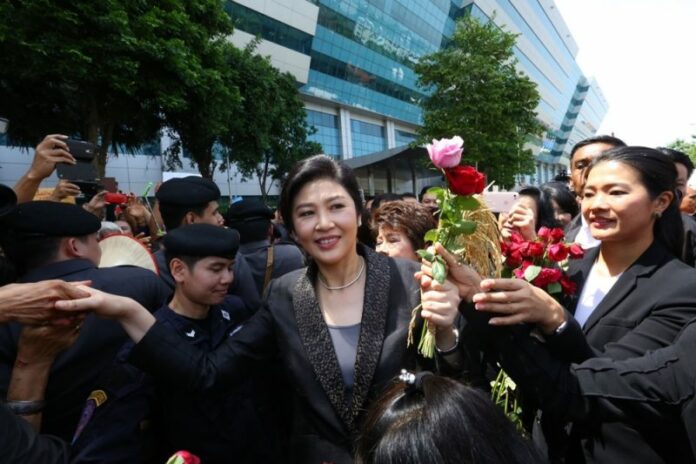
Former premier Yingluck Shinawatra accepts flowers from her supporters on Aug.1 outside the Supreme Court in Bangkok.
Story Pravit Rojanaphruk and Teeranai Charuvastra
BANGKOK — Former Prime Minister Yingluck Shinawatra told the Supreme Court that she is the victim of an “intricate political game” and asked the judges for justice in her closing statements Tuesday.
Eighteen months after her malfeasance trial began, Yingluck said she acted earnestly to assist farmers by introducing a rice subsidy program, did what was within her power to combat corruption in the program and was never derelict in her duties.
“I know very well that I am a victim of an intricate political game and hope that the court will afford me justice,” 50-year-old Yingluck said, speaking for nearly an hour from prepared statements.
A verdict is expected Aug. 25, and Yingluck faces up to 10 years in prison if convicted. No Thai prime minister, past or present, has ever been sent to prison on a criminal matter.
She accused Prayuth Chan-ocha, who leads the junta which ousted her government known as the National Council for Peace and Order, of trying to steer the outcome of the trial.
“I’d like to ask the court to kindly deliberate and judge this case in accordance with facts, legal basis and evidence entered legally, and not follow the manipulation of anyone, including the leader of the NCPO, who has people’s fates and the power of the state in his hands,” she said. “He earlier made prejudicial comment to the public that ‘if this thing was not wrong, it would not have gone to the courts to begin with.’ This is a clear indication that he is trying to lead before the court makes its ruling.”
As to the specific allegations against her, that she was responsible for massive losses incurred under agricultural price-guarantees introduced by her government, Yingluck said she committed no crime.
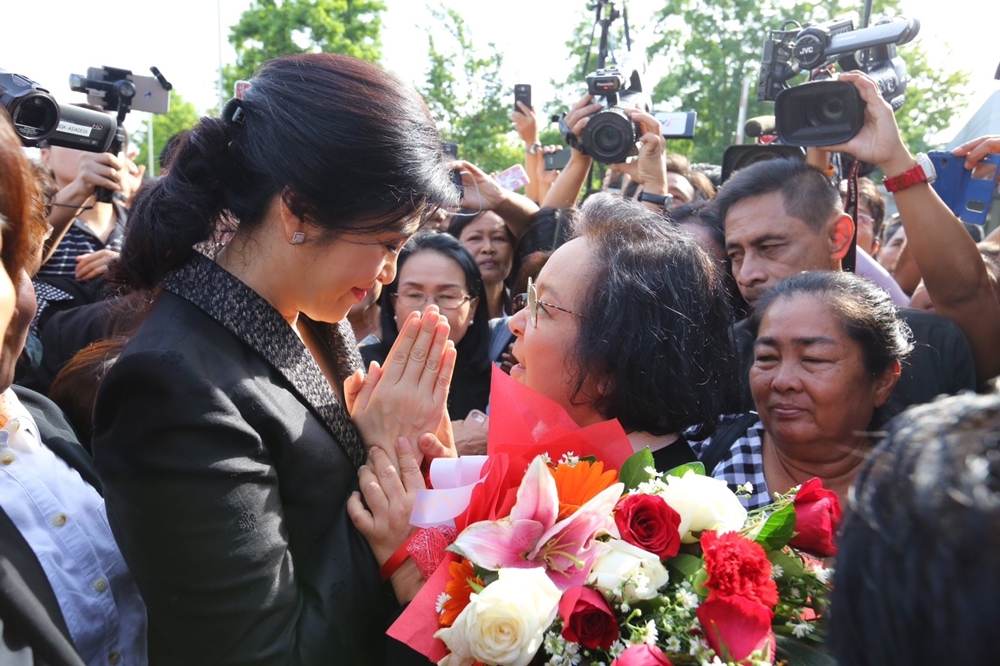
Former premier Yingluck Shinawatra greets a supporter outside the court Tuesday.
She said the program was beneficial to farmers and the general economy, and was bound to run losses.
As for her culpability in any corruption that occurred under her watch, she denied refusing to act on warnings and said she had ordered more stringent anti-graft measures for the program weeks before a no-confidence vote was staged against her on Nov. 25, 2013.
She said Prayuth Chan-ocha, the former army commander who ousted her government, understood the limits to a prime minister’s power, which was why he set those aside upon installing himself as prime minister.
“Even [Prayuth] understands this limitation. That’s why he invested himself with absolute power under Article 44, to issue orders and run the administration in the way that an elected government like mine could never do,” she said, referring to the relevant article in the junta’s interim constitution. Prayuth retains absolute power under the new constitution adopted earlier this year.
Beneficial or Destructive?
The trial has dominated political spheres since March 2015, when the Supreme Court’s Division for Holders of Political Office accepted the case against Yingluck.
At the heart of the trial is the rice subsidy, a key populist policy undertaken by Yingluck’s administration after she came to power in August 2011. Under the policy, the government bought rice from farmers at the premium price of up to 20,000 baht per ton, with the promise that it would resell it without affecting the market.
“The government will adopt a system of mortgaging agriculture products as a way to build income stability for farmers,” the newly elected Yingluck told the parliament on Aug. 23, 2011. “We will begin with the mortgage of unhusked white rice and jasmine rice.”
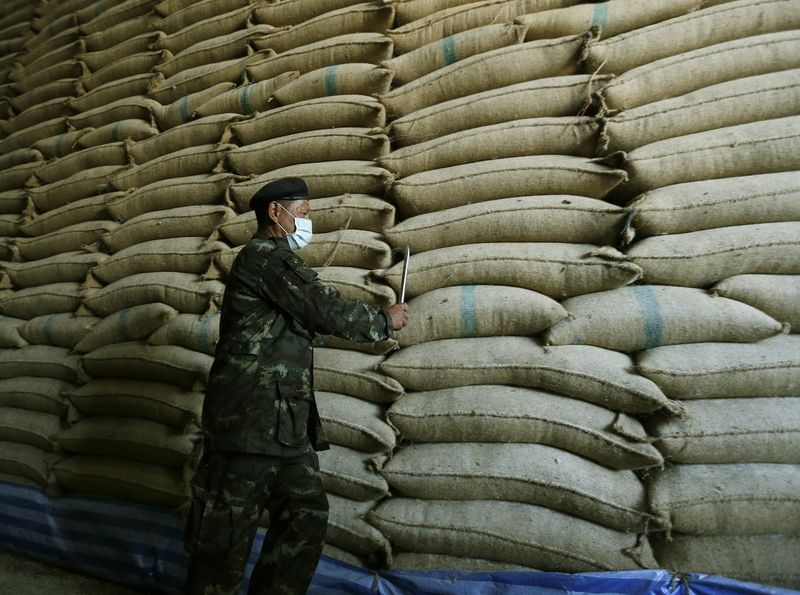
A Thai soldier inspects the quality of rice stored at a warehouse in Ban Phraek city, Ayutthaya province, Thailand, 03 July 2014. The inspection uncovered rot and corruption, reports said. EPA/NARONG SANGNAK
Opposition politicians also accuse Yingluck’s administration of corruption. One allegation charged that the government claimed to have sold rice to the Chinese government whereas the true beneficiary was Thai businesses with ties to the ruling Pheu Thai Party.
The minister in charge of the deal, Boonsong Teriyapirom, is also being tried on charge of fraud. His verdict is due the same day as Yingluck’s.
At today’s closing statement to the court, Yingluck said her case was about future governments’ ability to improve the lives of rural farmers, many of whom live in poverty.
“So that their children will be able to afford education and prosperity. Something I am most proud of in my life is the fact I had the opportunity to push for the program on behalf of the rice farmers,” she said in court. “I will continue to persevere in hope that future governments will be able to devise public policies that benefit people, that will free them from debt.”
Multi-Front Battle
The National Anti-Corruption Commission said in 2014 it found evidence of graft a year after launching its investigation. A guilty verdict by the commission resulted in the negligence count being filed against Yingluck.
Her trial took off in May 2016 under the regime of junta chairman Prayuth Chan-ocha, who has openly expressed contempt for Yingluck’s brother, former premier Thaksin Shinawatra, and sought to uproot the legacy of their political clan.
While the junta maintains it never has never interfered with the court case, Yingluck’s supporters say she hasn’t received a fair trial. The court rejected many witnesses the defense sought to call. Yingluck was declared a flight risk and ordered to seek court permission to leave the country.
Her team of lawyers has repeatedly filed motions to delay or dismiss the trial, all of which were rejected.
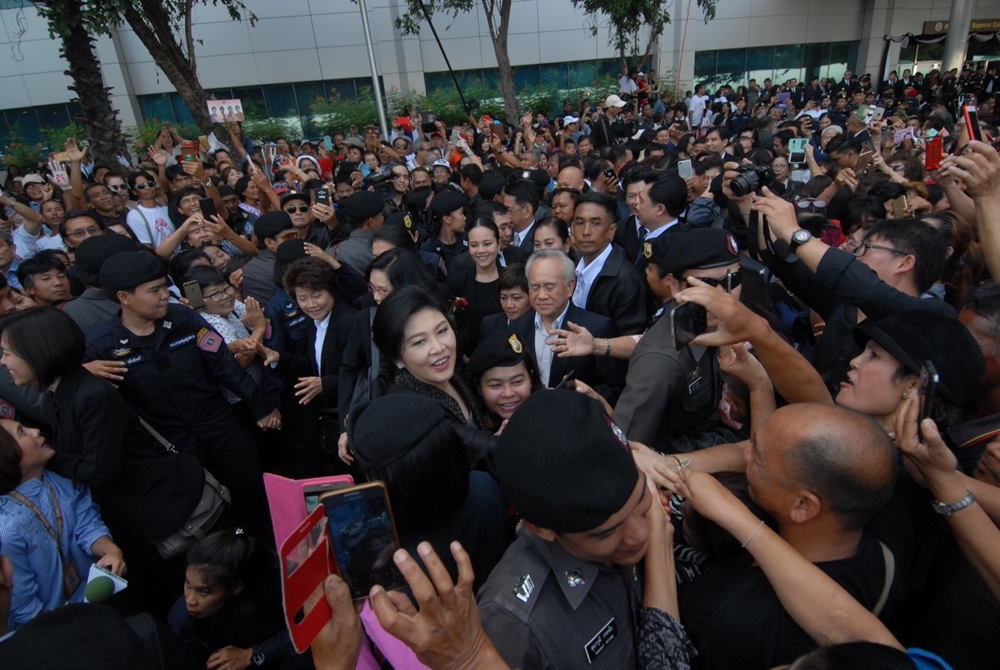
All told, Yingluck made 26 appearances in court to defend herself. Each appearance, including today’s closing statement, saw large crowds of supporters presenting roses and cheering her name.
“I am a daughter of farmers. I know how difficult it is for them without this policy,” said 48-year-old Mulika Phodaeng, who was among more than 1,000 supporters in front of the court Tuesday. “This is totally unjust.”
“If she has to go to jail. I will sleep in front of the jail. I will always be with her. I know she is likely to be convicted,” said another supporter, Pensri Charoennenraksa, 54. “But we know, the court also knows that she’s innocent. How can she be guilty for helping farmers?”
Senior politicians with Pheu Thai, the party of Yingluck and her government, also showed up at the court, including Nattawut Saikua, Kittirat Na Ranong and Watana Muangsook. Three police companies guarded the scene.
Former premier Yingluck Shinawatra greets her supporters Tuesday outside the Supreme Court in Bangkok.
Citing the need to keep public order, junta chairman Prayuth Chan-ocha has urged Yingluck’s supporters to stay home on the day of the verdict. He also warned that any attempt to mobilize a crowd may result in legal action.
“You can like or love anyone, but I don’t see why you should cause troubles for others,” Prayuth said July 24. “Whoever mobilizes the masses to come out, they must know it violates all kinds of laws.”
Tension between Yingluck’s camp and the regime rose sharply last week when the government seized 12 of her bank accounts before the verdict is reached. Officials said they are complyingwith a parallel regime order that she personally compensate the state for the losses of her government’s program.
In court Tuesday, she decried that decision, saying it went against international judicial norms.
“The current administration uses its power as if they are the judiciary themselves,” she said.
Yingluck and her aides had asked the regime to wait for a verdict before moving against her, but Prayuth said the former premier must be held accountable for her government’s damages, and the seizure of her assets was unrelated to the ongoing trial.
“I ask you not to mix these two stories up to instigate the people,” Prayuth told reporters Thursday. “Or to distort that we mistreated her by confiscating her assets, because it’s a different story.”
Additional reporting Sasiwan Mokkhasen
For the full closing statement by Yingluck, click HERE.
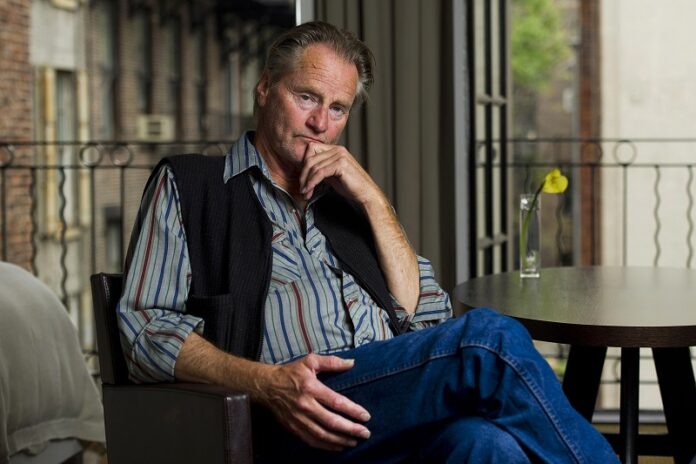
Actor Sam Shepard poses for a portrait in 2011 in New York. Photo: Charles Sykes / Associated Press
NEW YORK — Sam Shepard, the Pulitzer Prize-winning playwright, Oscar-nominated actor and celebrated author whose plays chronicled the explosive fault lines of family and masculinity in the American West, has died. He was 73.
Family spokesman Chris Boneau said Monday that Shepard died Thursday at his home in Kentucky from complications related to Lou Gehrig’s disease, or amyotrophic lateral sclerosis.
The taciturn Shepard, who grew up on a California ranch, was a man of few words who nevertheless produced 44 plays and numerous books, memoirs and short stories. He was one of the most influential playwrights of his generation: a plain-spoken poet of the modern frontier, both lyrical and rugged.
In his 1971 one-act “Cowboy Mouth, which he wrote with his then-girlfriend, musician and poet Patti Smith, one character says, “People want a street angel. They want a saint but with a cowboy mouth” – a role the tall and handsome Shepard fulfilled for many. But in soul-searching plays, his portrait of the West was a disillusioned one, peopled by broken characters whose realities fell far short of the American Dream.
“I was writing basically for actors,” Shepard told The Associated Press in a 2011 interview. “And actors immediately seemed to have a handle on it, on the rhythm of it, the sound of it, the characters. I started to understand there was this possibility of conversation between actors and that’s how it all started.”
Shepard’s Western drawl and laconic presence made him a reluctant movie star, too. He appeared in dozens of films – many of them Westerns – including Terrence Malick’s “Days of Heaven,” ”Steel Magnolias,” ”The Assassination of Jesse James by the Coward Robert Ford” and 2012’s “Mud.” He was nominated for an Oscar for his performance as pilot Chuck Yeager in 1983’s “The Right Stuff.” Among his most recent roles was the Florida Keys patriarch of the Netflix series “Bloodline.”
But Shepard was best remembered for his influential plays and his prominent role in the Off-Off-Broadway movement. His 1979 play “Buried Child,” about the breaking down of an Illinois family, won the Pulitzer for drama. Two other plays – “True West,” about two warring brothers, and “Fool for Love,” about a man who fears he’s turning into his father – were nominated for the Pulitzers as well. All are frequently revived.
“I always felt like playwriting was the thread through all of it,” Shepard said in 2011. “Theater really when you think about it contains everything. It can contain film. Film can’t contain theater. Music. Dance. Painting. Acting. It’s the whole deal. And it’s the most ancient. It goes back to the Druids. It was way pre-Christ. It’s the form that I feel most at home in, because of that, because of its ability to usurp everything.”
Samuel Shepard Rogers VII was born in Fort Sheridan, Illinois, in 1943. He grew up on an avocado ranch in Duarte, California. His father was an alcoholic schoolteacher and former Army pilot. Shepard would later write frequently of the damage done by drunks. He had his own struggles, too. Long stretches of sobriety were interrupted by drunk driving arrests, in 2009 and 2015.
Shepard arrived in New York in 1963 with no connections, little money and vague aspirations to act, write or make music. “I just dropped in out of nowhere,” he told the New Yorker in 2010. But Shepard quickly became part of the off-off-Broadway movement at downtown hangouts like Caffe Cino and La MaMa. “As far as I’m concerned, Broadway just does not exist,” Shepard told Playboy in 1970 – though many of his later plays would end up there.
His early plays – fiery, surreal verbal assaults – pushed American theater in an energized, frenzied direction that matched the times. A drummer himself, Shepard found his own rock ‘n roll rhythm. Seeking spontaneity, he initially refused to rewrite his drafts, a strategy he later dismissed as “just plain stupid.”
As Shepard matured as a playwright, he returned again and again to meditations on violence, masculinity and family. His collection “Seven Plays,” which includes many of his best plays, including “Buried Child” and “The Tooth of Crime,” was dedicated to his father.
“There’s some hidden, deeply rooted thing in the Anglo male American that has to do with inferiority, that has to do with not being a man, and always, continually having to act out some idea of manhood that invariably is violent,” he told The New York Times in 1984. “This sense of failure runs very deep – maybe it has to do with the frontier being systematically taken away, with the guilt of having gotten this country by wiping out a native race of people, with the whole Protestant work ethic. I can’t put my finger on it, but it’s the source of a lot of intrigue for me.”
Shepard was married from 1969 to 1984 to actress O-Lan Jones, with whom he had son Jesse Mojo Shepard.
His connection to music was constant. He joined Bob Dylan on the 1975 Rolling Thunder Revue tour of 1975, and co-wrote the song “Brownsville Girl” with him. Shepard and Patti Smith were one-time lovers but lifetime friends. “We’re just the same,” Smith once said. “When Sam and I are together, it’s like no particular time.”
Shepard’s movie career began in the late ’70s. While making the 1982 Frances Farmer biopic “Frances,” he met Jessica Lange and the two remained together for nearly 30 years. They had two children, Hannah Jane and Samuel Walker. They separated in 2009. Lange once said of Shepard: “No man I’ve ever met compares to Sam in terms of maleness.”
Shepard worked occasionally in movies (among other things, he wrote Wim Wenders’ 1984 Texas brothers drama “Paris, Texas”) but took acting gigs more frequently as he grew older. One movie, he said, could pay for 16 plays.
Besides his plays, Shepard wrote short stories and a full-length work of fiction, “The One Inside,” which came out earlier this year. “The One Inside” is a highly personal narrative about a man looking back on his life and taking in what has been lost, including control over his own body as the symptoms of ALS advance.
“Something in the body refuses to get up. Something in the lower back. He stares at the walls,” Shepard writes. “The appendages don’t seem connected to the motor – whatever that is – driving this thing. They won’t take direction – won’t be dictated to – the arms, legs, feet, hands. Nothing moves. Nothing even wants to.”
Shepard’s longtime editor at Alfred A. Knopf, LuAnn Walther, said Shepard’s language was “quite poetic, and very intimate, but also very direct and plainspoken.” She said that when people asked her what Shepard was really like, she would respond, “Just read the fiction.”
The playwright is survived by his three children and two sisters: Sandy and Roxanne Rogers.
In Shepard’s 1982 book “Motel Chronicles,” he said that he felt like he never had a home. That feeling, he later, acknowledged, always remained.
“I basically live out of my truck,” Shepard said in 2011. “I feel more at home in my truck than just about anywhere, which is a sad thing to say. But it’s true.”
Incoming White House communications director Anthony Scaramucci, right, blowing a kiss last month after answering questions during the press briefing in the Brady Press Briefing room of the White House in Washington. Photo: Pablo Martinez Monsivais / Associated Press
BOSTON — Harvard Law School apologized Monday after its new alumni directory erroneously listed ousted White House communications director Anthony Scaramucci as dead.
The directory included an asterisk next to Scaramucci’s name indicating that he had been reported dead since the previous edition was released in 2011.
“Regrettably, there is an error in the Harvard Law School alumni directory in the listing for Anthony Scaramucci,” Harvard Law spokeswoman Michelle Deakin said in a statement. “We offer our sincere apologies to Mr. Scaramucci. The error will be corrected in subsequent editions.”
The directory is published every five years and is available only to alumni of the Ivy League law school in Cambridge, Massachusetts.
Scaramucci, who left his White House post on Monday after only 11 days on the job, is a 1989 graduate of the law school. He also served as an “expert in residence” there in 2012, according to Harvard Law’s website, offering finance and investment advice to students.
He founded the SkyBridge Capital investment fund in 2005 and later served as a senior official for the U.S. Export-Import Bank before being named communications director for the White House on July 21.
Scaramucci shocked many last week with an expletive-laced interview that targeted then-chief of staff Reince Priebus and White House chief strategist Steve Bannon. He later tweeted that he sometimes uses “colorful language” and pledged to refrain.
But on Wednesday, the White House announced his resignation only hours after former Gen. John Kelly was sworn in as President Donald Trump’s new chief of staff.
Experts from KNG Petrovietnam work in LLC TyumenNIIgiprogas about geological and reservoir simulation model of the Severo-Purovskoe gas condensate field in 2014 in Tyumen, Russia. Photo: DMyshkin / Wikimedia Commons
HANOI — A former Vietnamese oil executive has surrendered to police after a year on the run amid a crackdown on corruption by the country’s communist authorities.
Trinh Xuan Thanh, 51, disappeared in July last year after he was accused of mismanagement at a subsidiary of national oil and gas giant, PetroVietnam, resulting in losses of some USD $150 million.
Police issued an arrest warrant against Thanh in September. Officials have said he fled to Europe.
Thanh turned himself to police on Monday, the Ministry of Public Security said on its website without giving more details.
The ruling Communist Party and government have stepped up their anti-corruption drive over the past few years with courts handing down the death penalty against several senior executives.
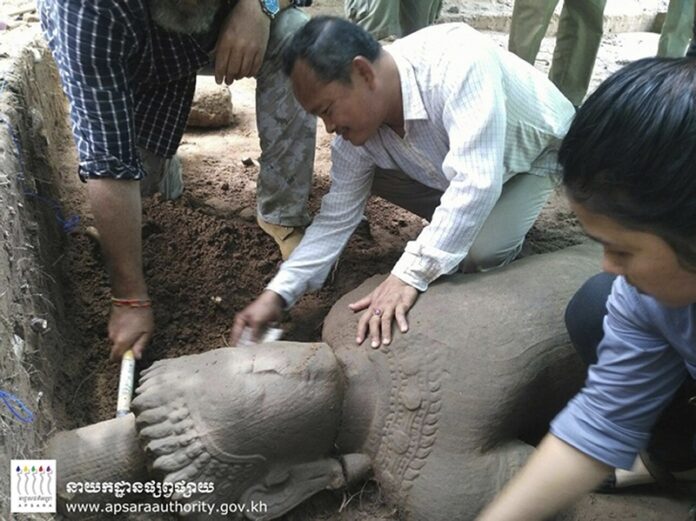
Archaeologists examine a 1.9-meter (6-foot, 3-inch) tall, 58-centimeter (23-inch) wide statue Monday at Angkor Wat in Siem Reap, Cambodia. Image: Associated Press
PHNOM PENH — Archaeologists at Cambodia’s Angkor Wat temple complex studying the site of a hospital from eight to nine centuries ago say they have found a large statue in their excavations.
The government agency that oversees the complex, the Apsara Authority, said on its website that the 1.9-meter (6-foot, 3-inch) tall, 58-centimeter (23-inch) wide statue was discovered Sunday by its team, working with experts from Singapore’s Institute of Southeast Asian Studies. It is one of the largest statues from the era to be unearthed in recent years.
The agency said the statue, believed to be from the 12th or 13 century, is thought to have been a symbolic guardian of the entrance of the hospital. It was found buried 40 centimeters (16 inches) under the ground, and will be put on public exhibition in the museum in the northwestern province of Siem Reap, where Angkor is located.
In late 2011, archaeologists at the temple complex unearthed the two largest Buddhist statues found there in eight decades.
Angkor was the capital of the Khmer Empire, which flourished from approximately the 9th to 15th centuries. Large numbers of architectural and religious artifacts have been looted from there and sold overseas, while others were buried for safekeeping during a civil war in the 1970s.
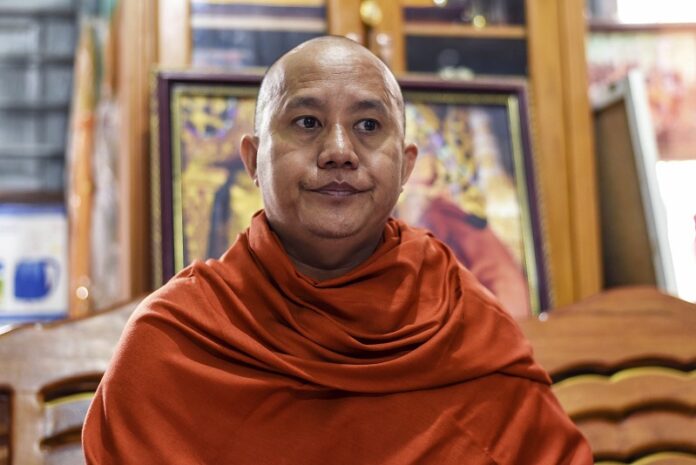
Ashin Wirathu, a high-profile leader of the Myanmar Buddhist organization known as Ma Ba Tha, is interviewed last year at his monastery in Mandalay, Myanmar. Photo: Aung Naing Soe / Associated Press
YANGON — Police in Myanmar have detained a prominent journalist, accusing him of attempting to flee the country shortly before his trial on defamation charges brought by a follower of a Buddhist monk who has stirred up anti-Muslim hatred.
The editor of the nonprofit online news outlet Myanmar Now, Swe Win, was taken by police on Monday to the central city of Mandalay, where his trial is to begin Thursday. His lawyer said he was detained Sunday as he prepared to board a flight to Thailand to make arrangements for the news service’s operations while he is involved with his trial.
The complaint against him was made by a follower of Wirathu, a Mandalay-based Buddhist monk best known for his provocative speeches about the country’s Muslim minority. An organization led by Wirathu, Ma Ba Tha, has been accused of stirring up sentiment against Muslims, leading to deadly violence.
Swe Win criticized Wirathu on social media, accusing him of violating the Buddhist code of monastic discipline.
Several journalists have been arrested recently in cases that rights advocates say violate freedom of expression.
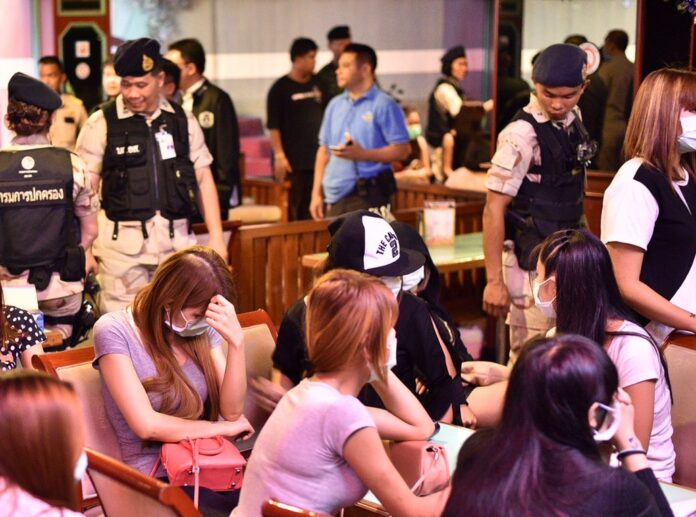
Officers from the Ministry of Affairs raid the Nataree brothel on Bangkok’s Ratchadaphisek Road in June 2016.
BANGKOK — Thailand should stop prosecuting female sex workers, improve conditions in women’s prisons and take steps to protect female human rights defenders, the UN body in charge of promoting gender equality has suggested.
Those issues were among a host of recommendations from the UN Committee on the Elimination of Discrimination Against Women, or CEDAW, in its first such review of women’s status in the kingdom in over a decade.
Although most the report’s 14 pages were devoted to measures Thailand should take to live up to its international and self-imposed commitments to gender parity, it did acknowledge positive developments such as enactment of the 2007 Protection of Victims of Domestic Violence Act, the junta-sponsored constitution of 2007 and – with some caveats – the Gender Equality Act of 2015.
“The Committee notes that the revised Constitution, which came into effect in April 2017, prohibits discrimination on various grounds, including sex, and guarantees the principle of equality between men and women,” the committee wrote.
It noted the Gender Equality Act included exceptions to those guarantees for matters of religion and “national security.” It also urged protections against discrimination be guaranteed in the southern border provinces, where they do not apply.
The committee’s recommendations came July 24, about two weeks after the military government presented its progress report in Geneva.
CEDAW recommends that Thailand review the Suppression and Prevention of Prostitution Act in order to decriminalize women in prostitution.
What’s more, the committee said the root causes of prostitution should addressed and targeted adopted measures to prevent women in vulnerable situations from entering prostitution. This, it said, could be achieved by providing women with alternative income opportunities.
What’s more, it called for the immediate end of the practice of violent raids of entertainment venues, entrapment operations and extortion.
In a climate that has seen at least one human rights lawyer charged with sedition for representing political dissidents, CEDAW recommended that Thailand adopt and implement “effective measures for the protection of women human rights defenders to enable them to freely undertake their important work without fear or threat of lawsuits, harassment, violence or intimidation.”
On women in detention, the committee recommended urgent measures be taken to reduce the number of women incarcerated and improve conditions of women’s detention facilities in accordance with a set of UN guidelines also known as “the Bangkok Rules.”
“Prohibit and take immediate action to discontinue invasive physical searches of women by penitentiary officers and extend the use of technologies such as 3D body scanners to all prisons,” the committee advised.
Eliminating harmful stereotypes was another issue raised by the committee. CEDAW urged Thailand to adopt a comprehensive strategy with proactive and sustained measures that target women and men at all levels of society, including religious and traditional leaders.
This should be done “to eliminate stereotypes and patriarchal attitudes concerning the roles and responsibilities of women and men in the family and society and harmful practices that discriminate against women.”
On the trafficking of girls and women, the committee recommended implementing effective protections, offering assistance and providing support to organizations which assist victims of trafficking.
The committee also recommends Thailand pass legal guarantees that women and men enjoy equal rights to confer their nationality on foreign spouses.
In the end, the committee said the Thai government should publish the recommendations in Thai language and distribute them to all related agencies to encourage their full implementation.