

































30 C
Bangkok
Monday, June 8, 2026
Home Blog Page 2332

Former Prisoner and Blogger Unite to Bring Beauty Behind Bars

Former prisoner Pronthip 'Kolf' Mankong, at left, and beauty writer Watinee Chaithirasakul, at right. They recently launched a project to donate lipstick to female inmates at Bangkok's central prison.

BANGKOK — With drugstores on almost every corner, cosmetics are never far for that boost to beauty and self-confidence. But out of reach for those whose bodies have been incarcerated.

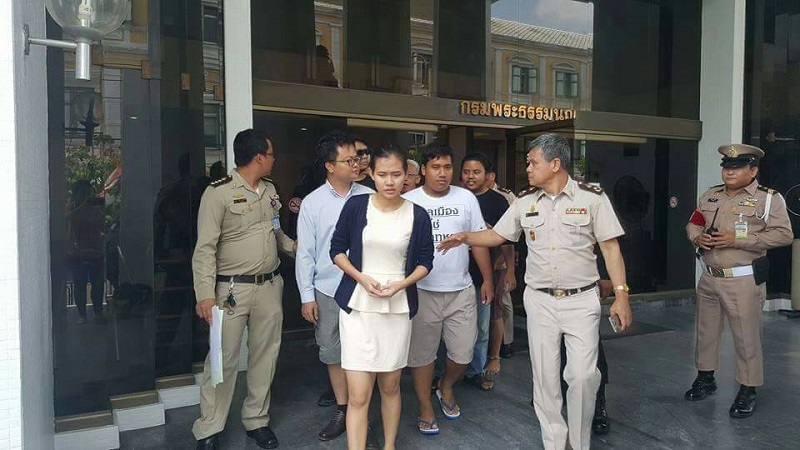
It’s been eight months since Pronthip “Kolf” Mankong walked out the Bangkok women’s prison after serving two years for a student play deemed insulting to the royal family.

From her experience, it was rare for inmates to own any cosmetics. Those that did had to buy them from the the prison black market for double or triple the price. Now that she’s out, she’s come up with a project with a beauty blogger to donate lipstick to those behind bars to increase their self-esteem and give them some control over their appearance.

Read: Art on Trial: The Wolf Bride

“Some people say prisoners are sent to prison to correct their bad natures,” Kolf said. “But in fact, criminals still have their dignity as human beings, and their integrity cannot be deprived.”

According to Kolf, it’s a woman’s right to put on makeup as it can nurture the soul, a crucial source of succor when their body is confined.

“Just a single puff of powder can empower them and ensure their existence in the world to maintain their pride,” she said. “And it’s their basic right to have equal access to cosmetics.”

Kolf said it took her more than six months to gather basic eyebrow liner, lipstick and blush – cosmetics she needed most to increase her confidence when making court appearances where she knew her image would be splashed across the media.

She said she obtained the black market eyebrow liner for 600 baht and the blush for about 100 baht from another prisoner. Her lipstick she bought for a fair price of 29 baht from an official sale inside, but there weren’t many shades to choose from, and she had to queue two hours to purchase it.

“I was lucky that I could spend my money superfluously, as my relatives and friends visited me often,” Kolf said. “But most of the inmates don’t have much money and no one visits them. Also, they earned little money for their labor, merely 8 baht a day – well, if they received one.”

So Kolf, who also founded a group addressing women convict’s mental health, launched the “Sending Beauty to Women Behind Walls” in late April with beauty blogger Watinee Chaithirasakul, who she had met at a book fair.

Apart from running her family’s textile business, Watinee runs Siswalk Sistalk, a Facebook cosmetics page. Instead of seeking industry freebies, Watinee and Kolf decided to solicit the public for donations to send to the female prisoners.

It was Watinee who suggested starting with lipstick, as they were concerned about collecting old, unusable makeup, and lipstick freshness can be detected from its smell. The used tubes they collect will be sorted by color. Later, similar shades will be melted together for sterilization and dropped into clear containers.

They introduced the project April 25 in a post quickly liked and shared more than 1,000 times. Many people expressed interested in the project, including some brands that donated 500 tubes of lipstick.

“They don’t deserve to be suppressed to live a depressed life,” Watinee said. “The project helps people to think more about the inmates’ mentality and makes those inside realize there are still many people who care about them.”

Watinee said she wasn’t concerned about human rights and equality prior to the 2010 political unrest in Bangkok, which ended in violence and no one brought to justice. She wishes the project would inspire others to think more.

“Prison can’t confine inmates’ rights. They’re punished for their crimes, but their rights shouldn’t be punished,” she said.

To make sure the given lipsticks are provided fairly to everyone, Kolf contacted the Central Women’s Correctional Institution and will require all inmates sign for each tube received.

She estimated that 2,000 sticks would be enough for inmates in the reception wing. To supply all female convicts would require 5,000 tubes.

For the first phase, only plain lipstick – no gloss or glitter – are being collected through June 15 and will be given out at the women’s prison in August.

For more information on supporting the project, contact the Fairly Tell Group via Line ID 9October1987 or via Facebook at SisWalk SisTalk.

18160172 1399760090081840 1862097222 o e1494140674182
Image promoting the ‘Sending Beauty to Women Behind Walls’ project. Photo: SisWalk SisTalk / Facebook


Related stories:

Art on Trial: The Wolf Bride

Advertisement

Polls Open as France Chooses New President, Deciding Europe’s Fate

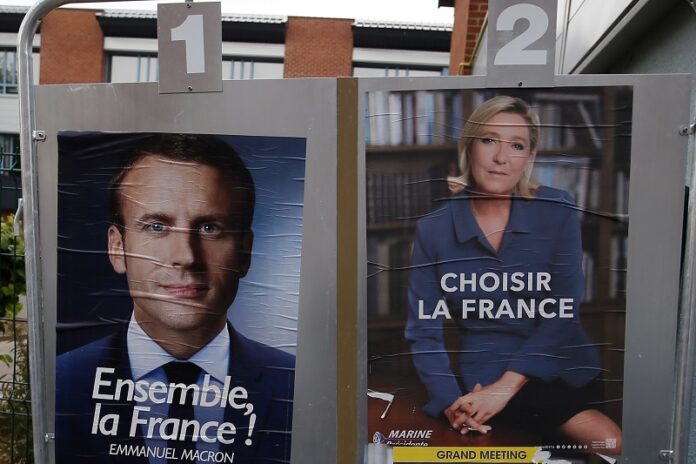
Children walk past election campaign posters for French centrist presidential candidate Emmanuel Macron and far-right candidate Marine Le Pen, Friday in Osses, southwestern France. Photo: Bob Edme / Associated Press

PARIS — Voters across France are casting ballots in a presidential election runoff that could decide Europe’s future, choosing between independent Emmanuel Macron and far-right populist Marine Le Pen.

With Macron the pollsters’ favorite, voting stations opened across mainland France at 8 a.m. (0600 GMT) under the watch of 50,000 security forces guarding against extremist attacks. Polling agency projections and initial official results will be available when the final stations close at 8 p.m. (1800 GMT).

The unusually tense and unpredictable French presidential campaign ended with a hacking attack and document leak targeting Macron on Friday night. France’s government cybersecurity agency is investigating the hack.

Either candidate would lead France into uncharted territory, since neither comes from the mainstream parties that dominate parliament and have run the country for decades.

Advertisement

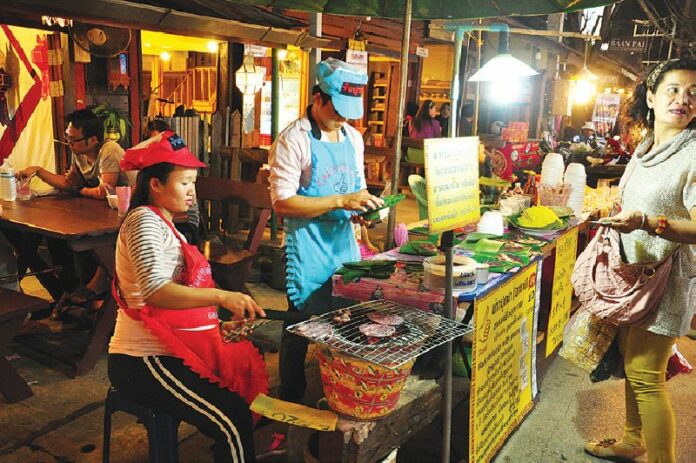
Bangkok Street Food Ban a Banal Assault on Way of Life

The irony of the debate on banning Bangkok’s street food was that it took foreigners – mostly Western media – to point out how unique and vibrant street food here was before the military regime backpedaled a tad.

Last month’s foreign news media reports about the clean-up – read: banning – of street food in the Thai capital was met with quick reassurance to foreign tourists by the regime that street food would still be available at major tourist spots such as Yaowarat and Khaosan roads.

Very little has been said about street food and what it means to ordinary Thais living and working in Bangkok, however. It was as if the government’s concerns was just about tourists’ money.

With many streets of Bangkok now bereft of street food, hundreds of thousands of working-class people who rely on it are being driven en masse to the ubiquitous convenience stores to savor frozen television food instead. It’s clear who will benefit taste-, nutrition- and money-wise. Many people ended up like cats being repeatedly fed on pre-cooked or ready-made food.

The junta’s citing of hygiene and order as a pretext for the clean-up has turned many roads in Bangkok such as Lat Phrao to resemble deserted streets or ghost towns at night, now that many vendors have been removed. Street food sellers – the majority of whom are lower-middle class – were simply told to move on and disappear, or offered alternative sites so inaccessible to have the same effect.

Intentionally or not, the consequence to the vibrancy of Bangkok is palpable. It’s as if we’re being atomized, our human relations reduced, readied for a marathon-length military rule – longer than what the junta has repeatedly reassured us concerning its longevity.

Pravit.mug .column.finalUnlike staff at convenient stores such as 7-Eleven and FamilyMart – both owned domestically by huge Thai conglomerates – who repeatedly ask if you will buy a Chinese dumpling or whatnot as they robotically thank you at the counter, there’s a sense of unpredictability in the human contact when chatting with street food vendors.
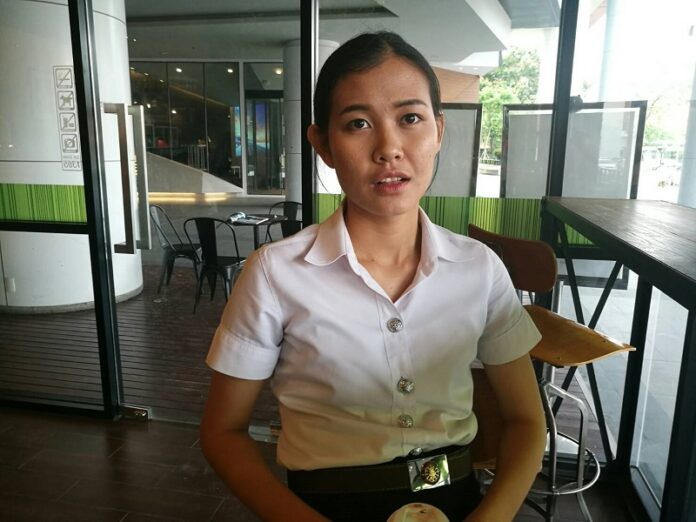
I couldn’t help but fear that deep down, junta leader Gen. Prayuth Chan-ocha might want to atomize us further, break up relations so it is easier for him to rule with an iron fist and with his embarrassing weekly Friday-television-propaganda-sermon that would have impressed Fidel Castro.

And if you find such a ban illogical, even self-defeating for Bangkok, then you might want to remind yourself that dictatorship is about control. Perfect totalitarian control is one that you obey without a second thought – actually without a thought. Dictatorial control is about making people jaded and being made to obey without thought. The more banal the dictatorial edict is, the better.

No matter how ill-conceived the banning of Bangkok’s street food is, in the end the victim is the city’s way of life and vibrancy.

As a Bangkokian, the latest order imposed by the junta is beyond saddening. At night, bustling places in Bangkok have turned eerily quiet and bereft of human activity and exchange. Gone is the midnight Bangkok street food you could find anywhere.

Indigent Bangkokians and non-Bangkokians seeking work in the capital can ill afford to dine at restaurants, so they end up with convenience store food, making the chain owners – who are already filthy rich – even richer. Will that be the predicament for millions for the rest of their working lives? Is there no way to strike a compromise and ensure greater hygiene and order without having to destroy street food?

I’m sure there’s a way if there’s a will and a recognition of the immense cultural and culinary value of street food – not just from the foreign tourist perspective.

All we can hope now is to wait for a revival of street food in some distant future.

Bring street food back to Bangkok after we regain democracy, and let the junta’s soldiers fete themselves to their hearts’ content on all the frozen television food provided by convenience stores inside military camps when they’re forced back their barracks.


Advertisement

Imprisoned Activist May Miss Awards Ceremony

An undated photo of jailed activist Jatupat “Pai” Boonpattararaksa seen in prison while awaiting trial on a charge of royal defamation for sharing a BBC Thai article on Facebook. Photo: Sa-nguan Khumrungroj / Courtesy

BANGKOK — An anti-junta student activist won the 2017 Gwangju Prize for Human Rights last month, becoming the second Thai to have ever done so.

Jatupat Boonpattaraksa, or Pai Dao Din, was informed about the result last month, for which the award ceremony is scheduled in less than two weeks, on May 18 in Gwangju, South Korea. However, the 26-year-old has been in prison since last last December for sharing a news item critical of the King written by BBC Thai on Facebook and has been repeatedly denied bail for the past 135 days.

“If unfortunately, though, you are not available for it, please inform us of someone who can be your surrogate for the occasion,” wrote The May 18 Memorial Foundation’s International Coordinator Inrae You, in an April to Jatupat. “But we do pray that you are freed soon enough so we see you in person here in Gwangju. If there is anything that we can do to make this happen, please let us know. We will be more than happy to assist you.”

Viboon Boonpattaraksa, Jatupat’s father, said his son has been notified of the award which comes with a gold medal and USD$50,000 cash prize.

“He was happy and said jokingly that he would like to come out [of prison] and travel to receive the award himself,” Viboon said on the phone on Saturday.

In fact, Viboon and supporters of Jatupat have yet to give up hope. On Friday a group of activists submitted a letter from Viboon addressed to police chief Pol Gen. Chakthip Chaijinda in Bangkok, asking the top cop to reconsider dropping their recommendation to the criminal court to deny Jatupat bail.

The letter cited that the new constitution, which came into effect in April, and the right to bail should be recognized. His bail was revoked because police were upset that Jatupat complained on Facebook that the surety sum was high while the economy was bad. The letter also stated that Article 34 of the 2017 constitution guarantees freedom of expression.

“We just give it a try,” said Viboon, adding that there had been no response so far from the police chief. “What police did by asking the court to revoke his bail wasn’t right.”

Repeated bail applications have been turned down on nine occasions by the Khon Kaen provincial court, Jatupat’s father said, adding that the highest bail surety placed was 700,000 baht.

As for the award – being the second Thai since human rights activist Angkhana Neelapaijit received the same prize back in 2006 – Viboon said it wasn’t a stroke of luck.

“It wasn’t a fluke. Pai did all the work, including fighting for community rights,” said Viboon on Saturday.

Viboon said the prize’s money would be for Jatupat’s future education abroad if he so desired. Jatupat is currently a fourth-year law student at Khon Kaen University but has one more subject to pass before graduating.

Jatupat faces a combined maximum imprisonment term of 20 years – 15 years for a lese majeste offence and five for violating the Computer Crime Act.

Pro-democracy activist Natta Mahattana, a prominent campaigner for Jatupat’s release said she heard Jatupat tell his 17-year-old sister she could use the prize money to further her education abroad.

Natta was at the police headquarters on Friday. She said the award reflects global recognition of Jatupat’s works.

“It’s also a signal sent to the Thai regime regarding the call for democracy,” she said.

The letter stated to Jatupat – who will join other laureates such as Myanmar’s Aung San Suu Kyi (2004) and Timor Leste’s Xanana Gusmao (2000) – that the selection committee “thought highly of [his] brave and noble actions against dictatorship and violations of human rights.”

“We also noticed your struggles have aroused attention about political conditions and the importance of their improvement among your citizens, especially among the young and have contributed to bringing democracy to Thailand,” the letter read.

Advertisement

French Cybersecurity Agency to Probe Macron Hacking Attack

Election campaign posters for French centrist presidential candidate Emmanuel Macron and far-right candidate Marine Le Pen are displayed in front of the polling station where Marine Le Pen will vote, Saturday in Henin Beaumont, northern France. Photo: Francois Mori / Associated Press

PARIS — France’s election campaign commission said Saturday “a significant amount of data” – and some fake information – has been leaked on social networks following a hacking attack on centrist Emmanuel Macron’s presidential campaign. It urged citizens not to relay the data on social media to protect the integrity of the French vote.

France’s government cybersecurity agency will investigate the attack, according to a government official who said it appeared to be a “very serious” breach.

The leak came 36 hours before the nation votes Sunday in a crucial presidential runoff between Macron and far-right candidate Marine Le Pen – and just as a two-day blackout on campaigning began so that voters could reflect on their choice.

Voting started Saturday in France’s overseas territories and in some embassies abroad.

The leaked documents appear largely mundane, and the perpetrators remain unknown. It’s unclear whether the document dump will dent Macron’s large polling lead over Le Pen going into the vote.

The election commission met Saturday after the leaks emerged just before midnight Friday. The commission said the leaked data apparently came from Macron’s “information systems and mail accounts from some of his campaign managers.” It said the leaked data had been “fraudulently” obtained and that fake news was probably mingled in with it.

The commission urged French media and citizens not to relay the leaked documents. French electoral laws impose a news blackout Saturday and most of Sunday on any campaigning and media coverage seen as swaying the election.

The Macron team asked the campaign oversight commission Saturday to bring in cybersecurity agency ANSSI to study the hack, according to a government official who spoke to The Associated Press on condition of anonymity because they weren’t authorized to discuss the details publicly.

ANSSI can only be called in for cases where the cyberattack is “massive and sophisticated” — and the Macron hack appears to fit the bill, the official said.

Someone on 4chan — a site known, among other things, for cruel hoaxes and political extremism — posted links to a large set of data Friday night.

Macron’s team quickly confirmed that it had been hit by a “massive and coordinated” hack some weeks ago, in which unidentified hackers accessed staffers’ personal and professional emails and leaked campaign finance material and contracts – as well as fake documents – online.

In a cursory look at the leaked documents, they appear to be day-to-day communications, with a few items so out of character that they might be fakes. Other documents, which seem to date back several years, don’t appear related to the campaign at all.

Le Pen’s campaign could not formally respond due to the campaigning blackout, but National Front official Florian Philippot, asked in a tweet: “Will the #Macronleaks teach us something that investigative journalism deliberately buried?”

The Macron hacking announcement came just 10 days after the campaign’s digital chief, Mounir Mahjoubi, said it had been targeted by Russia-linked hackers — but that those hacking attempts had all been thwarted.

Mahjoubi and other campaign staffers would not comment Saturday.

The documents leaked Friday were widely circulated on U.S. far-right sites. Experts dissecting the data say they spotted a couple of Russian names in the dump. Matt Suiche of cybersecurity firm Comae Technologies said “there’s Cyrillic script in the metadata,” but added it was hard to tell whether that’s due to carelessness or a deliberate misdirection.

In other voting issues, the French voting watchdog urged the Interior Ministry to look into claims by the Le Pen campaign of tampering with ballot papers in a way that favors Macron.

The first French territory to vote Saturday was Saint-Pierre-et-Miquelon, an archipelago near Newfoundland, where voters came dressed in scarves and jackets to ward off the chilly weather. Shortly afterward, voting started in French Guiana and the French West Indies, where voters wore shorts.

French citizens also turned out in droves to vote in the Canadian province of Quebec. The French consul general in Montreal said more than 57,000 people had registered to vote in the province, the vast majority in Montreal.

The last polling stations on the French mainland close at 8:00 p.m. Sunday, when the first pollsters’ projections and official partial results are expected.

The campaign has been unusually bitter, with voters hurling eggs and flour, protesters clashing with police and the candidates insulting each other on national television – a reflection of the country’s deep divisions.

Le Pen, 48, has brought her far-right National Front party, once a pariah for its racism and anti-Semitism, closer than ever to the French presidency, softening its message and seizing on working-class voters’ growing frustration with globalization and immigration.

The 39-year-old Macron, a former economy minister and investment banker who has never held elected office, also helped upend France’s traditional political structure with his wild-card campaign.

After ditching France’s traditional left-right political parties in a first-round presidential ballot, voters were choosing between Macron’s business-friendly vision and Le Pen’s protectionist, closed-borders view. Macron wants a strong EU, while Le Pen favors a France-first policy that could see France spin out of the bloc.

From depressed northern France to the streets of Paris, few voters seemed aware Saturday of the hacking attack on Macron’s team – although several were looking forward to the end of a vitriolic campaign.

In Henin-Beaumont in northern France, where Le Pen will cast her ballot on Sunday, 28-year-old Thomas Delannoy said the campaign “looks like reality TV.” The construction painter called the electoral process “laughable,” saying that neither candidate had a platform he could identify with.

Macron will vote Sunday in the seaside town of Le Touquet, where his wife Brigitte went for a walk Saturday with her daughter and grandchildren.

Story: Philippe Sotto, John Leicester, Raphael Satter

Advertisement

Less Confrontation, More Expansion for New Democracy Movement

Kornkanok Khumta

BANGKOK — When Kornkanok Khumta arrives to class, she often gets looks and giggles from her classmates.

It’s not because she causes trouble to them or her lecturers but because, for the past two years, her extracurricular activities have included opposing the junta. At 24, the soon-to-be fourth-year political science student will play an even greater role this year when she takes a leadership position in the New Democracy Movement, the group best known for opposing military rule in Thailand.

“They giggle and look at me as a trouble maker,” said Kornkanok.

Those classmates have something to do with the group’s new focus as well.

“Their mentality is that of just staying still and be cowed,” she said. “That’s why we have to empower them first. If we lack support of the base, there won’t be anything left. We have to link with ordinary people too.”

All told, the New Democracy Movement, or NDM, is a network of 20 groups, most of which are student groups such as the one she represents at Thammasat University (PPDD for Democracy) or at Chulalongkorn University (CCP). But there are only about 100 members in all.

The new movement will be less personality driven, Kornkanok said. Less of the famous faces associated with it in the past. Coordinator Rangsiman Rome has left to form a new group called the Democracy Restoration Group, and its most visible partner, Sirawith “Ja New” Seritiwat, will still pitch in but won’t lead the group to another major street protest anytime soon.

Kornkanok said the group will play down personalities and street confrontations with the junta and focus more on building a base of support. Kornkanok was even reluctant to give an interview, saying she was just one of the group’s 20-member secretariat. She stressed that her views cannot be taken for the movement’s resolutions.

A Newer Democracy Movement?

This will be a new NDM, the result of a March meeting to discuss its future. The new focus will be more on base-building and networking and less on confrontation. For nearly the past two years of the NDM’s existence, Kornkanok said, many people have been charged, and their mounting legal cases – her’s included – have become a burden to not just the individuals but the movement.

She readily admits NDM has accrued its share of negative reputation.

“The negative perception is that it’s all Redshirts, troublemakers and people begging to be arrested,” said Kornkanok, adding they gain nothing from having more members arrested and charged. “We should try new moves that are safer for the members and the network,” she said. “We can’t win by using small numbers of people, so we will expand our base and membership. We hope to connect many groups together.”

By becoming less confrontational, Kornkanok hopes NDM will become more accommodating to those who found NDM to be too extreme, or “hardcore,” as is said in Thai. This is because not all can take the kind of risk of arrest, detention and prosecution she and others have been taking.

“We reduce risk-taking works because we are not ready to shoulder these risks. We don’t even have a clear funding structure.”

This doesn’t mean NDM won’t do anything in two weeks on May 22 for the third anniversary of the 2014 coup. She said their plans will be announced via NDM’s Facebook page just a few days before the event to keep the National Council for Peace and Order guessing. She insists NDM still maintains hope of ousting the military regime, despite many having given up that goal.

83164


Birth of an Activist

Kornkanok was born to what she described as a “lower-middle class” family in Yasothon province who run an eatery. She was bright and got accepted into Thammasat after a year at Kasetsart University, but was unhappy with the lack of political activism then.

When the coup occurred, she was in Perth, Australia, on a four-month English language study trip. Despite disapproving of the military coup, she had no contacts that opposed it and thus did nothing. She recalled a Thai friend who took the opportunity to buy up stocks that were plunging in value due to the putsch.

She ended up joining the movement a year after the coup. Her parents were concerned, but they also believed someone had to do something.

“They know [about my activism], and they are concerned, but they also knew how vicious the junta is.” An anti-coup protest at the Bangkok Arts and Culture Center in May 2015, on the first anniversary of military rule, was a turning point. Kornkanok was arrested with dozens of others.

Although she interrogated and forced to vow in writing she wouldn’t engage in political activism, she said the effect was the opposite. That experience sucked her into political activism and a sense of comradery with other protesters, including Rangsiman, who became the most visible face of the student protest movement that day.

In December that year, she was arrested and briefly held at a Bangkok prison for joining a train trip to inspect the historic Rajabhakti Park. She was charged with violating the junta’s ban on political assembly of more than four people and faces a possible six months in jail if found guilty.

She has been to the military court about half a dozen times since then. Kornkanok may be most widely known for posting a complaint on Facebook about being forced by a female guard to change all her clothes underneath a sarong in front of 500 other women inmates and being subjected to a cavity search.

This led to big news and debate and to a change in practice, with only inmates charged with drug-related crimes having to undergo cavity searches. Today, some female prisoners who have been freed express their gratitude toward her. She said she’s unsure whether the demeaning practice has been quietly reintroduced.

“I am proud. But it was coincidental,” she said, adding that her status as a middle class student of a prestigious university helps.

Kornkanok is earnest, and at one point spoke like a Marvel comic superhero about the NDM’s future: “As long as there are problems we will keep our guard.”

But she also suggested it need not be the center of the pro-democracy universe. She said many have contacted NDM via its Facebook page, which has over 950,000 likes, to ask how they can join or go about engaging in activism.

“If you want to change the country, don’t wait for the NDM,” she said. “Search for like-minded people and seek help to expand your views.”

Advertisement

Fugitive Red Bull Heir’s Passports Revoked

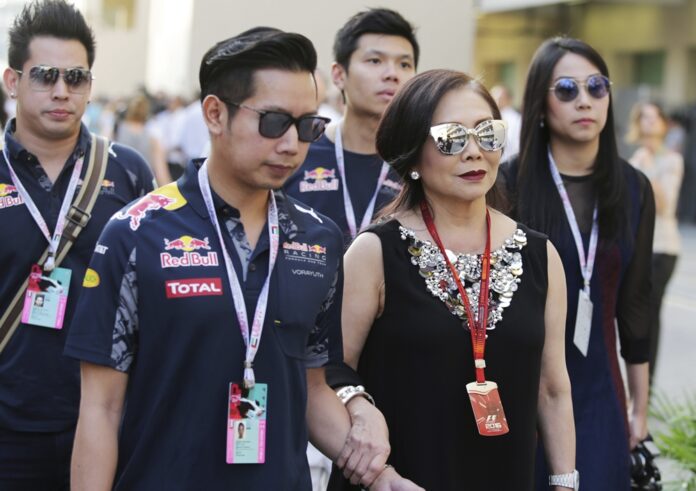
In this Nov. 26, 2016, photo provided by XPB Images, Vorayuth "Boss" Yoovidhya, second left, walks with his mother Daranee, second right, at the Formula 1 Grand Prix in Abu Dhabi. Photo: XPB Images via Associated Press

BANGKOK — The Ministry of Foreign affairs on Friday revoked the passport of Vorayuth “Boss” Yoovidhya, scion of Red Bull’s energy drink fortune.

The move came after it was revealed that Thai authorities had allowed the 32-year-old to leave the kingdom on April 25, three days before his arrest warrant was issued.

The decision was announced by Busadee Santipitaks, general of the department of information and spokesperson of the foreign ministry. Busadee said the move was made after police and related agencies requested the ministry to take action.

She added that the matter had been handled in accordance to the 2005 passports law. She said Vorayuth would no longer be able to use his Thai passports to travel and would be considered an illegal immigrant if found without a valid passport in a foreign state.

Five years after a fatal car crash in which Vorayuth allegedly hit a policeman with his Ferrari before dragging his body out the way and fleeing to his opulent residence in Thonglor area, he is now not just wanted but without a Thai passport.

Varyuth’s lawyers have maintained that the ill-fated police officer swerved unexpectedly in front of his sports car – a claim disputed by forensic examiners.

More recently, Vorayuth has been found by foreign media to be leading a jet set lifestyle of endless partying in England and beyond.

It was reported that he left Thailand last week for Singapore on his private jet.

Advertisement

Indonesia Searches for Scores of Inmates After Jailbreak

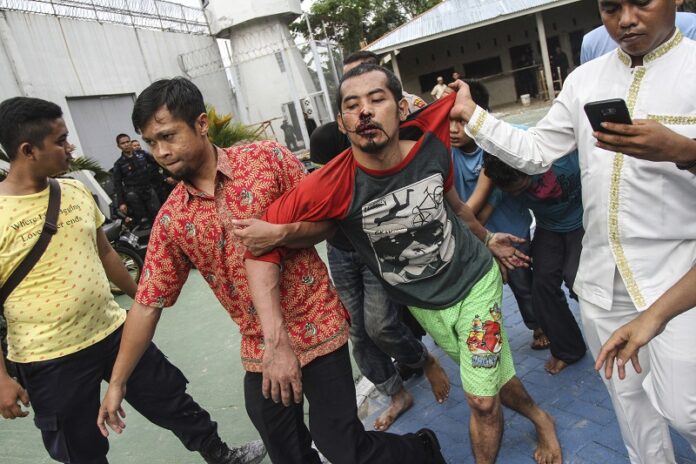
Plain-clothed police officers escort recaptured inmates following their escape at Sialang Bungkuk Prison on Friday in Pekanbaru, Riau province, Indonesia. Photo: Associated Press

PEKANBARU, Indonesia — Indonesian authorities are searching for scores of inmates who escaped Friday from an overcrowded prison on Sumatra island.

Hundreds of police and soldiers were deployed near Sialang Bungkuk Prison in Pekanbaru, the capital of Riau province, and were blockading roads to the capital and other provinces, said Justice and Human Rights Ministry official Wayan Dusak.

He said the escape occurred when prisoners were let out of their cells to take part in Friday prayers and overwhelmed the six guards on duty.

Local police spokesman Col. Guntur Aryo Tejo estimated the number of prisoners who escaped at 200 to 250, of whom 130 had been recaptured.

Some surrendered while others were captured by police or residents, Tejo said. He added that some were reportedly beaten by residents who found them trying to steal their motorbikes.

MetroTV showed dozens of men running from the prison and some being captured by police.

The prison, which has a capacity of 361, is holding more than 1,870 people, Tejo said.

“It seemed that many of the inmates alleged that there was discrimination in treatment of those accused of general crimes compared to special ones,” Tejo said, referring to officials and others accused of corruption who allegedly received better treatment.

In the capital, Jakarta, national police spokesman Brig. Gen. Rikwanto said the jailbreak was sparked by overcrowding.

“A riot occurred in one of the cells inhabited by 100 people because of overcrowding,” said Rikwanto, who uses a single name. “That led to a physical clash among the inmates that could not be controlled by the prison guards.”

About 300 policemen and soldiers were deployed to guard the prison.

Advertisement

Alleged ISIS Militant a Regular Visitor to Thailand: Police

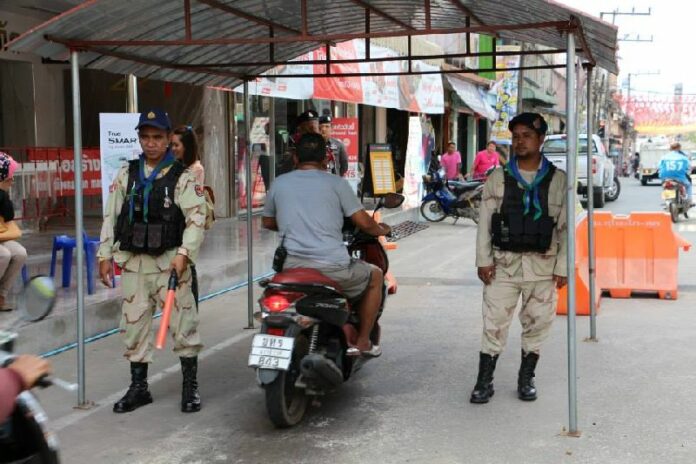
A security checkpoint in Narathiwat province on 24 March 2015.

BANGKOK — An alleged Islamic State militant on the run is a regular visitor to Thailand and could be hiding in the kingdom, a regional police commander said Friday.

A report by Channel News Asia said Muhammad Muzaffa Arieff bin Junaidi, 27, escaped a Malaysian police raid on an ISIS cell and fled to southern Thailand, a region struck by a Muslim separatist conflict that has been raging for more than a decade. The same media report also said Junaidi was carrying three firearms with him.

Lt. Gen. Ronnasilp Phusara, commander of the southern border province police command, said Malaysian authorities have not yet sent him any report about Junaidi, but police are already looking for the fugitive.

Read: Authorities Play Down Fears of ISIS in Thailand

“We have not been informed by the Malaysians. We have only seen report published by the media,” Ronnasilp said by telephone. “But even though they are just media reports, we are investigating this matter.”

Junaidi has made many trips between Thailand and Malaysia, according to Ronnasilp, adding that immigration record said Junaidi last left the Kingdom on April 21.

Junaidi has no previous criminal record in Thailand and Malaysian police have never requested their Thai counterparts to take any action on the man, Ronnasilp said.

Thailand’s southern region, which borders Malaysia, has been a hotbed of secessionist violence since 2004. The insurgents aim to secede the three provinces of Pattani, Yala and Narathiwat to revive the independent sultanate of Patani.

Although the southern separatists are not historically part of a wider global jihadist movement, there have been reports that ISIS has been keen to establish a presence in the region through efforts such as the distribution of local-language newspapers advocating its causes in Malaysia and the Deep South.

Lt. Gen. Ronnasilp said there has been no confirmed report of ISIS activities in the region so far.

Related stories:

Thai Said to be Among Suspected ISIS Militants Arrested in Malaysia

ISIS’ Malay-Language Media Unlikely to Win Hearts, Minds in Deep South, Experts Say

Govt Investigates Reports of ISIS in Deep South

Advertisement

‘Good Samaritan’ Celeb Turns Out to Be Deadly Car Crash Suspect

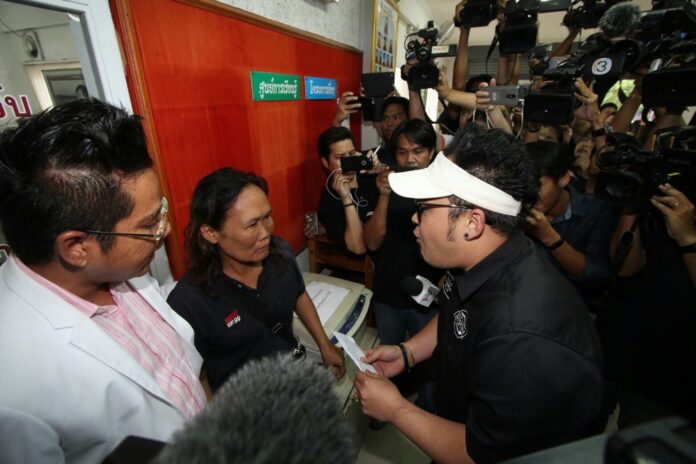
DJ Chawalit Simankhongtham offers money to Somkuan Thong-asa, mother of a 18-year-old man whom he struck in an April 27 car accident. The victim died on Tuesday.

BANGKOK — For several days, social media heaped praise on a celebrity actor and DJ who was seen helping a teenager injured by a motorcycle accident.

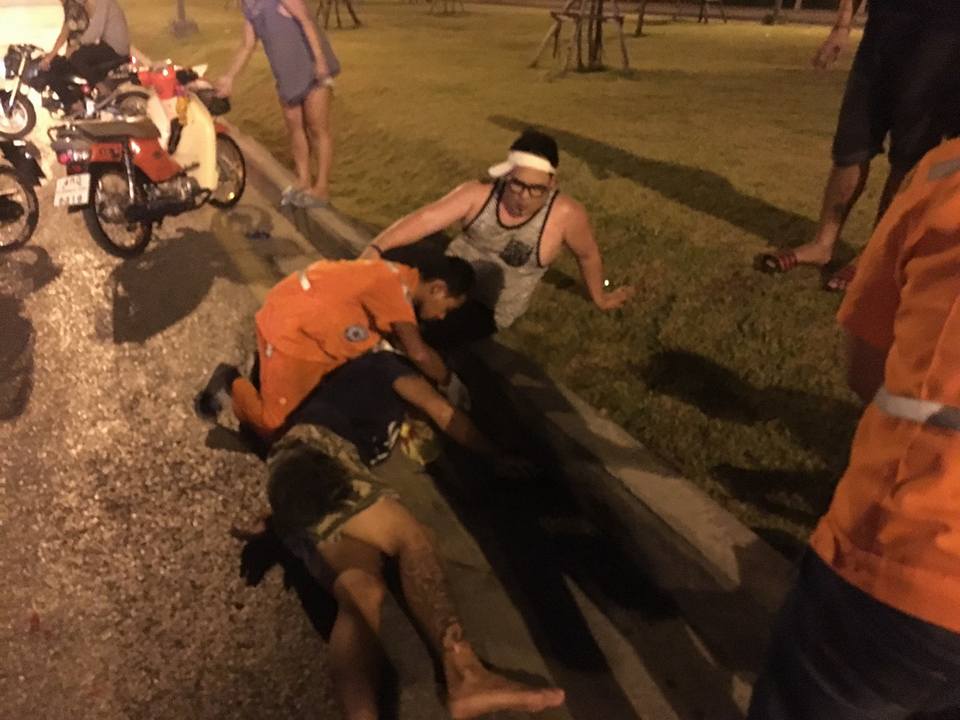
The incident took place in the early hours of April 27 in Bang Khen. Chawalit Simankhongtham said at the time he saw the teenger hit by another motorcyclist, who fled the scene, so he stopped his car and went out to help tend the victim’s wounds. The teeanger, 18-year-old Jirapas Thong-asa, later died of his injuries on Tuesday.

“He’s so kind-hearted. This is someone the society wants,” wrote the person who first shared the story to Facebook.

But the 34-year-old DJ admitted on Thursday – eight days later – to crashing his car into the motorbike, for which police are now pressing charges against him. The investigation only took off after a complaint was filed by the deceased teenager’s embittered mother.

“On the first day we talked to him, he only said two motorcycles crashed into each other and he happened to be at the scene,” investigator Chainarong Daengsongkhum of Sai Mai Police Station said by telephone. “Yesterday he admitted to being the driver.”

For the crash, Chawalit was charged with fatal reckless driving, driving without a license and driving without mandatory insurance. Police said they have CCTV footage of the scene as evidence against Chawalit, who also works as TV personality.

At the police station yesterday, Chawalit also encountered Somkuan Thong-asa, mother of the teenager he killed. He gave Somkuan a hug, wai in apology, and pulled out a stack of money, said to be 30,000 baht, to cover the funeral’s cost.

When Somkuan hesitated, the DJ pressed on with the money, saying he only wanted to help and that it wouldn’t affect the case. Somkuan only accepted upon her lawyer’s advice.

Somkuan later told reporters she was upset by Chawalit’s refusal to come forward earlier.

“If the DJ truly wanted to take responsibility, he should have gone to the funeral since day one,” Somkuan said. “If the media didn’t report the news, he might not have showed up at all.”

Lt. Col. Chainarong said Chawalit wouldn’t face charges of hit-and-run because he did show up at the police station shortly after the accident to file a report about the crash, though at the time he did not identify himself as the driver.

Speaking to reporters at the police station, Chawalit said he was shocked by what happened.

18157682 1533698430008657 318612411689677682 n
Chawalit Simankhongtham seen tending to the 18-year-old Jirapas Thong-asa at the scene of the April 27 car crash. Image: Tayvach Vimalin / Facebook

“What happened on that day unfolded very quickly,” Chawalit said. “I was driving along normally, then a motorcycle came out of nowhere, and I saw there was someone injured so I stopped my car to help.”

He also disputed one eyewitness’ account that he tried to flee the scene; Chawalit said he was merely moving his car to the side the road to avoid further accident.

Police did not identify any suspect until Jirapas’ mother filed a complaint to police on Tuesday and urged them to seek out Chawalit as the driver who fatally injured her son. Chawalit still told the media he was not involved in the crash, but police soon obtained footage of the scene which they said clearly identified Chawalit as the driver.

Chawalit only showed up to the police station to acknowledge the charges on Thursday. He reportedly told police he had busy schedule.

“We contacted him many times to come talk to us, but he said he wasn’t ready. He has a lot of appointments,” investigator Chainarong said.

Police will now question other witnesses before submitting the case to the prosecutor, he added.

Advertisement

Hot News

LATEST NEWS

Bangkok
overcast clouds
30 ° C
30 °
28.8 °
78 %
5kmh
100 %
Sun
31 °
Mon
36 °
Tue
38 °
Wed
35 °
Thu
35 °