































29.9 C
Bangkok
Saturday, June 27, 2026
Home Blog Page 2566

New MH370 Analysis Suggests No One at Controls During Crash

HMAS Success scans the southern Indian Ocean in 2013, near the coast of Western Australia, as a Royal New Zealand Air Force P3 Orion flies over, while searching for missing Malaysia Airlines Flight MH370. Photo: Rob Griffith / Associated Press

SYDNEY — A fresh analysis of the final moments of doomed Malaysia Airlines Flight 370 suggests no one was controlling the plane when it plunged into the ocean, according to a report released by investigators on Wednesday, as experts hunting for the aircraft gathered in Australia’s capital to discuss the fading search effort.

A technical report released by the Australian Transport Safety Bureau, which leads the search, seems to support the theory investigators have long favored: that no one was at the controls of the Boeing 777 when it ran out of fuel and dove at high speed into a remote patch of the Indian Ocean off western Australia in 2014.

In recent months, critics have increasingly been pushing the alternate theory that someone was still controlling the plane at the end of its flight. If that was the case, the aircraft could have glided much farther, tripling in size the possible area where it could have crashed and further complicating the already hugely complex effort to find it.

But Wednesday’s report shows that the latest analysis of satellite data is consistent with the plane being in a “high and increasing rate of descent” in its final moments. The report also said that an analysis of a wing flap that washed ashore in Tanzania indicates the flap was likely not deployed when it broke off the plane. A pilot would typically extend the flaps during a controlled ditching.

Peter Foley, the bureau’s director of Flight 370 search operations, has previously said that if the flap was not deployed, it would almost certainly rule out the theory that the plane entered the water in a controlled ditch and would effectively validate that searchers are looking in the right place for the wreckage.

“(It) means the aircraft wasn’t configured for a landing or a ditching  you can draw your own conclusions as to whether that means someone was in control,” Foley told reporters in Canberra on Wednesday. “You can never be 100 percent. We are very reluctant to express absolute certainty.”

The report’s release comes as a team of international and Australian experts begin a three-day summit in Canberra to re-examine all the data associated with the hunt for the plane, which vanished during a flight from Kuala Lumpur to Beijing on March 8, 2014, with 239 people on board.

More than 20 items of debris suspected or confirmed to be from the plane have washed ashore on coastlines throughout the Indian Ocean. But a deep-sea sonar search for the main underwater wreckage has found nothing. Crews are expect to complete their sweep of the 120,000-square kilometer (46,000-square mile) search zone by early next year and officials have said there are no plans to extend the hunt unless new evidence emerges that would pinpoint a specific location of the aircraft.

Australian Transport Minister Darren Chester said experts involved in this week’s summit will be working on guidance for any potential future search operations.

Experts have been preemptively trying to define a new search area by studying where in the Indian Ocean the first piece of wreckage recovered from the plane  a wing flap known as a flaperon  most likely drifted from after the plane crashed.

Several replica flaperons were set adrift to see whether it is the wind or the currents that primarily affect how they move across the water. The results of that experiment have been factored into a fresh drift analysis of the debris. The preliminary results of that analysis, published in Wednesday’s report, suggest the debris may have originated in the current search area, or to its north. The transport bureau cautioned that the analysis is ongoing and those results are likely to be refined.

Story: Kirsten Gelineau
Advertisement

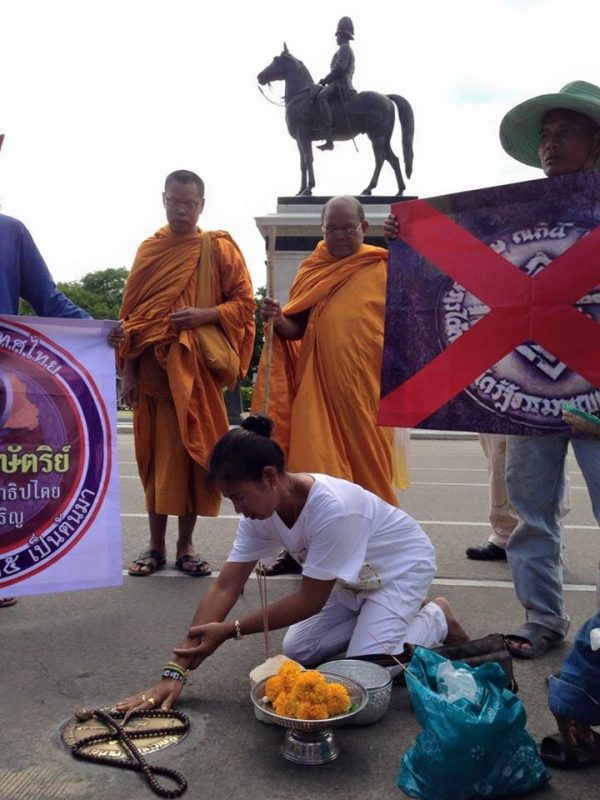
Ultra-Royalists Threaten To Destroy 1932 Revolution Plaque

Locals hold a ‘removal ritual’ for the plaque in 21 Jun. 2015. / Photo: MThai

BANGKOK — Social media was abuzz Wednesday after an ultra-royalist threatened Monday to destroy the 1932 Revolution plaque located next to Rama V’s equestrian statue.

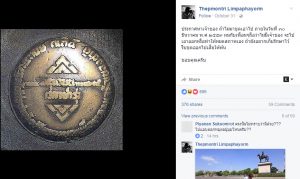
Thepmontri Limpaphayorm’s post Monday threatening to destroy the 1932 Revolution plaque.

User Thepmontri Limpaphayorm posted a photo of the plaque used to commemorate the location where the People’s Party announced its revolutionary manifesto that converted Siam from absolute monarchy to democracy on June 2, 1932.

“Looking for the owner [of this plaque]. If you don’t come dig it out by Dec. 30, my friends and I will consider that there’s no owner. We will go remove or destroy it ourselves. If you want to keep it as a souvenir, quickly dig it out,” the message read.

Thepmontri Limpaphayorm at a Yellowshirt protest in 2011.

Thepmontri, who graduated with a degree in history from Thammasat University, is an independent historian who has written books such as “Peeling Back the Oct. 14 Scab: A Worm On The Face of Thai History,” in reference to the popular revolt against military rule in 1973. He also gave speeches during Yellowshirt protests in 2011, and took a public stance against Cambodia in the Preah Vihear dispute.

While ultra-royalist netizens have voiced strong support for his threat, many others sharing the post decried his threat.

“I’m seeing lots of stuff about the People’s Party on Facebook today. People are digging the bones of these bandits up from the grave to cause another revolt. Go ahead! Come on out! All the Thai people will beat you up with our feet,” Orasa Suktadidtiworn wrote.

“I pass by this plaque often and never notice this plaque of un-fealty towards the nation. Let’s call it a Revolt’s plaque instead. If we’re going to remove it, we have to pray to Mae Thoranee [Mother Earth] and ask for permission to dig it up or cover it,” said Boonmee Zong.

Other users suggested it was an affront to Thai history.

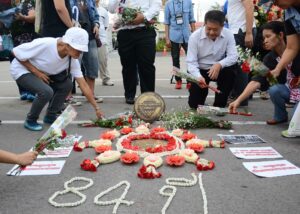
Activists lay garlands and candles at the 1932 Revolution plaque on 24 Jun. 2016, the anniversary of the 1932 popular uprising in Bangkok.

“Sonthi Limthongkul didn’t dare do it. Soldiers didn’t dare remove it, no matter from which era…[this person] doesn’t understand the past or the future, and has no love for history…You ask who’s the owner of this plaque? Thai citizens are, dammit!” a user called New Peace Globe wrote.

The People’s Party plaque has been a contentious item in recent history. Some vandalized the small, simple plaque with sharp objects, while others have cleaned and laid flowers around it.

Advertisement

Cops Have Yet to Charge ‘Beauty Idol’ Who Crashed Into 8 Cars

A photo of Kritrada Tabtimphol posted on her Facebook on Sept. 11. Image: Kritrada Zomy Tabtimphol / Facebook

BANGKOK — A businesswoman who crashed her BMW into eight cars on a busy road Tuesday evening in Bangkok was allowed to go to hospital without any charges or drug test, despite witness accounts of her erratic behavior.

Police on Wednesday morning had yet to press any charges against Kritrada Tabtimphol, 28, because she was too shocked to speak to cops, according to a Suphachai Harnkhamla, deputy chief of Huai Khwang Police Station, who added that it was up to the hospital to perform a drug test on the suspect.

“We cannot yet press any charge against her because she’s in a state of shock,” Col. Suphachai said by telephone. “She’s not ready to give any testimony. At this moment, we’re questioning all the witnesses involved.”

Kritrada, who sells beauty products online under the name “Zomy,” caused a traffic mayhem at about 5pm Tuesday when she rear-ended eight other cars with her BMW in front of Esplanade shopping mall on Ratchadapisek Road. Police said three people werre injured.

Eyewitnesses said Kritrada, who appeared to be unhurt, stepped out of her vehicle after the crash and shouted there was a bomb in her car. The motorist also prayed and danced when policemen tried to question her about the incident. She later fainted at the police station and was taken to Paolo Memorial Hospital by her family.

Despite her outlandish behavior, Kritrada was not tested for alcohol or drugs. Col. Suphachai said the hospital is doing the work, but he had no idea when the results would be available.

Image: Kritrada Zomy Tabtimphol / Facebook

“We told them to hurry up,” Suphachai said.

He added that Kritrada will be diagnosed to see if she has any mental disorder.

Kritrada owns an online business selling beauty products. She also works as a promotional model, or pretty. Her Facebook profile has more than 170,000 followers. She has not written any post since the accident; but her friends have posted messages of support.

Kritrada’s case resembled police handling of another high-profile car accident in Ayutthaya province eight months ago.

In March, businessman Jenphop Viraporn crashed his BMW into the back of another car at a high speed on the highway, killing two graduate students inside. Police let him go to hospital without pressing any charges or performing any drug test on the suspect, saying that he was too shocked to face legal prosecution.

After the matter came to public attention, Jenphop was charged with fatal reckless driving and deadly DUI. The latter charge was automatically pressed against him because of his refusal to undergo drug tests. His trial will commence Nov. 14.

Kritrada Tabtimphol’s BMW at Huai Kwang Police Station on Tuesday night.
Kritrada Tabtimphol’s BMW at Huai Khwang Police Station on Tuesday night.


Related stories:

Claiming Insanity, Fatal Crash Suspect Jenphop Wants Trial Shelved

Praewa Completes Community Service, 4 Years After Court Orders It

Prosecutor Backtracks on Bringing Red Bull Heir to Court

Advertisement

Duterte Eyes Joint Operations With Malaysia vs. Abu Sayyaf

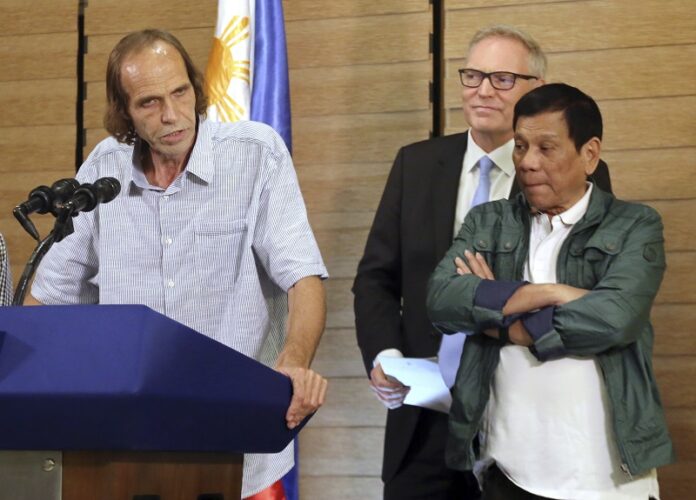
Released Norwegian hostage Kjartan Sekkingstad, left, briefly delivers his statement after meeting Philippine President Rodrigo Duterte, right in September in Davao city in southern Philippines. Photo: Manman Dejeto / Associated Press

MANILA — Philippine President Rodrigo Duterte will discuss possible joint military and police operations with Malaysia to quell Abu Sayyaf militant kidnappings of sailors along the countries’ sea border, saying that the brazen attacks have paralyzed trade and commerce.

Addressing the “deteriorating peace and order” in those waters will top the agenda when Duterte meets Malaysian Prime Minister Najib Razak and other top officials in Malaysia next week, Duterte told reporters late Tuesday.

Duterte said the attacks embarrassed him because the Abu Sayyaf perpetrators are based in the southern Philippine island of Jolo, an impoverished, jungle-clad region where the militants hold their hostages for ransom.

“There is a need for us, the three countries Malaysia, Philippines and Indonesia, to talk about this seriously and to put a stop because it has somehow paralyzed the trade and commerce in that area,” Duterte said.

He said his talks will cover border control, border crossing, “and, maybe, joint military and police operations.”

During a recent visit to Indonesia, Duterte said he discussed possible security strategies with President Joko “Jokowi” Widodo and the Indonesia leader was “OK with everything.” Duterte did not specify the security steps.

Despite initial talks by the three countries about ratcheting up security, Abu Sayyaf gunmen and allied militants — part of a wider Muslim rebellion that has been raging in the predominantly Roman Catholic nation for decades — have continued attacks at sea this year, kidnapping Malaysian and Indonesian crewmen of slow-moving tugboats mostly pulling coal barges.

The security talks are complicated and tricky because the Philippines and Malaysia have had territorial issues and questions have arisen, for example, how far Malaysian authorities chasing fleeing militants can go as they approach Philippine territory. In initial talks, the countries have considered establishing a more secure sea lane for commercial vessels as well as coordinated law enforcement actions, including sea and air patrols.

Indonesia has restricted coal shipments to the Philippines because of the danger. Although most of the vessels attacked were tugboats, which are easy to board, the militants attacked an ocean-going South Korean cargo ship for the first time about two weeks ago off southern Tawi Tawi province, near Sulu, abducting its South Korean skipper and a Filipino crewman.

Without any known foreign source of funds, the Abu Sayyaf has survived through the years mainly from ransom kidnappings. A Philippine threat assessment report seen by The Associated Press showed that the militants pocketed at least $7.3 million from six ransom kidnappings involving 21 people in the first six months of the year.

The report said the lucrative payoffs enabled the group to procure firearms and ammunition.

Duterte, who took office in June, has ordered the military to destroy the Abu Sayyaf, while pursuing talks with two larger Muslim rebel groups.

The Philippine military said Tuesday it has killed 70 Abu Sayyaf militants and captured 32 others in an offensive that began in July.

Story: Jim Gomez

Advertisement

All 33 Miners in Chongqing Disaster Found Dead

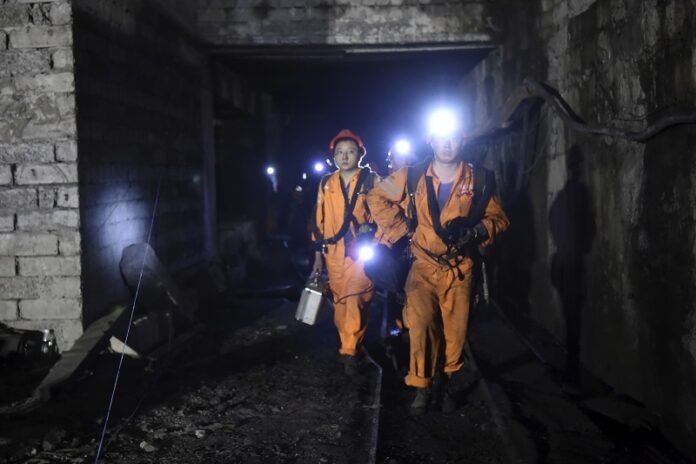
Rescuers work Monday at Jinshangou Coal Mine in Chongqing, southwest China. Photo: Tang Yi / Associated Press

BEIJING — Chinese state media say all 33 coal miners trapped underground in a gas explosion earlier this week have been found dead.

Two miners survived Monday’s explosion but rescuers working around the clock found no others alive. All bodies have been recovered and rescuers were shown bowing their heads in memorial for the dead.

Gas explosions inside mines are often caused when a flame or electrical spark ignites gas leaking from the coal seam. Ventilation systems are supposed to prevent gas from becoming trapped.

The State Administration of Work Safety ordered an investigation, saying those responsible must be strictly punished. Local officials in Chongqing also ordered smaller mines to shut down temporarily.

China’s mining industry has long been among the world’s deadliest.

Advertisement

Transient Lives Reflected in ‘Raw’ Photos

Photo: Yossawat Kasemthirakun / Courtesy

BANGKOK — Life is transient, yet its fleeting glimpses can be captured. Three photographers from various backgrounds share their perspectives on the matter through their works.

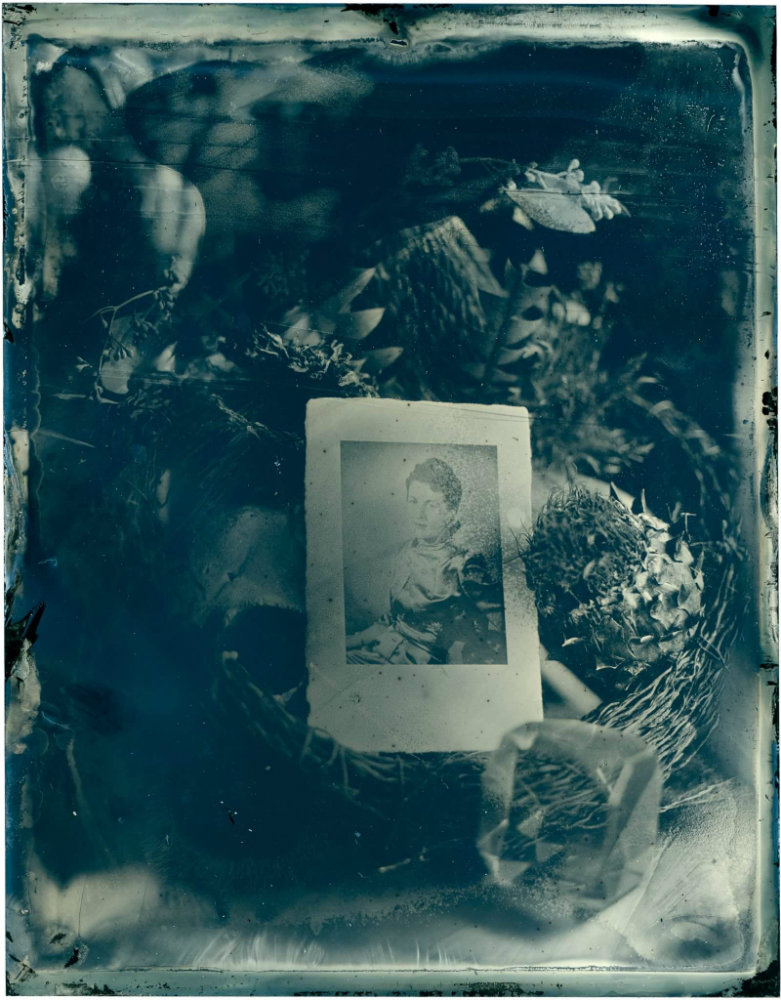
It may be impermanent, but life has interesting views to explore. Christian Hogue, Yossawat Kasemthirakun and Zuzanna Kowalska took photos from different places in the world to reflect patterns of life and combined them in a photography exposition.

New Zealand-born artist Christian Hogue captured the tranquility of beauty and the cycle of life. Skeletons are used to represent humans hidden souls, which some might not find until their very last day.

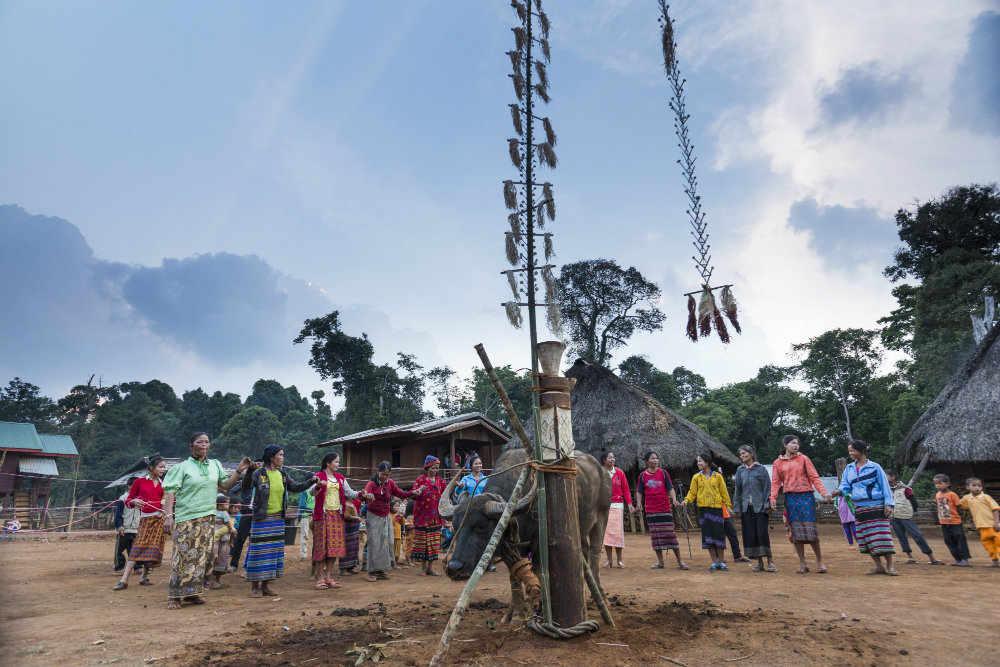
Thai photographer Yossawat Kasemthirakun reflected the tragic fates of animals being sacrificed in rituals, humans’ raw instincts exposed through his lens.

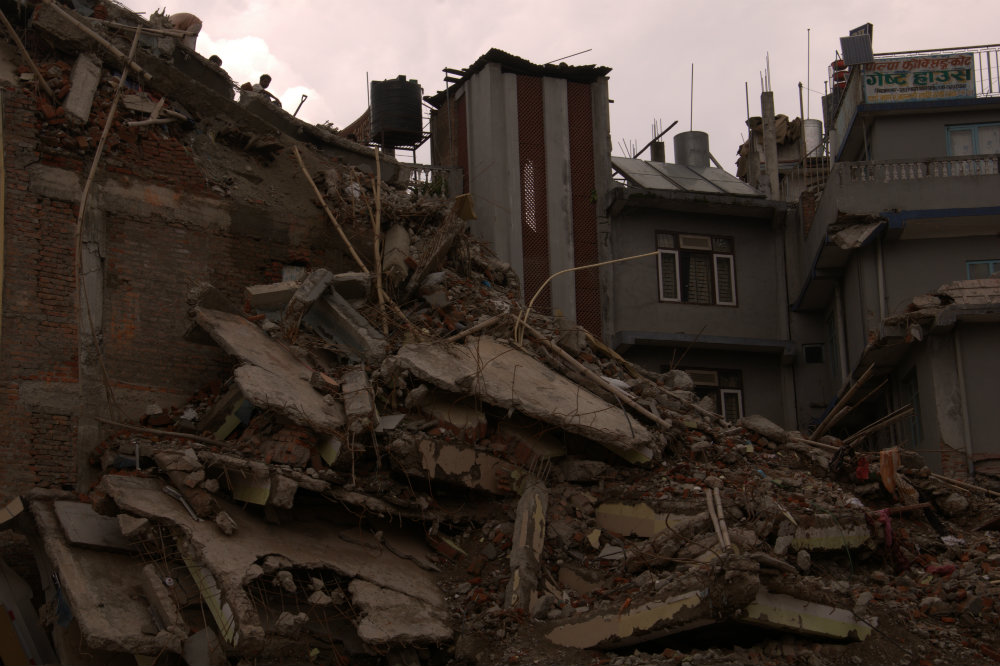
Polish artist Zuzanna Kowalska depicted the 2015 earthquake in Nepal , when humans learned they cannot control nature. Ruined locations are still waiting to be revived and restored along with humans’ emotions.

The exhibition launches at 7pm on Nov. 19, and runs through Jan. 3, 2017 at Kalwit Studio & Gallery on Wireless Road which is a short motorcycle ride away or 15-minute walk from BTS Phloen Chit.

Advertisement

Producer Sorry for Japanese ‘Idol’ Group’s Nazi-like Outfits

Yasushi Akimoto poses for photographers in 2013 during JASRAC (Japanese Society for Rights of Authors, Composers and Publishers) music award in Tokyo. Photo: Shizuo Kambayashi / Associated Press

TOKYO — The producer for a Japanese all-girl “idol” group has joined Sony Music in apologizing after the popular act performed in outfits resembling Nazi-era German military uniforms.

Keyakizaka46, a group of about 20 mostly teenage girls who sing and dance in synch, appeared at an Oct. 22 concert in black knee-length dresses that look like military overcoats, and black capes and officer caps with a Nazi-like eagle emblem. Sony Music is the group’s label.

Producer Yasushi Akimoto, a songwriter who is also an executive board member of the Tokyo 2020 Olympics organizing committee, apologized in a note posted late Tuesday on the group’s website. He said he was unaware of the outfits before the performance, and blamed his “lack of oversight.”

He also said he doesn’t think the designers were trying to make something reminiscent of the Nazis, but he would like to prevent a recurrence through staff education and having everything checked in advance.

Sony Music Entertainment (Japan) said in a statement on its website: “We express our heartfelt apology for causing offense … because of our lack of understanding. We take the incident seriously and will make efforts to prevent a recurrence of a similar incident in the future.”

The U.S.-based Simon Wiesenthal Center, a human rights group focused on anti-Semitism and hate speech, issued a statement Monday saying it was disgusted by the uniforms and calling on Sony Music and Akimoto to apologize.

“Watching young teens on the stage and in the audience dancing in Nazi-style uniforms causes great distress to the victims of the Nazi genocide,” Rabbi Abraham Cooper, associate dean of the Wiesenthal Center, said in the statement.

It’s not the first time that Sony has said it’s sorry after a complaint from the Wiesenthal Center. In 2011, Sony Music Artists Inc. apologized for a rock band under its management that dressed up like Nazis on a national TV broadcast. The Wiesenthal Center had expressed “shock and dismay” at the appearance by the band, Kishidan, on MTV Networks Japan.

Much of Asia is less sensitive about the use of Nazi themes than the West. The Wiesenthal Center has also protested incidents in South Korea and Thailand.

Keyakizaka46, formed by Akimoto in August 2015, is a spinoff of Nogizaka46. They both follow the model of the hugely popular all-girl group AKB48, and Akimoto described Nogizaka46 as a rival to AKB48 when he launched it in 2011.

The English-language Japan Times newspaper described Keyakizaka46 as a group on the rise, noting its first single, “Silent Majority,” was No. 1 on Japanese charts after selling about 260,000 copies within a week of its April 6 release.

Story: Ken Moritsugu

Advertisement

Rice Subsidy Returns: Gov’t Approves 20 Billion Baht For Farmers

Farmers dry rice grains Monday in Buriram province.

BANGKOK — The interim cabinet on Tuesday approved a higher-than-expected agricultural subsidy under which the government will spend at least 20 billion baht to guarantee prices for struggling rice farmers.

Responding to the some of worst market conditions in years, Prime Minister Prayuth Chan-ocha on Tuesday said his cabinet approved the subsidy to slow the flow of rice onto the market and help farmers with the policy, which is nearly identical to that of the former civilian government.

Under the structure approved today, the government will pay 13,000 baht per metric ton of jasmine rice, a figure about 1,500 baht over what was proposed by the country’s rice management committee that Prayuth chairs.

“I hope the farmers are satisfied,” Prayuth said Tuesday. “There is news about those who are still unsatisfied. I want to ask for their understanding and sympathy for the government, as there are currently many challenges, such as the effect from the rains.”

Read: Fining Yingluck for Rice Subsidy in ‘Grey Area,’ Critic of Policy Says

The idea is that farmers effectively sell their rice to the government. In practice, the authorities consider the subsidy as a loan the farmers secure with their rice. The rice will be kept in storage in hope the reduced supply will drive up market prices. Farmers who join the program can reclaim their rice months later when, theoretically, market conditions improve, and repay the loan.

It’s the same scheme for which ousted Prime Minister Yingluck Shinawatra is currently being tried for malfeasance due to losses it sustained. The military government last week announced it would personally fine her 35 billion baht for the program’s failure.

Unlike Yingluck’s subsidy, the junta is capping the amount of rice per household. It’s expected that two million farmers will sign up for the program, which is in effect now through February.

The subsidy is managed by the Bank of Agriculture and Agricultural Co-Operatives. Farmers will be paid 90 percent of current market price at 9,500 per metric ton, plus 2,000 baht for harvesting costs and 1,500 baht for storage. Those who don’t have barns to store rice will not receive the storage cost.

Prayuth ordered the market be monitored for any attempted disruption or manipulation.

The program comes as many have been campaigning for help for the farmers, who are suffering dire losses due to plummeting prices for rice. Commerce Minister Apiradi Tantraporn on Monday encouraged farmers to reach their consumers online for direct sales.

Advertisement

Ratchayothin Overpass to be Demolished Nov. 26

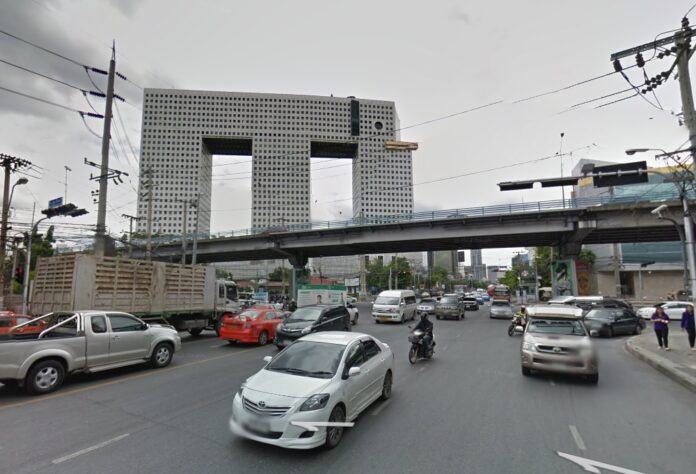
Cars pass under the Ratchayothin overpass on Phahonyothin Road with the iconic Elephant Building in the background. Image: Google

BANGKOK — One of Bangkok’s busiest traffic flyovers will be shut down later this month for demolition to make way for a new elevated rail line.

The Ratchayothin intersection overpass will be closed at 10am on Nov. 22 for demolition to begin four days later, according to the Mass Rapid Transport Authority, or MRTA.

The operation is expected to severely impact traffic in the vicinity; the bridge allows the ringroad of Ratchadapisek Road to pass over the ever-clogged Phahonyothin Road and connects downtown Bangkok with the suburbs.

The work is expected to take three years.

In place of the overpass, the MRTA will build a tunnel under Phahonyothin Road. A new bridge for autos will also be built parallel to the new Green Line extension along Phahonyothin Road.

The Green Line will run from Mo Chit north to Pathum Thani province.

The MRTA has advised motorists to cross Ratchayothin intersection through side alleys such as sois Phahonyothin 30 and Ratchadapisek 48.

Advertisement

Public Celebrations and Festivals May Resume Nov. 14

Fireworks greet the arrival of the year 2015 after the clock strikes midnight on Jan. 1, 2015, at Central World shopping mall in Bangkok

BANGKOK — Parties, festivals, and other forms of public entertainment may resume Nov. 14, a government spokeswoman announced Tuesday.

That’s the day the month-long ban on such events was imposed by the military government after the Oct. 13 death of King Bhumibol at 88.

Regime spokeswoman Taksada Sangchan confirmed that public festivities may resume in two weeks when the ban is lifted, but encouraged organizers to be respectful of the ongoing mourning period to be observed through October 2017.

Read: Grand Palace Re-Opens For Tourists

“All sectors can organize all the activities, but organizers must consider they are appropriate and in accordance with existing laws and regulations,” Col. Taksada said at a news conference.


Taksada said permitted events fall into nine categories:

1 .National events such as Songkran, Loy Krathong, Christmas and New Year’s Day
2. Provincial festivals such as Phi Ta Khon, Boon Bang Fai and Red Cross fairs
3. Street markets and other fairs that boost local economies
4. Upcountry cultural events such as Likay, Lam Tad and beauty contests
5. Entertainment events in nightclubs, pubs and bars
6. Private functions such as hotel conferences, seminars and banquets
7. Commercial music concerts
8. Spiritual events such as weddings, ordinations and the Kathin Festival
9. Sporting events and tournaments

State buildings will also return the national flag to full mast from Nov. 14 onwards, the colonel said.

However organizers of a number of upcoming events already canceled them prior to today’s announcement.

Sukhotai city government called off its Loy Krathong festival, stripping the event down to only floating krathong in the river. Bangkok was expected to follow suit.

February’s annual football match between Chulalongkorn and Thammasat universities has also been canceled.

Advertisement

Hot News

LATEST NEWS

Bangkok
overcast clouds
29.9 ° C
31.1 °
28.8 °
90 %
2.8kmh
97 %
Sat
37 °
Sun
36 °
Mon
36 °
Tue
33 °
Wed
34 °