25.5 C
Bangkok
Friday, June 19, 2026
Home Blog Page 2598

‘Girls’ to Break the Sound Barrier at Beam on Thursday

Mendy Indigo in April performing live at Beam. Photo: Mendy Indigo / Facebook

BANGKOK — Take a break from testosterone-soaked bass drops for a night of girl-powered beats at Thonglor dance venue Beam.

Four female DJs Korat-born DJ Mendy Indigo, bass pioneer Pichy, the swift-handed Praewa of Yellow Fang and tech-house newblood NT66 – will show what some homogametic lineage can dew on the decks.

TEMPO ELECTRIC GIRLS

Show and and pick your team or bounce around your condo while the event is livestreamed online. Admission is free. Electric Girls starts at 9:30pm on Thursday at Beam, the new nightlife venue in Thonglor.

Tempo Live streams live underground music events over the internet.


Advertisement

Mahakan Residents Blockade Fort to Stop Demolition

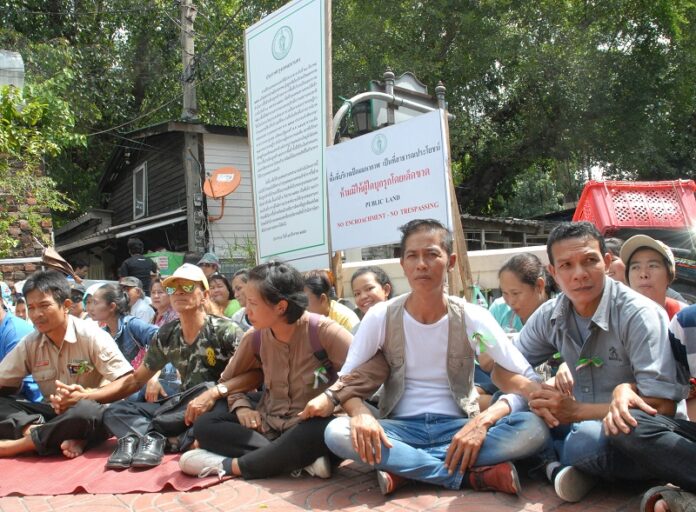
Pom Mahakan residents block an entrance to their community Wednesday morning in Bangkok.

BANGKOK — Mahakan Fort residents blocked three entrances of their community Wednesday morning to prevent further homes from being demolished.

The human blockade started at about 9am at Pom Mahakan and continued into the afternoon to stop the city from taking down the home of a family who agreed to leave. The family had to seek police help to leave with their possessions later in the afternoon.

Community leaders said they didn’t want them to leave while they were still negotiating with the city to save their homes.

Community leader Thawatchai Woramahakhun said the family was asked only to remove their possessions without abandoning their home for demolition.

“They want to leave, we let them leave,” Thawatchai said by phone Wednesday afternoon. “But no way we’re going to let them demolish the house. [The city] broke our agreement, and we can’t allow that happen.”

Under a compromise reached earlier this month, City Hall agreed to only dismantle 12 homes whose owners had agreed to leave while negotiations continued in the decades-running land dispute.

However 16 homes have been torn down since Sept. 4 and the city planned to demolish 10 more this week.

Community representatives and city officials will meet again Oct. 5.

Photo: Matichon
Photo: Matichon

Related stories:

Pom Mahakan Rallies Public Against Imminent Eviction Saturday

Advertisement

The Americans: Head Forgery Ring Suspect Ran From FBI

A 2001 FBI bulletin seeking fugitive fraud suspect Herbert La Fon. Photo: U.S. Federal Bureau of Investigation

BANGKOK — One was an oil exploration specialist who resigned from an executive-level position at a Texas-based energy firm and moved to Southeast Asia eight years ago. Another was settled here with a Thai wife and young child.

The third man, suspected of shooting a Thai cop and keeping a frozen body in a freezer, seems to have been on the run from the FBI for nearly four decades.

While officials continue piecing together information about the three foreign men arrested in a raid on a forgery ring that unexpectedly turned up a dismembered, frozen corpse, other details have emerged about the three men now confirmed to be Americans.

Read: Suspected Forgers’ Frozen Body Thought to be Older Western Man

Police on Wednesday said the suspected shooter, whose identity eluded them the longest, was not the Briton or American named in passports he carried, but actually 63-year-old American Herbert Craig La Fon.

“We talked to FBI and confirmed that all of them are American nationals,” said Lt. Gen. Nutthorn Praosunthorn, chief of the Immigration Bureau.

He said his identity was confirmed with the help of his fingerprints and family back in the United States.

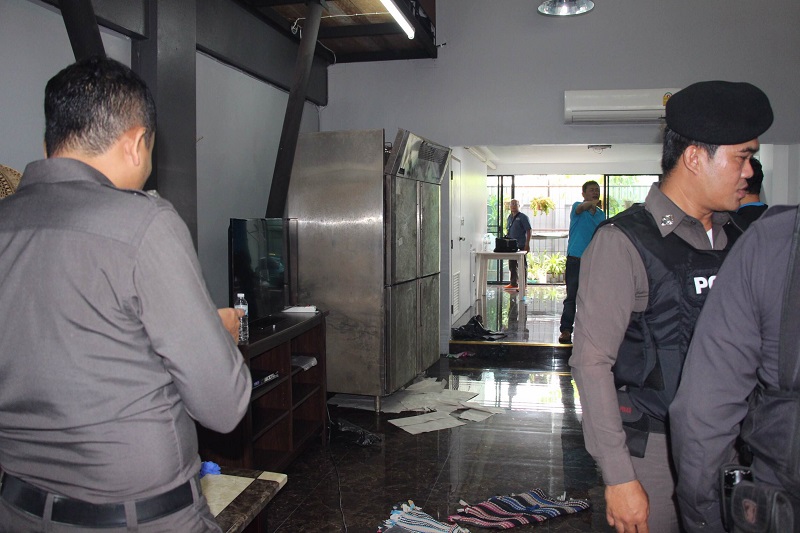
Police on Tuesday search the house in Phra Khanong’s Soi Sukhumvit 56 where a dead man was found in the refrigerator.

Police search the shophouse on Bangkok’s Soi Sukhumvit 56 Tuesday where the dismembered body was found inside a cold storage.

U.S. public records indicate La Fon, originally from Baltimore, went on the run after being accused of credit card fraud back in 1979. The charges were dismissed 20 years later after an important witness died, but he remained a wanted man. A 2001 FBI bulletin listed him as armed and dangerous and included an extensive list of aliases.

Police on Tuesday said a former neighbor of La Fon’s said he saw him move out some months back lugging the same freezer in which another older, Western man’s frozen remains were found Friday in the raid on a Phra Khanong shophouse.

Immigration Bureau chief Nutthorn said they were not yet able to confirm La Fon’s immigration status.

Another of the suspected forgers, 66-year-old James Eger, is listed on his LinkedIn profile as chief consultant with a Hong Kong-based New Times Energy Corp. A bulletin announcing his resignation from the position of CFO at Continental Energy Corp. of Dallas, Texas, was published in 2008. It said he was relocating to Southeast Asia to pursue business in “palm oil plantations and the conversion of crude palm oil to biodiesel.”

Nutthorn said Eger traveled in and out Thailand 148 times in the past three years and had applied for a permanent visa. He was in the country legally.

Police said the youngest of the three, 33-year-old Aaron Thomas Gabel, was married to a Thai woman named Sudarat Gabel. Attempts to reach Sudarat were unsuccessful.

None of the three had been wanted for arrest in Thailand, Nutthorn said.

The least is known about the man found in the freezer. Police suspect he was cut up with an electric saw but have been unable to ID the body beyond saying it was that of an older white man.

The three suspects were arrested Friday when police went to raid a suspected passport forgery ring on Soi Sukhumvit 56. That’s when La Fon allegedly shot a tourist police officer and the body was discovered. The officer survived and is recovering.

Police also found firearms and drugs.

The three suspects have been charged with concealing a corpse, possessing drugs and counterfeiting passports. La Fon is charged with attempted murder of a police officer.

Police are still investigating the case.

Additional writing and reporting Todd Ruiz

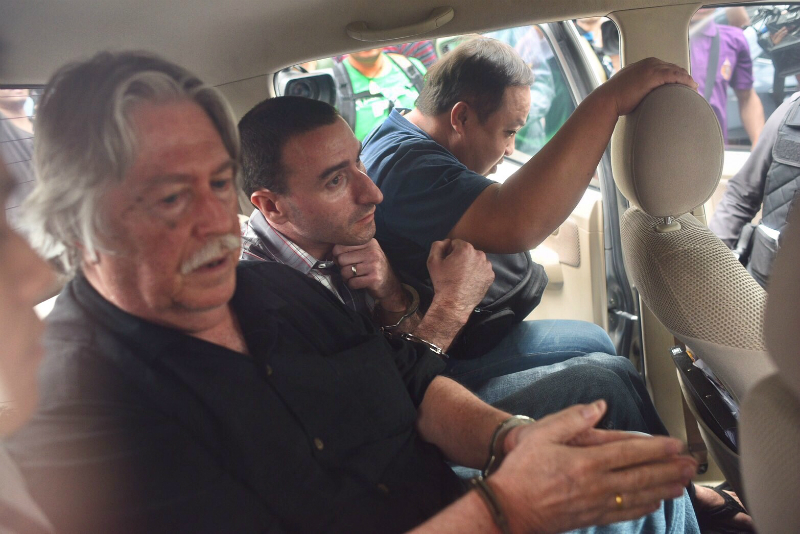
Two suspects identified as James Douglas Eger, at left, and Aaron Thomas Gabel, at middle, are taken Saturday from a police station to a Bangkok court.

Related stories:

Suspected Forgers’ Frozen Body Thought to be Older Western Man

Police Can’t ID Suspected Farang Forgers Or Their Dead Body

Foreigners Arrested After Raid on Forgery Ring Leads to Body in Fridge

Advertisement

Driver Chopped by Blade-Wielding Motorist in Bangkok

Nuttawut Nuanjun, 33, rehabilitating yesterday after a swordsman attacked him Monday.

BANGKOK — Police were hunting Wednesday for an unidentified man suspected of trying to take another motorist’s head with a long blade earlier this week.

In an interview from his hospital bed Tuesday, Office worker Nattawut Nuanjun said he was driving in the leftmost lane on Ekamai-Ramindra Road to meet a client at about 10am on Monday when a gray Mitsubishi cut him off. As he was changing lanes to overtake the other driver, he accidentally clipped the car.

The other vehicle didn’t stop, he said, so he drove in front of it to make it stop so they could discuss the damage for insurance purposes.

Getting out of his car, 33-year-old Nattawut said that before he could get a word out, the other driver unsheathed a foot-long blade and lunged for his neck. Nattawaut said he believed the man intended to kill him.

He raised his left arm in self-defense, so the blade slashed into the arm and his cheek. He ran back to his own car, saying his assailant followed him and opened his door to challenge him.

“Are you gonna drive off or what?” Nattawut recounted him saying as he made to flee.

Nattawut was hospitalized with a slashed tendon in his arm.

His colleagues took his case to social media after they said police refused to help, writing about it Monday night on the popular We Love Police Checkpoints page on Facebook.

Nattawut said he couldn’t file a complaint at the station because the hospital would not release him. His coworkers also tried to file a report at the Chokchai police station on his behalf but were told the victim had to be present.

In response to the delay, Col. Suphol Kumchoo said police were in the process of interviewing the victim in order to find his alleged attacker.

But he said calling attention to the case made solving it more difficult.

“Posting [on social media] without filing an arrest made the situation more complicated,” he said.

Advertisement

Security Forces Muzzle Torture Discussion With Arrest Threats

Cover image of 'Make Him Speak by Tomorrow,' a report on the use of torture by the military in Thailand released Wednesday by Amnesty International.

BANGKOK — When representatives of Amnesty International gathered at a Bangkok hotel Wednesday morning to talk about the military regime’s use of torture, plainclothes security forces told them they would be arrested if they so much as opened their mouths.

A panel discussion at the Four Wings Hotel of a new Amnesty International report on the use of torture since the 2014 coup was shut down when military officers warned foreign speakers would be arrested and prosecuted for violating labor laws if they spoke.

Omar Waraich, Amnesty regional spokesman, said all of the organization’s speakers had valid working business visas.

Waraich said that Amnesty had been “completely transparent” with the authorities about their work and reached out to senior officials, including the prime minister, about the report’s contents. He said they received no reply.

“Thai officials know about the content of our report, as we have sought engagement in recommendations with the authorities on the use of torture,” Waraich said.

The military regime has shut down or put pressure on a number of discussions in recent years, including those involving foreign speakers at places such as the Foreign Correspondents Club of Thailand.

Wednesday’s incident seemed the first time threat of arrest under labor law was used to silence an event. Waraich said that while officers did not directly shut down the panel, their threat of prosecution prompted Amnesty to comply and cancel the event.

All of the arranged speakers, including Laurent Meillan of the U.N. Human Rights Office, were foreign nationals.

“I regret I could not speak at this event today. This incident confirms a pattern of harassment of [human rights defenders] documenting torture in Thailand,” Meillan later tweeted, also saying the incident raised “serious questions about the ability of international organisations to stage public events in Thailand.”

Waraich said the report released today, “Make Him Speak by Tomorrow,” was the product of two years of thorough research into 74 cases of torture by 57 victims since the military seized power in 2014.

Though the use of torture has been documented in the past in the southernmost provinces, where a violent insurgency has ground on for years, Waraich said the report details a wider range of victims, including government opponents, suspected insurgents, migrants, and ethnic and religious minorities.

“Torture is wrong in every single case,” Waraich said.

In graphic detail it recounts harrowing accounts of torture, including suffocation and electrical shock to the genitals. It said the suspension of liberties and measures enacted by the junta contributed to the use of violence.

“There is an illegal framework that enables torture to take place,” Waraich said. “There are NCPO orders that allow impunity for torture by soldiers and police.”

In the report, Amnesty writes that many of the victims were “tortured during the first seven days of detention – the period when the military is allowed to hold them in unofficial places and without contact with the outside world or any other safeguards against ill-treatment.”

Waraich said Amnesty began compiling the report because “after the coup, numerous reports of torture increased” despite recent commitments made by the authorities against torture.

Related stories:

Thailand Moves to Ban Torture and Abduction. Activists Aren’t Ready to Celebrate.
Human Rights Activists Refuse to Hand Over Names of Alleged Torture Victims
Torture in Deep South Systematic and Spreading Elsewhere, Rights Groups Allege
Army Denounces Deep South Torture Report As Product of ‘Imagination’

Advertisement

Nakadia Back to Drop it in Bangkok Next Month

Photo: Nakadia / Facebook

BANGKOK — Long before women became a regular sight in the booth, Nakadia broke into the boys club in Bangkok before migrating to that place all DJs go – Berlin.

But she’s no stranger to her roots and her orbit will bring her fierce mixing and energy back through the kingdom again next month for a series of shows.

Passing through Asia for an international music event in Shanghai, Nakadia will drop some drops at venues in Bangkok and Phuket on a petite tour of the region.

Born in Nakhon Ratchasima, Nakadia rose up through the ranks and went big in 2004 to live the life full-time as one of few globally successful female electronic music DJs at the time.

Get ready freak on with her beats starting at 11pm on Oct. 8 at Live RCA Bangkok on Royal City Avenue. The club can be reached by taxi from MRT Rama 9. Entry is 300 baht.

Advertisement

First Baby Born From 3 Sets of DNA

Recreated DNA model. Photo: Caroline Davis2010 / Flickr

NEW YORK — Scientists say the first baby has been born from a controversial new technique that combines DNA from three people  the mother, the father and an egg donor.

The goal was to prevent the child from inheriting a fatal genetic disease from his mother, who had previously lost two children to the illness.

The birth of the boy is revealed in a research summary published by the journal Fertility & Sterility. Scientists are scheduled to present details at a meeting next month in Salt Lake City.

The magazine New Scientist, which first reported the birth, said the baby was born five months ago to Jordanian parents, and that they were treated in Mexico by a team led by Dr. John Zhang of the New Hope Fertility Center in New York. It’s not clear where the child was born.

The technique is not approved in the United States, but Zhang told the magazine, “To save lives is the ethical thing to do.”

A spokesman for the fertility center said Zhang was not available for further comment on Tuesday. Others involved in the research referred questions to Zhang.

The mother carries DNA that could have given her child Leigh syndrome, a severe neurological disorder that usually kills within a few years of birth. Her two previous children died of the disease at 8 months and 6 years, the research summary said.

The technique involved removing some of the mother’s DNA from an egg, and leaving the disease-causing DNA behind. The healthy DNA was slipped into a donor’s egg, which was then fertilized. As a result, the baby inherited DNA from both parents and the egg donor.

The technique is sometimes said to produce “three-parent babies,” but the DNA contribution from the egg donor is very small.

People carry DNA in two places, the nucleus of the cell and in features called mitochondria, which lie outside the nucleus. The technique is designed to transfer only DNA of the nucleus to the donor egg, separating it from the mother’s disease-causing mitochondrial DNA.

The research summary identified the mother as a 36-year-old woman and said her pregnancy was uneventful. One of the five eggs the researchers treated was suitable for use.

Critics question the technique’s safety, saying children would have to be tracked for decades to make sure they remain healthy. And they say it passes a fundamental scientific boundary by altering the DNA inherited by future generations. Mitochondrial DNA is passed from women to their offspring.

Still, last year, Britain became the first country in the world to allow creation of human embryos with the technique. In the U.S., a panel of government advisers said earlier this year that it’s ethical to test the approach in people if initial experiments follow certain strict safety steps.

That report was requested by the Food and Drug Administration, which is currently prevented by Congress from considering applications to approve testing the technique in people.

Shroukhrat Mitalipov, who has worked with the approach at the Oregon Health & Science University in Portland, said that given the panel’s conclusion, “We believe it’s time to move forward with FDA-approved clinical trials in the United States.”

Henry Greely, who directs the Center for Law and the Biosciences at Stanford University, said Tuesday he sees nothing wrong with using the technique if it is safe and is aimed at diseases clearly caused by faulty mitochondrial DNA.

But he called the research leading to the newly reported birth “unethical, unwise, immoral.” He said the approach “hasn’t been sufficiently proven safe enough to try to use to make a baby.”

Dieter Egli of the New York Stem Cell Foundation, who has done work in the area, was cautious about the implications of the new report.

“I wouldn’t go out there at this point and tout the accomplishment because we don’t have enough information,” he said Tuesday. “We do not know exactly what was done.”

“We have to wait” for a fuller report, he said.

The child is not the first to inherit DNA from three people. In the 1990s, some children were born after researchers used a different technique. But federal regulators intervened, and the field’s interest now has passed to the new approach.

Story: Malcom Ritter

Advertisement

Shimon Peres, Former Israeli President, 93

2015 file photo of former Israeli President Shimon Peres, right, at the King Hussien convention center, Southern Shuneh, Jordan. Photo: Nasser Nasser / Associated Press

JERUSALEM — Shimon Peres, a former Israeli president and prime minister, whose life story mirrored that of the Jewish state and who was celebrated around the world as a Nobel prize-winning visionary who pushed his country toward peace, has died, the Israeli news website YNet reported early Wednesday. He was 93.

Peres’ condition worsened following a major stroke two weeks ago.

In an unprecedented seven-decade political career, Peres filled nearly every position in Israeli public life and was credited with leading the country through some of its most defining moments, from creating its nuclear arsenal in the 1950s, to disentangling its troops from Lebanon and rescuing its economy from triple-digit inflation in the 1980s, to guiding a skeptical nation into peace talks with the Palestinians in the 1990s.

A protege of Israel’s founding father David Ben-Gurion, he led the Defense Ministry in his 20s and spearheaded the development of Israel’s nuclear program. He was first elected to parliament in 1959 and later held every major Cabinet post — including defense, finance and foreign affairs — and served three brief stints as prime minister. His key role in the first Israeli-Palestinian peace accord earned him a Nobel Peace Prize and revered status as Israel’s then most recognizable figure abroad.

And yet, for much of his political career he could not parlay his international prestige into success in Israeli politics, where he was branded by many as both a utopian dreamer and political schemer. His well-tailored, necktied appearance and swept-back gray hair seemed to separate him from his more informal countrymen. He suffered a string of electoral defeats: competing in five general elections seeking the prime minister’s spot, he lost four and tied one.

He finally secured the public adoration that had long eluded him when he has chosen by parliament to a seven-year term as Israel’s ceremonial president in 2007, taking the role of elder statesman.

Peres was celebrated by doves and vilified by hawks for advocating far-reaching Israeli compromises for peace even before he negotiated the first interim accord with the Palestinians in 1993 that set into motion a partition plan that gave them limited self-rule. That was followed by a peace accord with neighboring Jordan. But after a fateful six-month period in 1995-96 that included Prime Minister Yitzhak Rabin’s assassination, a spate of Palestinian suicide bombings and Peres’ own election loss to the more conservative Benjamin Netanyahu, the prospects for peace began to evaporate.

Relegated to the political wilderness, he created his non-governmental Peres Center for Peace that raised funds for cooperation and development projects involving Israel, the Palestinians and Arab nations. He returned to it at age 91 when he completed his term as president.

Shimon Perski was born on Aug. 2, 1923, in Vishneva, then part of Poland. He moved to pre-state Palestine in 1934 with his immediate family. Her grandfather and other relatives stayed behind and perished in the Holocaust. Rising quickly through Labor Party ranks, he became a top aide to Ben-Gurion, Israel’s first prime minister and a man Peres once called “the greatest Jew of our time.”

At 29, he was the youngest person to serve as director of Israel’s Defense Ministry, and is credited with arming Israel’s military almost from scratch. Yet throughout his political career, he suffered from the fact that he never wore an army uniform or fought in a war.

Of his 10 books, several amplified his vision of a “new Middle East” where there was peaceful economic and cultural cooperation among all the nations of the region.

Despite continued waves of violence that pushed the Israeli political map to the right, the concept of a Palestinian state next to Israel became mainstream Israeli policy many years after Peres advocated it.

Shunted aside during the 1999 election campaign, won by party colleague Ehud Barak, Peres rejected advice to retire, assuming the newly created and loosely defined Cabinet post of Minister for Regional Cooperation.

In 2000, Peres absorbed another resounding political slap, losing an election in the parliament for the largely ceremonial post of president to Likud Party backbencher Moshe Katsav, who was later convicted and imprisoned for rape.

Even so, Peres refused to quit. In 2001, at age 77, he took the post of foreign minister in the government of national unity set up by Ariel Sharon, serving for 20 months before Labor withdrew from the coalition.

Then he followed Sharon into a new party, Kadima, serving as vice-premier under Sharon and his successor, Ehud Olmert, before assuming the presidency.

Story: Aron Heller

Advertisement

Thailand’s New Online Fad: Social Surveillance

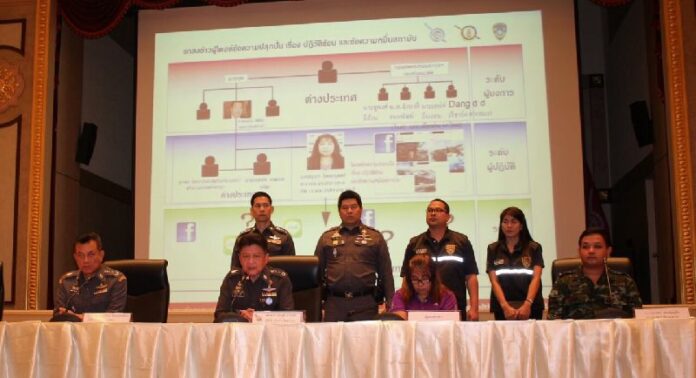
Police display alleged social media connections they said linked Chayapha Chokepornboonsri, 49, to rumors about a counter-coup in Thailand on June 24, 2015.

BANGKOK — She worked at a hotel and said she’d never heard of the lese majeste law before police arrested her. When they told her the quickest way back to her young daughters was confessing to being Facebook user Rungnapha Khamwichai, she did so, without ever speaking to a lawyer.

That was two years ago. For her confession, the military judges who convicted the single mom, identified only as Sasivimol, halved her sentence to 28 years for Facebook messages she says she didn’t write. Her older daughter will be nearly 40 by the time she is released in 2042.

Yet it wasn’t sophisticated government snooping or intrusive software that led to Sasivimol’s arrest, but rather a group of private citizens who saw the messages online and reported them for insulting the monarchy.

It’s part of a trend in which people are under watch by their own peers possibly even friends and family on social media. A recent report one year in the making by a London-based nonprofit found that Thailand’s constitutional guarantees of privacy are threatened by so-called social surveillance, a practice encouraged through direct and indirect measures by the military regime.

“Social surveillance is a government relying on your friends, family and loved ones to spy on you,” report author Eva Blum-Dumontet of Privacy International said.

Blum-Dumontet said it’s serious enough that regular citizens need to rethink their online habits.

“They have to be aware they can be arrested any day,” she said in a recent interview. “People have to realize the situation in Thailand has changed in terms of the amount of arrests and the violence of the government against its own people.”

Government spokesman Sansern Kaewkamnerd said although he hadn’t seen the report, the government needed updated tools to combat new threats such as drugs, human trafficking and the spread of false information.

“Government officers need to surveil and spread correct information in order to protect people from being victims of false information,” he said. “We want it to be the duty of every Thai to help do the same.”

He objected to the notion it was encouraging people to spy on each other.

“I don’t want to use the word ‘spy,’ I don’t want you to look at it in a pessimistic way,” the major general said. “If somebody spreads distorted information which can harm society in the future, then we have to help notify the relevant government agencies.”

He also disputed the government crossed any legal lines or infringed on privacy.

“There is a law, and the authorities can only inspect [communications] with a court warrant. If somebody posts pornograhic photos or photos that defame the nation, religion or the monarchy and we help prevent the damage, this is not called infringement.”

When she began researching the topic, Blum-Dumontet said she first looked into whether the state had deployed direct measures, such as Italian-made intrusion software acquired by police and the military as disclosed last year by Wikileaks.

“My first instinct was to see what they were using,” she said

As she interviewed people for her research, some told her the more one looks for sophisticated measures employed by the state, “the more wrong you will be.”

The report, published one week ago, relies on interviews, media accounts and information from the Internet Law Reform Dialogue, or iLaw, to recount several cases in which social surveillance was used to prosecute civilians. Most cases involved charges of royal defamation, a criminal offense under Article 112 of the criminal code known as lese majeste.

One recounts the case of Pongsak Sriboonpeng, a Redshirt supporter who struck up an online friendship with a man who shared similar views and even sent him a phone to use. When he went to meet the man, Pongsak was arrested and learned his “friend” was a cop. In September 2015, Pongsak was sentenced to 30 years in prison.

The report also details regime efforts to encourage social surveillance by offering cash bounties for reporting online dissidents and organizing cadres of student “Cyber Scouts” to police the internet.

It also faults the military government for “stoking existing tensions” and grievances to cultivate a climate of fear.

“By condemning as lese-majeste a wide range of dissenting opinion, the Thai government has been instigating a climate of fear that has affected the right to privacy of citizens,” the report said. “Individuals have been arrested for expressing their opinions on social media, a personal space many expect to be safe from government interference.”

Sansern said the matter of royal defamation was a special case.

“If you see somebody post a photo that steps right on every Thai heart, what are you going to do?” he said.

In its report, Privacy called on Thai authorities to dismantle the Cyber Scouts program, discourage online informants and condemn the release of personal information to attack someone online.

While social surveillance may be unsophisticated, Blum-Dumontet said trampling of internet freedoms and privacy  are within reach of the government through its control of the national telecommunications infrastructure – and its telecoms. She said she is working on another report looking at “surveillance on the cheap” through control of ISPs and telecoms which aren’t independent.

Though fear of social surveillance may have a chilling effect on expression, Blum-Dumontet said people need to be pragmatic and take it seriously.

“There has to be a point where you realize you are confronting a government that is not allowing you to express yourself, and people need to be extremely careful now in how they do things and use secure platforms,” she said.

Privacy International is based in London. It’s work in Thailand was supported by the Swedish International Development Cooperation Agency and began prior to the coup with the intention of making policy recommendations to the civilian government.

“At the time, it felt like a country where we could potentially have an impact on policy,” Eva-Dumontet said of the project’s inception.

Additional reporting Sasiwan Mokkhasen

Advertisement

Hmong Parents Protest Children’s Conviction by Reddit

A photo posted on Reddit Sunday claimed to show the process while a tourist’s watch was stolen by the kids in Chiang Mai. (Photo: Reddit / MedardBoss)

CHIANG MAI — After a photo spread the world over of their children “stealing” a tourist’s watch, two parents of the two Hmong children insisted to police Tuesday it was simply not true.

The photo of the foreign woman posing with two girls in Hmong ethnic garb in front at Chiang Mai’s most famous temple shot to the front page of Reddit after it was posted Sunday under the caption “Girlfriend in the progress of having her watch stolen.”

The image, in which one of the children’s fingers touch the strap of her wristwatch was taken as certain proof by most of thousands of commentators who upvoted it more than 6,000 times and in news stories it spawned around the world, which took at face value it captured a crime in commission.

Phujarat Jiraphakorn and Lulu Laowa today brought their two daughters, 7 and 10, who appeared in the photo, to answer questions after they were summoned by police.

Anek Chaiwong of Phuping police said the parents were incensed and would have pressed charges for making a false accusation, were the foreign couple still in Thailand.

“The farang did not file any complaint to us,” Lt. Col. Anek said.  “The parents of the kids are very concerned and said they would have filed a complaint against the false accusation were the farang still here in Thailand.”

In comments to the image posted to r/MildlyInteresting, MedardBoss, the original poster, implied the watch was later found missing among a few other disclosures.

“She was a bit drunk tbh,” he wrote. The account has since been deleted.

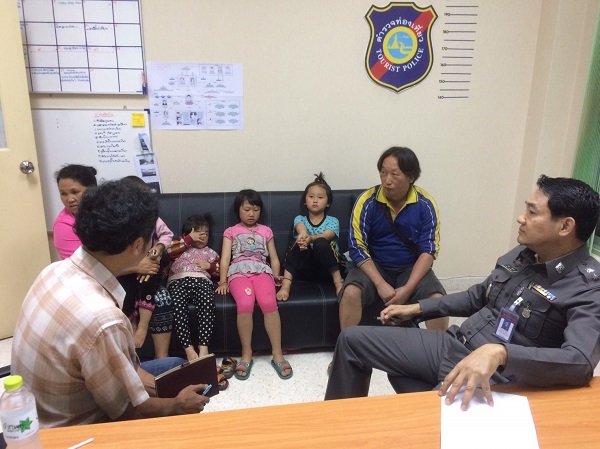
The Hmong family meets with Phuping police Tuesday in Chiang Mai.

But the couple said they interrogated the girls, who denied any wrongdoing. They said they take them to every weekend to Wat Phra That Doi Suthep to make some money posing for photos with tourists for which they accept voluntary donations.

“They never beg for money,” Lulu said. “It always depends on how much the tourists want to give them.”

The Hmong mother said she didn’t see how it was possible for her daughter to steal a watch from someone’s wrist without them noticing.

Their village headman also accompanied them to the police station Tuesday to vouch for the family’s clean record. Methaphan Fuengfukitchakarn said they are well known and liked, and said accusing the children on the basis on one photo was not fair to them.

Yet a number of users were less persuaded, leaving comments certain the girls were engaged in criminal subterfuge.

“I’ve lived in Chiang Mai for almost seven years. Those kids aren’t good; they’re expert. That watch is long gone,” Reddit user Oh_dear_ wrote.

Chiang Mai police aren’t convinced, saying they’ve never known children at the temple to be criminal elements.

“We are deeply concerned,” Anek said. “There has been no such incident like this before.”

Clarification: Due to an editing error, an earlier version of this story indicated police knew children at the temple to be criminal elements, when in fact they said never knew them to be so.

Advertisement

Hot News

LATEST NEWS

Bangkok
overcast clouds
25.5 ° C
25.5 °
25.5 °
93 %
3.2kmh
100 %
Fri
25 °
Sat
32 °
Sun
35 °
Mon
37 °
Tue
37 °