



























33.3 C
Bangkok
Sunday, June 21, 2026
Home Blog Page 2614

Top Architect Says River Project Plagiarized Design

At top, a rendering of the proposed Viman Phra In (Paradise of Indra) as presented by the Chao Phraya boardwalk design team. At bottom, a rendered image of Crystal Island as designed by British architect Norman Foster.

BANGKOK — Flames erupted over the Chao Phraya River again when one of the nation’s top architects pointed out that recently unveiled plans for a structure anchoring a controversial river redevelopment project were identical to that of a famous British architect.

In fact, architect Duangrit Bunnag said the design for the signature landmark Viman Phra In (Paradise of Indra), a monumental structure which will house a museum, came from a 3D model of architect Norman Foster’s work available for free download online.

On Tuesday, he asked the international architecture community to bring the story to Foster’s attention and offered his help to bring legal action against the university-hired boardwalk design team.

“The use of a model open for the public to download for free is common, but as a small part not the main design,” said the prominent architect, who has been a vocal opponent of the junta-driven project to develop concrete walkways along the river. “The 120 million baht design cost of this project was paid using our taxes.”

The issue was first brought to public attention Sunday by activist group Friends of the River, which has organized against a project they say was poorly conceived, destructive to riverside communities – and just ugly.

The junta has said it wants to build a monumental tourist attraction that will be an object of pride for the nation.

Members of ‘Friends’ said the design by the firm contracted by King Mongkut’s Institute of Technology Ladkrabang and Khon Kaen University, looked like Foster’s design for the Crystal Island, a Moscow project described as the world’s largest structure.

Design team A-Seven denied plagiarizing Foster; in fact, a representative insisted they have never even seen his work. They said the design was inspired only by a Thai-style chedi.

Design team head Watchara Chongsuwat went one further in a Matichon interview, asking why people didn’t consider Foster the copycat as chedis are – in his words – Thai architecture.
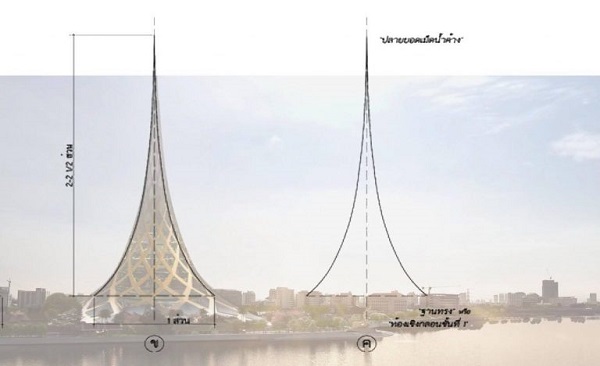
Artists’ rendering of the spire. The design team said it was inspired by Thai-style chedis.

Initiated by the junta, the project began as concrete walkways for seven kilometers along both sides of the river. Contractors subsequently added more structures, such as the sprawling Viman Phra In, as well as redevelopment plans for the surrounding land.

Opponents slammed the design team’s work and said the seven months allowed by the junta was not enough time for the feasibility study and that public hearings were far from inclusive.

Read: Opponents, Proponents of Chao Phraya Boardwalk Open Fire

The team also presented a screen capture showing their design in a rendering program. But Duangrit said it proved nothing more than they imported the model.

“They can download the model and adjust it in the program, adding more detail. But that doesn’t prove they designed it,” Duangrit said. “For the most simplest point, their design still looks just like Norman Foster’s building.”

A screengrab from a design program provided by design team A-Seven. Image: A-Seven / Matichon

Crystal Island by Foster and Partners was first proposed in 2007 but was put on hold after the 2008 financial crisis.

The architect, who has campaigned against the river project since it was announced last year, said plagiarism violates the Thai Architect Council’s regulations. He said the council has the responsibility to investigate. Should they be found guilty, it can revoke their license.

“My worry is that this is a project from the government, and if their license is revoked, the contract will be scrapped.”

The design team announced Monday that it will present its plans to City Hall on Sept. 26. Construction is expected to begin in early 2017 and completed mid-2018.

 

Advertisement

‘Missing’ Chinese Tourist Doesn’t Want to Go Back to China

Gau Li Ping, in orange and red, is escorted to Phyathai Sriracha Hospital on Tuesday in Chonburi province.

CHONBURI — A Chinese woman who reportedly vanished at a tiger zoo in Chonburi province was found Tuesday hiding in a farmer’s hut in a nearby rice field, police said.

Gau Li Ping (transcribed from Thai) separated herself from a tour group Sunday at the Si Racha Tiger Zoo and hid in the hut because she feared for her life if she returned to China, a local police chief said.

“She didn’t get lost. She had the intention of fleeing [and staying] in Thailand,” Col. Chanapat Nawaluk of Nong Khaem police said. “She told an interpreter she didn’t want to go back to her country.”

The rice field’s owner saw the woman Tuesday morning and called police after learning that she fit the description of the missing Chinese tourist, Chanapat said.

“She told the interpreter that she cannot go back to China because she’s afraid that she will die,” Chanapat said, adding that she did not explain the cause of her fear.

Gau refused to come to the police station for questioning so she was sent to a hospital. She was later placed in the custody of Pattaya’s Tourist Police, the colonel said, adding that the Chinese Embassy has been notified.

Gau entered the country legally, according to Chanapat.

Related stories:

Lives Interrupted for Asylum Seekers Facing Desperation, Detention in Thailand

Chinese Asylum Seekers Detained After Boat Founders in Storm

Countdown to Deportation of Chinese Dissidents Worries Loved Ones

Dissidents Fearful as Thailand, Once a Haven, Favors China

Advertisement

Russian Nurse Becomes Photo Nomad in Search of Beauty

Photo: Vika Sukhova / Courtesy

BANGKOK — Living in a dying Russian city where everyone gets married by 25 and retires to watch soap operas at home, a nurse turned photographer decided to travel the world in a quest for beauty.

Carrying her inseparable buddy, a Fuji camera, Vika Sukhova allowed her soul to wander the towns and countries capturing fleeting moments of humanity. That’s now led her to Bangkok for the first time where she will show 29 images mostly shot in black and white this week at WTF Gallery.

Visiting much of Western and Eastern Europe, Sukhova calls herself a world citizen and prefers not to identify with any one culture or country.

“It doesn’t mean I’m a conventional traveler,” Sukhova said. “It rather means I don’t belong to any particular place, especially in my hometown or my home country.”

Photo: Vika Sukhova / Facebook

“A Fleeting Home” goes on display at 7pm on Thursday and runs through Sunday.

Admission is free. WTF can be reached by foot from BTS Thong Lo exit No.1. The three-story venue is open 4pm to 10pm, Tuesday to Sunday.


Advertisement

Duterte Wants US Out of Southern Philippines

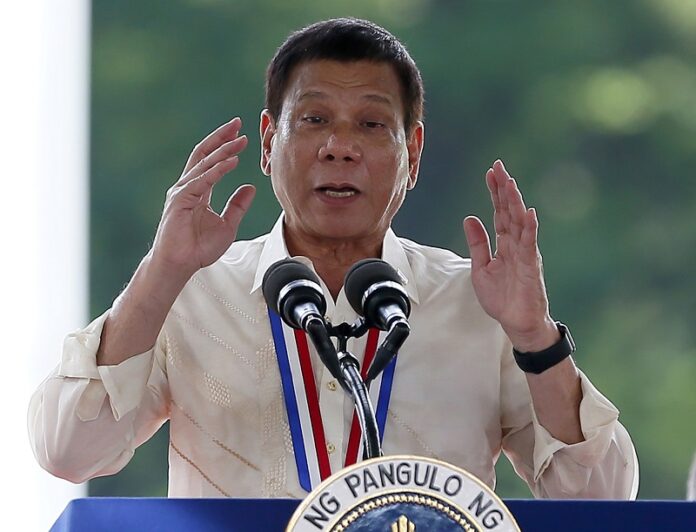
Philippine President Rodrigo Duterte gestures while addressing guests following a wreath-laying ceremony in observance of National Heroes Day Aug. 29 at the Heroes Cemetery in suburban Taguig city, east of Manila, Philippines. Photo: Bullit Marquez / Associated Press

MANILA — Philippine President Rodrigo Duterte said Monday he wants U.S. forces out of his country’s south and blamed America for inflaming Muslim insurgencies in the region, in his first public statement opposing the presence of American troops.

“For as long as we stay with America, we will never have peace in that land.”

Washington, however, said it had not received a formal request to remove U.S. military personnel. White House spokesman Josh Earnest said Duterte had a tendency to make “colorful comments” and drew a comparison with Republican presidential nominee Donald Trump.

Duterte has had an uneasy relationship with the U.S. since becoming president in June and has been openly critical of American security policies. As a candidate, he declared he would chart a foreign policy that would not depend on America, his country’s treaty ally.
In 2002, the U.S. military deployed troops to train, advise and provide intelligence and weapons to Filipino troops battling al-Qaida-linked Abu Sayyaf militants in the southern Philippines. When the American forces withdrew in February last year, U.S. officials said a smaller contingent of U.S. military advisers would stay. Details of the current U.S. military presence in the south were not immediately available.

Duterte did not mention any deadline or say how he intends to pursue his wishes.

State Department spokesman John Kirby said Monday that the U.S. was aware of Duterte’s comments, but is “not aware of any official communication by the Philippine government to that effect and to seek that result.” He said the U.S. remained committed to its long-standing alliance with the Philippines.

In opposing the U.S. military presence in the southern Mindanao region, Duterte cited the killing of Muslims during a U.S. pacification campaign in the early 1900s, which he said was at the root of the long restiveness of minority Muslims in the largely Catholic nation’s south.Before the alliance, the Philippines was a colony of the United States from 1898 to 1946, except for a period of Japanese occupation in World War II.

“For as long as we stay with America, we will never have peace in that land,” Duterte said in a speech to newly appointed government officials.

He showed photos of what he described as Muslim Filipinos, including children and women, who were slain by U.S. forces in the early 1900s and dumped in a pit in Bud Daho, a mountainous region in southern Sulu province. American soldiers stood around the mass grave.

“The special forces, they have to go. They have to go in Mindanao, there are many whites there, they have to go,” he said, adding that he was reorienting the country’s foreign policy. “I do not want a rift with America, but they have to go.”

By contrast, White House spokesman Earnest said, “Filipino people have enormous affection for the United States.” He said the U.S. military has been present in the Philippines for a number of years at the request of its leaders, and the U.S. provided humanitarian assistance when a cyclone struck and help for maritime security.

The special forces, they have to go. They have to go in Mindanao, there are many whites there, they have to go.

With the United States two months away from a presidential election that will pit President Barack Obama’s fellow Democrat Hillary Clinton against Trump, Earnest drew a comparison with the Philippines. He said that elections say a lot about what kind of person is “going to represent your country on the international stage.”

When asked if he were trying to draw a cautionary tale for the American people, Earnest said, “I guess some people could draw that analogy.”

Last week, Obama called off what would have been his first meeting with Duterte on the sidelines of an Asian summit in Laos after the Philippine president used the phrase “son of a bitch” in warning that he wouldn’t accept lectures from Obama on human rights.

Despite the remark, the two leaders later shook hands and had a brief chat in a holding room where Duterte reportedly said his words were not directed at Obama.

Duterte, however, has continued to press his criticism of the American president.

In another speech late Monday, Duterte said for the first time that he deliberately skipped a meeting between Southeast Asian leaders and Obama at the summit in Laos out of principle. His spokesman said at the time that Duterte did not attend the meeting because of a migraine.

American colonial forces killed many Muslims in the southern Philippines more than a century ago “because you were here as imperialists, you wanted to colonize my country and because you had a hard time pacifying the Moro people,” Duterte said in the speech.

While criticizing U.S. policies, Duterte has taken steps to repair relations with China, which were strained under his predecessor over territorial disputes in the South China Sea.

Story: Jim Gomez

Advertisement

Stanley Sheinbaum, Middle East Peace Activist, 96

FILE -- In this Oct. 24, 2015 file photo, Israeli left wing activists hold signs during a peace rally Oct. 2015 in Tel Aviv, Israel. Photo: Sebastian Scheiner / Associated Press

LOS ANGELES — Stanley K. Sheinbaum, a former economics professor whose drive for Mideast peace had him mingling with presidents, royalty and movie stars, has died. He was 96.

Sheinbaum died of heart disease on Monday at his home in the Brentwood neighborhood of Los Angeles, said his assistant, Marti Maniates.

Sheinbaum gave up teaching to devote himself to what he called his quest to “create a little peace and justice in this unjust world.”

He raised funds to defend Daniel Ellsberg during the military analyst’s trial for releasing the Pentagon Papers, a secret study of the Vietnam War.

Never one to shrink from controversy, Sheinbaum met with late Palestinian President Yasser Arafat in an unofficial diplomatic mission to bring peace to the Middle East. The meeting propelled him into headlines and sparked protests from Israelis and the American Jewish community.

“For a while, I was the most hated Jew in America … by other Jews anyway,” he said in his 2011 autobiography. But he added, “I didn’t waste time agonizing.”

Still, he acknowledged, his mission for peace failed.

Sheinbaum “was a tireless advocate whose courageous stances breathed life into monumental change on both the local and global stages,” Mayor Eric Garcetti said in a statement.

“His work will forever inspire everyone who believes in bringing people together to transform our world for the better,” he said.

Sheinbaum’s causes ranged from reforming the LAPD to urging California universities to divest from their holdings in South Africa during apartheid.

“My failure is the greatest disappointment I have ever experienced… and I can only take solace from the knowledge that I really, really tried. I really did.”

In 1971, hearing that Ellsberg was to be prosecuted, Sheinbaum saw a cause that meshed with his anti-Vietnam War sentiments. He volunteered to organize Ellsberg’s legal team and raise money for his defense. He and his wife Betty moved to Los Angeles for the trial and never left. He recruited Hollywood celebrities to hold fundraisers and he signed up two of the most prominent civil liberties lawyers in the country, Leonard Boudin and Leonard Weinglass.His book, “Stanley K. Sheinbaum: A 20th Century Knight’s Quest for Peace, Civil Liberties and Economic Justice,” was written with a co-author when he was in his 90s. It contained book jacket testimonials from President Bill Clinton, Barbra Streisand, Jane Fonda and Norman Lear, who summed up his friend’s legacy by saying: “He’s addicted to fairness and justice.”

After many months of legal drama, the case was dismissed for governmental misconduct involving a break-in at Ellsberg’s psychiatrist’s office and the judge’s meetings with members of the Nixon administration.

In the 1980s, Sheinbaum became obsessed with the cause of peace in the Middle East. He managed to arrange a meeting with Palestinian Liberation Organization leader Yasser Arafat and the picture of him with his arm around Arafat that appeared on the front page of the Los Angeles Times set off a firestorm of protest within the Jewish community. He was booed when he spoke at synagogues. But he continued his mission, meeting with Arafat several more times and trying to negotiate peace with Israel.

When Arafat died, he said hope of a peace agreement died with him. His dream of peace had failed.

“My failure is the greatest disappointment I have ever experienced,” Sheinbaum said, “and I can only take solace from the knowledge that I really, really tried. I really did.”

Story: Robert Jablon

Advertisement

Wind Orchestra Brings Shakespeare to the Ears Wednesday

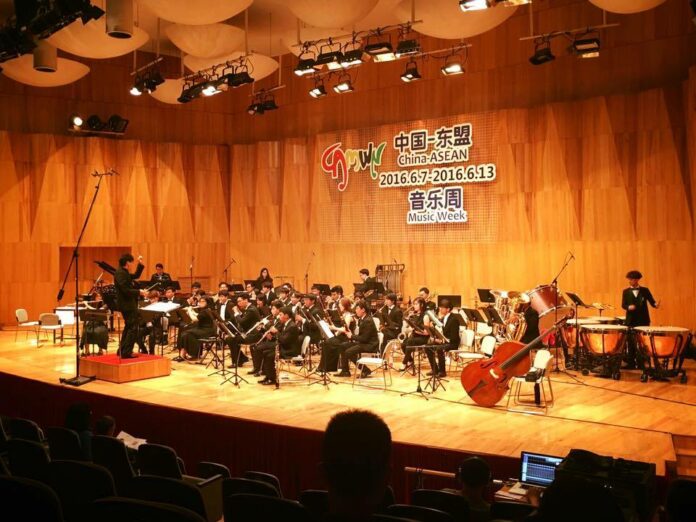
Mahidol Wind Orchestra performs in China-ASEAN Music Week. Photo: Mahidol Wind Orchestra / Facebook

BANGKOK — Four hundred years after Shakespeare shuffled off this mortal coil, his legacy endures not only in words but music. Several arrangements inspired by the famous poet will be performed Wednesday as part of “Shakespeare after 400.”

The Mahidol Wind Orchestra will perform arrangements by the Royal Shakespeare Company, followed by an original reinterpretation of folk song “Greensleeves” to portray the beautiful setting of the bard’s “Twelfth Night.” After that the orchestra will get down with some symphonic dances from “West Side Story,” which drew inspiration from “Romeo and Juliet.”

“As Shakespeare’s works are diverse, the performance combines various song and styles, be they classic or contemporary,” said conductor Thanapol Setabrahmana.

Learn more about Shakespeare and his work from the university’s Richard Anton Ralphs, who has directed several Shakespeare productions and will lead a discussion at 6:30pm before the concert starts.

The concert kicks off a series of events linking music to literature.

The Mahidol Wind Orchestra is comprised of undergraduate wind and percussion students of the university’s College of Music.

Tickets are 200 baht – 100 baht for students – and can be purchased at the box office.

The concert starts at 7pm on Wednesday at the Music Auditorium, College of Music, Mahidol University.

The best way to arrive is by taxi, from BTS Bang Wa exits No. 1 or 2.

Advertisement

Student on Life Support After Near Drowning in Hazing

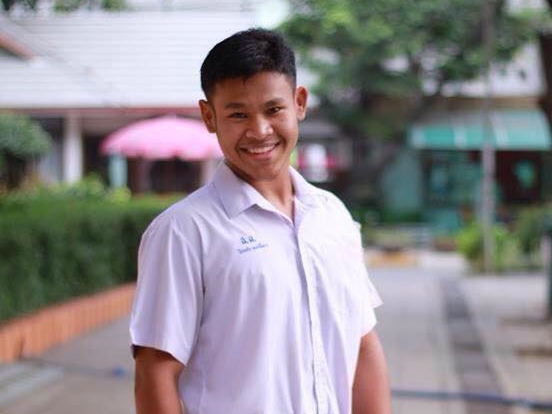
Chokechai Thongnuekhao in an undated photo. Photo: Pook Sukonta Berthebaud / Facebook

CHONBURI — The family of 19-year-old Chokechai Thongnuekhao was still waiting Monday to find out whether he would be back to his old self or suffer permanent brain damage after nearly dying in a hazing session he was forced to submit to at his university.

Witnesses said Chokechai was told Friday by senior students to swim across a large pond at the Chonburi campus of Kasetsart University as part of annual initiation rituals known as rub nong. Chokechai’s strength faltered before he could reach the other side, and he had to be rescued and taken to a hospital, where he remains on a ventilator.

Student Seared With Candle During University Hazing

“He’s out of critical condition. But we have to keep monitoring him. It’s a semi-critical condition,” Chutidej Tabongkarakha, director of Chonburi Hospital, said Monday afternoon.

Chokechai, an International Maritime Studies student, was the latest casualty in a tradition still common at Thai universities despite occasional fatalities and public controversy. No one has been charged for what happened to Chokechai.

According to Chutidej, the student showed recognition and blinked in response to hospital staff calling his name or giving him medicine. But he said it’s too early to tell whether his brain was damaged by oxygen deprivation, or whether he will be able to verbally communicate until he’s breathing on his own.

“Once we can remove the tube, we will reevaluate his brain,” Chutidej said.

Chokechai’s father, Amporn Thongnuekhao, told reporters Sunday after touring the site of the incident that he hoped Chokechai would recover and return to class soon.

Chokechai is a sports enthusiast who usually swims well, Amporn said.

Kasetsart University interim rector Chongrak Wachrinrat told reporters six or seven senior students were at the scene when the incident happened. According to Chongrak, the seniors “told” Chokechai to swim to them, and Chokechai appeared to have a cramp while swimming in the pond. The senior students immediately rescued Chokechai and brought him to hospital, the rector said.

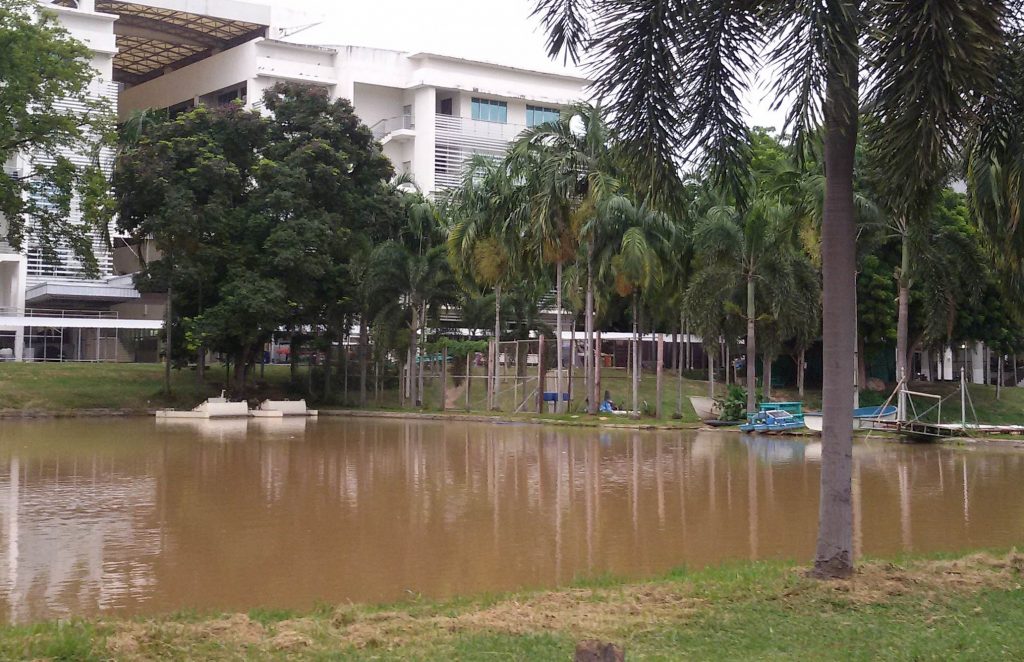
Chokechai Thongnuekhao nearly drowned crossing a pond on the Chonburi campus of Kasetsart University, seen here on Sunday.

He said the university is investigating the matter.

Amporn said he has not filed any criminal charges against any of the senior students and won’t if Chokechai fully recovers. None of the students had yet to meet with him or apologize in person, he said.

Both Chongrak and Amporn also disputed a story on social media that the pond was polluted with chemical waste, though Chutidej of Chonburi Hospital said lab results for any chemical contamination in Chokechai’s body are not out yet.

News of Chokechai’s brush with death was met with a storm of fury online, where many comments expressed disbelief that risky rub nong, or hazing, is still tolerated at many universities. The ritual usually involves senior students forcing freshmen to perform grueling tasks to prove their worth.

“Let me tell you, it’s been more than 10 years since I left university, I have never found any use from my rub nong times, not a single thing,” Pook Sukonta Berthebaud wrote in a Facebook post that’s been shared more than 32,000 times. “Do you want a civilized rub nong? They organize themselves as social service volunteers. They don’t use their birth certificates or power to intimidate or force anyone to grovel to them.”

Rub nong occasionally leads to deaths, injury and sexual assault. In August 2014, a 16-year-old student died during hazing in Hua Hin.

Related stories:

Chiang Mai University to Probe Violent Hazing Rituals

Chula Freshman Says Classmates Threaten Him For Calling Out Hazing

Advertisement

Thai Union Named to Dow Jones Sustainability Index for Third Consecutive Year

From right hand: Setakul Chotichoey Corporate Environment, Health, Safety Manager of Thai Union Group PCL., Darian McBain, Ph.D. Thai Union’s global director of Sustainable Development ,Comgrit Sorchom, Director, Environmental, Health and Safety and Kanin Kaewin, Department Manager, Sustainable Department.

• Marking third year of continued improvement
• SeaChange’ drives Materiality score to industry best-in-class

12 SEP, 2016, BANGKOK — Thai Union Group Public Company Limited (Thai Union), the world’s largest shelf-stable tuna processor and owner of a leading global portfolio of seafood brands, has been named to the Dow Jones Sustainability Indices (DJSI) Emerging Markets for the third consecutive year.

Thai Union’s SeaChange’ sustainability strategy successfully drove the score for Materiality to an industry best-in-class 100th percentile. With strong performances from Business Codes of Conduct, and Labor and Human Rights contributed to the improvements that ranked in the 96th and 91st percentile, respectively. The increase in Thai Union’s score indicates the company’s efforts and discipline in applying sustainable practices and accountability across its business and supply chain are achieving results.

“We are honored to be recognized for our ongoing implementation of our sustainability roadmap, proving that we are on the right track,” said Thiraphong Chansiri, Thai Union’s CEO. “Sustainability is critical to the future of our industry and our world. We will continue to make transparency and ethical conduct an integral part of how we do business, to the benefit of our environment, economy and society,” he added.

DJSI is among the most highly-regarded metrics that evaluate global companies on their sustainability performance. Each year, over 3,000 companies are invited to participate in
RobecoSAM’s Corporate Sustainability Assessment (CSA). Companies are selected for the indices based on a comprehensive assessment of long-term economic, environmental and social criteria that account for general as well as industry-specific sustainability trends. Only firms that lead their industries based on this assessment are included in the indices.
Thai Union became the first Thai company to be included in the DJSI food category in 2014.

“Sustainability is a global need that requires a global commitment. With our SeaChange’ sustainability strategy, stringent application of Business Ethics and Labor Code of Conduct and other sustainability best practices, we seek to encourage the entire seafood industry to work together towards sustainability. To have an internationally recognized, independent third party institution endorse our efforts and implementations in operational excellence is an encouraging reward,” added Darian McBain, Ph.D., Thai Union’s global director of sustainable development.

Underscoring its commitment to transparency, Thai Union recently opened its SeaChange’ sustainability strategy goals and commitments to public consultation. Earlier this year, stakeholders were invited to provide comment on the content and nature of the goals for each of the four key programs: safe and legal labor; marine conservation; responsible sourcing; and caring for our communities. The feedback was collated, and revisions are being made to reflect stakeholder viewpoints. The new SeaChange’ website will be launched soon , along with further updates on progress. SeaChange’ will also be used as a platform for conversation and dialogue across the global industry, looking at how Thai Union can change seafood for good.

About Thai Union Group PCL
Thai Union Group PCL is the world’s seafood leader bringing high quality, healthy, tasty and innovative seafood products to customers across the world for almost 40 years.

Today, Thai Union is regarded as the world’s largest producer of shelf-stable tuna products with annual sales exceeding THB 125 billion (US$ 3.7 billion) and a global workforce of over 46,000 people who are dedicated to pioneering sustainable, innovative seafood products.

The company’s global brand portfolio includes market-leading international brands such as Chicken of the Sea, John West, Petit Navire, Parmentier, Mareblu, King Oscar, and R’gen Fisch and Thai-leading brands Sealect, Fisho and Bellotta

As a company committed to innovation and globally responsible behavior, Thai Union is proud to be a member of the United Nations Global Compact, and a founding member of the International Seafood Sustainability Foundation. Its work in sustainability has been recognized by its inclusion in the Dow Jones Sustainability Indices (DJSI) Emerging Markets since 2014. In 2016, Thai Union received a DJSI score of 72, the third consecutive year of DJSI score improvement.

Contact: Wisaka Chantakit
Thai Union Group+66.81.845.7316
[email protected]

For news releases and related materials visit the Thai Union News Room
Click here for more on SeaChange’ and follow us at www.twitter.com/ThaiUnionGroup

This is a paid advertorial. Khaosod English is not responsible for its content or claims.

Advertisement

Relatives of MH370 Victims Want More Possible Debris Studied

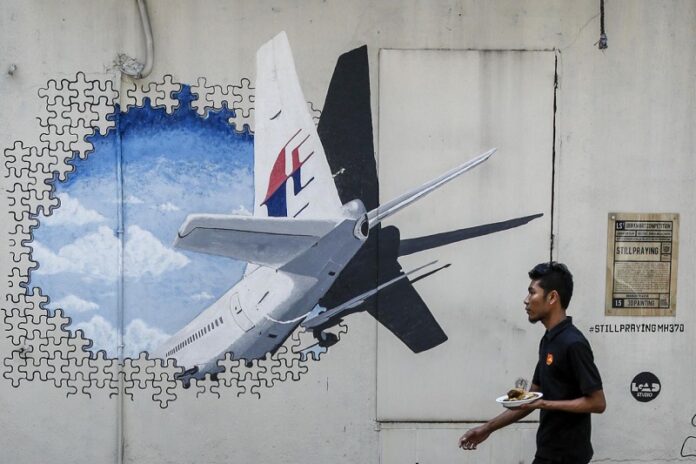
In this Tuesday, Feb. 23, 2016, file photo, a waiter walks past a mural of flight MH370 in Shah Alam outside Kuala Lumpur, Malaysia. Photo: Joshua Paul / Associated Press

CANBERRA, Australia — Relatives of some of the 239 passengers and crew on missing Malaysia Airlines Flight 370 called Monday for more of its possible debris to be examined to define a new search area.

Malaysia, China and Australia agreed in July that the search in the southern Indian Ocean would be suspended after the current 120,000-square kilometer (46,000-square mile) expanse has been thoroughly examined with deep sea sonar equipment in the absence of credible new evidence that identified the plane’s location.

Eight relatives of lost passengers who met with Australian officials coordinating the search on behalf of Malaysia expressed frustration that they were not given a definition of what constituted credible new evidence that would result in a continuation of the search.

American wreckage hunter Blaine Gibson attended the meeting at the Australian Transport Safety Bureau headquarters with the relatives from Malaysia, China, Australia and Indonesia and handed over to investigators five pieces of potential debris that he found on beaches in Madagascar. Two of the pieces were burnt, which could indicate a disastrous fire on board, he said.

Gibson previously found a panel from Flight 370 in Mozambique. Malaysia has yet to collect other potential debris that Blaine has found washed up on Madagascar since June and handed to authorities there.

“I hope that the search will go on and in my amateur opinion this constitutes new, credible evidence that justifies continuing the search,” Gibson told reporters of his unconfirmed debris find.

Some confirmed pieces of debris have washed ashore in the western Indian Ocean, and the families believe other items yet to be examined may be clues to the plane’s location.

Grace Nathan, a Malaysian whose mother was on the Boeing 777 that vanished during a flight from Kuala Lumpur, Malaysia, to Beijing on March 8, 2014, said governments should be coordinating a search for debris and using drift modeling to define a new area to search after the current search is to be completed in December.

“We want to call on the three nations – Australia, China and Malaysia – to make a concerted effort to go out and look for this credible new information,” Nathan said.

“It’s very impressive that one private individual citizen, Blaine Alan Gibson, has managed to find up to 15 pieces of aircraft debris and we hope that these three nations do more than just hope by fluke people find more debris,” she added.

The Australian Transport Safety Bureau confirmed in a statement that it had received debris from Gibson and was seeking advice from Malaysia on how Australia should proceed.

Jennifer Chong, a Melbourne-based Malaysian-Australian dual citizen whose husband was aboard Flight 370, wondered why Malaysia had not sent diplomats to the five-hour meeting with Australian search officials. China and Indonesia both sent diplomats to support their citizens.

Oceanographers are analyzing the first piece of wreckage found, a wing flap known as a flaperon that washed up on Reunion Island off the African coast in July last year – 16 months after the plane went missing – in the hope of narrowing a possible next area adjoining the current search boundary through drift modeling.

A wing flap found on Tanzania is also being examined at Australian Transport Safety Bureau headquarters for clues. Search officials expect more Flight 370 wreckage to wash up in the months ahead.

Sheryl Keen, chairwoman of Air Crash Support Group, which is supporting the relatives during their week in Australia, called on Malaysia to collect the debris found by Gibson on Madagascar and to consider handing responsibility for the search to Australia.

Story: Rod McGuirk

Advertisement

Bangkok Moves to Contain Zika Outbreak

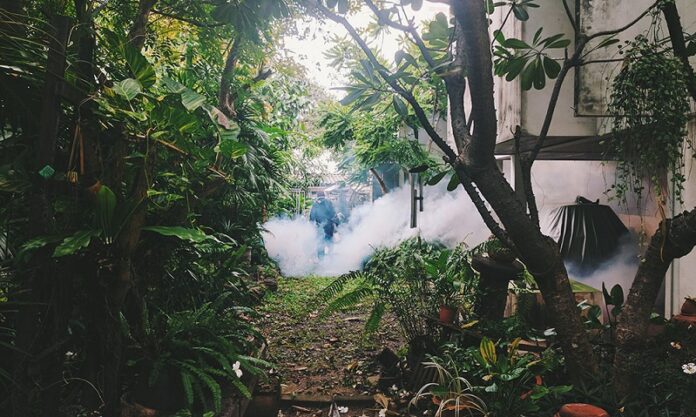
Workers fumigate a residence in Soi Ratchada 14 on Sept. 2. Photo: Pongvech Vechprasit

BANGKOK — City officials said Monday that adequate measures are being taken after it found 22 cases of Zika virus in Bangkok’s Sathon district, making for 29 confirmed cases in the capital this year.

Days after it emerged that a pregnant woman became infected with the virus which has been linked to birth defects, City Hall said it found 21 more cases in the area and moved aggressively to control mosquitoes and prevent further spread of infection.

Wanthanee Wattana of the Bangkok Metropolitan Administration, or BMA, said the city has dispatched crews to fumigate the streets and remove standing water where mosquitoes breed to reduce the chance of transmission. She called for the public to help.

Read: More Awareness, Reporting Cited for Thailand’s Rise in Reported Zika Cases

“I would like to urge everyone to help BMA eliminate the mosquitoes also,” Wanthanee said.

Wathanee said the city was notified by a private hospital on Sept.1 about the infected woman. She was 24-weeks pregnant at the time of infection and has since recovered, she said.

“We have to admit there were Zika cases in Bangkok before,” said Wanthanee Wattana of the Bangkok Metropolitan Administration. “The Sathon case was the eighth.”

Of the 22 Sathon cases, three people were infected while traveling outside the capital. Therefore the authorities have coordinated with provincial health officials to track down anyone who had contact with them.

Zika isn’t new to Thailand, but there were relatively few reported cases over the years. Both government officials and World Health Organization’s Thailand office concur the increase in reported Zika cases is the result of better surveillance, reporting and awareness of the disease.

Nationwide, there have been 97 cases in 16 provinces from January through August, according to a disease control official. Six provinces are being closely monitored.

The virus has surged across much of the world this past year and has been blamed for microcephaly, a condition of incomplete brain development, in babies born to women infected by it.

Advertisement

Hot News

LATEST NEWS

Bangkok
overcast clouds
33.3 ° C
35 °
33.3 °
59 %
1.7kmh
100 %
Sun
36 °
Mon
37 °
Tue
36 °
Wed
37 °
Thu
36 °