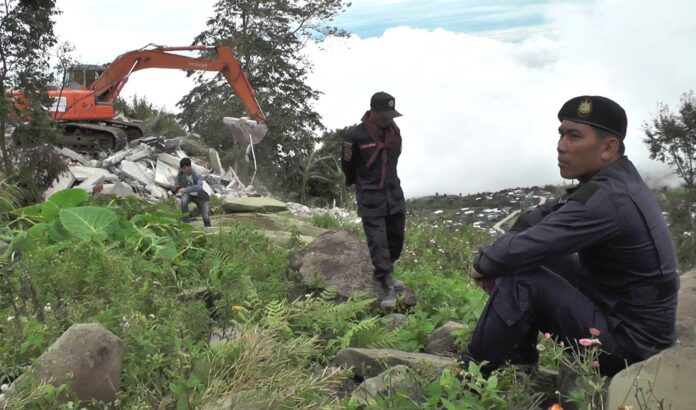
Interior department officers watch over the site where an illegally built structure is being demolished Thursday in Phetchabun province.
PHETCHABUN — Two officials on a mission to demolish resorts built on public land in Phetchabun province said an anonymous caller Thursday threatened that they would be attacked by the Islamic State if they did not cease operations.
The threat, which failed to materialize, followed a Department of Forestry raid on a group of resorts on the scenic Phu Thap Boek mountain as part of the military government’s effort to restore public land from unauthorized hotel operators.
According to a statement released to the press Thursday morning, the two officials in charge of the operation received calls the night before from a man who said he was a militant from the terror group. He threatened to stage bomb attacks unless they withdrew from the mountain.
“But nothing happened today. Everything proceeded as normal,” one of the two officials, Boonlap Suksai, said by telephone today. He said he only received the phone call once.
Boonlap added that the military did send some reinforcement to accompany his team this morning when they started demolishing the last three resorts that sat on the public land. The officials encountered no violence, and the operation was a success, Boonlap said.
Nineteen resorts on the peak of Phu Thap Boek were earmarked for demolition after forest officials ruled they were built on public land without permission. The junta issued a special order on July 5 to destroy the offending properties, and officials soon warned all 19 operators to pull down their buildings.
Boonlap said only three resisted, but today they gave up and allowed the demolition to take place.
“The business operators voluntarily demolished their resorts, and we helped them. They did it on their own accord. There was no resistance,” Boonlap said. “As of this time, every owner has surrendered.”
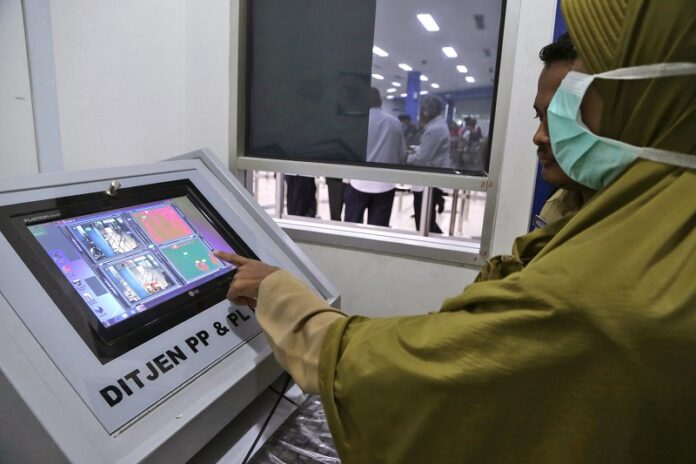
Indonesian Health Ministry officials operate a thermal scanner used to monitor ferry passengers arriving from Singapore at the arrival hall of Batam Center International Port in Batam, Indonesia on Thursday. Photo: M. Urip / Associated Press
JAKARTA — Indonesia is screening travelers from neighboring Singapore for the mosquito-borne Zika virus as the city-state reports a growing number of infections and its first case of a pregnant woman testing positive.
Indonesian Health Ministry spokesman Oscar Primadi said Thursday that health officials are recommending that the Foreign Ministry issue an advisory against nonessential travel to Singapore, particularly for pregnant women.
Singapore on Wednesday said it had identified 22 new Zika cases in one particular area of the city and its first case involving a pregnant woman.
Zika has mild effects for most people but doctors believe infection during pregnancy can result in babies with small heads, which is known as microcephaly, and other serious developmental disorders. Singapore had 155 cases as of Wednesday.
The U.S. Centers for Disease Control and Prevention is advising travelers to Singapore to take precautions such as protecting themselves against mosquito bites, and because the virus can also be sexually transmitted, to use condoms or not have sex.
Primadi said thermal imaging equipment to detect abnormal body temperatures was installed at eight Indonesian ports with routes serving Singapore, including the capital Jakarta’s airport.
He said travelers will also be given a health questionnaire so they will recognize symptoms and know to immediately report to health authorities.
On Thursday, Malaysia’s Health Ministry said a 58-year-old woman who traveled to Singapore had become that country’s first Zika case.
Health Minister S. Subramaniam said the woman and her husband visited Singapore for three days from Aug. 19. The woman developed a rash a week after her return and later tested positive for Zika in her urine, he said. Her daughter in Singapore tested positive for Zika on Tuesday.
“We can conclude that it is rather easy to get infected by the virus when visiting places that has outbreak, including Singapore,” he said. “Proactive action from the community can help stop the spread of Zika virus in Malaysia.”
Subramaniam said the virus was believed to be imported from Singapore because the woman started experiencing symptoms on the same day as her daughter.
The ministry has started control activities such as eliminating mosquito breeding sites and fog spraying in her residential area and other places that the patient had visited.
Indonesia has not yet reported any local Zika infections but an Indonesian woman in Singapore is among those infected there.
Republican Presidential candidate Donald Trump speaks in Youngstown, Ohio on Aug. 15. Photo: Gerald Herbert / Associated Press
PHOENIX, Arizona — Donald Trump is retreating from his vow to deport the nation’s entire population of people living in the country illegally, even as he sticks with an aggressive tone on illegal immigration and remains committed to building a physical wall along the U.S. border with Mexico.
The Republican nominee for president promised Wednesday to remove millions of people living in the country illegally if elected president, warning that failure to do so would jeopardize the “well-being of the American people.”
“Anyone who has entered the United States illegally is subject to deportation,” Trump said in a highly anticipated speech, which took place mere hours after his surprise meeting with Mexican President Enrique Pena Nieto in his first trip abroad as the GOP nominee.
But the billionaire New Yorker also said the effort of a proposed immigration task force in a Trump administration would focus on removing criminals, people who have overstayed their visas and other immediate security threats.
Left unanswered by Trump: What would happen to those who have not committed crimes beyond their immigration offenses?
Aimed at ending weeks of confusion over just where he stands on immigration, Trump’s fiery speech was filled with applause lines for his loyal supporters.
Mexico President Enrique Pena Nieto and Republican presidential nominee Donald Trump shake hands on Wednesday after a joint statement at the presidential official residence in Mexico City. Photo: Marco Ugarte / Associated Press
Any person living in the country illegally who is arrested “for any crime whatsoever,” he said, will immediately be placed into deportation proceedings. “There will be no amnesty,” he added, saying immigrants in the country without permission who wish to seek legal status or citizenship must return to their home countries in order to do so.
But there was no direct mention of a core promise of his primary campaign – to create a “deportation force” that would remove all of the estimated 11 million immigrants living in the country illegally.
Trump instead repeated the standard Republican talking point that only after securing the border can a discussion begin to take place about all such immigrants, ducking the major question that has frustrated past congressional attempts at remaking the nation’s immigration laws.
That omission didn’t bother Dan Stein, who leads the Federation for American Immigration Reform, a group that pushes for stricter immigration policies. He called Trump’s speech the outline of “a coherent and workable strategy.”
“But even more important than the details of the plan itself,” Stein said, “Trump laid out the most fundamental principle for true immigration reform: The policy exists to protect and serve ‘the well-being of the American people,’ and ‘protect all aspects of American life.'”
Critics, meanwhile, said Trump’s glossing over the fate of people who are peacefully living in the U.S. without permission doesn’t make up for his overall approach.
“It is still the most extreme position of any modern presidential candidate,” said Frank Sharry, a leading immigration advocate. “It is deeply unpopular with voters, and profoundly un-American.”
Even as he beat a retreat from his earlier pledge to deport all illegal immigrants from the country, Trump’s aggressive tone in Phoenix marked a shift from earlier in the day. A much more measured Trump described Mexicans as “amazing people” as he appeared alongside Pena Nieto in Mexico’s capital city.
The good feelings from his first meeting with a head of state as his party’s presidential nominee lasted only a short time, as a dispute arose in the hours after he left Mexico City over the most contentious part of the billionaire’s plans to fight illegal immigration – his insistence that Mexico must pay to build a physical wall along the roughly 3,200-kilometer U.S. southern border.
Trump told reporters during his afternoon appearance with Pena Nieto that the two men didn’t discuss who would pay for a cost of construction pegged in the billions. Silent at that moment, Pena Nieto later tweeted, “I made it clear that Mexico will not pay for the wall.”
With the meeting held behind closed doors, it was impossible to know who was telling the truth.
Trump told the rowdy Arizona crowd that he respects the Mexican president. “We agreed on the importance of ending the illegal flow of drugs, cash, guns and people across our border and to put the cartels out of business,” he said.
Yet, standing on American soil, he addressed directly a question he sidestepped when asked in Mexico.
“Mexico will pay for the wall, 100 percent,” the New York businessman said. “They don’t know it yet, but they’re going to pay for the wall.”
The Mexican president, however, said on Twitter that the subject was among the first things the men discussed. “From there, the conversation addressed other issues, and developed in a respectful manner,” Pena Nieto wrote.
Trump was cheered in Arizona, but his appearance in Mexico sparked anger and protests. The candidate is deeply unpopular in Mexico due in large part to his deriding the country as a source of rapists and criminals as he kicked off his campaign. He piled on in the months to come, attacked the country over free trade, illegal immigration and border security.
Campaigning in Ohio, Democrat Hillary Clinton jabbed at Trump’s Mexican appearance as she promoted her own experience working with foreign leaders as the nation’s chief diplomat.
“People have to get to know that they can count on you, that you won’t say one thing one day and something totally different the next,” she told the American Legion in Cincinnati.
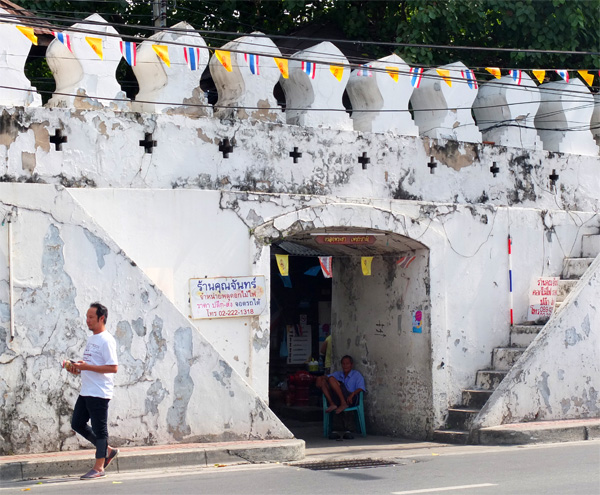
More than 300 people live between the wall of Mahakan fort and Khlong Banglamphu, seen here in September 2016, which the city declared eminent domain over in 1992 to build a park.
BANGKOK — A showdown is brewing for Saturday after neighborhood activists invited the public to come out in support of the historic Pom Mahakan community, which they believe City Hall will take steps to demolish.
After 24 years of fighting, dozens of discussions and delayed ultimatums, members of the community behind an old fort near Wat Saket and its supporters said Wednesday they are convinced the city will take action this weekend to finally begin forcible eviction.
The most recent deadline of Sept. 3, announced in July, was reiterated once again last week by Deputy Bangkok Gov. Aswin Kwanmuang. He also insisted no more extensions would be granted. He said the city would move this weekend to knock down 13 homes whose owners had previously agreed to leave.
Community leader Thawatchai Woramahakhun said a minority of residents in the community had accepted compensation to relocate.
In 2005 the Supreme Court ruled that City Hall had the right to clear out the century-old community and replace it with a park, as it is situated on public land.
More than 300 residents who have lived there for three generation then proposed sharing the space in order to protect their history.
To illustrate, the residents, with the help of community activists, created a “living museum” where people could visit and learn about local history and culture. The public learning space opened July 10 but was suspended recently when they learned the eviction was moving forward.
Though Deputy Gov. Aswin attended a historic public hearing in June and assured the community it would be consulted on an agreeable solution, the decision to evict came unilaterally from the city.
Walailak Songsiri, a community history expert and principal supporter, called for the public to gather at 8am on Saturday to protest the eviction.
Walailak said they may be unable to stop the eviction but must send a message about community preservation to the authorities and bear witness to its destruction.
“We just want to show the power of people outside of social media,” she said. “If Pom Mahakan is gone, soon other old communities will be gone too.”
Walailak said she was unsure how Saturday’s confrontation would turn out.
“They have been fighting for more than 20 years, as we know, their hearts must be very strong,” she said.
One police officer appears to hold a bloody bandage as he tends to another officer at an inter-departmental football match Wednesday in Sakon Nakhon province.
SAKON NAKHON — Police say photos spread online Wednesday night showed cops in Sakon Nakhon province giving their best at a friendly football match and were not evidence of a brawl, as the internet believes.
The set of photos was widely circulated via Line with a caption saying they were taken at a match between Song Dao and Panna Nikom Police Stations earlier in the day and questioning what happened.
“Is this a football match or a fistfight?” the caption said, adding that five officers were sent to hospital.
Many people on social media immediately jumped to the latter conclusion.
“Each of you guys have guns, you know. If we want to play this kind of friendly match, I suggest you divide into two sides and just shoot each other, so you won’t be a burden on the public to pay your salary like this,” wrote Somkit Chailert in a Facebook thread.
But Sakon Nakhon police commander Chaiyat Saithin disputed that narrative. Speaking by telephone Thursday, the chief said his officers were simply aggressive in struggling for the ball, and there was no melee.
“One person headed the ball and collided into another person. One person clashed into another. That kind of thing,” Maj. Gen. Chaiyat said.
He added that he’s already ordered his officers to counter such rumors on social media.
One police officer appears to be carried away from an inter-departmental football match Wednesday in Sakon Nakhon province.One police officer appears to have suffered a cut on his face from an inter-departmental football match Wednesday in Sakon Nakhon province.
People walk past a travel advisory on the Zika virus infection Sunday in Kuala Lumpur International Airport. Photo: Vincent Thian / Associated Press
KUALA LUMPUR — Malaysia’s Health Ministry says a woman who traveled to Singapore has been diagnosed with the Zika virus, the country’s first case of the mosquito-borne disease.
The ministry says the 58-year-old woman tested positive for Zika in her urine after she developed a rash a week after her return from Singapore. It says her daughter in Singapore also tested positive for Zika.
It said Thursday the virus was believed imported from Singapore since the woman started experiencing symptoms on the same day as her daughter.
Zika has mild effects on most people but can be fatal for unborn children. Infection during pregnancy can result in babies with small heads – a condition called microcephaly – and other brain defects.
Singapore says more than 40 people have been infected by the virus.
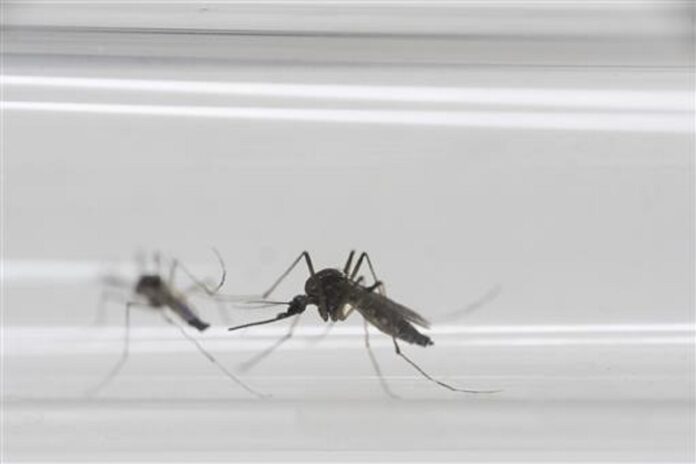
In this Monday, May 23, 2016 photo, Aedes aegypti mosquitos sit inside a glass tube at the Fiocruz institute where they have been screening for mosquitos naturally infected with the Zika virus in Rio de Janeiro, Brazil. Photo: Felipe Dana
BANGKOK — An apparent surge in the number of reported Zika cases in Thailand is most likely due to better surveillance, reporting and awareness of the disease, health experts said.
Although nearly 100 people have become infected with the Zika virus in six months, Thai health officials told the public Tuesday not to worry after a European health agency put Thailand in the red zone of countries where the disease is a threat.
“This is partly because surveillance has been strengthened in Thailand, but also because clinicians are much more aware of the disease and so are testing more people,” said Rick Brown of the World Health Organization’s Thailand office.
On Friday, concerns were raised after Thailand’s was moved into the red zone of a map by the European Centre for Disease Prevention and Control, or ECDC, for having “widespread transmission” of the disease.
Disease Control Department head Amnuay Gajina on Tuesday said the European map isn’t accurate because his department never sent official data to the organization; therefore, it probably relied on media reports. He also said the standard used in the ECDC map was different from that of the WHO.
Brown of the WHO said Wednesday that the ECDC uses the same information as the U.N. health agency but has a different system of classification. By the WHO’s measure, Thailand is a place where it was likely the disease was already in circulation.
“By implication, it’s possible that if more testing had been done in previous years, more cases would have been found,” Brown said via email.
Under the WHO model, Thailand is classified as Category 2, which is for countries with possible endemic transmission or evidence of local, mosquito-born Zika infections.
For 2016, that also included Indonesia, the Philippines and Vietnam.
On June 27, Amnuay announced a total 97 people had been infected with Zika virus in 10 provinces during the first half of the year.
Amnuay said he believes that by WHO standards, transmission of the disease in Thailand is “sporadic.”
Amnuay said incidents of infection have only been found in six of the 16 provinces where it was found earlier.
According to the Ministry of Public Health, Zika infections are currently limited to Chiang Mai, Chanthaburi, Phetchabun and Bueng Kan provinces.
Earlier this year, the ministry declared Zika an infectious disease to be closely monitored in accordance to the 2015 Communicable Disease Act.
However authorities said the virus, which belongs to the same family as dengue, was first found in Thailand in 2012 and was believed to infect about five people per year without ever reaching epidemic level.
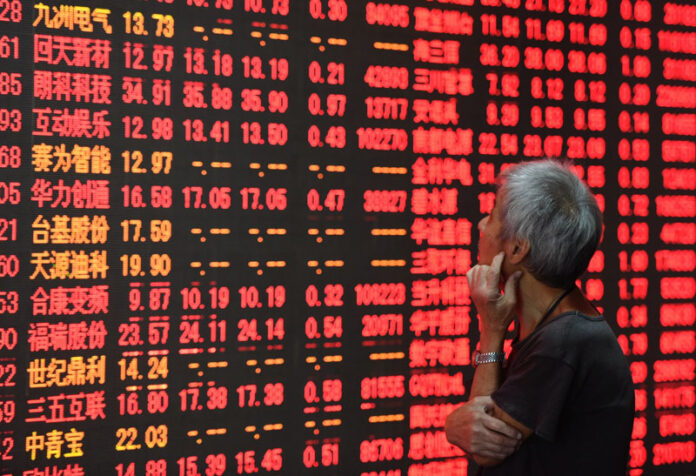
An investor stares at a stock price board at a stock trading hall in 2016 in Hangzhou, capital of east China's Zhejiang Province. Photo: Long Wei / Associated Press
NEW HAVEN, Connecticut — Despite all the hand-wringing over the vaunted China slowdown, the Chinese economy remains the single largest contributor to world GDP growth. For a global economy limping along at stall speed – and most likely unable to withstand a significant shock without toppling into renewed recession – that contribution is all the more important.
A few numbers bear this out. If Chinese GDP growth reaches 6.7 percent in 2016 – in line with the government’s official target and only slightly above the International Monetary Fund’s latest prediction (6.6%) – China would account for 1.2 percentage points of world GDP growth. With the IMF currently expecting only 3.1 percent global growth this year, China would contribute nearly 39 percent of the total.
That share dwarfs the contribution of other major economies. For example, while the United States is widely praised for a solid recovery, its GDP is expected to grow by just 2.2 percent in 2016 – enough to contribute just 0.3 percentage points to overall world GDP growth, or only about one-fourth of the contribution made by China.
A sclerotic European economy is expected to add a mere 0.2 percentage points to world growth, and Japan not even 0.1 percentage point. China’s contribution to global growth is, in fact, 50% larger than the combined 0.8-percentage-point contribution likely to be made by all of the so-called advanced economies.
Moreover, no developing economy comes close to China’s contribution to global growth. India’s GDP is expected to grow by 7.4 percent this year, or 0.8 percentage points faster than China. But the Chinese economy accounts for fully 18 percent of world output (measured on a purchasing-power-parity basis) – more than double India’s 7.6 percent share. That means India’s contribution to global GDP growth is likely to be just 0.6 percentage points this year – only half the 1.2-percentage-point boost expected from China.
More broadly, China is expected to account for fully 73 percent of total growth of the so-called BRICS grouping of large developing economies. The gains in India (7.4%) and South Africa (0.1%) are offset by ongoing recessions in Russia (-1.2%) and Brazil (-3.3%). Excluding China, BRICS GDP growth is expected to be an anemic 3.2 percent in 2016.
So, no matter how you slice it, China remains the world’s major growth engine. Yes, the Chinese economy has slowed significantly from the 10% average annual growth recorded during the 1980-2011 period. But even after transitioning from the “old normal” to what the Chinese leadership has dubbed the “new normal,” global economic growth remains heavily dependent on China.
There are three key implications of a persistent China-centric global growth dynamic.
First, and most obvious, continued deceleration of Chinese growth would have a much greater impact on an otherwise weak global economy than would be the case if the world were growing at something closer to its longer-term trend of 3.6 percent. Excluding China, world GDP growth would be about 1.9 percent in 2016 – well below the 2.5 percent threshold commonly associated with global recessions.
The second implication, related to the first, is that the widely feared economic “hard landing” for China would have a devastating global impact. Every one-percentage-point decline in Chinese GDP growth knocks close to 0.2 percentage points directly off world GDP; including the spillover effects of foreign trade, the total global growth impact would be around 0.3 percentage points.
Defining a Chinese hard landing as a halving of the current 6.7% growth rate, the combined direct and indirect effects of such an outcome would consequently knock about one percentage point off overall global growth. In such a scenario, there is no way the world could avoid another full-blown recession.
Finally (and more likely in my view), there are the global impacts of a successful rebalancing of the Chinese economy. The world stands to benefit greatly if the components of China’s GDP continue to shift from manufacturing-led exports and investment to services and household consumption.
Under those circumstances, Chinese domestic demand has the potential to become an increasingly important source of export-led growth for China’s major trading partners – provided, of course, that other countries are granted free and open access to rapidly expanding Chinese markets. A successful Chinese rebalancing scenario has the potential to jump-start global demand with a new and important source of aggregate demand – a powerful antidote to an otherwise sluggish world. That possibility should not be ignored, as political pressures bear down on the global trade debate.
All in all, despite all the focus on the US, Europe, or Japan, China continues to hold the trump card in today’s weakened global economy. While a Chinese hard landing would be disastrous, a successful rebalancing would be an unqualified boon. That could well make the prognosis for China the decisive factor for the global economic outlook.
While the latest monthly indicators show China’s economy stabilizing at around the 6.7% growth rate recorded in the first half of 2016, there can be no mistaking the headwinds looming in the second half of the year. In particular, the possibility of a further downshift in private-sector fixed-asset investment could exacerbate ongoing pressures associated with deleveraging, persistently weak external demand, and a faltering property cycle.
But, unlike the major economies of the advanced world, where policy space is severely constrained, Chinese authorities have ample scope for accommodating moves that could shore up economic activity. And, unlike the major economies of the developed world, which constantly struggle with a trade-off between short-term cyclical pressures and longer-term structural reforms, China is perfectly capable of addressing both sets of challenges simultaneously.
To the extent that the Chinese leadership is able to maintain such a multi-dimensional policy and reform focus, a weak and still vulnerable global economy can only benefit. The world needs a successful China more than ever.
Stephen S. Roach, a faculty member at Yale University and a former chairman of Morgan Stanley Asia, is the author of Unbalanced: The Codependency of America and China.
From left, actress Sasithorn Panichnok, cinematographer Boonyanuch Kraithong and director Pimpaka Towira. Original images: SF Cinema, Boonyanuch Kraithong / Courtesy
BANGKOK — Patricia Arquette took on the wage gap in her 2015 Oscar acceptance speech, and “Hunger Games” star Jennifer Lawrence called it out in an impassioned essay. Apart from wages, the women of Hollywood struggle with unequal opportunity, ageism and racial inequity.
While it may be tough for women in the world’s largest media machine, what about female filmmakers in Thailand? We asked four successful women in the industry about their experiences.
Actress Sasithorn Panichnok
Debuting at 19 in the 2001 drama “Jan Dara” by Nonzee Nimibutr, Thai-Indian actress Sasithorn “Heen” Panichnok is still acting 15 years later. She insists there aren’t any overt gender issues in the industry but says opportunities aren’t always merit-based.
Actress Sasithorn “Heen” Panichnok at the premiere of ‘The Island Funeral’ on July 20 at SF World Cinema in Bangkok’s CentralWorld. Photo: SF Cinema / Courtesy
“Here, actors don’t have to study acting or even be able to act. If you’re outstanding and unique, you can be an actor,” said Sasithorn, a graduate of Chulalongkorn University’s dramatic arts program. “This is not fair for someone who has studied and trained specifically in acting. If our appearance isn’t interesting enough, or what the market wants, then how can we find opportunities doing what we’ve trained for? Connections are very important here.”
Sasithorn’s first leading role was in 2002 disaster film “Taloompuk,” followed two years later by “Meteor” and direct-to-video thriller “Black Magic Woman.” After graduation, she went to New York for six years to pursue her dreams and train at Pace University’s Actors Studio Drama School.
“In New York, the casting process is very fast and efficient. They cast actors by who we are and don’t care much about how we dress or put on makeup,” Sasithorn said. “But here, if we show people of who we truly are, some people might dislike us.”
Still, being a foreigner was a con when working abroad, as some roles and jobs can only be taken by citizens. Also, language is a barrier in getting a desired role.
Director Pimpaka Towira
Of 63 films released in 2015, about 1-in-10 were made by female filmmakers in various genres, such as “Love Sucks,” a rom-com by actress Manasnan “Donut” Panlertwongskul; “Y/Our Music,” a music documentary by Waraluck Hiransrettawat Every; and “Arpat,” the nearly banned religion-themed studio horror film by Kanittha Kwunyoo.
In 2016, the only movie by a female filmmaker to have wide release was road-movie feature “The Island Funeral” about the conflict in the Deep South. Its director, Pimpaka Towira, is among industry’s female pioneers, with a filmography that includes 2003 romantic-thriller “One Night Husband” and 2007’s “The Truth Be Told: The Case Against Supinya Klangnarong,” a documentary on a media activist who fought a defamation case brought by Shin Corp, the telecoms company founded by Thaksin Shinawatra.
After nearly two decades behind the lens, Pimpaka said there’s no gender gap or mistreatment of women in the film industry.
Director Pimpaka Towira at the Thailand premiere of “The Island Funeral” on July 20 at SFW, CentralWorld. Photo: SF Cinema / Courtesy
“I haven’t experienced any harassment so far, or maybe because I simply don’t feel discriminated by my gender,” said Pimpaka. “I’m among the very first female filmmakers in the Thai film industry; and people, both the audience and filmmakers, might have doubted my ability. Once I got past the point of proving myself, nothing has been an issue.”
The director added that women have been working in the film business a long time, especially behind the lens as producers, production managers, assistant directors and costume designers. Given the increased number of women in the past decade, Pimpaka viewed that the only problem for female film directors may be public perception.
“Certain people might have some expectation that a woman’s film must only be romantic or feminist, while in fact we can make all genres of movies. Take Kathryn Bigelow, who directed “Zero Dark Thirty,” for example,” said the 49-year-old director. “Despite gender, each director has to struggle and work hard for their movie. In that sense, we’re all equal, and thats what I want people to perceive,” Pimpaka said.
Screenwriter Rutaiwan Wongsirasawad
Of all the film industry’s talented pioneers, Rutaiwan Wongsirasawad is in the top tier with 15 years experience as a director and screenwriter. Her works include the 2005 comedy “Oops!…There’s Dad,” “Wai Onlawon 4: Tum + Oh Return” and many short films.
She rejects any notion of gender disparity.
“There’s no difference between women and men in the film business,” Rutaiwan said. “Actually, there’s no such thing in any business even when I worked in advertising for 20 years.”
She also referred to Bigelow, who in 2008 became the first woman named Best Director at the Academy Awards for “The Hurt Locker.”
“There are many talented female screenwriters here. And from different perspectives in life, women can present the same story from a totally new angle,” she said.
The 57-year-old screenwriter and director said that although more women are entering the industry, some still leave due to traditional pressures.
Screenwriter and filmmaker Rutaiwan Wongsirasawad in a 2010 photo. Photo: Rutaiwan Wongsirasawad / Facebook
“The only factor that makes women remain in the Thai film industry less than the men, in the long run, is that women prioritize their families after marriage. As a result, they have less time to devote to work,” she said.
As a screenwriter, she said some studios paid men and women equally, such as the now defunct industry leader GMM Tai Hub, or GTH.
“Previously, GTH gave a very fair share to screenwriters and I think that’s a good start. Television scriptwriters also earned a lot, from what I’ve heard,” she said.
The keen screenwriter suggested that in the end, attitude is important to surviving in the industry.
“Real fairness doesn’t truly exist in the world. It depends on our perspective. Don’t say that there’s no opportunity given for women because the industry doesn’t forbid women to work in this business,” she said. “If you think something is unfair, maybe you have to rethink it yourself.”
Cinematographer Boonyanuch Kraithong
The sight of a petite woman carrying a huge camera around the set is an increasingly common sight on set. Boonyanuch “Gois” Kraithong is among a new generation of talented cinematographers. She began her career with GTH in 2010 before becoming a second unit camera operator for projects including the 2014 thriller “The Swimmers (Fak Wai Nai Gai Thoe),” TV series “Hormones 2,” and 2015 comedy “May Who?”
“Women are as tough as men,” Boonyanuch said. “We have to be vigilant and smart. If we don’t know what we’re doing, anyone can pick on us.”
The 27-year-old cinematographer accepted that it was difficult to prove herself in a field that is often dominated by men. But where’s there’s a will, she said, there’s a way.
“Some people might worry if I can carry the camera or handheld it. They think all women are weaker than men, so some employer might refuses to hire women in the first place,” she admitted. “Being surrounded by men in the set might put some pressure on me. At first I feel stressed but my professor who’s also a cinematographer taught me not to be afraid of it. So, getting rid of my fear has become my habit now,” said the 155-centimeter-tall cinematographer.
Boonyanuch said she’s never experienced any discrimination.
“On the contrary, the crew are more gentle to me and speak nicely to me,” said the graduate of Chulalongkorn University’s film program. “When I trained on the clapperboard in during my freshman year, some crew teased me, but I think it was because they felt good toward me.”
Boonyanuch said opportunity comes to those who are prepared for it, despite differences in gender. And, importantly, the women are paid the same as the men, she said.
“Being a woman does have a certain effect on the work, as we might think differently from men and see things from different perspectives,” she said. “Still, it doesn’t make one gender better than another.”
China's team coach Gao Hongbo reacts during the 2011 AFC Asian Cup group A soccer match against Qatar in Doha, Qatar. Photo: Hassan Ammar / Associated Press
Despite the improving Chinese Super League and its growing number of famous foreign stars, it is a second appearance at the World Cup by its homegrown players that fans in China truly crave.
And if their national team can beat 2002 semifinalist South Korea in Seoul on Thursday night, the chances of a trip to Russia in 2018 may improve considerably.
The Chinese Super League’s highest-profile stars – such as Alex Teixeira, Hulk and Jackson Martinez – will be of no help when China makes the short journey to the South Korean capital for the opening game in the last round of Asian qualifying for the 2018 World Cup.
For China, which made it only World Cup appearance in 2002, the precedents are troubling. It has defeated South Korea just once in 30 meetings.
Not only is history against the visitors, but recent form is too. South Korea, who has appeared at the past eight World Cups, breezed through the second round of qualification, winning all seven games, scoring 24 goals and conceding none. China, appearing in the final round of qualification for the first time since 2002, squeezed through as the fourth of the best four group runners-up.
“We know it will be a difficult game but we are ready for the challenge,” said China coach Gao Hongbo, who was in charge in 2010 when China recorded its famous victory over South Korea at the East Asian Cup. “My goal as head coach is to qualify for Russia 2018. We are not here just as a training partner for our opponents. The mentality of chasing the win is essential for every coach and player.”
China has included just one overseas-based player in its 25-man squad for the game in Seoul and the home match against Iran in the northeastern city of Shenyang five days later. South Korea, in contrast, has just three domestic stars in its roster.
There has been speculation that South Korea’s most famous export, Tottenham Hotspur attacker Son Heung-min, is being chased by Bundesliga clubs.
“I haven’t heard anything about my transfer,” Son, who joined the English Premier League team in August 2015 from Bayer Leverkusen, told reporters. “I don’t want to think about things happening outside the stadium. I just want to focus on playing football.”
The 12 remaining Asian teams have been split into two groups of six, with the top two from each qualifying automatically for Russia 2018.
Elsewhere in Group A, Syria travels to Uzbekistan and Iran, aiming for a fifth World Cup appearance, hosts Qatar in Tehran. Qatar is eager to qualify and give its team World Cup exposure before the country hosts the 2022 event. Qatari was one of the more impressive performers in the second round of qualification, topping its group with ease.
In Group B, Asian champion Australia kicks off its qualification campaign against Iraq in Perth and then plays United Arab Emirates in Abu Dhabi on Sept. 6.
Tim Cahill has been selected by coach Ange Postecoglou, keeping the 36-year-old former English Premier League star in contention for a fourth World Cup appearance.
“He’s still a very important part of what we do and we know that even if he’s not capable of playing 90 minutes, he can certainly make an impact for us,” Postecoglou said of Cahill.
Japan, expected to challenge Australia for the top spot in Group B, hosts United Arab Emirates in Saitama. The UAE knocked Japan out of the 2015 Asian Cup on its way to finishing in third place.
There are 13 European-based players in Japan’s squad, while the UAE’s roster is entirely home-based. Despite that, playmaker Omar Abdulrahman, regarded as one of the biggest talents in Asian soccer, is confident that his team can return home with a good result.
“We respect the Japanese team completely,” Abdulrahman said. “We came here to show a good level, and take a positive return, and already have defeated the Japanese national team at the Asian Cup. Now we will try to repeat it.”
Saudi Arabia, coached by Bert Van Marwijk who led the Netherlands to the final of the 2010 World Cup, will host Thailand in the other Group B match. The Saudis have qualified for four World Cups but the last appearance came in 2006.
The teams that finish third in each of the Asian qualifying groups will play off for the right to take on the fourth-place team from the CONCAFAF region for a spot at the 2018 World Cup.