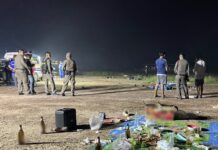
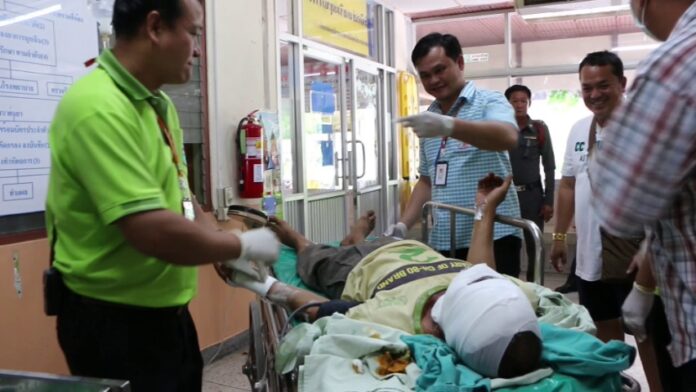
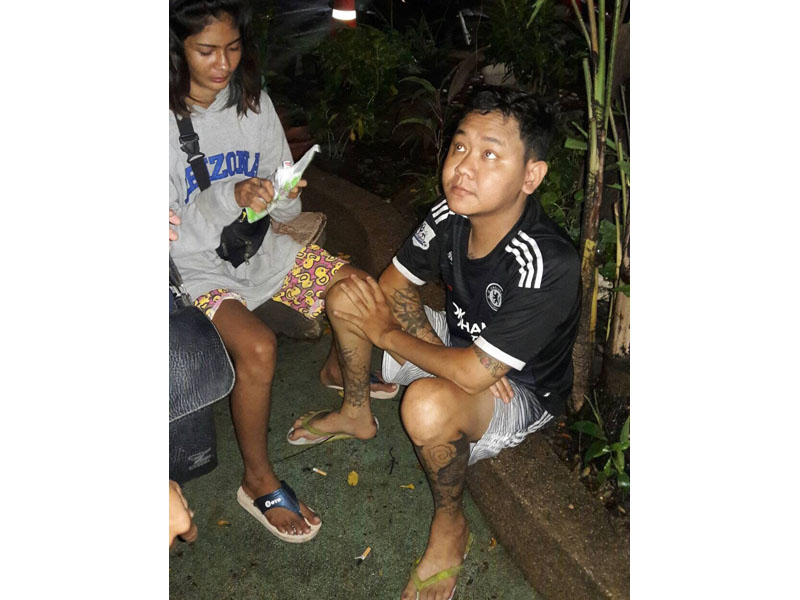
A crew member of the Pattarawadee 12 was brought to Bangpakong Hospital in Chachoengsao province Wednesday afternoon.
CHACHOENGSAO — Four crew members were hospitalized with injuries sustained today when their gas tanker exploded in the Gulf of Thailand.
The Pattarawadee 12, a 1,000-ton liquified petroleum gas tanker, had just transferred its haul at Bangpakong and had returned to sea when it blew up Wednesday afternoon, according to the authorities.
Four out of the 10 crew aboard were severely injured by the ensuing fire and were taken to Bangpakong Hospital. The ship was not severely damaged, police said.
The ship was clearing its tank of remaining gas vapor when the explosion occurred, but a local police commander said it was too soon to know for sure.
“We still don’t know what caused the explosion, as the gas had been all transferred out,” said Capt. Prakob Pumprasert of Bangpakong Police Station.
One of the injured, Sarayut Chanpan, 21, was in critical condition with burns over most of his body. The other three are Sompak Nhusua, 47; Chamnan Ratrongmuang, 35; and Kachawut Sairuam, 24.
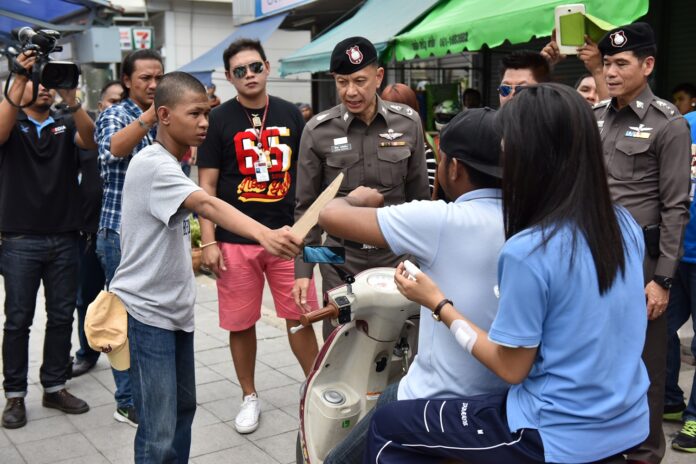
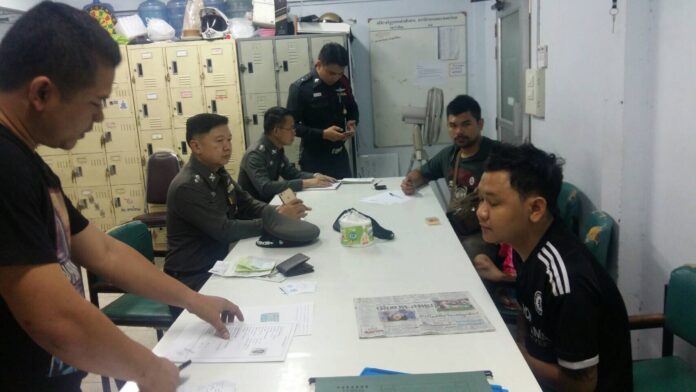
Worawat Lungsan, 21, participates in a police ‘re-enactment’ on Wednesday in Bangkok’s Min Buri district.
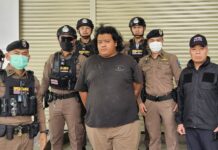
BANGKOK — A Bangkok man confessed today to slashing a woman’s arm with a knife last week, but said it was a case of mistaken identity because he was really drunk at the time.
Worawat Lungsan, 21, said Wednesday that he was out in the Min Buri district looking to score some more cough syrup to keep his high going when he saw a teen couple on a motorcycle late in the afternoon of June 19.
That’s when Worawat, a student in a government continuation school, attacked them with a knife because he thought they were students from archrival Min Buri Polytechnic Vocational School who had previously assaulted him.
At the moment Worawat slashed, 18-year-old Suttida Songserm, who was seated in back, raised her arm to protect her boyfriend up front. Worawat’s blade cut into her arm.
At that point, the accused assailant’s friend, 22-year-old Wanchana Chaonahee, ran to the scene in front of Soi Hathai Rat 1. He apologized to the couple, explained Worawat was confused, and then helped him flee by motorcycle.
The incident became a cause of justice du jour online as a passing Good Samaritan helped the couple post a video of the attack on Facebook soon after the attack. It was shared more than 12,000 times.
Police tracked the suspects from security camera footage and brought them for a police “re-enactment” today. Both men were charged with assault and carrying a knife in public.
Worawat apologized to the victims. He said he was carrying the knife in order to protect himself, as he had just been attacked by students from a rival school three days earlier.
So many things to do online; so little time. Schedule a binge-read of Khaosod English news when you want by getting a summary of the day’s news delivered directly to your inbox. And that’s all – no spam, no marketing.
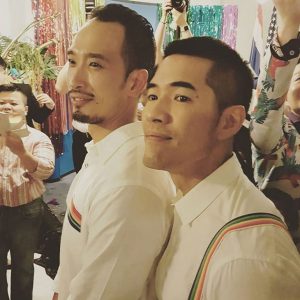
Vuthithorn ‘Woody’ Milintachinda from an October broadcast of Woody Wake Up to Talk.
BANGKOK — While many congratulated a well-known television host’s decision to go public with his gay marriage this week, notions of LGBT tolerance were crushed by a wash of homophobic comments unleashed online.
Since Vuthithorn “Woody” Milintachinda disclosed on his Monday talk show that he secretly married his longtime boyfriend two years ago, the news quickly became a hot topic online, where any best wishes from netizens were drowned out by abundant use of offensive language and stereotypes attacking Woody for being a gay man.
“When he was ordained, I thought he was a real man. Actually he’s a member of the ‘Yellow Club’ who likes shit bombs,” Facebook user Sunsun Banyong wrote Tuesday in reply to a Khaosod story.
“Yellow Club” is a derogatory term for gay men, referring to the color of feces.
The nastiness was unrestrained, as it tends to be online.
“Sperm will fertilize with shit now, congratulations,” Suriya Chakrawan wrote.
A photo of Woody (right) and his boyfriend. Photo: Woody Milintachinda / Instagram
Others broadened their venom to smear his family as well.
“I thought he was straight. It’s a shame. His parent should be proud? Or did the ambassador raise his son to be a faggot like his brother?” Yossakorn Intarasin commented on a Thairathpost.
Woody, 39, is the son of Piemsak Milintachinda, a former ambassador.
“This proves that even a person with high social status can’t be accepted,” said LGBT activist and former reporter Janewit Chueasawatee. “Then what about no-name LGBT people? How hard do they have to try to be accepted?”
However, Janewit said, events such as the reaction Woody received provide a door of opportunity for Thai society to finally have a serious discussion.
Though LGBT characters are mainstays of pop culture, there’s a broader attitude of “don’t ask, don’t tell” which sees individuals shamed and punished for drawing attention to their sexuality.
On his Monday episode of his Channel 9 show Tuen Ma Kui, Woody went public with the news he got married to his unidentified partner more than two years ago on Valentine’s Day in Phuket.
“It was a private wedding with only our friends,” Woody said. “We’ve been together for nine years.”
Seeming to anticipate the negative reaction, Woody said he knew some in Thailand would “not understand.”
But he told his audience he got all the support he needed in a message from his mother, Tabtip Milintachinda.
“Love is beautiful,” it said. “Don’t let those who don’t know its beauty upset you.”
Woody’s marriage was first revealed last week in Time Out Bangkok.
The hostile reaction was similar to when two popular singers, Pongsak “Aof” Rattanaphong and Chalatit “Ben” Tantiwut, came out several years back, with some of their fans declaring they would never listen to their music.
ขอให้ทุกคนได้เห็นว่ารักของคนเรานั้นไร้พรมแดนจริงๆ เรารักทุกคน Let's create a world with the freedom to love. pic.twitter.com/OUT4rZbwQc
Above: Woody Milintachinda and his unnamed husband in a photo the television host posted Tuesday afternoon with the caption, ‘Let’s create a world with the freedom to love.’ Photo: Woody Milintachinda / Twitter
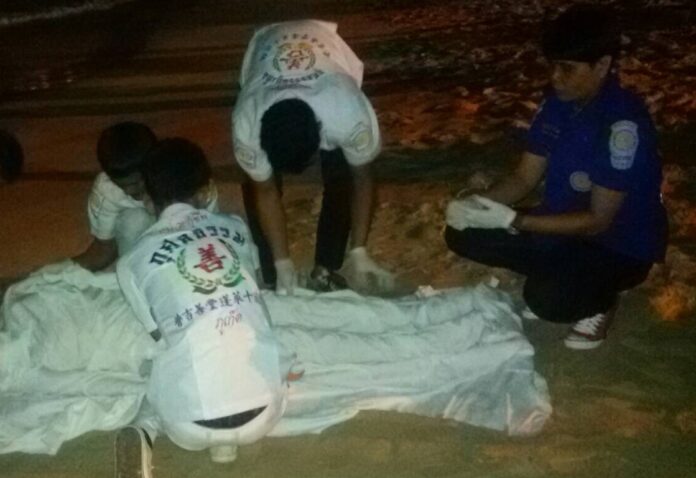
The body of a 28-year-old Korean woman was found dead on Patong Beach early Wednesday morning.
PHUKET — A Korean woman was found dead on Patong Beach early Wednesday morning.
The 28-year-old tourist’s body was found about 5am on Wednesday in the surf wearing only a bra. There was no sign of injury, and none of her belongings were found nearby.
Police are still searching for her boyfriend, also 28, who reportedly was staying with her at an area hotel. Khaosod English is withholding the deceased’s name until her family can be notified.
Her body was taken to Patong Hospital for further examination as to the cause of death. Police are investigating.
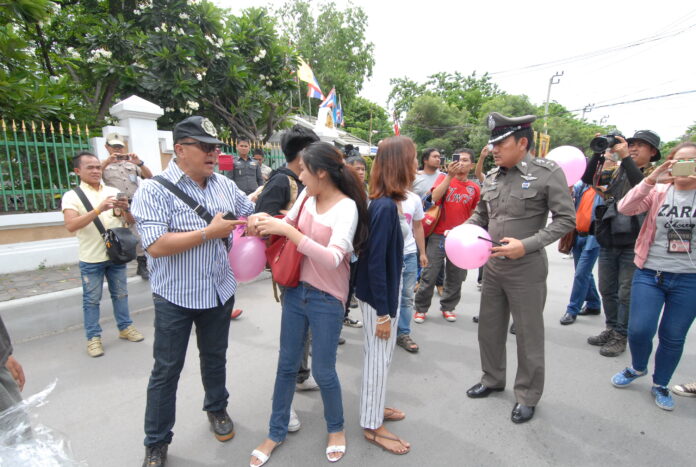
Security officers seize pink balloons as they break up a small rally in support of seven jailed referendum campaigners on Monday in front of the Bangkok Remand Prison.
BANGKOK — The girlfriend of an imprisoned student activist leader accused soldiers Tuesday of showing up at her mother’s workplace.
While the junta has previously admitted to sending soldiers to the family homes of its critics before, the incident, if true, would be the first known case of security officers harassing parties not related by blood.
The girlfriend of New Democracy Movement leader Rangsiman Rome said more than 10 uniformed soldiers arrived at her mother’s office at around 9am and proceeded to take photos for about 10 minutes. When her mother walked out to ask them why they were there, the soldiers quickly drove off.
“I’m very angry. I’m not scared. I’m just angry, and I worry for my family,” said the woman, who asked only to be identified as Maejung for fear of retaliation against her family.
She believes they went to her mother’s workplace because she uses that address.
Rangsiman and six other activists are currently held in the Bangkok Remand Prison where they await trials for violating the junta’s ban on protests Thursday at a campaign event against the junta-sponsored charter.
Junta spokesman Piyapong Klinpan said he cannot comment on specific cases, but insisted that the regime has no policy of threatening anyone, and activists and their associates should not be alarmed if soldiers visit them.
“Each area has security maintenance forces. Sometimes, they go out to meet the people. This is normal. There’s no special case,” Col. Piyapong said. “In this case of Mr. Rangsiman [and his girlfriend], I believe the soldiers merely wanted to ask for their cooperation. There’s no need for soldiers to intimidate anyone.”
He also criticized Rangsiman and his activist group for “having a hidden agenda” in their campaigns against the charter draft.
“In this political atmosphere, he keeps stirring up chaos and tries to pull other groups to meddle in the situation. It will lead to unrest. The NCPO will definitely not tolerate this,” Piyapong said, referring to the junta’s National Council for Peace and Order.
Maejung said she’s dated Rangsiman three years – since they met as students at Thammasat University – and she has supported his post-coup activism. But she said this is the first time that soldiers targeted her and her family.
“I believe it is because of Rome, because I went to see him in prison many times,” Maejung said.
She said she told Rangsiman about the incident during a Tuesday visit.
“He looked kind of stressed. He told me he also guessed that he was the reason for this,” she said.
There have been cases of soldiers stalking family members of critics of the military regime or visiting them at their homes. The junta’s opponents accuse the regime of using this tactic to dissuade them from their activism.
Correction: The original version of this article incorrectly stated that Rangsiman and Maejung met as law students. In fact, they studied at different faculties.
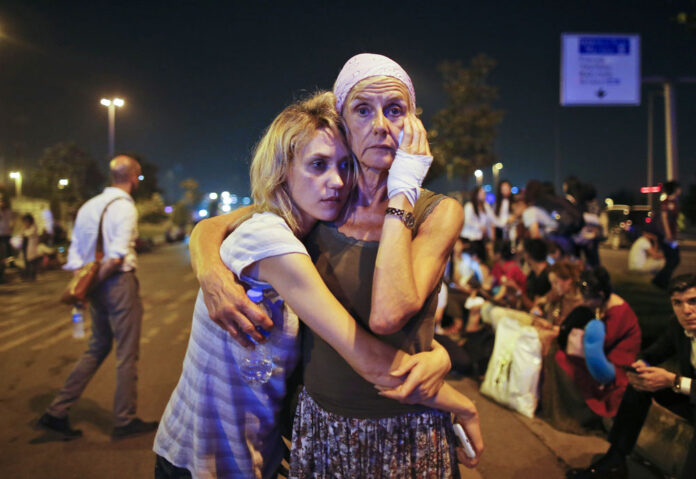
Passengers embrace each other as they wait outside Istanbul's Ataturk airport early Wednesday following their evacuation after a blast. Photo: Emrah Gurel / Associated Press
ISTANBUL — Three suspected Islamic State group suicide bombers targeted the international terminal of Istanbul’s Ataturk Airport Tuesday, killing at least 36 people and wounding many others, Turkish officials said.
Turkish Prime Minister Binali Yildirim said 36 were dead as well as the three suicide bombers. Justice Minister Bekir Bozdag said 147 were wounded. Another senior government official told The Associated Press the death toll could climb much higher.
The senior official, who spoke on condition of anonymity in line with government protocol, at first said close to 50 people had already died, but later said that the figure was expected to rise to close to 50.
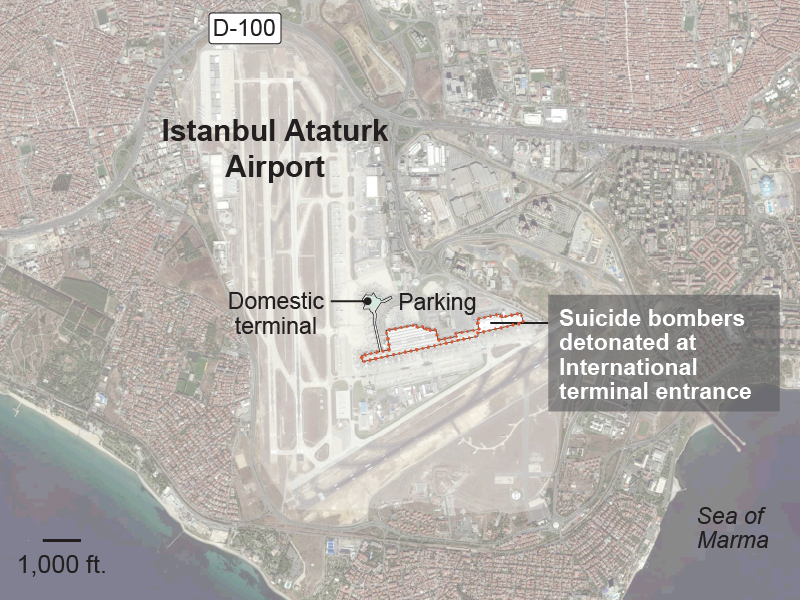
Map of Istanbul Attaturk Airport attack
Yildirim said three suicide bombers were responsible for the attack and all initial indications suggest the Islamic State group was behind it.
“The findings of our security forces point at the Daesh organization as the perpetrators of this terror attack,” Yildirim told reporters at the airport, using the Arabic name for IS. “Even though the indications suggest Daesh, our investigations are continuing.”
Yildirim said the attackers arrived at the airport in a taxi and blew themselves up after opening fire. Asked whether a fourth attacker might have escaped, he said authorities have no such assessment but are considering every possibility.
The victims included some foreigners, he said, adding that many of the wounded have minor injuries but others are more badly hurt.
Another Turkish official said two of the attackers detonated explosives at the entrance of the international arrivals terminal after police fired at them, while the third blew himself up in the parking lot.
The official, who also spoke on condition of anonymity in line with government regulations and cited interior ministry information, said none of the attackers managed to get past security checks at the terminal’s entrance.
Turkish airports have security checks at both the entrance of terminal buildings and then later before entry to departure gates.
Roads around the airport were sealed off for regular traffic after the attack and several ambulances could be seen driving back and forth. Hundreds of passengers were flooding out of the airport and others were sitting on the grass.
Hevin Zini, 12, had just arrived from Duesseldorf, Germany, with her family and was in tears from the shock.
“There was blood on the ground,” she told The Associated Press. “Everything was blown up to bits… if we had arrived two minutes earlier, it could have been us.”
South African Judy Favish, who spent two days in Istanbul as a layover on her way home from Dublin, had just checked in when she heard an explosion followed by gunfire and a loud bang.
She says she hid under the counter for some time.
Favish says passengers were ushered to a cafeteria at the basement level where they were kept for more than an hour before being allowed outside.
Two South African tourists, Paul and Susie Roos from Cape Town, were at the airport and due to fly home at the time of the explosions.
“We came up from the arrivals to the departures, up the escalator when we heard these shots going off,” Paul Roos said. “There was this guy going roaming around, he was dressed in black and he had a hand gun.”
Yildirim said air traffic at the airport, which was suspended after the attack, had resumed to normal.
The prime minister called for national unity and “global cooperation” in combatting terrorism.
“This (attack) has shown once again that terrorism is a global threat,” Yildirim said. “This is a heinous planned attack that targeted innocent people.”
He suggested that the attack was linked to what he said was Turkey’s success against Kurdish rebels as well as steps Ankara took on Monday toward mending strained ties with Israel and Russia.
“It is meaningful that this heinous attack came at a time when we have become successful in the fight against separatist terrorism … and at a time when we started a process of normalizing ties with our neighbors,” Yildirim said.
Yildirim insisted there was no security lapse at the airport but said the fact that the attackers were carrying weapons “increased the severity” of the attack.
The private DHA news agency said the wounded, among them police officers, were transferred to Bakirkoy State Hospital.
Turkey has suffered several bombings in recent months linked to Kurdish or Islamic State group militants.
The bombings include two in Istanbul targeting tourists that authorities have blamed on the Islamic State group.
The attacks have increased in scale and frequency, scaring off tourists and hurting the economy, which relies heavily on tourism revenues.
Istanbul’s Ataturk Airport was the 11th busiest airport in the world last year, with 61.8 million passengers, according to Airports Council International. It is also one of the fastest-growing airports in the world, seeing 9.2 percent more passengers last year than in 2014.
The largest carrier at the airport is Turkish Airlines, which operates a major hub there. Low-cost Turkish carrier Onur Air is the second-largest airline there.
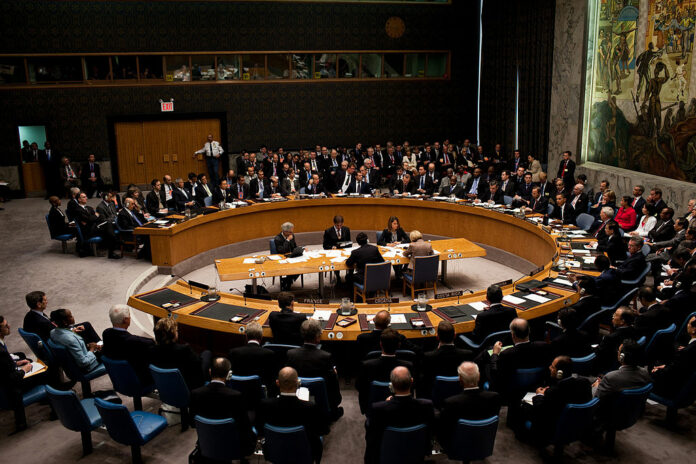
U.S. President Barack Obama chairs a 2009 U.N. Security Council session in New York City. Photo: Pete Souza / White House
UNITED NATIONS — Kazakhstan defeated Thailand for a coveted seat on the Security Council on Tuesday. Sweden also won a contested election, while the Netherlands and Italy ended a battle for another seat by agreeing to split the two-year term on the U.N.’s most powerful body.
The U.N. General Assembly met to choose five new council members and it overwhelmingly elected Ethiopia and Bolivia, who faced no opposition for seats earmarked for Africa and Latin America and the Caribbean.
In the contested race for an Asian seat, Kazakhstan defeated Thailand in the second round by a vote of 138 to 55. Human Rights Watch had criticized the human rights record of both countries.
After five rounds of voting, the Netherlands and Italy, who belong to the Western group of countries, were deadlocked with each receiving 95 votes — and needing 127 votes to win.
After two recesses called by General Assembly President Mogens Lykketoft, the Netherlands and Italian foreign ministers announced the deal, saying Italy will hold the Security Council seat in 2017 and the Netherlands in 2018.
The agreement needs to be endorsed by the group of Western nations who will meet Wednesday morning and are virtually certain to approve it. Once that happens, Lykketoft is expected to resume the suspended assembly meeting to give its approval to the deal.
Splitting a two-year council term is not unprecedented. It happened on at least five occasions between the mid-1950s and mid-1960s when, for example, Czechoslovakia held the seat in 1964 and Malaysia in 1965.
Winning a seat on the Security Council is a pinnacle of achievement for many countries because it gives them a strong voice in matters dealing with international peace and security from conflicts in Syria to South Sudan to actions that threaten global stability such as North Korea’s nuclear and ballistic missile tests and attacks by extremist groups such as the Islamic State.
The council also gets to authorize and oversee the U.N.’s far-flung peacekeeping missions.
The 15-member council includes five permanent members with veto power — the U.S., Russia, China, Britain and France — and 10 non-permanent members elected for two-year terms. Seats are allocated by region, and regional groups nominate candidates. Five countries are elected every year by secret ballot.
Heading into Tuesday’s voting, a close race was expected in the Western group with Sweden, the Netherlands and Italy competing for two seats. Sweden won on the first ballot with 134 votes but the Netherlands and Italy remained neck and neck.
Dutch Foreign Minister Bert Koenders announced the deal to split the term to the assembly to loud applause saying the 95-95 vote was “a clear signal that you appreciate both countries.” Italy’s Foreign Minister Paolo Gentiloni then said both countries “wanted also to give a message of unity between two European countries.”
Looking ahead to being on the council next year, Sweden’s Foreign Minister Margot Wallstrom said “with 40 conflicts and 11 full-blown wars, it is a very, very worrisome world that we have to take into account.”
27-year-old Sompong Puangsombat, seated, told Phra Khanong police Tuesday that he beat his 3-year-old niece to death with a broom handle.
BANGKOK — A couple today confessed they beat a 3-year-old girl to death because she defecated on her bed.
Sompong Puangsombat, 27; and Pawimon Pintong, 19; took their niece, Supatcha Pitsanayabut, to the Kluaynamthai 2 Hospital with serious injuries Monday night. Wounds were found all over the 3-year-old girl’s face and body, prompting hospital staff to call police. It was later determined she had been savagely beaten with a plastic broom handle.
Supatcha succumbed to her injuries.
“They were both charged for fatal assault,” said Col. Chanin Wachirapaneekul of the Phrakhanong Police Station.
Brought to the police station, the couple said they took Supatcha from her grandmother to live with them in their condominium in Soi On Nut 46 a week ago, as they wanted a playmate for their own child.
Sompong said he lost control of his rage at about 7pm on Monday after the little girl defecated on the bed. He beat her with the broom handle, then the pair later took her to the hospital, but it was too late.
Supatcha’s body was taken for further examination at Chulalongkorn Hospital.
27-year-old Sompong Puangsombat, seated, told Phra Khanong police Tuesday that he beat his 3-year-old niece to death with a broom handle.
German Chancellor Angela Merkel, at podium, addresses the German parliament Bundestag with a so-called Government Declaration about the British vote to leave the EU, Tuesday in Berlin. Photo:Markus Schreiber / Associated Press
WASHINGTON, DC — The United Kingdom’s Brexit vote is arguably the greatest disaster ever to hit the European Union. Now, the EU must act fast – not least by ending the post-referendum market turmoil – if it is to survive.
British Prime Minister David Cameron, having lost the referendum, did the obvious thing by resigning. But the other loser is the European Commission, whose president, Jean-Claude Juncker, did little to change the outcome of the Brexit vote. Not since Jacques Delors was President of the Commission, from 1985 to 1995, has that position been filled by a leader with any vision or political clout. Juncker, like Cameron, should accept responsibility and resign. The EU needs a strong leader again. There are many worthy candidates, but I recommend former Swedish Prime Minister Carl Bildt.
Before the post-referendum dust settles, the EU should set an ultimatum with clear and onerous principles for the UK’s exit – clarity to minimize the cost, and severity to deter populists in other member states from calling for exit referenda, too. Sensibly, European Commission leaders have already moved in this direction by voiding concessions made by the EU to the UK back in February and declaring that there “will be no renegotiation.”
The European Council, for its part, has already called for an immediate summit. Having failed for six years to resolve the Greek financial crisis, the EU finally appears to understand that its very survival depends on swift and decisive action.
But the EU must go further than just Brexit damage control. For the last four decades, Europe’s fundamental problem has been complacency in the face of low economic growth caused by excessive taxation and regulation. Europe can no longer afford this standstill. It must now begin to carry out fundamental reforms: cut unjustified social benefits; liberalize services, labor markets, and digital markets; reduce labor taxes; deregulate industry; improve education; and promote research and development.
Current EU rules are clear on the responsibilities of EU institutions and national governments, respectively. The problem is that most European governments (especially British Tory governments) tend to scapegoat the EU to mask their own political myopia. Little wonder that the EU has grown so unpopular. Given that it already receives the blame, the European Commission should now be granted the power to act politically. The EU has a strong case to make for itself, but it needs good-faith leaders to deliver its message to the people.
European populists point to the mishandling of migration issues to justify their cause. So, for starters, the EU should establish an orderly migration policy with quotas and criteria, as Australia and Canada have successfully done, and impose proper control over its external borders. The EU border control agency, Frontex, needs a stronger mandate and more resources to fulfill this crucial role.
Going further, the EU should institute a joint foreign and defense policy to address the underlying causes of the migration crisis – namely, the conflicts in Libya and Syria. For a quarter-century, Europe has benefited from the post-Cold War peace dividend and irresponsibly allowed member states’ average defense expenditure to slip to a paltry 1.4% of GDP. This should be increased to at least the 2% of GDP each NATO member has promised. Today, only five EU countries have defense expenditures at that level.
With good reason, US President Barack Obama has called Europeans “free riders.” Republican presidential candidate Donald Trump, going much further, openly questions both NATO and US military expenditures abroad. In the near future, Europe may no longer be able to rely on the US to defend it and should prepare for a scenario in which it is forced to fend for itself.
The principle of representative democracy is at the heart of European identity; ironically, only EU non-member Switzerland has a strong tradition of referenda. One of the positive consequences of the squalid Brexit campaign is that it demonstrated that referenda and plebiscites are demagogic, not truly democratic. EU members should recognize the risks of so-called direct democracy and tighten the criteria for the passage of referenda. At a minimum, referenda should be required to achieve a supermajority with a high percentage of voter turnout.
The best one can say about Brexit is that it finally may have put an end to European complacency. We will know for sure only if, and when, Europe chooses to save itself.
Anders Aslund is a senior fellow at the Atlantic Council in Washington, and the author of “Ukraine: What Went Wrong and How to Fix It.”