25.5 C
Bangkok
Sunday, July 5, 2026
Home Blog Page 2717

2 Tourists Killed in Phi Phi Speedboat Collision

Photo of the aftermath of the crash provided by local rescue workers.

PHUKET — Two tourists were killed when two speedboats collided near the popular Phi Phi islands at noon today in the latest fatal maritime mishap to strike Thai tourism.

The two victims, both Chinese nationals, were killed after the boat they were on crashed into another vessel 30 nautical miles off Phuket, according to a regional marine police commander, who blamed the incident on stormy weather.

“It was raining heavily,” Col. Lt. Prasert Srikhunrat said by telephone. “The sky was dark, so the two boats crashed into each other.”

According to Prasert, the Chollakij was carrying 36 passengers when it slammed into the Hongfah 333, which was carrying 26 passengers near the Moo Sankha Rocks off one of the Phi Phi islands. Nearly all of the passengers were Chinese tourists, Prasert said.

The deceased were said to include one man and one woman.

The exact number injured was not yet known, but Prasert said the most serious injuries occurred on the Chollakij.

The captains of both boats are now under arrest pending criminal investigation, Prasert added.  Wednesday’s incident comes on the heels of a swarm of accidents involving speedboats in major tourist destinations. Three foreign nationals died late last month after their speedboat capsized near Koh Samui, and just Sunday 28 tourists were injured in a crash off Koh Samet.

Related stories:

British, German, Chinese Women Die in Yet Another Speedboat Tragedy

28 Injured in Koh Samet Speedboat Crash

Ferry Captains Lose License for Racing to Phangan Island

Advertisement

Sentenced for Act of Rebellion, Punk ‘Anarchy’ Vandal Says Justice Unserved

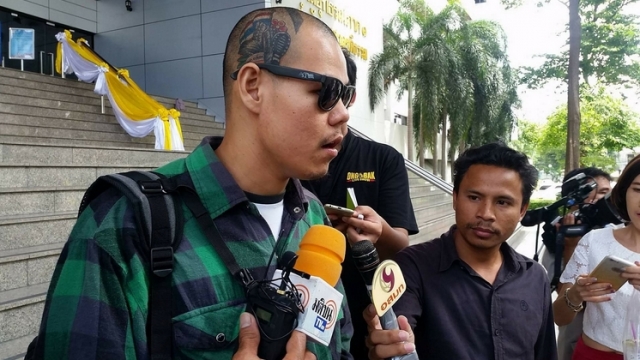
Nattaphol Khemngern speaks to reporters Wednesday in front of the Criminal Court where he spray-painted the anarchist symbol last year.

BANGKOK — Though his own case reached its end Wednesday inside the same building he was charged with defacing, a punk musician said the injustice which motivated him is unchanged.

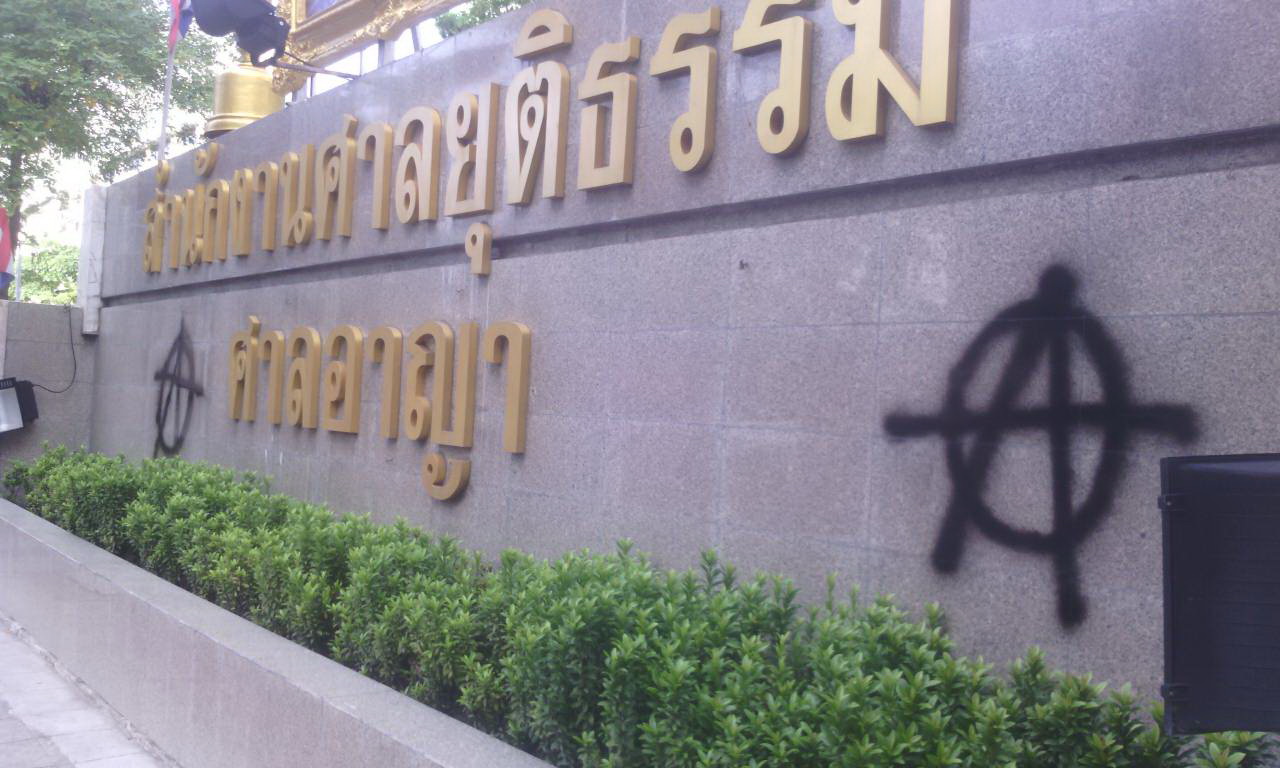
A year after his arrest, 23-year-old Nattaphol Khemngern was fined 4,500 baht and received a two year suspended sentence for painting an anarchy symbol on a sign in front of the Criminal Court. But the musician’s bid for justice for a former bandmate shot dead by a military officer in February, 2015, remains out of reach.

“My case came after, but it was done,” Nattaphol said Wednesday. “But my bro’s case took more than a year now and is still in progress.”

Paraded in front of the press May 26, 2015, Natthaphol said he painted the Circle-A symbol to campaign for his friend’s murder case after it went nowhere following the arrest of the soldier accused of killing him in the capital’s Bang Khen district.

At the time his vandalism was widely misreported as representing “Captain America.”

Yutthana Sripradit, 25, who played with Nattaphol in their band Drunk All Day, which raged against injustice, was shot dead Feb, 8, 2015, on Phahonyothin Road by a gunman in a black car. Pfc. Watcharaphong Choorat, a military officer from the 11th Military Circle, was arrested two days later.

Natthapol’s arrest generated public sympathy for the cause he was trying to bring attention to, and the case was later taken before a military tribunal where it has since languished.

“They said the case would move faster under the military court,” said Nattaphol. “But why does everything seem to be slower instead? We cannot inquire about anything. They use a military prosecutor.”


Two anarchy symbols were found painted May 24, 2015, in front of the Criminal Court on Ratchadapisek Road.


Today’s court judgment was on appeal of a July verdict under which the court gave Nattaphol the maximum sentence of two years in jail for damaging public property. Another charge of contempt brought by the courts was quickly rendered with another suspended sentence.

In addition to the suspended sentence, Nattaphol, who previously worked as an art director for Kantana Group, must report in three times a year and do 12 hours of community service.

He said his rebellious reaction didn’t help the course of justice.

“On the one hand I was prepared to lose, but on the other hand I just can’t bear it,” Nattaphol said. “But there is nothing I can do, especially now that I am on my suspended jail term.”


Related stories:

22-Year-Old Arrested for ‘Anarchy Graffiti’ at BKK Criminal Court

Advertisement

Underage Girls, Police ‘Bribe Ledger’ Discovered in Raid on Ratchada Flesh Parlor

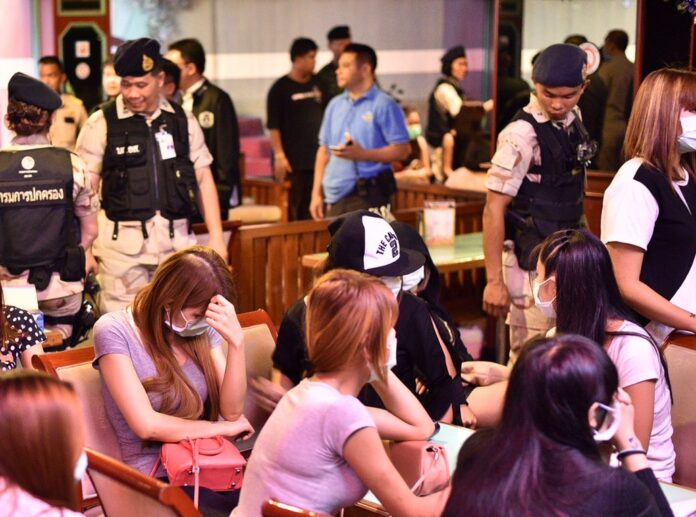
Officers from the Ministry of Affairs raid the Nataree brothel on Bangkok’s Ratchadaphisek Road in June 2016.

BANGKOK — At least three underage girls and a dozen more suspected of being minors were found rescued in a raid on a brothel in a prominent Bangkok red-light district along with more than 100 sex workers and what appeared to be a list detailing bribes paid to police.

Officers recovered what appeared to be a ledger detailing bribes paid to specific police units and individuals in a Thursday raid of a Bangkok brothel.

Tipped about possible human trafficking, a combined force of more than 100 officers from the Ministry of Interior Affairs raided Nataree Entertainment, one of many, massive Ratchadapisek Road massage parlors, at about 4pm on Tuesday. There officers said they found 121 sex workers, including three confirmed to be minors and another 12 they believe are also underage. Almost all were believed to be in the country illegally.

Worayuth Naowarat, the official in charge of the operation, said the raid followed a report three months ago from a foreign NGO alleging some of the sex workers at Nataree were trafficked. Local police were not involved in the raid.

Also found during the raid was what appeared to be a ledger of names of different police units and individuals and how much they were bribed by the brothel.

“Tourism Police, 10,000; 191 Emergency Police, 25,000; Special Branch Police, 30,000; Huai Khwang Detective Police, 24,000; Immigration, 76,000,” read a portion of the list.

While a police spokesman said it was too soon to tell whether the list is genuine, the local police commander and his deputies were already transferred to inactive posts soon after the raid.

Other names mentioned on the paper included the Bangkok Metropolitan Administration (6,000 baht), “Lawyer Pipop,” “Sgt. Cake,” “Cpl. Somnuek,” and “Beer 2nd Division.”

Police are widely associated with endemic corruption and bribe-taking from illicit businesses in exchange for turning a blind eye. Police spokesman Dechnarong Suticharnbancha said an investigation is needed to say whether the list is authentic before any further action can be taken.

“Please wait first. We must investigate this first,” Gen. Dechnarong said by telephone. “We have to see first whether it’s true or false. There are procedures for this.”

But the raid already cost Col. Kittipong Wisetsanguan his job as the commander of Huai Khwang Police Station, which has jurisdiction over Nataree Entertainment and other massage parlors in the area. According to Thairath, Kittipong and his deputies have been transferred to inactive posts while the investigation is conducted.

Related stories:

Thailand Wins ‘Ig Nobel’ Distinction for Bribing Cops not to Take Bribes

Corruption Catch-22: Report a Bribe and Go to Jail?

Fake Cop Busted for Extorting Bribes in Pattaya

Advertisement

Thailand Eliminates Mother-Child HIV Spread

In this June 17, 2004, file photo, an HIV-positive mother plays with her son, who did not contract the virus from her, in Phetchaburi province, south of Bangkok. Photo: Sakchai Lalit / Associated Press

BANGKOK — Thailand has become the first country in Asia to eliminate mother-to-child transmission of HIV and syphilis, the World Health Organization announced Tuesday.

The milestone is another step in Thailand’s aggressive campaign to reduce new cases of the AIDS virus, but experts warn many other problems still exist — including a rising rate of new HIV infections among gay men and transgender people.

The number of babies contracting HIV dropped from more than 3,000 in the late 1990s to 86 in 2015, a figure that was validated to meet WHO’s criteria for elimination — mother-to-child transmission rates of less than 2 percent and fewer than 50 new infections in 100,000 births.

Cuba became the first country to reach the goal last year. Along with Thailand, Belarus eliminated the mother-to-child spread of HIV and syphilis, Armenia did for HIV and Moldova did for syphilis, the WHO announced Tuesday.

Globally, 220,000 new cases of HIV were recorded in babies in 2014, and syphilis caused some 200,000 stillbirths and neonatal deaths in 2012.

“I do think that once Thailand has been able to do it, it’s a motivation for other countries around the world and also for the public health community because one does see now that, yes, the world can be free of HIV,” Poonam Khetrapal Singh, WHO’s Southeast Asia director, said by phone, noting Thailand’s HIV rate was once among the region’s highest.

Thailand’s success comes from strong prenatal care from large cities all the way to the poorest villages. Nearly all pregnant Thai women are screened for HIV, 95 percent of those who test positive are treated to prevent transmission to their babies and almost 100 percent of babies born to HIV-positive mothers are given antiretroviral drugs.

In this Monday, July 12, 2004, file photo, Thai children who are HIV positive and orphaned wait for a function to begin at the Human Development Foundation in Klong Toey slum of Bangkok, Thailand. Photo: David Longstreath / Associated Press

However, hundreds of thousands of migrant women, many of them working or seeking menial jobs in Thailand, are not included in the data. Many poor women from neighboring Myanmar and Cambodia do not receive any prenatal care or HIV screening while in Thailand. A 2010 Thai government report found that two to three times more migrant women were infected with HIV in certain areas of the country.

There are an estimated 2.7 million registered and undocumented male and female migrant workers in Thailand. They have limited access to the country’s health care system, and many are reluctant to get tested or treated for HIV due to language barriers or out of fear they will lose their jobs or have negative interactions with police or other authority figures, according to UNAIDS.

Steve Mills, technical director at nonprofit FHI360’s Asia-Pacific office in Bangkok, said this is an area Thailand needs to improve, along with focusing more on at-risk populations such as intravenous drug users and sex workers operating outside of brothels. Gay men and transgender people are of particular concern.

“With the evolution of the epidemic and people being on HIV treatment, it’s meant that condom use is harder to get to a satisfactory level,” he said, adding that gay men and transgender people are often harder to reach today because couples often meet through social networks instead of in bars, saunas or other public places where outreach workers once targeted them. “We need to encourage people to get tested.”

Last year, the World Bank published a study calling for more free anonymous testing and treatment among gay men. It said the rate of infection within Bangkok alone had jumped from an estimated 21 percent in 2000 to 28 percent in 2012. Only one-fifth of those infected were receiving antiretroviral drugs, even though it’s provided by the government without cost.

Thailand was hailed by the international community as a model for other countries after promoting 100 percent condom use among sex workers in brothels in the 1990s, drastically reducing infection rates.

But AIDS continues to kill. In 2014, an estimated 20,000 people died from the disease in Thailand, a rate that has remained steady for the past five years. An estimated 450,000 people are living with the virus in the country of 60 million.

Story: Margie Mason 

Advertisement

EU Renews Threat to Ban Thai Seafood Without Swift Action on Labor, Fishing

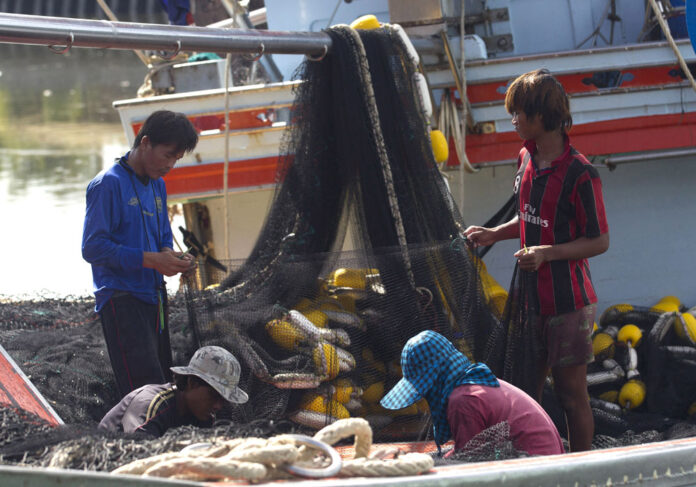
Migrant workers from Myanmar clean fishing nets Sept. 3, 2013, aboard a trawler after a fishing trip west of Bangkok in Samut Sakhon Province. Photo: Sakchai Lalit / Associated Press

The bloc’s fisheries and social affairs chiefs, in a letter Tuesday to Thai Deputy Prime Minister Gen. Prawit Wongsuwan that was obtained by the Associated Press, said talks in July in Bangkok on fighting fish fraud and labor abuses “will be a crucial opportunity for Thailand to present concrete and robust measures.” The letter was signed by both Fisheries Commissioner Karmenu Vella and Social Affairs Commissioner Marianne Thyssen.

Despite months of talks, the 28-nation EU is not satisfied with progress to end illegal, unreported and unregulated fishing in the world’s third-largest seafood exporter. Illegal labor practices in Thailand amounting in some cases to slave labor have only exacerbated the problem. The letter said barring a breakthrough on the issue next month and “tangible progress” by year’s end, a ban might follow.

Thailand, which has 8.1 percent of global fishing exports, needs the wealthy European market to maintain its seafood prominence. Annual Thai fish exports to the EU are estimated to be worth between EUR575 million and EUR730 million (23 billion baht and 29.2 billion baht).

In April, the EU extended a so-called yellow card against Thailand, meaning it was given another chance to clean up its act or face sanctions that would hit its economy hard. The EU commended Thai legislation to curb illegal practices but insisted action on the ground was sorely lacking.

The issue of labor abuse gained in prominence around the globe after a two-year investigation by The Associated Press exposed practices amounting to slavery. In addition to freeing more than 2,000 slaves, the reporting resulted in the arrest of a dozen alleged traffickers — with eight convicted and sentenced so far — and the seizing of millions of dollars’ worth of seafood and vessels. It also prompted companies in the fishing and food industries to change some of their labor and supply practices.

The Thai government has already promised to improve both its fishing and labor practices. The EU now wants to see that turned into reality.

Story: Raf Casert

Advertisement

Suspected Tiger Meat Slaughterhouse Found Near Tiger Temple

An officer and a tiger found Thursday afternoon at a house in Kanchanaburi city.

KANCHANABURI — A widening investigation into the Tiger Temple’s role in animal trafficking led officers today to their most alarming discovery yet – a home they believe was used as a tiger slaughterhouse.

Four tigers were found locked in cages Thursday at a home located not far from the now shuttered tourist attraction in a residence officials think was used to keep and kill tigers before their meat, skins and parts were sold.

Two workers were found inside the home about 50 kilometers away from the Tiger Temple, according to an officer with the Natural Resources and Environmental Crime Suppression Division. The owner’s whereabouts are unknown.

“[The two employees] didn’t really cooperate with us,” Pol. Col. Montri Pancharoen said by phone Tuesday afternoon. “But we believe that this is part of a big trafficking network which we will continue to investigate and expand into other provinces.”

The four tigers were reported to be all adults, according to Montri, who said their ages would be confirmed by veterinarians. They would also be examined to confirm their relation to the temple’s tigers, all 137 of which were removed during the past week in a raid by wildlife officials.

“[The tigers’] DNA will be tested to compare with those tigers moved out from the [Tiger Temple],” Montri said.

Police said they believe the home is owned by Thawat Kajornchaikul. Thawat is also known as Sia Tong, a kind of nickname used to describe someone wealthy and well connected. Police said he’s a Bangkok man married to a Kanchanaburi woman.


Related stories:

Officials Hunt for Abbot of Tiger Temple

Conservation Rhetoric Falls Apart as 1,000 Magic Tiger Amulets Seized From Monk (Photos)

Lion, Tiger Pelt, More Wildlife Discovered Inside ‘Tiger Temple’

Horrible Discovery in Tiger Temple: Dozens of Dead Tiger Kittens (Photos)

Officers Enter Tiger Temple to Begin Removing Tigers

Another Showdown as Tiger Temple Blocks 1,000 Wildlife Officers

Activist to Sue Over Tiger Temple Zoo Permit

‘Tiger Temple’ to Sue NatGeo Over Damning Report

Temple Refuses to Release Tigers, Again

Advertisement

Abandoned Babies Indicate Single Mother, Sex Education Problems

Shocked bystanders gather around an abandoned newborn found in Mingalar Taung Nyunt township, and a lactating mother immediately breast-feeds the baby, on May 12in Yangon. Photo: Thidar Han / Myanmar Now

YANGON — During a power blackout on a hot night in May, Thidar Han heard a baby crying at around 9 pm in a back lane of Yangon’s Mingalar Taung Nyunt Township, where she works as a ward administrator.

Thidar Han ventured into the dark alley and saw no one, but the crying continued. As she moved closer she was shocked to find an abandoned newborn, lying face down and with its umbilical cord still attached, in a plastic bag.

“The baby was fortunately alive and without breathing problems,” she said, adding that shocked bystanders gathered around and a lactating mother among them breast-fed the poor newborn. The baby, weighing 4 pounds and 12 ounces, was brought to Yangon Central Women’s Hospital just in time and survived after receiving intensive medical care.

According to officers at the Yangon Police Headquarters, it was the second baby to be abandoned by its mother in Mingalar Taung Nyunt Township in May. The other sadly died while it was being treated in hospital.

Records kept at the headquarters show the recorded cases of abandoned newborns nationwide. Though these are likely to be far from complete, they indicate a rise from 6 cases in Myanmar in 2011, to 4 in 2012, 9 in 2013, 12 in 2014, and 20 cases in 2015.

“Only unsolved child abandonment cases are reported to the police. So there might be other, unrecorded cases,” said an officer who asked not be named. Most cases occurred in Shan State and in Yangon, Mandalay and Magwe regions.

Some cases involved newborns who were left at back streets or at door steps, while most often new mothers left their babies behind in hospital after giving birth. Yankin Children’s Hospital recorded 5 such cases in 2015, 4 in 2014 and 2 cases in 2013, according to police records.

Desperate Single Mothers

Ma Htar, director of Akhaya Women, a women’s rights NGO in Yangon, said the tragic cases probably involved desperate women who had an unplanned pregnancy and felt they could not care for their babies due to poverty or because the father had abandoned them.

She said being a single, unmarried mother carries great stigma in Myanmar’s conservative society, while there are few services, either government or NGO, available that support such mothers.

“Single women are blamed for their fatherless child,” said Ma Htar, adding that services to help them “will emerge when Myanmar people have more knowledge about human rights.”

Ma Htar said old laws that punish abortion probably also put women in a situation of continuing an unwanted pregnancy, adding that politicians should reflect on the impacts of these laws.

Illegal Abortion

Under the Penal Code, abortion can lead to 10 years imprisonment, though court cases are rare and usually result in a two- or three-year sentence. Due to such penalties, Myanmar has no official abortion clinics, forcing women wanting the procedure to do so through secret, unregulated medical practices.

Abandonment of a child younger than 12 year is also punishable and carries a maximum sentence of seven years in prison.

Nyein Nyein, 45, a widow and mother of four from Yangon’s Latha Township, said raising children was hard for poor women in Myanmar. She believes better contraception and legal options for choosing an abortion should be made available to women and girls.

“Abortion should be allowed systematically, as it is now being carried out illegally,”she said.

Under Myanmar’s civil law, a woman who bore a child from a man who abandoned her can file a complaint to demand financial support.

A police officer in Panzundaung Township, who declined to be named, said such cases were rare. “Women do not file lawsuits against their irresponsible partners as they feel ashamed for the pregnancy. But actually, these men must be ashamed for their lack of care,” he said.

Kyee Myint, a Yangon-based lawyer who works on child rights cases, said more government funding should be made available to support vulnerable children and single mothers.

Government Measures

The phenomenon of abandoning babies, either to be found or left to die, is sometimes called ‘baby dumping’, and occurs in many countries. It often involves unprepared young women, teenage pregnancy, and children born out of wedlock.

In Southeast Asia, the issue has reportedly become increasingly common in Malaysia in recent years, with 517 babies found abandoned between 2005 and 2011, often for reason of stigmatisation associated with having illegitimate children born outside of marriage.

In some Western countries, authorities have installed so-called ‘baby box’ or ‘baby hatch’, where a baby can be anonymously abandoned while ensuring that the child will be cared for.

Phyu Phyu Thin, a National League for Democracy Lower House lawmaker from Yangon’s Mingalar Taung Nyunt Township, said sex education and family planning programs would help address the issue of unwanted pregnancy in Myanmar, adding that such measures should precede discussions on legalisation of abortion.

“The main cause of this problem is that young people don’t have sufficient knowledge about sex. Since they don’t understand it, they have to cope with unwanted pregnancies. That’s why we have cases of abortions and newborn babies abandoned on the roads,” she said. “I think sex education and family planning would help decrease these cases.”

Aung Kyaw Moe, director of the Department for Child Care at the Ministry of Social Welfare, Relief and Resettlement, said poverty and the lack services for single mothers should be addressed, adding, “Educative programmes on reproduction should be conducted for young people to reduce abortion and child abandonment.”

Aung Kyaw Moe added that abandoned babies would be cared for at state orphanages.

According to the ministry’s website, there are five government child care centres for orphans and abandoned children in Yangon, Mandalay, Magwe, Mawlamyine and Kengtung. Children administered here are supported to complete primary school and are then sent to two centres in Yangon, where they can stay until the age of 18 and receive vocational training.

In Yangon, at the Shwe Gone Dine Orphanage Center, principal Khin Yu Dar Yee said the regional government’s Ministry of Health and Directorate of Social Welfare had put 128 children under her care in the past five years, 45 of whom were later adopted by families.

She said she could not comment on how many children there were abandoned, but stressed that regardless of particular background all are in dire need of care.

“I hope that kind and good parents can adopt them,” she said.

Story: Ei Cherry Aung
Related stories:

Myanmar Children Affected by HIV/AIDS Struggle to Get Education

Advertisement

Myanmar Court Sentences BBC Reporter to Jail, Hard Labor

A file photo of newspapers for sale in Yangon.

YANGON — A BBC reporter in Myanmar has been jailed for three months with hard labor after being convicted of assaulting a police officer while covering a student protest, his lawyer said Tuesday.

The ruling marks the first time a journalist has been convicted under Myanmar’s new government, run by former political prisoner Aung San Suu Kyi.

The reporter, Nay Myo Lin, who works for the BBC Myanmar language service, plans to appeal the decision.

His lawyer, Thein Than Oo, called the sentence “unfair,” saying that his client had not intentionally hurt the policeman and was trying to help a fellow citizen.

“It is shameful that the court has issued this sentence,” Thein Than Oo said. “The police should not treat journalists as their enemy.”

The incident occurred in March 2015 when Nay Myo Lin was covering a protest near Yangon, Myanmar’s biggest city, against an education bill that students said was aimed at stifling academic freedom. A policeman knocked a protester off his motorbike and Nay Myo Lin tried to help the man, leading to a scuffle with the officer, Thein Than Oo said.

Nay Myo Lin was convicted of assaulting a public servant and sentenced on Monday by a court in the city of Mandalay, where he is based.

“The BBC will continue to work with his lawyer to support his appeal,” the BBC said in a statement issued Monday in London.

Suu Kyi’s party, the National League for Democracy, won a landslide victory in November elections, ushering in the country’s first civilian government after 54 years of direct and indirect military rule. Both the police and the judiciary are overseen by Myanmar’s Home Ministry, which remains under control of the military.

Related stories: 

N. Korea Boots BBC Journalist as Party Congress Continues

Case Dropped Against Hong Kong Journalist Over Body Armor 

Junta’s Threat Against Media Causes Uneasiness & Paranoia: Journalists Association 

Court Permits Journalist to Leave Thailand

Court Dismisses Charges Against Phuketwan Journalists

Advertisement

UberMoto Pitches Novel Solution to Lifting Ban: Change the Laws

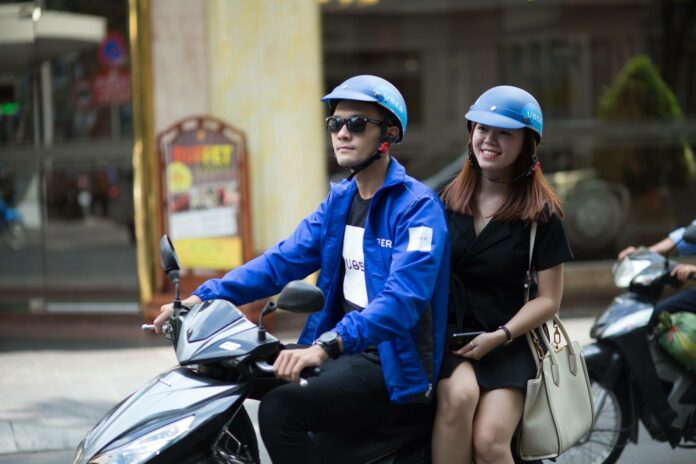
Photo: Uber / Facebook

BANGKOK — Transportation officials said they need to deliberate further over legal amendments proposed by Uber which would allow its UberMoto taxis to roll out again.

Weeks after the on-demand motorcycle taxi service was banned in the country, authorities said Monday that the San Francisco-based company pitched its own fixes to regulations such as operating territory and registration.

“Uber proposed amending the law,” said Darun Sangchai from the ministry. “But this issue is still new, we can not make the decision right away, as we did not have enough information and it needs time to be considered.”


In its request, Uber essentially asked the Transport Ministry to eliminate the regulations it was in violation of, a request that seems ambitious.

The company asked for the repeal of rules requiring drivers to wear registered uniforms, ride registered motorbikes and carry proper licenses. It also suggested removing territorial protections under which drivers are forbidden to ride into each other’s turf.

Darun said a committee comprised of ministry, military, police and municipal officials will discuss the issue. In the meantime, UberMoto must remain out of service, he said.

Authorities said a decision will be made based Uber’s compliance with the law for the sake of public safety as well as competitive fairness with traditional motorcycle taxis.

In addition to operating illegally, the popular services presented unfair competition to traditional motorcycle taxi operators already feeling the sting of tighter regulation since the military government came to power.

Both alternative motorcycle taxi services, GrabBike and UberMoto were ordered to halt their service May 17 because they did not comply with the law.

GrabBike is reportedly still giving rides through its delivery service for those who book themselves as a human package.

Related stories:

Did GrabBike Really Go Dark? These Motosai Say No.

Most of What You Heard About ‘GoBike’ Service is Wrong

UberMoto Goes Dark; New Moto App Coming From … Junta?

No Really, Govt Tells GrabBike and UberMoto, What You’re Doing is Illegal

‘You Wanna Fight?’ Bangkok Moto Taxis Confront GrabBike

UberMoto Ignores Same Ban Ignored by GrabBike

GrabBike Responds to Govt Ban With Big Discount and Apathy

Military, Police to Monitor GrabBike Shutdown

Advertisement

Ben & Jerry’s Just Announced Opening Day & Location. Expect Massive Queue.

Photo: Ben & Jerry’s / Courtesy

BANGKOK — Is it America’s best ice cream? Can it beat Haagen-Dazs, Cold Stone and Baskin Robbins? Thailand’s ice cream lickers, slurpers and munchers are about to find out when Ben & Jerry’s opens its first Thai branch in July.

A week after announcing it was coming to the ice cream-loving kingdom, the Vermont-based company has confirmed its (unsurprising) first location: the ground floor of Siam Paragon, which will open July 9.

As if that wasn’t enough to guarantee a massive, soul-freezing queue for the first day, Ben & Jerry’s have declared it Free Cone Day and will give away free ice cream to all.

Whether the company’s unique flavors with exotic names such as Cherry Garcia, Schweddy Balls and Dublin Mudslide will make it to Bangkok remains to be seen, as the company’s marketing trickle has the menu unveil set for just before the opening in July.

Ben & Jerry’s was founded in 1978 in Vermont by Ben Cohen and Jerry Greenfield.

Known for its progressive leanings, the company’s flavors are named after celebrities and cultural influences such as “Imagine Whirled Peace” inspired by John Lennon, “Bernie’s Yearning” after presidential candidate Bernie Sanders and “Yes Pecan!” after U.S. President Barack Obama’s election slogan.
Related stories

Better Hit the Gym, Ben & Jerry’s Coming to Thailand

Advertisement

Hot News

LATEST NEWS

Bangkok
overcast clouds
25.5 ° C
26.1 °
25.5 °
46 %
2.4kmh
100 %
Sun
30 °
Mon
31 °
Tue
36 °
Wed
31 °
Thu
33 °