


















29.2 C
Bangkok
Friday, August 28, 2026
Home Blog Page 3334

Thai Junta Expands Power Over Lucrative Sectors

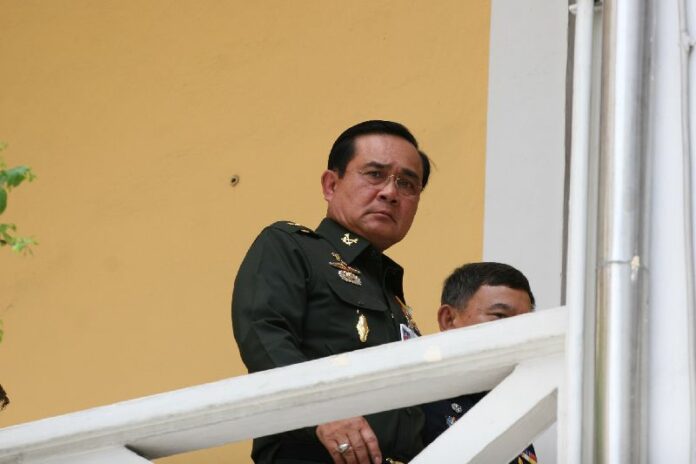
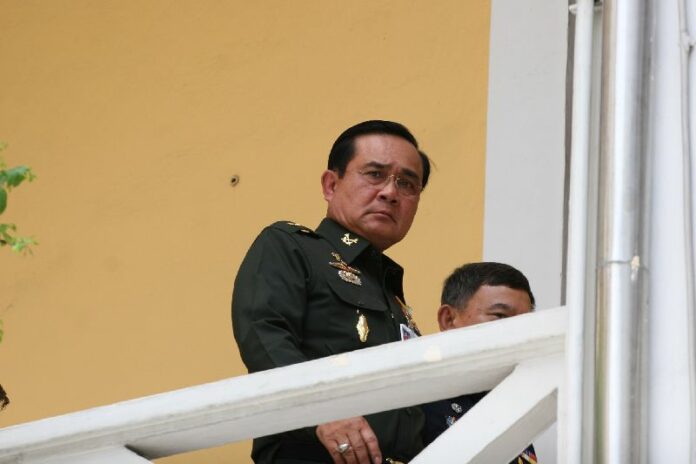
Army chief and coup-leader Gen. Prayuth Chan-ocha. [Photo taken on 24 April, 2014]

BANGKOK — After overthrowing Thailand’s civilian government in a coup d’etat last month, the Thai military junta has begun to implement major economic policies, with little to no oversight.

As of today, the leader of the  the junta's National Council for Peace and Order (NCPO), Gen. Prayuth Chan-ocha, has appointed himself chairman of two prominent economic boards that wield considerable power over the country's investment and energy sectors.

An NCPO order issued on Saturday announced Gen. Prayuth as the chairman of the Board of Investment (BOI), while another NCPO order broadcast this morning announced him as the chairman of a committee to oversee the nation's energy and petroleum policies.

Deputy leaders of the NCPO were also appointed as top members of these economic bodies. 

The NCPO has taken over these economic responsibilities at the same time that it has outlawed any criticism of the military regime and its "missions." The NCPO has threatened to prosecute anyone who disseminates information that questions the junta's good will, lest it lead to "confusion" and derail the NCPO's stated aim of reconciling the country.

The NCPO has also barred independent agencies such as the National Anti-Corruption Commission (NACC) from publicly scrutinising the military junta's operations. 

An NCPO announcement on 24 May ordered "all Courts, independent organizations and other agencies refrain from expressing opinions which might create misunderstanding, confusion and polarization among the public such that it affects the functioning of the officers of the NCPO."

The National Anti-Corruption Commission (NACC), an agency that many accused of harboring bias against the former government, has shown no signs of challenging these orders. 

Last week, deputy secretary general of the NACC, Worawit Sookboon, said there was no legal basis to conduct investigations into the personal assets of the coupmakers. Meanwhile, the anti-graft agency annouced it would begin its probe into Ms. Yingluck and four other former ministers' finances in connection with the administration's controversial rice-pledging policy. 

“This is worse than previous coups,” a political science lecturer at university in Bangkok told Khaosod English. “Because in [1991 and 2006], the military held onto power for a short time and then they organized a technocrat government to take care of all these economic issues for them. The NCPO on the other hand, their actions look more like the military regimes of the 1950s and 1960s. Back then the soldiers controlled many economic boards and state-owned enterprises, which led to massive corruption.”

The academic, who asked to remain anonymous because criticism of the junta is now considered illegal, added: “There is no accountability right now. Not even legislative power. We only have executive power under six people, which is the NCPO.”

Since seizing power, the NCPO has also picked up financial projects initiated by the former government that were stalled over accusations of corruption. 

Almost immediately after the coup, Gen. Prayuth ordered a massive loan of 90 billion baht from state banks to pay farmers who were owed money through the previous government's rice-pledging scheme. The NACC indicted Ms. Yingluck for failing to stop the corruption that allegedly plagued the policy, and is now investigating her personal assets in connection with that case. 

The NCPO's deputy leader, Air Marshal Prachin Chantong, said the junta may also resurrect the 2.2 trillion baht infrastructure overhaul project that was struck down by the Constitutional Court in February due to its lack of transparency.

So far, the NCPO has repeatedly dismissed concerns that its absolute power may lead to corruption. 

"I can assure you that the NCPO does not gain anything from this," Gen. Prayuth said in a nationally-televised address on Friday. "We are here to resolve the problems, not to create more. I urge you all to be vigilant and help us stop all corruption through the use of law, and to avoid further conflict and confrontations."

He added, "I understand it is very dangerous to use absolute power to resolve national economic and financial problems, especially in the long run."

Col. Winthai Suwaree, deputy spokesperson of the NCPO, offered similar reassurance.

"I insist that the NCPO is functioning under principles of righteousness, transparency, fairness, efficiency, and accountability," he said yesterday.

"We certainly won't let [corruption] happen," Col. Winthai stressed, "The nation and the people will greatly benefit from our works. I don't want some people to stick to the old images."

Corruption at the hands of coupmakers is a recurring theme in Thai history. For instance, Field Marshal Sarit Thanarat, who launched a military coup in 1958 and ruled Thailand under an iron fist until his death five years later, is widely considered to have overseen the most scandalous case of military kleptocracy in the Kingdom's modern history.             

Upon his death in 1963, it was revealed that Field Marshal Sarit had amassed at least 604 million baht (not adjusted for inflation), mostly by embezzling state funds. 

Dr. Paul Chambers, director of research at the Institute of Southeast Asian Affairs in Chiang Mai, said that a lack of oversight led to high levels of corruption under Thailand's previous military regimes. 

"There was no transparency or accountability under military governments," Dr. Chambers said. "This is again the danger today."


For comments, or corrections to this article please contact:[email protected]

You can also find Khaosod English on Twitter and Facebook
http://twitter.com/KhaosodEnglish
http://www.facebook.com/KhaosodEnglish
Advertisement

Thai Junta Expands Power Over Lucrative Sectors

Army chief and chairman of the military junta Gen. Prayuth Chan-ocha.

BANGKOK — After overthrowing Thailand’s civilian government in a coup d’etat last month, the Thai military junta has begun to implement major economic policies, with little to no oversight.

As of today, the leader of the  the junta's National Council for Peace and Order (NCPO), Gen. Prayuth Chan-ocha, has appointed himself chairman of two prominent economic boards that wield considerable power over the country's investment and energy sectors.

An NCPO order issued on Saturday announced Gen. Prayuth as the chairman of the Board of Investment (BOI), while another NCPO order broadcast this morning announced him as the chairman of a committee to oversee the nation's energy and petroleum policies.

Deputy leaders of the NCPO were also appointed as top members of these economic bodies. 

The NCPO has taken over these economic responsibilities at the same time that it has outlawed any criticism of the military regime and its "missions." The NCPO has threatened to prosecute anyone who disseminates information that questions the junta's good will, lest it lead to "confusion" and derail the NCPO's stated aim of reconciling the country.

The NCPO has also barred independent agencies such as the National Anti-Corruption Commission (NACC) from publicly scrutinising the military junta's operations. 

An NCPO announcement on 24 May ordered "all Courts, independent organizations and other agencies refrain from expressing opinions which might create misunderstanding, confusion and polarization among the public such that it affects the functioning of the officers of the NCPO."

The National Anti-Corruption Commission (NACC), an agency that many accused of harboring bias against the former government, has shown no signs of challenging these orders. Last week, deputy secretary general of the NACC, Worawit Sookboon, said there was no legal basis to conduct investigations into the personal assets of the coupmakers. Meanwhile, the anti-graft agency annouced it would begin its probe into Ms. Yingluck and four other former ministers' finances in connection with the administration's controversial rice-pledging policy. 

“This is worse than previous coups,” a political science lecturer at university in Bangkok told Khaosod English. “Because in [1991 and 2006], the military held onto power for a short time and then they organized a technocrat government to take care of all these economic issues for them. The NCPO on the other hand, their actions look more like the military regimes of the 1950s and 1960s. Back then the soldiers controlled many economic boards and state-owned enterprises, which led to massive corruption.”

The academic, who asked to remain anonymous because criticism of the junta is now considered illegal, added: “There is no accountability right now. Not even legislative power. We only have executive power under six people, which is the NCPO.”

Since seizing power, the NCPO has also picked up financial projects initiated by the former government that were stalled over accusations of corruption. 

Almost immediately after the coup, Gen. Prayuth ordered a massive loan of 90 billion baht from state banks to pay farmers who were owed money through the previous government's rice-pledging scheme. The NACC indicted Ms. Yingluck for failing to stop the corruption that allegedly plagued the policy, and is now investigating her personal assets in connection with that case. 

The NCPO's deputy leader, Air Marshal Prachin Chantong, said the junta may also resurrect the 2.2 trillion baht infrastructure overhaul project that was struck down by the Constitutional Court in February due to its lack of transparency.

So far, the NCPO has repeatedly dismissed concerns that its absolute power may lead to corruption. 

"I can assure you that the NCPO does not gain anything from this," Gen. Prayuth said in a nationally-televised address on Friday. "We are here to resolve the problems, not to create more. I urge you all to be vigilant and help us stop all corruption through the use of law, and to avoid further conflict and confrontations."

He added, "I understand it is very dangerous to use absolute power to resolve national economic and financial problems, especially in the long run."

Col. Winthai Suwaree, deputy spokesperson of the NCPO, offered similar reassurance.

"I insist that the NCPO is functioning under principles of righteousness, transparency, fairness, efficiency, and accountability," he said yesterday.

"We certainly won't let [corruption] happen," Col. Winthai stressed, "The nation and the people will greatly benefit from our works. I don't want some people to stick to the old images."

Corruption at the hands of coupmakers is a recurring theme in Thai history. For instance, Field Marshal Sarit Thanarat, who launched a military coup in 1958 and ruled Thailand under an iron fist until his death five years later, is widely considered to have overseen the most scandalous case of military kleptocracy in the Kingdom's modern history.             

Upon his death in 1963, it was revealed that Field Marshal Sarit had amassed at least 604 million baht (not adjusted for inflation), mostly by embezzling state funds. 

Dr. Paul Chambers, director of research at the Institute of Southeast Asian Affairs in Chiang Mai, said that a lack of oversight led to high levels of corruption under Thailand's previous military regimes. 

"There was no transparency or accountability under military governments," Dr. Chambers said. "This is again the danger today."


For comments, or corrections to this article please contact:[email protected]

You can also find Khaosod English on Twitter and Facebook
http://twitter.com/KhaosodEnglish
http://www.facebook.com/KhaosodEnglish

Advertisement

Phuket Police Catch Human Trafficker Through Ransom Scheme

(The Phuket News)

PHUKET — A 49-year-old man from Myanmar was arrested at the Por Pichai Fishing Quay on Friday on charges of human trafficking.

Ao Mo was accused of conning other people from Myanmar into working on fishing boats without pay, and then demanding a ransom for their release from slavery.

Read more about how the police caught him here

Note: Khaosod English is not responsible for content on other websites.

Advertisement

'Anti-Red' Beauty Queen Concedes Crown

Weluree "Fai" Ditsayabut (center) was crowned Miss Universe Thailand on 17 May 2014.

BANGKOK — The winner of the Miss Universe Thailand beauty contest has relinquished her crown after receiving a torrent of criticism in response to her vicious comments about Redshirt supporters.

Weluree "Fai" Ditsayabut, 22, said at the press conference today that she voluntarily conceded the crown without pressure from the organisers of the pageant. 

"I am happy and proud of my decision," Ms. Weluree said.

Soon after the 22-year-old university student and actress was crowned the winner of the beauty pageant last month, her history of publishing hateful comments about Redshirts on social media emerged.  

In one "public" comment from November, Ms. Weluree accused Redshirts of being "dirty," "anti-monarchy" dissidents and that Thailand would be cleaner without. 

"I am not neutral. I am on the side of His Majesty the King," Ms. Weluree wrote. "I'm so angry at these evil activists. They should all be executed."

The remarks were discovered at the peak of Thailand's political crisis which pitted the Redshirts, who were allied to the former government, against the anti-government protesters led by conservative, pro-monarchy Yellowshirts. 

A number of Redshirt supporters condemned the comments and called on Ms. Weluree to resign from her title, saying she was unsuitable to represent Thailand on the international pageant stage with such a negative attitude towards many of her compatriots. Ms. Weluree previously refused to concede her crown, but today tearfully admitted that the pressure has been too great for her to bear.

"The pressure was great. My family and my parents were troubled. My mother could not sleep because she was stressed," Ms. Weluree told reporters. "So I chose to make my family happy and voluntarily concede the pageant crown."

She thanked the judges for "seeing the good things" in her when they chose her as the winner of the contest last month. Ms. Weluree urged future beauty contestants to learn from her mistake. 

Organisers of Miss Universe Thailand say the crown will be passed to Pimbongkod "Ellie" Chankaew, the popular runner-up, in accordance with the official rules of the pageant. 

 
For comments, or corrections to this article please contact:[email protected]

You can also find Khaosod English on Twitter and Facebook
http://twitter.com/KhaosodEnglish
http://www.facebook.com/KhaosodEnglish

Advertisement

Man Evades Army Rangers, Robs 7-11 During Curfew

CCTV footage of a man who allegedly robbed a 7-11 store located in front of the headquarters of the Royal Thai Army's Long Range Rangers Patrol (LRRP) on Chaeng Wattana Road early this morning. 9 June 2014.

BANGKOK — Police are searching for a suspect who reportedly robbed a convenience store only yards away from a unit of Army Rangers during curfew hours early yesterday morning.

The incident took place at around 2:45 am at a 7-11 store located in front of the headquarters of the Royal Thai Army's Long Range Rangers Patrol (LRRP) on Chaeng Wattana Road.

Warapon Noochapong, 23, deputy manager of the store, told police that she was checking stocks of goods in the store, which was closed at the time in accordance with the military’s midnight – 4 am curfew, when a man wearing a motorcycle helmet knocked on the door and gestured that he would like to buy something.

After she let him in, the man picked up a bottle of water and walked to the cashier, Ms. Warapon said. However, instead of paying for the item, he reportedly took out a knife and "politely" instructed Ms. Warapon to give him the money.

Ms. Warapon said she gave him 1,200 baht in cash. The man then sped away on a Yamaha Fino motorcycle with no license plate, she said.

Police say the suspect committed the crime while a group of Army Rangers were switching shifts.

"We believe the robber was aware of the guard shift, that's why he chose to commit the act in that moment" an unnamed police officer said. 

Police say two other 7-11 stores in the district also reported robberies at around the same time, leading officers to believe they were committed by the same suspect.

CCTV footage in the area is being studied to identify and locate the suspect, police added.

The military junta, which replaced Thailand’s civilian government with the National Council for Peace and Order (NCPO) on 22 May, placed a nationwide curfew immediately after seizing power. In recent days the curfew has been lifted in major tourist destinations, such as Phuket, Pattaya, and Haat Yai. 

Last week, a NCPO spokesperson said that the military junta has no immediate plans to ease the curfew in Bangkok, which was the center of the six-month political crisis that prompted the military coup d'etat.


For comments, or corrections to this article please contact:[email protected]

You can also find Khaosod English on Twitter and Facebook
http://twitter.com/KhaosodEnglish
http://www.facebook.com/KhaosodEnglish

Advertisement

Thirteen-Year-Old Girl Conquers Mount Everest

Malavath Poorna (C) is congratulated during a ceremony in New Delhi. Malavath Poorna, aged 13, has become the youngest female to reach the summit of the world's highest mountain,Mount Everest. EPA/ST

By Doreen Fiedler

NEW DELHI (DPA) — Lawmakers in the Indian capital New Delhi are standing in line just to shake the hand of the low-caste girl who became the youngest person to reach the summit of Mount Everest.

She squeezes so hard that many a politician has to wince.

"I'm strong," the 13-year-old says with self-confidence.

"Mount Everest is not easy, really, it is the toughest climbing, and very dangerous. I saw crevasses, many metres deep," she says.

Then her smile fades, and she grows pensive.

"I saw dead bodies, six dead bodies, and I felt some fear."

What gave her strength was to recite the 10 commandments of the aid organisation Swaeroes. Among them: "I should never fear the unknown," and "I am not inferior to anyone."

The latter saying gains relevance when considering that Poorna belongs to the Lambada tribe, one of the Adivasi, or indigenous people, who are often marginalised in India's social system.

"We don't have money, we work as labourers in the fields, and many of us cannot read or write," Poorna told dpa.

Her village of Pakala is located about 200 kilometres north of the information technology metropolis Hyderabad. No roads lead to the village, much less any internet connection.

Thanks to Swaeroes, Poorna attends a boarding school, where besides her native Telugu she also studies Hindi and English.

She loves track and field, volleyball, and the game kabaddi. Nine months ago, she signed up the first time courses were offered in mountaineering training.

About 150 youngsters signed up, starting out with climbing boulders and later climbing up the walls of an old fortress.

Her instructor Parmesh Kumar was impressed by her determination.

"While the others were satisfied once they had completed a route, Poorna immediately got back in line."

Poorna admits that "I had fear, and didn't know how to climb the rock. Then I climbed to the top, and really, the fear was gone."

Then she learned how to use the ice axe, climbing ropes and crampons for walking on ice, which she had never seen before. Their training took the group to Darjeeling and Ladakh, on India's side of the Himalayas.

Her determination and enthusiasm would get her through the challenges of the world's highest peak.

"When we reached the advanced base camp at 6,400 metres, she had altitude sickness," said B Shekher Babu, a climber who accompanied her.

"We sent her back to the lower base camp, but three days later she was back."

She even made it to the 8,848-metre summit ahead of a 16-year-old boy, Anand, the other youngster in the Swaeroes group.

"She was simply fitter," Babu said.

Upon her return, Poorna met many other children from the lower castes and tribes. For hours, she hugged the well-wishers, shook hands and smiled into the cameras, her golden nose pin glittering from the flashbulbs and her long dark ponytail swinging to and fro.

"I want all children to be as strong and courageous and to grasp the opportunities that are presented them," she said.

Poorna said she plans to stick with mountain climbing. She would love to climb Mount Everest again, following a different route next time.

Her mid-term plans include wanting to join the police force.

Among her admirers is Archie Bandyopadhyay, of the National Campaign on Dalit Human Rights.

"She climbed the highest peak whereas most of her age community didn't even step out of their village," he said.


Advertisement

Nearly 30 Dead as Pakistani Forces End Airport Siege

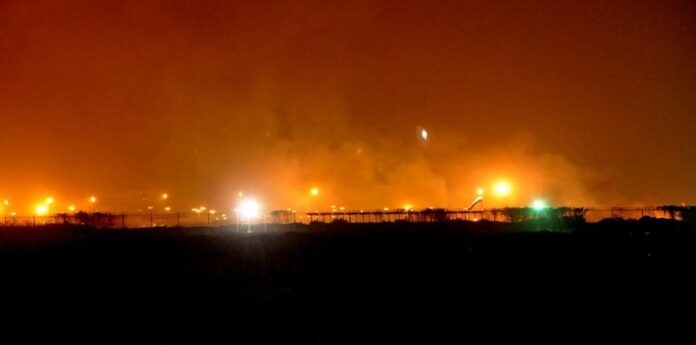
Smoke billows from Jinnah International Airport after suspected militants attacked the airport overnight Sunday in Karachi, Pakistan. At least two explosions and sporadic gunshots were heard, and an airport emergency was declared with all flights suspended. EPA/SHAHZAIB AKBER

By Subel Bhandari

ISLAMABAD (DPA) — At least 28 people, including 10 suspected terrorists, were killed during a gun battle lasting several hours between Pakistani security forces and militants who stormed an airport in Karachi, officials said.

All international and domestic flights from the southern city's Jinnah Airport were suspended when one of the terminals was attacked by 10 assailants shortly after midnight on Sunday, said Major General Rizwan Akhtar, chief of the Rangers paramilitary force.

"We have cleared the airport … all terrorists are dead," Akhtar told reporters.

A civil aviation official, Shujaat Azeem, said flights would resume by midday (0700 GMT) on Monday.

Thirteen members of the security forces and five civilians were among the dead, said doctor Seemi Jamali at the city's Jinnah Medical Institute.

At least 23 people with bullet injuries were brought to the hospital, she said. Five of them were in a critical condition.

Karachi is Pakistan's most populous city and the capital of Sindh province.

Two other airports in the country, including in the national capital Islamabad, were put on red alert and had their security strengthened, an Interior Ministry official said.

Akhtar said terrorists wearing suicide vests entered the airport in two groups of five and set ablaze a terminal used for cargo.

Seven of them were killed in a gun battle with military commandos while three blew themselves up when surrounded by soldiers, he added.

Early Monday, two groups of security forces fired at each other in panic, injuring one official. Rangers mistook an airport security staff member for an attacker and fired at him, Akhtar said.

Pakistani Taliban have launched similar attacks in the past, but mostly against military facilities. In 2011, militants laid siege to the city's naval base for 18 hours, killing at least 10 people.

Taliban have been waging a deadly insurgency since 2003 in Pakistan, killing over 40,000.

Tentative talks between the government and the Taliban were held last month but failed to make significant progress.

Advertisement

Army Occupies Skytrains, Closes Parks To Deter Anti-Coup Protests

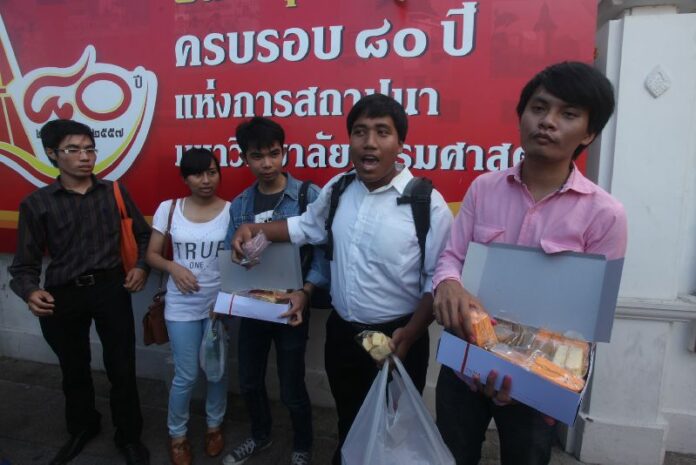
Student activists distribute "Sandwiches for democracy", 8 June 2014

BANGKOK — More than 5,000 soldiers and police officers were deployed in central Bangkok today to thwart protesters' attempts to organise an anti-coup rally.

Since anti-coup activists did not publicly designate a location for today's protests in advance, security forces resorted to sealing off all potential venues that could host a demonstration, including Benchasiri Park on Sukhumvit Road, Chatuchak Park on Phahonyothin Road, and Sanam Luang ("Royal Field") in the old quarters of Bangkok. 

Soldiers were also stationed at a number of BTS stations and on skytrains to look for potential demonstrators, while police officers patrolled landmarks such as Ratchaprasong Intersection and Victory Monument where previous weekly anti-coup demonstrations have been held. 

Police also dispatched at least ten plain-clothed officers to pose as customers at a McDonald's on Ratchaprasong Intersection to prevent any political demonstrations from taking place; the American fast food chain, along with "three finger salute" from the Hunger Games trilogy, has become an unlikely symbol of defiance against the military junta. 

Since seizing power in a coup d'etat on 22 May, the military's National Council of Peace and Order (NCPO) has outlawed public demonstrations and threatened to send transgressors to face trial in military courts. The NCPO has already detained scores of anti-coup protesters and activists thought to be critical of the military takeover. In a nationally-televised address on Friday, coup-leader Gen. Prayuth Chan-ocha warned Thais against flashing the "three-finger salute" in public. 

Despite the extensive presence of security forces today, several small protests broke out across the city. A group of protesters flashed the three-finger salute amid a scrum of reporters and onlookers at Siam Paragon shopping mall before police officers quickly closed in on the group.

Two were arrested at the scene, while five more were detained by security forces as they attempted to escape by skytrain and taxi. 

This evening, a group of anti-coup activists staged a "sandwich picnic" outside Thammasat University's Tha Prachan campus to circumvent the ban on political demonstrations. Administrators of Thammasat University, the site of popular uprising against the military regime in 1970s, shut down the campus' entrances, presumably to prevent the protesters from entering the compound. 

Pol.Gen. Somyot Pumphanmuang, deputy chief of the Royal Thai Police, said that today's operation relied heavily on undercover agents to mark, track down, and arrest potential protesters.

Uniformed police officers and soldiers only played a supporting role in the operation, Pol.Gen. Somyot said, adding that the security forces have tried their best to avoid violent confrontations with demonstrators as part of the military's effort to promote “national reconciliation.”

"I want to tell the protesters that they should think of their country," said Pol.Gen. Somyot. "Please wait and see the actions of the NCPO's leaders, because [the NCPO] has not started working yet, but the protesters are already opposing them. This is not right. If the NCPO leaders fail to do what they promise, I might also join the protesters, too."

He added, "Right now [the protests] are causing damage to our country. They are causing chaos. They are creating a bad image for the foreigners."

Throughout the day many critics of the coup posted photos of themselves on social media showing the three-finger salute in solidarity with the activists. 

"I beg you not to raise the three fingers," Gen. Prayuth said in his public address on Friday. "If you want to show it, you can, but can you show it inside your house? Don't show it outside."


For comments, or corrections to this article please contact:[email protected]

You can also find Khaosod English on Twitter and Facebook
http://twitter.com/KhaosodEnglish
http://www.facebook.com/KhaosodEnglish
Advertisement

Cambodia Told To Curb Activity of Exiled Redshirt

Jakrapob Penkair (photo by Chao Praya News).

BANGKOK — The Thai Ministry of Foreign Affairs has formally asked the Cambodian government to curb the activities of an exiled anti-coup activist living in Cambodia.

Thai officials say they summoned the Cambodian ambassador and asked her to "cooperate" by discouraging Jakrapob Penkair, a former minister and prominent Redshirt leader, from criticising the coup from his self-imposed exile in Cambodia.

It is not immediately clear whether the Cambodian ambassador made an official response.

Mr. Jakrapob has been residing in Cambodia since 2009 to avoid charges of lese majeste (insulting the monarchy). If convicted, Mr. Jakrapob could face up to 15 years in prison. 

The former minister recently returned to the spotlight when he vocally condemned the Thai military 22 May coup d’etat. Mr. Jakrapob vowed to organise a Cambodian-based resistance to the military regime, leading some Redshirt supporters to speculate that he is putting together a government-in-exile. A number of professors, activists and politicians have fled to Cambodia in recent weeks to avoid the military’s crackdown on dissidents.

The Prime Minister of Cambodia, Hun Sen, has publicly dismissed any plans for a Thai government-in-exile on Cambodian soil.

"I would like to stress that Cambodia is not a place for any country or group to set up a government-in-exile," Hun Sen said on 28 May.

Thailand's request for cooperation from the Cambodian government came a day after a spokesperson of the Democrat Party — which supports the military coup — urged the Ministry of Foreign Affairs to extradite Mr. Jakrapob in order to prosecute him for his alleged crimes.

"Mr. Jakrapob is a fugitive prisoner under a lese majeste case," said Democrat spokesperson Chavanond Intarakomalsut. "Therefore, it is not appropriate for him to use his Thai citizenship to falsely proclaim leadership of [an anti-coup resistance]."

Mr. Chavanond demanded Thai authorities urge the Cambodian government to promptly extradite Mr. Jakrapob to Thailand.

"Otherwise it will cause misunderstanding and affect international relations," the Democrat spokesperson warned.


For comments, or corrections to this article please contact:[email protected]

You can also find Khaosod English on Twitter and Facebook
http://twitter.com/KhaosodEnglish
http://www.facebook.com/KhaosodEnglish
Advertisement

Thai Schoolchildren To Be Re-educated Under Junta's New Guideline

"Returning Happiness to the People" concert organised by the army in Nakhon Ratchasima province, 7 June 2014.

BANGKOK — Under new orders from the Office of Basic Education of Thailand (OBEC), criticism of the military junta is now banned in all Thai public schools.

The order, issued by the OBEC earlier this week, bans the dissemination of  “provocative," "violence-condoning," or "false" information that could encourage students to disrespect laws or "oppose the mission of the National Council for Peace and Order (NCPO)."

The new education guidelines also prohibit public school officials from participating in political protests or hosting any demonstrations or political seminars in their schools. Teachers are asked to encourage students and their families to avoid all political demonstrations as well.

According to the order, teachers must "cooperate with and support the mission of the NCPO in every level,” and teach lessons "that focus on the creation of reconciliation." 

Since seizing power in a coup d'etat on 22 May, the Thai military junta has set out to achieve “national reconciliation" by cooling the heated political tensions that led to street protests and sporadic violence over the past six months.

In pursuit of this ambitious goal, the military has severely restricted political expession by detaining scores of activists, banning political protests, and censoring the press.

The junta has combined the effort to silence critics with a campaign to “return happiness to the Thai people” by way of free concerts and other "feel-good" events and propaganda. 

The deputy secretary of the OBEC, Mr. Kamol Rordklai, said yesterday that he is also considering revising school textbooks to reinforce a sense of patriotism among schoolchildren in support of the NCPO's reconciliation project. 

"We will improve modules in history, citizen duty, and morality, in accordance with the NCPO's policy, so that the children will know about unity and love for their country,” Mr. Kamol said.

Mr. Kamol said he has already presented these ideas to the NPCO. 

"NCPO thinks they are very appropriate, because the country has seen much conflict in the society," Mr. Kamol told reporters. 


For comments, or corrections to this article please contact:[email protected]

You can also find Khaosod English on Twitter and Facebook
http://twitter.com/KhaosodEnglish
http://www.facebook.com/KhaosodEnglish

Advertisement

Hot News

LATEST NEWS

Bangkok
overcast clouds
29.2 ° C
30.5 °
27.9 °
77 %
3.4kmh
100 %
Fri
30 °
Sat
35 °
Sun
32 °
Mon
26 °
Tue
29 °