













28 C
Bangkok
Friday, August 28, 2026
Home Blog Page 3353

Army Exercises New Authority, Escalates Media Crackdown

Soldiers raided Channel 11 provincial office in Chiang Mai Province, 20 May 2014.

BANGKOK — After declaring martial law before dawn on Tuesday morning, the military issued ten statements over the course of the day spelling out the specifics of its new, wide-ranging powers.

Citing the need to “restore law and order to the country,” the military has begun a heavy-handed crackdown on the media, which it is now authorized to do under section 11 of the martial law.

Thailand’s martial law, which was written in 1914 when the country was still ruled by an absolute monarch, grants the military “superior power over the civilian authority” and the power to curb a number of human rights.

So far, the military has ordered 14 television stations, affiliated with both pro- and anti-government political factions, off the air.

The military has also prohibited all news outlets and social media sites from publishing any content that “misleads the public” or “escalates the conflict,” warning that transgressors could be shut down and summoned for prosecution.

In addition, academics, bureaucrats, justice officials, and independent agencies have been strictly forbidden from giving any media interviews that “distort the facts, cause confusion among the public, or lead to further violence.”

In several other televised announcements spaced throughout the day, the military restricted the movement of both pro- and anti-government protest groups in Bangkok, and called upon local authorities to suppress any demonstrations that go against the mission of the military’s new peacekeeping organisation, the Peace and Ordre Maintaining Command (POMC).

Army commander-in-chief Gen. Prayuth Chan-ocha said in a press conference that it was necessary to invoke martial law in order to prevent possible "bloodshed" between the pro- and anti-government protesters that are both rallying in the capital city.

At least 25 people have died since anti-government protesters first began their street campaign to oust the current government last November. 

The caretaker government, led by acting Prime Minister Niwatthamrong Boonsongphaisarn said that it was not consulted before the military declared martial law at 3:00 a.m. this morning.

Yet Mr. Niwatthamrong insisted that the government does not object to the military's decision. 

"For martial law, they didn't need to tell us in advance," Prime Minister Niwatthamrong said in a press conference, "It's something they can do. The government understands the [military's] intention of keeping order and avoiding clashes … which is a good thing."

He also dismissed the rumour that the government is contemplating to remove Gen. Prayuth from his position.

Asked by a reporter whether the general election on 20 July will go ahead as planned, Mr. Niwatthamrong said it is likely that the election will be postponed to 3 August.

The caretaker Prime Minister added that he has already suggested the new date to the Election Commission and awaiting their response.

For comments, or corrections to this article please contact: [email protected]

You can also find Khaosod English on Twitter and Facebook
http://twitter.com/KhaosodEnglish
http://www.facebook.com/KhaosodEnglish
Advertisement

Northern Redshirt Rally Dismantled, TV Station Raided

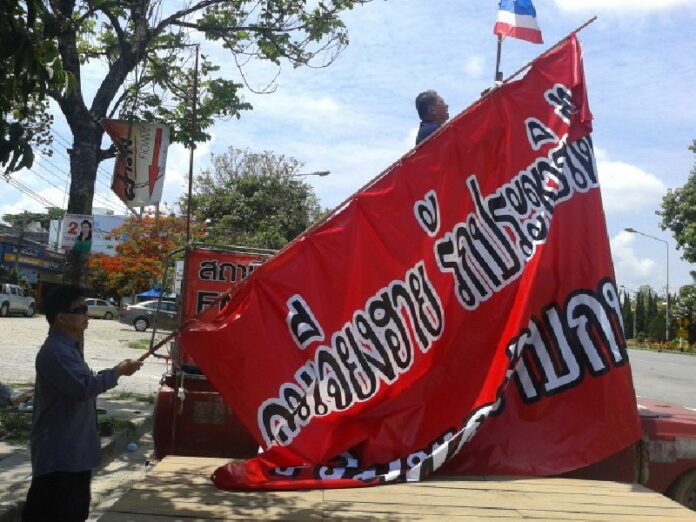
Pro-government Redshirts in Chiang Rai province dismantle their rally stage, 20 May 2014.

CHIANG RAI — As nationwide martial law takes hold in Thailand, pro-government Redshirts in Chiang Rai province "temporarily" suspended their political campaign, while soldiers were ordered to raid a state-owned television station in nearby Chiang Mai province.

Chiang Rai Redshirts had been organising a rally near Chiang Rai’s old city wall in league with the mass demonstration in Bangkok called by the United Front of Democracy Against Dictatorship (UDD).

But today’s declaration of martial law by Royal Thai Army commander-in-chief Gen. Prayuth led protesters to call off their demonstration – for now. 

"We understand that the military imposed martial law because they want to see peace and order in the country," said Attakorn Kanthachai, leader of the local Redshirt group Love Democracy Network. "So we have to dismantle the stage for the moment."

"Also, we cannot broadcast the footage of the [UDD] rally on Aksa Road, so there's no point in maintaining the stage any longer," Mr. Attakorn added.

This morning, the military shut down ten TV stations, including Asia Update, which had been televising the UDD rally on Aksa Avenue in Western Bangkok.

Nevertheless, the Chiang Rai Redshirts insist that their retreat is only temporary.

"If there's an attempt to find a neutral Prime Minister under Article 7, we will come out to protest such action," said Songtham Kid-an, another activist of the Redshirt group. 

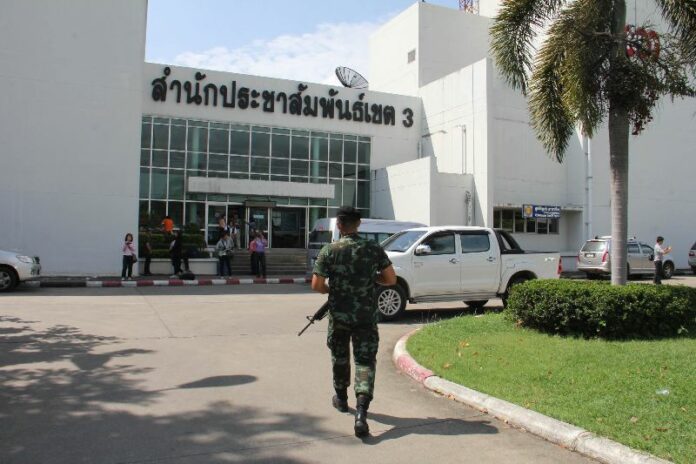
Meanwhile in nearby Chiang Mai province, armed soldiers raided the provincial television station of the state-owned Channel 11 in Mae Rim district.

The raid was ordered by the army's newly-formed Peace and Ordre Maintaining Command (POMC), which has invoked its powers under martial law to censor the media to prevent information that might "mislead" the public. 

After arriving at the Chiang Mai branch of the National Broadcasting Services of Thailand (NBT), the troops confiscated broadcasting equipment and ordered the staff to delete footage of the raid. 

Director of Chiang Mai's NBT Duangman Srikitwilaikul and two of her assistants were later escorted to a military base. The soldiers left the station soon afterwards.

A local Redshirt "community radio" in Chiang Mai has been similarly taken off the air.

"The military has not seized power. We merely want to end violence," said Maj.Gen. Sarayut Sangsri, a commander of Chiang Mai military region, "I don't believe there would be violence, because the military is now resolving the problem."

However, Maj.Gen. Sarayut advised against political gathering of any kind in the meantime. "Unless it is really necessary, there should be no meeting or seminar related to politics."

Chiang Mai and Chiang Rai provinces are major strongholds of the pro-government Redshirt movement.


For comments, or corrections to this article please contact:[email protected]

You can also find Khaosod English on Twitter and Facebook
http://twitter.com/KhaosodEnglish
http://www.facebook.com/KhaosodEnglish
Advertisement

What Can the Army Do Under Martial Law?

BANGKOK — In a political development that came as a surprise to many on Tuesday, the Thai army announced at 3:00 in the morning that the entire country is now under martial law.

Thailand’s martial law was written in 1914, before the country was a constitutional monarchy.  It grants the military extensive powers—including “superior power over the civil authority” in regards to maintaining public order—and also curbs a number of human rights.

Under the century-old martial law, the military now has the power to:  

  1. Search any “body vehicle, dwelling place, building or any place and at any time.” [Section 9:1].
  2. Inspect any letter, package, printed matter “or other things transmitting within the area under the Martial Law” [Section 9:2].
  3. “Force labor for supporting military service in all respects” and demand from any person “any conveyance, beast of burden, provisions, arm, instrument and tool for use in military service” [Section 10].
  4. Impose a curfew, prohibit any meeting or assembly, and control transportation in any public area [Section 11].
  5. Prohibit dissemination of any printed material and television or radio broadcast [Section 11].
  6. “Burn any house or thing which may be useful to the enemy” and “alter the nature of the country or village … for the purpose of fight or preparation for the defense at the discretion of the military authority” [Section 14].
  7. Detain for inquiry any person that the military has “reasonable ground to suspect” is the “enemy or violates the provisions of this Act” [Section 15].

In addition, no person is allowed to claim any compensation for any damages that may result from the exercise of these powers [Section 16].

The sweeping powers granted to the military under martial law are significantly more far-reaching than the authority enjoyed by the government under the Internal Security Act that was previously in place.

As a result, the army’s move has already come under harsh criticism from groups like Human Rights Watch.

"Thailand is using a century old law with draconian provisions that permit the military to exercise essentially unlimited authority to violate human rights if they are so inclined,” said Brad Adams, Director of Human Rights Watch’s Asia Division.

“It's a law that pre-dates the creation of all international human rights standards, and it shows," Mr. Adams said.

The military has already made moves to apply some of these powers.

This morning, the army’s newly-formed peace-keeping operation, the Peace and Order Maintaining Command (POMC), shut down ten politically-affiliated TV stations in order to prevent the dissemination of "misleading" information that could cause public confusion and unrest.

The POMC also ordered that all unlicensed community radio stations, which are often operated by hardcore Redshirt activists, be taken off the air.

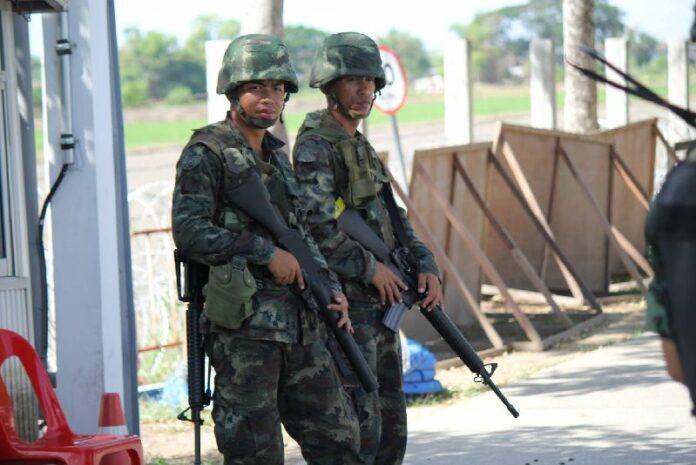
In addition, troops have been deployed to oversee both anti-government and Redshirt rally sites, with orders to prohibit activists from marching anywhere.  

Government officials say they were not informed of the army’s plan to announce martial law until it was declared on television at 3:00 a.m. this morning.

The army has insisted that they have not staged a coup.

If that proves to be true, this would be the first time in Thailand’s history that a nationwide declaration of martial law has not been followed by a military coup d’état. 


For comments, or corrections to this article please contact:[email protected]

You can also find Khaosod English on Twitter and Facebook
http://twitter.com/KhaosodEnglish
http://www.facebook.com/KhaosodEnglish
Advertisement

What Can the Army Do Under Martial Law?

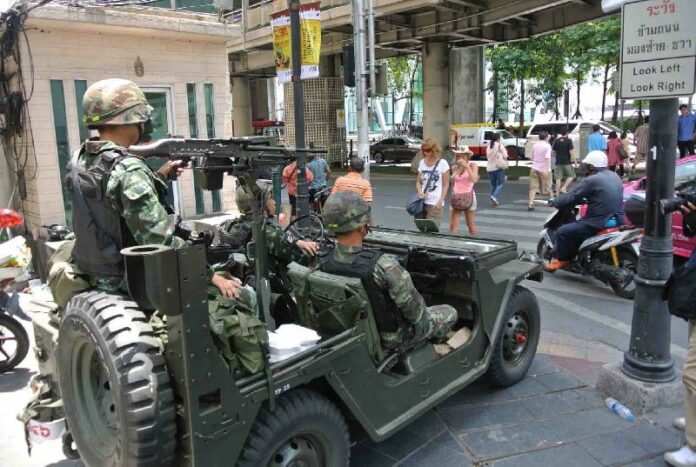
Armed soldiers on duty in Bangkok after the military declared martial law on Tuesday, 20 May 2014.

BANGKOK — In a political development that came as a surprise to many on Tuesday, the Thai army announced at 3am that the country is now under martial law.

Thailand’s martial law was written in 1914, before the country was a constitutional monarchy.  It grants the military extensive powers — including “superior power over the civil authority”  in order to maintain public order — and also curbs a number of human rights.

Under the century-old piece of legislation, the military is now authorized to:  

  1. Search any “body vehicle, dwelling place, building or any place and at any time.” [Section 9:1].
  2. Inspect any letter, package, printed matter “or other things transmitting within the area under the Martial Law” [Section 9:2].
  3. “Force labor for supporting military service in all respects” and demand from any person “any conveyance, beast of burden, provisions, arm, instrument and tool for use in military service” [Section 10].
  4. Impose a curfew, prohibit any meeting or assembly, control transportation in any public area, and “prohibit any person from conducting any act or having any prohibited undertaking or thing as determined by the Minister of Defense during the period of the Martial Law” [Section 11].
  5. Prohibit dissemination of any printed material and television or radio broadcast [Section 11].
  6. “Burn any house or thing which may be useful to the enemy” and “alter the nature of the country or village … for the purpose of fight or preparation for the defense at the discretion of the military authority” [Section 14].
  7. Detain for inquiry any person that the military has “reasonable ground to suspect” is the “enemy or violates the provisions of this Act” [Section 15].

In addition, the law bars people from claiming any compensation for any damages that result from the exercise of these powers [Section 16].

The sweeping powers granted to the military under martial law are significantly more far-reaching than the authority enjoyed by the government under the Internal Security Act, which was previously in place.

As a result, the army’s move has already come under harsh criticism from groups like Human Rights Watch.

"Thailand is using a century old law with draconian provisions that permit the military to exercise essentially unlimited authority to violate human rights if they are so inclined,” said Brad Adams, the Director of HRW's Asia Division.

"It's a law that pre-dates the creation of all international human rights standards, and it shows," Mr. Adams said.

The military has already begun excerising some of its new powers. This morning, the army’s newly-formed peace-keeping operation, the Peace and Order Maintaining Command (POMC), shut down ten politically-affiliated TV stations in order to prevent the dissemination of "misleading" information that could cause "confusion" and unrest.

The POMC also ordered that all unlicensed community radio stations, which are often operated by hardline Redshirt activists, be taken off the air.

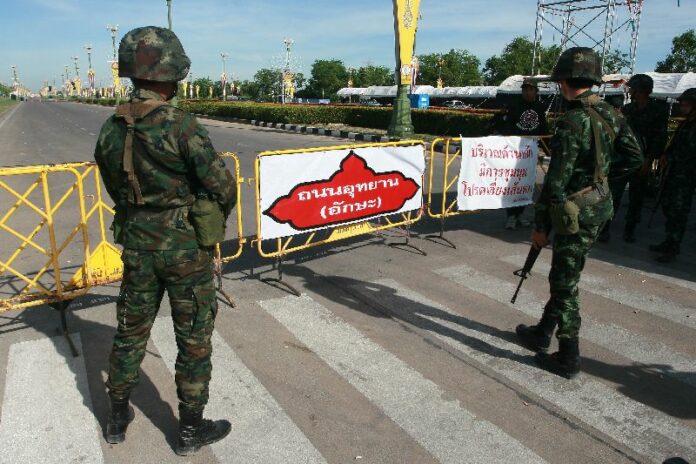
In addition, troops have been deployed to oversee both anti-government and Redshirt rally sites, with orders to prohibit activists from marching anywhere.  

Government officials say they were not informed of the army’s plan to announce martial law until it was declared on television at 3:00 a.m. this morning.

The army has insisted that they have not staged a coup. If that proves to be true, this would be the first time in Thailand’s history that a nationwide declaration of martial law has not been followed by a military coup d’état. 

UPDATE: The military launched a coup on 22 May. 


For comments, or corrections to this article please contact:[email protected]

You can also find Khaosod English on Twitter and Facebook
http://twitter.com/KhaosodEnglish
http://www.facebook.com/KhaosodEnglish
Advertisement

Citing Martial Laws, Military Censors Media

Soldiers stand guard at Thai Com satellite HQ in Pathumthani province, 20 May 2014

BANGKOK – The Thai military shutdown ten TV stations allied with both pro- and anti-government factions after declaring martial law early this morning.

Citing the power to censor the media in section 11 of the country's 100-year-old martial laws, the army’s newly-formed Peace and Order Maintaining Command (POMC) suspended 10 satellite TV channels in order to prevent the dissemination of "misleading" information that could cause public confusion and unrest.

The suspended TV stations include Asia Update and Blue Sky TV, which have served as the mouthpieces of the pro-government United Front of Democracy Against Dictatorship (UDD) and the anti-government People's Committee for Absolute Democracy With the King As Head of State (PCAD), respectively.

Both stations have regularly broadcasted live footage from their supporters' protest sites across the country.

So far, all politically-affiliated TV stations appear to have complied with POMC's demands, except for the anti-government T News station, which has announced its intention to appeal the order. 

In statement posted on its website, T News says it’s a for-profit TV station "without affiliation to any political faction,” and cannot afford to cease its operation because of an outstanding debt of 125 million baht. 

"We are appealing the POMC to allow T News to continue our commercial operations, otherwise the company will suffer massive financial losses," the statement reads.

According to the POMC's statement, all unlicensed "community radios" will be taken off the air as well. Many local Redshirt groups operate unregistered  "community radio stations," such as the UDD hardline faction allied to Redshirt activist Wuttipong "Ko Tee" Kochthammakul, who is thought to be currently living in exile.

Although most mainstream news outlets are being permitted to operate normally, the POMC stressed that all media must refrain from "inciting chaos" or reporting anything that "affects the peace and order maintaining operations of the security force."

Martial law, which grants the military “superior power over the civil authority” in matters of maintaining public order, was declared at 3:00 a.m. this morning by Gen. Prayuth Chan-ocha, commander-in-chief of the Royal Thai Army and chairman of the recently-installed POMC.

The military has ordered representatives from all state agencies to attend a 2:00 p.m. meeting this afternoon to discuss the declaration of martial law at military bases across the country. 


For comments, or corrections to this article please contact:[email protected]

You can also find Khaosod English on Twitter and Facebook
http://twitter.com/KhaosodEnglish
http://www.facebook.com/KhaosodEnglish
Advertisement

US to Thai Army: Don't Undermine Democratic Institutions

The US Embassy in Bangkok released a statement on its website in response to the Thai army's declaration of martial law on Tuesday morning.

US State Department Spokesperson Jen Psaki: 

We are aware of reports that Thailand’s army has declared martial law and are monitoring developments closely. We remain very concerned about the deepening political crisis in Thailand and urge all parties to respect democratic principles, including respect for freedom of speech. We understand the Royal Thai Army announced that this martial law declaration is not a coup. We expect the Army to honor its commitment to make this a temporary action to prevent violence, and to not undermine democratic institutions. The United States firmly believes all parties must work together to resolve differences through dialogue and find a way forward. This development underscores the need for elections to determine the will of the Thai people.

Advertisement

Govt Calls Emergency Meeting To Respond To Martial Law

Soldiers surround Redshirt rally on Aksa Avenue after martial law was declared this morning, 20 May 2014.

BANGKOK — The government is urgently convening a meeting to draft a formal response to the Royal Thai Army’s unexpected pre-dawn declaration of martial law on Tuesday, a top official said.

Suranand Vejjajiva, secretary to the caretaker Prime Minister Niwatthamrong Boonsongphaisarn, said the Cabinet is currently meeting to discuss the developing situation and will announce a formal response later in the day. He did not say where the meeting is being held.

Martial law, which grants the military “superior power over the civil authority” in matters of maintaining public order, was declared at 3:00 a.m. this morning by Gen. Prayuth Chan-ocha, commander-in-chief of the Royal Thai Army and chairman of the recently-installed Peace and Order Maintaing Command (POMC).

The military has ordered representatives from all state agencies to attend a 2:00 p.m. meeting this afternoon at military bases across the country. 

This morning, security forces were seen clearing anti-government protesters out of the Government House, taking control of major intersections, surrounding the Redshirt rally on Aksa avenue, and entering the residences of a number of Cabinet members, including Labour Minister Chalerm Yoobamrung. 

The army has also shut down a number of politicized TV stations, including Asia Update and Blue Sky TV.

However, daily life for most Thais proceeded normally this morning, and so far the military presence in Bangkok is considered “light.”

Almost 30 people have died since the most recent bout of political unrest erupted in Thailand last November.


For comments, or corrections to this article please contact: [email protected]

You can also find Khaosod English on Twitter and Facebook
http://twitter.com/KhaosodEnglish
http://www.facebook.com/KhaosodEnglish
Advertisement

DPA: Army Declares Martial Law in Thailand

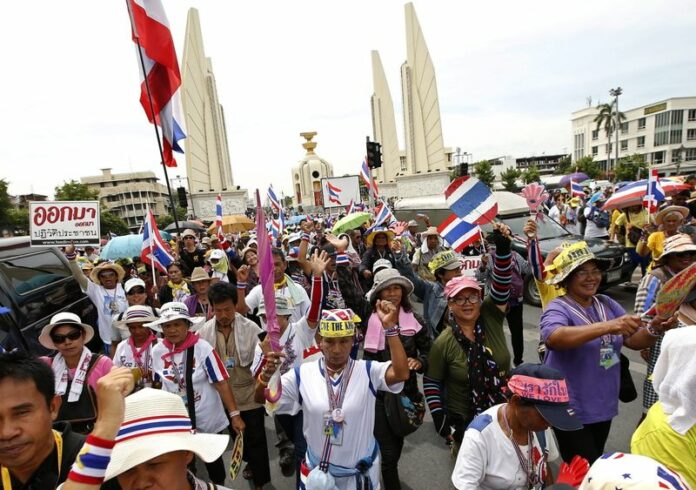
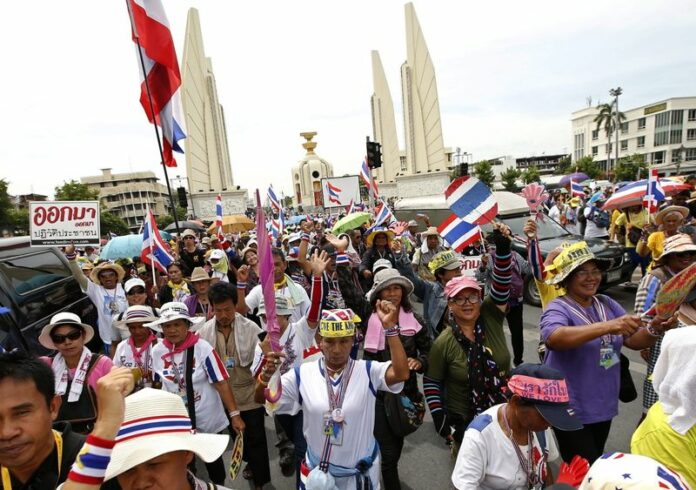
Thai anti-government protesters march during a rally at the Democracy Monument in Bangkok, Thailand, 19 May 2014 (DPA).

By Somchai Kwankijswet and Peter Janssen (DPA)

BANGKOK — Thai army Chief Prayuth Chan-ocha early Tuesday declared martial law, giving the military full control over peace-keeping in the country that has seen six months of anti-government protests.

The statement was issued about 3 am Tuesday (2000 GMT), according to local media reports.

In a brief statement Prayuth dissolved the government's Centre for Maintaining Peace and Order (CAPO) and set up an army-controlled peace keeping centre.

Prayuth has the authority to declare martial law without the consent of the government, which has had caretaker status since December 9.

"It looks like he may have decided to do this without consulting the government, since his first order was to dissolve the CAPO which was jointly run by the government and police," said Panitan Wattanayagorn, a political scientist and military affairs analyst at Chulalongkorn University.  

Thailand has been wracked by six months of non-stop protests seeking to topple the government.

At least 25 people have died in political-related violence and more than 700 injured.

On Thursday, Prayuth warned the army would use "full force" to maintain law and order in the country during the on-going political crisis, after three protesters were killed.

The declaration of martial law follows the launch over the weekend of a "final battle" against the government by Suthep Thaugsuban, leader of the People's Democratic Reform Committee (PDRC), the main anti-government protest group.

Suthep on Saturday said he would pressure the remaining 25 members of the caretaker cabinet to resign and launch a mass protest on Friday to Monday to topple the administration.  

He vowed to turn himself in to authorities to face insurrection charges on May 27 should his final battle fail.

"I think Prayuth is trying to neutralize the confrontation between the PDRC and elements of the pro-government groups who have threatened to fight back if Suthep's group capture some of the ministers," Panitan said.

Martial law gives the army control over security, but leaves the government in command of other tasks, unlike a coup.

Thailand has witnessed 18 coups in the past eight decades, the last of which ousted former prime minister Thaksin Shinawatra in 2006.

The army has stationed troops in the capital to help police keep the peace during the past six months of protests, which have brought Thai politics to a stalemate.

Advertisement

DPA: Army Declares Martial Law in Thailand

Thai anti-government protesters march during a rally at the Democracy Monument in Bangkok, Thailand, 19 May 2014 (DPA).

By Somchai Kwankijswet and Peter Janssen (DPA)

BANGKOK — Thai army Chief Prayuth Chan-ocha early Tuesday declared martial law, giving the military full control over peace-keeping in the country that has seen six months of anti-government protests.

The statement was issued about 3 am Tuesday (2000 GMT), according to local media reports.

In a brief statement Prayuth dissolved the government's Centre for Maintaining Peace and Order (CAPO) and set up an army-controlled peace keeping centre.

Prayuth has the authority to declare martial law without the consent of the government, which has had caretaker status since December 9.

"It looks like he may have decided to do this without consulting the government, since his first order was to dissolve the CAPO which was jointly run by the government and police," said Panitan Wattanayagorn, a political scientist and military affairs analyst at Chulalongkorn University.  

Thailand has been wracked by six months of non-stop protests seeking to topple the government.

At least 25 people have died in political-related violence and more than 700 injured.

On Thursday, Prayuth warned the army would use "full force" to maintain law and order in the country during the on-going political crisis, after three protesters were killed.

The declaration of martial law follows the launch over the weekend of a "final battle" against the government by Suthep Thaugsuban, leader of the People's Democratic Reform Committee (PDRC), the main anti-government protest group.

Suthep on Saturday said he would pressure the remaining 25 members of the caretaker cabinet to resign and launch a mass protest on Friday to Monday to topple the administration.  

He vowed to turn himself in to authorities to face insurrection charges on May 27 should his final battle fail.

"I think Prayuth is trying to neutralize the confrontation between the PDRC and elements of the pro-government groups who have threatened to fight back if Suthep's group capture some of the ministers," Panitan said.

Martial law gives the army control over security, but leaves the government in command of other tasks, unlike a coup.

Thailand has witnessed 18 coups in the past eight decades, the last of which ousted former prime minister Thaksin Shinawatra in 2006.

The army has stationed troops in the capital to help police keep the peace during the past six months of protests, which have brought Thai politics to a stalemate.

*********

Bangkok (CNN) — The Thai army declared martial law throughout the country Tuesday in a surprise move that an aide to the country's embattled Prime Minister said the government didn't know about beforehand.
"They took this action unilaterally. The government is having a special meeting regarding this. We have to watch and see if the army chief honors his declaration of impartiality," the aide said, describing the situation as "half a coup d'etat."
Lt. Gen. Nipat Thonglek told CNN the move was not a coup.
"The Army aims to maintain peace, order and public safety for all groups and all parties," a ticker running on the army's television channel said. "People are urged not to panic, and can carry on their business as usual. Declaring martial law is not a coup d'etat."
Martial law went into effect at 3 a.m. on Tuesday, the ticker said.
All Thai TV stations are being guarded by the military, Thai public television announced, showing pictures of soldiers and armored vehicles taking positions outside broadcast facilities in the country's capital.
The dramatic announcements come days after the head of the army issued a stern warning after political violence had surged in the country's capital.
Political tensions have been running high in Thailand. Supporters and opponents of the country's government have staged mass protests in recent days, and caretaker Prime Minister Yingluck Shinawatra was removed from office, along with nine cabinet ministers, by a top court earlier this month.

Advertisement

Thai Airways Threatens Strike If Govt Refuses To Quit

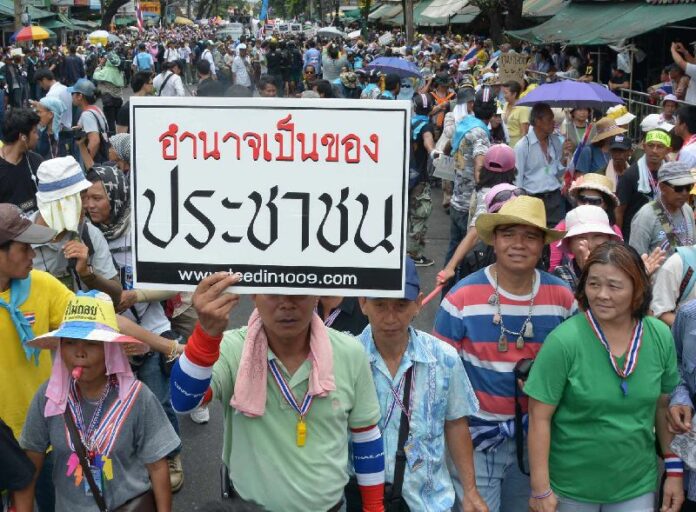
Anti-government protester with a sign that reads, "Power Belongs to the People," 19 May 2014.

BANGKOK — The leader of the Thai Airways union has threatened to call a strike and shutdown the company if the government refuses to resign by 21 May.

Somsak Manop, deputy chairperson of the Thai Airways union, said all union members of the state-owned airline should follow the plan put forth by the anti-government People's Committee for the Absolute Democracy With the King As Head of State (PCAD), which calls for a nationwide strike to "seize back the Sovereign Power" for  the people. 

The PCAD is in the midst of their "one last fight" to topple the government of caretaker Prime Minister Niwatthamrong Boonsongphaisarn, and replace it with an unelected "People's Council" to implement series of unspecified "national reforms.” PCAD leader Suthep Thaugsuban has claimed that the "Great Mass of the People" will achieve victory by 27 May. 

According to Mr. Somsak, if the government does not respond to PCAD's demand by 21 May, more than 15,000 employees of the airline will unanimously go on strike from 22-26 May, as a part of the PCAD’s final struggle against the government.

"If all employees join the strike, the company will automatically be shut down," Mr. Somsak said. 

The threat to strike comes at a time when the debt-ridden, state-owned Thai Airways is already facing massive financial losses, caused by the significant drop in tourism since turmoil broke out in Thailand last year, an inability to compete with privately-run airlines, and rampant nepotism.

Mr. Somsak admitted that some Thai Airways employees disagree with the strike plan because they fear it will only worsen the company's financial troubles. However, he claimed that 70-80% of the workers do agree with the strike, and said that Thai Airways will be in financial trouble regardless of whether the workers strike or not.

Mr Somsak added that "three to four" executive members of the Thai Airways union will join the PCAD's effort to hunt down Cabinet members and force them to resign from their caretaker positions. 

Caretaker director of Thai Airways Chokechai Panyayong said the administration is aware of the union's strike threat, and insisted that the company's operation will be not disrupted. 

"I am confident that Thai Airways staff has the spirit and responsibility for their duty," Mr. Chokechai said.

He explained that the administration has not forbidden its staff from joining any political demonstrations because it is their constitutional right to do so, but he stressed that staff are only permitted to join protests outside of working hours.

"I am sure there will be no disruption to our service," Mr. Chokechai added.


For comments, or corrections to this article please contact: [email protected]

You can also find Khaosod English on Twitter and Facebook
http://twitter.com/KhaosodEnglish
http://www.facebook.com/KhaosodEnglish
Advertisement

Hot News

LATEST NEWS

Bangkok
overcast clouds
28 ° C
30 °
27.7 °
77 %
0.5kmh
99 %
Fri
33 °
Sat
33 °
Sun
27 °
Mon
28 °
Tue
30 °