























28 C
Bangkok
Sunday, July 12, 2026
Home Blog Page 1809

New Hybrid Drink ‘Juice Nest’ Brings Goodness of Bird Nests to Functions (Sponsored)

Collagen, glutathione, and Q10 is added to expand the customer base and the health drink market. Aiming to enter foreign markets, after winning the Sial Innovation Finalist Award 2015.

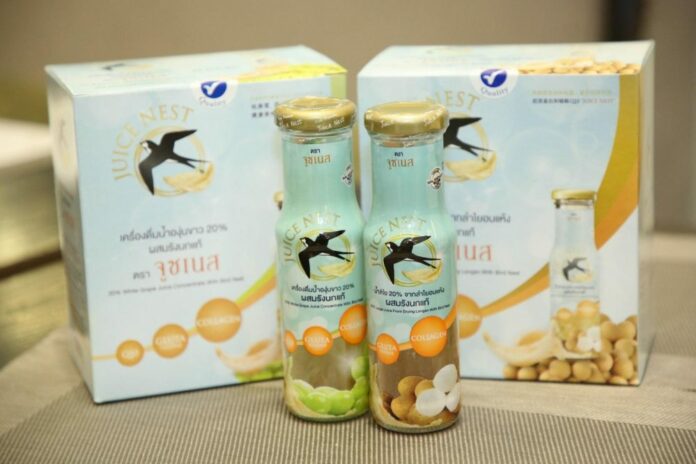
After the official launch earlier this year, Juice Nest challenges the beverage industry with its hybrid drink positioning. Juice Nest is a bird nest-infused functional beverage that combines the benefits from collagen, glutathione, and Q-10 from Japan, targeting health and beauty-loving young generation. The latest functional drink also reignites the bird nest market with an affordable price at 69 baht for 150-ml bottle for daily drinks or gifts. The drink aims to take 10% market share within three years. In the coming future, new recipes will be launched and the drinks will also be introduced to China, Taiwan, and Cambodia, especially after its achievement of SIAL INNOVATION FINALIST AWARD 2015.

C:\Users\Dell\Downloads\7G5A7953.jpg

Saravut Sereethoranakul, Marketing Director, JS Asia Beverage Company Limited, the owner of Juice Nest, said, “The company launched this bird nest-infused beverage, under Juice Nest brand, by positioning it as a hybrid drink that is easy to drink, delicious, and can be everyone’s daily beverage with its benefits from collagen, glutathione, and Q10 from Japan.  Today, we are still in the raising awareness phase among our target group – the health and beauty-conscious young generation. The brand crafts its image as the young crowd with active and healthy lifestyle, which is reflected through its advertisement and presenters such as Prin ‘Mark’ Suparat, Rasri ‘Margie’ Balenciaga, and Stefanie Lerch, as well as other influencers on social media like Instagram. Our beverage is available through modern trade, whilst ‘Win a Gold, Go Japan’ promotion is also organized annually. Doing so helps Juice Nest in striking its impression in the fiercely competitive market. Our latest campaign, ‘Dare to Try,’ also aimed to expand our presence among millennials. It was a chance for them to taste and know our product as the high quality ready-to-drink bird nest that is tasty and affordable. Within three years, we are confident that we will be in the hearts of the new generation and earn our 10% market share.”

“I make this ready-to-drink bird nest beverage from my passion, because my mother makes them for me since young. Throughout the years, I’ve come to love the drink and learn how to cook and select bird nests. Thailand is recognized as a source of high quality bird nest. I make a business from what I love and believe that I understand the needs of our consumers.”

C:\Users\Dell\Downloads\7G5A7989.jpg

Saravut added, “The ingredients of Juice Nest include genuine bird nest, making it a must-have product among Chinese tourists, who are certainly the major market for bird nest drink. With the hybrid drink concept, we are revamping the image of bird nest, from being the drinks for patient visits, souvenirs, and luxury expensive drinks to a more accessible, easy-to-drink, while providing health benefits. These qualities have earned the SIAL INNOVATION FINALIST AWARD 2015. The product was ranked fourth in the Research & Innovation category from more than 3,000 products worldwide. The SIAL INNOVATION event is the world’s number one food and beverage expo, therefore the award has paved ways for Juice Nest to China, a market worth more than 100 billion baht. Our major competitors are the Indonesians, who export bird nests, worth more than 10 billion baht, to China. Our company has our export plan ready and already started negotiating with distributors in China, Taiwan, and Cambodia. We are also preparing for a bird nest concession to meet our future demands.

Recently, the Dare to Try campaign features a buy one get one free deal to expand the teenage markets, by enabling them to try and know the product more widely as the quality and tasty drink that is affordable. The promotion runs in 250 locations nationwide, including BigC, Foodland, Tops Daily, Tops Market, Home Fresh Mart, Villa Market, and Gourmet Market from today till 31 December, or while stock lasts.

C:\Users\Dell\Downloads\7G5A8101.jpg

The overall bird nest market in Thailand is definitely driven by the healthy trend and is categorized into 1) premium bird nests, priced up to 50,000 – 100,000 baht per kilogram, available at traditional medicine and Chinese medicine stores and 2) the ready-to-drink bird nest that is available at two sub-markets. First is the instant bird nest that is available at restaurants and other specialty stores. Second is the bird nest drinks in glass container that is sold at supermarkets and department stores. The latter is worth 4.4 billion baht in 2017 (from AC Nielsen, etc.), with the growth opportunity of 6.3% in CVS channel. 1) the promotional strategy that is focused on health and beauty products, 2) the word-of-mouth recommendation, related to nutritional benefits of bird nests, that uplifts the sale, and 3) the festive seasons, gifts, and souvenirs.

Juice Nest is the bird nest-infused beverage that also provides the benefits of collagen, glutathione, and Q10. It is available today at 7-eleven, Big C, Foodland, Gourmet Market, Home Fresh Mart, Tops, Villa Market, and other shops nationwide. For more information and promotions, please follow us at  Facebook.com/juicenest  and Instagram: Juicenest_Official

Advertisement

19 Films Go Outdoor in Bangkok at Euro Film Fest

Photo: Goethe-Institut Thailand / Facebook

BANGKOK — Winter’s arrival means cinephiles can ditch the dark cinema and unfold chairs under the stars with a bag of popcorn. Just no mosquitos, please.

For the first time, the European Film Festival is going al fresco this year with a roster of 19 films at several venues around Bangkok.

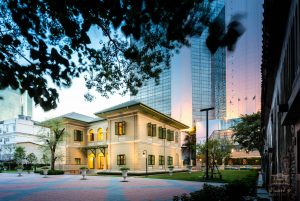
The event opens later this month at House No. 1, a neoclassical European-style building in the riverside Bang Rak district, with Austrian drama “Mademoiselle Paradis.” The recent film is based on the 18th century tale of a blind pianist’s relationship with the physician trying to restore her sight.

20045624 471447779888951 8741068615977853206 o
Photo: House No. 1 / Facebook

The festival goes on with film highlights like “Transit,” a drama which jarringly takes the Holocaust out of the 1940s and plants its story in today’s world to tell the story of a German refugee who assumes the identity of a dead French author.

Czech crime film “In the Shadow” follows a Communist police officer in the 1950s who hunts down a jewelry thief to find out the case is far more complicated than it seems.

Sweden sends in one of Ingmar Bergman’s acclaimed films “Fanny and Alexander.” The 1982 historical period drama looks at two siblings growing up in a dysfunctional upper-class family. It won four Academy Awards including the best foreign language film.

Finland mines deadpan humor with “The Other Side of Hope” in a story of a shirt salesman who befriends a Syrian refugee in Helsinki. A trio of pals embark on an epic search for their stolen winning lottery tickets in the Romanian comedy “Two Lottery Tickets.”

The festival is a chance to see “Loving Vincent” one more time, as the stylized, animated film rendered in Von Goghesque oil paints will return to the screen at the Austrian Embassy, as well as the acclaimed coming-of-age film “Call Me By Your Name,” which won the Academy Award for best adapted screenplay.

The European Film Festival will run Nov. 29 to Dec. 17 at several venues around the city, from the lawn of the Goethe Institut and Alliance Francaise to the neoclassical European-style House No. 1 and various ambassadorial residences.

Admission is free with online reservations available starting at noon on Nov. 16. The film schedule and venues are available online.

Advertisement

Election Commission Bans Online Sales of Political Merch

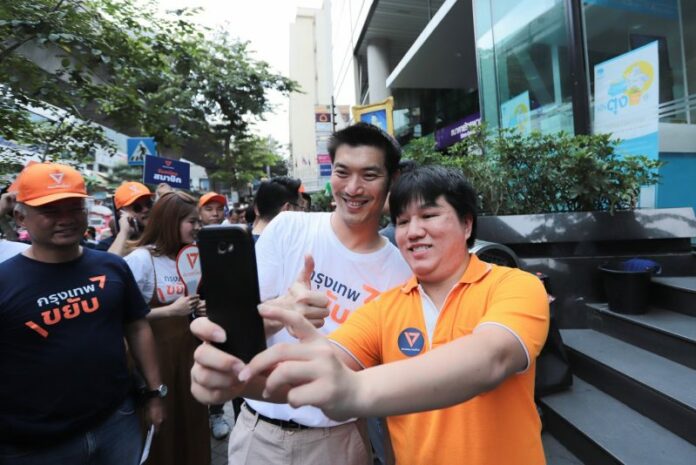
Photo: Future Forward Party / Facebook

BANGKOK — Don’t expect to shop online for T-shirts, tote bags and umbrellas promoting your favorite political party anytime soon.

The Election Commission on Wednesday banned online sales of political party merchandising, halting one party’s idea of selling goods over the internet.

Future Forward Party spokeswoman Pannika Wanich said the party had requested a judgment from the commission in writing to its idea. The negative ruling means it won’t create online stores for party-branded wares. Pannika said sales of goods at from its offices have generated just short of 2 million baht so far.

The commission’s stated rationale was that although election rules do not explicitly forbid online sales, they do not explicitly allow it either.

Advertisement

Junta No. 2 Answers Election Question With Offer of Violence

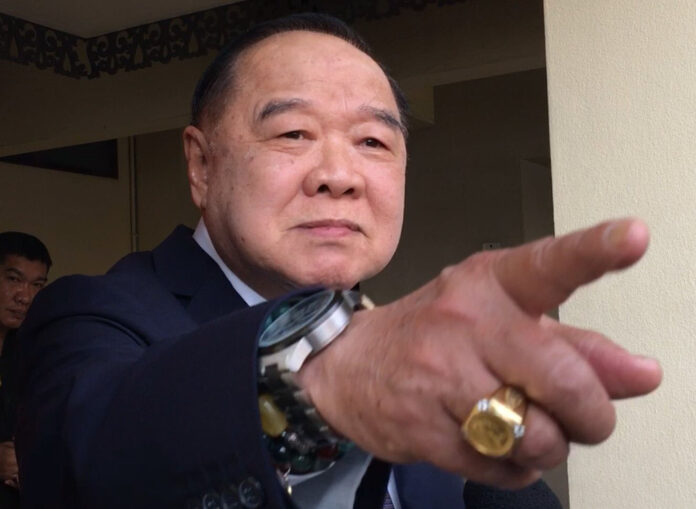
Gen. Prawit Wongsuwan points at a reporter on Nov. 15 at the Defense Ministry in Bangkok. Photo: Prachaya Nongnuch / Matichon
Gen. Prawit Wongsuwan points at a reporter on Nov. 15, 2018, at the Defense Ministry in Bangkok. Photo: Prachaya Nongnuch / Matichon

BANGKOK — Obviously incensed by questions whether oft-delayed elections would happen as planned in February, the deputy junta leader said he would answer such questions with his fists.

Gen. Prawit Wongsuwan, who is also defense minister and deputy prime minister, responded incredulously on Thursday to reporters’ questions about whether the junta would delay the elections now slated for Feb. 24. The 73-year-old retired general offered a noncommittal response that elections would happen according to the junta’s “roadmap” before responding angrily.

“If you’re going to talk like this, why don’t we just have a fistfight?” Prawit said, pointing his finger at the female reporter who posed the question.

Prawit said that any election-related matters should be put to the Election Commission.

“Why don’t you just ask and answer your own questions? Who am I to talk to about this?” Prawit said. “We are going according to the roadmap. The election commission already said the election is on Feb. 24.”

“Whoever wants to go draw Xs on a ballot that day, go ahead,” he said.

Prawit’s flash of belligerence and courting of violent language emulates that of his boss, junta leader Gen. Prayuth Chan-ocha. In July, Prayuth told a crowd in Ubon Ratchathani province that he would punch in the mouth anyone who criticized him.

Prawit was also asked about ousted ex-PM Thaksin Shinawatra, who is visiting Singapore at the height of an annual ASEAN summit and may be meeting some of his political allies in the Pheu Thai Party. His visit coincides with that of his political archrival, junta leader Gen. Prayuth, who is attending the summit.

“They probably won’t run into each other. One person is there to work, another is there for leisure,” Prawit said.

He added that he “didn’t know” if Pheu Thai party members traveling to meet Thaksin could be regarded as campaigning, which is still banned by the junta.

Reporters also asked about the relative popularity of Pheu Thai versus members of the pro-junta Palang Pracharat Party.

“People are preferring Uncle Tuu,” he said, referring to Prayuth’s nickname.

Related stories:

Prayuth: Election Coming in 2019 – Unless ‘Fight Breaks Out’

‘Tormented’ Prayuth Ready to Punch Critics In the Mouth

Prayuth Jokes About Beheading Soap Actor

Prayuth ‘Regrets’ Yelling at Pattani Fisherman

Thai Press Groups Respond to Junta’s Execution Threats with Mild Rebukes

Prayuth Promises To Be Less Angry, More Polite With Press

Advertisement

Pheu Thai Splintering to Win in 2019: Jatuporn

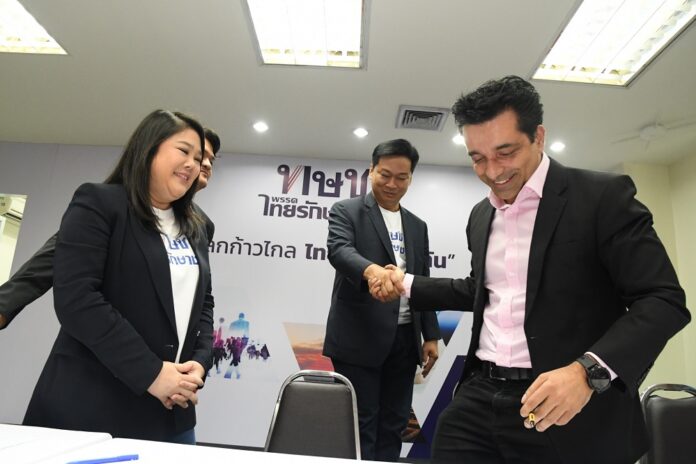
Former Bangkok Post editor Umesh Pandey, right, signs up with Thai Raksa Chart Party on Wednesday.

BANGKOK — Not one but four Pheu Thai parties will run in the upcoming election, an arrangement the group’s leader says is the only way to victory.

With politicians shuffling between Pheu Thai clones on a daily basis, Redshirt leader Jatuporn Prompan told reporters the junta-sponsored constitution favors a group of smaller parties to larger ones. He compared the strategy to breaking a large banknote into smaller bills.

Read: Pheu Thai, Allies Could Be Disbanded, Election Official Warns

“It’s the way the new constitution was designed,” Jatuporn said. “If we don’t break this 1,000 baht bill, the note will be worth only 700 baht. But if we do, it will be worth 1,500 baht.”

At least four parties are known proxies for Pheu Thai, a political powerhouse loyal to former leader Thaksin Shinawatra, who is living in self-imposed exile. They include Pheu Tham, Pheu Chart and Thai Raksa Chart.

Another southern-based party, Prachachart, is also recognized as a close ally.

Pheu Thai cadets have acknowledged them as spare parties for their supporters, and longtime pro-Thaksin politicos have registered with these proxies in recent weeks.

Former deputy House Speaker Lalita Lerksamran signed up with Pheu Chart. Khattiya Sawasdipol, the daughter of a rogue general assassinated during the 2010 Redshirt protests, switched from Pheu Thai to Thai Raksa Chart. Former Pheu Thai MP Pichai Naripthaphan is also reported to have moved to Thai Raksa Chart.

The party was also joined by former Bangkok Post editor Umesh Pandey, who quit the paper in May to protest alleged censorship.

Experts believe major parties like Pheu Thai and Democrats stand to lose seats in the upcoming poll thanks to recent gerrymandering efforts under the current junta. Pheu Thai is set to be the biggest loser: about 60 seats could be gone. Up to 48 seats would be up for grabs by smaller, new parties, according to a calculation by BBC Thai.

Even Pheu Thai archnemesis Suthep Thaugsuban suggested the tactic could work.

“I have already warned that Thaksin Shinawatra will adopt the strategy of breaking 1,000 baht bill into 100 baht bills,” Suthep, who’s been campaigning for a pro-junta party, told reporters Saturday. “This cannot be underestimated.”

Suthep predicted that, if the tactic plays out in the way Thaksin hopes for, Pheu Thai and its proxies could secure at least 300 seats in the lower House, granting them the ability to form a government.

Jatuporn declined to say which Pheu Thai allied parties he and other Redshirt leaders would join as MP candidates.

“I don’t know about details. Mostly when I talk to them, I ask about their lives,” Jatuporn said.

Related stories:

Election Rules Bent Against the Poor: Grassroots Parties

Analysis: Why Pheu Thai Made Its Unglamorous Pick For Leader

Advertisement

K-Pop Band’s Agency Apologizes Over Member’s A-Bomb Shirt

FILE- In this Sept. 24, 2018, file photo, members of the Korean K-Pop group BTS attend a meeting at the United Nations high level event regarding youth during the 73rd session of the United Nations General Assembly at U.N. headquarters. Photo: Craig Ruttle / Associated Press

SEOUL — The agency for K-pop superstars BTS apologized Wednesday for members wearing a T-shirt depicting the explosion of an atomic bomb and a hat with a Nazi emblem.

Japanese TV broadcasters recently canceled or stopped discussions on appearances in that country after images went viral of the musician wearing the shirt. The South Korean boy band ran into more troubles after news broke out that another member wore a hat featuring a Nazi symbol in a magazine photo book and band members flew flags with what appeared to be the Nazi swastika during a concert in the past.

“We would like to again offer our sincerest apologies to anyone who has suffered pain, distress and discomfort due to our shortcomings and oversight in ensuring that these matters receive our most careful attention,” the band’s agency, the Big Hit Entertainment, said in a statement.

The T-shirt portrayed an atomic bombing juxtaposed with the celebration of Korea’s 1945 liberation from Japan at the end of the World War II. The United States dropped atomic bombs on the Japanese cities of Hiroshima and Nagasaki before Tokyo’s surrender.

Before its division into North and South Korea after the liberation, the Korean Peninsula was colonized by Japan from 1910-1945. Many in both Koreas still harbor strong resentment against the Japanese colonial masters. But in South Korea, it’s extremely rare for anyone to publicly celebrate or mock the atomic bombings. The atomic bombings killed more than 200,000 people in Japan. A South Korean government estimate says about 40,000 of the dead were Koreans, while a victims’ group put the Korean death toll at 50,000, many forcefully mobilized as laborers by Japan.

South Korean politicians criticized the Japanese broadcasters’ decisions to cancel BTS appearances, accusing Japan of harboring “self-centered views on history” and letting politics interfere with cultural exchanges.

It doesn’t appear the T-shirt controversy is seriously affecting the band’s huge popularity in Japan, with 50,000 people reportedly filling up the Tokyo Dome to watch their performance Wednesday evening after a similar reception on Tuesday.

The BTS agency said the A-bomb shirt’s wearing was “in no way intentional” and that it wasn’t designed to “injure or make light of those affected by the use of atomic weapons.” It said it still apologizes for “failing to take the precautions that could have prevented the wearing of such clothing by our artist.”

Regarding the hat furor, it said all apparel and accessories used for the photo book were provided by a media company involved in its publication. It said the flags in question were aimed at symbolizing South Korea’s restrictively uniform and authoritarian educational systems, not the Nazism.

“We will carefully examine and review not only these issues but all activities involving Big Hit and our artists based on a firm understanding of diverse social, historical and cultural considerations to ensure that we never cause any injury, pain or distress to anyone,” the agency statement said.

The seven members of the band, which has a worldwide following, in May became the first South Korean artists to top the Billboard 200 albums chart with “Love Yourself: Tear.” The band began its Japan tour earlier this week.

South Korean K-pop and movie stars are extremely popular in Japan and other Asian countries.

Story: Hyung-Jin Kim

Advertisement

US Veep Says US Committed to Indo-Pacific Cooperation, Not Control

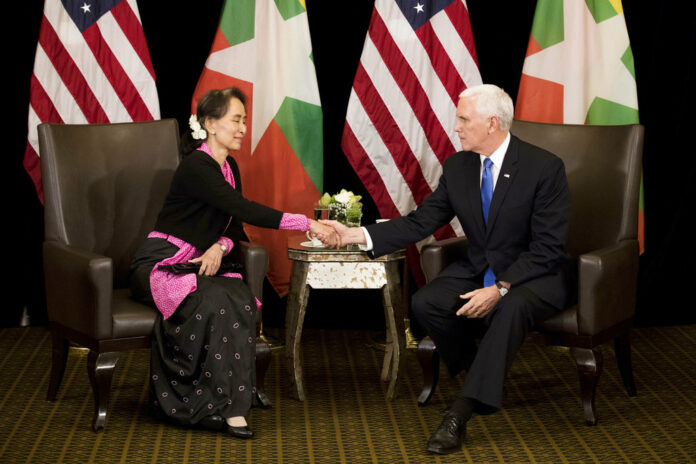
U.S. Vice President Mike Pence, at right, meets Myanmar leader Aung San Suu Kyi on Wednesday in Singapore. Photo: Bernat Armangue / Pool

SINGAPORE — America has a steadfast and enduring commitment to the Indo-Pacific region but wants cooperation, not control, U.S. Vice President Mike Pence said Thursday in comments to a Southeast Asian summit that carried a veiled swipe at China’s growing influence.

Pence, standing in for President Donald Trump at the 10-nation summit of the Association of Southeast Asian Nations in Singapore and another later in the week in Papua New Guinea, told his fellow leaders that “empire and aggression have no place” in the region.

He said U.S. support includes work to counter terrorism and pressure North Korea to give up its nuclear weapons and a commitment “to uphold the freedom of the seas and skies where we stand shoulder to shoulder with you for freedom of navigation, and our determination to ensure that your nations are secure in your sovereign borders on land, at sea, and in the digital world.”

“Like you, we seek an Indo-Pacific in which all nations, large and small, can prosper and thrive – secure in our sovereignty, confident in our values, and growing stronger together,” Pence said.

The ASEAN meetings focus on enhanced trade and security in a region of more than 630 million people.

While in Singapore, Chinese Premier Li Keqiang has sought to reassure China’s neighbors over its expanding reach, both economic and military, across the region.

Managing conflict in the South China Sea is a perennial concern. China is pitted against its smaller neighbors in multiple disputes in the sea over coral reefs and lagoons in waters crucial for global commerce and rich in fish and potential oil and gas reserves.

The region is a potential flashpoint, and a huge concern for the U.S. and other countries that rely on the right of passage for shipping.

Philippine President Rodrigo Duterte, who has sought to ease tensions with China over his country’s claims to disputed waters, said Thursday that it was crucial that the countries involved finish work on a “code of conduct” to help prevent misunderstandings that could lead to conflict.

“China is there. That is the reality,” he told reporters before joining the morning’s meetings. “Strong military activity will prompt a response from China. I do not mind everybody going to war, but except that the Philippines is just beside those islands. If there is shooting there my country will be the first to suffer.”

Pence alluded to Chinese concerns that the U.S. is seeking to contain its influence by saying, “Our vision for the Indo-Pacific excludes no nation.”

However, he added, “It only requires that every nation treat their neighbors with respect, they respect the sovereignty of our nations and the international rules of order.”

In contrast with Trump’s preference for bilateral dealings and distrust of international institutions, the meetings in Singapore have championed a commitment to free trade and a multilateral approach to coping with myriad issues, from cybercrime and terrorism to maritime security and e-commerce.

Trump withdrew from a Pacific Rim trade initiative, the Trans-Pacific Partnership, just after taking office last year. That trade pact is due to take effect on Dec. 30.

The U.S. also is not part of another, Southeast Asian centered grouping of 16 countries called the Regional Comprehensive Economic Partnership, which does include China, India, Australia and most other Asian economies.

On Wednesday, the leaders pushed back a final agreement on that 16-nation free trade deal until 2019. If realized, that arrangement will create the world’s biggest trading bloc with 40 percent of world trade and 30 percent of global economic activity.

The trade talks followed scores of bilateral meetings among the leaders and talks on other issues such as regional security, how to keep peace in the South China Sea and the crisis over hundreds of thousands of ethnic Rohingya Muslims who have fled to Bangladesh to escape violence in Myanmar.

The ASEAN members are Brunei, Cambodia, Indonesia, Laos, Malaysia, Myanmar, the Philippines, Singapore, Thailand and Vietnam. Its annual summit includes meetings with various other nations and a slew of bilateral meetings among the leaders.

While the Singapore meetings were typically focused on cooperation and goodwill, concerns over Myanmar’s treatment of its ethnic Rohingya Muslims flared with unusually sharp comments to the country’s leader, Nobel Peace Prize laureate Aung San Suu Kyi.

Advertisement

Woman Wears Wedding Gown Alone After Fiance Dies on Lion Air

In this photo taken on Sunday, Nov. 11, 2018, and released by Intan Syari, Indonesian Intan Syari poses in her wedding dress with a bouquet of flowers on the day of her planned wedding in Pangkal Pinang, Indonesia. Photo: Associated Press

JAKARTA — An Indonesian woman whose fiance died on a Lion Air flight that plunged into the sea was photographed in her wedding dress and professed her love for him on the day they were to have been married.

Intan Syari’s fiance, Dr. Rio Nanda Pratama, was among 189 people who were killed when the Boeing 737 crashed Oct. 29 shortly after taking off from Jakarta.

Syari and Pratama, both 26, had planned to get married Sunday. Pratama, who had attended a seminar in Jakarta, was on his way home to Pangkal Pinang for the wedding.

Syari said Pratama had joked before leaving that if he was late in returning, Syari should take photos in her wedding gown and send them to him.

“We were just joking at that time,” Syari told The Associated Press on Wednesday. “He asked me to still wear my wedding gown that he chose for me on our wedding day, put on beautiful makeup and hold a white rose bouquet, take good photos and send them to him.”

She said Pratama was her “first love” and they started dating 13 years ago.

On Sunday, she went ahead and took photos in the white wedding gown with a white satin head covering and a white rose bouquet in her hand, surrounded by relatives and friends.

“Although I actually feel grief that I cannot describe, I have to smile for you,” Syari wrote on Instagram. “I should not be sad, I have to stay strong as you always say to me, I love you, Rio Nanda Pratama.”

Investigators say sensors that help prevent planes from stalling were replaced on the Lion Air plane the day before its fatal flight and may have compounded other problems with the aircraft.

Body parts are still being recovered and searchers are continuing to hunt for the cockpit voice recorder.

Lion Air is one of Indonesia’s youngest airlines but has grown rapidly, flying to dozens of domestic and international destinations.

Advertisement

Red Cross Says Conditions Not Right for Rohingyas to Return

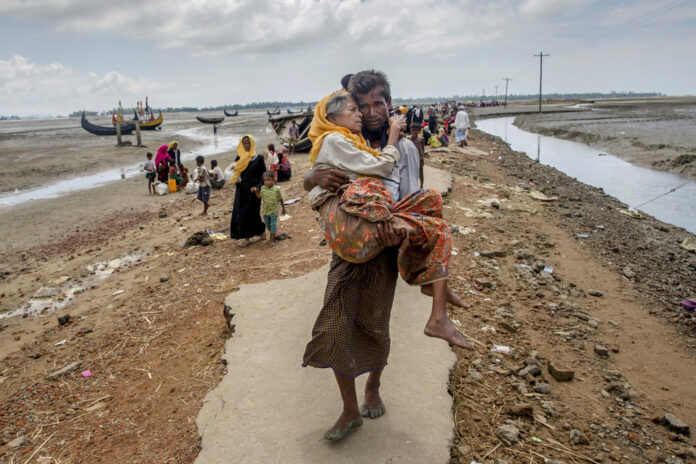
FILE - In this Sept. 16, 2017, file photo, Abdul Kareem, a Rohingya Muslim man, carries his mother, Alima Khatoon, to a refugee camp after crossing over from Myanmar into Bangladesh, at Teknaf, Bangladesh. Photo: Dar Yasin / Associated Press

UNITED NATIONS — The International Committee of the Red Cross says conditions are not right for Rohingya Muslim refugees to return safely to Myanmar from Bangladesh, where over 700,000 have sought refuge since August 2017 following a military crackdown.

Robert Mardini is the organization’s U.N. observer. He told reporters Wednesday that the conflict between the Rohingya and Myanmar’s government is not resolved and added that there is no place to go back to because “so many villages” are flattened in Myanmar’s Rakhine state, where the Rohingya live.

Mardini said that “we still believe that the conditions are not right for voluntary, safe, dignified returns.”

The International Committee of the Red Cross is one of the very few humanitarian organizations operating in Rakhine.

Advertisement

Verdicts on Khmer Rouge Leaders May Be Tribunal’s Last Gasp

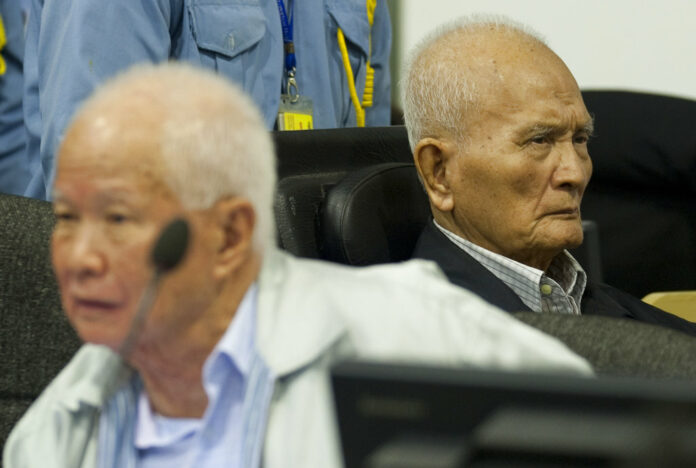
Khieu Samphan, at left, former Khmer Rouge head of state, and Nuon Chea, at right, who was the Khmer Rouge's chief ideologist and No. 2 leader, sit in the court hall at the U.N.-backed war crimes tribunal in Phnom Penh in an October 2013 file photo released by the Extraordinary Chambers in the Courts of Cambodia. Photo: Mark Peters / Extraordinary Chambers in the Courts of Cambodia via AP

PHNOM PENH — The tribunal judging the criminal responsibility of former Khmer Rouge leaders for the deaths of an estimated 1.7 million Cambodians will issue verdicts Friday in the latest — and perhaps last — of such trials.

Nuon Chea, 92, and Khieu Samphan, 87, are the last two surviving senior leaders of the radical communist group that brutally ruled Cambodia in the late 1970s.

They are already serving life sentences after being convicted in a previous 2011-2014 trial of crimes against humanity connected with forced transfers and disappearances of masses of people.

The proceedings against them were split into two successive trials for fear that the aging defendants might die before any verdict was reached in a single, more comprehensive trial and foreclose the opportunity for any sort of justice. The fear was justified — two co-defendants died before the trial was completed.

On Friday, Nuon Chea and Khieu Samphan will be judged on additional charges of crimes against humanity, such as murder, extermination, enslavement, torture and persecution on political, racial, and religious grounds; genocide, for the killings of members of the Vietnamese and Cham ethnic groups; and more breaches of the Geneva Conventions, including willful killing, torture or inhumane treatment.

As members of the Khmer Rouge leadership under the late Pol Pot, they have been prosecuted under the legal doctrine of joint criminal enterprise, which holds individuals responsible for actions attributed to a group to which they belong.

Cases launched against four additional, middle-ranking Khmer Rouge officials have been scuttled or frozen and are unlikely to be revived.

If the current trial is the last staged by the U.N.-assisted international tribunal — officially called the Extraordinary Chambers in the Courts of Cambodia — it will have convicted three individuals at a cost of more than $300 million.

The Khmer Rouge seized power in 1975 after a bloody five-year civil war. They immediately attempted a radical transformation of Cambodia into a peasant society, emptying cities and forcing the population to work the land.

They backed up their rule with ruthless elimination of perceived enemies, and were driven from power in early 1979 by an invasion from neighboring Vietnam, which had suffered border attacks from Khmer Rouge forces.

Although atrocities were carried out on a massive scale, political realities — specifically the repeated demands by Cambodian Prime Minister Hun Sen that no more suspects be prosecuted — appear to preclude further cases being pursued by the tribunal. Hun Sen insists that further prosecutions could cause unrest.

In addition to Nuon Chea and Khieu Samphan, the tribunal can lay claim to only one other prosecution, resulting in the 2010 conviction of Kaing Guek Eav, alias Duch, who as head of the Khmer Rouge prison system ran the infamous Tuol Sleng torture center in Phnom Penh.

Hun Sen himself was a midlevel Khmer Rouge commander before defecting while the group was still in power, and several senior members of his ruling Cambodian People’s Party share similar backgrounds. He helped cement his political control by making alliances with other former Khmer Rouge commanders.

The ground rules under which the tribunal was established in 2005 are complicated, providing for hybrid courts pairing Cambodian judges and prosecutors with international counterparts.

Cambodian court officials, known for their loyalty to Hun Sen’s government, are in a position to base their judgments on the tribunal’s inexact guidelines limiting prosecutions to senior leaders or persons considered “most responsible” for atrocities, or simply cease cooperation.

Although Nuon Chea had an especially low profile in the already secretive group, his importance can be gauged by his nom de guerre of “Brother Number Two,” reflecting his position as Pol Pot’s right-hand man.

According to a 2001 study by Cambodia scholar Stephen Heder and legal expert Brian D. Tittemore, there was “substantial and compelling evidence” that Nuon Chea devised and implemented the Khmer Rouge’s execution policies.

Khieu Samphan had at one point been the smiling, polite figurehead who nominally was the head of state in the Khmer Rouge regime. He was able to trade on his reputation as an honest left-wing academic and lawmaker in 1960s Cambodia before repression drove him underground and into the jungle with the then-nascent Khmer Rouge movement.

The Heder and Tittemore study acknowledged that evidence against Khieu Samphan was not as extensive as against Nuon Chea and others, but nevertheless suggested he “encouraged lower level (Khmer Rouge) officials to perpetrate executions and, at least in some instances, monitored and contributed to the implementation of Party policies by regional authorities.”

Heder, who for a time was an investigator for the tribunal, charged in a 1990 paper that Khieu Samphan was promoted up the ranks of the Khmer Rouge “because he remained steadfastly loyal to his leadership and policies while others who had earlier cooperated with Pol Pot and his Communist Party were detained or killed because they disagreed with or were suspected of disagreeing with what Pol Pot was doing.”

“Khieu Samphan’s political star rose literally on heaps of corpses,” Heder wrote.

Confronted in court with such charges, Nuon Chea and Khieu Samphan showed little remorse. Khieu Samphan denied knowing about matters including forced marriages and violent oppression of minorities, and both men mounted political defenses.

Khieu Samphan described the claim of genocide as “Vietnamese propaganda,” a defense he and other former Khmer Rouge leaders have made previously.

Cambodians have long been suspicious of Vietnam, their much bigger eastern neighbor, and prejudice against Vietnamese is widespread.

Khieu Samphan also cast blame on the United States for Cambodia’s problems. The U.S. heavily bombed the Cambodian countryside during the 1970-75 civil war that led to the Khmer Rouge’s seizure of power.

“I want to bow to the memory of all the innocent victims but also to all those who perished by believing in a better ideal of the brighter future and who died during the five-year war under the American bombardments and (in) the conflict with the Vietnamese invaders,” Khieu Samphan said. “Their memory will never be honored by any international tribunal.”

Story: Sopheng Cheang, Grant Peck

Advertisement

Hot News

LATEST NEWS

Bangkok
overcast clouds
28 ° C
28.3 °
24.4 °
84 %
4.5kmh
100 %
Sat
28 °
Sun
35 °
Mon
36 °
Tue
28 °
Wed
30 °