Trader Kevin Walsh, right, works in 2017 on the floor of the New York Stock Exchange. Photo: Richard Drew / Associated Press
SINGAPORE — Asian markets clocked more gains Tuesday ahead of a meeting between the U.S. and China at the Group of 20 summit this week, despite President Donald Trump’s comments that it’s “highly unlikely” he’ll hold off on raising tariffs as Beijing requested.
Keeping Score
Thailand’s SET was trading at 1,634.19 on Tuesday morning, a 0.2 percent increase. Japan’s benchmark Nikkei 225 added 0.1 percent to 21,843.37 and South Korea’s Kospi rose 0.4 percent to 2,090.35. The Shanghai Composite was up 0.3 percent at 2,582.72. Australia’s S&P/ASX 200 gained 0.6 percent to 5,702.70. Hong Kong’s Hang Seng index bucked the trend, giving up 0.4 percent to 26,269.33. Shares rose in Malaysia but fell in Taiwan, Singapore and Indonesia.
Wall Street
Technology and retail companies led a recovery of U.S. stocks, which suffered big losses last week. Monday marked the first full trading day of the holiday shopping season. Amazon surged 5 percent and Nike gained 1.7 percent. The S&P 500 index closed 1.6 percent higher at 2,673.45. The Dow Jones Industrial Average rose 1.5 percent to 24,640.24 and the Nasdaq composite jumped 2.1 percent to 7,081.85. The Russell 2000 index of smaller-company stocks added 1.2 percent to 1,505.96.
Trump on Tariffs
In an interview with the Wall Street Journal, Trump said it is “highly unlikely” he’ll reverse plans to raise tariffs on USD$200 billion of Chinese goods in January. He also threatened to impose tariffs on more Chinese goods if he fails to broker a deal with Chinese President Xi Jinping this week. The two leaders are set to meet on the sidelines of G-20 summit in Argentina, which takes place on Friday and Saturday. Trump also said that the new tariffs would “maybe” apply to iPhones and laptops imported from China. Apple slumped 2.1 percent to $170.93 in after-hours trading, erasing its gains in the U.S. session.
Analyst’s Take
The rebound in U.S. equities “is set to be tested as Trump has resumed his confrontational approach ahead of G-20 meeting with Xi,” Zhu Huani of Mizuho Bank said in a market commentary. “This has sent a cautious mood to the market as a grim reminder that hurdle remains high in the forthcoming Trump-Xi trade talk,” she added.
Energy
Oil futures fell on concerns over rising stockpiles and slowing economic growth. OPEC representatives and other major oil producers will meet in Vienna next week to discuss a possible cut in production. Benchmark U.S. crude shed 33 cents to $51.30. The contract added $1.21 to close at $51.63 in New York on Monday. Brent crude, the international standard, lost 21 cents to $60.27. It gained $1.68 to $60.48 in London.
Currencies
The dollar weakened to 113.45 yen from 113.59 yen late Monday. The euro rose to $1.1335 from $1.1327.
People in 2017 march through Minneapolis, Minnesota to protest the inauguration of Republican President Donald Trump. Photo: Fibonacci Blue / Wikimedia Commons
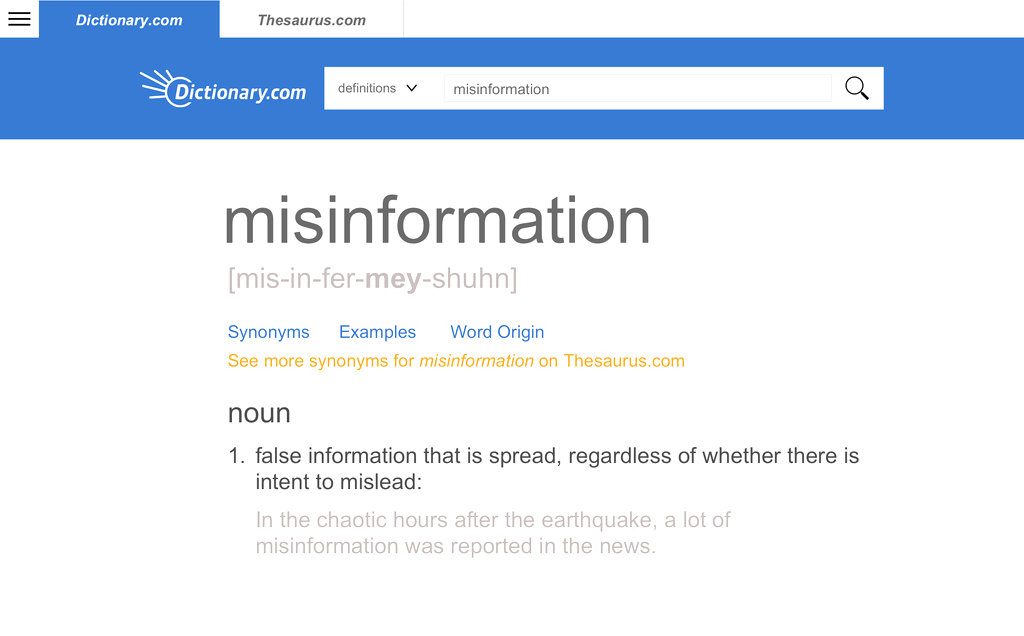
NEW YORK — Misinformation, as opposed to disinformation, was chosen Monday as Dictionary.com’s word of the year on the tattered coattails of “toxic,” picked earlier this month for the same honor by Oxford Dictionaries in these tumultuous times.
Jane Solomon, a linguist-in-residence at Dictionary, said in a recent interview that her site’s choice of “mis” over “dis” was deliberate, intended to serve as a “call to action” to be vigilant in the battle against fake news, flat earthers and anti-vaxxers, among other conduits.
It’s the idea of intent, whether to inadvertently mislead or to do it on purpose, that the Oakland, California-based company wanted to highlight. The company decided it would go high when others have spent much of 2018 going low.
“The rampant spread of misinformation is really providing new challenges for navigating life in 2018,” Solomon told The Associated Press ahead of the word of the year announcement. “Misinformation has been around for a long time, but over the last decade or so the rise of social media has really, really changed how information is shared. We believe that understanding the concept of misinformation is vital to identifying misinformation as we encounter it in the wild, and that could ultimately help curb its impact.”
In studying lookups on the site that trended this year, Dictionary noticed “our relationship with truth is something that came up again and again,” she said.
For example, the word “mainstream” popped up a lot, spiking in January as the term “mainstream media,” or MSM, grew to gargantuan proportions, wielded as an insult by some on the political right. Other words swirling around the same problem included a lookup surge in February for “white lie” after Hope Hicks, then White House communications director, admitted to telling a few for President Donald Trump.
This screen image released by Dictionary.com shows an entry for the word misinformation, which Dictionary.com announced as its 2018 Word of the Year. Image: Dictionary.com
The word “Orwellian” surfaced in heavy lookups in May, after a statement attributed to White House press secretary Sarah Huckabee Sanders accused the Chinese government of “Orwellian nonsense” in trying to impose its views on American citizens and private companies when it declared that United Airlines, American Airlines and other foreign carriers should refer to Taiwan, Hong Kong and Macau as part of China in public-facing materials, such as their websites.
Misinformation, Solomon said, “frames what we’ve all been through in the last 12 months.” In that vein, the site with 90 million monthly users has busied itself adding new word entries for “filter bubble,” ”fake news,” ”post-fact,” ”post-truth” and “homophily,” among others. Other word entries on the site have been freshened to reflect timely new meanings, including “echo chamber.”
The company’s runners-up for the top honor include “representation,” driven by the popularity of the movies “Black Panther” and “Crazy Rich Asians,” along with wins during the U.S. midterm elections for Muslim women, Native Americans and LGBTQ candidates.
But the rise of misinformation, Solomon said, stretches well beyond U.S. borders and Facebook’s role in disseminating fake news and propaganda in the Cambridge Analytica scandal. The use of Facebook and other social media to incite violence and conflict was documented around the globe in 2018, she said.
“Hate speech and rumors posted to Facebook facilitated violence against Rohingya Muslims in Myanmar, riots started in Sri Lanka after false news set the country’s Buddhist majority against Muslims, and false rumors about child kidnappers on WhatsApp led to mob violence in India,” Solomon said.
Is disinformation or misinformation at play in terms of the year’s most prominent conspiracy theories? Solomon noted proliferation on social media over students in the Parkland school shooting being crisis actors instead of victims of violence, and over a group of migrants from Honduras who are making their way north being funded by “rich liberals.”
Elsewhere in the culture, countless podcasts and videos have spread the absurd notion of a global cover-up that the Earth is flat rather than round. The idea of “misinfodemics” has surfaced in the last several years to identify the anti-vaccination movement and other beliefs that lead to real-world health crises, Solomon said.
There are distinctions between misinformation and disinformation to be emphasized.
“Disinformation would have also been a really, really interesting word of the year this year, but our choice of misinformation was very intentional,” she said. “Disinformation is a word that kind of looks externally to examine the behavior of others. It’s sort of like pointing at behavior and saying, ‘THIS is disinformation.’ With misinformation, there is still some of that pointing, but also it can look more internally to help us evaluate our own behavior, which is really, really important in the fight against misinformation. It’s a word of self-reflection, and in that it can be a call to action. You can still be a good person with no nefarious agenda and still spread misinformation.”
She pointed to “Poe’s law” in slicing and dicing “misinfo” and “disinfo.” The term, dating to 2005, has become an internet shorthand to sum up how easy it is to spread satire as truth online when an author’s intent isn’t clearly indicated.
The phrase is based on a comment one Nathan Poe posted on a Christian forum during a discussion over creationism, in which he commented: “Without a winking smiley or other blatant display of humor, it is uttrerly (sic) impossible to parody a Creationist in such a way that someone (italics used) won’t mistake for the genuine article.”
Dictionary.com chose “complicit” as last year’s word of the year. In 2016, it was “xenophobia.”
A Chinese national arrested over an alleged internet scam is escorted by police on his way to deportation at the immigration office in 2017 in Phnom Penh. Photo: Heng Sinith / Associated Press
PHNOM PENH — Police in Cambodia on Monday arrested more than 200 Chinese citizens accused of defrauding people in China over the internet.
Gen. Y Sok Khy, director of the Interior Ministry’s Department of Counter-Terrorism and Transnational Crime, said 36 women were among the 235 Chinese arrested in three different villages in Takeo province south of the capital, Phnom Penh.
Online scams by Chinese gangs that operate from foreign countries and target mainland Chinese are common throughout Southeast Asia and have been found as far away as Kenya and Spain. Cambodia has arrested and sent at least 1,000 Chinese and Taiwanese residents allegedly involved in such schemes to China since 2012.
The scams are carried out by making phone calls over the internet and employing deception, threats and blackmail against the victims. Placing phone calls over the internet makes communications costs cheap and hinders tracing of the source of the calls.
Y Sok Khy said the arrests followed months of surveillance and investigation. The suspects were sent to Phnom Penh for further questioning and will be deported to China, he said.
The arrests have caused controversy because suspects from Taiwan are usually deported directly to China in deference to Beijing, which views Taiwan as its own territory without sovereign legal status. Taiwan rejects China’s claim to its territory and wants its citizens returned there.
BANGKOK — CPN, the property and investment arm of Central Group, announced Tuesday it will open Bangkok’s first outlet stores near Suvarnabhumi International Airport next year.
CPN executive Wallaya Chirathivat said “Central Village” will feature 235 brands including Polo Ralph Lauren, Kenzo, Vivienne Westwood, CK Jeans and Adidas when it opens in August. It will be about 10 minutes by car from the airport with shuttle bus services planned from both the airport and the downtown CentralWorld mall.
The company said it will spend 5 billion baht to build the 40,000sqm on 100 rai (16 hectares) of land. In a release, the company said it will be designed in contemporary Thai style with ample outdoor space, a children’s playground, restaurants and a hotel. The operators expect 17,000 visitors daily for six million annually.
Boonsri Saengyoktrakarn and Rattanachat Saengyoktrakarn hold up photos of people parking illegally in front of their house.
BANGKOK — A court on Monday slapped a 5,000 baht fine on the shopper who blocked a driveway in east Bangkok with her truck, prompting a colorful reprisal.
Rotchanikorn Lertwassana was found guilty of causing a public nuisance to the Saengyotrakarn family, who responded to the illegally parked vehicle by smashing it with an axe and makeshift weapons, footage of which launched them to internet fame this past February.
Apart from the fine, Rotchanikorn was originally sentenced to 15 days in prison, but the court reduced it to a year of probation because she had no previous convictions.
Rotchanikorn told the media at the time that she parked her Nissan there and went shopping at one of five illegal markets that operated around the Saengyotrakarns’ mansion.
A promotional model became the latest new member to join the pro-junta Palang Pracharat Party on Monday. Noppawan Huajaiman, 33, said she has been what in Thai is called a pretty for 10 years and would like to represent their interests in politics. She arrived flanked by fellow models who said they were there to offer moral support.
If the election is held on Feb. 24 as planned, today was the last day to join a political party. Palang Pracharat has been attracting a wide range of celebrities – including former football team manager Watanya “Madam Dear” Wongopasi – as well as key Pheu Thai Party politicians. Pheu Thai accuses it of using money or pressure to convince them to join.
Boonlert Kanpakdee holds 100,000 baht with attorney Songkran Atchariyasap, at right, Monday at Khan Na Yao Police Station.
BANGKOK — A small town official came to the capital Monday to complain about selling a buffalo to a poor farmer whose friendship with the animal made them an internet sensation.
Accompanied by a gadfly ultra-conservative lawyer, an angry Boonlert Kanpakdee went to police in Bangkok’s Khan Na Yao today to complain that he hadn’t meant to sell Tongkum the buffalo and never expected Surat Phaeoket to actually come up with his 100,000 baht asking price.
With the help of donors smitten by their interspecies friendship, Surat on Thursday took possession of Tongkum after handing the money over to Boonlert, a subdistrict chief in Chai Nat province for whom he had been buffalo-sitting.
Boonlert today said he did not like that the purchase was crowdfunded.
“I berated him to his face. How could you act like a beggar? I look bad, as the mayor,” Boonlert said to the media Monday.
With him was Songkran Atchariyasap, a lawyer previously in the news for his outrage over displays of sexuality. He also is the head and sole member of the Network Against Acts that Destroy Kingdom, Religion and Monarchy.
“He solicited funds through people who believed him. I also donated money,” said Songkran, who himself had donated 100 baht. “Soliciting money from citizens is like tricking them. He tricked all the media as well.”
They alleged without evidence Surat’s told people the buffalo was already sold to someone else. Surat denies making such a claim and says a number of media accounts inaccurately embellished his story.
Days after the deal was done, Surat said Boonlert’s just trying to go back on his word.
“[Boonlert] told me he would sell him to me. He’s just changing his mind now,” Surat said by phone Monday. “I did everything correctly with the best intentions.”
As for Tongkum, he said they shall not be parted.
“I just want to be with him forever,” Surat said.
Boonlert said he had no plans to file a criminal complaint against Surat.
Maj. Yuttasilp Plasarn of Khan Na Yao police said they would look into whether any laws had been broken.
Update March 21: Organizer BEC-Tero Entertainment announced that the concert has been canceled due to ‘circumstances beyond our control.’
BANGKOK — Thirty-five years after “West End Girls” became a club anthem, English synthpop veterans Neil Tennant and Chris Lowe, the original Pet Shop Boys, will play Bangkok in April.
Arguably the most successful surviving duo in British music history, Tennant and Lowe, now 64 and 59 respectively, are embarking on an Asia tour announced this morning which includes a Bangkok arena date.
Part of the Super Tour, the gig will take place April 4 at Impact Exhibition Hall 5. Tickets start at 2,700 baht and available online from 10am on Jan. 12.
The duo, formed in London in 1981, is best known for hits “West End Girls,” “It’s a Sin” and an acclaimed cover of “Always on My Mind.” They last played Bangkok in 2013 at Sonic Bang at Impact Arena.
A migrant woman on Sunday helps carry a handmade U.S. flag up the riverbank at the Mexico-U.S. border after getting past Mexican police at the Chaparral border crossing in Tijuana, Mexico. Photo: Ramon Espinosa / Associated Press
TIJUANA, Mexico — Mexico pledged to shore up security near its border with the United States and local authorities said that 39 migrants were arrested after a peaceful march devolved into chaos when U.S. agents fired tear gas into Mexico to stop some migrants who tried to breach the border.
Mexico’s Interior Ministry said Sunday it would immediately deport those who tried to “violently” enter the U.S. from Tijuana. Meanwhile, Tijuana’s municipal government said that more than three-dozen migrants were arrested for disturbing the peace and other charges stemming from the march and what followed.
The vast majority of the more than 5,000 Central American migrants camped out for more than a week at a sports complex in Tijuana returned to their makeshift shelter to line up for food and recuperate from an unsettling afternoon.
Lurbin Sarmiento, 26, of Copan, Honduras walked back to the sports complex with her 4-year-old daughter shaken from what had unfolded a short time earlier at the Tijuana River and U.S. border.
She had been at the bottom of the river — a concrete riverbed conveying a trickle of water — near the border with her daughter when U.S. agents fired tear gas.
“We ran, but the smoke always reached us and my daughter was choking,” Sarmiento said. She said she never would have gotten that close with her daughter if she thought there would be gas.
The gas reached hundreds of migrants protesting near the border after some of them attempted to get through the fencing and wire separating the two countries. American authorities shut down the nation’s busiest border crossing at San Ysidro for several hours at the end of the Thanksgiving weekend.
The situation devolved after the group began a peaceful march to appeal for the U.S. to speed processing of asylum claims for Central American migrants marooned in Tijuana.
Mexican police had kept them from walking over a bridge leading to the Mexican port of entry, but the migrants pushed past officers to walk across the Tijuana River below the bridge. More police carrying plastic riot shields were on the other side, but migrants walked along the river to an area where only an earthen levee and concertina wire separated them from U.S. Border Patrol agents.
Some saw an opportunity to breach the crossing.
A migrant on Sunday waves an Honduran flag along the railroad tracks at the Mexico-U.S. border in Tijuana, Mexico, as a group of migrants tries to reach the U.S. Photo: Rodrigo Abd / Associated Press
An Associated Press reporter saw U.S. agents shoot several rounds of tear gas after some migrants attempted to penetrate several points along the border. Mexico’s Milenio TV showed images of migrants climbing over fences and peeling back metal sheeting to enter.
Honduran Ana Zuniga, 23, also said she saw migrants opening a small hole in concertina wire at a gap on the Mexican side of a levee, at which point U.S. agents fired tear gas at them.
Children screamed and coughed. Fumes were carried by the wind toward people who were hundreds of feet away.
“We ran, but when you run the gas asphyxiates you more,” Zuniga told the AP while cradling her 3-year-old daughter Valery in her arms.
As the chaos unfolded, shoppers just yards away on the U.S. side streamed in and out of an outlet mall, which eventually closed.
Throughout the day, U.S. Customs and Border Protection helicopters flew overhead, while U.S. agents on foot watched beyond the wire fence in California. The Border Patrol office in San Diego said via Twitter that pedestrian crossings were suspended at the San Ysidro port of entry at both the East and West facilities. All northbound and southbound traffic was halted for several hours. Every day more than 100,000 people enter the U.S. there.
Homeland Security Secretary Kirstjen Nielsen said in a statement that U.S. authorities will continue to have a “robust” presence along the Southwest border and that they will prosecute anyone who damages federal property or violates U.S. sovereignty.
“DHS will not tolerate this type of lawlessness and will not hesitate to shut down ports of entry for security and public safety reasons,” she said.
More than 5,000 migrants have been camped in and around a sports complex in Tijuana after making their way through Mexico in recent weeks via caravan. Many hope to apply for asylum in the U.S., but agents at the San Ysidro entry point are processing fewer than 100 asylum petitions a day.
Irineo Mujica, who has accompanied the migrants for weeks as part of the aid group Pueblo Sin Fronteras, said the aim of Sunday’s march toward the U.S. border was to make the migrants’ plight more visible to the governments of Mexico and the U.S.
“We can’t have all these people here,” Mujica told The Associated Press.
Tijuana Mayor Juan Manuel Gastelum on Friday declared a humanitarian crisis in his border city of 1.6 million, which he says is struggling to accommodate the crush of migrants.
U.S. President Donald Trump took to Twitter Sunday to express his displeasure with the caravans in Mexico.
“Would be very SMART if Mexico would stop the Caravans long before they get to our Southern Border, or if originating countries would not let them form (it is a way they get certain people out of their country and dump in U.S. No longer),” he wrote.
Mexico’s Interior Ministry said Sunday the country has sent 11,000 Central Americans back to their countries of origin since Oct. 19, when the first caravan entered the country. It said that 1,906 of those who have returned were members of the recent caravans.
Mexico is on track to send a total of around 100,000 Central Americans back home by the end of this year.
Manit Inpim of Transportation for All on the MRT Purple Line in August 2016. Photo: Accessibility is Freedom / Courtesy
BANGKOK — Four years after they won a historic case against the BTS Skytrain, a network of commuters with disabilities said they will file a lawsuit Tuesday over inaccessibility on Bangkok’s MRT subway system.
Manit Inpim of Transportation for All said Monday that they are suing in the Administrative Court because the operator and related government agencies failed to accommodate people with disabilities on the new Purple Line extension despite being warned before construction began. The suit seeks punitive compensation.
“We worked with the public sector from the beginning. I went to observe every station with my wheelchair and made suggestions to all related departments,” he said. “There have been some improvements, but it’s still not enough.”
The Purple Line opened in 2016 after many delays. The activists said they had been trying to work with the city since then on needed improvements.
According to a copy of the suit shared by the group, there are not elevators at each of the 16 stations’ entrances, which are about 200 meters to 350 meters apart. Below them at ground level, sidewalks are not navigable for wheelchairs or those visually impaired, it states. It also alleges that some staircase chair lifts can’t be operated without staff assistance, and onboard wheelchair restraints are not sturdy enough.
The activists said in a statement they chose to file the lawsuit tomorrow to coincide with the first rally 23 years ago by Disabilities Thailand, whose calls for transportation accessibility, they said, have seen little accomplished despite some important legal wins.
“Although every government has policies to improve rights for people with disabilities, enforcement by related agencies is full of problems and obstructions,” the statement read. “The current government has been trying to accelerate the construction and modernization of public transport every day, although the same old problems have yet been resolved. It’s making them permanent, creating more inequality in society.”
The lawsuit demands 16.8 million baht in compensation for six plaintiffs, all representatives from different disabled right groups. It’s based on daily assessed damages per plaintiff since the extension opened in August 2016.
Lawyer Sonthipong Mongkolsawas said they’re considering a class-action lawsuit as the next step.
Manit said administrators should try to think of the bigger picture to understand the issue’s importance.
“This is actually an investment for everyone. We don’t know what will happen tomorrow. There’s a possibility for anyone to become disabled,” he said, adding that it would be much easier for the operator to have included such facilities from the beginning.
“Let’s look at the BTS for example. Fixing the stations later is very difficult, nearly impossible,” he said. “The funds spent on additional construction cost them three to four times more than the initial budget.”
He then expressed disappointment with progress four years after winning a landmark court victory that saw City Hall, which owns the system, ordered to make all skytrain stations accessible. The city dragged its feet and has delayed full compliance for years.
“When we won on the BTS, we hoped the government would be shaken and hurriedly solve the problem, but nothing happened,” he said. “The Transport Ministry also has a 20-year strategic plan that includes constructions of skytrains all over Bangkok and the country, but we have no confidence at all that those plans will be completely inclusive for people with disabilities.”
Manit said there has been no further development regarding the BTS case after City Hall in May approved funds for new elevators.