Activists last month protest on the Pathumwan Intersection skywalk to call for elections this year.
BANGKOK — A university student and a citizen journalist charged with violating the junta’s ban on political gatherings said the regime’s attempt to crush dissent by targeting a larger swath of activists would backfire.
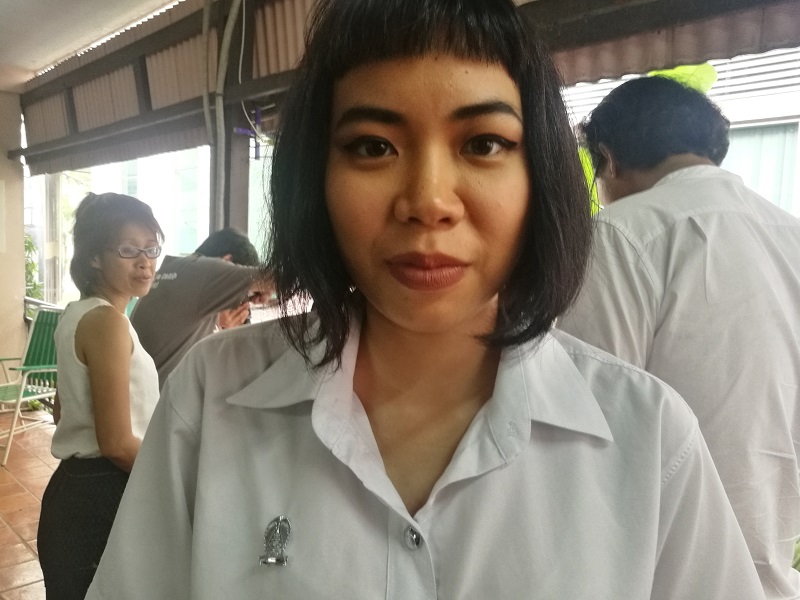
Chulalongkorn University student Aomtip Kerdplanant and citizen journalist Sa-nguan Khumrungroj – among 39 people charged for joining protests last month – said the junta’s move to go after many protesters and not just the leaders would motivate more people to come out in opposition.
“The junta’s attempt to stop us has led to gossip. It’s as if they are planting the seeds for students to become more interested in the political situation,” Aomtip said.
Aomtip Kerdplanant on Monday during a talk held by Media Inside Out.
Aomtip, a 21-year-old communication arts student, said the charges against students such as herself have alarmed fellow university students and led to greater discussion about repression by the military regime.
She said at a Monday talk organized by a free-press advocacy group that she did not expect to be charged for merely showing up Jan. 27 on the Pathumwan Intersection skywalk to call for elections this year.
“I didn’t do anything on that day, so I was quite surprised that they tried to take in as many people as possible,” said Aomtip, who was charged along with another three other university students.
The military government has said it will hold elections – on a timetable of its choosing.
On Sunday, junta spokesman Col. Winthai Suvaree lashed out at anti-government protesters, saying they were the “same faces” and in the minority.
“They are the same group, the same faces. The majority of people understand that these are people who have difficulty understanding things,” Winthai said.
Sa-nguan Khumrungroj on Monday during a talk held by Media Inside Out.
Sa-nguan, 60, said that while he does not support the junta, attending the protest to document it means he should not have been charged. He said he’s heard nothing from the Thai Journalists Association regarding the charges against him despite having contributed to national and international newspapers for four decades.
“The press must choose the right side. Whether we are protected or not is not important,” Sa-nguan said.
“Being a citizen journalist is at times dangerous. They will have suspicions about you first,” said Sa-nguan, who denied being a member of the opposition Redshirt movement.
BANGKOK — The Democrat Party said Monday it is taking a wait-and-see approach to news one of its former executives is planning to set up a pro-junta party to contest the next election.
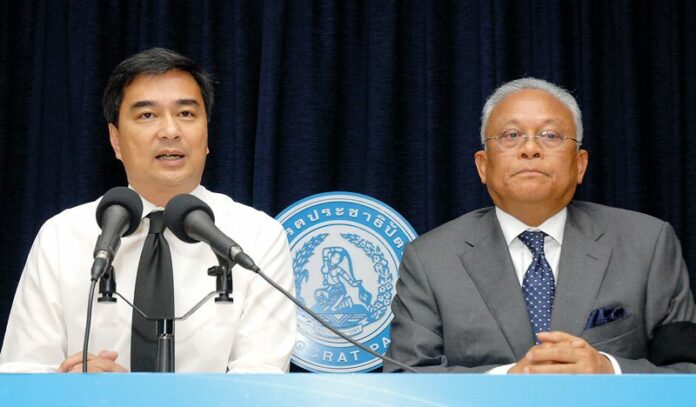
Just four days before registration opens for new parties, Democrat Party chairman Abhisit Vejjajiva and his aides said they have to see how Suthep Thaugsuban, whose role as a firebrand protest leader helped pave way for the 2014 coup, will act before they come up with a response.
This includes whether the Democrats will join with Suthep and vote for junta chairman Prayuth Chan-ocha to continue as prime minister, Abhisit said Monday.
“Ultimately it’s up to the election results and the party’s [decisions],” Abhisit said.
Suthep served as deputy prime minister under Abhisit from 2008 to 2011.
Suthep has reportedly been on the verge of announcing his political party for several days. It would see a fissure in the party he served more than 30 years as a member. Media reports have said other Democrats might defect to Suthep’s party, which will publicly support Gen. Prayuth’s bid to remain in power. Suthep “retired” from politics following the 2014 coup and receded from public view, only to return a year later to call for ongoing military rule.
Democrat spokesman Ramet Rattanachaweng said he had no comment as to how Suthep’s party would affect the election, which was slated to take place in November but now seems postponed to early 2019.
“I have to wait for him to set up a party first,” Ramet said Monday. “Let that day come first, and we’ll talk about it.”
Another key Democrat, Thepthai Senpong, has a similar response.
“I still can’t analyze anything. Let him set up the party first, then I’ll analyze it,” Thepthai said.
Former Democrat MP Nipit Intarasombat sounded more confident. While he acknowledged some Democrat MPs might defect to Suthep’s faction, he believes the majority will stay, especially in the south where the party – and Suthep – has its power base.
“I don’t know about other regions, but for the south, I asked them often. Everyone has expressed their intent to stay. They won’t go to any other party,” Nipit said. “I talk to them every two weeks!”
Political activities of all kind remains banned under the junta, including political party meetings and fundraising campaigns. Under those conditions, discussion of forging parties and alliances takes place out of public view.
Prayuth said Friday he wants to sit down with all political parties to discuss when the election should take place.
But observers will have a chance to see the fruit of whatever political intrigue has been at work on Friday, when those hoping to run in the next election are set to register their party names with the Election Commission.
Registration will start at 7:30am, and names will be granted on a first-come, first-served basis, acting Election Commissioner Somchai Srisutthiyakorn said Monday.
BANGKOK — Police and environment officials Tuesday denied an environment activist’s accusations they were protecting a powerful construction mogul accused of killing a black panther.
Police and officials investigating allegations that Italian-Thai Development CEO Premchai Karnasutra poached and ate a black panther in a wildlife sanctuary last month dismissed accusations that they are dragging their feet to shield him from prosecution.
“Not catch him? How is that possible? Of course we will issue a summons for him. We had him in custody and then he posted bail,” Col. Wuttipong Yenjit of Thong Pha Phum district said by phone Tuesday. “What are you finding issue with us for?”
The accusations were made online in a series of emotionally charged posts by Sasin Chalermlarp, president of the Seub Nakhasathien Foundation, an environmental protection foundation.
“If you really want to find a way to help those who did wrong by destroying society, what can we do to you?” Sasin wrote. “But let me ask you. Have you ever looked at the sky and the earth with full eyes like me? How do you sleep at night, does your conscience say anything? When you sit and poop, staring at the bathroom walls, do you feel ashamed? When you look at your parents, wife and kids, do you feel proud of yourself? I’m asking you. Answer me!”
A top environmental official said Sasin had an overactive imagination.
“Academics and NGOs are imagining things when they think the state is helping Premchai,” Environmental Minister Gen. Surasak Kanjanarat said Tuesday.
Surasak said that on Wednesday he will head a meeting with police and related authorities to update the case. “He has been charged with nine counts, but we will see after the meeting on the 28th whether he is liable for more.”
Premchai has ignored police summons to appear ever since he was released after being held briefly on Feb. 5. He was charged with poaching, trespassing and weapons-related charges.
Although the case has inflamed a public already frustrated by powerful figures placed above the law, the justice process has followed a seemingly predictable course of delays and excuses. Police have granted Premchai multiple extensions to appear without making any move to take him into custody.
Sasin, 49, is a respected environmental activist and academic, having led frequent protests against state initiatives such as new coal plant and dam projects.
On Sunday, he wrote that that there was enough evidence to prosecute Premchai: the salted black panther (actually a type of leopard), evidence it was used to make a black panther soup and a gnawed-upon leg bone discarded nearby, not to mention the hunting party’s possession of firearms and a recording in which Premchai can be heard trying to bribe forest rangers to let them go.
“How is this not enough? We’re just waiting on results of his poop,” Sasin wrote of a forensic examination of feces thought to have come from 63-year-old Premchai. “I think whatever happens, the prosecution will just aid Premchai for sure. At this point, he 1) should not be allowed bail 2) is a social and environmental hazard and 3) with this much evidence, if he gets away still, this government can’t pretend they’re not responsible.”
BANGKOK — Gear up for a melting pot of musical genres at one free music event next month in Bangkok.
As the creative force behind Los Angeles-based hip-hop collective Soulection, traveling DJ Andre Power is bringing his live set of everything from ‘90s uptempo throwbacks, soulful R&B, house-inspired jam, jazz and more to Future Factory Bangkok.
DJ K.A.D.E will open the night followed by music crew from Whvck.
Soulection Partywill run from 9pm to midnight on March 10. Future Factory is located in the basement of the Siamese Asset building on Phahonyothin Road between BTS Sanam Pao and BTS Ari.
Admission is free. But space is limited and entry must be registered registrationonline. Attendees must be over 20.
Power has performed at Coachella, South by Southwest (SXSW) and One Musicfest. He has shared stages with rapper Kendrick Lamar, Snoop Dogg, Jhene Aiko and more.
Update: Gambian officials apologized for their remark in a release dated Monday.
BANGKOK — The foreign affairs ministry on Monday handed a formal protest to the Gambian government after one of its minister reportedly suggested tourists looking for sex should go to Thailand.
Thai diplomats in Senegal, whose jurisdiction covers The Gambia, filed a letter expressing “displeasure” at the alleged remark made by Gambia’s tourism minister Hamat Bah, which went viral on Thai social media, foreign affairs spokeswoman Makawadee Sumitmor told reporters Monday.
A similar letter was sent to Gambia’s embassy in Malaysia, whose mission includes Thailand, Makawadee said.
The protest came two days after online news agency ETurboNews reported that Bah said Western sex tourists intent on traveling to the African nation should instead go to Thailand instead.
“We are not a sex destination. If you want a sex destination, you go to Thailand. The Gambia is not a sex destination,” the story quoted Bah.
Culture minister Veera Rojpojchanarat suggested sex tourism used to be prevalent but has since dropped because of the country’s focus on “morality.”
“Thailand has improved a lot in this issue,” Veera told reporters just before he attended a cabinet meeting Tuesday. “After the Ministry of Culture worked on promoting morality, this issue has improved a lot.”
But many on social media said Bah was just telling it like it is.
“If we weren’t hypocrites, everyone would know and understand,” Ad Lump wrote in a thread online. “Many foreigners come to Thailand each year to screw. If you don’t believe me, just find any clip. Type “thailand nightlife” “sex in Thailand,” “Pattaya night” into YouTube.”
U.S. Energy Secretary Rick Perry delivers a speech during the general conference of the International Atomic Energy Agency, IAEA, in September in Vienna, Austria. Photo: Ronald Zak / Associated Press
WASHINGTON — The Trump administration is opening talks with Saudi Arabia on a potentially lucrative atomic energy agreement that’s inextricably linked to an Obama-era nuclear deal with Iran. At stake: Billions of dollars in contracts for U.S. companies and bigger questions about America’s ability to keep friend and foe alike from reaching nuclear weapons capability.
Energy Secretary Rick Perry will lead an interagency U.S. delegation to talks with the Saudis in London on Friday, two administration officials and three outside advisers said. The meeting comes as the Arab powerhouse explores a civilian nuclear energy program, possibly without restrictions on uranium enrichment and reprocessing that would be required under a U.S. cooperation deal.
But there’s a catch: The Saudis have indicated they might accept such curbs if a separate nuclear deal with its arch-foe Iran is tightened, according to the officials, who spoke on condition of anonymity because they weren’t authorized to speak publicly on the matter.
The separate negotiations, over Saudi and Iranian nuclear capabilities, put American officials in the middle of the great balance-of-power of the modern Middle East. The Saudis are loath to sign away their ability to move closer to bomb-making capability while Iran is bound by a 2015 nuclear accord that will become increasingly lenient next decade.
When President Barack Obama blessed the nuclear compromise with Tehran, his officials insisted they weren’t weakening nonproliferation standards for everyone else. But that difficult task has fallen to President Donald Trump. And the Saudis, among his closest allies, are now asking a simple question: If Iran can enrich, why can’t we?
“Our objective is we want to have the same rights as other countries,” Saudi Foreign Minister Adel al-Jubeir said this month at a security conference in Munich.
At issue on Perry’s trip is what’s known as a “123 agreement.” Without one, U.S. nuclear energy firms like Westinghouse would lose out on business opportunities with the Saudis. American officials and outside advisers said the Saudis have dangled the prospect of such contracts if new restrictions are imposed on Iran’s nuclear activity.
Trump shares many of the Saudi concerns over the Iran deal, which he’s called the worst ever and repeatedly threatened to walk away from. In January, he vowed he wouldn’t issue more waivers of U.S. sanctions — an Iran deal requirement — unless it’s amended to prevent Tehran from gradually resuming a variety of currently banned nuclear activities.
Such talks, primarily with Europe, are thus taking on added importance ahead of a mid-May deadline for more Trump waivers.
Trump has identified four specific problems that must be addressed, including two not covered by the deal: Expiration dates on some nuclear restrictions, inspection rules for Iranian military sites, ballistic missile work and Iranian activity in countries around the Middle East — where it has helped Syria’s government in a civil war and aided Yemeni rebels in another.
A team led by the State Department’s policy planning chief Brian Hook has met twice recently with European officials, in London last month and Paris last week. It’s seeking Europe’s commitment to re-impose sanctions with the U.S. if Iran violates a new set of nuclear restrictions. A third meeting is set for Berlin in March.
British, French and German official have been receptive to the ideas, according to the U.S. officials and advisers. The focus is on a supplemental agreement addressing Trump’s concerns without unravelling the original Iran deal, padded by European promises to consider tougher responses and sanctions for Iranian missile activity, support for Hezbollah and other non-nuclear matters.
As it is now, Iran can use thousands of centrifuges and enrich uranium, albeit to levels far short of weapons-grade material. Under 123 agreements, foreign countries can buy U.S. nuclear technology and the nuclear know-how that comes with it if they agree not to enrich uranium and reprocess plutonium. Both can be used for nuclear weapons fuel.
The irony that an agreement designed to prevent Iran from obtaining a nuclear weapon lets it do more than its rivals isn’t lost on Saudi Arabia — or other countries that have voluntarily limited the scope of their programs. At least 23 countries have such agreements with Washington, including South Korea, South Africa and Vietnam.
The United Arab Emirates entered into a 123 agreement with the U.S. in 2009, one of the strictest ever reached. When the Iran deal was reached, the Emirati ambassador to Washington told Congress his country “no longer felt bound” by provisions preventing the UAE from enriching.
While Trump has aggressively courted the Saudi government, seeing the Sunni-led powerhouse as a bulwark against Shiite Iran, there is near universal agreement among national security experts that allowing any country to introduce nuclear weapons in the volatile Middle East would be a terrible idea. Currently, the only Mideast country believed to possess a nuclear arsenal is Israel.
But there are also concerns a U.S.-Saudi disagreement will lead the kingdom to turn to U.S. rivals Russia and China, whose state-owned nuclear companies are competing to build reactors in Saudi Arabia. That would give the United States even less insight into Saudi Arabia’s nuclear activities in the future.
The overlapping issues have Iran deal opponents insisting tougher rules on Iran is the easiest solution.
“A fix puts the administration in a much better position with the Saudis,” said Mark Dubowitz of the Foundation for the Defense of Democracies. “It’s a critical step in demanding adherence to the ‘gold standard’ as opposed to the Iran standard.”
Attendees register at the 'Lisu Cultural Inheritance and Sustainable Development' on Friday in in Chiang Mai’s Mae Taeng district. Photo: Mark Goldschmidt
By Michele Zack
Naively, I arrived on time to day one of a three-day meeting about a hill tribe’s cultural development only to find a deserted hall.
What to expect? No idea. A draft schedule had been circulated only days before, so I did not know who would be speaking or even my role. Two months earlier, I had accepted a vague invitation from a Lisu contact to “please join us.”
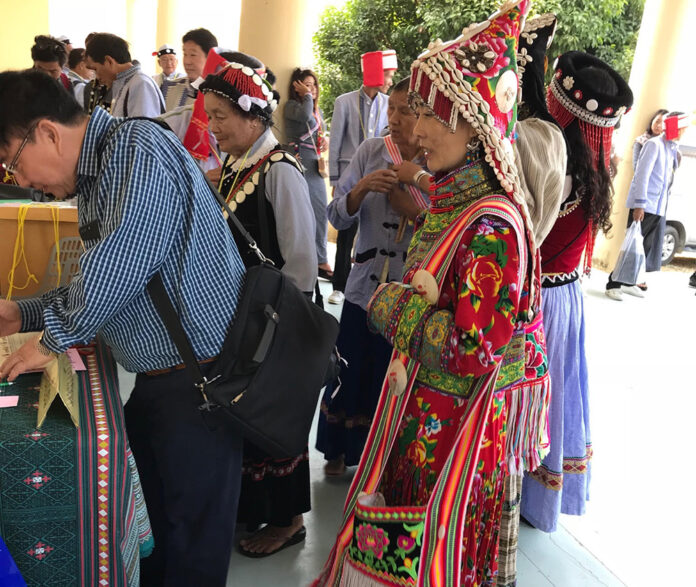
Within an hour after starting time however, the organizers of Friday’s international meeting on “Lisu Cultural Inheritance and Sustainable Development” were in place at the Municipality Convention Hall in Chiang Mai’s Mae Taeng district. Soon colorful clouds of people began wafting in.
Lisu women, dripping with beads and silver, lived up to their reputation as the most and eye-catching of hill women in traditional and updated finery from China, Myanmar, India and Thailand.
The men weren’t far behind. They wore custom jackets of blue-stripped Lisu fabric decorated with black velvet, cowry shells, bone buttons or the Lisu symbol of manhood – the crossbow – embroidered on the lapel. Some carried actual crossbows.
But the main accessories were headgear – from the traditionally beaded to more eclectic cowboy hats, turbans and sports caps, not to mention the shoulder bags.
Researched on and off over a 20-year period, I take a broad look at the 1.5 million-strong minority group dispersed across Thailand, China and Myanmar – with a few in India and Laos. The result is a mini-study in globalization, a time-lapse narrative in book form.
The Friday meeting was part of two events. The conference was attended on two mornings by about 200 Lisu leaders from five countries, and indigenous and foreign scholars. The larger festival down the road in a Lisu village was attended by a few thousand.
From left, Mark Goldschmidt, author Michele Zack, Lisu anthropologist Otome Hutheesing, an unidentified woman, Lisu museum manager Mimi Saejuand Lau and Ting Hue, a Cornell University grad student from Malaysia studying the Lisu in China. Photo: Courtesy
At the formal conference, mundane Lisu concerns over myi-do (repute), crop portfolios, and marrying off daughters are set aside to tackle the existential matters of cultural survival. The Lisu have only recently begun developing long-term strategies to fend off the demise of their language and culture. A parade of speakers, beginning with Atapah Sinlee, event organizer, insist that not just national divisions – but cultural and religious ones – must be overcome if the Lisu are to survive. This transnational Lisu Unity movement has picked up steam only in the last 10 years, greatly aided by social media.
The Lisu have taken to Facebook, Lisu Zone website and WeChat in China to reach across borders. They are using digital tools as the means of getting together and organizing for the first time.
I know this is true, because in the short period since publication of my book, I have gone from having three Lisu Facebook friends to several hundred. Lisu have networked to an astonishing degree. While they have been slower than other minorities to take up higher education in general, the internet is a milieu in which they thrive.
A few talks are held on Lisu history, which is traced back 3,000 years by a female Chinese anthropologist and Burmese Lisu scholar now resident in the US state of Minnesota. These stir up pride, but agenda item one of this meeting is the future. Speaker after speaker sound the alarm about the impending loss of Lisu language literacy, and several offer ideas and strategies on how to avoid language loss and the demise of the culture it would cause.
Photo: Mark Goldschmidt / Courtesy
The missionary Fraser developed a Lisu script 100 years ago, but because it was used for religious purposes, the animists, Buddhists and other non-Christians were resistant to learning it. Instead, as Lisu began attending schools, they learned Thai, Burmese, or Chinese writing systems. Lisu in Myanmar, 80 percent of whom are Christian, are by far the most literate Lisu, and unlike in every other country where this minority lives, children there are taught to read and write Lisu in both government and religious schools.
But, beginning with China, Fraser’s script has now been universally accepted by governments as the Lisu writing system. In 2009, it was adopted for international keyboard software standards by the UNICODE Consortium. Several speakers, Christian or not, academic or otherwise, made passionate pleas for the Lisu themselves to accept it, and to encourage and incentivize children (and even adults) to learn it as the best, and perhaps only, safeguard to ensure that Lisu language and culture will exist in 50, or even 20 years.
Other themes of the conference supporting this main one were education and economic development. Lisu entrepreneurs such as Chome Orn-anong exhorted her kinsmen and women to climb up the value added ladder by developing products and services to sell, as she has with her Abino Coffee Company. Before, farmers in her village of Doi Chang, Thailand’s oldest Lisu settlement (that today has an Akha majority), were receiving just 40 baht or 50 baht a kilo for this labor intensive crop, with middlemen reaping most of the profits. Now that she has researched and improved her product, acquired roasting expertise and developed a business plan, growers in her collective are receiving many times that price.
That was just the morning.
Having taken up such weighty topics, the second and larger part of the international began in the afternoon – a giant party attended by a couple thousand Lisu. It was a three-day celebration of cross-border Lisu-ness that unfolded at a temporary encampment 20 minutes from Mae Taeng near Dton Loong village. There was food, purveyors of culture, handicrafts, educational exhibits, the Abino Coffee Company and tickets being sold for a raffle tickets organizers hoped would pay for the conference.
Lunch was served by an army of cheerful women delivering dozens of dishes of remarkably fresh, home-style Lisu food to a hundred tables. Now, finally, we can have some fun! I enjoyed talking with other Lisu scholars, such as Masao Ayabe from Tokyo Metropolitan University who has been coming to Thailand to study the Lisu for 30 years.
I met the Indian Lisu scholar Avía who has written a Lisu dictionary, and is now completing a Lisu-English Dictionary. A Malaysian PhD Candidate from Cornell, Ting Hui Lau, shared her experience of two years of field work with the Lisu in the Upper Salween Valley inn Yunnan, China.
My mentor the Dutch anthropologist Otome Hutheesing, fluent in Lisu and now well into her 80s, is in heaven. She accompanied me to Yunnan in the 1990s, and we reminisced. Otome’s Lisu daughter Mimi Saeju brought us all together. By the end of lunch, hundreds of women and men were circle dancing to music provided by Lisu musicians at the center of our rustic dining hall. The heavier feelings of the morning’s conference lifted in this demonstration of Lisu community
The afternoon and evening were full of commerce, visiting, music and dancing, including some stunning performances by a pair of women, famous Chinese Lisu singers. As it got dark, the old Thai Lisu man who set up a mobile still to cook up a sour rice mash began offering “liquor medicine” to all and sundry. It drips off a string into a container below, thick, sour, and alcoholic.
This is a bit of a cultural test of the new Lisu Unity movement, I think, as most Christian Lisu have given up drinking and are not known to be flexible or tolerant on this score. However, the evening is extraordinarily mellow, we witness little public drunkenness, and the Christians seem as happy as everyone else to be here at this major gathering of the clans.
The old Lisu proverb, sometimes a war cry Shu ma da! or “We can never die!” comes to mind. It sometimes translated as “Never say die!”
For this to become prophecy, Lisu children today must learn not only to shout it with typical Lisu bravado while at play in imaginary battles – but also to write it.
Correction: Due to an editing error, an earlier version of this story incorrectly identified the Lisu as being majority Christian. That is only true in some areas.
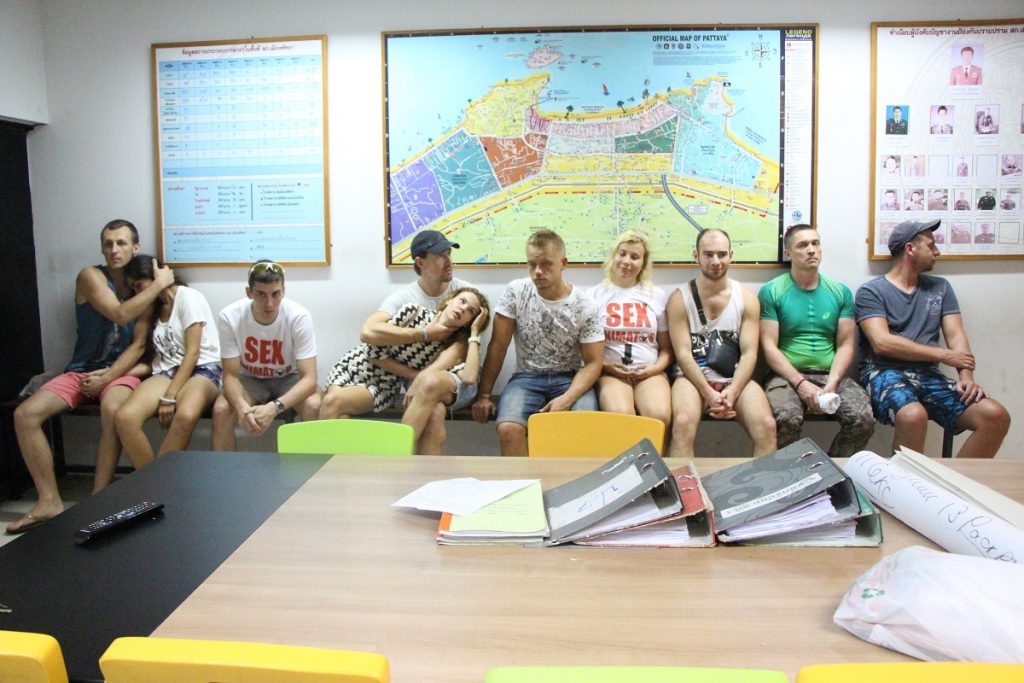
PATTAYA — The climax of what was billed as advanced sex training by a group of instructors led by a Russian “sex guru” was prematurely interrupted by police Sunday.
The courses were run by a Russian named Alex Lesley, who has made headlines back home for vowing to challenge President Vladimir Putin. His classes involved demonstrations with two female models: his wife and another woman recently outed as the mistress of a Putin oligarch ally, prompting Russia to threaten a ban of YouTube.
Cops raided their session at a hotel in central Pattaya on a tip from a Russian police informant, according to Special Branch officer Dullayapat Techapornyasin.
Lt. Col. Dullayapat said the informant shared video clips from inside a session that he said came from an unhappy “student” who felt the RUB40,000 (22,400 baht) lessons were not worth it.
“There were two women. They are models. They did things…. Let’s say if the video got out, the public would not be able to accept it,” Dullayapat said when asked to describe the footage. “They were in an obscene manner. In some parts, the lower parts of their bodies could be seen.”
In other videos posted online, Lesley’s training appears to involve using lashes to spank women as they lie on their stomachs.
A livestream video of the raid shows the moment plainclothes police led by Dullayapat walked into the room and confiscated mobile phones.
When a man who was filming asked the officer what was happening, Dullayapat told him to hand over his phone and said, “I have you now, okay?”
Dullayapat, who was uncomfortable discussing the “demonstrations,” declined to say what the two women were teaching or imitating to the group of 43 students, but added that no intercourse took place.
“But that’s based on what I saw. I didn’t see the whole session,” he added.
The Russians remained in the custody of Pattaya police Monday evening.
The course was taught daily in meeting rooms at the hotel Feb. 19 through Sunday. An arrest report seen by Khaosod English identified it as the Ibis Pattaya.
The program was run by Lesley, whose real name is Alexander Kirillov and reportedly holds Russian and Belorussian nationalities.
A team of Russians assisted him, including Anastasia Vashukevich, a woman known online as Nastya Rybka who identifies herself as an “oligarch huntress.” She is the subject of a Feb. 8 video by Russian opposition leader Alexei Navalny about her affair on a 2016 yacht trip with oligarch and Putin ally Oleg Deripaska, according to Daily Beast. Russia is threatening to ban YouTube and Instagram if the photos and videos, which also claim a Russian deputy prime minister was on the yacht, are not removed.
The unidentified victim who contacted Pattaya police told them the 40,000-baht lessons “did not make them happy,” and the raid took place last night just as the courses were about to conclude.
“At first there were communication problems,” Dullayapat said of the raid. “But we brought in an interpreter. And in the end we understood each other. They were polite to us.”
All 10 instructors were charged with working without permits, including the model, who was charged for overstaying her visa, he said.
Lesley, the self-styled sexpert, routinely promotes his courses on his Instagram, where he has about 37,000 followers. He’s an author of several books including one called “Life Without Panties.”
“After reading this book, your views on life will change and you will understand that you have the potential to attract any girl, ANYWHERE,” the blurb of the book reads on Amazon.com.
Last year Lesley announced he would contest Russian president Vladimir Putin in this year’s election. More recently, he claimed earlier this month to have trained an escort filmed having sex with oligarch Oleg Deripaska, according to British tabloid Daily Mail. Russia has threatened to ban YouTube and Instagram if the videos are not removed.
Lesley’s campaign slogan is reported to be “A country led by a military man will fight. A country, led by a scientist, will develop. A country that is run by a sex guru will multiply!”
Alex Lesley and other suspects at Pattaya City Police Station on Sunday
Update: This story has been updated with information from the police report about an unidentified Russian police informant’s role in tipping off Pattaya police. Alex Lesley’s real name has also been updated.
Corrections: An earlier version of this story identified the venue of the class as being on Ko Lan, an island just off the coast from Pattaya. In fact it was the Ibis Pattaya. The class was held in its Ko Lan meeting room. Although the police said the course was 40,000 baht, an online signup form shows it was 40,000 Russian rubles, which is the equivalent of 22,400 baht.
Photo: The Center for People and Forests / Courtesy
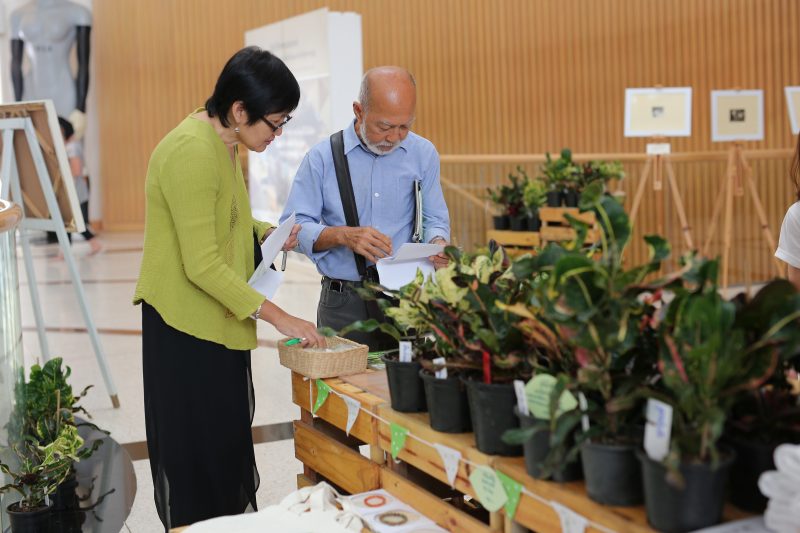
BANGKOK — Take a break from wandering the malls to pick up some houseplants and support forest folk at an eco-friendly fair.
Shop for purple orchids from Chiang Mai and unpasteurized honey from Krabi while browsing raw cloth from Nan at the People and Forests Fair to be held next month at the Bangkok Art and Culture Centre.
“We want city people to be interested in forest restoration,” said Warangkana Rattanarat, director of NGO organizer The Center for People and Forests Thailand.
Visitors can contribute to a collaborative forest quilt of leaves in the shape of Thailand by bringing their own leaves or using those provided from locations nationwide.
The fair will include 20 shops selling organic wares from people who live off forested land. Warangkana said people to see the benefit of forests lest they be cut down and used for other purposes.
Artists from Phayao and Nan provinces will also give away drawings of their forests back home. The first 500 visitors will receive a free tree to plant at home courtesy of the Forestry Department.
The People and Forests Fair will run 11am to 7pm March 4 on the first floor of the Bangkok Art and Culture Center (BACC), reachable from BTS National Stadium.
Photo: The Center for People and Forests / Courtesy
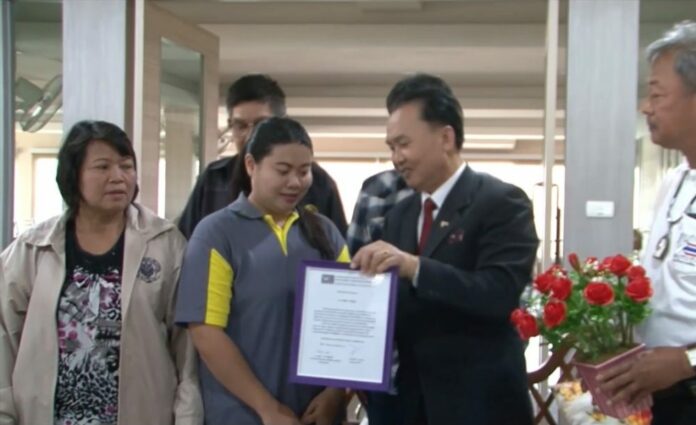
University student Panida Yospanya, 22, receives an award Feb. 13 from an anti-corruption organization for speaking out about a fraud scheme in Khon Kaen province.
BANGKOK — Two high-ranking officials were suspended while their alleged roles in pilfering funds meant for the country’s poorest is investigated, a deputy prime minister announced Sunday.
The secretary of the welfare ministry and his deputy were removed from active duty in the wake of revelations that officials stole millions of baht meant for indigent Thais. Deputy Prime Minister Chatchai Sarikulya said they were suspended on Friday and vowed an impartial investigation into the scandal, though he also asked the media to “be patient.”
The two officials were identified as Puttipat Lertchaowasit and Narong Kongkam.
The alleged graft came to light recently when a former intern in the Ministry of Social Development and Human Security blew the whistle. Panida Yospanya, 22, said provincial officials in Khon Kaen forced her to forge documents that allowed them to pocket 2,000 baht to 3,000 baht in funds per welfare recipient. She estimated her superiors and others defrauded the state of up to 7 million baht.
Funds from the program are meant for citizens living in poverty and HIV patients. The program was started in 2009 as a government measure to assist those in the lowest rungs of the economic ladder. It is unrelated to the military government’s more recent policy to subsidize living costs for eligible poor.
Panida, who studies at Mahasarakham University, said she refused to cooperate and quit her internship. Khon Kaen’s provincial governor said she’s now in a witness protection program.
After her story went public, several former employees backed up her accusations, prompting anti-graft agencies such as the Auditor General’s Office and the Public Sector Anti-Corruption Commission to launch an investigation into the alleged fraud. Inspectors were also ordered to review the books kept by all welfare offices nationwide.
Similar allegations have since surfaced in Bueng Kan, Surat Thani and Chiang Mai provinces. Junta chairman Prayuth Chan-ocha said Friday the government would take the matter seriously.