























31.6 C
Bangkok
Saturday, June 13, 2026
Home Blog Page 2121

Amtrak Train on New Route Hurtles Onto Highway, Kills 3

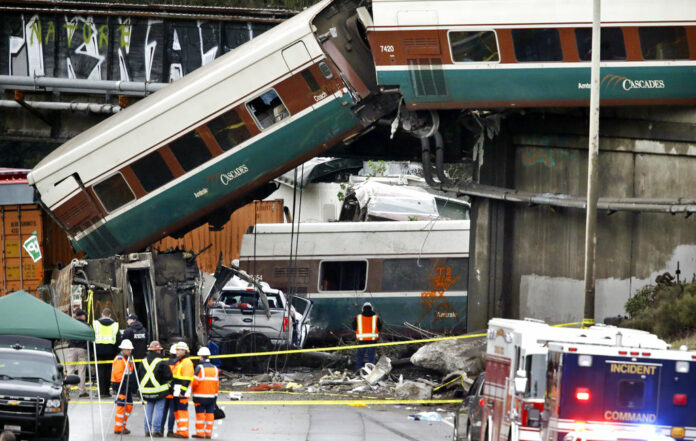
Cars from an Amtrak train lay spilled onto Interstate 5 below alongside smashed vehicles as some train cars remain on the tracks above Monday, Dec. 18, 2017, in DuPont, Wash. The Amtrak train making the first-ever run along a faster new route hurtled off the overpass Monday near Tacoma and spilled some of its cars onto the highway below, killing some people, authorities said. Seventy-eight passengers and five crew members were aboard when the train moving at more than 80 mph derailed about 40 miles south of Seattle before 8 a.m., Amtrak said. (AP Photo/Elaine Thompson)

DUPONT, Wash. — An Amtrak train making the first-ever run along a faster new route hurtled off an overpass south of Seattle on Monday and spilled some of its cars onto the highway below, killing at least three people, injuring more than 100 and crushing two vehicles, authorities said.

Attention quickly turned to the train’s speed. A website that maps location and speed using data from Amtrak’s train tracker app showed the train was going 81.1 mph (129 kph) about a quarter of a mile from the point where it derailed, where the speed limit is significantly lower.

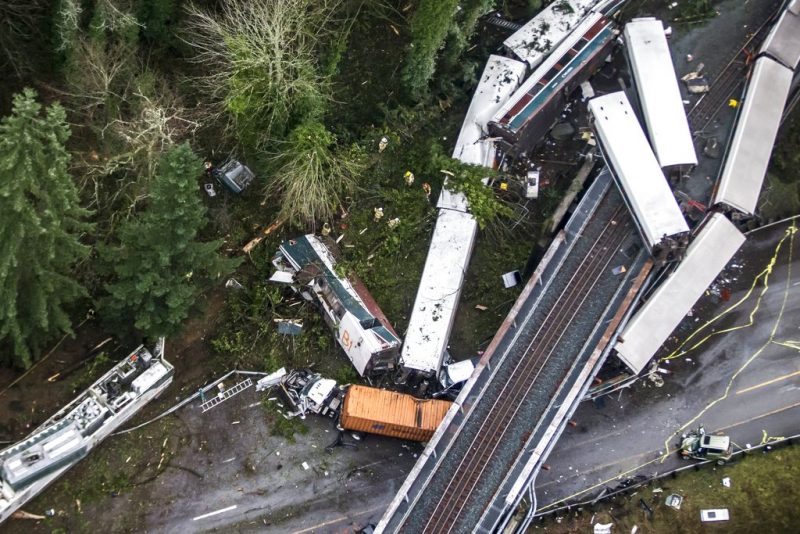
Seventy-seven passengers and seven crew members were aboard when the train derailed and pulled 13 cars off the tracks. Authorities said there were three confirmed deaths and more than a dozen people with critical or serious injuries.

About two hours after the accident, a U.S. official who with others was briefed on the investigation said he was told at least six people were killed. No additional briefings were provided by late afternoon, and the official said he had no new information to explain the discrepancy in the numbers.

The official was not authorized to discuss the investigation publicly and spoke to The Associated Press on condition of anonymity.

A track chart prepared by the Washington State Department of Transportation shows the maximum speed drops from 79 mph (127 kph) to 30 mph (48 kph) for passenger trains just before the tracks curve to cross Interstate 5, which is where the train went off the tracks.

The chart, dated Feb. 7, 2017, was submitted to the Federal Railroad Administration in anticipation of the start of passenger service along a new bypass route that shaves 10 minutes off the trip between Seattle and Portland.

It was not clear how fast the train was moving at the precise moment when it derailed.
AP17352841735681 e1513652574776
Cars from an Amtrak train that derailed above lie spilled onto Interstate 5, Monday, Dec. 18, 2017, in DuPont, Wash. The Amtrak train making the first-ever run along a faster new route hurtled off the overpass Monday near Tacoma and spilled some of its cars onto the highway below, killing several people, authorities said. (Bettina Hansen/The Seattle Times via AP)

Kimberly Reason with Sound Transit, the Seattle-area transit agency that owns the tracks, confirmed to the AP that the speed limit at the point where the train derailed is 30 mph (48 kph). Speed signs are posted two miles before the speed zone and just before the speed zone approaching the curve, she said.

Positive train control — the technology that can slow or stop a speeding train — wasn’t in use on this stretch of track, according to Amtrak President Richard Anderson.

He spoke on a conference call with reporters, said he was “deeply saddened by all that has happened today.”

In a radio transmission immediately after the accident, the conductor can be heard saying the train was coming around a corner and was crossing a bridge that passed over Interstate 5 when it derailed. Dispatch audio also indicated that the engineer survived with bleeding from the head and both eyes swollen shut.

“I’m still figuring that out. We’ve got cars everywhere and down onto the highway,” he tells the dispatcher, who asks if everyone is OK.

Aleksander Kristiansen, a 24-year-old exchange student at the University of Washington from Copenhagen, was going to Portland to visit the city for the day.

“I was just coming out of the bathroom when the accident happened. My car just started shaking really, really badly. Things were falling off the shelf. Right away, you knew that this was not something minor,” he said.

The back of his train car was wide open because it had separated from the rest of the train, so he and others were able to jump out to safety. He was at about the middle of the train, either the sixth or seventh car, he said, and was “one of the lucky ones.”

Emma Schafer was headed home to Vancouver, Washington, on winter break from the Cornish College of the Arts in Seattle and was napping when the crash occurred.

She awoke to find her body at a 45-degree angle and her train car dangling from the overpass. Someone behind her was pinned by the legs, she said, and she and others who could walk exited the train by crawling onto a car underneath theirs that had been crushed.

“It felt oddly silent after the actual crashing. There was a lot of metal, a lot of screeching, a lot of being thrown around. It was very quiet. Then there was people screaming,” Schafer said.

“I don’t know if I actually heard the sirens, but they were there. A guy was like, ‘Hey, I’m Robert. We’ll get you out of here.'”

Dr. Nathan Selden, a neurosurgeon at the Oregon Health & Science University in Portland, said he and his son drove through the accident scene while traveling north to visit Seattle. The doctor asked if he could help and was ushered to a medical triage tent in the highway median.

The most seriously injured had already been whisked away, but the patients he helped appeared to have open head wounds and skull, pelvic or leg fractures, as well as small cuts and neck sprains, he said.

He called it a miracle that an infant child he saw from the scene appeared completely unharmed.

President Donald Trump used the deadly derailment to call for more infrastructure spending in a tweet sent about three hours after the accident. He said the wreck shows “more than ever why our soon to be submitted infrastructure plan must be approved quickly.” The accident happened on a newly completed bypass.

The train was making the inaugural run on the new route as part of a $180.7 million project designed to speed up service by removing passenger trains from a route along Puget Sound that’s bogged down by curves, single-track tunnels and freight traffic.

The Amtrak Cascades service that runs from Vancouver, British Columbia, to Eugene, Oregon, is jointly owned by the Washington and Oregon transportation departments. Amtrak operates the service for the two states as a contractor and is responsible for day-to-day operations.

The Amtrak schedule called for the train to leave Seattle around 6 a.m. and arrive in Portland about 3 1/2 hours later.

The new bypass was built on an existing inland rail line that runs along Interstate 5 from Tacoma to DuPont, near where Train 501 derailed. Track testing began in January and February in advance of Monday’s launch and continued through at least July, according to the Washington State Department of Transportation.

The tracks, known as the Point Defiance Bypass, were previously owned by BNSF and were used for occasional freight and military transport.

The mayor of Lakewood, Washington, a city along the new route, predicted a deadly crash — but one involving a fast-moving train hitting a car or pedestrian at a grade-crossing, not a train tumbling off an overpass. At a recent public meeting, he called on state planners to build overpass-like rail structures instead of having trains cross busy streets.

Eric Corp, a councilman for the small city of DuPont near the derailment, said he rode the train with about 30 or so dignitaries and others on a special trip Friday before the service opened to the public Monday.

“Once we were coming up on that curve, the train slowed down considerably,” he said, adding that “in no way did it make me feel like we were going too fast.”

National Transportation Safety Board investigators were at the scene.

All southbound lanes of I-5 were closed south of Joint Base Lewis-McChord, and motorists were being warned to avoid the area.

Story: Rachel La Corte, Gillian Flaccus and Michael Sisak
Advertisement

American Who Kept Dead American in Freezer Gets 43 Years

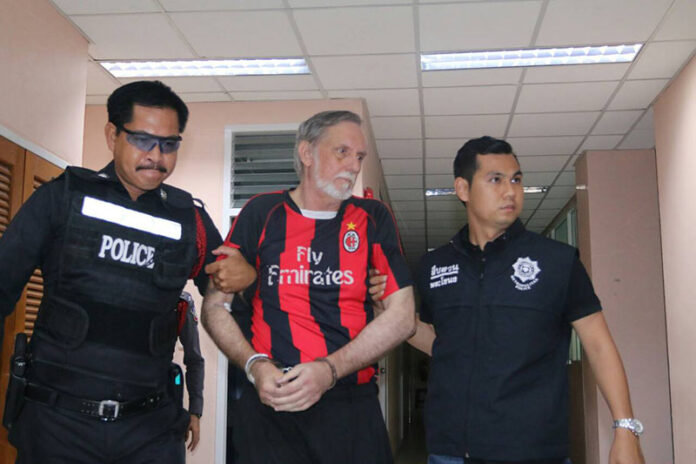
Herbert La Fon, 63 of the United States, is led from an interrogation session on Sept. 30 in Bangkok.

BANGKOK — Police said Monday they still don’t have all the pieces to the puzzle to explain why an American calendar publisher wound up in a shophouse ice box after their lead suspect was sentenced to over four decades in prison.

The Phra Khanong District Court on Friday sentenced Herbert La Fon to 43 years in prison and a 300,000 baht fine over a year after a forgery ring raid led to the surprise discovery of the frozen body parts.

“He never confessed to anything really,” Maj. Gen. Somprasong Yenthuam said in an interview. “But he did say that he obtained the freezer himself.”

La Fon was convicted of illegally possessing weapons, attempted murder of a police officer, drug possession, passport forgery and concealing a body.

Read: ‘Truth Serum’ Found in Dismembered American’s Body

Of the 43-year sentence handed down by the court, 33 years were for the attempted murder of a tourist police sergeant La Fon shot when the authorities raided his residence on a tip that there was a foreign forgery ring operating there. The officers were attacked by La Fon, who is 64 and has been on the run from the US FBI since 1979.

Co-defendants Aaron Gabel and James Eger were both acquitted of crimes due to insufficient evidence, according to the court verdict.

The body was later found to be that of Charles Edward Ditlefson in the freezer, a Californian known for publishing calendars featuring trains.

No one has been made to answer for his death as neither Gabel, Eger nor La Fon were charged with his murder.

Who killed Ditlefson – and why – remains a mystery as La Fon heads to prison – probably for the rest of his life. From analysis of the slain man’s remains, police believe he could have been killed any time between 2008 and January 2016. A “truth serum” drug was also found in his blood.

On the raid date of Sept. 23, 2016, police found dismembered body parts in four bags in the freezer, dozens of fake passports and drugs including methamphetamine and marijuana.

In court, housemaid La Nanda and her husband Sor Ka Por Myin testified they both saw the freezer at La Fon’s while in his service. Sureeporn Sae-tang, a refrigerator seller at Kluay Naam Thai Karn Chang shop said she remembered that La Fon purchased the freezer in October 2008.

La Fon used the false names Peter Andrew Colter and William Peter Johnson and was on the run from the FBI for nearly four decades.

In court, he claimed to have fought in the Vietnam War.

Related stories:

‘Truth Serum’ Found in Dismembered American’s Body

Frozen Body Identified as American Publisher

Police Say American Admits Cutting Up Victim, Denies Killing Him

Frozen Body Identified as American Publisher

Report Says American Linked to Dismembered Body Confesses to Murder

Suspected Forgers’ Frozen Body Thought to be Older Western Man

Police Can’t ID Suspected Farang Forgers Or Their Dead Body

Foreigners Arrested After Raid on Forgery Ring Leads to Body in Fridge

Advertisement

Dead Cadet: Army Invites Family for Talk

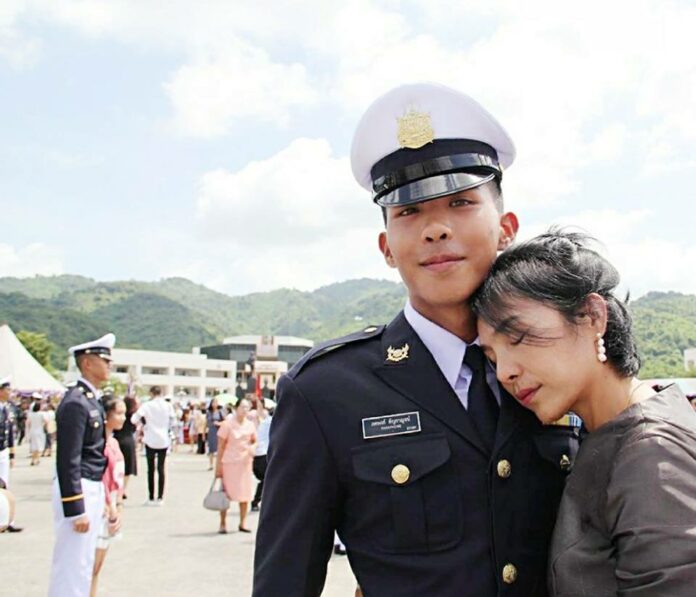
Pakapong Tanyakan poses for a photo with his mother Sukanya on Aug. 18. Image: Sukanya Tanyakan

BANGKOK — The military said Monday it has invited the family of late cadet Pakapong Tanyakan to discuss the circumstances of his death after its own review found it shared no blame.

Pakapong’s family lashed out after the army’s investigation ruled Friday that Pakapong died of a heart condition and not any mistreatment. After reportedly not inviting the family to its news conference announcing the results, a military representative said he wished they could meet to explain all the facts to them in person.

“If Nong Meay’s family does not have the faith or confidence in the committee’s proceedings, I’d like them to come talk with us about what they don’t have confidence in,” Deputy Chief of Staff Chawarat Marungruang said. “We are willing to explain every point that they have doubt about.”

Pakapong’s parents have declined the invitation so far, Gen. Chawarat said.

On Friday the military announced the results of its investigation into Pakapong’s death and maintained that he died of “sudden heart failure” and not a beating, as his family suspects.

While Pakapong’s family pointed to a broken rib as evidence of possible abuse, the army said the fracture was due to the cadet falling down eight flights of stairs.

His family has not spoken to the media since the investigation results were announced, but his mother Sukanya took to Facebook to describe the inquiry as “shameful.”

She also questioned why the military did not have security camera footage of the alleged fall.

Pakapong’s sister Supicha Tanyakan said prior to Friday’s news conference that she intended to take legal action against the military regardless of how its investigation concluded.

Pakapong died in October from what the military described as “sudden heart failure” one day after returning to the Armed Forces Preparatory School, an elite military academy, from a break.

Suspicions about his death became public in late November after the family took his body away in secret from a cremation ceremony to a private hospital where they discovered some of his internal organs went missing.

Following a public outcry, the military returned the organs to Pakapong’s parents and said they had been kept for medical examination.

Advertisement

Prawit Spotted Wearing 3rd Multi-Million Baht Watch

Image: CSI LA / Facebook

BANGKOK — A well-known anti-corruption campaigner called for Deputy Prime Minister Gen. Prawit Wongsuwan to be suspended until investigations into his unusual displays of wealth are completed after he was seen wearing another multi-million baht accessory.

Srisuwan Janya of the Association of Thai Constitution Protection issued a letter Monday urging junta leader Gen. Prayuth Chan-ocha to suspend Prawit, who’s also deputy junta leader, until the National Anti-Corruption Commission has completed its work.

“People will then know whether this government is sincere in tackling corruption and reform or not,” Srisuwan said.

Show and Don’t Tell: Gen. Prawit Won’t Explain His Bling Watch to Public

On Saturday, a third premium watch – what appeared to be a platinum Rolex Cosmograph – was spotted on the cover of a Matichon periodical from May, making for the third extravagantly priced timepiece Prawit, a career military man, has been spotted wearing.

The search for evidence of Prawit’s haute horology began earlier this month after he flashed a Richard Mille watch – and bling diamond ring – with an estimated value of over 3 million baht at a photoshoot.

The problem for the 72-year-old deputy junta leader began when a check of his mandatory financial disclosures showed no mention of the watches.

He was given until Jan. 8 to clarify how he obtained the watch, whose sole distributor in Thailand sells at a starting price of at least 3 million baht.

Netizens scouring old photos of Prawit found it wasn’t the only Richard Mille wristwatch. Days later, a Facebook page that crowdsources amateur investigations spotted him wearing a different Richard Mille in a file photo. It appeared to be model RM 30, which also costs at least 3 million baht. On Saturday, members of the same page, CSI LA, spotted a platinum Rolex Cosmograph Daytona. The watch sells in Thailand for just under 2 million baht.

An official involved in the case at the National Anti-Corruption Commission said Monday that the 30-day period for clarification could be extended 15 days or 30 days, if not more, at the commission’s discretion. The employee spoke on the condition of not being named because he was not authorized to speak to the media.

He added that it would be counter-productive for Prawit not to clarify matters to the commission.

“It’s his right to clarify but if he doesn’t, he would be forfeiting his right,” said the source. The source said other complaints about additional watches and rings could be combined into one case with the original case, now with the investigation office of the NACC.

Khaosod English tried to reach Secretary-General Worawit Sukboon for further information Monday but was told he was unavailable.

The commission is a nominally independent agency founded in 1999 as part of anti-graft effort in the newly enacted 1997 constitution. It is tasked with promoting transparency among political office holders and investigating corruption allegations.

Srisuwan, a prolific filer of public malfeasance complaints, is among those who have questioned the commission’s independence.

“Many of the commissioners in this set are questionable. For example, the president used to be a police officer and served administrators in the current government directly,” Srisuwan told Khaosod English back in February. “Therefore, whenever there’s cries about corruption relating to powerful people in the government, there’s a direct conflict of interest.”

Its politically appointed chairman, police Gen. Watcharapol Prasarnrajkit, has ties with Prawit.

Srisuwan said that he does “not fully trust” Watcharapol’s promise not to be involved in the probe.

The commission source said, with or without Prawit’s clarification, the NACC would eventually decide whether to forward the case to the Supreme Court’s Division for Political Office Holders.

If found guilty of not declaring some of his wealth, Prawit could be removed from the post of deputy prime minister.

“There is no time frame for handling the case, however,” the official added.

This past Tuesday, Prawit was expected to explain that the first Richard Mille was loaned to him by a friend. The rumors, true or not, were met with derision and did not come to pass.

A prominent reporter with close ties to the military, Wassana Nanuam, wrote online Saturday that the watches were loaned by a very close businessman friend – who has just died. She cited no source for the information.

Advertisement

Thailand to ‘Upgrade’ Munich Consulate

Image: Nils van der Burg / Flickr

BANGKOK — Thailand’s diplomatic mission in Munich is slated for expansion, with a new Consulate-General to replace its honorary representative, a top foreign affairs official said Monday.

Under a plan approved by the Cabinet, the new Consulate-General’s office will cover the two German regions of Bayern and Baden-Württemberg. The change means Thailand will have a second Consulate-General in Germany in addition to one already in Frankfurt.

“It’s like we are upgrading it,” foreign affairs minister Don Pramudwinai said, though he said the details were not finalized. “We are still working things out.”

Foreign Affairs is tasked tasked with furnishing personnel and funds to make it happen, while Germany was extended a reciprocal offer to expand its diplomatic presence in Thailand.

However, Germany currently has no plans to open a new consulate in Thailand, deputy head of German mission Jan Scheer wrote in an email.

Munich is home to a Thai honorary consulate office which only offers basic consular services such as granting visas but cannot represent Thailand diplomatically.

After the cabinet-approved the plan in August, a Thursday government order said the honorary office would close to make way for the new, larger facility. All Munich visa applications will be processed by the embassy in Berlin and other consular offices in the meantime, the announcement said.

Asked why Thailand was expanding its diplomatic presence in Germany, Don said the two nations enjoy amicable relations.

“We and Germany have been maintaining our friendship for a long time,” he said.

Advertisement

Panda Preview: Tokyo Trots Out Newest Baby (Video)

TOKYO — A baby panda has made a special appearance before Tokyo’s governor, a group of local schoolchildren and the media one day ahead of its official public debut.

Xiang Xiang, a 6-month-old female giant panda, will debut Tuesday in a limited public viewing for avid fans who obtained tickets through a highly competitive lottery process.

Xiang Xiang, or “Fragrance” in Chinese, was born June 12 to a resident panda at Tokyo’s Ueno Zoo and now weighs more than 12 kilograms.

Tokyo Gov. Yuriko Koike, who was all smiles after coming out of the zoo’s panda house on Monday, told reporters that the baby panda was “just adorable.”

Zoo officials said Xiang Xiang’s appearances will be limited to 2.5 hours a day for the time being to minimize stress.

Advertisement

2017 in Review: ‘Disruption, Despair and Dumpster Fires’

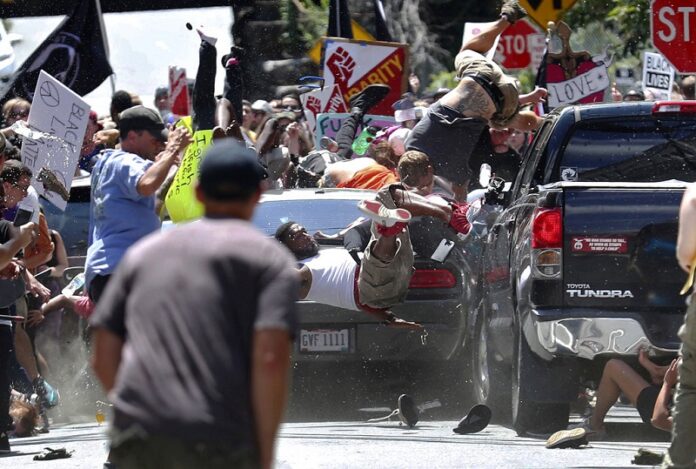
People are thrown into the air as a car drives into a group of protesters demonstrating against a white nationalist rally in August in Charlottesville, Virginia. Photo: Associated Press

NEW YORK — The news alerts gushed in: An attack on a concert, a church, an ice cream parlor; an assailant wielding a gun or hammer or acid. There’s an earthquake in Mexico, a monsoon in India, a volcanic eruption in Bali, hurricane after hurricane after hurricane. Keep up as your phone vibrates with word of your favorite actor accused of misconduct. Make that anchorman. Or politician. Or radio star.

The volatile year 2017 shook us so much and so often it felt like whiplash or worse, and that’s without even considering Donald Trump, at the center of so much of the turmoil.

“It’s almost like one of those horror rides at the amusement park where every time it heads into the next segment it gets worse,” said noted trendspotter Marian Salzman. “Every time I turn off a device, I feel like I have anxiety because I’m not tracking the news.”

The year, she said, boiled down to “disruption, despair and dumpster fires.”

In retrospect, 2017’s destiny seemed sealed in its opening moments.

Just after the new year dawned in Istanbul, a gunman killed 39 people at a nightclub and wounded scores more. The joy of the holiday dissolved into a scene of heartbreak outside the city morgue, where some cried and fell to the ground as they learned of a loved one’s fate.

Around the world this year, vehicles were made into weapons, with trucks, cars and vans plowing down people on the Westminster and London bridges in Britain; in Times Square and on a Manhattan bike path; on a major shopping street in the Swedish capital of Stockholm; on the historic La Rambla in Barcelona.

Terrorism and other violence struck so regularly that many accepted it as a fact of life.

“It can happen anywhere as long as there is one man willing to die,” said Luis Antonio Bone, 66, of Barcelona, who is retired from a cement factory job. Bone is at once realistic and defiant, saying crowded places may make him think about his safety but won’t deter him from outings.

“We have to live with it,” he said, “but keep living as we always have.”

That kind of resilience was mustered again and again, even by some of those marked by some of the year’s biggest tragedies.

In Texas, Pastor Frank Pomeroy vowed that good would persevere over evil. Pomeroy leads the rural church where a gunman killed 25 parishioners, his own 14-year-old daughter among them. “Rather than choose darkness as that young man did that day, we choose life,” he said in an emotional service only a week after the rampage.

In Las Vegas, too, where 58 people were fatally shot at a music festival, some searched for optimism in the face of savagery. Jay Pleggenkuhle, a 52-year-old landscaper, helped create a memorial garden with a tree for each of the victims. Some 1,000 people volunteered to help with his project, putting aside personal or political differences to work hand in hand.

“People have really been bound together following this tragedy,” he said.

A deadly chemical attack in Syria stirred people around the globe. Missile launches by North Korea brought angst that nuclear war was nearing. Rallies by white supremacists, wearing white hoods and clasping torches, roused uncomfortable memories of the United States’ past. All of it broke with such ferocity, it seemed impossible to focus on any one incident too long.

“Even something like a mass shooting that killed 50 people, the story moves on in just a couple weeks,” said Lauren Wright, a lecturer on politics and public affairs at Princeton University.

In Egypt, twin Palm Sunday attacks ambushed Coptic Christians and a November assault on a crowded mosque killed more than 300. In Britain, 22 people died when a suicide bomber detonated a backpack full of explosives after an Ariana Grande show.

Three major storms  Harvey, Irma and Maria  battered Puerto Rico and much of the Caribbean, as well as Texas and Florida, as 2017 went down as one of the most active hurricane seasons in recorded history. Fires tore through California and Portugal; earthquakes rocked Mexico, Iran and Iraq; flooding and an avalanche covered parts of Italy; mudslides leveled homes in Sierra Leone; and a deadly monsoon pummeled India, Nepal, Pakistan, and Bangladesh.

In hotspots around the world, people sought escape. Amnesty International estimated 73,000 refugees took to the Mediterranean in the first half of the year alone, with about 2,000 dying along the way. In Myanmar, the military has been conducting a brutal ethnic cleansing of Rohingya people, killing untold numbers and forcing more than 626,000 to flee into neighboring Bangladesh.

Amid the barrage, other big stories struggled for a spotlight. A grinding civil war in Yemen pushed millions in the impoverished country to famine. A political crisis in Venezuela brought intensifying clashes. In Zimbabwe, Robert Mugabe was ousted from control after a 37-year reign. In Spain, a push for Catalonian independence degenerated at times into ugly scenes of mayhem.

In the U.S., Trump opened his presidency with a dark inaugural address beseeching an end to “American carnage” but saw much of his agenda rejected, with members of his own party providing key votes against him. Divides deepened, with agreement elusive even on core national values. Americans were sadder, a “happiness” report found. Sales of the dystopic novel “1984” surged and a chilling stage adaptation came to Broadway.

Mass protests formed around the country, including droves of women who proudly deemed themselves “nasty,” a label placed on Hillary Clinton in the 2016 presidential race. When U.S. Sen. Elizabeth Warren was silenced through arcane legislative rules, the words of her colleague, Mitch McConnell, became an unlikely rallying cry of feminists: “Nevertheless, she persisted.”

That phrase echoed as a dizzying number of sexual harassment or assault allegations emerged against high-profile men and as thousands of victims of lesser-known men chimed in with two words that made clear the scope of the problem: “Me too.”

There were, in this arguably awful year, moments to hail, too, stories of heroism and bravery that restore faith and give the heart a little hope. More than 80 schoolgirls, abducted by Boko Haram extremists more than three years ago in Nigeria, were released. In South Sudan, a boy abducted and forced into the army  mourned in a funeral two years ago after word of his gunshot death reached his mother  was alive after all, and returned home.

The Islamic State lost power as it was driven from Mosul, Iraq, and Raqqa, Syria. In the U.S., a total solar eclipse gave a break from the unending cacophony, with droves of sky-gazers standing shoulder to shoulder across a swath of the country.

A new calendar page brings with it the chance to start fresh. Jordi Casares, a 71-year-old retired bank employee in Barcelona, lamented the terrorism and radicalism that marred 2017 but said he, for one, is optimistic for a better 2018.

“It can’t be any worse than this year,” he said.

Story: Matt Sedensky

Advertisement

Putin Thanks Trump for CIA Tip He Says Stopped Bomb Plot

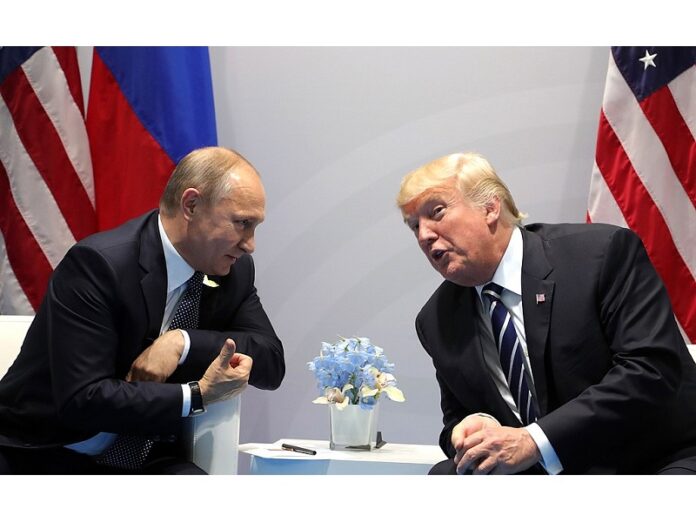
Vladimir Putin and Donald Trump meet at the 2017 G-20 Hamburg Summit in July in Germany. Photo: Kremlin.ru / Wikimedia Commons

MOSCOW — Russian President Vladimir Putin telephoned U.S. President Donald Trump Sunday to thank him for a CIA tip that helped thwart a series of bombings in St. Petersburg, the Kremlin and the White House said.

During the call, the two leaders’ second in three days, Putin expressed gratitude for the CIA information. The Kremlin said it led Russia’s top domestic security agency to a group of suspects that planned to bomb St. Petersburg’s Kazan Cathedral and other crowded sites this weekend.

“The information received from the CIA proved sufficient to find and detain the criminal suspects,” the Kremlin said.

The White House said in its readout of the conversation that “based on the information the United States provided, Russian authorities were able to capture the terrorists just prior to an attack that could have killed large numbers of people.”

The White House added that Putin extended his thanks and congratulations to CIA Director Mike Pompeo and the entire agency. Trump then called Pompeo “to congratulate him, his very talented people, and the entire intelligence community on a job well done!”

“President Trump appreciated the call and told President Putin that he and the entire United States intelligence community were pleased to have helped save so many lives,” the White House said in its statement. “President Trump stressed the importance of intelligence cooperation to defeat terrorists wherever they may be. Both leaders agreed that this serves as an example of the positive things that can occur when our countries work together.”

The Kremlin said Putin assured Trump that “if the Russian intelligence agencies receive information about potential terror threats against the United States and its citizens, they will immediately hand it over to their U.S. counterparts via their communications channels.”

The CIA’s tip to Russia comes even as Russia-U.S. ties have plunged to their lowest level since the Cold War era  first over Russia’s annexation of Crimea and support for pro-Russia separatists in Ukraine, more recently over allegations that Moscow interfered in the U.S. presidential election to help Trump.

While Russian officials have said the two countries were continuing to exchange some terror-related intelligence, Sunday’s statement from the Kremlin was Russia’s first public assertion that information from the United States helped prevent an attack.

The conversation was the second between the Russian and U.S. presidents since Thursday, when Trump thanked Putin for his remarks “acknowledging America’s strong economic performance,” according to the White House.

During the first call, they also discussed during ways to work together to address North Korea’s nuclear and ballistic weapons program, the White House said.

The Federal Security Service, or FSB, announced Friday that seven suspected followers of the Islamic State group had been arrested for allegedly planning to carry out terror attacks in St. Petersburg this weekend.

The agency said the suspects were plotting a suicide bombing in a church and a series of other explosions in the city’s busiest areas this coming weekend on IS orders. It said a search of a St. Petersburg apartment found explosives, automatic weapons and extremist literature.

Russian news reports said that Kazan Cathedral, a landmark 19th century Russian Orthodox church on St. Petersburg’s central Nevsky Prospect, was the prime target.

If the suspects succeeded in bombing the cathedral, it would have been the first major attack on a Russian Orthodox Church by Islamic terrorists, who have blown up apartment buildings, passenger planes and transport facilities in Russia.

In April, a suicide bombing in the St. Petersburg’s subway left 16 dead and wounded more than 50.

Russian TV stations have aired footage daily since Friday of the suspects in the foiled attacks being apprehended and questioned. One segment showed FSB operatives outside a St. Petersburg apartment building detaining a suspect, who appeared later saying he was told to prepare homemade bombs rigged with shrapnel.

“My job was to make explosives, put it in bottles and attach pieces of shrapnel,” the suspect, identified by Russian media as 18-year old Yevgeny Yefimov, said in the footage released by the FSB.

Several other suspects came from mostly Muslim regions in Russia’s volatile North Caucasus, and one man was from the ex-Soviet nation of Tajikistan that borders Afghanistan.

The TV reports included footage of a metal container, which the suspects used as a laboratory for making explosives, according to the FSB. Another video showed operatives breaking the doors and raiding an apartment used by other suspects.

Last week, the FSB said it also arrested several IS-linked suspects in Moscow, where they allegedly were plotting a series of suicide bombings to coincide with New Year’s celebrations.

The latest calls between Putin and Trump came after the Russian leader praised his U.S. counterpart during a marathon news conference on Thursday.

Putin hailed Trump’s achievements, saying that global markets have demonstrated investors’ confidence in Trump’s economic policies. He said he hoped the U.S. president would be able to follow through on his campaign promises to improve ties with Russia despite pressure from his political foes at home.

During the news conference, Putin also reaffirmed his multiple denials of meddling in the 2016 U.S. presidential election and argued that the U.S. is only hurting itself with investigations of alleged collusion between Trump and Russia. The allegations were “invented” by Trump’s foes to undermine his legitimacy, Putin said.

Alexei Chepa, a deputy head of the foreign affairs committee in the lower house of Russia’s parliament, hailed the CIA tip as a “step toward cooperation.”

“The more such actions we have, the better it will be for both our countries,” Chepa told the state RIA Novosti news agency.

Story: Vladimir Isachenkov

Advertisement

Bangkok Gets Block Party with 50+ Music Acts, Food, Art

Photo: Youngohm / Facebook

BANGKOK — More than 50 musicians from electronic and hip-hop to heavy rock will gather in an outdoor space for a 12-hour party.

Four stages will go up in the heart of the city for Bangkok Block Party, an all-day event bringing together music, food, drinks, workshops, barbers and tattoo art.

The international lineup leads off with Chicago indie trio Autograf, Nashville-based electro-indie duo Cherub and rap duo The Cozy Boys.

Electropop act X0809’s NoteP and techno DJ Dan Buri will perform as well as underground punk rock group The Greed, hardcore act License to Kill and many more.

Hip-hop scene ain’t dead. Thai-Swedish rapper Thaiboy Digital and Phuket-based hip-hop act Southside will perform along with up-and-coming Fiixd and Youngohm.

The money made from the event will go to “a good cause” to help orphans and refugees in the country, said Supreda “Nick” Sotawong, co-founder of the event and owner of hip-hop nightclub Blaq Lyte.

The “block party” will take place noon through midnight on Saturday, Jan. 13, at A Square. No idea where that is? It’s located on Soi Sukhumvit 26 just off Rama IV Road and shares the same venue with Rockademy Thailand, popular Peking Duck joint An An Lao and simulated surfing center Flow House Bangkok.

Tickets purchased online are 900 baht. They’re 1,500 baht at the door.

Advertisement

Kiradech Aphibarnrat Among 9 Players Projected Into Masters

Kiradech Aphibarnrat seen here during the French Open in 2014. Photo: Cyrille BERTIN / Wikimedia Commons

AUGUSTA, Georgia — A late surge by Kiradech Aphibarnrat makes him among nine players projected to get invitations to the Masters by finishing the year in the top 50 in the world ranking.

Kiradech ended his year with four straight top 10s, including a fifth-place finish Sunday in the Indonesian Masters. The Thai is projected to finish the year at No. 49, one spot ahead of Yusaku Miyazato of Japan, who also will get to Augusta National.

The last tournament offering ranking points this year is on the Asian Development Tour and is not expected to affect the top 50.

The other seven who get into the Masters through the world ranking are Tyrrell Hatton, Alex Noren, Matt Fitzpatrick, Branden Grace, Ross Fisher, Yuta Ikeda and Bernd Wiesberger. That puts the field of players expected to compete at 80 going into next year.

The Masters also invites players who are in the top 50 on March 25, and anyone winning a PGA Tour event that offers full FedEx Cup points.

Advertisement

Hot News

LATEST NEWS

Bangkok
overcast clouds
31.6 ° C
31.6 °
31.1 °
68 %
3.5kmh
93 %
Sat
35 °
Sun
36 °
Mon
33 °
Tue
35 °
Wed
32 °