
























31.1 C
Bangkok
Tuesday, June 9, 2026
Home Blog Page 2274

Finding Comfort, and North Korea, in a Tiny Seoul Restaurant

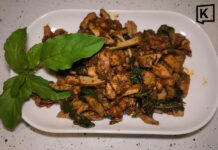
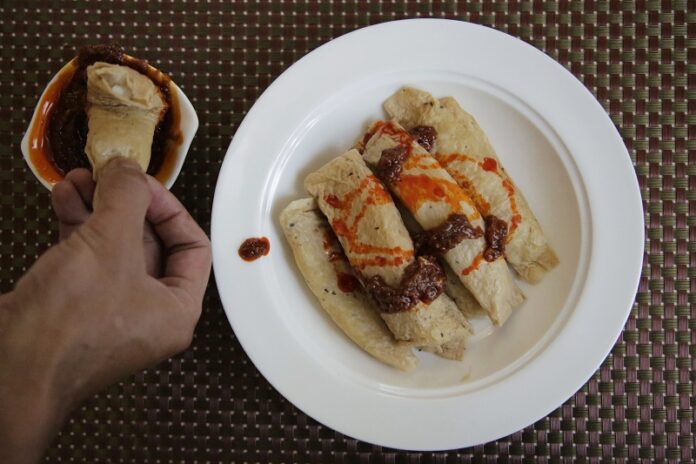
"Injogogibap" or beancurd skin stuffed with rice, a dish invented during the famine, is dipped into a spicy sauce June 16 in Pyongyang, North Korea. Photo: Wong Maye-E / Associated Press

INCHEON, South Korea — The little restaurant isn’t much to look at. It’s across the street from an empty lot in a city where bland high-rise apartment buildings sprawl in every direction. Boxes of dried fish are stacked by the front window. A dirty mop stands in the corner. The walls are painted a vomitous green.

But people come from across South Korea to eat here. They come for the potato pancakes, the blood sausage and, very often, for a fried street food that many dreamed of back when nearly everyone they knew was hungry. More than anything, though, they come for memories the food brings back of an outcast homeland they may never see again.

“This is the taste of where they came from,” says the restaurant’s owner, a refugee who asks to be identified only by her surname, Choi. “The food here tastes the way it does in North Korea.”

More than 30,000 North Koreans now live in South Korea, having fled poverty, hunger and the relentless pressures of life in an oppressive, authoritarian state. But for most, life in the South is far from ideal. Raised amid dictatorial dysfunction, and normally poorly educated, the exiles stumble into a brutally competitive nation where they are regularly disdained by their neighbors.

“Chon-nom” they are often called  “bumpkin.”

That derision, combined with their own disillusionment, can churn into a stew of suspicion, resentment and ambivalence. And though they may hate the nation they left behind, many also miss it deeply. Because how can you not miss home?

“Our lives here can be so difficult,” said a North Korean now living in the South. “But finding that restaurant made me so happy.” She spoke on condition her name not be used; even North Koreans who fled years ago remain concerned about reprisals against them or relatives still in the North.

Choi has built them a tiny island of North Korean life that starts to feel crowded if it has more than a half-dozen customers. In a burst of optimism she named it Howol-ilga, “People from Different Homelands Come to Gather in One Place.”

“My place is a comfort for them,” says Choi, 39, in a Northern accent so thick it can be barely comprehensible at first to Southerners. “When they come here and find a menu so similar to what they ate back home, they know they can relax.”

At first glance Choi doesn’t seem very relaxing. Gruff and often scowling, restaurant work has left her hands patterned with small knife cuts and her forearms spattered by ugly oil burns. She has only two employees, and keeps the restaurant open seven days a week. Exhaustion is a constant. She cannot remember her last day off.

But eventually  when she finally sits down to talk, chugging a can of Georgia Original coffee  a smile crosses her face.

Choi grew up in a small town so close to North Korea’s Amnok River border that you could wave to people in China. She learned cooking from her father, a onetime military cook who loved working in kitchens  rare in the North’s deeply conservative culture  and from relatives who smuggled in goods from China. “They had learned Chinese cooking there,” she said.

The family was far from rich, but made enough trading in clothes, cheap electronics and DVDs of South Korean TV shows to count as middle-class. It was enough to avoid the horrors of North Korea’s mid-1990s famine, which killed at least 500,000 people and perhaps well over a million. Years later, most North Korean refugees still refer to the famine by its Pyongyang-mandated euphemism.

“Even in the Arduous March we didn’t suffer much,” Choi says, shrugging. “It’s my family’s fate to escape living in poverty.”

She left the North in 2012, looking for a better life for her young son, and opened the restaurant two years later.

Modesty isn’t an issue for her.

“All of my customers talk about how good I am,” she says. “They tell me: ‘When I eat in other restaurants, it doesn’t taste like what I used to eat in the North. What you cook tastes completely different!'”

A South Korean, she insists, could never succeed in her kitchen.

“A cook’s appetite is different” when they come from another place, she says, leaning against one of her fake wood tables. “They taste things in a different way. So how could they cook this kind of food?”

Food and history are as tangled at Howol-ilga as they are in North Korea, where three generations of dictators have vowed to end a relentless, centuries-old struggle against hunger.

“Socialism is rice!” the country’s founding ruler, Kim Il Sung, proclaimed regularly in the 1960s, promising that everyone would soon be eating meat soup and rice every day. Instead, as South Korea became a global economic power the North lurched into its nightmare years, culminating in the 1990s famine. While the era of mass starvation is over, malnutrition remains a major problem, particularly among young children and pregnant women. And many Northerners still use food to talk about money and class differences, often saying, for example, that only the rich “eat rice every day.”

One of Choi’s best-loved dishes is injogogibap, a street food invented during the famine, when it was the closest thing to meat most people could afford.

Bits of leftover fried tofu, which in earlier days had been thrown away, were scraped from pots and pressed into hot dog-sized tubes that were then stuffed with rice. It’s delicious and filling (though tastes nothing like meat), with the tofu absorbing random flavors from cooking pots.

At the worst of times, when the smell of frying injogogibap would waft from food stalls into streets filled with hungry people, it became an object of fantasy. Even today some exiles dream about it.

That doesn’t surprise Sonia Ryang, an anthropologist at Rice University in Texas who grew up in a pro-North Korea community in Japan, and who has written extensively about the North. To smell injogogibap was to dream of filling your stomach at a time when starvation was wiping out entire neighborhoods.

“Far from not wanting to remember, they want to remember,” says Ryang. “Because it was proof that they were alive.”

Choi’s explanation is simpler. During the famine, she says, food was something that could always make people happy.

She smiles: “Eating is joyful.”

Story: Tim Sullivan

Advertisement

Helicopter Fires 15 Shots at Venezuela Interior Ministry, 4 Grenades at Supreme Court

Venezuela's President Nicolas Maduro gives a news conference in 2017 in Caracas, Venezuela. Photo: Ariana Cubillos / Associated Press

CARACAS, Venezuela — President Nicolas Maduro said a police helicopter fired on Venezuela’s Supreme Court on Tuesday in a confusing incident that he called a thwarted “terrorist attack” aimed at ousting him from power.

The exchange took place as Maduro was speaking live on state television to pro-government journalists. More than hour after the flyover ended, he told the audience that the helicopter had fired on offices of the court as a social event was taking place and launched a grenade that didn’t explode. He said the nation’s air defense was activated, preventing any loss of life.

“It could’ve caused a tragedy with several dozen dead and injured,” said Maduro, who sounded alternately calm and angry as he told the audience about what had happened in the airspace just beyond the presidential palace where they were gathered.

Associated Press reporters heard what sounded like loud gunfire as a blue helicopter buzzed through downtown around sunset but was unable to confirm where the explosions were coming from.

Meanwhile many of Maduro’s opponents on social media accused the president of orchestrating an elaborate ruse to justify a crackdown against Venezuelan seeking to block his plans to rewrite the constitution. Venezuela has been roiled by anti-government protests the past three months that have left at least 75 people dead and hundreds injured.

Adding to the intrigue, pictures of a blue police helicopter carrying an anti-government banner appeared on social media around the same time as a video in which a pilot for the police squad, identified as Oscar Perez, called for a rebellion against the Maduro’s “tyranny” as part of a coalition of members of the security forces.

“We have two choices: be judged tomorrow by our conscience and the people or begin today to free ourselves from this corrupt government,” the man said while reading from a statement with four people dressed in military fatigues, ski masks and carrying what look like assault rifles standing behind him.

There were no immediate reports of casualties.

Maduro said one of the pilots involved in the alleged attack used to fly for his former Interior Minister, Miguel Rodriguez Torres, who he accused of working for the CIA. Rodriguez Torres, who has been leading a campaign against by Maduro made up of leftist supporters of the late Hugo Chavez, immediately dismissed the accusation as baseless.

The helicopter incident capped a volatile 24 hours that began with widespread looting in the coastal city of Maracay on Monday night and continued Tuesday when opposition lawmakers got into a heated scuffle with security forces assigned to protect the National Assembly.

At least 68 supermarkets, pharmacies and liquor stores were looted and several government offices burned following anti-government protests in Maracay, which is about a 90 minute drive from Caracas.

On Tuesday, opposition lawmakers got into fisticuffs with national guardsmen as they tried to enter the National Assembly. At nightfall, a few dozen people were still gathered inside the neoclassical building as pro-government supporters stood outside threatening violence.

Story: Joshua Goodman

Advertisement

New Cyberattack Causes Global Mass Disruption

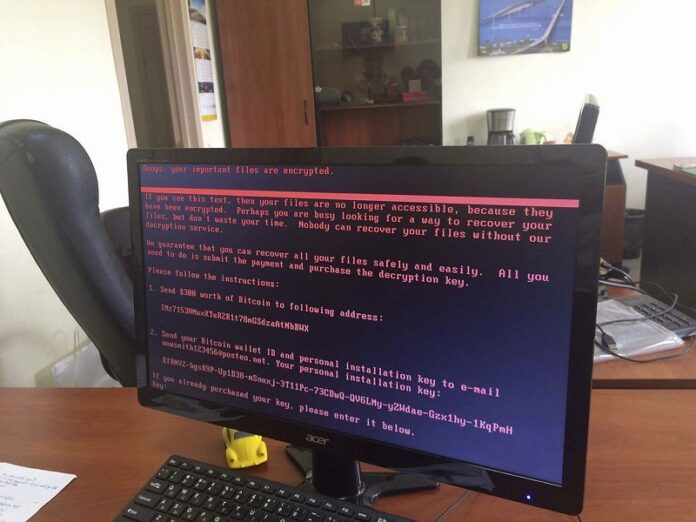
A computer screen cyberattack warning notice reportedly holding computer files to ransom, as part of a massive international cyberattack, Tuesday at an office in Kiev, Ukraine. Photo: Oleg Reshetnyak / Associated Press

PARIS — A new and highly virulent outbreak of malicious data-scrambling software appears to be causing mass disruption across the world, hitting companies and governments in Europe especially hard.

Officials in Ukraine reported serious intrusions of the country’s power grid as well as at banks and government offices, where one senior executive posted a photo of a darkened computer screen and the words, “the whole network is down.” The prime minister cautioned that the country’s “vital systems” hadn’t been affected.

Russia’s Rosneft oil company also reported falling victim to hacking and said it had narrowly avoided major damage, as did Danish shipping giant A.P. Moller-Maersk.

“We are talking about a cyberattack,” said Anders Rosendahl, a spokesman for the Copenhagen-based shipping group. “It has affected all branches of our business, at home and abroad.”

The attack was confirmed to have spread beyond Europe when U.S. drugmaker Merck, based in New Jersey, said its systems had also been compromised.

The number of companies and agencies reportedly affected by the ransomware campaign was piling up fast, and the electronic rampage appeared to be rapidly snowballing into a worldwide crisis.

There’s very little information about what might be behind the disruption at each specific company, but cybersecurity experts rapidly zeroed in on a form of ransomware, the name given to programs that hold data hostage by scrambling it until a payment is made.

“A massive ransomware campaign is currently unfolding worldwide,” said Romanian cybersecurity company Bitdefender, where analyst Bogdan Botezatu said that it appeared to be nearly identical to GoldenEye, one of a family of hostage-taking programs that has been circulating for months. Some analysts were calling the new form of ransomware Petya.

It’s not clear whether or why the ransomware has suddenly become so much more potent, but Botezatu said that it was likely spreading automatically across a network, without the need for human interaction. Such self-spreading software, often called “worms,” are particularly feared because they can replicate rapidly, like a contagious disease.

“It’s like somebody sneezing into a train full of people,” Botezatu told The Associated Press. “You just have to exist there and you’re vulnerable.”

The world is still recovering from a previous outbreak of ransomware, called WannaCry or WannaCrypt, which spread rapidly using digital break-in tools originally created by the U.S. National Security Agency and recently leaked to the web.

“Data breaches and cyber hacks are one of the biggest risks facing business worldwide,” said Michelle Crorie, a partner at law firm Clyde & Co. who specializes in cybersecurity issues. “The WannaCry attack and now Petya clearly demonstrate that hackers do not discriminate which type of business they are targeting.”

This particular variant of ransomware leaves a message with a contact email; several messages sent to the address were not immediately returned.

Story: Raphael Satter

Advertisement

Thailand Should Prosecute Officials, US Says in Trafficking Report

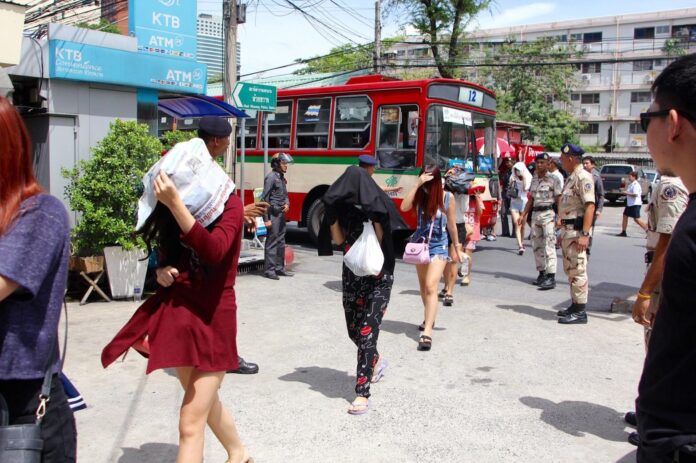
Sex workers rescued from Nataree Entertainment were brought to Huai Khwang Police Station on June 8, 2016, for questioning.

LOS ANGELES — Thailand remained in the second tier of nations in an annual US human trafficking report released Tuesday.

Tier 2 status in the US State Department’s 2017 Trafficking in Persons report means Thailand does not meet its standards but is making efforts to improve the situation. Thailand was upgraded last year from the lowest level, Tier 3, in a decision which proved controversial with human rights defenders working in the kingdom.

As it has routinely over the years, the report described Thailand as a source, destination and transit country for trafficked men, women and children.

It praised the government for “significant efforts” by “seizing more than 784 million baht … from traffickers, reporting more investigations, prosecutions, and convictions, convicting a business owner complicit in forced labor in the fishing sector, and extending the amount of time foreign trafficking victims and witnesses may be permitted to stay and work in Thailand.”

It faulted the government for not stepping up its efforts, however.

It said Bangkok “did not aggressively prosecute and convict officials complicit in trafficking crimes, and official complicity continued to impede anti-trafficking efforts. Officials identified fewer victims compared to the previous reporting period, and although forced labor investigations slightly increased, the number of labor trafficking investigations was low compared to the scale of the problem.”

The first among its recommendations was that Thailand “proactively investigate and prosecute officials allegedly complicit in trafficking, and convict and punish those found guilty” with meaningful sentences.

Decisions to upgrade certain nations, such as Myanmar’s previous elevation from Tier 3, have been met with criticism the report has been politicized by the State Department to curry favor or punish governments rather than be a straight assessment of the facts.

Thailand was downgraded to Tier 3 in 2014 where it remained for two years.

Advertisement

Virtual Thailand: Check in to the Dusit Thani Hotel (VR)

BANGKOK — When it comes to the changing skin of the city, the only cruel constant is change. But virtual reality can preserve what reality taketh away.

Take a brief tour of the Dusit Thani hotel, which was one of Bangkok’s first high-rise hotels and even had a discotheque when it opened in 1970. Sadly the prime example of Thai modernism and symbol of Bangkok’s swinging days will be demolished in 2018 to make way for a mixed-use development.

The video is available embedded above and below from YouTube. On the desktop, use your pointing device to look around. On a smartphone, simply move your phone to change the viewing direction. Users of Samsung Gear VR, Google Cardboard or virtual reality headsets should check their documentation on how to watch on their devices.


Related stories:

Artists Invade Bangkok’s Swankiest Hotel (Video)

Drawn-Out Goodbyes Made to Vanishing Bangkok

Bangkok’s Dusit Thani Hotel Gets Date With Wrecking Ball

Advertisement

Take Command of ‘General P’ in Thai Mobile Game

Photo: Heaven Heroes / Facebook

BANGKOK — Joining King Arthur, Lancelot, the Monkey King, Apollo and Athena in an online hero brawler comes General P.

A Thai online game company announced Tuesday it will soon release a new mobile game called Heaven Heroes, a hero-based bash ’em up will feature in its roster a military character named General P, an apparent reference to prime minister and junta leader Gen. Prayuth Chan-ocha.

“I’d totally play this game because it has an uncle I know. Let me download it. I’ll make this country great again,” user Ball Manou Tapaasd wrote on Facebook.

In an ad promoting the game, the general is shown next to a monk wearing sunglasses, possibly another reference to a certain former abbot who has defied the junta boss.

The game will be released in open beta on July 4 for both IOS and Android. Users can register in advance online.

Heaven Heroes is developed by Ini3 Digital, a Thai game company founded in 2004 and known as a pioneer of free-to-play games.

Some gamers were concerned whether it would last long.

“Will the game face Article 44?” Aof Anucha wrote in a comment.

“Gotta play it before it’s shut down,” Noctiz Cynthia wrote.

GENP1
Photo: Heaven Heroes / Facebook
Advertisement

Stolen Antique Shop Sign Returned to Owner

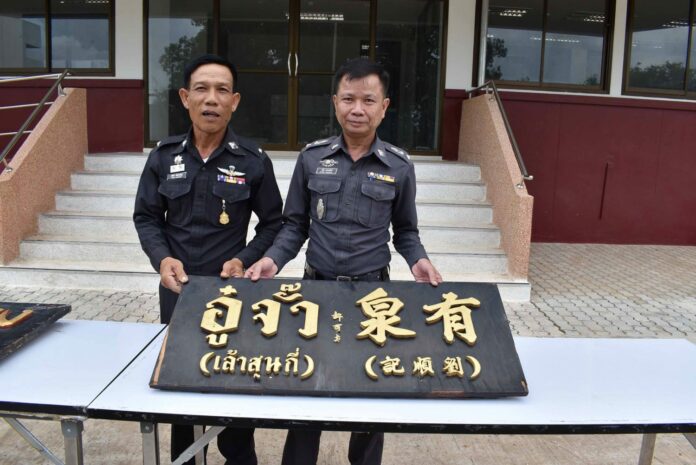
Police officers pose with the century-old sign of Lao Sun Kee grocery store on Tuesday. The century-old sign was stolen but returned through the mail. Read: Stolen Antique Shop Sign Returned to Owner

KALASIN — A century-old shop sign was unexpectedly returned to its owner Tuesday, a week after it was stolen.

Police in Kalasin province said the stolen sign was mailed to its rightful owner through mail. Post office workers spotted the package and alerted authorities Friday, according to police.

Grocery store owner Jiraporn Laopongpitch said she was happy to be reunited with the family heirloom passed down to her from her grandparents, who emigrated from China and opened the shop about a century ago.

“I’d like to thank police and the media for their news coverage and for pressuring the perpetrators to return the sign,” Jiraporn said at a news conference at the Kamalasai Police Station.

The sign of Lao Sun Kee grocery store went missing on June 18. Security camera footage shows a man taking it down in the early hours before driving away on a motorcycle.

Police said the theft investigation will continue. Officers are tracking down the suspect based on fingerprints found on the mail package.

Jiraporn suspected the thief worked for a gang known to prey on antique signs in Sino-Thai communities. Experts believe these artifacts can fetch tens of thousands of baht in the black market.

Advertisement

Oil Extraction on Protected Land Resumes Under Junta’s Shield

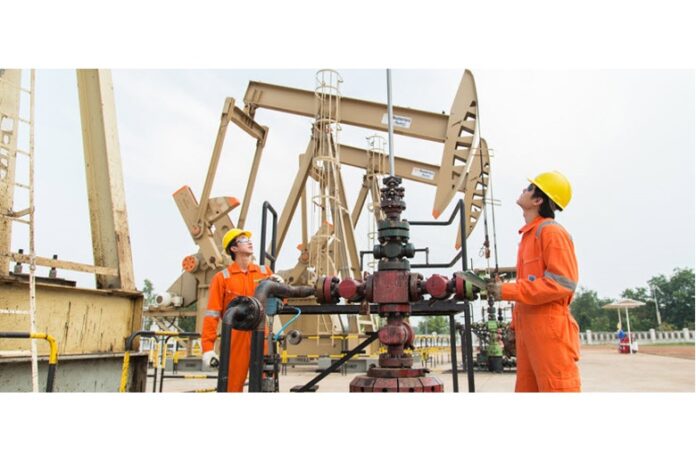
Photo: PTTEP

BANGKOK — Oil companies resumed operations Monday after the junta chief used his self-granted absolute power to overturn a court order and give them permission to continue their activities on land reserved for farmers.

The PTT Exploration and Production Co. Ltd., or PTTEP on the stock market, said they recommenced their petroleum production Monday on land which had originally been allocated for agricultural use after halting operations for 23 days due to a court order.

Read: Junta to Order Oil Production Restarted on Protected Land

The pause was the result of a June 1 ruling by the Supreme Administrative Court, which deemed that land reserved under the 1975 Agricultural Land Reform Act could not be used for other purposes, in light of which the Agricultural Land Reform Office had revoked concessions granted to several companies.

Following the verdict, the company had to stop operations on June 3 in the Lan Krabue district of Kamphaeng Phet province – despite having been active there since 1982.

It triggered the largest decrease in the company’s market value in four months.

A government spokesman said last week the junta’s special power was needed in this case to restore the production of energy and investors’ confidence.

A Friday order issued by the junta’s extralegal authority permitted the usage of land reserved for the promotion of farmers’ rights to be used for energy production – including mining and the generation of wind energy.

It said companies that never sought the authorities’ permission – and are illegally operating on protected land – are also allowed to resume their activities while they seek official approval.

The order wrote that the reform office must compensate affected farmers.

Apart from the PTTEP – the majority of which is owned by state oil company PTT – the order also benefitted another six companies whose productions were also located on protected land.

The company said the 23-day halt of the petroleum production in Lan Krabue district resulted in a 0.4 percent loss of their expected annual sales.

Advertisement

Vets Look to Rehabilitate ‘Paley,’ Sea Turtle Pale From Captivity

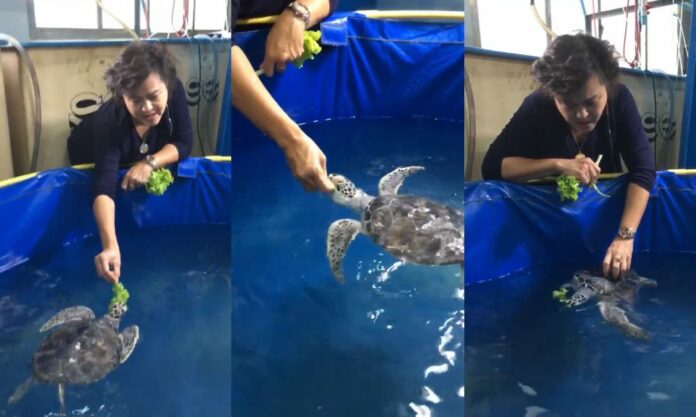
Nantarika Chansue, vet, feeds Paley in a video posted to her Facebook Tuesday.

BANGKOK — Marine experts at Chulalongkorn University said Tuesday that they were rehabilitating a green sea turtle that had grown ill after living in captivity.

The young female green sea turtle – named Paley because of the discoloration in her skin and shell – was handed over to the care of Chulalongkorn University after its owner kept it in a freshwater pond where the animal had grown ill, said Natarika Chansue, a veterinarian at Chulalongkorn University.

“She’s pale because she doesn’t get sunlight and was kept in freshwater,” Nantarika said by phone Tuesday. “The owner bought her illegally.”

Nantarika posted two videos of Paley on her Facebook page in which she introduced the reptile to the world.

Unaware that Paley was a sea turtle, the owner had kept her in a freshwater pond and decided to hand her over to the authorities when she started weakening.

Keeping protected animals such as the green sea turtle in captivity without permission is illegal in Thailand, a crime punishable by up to a 30,000 baht fine or three years in jail – or both. The owner, who authorities did not identify, was not charged. Nantarika said she would work with the Department of Marine and Coastal Resources to rehabilitate Paley.

While the animal is eating better than before, Nantarika says “her blood and skin are still not strong enough” and that “her recovery could take months.”

Nantarika and her team is training Paley to be less familiar with humans and to dive for food in saltwater to survive in the ocean.

“Paley shows us that it’s possible to train turtles be returned to the ocean. Before, she wanted humans to scratch her back often, but now she can show us she doesn’t like it,” Nantarika says in the video, as the turtle splashes away from her hand.

Nantarika ends her post with a plea for people to stop bringing exotic marine animals into captivity.

“This is one more life that was brought to become part of humans’ lives, but soon she will go back to living her own life,” Nantarika said as she fed Paley lettuce.

Earlier this year, Nantarika operated on Piggy Bank, an older female green sea turtle who survived an operation that removed almost a thousand coins from her stomach in March, but later died from surgical complications.

Related stories:

Turtley Crowded: Temple Promises More Space for Reptile Residents (Photos)

Turtle Watch: Coins Found Inside Two of Piggy Bank’s Friends (Photos)

Piggy Bank’s Turtle Friends to be Checked for Coins

Nation Mourns Piggy Bank, Takes Hard Look At Self

Piggy Bank, Giant Sea Turtle Who Ate Too Many Coins, 25

Now Empty of Coins, ‘Piggy Bank’ in Terminal Decline

Chula Vets Divest Turtle’s Stomach of 915 Coins (Photos)

‘Piggy Bank’ Ate Too Many Coins. Now Chula Vets are Trying to Save Her

Advertisement

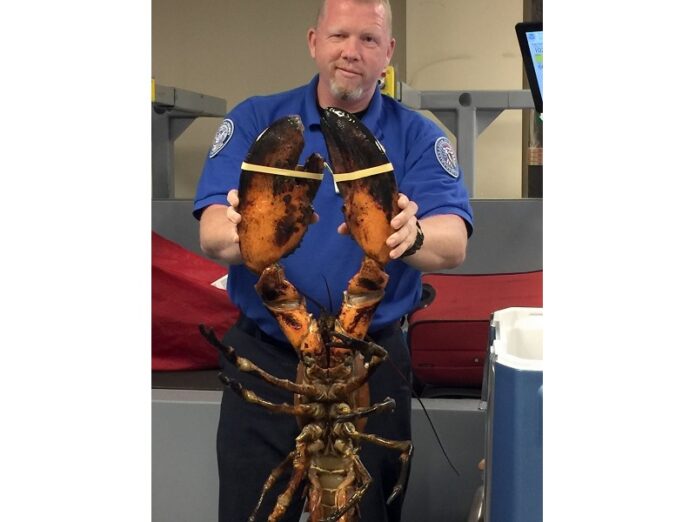
20-Pound Live Lobster Found in Luggage at Boston Airport

A TSA agent holding a live lobster that weighs roughly 20 pounds seen here Sunday at Boston's Logan International Airport. Photo: Associated Press

BOSTON — The Transportation Security Administration says a 20-pound (9-kilogram) live lobster has been spotted in a passenger’s luggage at Boston’s Logan International Airport.

TSA spokesman Michael McCarthy says the lobster found Sunday in the passenger’s checked luggage at the airport’s Terminal C is the “largest” he’s ever seen.

McCarthy says the TSA doesn’t prohibit transporting lobsters. The TSA website says a live lobster is allowed through security but must be transported in a “clear, plastic, spill-proof container.”

McCarthy says the lobster was in a cooler and “cooperated quite nicely with the screening process.”

He shared a picture of a TSA agent holding up the crustacean on social media.

Advertisement

Hot News

LATEST NEWS

Bangkok
overcast clouds
31.1 ° C
31.6 °
28.3 °
73 %
3.7kmh
100 %
Mon
29 °
Tue
35 °
Wed
34 °
Thu
34 °
Fri
28 °