26.1 C
Bangkok
Saturday, June 20, 2026
Home Blog Page 2300

Merit-Making Ceremony Held for Stuffed ‘Piggy Bank’ at Chula (Photos)

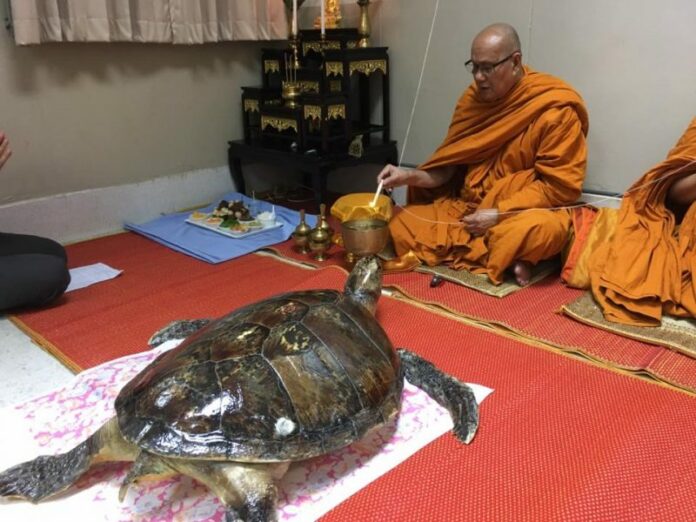
Taxidermied Piggy Bank, 25, at a merit-making ceremony Wednesday at Chualongkorn University. Photo: Nantarika Chansue / Facebook

BANGKOK — A merit-making ceremony was held Wednesday for a sea turtle who became internationally famous in March after surviving a surgical procedure to remove almost 1,000 coins from her stomach but later died from complications.

Read: Piggy Bank, Giant Sea Turtle Who Ate Too Many Coins, 25

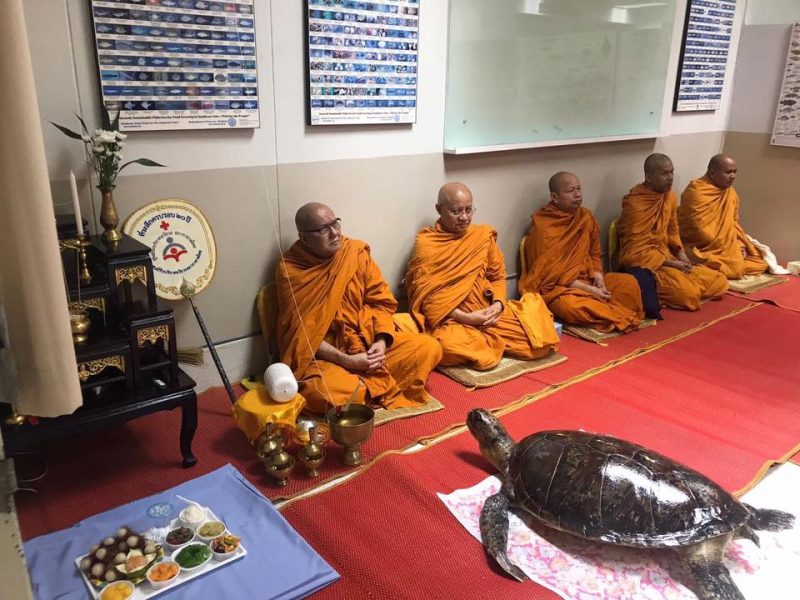
Monks from Wat Pathum Wanaram and faculty members of Chulalongkorn University’s Veterinary Medical Aquatic Animal Research Center held a merit-making ceremony for Piggy Bank, a turtle who rose to fame in March for successfully undergoing surgery to remove 915 she had ingested. The turtle’s body was stuffed for Wednesday’s ceremony, as Buddhists believe it will allow the 25-year-old sea turtle to rest in peace and reincarnate.

“We all focused and prayed for Piggy Bank’s soul to rest in peace and reincarnate in a better place,” wrote Nantarika Chansue, Piggy Bank’s vet on her Facebook page Wednesday.

“This sea turtle is going onto the shores of dharma,” Facebook user Saowanee O’shaughnessy commented.

Female green sea turtle Ormsin, or Piggy Bank, gained international fame after an X-ray revealed a mass of coins she had swallowed from her time in a pond lodged in her gut. Although Piggy Bank survived the surgery – which removed coins of various denominations – the animal later died from surgery complications.

The turtle’s death led vets to condemn the practice of throwing objects into ponds as a belief of good luck and to raise awareness about the harm this causes to animals living in them.

19114031 10155678764624271 5800499553011445960 n e1497684451905
Clergy from Wat Pathum Wanaram on Wednesday preside over a ceremony for Piggy Bank. Photo: Nantarika Chansue / Facebook
19059191 10155678756399271 2350829755496904828 n e1497684439221
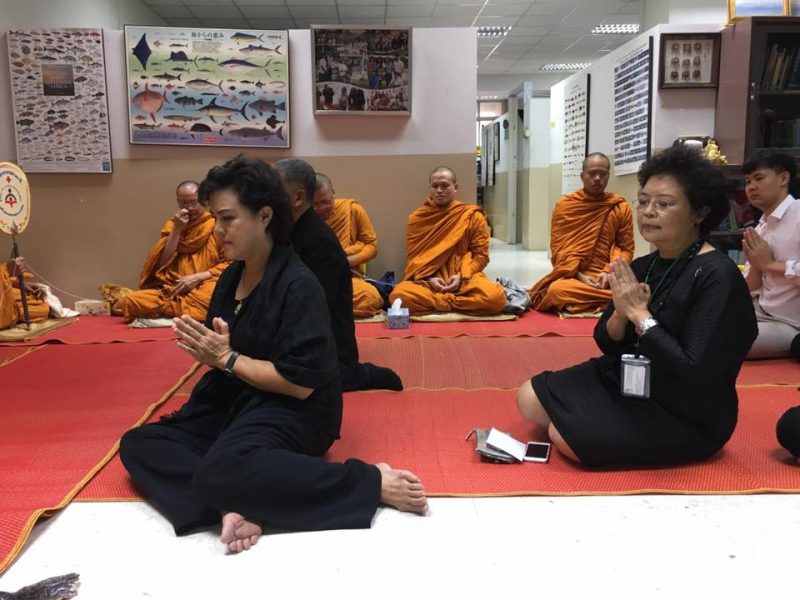
Left, Nantarika Chansue, Piggy Bank’s vet, Wednesday at the turtle’s merit-making ceremony.

Related stories:

Turtley Crowded: Temple Promises More Space for Reptile Residents (Photos)

Turtle Watch: Coins Found Inside Two of Piggy Bank’s Friends (Photos)

Piggy Bank’s Turtle Friends to be Checked for Coins

Nation Mourns Piggy Bank, Takes Hard Look At Self

Piggy Bank, Giant Sea Turtle Who Ate Too Many Coins, 25

Now Empty of Coins, ‘Piggy Bank’ in Terminal Decline

Chula Vets Divest Turtle’s Stomach of 915 Coins (Photos)

‘Piggy Bank’ Ate Too Many Coins. Now Chula Vets are Trying to Save Her

Advertisement

Celebrities Share the Best Advice They Ever Got from Dad

Actor Hugh Jackman poses for photographers during a press conference of his film "Logan" in May in Tokyo. Photo: Eugene Hoshiko / Associated Press

NEW YORK — Dads sometimes know best.

In time for Father’s Day on Sunday, a range of artists from film, television and music shared the most valuable lessons from their own dads:


Patty Jenkins, “Wonder Woman” director, daughter of a Vietnam War veteran

“Perseverance and focus, first of all, because I think that that kind of job of being a fighter pilot is strangely difficult. You’re on your own and you just have to put one foot in front of the other, figuratively speaking, to get things done and to deal with whatever comes up. And that actually comes up. That is very present in my life as a director every day.”


James Taylor, music legend

“Just to be there for your family. I’ve tried to be as much as possible. If there is a struggle, that’s it, trying to balance family life and life on the road.”


Hugh Jackman, “Logan” star

“Education. He preached education. And passion, like find whatever you’re good at then do everything you can to learn every bit of it, and don’t go out into the world until you’ve studied.”


Ashley Campbell, daughter of Glen Campbell, who is battling Alzheimer’s

“This one piece of advice really stuck with me. We were on tour and it was toward the end of the tour, so he was definitely not as there, not as with it. So moments of clarity were very noticeable. He looked at me and said, ‘How’s your music going?’ I, joking, said, ‘It’s going well. I am going to be a superstar!’ Very self-deprecatingly. And he got really serious and he said, ‘Be a super person and the superstar will follow.’ That’s Glen wisdom.”


Connie Nielsen, Hippolyta actress in “Wonder Woman”

“My father always said, ‘You belong in that room. No matter what, you can do whatever you want.'”


Bonnie Raitt, daughter of the late Broadway musical star John Raitt

“I think his positivity and seeing the good in people. He just never said bad words about anyone. I really believe it was that outlook, really honoring people and trying to find out who they really are underneath what they present themselves to be.”


Kate Mara, star of the film “Megan Leavey”

“The one that I sort of use every day, I guess, is just a good handshake because in this business, specifically, but I’m sure everybody meets new people on a daily basis, a firm handshake, I think, goes a long way. To this day there’s nothing worse than kind of a half-ass handshake from someone. I think it says a lot about your character.”


Bryan Canston, star of “Wakefield”

“You reflect on being a son, you reflect on being a father, and it’s a good time. For past issues that I’ve had with my father, now he’s passed and you kind of think of things differently. But the joy for me is being so proud of my daughter, who’s now 24 and an actor in her own right, and independent and a freethinking, funny, talented young woman.”


Mayim Bialik, co-star of “The Big Bang Theory”

“He taught me a lot of lessons. My dad had a really big personality, and he was a really gracious person. I don’t know if it’s a lesson in particular but it was a way that he was. He wasn’t afraid to let his big personality show, and sometimes that was a good thing and sometimes it was a bad thing. But when he walked into a room you knew it. That’s a powerful lesson, to see the presence of a person.”


Matt Smith, star of “The Crown” on Netflix

“My dad said to me very early on, ‘It’s not the disappointments, son. It’s how you get over them.’ And that, that — I’ll pass that onto my son, you know? Yeah. He was 70 (recently) so we kind of celebrated his birthday. He’s a very important man in my life, my dad. Probably the most important.”


Lucy Davis, Etta actress in “Wonder Woman”

“One of the things he said to me was, ‘If you give, you get. But not if you give to get.’ And I love that. And it made you realize that you just have to be the person you want to be just because that’s what you want to be, not because you think there’s going to be a reward at the end.”


Tom Bergeron, host of “Dancing with the Stars”

“Well we’d go out in the back 40 and, you know, clear some of the brush, slaughter a few hogs and then have a big meal. That’s in the old days, though.”


Barry Watson, star of “Date my Dad”

“My father always said luck is when opportunity meets preparation, so always be prepared, which I try to be!”

Story: Leanne Italie

Advertisement

US Policeman Acquitted in Killing of Motorist

This combination of file photos show key figures in the manslaughter trial of St. Anthony police officer Jeronimo Yanez in the July 2016 death of Philando Castile. Photo: Associated Press

MINNEAPOLIS — A Minnesota police officer was acquitted Friday in the killing of a black motorist that drew widespread attention when video of the shooting’s aftermath was streamed live on Facebook.

Key figures in the manslaughter trial of St. Anthony police officer Jeronimo Yanez in last July’s death of Philando Castile:


The Driver

Castile, 32, was a longtime elementary school cafeteria worker who family members described as loving and laid-back. Quick with a high-five for students and always eager to sneak kids extra graham crackers and other treats, Castile was known simply as “Mr. Phil.” One teacher testified at trial that Castile remembered which kids had allergies, and nudged students to finish their veggies.

Police had pulled Castile over many times before. Although he had no serious criminal record, The Associated Press examined records that show he was pulled over around 50 times in recent years in the Minneapolis-St. Paul area, typically for minor offenses such as driving on a suspended license or without proof of insurance, speeding, driving without a muffler or not wearing a seat belt.

His girlfriend, Diamond Reynolds, testified that on the day of the shooting, he had gone to work, went to get his hair dreaded for his upcoming birthday, then picked her up to go grocery shopping. They were on their way home when he was shot.

She testified he had a gun, and a permit to carry it, for protection.


The Officer

Yanez, who is Latino, had worked for the St. Anthony Police Department for nearly five years. He testified that he stopped Castile because he thought Castile looked like a suspect in a recent armed robbery. A faulty brake light gave the 29-year-old officer justification to pull Castile over.

After the shooting, Yanez’s body microphone captured audio of him saying first that he didn’t know where the gun was, but then that he told Castile to take his hand off the gun. Yanez testified that he clearly saw a gun and that Castile ignored his commands to stop pulling it out of his pocket.

“I was scared to death. I thought I was going to die. My family’s faces popped up in my mind, my wife and baby girl,” Yanez said, his voice choked with emotion.


The Girlfriend

Millions of people saw Reynolds in her live Facebook stream as Castile lay bleeding next to her in the driver’s seat. She was praised for her split-second decision to stream the shooting’s aftermath and her measured responses to Yanez, who had just fired shots into the car and still had his gun out.

Reynolds testified that she started recording because she feared for her own life.

“Because I know that the people are not protected against the police,” Reynolds said. “I wanted to make sure if I died in front of my daughter that people would know the truth.”

The defense attacked Reynolds’ testimony and pointed out several inconsistencies in statements she made to authorities and in public. She also acknowledged that she and Castile smoked marijuana regularly, and that marijuana was in the car at the time of the shooting.

Reynolds’ daughter — 4 years old at the time — was also in the car.


The Partner

Officer Joseph Kauser was called as backup when Yanez initiated the traffic stop.

Squad video shows Kauser was standing on the passenger side of the car and jumping back when the shots were fired. He testified that he didn’t see Castile’s gun, but noted that he was paying more attention to the car’s passengers. He said the situation didn’t seem alarming, and the shooting surprised him.

Kauser also testified that he trusted Yanez as a partner. He said he believed the officer followed proper protocol and that Castile was moving after Yanez told him not to reach for the gun.


The Mother

Castile’s mother, Valerie Castile, emerged as a calm voice for change after her son’s death. She urged protesters to remain peaceful while also calling on lawmakers to consider improvements in police training, hiring and other issues she felt contributed to her son’s death.

“He is the driving force in me to make sure this doesn’t happen to another mother,” she has said.

She remained stoic during the trial, sitting silently in the front row — across the aisle from Yanez’s family — as the squad car video of her son’s shooting was played repeatedly. She declined to comment to reporters during the course of the trial.

She has hired attorneys and plans a lawsuit.


The Prosecutors

Ramsey County Attorney John Choi made the decision to charge Yanez, and a team of seasoned attorneys from his office prosecuted the case.

State prosecutors Rick Dusterhoft and Clayton Robinson, and federal prosecutor Jeff Paulsen, played squad car video of the shooting repeatedly as they presented their case. Paulsen questioned Kauser at length about police procedure, what he saw during the stop, and how the shooting took him by surprise. When Kauser said, “I don’t know what (Castile) was reaching for,” Paulsen replied, “Exactly. He could’ve been reaching for his wallet.”


The Defense

Yanez hired three prominent Minnesota attorneys — Paul Engh, Earl Gray and Thomas Kelly — who have all handled big cases before.

During the trial, the three took turns cross-examining the state’s witnesses and presenting arguments to the jury. Gray pointedly went after Reynolds on cross-examination, flustering her as he exposed many issues in statements she made.


The Judges

Judge William H. Leary III is head of Ramsey County District Court’s civil division. Leary, who is white, was assigned to the case after Yanez’s attorneys asked to have another judge, who is black, removed.

Minnesota law allows defense attorneys to remove one judge without citing a reason, and Yanez’s attorneys declined to say whether race was a factor.

Leary ran a no-nonsense courtroom during the trial. He issued an order in advance saying he would allow no outward facial expressions or outbursts from the gallery.


The Jury

The 12 jurors that deliberated Yanez’s case included two black people. The rest of the jurors are white.

Story: Amy Forliti

Advertisement

Girlfriend Whose Texts Urged Suicide Guilty of Manslaughter

Michelle Carter appears in Taunton Juvenile Court on June 9 in Taunton, Massachusetts. Glenn Silva / Associated Press

TAUNTON, Massachusetts — A woman who sent her boyfriend a barrage of text messages urging him to kill himself when they were both teenagers was convicted Friday of involuntary manslaughter in a trial that raised questions of whether words can kill.

Juvenile Court Judge Lawrence Moniz found that Michelle Carter caused the death of Conrad Roy III, who intentionally filled his truck with carbon monoxide in a Fairhaven store parking lot in July 2014. Carter cried and clutched a handkerchief to her face as Moniz detailed her conduct and the circumstances of Roy’s death, but she was stoic when the verdict was formally pronounced.

The judge noted that the 18-year-old Roy climbed out of the truck as it was filling with toxic gas and told Carter he was scared. “Get back in,” Carter told Roy, according to a friend who testified Carter described the conversation in a text message to her about a month after Roy died.

“This court finds that instructing Mr. Roy to ‘get back in’ the truck constitutes wanton and reckless conduct by Ms. Carter,” the judge said.

He said Carter had a duty to call someone for help when she knew Roy was attempting suicide. Yet she did not call the police or Roy’s family, he noted.

“She did not issue a simple additional instruction: Get out of the truck,” the judge said.

Sobs broke out throughout the courtroom when the verdict was announced.

The judge ruled that Carter, now 20, can remain free on bail but ordered her not to make any contact with Roy’s family or leave the state.

She could face up to 20 years in prison. A sentencing hearing was scheduled for Aug. 3.

The sensational trial in Taunton offered a window into teen depression and suicide through text messages and Facebook communications.

Carter, who chose to have a judge hear the case over a jury, was 17 when she sent Roy dozens of messages urging him to take his own life.

“I thought you wanted to do this. The time is right and you’re ready, you just need to do it!” Carter wrote in one message.

Carter’s lawyer, Joseph Cataldo, argued Roy had a history of depression and suicide attempts and was determined to end his own life. He said Carter initially tried to talk Roy out of it and urged him to get professional help, but eventually went along with his plan.

The judge said he did not take into account in his verdict Roy’s previous attempts at suicide.

Roy’s father said outside court that the family was pleased with the conviction.

“This has been a very tough time for our family, and we’d like to just process this verdict that we are happy with,” Conrad Roy Jr. said.

Assistant District Attorney Katie Rayburn said the case dealt with important societal issues, “but in the end, the case was really about one young man and one young woman who were brought together by tragic circumstances.”

The American Civil Liberties Union denounced the conviction, saying it “exceeds the limits of our criminal laws and violates free speech protections guaranteed by the Massachusetts and U.S. Constitutions.”

Matthew Segal, the ACLU’s legal director for Massachusetts, called Roy’s suicide tragic but said, “It is not a reason to stretch the boundaries of our criminal laws or abandon the protections of our constitution.”

At trial, prosecutors focused on a series of text messages Carter sent Roy in the days before he killed himself.

“You can’t think about it. You just have to do it. You said you were gonna do it. Like I don’t get why you aren’t,” Carter wrote to Roy the day of his suicide.

Carter and Roy met in Florida in 2012 while visiting relatives. Their relationship largely consisted of text messages and emails.

Story: Denise Lavoie

Advertisement

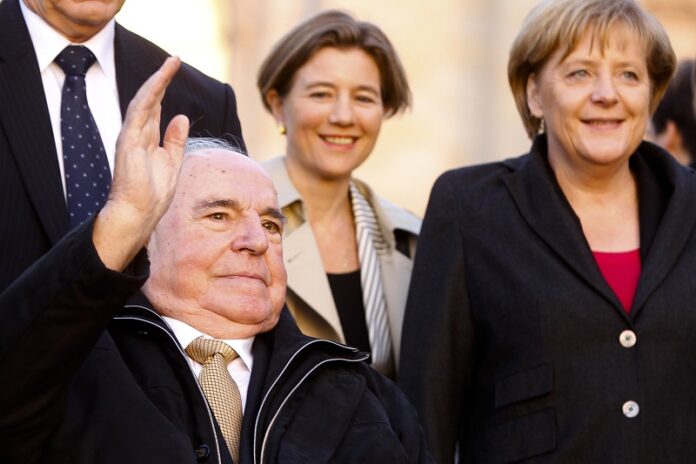
Helmut Kohl, Chancellor of German Reunification, 87

Former German Chancellor Helmut Kohl, left, waveing to audience as he arrives with his wife Maike Kohl-Richter, center, and Chancellor Angela Merkel, right, in 2010 at the Reichstag building in Berlin, prior to the celebrations marking the 20th anniversary of Germany's reunification. Photo: Markus Schreiber / Associated Press

BERLIN — Helmut Kohl, the physically imposing German chancellor whose reunification of a nation divided by the Cold War put Germany at the heart of a united Europe, died Friday at his home in Ludwigshafen. He was 87.

“A life has ended and the person who lived it will go down in history” said German Chancellor Angela Merkel, speaking from Rome. “It will take some time, however, until we can truly judge what we have lost in him. Helmut Kohl was a great German and a great European.”

During his 16 years at the country’s helm from 1982 to 1998 – first for West Germany and then all of a united Germany – Kohl combined a dogged pursuit of European unity with a keen instinct for history. Less than a year after the November 1989 fall of the Berlin Wall, he spearheaded the end of Germany’s decades-long division into East and West, ushering in a new era in European politics.

“When a new spirit began to sweep through Eastern Europe in the 1980s, when freedom was won in Poland, when brave people in Leipzig, East Berlin and elsewhere in East Germany staged a peaceful revolution, Helmut Kohl was the right person at the right time,” said Merkel. “He held fast to the dream and goal of a united Germany, even as others wavered.”

It was the close friendships that Kohl built up with other world leaders that helped him persuade both anti-communist Western allies and the leaders of the collapsing Soviet Union that a strong, united Germany could live at peace with its neighbors.

“Helmut Kohl was the most important European statesman since World War II,” Bill Clinton, the former U.S. president, said in 2011, adding that Kohl answered the big questions of his time “correctly for Germany, correctly for Europe, correctly for the United States, correctly for the future of the world.”

Former U.S. President George H.W. Bush said the world had lost “a true friend of freedom.”

“Working closely with my very good friend to help achieve a peaceful end to the Cold War and the unification of Germany within NATO will remain one of the great joys of my life,” Bush said. “Throughout our endeavors, Helmut was a rock – both steady and strong.”

President Donald Trump said Kohl was “a friend and ally to the United States as he led the Federal Republic of Germany through 16 pivotal years. He was not only the father of German reunification, but also an advocate for Europe and the trans-Atlantic relationship.”

“The world has benefited from his vision and efforts. His legacy will live on,” he said in a statement.

Russian President Vladimir Putin credited Kohl with “playing a key role in putting an end to the Cold War and with the reunification of Germany.”

Famed for his massive girth on a 6-foot-4 (1.93-meter) frame, Kohl still moved nimbly in domestic politics and among rivals in his conservative Christian Democratic Union, holding power for 16 years until his defeat by center-left rival Gerhard Schroeder in 1998.

That was followed by the eruption of a party financing scandal which threatened to tarnish his legacy.

For foreigners, the bulky conservative with a fondness for heavy local food and white wine came to symbolize a benign, steady – even dull – Germany.

Kohl’s legacy includes the common euro currency – now used by 19 nations – that bound Europe more closely together than ever before. Kohl lobbied heavily for the euro, introduced in 1999, as a pillar of peace – and when it hit trouble more than a decade later, he insisted there was no alternative but for Germany to help out debt-strapped countries like Greece.

Once viewed as a provincial bumbler, Kohl combined an understanding of the worries of ordinary Germans with a hunger for power, getting elected four times.

Kohl served longer than Konrad Adenauer, West Germany’s first post-World War II chancellor and his political idol. Only Otto von Bismarck, who first unified Germany in the 1870s, was chancellor longer, for 19 years.

“Voters do not like Kohl, but they trust him,” Rita Suessmuth, a former speaker of parliament, once said.

Often harsh and thin-skinned, Kohl also could display a quick wit and jovial earthiness. He ate pasta with Clinton and took saunas with Russia’s Boris Yeltsin.

Kohl linked his dedication to a united Europe to his roots in a part of Germany close to France and his memories of a wartime boyhood. He celebrated the European Union’s eastward expansion in 2004 with a speech declaring that “the most important rule of the new Europe is: There must never again be violence in Europe.”

Still, the “blooming landscapes” that Kohl promised East German voters during reunification were slow to come after the collapse of its communist economy, and massive aid to the east pushed up German government debt. He also drew criticism for failing to embark on economic reforms.

Born on April 3, 1930, in Ludwigshafen, a western industrial city on the Rhine, Kohl joined the Hitler Youth but missed serving in the Nazi army. As a 15-year-old, he was about to be pressed into service in a German anti-aircraft gun unit when World War II ended. His oldest brother, Walter, was killed in action a few months earlier.

A Roman Catholic, Kohl joined the CDU in his teens shortly after its postwar founding. He earned his doctorate in 1958 at the University of Heidelberg with a dissertation on the politics of Rhineland-Palatinate and became governor of that western state in 1969.

His first attempt to unseat Social Democratic Chancellor Helmut Schmidt failed in 1976, but Kohl seized his chance six years later, taking power on Oct. 1, 1982 when a junior coalition party switched sides.

He won elections in 1983 and 1987, then rode to an election triumph in 1990 on a wave of post-unity euphoria.

Kohl was reluctant to view united Germany as a major power because of its Nazi past. Still, he slowly edged his country toward greater responsibilities in the 1990s, as Germany sent troops for U.N. humanitarian missions in Cambodia, Somalia and elsewhere, and deployed peacekeepers to Bosnia.

He pursued reconciliation with Germany’s eastern neighbors, though some critics said he moved too slowly after the fall of the Iron Curtain.

Kohl was helped in securing German unity by his friendships with French President Francois Mitterrand and Soviet leader Mikhail Gorbachev, who approved NATO membership for a united Germany and agreed to pull Soviet troops out of East Germany.

“It was real luck that at that difficult time leading nations were headed by statesmen with a sense of responsibility, adamant about defending the interests of their countries but also able to consider the interests of others, able to overcome the barrier of prevailing suspicion about partnership and mutual trust,” Gorbachev said Friday in a statement released by his foundation.

Kohl’s earlier bridge-building with the U.S. also paid off. The stationing of U.S. Pershing II missiles in Germany starting in 1983, despite huge domestic protests, had established trust in Washington that was crucial to creating a single German state.

“It was a stroke of luck that there were about four to six leaders in power in the mid-80s who really trusted one another and could really make things happen,” Kohl later recalled. In his memoirs, he described George H.W. Bush as “the most important ally on the road to German unity.”

He praised former British Prime Minister Margaret Thatcher for her honesty, even as he recalled a confrontation with her just days after the fall of the Berlin Wall.

“I cited a 1970s-era NATO statement and said that NATO supported reunification. … Thatcher stamped her feet in anger and screamed at me, ‘That’s how you see it! That’s how you see it!'” he wrote.

In a poignant gesture of reconciliation in 1984, Kohl held hands with Mitterrand during a ceremony at a World War I cemetery in Verdun, France.

Another gesture of friendship and reconciliation the following year turned into a public relations fiasco. Kohl’s trip with then-U.S. President Ronald Reagan to a war cemetery in Bitburg where SS troops were buried alongside ordinary German soldiers generated international indignation.

Kohl’s relationship with Gorbachev, the last Soviet leader, also had to overcome early turbulence. In a 1986 interview, Kohl was quoted as comparing Gorbachev’s public relations skills with those of Nazi propaganda minister Joseph Goebbels. The Soviet Union protested.

Elation over German reunification ebbed amid the harsh realities of its cost and the difficulties of integrating east and west, but Kohl’s coalition squeaked by again in 1994. Yet high unemployment and Germans’ yearning for change gradually sapped his authority, provoking a humiliating loss to Schroeder’s center-left Social Democrats in 1998.

The following year, Kohl plunged his party into crisis when he admitted accepting undeclared – and therefore illegal – donations during his time as chancellor. Kohl refused to identify the donors.

His silence helped trigger a parliamentary inquiry and was condemned by many, both inside and outside his party, but Kohl vehemently denied that any decisions by his government were bought.

When Bonn prosecutors launched an investigation into possible breach-of-trust charges in January 2000, Kohl was pressured to give up his party’s symbolic honorary chairmanship – notably by Merkel, a longtime Kohl protegee who served for seven years in his Cabinet and followed him into the chancellery in 2005.

In a 2001 deal with Bonn prosecutors, the probe was dropped in exchange for a 300,000-mark fine (about USD $140,000 at the time) – giving Kohl the legal stamp of innocence. That was a common German practice but judicial investigations into other figures in the murky financing scandal continued.

In another battle after his departure from power, Kohl fought and won a lengthy legal fight to prevent the release of most of the files held on him by East Germany’s secret police. Journalists and historians had asked to see the material, prompting speculation it could shed light on the financing scandal. Kohl, however, argued successfully that the wiretaps used by the Stasi to spy on him were illegal and that he deserved protection from damage to his “human dignity.”

Kohl’s estrangement from his party lasted until 2002, when its new leaders invited him to speak at a convention as they sought to regain power.

The former chancellor was married for 41 years to Hannelore Renner, an interpreter of English and French who stood firmly but discreetly by his side. They had two sons, Peter and Walter.

In July 2001, Hannelore killed herself at age 68 in despair over an incurable allergy to light. In 2005, Kohl introduced his new partner Maike Richter, an economist some 35 years his junior. The couple married in May 2008.

Though slowed by illness in his later years, Kohl still made occasional eye-catching interventions on the political stage. As Merkel struggled to convince center-right lawmakers in 2011 of the wisdom of having Germany finance further bailouts of other eurozone nations, Kohl weighed in firmly.

“There must be no question for us that we in the European Union and the eurozone stand by Greece in solidarity,” he declared.

He also appeared to question Merkel’s approach at a time when conservatives were unsettled by her decision to speed up Germany’s exit from nuclear energy and by Germany’s abstention in a U.N. vote on a no-fly zone over Libya.

“I ask myself where Germany stands today and where it wants to go,” he said.

In April 2016, Kohl welcomed Hungarian Prime Minister Viktor Orban – who had clashed with Merkel over Europe’s approach to a large influx of refugees – to his home. That coincided with the publication of a new foreword to a Kohl essay in which the ex-chancellor stated that “Europe cannot become the new home for millions of people in need worldwide.”

Despite their differences, Merkel made clear Friday that Kohl had touched her life deeply when he helped forge a united Germany.

“Like millions of others, I was able to go from a life under a dictatorship to a life of freedom,” she said. “He will continue to live in our memories as a great European and as the Chancellor of reunification.”

Story: Geir Moulson

Advertisement

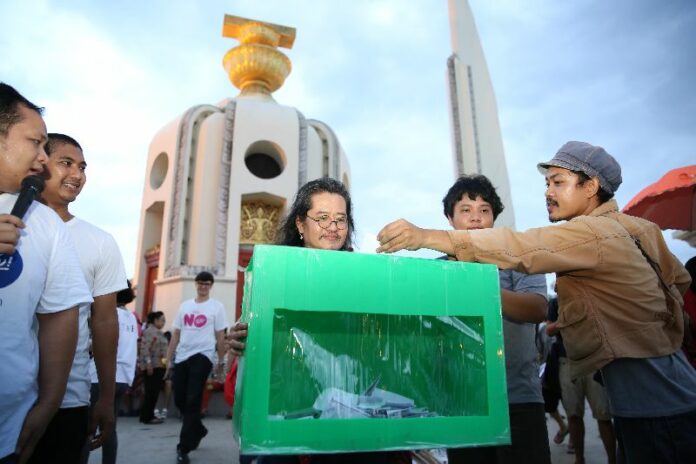
Govt Says Elections on Course, Politico Cries ‘Farce’

Hundreds gathered at Bangkok's Democracy Monument on the second anniversary of military rule on May 22, 2016.

BANGKOK — General elections should take place by the end of 2018, a spokesman for those who wrote the new constitution said Friday.

Speaking at a forum that saw politicos from the two largest parties sit down alongside government representatives at Chulalongkorn University, Norachit Sinhaseni of the Constitution Drafting Commission sought to dispel skepticism that a poll will be held.

Those assurances did not appear to convince the politicians seated at the table, such as former Pheu Thai MP Chaturon Chaisang and senior Democrat Party member Kasit Piromya, who remained unsure of the time frame and described the regime’s commitment to restoring democracy as a “farce.”

“[The] timeline has changed many times already,” said Chaturon, noting that Norachit’s comments made it clear there remained room for postponement. “So we’re not sure that elections will be held as scheduled.”

Either way, they said the new constitution ensures the junta will dominate politics for as long as eight years after an election is held.

Kasit said the whole thing reflected a “top-down” approach designed to impose the military’s conservative will upon society and politics.

“[There will be] more and more concentration of power in Bangkok, and not the decentralization that we hoped for. The military junta looks for stability. Stability is the name of the game,” Kasit told the audience. “There’s not much room for us to play.”

Speaking for the government, Norachit telegraphed positivity, saying that the legal framework that needed to be in place before the election could be held was ahead of schedule.

There are several laws that need to be passed to move forward. The first, pertaining to the Election Commission, was approved by the rubber-stamp legislature a week ago. Other legislation regulating political parties was approved Thursday, as were those pertaining to the House of Representatives and the Senate.

The work of drafting those and 10 other laws must be completed in December, or 240 days after the constitution was signed into effect by the king on April 6. Then the king would have 90 days to consider the laws, and an election must be held within 150 days after the palace signs off on them.

That would make elections possible in August 2018 at the earliest.

The discussion on election prospects came at a public forum organized by the Chulalongkorn’s Institute of Security and International Studies along with the Washington-based National Democratic Institute and the Friedrich Naumann Foundation.

Chaturon of Pheu Thai, which held a mandate from the electorate until it was ousted by the military in 2014, said he’s not confident a poll would take place next year. The veteran politician and former education minister, noted junta leader Gen. Prayuth Chan-ocha’s recent comments that there would be no elections if unrest continues. Since April, three bomb attacks have hit the capital.

While he said the new constitution is undemocratic and detrimental to the country’s development, his political rival Kasit of the Democrat Party was possibly more pessimistic.

The promised process to restore democracy, he said, “is only a farce.”

Kasit said he fears enduring military rule will leave a lasting mark.

“I feel fearful of what will happen to Thailand. We will become a sort of confused child because no one can act with their own intellectual capacity, because everything is already imposed.”

Chaturon said the new charter shifts power from the people to the elite and bodies with no accountability with voters.

On Thursday, the National Legislative Assembly voted 109-95 to set minimum funding levels for political parties that would discourage the creation of new parties.

“Political parties will be weakened and their role will be limited. It will be difficult for small parties to survive and hard for new party to get started.”

Advertisement

Defamation Trial of Student Activist’s Mother Begins

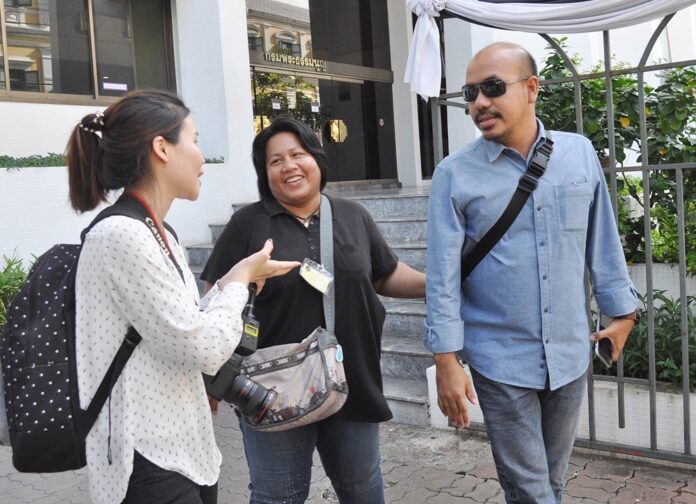
Patnaree Chankij talks to reporters in front of Bangkok military court Friday.

BANGKOK — Testimony began Friday in the trial of a prominent student dissident’s mother who faces up to 20 years in prison for writing the word “yeah” in a Facebook conversation about the country’s monarchy.
Domestic worker Patnaree Chankij is accused of insulting the monarchy, a crime known as lese majeste for which she could serve three to 15 years in prison. She is also charged with offenses under the Computer Crimes Act, which carries a penalty of up to five years in prison. She has pleaded innocent to all charges. Friday’s first and only witness, an army officer who filed the complaint against her, laid out the details of the prosecution’s case.
Critics believe the real purpose of the case is to pressure her son, Siriwit Seritiwat, or “Ja New,” who is one of the most outspoken activists against the military junta that overthrew a democratically elected government in a coup in 2014.

The case arose out of an online chat last year in which the other participant criticized the monarchy. At the end of the conversation Patnaree wrote the word “ja,” a colloquial term meaning “yeah” or “OK,” which is often taken to indicate acknowledgement rather than agreement. In January a man was sentenced to 11 years and 4 months in prison for his part in the conversation.

Heeding her lawyer’s advice, Patnaree, 41, is careful what she says about her case, but speaking earlier this week, her son at her side, she denied she had any intention to join in or endorse criticism of the monarchy in the conversation.

“I am fighting this charge to prove my innocence,” she told The Associated Press. “My intention, my thought and the text that I wrote have already shown that I had no such idea (to defame the monarchy).”

Her son said he was the government’s real target.

“First they tried telling my family to get me to stop taking part in activities,” Ja New said. “I insisted I wouldn’t stop. So in the end they’ve had to find some other way to stop me. That’s why we’ve ended up here.”

This week the office of the United Nations High Commissioner for Human Rights expressed its concern over a more than doubling of lese majeste cases since the military takeover, a rise that shows no sign of slackening since the accession late last year of King Vajiralongkorn Bodindradebayavarangkunan. It also said it was deeply troubled by how few people are acquitted and by the courts’ persistence in handing down what it called “disproportionate sentences.”

Supporters of the lese majeste law argue that the monarchy is a sacred pillar of Thai society and must be protected at all costs. Critics of the measure say it is used as a weapon to silence dissent.

Advertisement

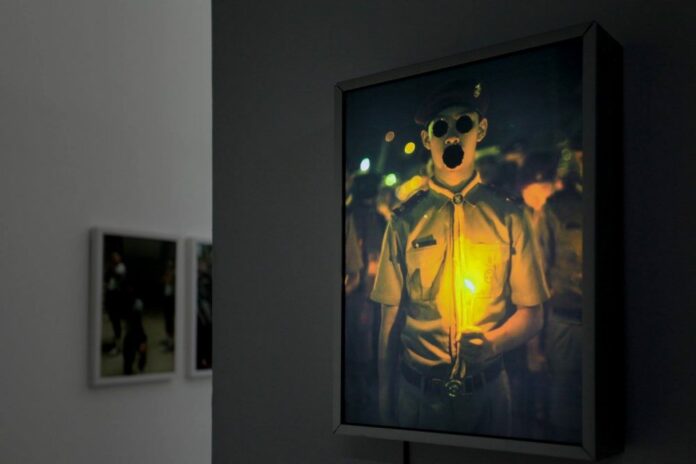
Soldiers Remove Artworks From Bangkok Gallery

A photo of the "Whitewash" exhibition. Image: Gallery Ver / Facebook

BANGKOK — Soldiers visited two art galleries in downtown Bangkok Thursday and ordered one to remove three photographs from an exhibition without citing any reason.

Held in two adjacent art galleries, one exhibition depicted the lives and memories of political prisoners while the other was an homage to the 2010 military crackdown on Redshirt protests which left more than 90 people dead.

It’s the latest effort by the military to micromanage their ban on political activities, in place since the May 2014 coup. Soldiers have previously blocked film screenings, academic seminars and even university football parades.

Tada Hengsapkul said “three to four” uniformed soldiers first came at about 1pm to his exhibition at the Cartel Artspace gallery and demanded entry. They misunderstood that lese majeste convict Pronthip “Kolf” Mankong was the one hosting the exhibition, Tada said.

In fact, Pronthip’s portrait was featured among other political prisoners’ in the “The Shards Would Shatter At Touch” exhibition, which opened May 20 and ends Tuesday. Pronthip, now a campaigner for the welfare of women prisoners, had written a critical piece about the use of her image without her permission for Prachatai, a news site known for its progressive and anti-establishment stance. Tada believed that’s how the military learned of his exhibition.

“I already apologized to her. I thought the matter was over, but she wrote about it on Prachatai,” Tada said Friday, adding that he knew the article might invite attention. “I knew it right away, soldiers would definitely come visit us.”

The soldiers only learned Pronthip was uninvolved upon entering the gallery, Tada said. He also told them he had removed her portrait – and all others – long before their arrival because of her complaint. Satisfied with the explanation, the soldiers soon left the gallery.

While Tada might have been spared censorship, Harit Srikhao, whose exhibition “Whitewash” was being held next door – was not, by chance.

While officers waited for Tada’s staff to fetch the key to get inside, the soldiers wandered into a nearby building and ran into Harit’s exhibition, which contrasts images of the bloody 2010 crackdown with pictures of everyday life.

Upon spotting the exhibition, soldiers entered the venue, called Gallery Ver, and demanded the owner take down three collages from the wall. Harit said he was not at the gallery at the time, so he had no idea what offended the soldiers.

“I’m not sure what the reasons were,” Harit said. The spots where the pieces hung have been left empty without explanation per agreement with the gallery owner, he added.

Tada said the soldiers were unarmed and were accompanied by several police officers. None of them identified their unit, he said.

Sompot Suwancharas, chief of the police station with jurisdiction over the area, said he had not heard anything about the visit.

Soldiers have become a common sight in everyday life since the 2014 coup, having adopted dual roles as law enforcement officers and security forces for the ruling junta. To enforce the junta’s ban on political activities, soldiers have forced the organizers of various events to cancel, from discussion panels to cultural shows.

They’ve become regular sights monitoring and filming shows which might be interpreted as political, such as an abstract performance piece based on the 1976 massacre of students at Thammasat University.

On Wednesday, security forces were dispatched to the concert of a country singer the prime minister had criticized for dressing and dancing provocatively. They asked her to put on a jacket. Kolf, whose article critical of her image being used in Tada’s exhibition prompted the military response, was herself jailed for a student play deemed offensive to the monarchy.

Tada said he was not that surprised by the soldiers’ visit. His exhibition is about current and former prisoners serving time on political charges.

“I’m already used to this kind of thing in this country,” Tada said, adding that he worried the attention and publicity about what happened would “scare off” new generations of artists.

Harit, whose exhibition was censored by the soldiers Thursday, said what happened “was not beyond expectation” but lamented the effect on his work.

“It doesn’t personally affect me, I don’t think so, but it affects the content of my work,” Harit said. “Three pictures are missing. It’s now an incomplete work.”

Related stories:

Police Sent to Cover Up Teen Country Singer ‘Lumyai’

Junta Bans Bookstore Talk on Draft Charter

Three Students Arrested During Hunger Games Premiere

Advertisement

Cult of Pancakes: IHOP Opens at Siam Paragon

Pancakes topped with berries, peaches and whipped cream. Photo: IHOP Thailand / Facebook

BANGKOK — An American pancake chain opened its first branch in Thailand on Friday at Siam Paragon mall.

After announcing in December it would open a branch in Bangkok, American breakfast food chain IHOP, or International House of Pancakes, opened it store today at Siam Paragon.

Read: Batter Up for Pancakes and More as IHOP Coming to Paragon

Those familiar with IHOP can expect to clog their arteries with chocolate chip, blueberry and cheesecake pancakes as well as waffles.

IHOP was founded in 1958 in Southern California. Today the franchise chain has more than 1,600 branches in North America, the Middle East and the Philippines.

Advertisement

Chiang Mai Barista’s Fancy Foam Art Named World’s Best

Arnon Thitiprasert makes latte art Thursday in Budapest, Hungary. Photo: Barista Association of Thailand / Facebook

BANGKOK — A Chiang Mai barista brought woodland critters to life in fancy foam to claim victory Thursday as the world’s best latte artist.

Besting more than 40 baristas worldwide, Arnon “Tong” Thitiprasert, the owner of Ristr8to cafe in Chiang Mai, won the World Latte Art Championship in Budapest, Hungary. Four competitions were held Tuesday through Thursday: the World Latte Art Championship, World Brewers Cup, World Coffee in Good Spirit Championship and World Cup Tasters Championship.

It was the latest accolade won by Tong, who has picked up awards worldwide for his skill. He started working as a barista in 2007 in Sydney before opening Ristr8to on Nimmanhaemin Road in Chiang Mai city.

19092633 1585022511509601 1370320055762641885 o e1497605122182
Photo: Coffee T&I Magazine / Facebook
19225778 1585022471509605 7944672320696667991 n e1497605188944
Photo: Coffee T&I Magazine / Facebook


Advertisement

Hot News

LATEST NEWS

Bangkok
overcast clouds
26.1 ° C
26.1 °
26.1 °
93 %
1.8kmh
100 %
Sat
33 °
Sun
35 °
Mon
37 °
Tue
37 °
Wed
36 °