French children walk past World War II veteran paratroopers as they deliver floral arrangements to dignitaries who will lay them at a war memorial in 2011 during a ceremony in Sainte Mere Eglise, France. Photo: Michael J. MacLeod / Wikimedia Commons
PARIS — France’s government has quietly backtracked on a policy that allowed children to leave the country without their parents’ permission, after years of complaints from families of radicalized teens who left to join extremist groups.
The new rules requiring parental permission go into effect Sunday, five years after the government lifted the restriction with little fanfare, citing a need to streamline bureaucracy.
At the time, the war in Syria was picking up and France became Europe’s largest source of recruits in the war zone, notably for the Islamic State group. Families said they were blindsided when their teenage sons and daughters were allowed to pass through border control no questions asked and even leave Europe’s passport-free zone for Turkey.
“We have to do everything we can to prevent minors from going into the terrorist zone,” lawmaker Patrick Hetzel told France 3.
But critics say the reversal comes far too late.
Samia Maktouf, a lawyer for two families that sued the government over their teenagers’ departures for Syria, has called for this policy shift for years.
“Unfortunately, they’re taking action rather late,” she told The Associated Press. “Four hundred French minors are now at the gates of Hell.”
Tourists were returning Thursday to Koh Samui’s Chaweng beach.
SAMUI — Samui beaches were back to life Thursday as severe flooding in the south started easing in some areas.
Water levels fell on average in all 12 southern provinces where heavy rains had caused flash floods for more than a week, killing 36 people and affecting more than one million residents.
The damage is now estimated at 22 billion baht. Forecasts for economic growth in the southern region economic have been revised down 2 percent for year, down from the 3.2 percent originally forecast by the University of the Thai Chamber of Commerce.
The flood affected agriculture and business, two key sectors in the south’s economy. Tourism and transportation along with fishing, rubber production and palm oil plantations were damaged.
People evacuate their flooded homes Thursday in Surat Thani province.
The Meteorological Department said Thursday the south should soon resume seasonal typical weather with water levels returning to normal.
They still have a way to go. The water stood two- to three-meters high in many provinces as of Thursday afternoon.
A bird’s-eye view over Songkhla province shows water levels still in crisis.
The southern railway remains cut off but service was extended further southward to the Thung Song station of Nakhon Si Thammarat province.
All public bus routes resumed operation with modified timetables. Most will leave earlier due to traffic congestion on affected roads.
An undated photo of Sonam Tsuboi posted online by his brother.
BANGKOK — A Japanese tourist reported missing in Bangkok’s backpacker district just over two weeks remained unaccounted for Thursday, as his mother flew in to join the search efforts.
Sonam Tsuboi, 22, was last seen Dec. 27 at the Mama Guesthouse on Khaosan Road, according to a post shared online by his brother Tama Tsuboi, who said he would also come to Bangkok on Monday if the tourist is still missing at that time.
“We have contacted every police station in the country and so now they are aware,” Tama said via online chat. “My mother and father will search by themselves with a few friends going to places he might be.”
Police in the area of Khaosan Road confirmed they received a missing person report on Sonam on Dec. 27 and opened an investigation.
Tama said his brother was traveling with a friend “but made many friends on his stay.” Sonam’s family found out he went missing because his girlfriend was supposed to meet him at the airport and he never showed up, Tama said.
He said he’s received no helpful leads so far.
“We’ve tried everything through social media but no information,” Tama wrote. “So there’s not much anyone can do right now apart from actually going there and spending time looking for him.”
A screengrab of Sorayuth Suthassanachinda’s Facebook Live reporting on flooded areas in Hua Sai district, Nakhon Si Thammarat.
NAKHON SI THAMMARAT — Sorayuth’s back.
After disappearing from the airwaves 10 months ago, convicted news anchor Sorayuth Suthassanachinda has waded, waist-deep, back to national audiences via Facebook live videos narrating the severe flooding in southern Thailand.
Since Sunday, the veteran journalist and former Channel 3 anchor has been posting field reports watched by millions, many of whom have welcomed him back warmly despite his tainted corruption.
“Since you left, I’ve never turned on Channel 3. Their quality really decreased, and it’s not as fun,” commented user May Waranpassorn on a Monday clip in which he chats with a man fishing in the floodwaters.
That clip has been watched more than a million times and shared more than 9,000 times.
Sorayuth, who had just begun a new live stream at the time of publication, could not be reached for comment. A woman identifying herself as his secretary said he was in the field doing his thing.
His fans rejoiced when he first reported on the floods in Phetchaburi province before moving on to Nakhon Si Thammarat on Monday, Prachuap Khiri Khan on Tuesday and Surat Thani on Wednesday. In the latest posted Thursday, he hangs out with a local kanom jeen maker and chats with people about their waterlogged village.
Still it’s far from the millions he drew in every day as the face of Channel 3 before being convicted of fraud in February 2016.
Sorayuth was found guilty of embezzling 138 million baht in sales of advertising airtime through a company he ran. He resisted calls to step down and only did so under pressure in March. He was sentenced to 13 years in jail but is free on bail while his case is under appeal.
None of that has dampened the affection of many who began every day with his voice making sense of things from behind his news desk.
“You really are a man of the people,” user Tanaporn Wichai wrote. “You go to where the people are suffering instead of abandoning us.”
United Nations Secretary-General Ban Ki-moon speaks on Sept. 9 during an interview at U.N. headquarters. Photo: Bebeto Matthews / Associated Press
SEOUL, South Korea— Former U.N. Secretary-General Ban Ki-moon said Thursday he’ll soon announce whether to run for South Korea’s top job as he returned home and strongly hinted at his political ambitions before hundreds of cheering supporters.
Ban’s return will likely heat up local politics as he’s considered as the only major conservative contender in a possible early election to replace impeached President Park Geun-hye. Dozens of lawmakers already bolted from Park’s conservative ruling party and want to align with Ban, while the main liberal opposition party is escalating political offensive against him.
“Many people have asked me whether I have a will for power. If ‘will for power’ means uniting a divided country into one and making it a first-class country again, then I have already said I am ready to burn my body in devotion to this and my mind hasn’t changed,” Ban told a televised conference upon his arrival at Incheon International Airport near Seoul.
As his supporters shouted his name, Ban, a former South Korean foreign minister, said he’ll get diverse opinions about his return to South Korean politics. “Based on my talks will people, I will make a decision that will be free from selfish motives. That decision won’t take long,” he said.
Opinion polls show Ban is one of the favorites to succeed Park, who is now on trial at the Constitutional Court that will determine whether to formally end her rule and hold a new election. The opposition-controlled parliament impeached her last month over her alleged roles in an explosive corruption scandal. South Korea is originally scheduled to hold a presidential election in December.
Ban, who ended his 10-year service as U.N. chief last month, is a soft-spoken career diplomat known for a gentle image and an ability to avoid making enemies. But he also faced criticism that he lacks charisma and experience in domestic politics.
Many South Koreans have taken great pride in him because they think Ban’s top U.N. job represents their country’s rise in the international arena from the rubbles of the 1950-53 Korean War. But critics say Ban would not have assumed the U.N. post without the help from the government of late President Roh Moo-hyun, which reportedly made massive efforts to make him a first South Korean U.N. chief.
Ban denied an allegation in the media that he took bribes from a businessman who was at the center of a corruption scandal that led to Roh’s suicide in 2009. Two relatives of Ban were charged in an indictment unsealed Tuesday with plotting to bribe a Middle East official to influence the $800 million sale of a building complex in Vietnam.
Ban’s main potential rival is Moon Jae-in, a former leader of the largest opposition Democratic Party who lost the 2012 election to Park. A survey released this week by Realmeter showed Moon had 27.9 percent approval rating compared to Ban’s 20.3 percent. The survey of 1,511 respondents had a margin of error of 2.5 points.
From left, director Boonsong Nakphoo, film journalist Suparp Rimtheparthip, consumer advocates Chalaporn Suksamran and Kanpassorn Suriyasangpetch, film director Tanwarin Sukkhapisit, director Genwaii Thongdenok, distributor Pat Eaimtrakul and director Chartchai Ketnust holdd hands Wednesday at the Bangkok Art and Culture Centre.
BANGKOK — A coalition of filmmakers, distributors and movie lovers gathered Wednesday to demand equal access and fair competition for the Thai film industry.
Frustrated by a system that makes it difficult for their films to be seen, filmmakers united as the Thai Filmmakers Network to take on the commercial interests they see holding back their industry and art.
“Now, the industry is hitting its low point, where Thai films lack support and equal screening opportunity,” said independent director Boonsong Nakphoo. “I know how to get by, but it’s not enough. The industry must be able to survive.”
Those who see the domestic film industry as producing only formulaic comedies, horror movies and period dramas may find common cause with the network, who blame the two major corporate cinema owners for colluding to be box office king-makers.
On Wednesday at the Bangkok Art and Culture Centre, the eight representatives from different parts of the industry, made four demands of the two major corporate cinemas that control the market: SF Cinema and Major Cineplex.
Film director Boonsong Nakphoo read the Thai Filmmakers Network’s statement to solve Thai film industry Jan. 11 at Bangkok Art and Culture Centre.
For one, they want multiplex cinemas to give over no more than 20 percent of their screens to a single film in order to make space for non-blockbusters. They also asked that Thai-made films be shown five times daily for at least two weeks, and a 2008 law fixing a ratio of imported and domestic films be enforced.
The network also asked for the abolition of the Virtual Print Fee, an outdated subsidy theaters still demand distributors pay. Intended to help ease the transition to digital, the subsidy is a costly hurdle for mid- and small-size filmmakers. Finally, they asked the national antitrust commission to address the anti-competitive market forces in the industry so all Thai filmmakers have equal footing.
The network said it would submit its requests to the influential national film industry federation on Friday in hope it could help push for fair competition in the industry.
A representative from SF Cinema present at the event said communication was important.
“Filmmakers and cinemas have to rely on one another,” said Suwannee Chinchiewchan, executive vice-president of marketing. “It’s best for us to communicate and discuss more on the issue.”
She added that SF Cinema provides equal shares to distributors. Major Cineplex had not responded to inquiries by Thursday afternoon.
Stories Waiting to be Told
Domestic filmmakers believe audiences and the market for movies are being underserved.
They make films lauded by critics abroad that never get seen at home.
“Some people say that if Thai filmmakers make good films, people will definitely watch them,” said director Tanwarin Sukkhapisit, whose recent film ‘A Gas Station’ has received praise and been selected for the 2016 Busan International Film Festival.
Despite that, it opened in Thailand to earn only 9,000 baht on opening day.
“As word of mouth started to work, the film was kicked out after being shown in the chain theaters for seven days,” Tanwarin said.
A 16-year industry veteran, Tanwarin has learned its lessons the hard way. In 2010, his film “Insects in The Backyard” was banned by the Culture Ministry on moral grounds of for sex scenes between same-sex and opposite-sex couples and the main character’s decision to become a prostitute instead of finding another solution to life’s problems. After a five-year court battle, the film can now be shown, but only if a three-second sex scene between two men is deleted.
Even without the ban, the 43-year-old director says he barely profits from his films because of the unequal share offered by the chain theaters and the Virtual Print Fee costs.
Chartchai Ketnust said he faced similar problems with his directorial debut last year, a Thai-Burmese co-production. He said “From Bangkok to Mandalay” earned nothing in Thailand, but made 20 million baht in Myanmar.
The flood of Western imports drowns the domestic industry, he said.
“Thai movies often have to make way for Hollywood flicks, which take over 80 percent of the cinemas,” said Chartchai, whose film showed on few screens and was dropped in favor of Japanese animation hit “Your Name.”
Despite the growth of the Thai box office in recent years, domestic filmmakers have suffered.
The market share for Thai films fell from 22 percent in 2014 to 13 percent last year. More specifically, 38 Thai films earned only 565 million baht at the box office in 2016 compared to 4.1 billion baht from 245 foreign films.
Although the Wednesday press conference gained interest from the press, film fans and those in the business, the network has yet to win the support of industry commercial interests.
While they risk antagonizing those who control their reach to audiences, the cinema chains must be aware of changes in how and where people see films.
“Certain big cinemas don’t give fair shares to all distributors,” said Pat Eaimtrakul of HAL Distribution. “Fortunately we can gain something from House RCA and Bangkok Screening Room, which give equal after-tax shares along with adequate screening schedules.”
Tanwarin the director said it wasn’t only for their own sakes.
“What we do doesn’t mean to make enemies or ostracize anyone’s rights,” he said. “We just want to build a bridge so that Thai films can survive and to make the industry firm and sturdy,” he said.
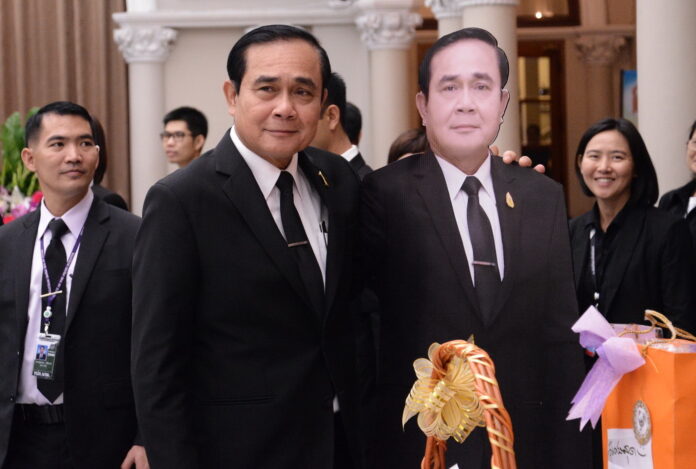
Gen. Prayuth Chan-ocha with his standee on Jan. 11 at the Government House in Bangkok.
BANGKOK — Thai could supersede English as the dominant world language – at least in the opinion of junta chairman Prayuth Chan-ocha.
After awarding trophies to youths Thursday at the Government House, Prayuth gave an address encouraging children to embrace their language, which he assured could one day become the world’s common language.
“The most commonly used language today is of course English. If it was Thai, we’d be a great power already. Is there a chance? Yes. If you do what I say, one day Thai will be the world’s lingua franca,” Prayuth said.
He added that although Thai is relatively difficult to learn, more people are learning the language.
“[Thai] has 44 characters … we have tones and more vowels than English. One word has many meanings. This is the pride Thais have built,” he explained.
Sahara, a rare red-haired female Hamadryas Baboon holds 3 weeks old dark-furred baby in 2015 in the Ramat Gan Safari Park near Tel Aviv, Israel. Photo: Ariel Schalit / Associated Press
PARIS — Baboon grunts and mating calls may hold secrets about human speech, according to a new study suggesting that the origins of human language could reach back as much as 25 million years.
The barks, yacks and wa-hoos of the Guinea baboons reveal distinct human-like vowel sounds, according to the study published Wednesday in the journal Plos One by scientists from six universities in France and Alabama.
The authors, led by Dr. Louis-Jean Boe of Grenoble Alpes University, studied the acoustics of 1,335 baboon sounds and the animals’ tongue anatomy.
They cast doubt on theories that language developed only after the appearance of humanoids with a low larynx. Instead, they say their research suggests that the human vocal system developed from abilities already present in ancestors such as the Guinea baboon.
Soldiers and reporters on Wednesday night inspect the scene of an alleged heist in Phato district of Ranong province.
RANONG — Prasong Hun-ngam was behind the wheel of his truck, driving a full load of frozen shrimp along a jungle road from the gulf to the Andaman Sea on Wednesday night when some men waved at him from beside a stopped car.
Thinking their vehicle had broken down, 56-year-old Prasong was about to stop when he realized one of them was waving something – and that something was a handgun.
“When I saw the gun I decided not to stop,” Prasong said. “When he saw that I wasn’t going to stop, he shouted at two of his friends, ‘Follow him!’”
The chase was on.
As Prasong sped away for his life, the highwaymen gave pursuit and opened fire on his six-wheeler. Instead of stopping to surrender his delicious and valuable load, the driver made a run for it.
To his relief, as he would later tell reporters, he tried to shake them for about five kilometers when he spied a security checkpoint manned by soldiers. His pursuers broke off and were forced to flee.
“The driver took us to show where the incident happened today,” Thanee Nakhokvik, superintendent of Phato district police, said Thursday. “We are checking CCTVs to find out who did it.”
The attempted shrimp-jacking took place on a quiet stretch of Highway 4006 in Ranong province that runs through hilly jungles between the Gulf of Thailand with the Andaman Sea.
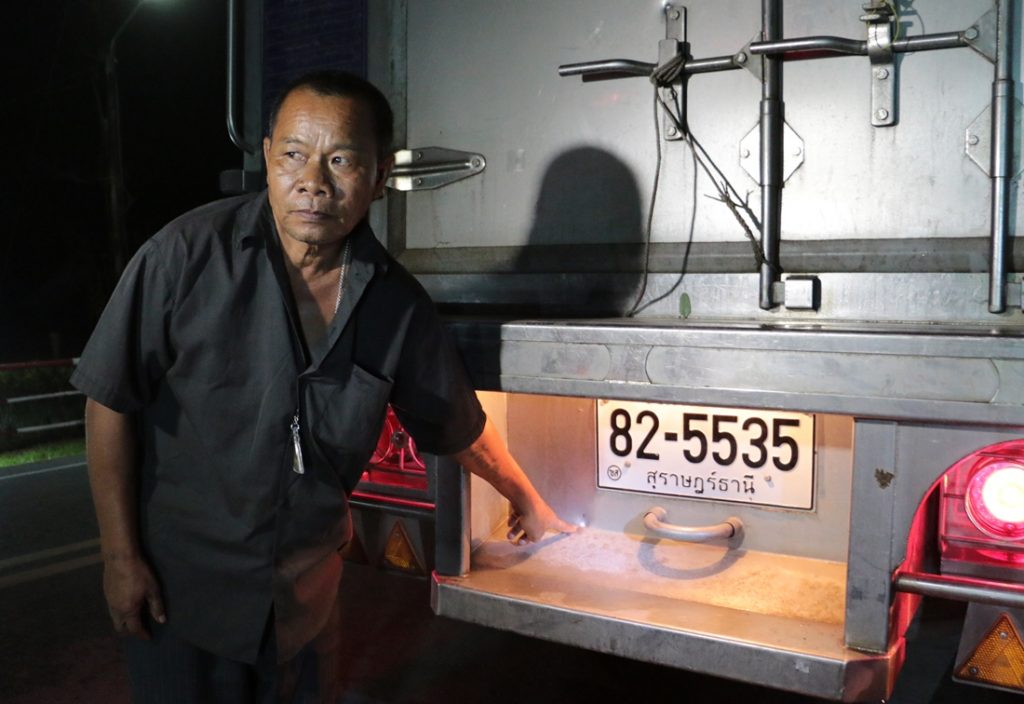
The Itthirit Konsong shipping company truck was carrying seven tonnes of frozen shrimp. Prasong said he has driven the route many years without incident. Police said they found four places bullets fired from a 9mm handgun had hit the back of the truck.
Soldiers who manned the checkpoint said they have never encountered such an incident. Col. Thanee of Phato police said much the same Thursday.
“This kind of thing has never happened in this area,” the colonel said. Police were treating it as an attempted robbery but could only speculate as to the ultimate motive.
He added that police would need time to identify any suspects.
Prasong Hun-ngam points to a bullet hole in his truck.
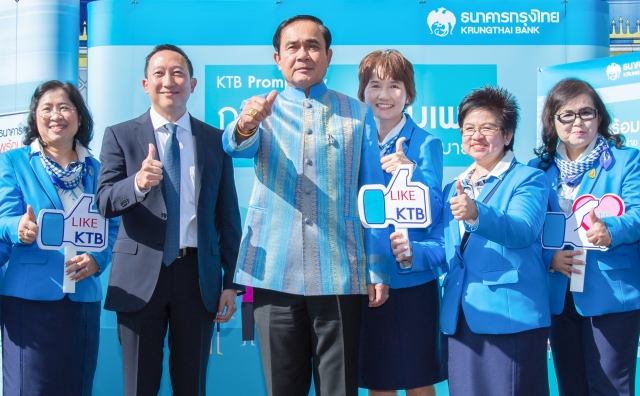
Prime Minister Prayuth Chan-ocha, at center, poses Aug. 9 to encourage people to register to PromptPay at the Government House in Bangkok. Photo: Prachachat
BANGKOK — The Revenue Department apologized Tuesday for telling some taxpayers their refunds had already been sent via the new national e-payment system earlier than the money landed in their accounts.
Responding to complaints on the webboard giant Pantip.com which cast doubt on the readiness of the delayed-but-coming PromptPay system, the Revenue Department blamed premature SMS notifications sent Friday notifying some that their tax refunds had been transferred.
Delayed just before what was to be its full launch in October, the national e-payment service was promised to be ready some time in the first quarter of 2017. At the time central bank said not all participating financial institutions were ready. Critics pointed to a number of cyber fraud cases as an alternative explanation.
In its response, the Revenue Department dismissed concerns about PromptPay.
“It was the new channel for refunding taxes, so a mistake happened,” department spokesman Somchai Saengratmaneedet said.
PromptPaywas born from the government attempt to push forward cashless society. It allows people to transfer money between bank accounts by using ID number or mobile phone number. It won’t charge transaction fees for transfers under 5,000 baht.
The military government has pushed the public to register, saying it will be necessary to access government services such as tax refunds and pensions. In December, the government did used the system to transfer a cash subsidy to the poor through PromptPay.
On Jan. 5, the Revenue Department said taxpayers registered with PromptPay would receive next-day refunds after filing their returns rather than wait on a paper check.
Pantip user “Si Yaek Ratchawong” said he got an SMS notice that the funds had been sent Jan. 6 but didn’t receive the funds until Monday. Others said they faced the same situation.
He said that when he called to inquire, someone at the department told him it would take longer if he wasn’t a customer of state-owned Krung Thai Bank. Spokesman Somchai said Tuesday that every bank’s customers will get their refunds at the same speed.
A banking technology expert from Finiwise.com said the problem most likely stemmed from poor communication during the new systems roll out.
“I believe it will get better after some time,” Chrisada Sookdhis said. “At least its security is as safe as the system currently used for transferring money between banks.”
PromptPay was overseen by the National Interbank Transaction Management Exchange, or NITMX, a bank consortium setup in 2005 to be an electronic exchange between banks under the direction of the central bank.