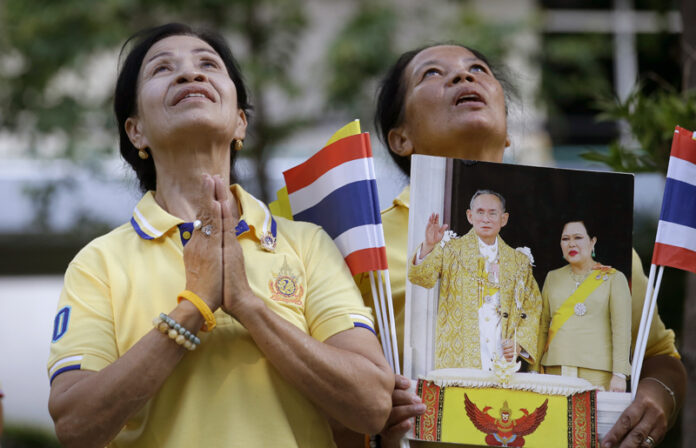
Thais hold portraits of King Bhumibol Adulyadej and Queen Sirikit as they pray outside of the Grand Palace during the celebrations marking the 70th anniversary of his accession to the throne on June 9 in Bangkok. Photo: Sakchai Lalit / Associated Press
BANGKOK — King Bhumibol Adulyadej has been treated for a severe infection, the Royal Palace said in a statement, the latest in what have become regular medical reports about the continuously deteriorating health of the world’s longest reigning monarch.
A statement issued by the palace late Friday said the 88-year-old king was observed with a high heart beat and thick mucus. It said a test result of the mucus and blood “indicated a severe infection.” It did not elaborate.
Bhumibol has been hospitalized for a large part of the past decade, mostly with ailments associated with aging. He has not made a public appearance since January.
In the past months, official announcements about his health have increased in frequency, but their narrow and technical focus make it hard to gauge the king’s overall condition.
Friday’s statement said an X-ray revealed that the king had fluid in his lungs, which a treatment helped to reduce. The king’s low blood pressure and a fever have since improved and his medical team is continuously watching the symptoms closely, the statement said.
At various times during his hospitalization, the king was said to have been fed intravenously and given oxygen to assist his breathing.
A statement in June said that doctors drained excess fluid from his brain, the second time this procedure has been carried out on him.
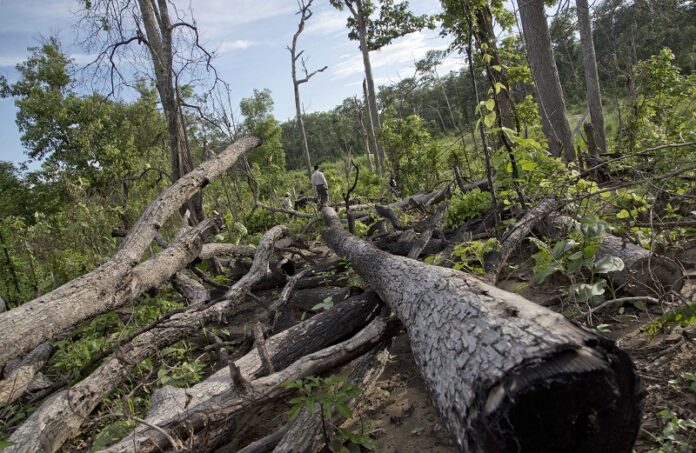
Myanmar is struggling to stop illegal logging, which has erased one-quarter of the country’s valuable forests in a generation. Photo: Gemunu Amarasinghe / Associated Press
PINLEBU, Myanmar — The hills of northern Myanmar’s Sagaing region were so legendarily thick with forests that in the days of kings, condemned criminals were ordered into the woods as a death sentence. Today illegal logging has left vast swaths of bare patches, with only a handful of old-growth stands.
Despite a temporary ban on all logging by the Southeast Asian country’s new government, the Associated Press found in a trip to the remote region that loggers are still cutting down some of the remaining old trees. The AP also saw loggers illegally chopping up the wood from already felled trees for transportation and sale. Piles of such wood have been confiscated by the government, but villagers said officials can be bribed to let it through.
Massive amounts of teak, rosewood and other hardwoods have been illegally cut and exported from Myanmar since 2011. Much of that wood was stripped from the Sagaing region, floated on the Irrawaddy River and transported to neighboring China and India.
Myanmar has lost more than a quarter of its forests since 1990, according to the U.N. The losses have been greatest in the north, in Sagaing and neighboring Shan and Kachin states. The pace of deforestation had increased under the last government, though it banned timber exports in 2014.
“Logging companies usually chop down trees more than they actually are permitted,” said Min Min, a farmer and environmental activist who previously worked transporting illegally cut logs. “According to my experience, I’ve never seen the government take action against the companies chopping down any size of trees they wanted.”
Four activists in Sagaing told The Associated Press that logging appeared to be continuing on a small scale despite the temporary ban, based on truckloads of lumber they have seen being transported. This is the rainy season in Myanmar, and an off period for the illegal timber trade in any case.
Those arrested have included members of Myanmar’s military, which no longer rules the country but remains powerful. Burmese media reported last week that nearly three tons of rosewood were seized from a military vehicle in Sagaing.
This summer, AP reporters rode jeeps and motorbikes for 20 hours over rough, muddy roads to reach villages in northern Sagaing, meeting former illegal loggers, local villagers and elephant keepers. Despite its remoteness, vast swaths of hillsides and valleys were bald patches.
Young trees, perhaps 10 years old, stand near the stumps of ancestors that were clearly many times larger. A few villages have managed to cling to old-growth stands in small community forests, but that is all.
“We used to be so afraid of coming to the forest alone because it was too forested,” said Aung Moe Kyaw, a local environmental activist. “Now, as you see, it is bald and no more big trees. The big trees are all gone now.”
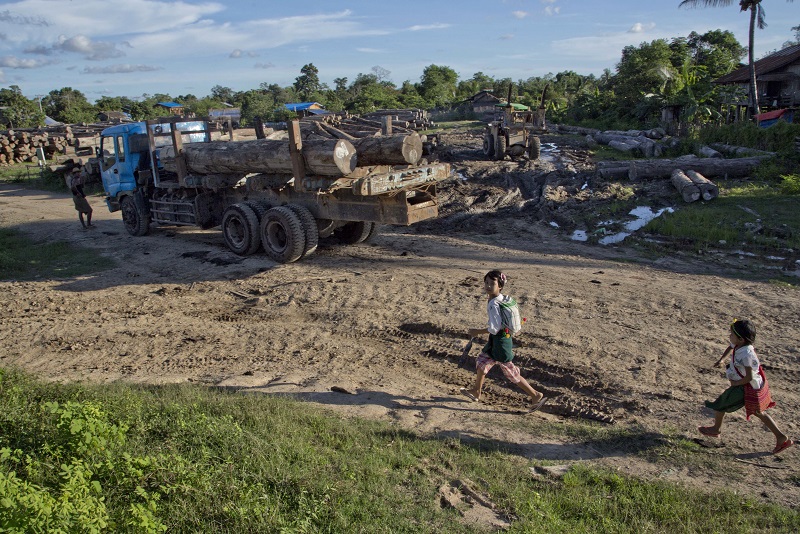
Logging in Sagaing has traditionally been done with the help of elephants, and while that work has continued, heavy equipment is used much more commonly.
Confiscated illegal timber is piled for an auction in Paekone village in northern Sagaging division, Myanmar. Photo: Gemunu Amarasinghe / Associated Press
“If the logging was only done by the government and pulled logs by elephant, deforestation wouldn’t be that bad,” said Than Lwin, an elephant trainer, showing off two of the six elephants that work hauling felled tree trunks that weigh up to five tons. “We see that logging companies are chopping down trees as much as they want.”
Mountains of recently cut illegal timber worth millions of dollars lie in villages across the region; most of the timber the AP team saw was rosewood, coveted in China and elsewhere for its natural red color. Activists say the wood has been seized by the government mostly since late 2015, but that loggers commonly have been able to get it back by bribing officials.
The AP team traveling witnessed loggers cutting wood outside Katha, a Sagaing town that is a transit hub for the trade. An activist traveling with the journalists said the logging was illegal and contacted forest department officials, who detained the loggers and seized their equipment.
The wood-cutting operation had been set up near a mountain far from the nearest village. Because exporting lumber rather than raw timber is not illegal, clandestine wood-cutting is a way to circumvent the law.
Villagers learned of the operation and informed the activist. The leader of the logging crew looked nervous when the activists and journalists arrived. When asked where he got the timber, he said his brother recently gave him the leftover logs, and that they were only for home use.
Local environmental activists working under the EU Forest Law Enforcement, Governance and Trade, which supports efforts to combat illegal logging in developing countries, say much illegally cut timber is hauled to Katha, transported on the Irrawaddy and sent on various paths through Kachin state and the Mandalay region before it reaches China’s western Yunan province. They say bribes allow illegal loads to pass official gates.
Min Min said a former boss would bribe police and forest department officials ahead of time, so that when Min Min arrived at the gate, the officials would let him go without checking his truck.
“The officials protect us for giving bribes, and sometimes they even come with us on the truck to show us the way to get to our final destination,” he said.
Myo Min, national director of the forestry department, said Thursday the government is trying to stop corruption.
“There are many individual bribery cases but not all staff from the forest department is involved,” he said. “… We have taken action against bribe-taking staff in the past and are still working on it now.”
Myanmar police referred questions about corruption to the forestry department.
Myo Min said the department has taken action against staff in the Katha district in the past. But the district’s director, Soe Tint, denied that officials have cooperated in illegal logging.
“Because of the Chinese demand for hardwood, there could be illegal logging cooperation among businessmen,” he said.
How big is Myanmar’s smuggling? From 2011 to 2014, Myanmar reported $2.83 billion in exports of hardwood in the rough, while trading partners reported imports of $5.57 billion. Illegal logging is likely to account for some of that $2.74 billion discrepancy. Other timber-cutting is probably absent from any country’s record-keeping.
India and China are by far the biggest consumers. From 2011 to 2015, the two countries collectively imported about six times more Myanmar teak and rosewood than the rest of the world combined.
“Most of illegal timber is transported to China through Kachin state,” said Khon Ja of the activist group Kachin Peace Network. “We have witnessed how they (illegal loggers) bribe military officers and civil officers throughout the way when they carried out the illegal timber.
“It is an unnecessarily great loss. The valuable natural resources are sold for a penny,” she added.
From 2010 to 2015, Myanmar had the third-largest forest loss in the world, equivalent to an annual loss of 546,000 hectares (2,100 square miles), according to the U.N. Food and Agriculture Organization.
In 2011, Myanmar’s longtime military rulers gave way to a military-backed but quasi-civilian government led by President Thein Sein that ruled until earlier this year. That government is credited with initiating a series of political reforms and helping the country emerge from decades of international isolation, but one side effect of that new openness was that Myanmar’s vast natural resources became easier to exploit.
“The worst period was under President Thein Sein’s administration,” said Than Hlaing, a Sagaing regional lawmaker. “The government itself was cooperating with the businessmen. The illegal logging was widespread in our region.”
Since 2014, the government has banned the export of raw timber logs to protect old-growth forests. In May, the new elected government led by Aung San Suu Kyi announced a nationwide logging ban for this fiscal year, which ends March 31.
The forest department compound in Katha is now home to a fleet of trucks, buses and vans that the government has seized from illegal loggers since late last year.
Myo Min, the forestry director, said last month that the government has seized more than 16,000 tons of illegally cut logs since April, when the current government took office and that more than 1,000 criminal cases have been filed in that time. He said that continues work that began toward the end of previous government, which seized 30,000 tons of logs and filed more than 2,200 criminal cases in its last fiscal year.
According to the U.N. Food and Agriculture Organization, from 2010 to 2015, Myanmar had the third-largest forest loss in the world, equivalent to an annual loss of 546,000 hectares. (2,100 square miles). Photo: Gemunu Amarasinghe / Associated Press
At least some illegal loggers are being prosecuted, including one whom AP reporters met in Wuntho village shortly after his release from prison, where he had spent four months.
Corruption and weak law enforcement remain obstacles.
“The illegal loggers are so smart and professional, as they have been doing it for a long time,” said Min Naung, a Lower House lawmaker and a member of the Natural Resources and Environmental Conservation Committee. “They know how to transport illegal logs when and where, and they definitely know the weaknesses of the government. They know how to avoid being arrested.”
He said some officials are still taking bribes, “even if it’s less,” and that the forest department lacks muscle. “They don’t have enough people to seize logging sites and people because it can be dangerous for them, and they have no weapons but pens,” he said.
A forest department worker in Sagaing was recently killed by illegal loggers. “We could do nothing about it and we were really sad what happened to him. We couldn’t protect him,” Min Naung said.
Soe Tint, the forest official, said that although the killing was the first of its kind in the district, his workers are often threatened or even harmed, and they frequently ask for backup from police.
Though local villagers have sometimes taken part in illegal logging, they say they’ve received virtually none of the proceeds. And they say the biggest operators rely on loggers from other regions.
Even by the standards of Myanmar, one of Asia’s poorest countries, northern Sagaing is impoverished and remote. The roads are too poor for most people to travel frequently. Villagers are heavily dependent on farming, but they lack irrigation, and harvest food from the forest outside of the growing season. Villages typically have only a primary school, so further education is out of the question for most children.
“It has been always difficult for us to stop illegal loggers,” said Aung Moe Kyaw, the activist. “They have a good deal with the authorities from different levels and they benefit from it, but villagers who live by the forests are so poor.”
At the same time, he said, simply having members of Parliament pay attention to the issue is an improvement.
“If the new government could protect these forests for a few years,” he said, “it would actually give the chance for these forests to live.”
BANGKOK — A Briton who was filmed stealing from a Thai tourist in Chiang Mai was arrested Thursday at Suvarnabhumi Airport.
Stephen Antonio (transcribed from Thai) denied the allegations, though police said they have evidence he committed the crime at Doi Suthep temple on Wednesday, including security camera footage.
“He has the right to deny the charge, but we have enough evidence to implicate him,” Col. Pitipong Boonpiam, chief of Phuping Ratchaniwet Police Station, said by telephone Friday.
According to Pitipong, the suspect took more than 100,000 baht worth of items and cash from a backpack that belonged to a Thai tourist at the temple.
In video said to be from inside the temple, a man identified as Antonio is seen looking furtively around as he moves to an unattended bag which he then takes.
Tourist Police said they apprehended Antonio as he arrived at the airport in Bangkok yesterday, presumably to board his flight home. He was later taken to be held at Phuping Ratchaniwet Police Station.
The British embassy said it will send a representative to be present during during police questioning of Antonio, Pitipong said.
Fire struck a Tesco Lotus supermarket in the southern province of Nakhon Si Thammarat on Aug.12. No one was injured. Photo: Prachachat
BANGKOK — A second man wanted for a 2015 car bomb attack on a Koh Samui shopping mall was named Friday as the fourth suspect in the spree of attacks last month across the southern region.
A military court approved a warrant for the arrest of Hakeem Dohloh, 32 of Pattani province, in connection to the fire bombing of a Tesco Lotus in Nakhon Si Thammarat province on Aug. 12. Charges of arson and possession of explosives were filed against him.
Hakeem, like previously announced suspectAsmeen Katemmahdi, had an outstanding warrant for the April 2015 explosion in the underground parking lot of Central Festival Samui. Authorities at the time speculated the incident might be an expansion of the separatist violence typically limited to the three southernmost provinces.
Police accuse Asmeen of a bomb attack in Hua Hin on Aug.11-12 that killed 2 people. The other two named suspects are Ruslan Baima, who was also accused of being behind the Hua Hin bombing; and Ahama Lengha, who is wanted in connection with attacks in Phuket which slightly injured one people.
Another warrant issued Friday was for Abdulkadir Saleah (transcribed from Thai), a 36-year-old from Pattani province who police said has a history in the insurgency. He was said to be linked to the Aug. 12 arson attack at Lee Mart supermarket in Trang province.
Despite mounting evidence pointing to a direct link between the attacks and the long-running violence in the Deep South, police authorities have been either denied any connection or said it is too soon to tell.
All five suspects are residents of the southern border provinces and remain at large.
The Tesco Lotus fire happened at 8am on Mother’s Day was part of a series of attacks across seven southern provinces which killed four people and injured dozens. No one was injured and the fire was put out.
The day after the attack, the military pinned the blame on Chiang Mai native Sakarin Karuehat, dispatching soldiers to arrest him from an oil drilling platform in the Gulf of Thailand. He was later released without charge. Police attempts to have him re-arrested were rejected by the courts due to lack of evidence.
According to police, a witness saw Hakeem after the attack at the Nakhon Si Thammarat bus station, where he changed his clothes and boarded a bus bound to the south.
Chief police investigator Gen. Srivara Ransibrahmanakul said police have identified four people behind the Tesco Lotus attack. He said police are gathering evidence to seek warrants for the other three.
Srivara was on his way to another military court Friday afternoon to seek warrants for a suspect believed linked to the arson attack in Trang province. The name of the suspect has yet to be revealed.
A performer rehearses ‘Red Peter.’ Photo: Jitti Chompee / Courtesy
BANGKOK — Would you stop being what you are if it meant survival? Animalism, absurdity and adaptation collide on stage in a surreal physical performance for four days in Bangkok.
Adapted from Franz Kafka’s story of a chimp who casts away his identity to survive by acting human, “Red Peter” comes to life this month at Bangkok CityCity to challenge audiences to find truth in the absurd.
“I intend to challenge Thai audiences to explore other interpretations of Kafka’s works through visual arts and choreography … I like so much what [Kafka] wrote, and the use of animals as main characters fits my work very well,” playwright by Jitti Chompee said by email. “Kafka combines obscure and surreal scenarios with the real world, a motif which today is used in a variety of literary and cinematic formats.”
On stage, expect a physical performance in which four cast members talk through their bodies, trying to best echo the monkey-to-human transformation without spoken dialogue.
Apart from taking his inspiration from Kafka’s “A Report to an Academy,” the 42-year-old said he was influenced by striking visuals from Berlinde De Bruyckere’s macabre sculptures to Picasso’s cubist paintings.
‘Pieta’ sculpted by Berlinde De Bruyckere
“I take [these] to design the shapes and positions of the dancers’ bodies, both individually and with one another,” he said. “Similarly, the rearrangement of objects and bodies to produce a cohesive depiction in cubism stimulates me to experiment with creating distorted images, including headless bodies.”
Jitti Chompee is the founder of 18 Monkeys Dance Theatre. The troupe is known for blending traditional Thai elements with physical movement to explore issues of gender identity, animalism and mismatched bodies.
“Red Peter” premiered in June in the Netherlands and will begin a four-day run in Bangkok with shows at 7:30pm Sept. 22 through Sept. 25 at Bangkok CityCity gallery.
Tickets are 800 baht and 350 baht for students. They can be bought online. The white-walled gallery is located on Soi Sathorn 1, reachable by foot or motorbike from MRT Lumphini’s exit No. 2.
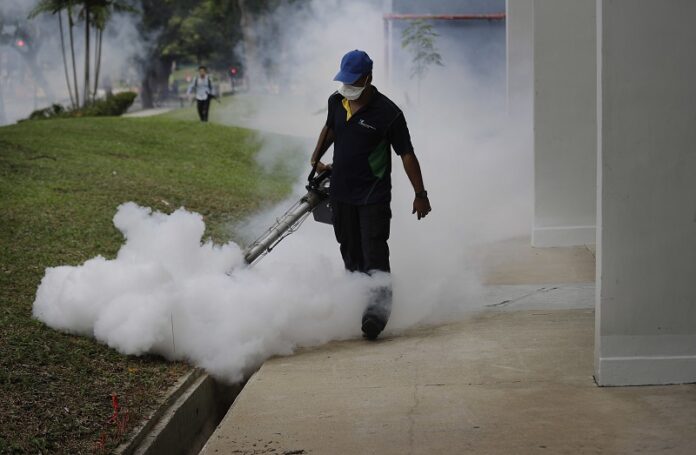
A pest control worker fumigates drains at a local housing estate in Singapore where the latest case of Zika infections were reported on Thursday. Photo: Wong Maye-E / Associated Press
LONDON, United Kingdom — Scientists trying to predict the future path of Zika say that 2.6 billion people living in parts of Asia and Africa could be at risk of infection, based on a new analysis of travel, climate and mosquito patterns in those regions.
Some of the most vulnerable countries include India, China, the Philippines, Indonesia, Nigeria, Vietnam, Pakistan and Bangladesh, according to the research.
Experts caution that the study could overestimate the number of people at risk because they don’t know whether Zika had already landed in some of these countries in the past and allowed people to develop immunity. More than two-thirds of people infected with Zika never get sick, and symptoms are mild for those who do, so surveillance systems may have missed cases.
Although Zika was first identified in 1947, the virus wasn’t considered a major health threat until a major outbreak in Brazil last year revealed that Zika can lead to severe birth defects when pregnant women are infected.
In February, the World Health Organization declared the spread of Zika a global emergency, and epidemics have been sparked in at least 70 countries. In the last few weeks, it has sickened more than 100 people in Singapore and started spreading in Florida. Zika is mostly spread by a specific species of tropical mosquito, but it can also be spread by sex and through blood transfusions.
Researchers hope their new study will help officials plan ahead to possibly avoid some of the worst effects of Zika.
“For countries with a finite amount of resources, this may help them use those resources as efficiently as possible,” said Dr. Kamran Khan, an infectious diseases physician and scientist at St. Michael’s Hospital in Toronto, the study’s senior author.
To figure out where Zika might gain a future foothold, researchers examined patterns of people traveling from infected regions in the Americas to Africa and Asia and combined that with an assessment of local conditions, including mosquito populations. They used the spread of a related virus, dengue, as a model for Zika since the same mosquito species transmits both diseases. Dengue is not spread by sex, like Zika, but mosquitoes are responsible for the vast majority of Zika cases globally.
Some experts pointed out that the expected impact of Zika will depend largely on whether people have any previous exposure to the virus – and that is unknown.
“No one has ever looked, so we don’t know if there is any pre-existing immunity to the virus,” said Dr. Abraham Goorhuis of the University of Amsterdam, an author of a commentary that accompanies the Lancet study. The virus in the Americas is an Asian strain that was responsible for a large outbreak in French Polynesia and other Pacific Islands in 2013 and 2014.
“If there was broad circulation of this virus in Asia, then it could be that the risk of Zika spreading to Asia won’t be as bad as we think,” Goorhuis said. He said another big unknown was whether people who might have been exposed to the African strain of Zika might be protected once the slightly different Asian version arrives. It’s unclear how widely the original 1947 strain found in Africa may have spread.
Goorhuis also noted it was possible Zika might eventually burn itself out after about a year or so of circulation, the way a related virus, chikungunya, recently did.
Others said scientists should seize the chance now to prevent Zika from becoming entrenched elsewhere.
Ben Neuman, a virology professor at the University of Reading, said that once the virus has started to spread by mosquitoes locally, and not just by travelers, it can become entrenched in animals as well as people and be extremely difficult to eradicate. “We have the opportunity right now to prevent (Zika’s) spread and by doing so, halting the spread of unnecessary suffering,” he said.
‘Little Red in The Ruins.’ Photo: For What Theatre / Courtesy
BANGKOK — Three centuries after Charles Perrault committed fairy tale to page in “Little Red Riding Hood,” a Thai dramatist is adapting it to puppet theater with allusions the next month’s 40th anniversary of the 1976 Massacre.
There’s more to puppetry than children’s entertainment in “Little Red in The Ruins,” a production opening later this month by Ben Busarakamwong, co-founder of For What Theatre.
“I’m inspired by Perrault’s Little Red Riding Hood, as the story revolves around the worth of human beings while they treat an animal like an evil who shouldn’t be lived together,” said the 29-year-old.
Ben hinted the play; which mixes puppetry, shadow puppet and mask performance; will use visual imagery to make subtle reference to the massacre of students at Thammasat University which happened 40 years ago on Oct. 6, 1976.
“Some scenes are inspired by iconic images from 40 years ago to pose a question of whether Thais treat others equally. If they say they stick to dogma, well, they can’t even keep to the first Buddhist precept of not harming living things.”
Music is an important part of the play, which will be accompanied by piano trio The Headache Horse. Piazzolla’s “The Four Seasons” will be performed to mark the changing relationships within Little Red’s family.
Before staging a puppet production, Ben volunteered with the 15-year-old Grandma Puppet troupe which specializes in children’s puppetry and participated in several puppetry workshops.
The 40-minute performance, in Thai with English surtitles, shows at 7:30pm from Sept. 15 – 17 at the Democrazy Theatre Studio, which is a 10-minute walk from Exit No.1 of MRT Lumphini.
Tickets are 350 baht and 300 baht for students. A 50 baht discount is offered for those who transfer payments in advance. For children under 15, tickets are 100 baht. They can be reserved via phone at 09-0969-0065 or the play’s event page.
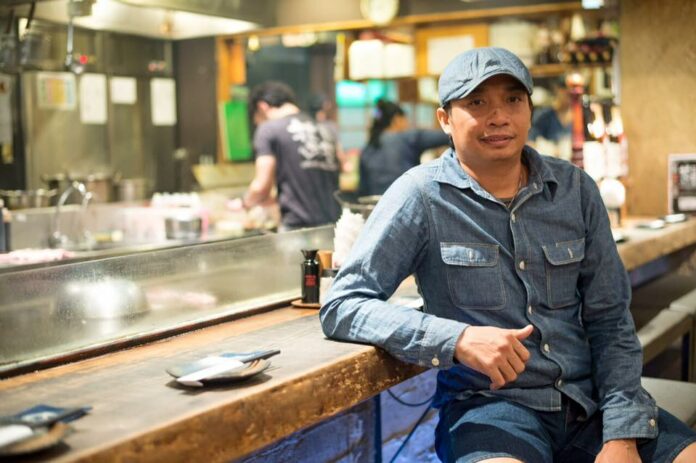
Wichian Inkraidee poses for a photo at Kacha Kacha bar. He's facing 560,000 baht in fines and a court battle for images of beer in his restaurant menu.
BANGKOK — When booze law inspectors appeared outside Wichian Inkraidee’s bar on New Year’s Eve nearly two years ago, he didn’t pay much attention to them.
The first day of 2015 was only a half hour away, and it’s customary for enforcers of Thailand’s strict alcohol laws to patrol entertainment and party venues such as the Asiatique shopping complex, where Wichian’s bar is located, for possible violations.
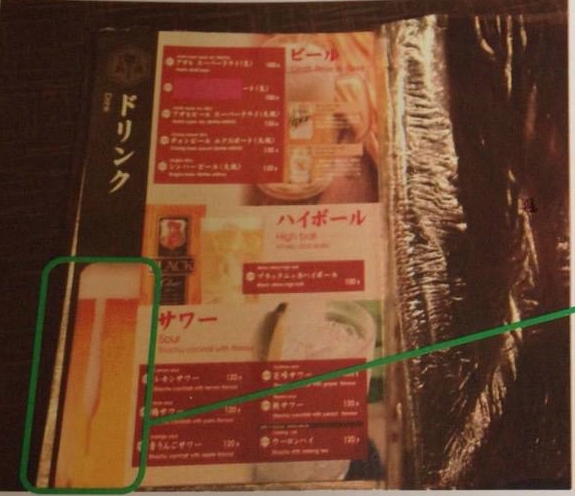
But they paid attention to him and his Japanese-themed bar and restaurant, Kacha Kacha, as he found out six months later when he was told to pay a 50,000 baht fine for an image in his menu of a glass filled with what looked like beer.
“I was shocked, I thought, what is going on?” Wichian said. “They simply told me to pay the fine. But, come on! I didn’t do anything wrong! And there was no summons to appear at all in those six months.”
Although the Alcohol Control Act doesn’t explicitly ban pictures of beer, its vague wording and arbitrary enforcement has vexed business owners and led an industry trade group this month to plead for more clarity and consistency in the law.
According to Wichian, police charged him with violating Section 32 of the 2008 law, which bans “displaying names or symbols of alcoholic beverage that exaggerate its benefits or convince others to consume it, whether directly or indirectly.”
That has been broadly interpreted by officers who are allowed to apply the law at their discretion. In the past, they’ve also found fault with a tissue box stamped with a beer logo, photos of booze on social media and the beer gardens which appear everywhere during the cool season.
The Alcohol Control Board has said the section means any depiction of booze is subject to punishment. That’s why no beer advertisements can actually use photos of beer, and the media routinely censors any footage or image that involves alcohol.
Lawyer and talk show host Pramarn Laungwattanwanich scoffed at such interpretation at an Aug. 18 panel discussion held at Bangkok’s Cyber World Tower.
“Just by letting you see a bunch of beer bottles, they say that already counts as ‘convincing,’” Pramarn said. “Do people want to drink alcohol that much? Does it really work? … Humans are not buffaloes, you know. They can think for themselves.”
Wichian was fined because inspectors say this image in the menu encourages others to consume alcohol.
Wichian wasn’t alone in running afoul of the law. In 2010, a Korean-themed restaurant in Pathum Thani was fined for violating the same law. Their offense? Tissue paper boxes on some tables bore the logo of Chang beer.
In October, alcohol control board director Samarn Futrakul warned that anyone who posted photos of booze on social media may be prosecuted if those images were deemed attempts to convince others into drinking.
Samarn’s crusade against alcohol grabbed headlines for weeks until he overreached by going after the popular beer gardens. He was chastened from many quarters and withdrew from the spotlight.
Sobering Reality
Some may find the apparent moral crusade against alcohol in Thailand confusing. Although Buddhist authorities say the Five Precepts forbid alcohol and other intoxicants, drinking has been a common and socially acceptable activity among Thais for decades, if not centuries.
The 2008 Alcohol Act isn’t the only weapon in the arsenal of the anti-booze warriors either.
Other laws ban the sale of alcohol on Buddhist holy days, on election days and in parks and other places. One year ago, a series of confusing laws was passed banning alcohol sales either in the vicinity of school properties. Consensus was never reached over what that meant, and officials announced it would be arbitrarily enforced at the discretion of officers.
As the numerous bars and nightclubs which still operate despite those bans testify can testify, the the law has been mostly ignored except for select instances of enforcement.
The discretion at work when they are is a discrepancy highlighted by Wichian’s case, in which he said he didn’t do anything more than what is common at other bars and restaurants.
“If my menu really violated the law, all the bar owners should have been in my shoes, too,” Wichian said.
Security officers on Feb. 24 raid a bar in Bangkok to look for any violation of alcohol laws.
Thanakorn Kuptajit, chairman of the Thai Alcohol Beverage Business Association, said it is this kind of discretionary enforcement of law that is destroying businesses. He urged the authorities to set up a panel of impartial experts to set clear guidelines on enforcing the law.
“Our member companies have lawyers to interpret what can and cannot be done. The state also has its own lawyers to do the interpretation,” Thanakorn said said the panel discussion. “We disagree in our interpretations, that’s fine. But we want someone to act as an arbiter, to help set guidelines that we can adhere to. Laws enforcement officers should stop exercising their own judgment already.”
He suggested alcohol control officials invite the Council of State, the agency which interprets legal codes, to serve as the impartial moderator. He also urged the Alcohol Control Board to consult with business operators before enacting any measures that further restrict alcohol sales.
Nearly two weeks after he made his pleas, Thanakorn said Wednesday he has yet to hear back from the board or any other state agency.
“They didn’t give us any answer. Nothing at all. The state sector didn’t make any move at all,” said Thanakorn, whose organization was formed in 2009 in response to the booze laws enacted a year earlier.
Representatives of the Alcohol Control Board did not return calls seeking comment. A reporter was told Samarn was traveling and unavailable.
Undefinable Rules
While the military government seems to be taking a softer approach on narcotics, it is unlikely that the same leniency will be shown in alcohol regulations any time soon.
In fact, the trend seems to be going in the opposite direction, as evinced by junta chairman Prayuth Chan-ocha’s order which banned alcohol sales “near” educational institutions from kindergartens to universities.
That seemingly unenforceable language came after the business community went into uproar over a much more specific ban which set up 300-meter dry buffer zones around certain types of schools.
Wichian, whose Asiatique bar was fined for the beer image in the menu, said he’s hoping to put an end to such arbitrary law enforcement by taking his case all the way to the Supreme Court.
He wants to see a legal precedent set to settle the matter once and for all.
“Other people just paid the fines, but I’d like to fight, because I think it was very unfair,” he said.
He’s already lost two previous court battles, and the penalties on his unpaid fine have racked up to 560,000 baht.“I could have paid the 50,000 baht at the beginning. But there was no standard at all,” Wichian said. “No one wants to waste money or waste their time. I simply want to know what the standard is.”
Police officers remove explosives and gasoline Friday from a stolen vehicle in Narathiwat province.
NARATHIWAT — A pick-up truck stolen earlier from a school in Pattani resurfaced today in the neighboring province of Narathiwat where it was used as a car bomb.
Police said an EOD team managed to defuse the explosives before they were detonated next to a police station. The truck had been commandeered Tuesday by a group of armed gunmen as it left the school where it was used to deliver milk for schoolchildren.
“The bomb was packed into a gas canister,” Capt. Songwuth Thongsom of Waeng Police Station said Friday. “Inside the truck, there were also some gallons of gasoline.”
Songwuth said the truck matched the description of the stolen vehicle, though its license plate was replaced with a forged one.
Police said they are looking for the perpetrators.
Six gunmen intercepted the truck as it was leaving Ban Chamao Sam Ton School on Tuesday afternoon, told its driver to get out and drove it away. Police later issued a warning that the car may be used as a car bomb.
On Aug. 23, a weaponized ambulance exploded in front of a hotel in Pattani, killing two people and wounding dozens. Police blamed the attack on the insurgents fighting for independence in the Muslim-majority region.
YANGON — A Buddhist nationalist group in Myanmar says a Facebook post in which it appeared to criticize former U.N. Secretary-General Kofi Annan was fake.
Myanmar’s government announced last week that Annan will lead an advisory panel aimed at finding “lasting solutions” to the conflict in Rakhine state, where human rights groups have documented widespread abuses against minority Rohingya Muslims.
Rakhine Buddhist nationalists have denounced the commission. Annan was criticized Monday on a page that appeared to be from Ma Ba Tha, a national group led by Buddhist monks that has been accused of helping to incite violence in the region that left hundreds of Muslims dead in 2012.
On Thursday, however, Wirathu, a monk who is among Ma Ba Tha’s most prominent leaders, said on his Facebook page that the post was from a fake account. Many people in Myanmar social media pose as Buddhist nationalists and sometimes mock them. The owner of the account could not be reached.
The post called Annan “a funny-looking and disrespectful person cannot talk about our own issues in the country.” It also called Annan, who is from Ghana, a “kalar,” a slur used in Myanmar against Muslims and Indians.
The post, however, included a photo not of Annan but of Morgan Freeman, the Oscar-winning actor. Freeman was marked with a red “X” next to the words “We no need Coffee Annan he go away.”
Freeman has been confused previously elsewhere not only with Annan but also with late South African President Nelson Mandela.