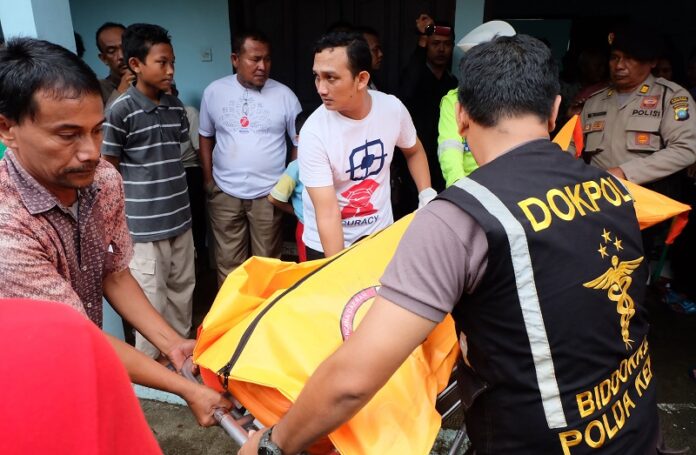
Indonesian police carry a body bag containing a victim of a capsized boat, at a hospital in Tanjungpinang, Bintan island, Indonesia, Sunday. Photo: Albert / AP
JAKARTA, Indonesia — Searchers on Monday found the last five victims of a tourist boat sinking in Indonesia that killed 15 people.
The search was ended with all the victims found, said Agustiawarman, the head of Tanjung Pinang Disaster Management Agency.
Only two of the 17 people on board the small wooden boat were rescued after it capsized in rough seas Sunday off Indonesia’s Bintan island, south of Singapore.
The search and rescue effort involving about 20 ships and 50 fishing boats had been hampered by high waves and strong currents, disaster agency spokesman Sutopo Purwo Nugroho said on Sunday.
He said the people on the boat were local tourists traveling to Penyengat island, about 6 kilometers (4 miles) from the city of Tanjung Pinang on Bintan.
Nugroho said some of the passengers tried to swim but were overcome by 3-meter (10-foot) waves. Two children were among those who died. The boat operator and a female passenger survived.
Boat sinkings are common in Indonesia, an archipelago of some 17,000 islands.
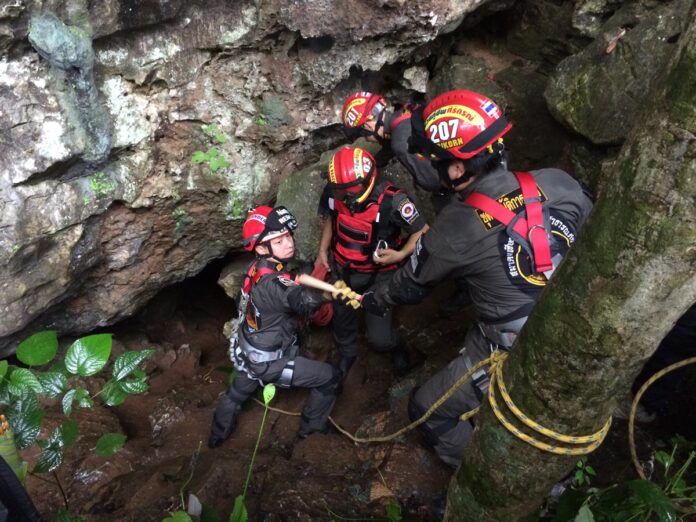
Search parties on Sunday inspect one of many caves in the Tham Luang - Khun Nam Nang Non forest park, where a tourist went missing.
CHIANG RAI — A search for a man who reportedly went missing 10 days ago during a forest meditation trip in Chiang Rai has had no success so far, police said.
Officials have not also confirmed any details about the man, who was described only as “Asian-looking,” such as his name, nationality, and whether he might have left the jungle on his own.
“We can’t make any guess about this,” Col. Songkrit Ontrakrai, chief of Mae Sai Police Station, said Monday. “We don’t even know if he’s already left the place, or if he’s gone to meditate at some other spot.”
A local vendor told police she saw the man headed to Tham Luang – Khun Nam Nang Non forest park on Aug. 12 after telling her in passable Thai that he wanted to meditate in one of its many caves for several days. He never returned to retrieve the bicycle he left at her stall, the vendor said.
After news spread, Japanese and Chinese embassies contacted police for information, but could not confirm if the man was one of their citizens, Songkrit said.
“So far we have not received any missing person complaint from of his relatives. None,” the officer said.
Park rangers wee still searching the area on Monday, but they may call off their effort soon if police receive no new information about the man in coming days, Songkrit added.
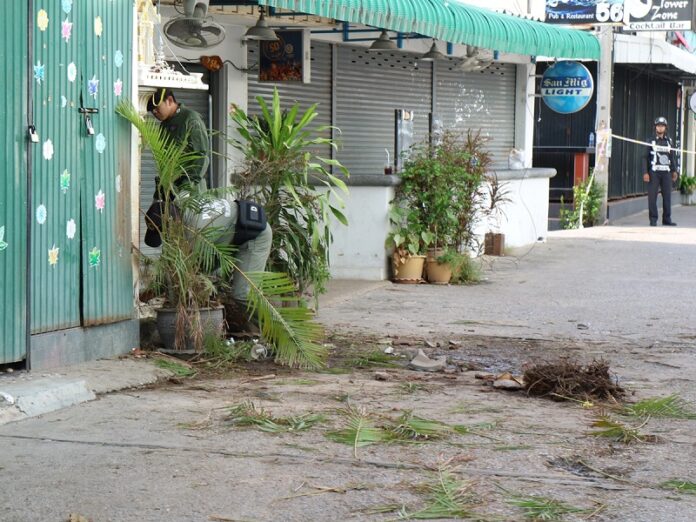
Police officers on Aug. 12 inspect a bomb site in Hua Hin.
BANGKOK — Police believe more than 20 people were involved in the wave of explosions and firebombs that struck seven provinces during Mother’s Day holidays, but only one arrest warrant has been issued so far.
Despite his declaration that police have detailed information on how the perpetrators planned and carried out the attacks that left four people dead, Royal Thai Police chief Chakthip Chaijinda told reporters he has yet to determine their motives.
“I now know all about the process, method, and the meeting points of all perpetrators,” said police Gen. Chakthip Chaijinda Monday. “We believe those who did the incidents in seven provinces concealed their faces and disguised themselves by dressing like tourists.”
In the aftermath of the bombing spree on Aug. 11-12, authorities quickly ruled out any link to separatist violence in the Deep South.
But Chakthip said today that police have not eliminated any possible motives in their investigation, which include discontent over the charter referendum, the southern insurgency and even unknown provocateurs hiring the bombers to cause unrest.
Chakthip did not disclose further information, saying it would affect the case.
Chakthip said he traveled to the southern province of Pattani on Sunday to personally question relatives of the people believed to be the bombers but did not elaborate.
Only one arrest warrant has been issued in connection with the Mother’s Day attacks for a Narathiwat resident called Ahama Lengha. Police said they couldn’t confirm whether he has already fled the country.
According to Chakthip, most of the perpetrators were “newcomers,” people who had no previous criminal history, which makes it difficult for police to track them down.
Asked whether they, like Ahama, all hail from the Muslim-majority Deep South, Chakthip replied, “Most of them are from that zone.”
Another warrant expected to be issued Tuesday is for Sakarin Karuehat, the oil rig worker taken into military custody under the junta’s special authority but later released on Thursday.
Sakarin, a 32-year-old native of Chiang Mai, is accused of firebombing a Tesco Lotus supermarket in Nakhon Si Thammarat in coordination with bomb attacks in other southern provinces on Aug. 12.
Deputy police commander Srivara Ransibrahmanakul, who heads the investigation into the bombings, will seek the arrest warrant for Sakarin from a military tribunal in Nakhon Sri Thammarat tomorrow, police said.
Meanwhile, deputy Prime Minister Wisanu Krue-Ngam said on Monday that families of the four deceased victims will be given 1.1 million baht in compensation each from the government.
The government will also cover medical bills for the 37 people wounded in the attacks, including 11 foreigners, and the victims will receive additional compensation for their injuries, Wisanu said.
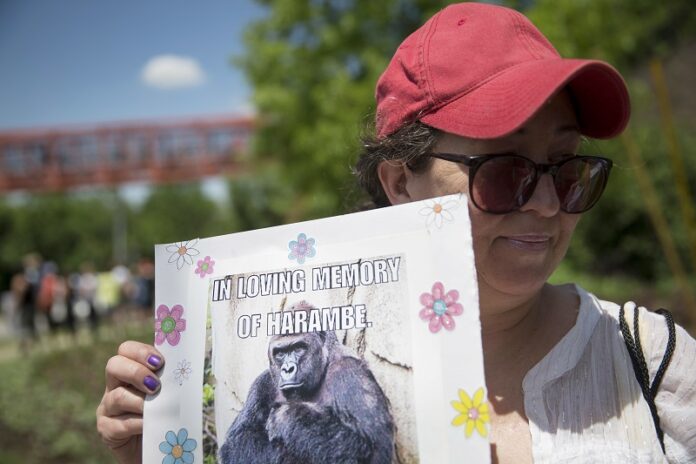
Alesia Buttrey, of Cincinnati, holds a sign with a picture of the gorilla Harambe during a vigil in his honor outside the Cincinnati Zoo & Botanical Garden, in Cincinnati on May 30. Photo: John Minchillo / AP
CINCINNATI — With online declarations such as “Harambe Lives!” the Ohio zoo gorilla shot and killed after a 3-year-old boy got into his enclosure has taken on life after death.
The late 17-year-old great ape has shown up in tongue-in-cheek petitions to rename the hometown Cincinnati Bengals, to add his face to Mount Rushmore or the Lincoln Memorial, and to put him on the dollar bill. He has grown the angel wings and halo of a deity in social media memorials.
He’s even been mock-nominated for president.
The Harambe phenomenon is fed by genuine sadness over his death, continued controversy over the circumstances that led to it, and the penchant of many social media users for satire — which sometimes turns offensive.
“There is a word we like to use in our discipline, in pop culture studies, and that is ‘polysemic’: has many meanings,” said Jeremy Wallach, a professor of popular culture at Bowling Green State University in Ohio. “Harambe definitely is that, a sign that possesses many different interpretations.”
Harambe remembrances began soberly, with a legitimate “Justice for Harambe” petition seeking to hold the boy’s mother responsible in his May 28 death. The county prosecutor ruled there was no cause for charges. The zoo reopened its gorilla exhibit with a higher, reinforced barrier and urged support for gorilla conservation efforts.
But the zoo’s hopes of moving on have been countered by all the continued reminders.
“We are not amused by the memes, petitions and signs about Harambe,” Thane Maynard, Cincinnati Zoo director, said by email. “Our zoo family is still healing, and the constant mention of Harambe makes moving forward more difficult for us. We are honoring Harambe by redoubling our gorilla conservation efforts and encouraging others to join us .”
Esther Clinton, who also specializes in popular culture at Bowling Green, said the Kong-like proportions of the craze reflect lingering questions.
“There are a lot of people who really do feel bad about what happened to him,” she said. “There’s a sense of here’s this poor guy, just in his cage imprisoned by humans, minding his own business; a kid climbs into his cage and he gets shot. It brings up all sorts of questions: about the zoo model, about the rights of non-human primates, about parenting.”
The Harambe phenomenon turned ugly in June, when images were posted on a Facebook page likening Adam Goodes, a retired Australian football player of indigenous ancestry, to the ape. They were pulled down and the page apologized. Twitter got caught in a similar controversy after racial posts about “Ghostbusters” star Leslie Jones, who is black, included aHarambe comparison. The social media site recently announced two new settings aimed at curbing harassment.
Social media users like to satirize controversies. “Never Forget #Harambe,” read posts accompanying Harambe’s photo superimposed on sculptures, above cityscapes, among famous dead people such as Muhammad Ali or John F. Kennedy. Some Twitter users routinely add the hashtag #RIPHarambe even to posts that have nothing to do with him.
He has surfaced in rewritten song lyrics, comedians’ acts, at sports events and in rap songs.
On Change.org, a recent search turned up 253 references to Harambe. They include the early Justice for Harambe petition and the recent petition to rename the Cincinnati Bengals the Harambes, which has received more than 21,000 signatures. Other petitions want a Harambe emoji, a Harambe character in Pokemon Go, to clone Harambe, even to canonize him.
WCPO-TV web editor James Leggate recently declared that enough was enough, by starting an online petition to end theHarambe online petitions.
“At first, the petitioners had good intentions,” he wrote. “But then the goofuses of the Internet hopped on the Harambetrain for their jollies, and it has gotten out of control.”
Animal rights activist Anthony Seta, who organized a Cincinnati vigil in tribute to Harambe soon after his death, thinks much of the attention in terms of memorials has been a positive.
“For the most part, I’m very happy with it. It shows people are remembering what a wonderful being he was,” he said. “The ones that are mocking and making light of the death of this being, I find incredibly offensive.”
Ashley Byrne, an associate director at PETA, said trolls poking fun at animal-rights activists seem to be in a “distinct minority” when it comes to Harambe.
“This tragic incident really did start a new conversation,” she said. “Most people who saw the video came away with a great degree of empathy for animals forced to live in captivity.”
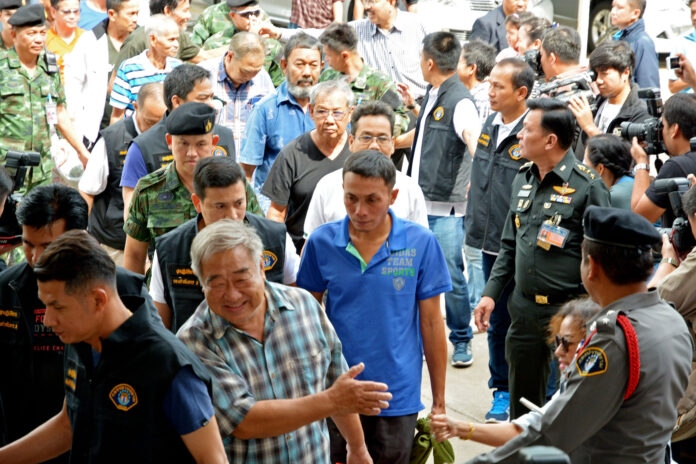
Police on Friday escort the 15 suspects to the Crime Suppression Division in Bangkok for interrogation and news conference.
BANGKOK — A Redshirt group accused of plotting armed insurrection against the military junta has no capability of doing such a thing, two people familiar with the movement said.
Fifteen people who allegedly belong to the so-called Revolution for Democracy Party were freed on bail Monday afternoon to await their trial by military tribunal. Two others were said to be on the run.
The authorities say they have evidence of the group’s plot to overthrow the government, and link its members to anti-monarchy wing of the Redshirt movement.
But activist and former lese majeste convict Ekachai Hongkangwan questioned the claim, saying that the group has no solid plan or preparations for such an ambitious task.
“They can’t do that kind of thing,” said Ekachai, who spent nearly three years behind bars and had worked with Red Siam, a group known for its radical stance on the Royal Family. “They don’t have the capability. They just banded as a group, that’s all.”
He said by telephone that he first heard about the group in 2012, when one of its members solicited other Redshirt factions and activists for financial support but, in the end, received none.
Somsak Jeamteerasakul, a historian in exile whose interests including studying Redshirt underground groups, said he’s not specifically heard of the Revolution for Democracy Party before. But he added that such groups are commonplace, and they are mostly just talk without real action.
“There were talks on Line [chat application] used by the Reds that there were some groups being formed,” Somsak said via online messages. “But in my evaluation, the furthest these groups could go after the coup is to communicate with each other on Line, and talk to each other about revolution.”
These groups were formed out of frustration that the official leadership of the Redshirt movement was not doing enough to oppose the military regime, but they lack both resources and systematic thinking, Somsak said.
Age Doesn’t Matter
Most of the 15 suspects implicated in the plot are in their 60s or 70s. They are facing charges of violating the junta’s ban on political assembly and being part of a criminal conspiracy.
On Friday afternoon the Bangkok military court denied them bail, on the grounds that the court office was closing down when the suspects were brought before the judges.
Fourteen of the suspects were being held at Bangkok Remand Prison while the sole woman in the group is jailed at the Central Women’s Correctional Institution.
Deputy junta chairman Prawit Wongsuwan said the suspects’ senior age would not play any factor in the ongoing investigation into their alleged plot.
“No matter how young or old they are, if they break the law and violate the constitution, we must prosecute them,” Gen. Prawit told reporters Monday. “Let me stress that security officers are not arresting scapegoats here. We have been monitoring them for a long time.”
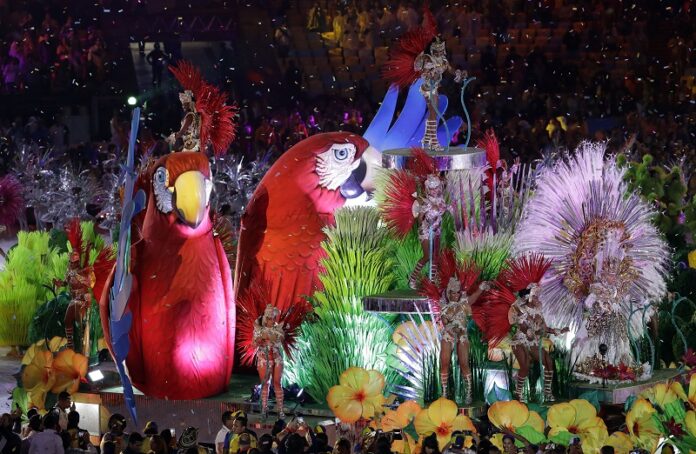
Samba dancers perform during the closing ceremony in the Maracana stadium on Sunday at the 2016 Summer Olympics in Rio de Janeiro. Photo: Natacha Pisarenko / Associated Press
RIO DE JANEIRO — Shaking to samba and expressing a sense of longing with uniquely Brazilian words, Olympians and fans said goodbye to the Rio Games with one last big bash that was both revelatory and a sigh of relief.
The closing ceremony Sunday celebrated the 16-day spectacle that was the Rio Games, which combined numerous highlights with ugly and even bizarre episodes that sometimes overshadowed competition. Cariocas — as Rio’s residents are known — weren’t swayed by the issues that led up to these Olympics, and braved rain and strong winds on the final night to cap their moment in the worldwide spotlight.
While South America’s first Olympics are over, safely and with a grandiose finale, many problems remain. Still, Brazil showed Sunday it still definitely knows how to party.
“These were marvelous Olympic Games in the ‘marvelous city,'” said International Olympic Committee President Thomas Bach, playing off the “cidade maravilhosa” nickname of Brazil’s postcard city of inviting coastlines, year-round sun and lush tropical vegetation.
While the stadium erupted in applause at that declaration, a few minutes later there were boos of sadness when Bach announced: “I declare the Games of the XXXI Olympiad closed.”
The closing ceremony in iconic Maracana Stadium was also meant to take care of some business — formally signaling the transition to the 2020 Summer Olympics in Japan.
Japan’s Prime Minister Shinzo Abe appears during the closing ceremony in the Maracana stadium on Sunday at the 2016 Summer Olympics in Rio de Janeiro. Photo: Matt Dunham / Associated Press
But Sunday’s party was all about Brazil, designed to be more low-key than the opening, which focused heavily on Rio.
The ceremony featured original footage of Alberto Santos Dumont, the man that Brazilians recognize as the inventor of the airplane. The theme, “Brazilians can do with their bare hands,” was a nod to the emerging economy of the world’s fifth most populous nation.
Dressed in colorful feathers, dozens of dancers formed in the shape of the arches of Lapa, a popular area of Rio akin to Roman ruins, then morphed to make the shape of iconic Sugarloaf before quickly changing again, this time to the official 2016 symbol.
Samba legend Martinho da Vila, whose tunes make their way into many popular telenovelas, sang “Carinhoso,” or “Affectionate.”
Olympians poured in under light rain, waving their flags while many shook their bodies to samba-infused pop that made the stadium feel like a Carnival parade. Britain’s athletes wore shoes with soles that lit up in changing colors of red, white and blue, while Tongan taekwondo athlete Pita Taufatofua danced onstage in a grass skirt as a DJ performed, reprising a moment that captured attention when he carried the flag for his country during the opening ceremony.
The show widened its lens to greater Brazil, a massive country with a land mass slightly larger than the continental United States. There was a tribute to cave paintings of some of the first inhabitants of the Americas, in Serra da Capivara, in Northeastern Brazil, today one of the nation’s poorest regions.
Spectators watched performers shake it to frevo, a frenetic dance that — if it’s even possible — makes high-octane samba seem like a staid ballroom affair. Holding small umbrellas, dancers jumped and marched while performing acrobatics.
They shook it to “Vassourinhas,” which means “small brooms,” a popular song that was also the name of a famous club in the northeastern city of Recife.
The show also built performances around “saudade,” which means anything from longing for someone to sadness to remembering good times. It is one of the most important words in Brazilian Portuguese. Lights flashed translations for the word in many languages, and a group of women sang “Mulher Rendeira,” or “Lace-making Woman,” a nod to the country’s African heritage. Brazil was the last country in the Americas to outlaw slavery, in 1888.
The games had many memorable moments, both for Brazilian competitors at home and athletes from around the world.
Soccer-crazed Brazil got partial payback against Germany, winning gold two years after a 7-1 World Cup semi-final shellacking that left Brazilians fuming. American gymnast Simone Biles asserted her dominance with four golds, swimmer Michael Phelps added five more to up his staggering total to 23 and the world’s fastest man, Usain Bolt, put on his usual show with three golds just days before turning 30 years old.
But there were also ugly episodes, like American swimmer Ryan Lochte’s fabricated story about a harrowing robbery that was actually an intoxicated-fueled vandalism of a gas station bathroom, and bizarre issues like Olympic diving pools going from crystal blue to gunky, algae green — at a time when Rio’s water quality in open waters is one of the biggest local environmental issues.
With the games over, Brazilians now return to problems that have long consumed the country of 200 million people. The economy is mired in its worst recession in decades, and later this week the Senate is expected to begin the trial on whether to permanently remove suspended President Dilma Rousseff, who was impeached in May for breaking fiscal rules in her managing of the federal budget.
There’s widespread expectation that the games in Tokyo, one of the world’s richest, most recognizable, cosmopolitan cities, will run more smoothly than they have in Rio. But there’s also worry in Japan over whether the Olympics will eventually further drag down an economy that has been struggling for decades.
The governor of Tokyo, Yuriko Koike, accepted the flag from International Olympic Committee President Thomas Bach andRio Mayor Eduardo Paes, signaling the transition.
Many people, from Brazilians to IOC members, will analyze how things went for the Rio Games in the months ahead. But on Sunday, one strong sentiment was relief — that despite some problems, overall the games went well.
That wasn’t a given going in. The Zika virus scared away some competitors and tourists, rampant street crime in Rio and recent extremist attacks around the world raised fears about safety and Brazil’s political crisis, and the economic angst behind it, threatened to cast a pall over the competitions.
“We are very resilient, we didn’t leave anything important unaddressed,” said Augusta Porto, 36, a translator and Rioresident. “We can welcome people despite the serious problems that we have faced in the recent past.”
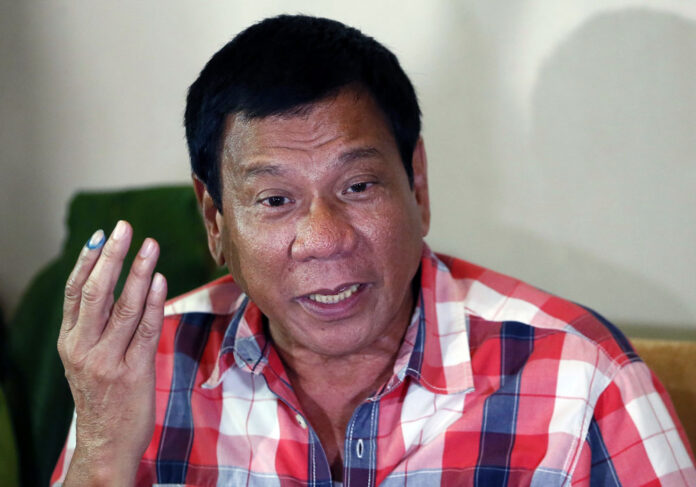
Philippines president Rodrigo Duterte, then mayor, gestures during a May 9 news conference in Davao city in the southern Philippines. Photo: Bullit Marquez / Associated Press
DAVAO, Philippines — The Philippines’ brash-talking president threatened Sunday to withdraw his country from the United Nations and lashed out at U.S. police killings of black men in his latest outburst against critics of his anti-drug campaign, which has left hundreds of suspects dead.
President Rodrigo Duterte pointed to the haunting image of a bloodied child being pulled from the rubble of a missile-struck building in the Syrian city of Aleppo to note the inability of the U.S. and the U.N. to stop such deadly conflicts, complaining that he comes under fire for the killings of criminals.
The U.S. State Department and two U.N. human rights experts have urged Duterte and Filipino authorities to stop extrajudicial killings in the fight against illegal drugs and ensure law enforcement compliance with international human rights obligations. Philippine police say more than 500 drug suspects have been killed in gunbattles with police since Duterte was sworn in eight weeks ago.
Agnes Callamard, the new U.N. Special Rapporteur on summary executions, suggested that Philippine officials could be held liable, saying in a recent statement that “claims to fight illicit drug trade do not absolve the government from its international legal obligations and do not shield state actors or others from responsibility for illegal killings.”
Criticisms against Duterte’s crusade against a problem that he says has become a pandemic provoked an angry outburst from Duterte, who held a news conference after midnight Saturday that dragged on for more than two hours.
“Maybe we’ll just have to decide to separate from the United Nations. If you’re that rude, son of a bitch, we’ll just leave you,” Duterte told reporters in Davao, where he first built a reputation for his tough crime-busting style while serving as the southern city’s longtime mayor.
Duterte also belittled U.N. work in the Philippines without providing facts, raising questions, for example, about the performance of the world body’s agency that fights hunger.
If the Philippines breaks off from the U.N. — which Duterte called “inutile” and “stupid” — he said he would invite other countries like China and African nations to form a new international body. The U.N., he said, should return Manila’s financial contributions.
“Look at the iconic boy that was taken out from the rubble and he was made to sit in the ambulance and we saw it,” Duterte said, referring to the photo of a 5-year-old Syrian boy, Omran Daqneesh, that has gone viral online.
“Why is it that United States is not doing anything? I do not read you,” Duterte said. “Anybody in that stupid body complaining about the stench there of death?”
When asked about the possible repercussions of his remarks, Duterte replied: “I don’t give a shit about them. They are the ones interfering.”
Duterte wondered whether U.N. officials were threatening to put him in prison and repeated that he was ready to sacrifice his life and presidency for his country.
Reacting to U.S. criticisms, Duterte cited the string of shootings involving police and black men that have sparked protests in the U.S.
“Why are you Americans killing the black people there, shooting them down when they are already on the ground?” he asked. “Answer that question, because even if it’s just one or two or three, it is still human rights violations.”
Duterte’s drug crackdown has left more than 500 suspected dealers dead and more than 4,400 arrested since he took office on June 30. Nearly 600,000 people have surrendered to authorities, hoping to avoid getting killed. The arrests have further overwhelmed the Philippines’ overcrowded jails.
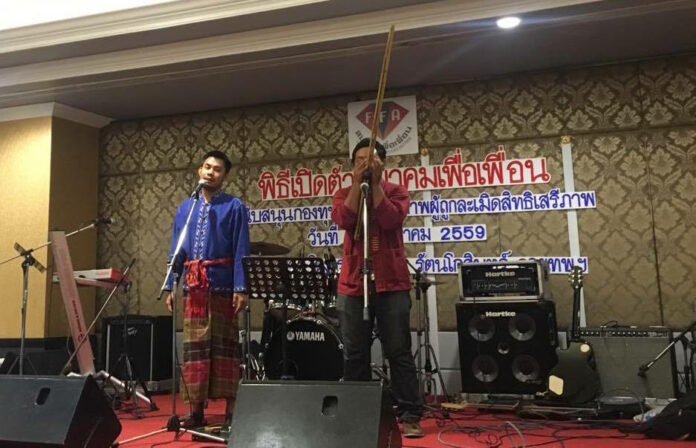
Patiwat ‘Bank’ Saraiyam, at left, sings traditional mor lam Saturday night at Bangkok’s Rattanakosin Hotel for the first time since he was granted an early release on a royal pardon after serving two years for his performance in a student play.
BANGKOK — When Patiwat ‘Bank’ Saraiyam took the stage Saturday night at the Royal Rattanakosin Hotel to play mor lam for the first time in public following his surprise release days earlier from prison, it proved an auspicious time and place to launch a group dedicated to supporting prisoners of conscience.
After all, it had been 112 days since the For Friends Association got to work, and the hotel has provided sanctuary to previous generations of pro-democracy protesters, even serving as a triage center for wounded when the 1992 popular uprising became “Black May.”
“The association is very important for those inside, as they help comfort us and make sure that we’re not left behind,” said the 27-year-old singer who was convicted of defaming the monarchy with his performance in a 2013 student play. “That’s why I want to perform today, as gratitude to all my supporters who gave me hope and made life inside not too miserable.”
Relatives and former political prisoners gather at the official launch of For Friends Association on Saturday night at the Royal Rattanakosin Hotel in Bangkok.
Patiwat was among former convicts and their loved ones to give heartfelt speeches at the official launch for the association, a group which offers a transparent and accountable system to lend aid to prisoners whose crimes make them subject to the harshest conditions, the marginalized of the marginalized.
It was also a means to raise much-needed funds.
“The 200 tickets almost sold out, which cost 1,100 baht each. We’ll get approximately 100,000 baht after deducting the expenses, which we’ll use as a starter fund to help provide better welfare for 30 jailed political activists and students,” said Piyarat ‘Toto’ Chongthep, association president.
Piyarat saw the need for the organization after Patiwat and other friends were convicted of crimes such as lese majeste – Section 112 of the Penal Code. Seeing such crimes as politically motivated, and the hardships faced by those even accused of them, the idea was to provide humanitarian assistance for them and others found guilty of thought crimes, as well as their families.
Along with others such as former political prisoner Ekachai Hongkangwan, he co-founded the association, which obtained legal status March 30. Their first efforts came a few weeks later after the arrest of eight dissident Facebookers, and it claims to have assisted 35 prisoners in the past four months.
Already involving matters of social taboo, suspects and convicts in such cases have seen increased restrictions, such as contact only with a short list of visitors approved by authorities.
Piyarat ‘Toto’ Chongthep, president of For Friends Association, spoke Saturday night at the Rattanakosin Hotel in Bangkok.
“While the numbers of prisoners for thought crimes have increased, we have limited staff to help out, and each prison has different rules on visitation,” Piyarat said. “Also, the interference from authorities makes things even more unpredictable, as the court could close early in the afternoon or stay late to give a verdict at midnight,” he said.
Despite the optimism of the association’s launch party, its fate hangs by a thread. Piyarat himself risks being jailed up to 10 years for famously tearing his ballot in protest on the day of the Aug. 7 referendum.
He will appear Tuesday in the Phra Khanong Circuit Court to answer a charge of violating the Referendum Act, which essentially criminalized dissent to the proposed charter.
“We have cautiously planned our work structure and management, so I think it won’t have much effect, with or without me,” Piyarat said, saying he’s prepared for whatever legal outcome.
The group has pledged transparent disclosure and effective use of contributions.
As a registered charity, it receives government scrutiny and runs entirely on donated funds and membership dues. Apart from 30,000 baht in monthly office overhead, funds are spent to facilitate visits and assist prisoners of conscience and their family members by helping to pay for things like toiletry items and transportation. Detailed expenditures are posted on their Facebook page andwebsite.
Piyarat may be an activist, but he said the group’s aims are apolitical.
“For Friends Association has no political aim or desire to put the government down. We provide humanitarian assistance equally, to everybody,” he said. “We take no sides. If one day any authority is in the same struggle, and asks for help, we’re ready to give them assistance.”
BANGKOK — While the place makes sense at night, it’s unclear what to do on RCA when the sun is out. Those waiting for showtimes at House RCA have had little more to do than eat 25-baht omelettes or wander around Tops Supermarket.
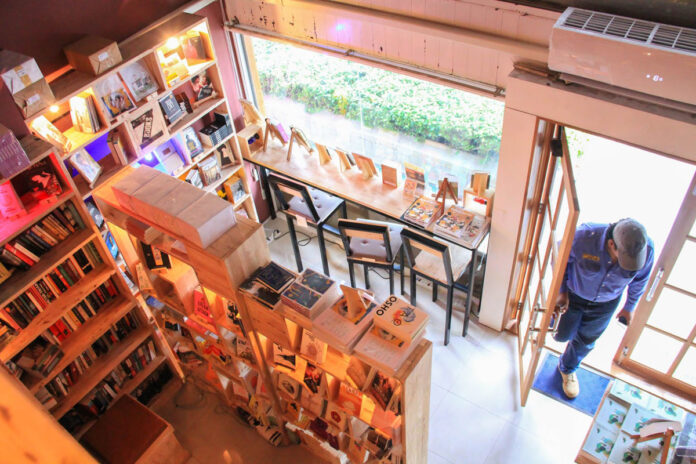
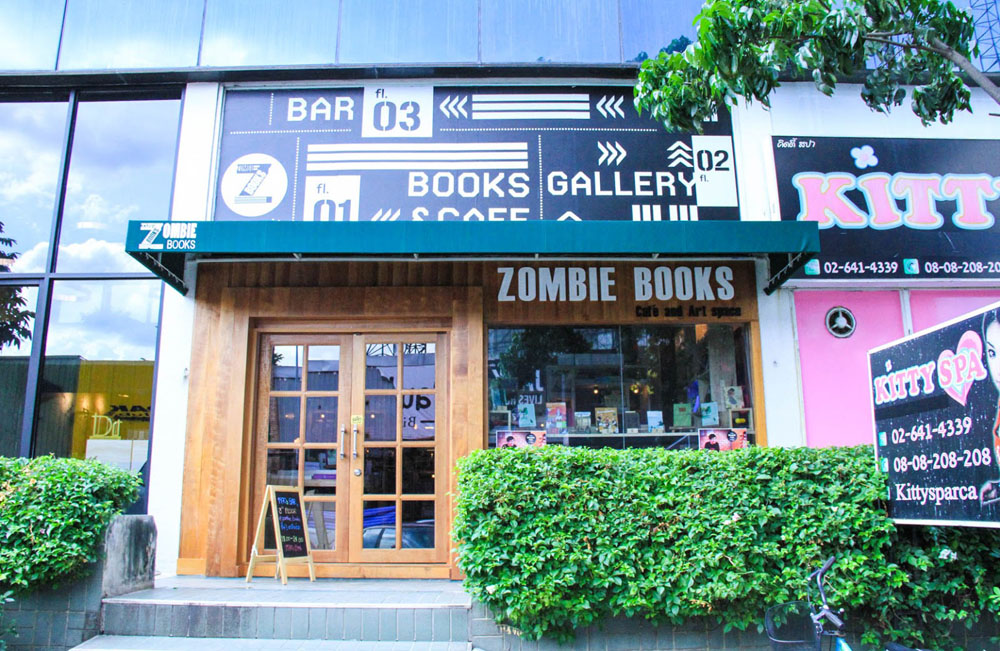
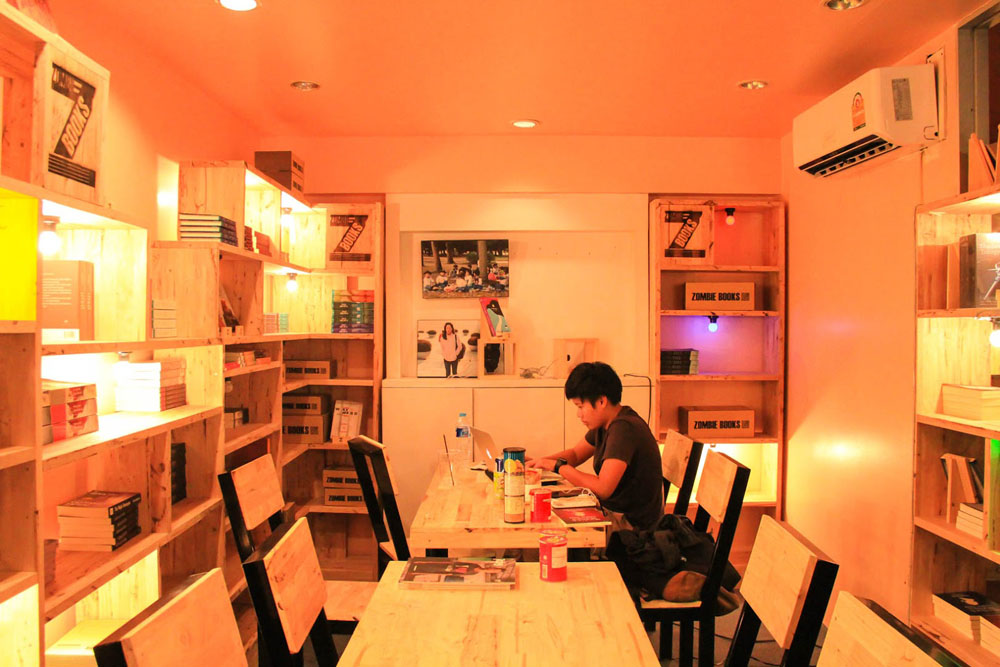
That’s changed now with new kid on the avenue Zombie Books, a multi-story building that opened a few months back to offer everything the idle class yearns for, from bookstore and gallery to coworking space, cafe and bar.
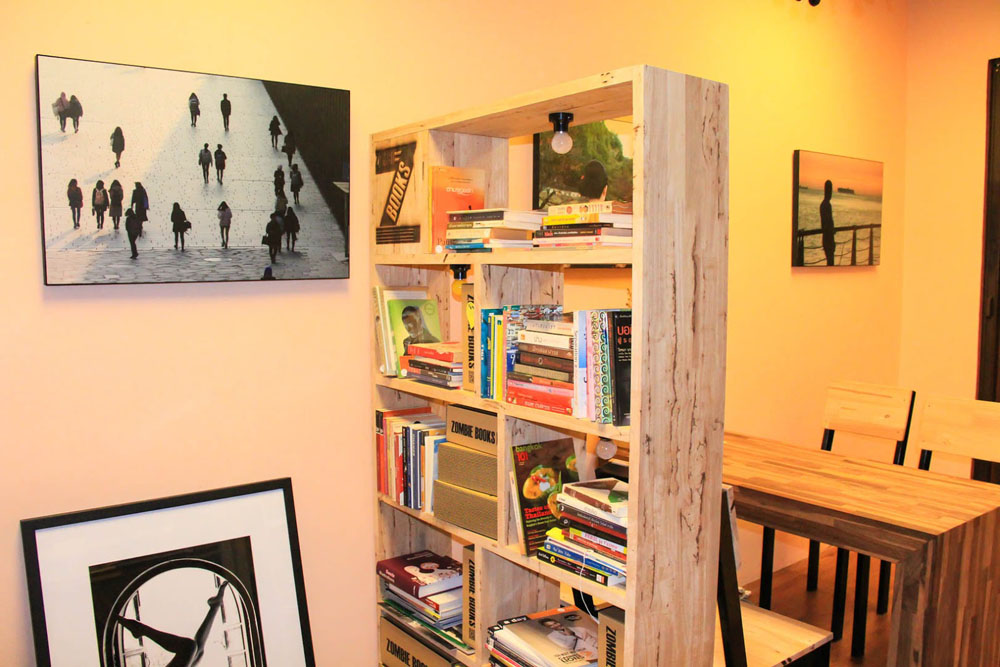
Walk about a five-minute walk up the road from the movie theatre and step inside to find wooden shelves lined with thousands of new and used books in both Thai and English. Covers range from Charles Dickens’ classics to post-feminist, chick lit “Bridget Jones’s Diary,” to the bestselling adventures ala “Into the Wild.”
Not into books, just thirsty? That’s alright because at the back of the first floor sits a coffee shop serving your basic iced Cappuccino to exotically named soft drinks such as Zombie Blood, a mix of apple and strawberry sodas.
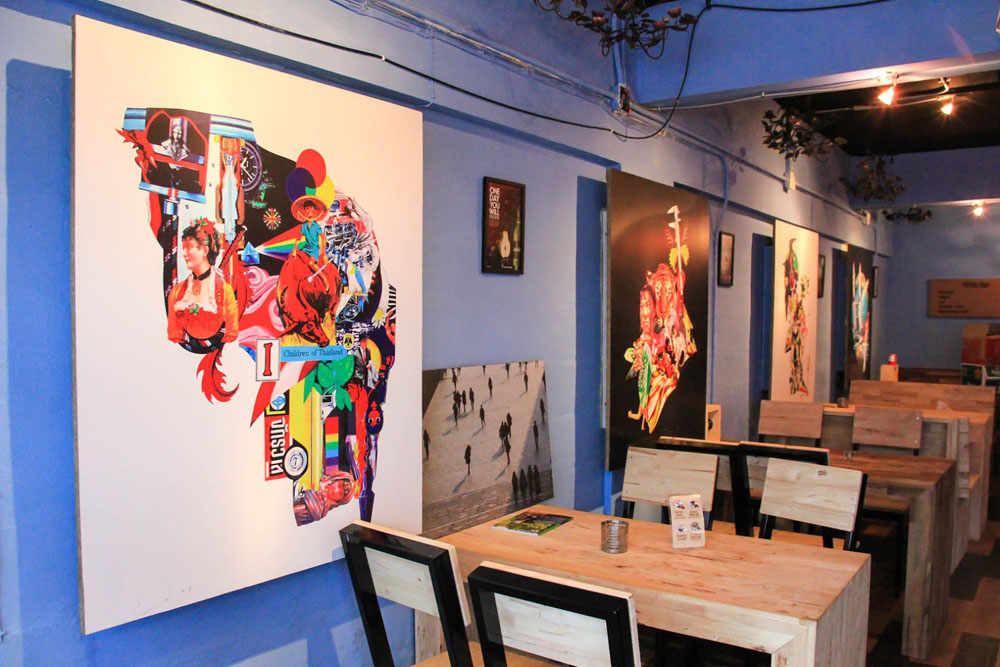
Stairs lead up to the mezzanine, where tables and chairs are ready for chit-chat, workshops, meetings or just working in peace under warm lighting. The second floor is quite similar, and lined with a dozen of framed pictures on the walls.
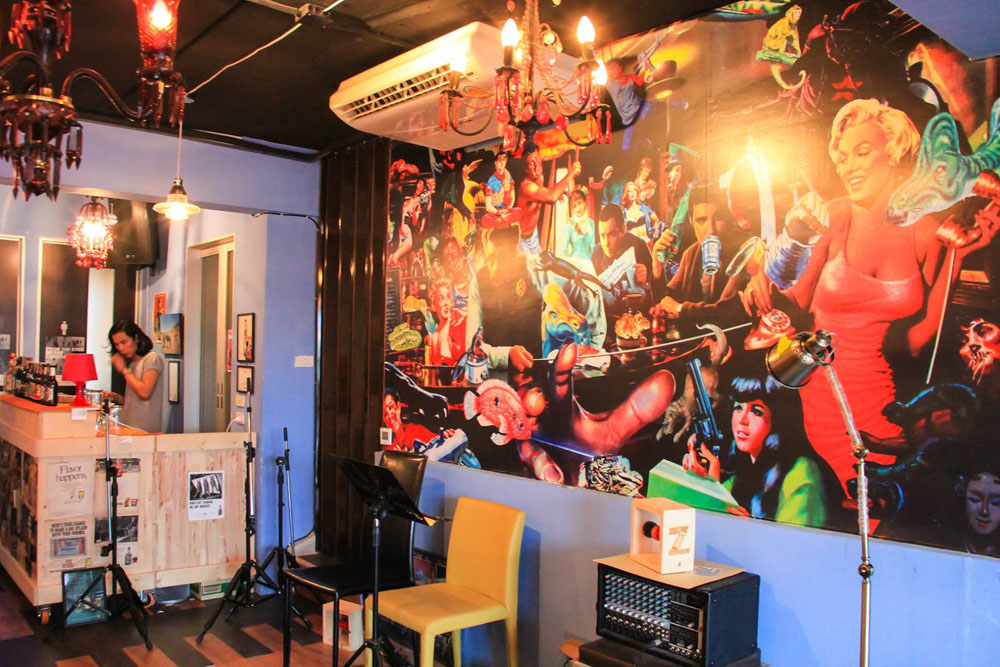
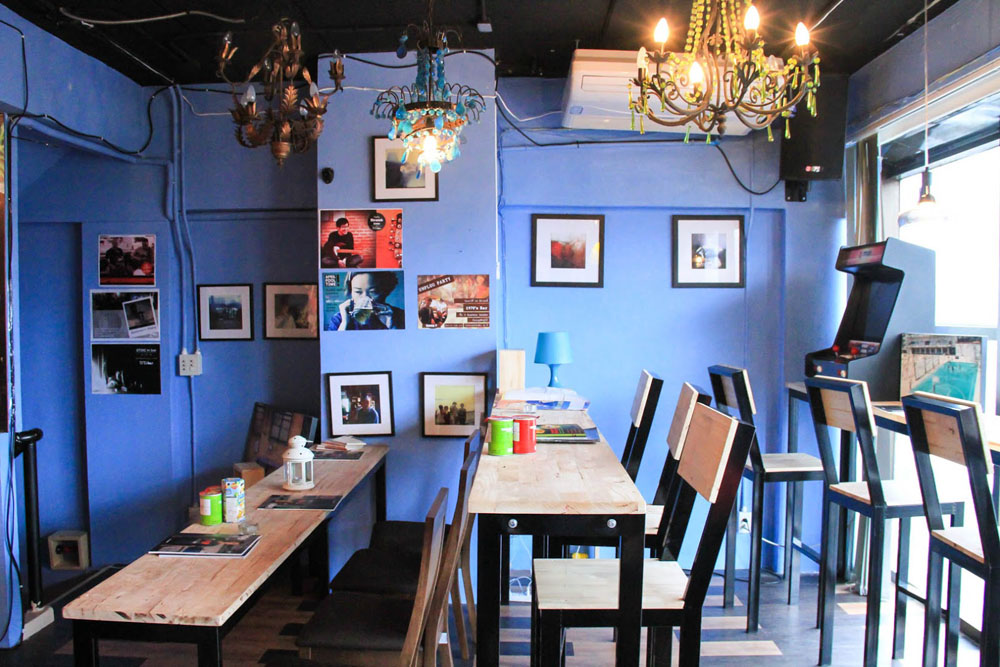
The third floor is a bar where some artful collage works, a record player and gaming machine area available. The bar opens at 6am and closes at midnight. Live bands of various genres from acoustic to jazz perform live on Fridays and Saturdays. The space is sometimes used for events such as mini-concerts or stand-up comedy.
“It’s rare for someone who goes to a bookstore just to buy only one book. So I want my bookshop to be somewhere interesting and not so boring,” the owner explains. “And I gotta make it not boring too.”
He only identifies himself as Tong and says at first he only wanted to create an online bookstore. But since space is needed to store the books, he decided to open a physical shop too.
Each book sold, mostly works of fiction, come from Tong’s preferences.
“The shop comes from my tastes. It is built from who I am and what I like,” said Thong, who is also writer under the pen name “10 Decibels.”
Zombie Books is Tong’s third bookshop, after his first in Pai and another in Bangkok. He said the the undead-themed name came from his return after a previous business failure.
“I’m still alive. I’m not dead yet,” Tong said. “Another reason is my belief that when a customer comes into our shop once, they’ll come back again. It’s like they’re one of us, they’re bitten by a zombie.”
Zombie Booksis located along the RCA party strip off Phetchaburi Road, can be reached by a motorbike from MRT Phetchaburi.
Fan art from Facebook page DrawAndDxng depicting the single gateway as an evil character wearing a coconut shell controlling all the data streams.
Many things have been said about the Single Gateway super surveillance project since the story broke this past September.
The Good People who run the country have been arguing about the need for mass surveillance in light of current laws that leave them powerless to protect the general public. They have evoked Applebaum’s four horsemen of the Infocalypse – child porn, terror, crime and drugs to justify the need for increased powers.
Let’s forget the few pros and many cons of the gateway project for a moment and review the trail of evidence that led to its public disclosure, a Pyrrhic victory for transparency if it prompts the government to better hide its tracks and find even darker corners to conduct the public’s business.
Yes, there is clear, publicly available information that would suggest not only that General Happiness knows about the project, but actually ordered it expedited. Many times.
The Cleric and His Four ‘Mistaken’ PM Orders
There are suggestions that some of the evidence has been, at the least, subjected to overabundant brevity in its public presentation at the highest levels to mislead the public.
The official narrative goes that there was never an order regarding the Single Gateway and any appearance otherwise resulted from a clerical error.
However, there are at least four Prime Ministerial orders to the Ministry of Information and Communication Technology, or MICT, regarding the Single Gateway project published on the Cabinet Secretariat website.
On June 30, 2015, the Cabinet Secretariat issued a Prime Ministerial orderto the Ministry of Social Development and Human Security to solve the “problem” of gaming addiction and, in the same paragraph, the MICT and Justice Ministry to set up a Single Internet Gateway to control the flow of information from overseas.
Next month on July 21, 2015, the Cabinet Secretariat issued another order directing the MICT to expedite the establishment of the Single Gateway as per the June 30 cabinet resolution.
Two Tuesdays later on Aug. 4, 2015, the Cabinet Secretariat published a third PM orderthat included acknowledging progress by the MICT on the Single Gateway and ordering them to engage with the people and answer questions, so the public would be cooperative.
Three meetings later on Aug. 25, 2015, the Cabinet Secretariat published order No. 4 which insisted the MICT expedite the project and demanded “significant” progress by Sept. 30, the fiscal year-end.
Section 1.2 of the June 30 cabinet minutes includes this section: The Ministry of Information and Communication Technology must also work with related agencies, such as Ministry of Justice and Royal Thai police, to proceed with implementation of a single gateway to be used as a device to control inappropriate websites and flow of news and information from overseas through the internet system.
Four orders from Prime Minister Prayuth Chan-ocha published on the official Cabinet Secretariat website would be cast-iron proof most anywhere on this planet, but here in Thailand where fact-checking is a long-lost art form, few bothered to confront General Happiness with these orders and most took his word as gospel.
And that word was a whopper: The Single Gateway did not exist but rather was a clerical error.
For some, that was the end of the story. Some bumbling bureaucrat in the cabinet secretariat mistakenly issued an order in the name of the prime minister. Repeated four times, that would make it epic bungling worthy of Homer (Simpson – not Iliad).
Following the Rabbit
But while most were happy to take the red pill and wake up blissfully unaware in the Matrix, a few of us took the blue and are only now scratching the surface to see how deep the rabbit hole goes – and it certainly seems deep.
And deeper invariably means darker, which is even more worrying.
The government no longer publishes full cabinet resolutions. In what has much further ramifications than just a little Single Gateway, if one is to look closely at the myriad of quasi-cabinet resolutions that have been published, one discovers they are actually mere summaries instead of the full, legally binding resolutions.
Some say summary; some say summary of the important points.
Either way, it is not the legally binding cabinet resolution.
To be fair, this practice did not start under this military government.
Now the real question people should be asking is, have other minor inconsequential details been omitted in the published cabinet resolutions that have been acted on by that bungling, clueless, scapegoat in the cabinet secretariat, who could still be making these clerical errors?
What else has been enacted and then obfuscated and omitted by governments, unelected or elected, that has been kept secret, other than the Single Gateway?