
































26.1 C
Bangkok
Saturday, June 20, 2026
Home Blog Page 2632

Wait Not Over For Loved Ones of Jailed ‘Wolf Bride’ Actress

Inmate Pornthip Munkong's boyfriend of nine years, Weeranan Huadsri, at left, and mother Nual Munkong on Friday outside the Klong Prem Central Prison in Bangkok.

BANGKOK — Two farmers from Phitsanulok province continued waiting outside a Bangkok women’s prison for Pornthip Munkong to go free Friday, much as they did every day last week.

Pornthip, their daughter, was jailed on a 2014 conviction for insulting the monarchy in a play she staged with a fellow activist the year before. After the other activist convicted of the same crime was suddenly released last week among those to receive annual royal pardons, Pornthip’s family and friends had hope that she, too, would follow.

But the problem is that no one can tell them when or if her freedom will come, so they have had no choice but to endure the waiting.

“There’s no clarity of whatsoever on the release,” said Pornthip’s mother, Nual Munkong. “Two years is already a long time for parents to not see their child. We were glad when we heard about the release, but this leaves us devastated.”

Read: Exasperating Wait For Release of Loved Ones From Prison

According to Nual, she and her husband Manit had to leave their home in Phitsanulok and stay with cousins in the capital city for the past week just so they could make the daily commute to the  Women’s Central Prison in Bangkok’s Chatuchak district. Each trip to and from the prison costs at least 300 baht, a large sum for rural farmers like Nual and Manit.

And they’re not alone. Loved ones of other convicts have been idling outside the prison during the past week since hearing up to 26 pardoned convicts would be released.

Under the military government that seized power in May 2014, Pornthip was convicted of lese majeste (insulting the monarchy) for acting in a student play called “The Wolf Bride,” which was staged in the Main Hall of Thammasat University in October 2013. Authorities said the play included defamatory allusions to the Royal Family.

Pornthip was found guilty along with her acting partner Patiwat Saraiyaem. They were scheduled to be released later this year in October, but the prison let Patiwat walk free the morning of Aug. 12, Her Majesty the Queen’s Birthday, on the grounds he qualified for a mass royal pardon handed down on that special occasion.

Since then, Pornthip’s loved ones hope she would be granted the same pardon. But officials at the women’s prison won’t confirm or deny even the possibility, saying that they will free any pardoned inmates as soon as they receive an order from the Department of Corrections.

Another person caught in Godotesque limbo is Pornthip’s boyfriend, Weeranan Huadsri. Like Pornthip’s family, Weeranan has waited up to six hours per day in front of the women’s prison.

“As someone who has to wait, this is not alright,” Weeranan said . “Everyone has to work and is not always available. Also, there’s a cost that we must pay for the waiting, such as transportation and accommodations. Still, we want to wait for our loved one.”

The  Women’s Central Prison is one part of a sprawling corrections complex collectively known as Klong Prem Central Prison.

Weeranan said when he called the Department of Corrections about his girlfriend, the officials replied that those pardoned would be out soon, but wouldn’t say when. They also told him the delay was due to new measures that require detailed information about the convicts before they are released.

The next chance for Pornthip’s release is Monday. Manit, her father, won’t be there, because he has to return to work on his farm Sunday. Nual will continue waiting in Bangkok, something she is trying to keep from her daughter so that she doesn’t worry.

Weeranan, who works for the civil rights group Thai Lawyers for Human Rights, said Pornthip is already concerned her parents are going through a lot of difficulty just to wait for her.

“There’s a saying ‘Justice delayed is justice denied,’ which I think is appropriate to the situation,” Weeranan said.


Advertisement

SMAP Decision: Japan’s Long-Running, All-Male Pop Act to Break Up

TOKYO — The on-again, off-again breakup of an all-male Japanese pop group with a strong following throughout Asia is back on: The five members of SMAP will go their separate ways at the end of this year, after performing together for more than two decades.

The group’s agency, Johnny & Associates, announced Sunday that SMAP would disband, according to Japanese media reports. The agency said its members would focus on their solo careers, Kyodo News service reported.

A possible split was widely rumored in January, until the group’s members made an unusual television appearance to say they would stay together and apologized for causing concern among their fans.

Johnny & Associates said that it had recently proposed the band take a hiatus, but that some members wanted to break up for good, according to the media reports.

“We judged it difficult for them to continue activities as a group,” Johnny & Associates said, according to Kyodo.

SMAP, which stands for “Sports Music Assemble People,” was formed in 1988 as a six-person teenage boy band. Its first CD came out in 1991, and the group surged to stardom with choreographed singing and dancing.

SMAP’s members now range in age from 39 to 43, and it remains a popular group that is a staple of entertainment shows and commercials. Each member has also performed individually in variety shows and films.

Feel the power of SMAP.

Advertisement

Chiang Rai Rangers Searching for Missing Asian Tourist

Search parties on Friday inspect one of many caves in the Tham Luang - Khun Nam Nang Non forest park, where a tourist went missing.

CHIANG RAI — Park rangers in Chiang Rai province launched a search Thursday for a foreign tourist who went into the forest to meditate a week ago and then vanished.

The tourist, who was only described by a witness as Asian-looking, was last seen Aug. 12 as he made his way to the Tham Luang – Khun Nam Nang Non forest park, known for its many caverns.

“We have sent out search parties until we find him, dead or alive,” forest park director Sawasdi Taweerat told reporters Friday. “But I believe he’s still alive, because the missing man had plenty of food supplies with him.”

Pavinee Mayer, a vendor who appeared to be the last person to have seen the missing tourist, said the man stopped by at her stall on the afternoon of Aug. 12 and told her, in Thai, that he was trekking into one of the caves in the forest to meditate for several days.

The tourist, who “looked either Chinese or Japanese,” left his bicycle at her stall and carried his supplies into the jungle, Pavinee said. When she returned to her stall on Wednesday, the bicycle was still there, so she alerted police.

After the search was halted Friday with no sign of the man, officials said they still have one large cave to search in a few days once flood water drains from its entrance chamber.

Advertisement

Media’s Self-Inflicted Punishment is the New Censorship

Nattakorn Devakula and Atukkit Sawangsuk in a promotional image for Voice TV's Wake Up News program.

RetentionPublic and foreign diplomats are routinely told by the military regime that Thai media enjoys freedom to criticize. That’s only half true at best. The reality is that, two years after the 2014 coup, the selective pressures being applied on some media critical of the junta have just become more subtle and sophisticated, thus rather invisible.

Apparently, the junta doesn’t need to muzzle the media, as at least one outlet has shown it’s willing to strap it on for them.

Take what happened at Voice TV earlier this week. It began when Voice TV news director Prateep Kongsib announced Sunday on Twitter the station’s decision to pull two well-known political news commentators off the air from some programs for 10 days in order “to survive under these special circumstances.”

Prateep, who also tweeted the station “was given a condition that can’t be refused,” later told me the decision resulted from a meeting between representatives of Voice TV, telecoms regulators and the junta. (Was the junta rep there to ensure the regulator from the National Broadcasting and Telecommunications Commission, or NBTC, remained pro-active?)

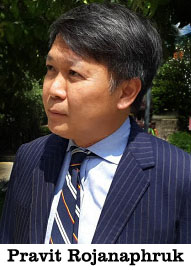
Pravit RojanaphrukLast month, junta leader Gen. Prayuth Chan-ocha used his absolute power under Article 44 of the provisional charter to empower the commission to censor any media deemed a threat to national security and shield it from legal consequences for doing so. According to an outstanding junta order from 2014, security threats include anything construed as defaming the monarchy, “insincere” criticism of the junta, or anything that might sway public opinion against it.

After the news got out, there was criticism of the junta, but even more so criticism of the commission.

Commissioner Thawatchai Jittrapanun soon tweeted Wednesday that the commission did not order the suspension of any staff at Voice TV, adding that the law does not grant it the power to punish any particular media worker as the power rests with each media company.

“There’re still misunderstanding regarding the resolution of the NBTC regarding Voice TV. The commission did not suspend any staff. Instead it was a proposal made by the TV station so the commission did not act further,” Thawatchai tweeted.

I tweeted back and asked why would Voice TV submitted a letter to the commission Monday informing it of the disciplinary action if it had nothing whatsoever to do with the NBTC? There was no answer from Thawatchai. Another commissioner, Supinya Klangnarong, explained to me earlier by telephone that this was an offer made by the station in a desperate attempt to thwart the possibility of heavier punishment meted out by the commission.

Supinya said Voice TV had been warned several times in the past by the NBTC and heavier punishment could mean an order to permanently remove two popular political programs. This, she added, would have severe repercussions on the station’s advertising revenues.

Although Voice TV is owned by Panthongtae Shinawatra, the only son of ousted and fugitive former premier Thaksin Shinawatra, it is also a corporate media outlet and turning a profit matters as much as scrutinizing the military regime, if not more.

Voice TV chose to engage in pre-emptive self-punishment in order to appease the NBTC, thus the junta, in a bid to avoid greater calamity. On the surface, it lends the appearance that the junta and the NBTC had nothing to do with the move and thus should not be held responsible for what happened.

Supinya and Prateep’s accounts suggested a more subtle and sophisticated model of self-censorship at work, however. Supinya said that basically any criticism against the junta on television could be construed as violating the MoU reached with the junta/NBTC. Prateep meanwhile told me the two staff members have been accused of harboring a “negative attitude” toward the junta and its military government.

Does this mean it’s now unacceptable to have a negative attitude toward the coup makers who illegitimately seized power?

In this new model of pre-emptive self-censorship, it’s the media organization which “voluntarily” takes the initiative to censor itself by punishing its own staff to avoid the appearance of another infringement on press freedom by the junta or broadcast commission.

No statement was issued by any of the media associations condemning this violation of press freedom.

The two suspended staff members also feel compel to speak as little about it as possible, as they do not want to be accused by colleagues of jeopardizing the future of the TV station itself.

Nattakorn Devakula, who along with Atukkit Sawangsuk was suspended 10 days, was even sympathetic to those who suspended him. He told me via Facebook message: “I would rather stay quiet on it. Trying to cooperate with [the commission] to prevent further escalation of the conflicts. But to sum it short, they are unhappy with commentary on political/divisive issues of most kinds.”

A female Voice TV staff who was not suspended and asked not to be named due to the sensitivity of the issue referred to the act as “self-punishment” instead of blaming the junta or the NBTC for curbing press freedom. The issue is thus framed as a matter of internal regulation than external threat to press freedom, as illustrated by the stance taken by NBTC commissioner Thawatchai. It shifts the language from “rights” to that of “regulation.”

It also pits staff against management, further diverting attention and possible repercussion from the junta and the commission. No wonder Nattakorn doesn’t denounce his management, as staff could accuse the two of jeopardizing the station’s survival if they didn’t comply.

This is the latest in a long history of threats against Thai media. Under Thaksin Shinawatra, one outlet highly critical of his government, Matichon Group, which owns Khaosod and Khaosod English, was pressured to back off via threats of an attempted corporate takeover by a Shinawatra proxy company back in 2005. There was no proof beyond a reasonable doubt the company which tried to take over Matichon was doing so on Thaksin’s behalf as alleged. Under Thaksin as it is now, the awarding of lucrative state-agency ads and commercials to friendly media firms have become a common practice.

The junta, aka National Council for Peace and Order or NCPO, has evolved from the first days after the coup when it use naked force to muzzle opposition media by sending troops “guard” various TV stations thus ensuring self-censorship, ordering some shut down, and detaining journalists without charge for “attitude adjustment.” It now implicitly “enabled” Voice TV to punish its own staff for doing a competent job at holding the regime accountable.

I asked Prateep if it would be difficult for Voice TV to survive if it doesn’t soften its content and he replied, “That’s the signal they are sending.” Given the situation, news organizations more committed to maximizing profits instead of holding the powers that be accountable will eventually relent and tell its staff to go easy on the junta. Such processes lead to internalized censorship where a line would be drawn as to what is permissible and what is not without any knowledge of the public.

Internalizing self-censorship is nothing new for Thailand, where media have routinely self-censored themselves for decades (and still do so) on any news which might be construed of as mildly critical of the monarchy – and even some that are not – for fear of violating the draconian lese majeste law.

We must give credit to the junta and the NBTC for the new paradigm of voluntary, preemptive self-punishment, however.

Advertisement

Antlers Stolen by Hunter S. Thompson Returned to Hemingway Home

Anita Thompson, left, is joined by Library Executive Director Jenny Emery Davidson, middle, and Program Manager Scott Burton as they pose with trophy antlers while returning them to the former home of writer Ernest Hemingway on Aug. 5 in Ketchum, Idaho. Photo: Christina Jensen / The Community Library / Associated Press

BOISE, Idaho — A young Hunter S. Thompson went to Idaho to write about Ernest Hemingway and decided to take a piece of his hero home with him — a set of trophy elk antlers.

More than half a century later, the gonzo journalist’s wife returned the antlers to Hemingway’s house in the mountain town of Ketchum.

“He was embarrassed that he took them,” Anita Thompson told The Associated Press on Thursday, noting the deep respect her husband had for Hemingway’s work. “He wished he hadn’t taken them. He was young, it was 1964, and he got caught up in the moment.

“He talked about it several times, about taking a road trip and returning them,” she said.

She gave back the antlers Aug. 5 to Ketchum Community Library, which helps catalog and preserve items in the residence where the author took his own life. It’s now owned by the Nature Conservancy.

In 1964, Hunter Thompson, then 27, came to Ketchum when he was still a conventional journalist. He had not yet developed his signature style, dubbed gonzo journalism, that involved inserting himself, often outrageously, into his reporting and that propelled him into a larger-than-life figure.

Thompson was writing a story for the National Observer about why the globe-trotting Hemingway shot and killed himself at his home three years earlier at age 61. Thompson attributed the suicide in part to rapid changes in the world that led to upheavals in places Hemingway loved most — Africa and Cuba.

Even Ketchum, which in the 1930s and 1940s attracted luminaries such as Gary Cooper, had fallen off the map of cafe society by the late 1950s, Thompson wrote.

In the story, later collected in his book “The Great Shark Hunt,” he noted the problem of tourists taking chunks of earth from around Hemingway’s grave as souvenirs.

Early in the piece, he wrote about the large elk antlers over Hemingway’s front door but never mentioned taking them.

For decades, the antlers hung in a garage at Thompson’s home near Aspen, Colorado.

“One of the stories that has often been told over the years is the story of Hunter S. Thompson taking the antlers,” said the library’s Jenny Emery Davidson, who helped accept the trophy. “These are two great literary figures who came together over the item of the antlers.”

Davidson said historian Douglas Brinkley, who spoke at the library in May and was familiar with the antler story after interviewing the writer, contacted Anita Thompson. She called the library on Aug. 1.

Davidson said the antlers have since been shipped to a Hemingway grandson in New York who wanted them. It’s not clear if the antlers came from an elk killed by the author, who was a noted big game hunter, or if they were a gift.

Sean Hemingway didn’t respond to emails or phone messages seeking comment.

Like Ernest Hemingway, Thompson ended his own life by shooting himself, dying in 2005 at age 67 at his Colorado home.

His widow wants to turn the house where he lived and worked into a museum, planning to open it next year by invitation only. Like Hemingway’s home, it’s much the same as it was when Thompson was alive.

“I couldn’t open it with a clear conscious knowing there’s a stolen pair of antlers,” Anita Thompson said, noting the theft was unusual behavior, even by her husband’s standards.

Story: Keith Ridler

Advertisement

Masked Gunmen Target Family in Muang Thong Thani Condo

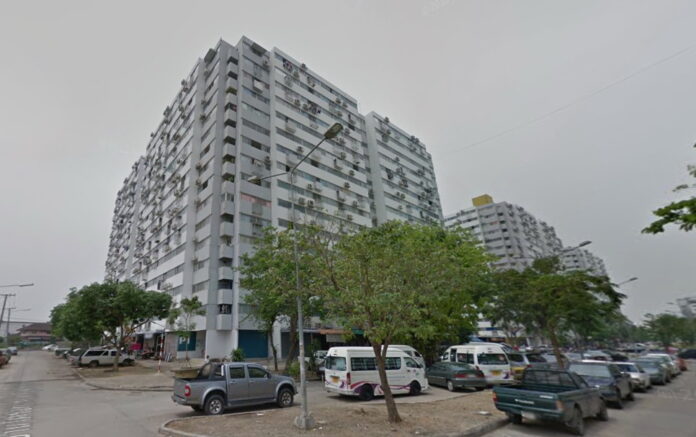
The Popular Condominium near Impact Muang Thong Thani is rented out daily to visitors of the convention center. Photo: Google

BANGKOK — A family of eight from southern Thailand said they were robbed by three masked men at a condominium where they were staying in the Muang Thong Thani housing complex early Saturday.

The family was said to be staying in four separate rooms in the complex’s Building P to visit an exhibition at nearby Impact Muang Thong Thani.

According to the victims, the gunmen kicked down the doors to the units they were renting at around 2am, took their possessions and then fled the scene.

Pak Kret Police Station chief Ritthinan Puipanthawong said officers were investigating the incident. The suspects remain unidentified.

Advertisement

Alleged Anti-Junta Elderly Militants Denied Bail

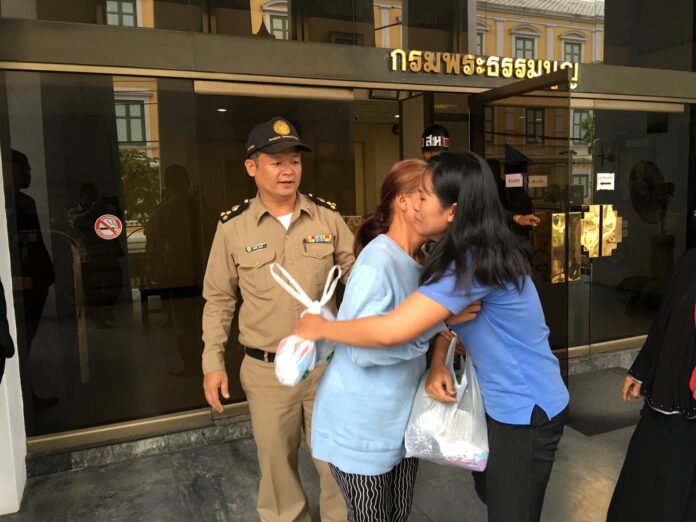
One of the alleged militants on Friday gave a hug to her supporter in front of a Bangkok military court.

BANGKOK — All of the 15 suspects arrested for allegedly plotting anti-government violence were denied bail release by the military court Friday.

The defendants, who are mostly Redshirt supporters in their 60s, stand accused of belonging to a clandestine network and conspiring in armed struggle against the state, an allegation denied by leaders of the Redshirt movement.

Army Backtracks on Claims of Elderly Terror Suspects’ Link to Bomb Attacks

Thanadej Puangpoon, the attorney representing the accused, said the military tribunal ordered the 15 sent to prison even though he said they are in poor health and could not possibly interfere with any evidence.

“I explained that the suspects don’t even know who the witnesses are, so they had no way of interfering with the witnesses,” Thanadej Puangpoon, the attorney representing the accused, told reporters. “And most of the suspects are mostly in their senior age, so [being in prison] would affect their health.”

The 15 are charged with insurrection, belonging to a secret society with an intent to commit crimes, and violating the junta’s ban on political gathering.

They were taken to Bangkok Remand Prison and Central Women’s Correctional Facility. Thanadej said he hoped to apply for bail on their behalf again on Monday.

Police said they’re also looking for two other suspects in connection with the alleged clandestine ring.

Earlier today Jatupon Prompan, leader of the Redshirts’ official organization, disputed the allegation, calling it a “nonsensical farce.”

Meanwhile, Sunai Phasuk, a Human Rights Watch coordinator for Thailand, raised concerns that the suspects may not receive a fair trial, because the 15 were previously held in military detention without access to lawyers.

“It’s not transparent,” Sunai said, “Their allegation can’t be independently proven.”

He also criticized the court’s tendency to deliberate on bail request based on the nature of the crimes the suspects are charged with, instead of separately consider a bail for each of the defendants.


Advertisement

Activist on Hunger Strike Denied Release by Military

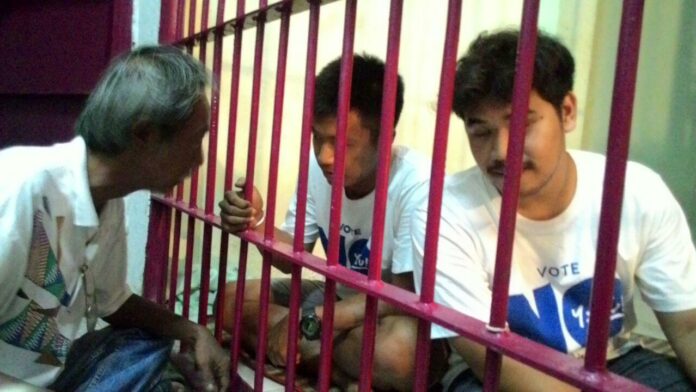
Wiboon Boonpattararaksa talks to his son Jatupat Boonpattararaksa, at center, on Aug. 6 at a police station holding cell in Chaiyaphum province. Jatupat was on a hunger strike to protest his arrest for campaigning against the charter. Photo: Thai Lawyer for Human Rights

BANGKOK — A hunger striking activist who was ordered free by a court today was instead taken before a military tribunal on a 2015 charge stemming from holding an anti-coup banner.

A leader of the northeastern activist group Dao Din, Jatupat ‘Phai’ Boonpattararaksa was originally expected to be freed from Phu Khiao Prison in Chaiyaphum province late Friday afternoon after the court approved to his release on the condition he cannot leave the country.

Jatupat had been on a hunger strike since his arrest two weeks ago for campaigning against the charter.

At 5pm Friday, police arrived at the prison to take him to Khon Kaen military court for another charge from last year. It stemmed from a May 2015 rally at Khon Kaen’s Democracy Monument at which seven Dao Din members displayed a banner which said  “oppose the coup.”

Before departing to Khon Kean, Jatupat’s mother, Prim Boonpattararaksa, asked to meet her son to let him sign his university enrollment forms, but police refused.

The mother along with Jatupat’s sister then tried blocking the police vehicle, pleading with the officers in tears. After an hour, police let Prim meet her son to sign the document.

Read: Fourth Day of Hunger Strike For Jailed Referendum Activist

Jatupat was arrested Aug. 6 at a market in the northeastern province Chaiyaphum where he was distributing leaflets against the draft charter. He was charged for violating the Referendum Act.

The 25-year-old activist began his hunger strike immediately after he was imprisoned and refused to post bail in protest of what he said was the illegitimacy of the charges.

Fellow activist Wasin Prommanee, who was arrested at the same time, was freed on a bond.

Wiboon Boonpattararaksa, Pai's father and lawyer, on Friday morning at Chaiyaphum's Phu Khaio Provincial Court.
Wiboon Boonpattararaksa, Pai’s father and lawyer,
on Friday morning at Chaiyaphum’s Phu Khaio Provincial Court.

A number of rights groups, such as Human Rights Watch, had urged the government to free Jatupat, especially after he was reported to be in poor health condition following the strike.

His father, Wiboon Boonpattararaksa, a lawyer who is representing his son, staked his license and 30,000 baht to cover the 150,000 baht bond.

Wiboon said he briefly talked to his son in the court. Phai said he would end his hunger strike after he’s released.

Jatupat and Wasin are to testify in court on Monday.

Advertisement

Experts Use Drift Modeling to Define New MH370 Search Zone

A school utility worker mops a mural depicting the missing Malaysia Airlines Flight 370 at the Benigno "Ninoy" Aquino High School campus at Makati city, east of Manila, Philippines On April 8, 2014. Photo: Bullit Marquez / AP)

CANBERRA, Australia — Experts hunting for the missing Malaysian airliner are attempting to define a new search area by studying where in the Indian Ocean the first piece of wreckage recovered from the lost Boeing 777 — a wing flap — most likely drifted from after the disaster that claimed 239 lives, the new leader of the search said.

Officials are planning the next phase of the deep-sea sonar search for Malaysia Airlines Flight 370 in case the current two-year search of 120,000 square kilometers (46,000 square miles) turns up nothing, said Australian Transport Safety Bureau chief commissioner Greg Hood, who took over leadership of the bureau last month.

However, a new search would require a new funding commitment, with Malaysia, Australia and China agreeing in July that the $160 million search will be suspended once the current stretch of ocean southwest of Australia is exhausted unless new evidence emerges that would pinpoint a specific location of the aircraft.

“If it is not in the area which we defined, it’s going to be somewhere else in the near vicinity,” Hood said in an interview this week.

Further analysis of the wing fragment known as a flaperon found on Reunion Island off the African coast in July last year — 16 months after the plane went missing — will hopefully help narrow a possible next search area outside the current boundary.

Six replicas of the flaperon will be sent to Australia’s Commonwealth Scientific and Industrial Research Organization’s oceanography department in the island state of Tasmania where scientists will determine whether it is the wind or the currents that affect how they drift, Hood said. This will enable more accurate drift modeling than is currently available.

If more money becomes available, the Australian bureau, which is conducting the search on Malaysia’s behalf, plans to fit the flaperons with satellite beacons and set them adrift at different points in the southern Indian Ocean around March 8 next year — the third anniversary of the disaster — and track their movements.

Meanwhile, barnacles found on the flaperon and an adjacent wing flap that washed up on Tanzania in June are being analyzed for clues to the latitudes they might have come from. The flap is in the Australian bureau’s headquarters in Canberra where it has been scoured for clues by accident investigators.

Peter Foley, the bureau’s director of Flight 370 search operations since the outset, said the enhanced drift modeling would hopefully narrow the next search area to a band of 5 degrees of latitude, or 550 kilometers (340 miles).

“Even the best drift analysis is not going to narrow it down to X-marks-the-spot,” Foley said.

Some critics argue that the international working group that defined the current search area — which includes experts from the U.S. National Transportation Safety Board, Britain’s Air Accidents Investigation Branch, the plane’s manufacturer Boeing, Australia’s Defense Science and Technology Group, satellite firm Inmarsat and electronics company Thales — made a crucial mistake by concluding that the most likely scenario was that no one was at the controls when the plane hit the ocean after flying more than five hours.

The airliner veered far off course during a flight from Kuala Lumpur, Malaysia, to Beijing. What happened to the plane has become one of the biggest mysteries in aviation, with a wide range of theories, including that a hijacker could have killed everyone on board early in the flight by depressurizing the plane.

The current search area was defined by analysis of a final satellite signal from the plane that indicated it had run out of fuel. Scientists have determined how far the plane could have travelled from a height of up to 12,200 meters (40,000 feet) after both engines lost power.

But critics who favor the theory that Captain Zaharie Ahmad Shah hijacked the plane argue that he could have glided the plane beyond the current search area. Some say he could have made a controlled ditch at sea in order to minimize debris and make the plane vanish as completely as possible. Officials say Zaharie flew a similar route on his home flight simulator only weeks before the disaster.

Foley said his bureau’s analysts were working on the flap to ascertain whether or not it was deployed when the plane hit the water. They will test their hypothesis with the Boeing accident investigation team to validate their findings.

Recent analysis of the final satellite signals also suggest the plane was descending at a rate of between 3,700 meters (12,000 feet) and 6,100 meters (20,000 feet) a minute before it crashed. A rate of 600 meters (2,000 feet) a minute would be typical of a controlled descent.

“The rate of descent combined with the position of the flap — if it’s found that it is not deployed — will almost certainly rule out either a controlled ditch or glide,” Foley said.

“If it’s not in a deployed state, it validates, if you like, where we’ve been looking,” he said.

Crews have not given up hope of finding the plane in the current search area, which because of bad weather and 20-meter (65-foot) swells could take them until December to finish scanning.

Less than 10,000 square kilometers (4,000 square miles) of seabed, which is outside the original 60,000-square-kilometer (23,000-square-mile) high-priority search zone, remain to be searched.

More than 20 sonar contacts require closer examination by a sonar-equipped underwater drone. These are between 2,700 kilometers (1,700 miles) and 1,900 kilometers (1,200 miles) from the Australian port of Fremantle where the search ships are based.

“We are still hopeful and optimistic,” said Hood.

Foley said finding the plane was the only chance of the solving the mystery of what happened aboard Flight 370.

“We will never know what happened to that aircraft until we find it,” Foley said.


Story: Rod McGuirk

Advertisement

Oil Rig Worker Freed But Still Faces Charges

An army escort on Wednesday drives Sakarin Karuehat (in orange) to a police station in Nakhon Si Thammarat. He was released a day later.

NAKHON SI THAMMARAT — A 32-year-old Chiang Mai man accused of participating in the wave of terror attacks in southern Thailand last week has been released from military custody, police said Friday.

But police said they will file explosives-related charges against Sakarin Karuehat next week, and this time, the case will be filed in a military court, where army officers sit as judges and no appeal is possible. He was previously held incommunicado for nearly a week in a Nakhon Si Thammarat army base on suspicion of firebombing a supermarket there.

Here’s Why Experts Believe BRN Was Behind Attacks

“We will probably ask the provincial military court for a new arrest warrant by Monday or Tuesday,” said Tesa Siriwatho, commander of the regional police force.

Sakarin has been at the center of a controversy that plagued the bombing investigation since it got off the ground. The swift arrest of Sakarin, who works on a oil rig in Gulf of Thailand, was slammed by some critics of the junta, and even the top police investigator, as sloppy police work. But the authorities contend they have evidence to implicate the man.

According to Lt. Gen. Tesa, police initially asked for an arrest warrant on Sakarin from a civilian court because they thought the attack on the Tesco Lotus was arson at the time.

“But after we collected evidence at the crime scene, we concluded that it was a [fire] bomb attack,” Tesa said. “So we have to cancel the outstanding warrant, and ask for a new one from the military court.”

Sakarin is accused of placing a firebomb inside the supermarket prior to the explosion on Aug. 12. Police said they have footage of him entering the venue with a plastic bag and later leaving without it.

His sister denies he had any involvement.

Police announced Wednesday that all suspects in the Aug. 11-12 bombing spree would be tried by military tribunal.

But deputy police commander Srivara Ransibrahmanakul, who’s nominally leading the investigation, was reportedly upset about the flimsy evidence against Sakarin.

“When it comes to an investigation, you should think with your mind and not your damn feet, because this is an important and sensitive matter,” Srivara reportedly said on Tuesday to police officers in Nakhon Si Thammarat.

Advertisement

Hot News

LATEST NEWS

Bangkok
overcast clouds
26.1 ° C
26.1 °
26.1 °
93 %
1.8kmh
100 %
Sat
33 °
Sun
35 °
Mon
37 °
Tue
37 °
Wed
36 °