


































36.6 C
Bangkok
Wednesday, June 24, 2026
Home Blog Page 2652

Drop Pins on This Map to Help Make Bangkok Great Again

YouPin’s crowdsourced map shows pins entered by regular citizens.

BANGKOK — Broken manhole cover traps, fallen wires, phoneless phone booths, missing bus maps and smelly bins. Walking in Bangkok can be a challenging and unpleasant experience.

Rather than place hope in the powers that be to fix everything and make the city walkable – an outcome that could be worse – a group of urban advocates got together to brainstorm a new platform to crowdsource the problem and invite everyone to help make the city better.

First is collecting the data, for which the group of gadflies created “YouPin,” an app anyone can use to build out the crowdsourced map of street problems via a web app or bilingual chatbot.

“We wanted to create a sense of ownership of the city” said Thitiphong Luangaroonlerd, who developed the project and app with a large group of about 20 friends. “Instead of only waiting for authorities to fix things, we now do what we can.”

It’s a Big Data approach to understanding and prioritizing problems for improvement.

YouPin’s gallery shows photos of problems uploaded by users.

As a longtime advocate for street maintenance, Thitiphong said City Hall does has listened and resolved problems he’s complained about. But, the 33-year-old IT worker said, the channels of reporting them need to work better, as the 1555 hotline and government website are not very usable.

And they don’t leverage the benefits of today’s networked technology.

“Also it lacks the quality of being social,” he said.

By putting the reported problems in a public place, Thitiphong said communities can weigh in with what they agree is important to help officials prioritize matters.

While the interface of the beta version of the web app does not yet include English, the Facebook chatbot loves talking in both languages. All you need to do is upload a photo or video with some description of the problem to report, then share the location it was discovered.

The system offers nine categories of problems, including sidewalks, roads, pollution, transportation and waste.

YouPin chatbot speaks both Thai and English.

This past weekend, organizers held “Bangkok Urban Hack Day,” where Bangkokians of different walks of life gathered to propose what could be done with the more than 500 pins already added to the map.

“For some pins, we have to depend on the government to fix it, so there needs to be offline cooperation,” Thitiphong said. “But some pins we can fix by ourselves, such as dirty walls or stinky garbage spots.”

They want to collect more data first so they can see what it will be and how to best proposed interfacing with City Hall.

They’ve already won laurels for their effort however. YouPin was chosen in June by the U.N Development Program as Thailand’s winning entry in a sustainable cities competition.

Thitiphong believes embracing data is a real way to make the capital city better.

“Because data has no bias and is measurable,” he said. “Without collecting data, we can never objectively say whether Bangkok today is better than yesterday.”

Advertisement

Forgotten by State, Butchered Students of 1976 Return to Haunt Stage

Promotional poster of B-Floor’s ‘Fundamental’

BANGKOK — Forty years ago, police and soldiers along with paramilitaries gunned down what witnesses said were more than 100 students on the campus of Thammasat University, a massacre mostly swept from memory today.

For its 40th anniversary, an underground, risk-taking theatre troupe will invoke its memory by calling out the indifference which made it possible later this year at the Bangkok Art and Culture Centre.

Without speaking, nearly a dozen members of B-floor Theater will address what happened Oct. 6, 1976, through their bodies in “Fundamental,” a performance going through the motions of a national tragedy, the circumstances of which remain ripe today.

“Society today is still driven by the same things, and I’m astonished how it really works,” said Teerawat “Ka-ge” Mulvilai, the play’s 43-year-old director. “I’m afraid that one day a kind of violence that I’m unable to stop will happen.”

Teerawat said the collective apathy that enabled the slaughter, for which no one was held accountable, persists 40 years later.

“This is a fundamental part of Thai society,” he said. “It’s like everyone supports it.”

Ka-ge’s productions are known for emphasizing physical movement and incorporating multimedia elements in performances critical of society’s institutional relationships and power imbalances.

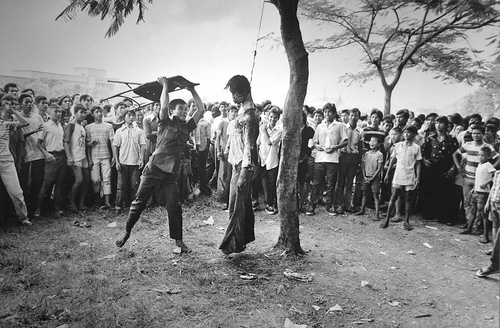
Apathy as the focus for “Fundamental” came from the infamous photo taken Oct. 6, 1976, in which a man uses a chair to beat the lifeless body of a Chulalongkorn University student who had been lynched from a tree.

More striking than one man’s barbarism, the photo is remarkable for the large crowd gathered to watch. Many laughing.

The director said he believes in the axiom that the world’s cruelty results not from evil people, but those who allow it to happen.

So, instead of taking the perspective of the victims, Ka-ge chose to assume the vantage point of those there to witness the violence with the brutality of apathy, to show the power of mainstream indifference and its contributions to human savagery.

The photo taken by Associated Press photographer Neal Ulevich, who won a Pulitzer Prize for his work in 1977.

Advance tickets for “Fundamental” are available now through Aug. 15 for 320 baht. After that they will be 550 baht (420 baht for students).

There is no dialogue, so no subtitles will be needed.

The production will stage its run Sept. 14 through Oct. 2 on the fourth floor of the Bangkok Art and Culture Centre. There will be 7:30pm performances Wednesday through Saturday and 3pm matinees on Sunday.

Advertisement

Amnesty warns that Malaysian law gives govt ‘abusive powers’

Malaysian Prime Minister Najib Razak on Monday addresses delegates during his speech at the Malaysia's ruling party United Malays National Organization's (UMNO) anniversary celebration in Kuala Lumpur. Photo: Associated Press / Joshua Paul

KUALA LUMPUR, Malaysia — A Malaysian security law that gives embattled Prime Minister Najib Razak sweeping emergency powers came into force Monday, with Amnesty International warning it could be used to trample on human rights.

Under the National Security Council Act, a council led by Najib, who faces pressure to resign over a financial scandal, can declare a state of emergency in areas deemed to be under a security threat. Security forces can impose curfews and have wide powers of arrest, search and seizure without a warrant.

The law is aimed at countering terrorism threats, but critics fear Najib will use it as a tool to hold on to power.

Amnesty said the law “empowers the Malaysian authorities to trample over human rights and act with impunity.”

“With this new law, the government now has spurned checks and assumed potentially abusive powers,” Josef Benedict, Amnesty’s deputy director for South East Asia and the Pacific, said in a statement.

The human rights group said Najib and his government were increasingly resorting to repressive laws in the name of protecting national security “but in practice, imperil human rights.”

The U.N. human rights regional office last week also said it was “gravely concerned” that the law may encourage human rights violations and lead to “unjust restrictions” on free speech and assembly.

Najib has been dogged for months by embezzlement investigations involving state investment fund 1MDB, which he founded in 2009. It is being investigated in several countries including the U.S., Switzerland and Singapore.

Last month, the U.S. Justice Department initiated action to seize $1.3 billion of assets that it said were part of a massive heist from 1MDB by people close to Najib.

The fund was created to promote economic development projects. Instead, U.S. prosecutors said fund officials diverted more than $3.5 billion through a web of shell companies and bank accounts abroad. The Justice Department complaint said more than $700 million of IMDB money was transferred into the bank account of Najib, who is referred to as Malaysian Official 1 in the document, contradicting his claim the money was a donation from the Saudi royal family.

The money taken from IMDB was used to pay for luxury properties in New York and California, a $35 million jet, art by Vincent Van Gogh and Claude Monet and helped finance the Hollywood film, “The Wolf of Wall Street,” made by Red Granite Pictures headed by Najib’s stepson, according to the DOJ complaint.

The U.S. forfeiture demand, the largest single action it’s taken, are by far the biggest threat to Najib’s credibility that could reinvigorate the opposition and ruling party members who are secretly opposed to him.

He has pledged to cooperate in the investigations and denied any wrongdoing. He remains firmly in political control of the country, after replacing his critics in the ruling party and the government with men loyal to him.

Najib has defended the new security law. He accused critics of fear-mongering and said last week that the terrorism threat was real and growing. Malaysian police have said a grenade blast at a bar last month that injured eight people was the first attack in the country by the Islamic State militant group. More than 160 people have been detained for suspected links to Islamic State over the past three years.

“My government will never apologize for placing the safety and security of the Malaysian people first. These laws were necessary, and other countries have since followed our lead,” Najib said.

Advertisement

Late Royal Astrologer’s Aide Sentenced for Lese Majeste

Lese majeste suspect Jirawong Watanathewasilp was brought to a military court Wednesday to have his stay in military custody extended for the fourth time. Of 14 people accused of defaming the monarchy since mid-October, Jirawong is the only living, identified suspect known to be in custody.

BANGKOK — A military tribunal convicted an assistant to the Crown Prince’s late court astrologer of insulting the monarchy and sentenced him Monday to three and a half years in jail.

Jirawong Watanathewasilp is the sole surviving member of a trio of alleged “royal impostors” who were arrested in late 2015 and charged with lese majeste for exploiting their ties to Crown Prince Vajiralongkorn for personal gain, a scandal that dominated the media despite strict censorship imposed in discussing the matter.

Third ‘Royal Impostors’ Suspect Still Alive, Official Says

Jirawong will be tried twice more by the military court on the same charge for two other alleged offenses.

His conviction comes 10 months after the three men were arrested and jailed in a special military prison built on an army base where the other two soon died. Jirawong’s sentence was halved because he did not contest the charge.

Upon sentencing he was immediately returned to the detention facility at the 11th Army Circle base on Bangkok’s Nakornchaisri Road, where he has been held since October, to await his further trials.

According to police, Jirawong, together with royal soothsayer Suriyan Sujaritpalawong and police officer Prakrom Warunprapha, embezzled state funds and amassed wealth by abusing their ties to the Crown Prince.

Suriyan and Prakrom later died in custody of a blood infection and suicide, respectively, according to statements released to the press by the authorities.

As with many other cases that involve the monarchy, the exact nature of the trio’s alleged wrongdoing was never made clear by police, and media agencies were instructed not to report about the scandal other than publishing official statements and authorized leaks.

Related stories:

Famous Astrologer ‘Mor Yong’ Dies in Custody

‘Royal Imposters’ Suspect Found Hanging in Prison, Officials Say

Reporters Tour Controversial Military Prison Where 2 Died

Advertisement

Vengaboys Return For a Very RCA ‘90s Reunion

BANGKOK — All hail ‘90’s kids! Revisit the way it was once again at a ‘90s flashback show recalling the pre-Y2K Bangkok club scene featuring Eurodance band Vengaboys.

The nostalgia will be heavy at BITEC Bangna in September at concert headlined by the Vengaboys, a Dutch Eurodance group that gained worldwide success in the late 1990s with “We Like to Party”, “Boom, Boom, Boom, Boom!!” and “We’re Going to Ibiza.”

Trying to recapture the RCA club vibe of the ‘90s, the beats will go on with Thai ‘90s acts including teen-pop trio T-Skirt, pop-dance duo China Dolls, hip-hop artist Da Jim and even a boyband called Dr. Kids.

Tickets are 1,500 baht to 2,500 baht, but a limited number can be purchased online in advance for 1,300 baht and 2,200 baht. That goes up to 1,700 baht and 2,800 baht at the box office on the night of the concert.

The reunion starts from 5pm to 11pm on Sept. 17 at Hall 105, Bitec Bangna, a 10-minute walk from BTS Bang Na via exit No. 1.

Advertisement

Olympic Athletes Risk Violent Illness From Rio Water

Doctoral candidate Rodrigo Staggemeier shows samples of water and sand from Copacabana Beach, collected for a study commissioned by The Associated Press, on July 11 in Rio de Janeiro, Brazil. Photo: Silvia Izquierdo / Associated Press

RIO DE JANEIRO — Just days ahead of the Olympic Games the waterways of Rio de Janeiro are as filthy as ever, contaminated with raw human sewage teeming with dangerous viruses and bacteria, according to a 16-month-long study commissioned by The Associated Press.

People take photos by the Olympic rings decorating Copabana Beach on Thursday in Rio de Janeiro, Brazil. Photo: Felipe Dana / Associated Press

Not only are some 1,400 athletes at risk of getting violently ill in water competitions, but the AP’s tests indicate that tourists also face potentially serious health risks on the golden beaches of Ipanema and Copacabana.

The AP’s survey of the aquatic Olympic and Paralympic venues has revealed consistent and dangerously high levels of viruses from the pollution, a major black eye on Rio’s Olympic project that has set off alarm bells among sailors, rowers and open-water swimmers.

Read: Here Are Our Olympic Hopefuls Competing in The Rio Games

The first results of the study published over a year ago showed viral levels at up to 1.7 million times what would be considered worrisome in the United States or Europe. At those concentrations, swimmers and athletes who ingest just three teaspoons of water are almost certain to be infected with viruses that can cause stomach and respiratory illnesses and more rarely heart and brain inflammation — although whether they actually fall ill depends on a series of factors including the strength of the individual’s immune system.

Since the AP released the initial results last July, athletes have been taking elaborate precautions to prevent illnesses that could potentially knock them out of the competition, including preventatively taking antibiotics, bleaching oars and donning plastic suits and gloves in a bid to limit contact with the water.

But antibiotics combat bacterial infections, not viruses. And the AP investigation found that infectious adenovirus readings — tested with cell cultures and verified with molecular biology protocols — turned up at nearly 90 percent of the test sites over 16 months of testing.

“That’s a very, very, very high percentage,” said Dr. Valerie Harwood, Chair of the Department of Integrative Biology at the University of South Florida. “Seeing that level of human pathogenic virus is pretty much unheard of in surface waters in the U.S. You would never, ever see these levels because we treat our waste water. You just would not see this.”

While athletes take precautions, what about the 300,000-500,000 foreigners expected to descend on Rio for the Olympics? Testing at several of the city’s world-famous beaches has shown that in addition to persistently high viral loads, the beaches often have levels of bacterial markers for sewage pollution that would be cause for concern abroad — and sometimes even exceed Rio state’s lax water safety standards.

In light of the AP’s findings, Harwood had one piece of advice for travelers to Rio: “Don’t put your head under water.”

Swimmers who cannot heed that advice stand to ingest water through their mouths and noses and therefore risk “getting violently ill,” she said.

Danger is lurking even in the sand. Samples from the beaches at Copacabana and Ipanema revealed high levels of viruses, which recent studies have suggested can pose a health risk — particularly to babies and small children.

“Both of them have pretty high levels of infectious adenovirus,” said Harwood, adding that the virus could be particularly hazardous to babies and toddlers who play in the sand.

“You know how quickly an infant can get dehydrated and have to go to the hospital,” she added. “That’s the scariest point to me.


Advertisement

Man Dies During City Hall Recruiting Exam

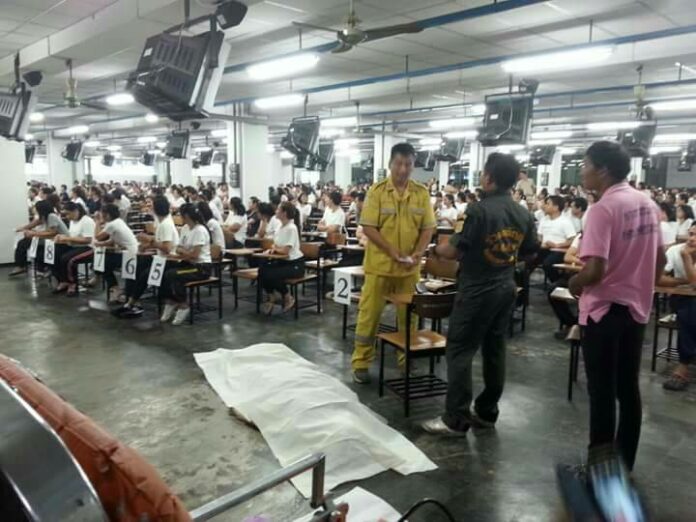
Rescue workers prepare to remove the body of Kobchai Pureprasert, 39, from an examination room Sunday at Ramkhamhaeng University in Bangkok.

BANGKOK — A man died after suffering a seizure Sunday during testing for a municipal job at Ramkhamhaeng University.

University staff said Kobchai Pureprasert, 39, suffered a sudden seizure while sitting for a test with about 500 people seeking positions with the Bangkok Metropolitan Administration on Sunday afternoon. First aid was rendered but failed to save his life.

“His friends and relatives don’t know whether he had any congenital condition,” said police Lt. Kittichet Kittisart of Huamark police.

Kobchai had been an administrator at Charoenkrung Pracharak Hospital. His body was taken to Police General Hospital for examination.

Kittichet said the incident didn’t affect the test as it concluded at about 4pm.

Advertisement

Teens Killed in Pathum Student Shootout, Shopkeeper Wounded

Rescue workers at the crime scene Sunday night in northern metro Bangkok.

PATHUM THANI — Two students were killed in a gang firefight in Pathum Thani on Sunday night, which also left a shopkeeper injured by the crossfire.

The fight started at about 10pm, when two students from Panja Wittaya College of Technology arrived on a motorcycle in front of a house where a dozen or so students from a rival college were socializing.

The two students, both 17, allegedly opened fire on the residence, and soon the youths inside the house returned fire, killing the two boys. A 58-year-old grocery shopkeeper was also wounded by stray bullets.

Pathum Thani police chief Thavorn Kaosa-ard said police are looking for the surviving students, who fled the scene.

“Right now, police already have their identities,” Maj. Gen. Thavorn announced Sunday night. “Investigators are tracking them down to bring them to justice.”

The names of all suspected parties were withheld as they were minors.

The killings came less than two months after junta chairman Prayuth Chan-ocha enacted new measures and punishments for those involved in student gang fights to end the chronic culture of deadly college rivalries.

In an announced effort to put an end to fatal tribalism among polytechnic colleges, the military government in June imposed a new law granting authorities the power to detain any students suspected of plotting gang violence. The law also prescribes 6-month jail terms to those found to encourage or aid in such fights.

Related stories:

Learn 3 K-Pop Gestures From Bangkok’s Top Cop And Make Love, Not War

Advertisement

Thailand’s Ariya Jutanugarn wins Women’s British Open

Thailand's Ariya Jutanugarn plays off the fairway during day four of the Women's British Open on Sunday at Woburn Golf Club, Woburn in England. Photo: Associated Press / Steve Paston

MILTON KEYNES, England – Ariya Jutanugarn won the Women’s British Open on Sunday at Woburn for her first major championship and fourth LPGA Tour victory of the year.

The 20-year-old Thai player closed with an even-par 72 for a three-stroke victory over American Mo Martin and South Korea’s Mirim Lee. Jutanugarn finished at 16-under 272 on the Marquess Course, the hilly, forest layout that is a big change from the usual seaside layouts in the tournament rotation.

Martin, the 2014 winner at Royal Birkdale, shot a 70. Lee had a 73.

Stacy Lewis was fourth at 11 under after her third straight 70.

The long-hitting Jutanugarn broke through four months after blowing a late lead in the first major championship of the year. In early April in the ANA Inspiration in the California desert, Jutanugarn – at the time, best known for blowing a two-stroke lead with a closing triple bogey in the 2013 LPGA Thailand – bogeyed the final three holes to hand the title to Lydia Ko.

Jutanugarn put the hard lessons to use in May, winning three straight events to become the LPGA Tour’s first Thai champion. And Saturday, she shot a bogey-free 6-under 66 to pull two strokes ahead of Lee and break the tournament 54-hole record of 201.

Advertisement

English Bar Blocks Cell Phones to Get Patrons Talking to Each Other

Patrons in The Gin Tub in Brighton, England, in a photo posted July 22. Photo: The Gin Pub / Facebook

LONDON — A new English cocktail bar offers something truly old-fashioned on its menu: the chance to talk to real people instead of staring down your cell phone.

The Gin Tub in Brighton has won rave reviews in its first week of business by installing a cell signal blocker and placing throwback rotary phones at its tables. They can be used to dial patrons at neighboring tables or the bar for another round.

The Gin Tub is reckoned to be the only British pub blocking cell phones by using a Faraday shield built into its ceiling, an exception in Britain’s 2006 Wireless Telegraphy Act that otherwise outlaws the use of signal blockers.

Proprietor Steve Tyler says: “Mobile phones have killed pubs. When you go out socially, you don’t need social media.”

Advertisement

Hot News

LATEST NEWS

Bangkok
few clouds
36.6 ° C
36.6 °
34.4 °
49 %
4kmh
12 %
Wed
37 °
Thu
39 °
Fri
37 °
Sat
36 °
Sun
37 °