Patrons in The Gin Tub in Brighton, England, in a photo posted July 22. Photo: The Gin Pub / Facebook
LONDON — A new English cocktail bar offers something truly old-fashioned on its menu: the chance to talk to real people instead of staring down your cell phone.
The Gin Tub in Brighton has won rave reviews in its first week of business by installing a cell signal blocker and placing throwback rotary phones at its tables. They can be used to dial patrons at neighboring tables or the bar for another round.
The Gin Tub is reckoned to be the only British pub blocking cell phones by using a Faraday shield built into its ceiling, an exception in Britain’s 2006 Wireless Telegraphy Act that otherwise outlaws the use of signal blockers.
Proprietor Steve Tyler says: “Mobile phones have killed pubs. When you go out socially, you don’t need social media.”
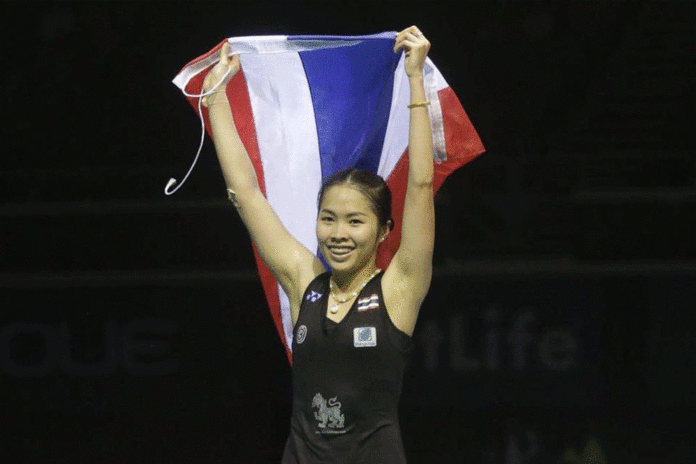
BANGKOK — After overcoming a last-minute scare she might be barred from the games, badminton superstar Ratchanok “May” Intanon could be Thailand’s strongest hope for Olympic glory in Rio, but the 21-year-old from Yasothon is not the only medal hopeful heading to Brazil.
Ratchanok “May” Intanon in an undated photo file. Photo: Ratchanok Intanon / Facebook
Although the national women’s volleyball team failed to qualify, despite the blessing of a champion monk, more than 50 athletes will represent the kingdom at the games opening Friday, all hoping to bring home something shiny in their luggage.
At the last Summer Olympics, staged in London in 2012, Thailand only brought home three medals: a silver in men’s light flyweight boxing, silver in women’s 58kg weightlifting and a bronze in the women’s 49kg Taekwondo.
Thailand began participating in the summer Olympics in 1952 and so far has won medals in only three events: boxing, taekwondo and weightlifting. In 2016 there is a good chance that could change.
The Associated Press predicted today that Thailand will bring home four bronze and two silver medals; others are more optimistic.
Amnat Ruenroeng, at left, trades punches with China’s double Olympic gold medalist Zou Shiming during their IBF flyweight title belt boxing match March 7, 2015, in Macau. Photo: Kin Cheung / Associated Press
Boxing
Thailand has bagged an impressive medal haul from boxing. Fourteen of its 24 Olympic medals have come from the sport, including its first ever Olympic medal – a 1972 bronze for Payao Poontarat in men’s light flyweight boxing.
Possibly the best chance for boxing glory in Rio falls at the feet of Buriram native Wuttichai Masuk. Wuttichai, 26, competes in the Light Welterweight division and won gold at the 2015 SEA Games and bronze at the World Amateur championships in Doha last year.
Then there’s Amnat Ruenroeng. A former drug addict who learned to box in prison, the Chonburi province native competed in Beijing in 2008 before going professional. For 2016, he was one of two pros controversially allowed to make an Olympic bid. Now 36, Ruenroeng is favored by The Associated Press’ predictions to pick up a bronze in the lightweight division.
Amanda Carr in a photo posted in June, 2015, at the USA BMX Midwest Nationals in Rockford, Illinois. Photo: Amanda Carr / Facebook
BMX
Cycling BMX made its debut as an Olympic event back in the 2008 Beijing Games. Amanda Carr will become the first woman to represent Thailand at this event.
Carr, aka “Yong,” was born in Florida to an American dad, while her mom hails from Udon Thani. Although Carr was raised in the states, she is fluent in the Isaan dialect. After failing to make the American team for the 2012 Olympics she decided to switch allegiancesto her motherland.
But she’s no Vanessa Mae. After taking gold at the 2014 Asian Games, can Carr go one better and bag a medal in Rio? The AP forecasters are skeptical.
Ariya Jutanugarn in June at the 2016 KPMG Women’s PGA Championship in the U.S. state of Washington. Photo: Ariya Jutanugarn
Golf
Women’s golf returns to the Olympics after being contested only once previously in 1900 when the United States made a clean sweep of gold, silver and bronze. Flash forward a century and Bangkok-born Ariya Jutanugarn is a serious medal contender.
At 20 and with a long career ahead of her, Ariya already shot to fame earlier this year when she sunk her rivals and won three straight LPGA Tour events. In doing so, Ariya, aka “Pro May,” became the first woman to achieve this feat since 2013. She was the first Thai to win an LGPA tour.
Ariya has suffered from spoiling herself, taking the lead several times only to lose out to bad swings. She’s presently leading at the Women’s British Open.
AP expects her to bronze.
Panipak Wongpattanakit, at left, in a file photo from November 2014 at the Incheon Asian Games in South Korea. Photo: Tennis Panipak Wongpattanakit / Facebook
Taekwondo
Chanatip Sonkham is currently ranked world No. 5. The 25-year-old won bronze at London 2012 in the under-49kg division as well as winning gold in the SEA Games in 2015.
But the Thai Taekwondo team’s medal hopes don’t end there.
Panipak Wongpattanakit, who turns 19 next month, is also ranked in the top 10 in the same weight class. Panipak, a sports science major at Chulalongkorn University, won gold at the 2015 World Taekwondo Championships in Russia for her weight division.
AP sees a bronze future for Panipak but nothing shiny for Chanatip.
Weightlifting
Once again the weightlifting team has a good chance of success.
Pimsiri Sirikaew, who won silver in the women’s 58kg weightlifting four years ago has a solid chance of ascending the podium again in Rio.
The 26-year-old Pimsiri will return to the Olympics with more experience and may also benefit following the recent bans of other women’s weightlifters for doping offenses.
But it’s an athlete once sanctioned herself, Sukanya Srisurat, who AP sees doing the heavy lifting necessary to win a silver medal. The 21-year-old Chonburi native will compete in the 58kg division.
Shooting
Sutiya Jiewchaloemmit in a June 10 photo posted to her Facebook.
Thailand’s sport shooting team is known not for its medaling prowess but some infamy after one of its Olympians fell to an assassin’s bullets in Bangkok a year later after competing in the 2012 London Games (Jakkrit Panichpatikum’s step-mother later said she ordered the hit to free her daughter from his abuse).
That may soon change thanks to Sutiya Jiewchaloemmit, a 30-year-old Bangkok native and Thammasat University graduate. While she placed fifth in 2008, the Associated Press has her down for shooting her way to a silver in Rio.
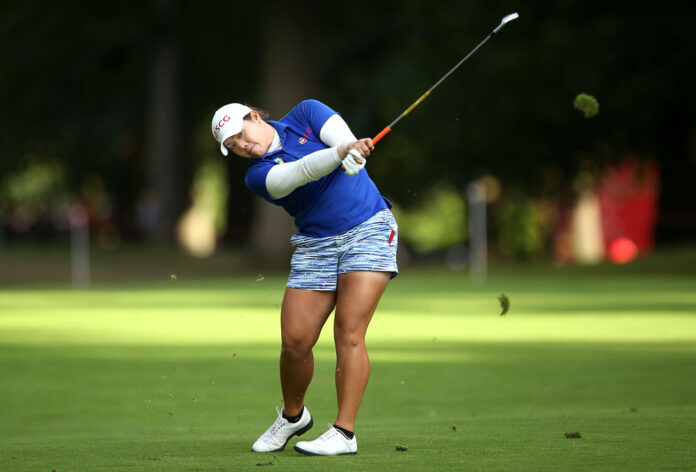
Ariya Jutanugarn in action during day three of the Women's British Open at Woburn Golf Club in Woburn, England, on Saturday. Photo: Steve Paston / PA / Associated Press
WOBURN, England — Ariya Jutanugarn took the Women’s British Open lead Saturday at tree-lined Woburn, nearly four months after blowing a late lead in the first major championship of the year.
“I think I know how to play under pressure,” the 20-year-old Bangkok native said. “I know like what I have to focus and the only thing I have to is like focus on what is under my control.”
In early April in the ANA Inspiration in the California desert, Jutanugarn — at the time, best known for blowing a two-stroke lead with a closing triple bogey in the 2013 LPGA Thailand — bogeyed the final three holes to hand the title to Lydia Ko.
“I really get nervous, especially being my first time leading,” Jutanugarn said that afternoon at Rancho Mirage. “I got a lot of experience from this week.”
She put the hard lessons to use in May, winning three straight events to become the LPGA Tour’s first Thai champion. And Saturday, she shot a bogey-free 6-under 66 to pull two strokes ahead of Mirim Lee.
“I feel a lot more comfortable,” Jutanugarn said. “Like especially today, because I didn’t hit my iron good, but I still make some birdies.”
Jutanugarn birdied six of the first 14 holes and closed with four pars to reach 16-under 200 and break the tournament 54-hole scoring record. She chipped in from 90 feet for birdie on No. 8 and made a 30-footer on 10 on the Marquess Course, the hilly, forest layout that is a big change from the usual seaside links.
Lee shot a 69. The South Korean player led after each of the first two rounds, opening with a 62 and shooting a 71 on Friday.
“Everything was OK. Just OK, not perfect,” Lee said.
Mo Martin was third at 11 under after a 69. The American won the 2014 tournament at Royal Birkdale.
Scotland’s Catriona Matthew, at 46 trying to become the oldest major champion, had a 71 to move into fourth at 10 under. She played alongside Jutanugarn.
“If she keeps playing like she keeps playing, she’s going to be tough to catch,” Matthew said. “But go out tomorrow and try to make as many birdies as I can.”
The top-ranked Ko was tied for 27th at 3 under after a 69. She closed with a double bogey after birdieing five of the previous seven holes.
“I just had a toffee. Sugar always helps the feelings,” Ko joked. “But I know that I still played solid out there. It’s not the greatest finish to finish with a bogey or a double. … I’ve just got to get over it.”
Stacy Lewis was 9 under after a 70. She won at St. Andrews in 2013.
“A little bit of a mess today,” the American said. “Just a few too many mistakes.”
Charley Hull, the English star playing on her home course, was tied for 40th at 2 under after a 75.
“I felt like I played pretty decent, just didn’t hole any putts,” Hull said.
Jutanugarn broke the 54-hole record of 201 set by Caroline Masson in 2011 at Carnoustie. The 72-hole mark is 269 by Karen Stupples in 2004 at Sunningdale.
To relax, the Thai player smiles as part of her pre-shot routine.
“I really want to try to be like relaxed before the shot,” said Jutanugarn, in position to jump from sixth to third in the world ranking with a victory. “I feel like whatever is going to make me happy and easy one is like smile.”
She hoped to be smiling late Sunday.
“I think it’s no pressure for me because only thing I want to is have fun,” Jutanugarn said. “So one more day, I want to have fun.”
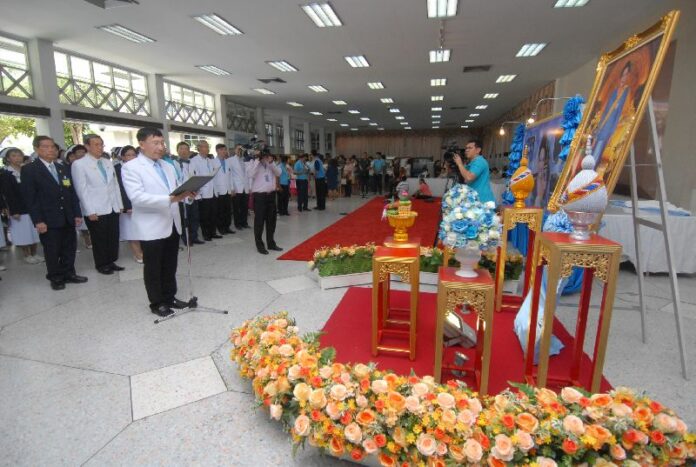
Udom Kachinthorn, the director of Siriraj Hospital’s Faculty of Medicine, wishing a happy birthday to Her Majesty the Queen in a ceremony at Siriraj Hopsital on 12 August 2014.
BANGKOK — The royal palace says 83-year-old Queen Sirikit suffered a lung infection but her condition has improved.
An announcement issued Saturday night says Sirikit was moved on July 24 from Bangkok’s Siriraj Hospital, where King Bhumibol Adulyajej has been living for most of the past few years, to Chulalongkorn Hospital for treatment of minor lung inflammation and blood infection.
It said that after treatment, symptoms of fever and cough had subsided.
Both the queen and the 88-year-old king have been in ill health in recent years, with Siriraj Hospital serving as the de facto royal residence. Bhumibol and Sirikit have also suffered strokes, with the queen’s apparently being the more severe case.
Bhumibol is the world’s longest serving monarch, since 1946.
The unidentified French national as he was discovered late Friday afternoon in Prachuap Khiri Khan province.
PRACHUAP KHIRI KHAN— Friday night’s usual craziness got an early start in Prachuap Khiri Khan city, with the discovery of a French man lying naked in the middle of the road.
The 62-year-old Frenchman decided to get some rest just on Sala Cheep Road in front of the Emmanuel Guesthouse where he had been staying since July 14. His wailing could be heard all along the road at about 5:30pm.
Notified by some good samaritans, police came and helped take the man, whose name was withheld, back to his room. At that point he decided to lock himself inside, but after a chat, officers were able to persuade him to come out again.
“We took him to the hospital as he was determined to be in a deranged state,” said police Col. Amphol Amornlakpreecha.
Kanokwan Saleephol, the 34-year-old guesthouse owner said her guest appeared to be sad some days ago, saying he missed his wife whom he had split from before the trip to Thailand.
She said nearly a full bottle of wine precipitated his appearance in the road.
Kanokwan Saleephol, owner of Emmanuel Guesthouse, displays the bottle of wine consumed by the unidentified Frenchman who later turned up naked Friday in the road outside.
STOCKHOLM — She was off duty and wearing a bikini but that didn’t stop Swedish police officer Mikaela Kellner from catching a suspected thief.
A photo of Kellner pinning the suspect to the ground was trending on social media in Sweden this week.
“My first intervention while wearing a bikini during my 11 years as a police officer,” she wrote on Instagram.
Kellner and three friends were sunbathing Wednesday in a Stockholm park, a homeless man selling newspapers approached, she told Swedish newspaper Aftonbladet.
After he left, one friend noticed her phone was missing. Kellner and a fellow police officer gave chase.
Kellner said she didn’t hesitate to make the arrest while wearing a bikini.
“If I had been naked I would have intervened as well,” she said.
A pile of newspapers in Thailand in a photo from Feb. 20, 2014. Photo: Connie Ma / Flickr
The withdrawal of an ultraconservative newspaper from the largest national media association last week was another chapter in the ongoing debate and struggle over the role of Thailand’s mass media.
In a statement announcing its withdrawal from the National Press Council of Thailand, Naewna said the body had become “a tool of those who do not wish the country well.”
Slightly raising the lid on that vague statement, the Bangkok Post quoted a Naewna source saying the paper was unhappy “with a recent move by the body and other media organisations that was deemed to protect biased journalism.”
What Naewna considers biased journalism – editorial content critical of military rule – is already under assault by the junta
Pro-democracy news nonprofit Prachatai.com was raided earlier this month after one of its reporter was detained overnight and charged with violating the Referendum Act. Taweesak Kerdpoka had been arrested after he was found “embedded” with activists from the New Democracy Movement, as he was in their vehicle loaded with Vote No campaign materials while covering a story.
Make no mistake, Naewna itself is far from impartial. It’s one of the few die-hard, pro-junta conservative outlets along with Thai Post. This shows the tension between what is regarded as acceptable, good and genuine media in Thailand.
Should the media act more like a mirror, reflecting what’s going on, or a lantern, leading society toward a better state? This tension was raised by a well-known former dean of Thammasat University’s School of Journalism, Boonrak Boonyakaetmala, two decades ago and is still unanswered.
In reality there should be no debate since the “mirror” role can be fulfilled through straight news reports and analysis while the “lantern” functions through commentaries and editorials. Society needs both functions from any competent media outlet, as the public should not just receive news and information but should be able to articulate by agreeing or disagreeing with issues raised by columnists and editorial writers.
Thailand being Thailand, there are people who think there’s only one type of good press, with the rest posing a threat to the “correct understanding and views” of society. They believe those deserve no protection nor should be regarded as bona fide media at all. This is a very crude and narrow understanding that is condescending to the public, as it assumes people are so vulnerable they will fall prey and be confused by “incorrect” information and ways of thinking.
It’s not just people in the media professions who exhibit this superiority complex. Junta leader Gen. Prayuth Chan-ocha, whose regime’s vicious suppression of debate most recently imprisoned an elderly manhanding out leaflets, said during his televised monologue last night that it’s the politicians misleading people about the Aug. 7 charter plebiscite.
Such a patronizing view only retards our social progress.
The public is let down by a traditional mass media which censors any news or commentary about the monarchy that contains an iota of critical information, criticism or sometimes just anodyne information. Such a gatekeeping role comes partly from fear of breaching the draconian lese majeste law and partly out of a genuine belief by some holding same elitist notion the public may be “confused” or “misled,” and therefore may lose its loyalty to the throne, particularly as the nation approaches its monarchical transitional period.
The biggest issue facing Thailand cannot be referred to without employing gauzy euphemism.
Even here at Khaosod English, we removed two such articles in the past eight months, the latest one being Thursday.
The media role of gatekeeper is not meant to be abused as it is in Thailand.
That responsibility of deeming what is fit for publication is crumbling fast, as people find ways around it through the proportionate rise and popularity of social media, particularly Facebook, Twitter and YouTube.
More and more, Thais are bypassing traditional media and learning about the issues withheld as biased or unfit to print through their own networks of social media and the new legions of online influencers. We are witnessing the build of a new information Big Bang, in a way not unlike when newspapers were born out of the Industrial Revolution in Europe and the need to advertise.
It also risks being more fractured, more partisan and less inclusive however. The repercussions are enormous, but each citizen can become their own gatekeeper on what is accurate, reasonable and believable.
The body of Kariangsak Suttilux, 38, was found hidden in the grasses near a lotus pond in Bangkok's Min Buri district Friday.
BANGKOK — A man’s body with many knife wounds was found hidden in a Min Buri district field Friday evening.
The body discovered in the tall grasses near a pond in Soi Rat Uthit 54 was identified as Kariangsak Sittilux, 38, who had been reported missing Monday. Long blade wounds were found on his stomach and both thighs.
Police Maj. Gen. Chaiyaporn Panichuttra said police believed Kariangsak was murdered elsewhere before his body was dumped in the grass.
Samrit Tuammee, 39, first discovered the body at about 5pm on Friday while picking lotus flowers at the pond.
Relatives had gone to the Lampakchee Police Station on Monday to report Kariangsak, a Mini Big C retail outlet assistant manager, had gone missing after going drinking with friends.
A Korat artist poses for photo on July 11, 2016, with candlewax crafted into the figure of Hanuman, the monkey god adopted by the Election Commission as its mascot for the August 2017 charter referendum.
BANGKOK — An organization experienced in observing elections across Asia for years will send fewer than 10 of its staff to observe the upcoming referendum on the new constitution.
The Asian Network for Free Elections says it has previously hoped for much larger number, but it was forced to trim down the operation because of the bureaucratic hurdles set by the Thai election commission.
“We won’t be able to conduct a full monitoring mission as previously done because of the delay in getting accreditation from the Election Commission,” said Anfrel’s logistic officer Pongsak Chanon on Friday. “They just won’t send us the approval.”
Due to this delay, Anfrel won’t be able to field a full delegation of observers from abroad, and it will have to have to monitor the Aug. 7 referendum with the staff that it already has in Bangkok, which numbers about 10 people, Pongsak said.
Nine days from now, millions will vote on for or against the new charter drafted under the military regime that took power in May 2014.
The same referendum will also ask voters whether they’re open to possibility of having an unelected prime minister.
The junta has been urging the public to accept the charter, while critics of the regime want it rejected.
Poster of “To Do Things With Words” exhibition. Photo supplied by the organizer.
BANGKOK — From writing words with pens, five French artists forming words with their art and gesture in the upcoming exhibition “To Do Things With Words” launches on Saturday.
The exhibition title is inspired by “How to Do Things With Words”, a book by British philosopher of language J.L. Austin who initiated the term “performative language,” referring to the power of words that doesn’t only describe a given reality, but also an action.
Visitors to the exhibition will observe walls plastered with texts, watch videos, and experience the power of words through live performances on site. The event will be in Thai, English and French.
“The language, even if we do not speak the same language, is an instrument of common sense that we all share,” the French curator Doriane Spiteri said in an email. “For the artists, the language is a way of thinking on the point of view, the oral tradition, the different messages we receive in everyday life.”
The curator added that word and language can be used in a variety of ways as an art form to create emotion, to communicate, to create space for dialogue and also for political purpose.
“In the 70s and 80s, women artists used the language for political purposes. Some women, like Jenny Holzer and Barbara Kruger for example, used the language to disseminate messages in the street to question the place of women in the society and in the art,” Spiteri wrote.
Joining as part of a one-month-residency program at Hong Hub, Spiteri chose to curate immaterial art as it allows for easier mobility. The chosen five artists are keen to express words through art. For example, Damien Marchal filmed a dance at the U.N. Geneva office, while Camille Bondon’s collaborated performance with Thai artists which discusses how the same messages can be interpreted or hijacked into different meanings.
The exhibition launches at 7pm on Saturday with a performance by Camille Bondon in collaboration with Sompong Tawee and runs through Aug. 19 at Buffalo Bridge Gallery, located on Phahonyothin Road. The nearest BTS station is Saphan Khwai.












































 Make no mistake, Naewna itself is far from impartial. It’s one of the few die-hard, pro-junta conservative outlets along with Thai Post. This shows the tension between what is regarded as acceptable, good and genuine media in Thailand.