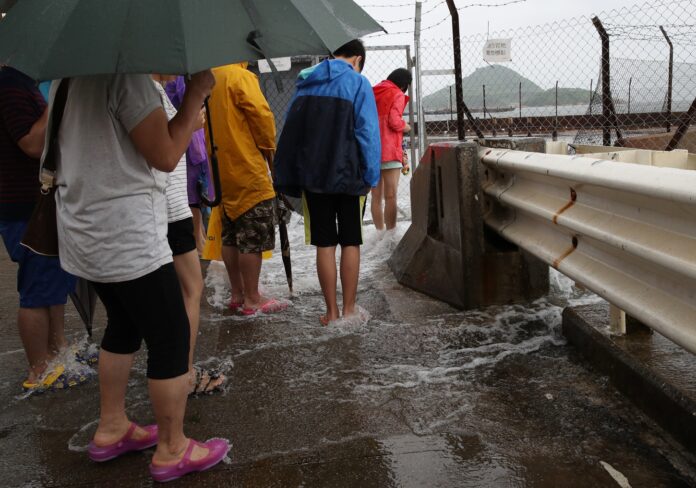
People play with overflown water caused by Typhoon Nida in Hong Kong, Tuesday, Aug. 2, 2016. The Hong Kong Observatory issued the number 8 storm signal, as Typhoon Nida is moving northwest across southern China, bringing high winds and heavy rain but no immediate reports of deaths or destruction. (AP Photo/Kin Cheung)
BEIJING (AP) — Typhoon Nida was moving northwest across southern China on Tuesday, bringing high winds and heavy rain but no immediate reports of deaths or destruction.
The storm made landfall at 3:35 a.m. Tuesday near Hong Kong and was expected to churn across the manufacturing center of Guangdong province, gradually weakening as it moved into the neighboring Guangxi region.
Flights, ferries and ground transport were heavily disrupted in Hong Kong on Tuesday morning and schools canceled classes.
By mid-day, the Hong Kong observatory had canceled its rainstorm warning, but urged people to continue to be vigilant for river flooding. It said it recorded maximum gusts exceeding 128 kilometers per hour (80 miles per hour).
Large parts of China have seen heavier than usual seasonal rainfall this summer, leading to widespread flooding and scores of deaths.
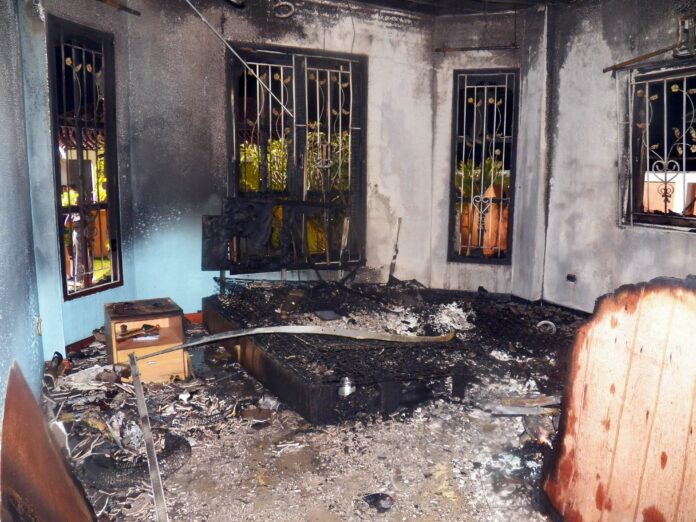
Photo of the house where Andrew Green Thomas was found dead on Monday morning
CHONBURI — A 56-year-old Briton hanged himself after setting fire to his own house in Chonburi’s Banglamung district on early Monday, police said.
Andrew Green Thomas committed suicide following an argument he had with his Thai wife, and nothing at the crime scene indicates any foul play, according to local police chief Anan Purahong.
“There is no evidence of any murder,” Col. Anan of Huai Yai Police Station said on Tuesday. “It was about a family quarrel.”
Police report says Thomas set a fire at his home in Soi 36 at around 4am Monday before hanging himself at the residence.
Forensic police will perform autopsy on his body to conclude the exact cause of death as required by the law, Anan said.
“But at this moment, the case is closed,” the officer said.
That’s the question of one tourism official who has proposed placing Pokestops at famous tourist destinations in order to attract young travelers, especially avid players of the immensely popular game Pokemon Go.
“Rare types of Pokemon will be placed at tourist destinations we want to promote to tourists,” Pongpanu Svetarundra of the Ministry of Tourism and Sports announced Monday.
He said it could attract independent travelers and “Gen-Y” traveler-trainers.
In the augmented-reality game, players seek out and catch Pokemons with their mobile phones at real world locations. These “pocket monsters” are found at specific locations known as Pokestops.
Although the current locations are preset, the game’s developer does accept Pokestop requests from players.
The Nintendo game was released in many parts of the world in July, such as the United States and Japan. However, its release date for Thailand has yet to be announced, despite erroneous reports in pretty much every media outlet it would come to Thailand in September.
LAGOS, Nigeria — A Nigerian accused of scamming USD$60 million (about 2 billion baht) from companies around the world through fraudulent emails has been arrested after months of investigation, Interpol and Nigeria’s anti-fraud agency said Monday.
The ringleader of a global scamming network, identified only as 40-year-old Mike, was arrested along with a 38-year-old accomplice in Nigeria’s oil capital, Port Harcourt, in June, the statement said. He is on administrative bail, which implies that officers do not yet have enough evidence to charge him.
The man is accused of leading a network that compromised email accounts of small and medium-sized businesses around the world including in the United States, Australia, India, South Africa and Thailand. The statement didn’t name any targets.
The network involved about 40 people in Nigeria, Malaysia and South Africa who provided malware and carried out the frauds, with money-laundering contacts in China, Europe and the United States providing bank account details.
A supplier’s email would be compromised and fake messages sent to a buyer with instructions for payment to a bank account under the network’s control, the statement said. Or an executive’s email account would be taken over and a request for a wire transfer sent to an employee.
Lawyer Gary Miller of the International Fraud Group said the amount was “minuscule, a drop in the ocean” in a cybercrime industry estimated to be worth USD$1 trillion to USD$2 trillion.
He said it is “quite unusual” to track down a cyber-criminal because “they’re usually protected by a few tens, if not hundreds, of zombie servers which hide their identity.” His group traces looted funds for individuals and companies.
Nigeria is notorious for internet fraud. The U.S. Embassy says it receives inquiries every day from Americans who have been defrauded.
BANGKOK — A private airplane crashed on Monday afternoon near a temple in Nong Chok district, killing its captain.
The dead pilot is unidentified. Four people — three passengers and one bystander on the ground — were sent to a hospital.
The plane reportedly made an emergency landing onto a canal next Wat Lampa Ong at around 4pm.
According to the local rescue team, the plane, which belongs to a company called Thai Regional Airlines, was traveling from Nakhon Ratchasima province to Suvarnabhumi Airport when the incident took place.
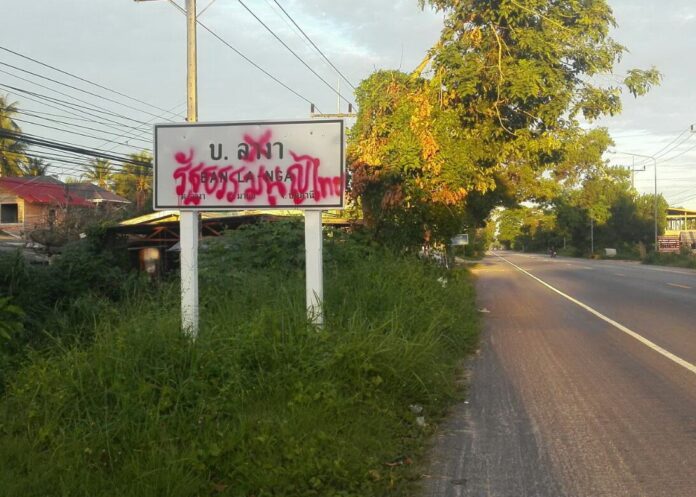
A graffiti found Monday morning in Narathiwat province
BANGKOK — People in the three southern border provinces woke Monday to signposts and roads spraypainted with graffiti apparently denouncing the proposed constitution at stake in the upcoming referendum.
Experts and authorities are divided over whether they were a message addressed to the Thai state by local Muslim separatists, who rarely address national politics throughout a dozen years of their insurgency.
For Zahari Chelong, editor of an online news agency that has extensively reported on the insurrection, the unsigned graffiti bears the militants’ fingerprints.
“Looking at the circumstances and the way they [the graffiti] was done, it’s clear that this is a message from the movement,” Zahari of the Wartani news website said by telephone. “This is an expression of their stance. They don’t accept the constitution.”
Hara Shintaro, a Pattani-based scholar and writer, gave the same assessment. He said it’s natural that the militants, who have fought to restore the once-independent state of Patani, would reject any Thai constitution because of clauses forbidding secession.
“They don’t acknowledge Thai constitution which prohibits separation. I mean, any version,” Hara wrote. “They deny Thai constitution, whatever the shape is.”
X Marks the What?
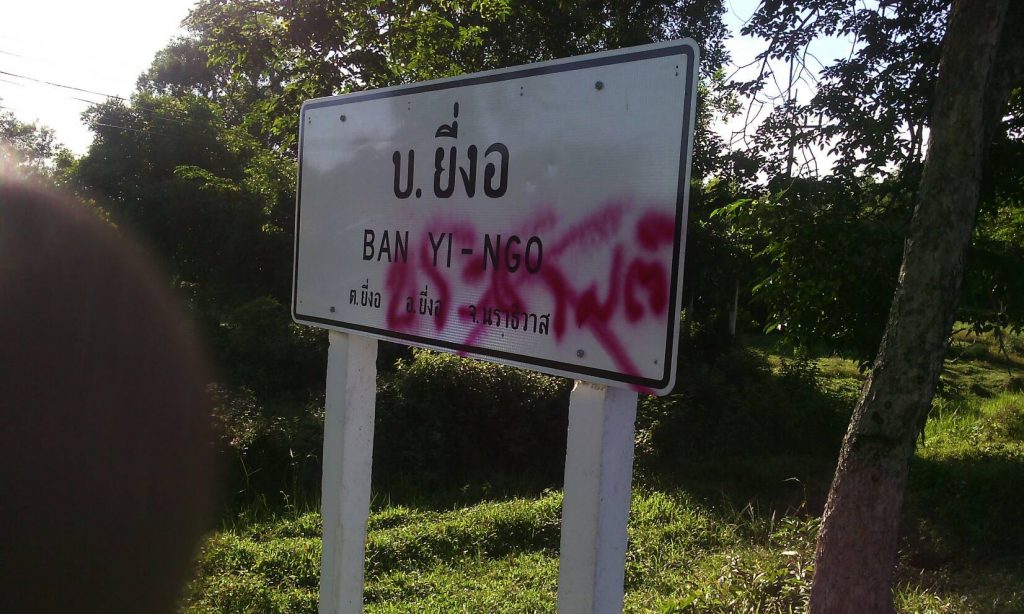
The works of graffiti were spotted in the provinces of Pattani, Narathiwat and Yala on Monday morning, sprayed on roads, signs and at least one administrative building in a manner consistent with typical insurgent messaging.
The messages themselves were terse. They only consist of the words “constitution” and “referendum” in Thai, with X marks.
A graffiti found Monday morning in Narathiwat province
The minimalist style of the messages is what prevented Srisomphop Jitpiromsri, director of the Deep South Watch news agency, from saying outright it was the militants’ work.
“I can’t say for sure what they even are trying to convey, because the messages don’t tell us anything. They may even mean they want to tick an X for the constitution in the referendum!” Srisomphop said, laughing.
But on a more serious note, the expert said he knew of no other group which goes out before dawn to spraypaint messages for the authorities.
“It’s a tactic that the movement has been using again and again,” he said.
On the other hand, regional police chief Chalermpan Achalaboon ruled out the separatists, and blamed local student activists opposed to the military regime and the constitution.
“It could be the students and activists who campaign in a nonviolent method,” said Maj. Gen. Chalermpan, who commands the police force in the three southern provinces. “It has nothing to do with the separatist movement. They stay where they are; they have always separated themselves from this kind of issue.”
Elusive Warriors
Even scholars who believe the graffiti is a message from the secessionists say they’re puzzled why the militants would break their usual silence to weigh in on an issue that they’ve never touched before.
The insurgents, the experts said, only have one goal – to secede the three provinces and form an independent state of Patani – and national politics in Bangkok have not been a matter of interest for them.
“This is the first time I knew of them speaking out [about the constitution],” Zahari said. “It’s really a strange situation, a strange signal … Usually, they don’t care. They just want to build a new country, they want Patani as a country, so they don’t care.”
Although Srisomphop said the militants rarely address national politics – and never constitutional referendums – they might feel compelled to speak out against the current draft being put before voters Sunday.
“This constitution can be linked to the Deep South, too, because clauses on decentralization, autonomy and self-determination have been mostly cut from the previous draft,” Srisomphop said. “So it does affect their movement.”
Ayutthaya elephants put to work Monday to promote Sunday's charter referendum.
UBON RATCHATHANI — Another public discussion of Sunday’s charter referendum has been banned, this time in the northeast at Ubon Ratchathani University.
Titipol Phakdeewanich, the dean of the university’s Political Science Faculty, said the seminar was canceled under pressure from the university and provincial Gov. Somsak Jangtrakun, asked the university to cancel the event.
“The university and the province raised serious concerns about this seminar and questioned the neutrality of the event,” Titipol wrote in English in a message posted online which went on to express disagreement with the decision.
Thitipol said the event had been approved by the military regime.
He was slated to moderate the Tuesday symposium, “A Free and Fair Constitutional Referendum and its Implications for the Future of Thai Democracy,” whhere speakers were to include former Pheu Thai Education Minister Chaturon Chaisaeng and former National Human Rights Commissioner Nirand Pitakwatchara.
Titipol said the military has always granted permission, but this time the intervention came from the province through a university administrator he asked not to be identified.
“The order wasn’t made formally,” Titipol said. “It’s my role as a dean [to hold such events], and if I don’t do it now I can’t be considered as effective. But the administrator wanted me to just stay still.”
He elaborated on the importance of allowing such events online.
“In a diverse society, harmony, unity, and reconciliation are not the results of suppression. It is possible that people can live in harmony and a society can be peaceful when differences are recognised and accepted,” Thitipol wrote. “Expressions by Thais that show their disagreement with the constitutional draft should not be simply interpreted as opposition to the Thai junta or the NCPO.”
Chiranuch Premchaiporn of Prachatai news, in orange, speaks Monday in Bangkok at a meeting announcing the establishment of the Referendum Watch Network to monitor the Aug. 7 referendum.
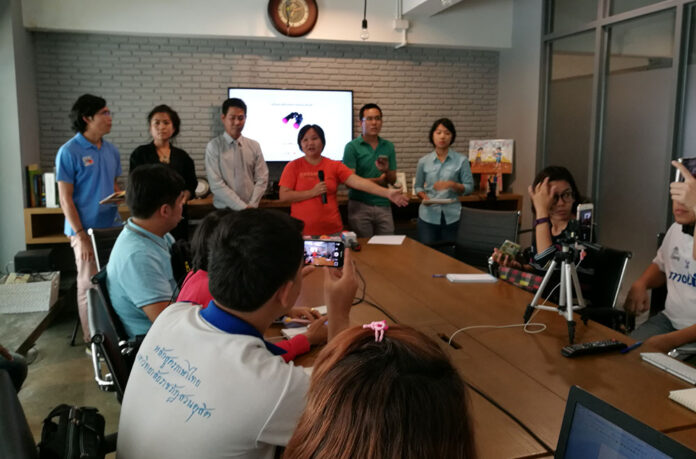
BANGKOK — An ad-hoc network of unofficial referendum monitors was launched Monday by six organizations in a last-minute bid to scrutinize this coming weekend’s public poll on the junta-sponsored charter draft.
The network drawn from the media, academics and legal advocates said their concerns about the transparency and credibility of Sunday’s referendum were compounded by the absence of accredited Thai observers, the banning of exit polls and the use of a privately developed smartphone app to report the results.
“It has opened room for murkiness,” Chiranuch Premchaiporn, director of pro-democracy online news site Prachatai, of the Rapid Report application which will be used for the first time and will only report 95 percent of the total vote on Sunday.
Prachatai is one of the six organizations which have organized as the Referendum Watch Network.
The head of the Election Commission department responsible for carrying out the vote said only 95 percent will be reported to avoid any discrepancy with the traditional counting system, which will be made public by Wednesday.
The Rapid Report app is expected to provide unofficial results by no later than 7:30pm on Sunday.
Also part of the Referendum Watch Network are Mahidol University’s Institute of Human Rights and Peace Studies, domestic election monitoring group We Watch, the Thai Center for Investigative Journalism, Human Rights Lawyers Association and legal reform advocacy group Internet Law Reform Dialogue, aka iLaw.
Chiranuch questioned by exit polling was banned, saying it only served to cast doubt on the transparency and reliability of the results.
“Normally there would be exit polls, and we can counter-check the results somewhat,”she said.
Yingcheep Atchanont, project manager at iLaw, said the media should ask why exit polls won’t be permitted.
“I would not demand the media [conduct exit polls], which is illegal,” Yingcheep said. “But I ask that the media post questions on the subject.”
Trying to allay concerns the network might be biased because its members opposed the 2014 coup, Eakpant Pindavanija, director of the Mahidol institute, said they are acting on ethical imperatives and have no interest in distorting things.
“We do still have our principles, and we’re impartial when it comes to our professions as we have our codes of conduct,” Eakpant said.
Furthermore, he added, the groups tried to win accreditation from the Election Commission, but were denied on a questionable technicality.
We Watch has 30 trained election observer volunteers. They encouraged anyone to send in video or text reporting any alleged irregularities, including whether soldiers have entered polling stations.
They are promoting use of the hashtag #ส่องประชามติ (monitoring referendum) while those not literate in Thai can send messages to Prachatai or iLaw via their Facebook pages.
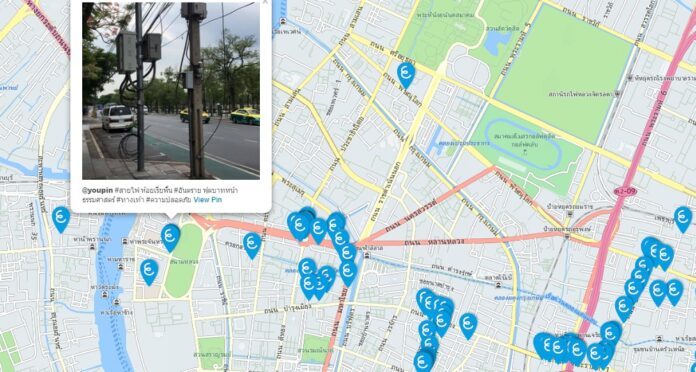
YouPin’s crowdsourced map shows pins entered by regular citizens.
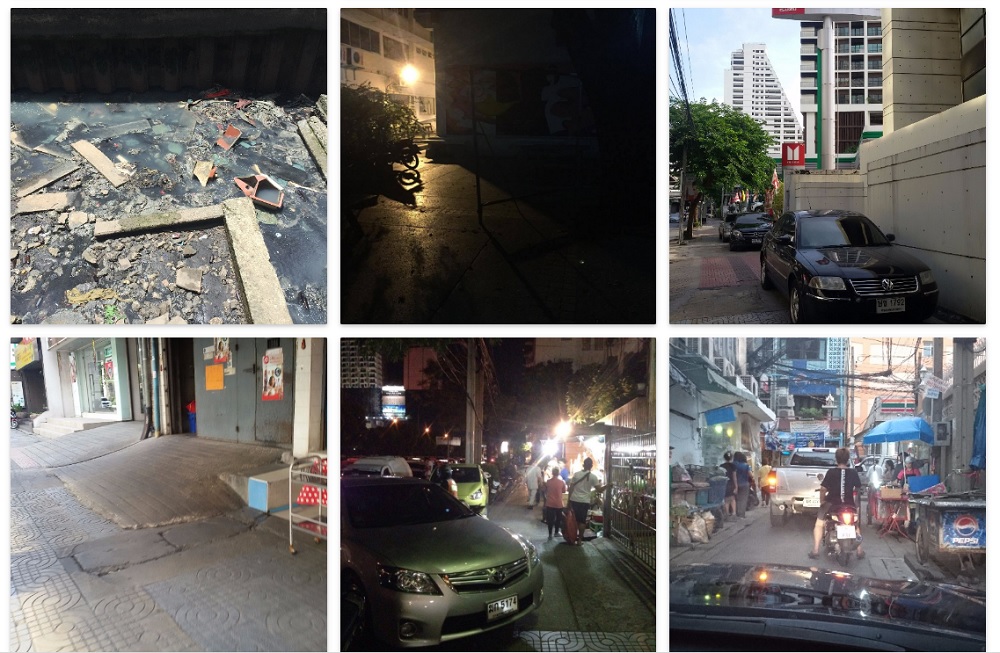
BANGKOK — Broken manhole cover traps, fallen wires, phoneless phone booths, missing bus maps and smelly bins. Walking in Bangkok can be a challenging and unpleasant experience.
Rather than place hope in the powers that be to fix everything and make the city walkable – an outcome that could be worse – a group of urban advocates got together to brainstorm a new platform to crowdsource the problem and invite everyone to help make the city better.
First is collecting the data, for which the group of gadflies created “YouPin,” an app anyone can use to build out the crowdsourced map of street problems via a web app or bilingual chatbot.
“We wanted to create a sense of ownership of the city” said Thitiphong Luangaroonlerd, who developed the project and app with a large group of about 20 friends. “Instead of only waiting for authorities to fix things, we now do what we can.”
It’s a Big Data approach to understanding and prioritizing problems for improvement.
YouPin’s gallery shows photos of problems uploaded by users.
As a longtime advocate for street maintenance, Thitiphong said City Hall does has listened and resolved problems he’s complained about. But, the 33-year-old IT worker said, the channels of reporting them need to work better, as the 1555 hotline and government website are not very usable.
And they don’t leverage the benefits of today’s networked technology.
“Also it lacks the quality of being social,” he said.
By putting the reported problems in a public place, Thitiphong said communities can weigh in with what they agree is important to help officials prioritize matters.
While the interface of the beta version of the web app does not yet include English, the Facebook chatbot loves talking in both languages. All you need to do is upload a photo or video with some description of the problem to report, then share the location it was discovered.
The system offers nine categories of problems, including sidewalks, roads, pollution, transportation and waste.
YouPin chatbot speaks both Thai and English.
This past weekend, organizers held “Bangkok Urban Hack Day,” where Bangkokians of different walks of life gathered to propose what could be done with the more than 500 pins already added to the map.
“For some pins, we have to depend on the government to fix it, so there needs to be offline cooperation,” Thitiphong said. “But some pins we can fix by ourselves, such as dirty walls or stinky garbage spots.”
They want to collect more data first so they can see what it will be and how to best proposed interfacing with City Hall.
They’ve already won laurels for their effort however. YouPin was chosen in June by the U.N Development Program as Thailand’s winning entry in a sustainable cities competition.
Thitiphong believes embracing data is a real way to make the capital city better.
“Because data has no bias and is measurable,” he said. “Without collecting data, we can never objectively say whether Bangkok today is better than yesterday.”
BANGKOK — Forty years ago, police and soldiers along with paramilitaries gunned down what witnesses said were more than 100 students on the campus of Thammasat University, a massacre mostly swept from memory today.
For its 40th anniversary, an underground, risk-taking theatre troupe will invoke its memory by calling out the indifference which made it possible later this year at the Bangkok Art and Culture Centre.
Without speaking, nearly a dozen members of B-floor Theater will address what happened Oct. 6, 1976, through their bodies in “Fundamental,” a performance going through the motions of a national tragedy, the circumstances of which remain ripe today.
“Society today is still driven by the same things, and I’m astonished how it really works,” said Teerawat “Ka-ge” Mulvilai, the play’s 43-year-old director. “I’m afraid that one day a kind of violence that I’m unable to stop will happen.”
Teerawat said the collective apathy that enabled the slaughter, for which no one was held accountable, persists 40 years later.
“This is a fundamental part of Thai society,” he said. “It’s like everyone supports it.”
Ka-ge’s productions are known for emphasizing physical movement and incorporating multimedia elements in performances critical of society’s institutional relationships and power imbalances.
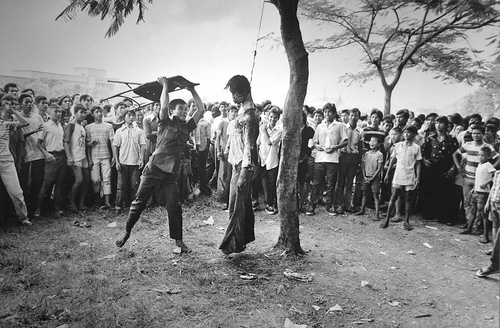
Apathy as the focus for “Fundamental” came from the infamous photo taken Oct. 6, 1976, in which a man uses a chair to beat the lifeless body of a Chulalongkorn University student who had been lynched from a tree.
More striking than one man’s barbarism, the photo is remarkable for the large crowd gathered to watch. Many laughing.
The director said he believes in the axiom that the world’s cruelty results not from evil people, but those who allow it to happen.
So, instead of taking the perspective of the victims, Ka-ge chose to assume the vantage point of those there to witness the violence with the brutality of apathy, to show the power of mainstream indifference and its contributions to human savagery.
The photo taken by Associated Press photographer Neal Ulevich, who won a Pulitzer Prize for his work in 1977.
Advance tickets for “Fundamental” are available now through Aug. 15 for 320 baht. After that they will be 550 baht (420 baht for students).
There is no dialogue, so no subtitles will be needed.
The production will stage its run Sept. 14 through Oct. 2 on the fourth floor of the Bangkok Art and Culture Centre. There will be 7:30pm performances Wednesday through Saturday and 3pm matinees on Sunday.