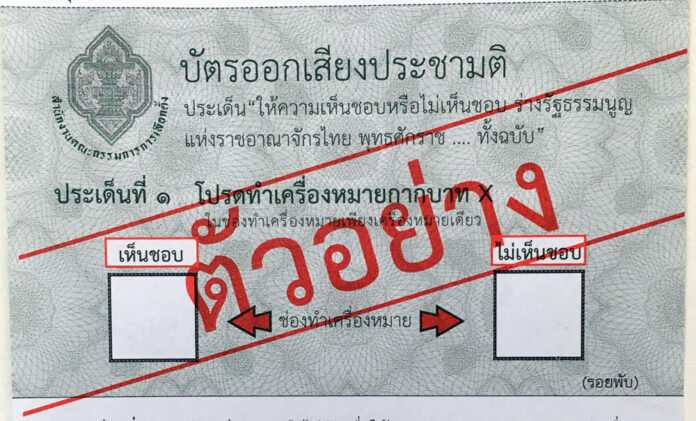
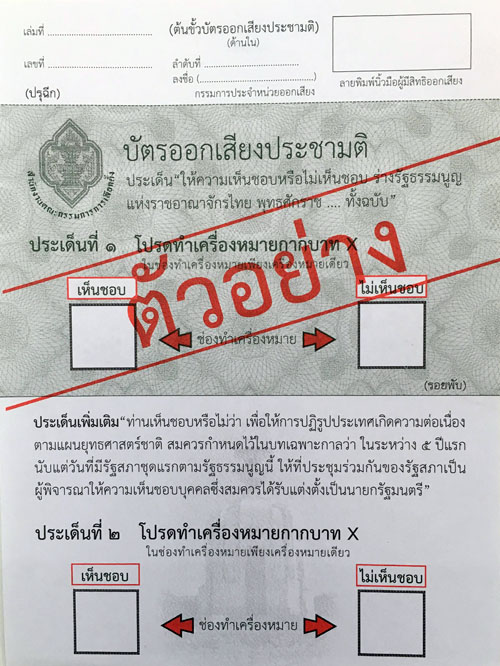
A portion of a sample ballot for Sunday's charter referendum.
Ed. note: Concerns have been raised about the integrity and credibility of Sunday’s vote in light of the political climate and the exceptional measures taken by the military regime in the run-up to the vote. Pravit Rojanaphruk spoke to top election officials and reviewed their procedures to provide this step-by-step guide to how it’s supposed to play out.
Ballot boxes and papers will be transported and kept in secured places until referendum day. The roughly 95,000 polling stations will be examined for readiness prior to in the early morning of Aug. 7 before polling starts. Every polling station is supposed to have eight staff: a director, many of whom are school teachers; two security officers, at least one of which is a police officer while the other could be military; and five local volunteers trained for the job.
At around 6am on Sunday, polling staff will arrive at each station carrying ballot boxes and papers to prepare for the polls to open at 8am. It opens with election officers showing that the ballot boxes are empty to the public and voters. They then will seal the ballot boxes with tape and plastic thread or some similar permitted materials before voting commences.
Voters have to affix his or her right hand index fingerprint to the top part of the ballot that will be kept by the Election Commission, or EC. Officials then tear out the ballots with two questions, the top one comprised of two square boxes. Once voters have the ballots, they will use a pen to mark an X sign to the left box if they support adoption of the charter and the right if they reject it. The second question, written somewhat confusingly, is about allowing an unelected prime minister to be selected by the appointed senate jointly with the elected MPs by voting for the five years after the House of Parliament convened. The affirmative answer is the lower left box.
Once the polls close at 4pm, three people – the polling station director, a volunteer and a security officer – will affix their names and signatures on each of the ballot books (which contain 20 ballot papers) to verify that everything is accounted for.
All eight poll workers will then play different roles in the on-site vote counting process. One person will read aloud the counting results which will be marked on a board visible to any observer from outside the polling station.
The final count will then be tallied and reported through Rapid Report, a proprietary app being used for the first time. Only 95 percent of those returns will reported by the central EC in Bangkok. The application, with its names and passwords, are said to only be accessible to each polling station director.
The ballot boxes and papers will then be transported to district-level centers. The results are put together and checked at the center before being sent to the central Election Commission headquarters at the Chaeng Wattana Government Complex in Bangkok.
Anyone at the polling station has the right to object if he or she believes the counting of a particular ballot paper or papers was inaccurate and the poll station director has the duty to stop the count and address the issue on site.
The counting is done once, and a recounting of the whole station can only be done if a citizen files a formal complaint to the EC which the commission deems reasonable.
The Election Commission then has three days to make public the results of the referendum.
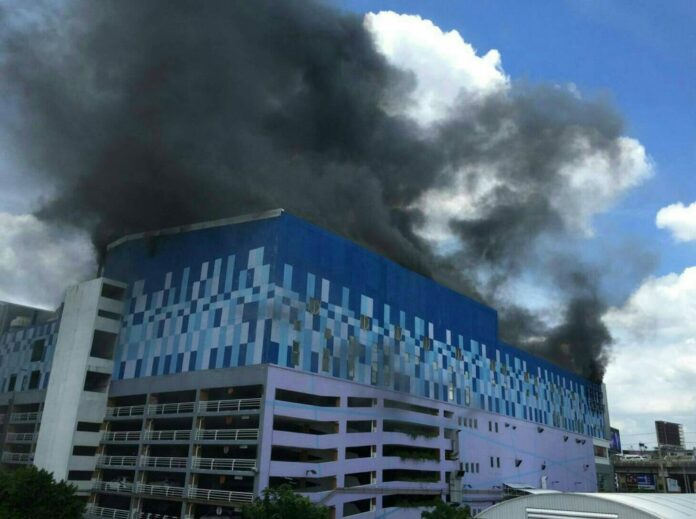
Smoke rises above Major Cineplex Pinklao prior to the theater’s roof collapsing as it was engulfed in flames Thursday in western Bangkok. Photo: Matichon
BANGKOK — Revelations that no smoke detectors or fire suppression systems were installed inside a large cinema destroyed Thursday by fire has prompted officials to inspect 300 other cinemas in the capital city to find out if they comply with fire regulations.
Instead of smoke detectors, Major Cineplex Pinklao in western Bangkok relied on heat detectors, which take longer to set off an alarm, according to Bussakorn Saensuk, a fire hazard expert for the Engineering Institute of Thailand.
Even more so, the theater relied on fire extinguishers should disaster strike.
“Major didn’t have any sprinklers,” Bussakorn said Tuesday by telephone. “And the fire alarm there didn’t detect smoke. It was a heat detector, which works slower.”
Attempts to put out the blaze using hand-held extinguishers failed, she said.
“Because of the lack of smoke detectors, and because of building materials which easily caught fire, the blaze spread quickly until fire extinguishers could not contain it,”
The law allows use of either type of detectors, but smoke alarms are far more reliable, Bussakorn said.
No one died when fire ravaged four of Major Cineplex Pinklao’s cinemas and eventually caused its roof to collapse, as the theater had not yet opened when the blaze started.
Had the cinemas been packed with movie-goers at the time, Bussakorn said, the results could have been devastating.
“It was very risky,” the official said.
Alarms Raised
In light of the Friday’s fire, the Bangkok Metropolitan Administration has dispatched teams to inspect more than 300 cinemas in the capital. Bussakorn said there’s no central database where each cinema registers its fire safety equipment equipment and building material, so officials have to visit each place.
In the first first venue they visited, Central Plaza Rama IX, officials already found problems.
“We found that there were many flaws that have to be fixed, such as their fire escape routes,” Taiwut Khankaew, director of the administration’s Building Control Division, told reporters. “Furthermore, some of the decorations inside the venue were of a highly flammable material. They have to fixed by coating them with fire retardants.”
On Wednesday teams will inspect theaters at Paradise Park, with Siam Paragon to follow. Bussakorn said officials hope to complete the citywide inspection this month.
Fire hazard is a recurring issue in Thailand, where code enforcement is lax and officials’ attention usually comes only after tragedy strikes.
A school dorm in Chiang Rai province was allowed to operate for decades despite violations of fire safety laws, such as the lack of smoke detectors and alarms, until it burned down in May, killing 17 children sleeping there.
Pojai, at left in better times and dead at right as her owner found her after a July 12 flight aboard Nok Air. Photo: Itsares Khumdee / Facebook
BANGKOK — Nok Air announced Tuesday it will no longer provide pet transport services after a Siberian Husky died during shipping.
The airline’s announcement came in response to a viral Facebook post by Itsares Khumdee about Pojai, his Siberian Husky, who died after traveling aboard a July 12 Nok Air flight from Don Mueang International Airport to Trang.
In the post shared more than 4,000 times, Itsares speculated that Pojai died because she was kept in a hot cargo storage room for almost two hours before the flight took off or because the plane’s cargo hold was not properly pressurized.
“Was the pressure adjusted, and was there enough air for a dog to breathe in the cargo compartment?” Itsares wrote. “Because it looks like she suffocated from atmospheric pressure.”
Itsares said he asked airline staff to ensure Pojai was kept in an AC room during the two hour wait before the flight. When he went to inspect the security camera three days later, he found out after 15 minutes, his dog was moved to into a warm room without so much as a fan.
After waiting 14 days for the airline to respond, Itsares went public, spreading his story online after Nok Air refused to take responsibility or pay compensation.
According to conditions listed their website, Nok Air says it is not responsible for any death or injury or disorder that happens to animals during transport.
Nok Air CEO Patee Sarasin Tuesday morning posted on his Facebook that Nok Air would cease the service and compensate Itsares.
“In order to prevent same situation from happening again, we will no longer fly pets,” Patee wrote.
The CEO could not be reached for further comment.
The airline Tuesday said the cancellation of the service is effective immediately, although guide dogs will still be allowed to travel with visually impaired passengers.
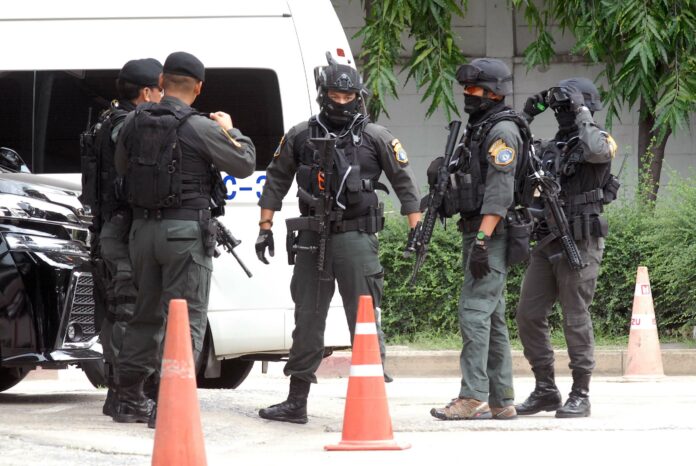
Commando police on Tuesday stand guard at Crime Suppression Division while the 11 suspects are brought to hear their charges.
BANGKOK — Eleven people, including former politicians and local officials, are under arrest for allegedly misrepresenting the new constitution draft that will be put to a referendum this Sunday.
For their alleged misrepresentation of the charter in the batches of letters that they sent to their supporters, the suspects face severe charges of insurrection, conspiring against law enforcement and violating the referendum law, which bans any attempt to “mislead” the public to vote for or against the constitution.
The 11 suspects were brought to the Crime Suppression Division on Tuesday to be charged with the offenses. Among the accused are Tassanee Buranupakorn, a 44-year-old former Pheu Thai MP from Chiang Mai province who was placed in military detention since Wednesday, provincial administrator Boonlert Buranupakorn and mayor Kachen Jeakkhachorn.
Winyat Chartmontree, the lawyer who represents the suspects, said police prevented him and a fellow attorney from seeing his clients.
“Police told us this is a part of the arrests that lawyers didn’t need to be there,” Winyat said by telephone. “We couldn’t be there, we couldn’t find out what was going on. This affects the rights of the suspects. They have the rights to consult their lawyers.”
All suspects were later flown to the Chiang Mai regional police headquarters for further interrogation. The eleven can be held for 48 hours before police either ask the the military court in Chiang Mai to remand them in prison, or release them on bail.
Deputy police chief Sriwarah Rangsipramkul said the group “distorted” facts about the constitution draft in the letters that they mailed to their supporters in Lampang and Chiang Mai provinces, which police intercepted before they reached their destinations.
However, police have never disclosed the exact the nature of what the letters said.
According to Winyat, only one of the suspects has admitted to the offenses, while the others deny the allegations.
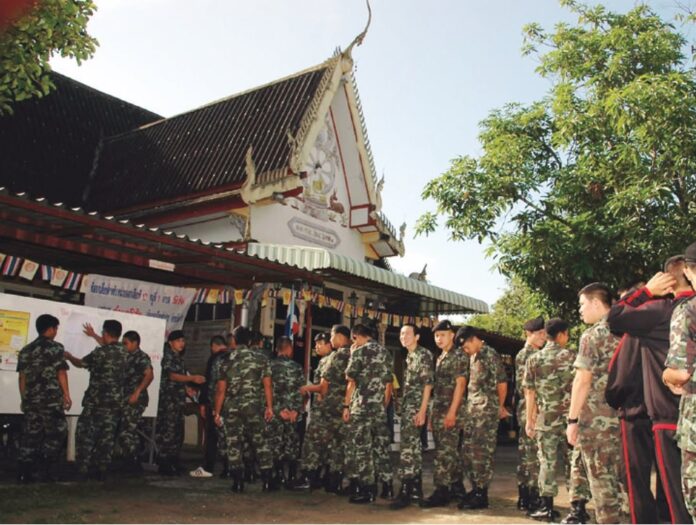
Soldiers line up at a polling station on Aug. 19, 2007, to cast their ballots on the previous constitution referendum in Surat Thani province.
BANGKOK — Can people trust that the Aug. 7 referendum charter draft will be transparent, impartial and credible?
Given the junta’s wielding of absolute power and its big stakes in a “successful” outcome of the Aug. 7 referendum on the constitution it wants passed by the public, there are many questions about the process.
Why does the ballot require a fingerprint? How reliable is the privately developed app used to report returns? Why will only 95 percent of the votes be counted for the day-one results? Will the presence of soldiers interfere with the outcome?
To understand how it is all supposed to go down Sunday, we asked two people who should know best, Election Commissioner Somchai Srisutthiyakorn and Wanchai Jakikusol, who runs the commission department responsible for the voting logistics.
Vote Counting?
A sample ballot for Sunday’s charter referendum.
Despite recent rumors circulating on social media that ballots would be counted in secret, the commission said ballots will be counted at polling locations Sunday. That is except under certain circumstances, such as if it’s too dark to see due to lack of electricity. There are 95,000-plus polling stations around the kingdom and virtually all should be counted openly once the polls close at 4pm on Sunday.
Both Somchai and Wanchai said they believe the process will take more time than a typical, single-question referendum because there is a second question on the ballot.
The first asks whether one endorses or rejects the junta-sponsored draft charter.
The second asks whether one approves of allowing for five years the unelected, junta-appointed senate to take part in selecting the prime minister along with elected MPs, essentially creating the chance of having a prime minister not elected directly by the public.
Not all counting may finished as some polling stations may have no electricity and it may turned dark before the counting is done. As the EC has limited budget, said Wanchai, there’s a possibilities that some counting may have to continue elsewhere after dark but transportations of ballot boxes will be done independent of the military junta.
Both men urged the public to be the commission’s eyes and ears during vote counting, despite the fact that no Thais have been accredited as election observers under a technicality interpreted from the junta’s Referendum Act passed by its interim legislature.
To make a formal complaint of misconduct or irregularity, one must physically visit a provincial office of the Election Commission, or EC, or via an EC smartphone app available for iPhone and Android.
On Monday, an unofficial network of organizations created an unofficial monitoring group and urged the public to report irregularities Sunday on social media using hashtag #ส่องประชามติ (#monitoringreferendum).
Military Interference?
The Election Commission only has 2,000 staff, so virtually all polling station workers will be a mix of paid and appointed volunteers, mostly drawn from local administrators under the Interior Ministry and teachers from the Education Ministry.
There will be two security guards at each polling station and at least one of the two will be a police officer, Wanchai said.
One may be a military officer if necessary. The two insist the military under the command of the junta will not be allowed inside the polling stations.
“They have nothing to do with it. They have no duties inside, and they will be outside the stations,” commissioner Somchai added.
Somchai shrugged off the possibility of the junta sending soldiers inside polling stations and hypothetically compromising the vote counting or creating a climate of intimidation during the vote.
“That’s too imaginative,” he said, adding that the counting method will be no different from other elections organized by the EC in the past.
Wanchai was more forthcoming about the possibility of a “military intervention” at the polling stations and beyond, however.
“[The junta] has no right. They won’t be let inside. But I don’t know if [junta leader Gen. Prayuth Chan-ocha] will use Article 44 or not?” he said, referring to the absolute power Prayuth granted to himself, ex officio, after seizing power in 2014.
“Well, they have taken over the country and they can do whatever they like… but we won’t let them stand inside,” Wanchai said.
Somchai swears the junta cannot tell him what to do and he will try to make sure the counting will be fair and transparent. “I don’t know if they can point a finger and tell someone to do this and that or not. But they can’t point a finger to me and tell me what to do,” said Somchai.
Seeking to demonstrate the durability of ballot boxes, Election Commissioner Somchai Srisutthiyakorn achieves the opposite Tuesday.
Ballot Integrity?
For possibly the first time, voters will be required to affix a fingerprint to the top of their ballot, above their vote.
This is not to intimidate voters by linking their identity to their vote, Wanchai said, but was intended as a marketing maneuver. The commission hopes people will take selfies with their inked fingers, he said, and share them on social media, thus encouraging others to come out and vote.
Meanwhile, Somchai boasted five step security measures on the ballots and his colleague agreed they could not be forged.
“The printing house we chose is a secure printing house dealing with important papers such as checks, stamps and other documents,” Somchai said. “Staff are body-checked before they enter or leave the premises and there are EC staff guarding the place, even at night, plus the five-step anti forgery measures.”
Despite the fact the millions of ballots have already been printed at a secret printing house, Somchai maintains that somehow he’s the only person who knows what color they are.
“I alone knows what color it is,” he said of the ballots. “So there’s no need to investigate others if there are forged papers.”
Among the five measures introduced include micro letters hidden in the voting papers and the use of special ink only visible under ultraviolet light.
Only three EC staff have knowledge of the details, Somchai said, and measures four and five are kept secret as they employ sophisticated technologies the commissioner would not reveal.
Credible Counting and Reporting?
Tallying up the results will be done in parallel through two systems. This will be the first time an app will be used by the EC to quickly tally results.
Somchai said only two hundred thousand baht was spent on the Rapid Report app.
The app has not been publicly tested and its source code is unknown but the commissioner said a drill will take place twice, once tomorrow (Wednesday) and on Aug. 6, a day before the vote. Somchai would not name the private firm who developed the app.
That said, the app’s main utility, he said, is to satisfy public curiosity and the results reported through the app will not be regarded as official.
The responsible staff at each polling station will be given a username and password for filing results from each of the 95,000-plus voting locations around Thailand. Results will start coming in after polls close at 4pm and will be tallied until 9pm on Sunday. They will feed into the EC’s headquarters at the Chaeng Wattana Government Complex in Bangkok, where they will be displayed by regional, provincial, and national levels on two large screens set up in public view.
There’s a catch, however. Only 95 percent of the total vote will be reported through the app.
Both Somchai and Wanchai said this is in order to avoid possible discrepancies with the official result process running in tandem, the results of which will be made public by Wednesday at the latest.
Both Somchai and Wanchai said this could mean that if the results from Rapid Report system are very close, say 50.5 percent to 49.5 percent, then the final official result could end up tipping the outcome the opposite way.
“That’s a possibility,” Somchai said.
Somchai in fact expects a possibility that only 80 percent of the votes will be sent in through the app by 9pm on Sunday as he reckoned that about 5 per cent of the voting stations have no phone connectivity.
Veeradet Tanvist sit in his taxi at a gas station in Bangkok.
BANGKOK — A taxi driver said he drove more than 150-kilometer to chase down a bus driver who slashed his face Tuesday.
The quest for justice across six provinces came to an end when cabbie Veeradet Tanvist fainted due to loss of blood when he stopped for gas in Bangkok. Police say they are investigating.
According to Veeradet, white bus belonging to Phu Kradueng Tour company slammed into his taxi while it was trying to overtake his car in Korat’s Pak Chong district 1am Tuesday.
Veeradet said he demanded the bus to stop and negotiate a compensation, but the bus driver got off with a sword and slashed him in the face before fleeing on the road to Bangkok.
Despite a ghastly cut wound stretching from his left ear to his chin, the 65-year-old cabbie drove to chase tdown he bus for two hours until his car ran out of gas. The driver then made a stop at the NGV station on Vibhavadi Rangsit Road around 3am, where he later fainted, prompting staff to alert police.
Veeradet’s car appears to suffer extensive damage from the crash; the bonnet as well as front glass were gone.
Capt. Rakkiat Pathumwan of Thong Song Hong Police Station said he had yet to question Veeradet because the victim was brought to hospital to treat his face wound.
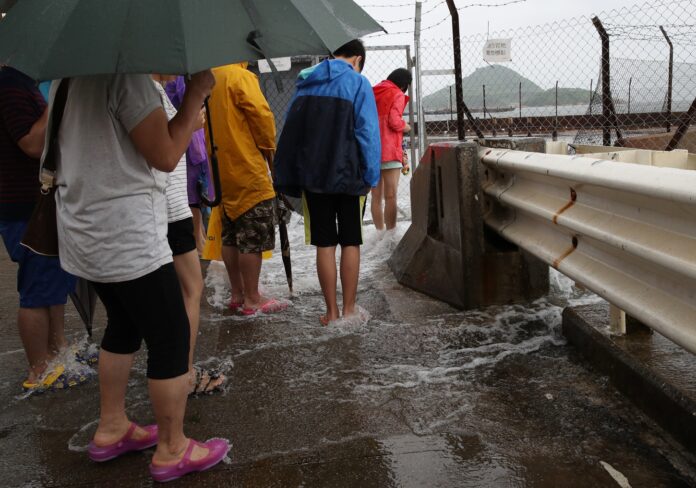
People play with overflown water caused by Typhoon Nida in Hong Kong, Tuesday, Aug. 2, 2016. The Hong Kong Observatory issued the number 8 storm signal, as Typhoon Nida is moving northwest across southern China, bringing high winds and heavy rain but no immediate reports of deaths or destruction. (AP Photo/Kin Cheung)
BEIJING (AP) — Typhoon Nida was moving northwest across southern China on Tuesday, bringing high winds and heavy rain but no immediate reports of deaths or destruction.
The storm made landfall at 3:35 a.m. Tuesday near Hong Kong and was expected to churn across the manufacturing center of Guangdong province, gradually weakening as it moved into the neighboring Guangxi region.
Flights, ferries and ground transport were heavily disrupted in Hong Kong on Tuesday morning and schools canceled classes.
By mid-day, the Hong Kong observatory had canceled its rainstorm warning, but urged people to continue to be vigilant for river flooding. It said it recorded maximum gusts exceeding 128 kilometers per hour (80 miles per hour).
Large parts of China have seen heavier than usual seasonal rainfall this summer, leading to widespread flooding and scores of deaths.
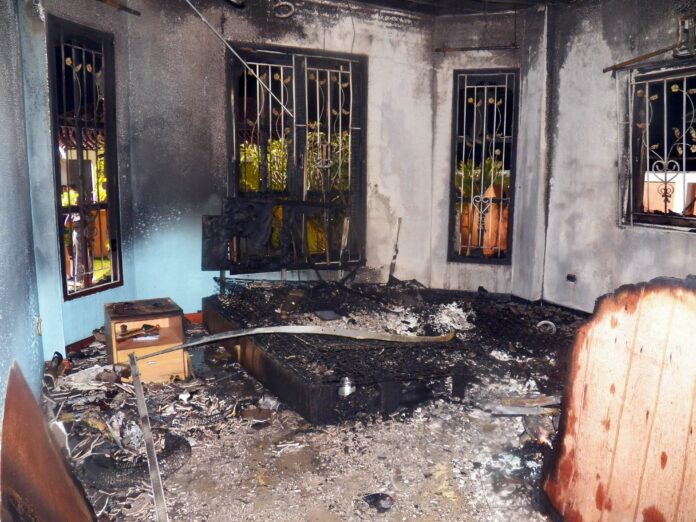
Photo of the house where Andrew Green Thomas was found dead on Monday morning
CHONBURI — A 56-year-old Briton hanged himself after setting fire to his own house in Chonburi’s Banglamung district on early Monday, police said.
Andrew Green Thomas committed suicide following an argument he had with his Thai wife, and nothing at the crime scene indicates any foul play, according to local police chief Anan Purahong.
“There is no evidence of any murder,” Col. Anan of Huai Yai Police Station said on Tuesday. “It was about a family quarrel.”
Police report says Thomas set a fire at his home in Soi 36 at around 4am Monday before hanging himself at the residence.
Forensic police will perform autopsy on his body to conclude the exact cause of death as required by the law, Anan said.
“But at this moment, the case is closed,” the officer said.
That’s the question of one tourism official who has proposed placing Pokestops at famous tourist destinations in order to attract young travelers, especially avid players of the immensely popular game Pokemon Go.
“Rare types of Pokemon will be placed at tourist destinations we want to promote to tourists,” Pongpanu Svetarundra of the Ministry of Tourism and Sports announced Monday.
He said it could attract independent travelers and “Gen-Y” traveler-trainers.
In the augmented-reality game, players seek out and catch Pokemons with their mobile phones at real world locations. These “pocket monsters” are found at specific locations known as Pokestops.
Although the current locations are preset, the game’s developer does accept Pokestop requests from players.
The Nintendo game was released in many parts of the world in July, such as the United States and Japan. However, its release date for Thailand has yet to be announced, despite erroneous reports in pretty much every media outlet it would come to Thailand in September.
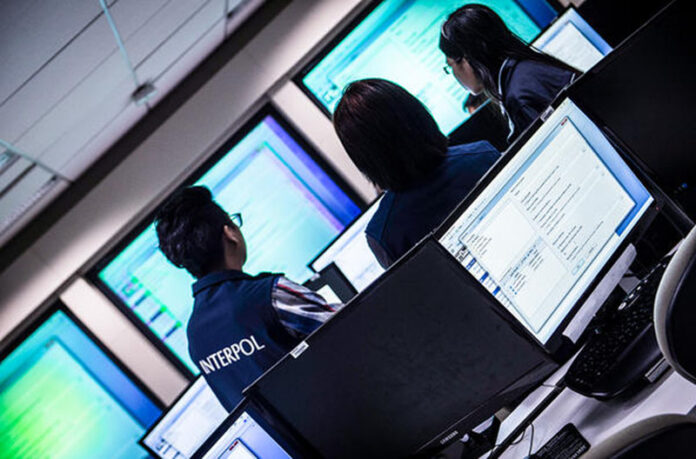
LAGOS, Nigeria — A Nigerian accused of scamming USD$60 million (about 2 billion baht) from companies around the world through fraudulent emails has been arrested after months of investigation, Interpol and Nigeria’s anti-fraud agency said Monday.
The ringleader of a global scamming network, identified only as 40-year-old Mike, was arrested along with a 38-year-old accomplice in Nigeria’s oil capital, Port Harcourt, in June, the statement said. He is on administrative bail, which implies that officers do not yet have enough evidence to charge him.
The man is accused of leading a network that compromised email accounts of small and medium-sized businesses around the world including in the United States, Australia, India, South Africa and Thailand. The statement didn’t name any targets.
The network involved about 40 people in Nigeria, Malaysia and South Africa who provided malware and carried out the frauds, with money-laundering contacts in China, Europe and the United States providing bank account details.
A supplier’s email would be compromised and fake messages sent to a buyer with instructions for payment to a bank account under the network’s control, the statement said. Or an executive’s email account would be taken over and a request for a wire transfer sent to an employee.
Lawyer Gary Miller of the International Fraud Group said the amount was “minuscule, a drop in the ocean” in a cybercrime industry estimated to be worth USD$1 trillion to USD$2 trillion.
He said it is “quite unusual” to track down a cyber-criminal because “they’re usually protected by a few tens, if not hundreds, of zombie servers which hide their identity.” His group traces looted funds for individuals and companies.
Nigeria is notorious for internet fraud. The U.S. Embassy says it receives inquiries every day from Americans who have been defrauded.