Red Velvet, pictured, is among the South Korean artistic group delegation to North Korea. Photo: Lim Tae-hoon / Associated Press
SEOUL — South Korea said Tuesday it will send a 160-member artistic group to North Korea, including about 10 celebrated K-Pop singers, for rare concerts there.
The South Korean musical artists will visit Pyongyang, North Korea’s capital, from March 31 to April 3 and give two performances, according to a joint statement issued after the two Koreas met at a border village.
The development comes during a thaw in the North Korean nuclear crisis. A North Korean band performed in South Korea during the recently ended Pyeongchang Winter Olympics.
The South Korean delegation will include some of the country’s pop legends, including Cho Yong-pil, Lee Sunhee and Cho Jin Hee, who performed in Pyongyang during a previous era of detente. Popular girl band Red Velvet is also among the South Korean groups, the statement said.
South Korea last sent a pop singer to North Korea in 2005, according to Seoul’s Unification Ministry.
During Tuesday’s talks, the two Koreas were unable to agree on which songs the South Korean singers will sing in Pyongyang, a potentially sensitive issue in a country where most citizens are blocked from accessing outside information. But South Korean delegates said they are optimistic an agreement can be reached, saying they will exchange letters via a cross-border communication channel.
“When it comes to the list of songs, I don’t think it will take a long time if we talk about the songs they know,” said chief South Korean delegate Yoon Sang, a popular singer and composer. “Some sensitivity remains regarding which songs we’ll choose.”
The Koreas also haven’t agreed on who else will be included in the South Korean artistic delegation other than K-Pop singers. Past South Korean performances in the North included a joint symphony concert, an opera and folk music.
Yoon’s North Korean counterpart in the talks was Hyon Song Wol, leader of the North’s only girl band. She also headed another North Korean band which performed in the South during the Olympics. Her planning visit to South Korea in January triggered a media frenzy.
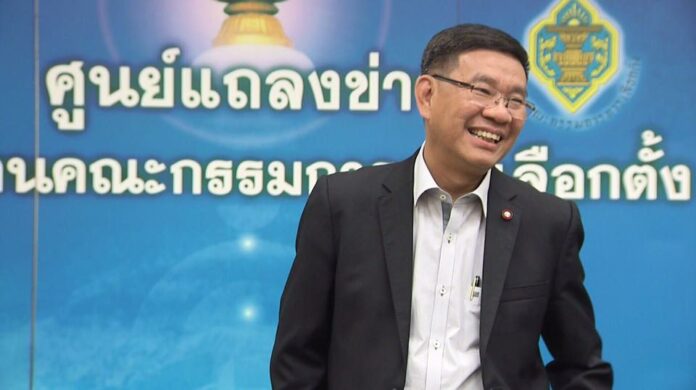
BANGKOK — The junta leader Tuesday evening dismissed a longtime election commissioner for “inappropriate conduct.”
Gen. Prayuth Chan-ocha issued an order under Article 44 of the defunct constitution to remove election commissioner Somchai Srisuthiyakorn.
According to the order, Somchai exhibited “inappropriate behavior” during an interview to media and “confused the public on the election process.” The order also stated that Somchai had a conflict of interest when he applied to become secretary-general of the Election Commission without resigning from his current position on the commission.
The order to dismiss Somchai was effective immediately.
“It’s a real honor to unmask the NCPO,” Somchai said in a Tuesday evening Facebook post.
Somchai, 59, is known for speaking his mind and recently criticized the repeated elections delays.
In an interview published online Monday, Somchai confronted the junta regarding its decision last year to essentially disband the Election Commission to appoint new members.
“The NCPO is one of the authorities in Thai society, even the one with most power […] so the NCPO cannot support any single political party,” Somchai told The 101 World.
New political parties were allowed to register this month, and although Prayuth has been demur on his post-election ambitions, he is expected to seek ongoing power through a proxy party for the military.
Prayuth removed Somchai from office under Section 44 of the 2014 interim charter which gave him the authority to take any action for “national security.” It remains in effect under the 2017 constitution until a new government is seated.
Somchai oversaw the 2016 charter referendum as well as the last pre-coup general election in 2014, for which he was criticized about his commitment to democratic institutions. In June of last year, the junta-appointed legislature voted to unseat all commission members and appoint replacements.
Karakade (Bella Campen) tests out her water filter in episode 7 of "Bupphesaniwat."
BANGKOK — Karakade orders a clay funnel from the Chinese blacksmith, then fills up the apparatus with linen, charcoal, sand and rocks before instructing a manservant to pour in dirty khlong water.
To the amazement of onlookers, the water that drips out the bottom runs clear.
This recent scene from the currently historical soap “Bupphesaniwat” about a modern woman who time travels to 1682 Ayutthaya has not only tripledAyutthaya’s tourism – it has also gotten Thais nationwide talking about water quality and water filters.
A scientist from the Metropolitan Waterworks Authority who wrote a recent study about the safety of tap water said it is safe to drink in the capital’s metropolitan area – often safer than filtered water.
“Most people don’t trust Bangkok’s tap water, but it’s actually no different from other types of water,” Auttapol Kordach, a scientist at the organization’s Water Quality Department and one of the authors of the reportsaid Tuesday by phone.
The study collected 2,354 water samples from October 2011 to September 2016 from both water sources and tap water at people’s houses in Bangkok, Nonthaburi and Samut Prakan. Water in this metropolitan area comes from two main sources: the Chao Phraya River and Mae Klong River.
Although many houses use water filters – water dispensers that cool and filter water or water storage tanks that act as water reserves or to help pump up water in multi-storied homes – Auttapol said that their improper maintenance can actually contaminate water.
“Water filters that haven’t been cleaned can actually have a more negative result. People have them for peace of mind, or because they like the taste,” he said.
Low trust in state waterworks comes from losing public trust since the 2011 flood and from the presumption that capital’s pipes aren’t clean.
Karakade (right, Bella Campen) with her water filter in “Bupphesaniwat.”
“People think pipes underground are dirty. But the pipes are a closed system, and even if there’s a leak, there’s chlorine to kill bacteria and water that leaks out doesn’t flow back in,” he said, maintaining that city waterworks constantly check up on pipes.
The study showed that E.coli had the highest probability of being found in water storage tanks – more than 8 percent – followed by 4 percent for filtered dispensers, 2.8 percent for water filters and 1.1 percent for tap water.
Auttapol said that E.coli comes from water contaminated by mammals’ feces. Metropolitan tap water has at least 0.2 milligrams of chlorine per liter to kill the bacteria, in accordance with World Health Organization guidelines, he said.
“Areas further from treatment plants or pumping stations have less chlorine,” Auttapol added.
Those testing tap water to drink can look for two things: clarity and chlorine.
“Turn on your tap. If it runs clear and you can smell the chlorine, then it’s definitely safe to drink,” he said. “You can let the water sit out a bit for the chlorine to evaporate if you don’t like the taste.”
Those especially vigilant in testing their water can purchase testing kits, Auttapol said.
A real-time mapby city waterworks also updates each area’s water cleanliness levels. The tabs at the bottom say: main menu, free residual chlorine turbidity, conductivity, salinity, chloride levels and pH levels.
Click each quality to see how the water is running in your area.
“Look for high numbers of chlorine, low levels of turbidity and other qualities. The water’s pH levels should be in the neutral range from 6.5 to 7.5,” Auttapol said.
The study does not apply to provinces that aren’t under the Metropolitan Waterworks Authority’s jurisdiction.
BANGKOK — The national broadcasting regulator on Wednesday suspended a popular news talk program on Voice TV for 15 days, saying it caused confusion and incited societal division.
Voice TV – owned by Pathongthae Shinawatra, son of fugitive former premier Thaksin Shinawatra – will appeal the decision against “Tonight Thailand” and seek a temporary injunction at the administrative court, its management said Tuesday.
A sub-committee of the National Broadcasting and Telecommunication Commission, or NBTC, cited a program aired on Dec. 26 and two others aired on March 1 and March 5 as problematic.
A minute from the meeting obtained by Khaosod English shows the program on the December evening violated the MOU that bans criticism of the military junta.
It said the March 1 program was found to be “sarcastic” against the national leader.
“The sarcasm was too much and caused confusion. What was said was not truthful, such as government corruption or comparing [Prayuth] to Pinocchio, which is tantamount to saying the premier is a liar,” the minute read.
The summary of the sub-committee’s meeting, signed by member Direk Rowas also noted that the channel repeatedly replayed the image of anti-junta activist Sirawith Seritiwat, or Ja New, wearing a Pinocchio mask while other TV stations only showed it once.
The subcommittee concluded that a March 5 interview with Future Forward Party co-founder Piyabutr Saengkanokkul, in which he appears to compare the country to a house, caused division in society and contained unsubstantiated accusations.
“It’s like the house we live in today. One day we feel that things are not working, we want to change the house and build a new house and then there’s the former owner who rules over the old house who come and tell us, hey, hey, hey, you must bear with it and stay on, and you cannot dismantle the house because it’s already beautiful,” the minute quoted Piyabutr.
“But we feel very uncomfortable. We don’t want to live there, so there’s only one option which is to leave for another house – or you have to stay on and fight the rulers who seized power and said the house sucks and needs change,” it continued.
The document said that such statement incited the populace to fight and that saying people want to change the house or build a new one suggested “this house lacks fairness,” adding that the vague use of the word “house owner” could lead to many interpretation and that it was thus “dangerous.”
A co-host of the program, who spoke on condition of anonymity for lacking official consent, said such punishment is an overreaction and disproportionate, adding that the meeting minute suggested the station should have been given a warning instead of having the program suspended 15 days. “It’s as if they want to mete out a punishment, they will just do it.”
Part of the minute also stated that the program’s host should not say the country was better under Thaksin than under military rule.
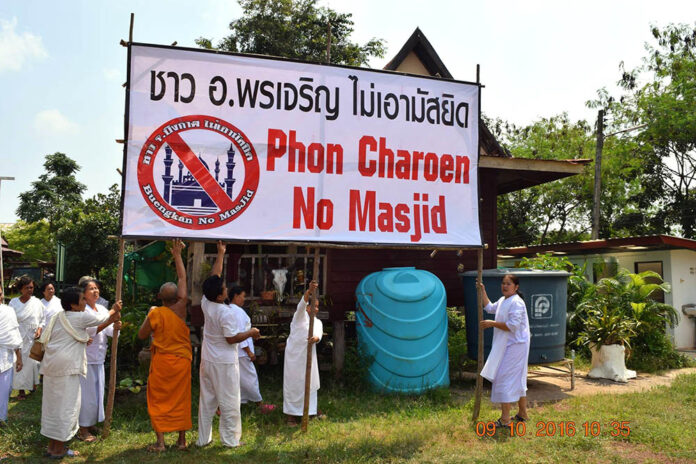
A banner opposing construction of mosques in Bueng Kan province's Phon Charoen district posted to a Thai Facebook page that is a clearinghouse of anti-Muslim sentiments. Photo: No Mosques in Bueng Kan / Facebook
BANGKOK — A Buddhist scholar and foreign correspondent both warn in recent books of the rising specter of Buddhist nationalism in Thailand.
Buddhist scholar Suraphot Thaweesak recently warned that a bid to enshrine Buddhism as the national religion would increase the kind of extremism that French journalist Arnaud Dubus writes about in his recently released book “Buddhism and Politics in Thailand.”
“They think the state must protect Buddhism. … It’s difficult to make them see other points. We have to invite them to think about the teachings of Buddhism, that the Buddha talks about cessation of suffering,” Suraphot said, adding that establishing a national religion would spark more conflict with Thais of other faiths.
Dubus’ evidence of growing Buddhist extremism includes calls to burn down mosques in the predominantly Muslim-Malay Deep South, where soldiers have ordained as monks, equipped with both alms bowl and heavy weapons.
The short volume gives a broad look at how Dubus believes state-sanctioned and centralized Buddhism has failed to adapt to new realities after a century of being co-opted by the state.
Dubus, who’s lived in Thailand three decades, writes that the new constitution, passed by referendum in 2016, contains disturbing passages that afford special status to Buddhism.
Under Article 67, “the state shall promote and support education in and propagation of the principles of Thevarada Buddhism […] and shall establish measures and mechanisms to prevent the desecration of Buddhism in any form. The state shall also encourage the participation of all Buddhists in the application of such measures and mechanisms,” the book says.
Dubus says in his book that in a first, “Buddhism was this time clearly put at a level superior to other religions.”
“One indication of the Muslim discomfort was the very high number of ‘no’ votes to the draft charter in the southern provinces during the August 7, 2016, referendum as well as the high number of defaced and spoiled ballots,” he wrote.
Controversial hardline monk Apichart Punnajanatho participates in a ceremony expelling him from the monkhood at Bangkok’s Wat Benchamabophit in September 2017. Photo: Center for the Protection of Buddhism in Thailand / Facebook
Dubus notes in his book, a discussion of which this writer joined last month at Alliance Francaise, that the draft charter went even further by dropping traditional language calling for “religious harmony.”
It soon must have dawned on the junta that something was amiss, however, Dubus wrote.
“The military junta apparently realized, when analysing the referendum results, that something was amiss, and that there was a high risk of increasing discontent among the Muslims,” he says in the book. “Thus on August 22, barely two weeks after the referendum, Prayuth Chan-ocha issued an order under section 44 of the interim charter – which gives him absolute power for the good of national security – trying to correct the effect of section 67 of the draft charter.”
A panel was subsequently established to “prevent acts which threaten Buddhism and other religions” and “promote good understanding and harmony among followers of all religions.”
Buddhist meditation trainer Vichak Panich, who’s well known for espousing a liberal view in his online videos, expressed similar concerns but said the hardliners are likely to be in the minority.
Vichak said it’s hard to convince such people to reconsider their thinking, however.
“We may have to ask what kind of Buddhism they want to promote,” he said.
For Najib Ibn Ahmad, a 50-year-old Muslim from Narathiwat province, hope for the future rests on the younger generation of Buddhists. Najib, an independent researcher on local Thai-Malay culture, predicts if Buddhist extremists fail to establish Buddhism as the national religion in the next decade, the younger Thai Buddhists who inherit society are likely to be more open-minded.
The current situation doesn’t bode well, however. Najib said that while the state talks about a pluralistic culture, there exists persistent attempts to declare Thailand officially Buddhist as only Cambodia has done. “Things will become more extreme if it becomes law. I am worried.”
Asked how he might soothe the fears that Buddhism is under threat and needs to be enshrined in the constitution as the national religion, Najib said it’s beyond his ability.
“It’s a belief, and beliefs are not knowledge. Buddhism has survived for 2,500 years, just like Islam has thrived for 1,400 years. There exist dynamics, and if it decays, there will be people who will revive it. I don’t have the skill to convince them but the media can make them better informed.”
Najib said the continued use of Buddhist temple grounds as camping sites for small military units deployed in the restive Deep South, where a separatist insurgency has killed thousands since 2004, makes local Thai-Malay Muslims feel the monks have become part of the military apparatus.
Another state action that has exacerbated the already tense situation in the southernmost provinces are so-called “military monks.” These are soldiers who are ordained and keep their weapons while officiating as monks.
It, according to Dubus, “reinforces this conflation between Buddhist religion and nationalist politics in the eyes of Thai Malay Muslims.”
Dubus fails to provide details on the number of these military monks or interview any of them, however.
There’s also the rather popular monk preaching anti-Islam sentiments online. Back in October 2015, Phra Maha Apichat put out a call via Facebook for Buddhists “to burn a mosque for every Buddhist monk killed in the south.”
Apparently, that stance was too much for the state. Last year, the monk was brought to Bangkok to be disrobed and forced to lie low.
This doesn’t mean the hostility he espoused or supporters have gone away.
In a dark scenario painted by Dubus at the end of the book, he concludes that overall, it’s difficult to see a positive future for Thai Buddhism. Dubus fears that Thai Buddhism could continue to go down “the slope of nationalism and politicization” wherein Buddhism becomes the national religion and serves as “a springboard for the most conservative version of Buddhism to become dominant.”
Suraphot meanwhile proposes the secularization of Buddhism:
“The solution is to separate religion from the state and questions the relationship between the state and religion. The state must be impartial among religions.”
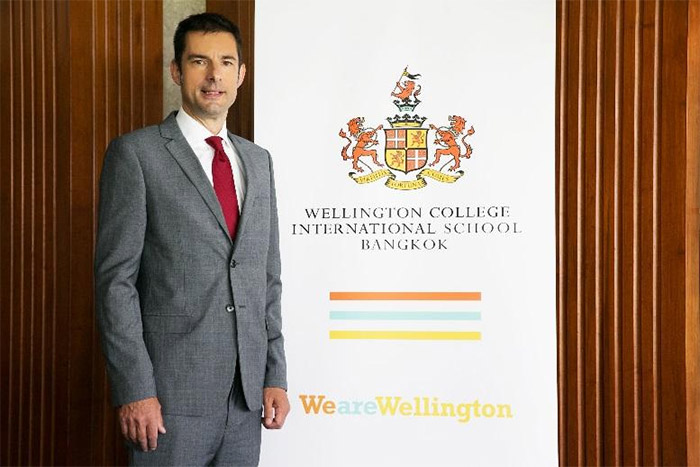
BANGKOK — ASEAN’s first Wellington College International School was recently launched in Bangkok to offer an alternative for educational pursuit with world-renowned British standards of academic excellence and nurturing of physical and emotional health.
Wellington College International School Bangkok is now accepting boys and girls for Pre-Nursery to Year 6, with classes commencing in August.
Proficiency in English language is one of the crucial foundations for students who wish to pursue higher education in elite institutions abroad. Hence learning from an young age becomes more important, prompting international schools to become ever-popular choice for modern Thai parents as well as expatriate families that reside in Thailand. Arguably, there is still strong demand for international schools in Thailand that fully harness high international standard while also catering to the needs of parents.
Such limitations inspired Dr. Darika Lathapipat, Chairman of the Board of Governors of Wellington College International School Bangkok and Chancellor of Dhurakij Pundit University, to meet these needs. Knowing full well of the potential growth of international schools in Thailand, Dr. Darika launched Wellington College International School Bangkok for the first time in ASEAN, to set a new benchmark in international education with British standards. The school recently hosted “The Infinite Possibilities” event to formally introduce the curriculum and offerings to interested parents on March 7, 2018, at The Emporium, with numerous VIP guests and celebrity parents looking to send their children to a top international school.
Dr. Darika said that the global market for international school has seen exponential growth. 20 years ago, there were only 1,000 schools worldwide, but by December 2016 there were more than 8,600 schools. Newer international schools are mainly found in Asia, and for Thailand, the growth for international school is 5% which is considered promising, showing potential to grow more in the future. Wellington College in the UK evaluated the Thai market and is confident that the country is ready for Wellington College curriculum. Considering the location, the environment and the potential market, Thailand is fortunate to be home to the first Wellington College International School in ASEAN.
Photo: Wellington College International School
“During the past 10 years, 5-6% more children were enrolled in international schools in Thailand, but somehow there are not enough large schools that can accommodate up to 1,500 students. We reached out to Wellington College, which is one of the consensus top five schools in England, because we saw that not only do they strive for academic excellence but also wellbeing. Also Wellington College has a distinctive International Business Unit and strong methodology that ensures us that the Thai school will become as successful as the one in the UK,” the Executive said.
Wellington College in the UK is outstanding in its academic offering and inspirational methodology. Students are groomed and encouraged to develop analytical thinking, independence, to overcome challenges in school, as well as in real life, and to become compassionate and empathetic to the world and to others. It can be said that the curriculum is tailored for the 21st century.
Mr. Christopher Nicholls, Founding Master of Wellington College International School Bangkok, also explained that the system used is GCSE and A Level or International Baccalaureate (IB) with emphasis on science, technology, engineering and math as well as computer coding and Mandarin Chinese language. Wellington College International School Bangkok operates under the identity that includes being Inspired, Intellectual, Independent, Individual and Inclusive, which is embodies by both the faculty and the students.
“We not only strive for academic excellence but we also pay attention to—and support—activities such as sports, music, art and theatre as they are crucial in building experiences and a foundation of abilities for our students. For us, these activities are part of the program and are not regarded as extracurricular activities. We encourage students to try new things to discover themselves and their potential,” Mr. Nicholls said. He also added that the purpose of Wellington College International School Bangkok is not simply preparing students for university entry, but to nurture their physical and emotional wellbeing. It is assured that graduates from Wellington College International School Bangkok will be wise, perceptive and analytical. They will be able to develop themselves in various ways, to continue their higher education in universities and lead a quality life as an integral part of society.
Photo: Wellington College International School
Wellington College International School Bangkok is situated on 50 Rai of land on Krungthep Kreetha Road. The institution opens classes from Pre-Nursery to Year 6 for boy and girls aged 2-11 in August 2018. Phase Two, which will offer classes through to Year 13 for 18-year-old students, will commence by 2020. Wellington College International School Bangkok, which accommodates 1,500 students, has taken an investment of 2.5 billion baht to complete. The future plans for Wellington College International School Bangkok include a third phase on an additional 20 rai of adjacent land, which may include boarding facilities, around 2022. Interested parents can find more information via Facebook, www.WellingtonCollege.in.th, Line ID: @Wellingtonbangkok or by calling 02-087-8888.
Wellington College was voted by The Week magazine as the UK’s most Forward-Thinking School, while Tatler magazine praised the collage as England’s best Senior School. Most recently, Wellington College was awarded the Best Boarding School in 2018 among independent schools by Times Education Supplement (TES) for its nurturing atmosphere and excellent services that equip pupils with leadership abilities, useful skills and practical talents through a variety of activities that the students can enjoy and further implement in real life.
Xaysana Keopimpha on Tuesday at the Criminal Court
BANGKOK — A Laotian man dubbed the “biggest drug lord” in Thailand’s northeast was sentenced Tuesday to life in prison.
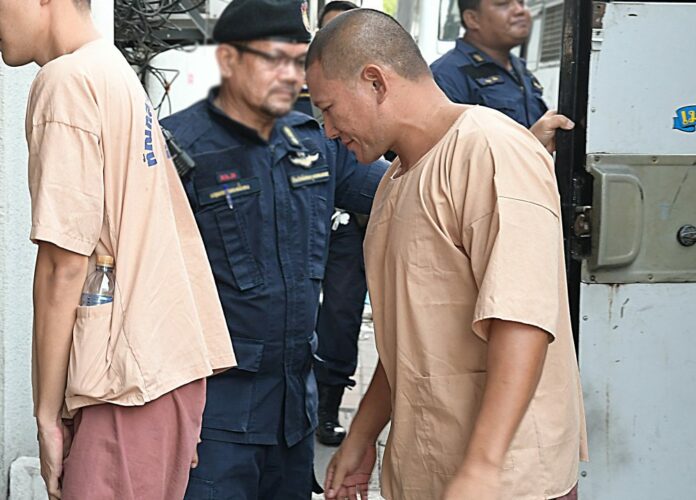
The Criminal Court sentenced Xaysana Keopimpha this morning after he was convicted on a variety of narcotics charges, including distribution, trafficking and possession.
Xaysana’s sentence was reduced from death for his guilty plea.
The 42-year-old had been wanted by authorities for running a transnational drug network operating in several parts of Isaan and in Laos.
Acting on a tip, police arrested him in January 2017 at Suvarnabhumi Airport when he arrived on a flight from Phuket. In the months that followed, several Thai celebrities became implicated in laundering Xaysana’s money. the back of a tip off as soon as he landed in Suvarnabhumi Airport on a flight from Phuket.
The National Legislative Assembly meets this past December in Bangkok. Photo: Prachachat
BANGKOK — The junta-appointed legislature’s decision to send its senate bill for legal review could see elections pushed back once again.
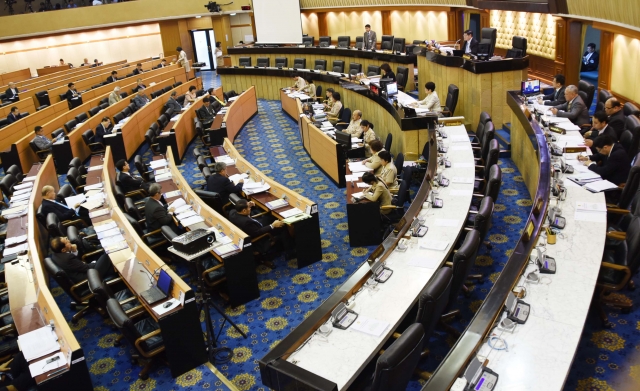
Pornpetch Wichitcholchai, president of the National Legislative Assembly, petitioned the Constitutional Court on Monday to decide whether the measures it passed on selection of upper house members were constitutional. The assembly refrained from seeking a similar ruling on its bill pertaining to members of parliament, as Pornpetch said he feared it could further delay elections.
Acting Election Commissioner Somchai Srisutthiyakorn expressed a different opinion last week, saying if either of the two bills were to be delayed, elections could take place in February, as most recently planned.
Pornpetch added that any other agency could seek a Constitutional Court ruling on the MPs bill as well.
If the Senate bill is found to be unconstitutional, it will have to be rewritten. The term of the junta-appointed Constitution Drafting Commission ends when these and two other laws necessary to stage an election are completed.
Deputy Prime Minister Wissanu Kruea-ngam said Monday that it is up to Prime Minister Gen. Prayuth Chan-ocha to decide whether the executive branch seeks a court ruling on the MPs bill when it comes before his cabinet. If it goes through, Wissanu said, the bill will be presented to His Majesty for a royal endorsement.
Seeking to allay fears the legal maneuver means further delay, Wissanu said it should not take a long time for the court to decide and should not seriously affect the timetable.
The site of a fatal road accident March 12 in Sakon Nakhon.
SAKON NAKHON — Officials on Tuesday lowered the speed limit of a northeastern province to 60kph in an effort to lower road accidents.
Transport officials in Sakon Nakhon city lowered the speed limit by 20kph in light of a growing number of road fatalities in the area.
“We decided to set this limit because along these roads, 15 people die per month from accidents. Fifteen! Fifteen people!” police Maj. Gen. Somkiat Kerdjongruk said Tuesday. “Mostly the accidents are from motorcycles crashing into cars.”
Just yesterday, three people died and 54 were injured in road accidents in Sakon Nakhon according to statistics provided by private advocacy group Thai Road Accidents Victims Co.. In contrast, six people died yesterday in Nakhon Ratchasima province, which has over double the population, and only one died in Bangkok. Since Jan. 1, 73 people died in Sakon Nakhon alone, tying making it the 13th most dangerous province along with Phetchabun.
The new speed limit – which applies to all types of vehicles – was imposed on Nittayo Road, a main road that connects the province to Udon Thani, and Suk Kasem Road, which connects to Kalasin province.
On the portion of Nittayo Road from Baan That Na Weng Intersection to the City Gate, motorcycles are allowed to go 70kph.
Somkiat said he was confident the new speed limit would reduce accidents in the area.
Within Bangkok, Pattaya and city municipalities, the national speed limit is 80kph. Outside those areas, the limit is 90kph. An average of 66 people die daily on Thai roads, said Liviu Vedrasco of the World Health Organization in Thailand, citing a 2013 study.
Producer Harvey Weinstein participates in a panel at the A&E 2016 Winter TCA in Pasadena, California. Photo: Richard Shotwell / Associated Press
NEW YORK — The Weinstein Co. filed for bankruptcy protection on Monday with a buyout offer in hand from a private equity firm, the latest twist in its efforts to survive the sexual misconduct scandal that brought down co-founder Harvey Weinstein, shook Hollywood and triggered a movement that spread out to convulse other industries.
The company also announced it was releasing any victims of or witnesses to Weinstein’s alleged misconduct from non-disclosure agreements preventing them from speaking out. That step had long been sought by New York Attorney General Eric Schneiderman, who filed a lawsuit against the company last month on behalf of its employees.
“Since October, it has been reported that Harvey Weinstein used non-disclosure agreements as a secret weapon to silence his accusers. Effective immediately, those ‘agreements’ end,” the company said in a statement. “No one should be afraid to speak out or coerced to stay quiet.”
In a statement, Schneiderman praised the decision as “a watershed moment for efforts to address the corrosive effects of sexual misconduct in the workplace.”
The movie and TV studio becomes the first high-profile company to be forced into bankruptcy in the nationwide outcry over workplace sexual misconduct. Dozens of prominent men in entertainment, media, finance, politics and other realms have seen their careers derailed, but no other company has seen its very survival as tightly intertwined with the fate of one man as the Weinstein Co.
Some 80 women, including prominent actresses, have accused Harvey Weinstein of misconduct ranging from rape to harassment. Weinstein, who was fired as his company’s CEO in October, has denied any allegations of non-consensual sex.
The Weinstein Co. said it has entered into a “stalking horse” agreement with an affiliate of Dallas-based Lantern Capital Partners, meaning the equity firm has agreed to buy the company, subject to approval by the U.S. Bankruptcy Court in Delaware.
Lantern was among a group of investors that had been in talks for months to buy the company outside of bankruptcy. That deal was complicated when Schneiderman filed his lawsuit, citing concerns that the sale would benefit executives accused of enabling Weinstein’s alleged misconduct and provide insufficient guarantees of compensation for his accusers. Talks to revive the sale finally fell apart two weeks ago when the group of buyers said they had discovered undisclosed liabilities.
The Weinstein Co. said it chose Lantern as a potential buyer because the firm was committed to keeping on the studio’s employees as a going concern.
“While we had hoped to reach a sale out of court, the Board is pleased to have a plan for maximizing the value of its assets, preserving as many jobs as possible and pursuing justice for any victims,” said Bob Weinstein, who co-founded the company with his brother Harvey in 2005 and remains chairman of the board of directors.
Lantern co-founders Andy Mitchell and Milos Brajovic said they were committed to “following through on our promise to reposition the business as a pre-eminent content provider, while cultivating a positive presence in the industry.”
Under bankruptcy protection, civil lawsuits filed by Weinstein’s accusers will be halted and no new legal claims can be brought against the company. Secured creditors will get priority for payment over the women suing the company.
Schneiderman’s lawsuit will not be halted by the bankruptcy filing because it was filed by a law enforcement agency. Schneiderman said his investigation would continue and that his office would engage with the Weinstein Co. and Lantern to ensure “that victims are compensated, employees are protected moving forward, and perpetrators and enablers of abuse are not unjustly enriched.”
Other bidders also could emerge during the bankruptcy process, particularly those interested in the company’s lucrative 277-film library, which includes award-winning films from big-name directors like Quentin Tarantino and horror releases from its Dimension label. Free of liabilities, the company’s assets could increase in value in a bankruptcy.
In more fallout over the scandal, New York’s governor directed the state attorney general to review a decision by the Manhattan district attorney’s office not to prosecute a 2015 case involving an Italian model who said Weinstein groped her.
The bankruptcy process will bring the company’s finances into public view, including the extent of its debt. The buyers who pulled out of the sale earlier this month said they discovered up to $64 million in undisclosed liabilities, including $27 million in residuals and profit participation. Those liabilities came on top of $225 million in debt, which the buyers had said they would be prepared to take on as part of a $500 million acquisition deal.
The Weinstein Co. already had been struggling financially before the scandal erupted in October with a news stories in The New York Times and The New Yorker. Harvey and Bob Weinstein started the company after leaving Miramax, the company they founded in 1979 and which became a powerhouse in ’90s indie film with hits like “Pulp Fiction.” After finding success with Oscar winners “The Artist” and “The King’s Speech,” the Weinstein Co.’s output and relevance diminished in recent years. The company let go 50 employees in 2016 and continuously shuffled release dates while short of cash.
Last year, the studio sold distribution rights for the movie “Paddington 2” to Warner Bros. for more than $30 million.









































 Such limitations inspired Dr. Darika Lathapipat, Chairman of the Board of Governors of Wellington College International School Bangkok and Chancellor of Dhurakij Pundit University, to meet these needs. Knowing full well of the potential growth of international schools in Thailand, Dr. Darika launched Wellington College International School Bangkok for the first time in ASEAN, to set a new benchmark in international education with British standards. The school recently hosted “The Infinite Possibilities” event to formally introduce the curriculum and offerings to interested parents on March 7, 2018, at The Emporium, with numerous VIP guests and celebrity parents looking to send their children to a top international school.