































26.1 C
Bangkok
Saturday, June 20, 2026
Home Blog Page 2259

River Dwellers Abandon Homes For Concrete Promenade (Photos, Video)

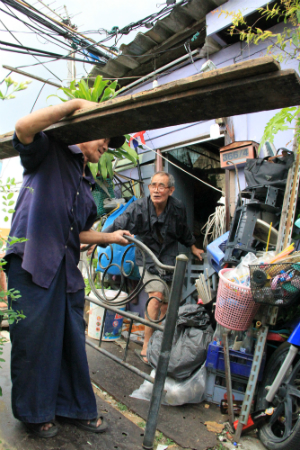
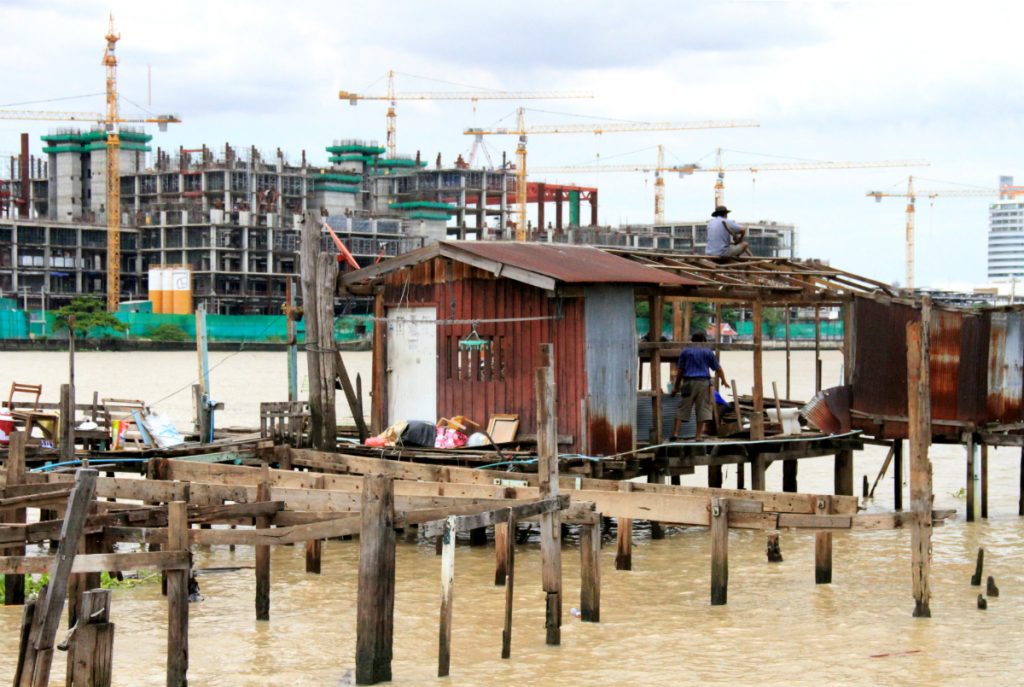
BANGKOK — Malai Rakphuengamarit spent a recent Friday directing her husband and two hired men on where to put pieces of the steel roof and wood structure torn down from her riverside home.

That house and seven more in the Wat Chat Kaew Chongkonnee community were among 273 households in 14 communities due for the wrecking ball by month’s end. Their eviction was deemed necessary to pave the way for construction of a controversial redevelopment project that critics say amounts to a “highway on the river.”
IMG 8503
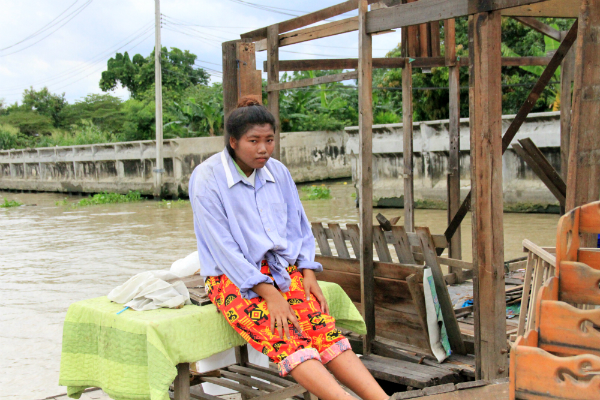
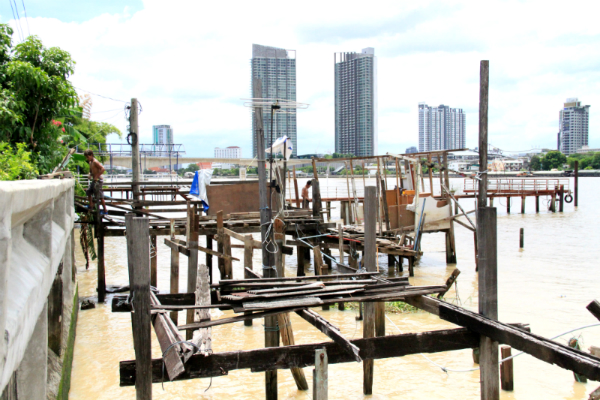
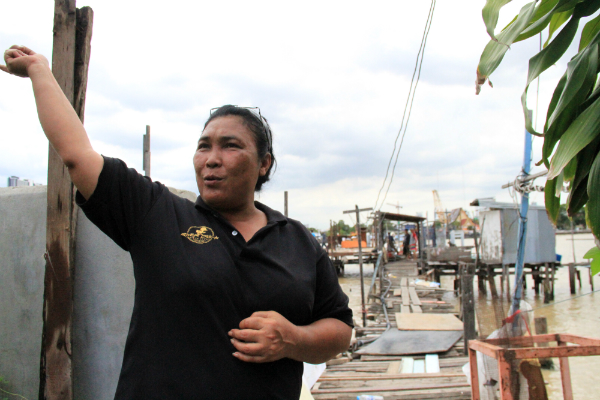
Malai Rakphuengamarit stands in front of the wooden walkway on the Chao Phraya River that led to the eight homes in her community.

The 49-year-old woman, who works as a maid, said she is willing to abandon her home of 32 years because she’s always known it encroached onto the Chao Phraya River, and she never had any legal right to it.

Like all her neighbors, Malai once lived on a boat at the same spot back decades back, before it was developed into a raft and finally became a house on the river.

Read: Friends of Chao Phraya Explain Why They Hate ‘Highway on the River’

Undertaken by the junta as a national landmark, the project’s first phase will be concrete walkways and bike lanes stretching along both sides of the Chao Phraya between the Rama VII and Phra Pinklao bridges. It has come in for heavy criticism for its design and the impact it will have on the landscape, environment, local heritage and tourism.

Before being told to move out by City Hall to build the boardwalk, Malai said she had been told to leave before, as her community sits across from the site of the new parliament building expected to be completed about when the promenade is complete in 2019.
IMG 8508
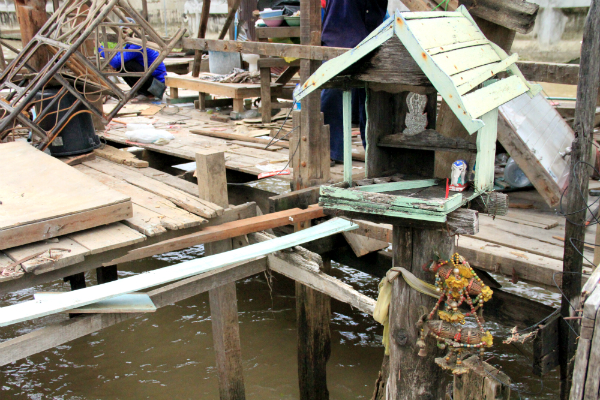
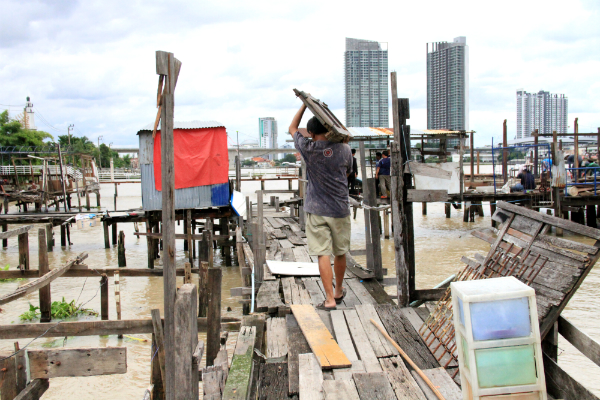
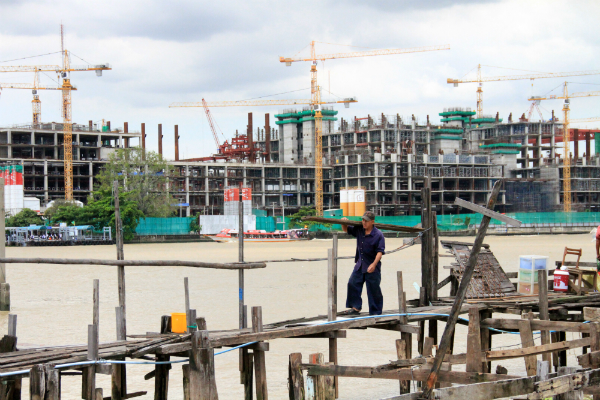
Riverside homes in the Wat Chat Kaew Chongkonnee community are demolished July 14 to make way for the construction of concrete walkways.

Malai said the compensation offered to her was fair for the fact she would have to relocate and begin life anew away from her current workplace and her fourth-grade daughter’s school.

“I thought I would get 30,000 [baht] to 50,000 baht, but when I saw the document, it was a six-digit number,” said Malai, who refused to disclose the exact amount she was offered. “It’s good that I can have some money to start over somewhere else.”

Though the eviction process began early this month, residents of all affected communities will receive their compensation Wednesday. Most, like Malai, had to find money to pay for workers before receiving the compensation.

They were motivated to tear down their own homes to make use of the materials.

As for the project they were leaving to make way for, the mother of three said she genuinely did not agree with it was a good idea and believes there could have been better ways to spend 8.3 billion baht.

“They said they want a clean river,” she said. “But then they will build a road onto the river, I don’t think it’s going the right way.”

IMG 8521

IMG 8512

IMG 8565

IMG 8544

IMG 8526

IMG 8545

IMG 8509

Related stories:

Evictions Continue as Funds Set for Chao Phraya Promenade

Friends of Chao Phraya Explain Why They Hate ‘Highway on the River’

Chao Phraya Promenade Project to Make Progress in April

Lacking Leverage or Clout, River Residents Give Up Homes For Boardwalk

Riverside Communities Evicted for Chao Phraya Makeover

Architect Council Says University Can’t Actually Design River Project

Riverside Design Dropped Under Cloud of Plagiarism Charges

Top Architect Says River Project Plagiarized Design

Opponents, Proponents of Chao Phraya Boardwalk Open Fire

Locals Ready to be Evicted for Chao Phraya Boardwalk, Official Says

River’s Friends Float Hope for Public Hearings on 14B-Baht ‘Promenade’

Radical Makeover of Chao Phraya River Delayed

Chao Phraya Promenade Should be Sent Back to Drawing Board, Architects Say

Advertisement

Ride-Hailing App Grab Raises $2.5 Billion

GrabBike taxi operators in a promotional image posted Feb. 3, 2016. Photo: Grab / Facebook

JAKARTA — Japan’s Softbank and China’s top ride-hailing firm Didi Chuxing are pouring USD $2 billion into the latest round of financing by cash-hungry Southeast Asian taxi app Grab.

Grab said Monday that it expects another $500 million will come from other existing and new investors. Its last announced cash injection was in September when it raised $750 million led by Softbank, whose chief executive Masayoshi Son is Japan’s richest person and a self-styled tech visionary.

Grab is vying to dominate the market for car and motorbike hailing in Southeast Asia, where it competes with traditional taxis and rival apps such as Uber.

In Indonesia, the region’s biggest economy and most populous country with more than 250 million people, it’s in a fierce battle for customers with local app Go-Jek.

None of the apps are profitable. Didi Chuxing itself raised USD $7.3 billion in June last year.

Anthony Tan, the Malaysian co-founder of Grab and its chief executive, said the support from Softbank and Didi would help Grab build an “unassailable market lead” and also expand GrabPay, its mobile payments business.

The ride-hailing apps are popular with residents of congested Southeast Asian cities, who aside from using them for rides also find them convenient for fetching takeaway food, delivering documents and other tasks.

But they have also faced opposition, with Thailand’s government trying to limit their use and taxi drivers in the Indonesian capital Jakarta staging a violent protest last year that snarled traffic for hours.

Advertisement

Find Out What Happened to This Buffalo and Get 100K Baht #FindBoonrawd

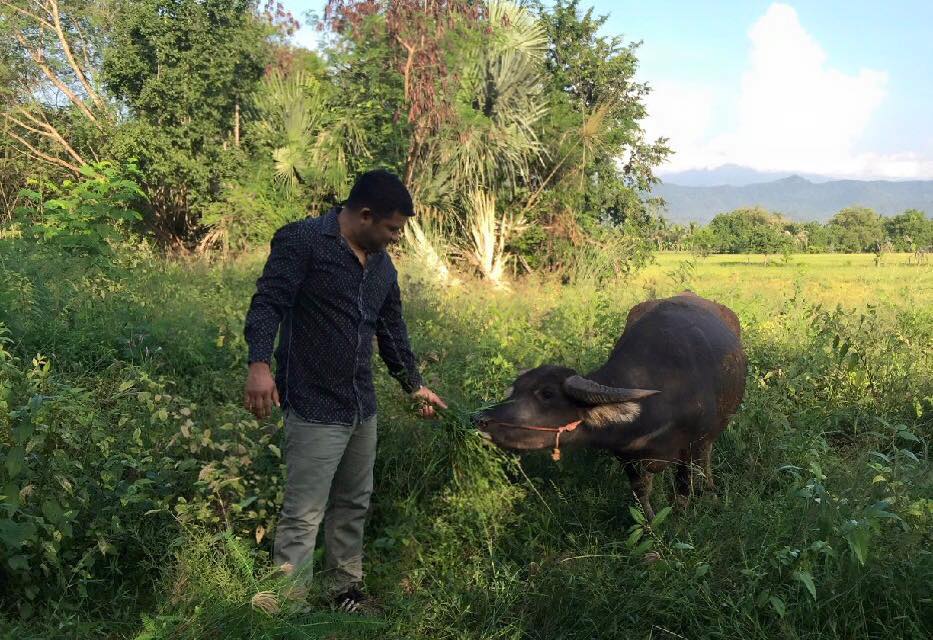
At left, Rapeepak Taratornpitak poses for a selfie with Boonrawd, a buffalo he saved from a slaughterhouse and donated to a royal project. At right, Boonrawd before he went missing. Photos: Rapeepak Taratornpitak / Facebook

PHETCHABUN — A buffalo conservation foundation is offering a 100,000 baht bounty to combat what its president described Monday as corruption by livestock officials.

Nuthaya Polham, head of the New Life for Animals foundation, said a buffalo that went missing after being deposited into a buffalo-sharing royal project is the result of endemic corruption involving local livestock officials.

“Boonrawd is a handsome, beautiful bull in perfect form who would sell for a really high price,” said Nuthaya, whose foundation saves buffalo from slaughterhouses and puts them to work in the fields. “If the corrupt livestock officials haven’t sent him to a slaughterhouse, then they probably sold him.”

Boonrawd, a bull buffalo, was bought from a slaughterhouse by farmer Rapeepak Taratornpitak. Rapeepak then donated him one year ago to a Buffalo Bank royal agricultural project, where Boonrawd went into a pool of shared animals available to farmers for use. But Boonrawd disappeared after going into the bank, which is located in the Khao Khor district of Phetchabun province.

On Wednesday, Rapeepak approached the New Life for Animals Foundation for help, prompting the foundation put up the hefty cash prize Sunday as a reward for anyone who brings Boonrawd back.

Nuthaya said the staff at the bank were responsible for Boonrawd’s disappearance.

20139902 1867004576952374 433867548790896201 n
Rapeepak Taratornpitak feeds Boonrawd in a photo posted July 19. Photo: Rapeepak Taratornpitak / Facebook

“Whenever farmers deposit their buffalos into the Buffalo Bank project, the livestock inexplicably go missing. The farmer asks, ‘Where is my kwai?’ and the livestock officials say that it’s being lent to another farmer,” Nuthaya said. “But when we go to check on the so-called farmer that was borrowing the animal, we find out that person isn’t a farmer at all, but a restaurant owner who said they didn’t borrow any buffalo.”

The Buffalo Bank project was initiated by Rama IX over 50 years ago to help poor farmers borrow livestock to plow their fields during sowing season instead of renting them. Buffalos in the project must not be sold or slaughtered, Nuthaya said.

“We’re also trying to find Boonrawd,” said Patiwat Dilokpot, director of Phetchabun’s Department of Livestock Development. “The latest we know is that a farmer borrowed it, but he forgot where he left the buffalo.”

Patiwat said he was unconcerned about the foundation’s bounty.

“Yes, I heard some news of that. That’s up to them,” he said. “But we officials have to find the buffalo ourselves too.”

20229122 1868826436770188 5860495529395875755 n
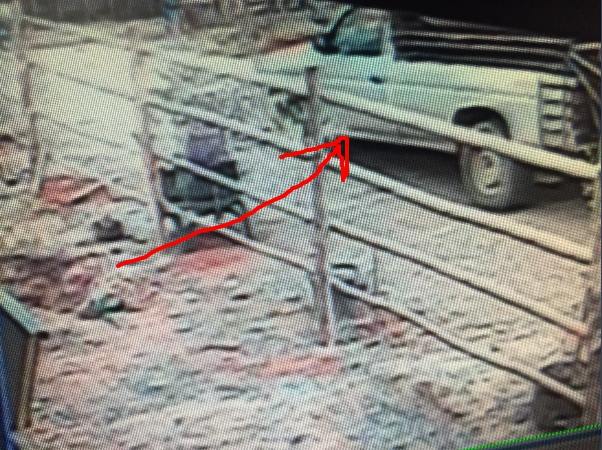
Image from CCTV footage that farmer Rapeepak Taratornpitak says shows a truck carrying Boonrawd away, posted Saturday. Photo: Rapeepak Taratornpitak / Facebook

Rapeepak posted CCTV images Saturday to his Facebook page that he says show Boonrawd being carried away on a truck.

“I found some evidence linking livestock officials. At least there’s some evidence, although the chance is slim, at least there’s still a chance. Thanks to the New Life for Animals Foundation, soldiers, police and media for helping me find Boonrawd and not overlooking our fellow earth-dweller, Boonrawd.”

Nuthaya said Boonrawd’s case is part of an epidemic caused by corrupt officials who abuse their status.

“Usually, the officials intimidate the wronged farmers into not building a case against them. They say, ‘You really wanna sue a royal project?’ I don’t see why they have to invoke the royal institution in their threats.”

The New Life for Animals Foundation said it received calls from local livestock officials telling them to drop the matter of Boonrawd’s disappearance because the department is being criticized.

“They need to tell us the truth, whether Boonrawd is dead or alive,” Nuthaya said. “They’re not telling us the facts or taking responsibility. They’re corrupt.”

The animal activist also said local livestock officials also fudge the numbers of buffalos available in a province, due to the decreasing numbers of the animal nationwide.

“They might say that there’s 800 in a province, but when we go and check, there’s none there,” Nuthaya said. “Boonrawd isn’t the first, and he won’t be the last buffalo treated this way.”

20229386 1867581870227978 5482113864679869196 n
Boonrawd looks into the camera. Photo: Rapeepak Taratornpitak / Facebook
Advertisement

Why ‘Thailand 4.0’ Ambitions Are No Laughing Matter

BANGKOK — The term “Thailand 4.0” emerged about a year or so ago and has since been thrown around in a number of different contexts with little explanation.

Thailand 4.0 is an economic plan that must first be understood it in the context of overall Thai economic development. The government likes to spin this as the fourth iteration of an economic growth plan which progressed from 1.0 to 2.0 and 3.0 to the current plan of 4.0 – a term that dovetails nicely with the popular tech and Internet of Things interconnectivity term “Industry 4.0,” which is about automating smart manufacturing.

Going with the model put forward by the government to keep the context consistent: Thailand 1.0 focused on developing the agricultural base. Thailand 2.0 shifted focus to light industries and developing the economic structure to support the likes of food products, textiles and crafts. Thailand 3.0 saw a move to heavy industry, which involved the creation of equipment and machinery such as automobile production – an area the country became fairly prolific and proficient in.

With those three phases of economic development laying the foundation, Thailand 4.0 now looks to shift the economy to more of a knowledge base. The government has said it wants to focus on innovation, knowledge, technology and creativity.

The goal is to leverage these areas to improve overall life in Thailand in a few ways. Among them is trying to triple the average national income to USD$15,000 by 2032. It’s also trying to reduce social disparity and raise human value – which includes attempts to elevate at least five Thai universities to be ranked in the global top 100 within 20 years. Finally it wants to elevate environmental issues to make Thailand more sustainable and ready to face climate change.

Thailand 4.0 is a multifaceted plan that on the surface seems solid – all the right boxes are checked. The official program lays out five agendas:

The first looks to improve education and set up skill development programs to help workers retool for a knowledge economy.

The second agenda is about developing future industries and bolstering research and development.

The third agenda drills down into developing a vibrant ecosystem for entrepreneurs to attract more investment to the country.

Agenda item No. 4 takes aim at fostering grass roots innovation at the regional level by establishing “innovation hubs” in all 76 provinces.

And the final agenda of the Thailand 4.0 plan looks to proliferate Thai innovation across the ASEAN region as well as the global economy.

It’s a bold plan with a lot of moving parts and external factors that will need to be aligned if it’s going to succeed. But whenever there is a government program to advance the economy there are opportunities to be had.

I reached out to the managing director of Fluxus Thailand, Gareth Davis to talk about the impact Thailand 4.0 will have for Thai based tech companies and the challenges the kingdom will face with this plan.

“Thailand has a small but open economy. To prosper in the 21st century, it first needs to think about building strength within. This means promoting innovation, entrepreneurial spirit and an inclusive society that brings together the rich, the poor, and those in urban centers and rural areas,” Davis said, adding that “from this position, the country will be well placed to connect with the world and compete on the international stage.”

While opportunity will certainly open up in the local market under the Thailand 4.0 initiative – the push to a digital economy – there are some potential roadblocks that could derail the whole plan. Standing out in particular is locally available talent.

While a big factor of the plan seems to be attracting foreign investment to back local companies and innovation, there is currently a sizable skills gap in the market, not just regionally but globally. To be fair, the first of the five agendas does address improving education and skills training to help bolster the workforce, but that is no small undertaking and it takes time to develop and scale.

While it’s certainly possible to import the skilled workers needed to fill the gaps that are left while the workforce is retooled in the meantime, there doesn’t seem to be any provision in the Thailand 4.0 plan to address this.

At the end of the day Thailand 4.0 is ambitious and bold. It looks to tackle the shortcomings of the Thai economy and build the country to be on a par with more prosperous and economically advanced nations. All criticism aside, no plan is perfect, and poor execution can undermine the best. Execution is what the future success of Thailand 4.0 will come down to: If the right people are charged with making it a reality and given the resources to make it happen, then it stands as good a chance of success as any other plan. If not, it doesn’t take much imagination to assume the outcome.

Lets hope for the former.

Related stories:

Machines Coming to Take Millions of Thai Jobs: Report

Advertisement

See 4 Graphic Booze Warning Labels Under Study

BANGKOK — Officials are mulling a plan to slap graphic warning labels on alcohol products, a top regulator said Monday.

Similar to the explicit warnings already mandated for cigarettes, large warning labels are being studied for alcohol to raise awareness of its dangers and cut the number of drinkers, according to Alcohol Control Board director Nipon Chinanonwait.

“It’s likely we will go through with this, like we did with cigarettes,” Nipon said by phone. “But we have to research first how much effect it would have on consumers.”

Potential warnings would feature four photos chosen from a photography contest held two months ago, he said.

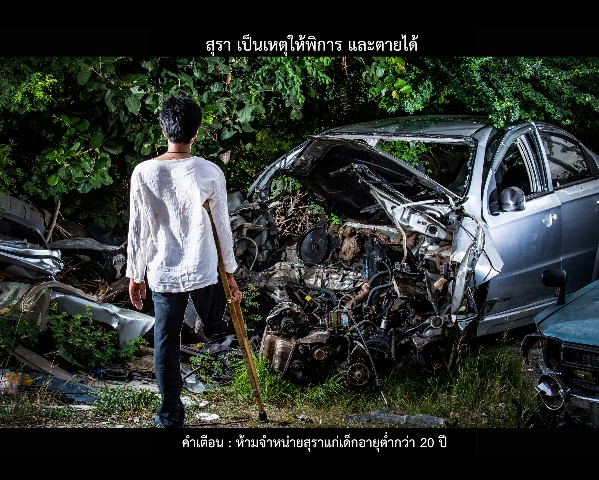
One image shows a wrecked car with a caption that says, “Alcohol can cause disabilities and deaths,” while another depicts an apparently drunk man threatening a woman. “Alcohol can hurt you, your family and society,” it reads.

Nipon said he doesn’t know when a decision will be made, as officials need to complete their research first, and any change would have to be submitted to the World Trade Organization for review.

“There is no timeframe,” Nipon said. “We have to experiment with it first, otherwise we will issue the measure on our discretion. It has to be evidence based.”

Despite its free-wheeling nightlife scenes, Thailand has tough laws on the sale and marketing of alcohol that aims to shut down public displays of booze.

The most notorious provision bans any attempt to “encourage” others to drink, an offense that carries a maximum fine of 500,000 baht. Just last week, police announced they were investigating four celebrities suspected of violating the ban.

Nipon added that alcohol regulators will also consult with booze manufacturers before making any decision on the graphic warnings.

“We have to talk with many sides, because if we don’t, they will accuse us of lacking transparency,” Nipon said. “We must have scientific evidence. To be frank with you, the businesses are not going to give in so easily.”


560000007769504
‘Alcohol can cause disabilities and deaths’
560000007769503
‘Alcohol can hurt you, your family and society’
560000007769501
‘Alcohol can cause disabilities and deaths’
560000007769502
‘Alcohol can cause disabilities and deaths’

Related stories:

Make Notoriously Vague Booze Laws More Clear, Trade Group Urges

Regulator Shuts Down Booze Buffet; Threatens to Prosecute People Sharing Alcohol Pics

Booze Regulator Warns Public on ‘Instant Beer’

Advertisement

64 Years After Korean War, North Still Digging up Bombs

Maj. Jong Il Hyon, 44, a member of a bomb squad for South Hamgyong, speaks to The Associated Press in February at a construction site on the outskirts of Hamhung, North Korea's second-largest city, where workers unearthed a rusted but still potentially deadly mortar round. Photo: Wong Maye-E / Associated Press

HAMHUNG, North Korea — In the 10 years he has been digging up ordnance from the Korean War, Maj. Jong Il Hyon has lost five colleagues to explosions. He carries a lighter one gave him before he died. He also bears a scar on his left cheek from a bomb disposal mission gone wrong.

Sixty-four years after it ended, the war is still giving up thousands of bombs, mortars and pieces of live ammunition. Virtually all of it is American, but Jong noted that more than a dozen other countries fought on the U.S. side, and every now and then their bombs will turn up as well.

“The experts say it will take 100 years to clean up all of the unexploded ordnance, but I think it will take much longer,” Jong said in an interview with The Associated Press at a construction site on the outskirts of Hamhung, North Korea’s second-largest city, where workers unearthed a rusted but still potentially deadly mortar round in February. Last October, 370 more were found in a nearby elementary school playground.

According to Jong, his bomb squad is one of nine in North Korea, one for each province. His unit alone handled 2,900 leftover explosives  including bombs, mortars and live artillery shells  last year. He said this year they have already disposed of about 1,200.

Fortunately, there have been only a few injuries in the past few years. But Jong said an 11-year-old boy who found a bomb in May lost several fingers when it went off while he was playing with it.

North Korea is just one of many countries still dealing with the explosive legacy of major wars. In Asia alone, Vietnam, Cambodia, Laos and even Japan have huge amounts of unexploded ordnance left to clean up.

The three-year Korean War, which ended in what was supposed to be a temporary armistice on July 27, 1953, was one of the most brutal ever fought.

Virtually all of the 22 major cities in North Korea were severely damaged and hundreds of thousands of civilians killed by U.S. saturation bombing. The tonnage of bombs dropped on the North was about the same as the total dropped by the U.S. against Japan during World War II. North Korea is probably second only to Cambodia as the most heavily bombed country in history.

By 1952, the bombing was so complete that the Air Force had effectively run out of worthwhile targets.

North Koreans claim 400,000 bombs were dropped on Pyongyang alone, roughly one bomb for every resident at the time, and that only two modern buildings in the capital were left standing. All told, the U.S. dropped 635,000 tons of bombs on Korea during the war, most of it in the North, including with 32,500 tons of napalm.

Twelve to 15 percent of the North’s population was killed in the war.

Charles Armstrong, a historian at Columbia University, said the expansion of saturation bombing in North Koreamarked something of a turning point for the United States and was followed by the use of an even heavier version during the Vietnam War.

“To this day, the North Korean government and media point to the American bombing as a war crime and a major justification for the continued mobilization of the North Korean people  as well as the development of nuclear weapons  in defense against future attacks,” he said.

Armstrong noted that the Hamhung area and the nearby port of Hungnam were hit particularly hard by U.S. bombers because they were an industrial center and home to the largest nitrogen fertilizer plant in Asia.

Nitrogen fertilizer can be used to make explosives, so the U.S. Air Force obliterated the area in late December 1950. Later rebuilt, the fertilizer plant is still functioning today and remains one of Hamhung’s most famous landmarks.

The bomb squads respond to calls when ordnance is discovered, check construction sites before excavation work begins and educate people, especially school children, about the dangers. Jong’s squad, which covers South Hamgyong province, has nine members. The largest, in Kangwon along the South Korean border, has 15.

One bomb was uncovered in March by farmers digging an irrigation canal near a railway that runs through Hamhung from Pyongyang to the northeastern port of Chongjin.

“This railway was here during the war, so it was a target,” said Yom Hak Chol, manager of the 4th work team of the Pohang cooperative farm. He was working in the field when the bomb was found and watched the bomb squad remove it.

“We had to evacuate the area. The bomb squad blew it up over there,” he said, pointing to a narrow canal area where cows stood grazing between sprawling corn fields. “It left a hole 3 meters (10 feet) deep.”

Some bombs are not easily recognizable to the untrained eye. Jong said he has come across a surprising variety of bombs and explained in detail one in particular  a “butterfly bomb” that used wing-like attachments to disperse small “bomblets” over a wider area. The bomb was originally devised by the Nazis during World War II. The U.S. revised its design and used them in North Korea.

Jong said many aging bombs have become even more dangerous as rust erodes their detonators, and that some could go off with the slightest movement.

“I’m sure that my daughter’s generation will also suffer from this problem,” he said. “I want the world to know that.”

Story: Eric Talmadge

Advertisement

Britain’s Chris Froome Wins 4th Tour de France

Tour de France winner Britain's Chris Froome, on Sunday wearing the overall leader's yellow jersey, second place Rigoberto Uran of Colombia, left, and third place Romain Bardet of France, celebrate on the podium after the twenty-first and last stage of the Tour de France cycling race over 103 kilometers (64 miles) with start in Montgeron and finish in Paris, France. Photo: Thibault Camus / Associated Press

PARIS — After the champagne bubbles fade and Chris Froome drifts away from his Sunday night celebrations to reflect on a fourth Tour de France win, he may do so with greater fondness than the others.

The first, in 2013, brought the bursting pride of a first success. But he won by more than four minutes, as he did last year. Although Nairo Quintana finished a little over one minute behind him in 2015, this year’s victory  by just 54 seconds  over another Colombian, Rigoberto Uran, tastes sweeter.

“This Tour has been my toughest yet,” Froome said.

Froome temporarily lost the race lead to the daring Italian Fabio Aru in the Pyrenees on a huge climb to the ski station of Peyragudes, and thought he’d lost it altogether two days later.

Last Sunday in Rodez, he was forced to change his rear wheel in the final 40 kilometers (25 miles) after a spoke broke. He got dropped, drifting way behind the peloton.

“I was just standing there on the side of the road with my teammate Michal Kwiatkowski,” Froome said. “I thought it was potentially game over.”

Riding with unchained fury, Kwiatkowski and Froome bridged the gap  and saved his Tour.

Fast forward to Saturday’s penultimate stage in Marseille and a time trial  one of his strongest disciplines. Froome was right back in the ascendency and closing in on win No. 4.

Yet the future champion was jeered by fans at the Stade Velodrome football stadium as he began his ride, and more jeers followed along the route.

Froome had urine chucked over him on a previous Tour, so booing was hardly going to unsettle him. He was almost chivalrous on the podium Sunday, addressing fans in admirable French.

“Thank you for the welcome and your generosity,” Froome said, with unintentional irony. “Your passion for this race makes it really special. I fell in love with this race.”

This was the third straight win for the Team Sky rider.

“I want to dedicate this victory to my family. Your love and support makes everything possible,” he said. “I also want to thank my team Sky (for your) dedication and passion.”

Bardet placed 2 minutes, 20 seconds behind him. But he denied Spaniard Mikel Landa  Froome’s teammate  a podium spot by just one second. Aru finished fifth, 3:05 behind.

As per tradition, the 21st stage  103 kilometers (64 miles) from Montgeron to Paris  was reserved for sprinters and a procession for the rest. Dutchman Dylan Groenewegen won, edging German rider Andre Greipel and Norwegian Edvald Boasson Hagen.

The focus was elsewhere.

Froome now needs only one more title to match the Tour record of five shared by Frenchmen Jacques Anquetil and Bernard Hinault, Belgian Eddie Merckx and Spaniard Miguel Indurain.

“It’s a huge honor to be talked about in the same sentence,” Froome said of those cycling greats.

However, Froome is more of a slick modernist than a reminiscent historian.

“I probably don’t even know the full history of those events,” he said. “Coming into cycling quite late in my life, obviously my childhood back in Africa, I only started watching the Tour de France in the years that Lance Armstrong was racing.”

Indurain won five straight Tours from 1991-95, and Armstrong won seven straight from 1999-2005 before the American was stripped of all of them for doping.

Clearly, the Kenyan-born Froome isn’t one to seek inspiration elsewhere.

“I’m not a big person to necessarily choose a role model,” he said. “I’ve got a bit of a unique style on the bike and my own way of doing things.”

That included ruthlessly putting more time into Uran and Bardet in Saturday’s time trial.

Some might say Froome did not shine too brightly because he didn’t win a stage, but neither did American Greg Lemond when clinching his third Tour in 1990.

For Froome, consistency and a dogged ability to respond under pressure were the keys.

So was overcoming fear.

Notably in tackling speedy downhill sections that once filled him with the equivalent of an actor’s stage fright. Some used to prod at his fear, like a schoolyard bully senses a weakness.

Not anymore.

Froome zipped downhill with new-found confidence.

“Something I’ve certainly worked on the last few years is my descending,” he said.

Others should do more homework.

Bardet lost his second place after a nightmare time trial, crawling home in near-exhaustion.

Astonishingly, Bardet revealed he found training for the clock race too dull to bother with.

“I don’t like to go out for training with the time trial bike,” he said. “It’s a bit boring for me.”

You wouldn’t catch Froome skipping training. Then again, his dedication is higher than most.

Story: Jerome Pugmire

Advertisement

England Beats India to Win Fourth Women’s Cricket World Cup

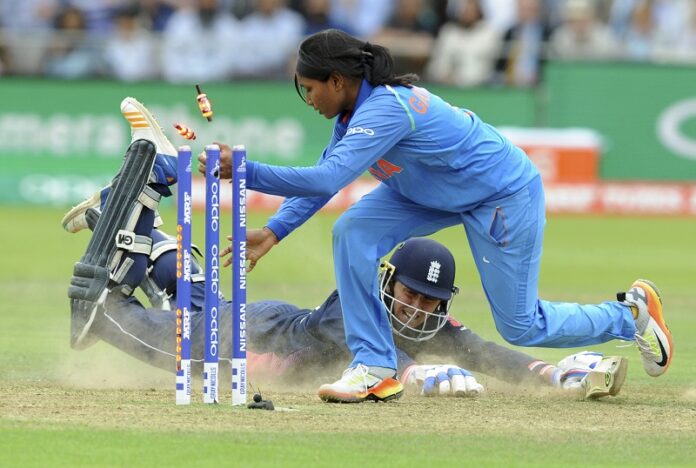
England's Jenny Gunn slides into the crease as India's Rajeshwari Gayakwad unsuccessfully attempts to run her out during the ICC Women's World Cup 2017 final match between England and India on Sunday at Lord's in London, England. Photo: Rui Vieira / Associated Press

LONDON — England lifted the Women’s Cricket World Cup for the fourth time after beating India by nine runs at Lord’s on Sunday.

India, chasing a modest 229 to win, was cruising to victory in the final as it reached 190 for three. But a late collapse, sparked by five wickets in 19 balls from Anya Shrubsole, saw England snatch an unlikely victory on home soil.

“It was just an unbelievable game. We looked for minute like we were out of it,” Shrubsole said. “But one of the great things about this team, we never give up. We never let the run rate get away from us, even though we weren’t getting wickets. We knew if we got a couple we’d be right in the game and all was well in the end.

“I think it’s a dream and a dream you never think is going to come true.”

It was a milestone moment for women’s cricket as Lord’s  known as the Home of Cricket  was sold out and ticket scalpers were outside the ground.

The English had lost to India in their opening game of the tournament but impressive victories in the next six matches made them favorites to add to the cups they won in 1973, 1993 and 2009.

England captain Heather Knight won the toss and chose to bat first, but she had departed for one when Natalie Sciver arrived in the middle with England 63 for three.

Sciver and Sarah Taylor put on 83 for the fourth wicket, but both were casualties of a stunning spell of three wickets for two runs off 10 balls by fast bowler Jhulan Goswami. Sciver, the only player to make two centuries at this World Cup, reached another 50, but added just one more run before she was trapped by Goswami.

Katherine Brunt made a breezy 34 and Jenny Gunn an unbeaten 25, but England’s total of 228 for seven appeared distinctly reachable for India.

Shrubsole got England off to a dream start as India began their reply, nicking the off-stump of the dangerous Smriti Mandhana for a duck in the second over.

When Mithali Raj got herself run out, by Sciver, going for a single that was never on, India was 43 for two and the encounter was finely poised.

However, that brought Harmanpreet Kaur, who destroyed Australia with a breathtaking unbeaten 171 in the semifinal, to the crease. Kaur clubbed two sixes on her way to 51 before holing out to Tammy Beaumont, off Alex Hartley, going for a third.

But misfields and mistakes were starting to creep in for England. Taylor missed a stumping to get rid of Poonam Raut before Knight dropped Veda Krishnamurthy.

The game seemed up by the time Raut, struggling with cramp, finally fell leg before to Shrubsole for 86, leaving India 191 for four.

But when Hartley accounted for Sushma Verma for a duck, then Shrubsole removed Krishnamurthy and Goswami in successive balls, England had a lifeline.

Taylor thought she had Deepthi Sharma stumped but an drawn-out replay could not prove her foot was off the floor at the point of impact.

Yet moments later Shikha Pandey was run out, Sharma picked out Sciver off Shrubsole and India was nine down.

Unbelievably, Gunn dropped the most straightforward catch of a thrilling final from Rajeshwari Gayakwad just to ramp up the tension even further.

But Shrubsole got the job done with the next ball, clean bowling Gayakwad to spark celebrations on the pitch and bedlam in the stands in north London.

Advertisement

Indonesian Leader: Shoot Drug Traffickers Who Resist Arrest

Indonesia's President Joko
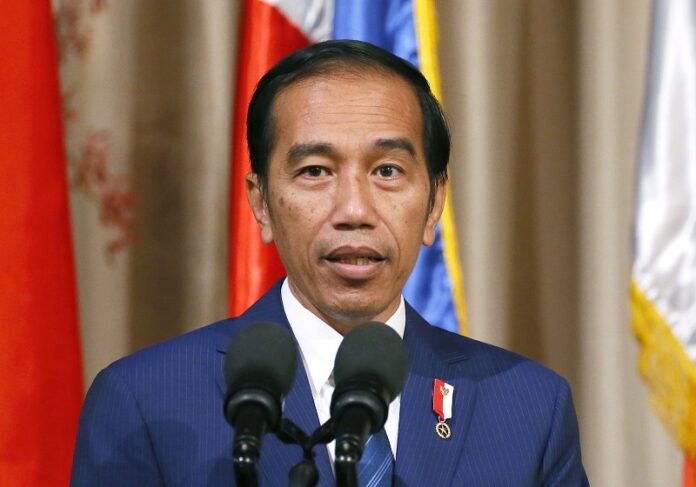
Indonesia's President Joko "Jokowi" Widodo addresses the media in 2017 during a visit to the Malacanang Palace in Manila, Philippines. Photo: Bullit Marquez / Associated Press

JAKARTA — Indonesian President Joko “Jokowi” Widodo says police should shoot drug traffickers who resist arrest because of a narcotics crisis facing the country.

Presidential spokesman Johan Budi said Sunday that Jokowi made the comments at a recent meeting of an Indonesian political party.

“We have to take firm action. If drug dealers who operate in Indonesia fight back when arrested, officers can shoot them, because we are in a narcotics emergency position now,” Jokowi said, according to his spokesman.

Local media reported last week that police shot dead a Taiwanese man for resisting arrest during a seizure of 1 ton of crystal methamphetamine, Indonesia’s largest-ever seizure of the drug.

Philippine President Rodrigo Duterte launched an anti-drug crusade last year in which thousands of alleged drug dealers and users have been killed, often in circumstances akin to lawless summary executions. The crackdown has been condemned by rights groups and governments around the world.

Indonesia has tough anti-drug laws and traffickers can receive the death penalty. Four people, one Indonesian and three Nigerians, were executed by firing squad last year, and dozens are on death row for trafficking.

Budi said Jokowi’s comment is not a shoot to kill order and police actions should be measured and in accordance with the law.

It’s a message to all Indonesians to show the commitment of the government to fighting narcotics, he said.

Advertisement

Rohingya Trafficking Verdicts Welcomed, But May Be ‘Tip of the Iceberg’

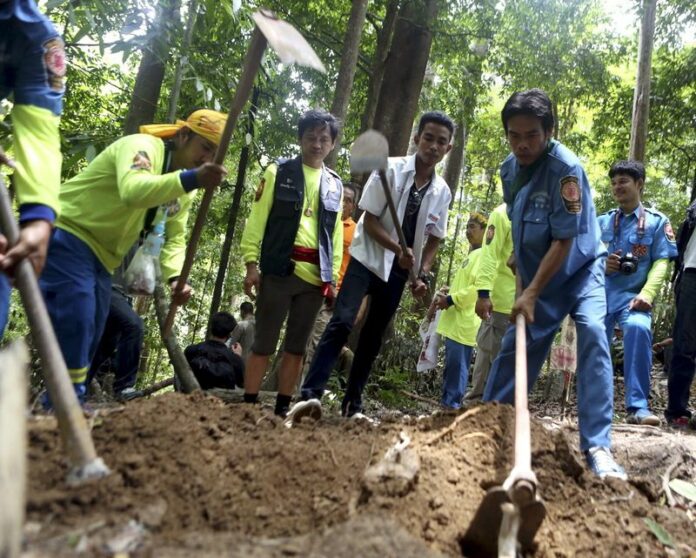
Thai rescue workers collect human remains May 5, 2015, of a suspected Rohingya migrant after discovering an abandoned migrant trafficking prison camp in a jungle in Phang Nga province, southern Thailand. Photo: EPA / STR

BANGKOK — Rights activists and a local Rohingya leader welcomed the heavy sentences handed down by the Criminal Court this past week to those involved in a massive human trafficking operation but said more needs to be done.

After 62 of 103 defendants were convicted of various crimes related to the human trafficking ring which largely preyed on Rohingya fleeing persecution in Myanmar, those involved in the issue said apathy at home remains a problem as does fear of the powerful …

Siyeed Alam, Bangkok-based president of the Rohingya Association in Thailand, was in the courtroom from 9am to 10pm to hear what may have been the longest verdict read in Thai judicial history.

“It went well, and it seems that the Thai government is concerned about human trafficking,” Alam said. “However, there was no mention about the 300 to 400 people who died.”

On May 1, 2015, 32 bodies were recovered from mass graves along with about 100 Rohingya from Myanmar and Bangladesh from a prison camp near the Thai-Malaysian border on a mountain in Songkhla province’s Padang Besar district. It eventually led to the arrest of 103 suspects out of 153 arrest warrants issued.

Manas noted the fact a former senior police officer, Maj. Gen. Pawin Phongsirin, the deputy provincial police commander in charge of the case, fled later that year to Australia to seek refuge, saying he feared for his life. Manas said that says a lot about the power of those involved in the trafficking ring.

“I don’t want to say more, but I know a thing or two,” he said.

The court spent 13 hours reading the verdicts. Three of the major suspects convicted was Lt. Gen. Manas Koongpan, former Satun province administrator Patchuban Angchotipan (aka Koh Tong) and former Pandang Besar mayor Banjong Pongphol.

Manas was found guilty of exploiting his authority during his time as a director of the Internal Security Operations Command, or ISOC, a counterinsurgency force active in the southernmost provinces which answers to the prime minister.

He oversaw the region through which the trafficking route ran. He was sentenced to 27 years by the Criminal Court. Ringleader Patchuban was given a sentence of 75 years while Pandang received a 78-year term.

Alam said apathy among Thais is an issue that needs to be addressed, an issue also noted by a prominent social commentator.

Pipob Udomittipong wrote online Thursday that the Thai media, particularly broadcast media, seemed less interested in the “groundbreaking” court cases than Western media outlets such as Reuters or the BBC. Asked why that might be the case, Chiang Mai-based Pipob said it might be because it involved a senior military officer, and Thai broadcast media might have felt reluctant to play up the news.

Also cited was a general apathy toward the Rohingya people, who some Thais consider as simply alien.

“They may see them as ‘the other,’ non-Thai, and so they don’t pay attention,” Pipob said.

While praising the verdicts as “historic,” a Thai campaigner for Rohingya rights said the verdicts were the culmination of hard work and lobbying by a handful of NGO workers in Thailand, including herself.

Wanida Jiamram, a manager at the International Institute of Peace and Development Studies, said although there are only about 10 Thai human rights defenders specializing in the issue, with a couple other Westerners and Rohingya people, they worked hard to draw interest from Western governments and the United Nations and supplied them with critical information.

Wanida has worked on the issue for eight years. She said more needs to be done in Myanmar to resolve the crisis but added that a more enabling attitude among Thais is also vital.

“Some Thais feel disdain toward the Rohingya. Thais still have an issue with nationalism and don’t quite regard them as fellow human beings,” she said. “The only thing we can do is to try to make them realize the Rohingya are humans like us.”

She said the good news was that the abuse discovered two years ago, which led to Wednesday’s ruling, brought the issue to the awareness of Thai muslims. Both in Bangkok and the Deep South, Thai Muslims have begun paying attention and realizing they were not doing enough for the plight of the Rohingya, who are also Muslim.

“I am a non-believer when it comes to religion, and those [Thai] Muslims recognized that and felt sorry,” Wanida said, adding that trafficking didn’t end with Wednesday’s verdicts, no matter how historic.

Alam believes some 50 to 60 traffickers are still at large. Speaking fluent Thai, Alam reckoned there must be some Rohingya complicit in the operation as well. He urged the United Nations and concerned countries, Thailand included, to pressure Myanmar to resolve the problem at the root.

Acknowledging important progress, Amy Smith, executive director of Bangkok-based Fortify Rights, said the verdicts should send a strong message.

“The judgment is a milepost for Thai authorities and we hope it sends a shock wave to criminal syndicates and complicit institutions in the country,” she said in a statement. “More needs to be done to account for the horrific crimes that took place in Thailand over the last few years and to ensure this never happens again.”

Smith also praised the 4.4 million baht in court-ordered restitution for the victims as well. “Impressive!” she tweeted late Wednesday night.

But she said extensive trafficking continues despite the verdicts.

“This is maybe the tip of the iceberg,” she said.


Advertisement

Hot News

LATEST NEWS

Bangkok
overcast clouds
26.1 ° C
26.1 °
26.1 °
93 %
1.8kmh
100 %
Sat
33 °
Sun
35 °
Mon
37 °
Tue
37 °
Wed
36 °