



























33.8 C
Bangkok
Saturday, June 27, 2026
Home Blog Page 2482

Was Kidnap-Murder of Lesbian in Love Triangle a Hate Crime?

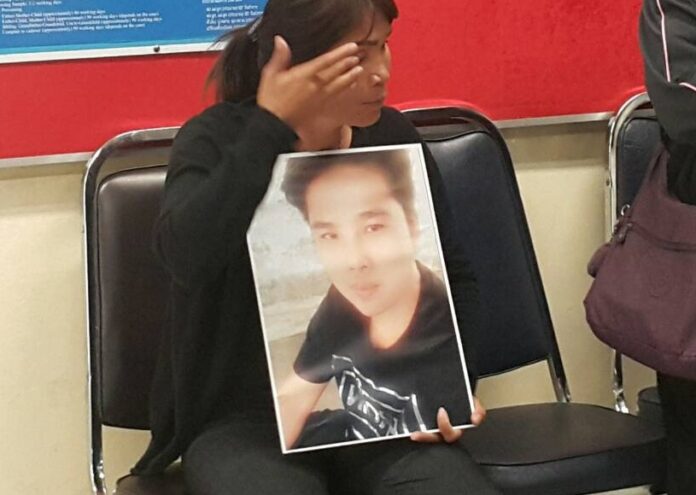
Mother of kidnap-murder victim Suphaksorn Pontaisong on Thursday wipes away tears as she waited to retrieve her daughter’s body at forensic police department.

BANGKOK — To police investigators, the abduction and killing of a Bangkok woman followed the familiar angles of a deadly love triangle. To some members of the LGBT community, however, it was the latest in a long history of hate crimes motivated by the victim’s gender identity.

The victim, 28-year-old Suphaksorn Pontaisong, was an economic migrant from Sa Kaeo province. She worked as a waitress in a restaurant until she was kidnapped close to her home last month. Her parents reported her missing. A police colonel was implicated. Her naked body was found in a shallow grave Wednesday.

Suphaksorn was also a lesbian, or as Thais prefer, tomboy, often shortened to tom.

Though they haven’t entirely ruled out that Suphaksorn’s identity was a factor, police say she was the victim of a jealous rage that sharpened into murder. Investigators accused a high-ranking police officer of ordering Suphaksorn to be killed because she was attracted to the same woman he was romantically involved with. In a country where experts say violence against transgender and gay Thais remains underreported, some in the LGBT community have complained Suphaksorn might have been the latest victim of a hate crime.

“I think gender [identity] played a factor,” Kath Khangpiboon, co-founder of the Thai Transgender Alliance, said Friday. “If society doesn’t care about this, hate crimes will continue to be uncounted.”

An undated photo of Suphaksorn Pontaisong provided by her family.

Kath isn’t alone. Since Tuesday when the story went public, the LGBT community has been awash with speculation that what happened was a hate crime.

“If she wasn’t a tom, would she have been killed?” Nook Atitaya wrote. “The more I read the more I think that it was a desire to show that he had power over her in every aspect: power of being male, and the power of the color of his uniform [police rank].”

Unlike Western countries, Thailand has no legislation regarding crimes which target someone because they belong to a certain group.

Another user, Phattarapakorn Chinz Chinaksorn, also saw a manifestation of hatred against a tom in the crime.

“Many men hate toms,” Phattarapakorn wrote. “For many men, they say, ‘You can take away my life but not my dignity.’ That is, when they lose to a tom, it’s humiliating. That’s really what society is like.”

‘Teach a Lesson’ 
One reason some people believe it was hate crime was because Suphaksorn was found naked, and police initially suspected she might have been raped. A medical examination ruled that out late Friday afternoon.

Col. Amnuay Pongsawat, the police officer accused of being the ringleader, also reportedly said he intended the kidnapping to “teach a lesson” to Suphaksorn.

“Teaching a tom in Thai society is what kind of teaching?” Chantalak Raksayu wrote in reply to a post that shared the news about Amnuay’s alleged confession to a Facebook group of LGBT activists.

Paisarn Likhitpreechakul, an activist working with the Foundation for Sexual Orientation and Gender Identity Rights and Justice, said the fact that Suphaksorn was buried naked made him wonder if it was a hate crime.

“Her being stripped naked, was there gender-identity violence involved?” Paisarn said. “Was there hatred against tom involved? But if it’s confirmed that she was raped, too, I’d think it’s definitely a hate crime.”
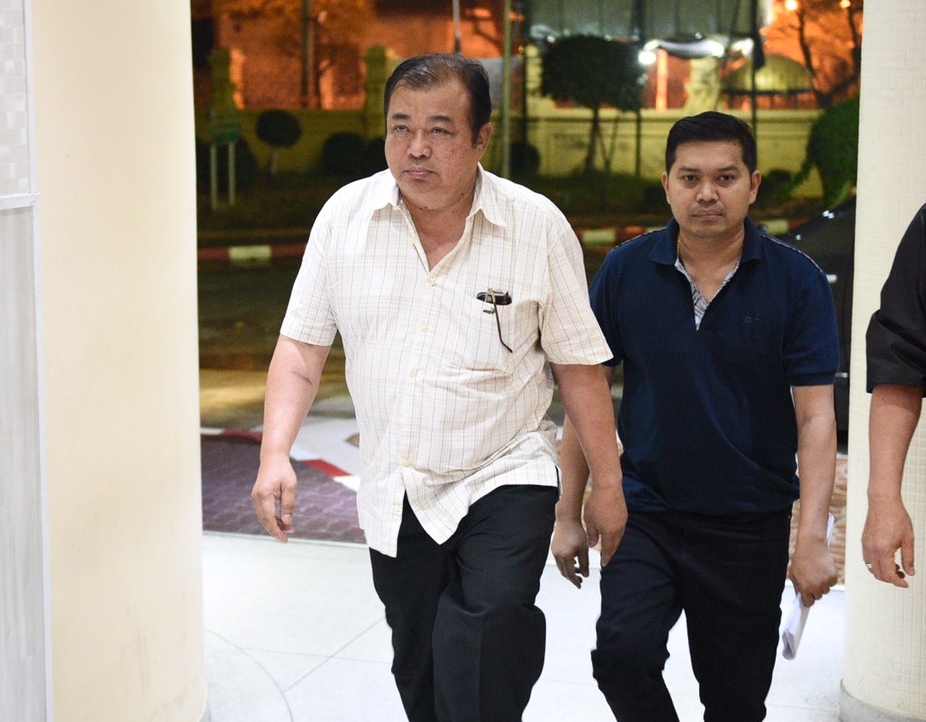
Col. Amnuay Pongsawat arrives at the headquarters of Bangkok Metropolitan Bureau on Tuesday night.

One of the investigators in charge of the case said he found no evidence that points to a hate crime so far.

“It has nothing to do with that. It was a personal issue,” Col. Noppasil Poonsawat said.

He also said perpetrators in deadly abduction cases are known to strip their victims naked before burying them so their identities are more difficult to determine if the bodies are found.

But Kath, the transgender rights activist, said the alleged killers’ motives are enough to make it a hate crime.

“She was involved with a woman, and it upset the man,” Kath said. “I think that was already a basis for the hatred. His way of thinking toward toms was already ingrained, so he chose to eliminate her.”

Untold Violence
It may be still too early to say whether Suphaksorn was the victim of a hate crime, but activist Paisarn said the record of violence against LGBT victims in Thailand is incontrovertible.

He pointed to several high-profile cases, such as a 2011 case in Trat province, when a woman allegedly hired a group of men to kill a woman who was attracted to her daughter because, according to news reports at the time, she did not want her to date a tom. In 2006, a tom was burned alive in Korat. In 2008, another tom in Chiang Mai was gangraped and murdered.

Paisarn said the actual number of such hate crimes remains unknown, as they often go unreported.

“People feel that police don’t have the competence to actually arrest the perpetrators,” Paisarn said. “It’s like rape cases. Some people don’t report it because they don’t expect the police to do anything.”

Kath said she counted “more than 10” deaths resulting from either hate crimes or bullying against LGBT Thais last year alone, citing her group’s investigations.

As there is no legislation regarding hate crimes in Thailand, police do not track instances of violence against victims based on their gender identity or sexual preferences, said Surachet Satitniramai, head of the National Human Rights Commission’s subcommittee on LGBT rights. No state agency keeps statistics of such crimes.

“Hate crimes happen around the world, including in Thailand,” Surachet said. “Prejudice against transgenders still exists. Some were ingrained by their parents. It’s a cultural issue.”

Paisarn said his group, years ago, petitioned many agencies including the rights commission to demand legal protection of LGBTs in the form of a hate crime law, but the issue eventually went quiet.

Surachet defended the lack of hate crime bills on the grounds that discrimination against LGBTs is already outlawed in 2015’s Gender Equality Act, while acts of violence are prohibited under the relevant sections of the Penal Code.

Related stories:

Sign Barring Transgender Intern Kindles Debate Over Toilet Equality

TV Presenter Marries Boyfriend, Slammed With Internet Homophobia

Advertisement

Indonesia Narcotics Chief Blames Pilots on Drugs for Crashes

A Lion Air aircraft seen here in 2010 in Soekarno–Hatta International Airport, Java, Indonesia. Photo: Afrogindahood / Wikimedia Commons

JAKARTA — The head of Indonesia’s narcotics agency says most of the country’s airline accidents have involved pilots on drugs, including a Lion Air jet that slammed into the sea four years ago while trying to land on Bali.

Budi Waseso made the comments Thursday at a ceremony inaugurating Bali’s traditional village security guards as anti-drug volunteers.

“Almost all air accidents in Indonesia, whether it was just a skid or whatever, the pilots are indicated to be positive for drugs,” he told reporters.

He said the Lion Air pilot had hallucinated that the sea was the runway.

The comments come after a video circulated online last month showing an apparently intoxicated pilot in the cockpit of a passenger plane. News reports this week said two other pilots recently tested positive for drugs.

Advertisement

Somtow’s Back to Conduct ‘Chariot of Heaven’

BANGKOK — After conducting the royal anthem for audiences in the Sanam Luang and on a plane, composer Somtow Sucharitkul is back on the opera track with his latest work commemorating the 100-day anniversary of King Rama IX’s death.

“Chariot of Heaven,” part of a larger unfinished project, will be released Jan. 20 in honor of His Late Majesty King Bhumibol Adulyadej.

It is the fourth installment of “DasJati – Ten Lives of the Buddha,” Somtow’s ambitious project to create music dramas reflecting the last 10 lives of Buddha or Tossachat for performance in a five-day festival.

Surtitles in Thai and English will be available throughout the performance.

The performances begin at 8pm, Jan. 19 – 22, with 2pm matinees on Saturday and Sunday, in the Main Hall of the Thailand Cultural Centre.

Admission is free and tickets can be reserved online. The 100th day ritual performance on Jan. 20 is by invitation only.

The venue can be reached on foot or mototaxi from MRT Thailand Cultural Centre exit No. 1.

Advertisement

After 11 Years, Pride Parade to Step Out in Bangkok

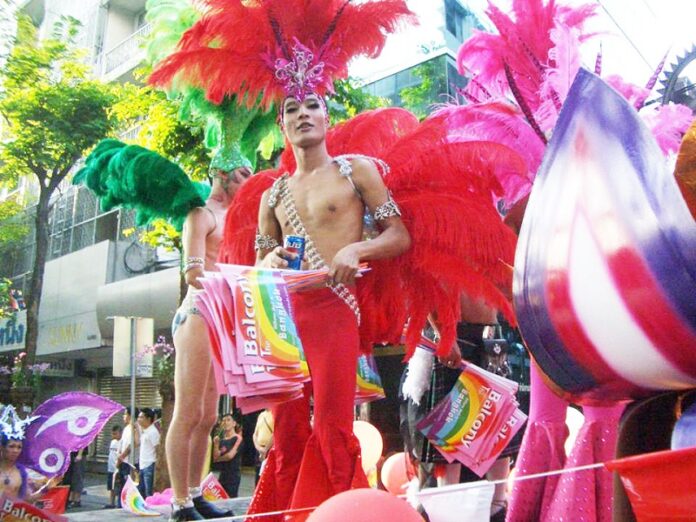
Gay parade on Silom Road in 2006. Photo: Rainbow Sky Association of Thailand / Facebook

Update: The event was postponed to the end of 2017 due to the ongoing mourning for King Bhumibol.

BANGKOK — The capital city will celebrate diversity in May with its first pride parade in 11 years.

Organized by a number of LGBT organizations, the six-day Bangkok Pride event promises to host workshops, film screenings, and “lots of parties.”

“We can not wait to make one of the most important LGBT celebrations a reality in Bangkok,” said Paul Heymans of Out BKK. “It’s time to fly our rainbow flags high and show the world that Thailand is also progressing towards free and equal rights for everyone.”

The event is scheduled for May 15 through May 20, with the pride parade to take place on the last day.

Heymans said the original plan to hold it on Silom Road, long a popular gay nightlife destination, had to be changed to another location to be announced next month.

Out BKK is among the organizations including the HIV Foundation and Rainbow Sky Association organizing the event.

It’s been a long time since the last pride parade marched down Silom Road in 2006. Attempts to organize another in Chiang Mai failed due to anti-gay protests.

Phuket has hosted the only regular annual event, usually held in April each year.

Related stories:

8 Days of Pride Kick Off Sunday on Phuket


Advertisement

Definitions of ‘Comfort Women’ Reveal Japan-S. Korea Divide

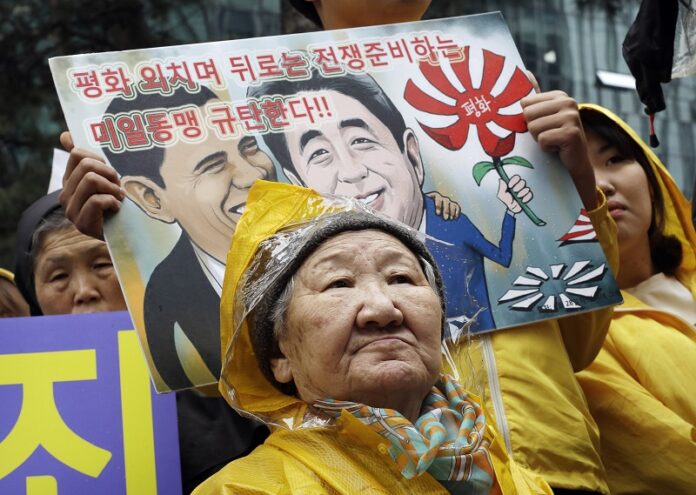
A former comfort woman Kil Un-ock, who was forced to serve for the Japanese troops as a sexual slave during World War II, attends a rally in 2015 against a visit by Japanese Prime Minster Shinzo Abe to the United States, in front of the Japanese Embassy in Seoul, South Korea. Photo: Ahn Young-joon / Associated Press

TOKYO — “Comfort women,” used by the Japanese military for sex, were present wherever the army invaded and occupied Asia countries from the early 1930s through the end of World War II.

That aspect of wartime history was kept quiet until the early 1990s, when a South Korean woman came forward, joined by some others, seeking Japanese help and accountability. Since then, the two countries have been divided over how badly Japan treated comfort women and how it should atone for past behavior.

That hasn’t changed despite a 2015 agreement intended to resolve differences. After South Korean activists installed a “comfort woman” statue in front of the Japanese consulate in the South Korean port city of Busan, Japan announced last week that it would temporarily recall its ambassador to South Korea and suspend economic talks.

The divide is reflected in the term “comfort women” itself. Both countries use it, but it means different things to each:

Who Are the “Comfort Women”?

The original Japanese word, “ianfu,” (pronounced EE-an-foo) is a euphemism for women sent to front-line brothels called “comfort stations.” Recruited or captured in Japan, the Korean Peninsula, China, the Philippines and Indonesia and elsewhere in Asia, they were used by hundreds of brothels supervised by the military, which set the tariffs, service hours and hygiene standards. The idea was to prevent venereal diseases and avoid triggering anti-Japanese sentiment by deterring Japan’s troops from raping local women.

Japan says there is no official record of the number of comfort women. Estimates by Japanese historians range from 20,000 to 200,000 depending on the parameters used. Initially, some were adult prostitutes or women from poor Japanese families, historians say. Later in the war, many non-Japanese, sometimes minors, were kidnapped or tricked into working in the brothels, some victims have said.

Japan and South Korea also used their own comfort women for American GIs after the war. Japan’s government set up brothels soon after its surrender in 1945 for U.S. servicemen pouring into the country and hired as many as 70,000 Japanese prostitutes, though Gen. Douglas MacArthur closed them in 1946. South Korea reportedly had a similar system for U.S.-led U.N. troops during the 1950-1953 Korean War and promoted sex businesses for American troops after the war. In 2014, about 120 former South Korean prostitutes and bar employees who worked near U.S. bases in the 1960-1980s sued their own government seeking compensation; a ruling is expected next week.

What Term Means in Japan

In Japan, comfort women initially were considered victims of World War II atrocities and thought to have come mainly from South Korea and the Philippines. Dozens from the two countries regularly visited Japan demanding official government apologies and compensation mainly in the 1990s-2000s. Years of continuous pressure for apologies have soured the initial sympathy, though, and many Japanese have grown weary of reminders of their country’s wartime past.

Some argue the women were not coerced but volunteered to be prostitutes for the military. During Shinzo Abe’s first term as prime minister in 2006-2007, his Cabinet adopted an official line that there was a lack of documentary proof the women were forcibly recruited or put to work in the wartime brothels. In 2016, Abe told a parliamentary session that replacing the term “ianfu” with “sex slaves” was inaccurate and said the widely used estimation of 200,000 women was groundless. Abe expressed his sympathy for the women, but described them as victims of human trafficking. He has repeatedly denied the women were coerced into sexual slavery. Japan has lobbied the United Nations to remove the word “sex slaves” from documents related to the issue. Japan’s largest newspaper, the Yomiuri, apologized in 2014 for using the expression “sex slaves” in its English edition in the past, promising not to use it again.

Japan issued an apology in 1993 and a government investigation concluded many women were taken against their will and “lived in misery under a coercive atmosphere.” A fund set up in 1995 paid nearly 5 billion yen ($44 million) for medical and welfare projects for more than 280 of the women, including 61 South Koreans. Many victims in that country rejected the fund money under their powerful support group’s stance to keep seeking further official apologies. Japan maintains all its wartime compensation issues with South Korea have been settled by a 1965 treaty.

What Term Means in South Korea

Most South Koreans prefer the term “comfort women” even though it is adopted from their former colonial ruler. Critics of the euphemism say it makes light of the women’s suffering, but the victims themselves generally have preferred it, perceiving more stigma from being called sex slaves. South Korea was a more deeply conservative society that prized women’s chastity and was hesitant to discuss sex publicly in the 1990s, when the women began revealing their long-hidden experiences.

The South Korean government uses the phrase “comfort women of the Japanese military” to reflect the victims’ preferences. The main support group for the women that organizes weekly protests outside the Japanese Embassy in Seoul uses “comfort women of the Japanese military” in its Korean-language documents. It uses the phrase “military sexual slavery by Japan” in English statements.

“I personally hope we don’t call them ‘comfort women.’ When Americans or other foreigners hear this term, I think they would say, ‘What’s that?'” said Jung Hye-kyung, an expert on Japanese colonial abuses.

Of the 239 South Korean women who officially registered themselves as comfort women, to obtain subsidies and benefits, only 40 are still alive. Experts believe many others have never come forward.

Story: Mari Yamaguchi, Hyung Jin Kim

Advertisement

Kerry Visits Vietnam on Last Trip as US Secretary of State

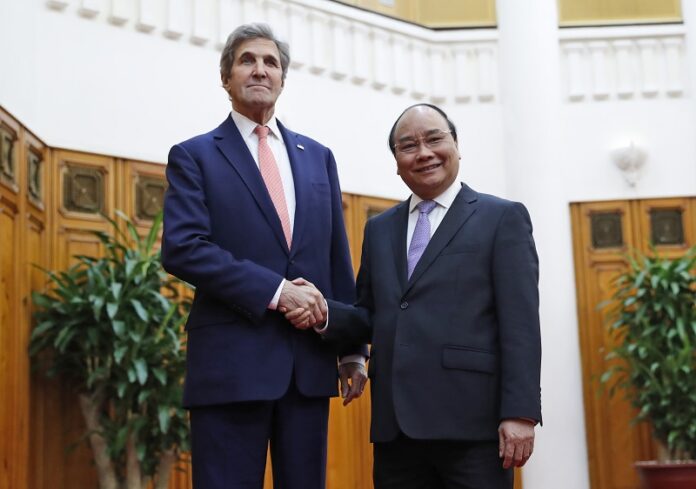
U.S. Secretary of State John Kerry, left, shakes hands with Vietnam's Prime Minister Nguyen Xuan Phuc Friday at the Office of the Government, before their meeting in Hanoi, Vietnam. Photo: Alex Brandon / Associated Press

HANOI — Secretary of State John Kerry met Vietnamese leaders Friday during his last trip as the top diplomat for the United States.

He held separate meetings with Prime Minister Nguyen Xuan Phuc and acting Foreign Minister Bui Thanh Son.

Kerry later left for Ho Chi Minh City to meet a group of Vietnamese youth and is scheduled Saturday to tour the Mekong delta province of Ca Mau, where he fought during the Vietnam War almost 50 years ago.

Kerry then travels to Paris to attend a conference on Middle East peace and then to London where he will meet Foreign Secretary Boris Johnson to discuss Syria.

The most travelled top diplomat in U.S history ends his trip by attending the World Economic Forum annual meeting in Davos Switzerland on Jan. 18, just two days before President-elect Donald Trump is sworn in office with former oilman Rex Tillerson nominated as his replacement.

Kerry and Sen. John McCain, who was held prisoner of war when his navy jetfighter was shot down over Hanoi during the war, were key participants in the U.S’s efforts to normalizing relations with former foe Vietnam in 1995.

Advertisement

Monster-Croc Nadia Swims Free From Flooded Zoo

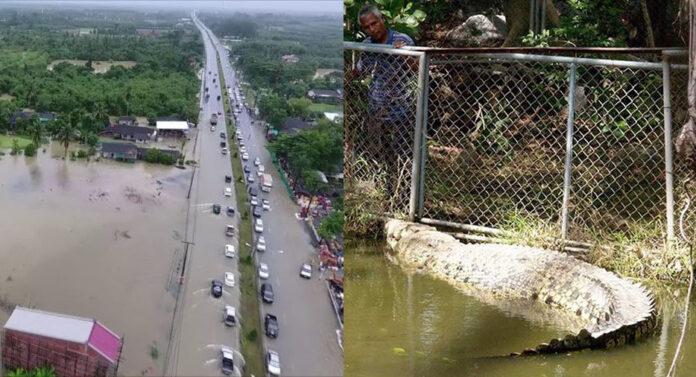
Left: Nakhon Si Thammarat flooded on Jan.4. Right, Nadia during her enclosed days. Photo: Sasigun Jiramonkolchat / Facebook

NAKHON SI THAMMARAT — A team of crocodile hunters were searching Friday for a five-meter croc named Nadia who slipped her bonds to escape captivity a zoo in the south of Thailand.

Friday morning’s search had yet to find the renegade reptile whose liberation was aided when her Nakhon Si Thammarat province zoo was hit by the flooding which has ravaged the region, killing at least 36 people and disrupting the lives of more than 1 million.

When the Tha Lad Zoo flooded Wednesday, the crocodile was among a number of animals to escape their enclosures. Others drowned.

Neighboring residents have been warned the crocodile, imported from India, is on the loose.

Manas Pongnira, zoo vice president Zoo, could not be reached for comment. His secretary at the zoo said he was preoccupied with the search.

The Department of Fisheries helped round up a crocodile-hunting team to bring Nadia back. There’s their own Nikom Suksawad, the zookeepers in charge of feeding Nadia, and local fisherman Suchart Tetnra.

For three hours on Thursday night, the team was boating around the flooded zoo. When they reached deep spots, they killed the engine and paddled, shining lights in hope they would reflect back from crocodile eyes peering over the surface of the water.

If found, Nadia will be tied up. If she resists capture they’ll shock her with a low-voltage stun gun to numb her.

In the meantime, civilians and personnel uninvolved in the hunt are forbidden from entering the flooded zoo in case Nadia is still prowling around.

Related stories:

As Southern Flooding Eases, 22B Baht Price Tag For Repairs

More Flash Floods Expected as North-to-South Road Reopens

Young Girl Drowns in Southern Flooding, Surprise Storm Lashes Bangkok

Reform Assembly Members Donate 5,000 Baht Each to Aid Flood Relief Efforts

19 Die as Floods Continue to Submerge South

Malls, Airport Closed as Worst Flood in Decades Hit South

Absurd News Parody Brings Smiles to Flood-Ravaged South (Photos)

Advertisement

Hang 10 Again: Flow House Returns Saturday For Children’s Day

A young surfer has fun at Bromsgrove Summer Camp in an image posted July 14, 2016. Photo: Flow House Bangkok / Facebook

BANGKOK — After a low-tide of financial difficulties shut its doors in December, the surf is up again at Flow House for at least one more day this Saturday on Children’s Day.

After shutting down for a month, Flow House Bangkok will celebrate Children’s Day by allowing in anyone under 10 to ride the waves for 300 baht per hour. Those 10 and up pay the regular rate of 500 baht per hour. Valid identification must be presented at the venue.

Saturday’s event runs from 11am to 10pm, with the last session starting at 9pm.

Read: Leap, Learn, Play: 8 Things to do on Children’s Day

The normal pricing list will be announced online and only cash is accepted during the test run.

Members and customers holding vouchers can use their privilege until the expiry date.

Flow House Bangkok is located in the A-Square mall on Soi Sukhumvit 26 and can be reached from BTS Phrom Phong by a motorbike or taxi.

 
Related story:

Cash ‘Flow’ Issues Force Bangkok Surfing Joint Out of Business

Leap, Learn, Play: 8 Things to do on Children’s Day

Advertisement

NLA Amends Interim Charter to Change Constitution

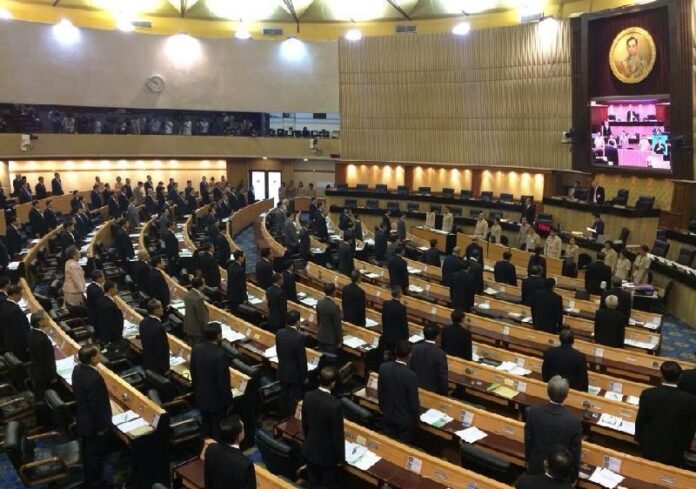
National Legislative Assembly members seen in a Aug. 8, 2014, file photo.

BANGKOK — The junta-appointed legislature unanimously approved amendments Friday to the 2014 interim charter to allow rewriting parts of the new constitution already passed by the people.

The new constitution, which had been pending royal endorsement after being adopted in a public referendum, will be revised after Prime Minister Prayuth Chan-ocha said Tuesday the His Majesty the King wanted some sections involving his authority to be rewritten.

The amendment passed Friday also relieved the king from obligations to appoint a regent when he is out of the kingdom or is unable to execute his duties.

Read: Prayuth to Change Constitution at King’s Request

Article 39 of the interim charter says the constitution must be dropped if the king disapproves of the document or does not take action on it within 90 days.

It was amended to allow ex post facto changes to the post-referendum charter as per King Vajiralongkorn’s request. The process to amending the constitution will begin after the prime minister receives it back from the king.

The process must begin before Feb.6, which marks the 90-day deadline after it went for first royal endorsement.

The amendment will be drafted by a specially formed, 10-member committee including head charter drafter Meechai Ruchupan and Deputy Prime Minister Wissanu Krea-ngam.

After the constitution is amended, it will be re-submitted for royal endorsement within 30 days. The king will then have another 90 days to consider it.

Prayuth insisted no amendments concerned the public’s rights and freedoms.


Related stories:

Prayuth to Change Constitution at King’s Request

Charter Will Be Dropped Feb. 6 Without King’s Endorsement

New Constitution Submitted for Royal Endorsement

Advertisement

Vets Rescue Tiger With Shotgun Wounds in Northern Thailand

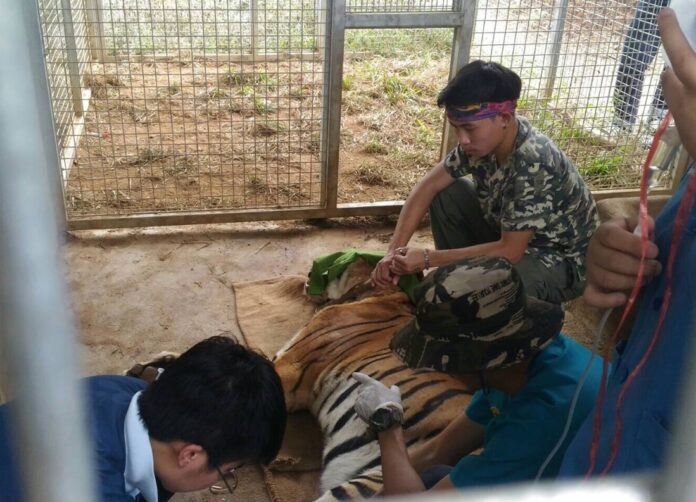
A veterinarian team tends to a wounded Bengal tiger Friday at a wildlife station in Lampang province.

LAMPANG — A team of veterinarians on Friday morning ruled out surgery for a wild tiger shot while foraging near an orchard in Lampang province.

The male Bengal tiger was found with seven gunshot wounds close to the Lampang-Tak Road on Monday. The director of a state-run zoo in Chiang Mai province who was part of the team caring for the tiger said he hopes to release it back to the wild after it fully recovers.

“The team is caring for him like he is their child,” Sarawut Srisakun of Chiang Mai Night Safari said by telephone.

The tiger was most likely wounded by a shotgun, but none of the seven pellets hit any vital organs, Sarawut said. An operation to remove the pellets was ruled out because doctors fear the surgery could end up damaging the tiger’s nerves, he added.

“The tiger will release the pellets from its body through abscesses,” Sarawut said.

The tiger is being held at a wildlife station in the Thoen district of Lampang. It will take “about six months” of recovery and rehabilitation before the big cat can be released back to the wild, Sarawut said.

Local authorities located the tiger on Monday after receiving reports from residents they heard it roaring in the woods at night.

Sarawut regretted that the tiger was likely shot out of fear by a local hunter or farmer; contrary to popular belief, he said, tigers usually avoid humans and would only attack if one turns their back.

“If you meet one in the forest, remember that it’s scared of us as much as we’re scared of it,” Sarawut said.

He advised those who encounter tigers in the woods to face the creatures and scare them off with arm movements instead of resorting to firearms.

Advertisement

Hot News

LATEST NEWS

Bangkok
overcast clouds
33.8 ° C
35 °
32.2 °
63 %
3.6kmh
100 %
Sat
37 °
Sun
36 °
Mon
35 °
Tue
34 °
Wed
33 °