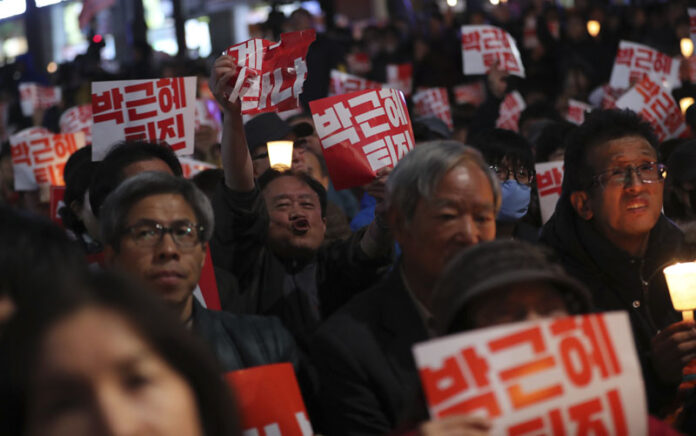
South Koreans hold signs at a rally calling for President Park Geun-hye to step down Saturday in downtown Seoul, South Korea. Photo: Lee Jin-man / Associated Press
SEOUL, South Korea — Thousands of South Koreans took to the streets of the capital on Saturday calling for increasingly unpopular President Park Geun-hye to step down over allegations that she let an old friend, the daughter of a religious cult leader, interfere in important state affairs.
The evening protest came after Park ordered 10 of her senior secretaries to resign over a scandal that is likely to deepen the president’s lame duck status ahead of next year’s election.
Holding candles and signs reading “Who’s the real president?” and “Park Geun-hye step down,” the protesters marched through downtown Seoul after holding a candlelight vigil near City Hall. Police estimated that about 12,000 people turned out for the biggest anti-government demonstration in Seoul in months.
“Park has lost her authority as president and showed she doesn’t have the basic qualities to govern a country,” Jae-myung Lee, from the opposition Minjoo Party and the mayor of the city of Seongnam, told the protesters from a stage.
Park has been facing calls to reshuffle her office and Cabinet after she acknowledged on Tuesday that she provided longtime friend Choi Soon-sil drafts of her speeches for editing. Her televised apology sparked intense criticism about her mismanagement of national information and a heavy-handed leadership style that many see as lacking in transparency.
There’s also media speculation that Choi, who holds no government job, meddled in government decisions on personnel and policy and exploited her ties with Park to misappropriate funds from nonprofit organizations.
Prosecutors on Saturday widened their investigation by searching the homes of presidential officials suspected of interacting with Choi and receiving their office files from the Blue House — the presidential office and residence. Prosecutors had previously summoned some of Choi’s key associates and raided their homes and workplaces, as well as the offices of two nonprofit foundations Choi supposedly controlled.
The saga, triggered by weeks of media reports, has sent Park’s approval ratings to record lows, and the minority opposition Justice Party has called for her to resign. The Minjoo Party, a larger opposition party that has refrained from calling for Park’s resignation over fears of negatively affecting next year’s presidential election, said Park’s decision to shake up her secretariat was too little, too late, and called for stronger changes, including the reshuffling of her Cabinet.
Park’s aides on the way out include Woo Byung-woo, senior presidential secretary for civil affairs, and Ahn Jong-beom, senior secretary for policy coordination. Lee Won-jong, Park’s chief of staff, tendered his resignation on Wednesday.
Woo has been blamed for failing to prevent Choi from influencing state affairs and has also been embroiled in separate corruption allegations surrounding his family.
Ahn, whose home was searched by prosecutors on Saturday, is under suspicion that he helped Choi pressure South Korean companies into making large donations to the Mir and K-Sports foundations, launched in October last year and January this year, respectively. Choi reportedly masterminded the creation of the two nonprofits, which managed to gather around $70 million in corporate donations over a short period of time, and is suspected of misappropriating some of the funds for personal use.
Park’s office said she plans to announce a new lineup of senior secretaries soon.
Choi’s lawyer Lee Gyeong-jae said that she was currently in Germany but would return to South Korea if prosecutors summon her. In an interview with a South Korean newspaper earlier in the week, Choi acknowledged receiving presidential documents in advance, but denied intervening in state affairs or pressuring companies into donating to the foundations.
Choi and Park reportedly became friends in the 1970s, when Choi’s late father, Choi Tae-min, a shadowy religious figure who was a Buddhist monk, cult leader and Christian pastor at different points of his life, emerged as Park’s mentor.
At the time, Park was serving as acting first lady after her mother was killed in 1974 by a man trying to assassinate her father, military strongman Park Chung-hee, who would be murdered by his own spy chief five years later.
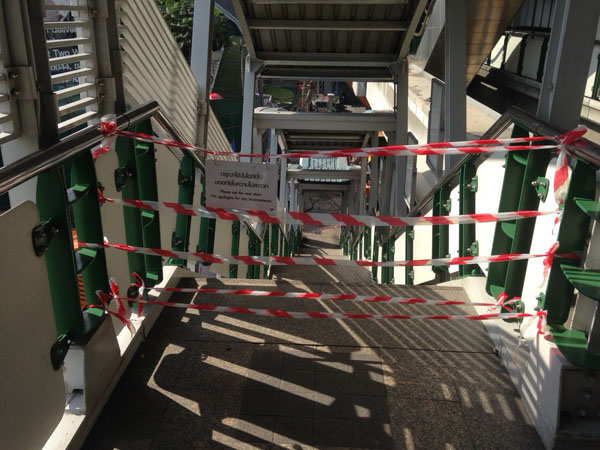
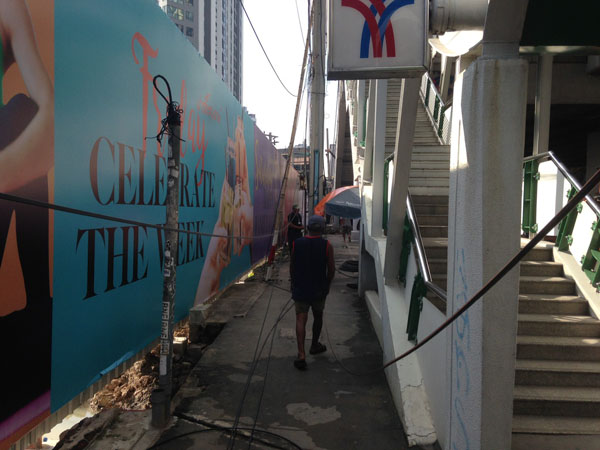
Workers remove a fallen crane from across the sidewalk at BTS Phra Khanong on Sukhumvit Road on Sunday in Bangkok.
BANGKOK — A construction crane came crashing down Sunday onto the sidewalk of Sukhumvit Road.
At about 11am, the construction crane at the site of a new community mall called Boutique fell onto the public street. No one was reported injured in the accident.
Officers shut down Exit No. 1 of the Skytrain station, and workers were clearing the scene Sunday afternoon. The crane also took down two utility poles, according to Phra Khanong official Acharadee Chaisurirat.
She believed the accident was caused by loose earth due to weeks of heavy rainfall but would report the incident to the police and seek compensation from the construction firm.
Update: Si Quey is cremated at a temple in Nonthaburi on July 23, 2020, in the light of new evidence that suggests he was likely framed for the murders.
Late on a Monday afternoon decades back, 8-year-old Somboon Boonyakan went to buy some vegetables for his family to cook dinner from a local Chinese gardener. He never returned.
See Uey once met a Chinese hermit who advised him that eating children’s intestines would grant him supernatural powers.
As dusk approached, Nawa Boonyakan called on his friends to search for his missing son in the woods near their home in the seaside town of Noen Phra, Rayong province, fearing the young boy might have wandered off.
In the shaded gloom of the woods, Nawa and his companions stumbled upon the gardener Somboon had gone to buy from. His name was See Uey Sae-Ung. He was burning a pile of brush when Nawa found him.
The anxious father must have been relieved to encounter someone who’d seen his son before he went missing. Maybe See Uey could provide the detail that would lead him to Somboon.
Any relief soon turned to horror when Nawa noticed what See Uey was burning under the debris: a small leg. He rushed to stamp out the fire and uncovered the half-burned, eviscerated body of Somboon beneath the charred leaves. Howling in rage, Nawa and his friends attacked See Uey and held him down until police arrived.
It was 1958. In the next few days, the story hit the frontpage of newspapers across the country – See Uey confessed to killing Somboon and ripping out his intestines.
But he didn’t stop there. He also admitted to murdering five other children in the same gruesome manner because he liked the taste and sought special powers. His confessions – and the histrionic media coverage – enshrined him as the most notorious killer in Thai history, where every child from that point on would grow up knowing his name as the boogeyman who would snatch them in their sleep.
Today, tourists and visitors alike still visit See Uey almost every day.
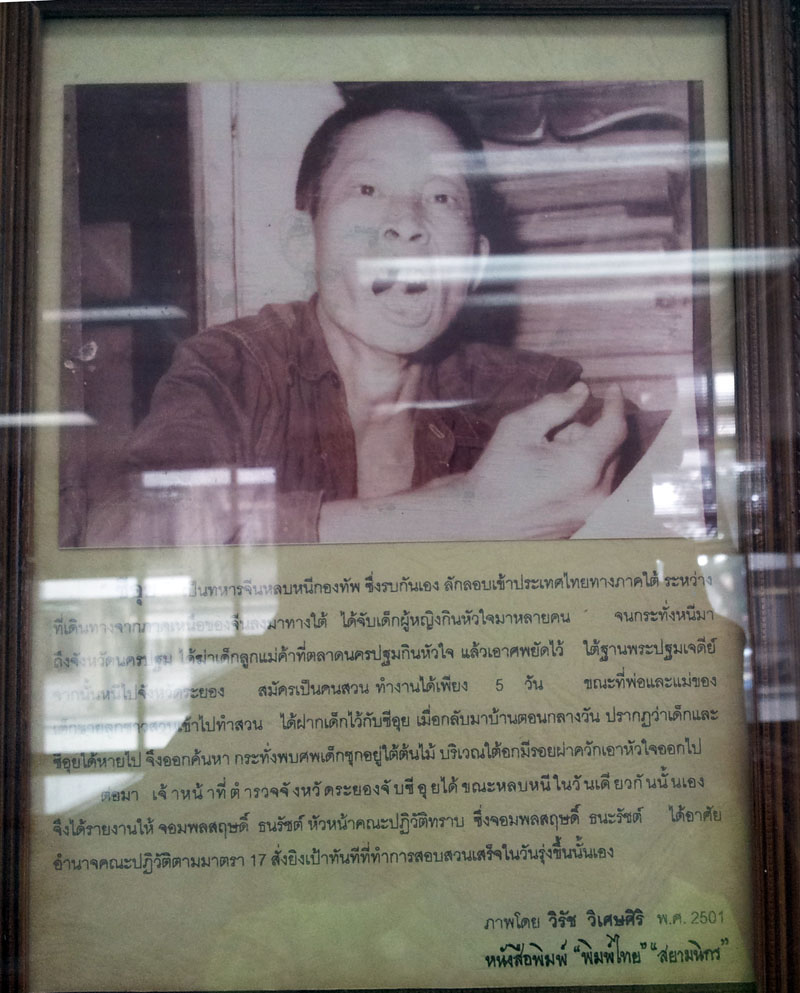
See Uey in a recent photo.
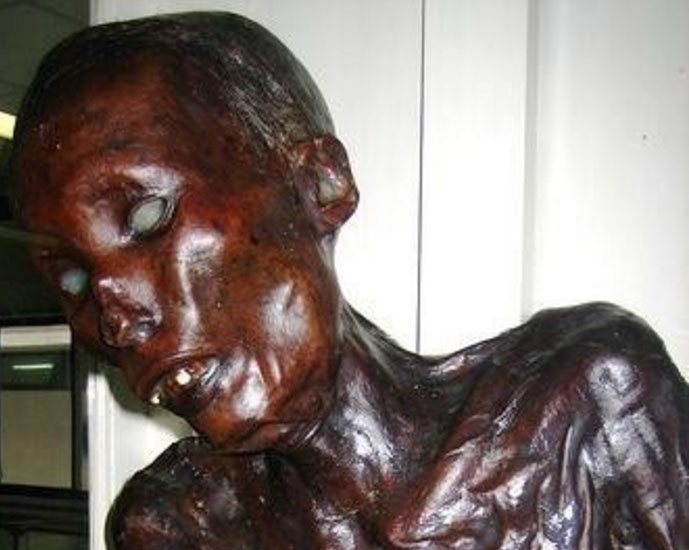
The Forensic Medicine Museum at Siriraj Hospital is known to many Thais as the See Uey Museum. That’s because the macabre highlight of its ample ghoulish wonders is the killer’s shriveled corpse, slathered in wax, in which visitors can peer at the bullet holes left by his executioners.
Looking back with 50 years of hindsight, was See Uey indeed the monster depicted by the authorities and media? Was he capable of an itinerant murder spree across four provinces? What role did Cold War, anti-Chinese sentiments play?
“Police Arrest Child Murderer Who Rip Outs Victim’s Heart and Sucks Fresh Blood,” was the Feb. 3 headline, one week after See Uey’s capture, in Pim Thai, the same newspaper which reported how Nawa Somboonkan found his son’s body.
During the week to come, the newspaper documented what See Uey, a 37-year-old migrant from southern China, reportedly told investigators: everything.
He was working in an orchard when Somboon came to buy vegetables. He stabbed the boy in the throat, washed his body, then cut out his liver, heart and kidney. He stored the organs in his kitchen cupboard for later consumption.
See Uey was caught just as he was burning the body to cover up his crime.
Investigators noted from day one that Somboon’s murder eerily resembled the deaths of five other children killed in 1954, 1955 and 1957. Three of them were killed far from Rayong in Prachuap Khiri Khan; one in Bangkok and the other in Nakhon Pathom. All were found stabbed in the throat with some organs removed, just like Somboon.
News reports said See Uey admitted to all of them. He told police he killed 11-year-old Nid Saephu in May 1954; 6-year-old Muaychu Saehua in November 1954; 7-year-old Kimhiang Saelee in June 1955; 10-year-old Ngan Saelee in October 1955 and 5-year-old Siewchu Saelim in February 1957. All victims were ethnic Chinese.
See Uey also told investigators he cut up his victims because he liked eating their organs, especially the hearts. He made one exception for Muaychu Saehua, whom he murdered near Chitlada Palace in Bangkok. He said her heart was too small for a hearty meal, so he dined on her gullet instead.
“It tasted delicious, too,” See Uey said.
His grisly rampage soon earned him the nickname of “The Murderous Cannibal,” and his name grew to become a synonym for murder cases involving eating parts of the victims, making him a sort of Thai Hannibal Lecter.
See Uey didn’t put up any fight when his trial opened on March 25, 1958. He confessed to every count of murder pressed against him, and freely discussed his exploits in court. Among the witnesses who testified against See Uey were young siblings of the 6-year-old Muaychu. They said they saw him leading their sister away from a Chinese New Year fair in Bangkok’s Chinatown on Nov. 30, 1954, the night before her body was found dumped near railroad tracks.
His trial lasted only nine days.
The court initially sentenced See Uey to life, sparing him the death sentence because he pled guilty. But prosecutors immediately appealed the verdict, arguing that the mandatory clemency granted for confessions should not apply to See Uey because the evidence would have been enough to convict him.
The appeals court agreed and sentenced See Uey to die. The Chinese man reportedly fainted upon hearing the verdict, and he only came to after a policeman gave him several puffs of a cigarette.
See Uey was locked up in northern Bangkok’s notorious Bang Kwang prison until Field Marshal Sarit Thanarat, who ruled the military junta at the time, signed an order for his death. He was executed by firing squad on Sept. 17, 1959.
Much of what is known about See Uey’s life came from his own translated testimony to police investigators and judges:
He was born in 1927 to a family of farmers in the southern Chinese port town of Shantou. In 1945, at 18, he was drafted to fight against invading Japanese. He said his unit was once cut off and encircled by the Japanese for weeks. While his compatriots ate grass to survive, See Uey said he turned to the flesh of slain soldiers on the battlefield. It was the first time he tasted human meat.
After the war ended, See Uey came to Thailand in 1946 via a cargo ship like millions of other Chinese immigrants before and after him. He landed at Khlong Toei Port on Dec. 28, 1946. He took up several menial jobs in the capital before finding work as a gardener in Prachuap Khiri Khan.
It was in Prachuap’s Thap Sakae district when he allegedly sought his first kill. He said he attacked his first victim, 8-year-old Bangorn Pamornsut, near a market on the night of April 10, 1954. He bit her throat and tried to drag her into the woods, but she managed to escape.
The next time he struck on May 19, the victim wasn’t as lucky. Nid Saephu, 11, was taken away from a nighttime wedding fair. Her body turned up the next morning beside a railroad line. She was stabbed in the throat. Her heart, liver and kidneys were gone.
After killing 6-year-old Muaychu in Bangkok that November, he went on to murder 7-year-old Kimhiang and 10-year-old Ngan in Prachuap’s Sam Roi Yot district on June 22 and Oct. 28, respectively. After some time passed and parents sighed with relief that the child killings had stopped, See Uey struck again three years later in Nakhon Pathom province on Feb. 6, 1957.
The body of 5-year-old Siewchu was found mutilated next to the town’s iconic landmark, the ancient pagoda of Phra Pathom Chedi.
All of this, of course, was based on what See Uey told the authorities. Forensic science was all but non-existent in Thailand at the time. See Uey also could not communicate directly with the judges because he spoke very little Thai.
But police said they had witness descriptions that matched See Uey, and the pattern and methods were identical. Maj. Teekayu Boonnateekul, commander of Rayong police, told a newspaper on Feb. 6, 1958, that See Uey had confessed voluntarily.
“There was no threat made against him,” Teekayu said. “The interpreter simply told him: Say everything that you want to say.”
Yet a number of skeptics are not convinced that See Uey was the villain he was made to be. Some said it would have been extremely difficult for a lone, impoverished Chinese man who couldn’t speak Thai to travel so extensively.
‘Police Arrest Child Murderer Who Rip Outs Victim’s Heart and Sucks Fresh Blood,’ was the headline on Feb. 3 in Pim Thai, seen here in a microfiche record.
Others point to the abundant record of Thai police framing scapegoats when they’re under pressure in high-profile murder cases. Like See Uey was over half a century ago, suspects today are paraded before the public before they set one foot into court, some of whom are later cleared of wrongdoing.
Like those today who suggest two Burmese men were scapegoats for the murder of two backpackers in 2014, there are skeptics who suspect See Uey provided a convenient patsy as a member of a marginalized ethnic group. His arrest and swift execution came at the height of the Cold War, when Thailand was ruled by a military dictatorship preaching the menace of “Red China” and eyeing the growing Chinese diaspora with suspicion.
Field Marshal Sarit, the junta strongman who signed See Uey’s death warrant, also ordered summary executions of scores of civil rights activists and suspected criminals under his rule. Many of those condemned were Chinese men accused of arson.
Then there was Sawai Pinsilpachai, a Thai butcher, who was identified by police as the serial child killer and locked up for nearly a year. A court released him on bail in January 1958 – one month before See Uey’s arrest.
His family at the time complained he was a scapegoat.
“We have lost so much money. We’re almost penniless now, even though my son is completely innocent,” Sawai’s mother, Thongkiew Pinsilpachai, told reporters on Feb. 4, 1958.
Police briefly toyed with the idea of prosecuting Sawai as an accomplice of See Uey but eventually dropped it for lack of evidence.
Suppose See Uey was guilty as they said, why did he commit such horrifying crimes?
Psychiatrists at the time deemed him free of any mental disorders. Some media reports claimed See Uey once met a Chinese hermit who advised him that eating children’s intestines would grant him supernatural powers.
In the only interview See Uey is known to have given to the media, he said he believed consuming human vitals such as hearts and livers would strengthen his health.
“I ate them because they revitalized my body,” See Uey was quoted through an interpreter in a Feb. 12 Pim Thai report.
And human intestines taste really good, he noted matter-of-factly.
The unnamed reporter described See Uey as a short, slim man who looked like any ordinary person. But See Uey had a habit of scratching his head and yawning frequently.
“It is when he yawned and stretched his mouth, that his snarling teeth were visible, and his eyes turned to look like those of a beast, poised to strike at its prey,” the reporter wrote of the jailhouse interview in Rayong.
The reporter asked why he targeted children.
“Because they were easy to lure and fool … If I target adults, they might fight back,” See Uey replied, adding that he had never sexually abused any of the victims, despite what some reports said.
The interview ended with See Uey pleading for the guard to take him for a walk in the market.
“Please, I promise, I won’t run away,” See Uey said. The guard wordlessly took him by the shackles back to his cell.
Aswin Kwanmuang, foreground center, visits Saphan Lek in Bangkok in October 2015. Photo: Matichon
BANGKOK — It was 8am when Aswin Kwanmuang got the call telling him to go to the Government House to meet the prime minister. He repeated the words back to the person on the other end of the line, pondering what he had just heard.
So the he went. It was a Tuesday, so he had to wait around until the cabinet meeting ended at about 11am. That’s when he was called into the meeting room where top government figures including junta leader Prayuth Chan-ocha, who told him he was now governor of Bangkok.
“In police and military systems, they don’t usually give you a reason,” Aswin, 65, said in a recent interview. “An order is an order. Our duty is to say ‘yes sir.’”
It was Oct. 18 when Aswin, then deputy Bangkok governor, was summarily appointed to the top job by Prayuth’s self-granted, absolute power. The order said he would be in the position until a new election is held – or the junta orders otherwise.
Aswin, a well-connected police official who’s served four years in city leadership, became the first governor appointed to the position in 30 years. Bangkok and Pattaya are the only two places where provincial leaders are directly elected by popular vote. Everywhere else they are appointed by Interior Ministry.
In normal times, the next election would have been held sometime next year. That’s unlikely to happen under the junta’s current timetable for restoring semi-democratic rule, and Aswin might serve as long as the junta remains in power, possibly until early 2018.
He replaced Sukhumbhand Paribatra, the two-term governor from the Democrat Party suspended in August due to allegations he colluded to embezzle state funds.
Aswin is now assembling his team of advisers – with some notable exceptions.
“I definitely said no to politicians,” he said. “I don’t want people to be associated with any political parties. I have never been a member of any party in my life.”
Evictor-Crusader
The initiative most associated with Aswin’s tenure as deputy governor is perhaps the city’s most controversial: clearing out popular night markets and sidewalk vendors in the name of reclaiming public space. He’s been the public face of the campaign the junta tasked the city with in 2014.
Aswin became known for his outspoken and uncompromising style at the negotiating table during a number of eviction battles. His successes include demolishing the toys and electronics market at Saphan Lek and the Pak Khlong Talad flower market. He also managed to make progress in a 24-year eviction battle over the Pom Mahakan fort community by getting a dozen households to move out.
Now that he’s governor, Aswin said he will rely on political science more than the force of law to solve land encroachment issues. He said he’s a newfound believer in the art of agreement rather than forced eviction.
“There are a lot of land encroachment issues no one has ever touched, such as hotels along the Chao Phraya riverside,” he said. “To me, this problem should be looked into more.”
For another issue that often has City Hall on its back foot – flooding – he chose another well-known personality: Royon Jitdorn, a government hydrologist who stopped making forecasts earlier this year aftera false alarm.
“Bangkok is a lowland. There will always be floods,” Aswin said of his plans for the remaining weeks of the rainy season. “But if we get the water out as quickly as possible, people will complain less.”
Well-Connected
Before joining the Bangkok Metropolitan Administration after retirement from the police force, Aswin made himself known as a productive officer who had risen to the level of deputy national police chief.
In 2008, the media nicknamed him “Aswin Case Closed” due to his fast and aggressive style. He was also named by the public as the cop toughest on crime in an ABAC Poll that year.
He was also known for being snug with former protest leader Suthep Thaugsuban. When Suthep served as deputy prime minister in the administration of Abhisit Vejjajiva, Aswin was promoted to the special position of police adviser, a position made equal to deputy police chief.
In October 2015, Aswin was chosen by Gen. Prayuth to serve on the 200-strong advisory group which replaced the National Reform Council. Although he’s been criticized for pulling double duty – and double pay – on the National Reform Steering Assembly, Aswin has refused to step down despite his new full-time obligations keeping Bangkok humming.
Aswin, whose name means “knight,” takes speculation in stride that his surprise appointment came because the city needs competent leadership of the logistical challenges posed by the throngs of people arriving from throughout the nation to pay respect to King Bhumibol.
“I’m not worried. I’ve worked here (as deputy governor) for three years and a half already,” he said. “Though I can’t handle it all by myself, that’s why I have to find the experts to join my team.”
An officer explains what is not allowed inside the Grand Palace on Saturday in Bangkok.
BANGKOK — To describe the lines outside the Grand Palace on Saturday as very long would be an understatement.
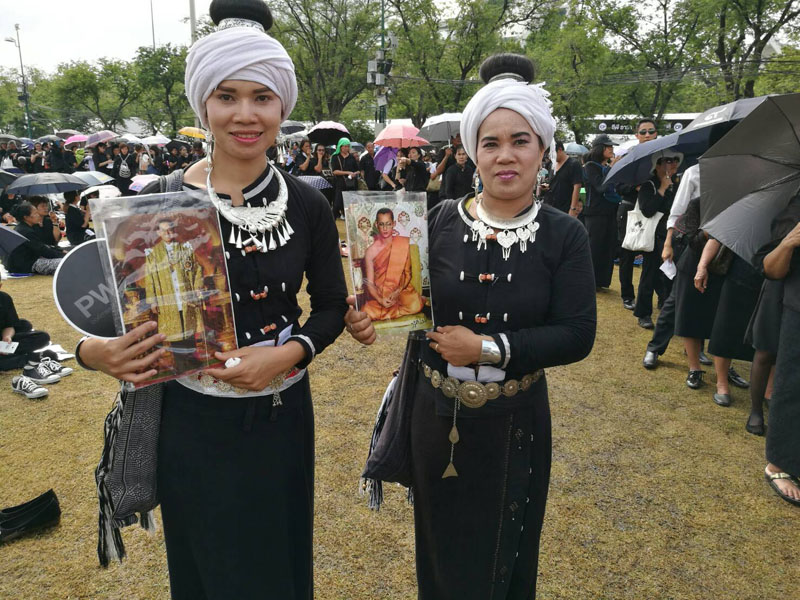
In four rows, lines of mourners waiting to be among the first 10,000 allowed in to pay their respects snaked naga-like outside.
The lucky ones would wait just eight or nine hours before being ushered with 99 others into the Grand Palace’s Dusit Maha Prasat Throne Hall to spend two to three minutes with the royal urn and coffin of King Bhumibol, who died Oct. 13 at 88.
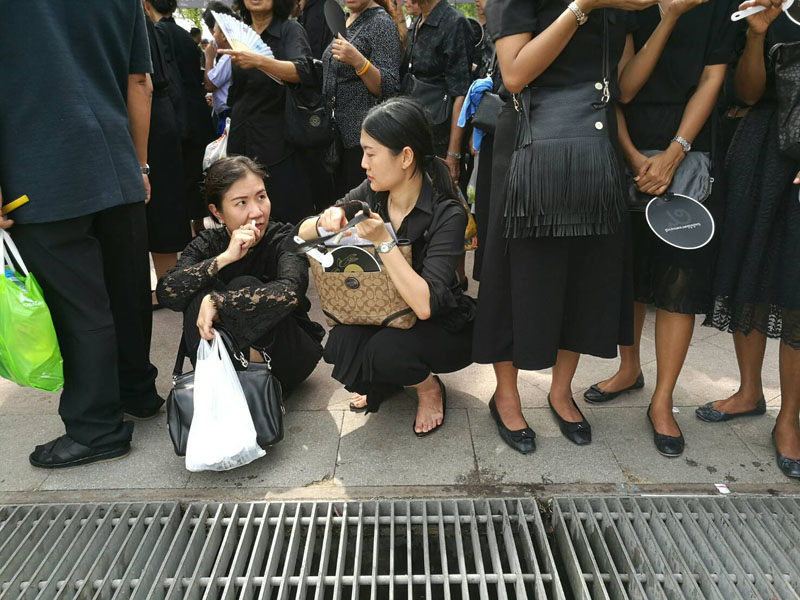
Suratchada Phuengphaophan, a 43-year-old office worker, and her friend Tunyaporn Teerateekanuwong, a banker, looked close to fainting.
“We’re not going to quit,” said a visibly frail Suratchada, who had arrived at 5am to the Sanam Luang and by 1pm had spent eight hours exposed to the sun.
Still, as they sniffed herbal inhalers and squatted, they admitted the line ahead was just daunting. They hoped to make it in before the throne hall closed at 9pm but could not be sure.
Suratchada Phuengphaophan, a 43-year-old office worker, and her friend Tunyaporn Teerateekanuwong, a banker, looked close to fainting Saturday at the Grand Palace in Bangkok.
A plan to hand out tickets was abandoned early in the morning as officials decided the logistics of it became too complicated.
Tunyaporn said that as the late King had worked tirelessly for the people, she would’t give up.
“I didn’t expect it to be this long, however,” she said.
Surachada complained some were cutting in line and hoped it would be better organized in the future.
Things were generally better organized two weeks after the passing of the King. Siam Cement Group constructed clean toilets with wash basins and soap for not just men and women but for people with disabilities as well.
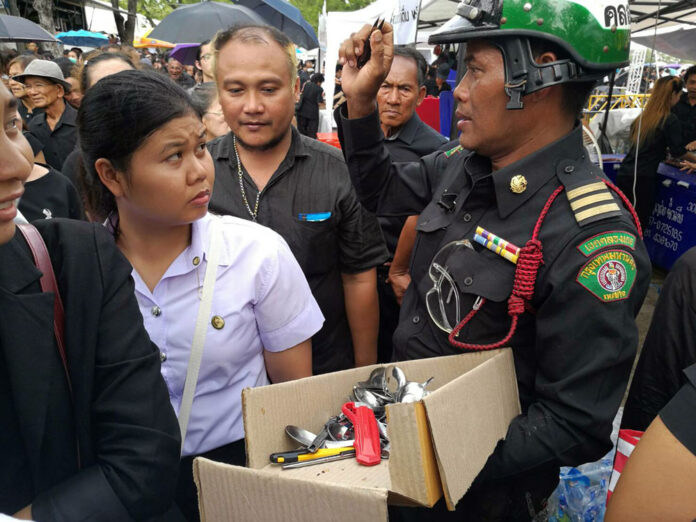
Security was tight with knives, cutters and even metal eating utensils such as forks confiscated.
Mourners on Saturday outside the Grand Palace in Bangkok.
Free food, drinks and medical booths including psychiatrists were available and more permanently situated in various booths, including one run by soldiers serving directly under the heir apparent, Crown Prince Vajiralongkorn.
But this was the first day commoners could pay their respects inside the throne hall, where the royal urn and coffin are kept. No officers seemed to know if all those waiting in line would get a chance to enter the palace by 9pm.
Seated near the Wiset Chaisri Gate on the northwest side of the palace, a female military officer reminded the 100-strong mourners entering that no pictures were allowed inside and woman wearing trousers, even if black, would not be allowed in.
By 2pm, another officer predicted many would not make it inside.
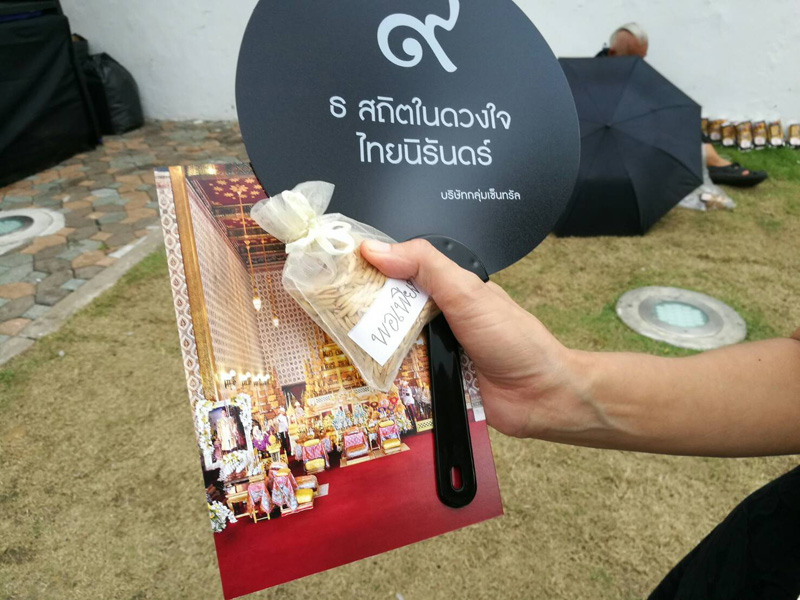
A mourner who made it inside the palace to pay respects to the Late King shows the commemorative items received on Saturday in Bangkok.
Over at the Thewa Bhirom Gate, Naripat Kiewthon emerged from the palace with her four family members. She queued at 4am.
“It was worth it,” said the woman, as she showed a tiny plastic envelope containing a commemorative grains of unhusked rice given to each mourner as a memento.
It was just before 4pm when rain began to patter lightly, but none appeared ready to give up. The line was long. Yet some said they would just come back if they didn’t make it in today.
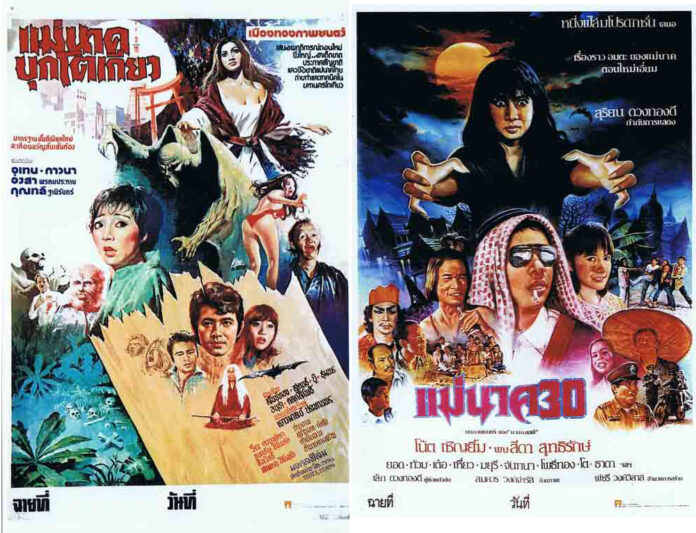
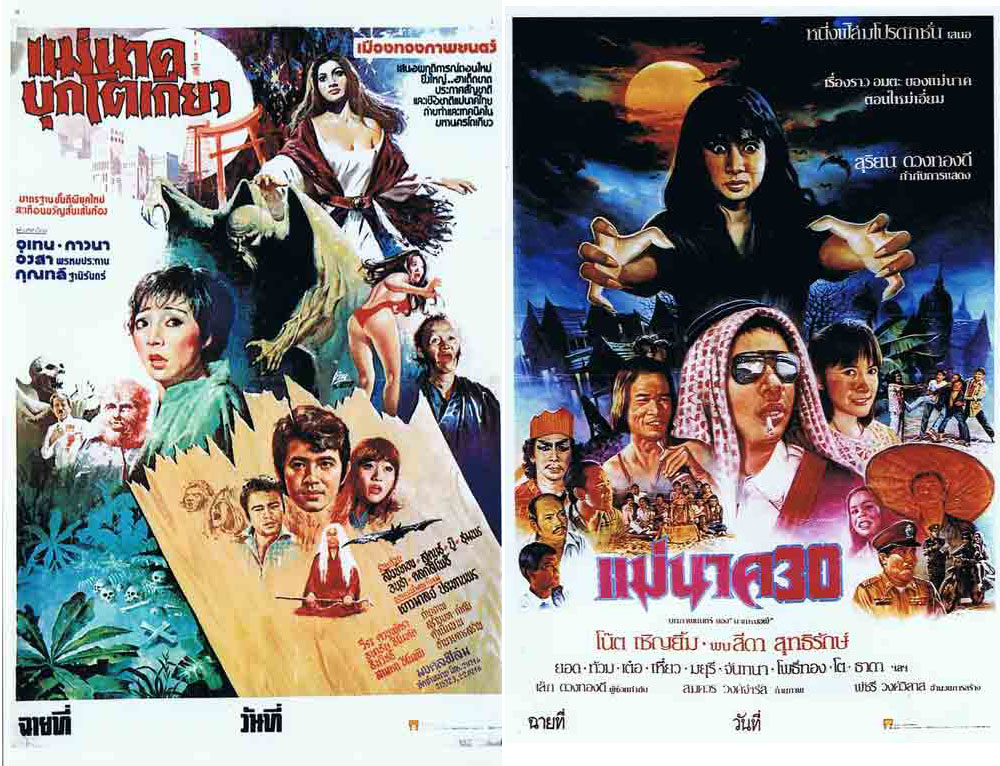
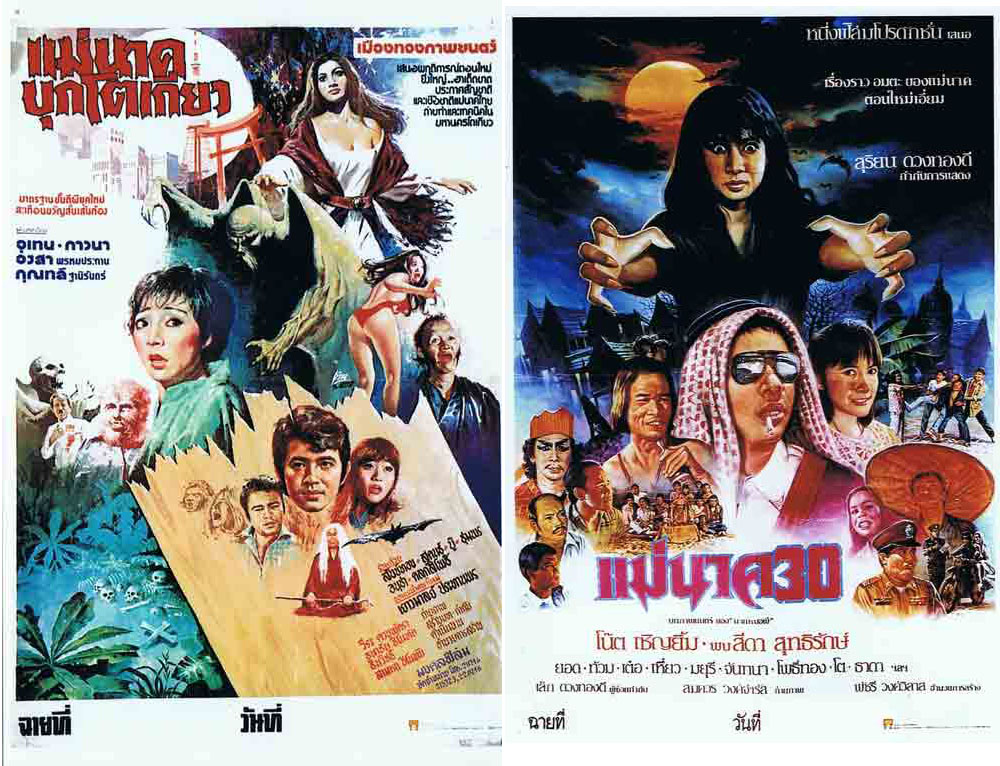
‘Mae Nak Invades Tokyo’ (1976), at left, and a self-aware turn in 1987’s ‘Mae Nak 30’
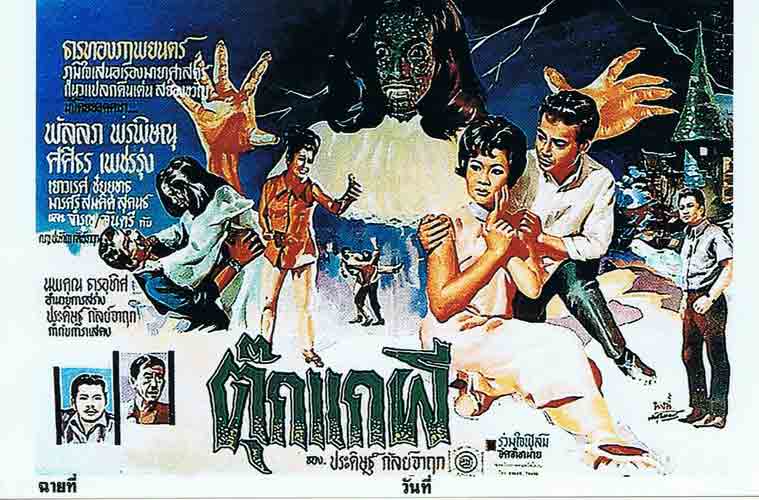
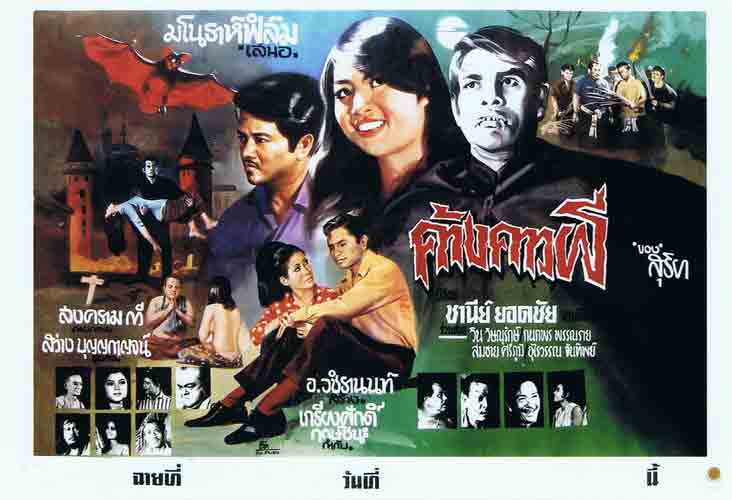
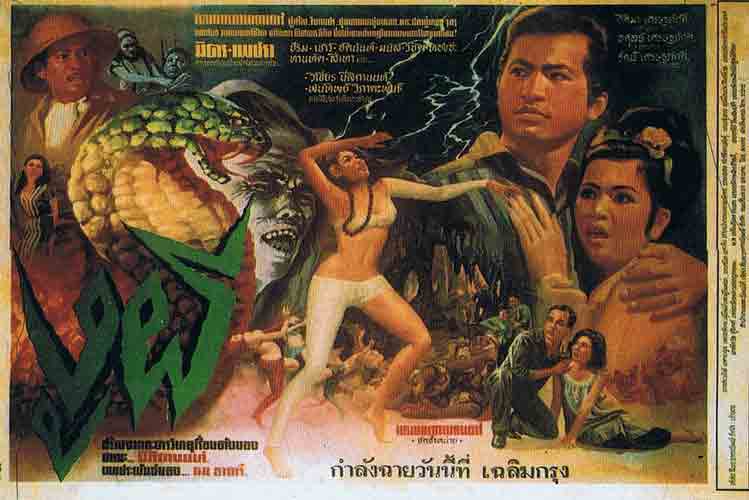
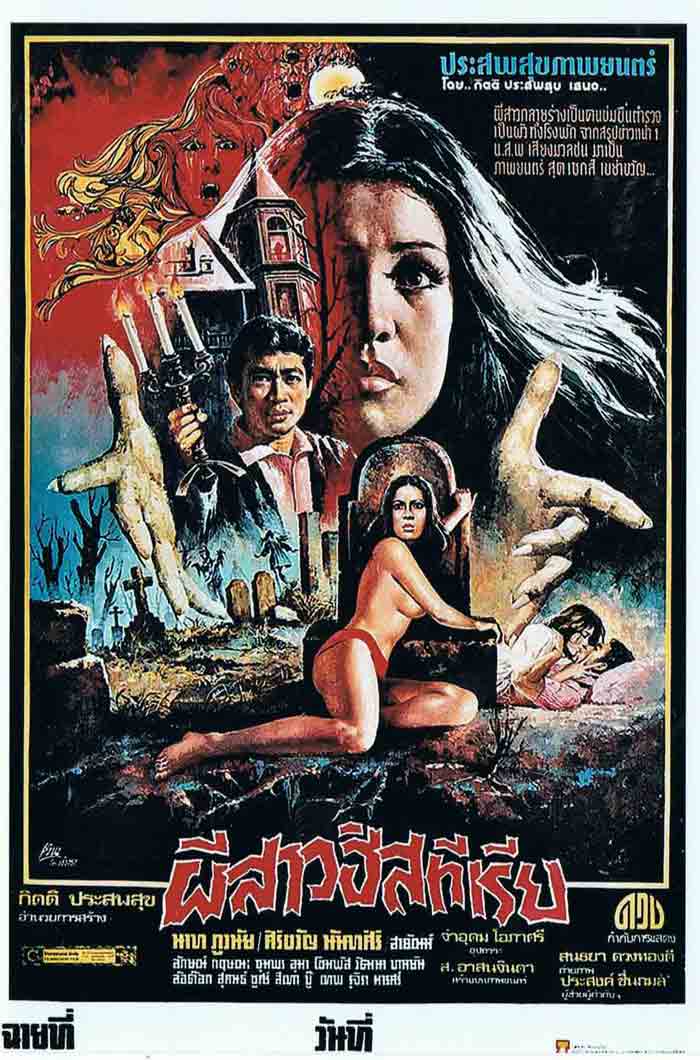
BANGKOK — Thai ghosts uniquely blend traditional beliefs, superstition and Buddhism. For as long as there has been film, this national obsession has made its way onto celluloid in countless horror movies popular at home and abroad.
Equally unique are the posters that bombastically promote them with fear, humor and sex from the classic, hand-painted era to today’s Photoshop techniques.
To get ready for Halloween, here are some of the spookiest movie posters for a proper education on the most popular Phi (ghost) in the media, including some reimagined from Hollywood. (Scroll to end for full interactive gallery.)
“Pee Mak kaaaaa,” Mae Nak, that most enduring ghost of pop culture, calls her husband from beyond death. In its many versions on screens big and small, the story follows Mae Nak’s undying love for her husband, who is drafted and sent to war. She dies during labor but continues waiting with their little baby. The horror story is thought to be based on real events, and pilgrims can find a shrine to Mae Nak at Wat Mahabut in Soi On Nut 7.
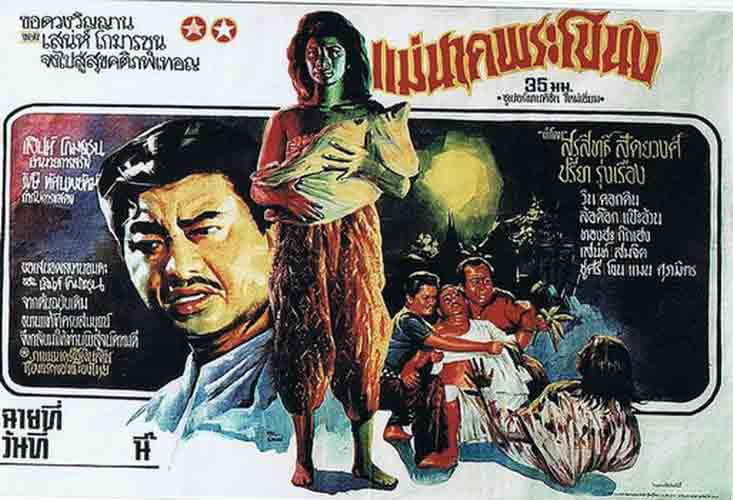
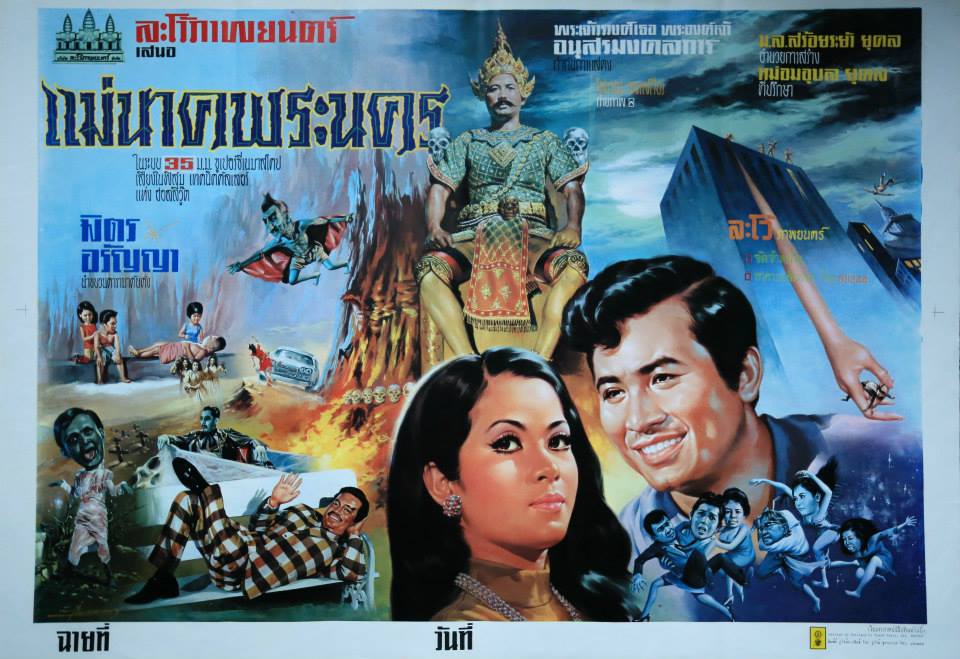
In 1936, “Nang Nak Phra Khanong” wasn’t just the first Mae Nak film, it was the first Thai horror film period. It was more memorably remade 23 years later in 1959, in Mae Nak Phra Khanong,” which made Preeya Rungruang a superstar forever associated with the role.
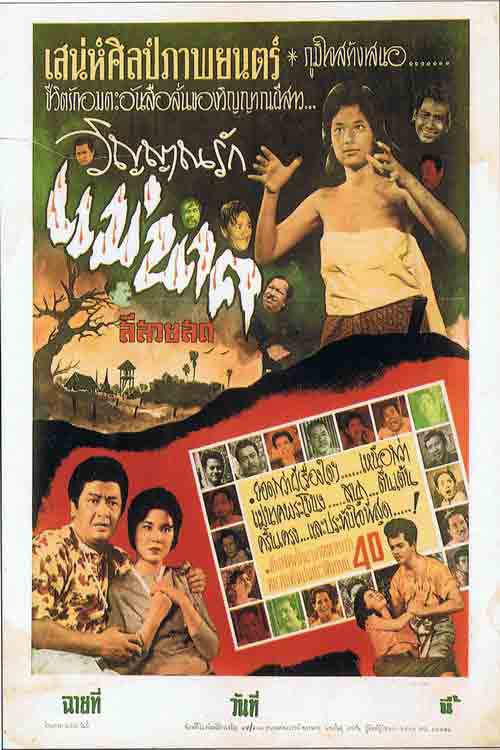
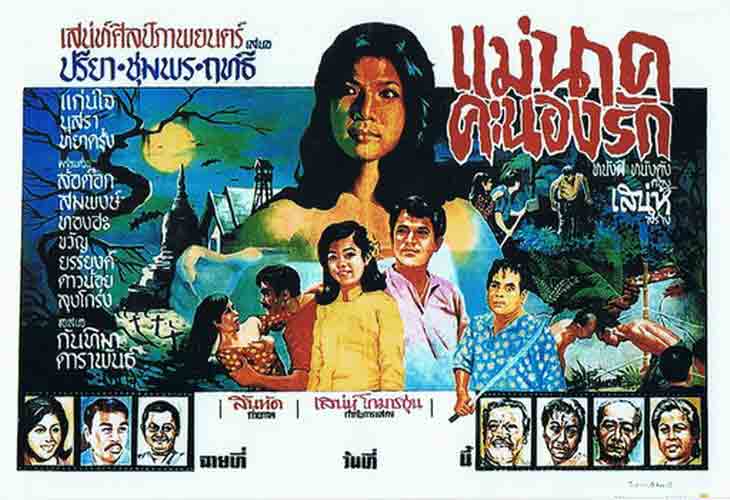
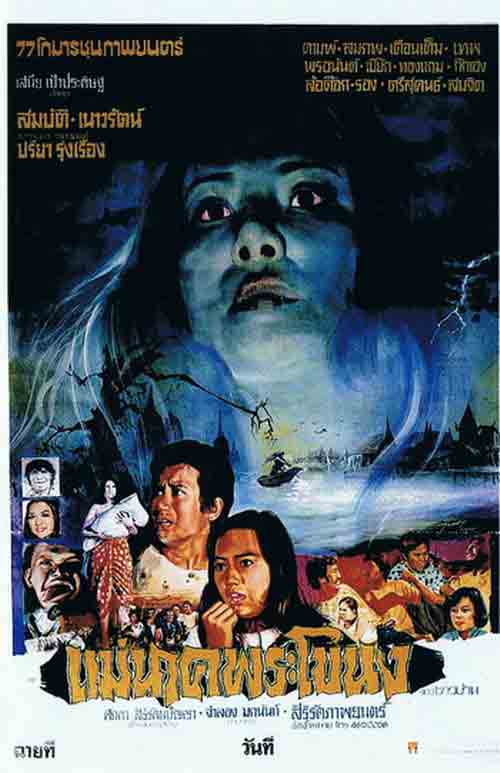
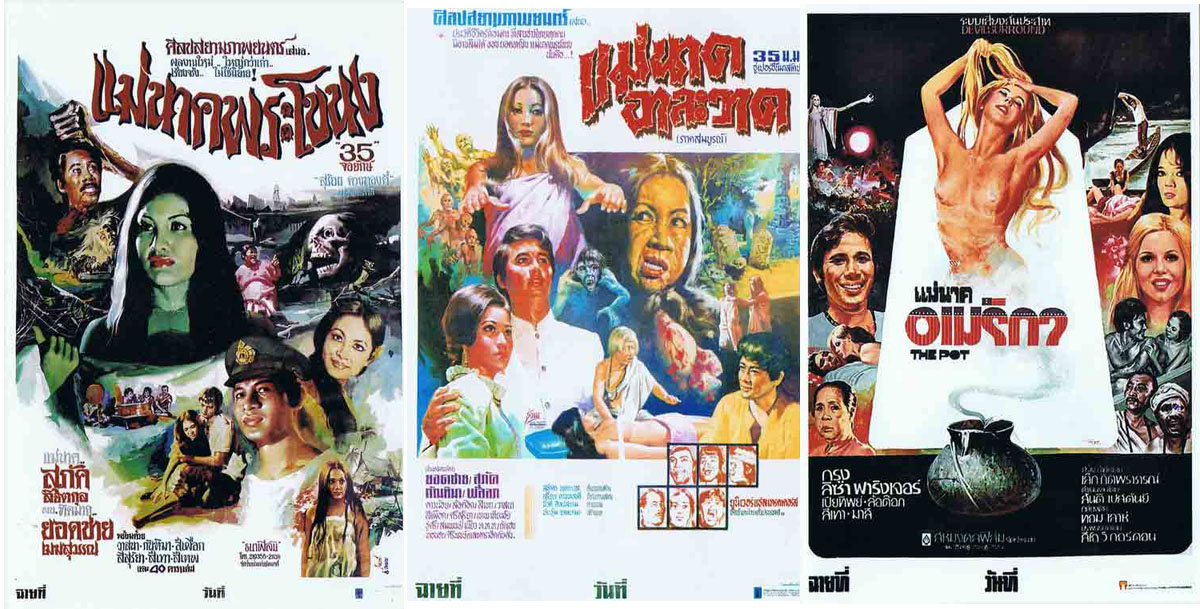
Mae Nak Phra Khanong” 1959 starring Preeya Rungruang.Preeya Rungruang reprised the role in 1962’s ‘Vinyan Rak Mae Nak Phra Khanong (Mae Nak Phra Khanong’s Loving Spirit)’‘Mae Nak Kanong Rak (Mae Nak’s Wild Love)’ in 1968 saw Preeya Rungruang return to the role a third time.Preeya Rungruang’s fourth and final outing as Mae Nak in 1978’s ‘Mae Nak Phra Khanong’In 1970, Mae Nak was back in ‘Mae Nak Phra Nakhon,’ which starred legendary actors Mitr Chaibancha and Aranya Namwong.Mae Nak was too big to keep in Thailand. She went abroad as seen in these posters, including 1975’s “Mae Nak America” aka “The Pot,” with Lisa Farringer as Mae Nak.‘Mae Nak Invades Tokyo’ (1976), at left, and a self-aware turn in 1987’s ‘Mae Nak 30’Nak Today: Critics approved of 1999’s ‘Nang Nak,’ at left, but in 2013 it was audiences that made ‘Pee Mak Phra Nakhon’ break box office records to become the highest grossing movie at the time.
Pop
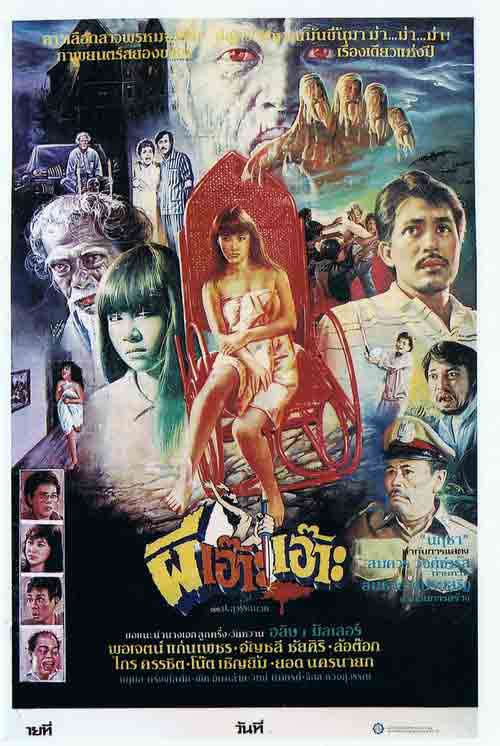
Pop is also a popular Phi known its appetite for gore. Pop has appeared in many films, most notably the Baan Phi Pop (Phi Pop’s House) series that has seen many installments – 15 to be exact – since 1989 when Nattanee Sitthisaman first starred as Pop Yip, a woman possessed by a vicious female, gut-munching spirit.
The original 1989 ‘Baan Phi Pop (Phi Pop’s House)’Then ‘Baan Phi Pop (Phi Pop’s House)’ Nos. 6 & 7. In the latter 1992 film, the ghost goes to Preah Vihear Temple.No. 10 at left and ‘Baan Phi Pop Reformation,’ the latest installment from 2011
Krasue
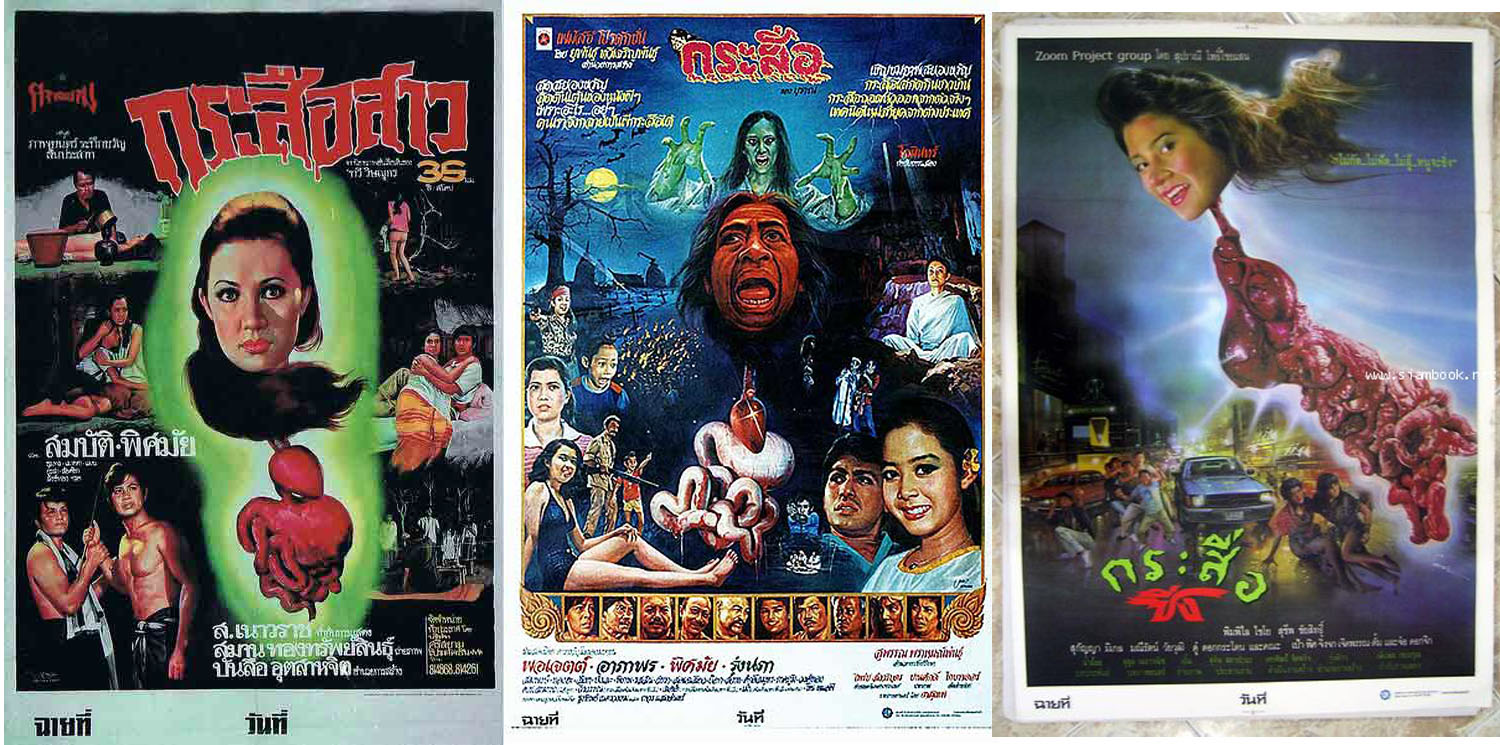
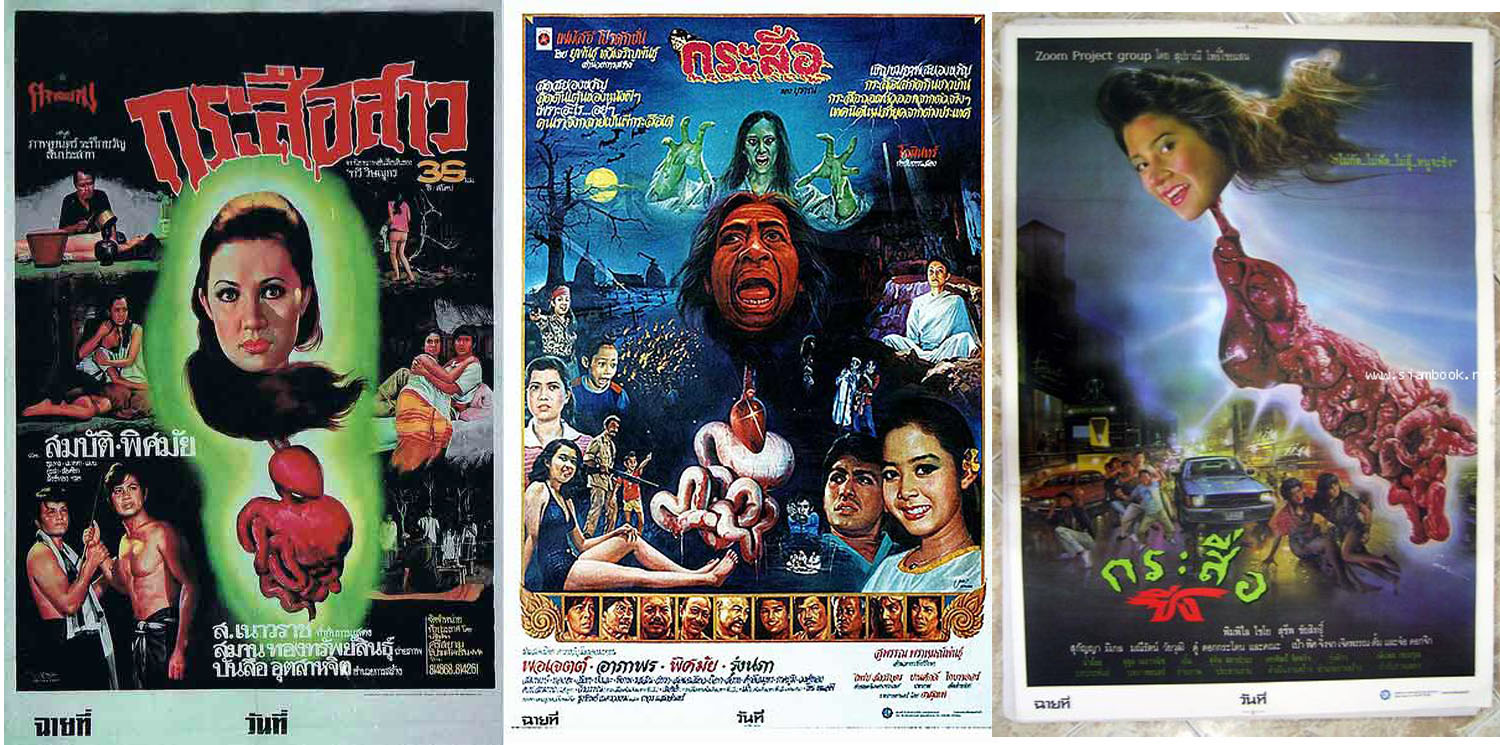
A woman’s head floating above a bundle of organs would be a striking sight anywhere, and in Thailand Krasue is another iconic ghost known to all for roaming around at night in a quest to find raw meat and filth to chow down on. Filmmakers can’t decide whether she is scary or sweet.
From left, ‘Krasue Sao (Ghosts of Guts Eater)’ (1973), ‘Krasue’ (1982) and ‘Krasue Sing (Speedy Krasue)’ (1990).‘Krasue Krahailueat (Bloodthirsty Krasue)’ (1995), at left, and ‘Krasue Valentine’ (2006).
Ghost vs. Ghost
Sometimes ghosts fight one another.
From left, ‘Krasue Bites Pop’ (1990), ‘Mae Nak Meets Phi Pop’ (1992) and ‘Krasue Fights Pop’ (2009).
Ghost Animals
Ghosts can take animal form too, be it snake, gecko, bat, tiger or crocodile.
Sexy Ghosts
Why not?
‘Phi Sao Hysteria (Hysterical Young Female Ghost)’ (1975)‘Phi Or Or (Teenage Ghost)’ (1984 horror comedy)
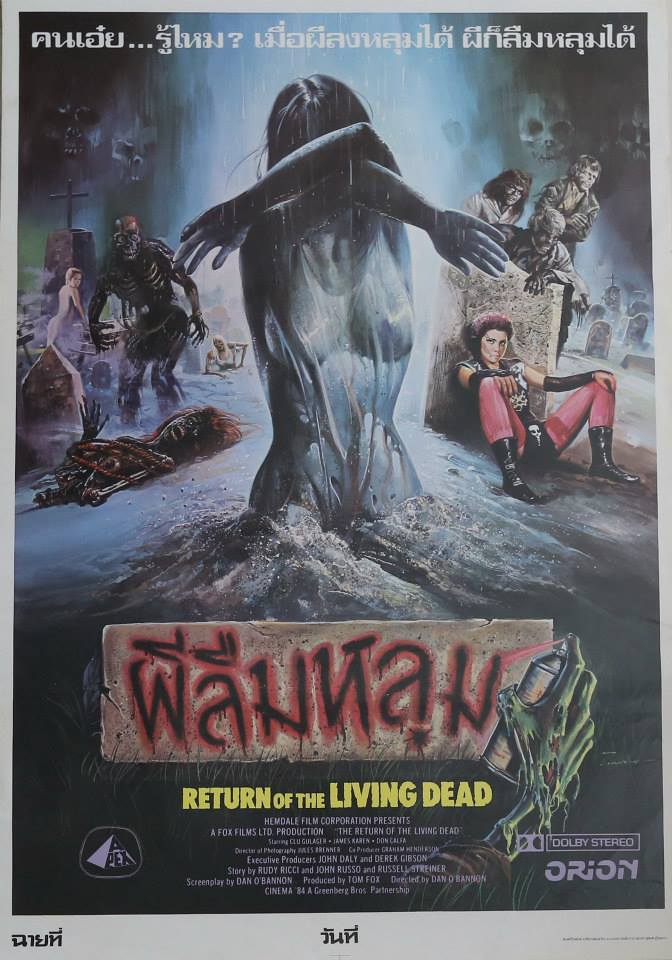
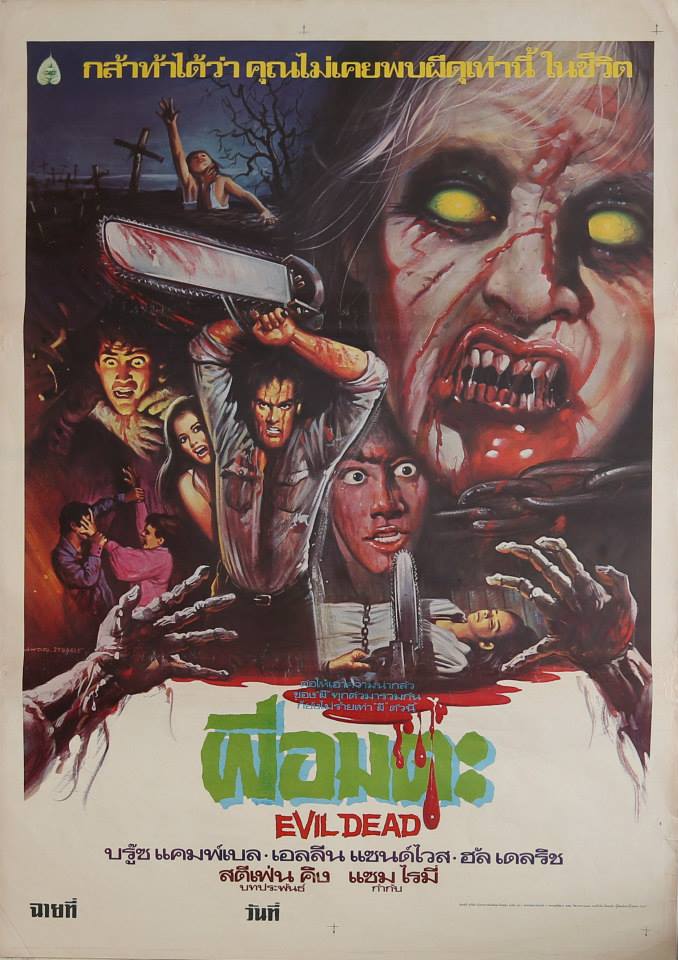
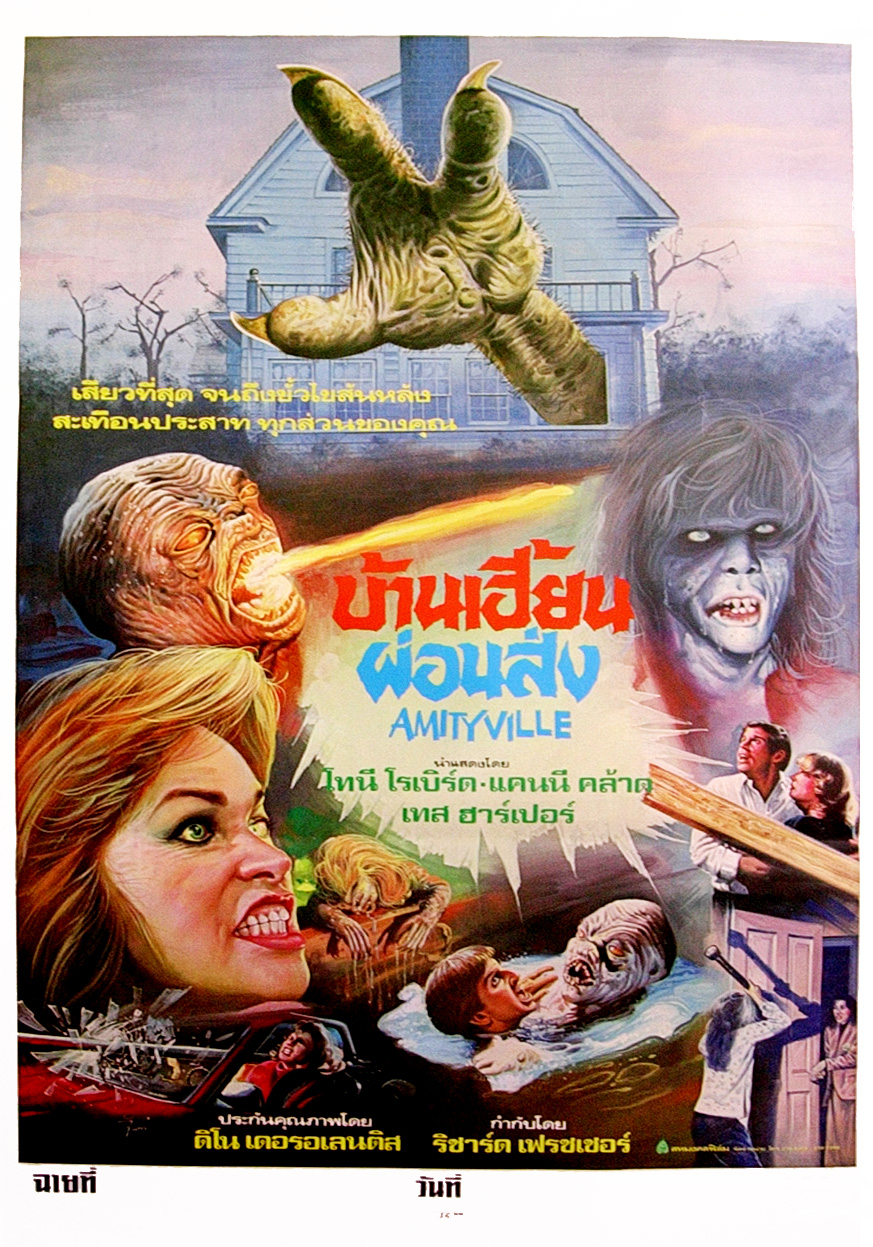
Bonus: Hollywood Horror in Thailand
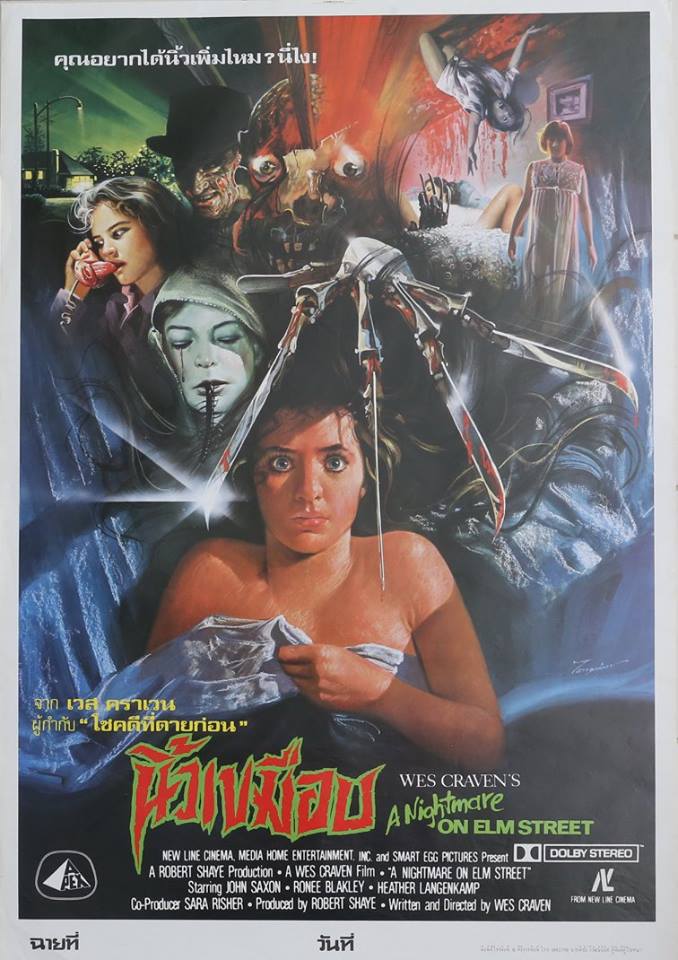
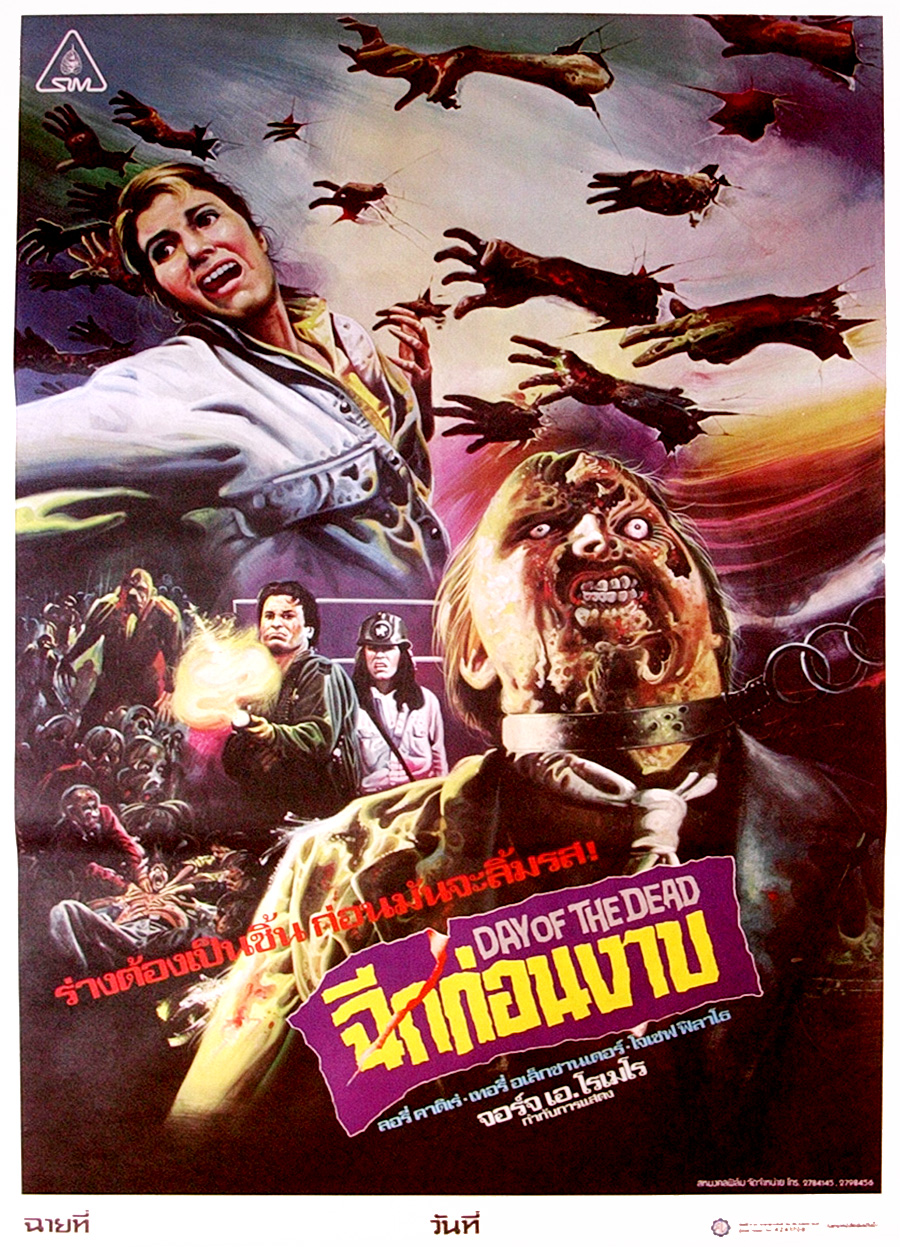
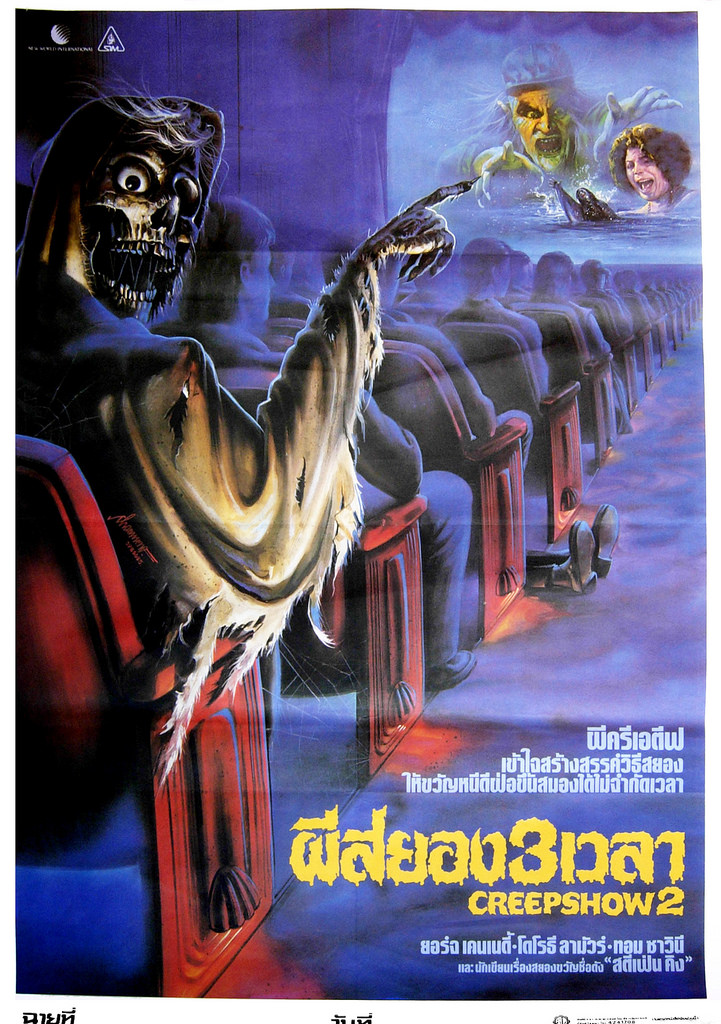
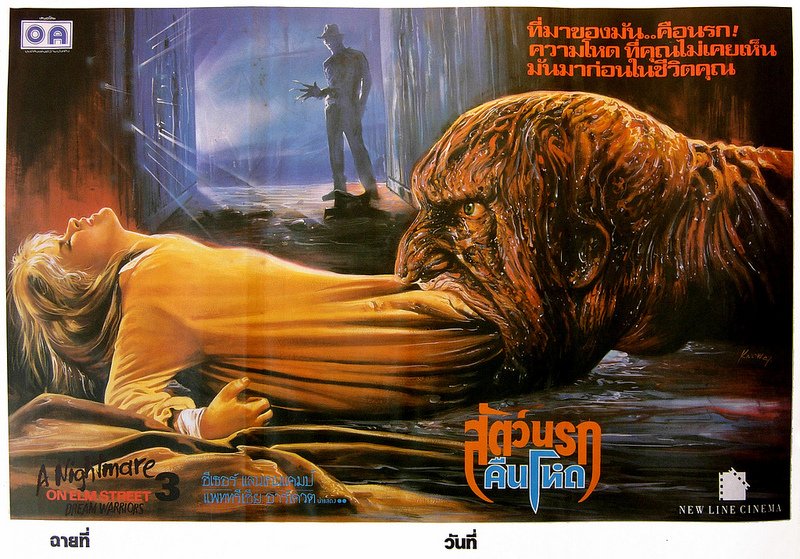
Here are some iconic Hollywood horror films rendered in Thai poster style.
1 of 29
Mae Nak Phra Khanong” 1959 starring Preeya Rungruang.
Preeya Rungruang reprised the role in 1962’s 'Vinyan Rak Mae Nak Phra Khanong (Mae Nak Phra Khanong’s Loving Spirit)'
‘Mae Nak Kanong Rak (Mae Nak’s Wild Love)’ in 1968 saw Preeya Rungruang return to the role a third time.
Preeya Rungruang’s fourth and final outing as Mae Nak in 1978’s ‘Mae Nak Phra Khanong’
In 1970, Mae Nak was back in ‘Mae Nak Phra Nakhon,’ which starred legendary actors Mitr Chaibancha and Aranya Namwong.
Mae Nak was too big to keep in Thailand. She went abroad as seen in these posters, including 1975’s “Mae Nak America” aka “The Pot,” with Lisa Farringer as Mae Nak.
‘Mae Nak Invades Tokyo’ (1976), at left, and a self-aware turn in 1987’s ‘Mae Nak 30’
Nak Today: Critics approved of 1999’s 'Nang Nak,' at left, but in 2013 it was audiences that made 'Pee Mak Phra Nakhon' break box office records to become the highest grossing movie at the time.
The original 1989 ‘Baan Phi Pop (Phi Pop’s House)’
Then ‘Baan Phi Pop (Phi Pop’s House)’ Nos. 6 & 7. In the latter 1992 film, the ghost goes to Preah Vihear Temple.
No. 10 at left and 'Baan Phi Pop Reformation,' the latest installment from 2011
From left, ‘Krasue Sao (Ghosts of Guts Eater)’ (1973), ‘Krasue’ (1982) and ‘Krasue Sing (Speedy Krasue)’ (1990).
‘Krasue Krahailueat (Bloodthirsty Krasue)’ (1995), at left, and ‘Krasue Valentine’ (2006).
From left, ‘Krasue Bites Pop’ (1990), 'Mae Nak Meets Phi Pop' (1992) and ‘Krasue Fights Pop' (2009).
'Phi Sao Hysteria (Hysterical Young Female Ghost)' (1975)
UNITED NATIONS — The United Nations paid tribute to King Bhumibol Adulyadej on Friday with a moment of silence and speeches in the General Assembly Hall.
Secretary General Ban Ki-moon remembered the monarch who died Oct. 13 after ruling for 70 years as a visionary and humanitarian who stabilized Thailand during times of political turmoil and tensions.
Ban also praised Bhumibol’s commitment to sustainable development, noting the king was awarded the first United Nations Human Development Lifetime Achievement Award in 2006.
“The United Nations recognizes and pays tribute to the remarkable life that His Majesty King Bhumibol led and joins all those who loved the revered king in offering heart-felt condolences,” Ban said.
Speakers from Niger, Kuwait, Georgia, Chile, and the U.K. also spoke in Bhumibol’s honor. The United States spoke as the U.N. host country, while a representative of Thailand concluded the round of speeches.
U.S. Ambassador Samantha Power remembered that the King’s parents met in the United States and that he was born in Cambridge, Massachusetts.
“His majesty only lived there as an infant, but his presence is still very much felt in Cambridge,” Power said, pointing out there is a square named for him in the Massachusetts city. “Walking through King Bhumibol Square, it is not uncommon to see Thai people come to pay homage.”
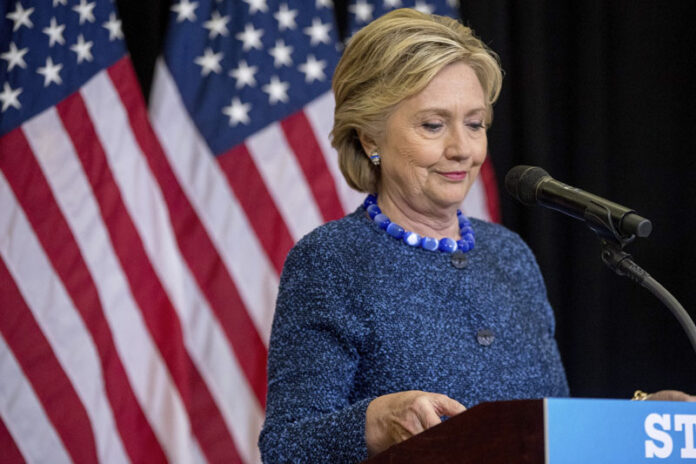
Democratic presidential candidate Hillary Clinton pauses while speaking Friday at a high school in Des Moines, Iowa. Photo: Andrew Harnik / Associated Press
WASHINGTON — The FBI is investigating whether there is classified information in new emails uncovered during the sexting investigation of disgraced former congressman Anthony Weiner, the estranged husband of one of Hillary Clinton’s closest aides.
FBI Director James Comey told Congress in a letter that the emails prompted investigators to take another look at whether classified information had been mishandled, which had been the focus of its recently closed, criminal probe into Clinton’suse of a private email server. Comey couldn’t guarantee that the latest focus of the investigation would be finished before Election Day.
Clinton said Friday that “the American people deserve to get the full and complete facts immediately. She urged the FBI to “explain this issue in question, whatever it is, without any delay.”
“Let’s get it out,” she said.
Comey did not provide details about the emails, but a U.S. official told The Associated Press that the emails emerged through the FBI’s separate sexting probe of Weiner, who is separated from Clinton confidant Huma Abedin.
She served as deputy chief of staff at the State Department and is still a key player in Clinton’s presidential campaign. The two separated earlier this year after Weiner was caught in 2011, 2013 and again in 2016 sending sexually explicit text messages and photographs of himself undressed to numerous women.
Federal authorities in New York and North Carolina are investigating online communications between Weiner and a 15-year-old girl. The U.S. official was familiar with the investigation but was not authorized to discuss the matter by name and spoke on condition of anonymity.
The disclosure came less than two weeks before the presidential election and thrust a political liability for Clinton back into the headlines that her campaign thought had been resolved and had begun to recede from the minds of voters. The FBI said in July its investigation of Hillary Clinton’s private email server was finished.
Comey stressed in his letter that the FBI could not yet assess “whether or not this material may be significant,” or how long it might take to run down the new investigative leads.
“In connection with an unrelated case, the FBI has learned of the existence of emails that appear to be pertinent to the investigation,” Comey wrote. “I agreed that the FBI should take appropriate investigative steps designed to allow investigators to review these emails to determine whether they contain classified information, as well as to assess their importance to our investigation.”
Clinton, in a brief statement to reporters Friday evening, noted: “The director himself has said he doesn’t know whether the emails referenced in his letter are significant or not. I’m confident whatever they are will not change the conclusion reached in July.”
It was unclear what the emails contained, who sent them, or what connection they might have to the yearlong investigation the FBI closed in July without recommending criminal charges. The FBI probe focused on whether Clinton sent or received classified information using a server in the basement of her New York home, which was not authorized to handle such messages. Abedin was interviewed by the FBI as part of its investigation.
Comey said in July that his agents didn’t find evidence to support a criminal prosecution or direct evidence that Clinton’sprivate server was hacked.
Matthew Miller, a former chief spokesman for the Justice Department, was dismayed by the timing of Comey’s letter.
“Longstanding DOJ and FBI practice is you don’t say anything publicly close to an election that can possibly influence that election,” Miller said.
Comey, who has talked often about the FBI’s need to be accountable to the public, promised extraordinary transparency about the investigation and during intervening months has authorized the release of investigative files from the case, which are normally kept confidential.
That stance also left Comey, a career federal prosecutor who has served under both Republican and Democratic administrations, open to criticism from leaders in both parties that he was trying to influence the outcome of the presidential race.
Clinton campaign supporters were already suggesting the FBI director was putting a thumb on the scale. Had he waited until after Nov. 8 to announce the discovery of the new emails, however, Comey would surely have faced criticism for sitting on major news until after the new president had been selected.
In an internal email to FBI employees, Comey wrote: “Of course, we don’t ordinarily tell Congress about ongoing investigations, but here I feel an obligation to do so given that I testified repeatedly in recent months that our investigation was completed. I also think it would be misleading to the American people were we not to supplement the record.” The Associated Press acquired the email Friday night.
State Department spokesman Mark Toner said the department learned about the FBI letter from news reports and did not get any notification from the FBI. Toner pledged the department would “cooperate to the full extent that we can.”
Speaking at a Clinton rally in Florida, President Barack Obama also steered clear of the issue. White House spokesman Eric Schultz declined comment beyond reiterating Obama’s continuing support for Clinton.
The ranking Democrat on the Senate Intelligence Committee, Sen. Dianne Feinstein, said Comey’s letter was particularly troubling because it left so many questions unanswered.
“Without knowing how many emails are involved, who wrote them, when they were written or their subject matter, it’s impossible to make any informed judgment on this development,” said Feinstein, D-Calif. “The FBI has a history of extreme caution near Election Day so as not to influence the results. Today’s break from that tradition is appalling.”
Republicans immediately pounced on the news, hoping to shake up a presidential race where most polls appear to show Republican nominee Donald Trump lagging well behind Clinton.
House Speaker Paul Ryan said Clinton has “nobody but herself to blame.”
“She was entrusted with some of our nation’s most important secrets, and she betrayed that trust by carelessly mishandling highly classified information,” Ryan, R-Wis., said in a statement. “This decision, long overdue, is the result of her reckless use of a private email server, and her refusal to be forthcoming with federal investigators. I renew my call for the Director of National Intelligence to suspend all classified briefings for Secretary Clinton until this matter is fully resolved.”
Speaking to cheering supporters at a rally in New Hampshire, Trump used Comey’s new letter to attack Clinton.
“We must not let her take her criminal scheme into the Oval Office,” said Trump, who has pledged to “lock up” his political rival if elected. “Perhaps finally justice will be done.”
Prior to seeking public office as a Republican, Trump was a supporter of Clinton’s past campaigns for president and senator. Records show the New York billionaire also contributed at least $4,300 to former Rep. Weiner’s Democratic campaigns.
U.S. Representative Tammy Duckworth, D-Ill., appears at a brunch in Springfield, Illinois. Duckworth is now a Democratic candidate for the U.S. Senate in the November 2016 general election. Photo: Seth Perlman / Associated Press
CHICAGO — Illinois Republican U.S. Sen. Mark Kirk apologized Friday for mocking his Democratic rival’s immigrant background and her claim that her family’s military service dates back to the Revolution – comments that drew wide criticism and threatened an already difficult re-election campaign.
“Sincere apologies to an American hero, Tammy Duckworth, and gratitude for her family’s service,” Kirk wrote in a Twitter post.
During a debate Thursday evening, U.S. Rep. Tammy Duckworth said her family has “served this nation in uniform going back to the Revolution.”
Kirk responded that he had forgotten that the congresswoman’s “parents came all the way from Thailand to serve George Washington.”
Duckworth, an Iraq War veteran who lost both legs when the Black Hawk she was piloting was shot down in 2004, was born in Bangkok. Her mother, who is of Chinese descent, was born in Thailand. Duckworth has said her father first went to Southeast Asia while serving with the Marines in Vietnam.
Kirk’s remark was greeted mostly by silence in the auditorium of the University of Illinois in Springfield on Thursday evening. Elsewhere, there were quick calls for him to apologize. The Democratic Senatorial Campaign Committee immediately called the comment “offensive, wrong and racist.”
Duckworth, the first Asian-American congresswoman from Illinois, later tweeted a photo of herself with her parents, including her father in uniform displaying his medals. Her tweet says: “My mom is an immigrant and my dad and his family have served this nation in uniform since the Revolution.”
Kirk left the debate Thursday night without speaking to reporters. Campaign manager Kevin Artl said Thursday the senator has called Duckworth “a war hero in his commercials and he commends her family’s service.”
Kirk’s campaign said the senator tried to contact Duckworth by phone to apologize Friday before posting his apology on Twitter. Duckworth’s campaign confirmed he had reached out, but it was unclear whether the candidates spoke.
Kirk’s comments drew heavy scorn across social media. Democratic presidential nominee Hillary Clinton posted on Twitter that she is thankful for Duckworth’s and her family’s service, adding: “It’s really not that hard to grasp, Mark Kirk.”
Donald Trump’s campaign manager also took the opportunity to jab at Kirk, who earlier this year withdrew his support for the GOP presidential nominee and has been a vocal critic.
“The same Mark Kirk that unendorsed his party’s presidential nominee and called him out in paid ads? Gotcha. Good luck,” Kellyanne Conway posted on Twitter late Thursday.
Kirk, who suffered a stroke in 2012 and returned to work one year later, is seen as one of the Senate’s most vulnerable Republican incumbents. The first-term senator from the Chicago suburb of Highland Park is running in a state that leans heavily Democratic, particularly in presidential election years.
Kirk has worked to distance himself from Trump and the GOP, saying he is an independent voice who can work with Democrats to get things done. He often notes his “F” rating from the National Rifle Association and that he broke with his party to call for hearings on President Barack Obama’s pick for the Supreme Court.
But Kirk has complicated his own re-election bid with his tendency to make off-color statements. In August, he said Obama was acting like the “drug dealer in chief” when the U.S. made a $400 million payment to Iran contingent on the return of U.S. prisoners.
He apologized in 2015 after referring to South Carolina U.S. Sen. Lindsey Graham, who’s unmarried, as a “bro with no ho.”
During his first bid for Senate in 2010, Kirk acknowledged that he had exaggerated some of his own military record, including stating that he came under enemy fire while flying reconnaissance missions in Iraq as a Navy intelligence officer.
Democrats consider Duckworth’s success on Election Day one of the keys to reclaiming a majority in the chamber. The second-term congresswoman from the Chicago suburb of Hoffman Estates has a comfortable lead in the most recent polls, but Kirk says the race is closer than people think.
Ubiquitously absent from televisions during the one-month period of compulsory mourning for His Majesty King Bhumibol Adulyadej are prime-time soap operas.
Two weeks on, some are already longing for the latest episode of their favorite soaps. What’s called lakorn may be simplistic, lack character development or simply crude, but there are reasons millions of Thais are fond of them.
For tens of millions, life is a struggle. Real life is brutal, complicated and difficult enough that when people come home, they want something simple, idealized and easy to understand. They love the fantasy, the better-than-real protagonists with their good looks and beauty, Eurasian or not.
Soap operas are addictive like junk food, but like other addictions, can be detrimental to your health.
The problem is, a good number of people are so immersed in these dramas they see life and politics through the same lens as things to be oversimplified and followed passively.
Politics becomes a struggle of good vs. evil populated by the same paper-cut characters from their favorite TV dramas. The plot involves just two clearly identified sides, and if you are on the “wrong” side, you must be on the side of the villains. The Good People are good; the Bad People bad.
This gives way to strong emotion and binary extremes of love or hate for certain public figures, to an excess.
In this simplistic understanding of politics and society, things are never complicated and always clear cut. Never mind if, from time to time, it becomes so apparent things are rarely so simple.
An example is the oft-repeated insistence that “every and each Thai” loves His Majesty the Late King. I have heard this endlessly repeated on TVs during the past two week, and the people who insist on this as a truism range from educated middle class to rural and urban poor. They all say the same thing, despite the fact that on the very same outlets report about the military government’s heightened campaign to deal with those who allegedly insult the late King.
Real society is not that simple but more complex. Thais’ reactions to the death of the King range from the deep and genuine grief expressed around the Grand Palace to the extreme schadenfreude exhibited by people like Paris-based, anti-monarchist Aum Neko. Whether one agrees or disagrees, all of them are Thais, however, and doing away with big words and gross generalizations would go a long way in restoring reality and sanity.
Seeing things in black-and-white terms doesn’t prepare people handle a complex and pluralistic society.
So while the military government wants those who allegedly insulted the late King extradited from seven countries, the regime’s police chief said Wednesday he would personally pay for one-way plane tickets out of the country for Thais who want to insult the King.
Soap-operatic readings of society also means many think things will be okay as long as they have good leaders in power, and it doesn’t matter if they came to power through illegal means, such as a military coups, and won’t tolerate checks and balances or legal accountability.
Soap operas may be entertaining, but viewing society in their dimensions can only bring about more dramatic disappointment.

































 His trial lasted only nine days.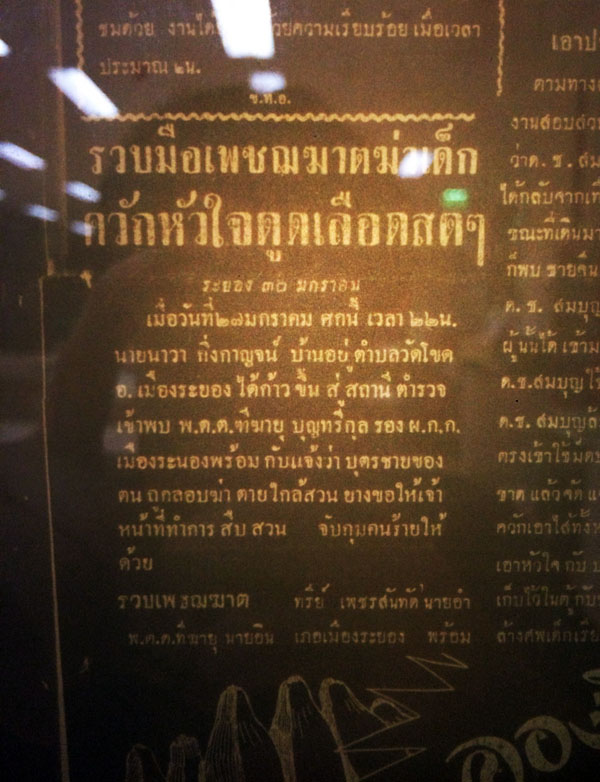











 Politics becomes a struggle of good vs. evil populated by the same paper-cut characters from their favorite TV dramas. The plot involves just two clearly identified sides, and if you are on the “wrong” side, you must be on the side of the villains. The Good People are good; the Bad People bad.