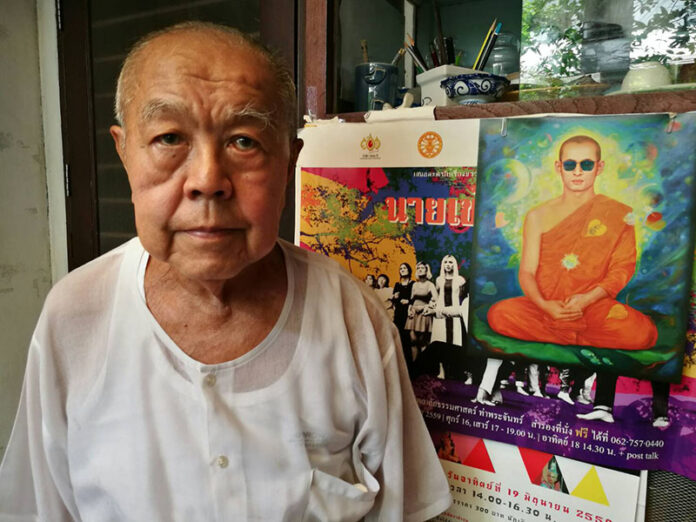
Historian Sulak Sivaraksa before a painting of King Bhumibol on Oct. 26, 2016, at his home in Bangkok's Bang Rak district.
BANGKOK — For 100 days, the old man will wear white, even at home. He will observe basic Buddhist precepts and avoid meat, all in honor of His Majesty King Bhumibol Adulyadej, who passed away two weeks ago.
This is Sulak Sivaraksa, however, a noted royalist scholar for whom criticism is inseparable from his loyalty to the monarchy, a position that has gotten him into trouble time and again.
In fact much of what Sulak had to say during the course of a Wednesday interview about the legacy of King Bhumibol cannot be published. That’s due to the same lese majeste law he’s been charged with more than once, a law that’s been so liberally applied beyond its statutory scope it now effectively prohibits any discussion of the monarchy short of adulation.
Not that Sulak is too worried. At 83, he beat the rap before in 1995, when he managed to convince a court to clear him of wrongdoing after a four-year legal battle. In 2014 he was accused again for suggesting an ancient elephant battle probably didn’t go down as remembered. An investigation stemming from charges filed over a year ago is ongoing.
Put simply, Sulak is that very rare breed of Thai royalist that believes loyalty demands dissent.
As for his legal challenges, it hasn’t hurt that he enjoys some privilege as a member of the elite.
With a backdrop of classical Western music and not the royal compositions prevalent now during the period of mourning, Sulak said he was thankful the royal physicians didn’t artificially prolong the life of the late King, who was suffering from kidney failure and other complications.
“I am grateful that His Majesty didn’t have to suffer,” Sulak said. “I must commend the doctors, but surely [His Majesty’s death] left a hole in my heart.”
Sulak, who is known for critical essays and speeches about the monarchy, praised the late King for what he believed was an intervention to quash his first lese majeste charge in 1984. Yet he was equally critical about the late monarch, who passed away Oct. 13 at 88. Sulak pointed out it’s impossible to properly scrutinize the more than 4,000 royal projects initiated by the King, which he acknowledges were done with good intentions toward his subjects.
“Some of these projects could not be [made] properly accountable,” said Sulak, whose elaboration cannot be published.
Informed that much of what he had to say would likely not be published, Sulak pointed out that the law, Article 112 of the Penal Code, doesn’t protect past monarchs as it is written.
“Legally, Article 112 only applies to the present King. Once he passed away, Article 112 is no longer applicable. But unfortunately, this country doesn’t uphold the spirit of the law. Recently, the Supreme Court convicted a person who defamed King Rama IV.”
As a historian, he said the implication is that history cannot be taught if one cannot honestly assess Kings of the past.
“If Article 112 is taken as it stands, then you can criticize the late King Rama the IX legally. And to honor the late King, those in power should also do away with Article 112,” Sulak said.
Despite the King’s own objections to the law, his kingdom has moved in the other direction. More than 60 lese majeste cases have been filed since the May 2014 coup, according to Pirongrong Ramasoota Rananand, a journalism instructor at Chulalongkorn University.
Sulak recited the late King’s opinion on the matter, made in a royal speech in 2005.
“And to honor the late King, those in power should also do away with Article 112, as his late Majesty openly said any case of lese majeste harms him personally and undermines the monarchy,” Sulak said. “If the powers that be really respect the King and honor the King, they should do away with Article 112.
He pointed to wounds which have long festered in silence, such as those traumatized by the Oct. 6, 1976, massacre of students at Thammasat University at the hands of ultra-royalist militias.
“Those who suffered on the 6th of October, many still hold grudges against the King, rightly or wrongly,” he said. “This should be discussed openly, for the benefit of the King and the truth.”
For the sake of the monarchy’s future, he said it must work for the people.
“Do we want the monarchy to be sacred and untouchable or indeed divine?” he said. “Some may wish that … but for most people in the 21st century, the monarchy can only survive if it serves the people.”
“The monarchy must be accountable to the people. It must be strictly under the constitution. The King must be an ordinary person, with a sense of humor, especially at his own expense, otherwise the monarchy will not last.”
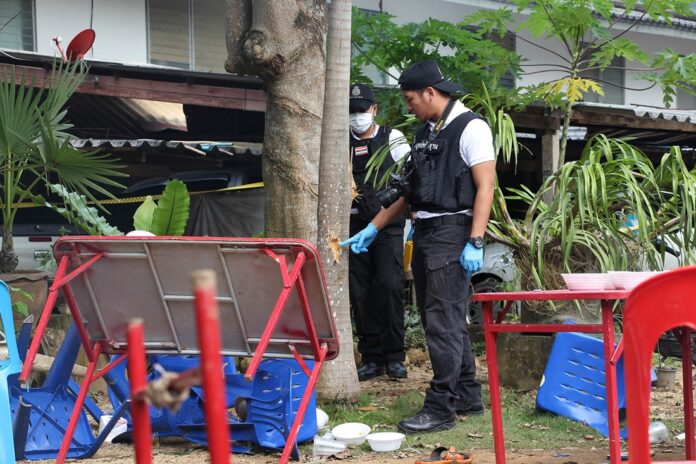
A forensic police officer on Wednesday examines a bullet hole allegedly left by Cpl. Hassapol Soprakon’s assault rifle at Batutamong Police Station.
YALA — When someone opened fire on policemen dining in Yala province, killing two and wounding 16, it wasn’t the separatists who’ve battled security forces there for over a decade, but one of their own, prompting a massive manhunt still underway Thursday.
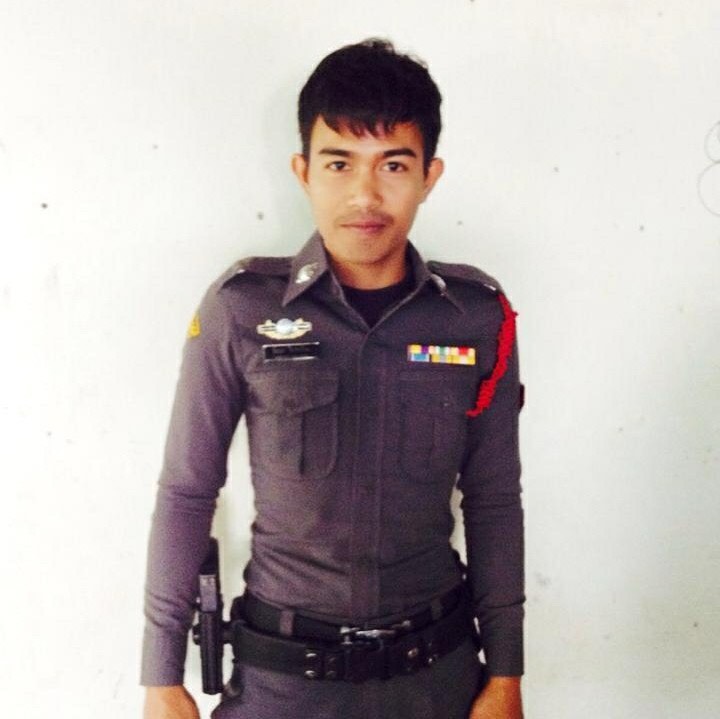
The alleged gunman, Cpl. Hassapol Soprakon, was described by his commanders as a troubled policeman who finally snapped Tuesday night after his supervisors refused his request to be reassigned away from the region where insurgents stage attacks on a near-daily basis.
“We haven’t found him yet, but he turns on his phone sometimes to call his friends, so we have asked them to help convince him to surrender,” Col. Kritsada Kaewchandee, acting commander of the Yala police force, said. “They are telling him to think about his kid.”
Hassapol, 28, is likely still armed with the M-16 assault rifle he used in the shooting rampage two nights earlier. “He’s very dangerous,” Kritsada said.
The shooting took place in the garden of Batutamong Police Station, where policemen and their families were eating and drinking together Tuesday night. Witnesses said they saw Hassapol – who served as a squad leader – retrieve the assault rifle earlier from the armory, but they thought he was heading out on patrol.
A witness, the wife of another officer, also heard Hassapol muttering to himself.
“You damned lot are all so happy right?” Kritsada said he was reportedly heard grousing as he left the building.
Photo of Cpl. Hassapol Soprakon provided by Yala police.
Seconds later, Hassapol discharged his rifle at the policemen and their families, killing two officers and wounding 16 people, including four women. He soon fled the scene.
Kritsada blamed Hassapol’s actions on stress. The policeman had asked to be transferred out of Yala, only to be denied by his supervisors. Kritsada said the commanders only learned recently that Hassapol’s wife back in his home province of Buriram left him for a foreign man, leaving his 4-year-old son in the care of his parents.
“He should have told his commanding officer about his problems, so the commander could solve them,” Kritsada said. “Perhaps they could have moved him back to Buriram.”
Hardship Post
Members of the police force universally dread being posted in the southern border provinces of Pattani, Yala and Narathiwat, where police stations and officers are prime targets for militants fighting for independence from Thailand.
More than 6,500 people are believed to have died in the region since secessionist violence broke out in early 2004.
Kritsada said he sympathized with Hassapol and other officers who want to work somewhere safe “I wanted to move out, too, but my boss asked me to stay and help,” he said with a laugh.
But regulations don’t allow policemen to choose their assignments.
“They don’t have right to transfer themselves, otherwise all of the cops would be gone,” Col. Kritsada said. “It reflects the reality that this area is a dangerous place. Puu Yai (senior bureaucrats) should give importance to this issue.”
In the aftermath of Tuesday night’s rampage on, all police stations in Yala were ordered to ask their officers whether any of them have any stress issue. Anyone who wishes to take days off would have their wishes granted, Kritsada said.
“But some people like to keep their stress secret,” the colonel said. “They’re afraid that if they report their stress, they will be considered unfit for duty and expelled from the force. So he kept it inside. And in the end, it exploded like this.”
BANGKOK — Settle in for another smooth jazz ballad from junta chairman Prayuth Chan-ocha, who just Wednesday dropped his latest single, “Hope and Faith,” a track recorded in advance of His Majesty King Bhumibol’s death two weeks ago.
In addition to his famed motorcycle riding ability and toppling of the previous civilian government, the retired general is known for penning saccharine ballads for the public, such as “Returning Happiness to the People,” the anthem of his regime that played for much of two years on television and radio.
Seeking to again set the tone with his wordsmithing, Prayuth’s newest song “Hope and Faith,” is described by his public relations department as a “gift to the public” to “boost public morale and spirits, so that everyone can get through obstacles together in order to build up the nation.”
“Don’t give up or be shaken, though tragedies obstruct us like thorns,” Sgt. Maj. Pongsathorn Porchit sings. “Combine our powers to get through this, for Thainess.”
Prayuth wrote the lyrics two months ago and the song was then produced by army musicians, apparently for release after the death of His Majesty King Bhumibol at 88.
Col. Sansern Keawkamnerd, junta spokesman, said Thursday morning the junta does not want to discuss the meaning and backstory to the song.
“Hope and Faith,” said to have been written by the retired general himself, was composed and directed by Maj. Surachai Tawinphrai, sung by Sgt. Maj. Pongsathorn and produced by Maj. Gen. Kissada Salika.
Smooth saxophones ease the listener into a piano-backed, easy-listening ballad laid out by the sergeant major’s gentle yet earnest tenor. Consistent with Prayuth’s don’t-dream-it-be-it approach, it invokes cooperation, nationalism, Thai exceptionalism and hope, all backed by equally earnest keyboards.
It’s Prayuth’s third known songwriting effort to date after “Because You’re Thailand” was released in December as a New Year gift to the nation.
Here’s our unofficial translation:
“Hope and Faith”
Lyrics by Gen. Prayuth Chan-ocha
Composed and Directed by Maj. Surachai Tawinphrai
Sung by Sgt. Maj. Pongsathorn Porchit
Produced Maj. Gen. Kissada Salika
Hope and faith create great power Holding hands and hearts, walking forward towards the destination Don’t give up or be shaken, though tragedies obstruct us like thorns Combine our powers to get through this, for Thainess
Two hands, one heart of all the nation’s Thais (repeated) Let’s hold hands and declare our nation glorious eternal!
Just be honest, just be united, steadfast in goodness forever (repeated) Just have faith, just have strength in your heart / What you hope for will come true
In this Wednesday, Oct. 12, 2016 photo, Anthony Viator removes a branch of buds from a marijuana plant on Laura Costa's farm near Garberville, Calif. Costa opposes the passage of Proposition 64, the Nov. 8 ballot initiative which would legalize the recreational use of marijuana, fearing that corporate interests and big farms will put her and other small growers out of business. (AP Photo/Rich Pedroncelli)
GARBERVILLE, California — Laura Costa’s son and husband moved quickly with the pruning shears to harvest the family’s fall marijuana crop, racing along with several workers to cut the plants and drop them in plastic bins ahead of an impending storm.
The rain could invite “bud rot,” Costa said, “a big no-no.”
The farm, hidden along a winding mountain road in a remote redwood forest, is just one of many illegal “grows” that make up Northern California’s famous Emerald Triangle, a rural region that developed over decades into a marijuana-producing mecca at the intersection of Humboldt, Mendocino and Trinity counties.
California voters will decide Nov. 8 whether to legalize marijuana for recreational use – an issue that has sown deep division here among longtime growers. The Costa family and many other pot farmers have yearned for the legitimacy and respectability that growers of legal crops enjoy.
But they also fear Proposition 64 will bring big changes, including costly regulations and taxes, lower prices and the risk that corporate interests could put smaller operations out of business.
“It will end traditional marijuana farming like this,” said Costa, 56, sitting in the middle of one of four 40-plant gardens, puffing on a glass pipe. “It will end our way of life.”
That way of life is visible throughout the region. Four-wheel-drive vehicles often disappear down dirt roads to drop off workers and supplies. Indoor grows abound in business-park warehouses in Eureka, the region’s largest city with a population of about 28,000, and in the garages of private homes in nearby affluent neighborhoods.
Marijuana is smoked as casually – and frequently – as cigarettes in many homes, and “strains” of weed are discussed and debated like wine or craft beer.
Young people from around the world flock here for work, many arriving without job offers. They hang out in Arcata’s town square or along the main drag of Garberville, sitting on their camping gear, smoking weed and hoping a farmer picks them up for a job.
Rolie Gonzalez III displays a branch laden with marijuana buds at a farm near Garberville, California. Photo: Rich Pedroncelli / Associated Press
“We heard it was fun,” said Rachel Perez, 22, who traveled from Spain with three companions seeking work as trimmers. They remained optimistic despite going without offers for two days.
Police complain that the seasonal nature of the farming means that many job-seekers go without work, exacerbating homelessness. They also worry about the risk of people driving under the influence of marijuana.
Law enforcement officials are urging voters to reject the measure, but it is leading in polls. Supporters have raised USD$23 million, compared with $1.6 million by opponents.
Northern California’s marijuana industry has its roots in the mid-1980s, when the region became a quasi-military zone after President Ronald Reagan declared the war on drugs in 1982.
The next year, the Campaign Against Marijuana Planting – or CAMP – launched to wipe out illegal cannabis production in Northern California, where growers flocked because of its remoteness and temperate climate. The task force was composed of federal, state and local law enforcement officials, who erected roadblocks and often conducted door-to-door searches.
U2 spy planes and satellite images were used to locate illegal farms. Black helicopters dropped camouflaged drug agents armed with automatic rifles into the fields to chop down the crop.
The region soon surpassed Thailand as the United States’ top marijuana supplier, but the CAMP operation drove the industry deeper underground. Skittish farmers formed tightly knit circles that relied on trusted distributors to get their crop to dealers and, ultimately, consumers.
“We trusted one another and relied on handshakes,” says Swami Chaitanya, 73, a longtime grower in remote Mendocino County, about an hour south of Costa’s farm. “Yes, rip-offs occurred. But it was dealt with internally.”
Earlier this month, Chaitanya crumbled some of his renowned “Swami’s Select” bud into a joint as big as a man’s pinkie finger, lit it and took a deep drag before passing it to his wife, Nikki Lastreto, 61.
“It’s called a grower’s joint,” Lastreto says of the mammoth joint before taking her own drag inside their sprawling home on Turtle Creek Ranch. The ranch is situated in a peaceful meadow of Hindu statutes and marijuana plants 5 miles down a tooth-rattling dirt road.
Chaitanya and his wife support Proposition 64. He says the 62-page ballot measure “is not perfect” but can be amended, and he rejects arguments that California should wait for a more grower-friendly law.
“If we wait, we will fall behind,” Chaitanya said.
The Connecticut native and Wesleyan University graduate began growing marijuana shortly after arriving in San Francisco in 1969, during the so-called summer of love. He recalled growing a dozen plants hidden in the gardened terraces of San Francisco’s Telegraph Hill. He bought his Mendocino property 13 years ago.
In marijuana circles, he is a celebrity not only for the quality of his organically grown pot, but for his long beard, flowing white robes and passionate advocacy for the industry.
He, too, expects that large farms will proliferate if the measure passes. But he sees traditional growers surviving and thriving alongside the big farms, which he predicts will produce mediocre marijuana to satisfy a non-discriminating mass market. Chaitanya and other traditional growers who support Proposition 64 believe discriminating consumers will pay a premium for Northern California marijuana.
About 10 miles down the road, grower Tim Blake says the measure is the next big step for an industry emerging from the shadows. When California became the first state to legalize medical marijuana in 1996, he said, it ushered in a less-restrictive era in which businesses could start to operate in the open and even attract investors.
The provision also would wipe clean many criminal convictions and stop the prosecution of other marijuana-related crimes.
“It’s time to end criminalization,” Blake said. “There is a lot of fear among farmers, small farmers in general,” about losing their livelihood and “the way things have been. But they’ve already lost that aspect.”
If the proposition fails, Blake argues, California would be in danger of losing its position as the nation’s top-producing marijuana region. Four other states and the District of Columbia have legalized recreational pot, and four more states have questions on the November ballot.
“We can’t afford to fall further behind,” he said, giving a tour of his farm.
Farmers are so divided that the California Growers Association, which represents 450 farmers and 350 supporting businesses, voted to remain neutral.
“Nobody, not even the supporters, think this is a home run,” association president Hezekiah Allen said. “A lot of people think California can do better.”
Allen helped craft the measure and said the association is responsible for the prohibition against marijuana farms larger than an acre during the first five years of legalization. He said “that should be enough time” for small farmers to come out of the shadows, get licensed and get on making a living legally.
There is no evidence that Wall Street corporations are eyeing California if Proposition 64 takes effect on Jan. 1, 2018. U.S. tobacco companies say they have no plans to jump into the marijuana game.
Nonetheless, Costa and others say it’s only a matter of time before other brands move in, upending a tight-knit community accustomed to doing business on its own terms.
For the first time, Christine Miller has retained a lawyer and an accountant to help wade through the potential regulatory issues and taxes that might affect her 250-plant farm in Benbow.
Miller, 39, has covered her plants and can wait a few more weeks to harvest because the wet weather isn’t a concern. When it’s time, her workers will cut bud-bearing branches from plants that can reach as high as 16 feet. Most are 6 to 8 feet.
The branches are then hung in a dark shed or barn for about a week until the buds dry. That’s when trimmers are called in to separate the valuable buds from the rest of the plant and make them ready for market.
A conservative, back-of-the-envelope estimate is that each marijuana plant yields a pound of bud. But skilled farmers can usually coax three times that and sometimes more. One pound of Northern California marijuana fetches anywhere from $1,000 to $3,000 wholesale. Many farmers use a middleman to transport and distribute the drug to retailers, whether licensed medical dispensaries or corner dealers.
The drug often changes hands several times, getting marked up repeatedly, before it’s consumed. What’s more, alternative ways of getting high are becoming increasingly popular. Users are buying more marijuana-laced baked goods and candy and highly concentrated forms of cannabis called “dab.”
Proposition 64 aims to regulate – and tax – that entire supply chain. Legalizing recreational use will legitimize the drug, leading to even more consumption, proponents argue.
“You’re going to see cannabis grow at levels people can’t even fathom,” Blake said. “It’s going to bring all that business back to California.”
Rescue workers assist Canadian tourist Dale Weinmeyer on Thursday at the D&D Inn on Bangkok’s Khaosan Road. Photo: Chanasongkram Police
BANGKOK — A Canadian tourist leapt from a fifth floor balcony at a hotel in the popular backpacker district Thursday morning but walked away with minor injuries, police said.
Dale Patrick Weinmeyer, 36, appeared intoxicated when he jumped, according to Pitak Sitthikul, chief of the police station with jurisdiction over Khaosan Road, where D&D Inn is located.
“He could talk [to rescue workers]. His injuries weren’t serious,” Col. Pitak of Chanasongkram Police Station said. “He looked like he was intoxicated.”
Weinmeyer jumped from a balcony on the fifth floor during a heated argument with his wife at around 10:30am, according to police. The tourist landed in the hotel’s garden, which softened the impact.
Weinmeyer had no visible injuries and was able to walk away, according to a police report. He was taken to Vajira Hospital for examination.
This photo provided by The Museum of Modern Art in New York shows the original set of 176 emojis, which the museum has acquired. The emojis were a gift to the museum from the phone company, Nippon Telegraph and Telephone. Photo: Shigetaka Kurita / NTT DoCoMo / Courtesy of The Museum of Modern Art
NEW YORK — Back in the day, before cars could drive themselves and phones could send stickers and animations, a Japanese phone company released a set of 176 emojis.
The year was 1999 and the tiny 12-by-12 pixel designs — smiley faces, hearts of the intact and broken variety, cats, and so on — were mainly popular in Japan. In 2010, Unicode Consortium, which now controls emojistandards, translated the emoji into the Unicode standard, which means that a person in France, for example, can send an emoji to a person in the U.S. and it will look the same, no matter what brand of phone or operating system they use.
New York’s Museum of Modern Art said Wednesday that it has acquired the original set of 176 emojis. They were a gift to the museum from the phone company, Nippon Telegraph and Telephone.
“From the start (in 1929!), part of MoMA’s mission has been to display and collect the art (and design) of our time,” said Paola Antonelli, senior curator of the Department of Architecture and Design at the museum, in an email. “Our time is lived today in both the digital and the physical space.”
The museum’s other digital acquisitions have included the “@” symbol and video games.
As to how a museum acquires something as ubiquitous as a keyboard symbol or an emoji, Antonelli noted design works differently than art, which in many cases is unique — think of a painting, or a statue. Some design elements, such as the “@” symbol, are in the public domain, which means anyone can use them and the museum can simply display them.
The museum will show the emojis in its lobby through the end of the year, using 2D graphics and animations, and connecting the old emojis with the current generation.
Today, the Unicode Consortium recognizes nearly 1,800 emojis. There’s wine, a baby bottle, a dancing woman in a red dress, and, of course, poop. There have been emoji-controversies, such as Apple’s decision to replace the gun symbol with a bright green toy pistol.
The human faces in emoji have grown more racially diverse in recent years, and over the summer 11 new emojis were added representing female professionals, rounding out their male counterparts, thanks to a proposal from Google.
New emojis are added regularly, and continue to evolve and reflect our changing times.
“(Emojis) as a concept go back in the centuries, to ideograms, hieroglyphics, and other graphic characters, enabling us to draw this beautiful arch that covers all of human history,” Antonelli said. “There is nothing more modern than timeless concepts such as these.”
Herbert La Fon, 63 of the United States, is led from an interrogation session on Sept. 30 in Bangkok.
BANGKOK — An autopsy on the frozen remains of an American citizen found during a dramatic raid in Bangkok last month found the victim was injected with a barbiturate commonly used as an anesthetic and “truth serum,” a police source said Wednesday.
In addition to finding sodium thiopental in the remains of the man identified as Charles Edward Ditlefson, the autopsy also suggested he died of either asphyxiation or poisoning before being cut into the 11 pieces discovered Sept. 23 inside a shophouse freezer in Soi Sukhumvit 56.
The drug is a fast-acting depressant which in seconds induces a state of hypnosis and anesthesia, according to the U.S. National Institutes of Health. It’s also sold under the brand name Sodium Pentothal and is colloquially known as a “truth serum.”
“This kind of substance is only used by anesthesiologists,” the police source said on the condition of anonymity as he was not authorized to speak about the case to the media.
The raid was originally intended to bust a passport forgery ring believed to be operating there. Three American nationals were taken into custody: Herbert La Fon, Aaron Gabel and James Eger.
All of them denied killing Ditlefson, a California railfan once known for publishing calendars featuring old trains.
La Fon, who allegedly shot a cop during the arrest and was on the run from the FBI for nearly four decades, reportedly admitted to cutting up the man’s body and hiding it in the freezer, possibly as long as eight years ago.
The three suspects are being held at Bangkok Remand Prison to await trial. Police are scheduled to seek an extension to their custody on Friday.
National Police Chief Gen. Chakthip Chaijinda speaks to reporters Wednesday at Royal Thai Police headquarters in Bangkok.
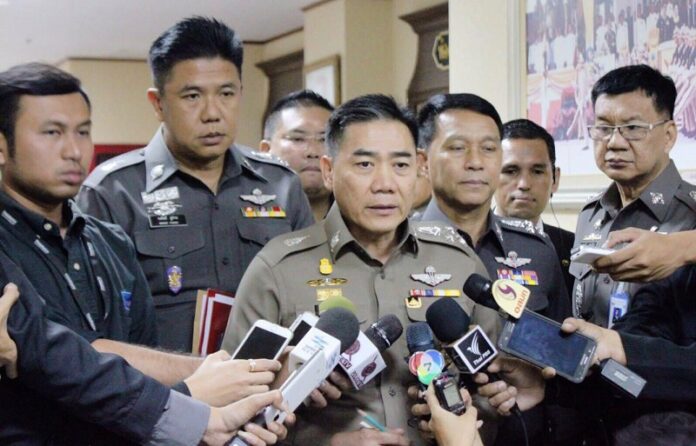
BANGKOK — The authorities’ crusade against those who defame the monarchy faced a paradoxical response Wednesday: should they stay or should they go?
While the government has been publicizing efforts to win extradition of exiles accused of violating the royal defamation law, the former national police chief today made it clear they shouldn’t be in the kingdom.
“If they don’t have the money for airfare then come get it from me,” said Gen. Chakthip Chaijinda. “Those who insult the monarchy … I am willing to be in debt for the country!”
Chakthip said since the death of His Majesty the Late King, police were notified of 20 cases of royal defamation. Arrest warrants have already been issued in eight cases under Article 112 of the Penal Code, he said, and four cases were moving forward.
The chief also said Wednesday he had contacted Interpol to help bring those who violate lese majeste law living abroad back home to prosecution.
No country has ever honored Thailand’s requests to extradite suspects wanted under the law, known as lese majeste. Still, with national passions high after the Oct. 13 death of King Bhumibol, officials have sought to telegraph responsiveness to the many Thais upset about those who have spoken ill of the late monarch.
Justice Minister Paiboon Kumchaya said he had received “positive responses” from the ambassadors of seven countries where 19 alleged royal defamation suspects are living in exile. Last week he sent letters formally requesting they censure the suspects residing in their nations.
“I received the cooperation from the embassies inquiring for information to report back to their countries which I am very grateful,” he said Wednesday.
Authorities have even suggested they had won Google’s cooperation in censoring content deemed defamatory. Headlines have trumpeted cooperation on the part of the internet search giant, which in fact has only said it would follow its policies of making content unavailable in places where it is illegal.
Google has gone so far as to send letters notifying The Nation and BBC Thai that they did not change their policy on censoring content specifically for Thailand, reiterating it must be done through their existing process.
They also denied any role in monitoring posts of Thai social media users and said the removal of any content per government request would be seen in their transparency report.
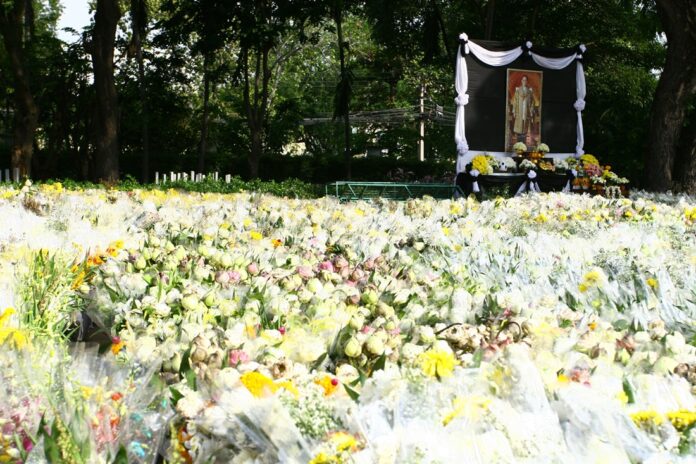
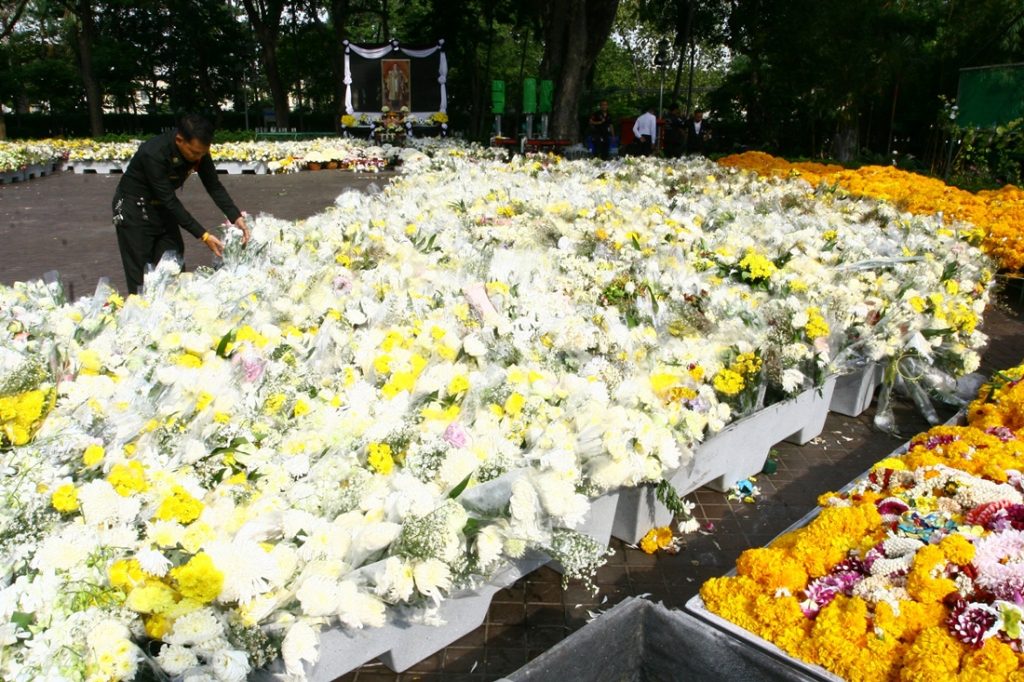
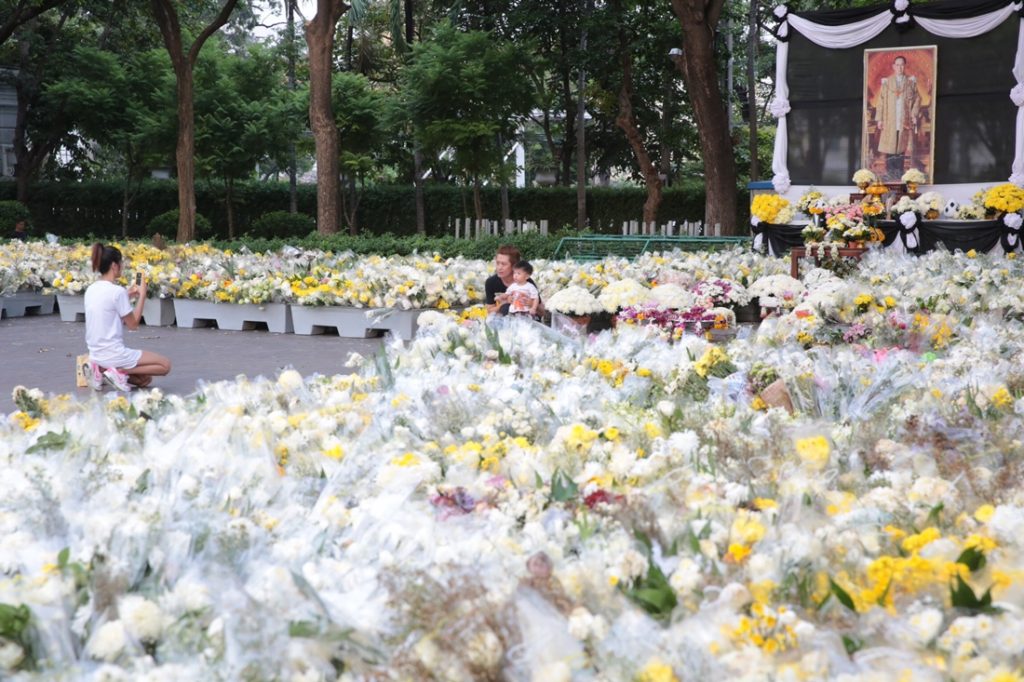
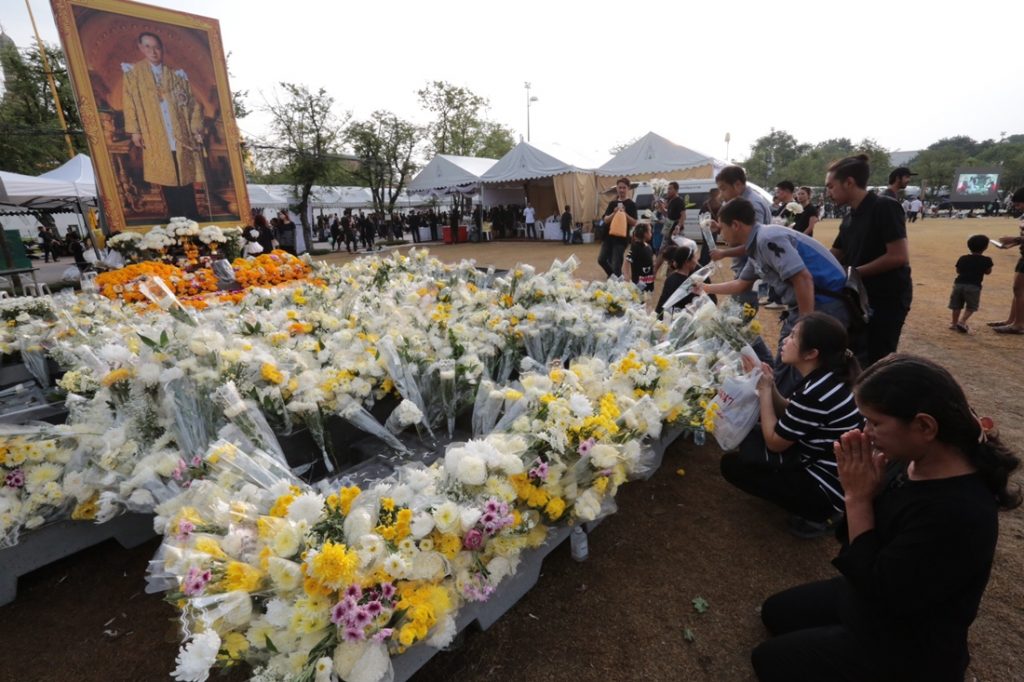
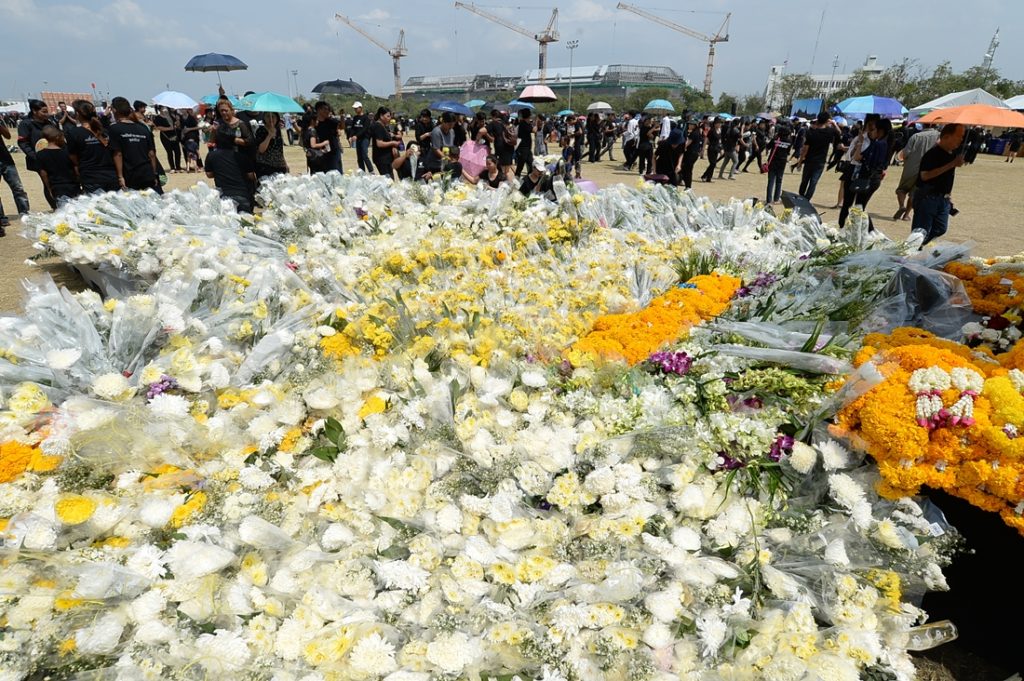
BANGKOK — Tens of thousands of mourners have left flowers around the Grand Palace in memory of His Majesty the Late King Bhumibol, who died on Oct. 13 at 88.
Nearly as fast as they can leave them in great heaps, city employees working in three shifts have been removing them – but to where?
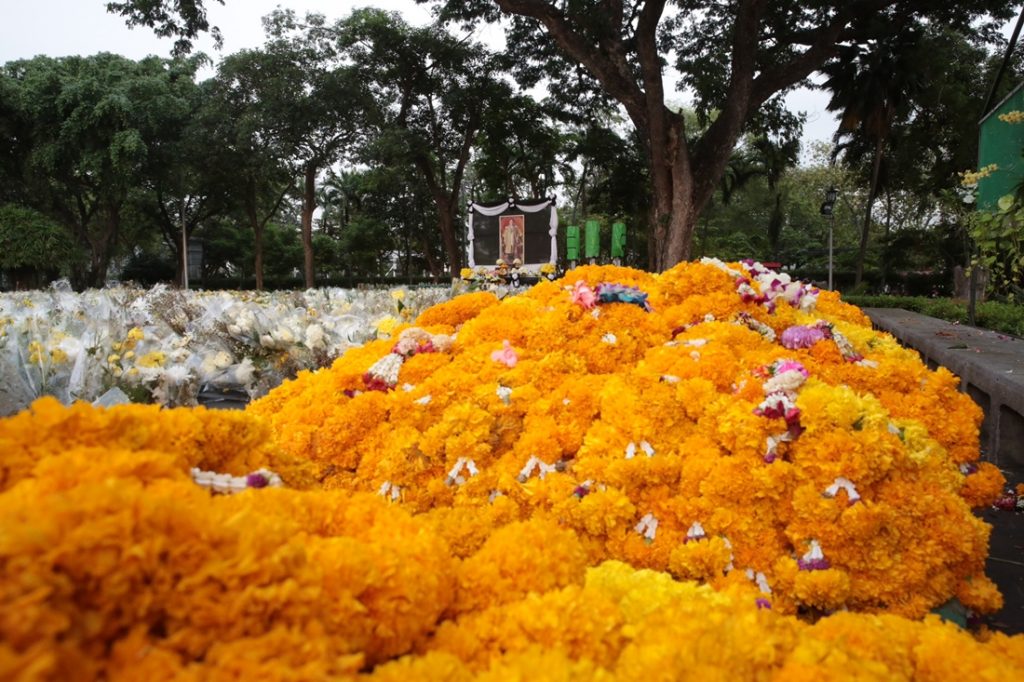
On Wednesday, the director of a Western-style public garden close to the Grand Palace gave a tour to show how they have been put to further use in honor of the king and those mourning him.
Passakorn Pojjiraporn, director of Saranrom Park, said that the flowers are brought by the workers to the park and sorted into two groups. The fresh ones are displayed in honor of the late monarch at four locations: one in the park, one at the southern end of the Sanam Luang, and two on Maharat Road. Flowers that are too damaged for display are sent for composting at the Rama IX Park in eastern Bangkok, said
Passakorn estimated each day the park receives 200 to 250 large bags of dao rueng, the yellow flowers associated with religious rites, collected from around the Grand Palace. It also receives about 400 large bags of other types of flowers daily, he said.
Members of the public are welcome to visit and see for themselves at the park, a historic garden dating back to 1860s.
Piles of flowers at Saranrom Park on TuesdayPiles of flowers at Saranrom Park on TuesdayFlowers left by mourners at Sanam Luang on TuesdayFlowers left by mourners at Sanam Luang on TuesdayPiles of flowers at Saranrom Park on Wednesday
BANGKOK — Thailand’s new and possibly fanciest regular train service can now be booked for overnight trips to the north and northeast.
Equipped with new carriages featuring improved decor and facilities, the Special Express Train routes linking the capital to Chiang Mai and Ubon Ratchathani provinces will begin running daily Nov. 11.
Tickets are now on sale, the State Railway of Thailand announced Wednesday.
The new cars will also be used for a new route between Bangkok and Nong Khai in the north and and Hat Yai in the south starting Dec. 2. Tickets for those routes go on sale Saturday.
Prices range from 700 baht to 1,600 baht depending on the route, class of car and position of the sleeper seat. Check timetables for routes listed as “Special Express.”
The government-operated railway spent roughly 4 billion baht on the new 115 Chinese-made carriages.
The addition of new bogies to the system’s worn and often uncomfortable equipment has been warmly received by the public since first announced in July.
Every passenger seat offers a USB charging socket and LCD screen entertainment selections.
Instead of standalone diesel-electric locomotives, the new trains will be pulled by powered cars, which are said to be quieter and less harmful to the environment.
The toilets, long one of the least pleasant experiences for Thai rail travelers, will operate like those on airplanes and not simply empty onto the tracks.
The cars are also equipped with security cameras, officials said, and include accessibility lifts to raise wheelchairs from the platform.
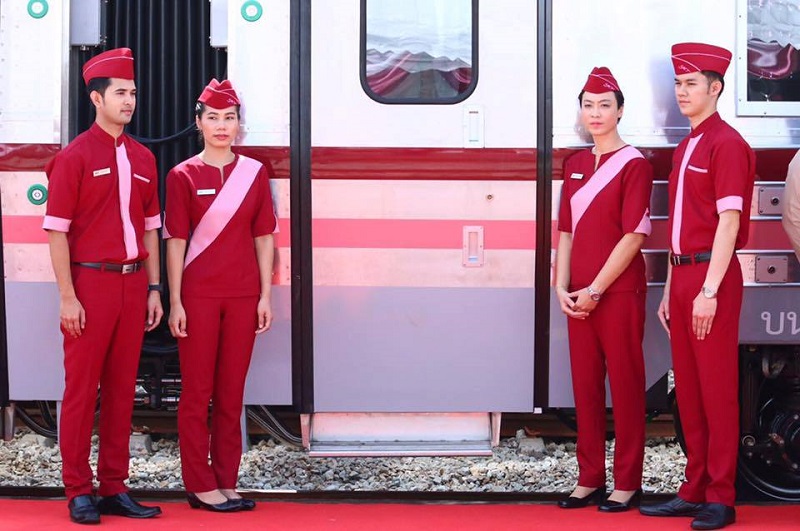
Conductors and other train staff will also be outfitted in spiffy new uniforms.