27.2 C
Bangkok
Tuesday, June 30, 2026
Home Blog Page 2628

Prison Refutes Rumor Yellowshirt Founder Sondhi Died

Sondhi Limthongkul consoles one of his co-defendants Tuesday as they were taken to prison to begin serving 20-year jail terms for fraud.

BANGKOK — Former media tycoon and political activist Sondhi Limthongkul is alive and serving his 20-year jail for fraud conviction, despite online rumors suggesting otherwise, director of the Klong Prem Central Prison said today.

He was responding to a rumor circulated on social media Wednesday morning that Sondhi, who’s credited with helping topple two governments and surviving attempted assassination, died of stroke in prison Tuesday night, hours after losing his final appeal of a conviction for fraud amounting to more than a billion baht.

Yellowshirt Leader Sondhi Jailed 20 Years for Fraud

“I confirm that Mr. Sondhi is in normal condition. He is not suffering from any illness, as circulated in the online communities,” prison director Thawatchai Chaiywat told reporters.

Thawatchai said Sondhi did show some signs of stress but could sleep and eat normally.

The claim, shared by many Redshirts, said Sondhi had a stroke and was sent to prison hospital, where he later died.

According to Thawatchai, the former firebrand Yellowshirt activist even wrote him a letter expressing concern about the rumor, because many of his relatives mentioned it to him during today’s visiting hours.

“Mr. Sondhi wrote in his letter that he’s not sick. Everything is fine,” Thawatchai said.

On Tuesday the Supreme Court upheld a lower court’s 2012 conviction of Sondhi and three other executives of Manager Media Group for forging a company report to guarantee a 1.02 billion baht loan from Krung Thai Bank in 1997. Sondhi was immediately returned to prison to serve out a 20 year sentence, without it being suspended as is sometimes the case for well-connected or wealthy defendants.

It was a dramatic downfall for one of the most prominent activists in Thailand’s recent history.

In 2005 Sondhi founded the royalist Yellowshirt movement and campaigned for the overthrow of then-Prime Minister Thaksin Shinawatra, whom he accused of corruption, nepotism and disloyalty to the monarchy. The military staged a coup against Thaksin a year later, amidst the escalating street protests at the time.

Again in 2008, Sondhi and his resurrected Yellowshirt campaign successfully brought about the end of a pro-Thaksin government following months of protests, in which his supporters occupied government buildings and airports in Bangkok.

Sondhi receded from public view after a group of gunmen attempted to assassinate him in April 2009. His attackers were never caught.

Related stories:

Anti-Graft Crusader and Yellowshirt Founder Convicted of Fraud

Advertisement

From Iranian Scares to French Love, ‘Little Big’ Brings Indie Films to Bangkok

Under The Shadow. Photo: Vertical Entertainment / Courtesy

BANGKOK — A fearsome Djinn terrorizes a family in Iran’s first psychological horror film, an American drama details a woman’s transition to man, and a poignant Japanese drama about imperfect lives are among films ready to make audiences cry next week.

After a decade hiatus, a project begun 17 years to bring independent films to Bangkok is back with a roster of four acclaimed features.

Discontinued in 2006 because independent films had more venues to screen, the Little Big Films Project returns next week to tug at the heart strings.

Premiering earlier this year at Sundance, “Under the Shadow” is a 2016 Iranian horror film portraying the terrors a mother and her daughter have to cope with in revolution-torn Tehran in the 80s, as they are haunted by Djinn, the evil Middle-Eastern spirit.

“About Ray” follows Elle Fanning’s Ray who seeks to transition fully to male as her family struggles to accept Ray’s new identity. Also stars Naomi Watts and Susan Sarandon.

In period film “From The Land of the Moon,” Gabrielle (Marion Cotillard), a woman who settled for a marriage of convenience, is recovering from illness when she falls in love with a veteran recently returned from Southeast Asia. The 2016 French film competed for the Palme d’Or at Cannes.

“After the Storm” revolves around an award-winning author turned private detective who is trying to turn around his life as a deadbeat dad while trying to reconnect with his ex-wife. The 2016 film written and directed Hirokazu Koreeda competed at Cannes.

Koreeda will be in Bangkok to launch the project and will hold a cinematography workshop at 10am on Sept. 7 at House Rama RCA.

“After the Storm” shows Sept. 15, “About Ray” on Sept. 29, “Under The Shadow” on Oct. 13 and “From The Land of the Moon” on Oct. 27. The films will show at House Rama RCA, Lido, Paragon Cineplex, CentralWorld’s SFW Cinema and Esplanade Ratchada.

Advertisement

US Woman Falls Off Cliff Escaping Alleged Attacker in Krabi

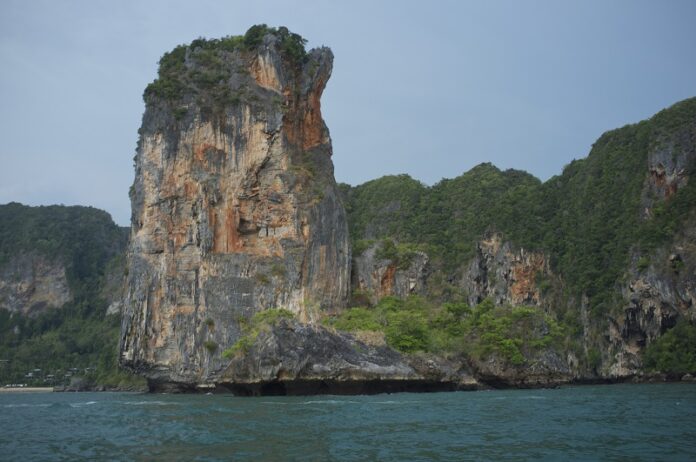
Limestone cliffs of Krabi Bay in 2014. Photo: Aleksandr Zykov / Flickr

BANGKOK — An American tourist was recovering Wednesday in a hospital in Thailand after breaking her spine while tumbling down a cliff trying to escape from a man who allegedly was molesting her.

The 23-year-old woman was attacked last Thursday in the southern seaside province of Krabi, a popular tourist destination, police said.

The woman, whom The Associated Press is not naming to protect her privacy, told police that a man who offered to help guide her back to her hotel at night took her down a remote path and tried to remove her clothes. She said she fought back, biting his ear before running away, only to plunge down a 45-meter (150-foot) cliff.

The woman was found by rescuers the next morning and is now recovering after surgery.

According to Krabi Tourist Police Inspector Attapong Sanjaiwut, the alleged attacker said that the account of sexual assault was a misunderstanding, and that he stayed by the woman’s side part of the night and called rescuers in the morning.

Police have detained the alleged attacker, who faces 5 to 20 years in prison if convicted of causing serious injury and obscene behavior toward another person. Attapong said police sent an initial report Wednesday to prosecutors, who are waiting to take testimony from the victim before she leaves Thailand. He suggested the woman might be able to leave for the United States in about 10 days.

Thailand welcomed almost 30 million foreign visitors last year, and tourism is one of the country’s important revenue earners.

Advertisement

BRN Says It Was Behind Mother’s Day Bombings: Report

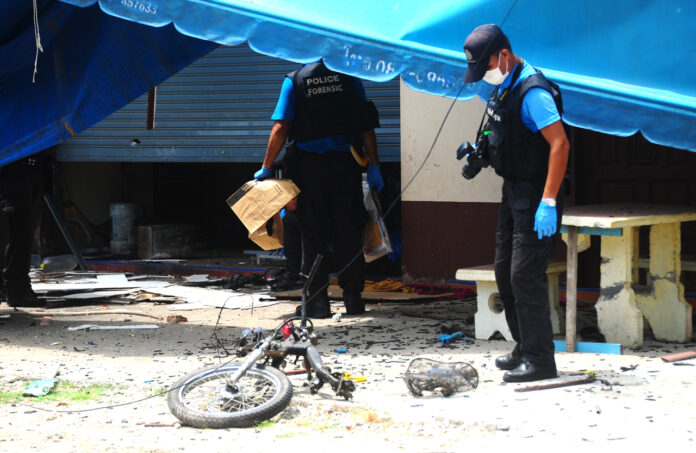
Police on Sep. 7, 2016, inspect wreckage of a motorcycle bomb that exploded in front of Ban Ta Ba School in Pattani province, killing two people.

BANGKOK — A secretive separatist group in the southern border region has taken responsibility for last month’s bombing attacks in the south of Thailand, according to a news agency.

In an unprecedented move, an unnamed commander in the National Revolution Front, or BRN, told BenarNews it was behind not only Tuesday’s bomb attack at a school in Pattani province, but the spree of bomb and arson attacks in seven provinces that killed four people during the Mother’s Day holiday in August.

“We claim that the attack in Tak Bai district was the act of our operation, as well as the train bombing and those attacks in the seven upper southern provinces too,” the commander was quoted in the report.

In an emailed message, the managing editor of BenarNews confirmed the story’s details.

“I can confirm that we spoke to sources within the BRN,” Kate Beddal wrote. “… Not able to give more details to protect our journalists.”

BenarNews is a nonprofit news site funded by the U.S. government.

Four people were killed in the series of explosions and firebombs that struck seven provinces on Aug. 11-12, which marked the National Mother’s Day. No one had claimed responsibility for the attacks so far, but police say evidence increasingly point to separatist movement in the border provinces of Pattani, Yala and Narathiwat.

That separatist movement has historically not claimed responsibility for the frequent attacks it is suspected of carrying out. While the suspected militants in the past mostly targeted Thai security forces, civilians and other “soft targets” have come under frequent attack in recent weeks.

A weaponized motorcycle exploded in front of Ta Ba School in Pattani on Tuesday morning, when parents were dropping their kids off to the school. The blast killed Mayeng Wobah and his 4-year-old daughter, Mitra Wobah, and injured at least 10 others.

The BRN commander told BenarNews the group was targeting a group of police officers standing guard near the school and did not intend to kill civilians.

Authorities and experts have long described the BRN as the most well-armed and active among a network of shadowy militant cells operating in the three southern border provinces. The militants are aiming to secede the Muslim-majority region and revive the independent state of Patani.

At least 6,200 people have died since the separatist violence broke out in January 2004, mostly civilians.

Correction: An earlier version of this story mistakenly described BenarNews as a state news organization. It is in fact funded by the U.S. Broadcasting Board of Governors, according to its website.

Related stories:

BRN Implicated in ‘Unprecedented’ Ambulance Car Bomb

Separatists ‘Crossed Rubicon’ With Attacks, May Escalate: Expert

Military Holds First Suspect Arrested For August Attacks

Advertisement

Can Apple Make Listening Easy Without Headphone Jack?

An earphone jack and charging port on an Apple iPhone 6 on Sept. 2 in New York. Apple is getting ready to unveil new iPhones on Sept. 7. Photo: Richard Drew / Associated Press

SAN FRANCISCO — When Apple shows off its latest iPhone on Wednesday, it will answer a question it hasn’t had to address in years: “What’s it putting in the box?” (Besides the iPhone itself, that is.)

The iPhone has traditionally shipped with a pair of Apple’s iconic earbuds, made famous in early advertising for the iPod music player. But tech analysts and industry bloggers, citing leaks from Apple’s Asian suppliers, say it looks like the tech giant has decided to do away with the analog headphone jack in the next iPhone.

That means the earbuds themselves are in for a revamp, one that could hint at Apple’s plans for expanded use of wireless technology.

IPHONE 7: INCREMENTAL CHANGES

The headphone jack is drawing attention partly because there might not be many other major changes in this year’s iPhone. The new models — the iPhone 7 and 7 Plus, if Apple sticks to its usual convention — are expected to offer faster processors, more memory and improved cameras.

But despite a recent dip in iPhone sales, most Apple watchers expect the company to save its next big overhaul for 2017, the 10th anniversary of the first iPhone’s release.

Though it might not seem dramatic, eliminating the 3.5 millimeter analog jack would be controversial. On the plus side, it could let Apple make the iPhone slightly thinner and possibly waterproof; it might also free up space for other components.

But it also means future iPhone buyers will need new headsets that use a digital connection. That could just mean changing the headset cord so that it plugs into the same port that recharges the device. Or it could herald an Apple commitment to wireless earbuds that connect to the phone via a technology such as Bluetooth. Apple already sells wireless headsets from Beats Electronics, which it acquired two years ago for $3 billion.

While Apple hasn’t commented, reports of the change have sparked an outcry from those who believe the old analog jacks worked perfectly well. Tech blogger Nilay Patel of The Verge blasted the move as “user-hostile and stupid.”

WHY HEADPHONES MATTER

For many people, listening to music and watching video — not to mention making the occasional phone call — constitutes one of the main uses for a smartphone. “People enjoy listening to music on their smartphones today as much as they listen to music at home,” said Brian Blau, a tech analyst at Gartner.

Today’s wireless Bluetooth headsets, however, can be clunky to set up and sometimes randomly drop their phone connections. And no headphone jack means that existing headsets won’t work with the new iPhones without an adapter. It’s also not clear how you’d plug in your headset if you’re already charging the phone.

Finally, Apple uses a proprietary design for its charging port, known as “Lightning.” So new headphones that plug into that port won’t be compatible with devices made by Apple’s competitors.

OLD TECH ON APPLE’S HIT LIST

Apple has a history of preemptively doing away with older technologies, often prompting lamentations from users — at least until they got used to it. Co-founder Steve Jobs famously decided the first iMacs didn’t need a floppy disk drive in 1998, years before Windows PCs followed suit. Later, he made waves by selling MacBooks without a CD drive or even a traditional hard drive, which have also disappeared from competing laptops.

More recently, Apple made millions of old power cords incompatible by replacing the 30-pin charging port on older iPhones and iPads with the much smaller Lightning port in 2012.

Apple, however, isn’t the first company to do away with the headphone jack. Already this year, Lenovo’s Motorola division and Chinese smartphone maker LeEco have released phones without analog audio jacks, relying instead on cords that plug into a new digital port known as USB-C — which, of course, is different from Apple’s Lightning port. Some argue that digital connections provide higher quality sound.

“The market is changing,” said Jim Thiede, head of global product marketing at Motorola, who expects to see a number of manufacturers producing “USB-C headphones, earbuds and what have you” over the next three to six months.

OUR WIRELESS FUTURE

Some believe Apple’s real goal is to move people away from cords and plugs altogether.

“They don’t like the mess,” said Jan Dawson, a tech analyst with Jackdaw Research. “Anybody who’s carried a set of earbuds in their pocket have had them get tangled up. And they get in the way when you’re exercising.”

Apple has already cut the number of ports on its latest MacBooks, encouraging owners to use wireless features like Apple’s AirDrop and AirPlay for sharing files or streaming music and video, he noted.

Widespread adoption of wireless headsets might also encourage people to try streaming music using the Apple Watch, said Carolina Milanesi, a mobile tech analyst at the research firm Creative Strategies. That would be a first step toward getting them interested in future smartwatch apps and services, she suggested.

“It might be good if you had a Bluetooth headset that connects to your phone and your watch at the same time,” she said. “What we see today is not necessarily the ultimate goal that Apple has for its devices.”

Despite criticism of Bluetooth’s audio fidelity, Milanesi said more expensive models offer better quality.

Apple could distribute the new iPhones with a “good enough” Bluetooth headset included, she added, while selling more expensive headsets separately. Dawson suggested Apple may provide earbuds with a Lightning plug, and possibly an adapter for older headsets.

Most iPhone owners will get used to the new technology, Milanesi predicted. Still, she cautioned, “people don’t like change.”


Advertisement

Owner of Demolished Resort Sent to ICU for Stroke, Wife Says

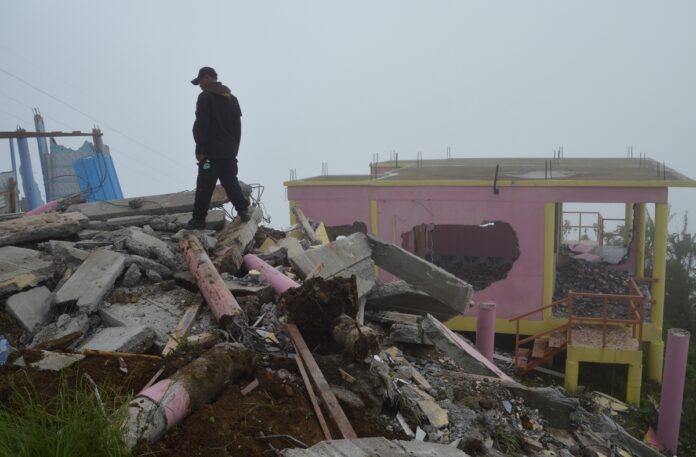
A security officer on Aug. 30 walks atop the ruins of what used to be a resort on Phu Tab Boek mountain in Phetchabun province.

PHETCHABUN — The owner of a resort demolished by forest officials for squatting on public land in Phetchabun province was hospitalized after having a stroke brought on by immense stress, his wife said.

Taweesak Pongjirapanya is among the owners of 19 hotels that officials said were illegally built atop the picturesque mountain of Phu Thap Boek and had to be demolished as part of the junta’s campaign to stamp out unauthorized use of protected public lands.

Read: Bogus ‘ISIS’ Bomb Threat Fails to Stop Demolition of Encroaching Resorts

Taweesak suffered a stroke shortly after security officers started pulling down his hotel, called Phu Thong Kham Resort, on Aug. 30, according to his wife Kachee Pongjirapanya. She said Taweesak remains unconscious in intensive care.

“I don’t know if I can demand anything,” Kachee said by telephone Wednesday. “But I want them to return us our resort. I want them to help us. I want them to help pay medical bill, because we have no money left.”

According to Kachee, her husband inherited the plot of land from his grandparents who lived there before land deeds were issued, and they have no business other than the resort they built on that land.

“We have nothing else. We built it to make a living,” Kachee said. “If they took it away from us like that, we would have to rent land from someone else.”

But one of the officials in charge of the eviction said the government allowed landholders such Taweesak to live on the mountain – so long as they didn’t develop it commercially – because it is part of the Phu Hin Rong Kla National Park. Doing so amounts to land encroachment, said Boonlap Suksai, head of the Forest Department’s regional office.

“There are some native Hmong who turned their land into resorts. And there are outsiders who rented the land from the natives, turned it into resorts but kept the natives as proxies,” Boonlap said.

He added that all of the 19 resorts identified as land encroachers have been demolished, and authorities will soon come up with a plan to redistribute the land to legitimate owners for appropriate uses.

The demolition followed junta chairman Prayuth Chan-ocha’s July 5 order to destroy the 19 offending properties.

Since seizing power from an elected government in May 2014, the junta has embarked on a campaign to take back lands in National Parks and other protected forests that had been developed without permission.

While the campaign was praised as an overdue effort to save forests and beaches from business operators, it also led to clashes between security officers and some forest communities who said they had been living off the land for decades.

Related stories:

Evicted Villagers and Park Officials Reach Compromise

Karen Rights Activist and Key Court Witness ‘Disappears’

Advertisement

Asian Club of Strongmen Welcomes ‘Duterte Harry’

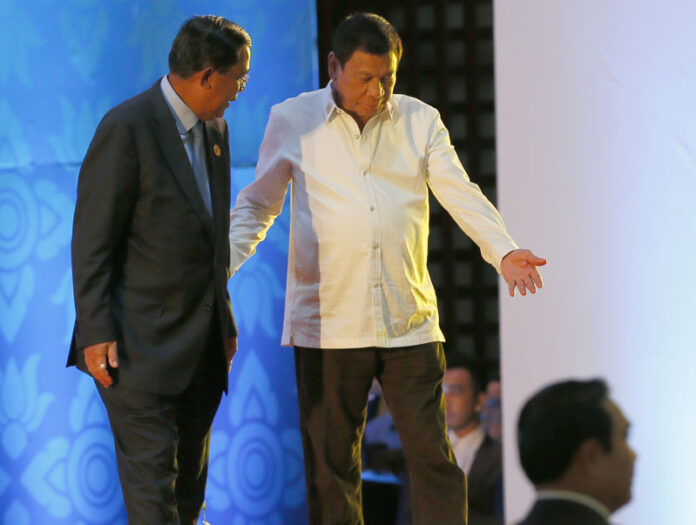
Philippine President Rodrigo Duterte, right, ushers Cambodian Prime Minister Hun Sen following the opening ceremony for the ASEAN Summit on Tuesday in Vientiane, Laos. Photo:Bullit Marquez / Associated Press

VIENTIANE — As bodies continue to pile up in his war on illegal drugs, the Philippine president is making waves at his first summit of the Association of Southeast Asian Nations where he joins a diverse cast of leaders, including some who have found themselves in the cross hairs of human rights watchdogs.

Rodrigo Duterte would fit right in, critics say, and even steal the show.

As president, Duterte brings a long-blemished rights record into the 10-nation ASEAN bloc, which has struggled with internal strife due to its unwieldy collective of dictatorships, authoritarian states, a monarchy and fledgling democracies since its founding nearly half a century ago as an Asian bulwark against communism.

“For most ASEAN leaders, Duterte represents a throwback to an uglier and more brutal form of Asian state, which taints ASEAN efforts to market itself as an increasingly progressive, modernizing trade block with a focus on trade data, rather than daily police-killing body counts,” said Phelim Kine of New York-based Human Rights Watch.

Once a government prosecutor who fought outlaws and insurgents, Duterte was a longtime mayor of southern Davao city, where he started to build a name for his deadly anti-crime campaign –  he was nicknamed “Duterte Harry” after Clint Eastwood’s Dirty Harry movie character. Since he took office as president on June 30, his crackdown on suspected drug dealers and users has left more than 2,000 people dead. More than 600,000 others, mostly drug addicts, have surrendered apparently for fear of being gunned down.

“That dynamic means that Duterte can expect his most meaningful face-time in Laos with other ASEAN embarrassments such as Cambodia’s dictator Hun Sen, representatives of Thailand’s military junta and his authoritarian Laotian hosts,” Kine said. He can rely on these leaders to lend him a sympathetic ear for “his grotesque justifications of abuse of rule of law and state-sanctioned extrajudicial violence as the price of a ‘secure’ society,” he said.

In a rare moment of diplomatic tumult ahead of an ASEAN summit, the 71-year-old Duterte cursed on Monday at President Barack Obama, warning the world’s most powerful man not to question him about the rising body count in his crackdown or “son of a bitch I will swear at you.” This was hours before they were supposed to meet in the Laotian capital.

The next day Duterte expressed regret in a semi-apology aimed at mending fences. But it was too late.

An evidently offended Obama had by then canceled Tuesday’s meeting, which was shaping up as the most-awaited, again because of Duterte – he had recently unleashed abuses at the U.S. ambassador to Manila, calling him gay in derogatory terms and railed against America’s security policies. Also, Obama was expected to raise the matter of extrajudicial killings, all contributing to growing antagonism between the two longtime allies.

Given what Duterte said, “we felt that it wasn’t the right time to have a bilateral meeting with the U.S. president,” Ben Rhodes, Obama’s deputy national security adviser, said. “Certainly the nature of those comments was not constructive.”
Obama is only the latest victim of Duterte’s foul tongue.

In the few months since the election campaign and more than two months into the presidency, Duterte has cursed the pope, the U.N. secretary-general and gotten into verbal tussles with the revered Roman Catholic Church in the Philippines.

Aside from his deadly record, Duterte’s disdain for statecraft, irreverence and bluntly frank and profane language would likely weigh on ASEAN, a conservative group steeped in tradition, protocol and nuanced rhetoric.

ASEAN’s still in a flux. In an incredible reversal of roles, for example, the Philippines was the democracy champions just years ago and was pushing then military-ruled Myanmar to move toward democratic reforms. Myanmar is now led by Nobel Peace laureate Aung San Suu Kyi, who fought her country’s military junta while languishing in home detention for decades.

ASEAN came into being during the Cold War era, and has long been hamstrung by the stark diversity of its member governments along with a bedrock rule of noninterference in each other’s affairs and a policy of making decision by consensus. That has allowed leaders like Hun Sen, Thailand’s coup leader-turned-premier Prayuth Chan-ocha, the faceless one-party communist rulers of Laos and Vietnam, and the general who once ruled Myanmar to occupy regional legitimacy and defy the West’s call for democratic governance.

ASEAN says it’s best to keep dictators in its midst engaged, because dialogue helps to keep them in check. It takes credit for helping Myanmar’s generals give up power. It also says it is necessary to keep the diverse nations together so that they have a stable platform to resolve conflicts and integrate their economies as a counterweight to Asian powerhouses China and India.

Duterte rejects any suggestion that he is a dictator. He sees himself as a leader with an extra tough approach on crime, especially on illegal drugs, because the problem has worsened into a pandemic, corrupting law enforcers and sparking heinous crimes. In ASEAN, he said he would assure the bloc and other countries that there would be no radical shifts in Philippine policies under him.

While critics cringe, Duterte has been adored by a substantial electorate of followers who gave him a convincing election victory on a promise to eradicate crime, drug trafficking and corruption in six months. The tall promise was embraced by crime-weary Filipinos but abhorred by opponents and rights groups as a dangerous expansion of his rights record in Davao, where he was linked to killings with his tacit endorsements of vigilante extermination of alleged drug dealers by motorcycle-riding death squads.

Anna Olarte, an English teacher at an international school in Vientiane, trooped to a convention center with more than 700 other Laos-based Filipinos to see and cheer the president she voted for.

When Duterte walked up the stage and bowed deeply before her and others, Olarte said her heart melted. “It was like, my God, this is my president,” she said.

Story: Jim Gomez

Advertisement

US Pledges to Clear 80 Million Stray Bombs in Laos

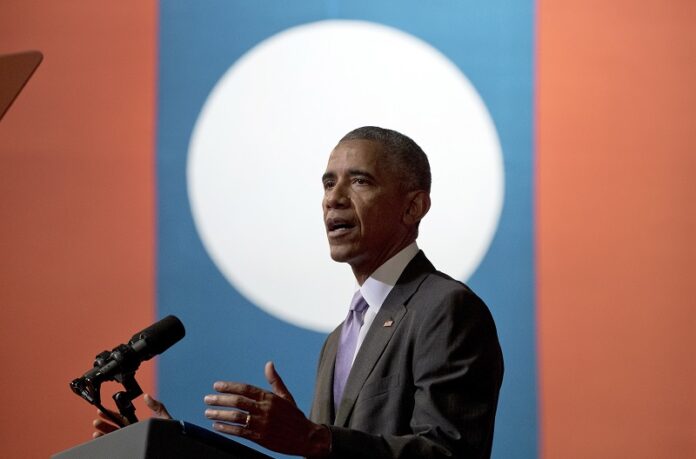
U.S. President Barack Obama speaks on Tuesday at the Lao National Cultural Hall in Vientiane, Laos. Photo: Carolyn Kaster / Associated Press

VIENTIANE — Declaring a “moral obligation” to heal the wounds of a secret war, President Barack Obama on Tuesday pledged help to clear away the 80 million unexploded bombs the U.S. dropped on Laos a generation ago – more than 10 for every one of the country’s 7 million people.

Half a century ago, the United States turned Laos into history’s most heavily bombed country, raining down some two million tons of ordnance in a covert, nine-year chapter of the Vietnam War. The first U.S. president to set foot in Laos while in office, Obama lamented that many Americans remain unaware of the “painful legacy” left behind by a bombardment that claims lives and limbs to this day.

“The remnants of war continue to shatter lives here in Laos,” Obama said before an audience of students, businessmen and orange-robed Buddhist monks who held up cellphones to snap photos of the American president. “Even as we continue to deal with the past, our new partnership is focused on the future,” he said.

To that end, Obama announced the U.S. would double its spending on bomb-clearing efforts to $90 million over three years – a relatively small sum for the U.S. but a significant investment for a small country in one of the poorer corners of the world. Obama plans to put a human face on the issue when he meets Wednesday in Vientiane with survivors of bombs that America dropped.

The president did not come to apologize. Instead, he called the conflict a reminder that “whatever the cause, whatever our intentions, war inflicts a terrible toll – especially on innocent men, women and children.”

Thanks to global cleanup efforts, casualties from tennis ball-sized “bombies” that still litter the Laotian countryside have plummeted from hundreds to dozens per year. But aid groups say far more help is needed. Of all the provinces in landlocked Laos, only one has a comprehensive system to care for bomb survivors.

“We’re incredibly proud of the progress the sector has made over the last five years in terms of the decline in casualties and new victims,” said Channapha Khamvongsa of the nonprofit Legacies of War. “But we are concerned about the upwards of 15,000 survivors around the country that are still in need of support.”

The $90 million to clean up bombs joins another $100 million the U.S. has committed in the past 20 years. The Lao government, meanwhile, says it will boost efforts to recover remains and account for Americans missing since the war.

The punishing air campaign on Laos was an effort to cut off communist forces in neighboring Vietnam. American warplanes dropped more explosives on this Southeast Asian nation than on Germany and Japan combined in World War II, a stunning statistic that Obama noted during his first day in Vientiane.

Obama was one of several world leaders visiting Laos to attend the Association of Southeast Asian Nations. Taking its turn as chair of the regional forum, Laos’ communist government is seizing a rare moment in the spotlight.

For Obama, the visit serves as a capstone to his yearslong effort to bolster relations with Southeast Asian countries long overlooked by the United States. The outreach is a core element of his attempt to shift U.S. diplomatic and military resources away from the Middle East and into Asia in order to counter China in the region and ensure a U.S. foothold in growing markets.

Yet Obama’s outreach took an uncomfortable turn just as he headed to Laos from another summit in China. The White House called off a scheduled meeting Tuesday with President Rodrigo Duterte of the Philippine – a U.S. treaty ally – after the brash new leader referred to Obama as a “son of a bitch.”

Duterte, who had been expecting Obama to criticize his deadly, extrajudicial crackdown on drug dealers, later said he regretted the personal attack on the president.

Obama filled the hole in his schedule by meeting with South Korean President Park Geun-hye in a display of unity a day after North Korea fired three ballistic missiles. Obama vowed to work with the United Nations to tighten sanctions against Pyongyang, but said the door wasn’t closed to a more functional relationship.

Obama’s Asia project – dubbed his pivot or rebalance – has yielded uneven results, as conflict in the Middle East has continued to demand attention and China has bristled at what it views as meddling in its backyard.

So with just four months left in office, Obama used his historic trip to Laos to reassert his aims. He touted new military aid and U.S. support for regional cooperation in addressing maritime disputes and made a plug for the massive Trans-Pacific Partnership free trade agreement, the policy’s central economic component that is now stuck in Congress.

Story: Josh Lederman, Kathleen Hennessey

Advertisement

Foreign Couple Injured in Suan Phlu by Home Fire

Photo: FM 91 Trafficpro / Facebook

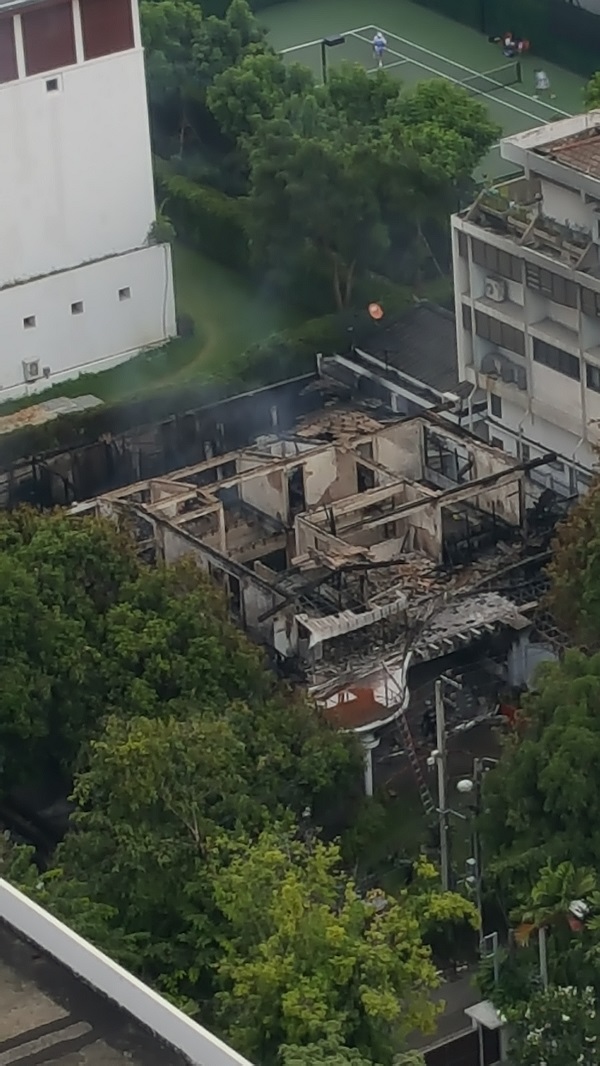
BANGKOK — Two people were injured when fire consumed a house in Soi Suan Plu 6 in the Sathon area this morning.

The fire broke out at about 7am on Wednesday at the two-story wooden residence and was brought under control by approximately 8am. The residents, a foreign couple, received minor burns, according to Pol. Lt.Col. Narong Yimpan. He did not know their nationality.

Police are investigating the cause of the fire, said the deputy chief of Thung Maha Mek Police Station.

A residence on Bangkok's Soi Suan Phlu 6 after it was destroyed by fire Wednesday morning. Photo: Dave Richards
A residence on Bangkok’s Soi Suan Phlu 6 after it was destroyed by fire Wednesday morning. Photo: Dave Richards
Advertisement

Obama Aide to Meet Wife of Missing Activist Sombath

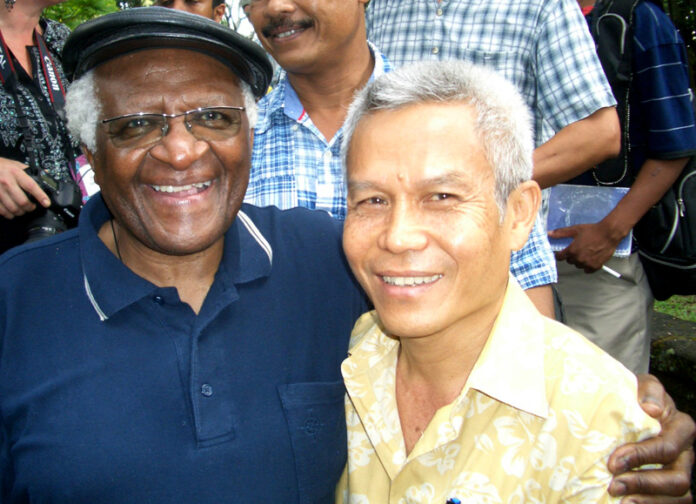
Sombath Somphone, seen here in 2006 with Desmond Tutu, is a respected community development worker from Laos abducted in Vientiane on Dec. 15, 2012. Photo: Shui-Meng Ng

VIENTIANE — A top aide of President Barack Obama said Tuesday he will meet with the wife of a missing Laotian activist, whose case has been repeatedly highlighted by human rights groups as an example of authoritarian excesses of Laos’ one-party Communist government.

Deputy National Security Adviser Ben Rhodes told reporters he will meet with Shui Meng Ng on Thursday while Obama is visiting Laos. The president arrived on Monday to attend a regional summit.

Human rights activists were hoping that Obama would speak about Ng’s husband, Sombath Somphone, who was picked up apparently by security forces on Dec. 15, 2012. He has not been seen since.

Obama has not mentioned him so far in his public remarks, but Rhodes said that “we care very deeply about her case and her husband, and we believe she deserves to know what happened to her husband.”

He said he also met Ng during a recent visit to Laos, and planned to stay in “regular contact” with her. Rhodes said the Laotian government has told the U.S. the same thing it tells Sombath’s wife – that it’s looking into his disappearance.

“Oftentimes, they indicate that they do not know, and that there’s an ongoing investigation,” Rhodes said.

He said that typically, Obama addresses human rights issues with foreign leaders more broadly, and lets his staff raise specific cases with their counterparts.

Sombath’s disappearance was captured on a traffic video camera, in which he is seen being stopped at a police outpost in Vientiane and asked to step out of his Jeep, according to Amnesty International. Within a few minutes a man on a motorcycle arrives, drives away Sombath’s vehicle, and a pickup truck takes Sombath away with armed people on a motorcycle leading the way. The passenger on the motorcycle fires a gunshot into the air, Amnesty International said.

The human rights group said it believes the authorities are either directly responsible for his disappearance, or have simply failed to take steps to find out what happened to him.

“President Obama and world leaders gathering in Laos need to demand answers and accountability from their Lao government hosts on the case of disappeared NGO leader Sombath Somphone. The message has to be clear that the cover up has to end, Sombath needs to be found, and that no other outcome is acceptable,” Phil Robertson, deputy director for Asia at Human Rights Watch, said Tuesday.

The U.S.-educated Sombath mostly worked in rural development, showing farmers creative ways to raise fish and make handicrafts. But he was also vocal about land deals that left thousands of villagers homeless without compensation, sparking rare political protests. He also had international connections.

Sombath is not the only possible victim of a government crackdown.

In 2015, an ethnic Lao who is a Polish citizen disappeared while visiting Laos, according to his Polish wife, allegedly for posting critical comments on Facebook. He was subsequently sentenced to 4 years and 9 months in prison.

In March this year, three young Laotian migrant workers who returned to Laos to renew their passports vanished and reappeared on state TV in prison uniforms to state that they had used the internet to “defame the government.” They have not been charged and their parents have not been allowed to visit them. Another dissident, Ka Yang, who fled to Thailand was deported to Laos in 2011 and imprisoned.

Most Laotians are unaware of such events because of the government’s tight control over the media, the security forces and the judiciary.

Advertisement

Hot News

LATEST NEWS

Bangkok
overcast clouds
27.2 ° C
31.6 °
27.2 °
85 %
5.4kmh
100 %
Mon
27 °
Tue
33 °
Wed
31 °
Thu
32 °
Fri
32 °