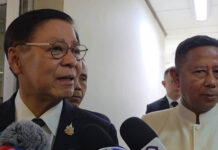
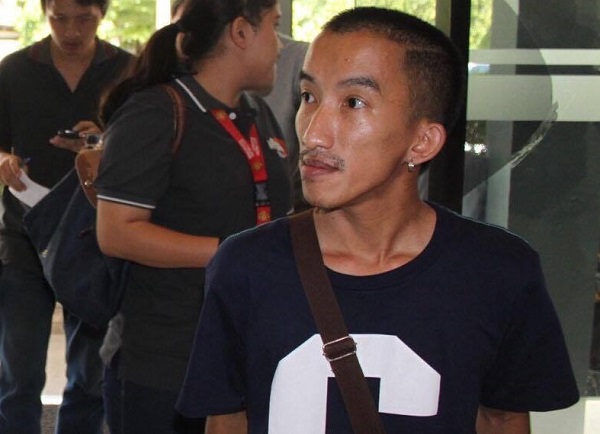
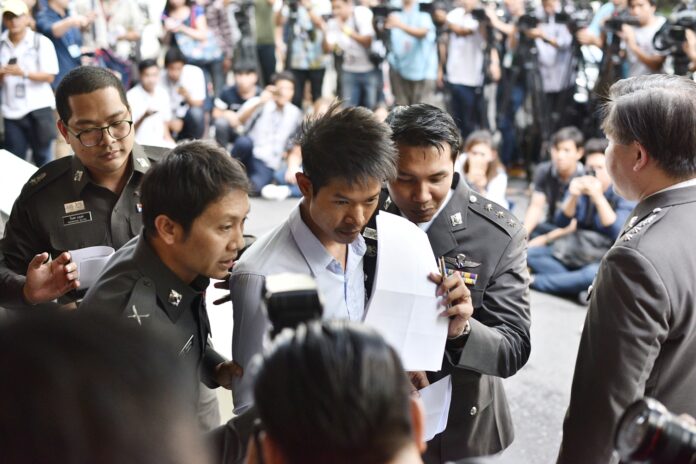
Thanet Anatawong, who fled the country late last year, appears Tuesday at Bangkok’s Crime Suppression Division headquarters. Photo: Matichon
BANGKOK — A fugitive pro-democracy activist who jumped bail after saying he was snatched from a hospital bed by authorities has returned to fight the charges against him.
Thanet Anantawong, 26, said Tuesday he spent over six months in Laos and New Zealand after a news organization wrongly reported he’d been charged with insulting the monarchy, a cultural taboo he said made it difficult to continue living in Thailand.
Thanet was arrested soon after an activist group he was associated with attempted to visit the site of a controversial royal monument tainted by allegations of corruption. He was awaiting surgery at Sirindhorn Hospital when officers took him into custody on Dec. 13. Authorities charged him with sedition and posting false information online, allegedly for his use of Facebook. He was released Dec. 18 on a 100,000-baht bond and jumped bail days later.
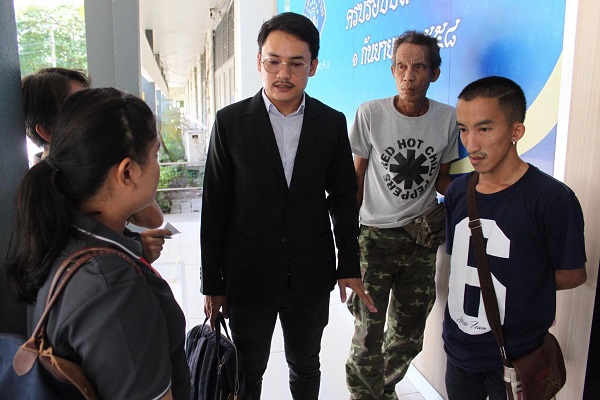
On Tuesday, Thanet said he was prepared to pay the 100,000 baht bond for his freedom and fight the charges in court. He was helped by lawyers from Thai Lawyers for Human Rights and Redshirt umbrella group United Front of Democracy Against Dictatorship.
Thanet said he turned himself into police Monday and was granted bail on a 10,000 baht bond relating to a separate charge of violating the ban on political gatherings related to the activists’ trip to Rajabhakti Park.
Thanet Anatawong, who fled the country late last year, appears Tuesday at Bangkok’s Crime Suppression Division headquarters. Photo: Matichon
A delegate wears a hat with a bubble-head doll of Democratic Presidential candidate Sec. Hillary Clinton during the first day of the Democratic National Convention in Philadelphia , Monday, July 25, 2016. Photo: John Locher
PHILADELPHIA, Pennsylvania — A glass ceiling is shattering at the Democratic National Convention as Hillary Clinton ascends to the presidential nomination with Tuesday’s roll call of the states, making her the first woman to lead a major party into a White House race.
But as history is being made, hostility is being heard, too. Rhetorically, at least, die-hard Bernie Sanders’ supporters also are breaking some glass, loudly protesting his treatment by the party and still cold to Clinton even as Sanders appeals for Democrats to unify and defeat Republican Donald Trump, “a bully and a demagogue.”
What was expected to be a tightly orchestrated convention, run with all the professionalism and experience that were lacking at Trump’s often-chaotic affair in Ohio, instead showed its rough edges in the early going, starting with chants of “Bernie” during the opening invocation and boos at numerous mentions of Clinton’s name.
First lady Michelle Obama gave a heartfelt endorsement of the candidate who engaged her husband in a fierce struggle for the nomination in 2008. “I trust Hillary to lead this country,” she said in a speech that provided a parent’s-eye view of the White House and its power.
First Lady Michelle Obama speaks during the first day of the Democratic National Convention in Philadelphia , Monday, July 25, 2016. Photo: J. Scott Applewhite
Liberal favorite Elizabeth Warren, senator from Massachusetts, and Sanders himself also gave the party something to cheer about Monday night.
While Mrs. Obama has often avoided overt politics, her frustration with Trump’s rise was evident. Without naming him, she warned that the White House couldn’t be in the hands of someone with “a thin skin or a tendency to lash out” or someone who tells voters the country can be great again. “This right now, is the greatest country on earth,” she said.
Sanders took the stage to a sustained roar and shouts of “We love you, Bernie.” Some of his supporters were in tears.
While asserting “our revolution continues,” the Vermont senator implored his restive followers to get behind Clinton. On issues of poverty, immigration, environmental protection and more, he said, Clinton’s election counts. “If you don’t believe that this election is important,” he said, “take a moment to think about the Supreme Court justices that Donald Trump would nominate.”
Democrats made a pronounced effort to showcase their diversity, salting the lineup from the stage with black, Hispanic, gay and disabled speakers in an obvious counterpoint to Trump and the various groups he has upset with his remarks.
The convention opened in a dustup over leaked emails showing the party’s pro-Clinton, anti-Sanders slant during the primaries, when it was supposed to be neutral. In the uproar, party chairwoman Debbie Wasserman Schultz of Florida went swiftly into exile, first giving up her position, then the convention’s opening-day gavel after being roundly booed by Sanders partisans at a meeting of her home-state delegation.
Sanders delegate Gian Carlo Espinosa, 29, of Key West, Florida, said he would not abandon protests, as Sanders urged. “Why else are we here?” he asked. “The people that we’re representing are displeasured with the party. We have to get that across somehow.” This, despite Sanders telling his backers in an email and text message: “Our credibility as a movement will be damaged by booing, turning of backs, walking out or other similar displays.”
In roasting heat, spirited protests unfolded outside, another echo of the Republican convention in Cleveland. Several hundred Sanders backers marched down Philadelphia streets, with signs saying “Never Hillary.” One said, “Just go to jail, Hillary,” a takeoff on cries at the Republican convention to “lock her up.”
Nevertheless, Clinton was firmly on track to write the next chapter of a story that left off in 2008, when she conceded the Democratic presidential race to Barack Obama in a speech that lamented “we weren’t able to shatter that highest, hardest glass ceiling this time,” but added proudly, “it’s got about 18 million cracks in it,” a tally of her primary votes.
The roll call, when each state announces its delegate totals from the primary season, will affirm a nomination Clinton locked up weeks ago. One question of the day was whether Sanders would press for a count by all the states, as his delegates want, or interrupt the process to ask that her nomination be approved by acclamation. That’s what Clinton did on Obama’s behalf in 2008 to indicate their rivalry was truly over.
Clinton promised an uplifting counterpoint to Trump’s dark portrayal of the state of the nation, but the fallout from some 19,000 leaked Democratic National Committee emails threatened to complicate those plans.
Michael Buratowski, an analyst with the cybersecurity firm the Democrats employed, said he found evidence of Russian involvement, such as the use of a Russian-language keyboard and time-offs that coincided with Russian business hours in what he described as an attack too sophisticated to be the work of freelance hackers. The hackers took at least a year’s worth of detailed chats, emails and research on Trump, according to a person knowledgeable of the breach who wasn’t authorized to speak publicly about the matter.
As the convention began, the DNC released a statement apologizing to Sanders and his supporters “for the inexcusable remarks made over email.”
The statement was signed by DNC leaders, though Wasserman Schultz’s name was notably absent.
SAN DIEGO, California — Marvel Studios took a year off from Comic-Con, but it came back with a pow on Saturday with a spectacle and star-filled presentation offering exclusive looks at “Spider-Man: Homecoming,” ”Doctor Strange” and “Guardians of the Galaxy Vol. 2.”
“We only want to come when we have a lot of stuff to show you,” Marvel Studios head Kevin Feige said. Feige didn’t disappoint the 6,500 person crowd inside the convention hall with the nearly two-hour presentation.
They kicked things off with “Black Panther,” which doesn’t start shooting until January for a release in 2018. While there weren’t any assets to tease, they did bring out the cast, including star Chadwick Boseman, Lupita Nyong’o, Michael B. Jordan, the just-announced Danai Gurira, best known for “The Walking Dead,” and director Ryan Coogler.
Tom Holland walks on stage at the “Spider-Man: Homecoming” panel on day 3 of Comic-Con International on Saturday, July 23, 2016, in San Diego. Photo: Chris Pizzello
Coogler, who directed “Creed” and “Fruitvale Station,” said that it was a very emotional experience being at Comic-Con. He actually came as a fan in 2009 and remembered sitting in the very back of Hall H.
“It’s absolutely crazy to be looking at my people from this view,” Coogler said.
The rest of the films on Marvel’s slate, even those which have just started shooting, had something to show.
Audiences saw a hilarious documentary-style “Thor” spoof from “Thor: Ragnarok” director Taika Waititi imagining what Thor (Chris Hemsworth) was up to while his buddies were off battling each other in “Captain America: Civil War.” Essentially, Thor moves to Australia and gets a dumpy white-collar roommate.
“Thor: Ragnarok” has just started filming for a Nov. 2017 release.
Those in Hall H also got a sneak peek at “Spider-Man: Homecoming,” which is just 10 days into its shoot.
Marvel Studios unveiled initial footage showing star Tom Holland as Peter Parker in the latest big-screen reboot of the web-slinger.
Director Jon Watts said “Homecoming” is simply a high school movie. Moderator Chris Hardwick added that it has some John Hughes vibes to it.
It’s the first modern “Spider-Man” movie to be done with the supervision of Marvel Studios. It’s being co-produced by Sony Pictures. This new Spider-Man was first unveiled in “Civil War” and became an immediate fan favorite. The film comes out next July.
Marvel brought out the production value for “Doctor Strange,” starting out that portion of the presentation with a smoke and light show, which cleared to reveal star Benedict Cumberbatch on the stage.
President of Marvel Studios Kevin Feige, left, and actor Benedict Cumberbatch attend the “Dr. Strange” panel on day 3 of Comic-Con International on Saturday, July 23, 2016, in San Diego. Photo: Chris Pizzello
“The scale of it is something else,” said Cumberbatch, no stranger to playing beloved characters.
The scene showed focused in on Tilda Swinton’s The Ancient One teaching a reluctant Stephen Strange (Cumberbatch) about his crazy new powers. Director Scott Derrickson said he wanted to make sure the “mind-trippy visuals” of the comics were an integral part of the film, which bows in November.
Costumed ravagers took the stage to help tease “Guardians of the Galaxy Vol. 2,” out next year, as did stars Chris Pratt, Zoe Saldana and Dave Bautista. The crowd went wild for an extended look at a scene with the adorable Baby Groot — a CG tree character, who in the last film was full-sized and voiced by Vin Diesel — staging an escape from captivity with Yondu (Michael Rooker) and Rocket Racoon (Bradley Cooper). Rooker sat on the stage in full costume and makeup.
Kurt Russell, also present for the panel, was confirmed as Star Lord’s (Pratt) father in a newly release trailer, resulting in a resounding cheer from the audience. Less popular, though, was the announcement that “Guardians of the Galaxy” would be overtaking the Tower of Terror ride at Disneyland starting next summer with a new ride. Audience members booed at the concept image.
Marvel closed things out on a high note, however, with an obligatory all-Marvel photo, including the new Captain Marvel herself — Oscar-winner Brie Larson, who was greeted with a rapturous standing ovation.
BANGKOK — Wander through piles of two million books for heavily discounted reads from Mario Puzo’s “The Godfather” to Seth Grahame-Smith’s “Pride and Prejudice and Zombies.”
The Big Bad Wolf Book Sale, a regional sale that started in Malaysia, comes to Thailand for the first time next month with loads of English-language books discounted 60 percent to 80 percent, with most novels sold for 150 baht or less.
Love Hello Kitty? Never got around to reading those Michael Jackson and Steve Jobs biographies? Giant heaps of printed materials and more in a wide range of categories will be sold, from encyclopedias and unusual cookbooks to The Hunger Games box sets.
Don’t expect the latest publications, as most of the books qualify as “recent” at best.
Admission is free. All books are in English. Check out the selection online.
The first warehouse book sale was held in 2009 at Malaysia’s Selangor. It then spread across Malaysia and into Indonesia.
The Big Bad Wolf Book Sale runs Aug. 12 through Aug. 21 at Impact Convention Center’s Hall 9. The book fair will be open 10am to 10pm on Monday through Thursday, followed by a marathon 60-hour session from 10am on Friday to 10pm on Sunday.
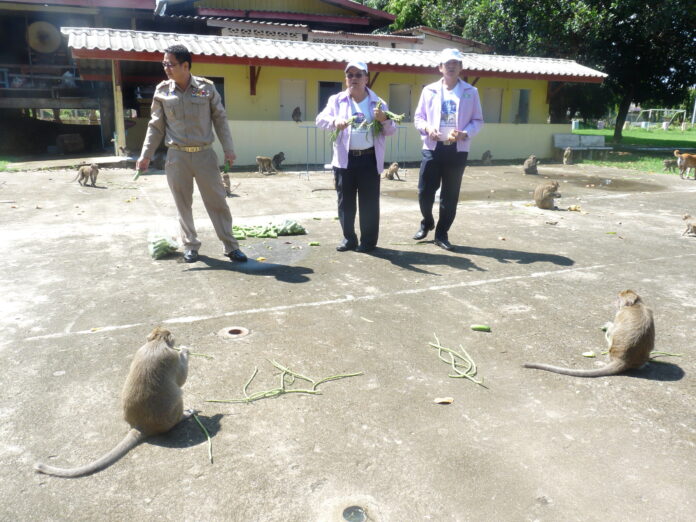
Election officials on Monday treat monkeys to a free meal of fruit and vegetables at Wat Hat Mun Krabua in Pichit
BANGKOK — Should a gang of monkeys return to terrorize a Pichit provincial polling station a second time, they’ll need thumbs to get at the pink voter lists after the fragile documents were moved into a glass enclosure.
At least that’s the hope of elections officials who, after Sunday’s incident in which more than 100 macaques stormed a temple polling place and damaged the posted documents, moved replacement documents into a locked cabinet.
Voter list now safe!
For good measure, the officials also treated the monkeys roaming about Wat Hat Mun Krabua to a meal of fruit and vegetables, hoping that the primates would become more friendly toward the state.
With the monkey problem hopefully solved, provincial elections chief Prayoon Chakkrapatcharakul said his office would turn its attention to achieving a high voter turnout.
“Pichit province expects at least 80 percent of people will come out to exercise their right to vote,” he said.
Naturally, the monkey attack became a trending topic of discussion and sparked online memes among critics of the junta.
Some teasingly challenged the regime to prosecute the monkeys, in line with its seemingly zealous enforcement of the referendum law, which criminalized any vandalism of voting equipment and any campaigning deemed to “mislead” the public into voting yes or no.
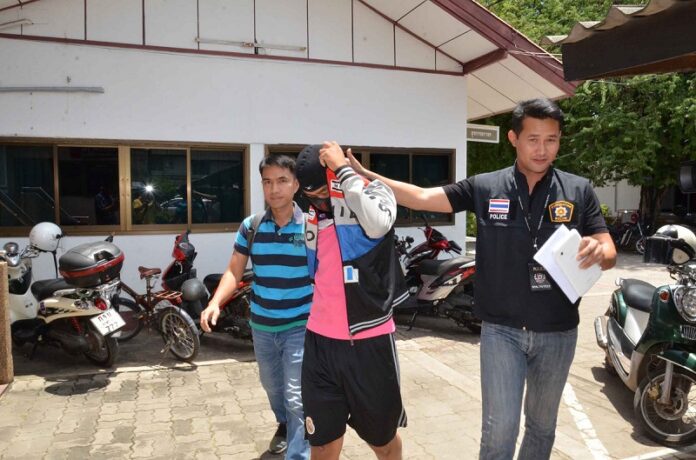
Saroj Meepai is escorted by officers on June 11 at the Central Investigation Bureau
BANGKOK — A month after a teacher at an elite Bangkok boys school was arrested on suspicion of posting photos and videos online described as the sexual abuse of young schoolboys, the police investigation seems to have stalled out.
Police have yet to bring Suankularb School science teacher Saroj Meepai, currently free on bail, to court, and the school said a disciplinary review by education officials is unfinished, while the initial outcry in the media and online communities has subsided.
“The officials are handling this matter,” Suankuarb deputy director Amnuay Chanhom said by telephone Tuesday. “I have already urged them to hurry up, but at this time we still cannot rule whether he has done wrong. We have to wait for all the evidence to be examined.”
For allegedly sharing images of the abuse on his Twitter account, Saroj is facing two separate investigations: a criminal probe by police and an administrative review by the state education regulatory board.
According to Amnuay, the school cannot hand down any punishment until the board finishes its inquiry, and he doesn’t know when that will be. In the meantime, Saroj remains suspended from his job.
Amnuay added that Saroj was granted bail; he had been denied release immediately after his arrest June 11.
Maj. Peempot Khetthet, an investigator with the police’s online crime division, said as far as he knew, investigators have not forwarded any charges against Saroj to the prosecutor’s office.
“I don’t think we’ve already done that, because witness examination isn’t over yet,” Peempot said Tuesday.
The slow pace of the investigation contrasts the widespread outrage and media attention when a group of students in June outed Saroj as the owner of a Twitter account which posted explicit boasts of sex with underage students, including graphic photos and videos as proof of the claim.
Upon being arrested for spreading child pornography, Saroj backtracked and said he was having sex with adults and he fabricated details of abusing children for the sake of gaining more followers.
Amnuay, deputy director of the school which for 134 years has educated the elite of the elite, is open to that explanation, unless children step forward to say that they were abused by Saroj.
“I don’t know if they were really schoolboys,” Amnuay said. “I have to ask the committee for their opinion. But at this moment, no students at our school have come forward as victims so far. So we can’t prove if it’s true, whether they were really children. We have to wait for the conclusion.”
At the outset of the scandal, Suankularb administrators were accused by some students of attempting to cover up Saroj’s alleged crimes, ostensibly to protect its reputation as the oldest and most prestigious public boys school in Thailand.
But Amnuay said that’s not the case, and the school has taken steps to make sure its teachers are held accountable, such as a hotline where students can leave anonymous tips about “inappropriate behavior” by any instructors.
Update: This event has been postponed to March 18 in light of the death of His Late Majesty King Bhumibol
BANGKOK — The 4,000 square meters of Impact Arena will be packed with ‘90s kids rocking, jumping and screaming along to their all-time favorites later this year.
Twenty years after they pioneered electronic sound and paved the way for a generation of rock stars, Modern Dog will celebrate their 22nd anniversary with what they say is their biggest concert ever.
Famous for songs such as “Busaba” (Flower), “Gorn” (Before), “Ta Sawang” (Eyes Open) and more, the fathers of Thai alternative rock released their first album in 1994, two years after placing first in what was a big annual music contest sponsored by Coca-Cola.
The band got off to a big start when they performed as the opening act for one of their biggest influences, Radiohead, in 1994 at MBK Center.
Now in their 40s, singer-songwriter Thanachai Ujjin, guitarist Maetee Noijinda and drummer Pawin Suwannacheep will release their sixth album in August, two months before the show.
The Modern Dog 22 concert will take place on March 18 at Impact Muang Thong Thani. Tickets range from 1,000 baht to 3,500 baht and are available online.
A 16-year-old boy is brought to a police station in Kalasin province Monday where he was charged with the attempted murder of his father.
KALASIN — A 16-year-old boy was arrested Monday in connection with what police say was the attempted murder of his father.
Police said the teen was charged with the attempted murder of Somphong Phetprayoon, 60, who was found severely injured inside his Kalasin province home Friday night with numerous stab wounds to his head and body. Police believe the boy attacked his father along with two friends.
“They pretended to steal his fighting cock to lure him out,” said police Maj. Gen. Apichit Tienpermpoon, adding the motive seemed rooted in a conflict between the father and son.
Police first investigated the case as a burglary until they called Somphong’s son in for questioning yesterday.
A reporter present during questioning said that police told the 16-year-old suspect to call a friend. When the friend answered the phone, he asked for 20,000 baht he said was promised in exchange for the murder.
Apichit on Tuesday dismissed that part of the story, saying there was no official report about the suspect hiring his friends.
Somphong, himself a local official, is now in stable condition.
The other two friends suspected of involvement remain at large and are being sought by police.
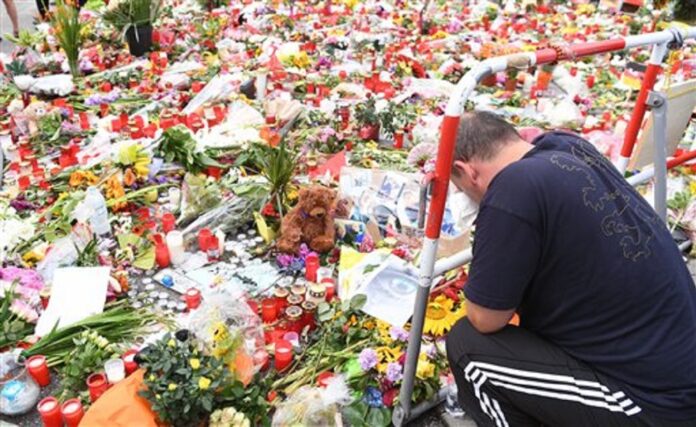
A man prays next to flowers and candles that have been placed in front of the main entrance of the Olympia-Einkaufszentrum (Olympia Shopping Mall) in Munich, Germany, Monday, July 25, 2016, after a rampage that left numerous people dead and injured. Photo: Peter Kneffel
BERLIN — Four attacks in a week — three of them carried out by asylum seekers — have left Germany on edge and Chancellor Angela Merkel’s policies of welcoming refugees under renewed criticism.
Anxiety over Germany’s ability to cope with last year’s flood of more than 1 million registered asylum seekers first surged following a series of sexual assaults and robberies in Cologne during New Year celebrations.
But in the last seven days, the violence has become even more deadly.
The unprecedented bloodshed began July 18, when a 17-year-old from Afghanistan wielding an ax attacked people on a train near Wuerzburg, wounding five people before he was shot to death by police. The Islamic State group claimed responsibility.
On Sunday, a 21-year-old Syrian used a machete to kill a 45-year-old Polish woman in the southern city of Reutlingen. Authorities said assailant and victim knew each other from working in the same restaurant, and the incident was not related to terrorism.
Also Sunday, a 27-year-old Syrian who was denied asylum detonated a backpack of explosives and shrapnel at the entrance to an outdoor music festival in Ansbach, killing himself and wounding 15 people. The Islamic State group claimed responsibility, and German security officials said a video on the attacker’s phone shows him pledging allegiance to the extremists.
The deadliest attack came Friday night in Munich. The German-born, 18-year-old son of Iranian asylum seekers went on a shooting spree and killed nine people. The youth had obsessively researched mass shootings, and authorities said the attack does not appear to be linked to Islamic extremists.
The violence followed an attack in the French Riviera by a Tunisian truck driver who plowed his vehicle into a Bastille Day crowd, killing 84 people in Nice.
Experts say the attacks are likely to inflame anti-foreigner sentiment in Germany, creating a challenge for Merkel’s government.
Merkel could now face increased calls for tighter border security and greater vetting of arrivals, even though the flow of migrants and asylum seekers has slowed drastically, said Florian Otto, an analyst with the risk consultants Verisk Maplecrof. The influx diminished after the European Union and Turkey agreed on a deal aimed at stopping people from reaching the continent by sea.
Although it’s too soon to say whether these attacks would threaten Merkel’s chances of staying in power after federal elections next year, “she will face more pressure and scrutiny for her immigration policies,” Otto said.
“The motives of the … attacks differ widely; they were not linked. But to some extent, that won’t matter in the public debate, which will be focused on the outcomes,” he said.
The sexual assaults in Cologne, which prosecutors said were committed largely by foreigners, fueled anti-immigrant sentiment and helped bolster support for the populist, anti-Islam AfD party in three regional elections.
Concern had lessened as border controls were re-established after being abolished for a time last fall to handle the biggest influx and warnings of a spike in crime weren’t realized. But with regional elections coming in the fall, this month’s attacks could give AfD fresh support.
On Monday, the AfD criticized Merkel’s administration, saying that under “the current ideology of a dangerous ‘multiculturalism,’ the country’s domestic security and the order of Germany keeps getting destroyed.”
In this Saturday, July 23, 2016 file photo, German Chancellor Angela Merkel arrives for a statement in Berlin, Germany, on the Munich attack. Photo: Michael Sohn
Social media criticism of Merkel was especially harsh, with some people condemning her for accepting hundreds of thousands of migrants last year.
Merkel tried to calm the mood over the weekend by saying the security services will “do everything possible to protect the security and freedom of all people in Germany.”
Interior Minister Thomas de Maiziere said most asylum seekers had come to Germany to escape persecution, and it was important to remember that only a tiny minority had links to terrorism. It would be wrong, he told the Funke newspaper group, to put all of them under “general suspicion, even if there are investigations in individual cases.”
“We are currently talking about 59 investigations for possible links to terrorist structures, and that’s with many hundreds of thousands of newly arrived people,” he was quoted as saying. In the overwhelming number of cases, reports turn out to be false.
De Maiziere called for Germany’s borders to be better protected without preventing people from coming in by legal and safe means “in reasonable numbers.”
In the Munich shooting, he noted there was no indication the gunman, born in Germany to Iranian parents, had failed to integrate in German society.
Nonetheless, “people in Germany are scared,” said Rainer Wendt, the head of the police union DPolG.
“Last year, we gave up control of our borders and instructed police not to check everything that should have been checked,” Wendt said in an interview on German broadcaster n-tv. “There was also this welcome culture, which stopped us clearly seeing that some people have come here who are up to no good, or who are so psychologically unstable that they pose a considerable threat.”
Armin Nassehi, a sociologist at Ludwig Maximilian University in Munich, said that among the 1 million asylum seekers who were registered in Germany last year, “there’s a big number of traumatized people who know nothing but violence — that’s a fact one cannot ignore.”
He pointed out that “most people who commit Islamist acts of terror are also psychologically unstable.”
Asked why there were so many attacks in such a short time, Nassehi suggested some of the attackers may be copycats, saying that “images of violence produce further violence.”
Asked how similar attacks could best be prevented, de Maiziere said it was important to ensure that new arrivals be well-integrated quickly into German society.
“Good integration policy is always preventive security policy as well,” he said.
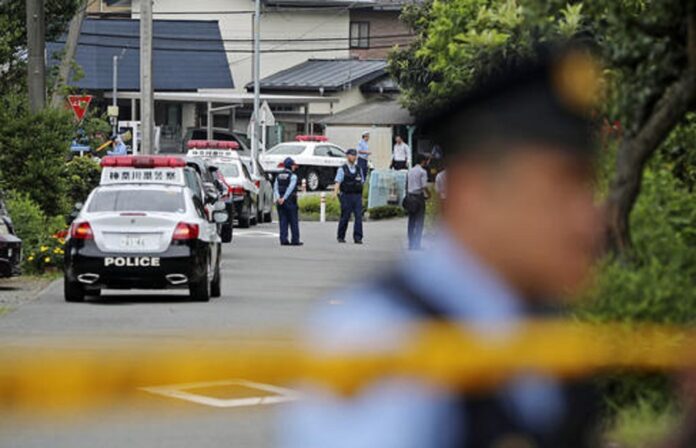
Police officers stand guard at a crossroad near the Tsukui Yamayuri-en, a facility for the handicapped, where a number of people were killed and dozens injured in a knife attack in Sagamihara, outside of Tokyo, Japan, Tuesday, July 26, 2016. Photo: Eugene Hoshiko
SAGAMIHARA, Japan — At least 19 people were killed and about 20 wounded in a knife attack Tuesday at a facility for the handicapped in a city just outside Tokyo in the worst mass killing in generations in Japan.
Police said they responded to a call at about 2:30 a.m. from an employee saying something horrible was happening at the facility in the city of Sagamihara, 50 kilometers (30 miles) west of Tokyo.
A man turned himself in at a police station about two hours later, police in Sagamihara said. He left the knife in his car when he entered the station. He has been arrested on suspicion of attempted murder and trespassing.
Officials in Kanagawa prefecture, which borders Tokyo, identified the suspect as Satoshi Uematsu, and said he had worked at the facility until February. Japanese media reports said he was 26 years old.
He entered the building about 2:10 a.m. by breaking a glass window on the first floor of a residential building at the facility, Shinya Sakuma, head of prefectural health and welfare division, said at a news conference.
Kanagawa Gov. Yuji Kuroiwa expressed his condolences to the victims.
The Sagamihara City fire department says that 19 people were confirmed dead in the attack. The fire department said doctors at the scene confirmed the deaths.
The death toll could make this the worst mass killing in Japan in the post-World War II era.
A woman who lives across from the facility told Japanese broadcaster NHK that she saw police cars enter the facility around 3:30 a.m.
“I was told by a policeman to stay inside my house, as it could be dangerous,” she said. “Then ambulances began arriving, and blood-covered people were taken away.”
Japanese broadcaster NTV reported that Uematsu was upset because he had been fired, but that could not be independently confirmed.
The facility, called the Tsukui Yamayuri-en, is home to about 150 adult residents who have mental disabilities, Japan’s Kyodo News service said.
Television footage showed a number of ambulances parked outside, with medical and other rescue workers running in and out.
Mass killings are relatively rare in Japan, which has extremely strict gun-control laws. In 2008, seven people were killed by a man who slammed a truck into a crowd of people in central Tokyo’s Akihabara electronics district and then stabbed passers-by.
In 2001, a man killed eight children and injured 13 others in a knife attack at an elementary school in the city of Osaka. The incident shocked Japan and led to increased security at schools.
More recently, 14 were injured in 2010 by an unemployed man who stabbed and beat up passengers on two public buses outside a Japanese train station in Ibaraki Prefecture, about 25 miles (40 kilometers) northeast of Tokyo.
A man who lives near the site of the latest attack said he was shocked such an attack happened in the quiet, semi-rural area near Mount Takao, a mountain popular with hikers.
“I never imagined such a horrible thing happening,” said Chikara Inabayashi, who was tending his watermelon patch. “I was astonished, that’s the only thing I can say.”