


















30 C
Bangkok
Thursday, August 27, 2026
Home Blog Page 3362

ASEAN Summit Focuses on South China Sea Tensions

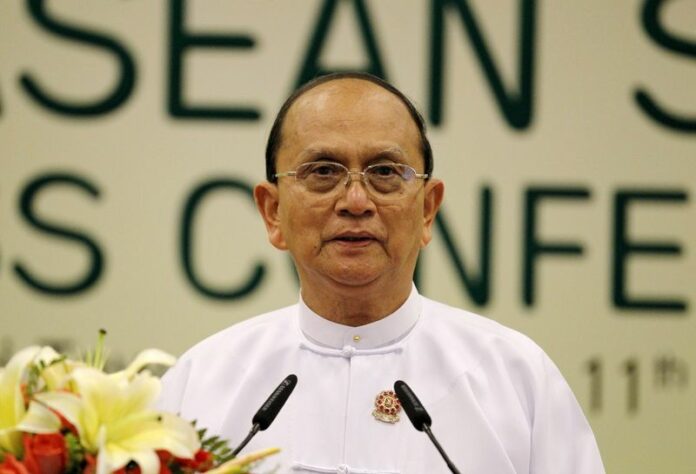
Myanmar President Thein Sein talks to media during a press conference after the 24th Association of Southeast Asian Nations (ASEAN) Summit in Naypyidaw, Myanmar, 11 May 2014 (DPA).

By Peter Janssen (DPA)

NAYPYITAW —  South-east Asian leaders on Sunday called for "self-restraint and non-use of force" in the South China Sea, where member states and China have sparred over disputed territorial claims.

A joint declaration issued at the 10-member Association of South-east Nations summit hosted for the first time by Myanmar, called on all sides to "refrain from taking actions that would further escalate tension and to work towards an early conclusion of the Code of Conduct in the South China Sea."

The statement followed Vietnamese charges that Chinese boats had rammed Vietnamese vessels and used water cannon against them last week in the South China Sea, and more recently erected an oil rig in disputed territorial waters.

A similar statement issued by the ASEAN foreign ministers Saturday reportedly irked Beijing, where Foreign Ministry spokesman Hua Chun Ying said China's disputes in the South China Sea should be dealt with bilaterally.

China has in the past been reluctant to sign a code of conduct in relation to the South China Sea, and has preferred to tackle maritime disputes on a bilateral basis, rather than as an ASEAN regional security issue.

"ASEAN expressing its common view on the South China Sea is not meant to be unfriendly against any country, including China," said Indonesian Foreign Minister Marty Natalegawa.

The meetings, held twice a year, end with declarations on regional issues such as economic integration and common security concerns.

Myanmar, which is hosting the ASEAN summit for the first time, has steered clear of the South China Sea issue in its official statements.

China was one of the few counties to stand by Myanmar during its pariah years, when it was under junta rule and subject to economic sanctions by Western democracies. China is currently Myanmar's leading foreign investor and trade partner.  

Myanmar President Thein Sein chose to concentrate on climate change in his opening address to the forum.

He proposed the establishment of a regional humanitarian assistance centre to boost the capacity to respond to natural disasters, and a regional campaign to reforest coastal areas with mangroves.

Central Myanmar was devastated by Cyclone Nargis in May 2008, which claimed at least 138,000 lives at a time when the country was still under military rule.

"Mangrove forests not only reduce the greenhouse gases but also reduce the impact of storms and floods in low-lying coastal areas," Thein Sein said.

The retired army general is credited with pushing through several political and economic reforms since taking office in 2001.

Reforms including the release of political prisoners and allowing opposition leader Aung San Suu Kyi to join mainstream politics as a member of parliament prompted Western democracies to drop economic sanctions that had been in place for decades.

Myanmar was selected to host an ASEAN summit for the first time since it became a member in 1997 of the bloc that includes Brunei, Cambodia, Indonesia, Laos, Malaysia, the Philippines, Singapore, Thailand and Vietnam.
Advertisement

Chinese Woman Begins Ascent to Redeem Everest Climbing Season

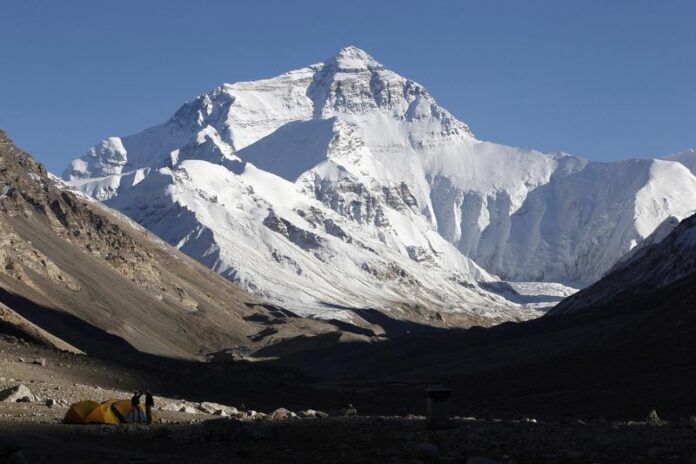
Mount Everest (DPA).

KATHMANDU (DPA) — A Chinese woman was on her way up Mount Everest, in the first attempt to reach the summit after expeditions were called off following a deadly avalanche, officials said Sunday.

"We have received information that Wang Jing is making her way up toward the Base Camp with a group of three supporting Sherpa climbers," said Dipendra Poudel, secretary of the mountaineering department of Tourism Ministry.

The 40-year-old Wang has already climbed seven peaks above 8,000 metres. The ministry said climbing guides were working to fix new ropes and ladders over the icefall since the April 18 avalanche.

Poudel said another group of 10 climbers was to head toward Everest next week from Kathmandu for an expedition.

Altogether, 334 climbers had sought permits to climb Everest this year before expeditions were called off after an avalanche struck the mountain, killing 16 Nepali climbing guides on April 18.

An American woman was also on her way up Mount Lhotse, another peak in the Everest region at 8,501 metres.

The 51-year-old Cleonice Weidlich got a head start on a helicopter to Camp 2, altitude 6,500 metres, with her equipment.

"We only allow helicopters to go up to camps in case of emergency," said Dipendra Poudel, secretary of the mountaineering department of Tourism Ministry.

"A section of the climbing ladder was broken after the avalanche at the Khumbu icefall, which might have been the reason she had to fly to Camp 2."

Climbers to both Everest and Lhotse follow the same route up to Camp 4 before branching out in different directions.

According to law, helicopters are only allowed on the slopes of the mountain for rescue operations. But Poudel said the government has been under pressure to save face this climbing season after most of the expeditions were called off last month.

Weidlich was accompanied by a climbing guide and a porter. She had successfully reached the 8,848-metre Everest summit in 2010.

Advertisement

Police Apologise To Buddha Issara For Tear Gas Barrage

BANGKOK — The police have formally apologised to a core anti-government leader for spraying him with tear gas and a high-pressured water hose during a skirmish in Bangkok yesterday.

The clash between protesters and police occured when the monk and activist Buddha Issara led supporters of the People's Committee for Absolute Democracy With the King As Head of State (PCAD) to the headquarters of the Centre for Administration of Peace and Order (CAPO) on Viphavadee Road.

The monk and his entourage attempted to enter the CAPO compound, and police responded by firing barrage of tear gas and high-pressured water at them, forcing Buddha Issara to retreat.

The monk later pressed charges with Thoong Song Hong Police against the police force, accusing them of attempting to murder him and violating his constitutional right to peaceful assembly. 

Today Buddha Issara led hundreds of protesters back to the CAPO headquarters to demand a formal apology from police. When the police initially failed to respond to his request, Buddha Issara ordered supporters to start dismantling concrete barriers around the entrance to the CAPO compound.

PCAD guards also briefly blocked Viphavadee Road and the elevated tollway during the demonstration, disrupting traffic and forcing a number of foreign tourists to walk with their luggages to find another way to reach Don Mueang Airport. 

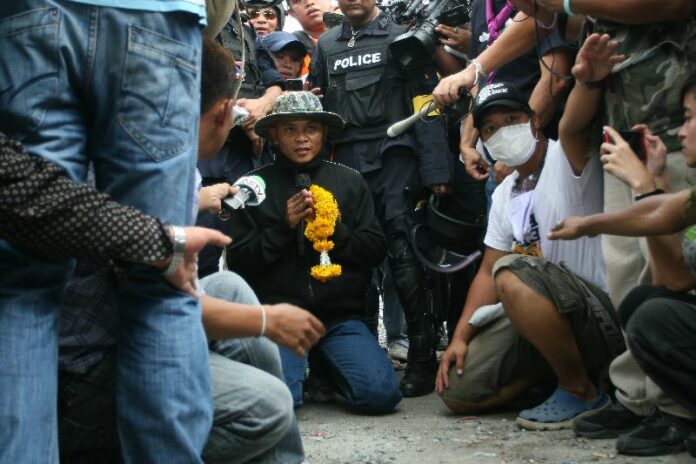
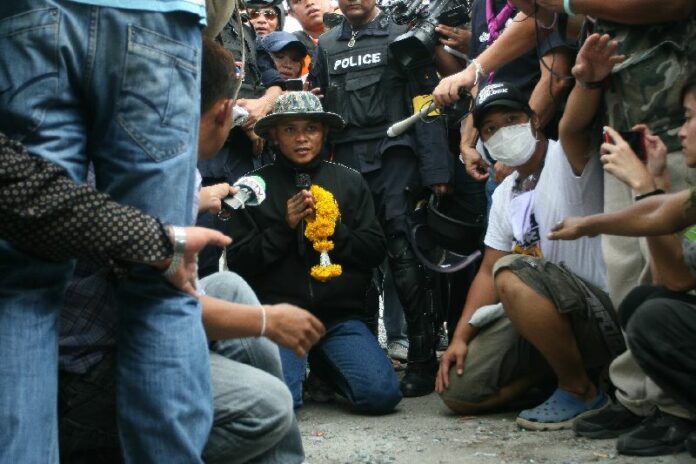
However, the police eventually sent several representatives bearing traditional garlands to apologise to Buddha Issara. The officers knelt down humbly and asked the monk to forgive police for their actions on the previous day. 

Pleased with the gesture, Buddha Issara accepted the apology, and the protesters dispersed peacefully from the area.


For comments, or corrections to this article please contact:[email protected]

You can also find Khaosod English on Twitter and Facebook
http://twitter.com/KhaosodEnglish
http://www.facebook.com/KhaosodEnglish

Advertisement

Police Apologise To Buddha Issara For Tear Gas Barrage

BANGKOK — The police have formally apologised to a core anti-government leader for spraying him with tear gas and a high-pressured water hose during a skirmish in Bangkok yesterday.

The clash between protesters and police occured when the monk and activist Buddha Issara led supporters of the People's Committee for Absolute Democracy With the King As Head of State (PCAD) to the headquarters of the Centre for Administration of Peace and Order (CAPO) on Viphavadee Road.

The monk and his entourage attempted to enter the CAPO compound, and police responded by firing barrage of tear gas and high-pressured water at them, forcing Buddha Issara to retreat.

The monk later pressed charges with Thoong Song Hong Police against the police force, accusing them of attempting to murder him and violating his constitutional right to peaceful assembly. 

Today Buddha Issara led hundreds of protesters back to the CAPO headquarters to demand a formal apology from police. When the police initially failed to respond to his request, Buddha Issara ordered supporters to start dismantling concrete barriers around the entrance to the CAPO compound.

PCAD guards also briefly blocked Viphavadee Road and the elevated tollway during the demonstration, disrupting traffic and forcing a number of foreign tourists to walk with their luggages to find another way to reach Don Mueang Airport. 

However, the police eventually sent several representatives bearing traditional garlands to apologise to Buddha Issara. The officers knelt down humbly and asked the monk to forgive police for their actions on the previous day. 

Pleased with the gesture, Buddha Issara accepted the apology, and the protesters dispersed peacefully from the area.


For comments, or corrections to this article please contact: [email protected]

You can also find Khaosod English on Twitter and Facebook
http://twitter.com/KhaosodEnglish
http://www.facebook.com/KhaosodEnglish

Advertisement

Building Regulation 'To Be Revised' After Earthquakes

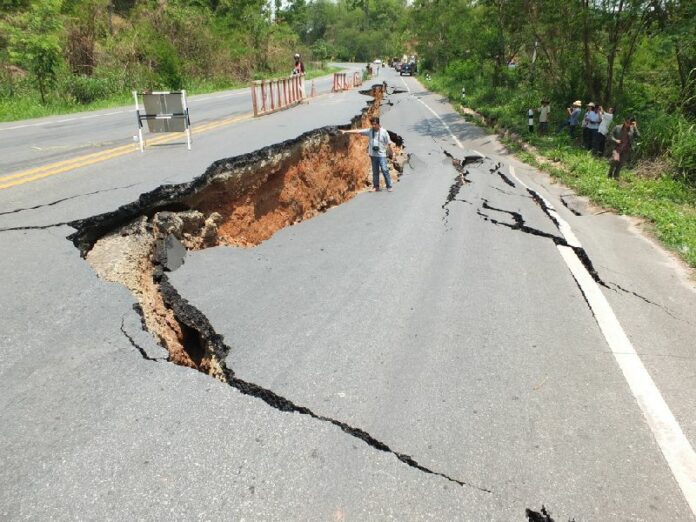
BANGKOK — A Senator has called to amend national building regulations following a 6.0 magnitude earthquake in Chiang Rai province last week.

The quake shook the northern region on 5 May, as the nation was celebrating the auspicious anniversary of His Majesty the King's Coronation, and caused extensive damages to many roads, residences, and historic sites.

The earthquake was one of the largest to have hit Thailand in modern history.

Speaking to the newly-convened Senate in Bangkok, Chiang Rai Senator Mongkolchai Duangsaengthong said he has asked Chulalongkorn University and local administrations in Chiang Rai province to send experts to inspect many affected buildings and look for any long-term consequences caused by the earthquake.

Mr. Mongkolchai also urged the authorities to dispatch psychiatrists to help frightened citizens who have fled their homes in the aftermath of the quake and have been living in temporary shelters since. 

"The people who are affected are too afraid to return to their homes," Mr. Mongkolchai said.

Furthermore, the Senator said the government should amend the current Building Control Act to include preparations for future quakes, while the Department of Disaster Prevention should regularly conduct earthquake drills for the public. 

Senate Speaker Surachai Liangboonlertchai replied that he would pass Mr. Mongkolchai's proposals to relevant authorities, and added that the Senate could also organise a fund-raising on behalf of the earthquake victims in Chiang Rai province.

Meanwhile, local officials in Chiang Rai said the damage survey in the province showed that at least 54,000 people have been affected by the 5 May earthquake and its numerous aftershocks. One fatality has been reported. 

According to the reports, 8,371 residential buildings, 63 temples, 31 governmental buildings, five roads, three schools, one hotel were damaged by the quake.

Officials warned that the toll is not the final number, as the damage survey is still ongoing in some districts.


For comments, or corrections to this article please contact: [email protected]

You can also find Khaosod English on Twitter and Facebook
http://twitter.com/KhaosodEnglish
http://www.facebook.com/KhaosodEnglish

Advertisement

Man Throws Grenade at Woman 'For Dumping Him'

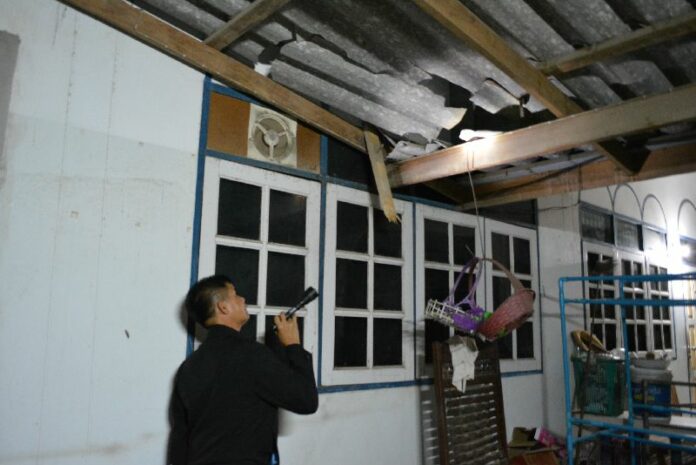
Damage from a grenade blast in Prachuap Kiri Khan, 10 May 2014.

PRACHUAP KIRI KHAN — A man reportedly hurled a grenade at his ex-girlfriend out of jealousy in Prachuap Kiri Khan today.

The victim, a 27 year old woman who gave her name as Kamolthip, was struck in the head by shrapnel from the blast. 

Her mother, who identified herself as Cha-on, 62, said the explosion occurred inside garage where Ms. Kamolthip was sitting with her current boyfriend. When Ms. Cha-on rushed to the scene, she found Ms. Kamolthip writhing with pain because of large wounds on her head. The garage ceiling was also damaged by the blast. 

Ms. Kamolthip was promptly sent to hospital, where she continues to receive treatment for her head injuries. 

According to Ms. Cha-on, Ms. Kamolthip broke up with a man she had been dating in Prachap Kiri Khan when she moved to Bangkok for her studies. Ms. Kamolthip has recently returned home after finishing her studies, and began a new relationship, Ms. Cha-on said.

Ms. Cha-on believes her ex-boyfriend may have been enraged to see Ms. Kamolthip dating another man, and decided to throw a grenade at them out of jealousy. 

Police say they are investigating the incident.


For comments, or corrections to this article please contact: [email protected]

You can also find Khaosod English on Twitter and Facebook
http://twitter.com/KhaosodEnglish
http://www.facebook.com/KhaosodEnglish

Advertisement

Suthep Tells Senate To Appoint Unelected PM

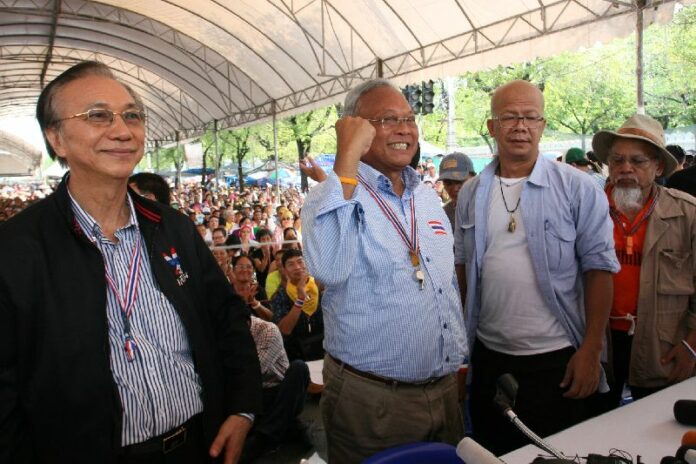
PCAD leader Suthep Thaugsuban at a press conference 10 May 2014

BANGKOK — Anti-government protest leader Suthep Thaugsuban is demanding the Senate and courts seek Royal Approval for an unelected Prime Minister.

Mr. Suthep, the firebrand leader of the People's Committee for Absolute Democracy With the King As Head of State (PCAD), voiced his demands during yesterday’s "Final Battle," in which thousands of anti-government demonstrators took to the streets and besieged nearly all state-owned TV stations and important government buildings in Bangkok. 

In a speech last night, Mr. Suthep insisted that the government has ceased to exist since ex-Prime Minister Yingluck Shinawatra was ousted by the Constitutional Court on Wednesday.

"Today Thailand has no government, and Thailand is not in the state to form a government," Mr. Suthep said. "It's a headless ghost."

He dismissed the Cabinet's appointment of a new PM, former Commerce Minister Niwatthamrong Boonsongphaisarn, calling it illegal and meaningless. 

According to Mr. Suthep, the only solution for Thailand is to replace the remaining Cabinet with an unelected one, chaired by a PM appointed by His Majesty the King. 

The PCAD leader called on the newly-elected Senate Speaker Surachai Liangboonlertchai to urgently "consult" with other Senators to agree on a candidate for the premiership and submit the name to His Majesty the King for his Royal Approval. Mr. Surachai is an appointed member of the Senate – which is half elected, half appointed –  who is thought to be sympathetic to the anti-government cause.

Mr. Suthep also urged top judges of various courts, along with the chairman of the Election Commission (EC), to meet with the Senators and provide them with advice concerning the choice for unelected PM. 

"Tomorrow is Saturday, but you must work. You must not rest. You must urgently meet with each other to proceed with these [instructions]," Mr. Suthep said.

He added, "I would like to humbly address the puuyai [elders] that they must choose someone who is honest, uncorrupt, and loyal to the country. Don't pick anyone from any political party to be Prime Minister, because the Great Mass of the People will not accept it."

Mr. Suthep stressed that his demands should not be interpreted as any sort of ultimatum or intimidation, as he was simply relaying the will of the people to the establishment.

"I would like to humbly inform you that the Great Mass of the People has been fighting for over six months now. We cannot wait any longer. This thing has to end by Monday. If you don't do it, or if you can't do it, don't be angry at me, because the people will take matters into their own hands," Mr. Suthep warned. 

Pro-government supporters have repeatedly threatened a massive "resistance" if Mr. Suthep's demands for unelected Prime Minister are accepted by the establishment.


For comments, or corrections to this article please contact: [email protected]

You can also find Khaosod English on Twitter and Facebook
http://twitter.com/KhaosodEnglish
http://www.facebook.com/KhaosodEnglish

Advertisement

Myanmar Stresses China's Peaceful Rise to Regional Leadership

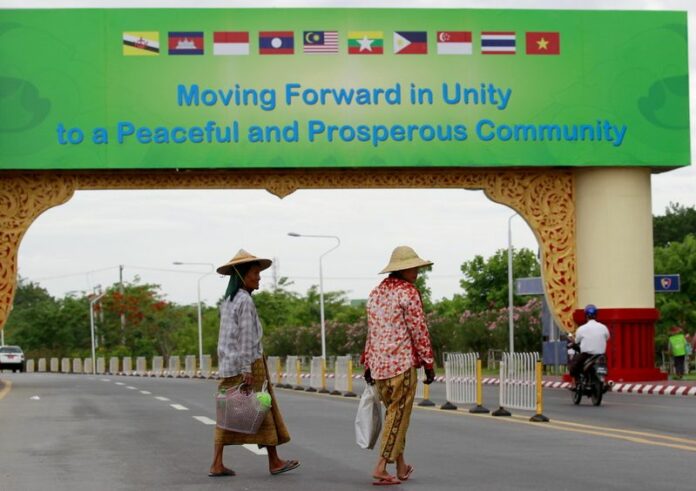
Workers pass across the road next to the gateway decorated for 24th ASEAN Summit in Naypyitaw, Myanmar, 09 May 2014 (DPA).

NAYPYITAW (DPA) — Myanmar officials highlighted the importance of China's peaceful rise in the region on Saturday ahead of the Association of South East Asian Nations (ASEAN) summit.

Myanmar will host Sunday for the first time since it joined the 10-nation bloc in 1997.

"China is not only a big friend of Myanmar's, but China is also the biggest trading partner of most of the ASEAN counties so China's peaceful rise is very important for the ASEAN region," said Ye Htut, a spokesman for President Thein Sein.

ASEAN summits, held twice a year, end with declarations on regional issues such as economic integration and common security concerns.

The Philippines and Vietnam are lobbying this year for a strong statement from ASEAN against aggression in the South China Sea. Several countries have territorial disputes with Beijing over sovereignty claims to the sea, petroleum reserves and rights to fishing grounds.

Myanmar, as host, will play a crucial role in determining the tone of the final ASEAN statement on China, its northern neighbour and main foreign investor.

ASEAN foreign ministers met in the capital Naypyitaw Saturday to discuss regional issues, including the South China Sea tensions, ahead of the summit.

Ye Htut described the Philippines' and Vietnam's problems with China as a matter of "bilateral relations."

China's policy has been to address its territorial disputes at the bilateral level, while the Philippines and Vietnam want a common ASEAN stance to pressure Beijing to agree to a Code of Conduct in the disputed areas.

The issue is seen as a test for ASEAN unity, in the face of China's growing political and economic clout in the region.

China was one of the few countries that stood by Myanmar when it was under military junta rule between 1988 to 2010, and propped it up during years of Western economic sanctions.

ASEAN groups Indonesia, Malaysia, Singapore, Brunei, the Philippines, Vietnam, Cambodia, Thailand, Laos and Myanmar.

Advertisement

Indonesian Opposition Party Wins Parliamentary Vote

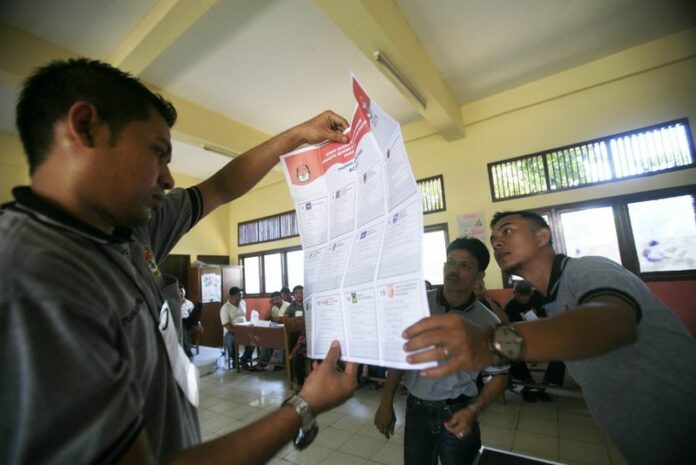
Electoral officials check ballot papers during vote counting at a polling station in Banda Aceh, Indonesia, 09 April 2014 (DPA).

By Ahmad Pathoni (DPA)

JAKARTA — The opposition Indonesian Democratic Party of Struggle (PDI-P), led by former president Megawati Sukarnoputri, secured 19 percent of the vote in April 9 parliamentary elections, the General Election Commission said.

Golkar, the ruling party during the reign of former dictator Suharto, was second with about 15 per cent. The Gerindra Party of former military general Prabowo Subianto, who is a presidential hopeful, came in third with 12 per cent, the commission said.

PDI-P has nominated popular Jakarta Governor Joko Widodo as its candidate for the July 9 presidential election. But the party needs to form an alliance with one or more other parties, as a party or coalition of parties that must receive 25 per cent of the popular vote or 20 per cent of seats in parliament to nominate a presidential candidate.

PDI-P has struck an alliance with the National Democratic Party (NasDem), which won nearly 7 per cent of the vote but is still trying to woo other parties to broaden its support base.

Surveys before the parliamentary elections indicated Widodo would win the presidency by a landslide, with his popularity ratings more than double those of his closest rival, Subianto.

Widodo, a heavy metal fan and former furniture retailer, rose to political prominence as mayor of Solo in Central Java province, where he introduced a series of policies including free health care and education.

Widodo won the Jakarta gubernatorial election in 2012 and has since built a reputation as a capable and hands-on leader with a common touch, through his frequent visits to the capital's poor neighbourhoods.

President Susilo Bambang Yudhoyono's Democratic Party, which leads the ruling coalition, was at 10 per cent in the official vote tally, a sharp drop from 21 per cent in 2009 elections.

Yudhoyono cannot run again after two terms in office, and his party has been embroiled in corruption scandals involving senior members.
 

Advertisement

Motorist Reportedly Attacked By Armed PCAD Militants

PCAD guards man the Uttrapimuk-Don Muang Tollway  while PCAD supporters demonstrate at the Police Sports Club nearby, 9 May 2014.

BANGKOK — A motorist says he was attacked by a group of anti-government protest guards during their brief occupation of the Uttrapimuk-Don Muang Tollway in Bangkok today.

Viphavadee Road and its elevated toll way were shut down by supporters of the People's Committee for Absolute Democracy With the King As Head of State (PCAD) while they clashed with police at the Police Sports Club this afternoon. 

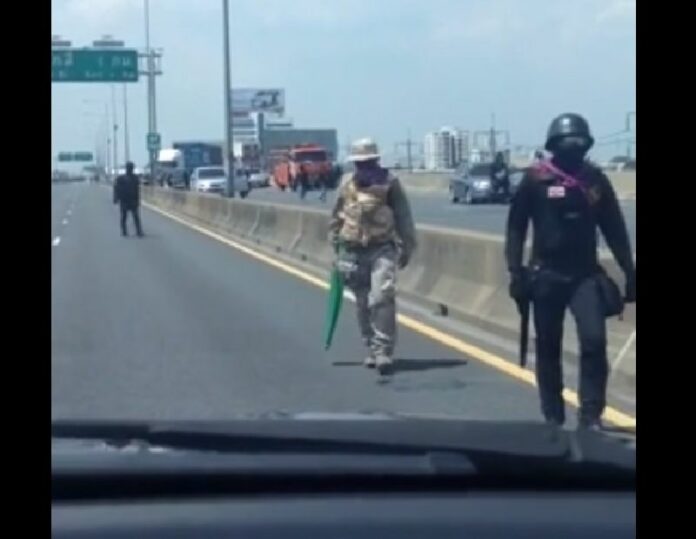
During the PCAD demonstration at the Police Sports Club nearby, masked "guards" wearing bullet-proof jackets manned the expressway to regulate traffic. Videos posted on social media show the guards threatening commuters not to drive past their checkpoint without permission.

One motorist told Khaosod that he was driving to Don Mueang Airport with his girlfriend when PCAD guards forced him to park his car on the right lane of the toll way.

According to Mr. Sorasak, who requested to be identified only by his surname for fear of retaliation by PCAD supporters, a group of masked PCAD guards approached his vehicle and ordered him to roll down the window. When he refused, one of the guards broke the windshield with a handgun and and another repeatedly punched him in the face until he fell unconscious, Mr. Sorasak reported.

The assault on Mr. Sorasak was captured on video by another motorist, who later posted the video clip of the incident on Facebook.

Mr. Sorasak, who was reportedly sent to Viphavadee Hospital to treat injuries from the assault, said his mother has filed formal complaints with Thoong Song Hong Police; Mr. Sorasak explained that he could not file the complaints himself as the doctors have not permitted him to leave the hospital.

Pol.Cpt. Anuchit Chartchuliam, a police officer at Thoong Song Hong Police Station, told Khaosod that Mr. Sorasak's family have filed charge yesterday, and the police are now investigating the incident.

PCAD guards have a record of physically assaulting random bystanders, despite PCAD leaders' insistence that they have intensified discipline training for their guards. Some PCAD guards also carry firearms. 

Last month a group of PCAD guards beat and shot an army colonel after he attempted to remove traffic cones placed by PCAD protesters on Chaeng Wattana Road. PCAD core leader Buddha Issara later apologised to the Royal Thai Army, claiming that the colonel was assaulted because of a "misunderstanding."


For comments, or corrections to this article please contact: [email protected]

You can also find Khaosod English on Twitter and Facebook
http://twitter.com/KhaosodEnglish
http://www.facebook.com/KhaosodEnglish

Advertisement

Hot News

LATEST NEWS

Bangkok
overcast clouds
30 ° C
31.1 °
29.9 °
72 %
4kmh
100 %
Thu
30 °
Fri
35 °
Sat
34 °
Sun
26 °
Mon
26 °