30.7 C
Bangkok
Wednesday, September 16, 2026
Home Blog Page 1935

Maya Beach Closed Indefinitely to Tourists: Official

Tourists at the popular Maya bay on Phi Phi Leh in Krabi province. Photo: Rajavi Omanee / Associated Press

KRABI — Sorry, tourists, that famous Thai beach Leonardo DiCaprio once set foot on will now remain closed indefinitely.

Initially set to reopen next month, Krabi province’s Maya Beach – which became world-famous as a setting for Hollywood film “The Beach” in 2000, won’t welcome any visitors until the ecology there rejuvenates to its “original state,” a conservation department official announced Tuesday.

“Experts have expressed concerns that there is still not enough [time] for the coral and the newly planted forest to be revived,” said Vorapot Lomlim of the Hat Noppharat Tara and Phi Phi Marine National Park.

He added that more than 1,000 coral have been planted in the bay, with more to come soon. Still, they’ll take years to be fully grown.

Officials first announced in March that the beach would be off limits to tourists from June to September, later extended to November, from concerns that the massive influx of visitors was posing a serious harm to its ecology, especially the coral.

Vorapot today said the department could not set a schedule for the rehabilitation process.

The decision to shut off the beach has been met with both praise from environmentalists and complaints from those in the tourism industry.

Watpol Chantaro, president of Phi Phi Leh Island travel business association, said of the latest announcement that it would badly impact local tourism.

He said the authorities did not inform the island business guild each time they would delay the beach reopening, preventing tourists from visiting the place even though they booked the service in advance.

The association will hold a meeting next week to discuss solutions and will petition the provincial governor and related government agencies later on, Watpol added.

Related stories:

Look Don’t Touch: Maya Beach Cordoned Off From Boats

Maya Beach of ‘The Beach’ Fame Set for Tourism Respite

‘The Beach’ Beach on Phi Phi Leh Gets Vacation From Tourists

Advertisement

Suspects in Chinese Tourist Murder Left Country: Police

Rangers at the scene of Ton Nga Chang Waterfall on Sept. 20.

BANGKOK — Individuals who might be involved in the death of a Chinese tourist in southern Thailand are no longer in the country, police said Tuesday.

Police will ask Chinese authorities to have those individuals brought to Thailand for questioning, Lt. Col. Khemarin Pismai said. Police ruled the 28-year-old woman’s death in Songkhla province a homicide.

“Our next step is to coordinate with the foreign authorities,” Khemarin said.

He added that a Chinese national is in police custody and treated as a person of interest, though the man denied any knowledge of the incident.

“He said he doesn’t know anything about it,” Khemarin said. “But we have suspicions. That is why we are treating him as a person of interest.”

The body of Chinese tourist Tian Lei was found in September in a waterfall in Hat Yai district. Though initially reported as a falling accident, then-deputy tourism police chief Surachet Hakpan later told the media she was murdered.

Surachet said investigators believe the murder to be a crime of passion.

Songkhla provincial police commander Preeda Piamwaree said he’s not allowed to talk to the media about the case.

Speaking to reporters today, tourism minister Weerasak Kowsurat confirmed “many individuals” sought by police have already left the country. Despite Surachet’s assessment, Weerasak maintained that investigators have not ruled out an accident as a potential cause of death.

Advertisement

Prisons to Allow Video Calls Between Inmates, Family

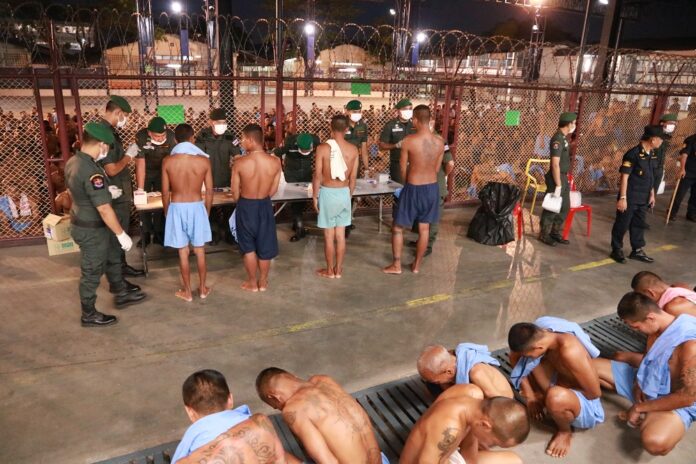
A March 2018 file photo of a Thai prison

BANGKOK — Officials are eyeing a popular messaging application to add video call services between inmates and visitors in prisons.

Five prisons nationwide will allow inmates to receive video calls from family and relatives through Line application for the first time, according to the Department of Corrections on Monday.

Col. Naras Savestanan, chief of the department, said the service had been tested and would initially apply to Phitsanulok Central Prison, Rayong Central Prison, Chiang Mai Central Prison, Nakhon Si Thammarat Central Prison and Khlong Phai Central Prison in Nakhon Ratchasima province.

This is not the first time authorities make an effort to adopt technology in the visiting system. Naras said the department tested a video conference call a decade ago, but that the service was terminated due to a technical error.

“But today, communications via social media have developed significantly and the internet speed is much faster, so we decided to use it again,” Naras said.

The trial is expected to be completed within a couple of months, Naras said, adding that the service would expand to other prisons if successful.

The department chief said the process will require that visitors provide their IDs and register at the Department of Correction. Officials will then contact visitors to tell them if, when and how many times they can call.

Advertisement

In Neighborhood Buried by Quake, Kin Found in Final Embrace

Indonesian red cross team carry the body of a tsunami victim following a massive earthquake and tsunami Monday at Talise beach in Palu, Central Sulawesi, Indonesia. Photo: Tatan Syuflana / Associated Press

PALU, Indonesia — For two days, Edi Setiawan helped pull the dead and the living out of a sea of mud and debris, all of them victims of one of Indonesia’s deadliest earthquakes in years.

And then, half-buried in the brown sludge, he saw two motionless bodies that broke his heart.

“I could see my father still embracing my sister,” Setiawan said Monday, recounting the devastating moment he found the pair entombed in mud near their home in the city of Palu.

“I just cried,” he said. “I was able to save other people, but I was unable to save my own family.”

Friday’s magnitude 7.5 quake killed more than 840 people and destroyed thousands of homes, triggering a humanitarian crisis with survivors now in desperate need of food, water and fuel.

Most of the casualties were caused by the quake itself and a deadly tsunami that slammed into the coastline around Palu. But hundreds of others were buried alive by a phenomenon called liquefaction, in which loose soil shaken by a quake gives way and collapses.

Disaster agency spokesman Sutopo Purwo Nugroho said Palu’s Petobo neighborhood, where Setiawan lived, was especially hard-hit. “There are still hundreds of victims buried in mud” in the area, he said.

On Monday, newly arrived rescue teams were confronting the behemoth task of trying to dig them out.

Palu, a city of 380,000 on the western coast of central Indonesia’s Sulawesi island, stood in ruins. Toppled cellphone towers have cut off communications, while downed power lines leave the city in darkness after the sun sets.

While thousands of desperate people swarmed the airport tarmac trying to escape on board a military aircraft that arrived with aid, burials began in a freshly dug mass grave.

When the massive quake struck on Friday, Setiawan said he was cleaning debris from another strong tremor that had cracked the walls of his home just hours earlier but left it standing.

As the 32-year-old rushed outside, “the ground I stepped on cracked … water and mud came out, more and more from all directions.”

His neighborhood seemed to be sinking.

His wife and year-old daughter were fine, but other family members, friends and neighbors were missing.

He tried to reach his parents’ home, about 300 meters (yards) away, but the sea of mud that engulfed the area made it too hard to reach. With other villagers, he turned to saving whoever he could.

“I took a 2-year-old (child) on my head, a 3-year-old on my back, and held a 5-year-old while struggling to swim out from mud to the asphalt road,” Setiawan said.

Villagers hurled ropes to people stuck in pools of thick mud that seemed like quicksand, and pulled them out by hand. Some of them saved his mother.

By Saturday, they had rescued 11 adults, including a pregnant woman, and two other children – although one later died.

Then they turned to the dead, recovering four bodies. It was Saturday when Setiawan saw the bodies of his father and sister in the sludge, locked in the embrace that had marked the last moment of their lives.

Many complained bitterly at the failure of rescue teams, overwhelmed by the scale of the crisis, to make it to their neighborhood in time.

Idrus, 52, who like many Indonesians uses only one name, said that “up to Saturday, we still saw many people screaming for help from the roofs.”

“But we could not do (anything) to help them,” he said. “Now, their cries are no longer heard.”

Setiawan said the first government rescue teams arrived in his area Sunday, but because the mud was still unstable, they were only able to take photos documenting the tragic scene.

On Monday, they returned, and recovered eight bodies.

Story: Todd Pitman, Niniek Karmini

Advertisement

Online Freedom Exhibit at TCDC Talks Memes, Pixels, Censorship

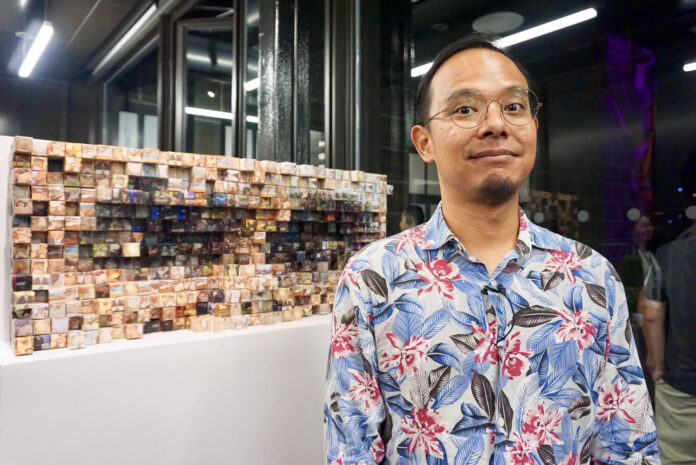
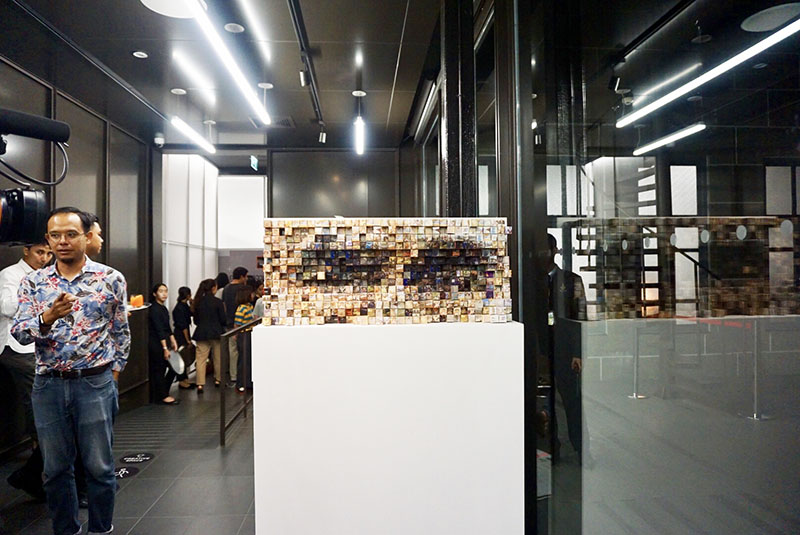
Wee Viraporn with his “Watch!” sculpture.

Top: Wee Viraporn with his “Watch!” sculpture.

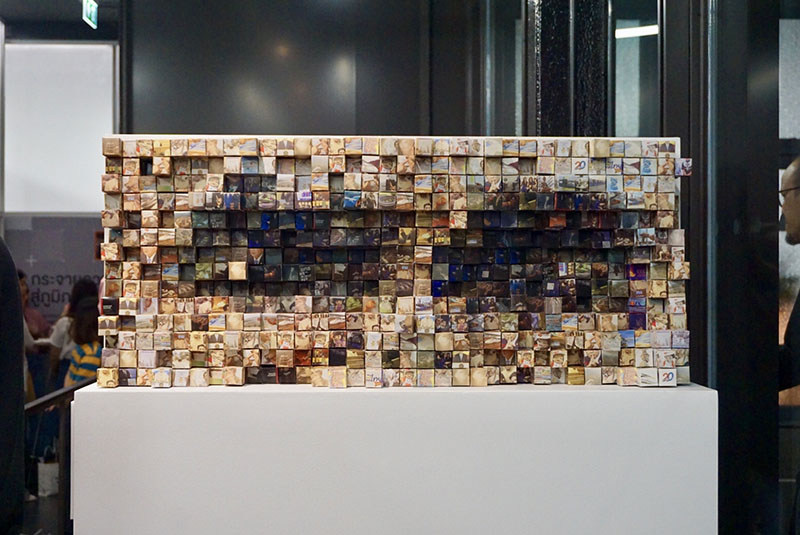
BANGKOK — Through a pixelated sculpture of Prayuth’s eyes to a memeified event in Thai history, artists at an exhibition say the internet in Thailand is both a venue for freedom and a tool for surveillance.

A UNESCO-curated exhibition on Thai internet freedom launched Friday at a downtown design-hub to mark Universal Access to Information Day. Through six displays, ranging from hand-drawn infographics to documentaries, artists portray the Thainet as a double-edged sword, granting connectivity on one side but distortion and censorship on the other.

“We are watching what they’re doing but they are also watching us back,” artist Wee Viraporn said. “We will never have total freedom of expression or total freedom to monitor our government as long as it monitors our internet usage.”

LRG DSC04168

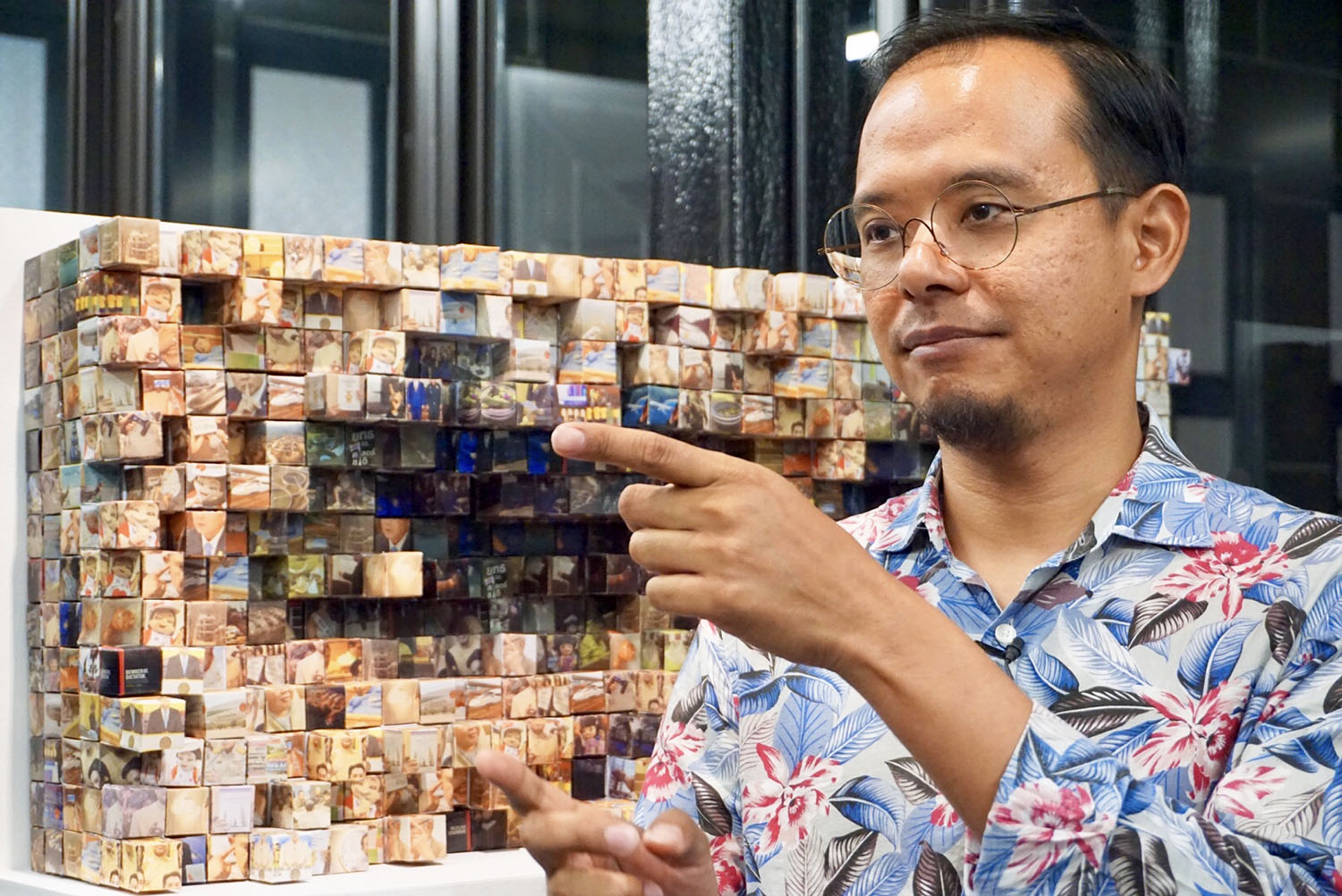
Wee created a sculpture titled “Watch!” to show this two-way surveillance. From afar, the mass of small cubes come together to resemble Gen. Prayuth Chan-ocha’s eyes. Up close, each cube is pasted with photos of news stories about unsavory actions of higher ups – from Gen. Prawit Wongsuwan’s undeclared luxury watches and the alleged killing of a black panther by a construction mogul to snoozing MPs and even Nong Kiew Koy, the junta mascot.

LRG DSC04175
“Friendship Ended With Mudasir Now Salman is my Best Friend” by Tewprai Bualoi.

Another artist, Tewprai Bualoi, 25, created “Friendship Ended With Mudasir Now Salman is my Best Friend,” named after the meme of the same name. Shots of memes such as the Soviet anthem and It’s Time to Stop are cut with quick flashes of historical footage to hint at a controversial event in Thai history.

“Thais use memes to talk about things that we can’t talk about because we’re being monitored by the state. So we use memes as language,” Tewprai said. Asked to reveal what event his video tries to portray, he was reticent.

“I want to try and talk about an event that isn’t usually talked about. If I told you, then I wouldn’t need to make this video meme!” Tewprai said.

Khaosod English’s live coverage of the Internet Universality Beyond Words opening.

In contrast to Tewpai’s coded work, Siriwat Pokrajen created “Internet Universality,” a short documentary about the broad interpretations and misuse of the Computer Crimes Act and the lese-majeste law. It features talks by Yingcheep Atchanond of iLaw, a legal reform advocacy.

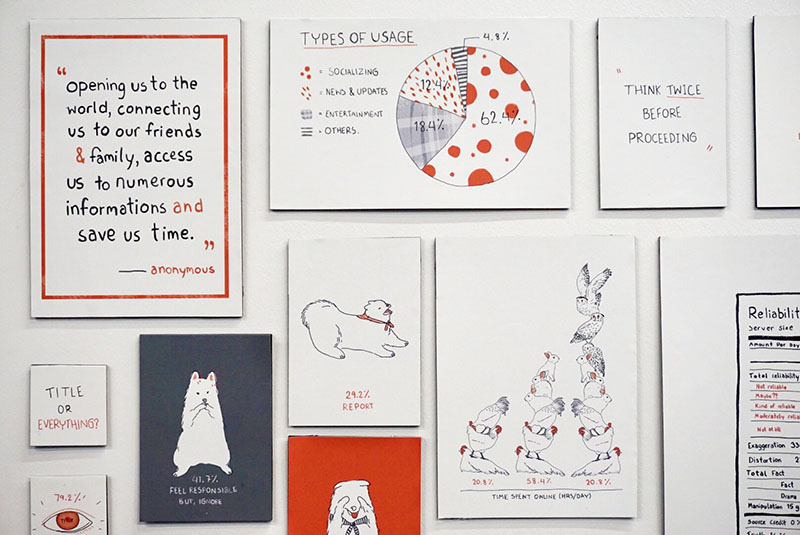
While less political, the other three exhibits are informative about Thai internet use. Design student Nippita Pongern, 20, created three booklets’ worth of handmade illustrations and infographics about Thai internet usage and literacy in “My Virtual Playground.”

For example, through illustrations of rabbits, chickens and owls, one graphic shows that 60 percent of Thais spend a daily six hours on the internet.

LRG DSC04162
Nippita Pongern with her “My Virtual Playground” exhibit.

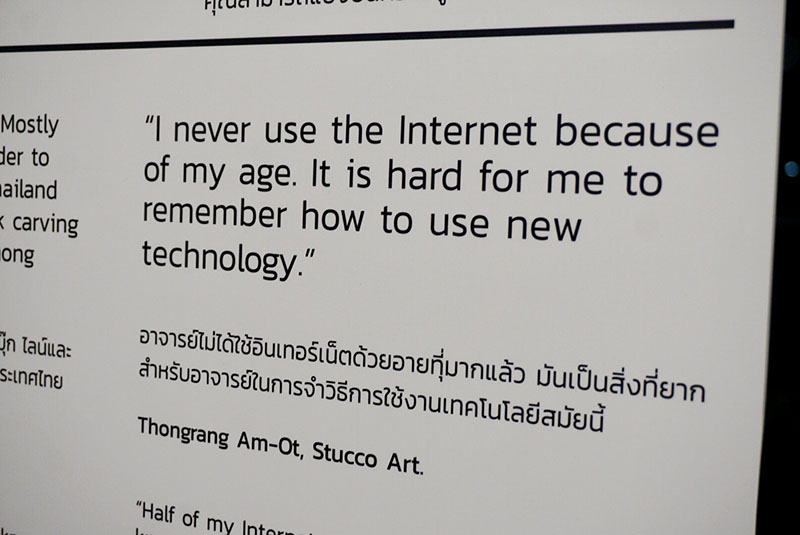
In “Artisan 4.0,” five students from the King Mongkut University of Technology Thonburi interviewed elderly craft artisans in Bangkok and Phetchaburi about the impact of the internet on their lives. While some said the internet helped them sell more products, others rejected its use.

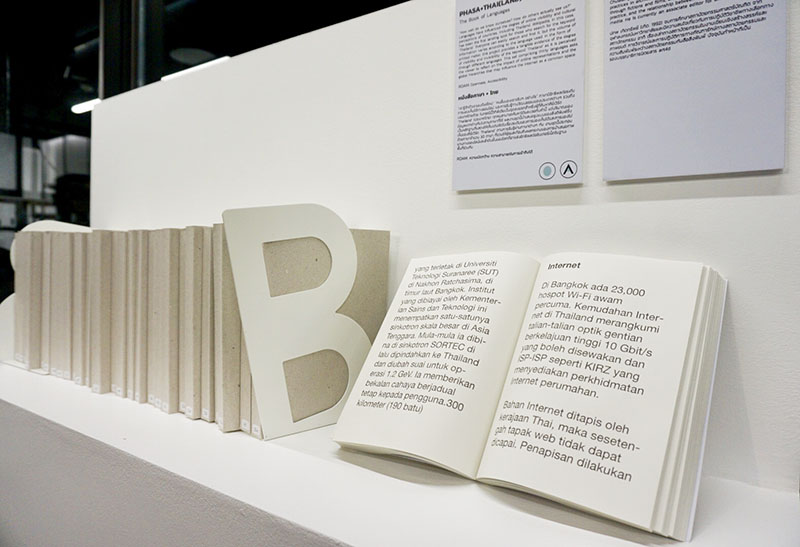
Finally, there’s an exhibit of thirty booklets of the Thailand Wikipedia entry page, each in a different language. “Phasa+Thai(land): The Book of Languages” by Paphop Kerdsup shows that different information is consumed depending on the language used online. Visitors are encourage to parse the booklets for factual differences.

Internet Universality Beyond words runs 10:30am to 9pm every day except Monday through Oct. 14 on the fifth-floor hallway at the Thailand Creative and Design Center, or TCDC. The design space is located in Soi Charoen Krung 34 and can be reached from BTS Saphan Taksin and the Wat Muang Kae pier. Admission is free.

LRG DSC04188LRG DSC04143 LRG DSC04185 LRG DSC04130

LRG DSC04190
“Phasa+Thai(land): The Book of Languages” by Paphop Kerdsup.
LRG DSC04151
The “Artisan 4.0” exhibit.

Related stories:

Throw Coups, Deny Visas at Political Games Exhibit

Advertisement

Passenger’s Body Found in Pacific Lagoon After Plane Crash

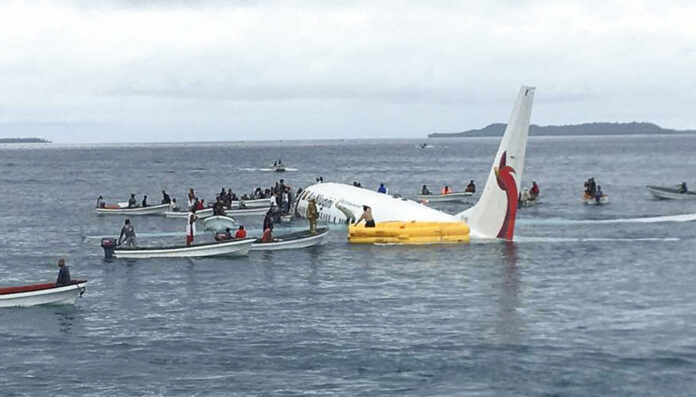
Local fishing boats move in to recover the passengers and crew of an Air Niugini flight Friday following the plane crashing into the sea on its approach to Chuuk International Airport in the Federated States of Micronesia. Photo: James Yaingeluo / Associated Press

CANBERRA, Australia — A passenger’s body has been found in the Pacific lagoon where a plane crash-landed last week near an island runway in Micronesia.

Air Niugini had initially said all 47 passengers and crew had survived when the Boeing 737 crashed near the Chuuk island runway on Friday.

The Papua New Guinea national carrier said on Saturday one passenger had not been accounted for but was witnessed reaching a rescue dinghy as U.S. Navy sailors and locals helped people escape the sinking plane.

But Air Niugini chief executive Tahawar Durrani said the man’s body was found by divers Monday. The airline said in a statement on Tuesday the man was Indonesian, but did not reveal his identity.

“Our outreach team is in touch with the man’s family and we are making arrangements to repatriate his body,” Durrani said in a statement.

Four passengers were in stable conditions at a Chuuk island hospital and will be taken soon to Guam for further treatment, Air Niugini said.

Hospital and aviation officials have not responded to requests for comment.

Flight PX73 from nearby Pohnpei island crashed about 145 meters (475 feet) from the Chuuk International Airport runway, the airline said.

What caused the crash remains unclear. The airline and U.S. Navy said the plane landed in the lagoon short of the runway. Some witnesses thought the plane overshot the runway.

A Papua New Guinea accident investigation team flew to Micronesia on Friday, the Post Courier newspaper reported.

Flight PX73 flies from Tokyo’s Narita International Airport to Papua New Guinea’s capital, Port Moresby, via Pohnpei and Chuuk.

Air Niugini has operated since 1973. Data from the Aviation Safety Network indicate the Indonesian passenger is Air Niugini’s first fatality in two decades.

Story: Rod McGuirk

Advertisement

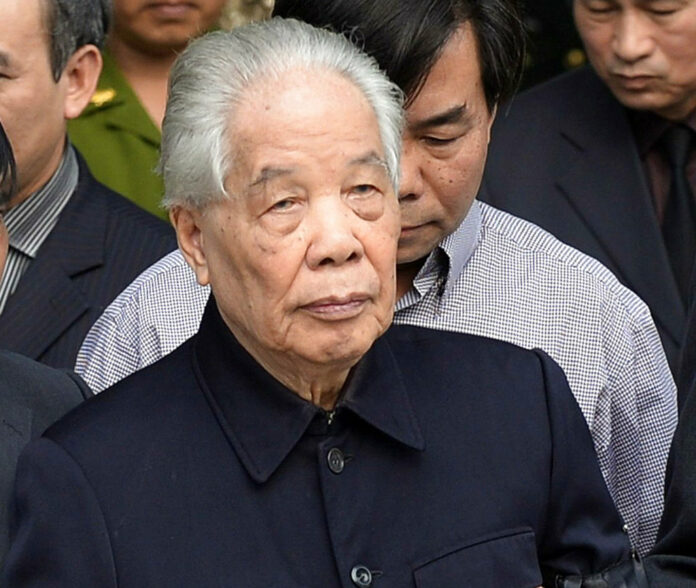
Do Muoi, Former Vietnam Communist Party Chief, Dead at 101

Former Communist Party Secretary General Do Muoi, front center, is helped to walk to pay respects to late Gen. Vo Nguyen Giap at the National Funeral House in 2013 in Hanoi, Vietnam. Photo: Hoang Dinh Nam / Associated Press

HANOI — Former General Secretary of the Communist Party of Vietnam Do Muoi, a committed communist, has died at age 101.

The government said in a announcement posted on its website that Muoi died late Monday night at the National Military Hospital 108 after battling a serious illness despite efforts by Vietnamese and foreign doctors to treat him.

Born Nguyen Duy Cong in suburban district of Thanh Tri in Hanoi in 1917, Muoi joined the Communist Party of Indochina, the former Communist Party of Vietnam at young age and rose through the ranks the party and government before becoming prime minister in 1988.

He served as the head of the Communist Party for more than 6 years before stepping down in 1997. No funeral arrangements have been announced.

Advertisement

Future Forward Party Plans to Raise 300M Baht for Election

Future Forward leader Thanathorn Juangroongruangkit speaks in October at the party headquarters in Bangkok.

BANGKOK — Saying he’s ready to become prime minister, a billionaire-turned-politician on Monday urged people to become members of his party and pledged to raise hundreds of millions of baht for his election campaign.

Speaking at the Future Forward party headquarters in Bangkok, leader Thanathorn Juangroongruangkit said his movement plans to raise 300 million baht for its election campaign, currently scheduled for February 2019. He said the party aims to collect 100 baht on annual membership fees from each member and 2,000 baht from those willing to pay lifetime fees starting Saturday.

“We will definitely raise 300 million [baht] from the public… We will do our best to raise funds,” Thanathorn said Monday as the movement relaunched itself after the Election Commission last week legally recognized it as a political party. He said the party – which vows not to take the path of money politics – currently has 1,000 supporters.

Thanathorn added they would sell memorabilia such as teddy bears, totes and T-shirts at their headquarters on Petchaburi Road in Bangkok, but said selling political goods online is prohibited under election laws.

Asked how much the party had spent over the past seven months – with leaders attending meetings and conferences in the United States, Canada and soon Europe – Thanathorn just said to “wait until after January 2019,” adding that he planned to disclose the party’s ledger on a quarterly basis.

A founding member, who spoke on condition of anonymity for fear of creating conflict within the party, said leaders originally planned to collect a 200 baht annual membership fee, but that some founding members opposed, citing it was too much to shoulder for ordinary members.

“Paying 200 baht may sound little for the urban-middle class but not for ordinary folks,” the source said.

It added that the challenge for a party that vows not to rely on money to win votes continues when it invites people for talks in the provinces.

“There’s a need to pay at least for transportation fees and food. You can’t just invite them and offer nothing. They won’t come for the second time,” the source said.

While it’s common knowledge that former MPs in some big parties are given monthly retention fees of up to 100,000 baht a month, the source claimed to receive 25,000 baht a month from the party and that it’s not really sufficient to travel for meetings in other regions.

“When campaigning time comes, we need a budget to hire a car and some campaigning staff and it will costs money, the source said, adding that the party is still working out on the details.

“Maybe Thanathorn’s family is telling him to put a lid and not piggyback on the family’s coffer,” the source said Monday after the party meet the press. Despite his wealth, Thanathorn said he wouldn’t use that to fund his party, insisting instead on the opposite model.

Campaigning is a challenge for any new party, especially so for a party vowing not to spend money the “conventional” way by handing out cash and retention payments to canvassers.

“We tell them we don’t hand out cash. It’s about ideology,” said Palakorn Jirasophon, team leader for Bangkok and the surrounding provinces.

Thanathorn himself admitted Monday during the questions and answers session with reporters that unlike established political parties, Future Forward doesn’t have a constituency base.

Critics expect the party – which vows to transcend a decade-old political rift – to win some seats through the partylist system, as its strong social media presence has garnered the support of the young and urban middle class. However, Thanathorn remarked on something they lacked.

“We don’t have any constituency base… Every group is new group for us,” Thanathorn said. “Because we are a new party, it’s very difficult to say how many seats we will get.”

However, party spokesperson Pannika Wanich who had earlier boasted about how the party is popular on social media – twice topping as the top trending Thai-language hashtag on Twitter – insisted Future Forward is not just the young urban middle class hipsters or social media users.

“Our party is for everyone,” she said.

Thanathorn, 39, formerly served on the board of Matichon Group, the parent company of Khaosod English.

Advertisement

Rivals Left Fuming as Serving Ministers Join Pro-Junta Party

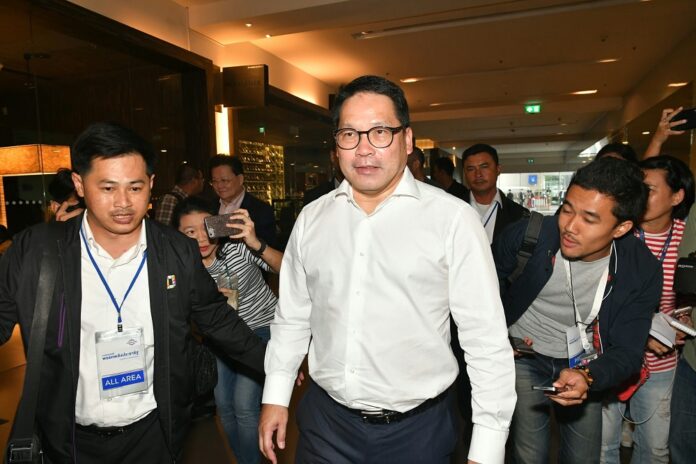
Industry Minister Uttama Savanayana arrives at Palang Pracharat Party executive meeting on Saturday.

BANGKOK — News of four ministers under junta chairman Prayuth Chan-ocha joining the rank of a pro-government party was met with a chorus of criticism from Pheu Thai and Democrat politicians.

Uttama Savanayana, Suvit Maesincee, Nuttapol Teepasuwan and Sontirat Sontijirawong confirmed their membership with Palang Pracharat Party on Saturday, even as they continued to serve in ministerial posts. Uttama was also elected leader of Palang Pracharat, widely seen as a proxy of the military regime.

Read: Pro-Junta Party Confident It Will Lead Next Govt

Pheu Thai spokesman Anusorn Iamsa-ard questioned how the election – slated to take place February – could be transparent if those in charge of organizing it are also involved.

“This is a competition where the referees have something to gain or lose,” Anusorn told reporters Sunday. “They are both athletes and rulekeepers at the same time. How can we have a fair election?”

Former Pheu Thai sec-gen Chawalit Wichayasuth went as far as calling it “the most biased election” in recent history.

Speaking to reporters Sunday, a senior Democrat Party official also warned that the next election won’t have any credibility if the four ministers exploit their public offices for their political interests.

“Exercising power for their own kind … will affect credibility in the election. The country will be damaged, and the election result won’t be accepted,” Ongart Klampaiboon said.

Founded in March, the party is recognized by many observers as the vehicle for junta leaders in the upcoming election. Its party name – Palang Pracharat – is a reference to the pracharat government initiative launched by Prayuth.

Advertisement

Urgently Needed: New Tesla Chairman, Must Be Able to Handle Conflicts, Debt

A file photo of Tesla CEO Elon Musk in his high time. Image: The Joe Rogan Experience / YouTube.

WASHINGTON  — It won’t be an easy job.

Whoever becomes the new chairman of Tesla Motors will face the formidable task of reining in Elon Musk, the charismatic, visionary chief executive with an impulsive streak, while also helping Musk achieve his dream of turning Tesla into a profitable, mass-market producer of environmentally-friendly electric cars.

Musk is giving up the chairman’s role under a settlement announced Saturday with the Securities and Exchange Commission. Besides a new chairman, Tesla was also ordered to appoint two new, independent members to its board. A more assertive board could provide the kind of tighter oversight that many legal experts, and Tesla investors, say is overdue for a company of Tesla’s market value.

The settlement stemmed from a lawsuit the SEC filed charging Musk with misleading investors in August with a tweet that said he had “funding secured” for taking the company private.

Yet a more forceful board, coupled with a domineering CEO like Musk, could create conflicts at a risky time for the company. Visionary CEOs such as Apple’s Steve Jobs and Twitter’s Jack Dorsey have been forced out by strong boards of directors, though both eventually returned to their companies.

Even with the settlement, Tesla faces a daunting array of challenges.

The Justice Department has opened its own investigation into Musk’s Aug. 7 tweet, in which he said he would take the company private at $420 a share. The SEC’s lawsuit charged that the tweet, which caused Tesla’s shares to jump, was misleading because he did not actually have the funding lined up for such a move.

Tesla is also under heavy pressure to turn a profit because it is burning through $1 billion in cash every three months and, as of the end of June, had just $2.2 billion in the bank.

Musk has said the company needs to produce 7,000 cars a week to make money, a target he aimed to reach in the July-September quarter. The company is likely to report production numbers this week and financial results from that quarter in early November.

Another concern: About $1.3 billion in Tesla debt is due to be repaid by March, including $230 million in November.

Some investors might want more than a new chairman. Tesla has no chief operating officer, a critical No. 2 executive in most companies. That’s a stark contrast to other startups, such as Facebook, where Mark Zuckerberg hired Sheryl Sandberg as a highly influential COO.

In the lawsuit filed Thursday by the SEC, the agency said it was seeking to remove Musk from Tesla management altogether. Many investors have argued that keeping Musk as CEO is critical at such a time.

“I do not doubt the value of Musk to Tesla,” John Coffee, a Columbia University law professor and corporate governance expert, said. “Without him, they are just a struggling start up that is burning cash at a hopeless rate and is facing a debt refunding crisis in the near future.

“Musk is an iconic entrepreneur but he needs adult supervision,” Coffee added.

That’s where the new board members come in. The current board, which includes Musk’s brother, Kimbal Musk, is widely seen as subservient to Musk. They have publicly expressed support for many recent moves, such as his rejection last week of an early SEC settlement offer.

“The board is truly the alpha chapter of the Elon Musk fan club,” said Erik Gordon, a professor at the University of Michigan’s Ross School of Business.

Teresa Goody, a former SEC attorney and founder of The Goody Group, a consulting firm, said that many startups begin with a powerful CEO who typically puts “friendlies” on the board.

As a company grows and becomes more sophisticated, Goody said, more independent directors are typically brought on board to provide better oversight.

“That’s happening a little later in the life cycle of the company in the case of Tesla,” she said.

Still, Elon Musk is different than many CEOs because he owns roughly 20 percent of the company’s stock. That gives him more influence.

“In a typical case, the CEO is a high-priced employee” of the board, Gordon said. “Musk will still be more powerful than the board chair.”

There will be other constraints on Musk’s behavior: As part of the SEC settlement, his tweets and other comments will have to be vetted by the company before they can be released to the public.

“This humiliation — that Elon can’t go outside unless he’s on a leash — that will bother him the most,” Gordon said. He called it an “extraordinary measure.”

Gordon thinks the SEC should have gone further and sought to add as many as four new board members and remove some old ones.

Still, Gordon said, “I think this experience has shown him that however smart he is, or however powerful he thinks he is, the government is also powerful too.”

Musk may want to keep a close eye on the new chairman, however. Musk himself was the chair of the board, after investing in the company, before firing the chief executive and taking over as CEO

___

AP Auto Writer Tom Krisher contributed to this story from Detroit.

Advertisement

Hot News

LATEST NEWS

Bangkok
overcast clouds
30.7 ° C
31.6 °
30 °
68 %
4.5kmh
98 %
Wed
32 °
Thu
34 °
Fri
33 °
Sat
30 °
Sun
31 °