































27 C
Bangkok
Thursday, September 17, 2026
Home Blog Page 1968

Cult of Misogyny Flourishes Online


Women are represented as dolls to be played with and discarded in a popular Facebook forum for misogyny and sexism. Image: Phuchaisaivan / Facebook

Police charged into Chaichana Sirichat’s Bangkok apartment to rescue the girlfriend he was beating live on Facebook and threatening to kill. She was crying and her face a swollen mess of contusions and blood. After the disturbing video spread, people claiming to know Chaichana came out to blame the woman for forcing his hand by having a string of affairs and using him for money.

Suddenly, their campaign quickly turned the virtual court of public opinion to his side.

“She’s kind of a bitch, taking his money and then shagging other guys,” Facebook user Kluay Krab wrote in a comment to a news article.

“She did it first. The guy wasn’t wrong – he loves her so much that he just snapped,” user Suparad Danai Kangfu wrote.

Read: Men Killing Women at Alarming Rates, And We All Share Blame

In story after story, men proclaimed love for the women they hurt or killed, attempting to justify their crimes. Women wronged them. Cheated or manipulated them. And in today’s hypertoxic online discourse, many leap to their support, evincing the same beliefs that the victims “had it coming.”

Phuchaisaivan is a popular Facebook page followed by more than 900,000 people. It is a clearinghouse for unabashedly misogynistic posts depicting women as disposable playthings for male pleasure through a romanticized lens of “traditional” roles.

The day Chaichana broadcast his violence on Facebook, the page posted an image suggesting solidarity with his actions. Captioned “You Can See,” it shows the silhouettes of a man and woman, both holding knives. While the woman is soaked in blood from head to toe, the man cries and bleeds from a wounded heart. The message is clear: Male attackers are the victims of female guile.

Image: Phuchaisaivan / Facebook

The controversial post drew both support and criticism. Defending his work, the admin wrote that it “reflects one kind of violence which is mental and another kind which is physical. I just posted the picture, and the audience will interpret it by themselves,” and “It’s freedom of thought. No one is right or wrong here.”

He deleted the post the next day but continues to produce more subtle content that romanticizes rape, objectifies women and stereotypes them as shallow materialists. In a cycle, posts that accrue more criticism than support are eventually removed.

That brand of rampant online sexism is rooted in the real world.

Patriarchy and misogyny, tolerating or even supporting men’s violence toward their partners, is deeply intertwined with Thai cultural values, so profoundly that “we don’t know that it’s violence, since we’ve already condoned it with this rationale,” according to a women’s rights activist and media professor.

“We’ve fostered the concept of manhood for thousands of years, making men believe that they’re owners of women’s lives,” said Chulalongkorn University’s Chanettee Tinnam.

That suppression thrives in the rhetoric propagated at the institutional level. Thai literature and school textbooks glorify male supremacy and female subordination. Buddhist doctrine also belies various forms of discrimination against women.

Read Part 1: Men Killing Women at Alarming Rates, And We All Share Blame

Thailand in 2016 slipped eight places to 87th in the UN Gender Inequality Index from the year prior. Five years ago, the women’s affairs department reported findings that Thai men were seventh the most abusive in 49 countries studied.

“Men justify their violence against women as acts of love and goodwill, because a wife might misbehave in the eyes of her husband,” Chanettee said. “They believe they do it because they want their wives to be ‘good’ again.”

In 2016, the Thai Health Promotion Foundation reported that 14 percent of male survey respondents believed it’s okay for men to show their love and express their jealousy with violence.

These attitudes, also normalized in mainstream media representations, are shared by some women. UNICEF in 2014 found 13 percent of female respondents in Thailand said women deserve to be beaten in certain circumstances.

“When [men] fight or hit someone until they bleed, [they believe] it’s only an expression of masculinity,” said Sompong Buathong, a leading activist for gender equality in a northeastern community he said used to be plagued with violence, from beatings and rape to murder, before an awareness raising campaign reached it about 20 years ago.

He said he only understood afterward that the social norms in his town in Amnat Charoen province made him, without thinking, accept and be part of abusive male dominance. Instead of laying hands on his wife, he neglected her needs and well-being.

“I really thought it was normal. I wouldn’t hit my wife, but when friends asked me to go out drinking, I would go out until dawn. I didn’t think of her feelings, if she would be scared staying home alone all night,” he said. “I wouldn’t consult her on anything financially as well… although she also earned money for the family.”

She had been raised to be submissive to her husband, so Sompong said she also didn’t see the problem. Even now she doesn’t like him doing laundry because “she thinks it’s sinful.”

This mindset not only compels female obedience but also places high expectations on men to lead and provide for their families at risk of being considered failures. These rigid roles on both sides can prove a potent force behind the violence, said women’s studies professor Kosum Omphornuwat.

Read Part 2: Women Died When ‘No One Helped’

“Men are pressured by values of patriarchy to be prosperous in many aspects, and many of them cannot reach that goal,” said Kosum, who teaches at Thammasat University. “As they feel like they have nothing, when a woman comes into their lives … [they] think they own her already.”

“When it turns out one day that the women want to leave them for someone new, it’s unacceptable as it represents failure, and now they again will have nothing. Thinking of her as an object, this attitude translates [disappointment] into violence,” she said.

In order to solve the problem, Kosum believes social structures and education need to be reformed to eradicate the toxic perception Thais have about violence against women.

“Men taking violent actions is just a symptom of failures in the whole of our social system. … We have a law specifically protecting victims of domestic violence, but it still doesn’t help,” she said. “If we look at it only as an individual problem, it might not lead to any impactful solutions.”

Advertisement

Women Died When ‘No One Helped’


A woman is beaten by her girlfriend in a Bangkok parking lot while several people look on in a still image from a security camera. Image: Thikampron Kaain / Facebook

Ploy says life was good when she first got married, but it soon turned into a violent hell when her husband started suspecting her of infidelity.

Violence became her routine. He beat her daily and sometimes left her locked up and starving at home. He chained her up not once, but at least eight times, even using them to strangle her.

“We would always fight. Most of the time over small things,” she said. “I used to sneak out with my kid and go to my sister’s. Then he followed and apologized, saying he wouldn’t hurt me again, but when I went back everything would be just the same.”

Ploy, who shared her story at a recent anti-domestic violence seminar, is one of countless Thai women whose own homes have become deadly places to survive. While the cycle of physical trauma was already unbearable, Ploy said her spirits were crushed when her cries for help fell on deaf ears.

Read Part 1: Men Killing Women at Alarming Rates, And We All Share Blame

“He would lock down the house. No one helped me,” she said at the Bangkok event, her voice starting to break. “Neighbors who heard me screaming only thought it was just another fight between husband and wife who would soon make up.”

Thais have been taught not to get involved in other people’s domestic business, even at its ugliest. That’s been a major obstacle to those seeking to fight the scourge of violence in the home.

The majority of women who have died from domestic violence did so because no one helped them, even when a cry was heard.

“The majority of women who have died from domestic violence did so because no one helped them, even when a cry was heard,” said Angkana Intasa of the Women and Men Progressive Movement Foundation, which promotes gender equality. “It occurs from a belief that a family’s affairs are personal and should not be intruded into. It makes people think that it’s not a problem that needs solving.”

Asked if they would intervene to help victims of violence, 95 percent of respondents to a survey told the foundation they would not.

Praewdao Siwapuwadolpitak experienced that first-hand when she saw a young woman being beaten severely by her girlfriend last month in a Bangkok parking lot, an incident caught on video that went viral online.

“I saw a lot of people watching as it happened, motorcycle taxis, vendors, but nobody helped her,” she said. “I talked to my boyfriend and decided that we had to help her, otherwise we wouldn’t be able to sleep well.”

And they took action. Praewdao tried to calm the attacker down while her boyfriend watched her back.

Read Part 3: Cult of Misogyny Flourishes Online

“She cried for help all the time. When I went in, she prostrated me at my feet,” she said. “She tried to cling to me, like she was afraid that I would leave. I had to tell her that I wasn’t going anywhere.”

They stayed with the victim until she was taken to a hospital after the girlfriend fled the scene.

The authorities are also likely to be unreliable. Ploy, who bore her husband’s frequent violence for decades, said police took no action even after she made dozens of complaints.

“When police came to the house, my husband would go talk to them outside as they wouldn’t dare come in,” she said. “He would say, ‘Why did you come here? It’s just a fight between husband and wife. We’ll be good again in no time,’ then the police just left.”

A police officer at the same event who often works on similar battery cases acknowledged the issue coming from both a legal procedure that isn’t supportive and a lack of empathy from investigators themselves.

“Many women make complaints to police several times, and they do nothing but call both sides in to mediate,” Lt. Col. Preabprom Mekhiyanont said. “If the woman presses charges, the husband will know immediately, and when she goes home she will face a backlash.”

“The process of justice is very slow. … It can take years before they can go to court,” she said. “When I explain the procedure, most are very discouraged. This is not like other kinds of assault cases that you can press charges, then go home and feel safe.”

Although a domestic violence act was passed in 2007, enforcement remains poor. Angkana, who was part of the push to enact the law, expressed disappointment with the results.

“There’s almost no one pressing charges under this law, because women usually get talked into compromise instead,” she said. “Many police don’t even know this law exists, and some clauses in the law are not very applicable to real situations.”

The law, passed after nearly a decade-long battle, aims to protect victims by expediting the legal process and supplying them with proper specialized care. Offenders face statutory penalties of up to six months in jail and fine of 6,000 baht.

Police are compelled to investigate any complaints made under the act and make any arrests within 48 hours. But prosecution is far from certain as opportunities remain for reaching private settlements outside of the system, an outcome the police themselves often push for.

The law is set due for an update after the interim cabinet last year said “obstacles” in its enforcement needed to be fixed. A draft is expected soon.

On Aug. 27, Angkana led a group of anti-domestic violence activists to petition the Government House to urgently address the issue by reforming both the legal and education systems regarding women rights.

In a prior interview, she emphasized the importance of changing perceptions about domestic violence.

“There are a lot of victims who want to take legal action, but the system is not supportive at all. The failure is in the system and with people’s attitudes that this is not something they should get involved in,” she said. “We can’t fix this by just campaigning. We have to change the mindset. If society is more understanding, it will help solve the problem to a certain extent.”

Advertisement

Men Killing Women at Alarming Rates, And We All Share Blame


Gesturing with the hands used to murder the woman he professed to love, Thanakrit “Wuth” Prakob recalled his breaking point in a videotaped confession.

“She called me and said, ‘Wuth, I’m now back with my ex. We’ve already slept together.’ I asked why, why did you do this to me? She said there were issues with her family. … I couldn’t say another word and hung up the phone immediately,” he told police in June.

Three weeks after the breakup, as Laksana Kamlangkeng was at his place packing her bags, Thanakrit brought a hammer down on her head repeatedly, cut her body into 14 pieces and disposed of them in a forested part of Bangkok.

Equally disturbing is how common these acts are and what little outrage they generate.

One man beat his girlfriend black and blue live on Facebook. Another walked into a hospital to gun down his wife and father-in-law before turning the gun on himself. In Chumphon, a man attempted to hang his wife as their children looked on. Nearly every case was chalked up to a crime of passion.

The month of June was a particularly bad one for women victimized by men. Along with Thanakrit’s grim murder, there were 25 news reports of women killed or assaulted by their husbands or boyfriends.

The graphic accounts were met with little surprise. Domestic violence is woven into the cultural fabric, with the few agencies trying to do something running up against deeply rooted social values that tolerate – or even support – the use of violence against women.

People back then wouldn’t get involved in something like this. They didn’t care.

Photo: Women and Men Progressive Movement Foundation / Courtesy

Acknowledging the recent surge in violence, Angkana Intasa of the Women and Men Progressive Movement Foundation said it’s a chronic social problem waiting to explode.

“The media is giving more attention to these stories, and there are more women coming out,” she said. “The reason it has persisted is that gender inequality hasn’t been solved. There’s also men’s sense of being entitled to wield authority over [women], and a sense of ownership that they can be as violent as they want to their partners.”

The actual number of women abused by male partners is difficult to pin down precisely due to poor data collection and low reporting by traumatized victims.

The Women’s Affairs and Family Development Department has tried to get a sense of the problem by looking at how many women admitted to hospitals cited domestic violence. In 2016, 18,919 women reported abuse, a marked increase from 12,637 in 2013 and 10,869 in 2012.

In The Abusers’ Own Words

In case after case, “uncontrollable” jealous rage is cited as the main motive for harming and murdering women. The majority of the June cases involved grudges over affairs, failed relationships or romantic rejection.

On June 4, two men separately shot their ex-girlfriends to death in public and killed themselves after the women refused to reconcile. Four days later, two other men murdered their partners and confessed to police they suspected them of having affairs.

But jealousy provides an incomplete explanation. Talk to the abusers themselves, and find a toxic mix of men whose lives are out of control and expectations that women should not challenge them on anything.

Amnat Panpraseat
Amnat Panpraseat

Amnat Panpraseat was drunk one night – as he was every night – when he nearly choked his wife to death over a package of noodles more than six years ago.

“She refused to put the noodles into a bowl for me,” he said. “I snapped. I choked her as if I wanted her to die, but in a split second I realized what I was doing and I let go of her. If I hadn’t let go, she would have died for sure.”

It wasn’t the first time he got violent with his wife. As he recounted his story recently in an interview, Amnat, now 37, said his marriage had been troubled from the start, aggravated by drug and alcohol abuse.

“I was drinking a lot and would come home drunk around 3 to 4am, bringing some food and telling her to put it on a plate for me,” he said. “She would lash out, and then I’d beat her, kick her, use anything I could grab to hit her.”

“I had been like that for many years,” he continued. “It was about my pride too, like, you’re my wife, why would you behave like this with me?”

Read Part 2: Women Died When ‘No One Helped’

Now he’s working to spread awareness of domestic violence and women’s rights, regularly speaking out against the kind of male violence he knows too well. He never faced criminal justice for his past, but he’s trying to atone for it.

He’s not the only one seeking redemption. For decades, a few public and private organizations have launched joint efforts to solve or at least ease the problem at its root in communities across country with approaches they say have been effective, if on a relatively small scale.

Pornnarong Panthong, a 52-year-old veteran activist, said he was alcoholic and beat his wife any time she made him feel “dissatisfied.”

“Mostly it was because I wanted to drink, and she refused to give me money,” he said. “I thought that because she lived with me, she had to obey what I said.”

One particular memory stands out to him.

Pornnarong Panthong
Pornnarong Panthong

“I was out with friends and I ran out of money, so I went home to get more,” he said. “She tried to stop me because she saw I was already drunk, so I hit her with the back of my hand so hard she flew across the room, hit a wall and fell down. … I never asked how she was.”

Before he got married 26 years ago, Pornnarong said he was already an exploitative womanizer.

“To me, women were like dessert that I could grab and eat whenever I wanted,” he said in a recent interview. “If I got involved with any girl, she would become my possession.”

The reformed abusers frequently bring up their feelings of inadequacy and the insecurities that fed their misogyny.

“If I liked someone, I’d do whatever it took to get her, otherwise it’d be a disgrace. If the sweet talk didn’t work, I’d just force them,” he said. “My friends were also like that. We’d compete and keep scores, like who would get to have sex with her first.”

“When one of us got a girl, she would be passed between us,” he said. Showing some reluctance to elaborate, he only added, “As she was my possession, I could just give her to anyone.”

As to how they could get away with their behavior without consequence, he explained the widespread cultural attitude of staying out of a couple’s business, however alarming.

“People back then wouldn’t get involved in something like this,” he said. “They didn’t care.”

A Woman’s Place

“A man is an elephant’s front legs. A woman is the hind legs,” according to a common Thai expression used to rationalize women’s subordinate place.

Boys are taught to display strength, play aggressively and be loud. When they grow up and that translates into violence, society is conditioned to overlook it. Women seeking help from police claim they are often turned away and told to “work it out.”

Changing those deeply ingrained attitudes isn’t easy. As Angkana has experienced in nearly 20 years promoting gender equality, a long and arduous process of education and rehabilitation is needed for a lasting impact.

Read Part 3: Cult of Misogyny Flourishes Online

“When the foundation tries to bring change into a community, we can’t make them feel like we’re forcing them to alter their way of life,” she said. “We have to try to speak the same language with them, not make them feel like their pride is challenged. This is very important.”

Going in and lecturing the men on their behavior will achieve nothing, she said.

So different approaches have been devised depending on the context of each community. Taking on the underlying causes rooted in economics, identity and gender equality would be impractical. Usually the foundation starts with that most common trigger: alcohol.

“We use alcohol as a tool to work with men … because many of them wouldn’t understand the concept of patriarchy,” Angkana said. “They can’t think right when they’re drunk, but when they stay sober, they will be able to develop their potential, whether in their jobs or attitudes.”

They use financial motivation as persuasion, explaining that stopping drinking would mean more money and comfortable lives. Afterward comes the educational outreach in the form of seminars, support groups or private consultations, all aimed at expanding awareness of women’s rights to both men and women.

Both Pornnarong and Amnat went through such a rehab program. It took years, but they now live happier lives with their families and were even motivated to campaign against the violence.

Amnat, who once beat his wife over late-night snacks, now works full-time for the foundation in his Wat Pho Riang community in the capital’s Bangkok Noi district. He said his life made a complete U-turn after he participated in the campaign five years ago.

Photo: Women and Men Progressive Movement Foundation / Courtesy

“Before the foundation came to my community, we saw husbands beating wives regularly,” he said. “At first I thought, why bother? They fight, but they will soon make up. … But the more I saw how they work, the more I learned how it was wrong. I used to think it was normal and also none of my business.”

Although it hasn’t been easy, he said doing small things he’d never considered before, such as chores or regularly eating with his wife, gradually changed the way he regarded her. He said they haven’t fought in over a year.

Pornnarong, whose community in Amnat Charoen province has become a model for the campaign, said his personal experience as an alcoholic abuser who was able to really change his life helps him relate to other abusers and effectively convince them.

“It took a couple of years before I changed. When people around me saw it, they also changed their behavior, unconsciously,” he said. “For those severely addicted to alcohol, we use a buddy system, or sit in groups and talk, let people who could stop drinking tell them how their lives turned around.”

A job center also helps the men find sustainable incomes, as money is seen as one of the main factors contributing to domestic violence.

“When campaigning against drinking in my community for a while, we realized that it’s not the real cause,” Pornnarong said. “The main problem is the economy, their income, that makes them fight all the time. If they quit drinking but live on without a career, they’ll turn back to violence again.”

Pornnarong was also part of a decade-long effort pushing for legislation to protect victims of domestic violence, which passed in 2007. He’s the reason Angkana thinks redeemed abusers can be made into the most effective activists due to their unique perspective.

“We want someone like this to come work with us, and you’ll see the power of ordinary people,” she said. “Conditions leading to changes in policies and laws come from these ordinary people. We don’t believe that they’ll ever come from elites wanting to change them.”

Advertisement

Woodward Book Puts White House Back in Damage-Control Mode

President Donald Trump delivers a statement on the Iran nuclear deal from the Diplomatic Reception Room of the White House, Tuesday, May 8, 2018, in Washington. Photo: Evan Vucci / Associated Press

WASHINGTON — An incendiary tell-all book by a reporter who helped bring down President Richard Nixon set off a firestorm in the White House on Tuesday, with its descriptions of current and former aides calling President Donald Trump an “idiot” and a “liar,” disparaging his judgment and claiming they plucked papers off his desk to prevent him from withdrawing from a pair of trade agreements.

The book by Washington Post journalist Bob Woodward is the latest to throw the Trump administration into damage-control mode with explosive anecdotes and concerns about the commander in chief. The Associated Press obtained a copy of “Fear: Trump in the White House” on Tuesday, a week before its official release.

Trump decried the quotes and stories in the book on Twitter as “frauds, a con on the public,” adding that Defense Secretary Jim Mattis and chief of staff John Kelly had denied uttering quoted criticisms of the president in the book.

And he denied accounts in the book that senior aides snatched sensitive documents off his desk to keep him from making impulsive decisions. He said in an interview with The Daily Caller, “There was nobody taking anything from me.”

Later Tuesday, Trump was back on Twitter denying the book’s claim that he had called Attorney General Jeff Sessions “mentally retarded” and “a dumb southerner.”

Trump insisted he “never used those terms on anyone, including Jeff,” adding that “being a southerner is a GREAT thing.” Sessions has been a target of the president’s wrath since recusing himself from the Russia investigation.

The publication of Woodward’s book has been anticipated for weeks, and current and former White House officials estimate that nearly all their colleagues cooperated with the famed Watergate journalist. The White House, in a statement from press secretary Sarah Huckabee Sanders, dismissed the book as “nothing more than fabricated stories, many by former disgruntled employees, told to make the President look bad.”

Woodward did not immediately respond to a request for comment.

The book quotes Kelly as having doubts about Trump’s mental faculties, declaring during one meeting, “We’re in Crazytown.” It also says he called Trump an “idiot,” an account Kelly denied Tuesday.

The book says Trump’s former lawyer in the Russia probe, John Dowd, doubted the president’s ability to avoid perjuring himself should he be interviewed in special counsel Robert Mueller’s investigation into Russian election interference and potential coordination with Trump’s campaign. Dowd, who stepped down in January, resigned after the mock interview, the book says.

“Don’t testify. It’s either that or an orange jumpsuit,” Dowd is quoted telling the president.

Dowd, in a statement Tuesday, said “no so-called ‘practice session’ or ‘re-enactment'” took place and denied saying Trump was likely to end up in an orange jumpsuit.

Mattis is quoted explaining to Trump why the U.S. maintains troops on the Korean Peninsula to monitor North Korea’s missile activities. “We’re doing this in order to prevent World War III,” Mattis said, according to the book.

The book recounts that Mattis told “close associates that the president acted like – and had the understanding of – ‘a fifth- or sixth-grader.'”

Mattis said in a statement, “The contemptuous words about the President attributed to me in Woodward’s book were never uttered by me or in my presence.”

A Pentagon spokesman, Col. Rob Manning, said Mattis was never interviewed by Woodward.

“Mr. Woodward never discussed or verified the alleged quotes included in his book with Secretary Mattis” or anyone within the Defense Department, Manning said.

Woodward reported that after Syria’s Bashar Assad launched a chemical weapons attack on civilians in April 2017, Trump called Mattis and said he wanted the Syrian leader taken out, saying: “Kill him! Let’s go in.” Mattis assured Trump he would get right on it but then told a senior aide they’d do nothing of the kind, Woodward wrote. National security advisers instead developed options for the airstrike that Trump ultimately ordered.

U.S. Ambassador Nikki Haley denied Tuesday that Trump had ever planned to assassinate Assad. She told reporters at U.N. headquarters that she had been privy to conversations about the Syrian chemical weapons attacks, “and I have not once ever heard the president talk about assassinating Assad.”

She said people should take what is written in books about the president with “a grain of salt.”

Woodward also claims that Gary Cohn, the former director of the National Economic Council, boasted of removing papers from the president’s desk to prevent Trump from signing them into law, including efforts to withdraw from the North American Free Trade Agreement and from a deal with South Korea.

Trump did not speak to Woodward until after the book’s manuscript was completed. The Post released audio of Trump expressing surprise about the book in an August conversation with Woodward and dismay that he did not have an opportunity to contribute. Woodward tells Trump he had contacted multiple officials to attempt to interview Trump and was rebuffed.

“I never spoke to him,” Trump told The Daily Caller. “Maybe I wasn’t given messages that he called. I probably would have spoken to him if he’d called, if he’d gotten through.”

The book follows the January release of author Michael Wolff’s “Fire and Fury,” which led to a rift between Trump and Steve Bannon, his former chief strategist, who spoke with Wolff in terms that were highly critical of the president and his family. Wolff’s book attracted attention with its vivid anecdotes but suffered from numerous factual inaccuracies.

Woodward’s work also comes weeks after former White House aide and “Apprentice” contestant Omarosa Manigault Newman published an expose on her time in the West Wing, including audio recordings of her firing by Kelly and a follow-up conversation with the president in which he claimed to have been unaware of Kelly’s decision.

While White House aides have become increasingly numb to fresh scandals, the latest book still increased tensions in the West Wing, especially given the intimate details shared and the number of people Woodward appeared to have interviewed. Some White House officials expressed surprise at the number of erstwhile Trump loyalists willing to offer embarrassing stories of the president and his inner circle.

White House aides on Tuesday coordinated with other officials quoted in the book to dispute troublesome passages. But insiders speculated the fallout could be worse than that from “Fire and Fury,” given Woodward’s storied reputation.

Woodward’s book was already ranked the top-selling book on Amazon on Tuesday.

Trump has been increasingly critical of anonymous sources used by reporters covering his administration. Woodward’s account relies on deep background conversations with sources, meaning their identities are not disclosed.

Former George W. Bush press secretary Ari Fleischer defended Woodward’s methodology. “I’ve been on the receiving end of a Bob Woodward book,” he tweeted Tuesday. “There were quotes in it I didn’t like. But never once – never – did I think Woodward made it up.”

He added: “Anonymous sources have looser lips and may take liberties. But Woodward always plays it straight. Someone told it to him.”

Story: Zeke Miller

Advertisement

10 Arrested For Sharing Koh Tao News, Lawyer Says

Tourists on Sairee Beach, Koh Tao, on September 1, 2018.

BANGKOK — At least 10 people are in custody for sharing claims on Facebook that a British tourist was sexually assaulted on Koh Tao, an attorney representing them said Wednesday.

Though the police officer in charge of the investigation initially said the arrests would be made today, the 10 were seized yesterday, lawyer Winyat Chartmontri said in an interview. He also called the charges against them premature, saying police have yet to establish their motives.

“I believe – no – I’m sure that they didn’t violate the laws,” Winyat said, adding that the cybercrime law only forbids sharing information one knows to be false. “They expressed their opinion with sincere intentions. I don’t understand why police came up with this charge.”

Read: Police Seek Arrest of Samui Times Editor Over Koh Tao Rape Report

All told, 12 people were slapped with arrest warrants after they reportedly shared posts from CSI LA, a self-styled investigative Facebook page that has published reports about the alleged rape. Police were also closing on two others at the time of the interview, Winyat said.

In a Tuesday interview, deputy tourist police chief Surachet Hakpan said investigators had established that no rape occurred on June 26 as the victim and CSI LA alleged. Police is seeking the page’s admin is being sought by police, though he is believed to live overseas.

Winyat criticized the arrest warrants, saying police could have first brought them in for questioning.

“The important question is, did the admin know it was a false claim, and did the people who shared know it was a false claim?” the lawyer said. “Even police don’t know what is false in this case. Was the woman raped or not? She insist she was.”

He added that the 10 are being sent to a police station on Koh Tao, where Surachet will hold a news conference and decide whether to take the suspects to court for a custody hearing or release them on bail.

Advertisement

Stranded People Leave Flooded Airport After Typhoon in Japan

Kansai International Airport is partly inundated Tuesday following a powerful typhoon in Izumisano, Osaka prefecture, western Japan. Photo: Kentaro Ikushima / Associated Press

TOKYO — People stranded at a flooded offshore airport overnight returned by boat and bus to the Japanese mainland Wednesday morning after a typhoon swept across part of Japan’s main island.

Japanese broadcaster NHK showed aerial footage of the boat and a caravan of buses transporting about 3,000 people from Kansai International Airport across a partially damaged bridge under sunny skies. The airport that serves Osaka, one of Japan’s largest cities, remains closed.

Typhoon Jebi peeled roofs off buildings, toppled power poles and damaged businesses as it crossed Japan’s main island Tuesday. Japanese media tallied at least nine deaths, and the Fire and Disaster Management Agency said more than 200 people were injured.

More than 1 million households remained without power Wednesday morning.

Jebi, reportedly the strongest typhoon to make landfall in Japan since 1993, has been downgraded to a tropical storm and is heading north of Japan.

Kansai International Airport is built on artificial islands in Osaka Bay, and the high seas flooded one of its two runways, cargo storage and other facilities, said the Ministry of Land, Infrastructure, Transport and Tourism. One passenger was slightly injured by shards from a window shattered by the storm.

Kansai International Airport is partly inundated Tuesday following a powerful typhoon in Izumisano, Osaka prefecture, western Japan. Photo: Kentaro Ikushima / Associated Press

A tanker that was mooring slammed into the side of a bridge connecting the airport to the mainland, damaging the bridge and leaving people stranded overnight, transport ministry official Mitsuo Nakao said.

The tanker was also damaged, but its 11 crewmembers were not injured, according to the coast guard.

The heavily damaged ship has been pulled away from the bridge into nearby open waters.

The deaths included a man in his 70s who was blown to the ground from his apartment in Osaka prefecture. Police said five others died elsewhere in the prefecture after being hit by flying objects or falling from their apartments. In nearby Shiga prefecture, a 71-year-old man died when a storage building collapsed on him, and a man in his 70s died after falling from a roof in Mie, officials said.

Daihatsu Motor Co. stopped production at its Kyoto and Osaka factories, while Panasonic halted work at its air conditioning and refrigerator factory in Shiga. Major beverage maker Kirin Co. suspended production at its brewery in Kobe, according to Kyodo News agency.

In nearby Nishinomiya in Hyogo prefecture, about 100 cars at a seaside dealership burned after their electrical systems were shorted out by sea water, fire officials and news reports said.

In Osaka, the Universal Studios Japan theme park remained closed for a second straight day. A news release said it would open again on Thursday.

Advertisement

Duterte Voids Amnesty of Critical Senator, Orders His Arrest

Philippine opposition Sen. Antonio Trillanes IV presides over a committee hearing on Civil Service Tuesday, Sept. 4, 2018 in suburban Pasay city, south of Manila, Philippines. Photo: Bullit Marquez / Associated Press

MANILA — Philippine President Rodrigo Duterte has ordered the arrest of his fiercest critic in Congress after revoking the senator’s amnesty for involvement in unsuccessful military uprisings years ago.

Sen. Antonio Trillanes IV condemned Duterte’s move, which was made public Tuesday, as illegal and draconian but said he would not resist arrest. After Senate leaders said they would not allow his arrest in the Senate, Trillanes said he would stay within the building while arresting officers waited outside in a looming standoff.

“We’re living basically in a de facto martial law environment of the ’70s kind,” Trillanes told a throng of journalists and followers, referring to the martial law declared by dictator Ferdinand Marcos in 1972, which is regarded as a dark chapter in Philippine history.

Some opposition politicians and followers visited the Senate to show support for Trillanes, a 47-year-old former navy officer who was detained for years before his election to the Senate for involvement in three military uprisings from 2003 to 2007 to protest official corruption.

Duterte ordered the Department of Justice and the military to pursue criminal complaints against the senator after his amnesty was invalidated. Military spokesman Col. Edgard Arevalo said Trillanes “will be reverted to his status as active military personnel subject to military law and military discipline,” adding that a military court may be reconstituted to try him.

Trillanes received an amnesty under Duterte’s predecessor, President Benigno Aquino III. Several young military officers who were detained for joining failed coup attempts and uprisings against Aquino’s predecessor, Gloria Macapagal Arroyo, were also granted amnesties, but only Trillanes’ has been voided so far.

Trillanes said his lawyers would petition the Supreme Court to fight the move by Duterte, who is on a visit to Israel.

“They’re bending the law to be able to do their political objective, which is to persecute the political opposition,” Trillanes said.

Justice Secretary Menardo Guevarra told a news conference that Duterte signed a proclamation last week voiding Trillanes’ 2011 amnesty because the senator had failed to comply with all of its requirements, including a clear admission of his involvement in past coup attempts.

Trillanes cannot invoke his congressional immunity from arrest because the crimes he allegedly committed, including rebellion, were serious and punishable by life imprisonment, Guevarra said.

During a televised Senate session, however, Trillanes showed video footage and news reports denying Duterte’s basis for voiding his amnesty. The news reports showed an image of his amnesty application, which officials said they could not find, and carried remarks by Trillanes acknowledging his participation in the uprisings.

Opposition Sen. Franklin Drilon said all rebellion and coup-related cases against Trillanes were dismissed by a court after he was amnestied. The government could not renew those cases now because it would amount to “double jeopardy,” which is forbidden, Drilon said.

Presidential spokesman Harry Roque told reporters in Israel that the move against Trillanes was not political persecution, saying the government was just enforcing the law.

Duterte has openly expressed anger against Trillanes, who has accused him of large-scale corruption and involvement in illegal drugs. The volatile president has repeatedly denied the allegations.

Aside from Trillanes, another opposition senator, Leila de Lima, has been detained after being accused by Duterte of involvement in illegal drugs, a crime she has vehemently denied. A former human rights commission chief, de Lima investigated Duterte’s alleged role in extrajudicial killings when he served as mayor of southern Davao city for years.

Another Duterte critic, Maria Lourdes Sereno, was ousted by fellow justices from the Supreme Court in May after the government alleged that her appointment by Duterte’s predecessor was legally flawed and petitioned for her removal.

Prominent Malaysian politician Anwar Ibrahim, who delivered a speech Tuesday at a business forum in Manila, said he was unaware of details of Trillanes’ case when asked for his reaction at a news conference. But Anwar added that he would “certainly want” Duterte “to continue to ensure that there is a vibrant democracy and respect for the rule of law in the Philippines.”

“My consistent view is that you cannot abuse power to victimize the opposition or dissidents,” said Anwar, a former Malaysian deputy prime minister who spent years in jail after being convicted on sodomy and corruption charges that he says were politically motivated.

Story: Jim Gomez

Advertisement

Wives of 2 Reuters Reporters in Myanmar Shocked by Verdicts

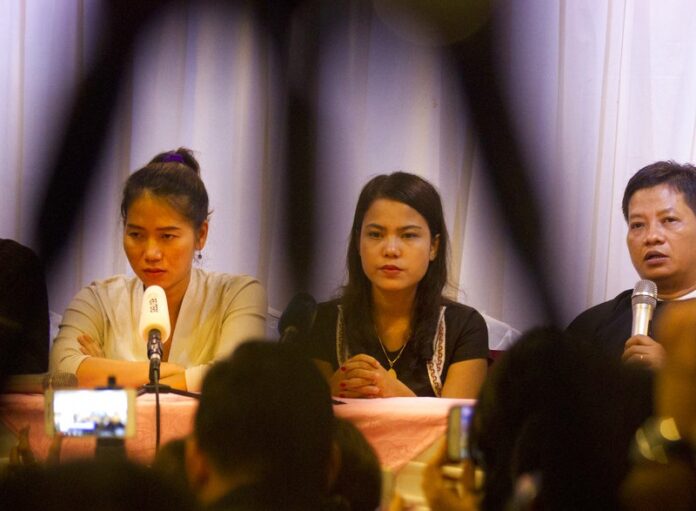
Than Zaw Aung, right, a lawyer of two Reuters journalists, talks to journalists during a press briefing together with Pan Ei Mon, second left, wife of Reuters journalist Wa Lone, Chit Su Win, second right, wife of Reuters journalist Kyaw Soe Oo, and Khin Maung Zaw, left, a lawyer of two Reuters journalists, at a hotel Tuesday, Sept. 4, 2018, in Yangon, Myanmar. Photo: Thein Zaw / Associated Press

YANGON — The wives of two Myanmar reporters for the Reuters news agency sentenced to seven years’ imprisonment for possessing state secrets said Tuesday they were shocked by the court’s decision.

Wa Lone and Kyaw Soe Oo were sentenced Monday in proceedings that were widely decried as unfair. They had reported about the army’s brutal counterinsurgency campaign that drove 700,000 members of the Muslim Rohingya minority to flee to Bangladesh. The subject is sensitive in Myanmar because of worldwide condemnation of the military’s human rights abuses, which it denies.

Wa Lone’s wife, Pan Ei Mon, said at a news conference that she never expected such a harsh punishment “because everyone knows that they didn’t do anything wrong.” The two men testified that they had been framed by the police.

Pan Ei Mon gave birth to the couple’s first child in Yangon on Aug. 10, but her husband has not seen their daughter.

“After I gave birth, I continued to keep strong with the hope that my daughter and her father will meet soon. But I felt like my hope was broken after the verdict yesterday. I am hopeless now,” she said.

Kyaw Soe Oo’s wife, Chit Su, also said she had expected her husband would be coming home. They have a 3-year-old daughter.

“I believed he would be free, he felt the same,” she said. “But it didn’t happen, I felt like I am a crazy person.”

She said she still hopes for mercy from the state. At the same time, she remains proud that her husband did his duty as a journalist.

The lawyers for the journalists said at the news conference that they would do whatever they could to get their clients freed. They can file an appeal or ask for a pardon, or hope the reporters could be freed under a general amnesty for prisoners.

Pan Ei Mon said she was saddened and hurt that the country’s leader, Nobel Peace Prize laureate Aung San Suu Kyi, had taken a legalistic position in a June interview with Japanese broadcaster NHK by saying that the two reporters were arrested for breaking the Official Secret Act, not because they exposed the army’s abuses.

“I am very sad about what she answered because she was the one whom we always admired and respected,” she said.

“We loved and respected her so much,” she said. “We feel very sad as our respected person has the wrong opinion about us.”

The case drew worldwide attention as an example of how democratic reforms in long-isolated Myanmar have stalled under Suu Kyi’s civilian government, which took power in 2016.

Although the military, which ruled the country for a half-century, maintains control of several key ministries, Suu Kyi’s rise to government leader had raised hopes for an accelerated transition to full democracy, and her stance on the Rohingya crisis has disappointed many former admirers.

Story: Aung Naing Soe

Advertisement

Powerful Typhoon Slams Into Western Japan, Flooding Airport

TOKYO — A powerful typhoon blew through western Japan on Tuesday, causing heavy rain to flood the region’s main offshore international airport and high winds to blow a tanker into a connecting bridge, disrupting land and air travel.

Jebi was the strongest typhoon to make landfall in Japan since 1993, according to Japan’s Kyodo News service.

The storm was heading north across a swath of Japan’s main island of Honshu toward the Sea of Japan. It was off the northern coast of Fukui on Tuesday evening with sustained winds of 126 kilometers per hour (78 miles per hour) and gusts up to 180 kph (110 mph), the Japan Meteorological Agency said.

In the hard-hit city of Osaka, high seas poured into Kansai International Airport, flooding one of its two runways and cargo storage and other facilities, forcing the airport to shut down, according to the Ministry of Land, Infrastructure, Transport and Tourism.

More than 700 flights were canceled, according to Japanese media tallies. High-speed bullet train service was suspended from Tokyo west to Hiroshima.

A 2,591-ton tanker that was mooring slammed into the side of a bridge connecting the airport to the mainland, damaging part of the bridge and the vessel. The tanker’s 11 crew members were not injured and remained on board, according to Japan’s coast guard.

Elsewhere in Osaka, the Universal Studios Japan theme park and U.S. Consulate were both closed. Prime Minister Shinzo Abe canceled a scheduled trip to Kyushu, Japan’s southernmost main island, to oversee the government’s response to the typhoon, said Chief Cabinet Secretary Yoshihide Suga.

The typhoon first made landfall on Japan’s southwestern island of Shikoku and then again near Kobe on Honshu. Television footage showed fallen tree branches and high seas overflowing onto low-lying areas.

Tokyo escaped relatively unscathed, with some intermittent squalls.

Story: Mari Yamaguchi

Advertisement

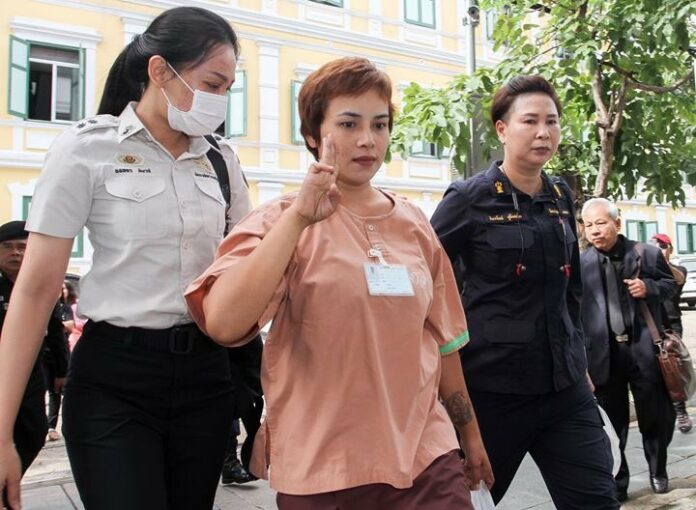
Nurse Who Witnessed Temple Slaughter Freed on Bail

Image: @iLawFX

BANGKOK — A key witness to a temple massacre during a 2010 military crackdown on street protests was released on bail Tuesday after a royal defamation accusation put her behind bars for a year.

The military court freed Nattathida Meewangpla on a bond of 900,000 baht, legal watchdog group iLaw said in a statement. Her trial, like many others that concern the monarchy, has been conducted in secret.

Nattathida had volunteered as a medic when the army swept in to clear Redshirt protesters from downtown Bangkok in May 2010. She was later named by investigators as an eyewitness to soldiers firing into a crowd sheltering inside Wat Pathum, killing six people.

In 2015, Natthathida was held incommunicado by the army and later accused of plotting a terror attack. She was held in prison before she was freed on bail in July 2017 – only to be arrested again and sent back to jail on lese majeste offense. Police said they found messages defaming the monarchy on her phone after her first detention.

Associates and friends had recently raised concerns about her mental health. Her trial is ongoing.

Advertisement

Hot News

LATEST NEWS

Bangkok
overcast clouds
27 ° C
28.3 °
25.9 °
81 %
2.6kmh
99 %
Wed
27 °
Thu
34 °
Fri
34 °
Sat
32 °
Sun
29 °