27.5 C
Bangkok
Thursday, September 17, 2026
Home Blog Page 1978

For First Time Since War, Gold Goes to Korea

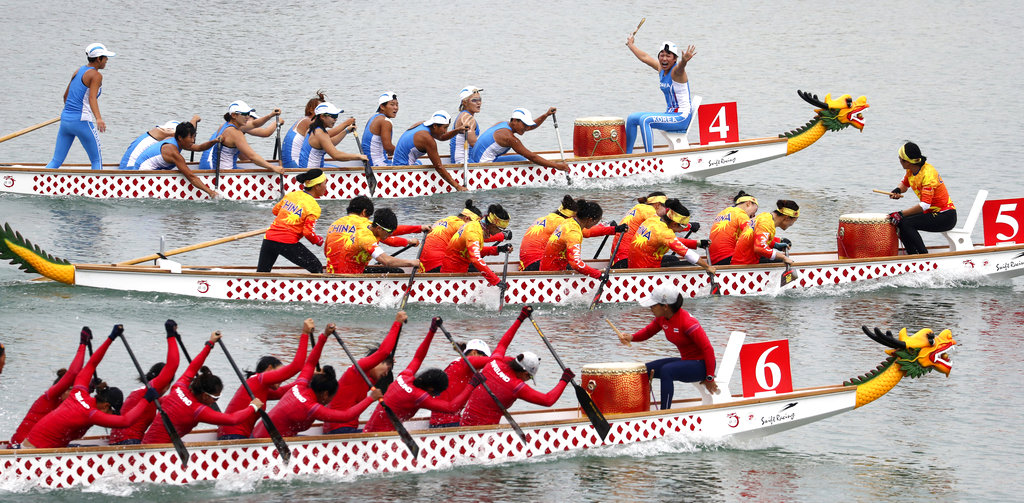
Members of combined Koreas team celebrate their victory during the ceremony for women's 500-meter dragon boat Sunday at the 18th Asian Games in Palembang, Indonesia. Photo: Kim Do-hun / Yonhap via AP

JAKARTA — There was no dividing them. The folk song Arirang played and the “unification” flag was raised to celebrate the first gold medal by a combined Koreas team at a major multi-sport event.

The crew comprising South Koreans and North Koreans won the 500-meter dragon boat final on Sunday at the Asian Games co-host city of Palembang, a day after the paddlers delivered the historic first medal for a combined Koreas team by taking bronze in the 200-meter dragon boat competition.

The gold was awarded to Korea — the name for the joint teams that are entered in rowing, canoeing and women’s basketball — rather than being added to the tally of either North or South Korea.

The celebrations started as soon as the dragon-headed boat with its 10 paddlers, its drummer and its sweep crossed the line.

Koreans hugged on the boat and on the banks along the course.

South Korean news agency Yonhap quoted Kim Kwang Chol, a North Korean coach, as saying he “felt the strength of a unified nation when we came together, dedicated our minds to a single purpose, and paddled the boat forward.”

korea2
Members of combined Koreas team, top, celebrate after winning the women’s 500-meter dragon boat at the 18th Asian Games in Palembang, Indonesia, Sunday, Aug. 26, 2018. (Kim Ju-hyung/Yonhap via AP)

The Koreas, still technically at war after their 1950-53 conflict ended in an armistice, have fielded 60 athletes in combined teams in the three sports along with larger contingents for their respective national squads.

Athletes from both countries paraded into the opening ceremony together last weekend behind the “unification” flag, which features the outline of the peninsula in blue on a white background. It took a week to reap the medals.

Kim, the North Korean coach, said he wasn’t sure when he took his paddlers to South Korea for practice last month that they’d have enough time to prepare.

“But I noticed that the North and South Korean athletes’ fighting spirit was so high after watching them train,” Kim was quoted as saying by Yonhap. “As I saw our boat going forward with the athletes’ combined effort and strength, I felt the united power of Korea.”

In the 500, the Koreans finished in 2 minutes, 24.788 seconds to hold off China and Thailand.

There could be more gold for the Koreas, too, with the combined women’s basketball team reaching the semifinals.

South and North Korea have entered joint teams in previous international events, starting with the 1991 table tennis world championships, and more recently at the Winter Olympics in Pyeongchang, South Korea.

The women’s Olympic ice hockey team gained huge support despite losing all of its games, and inspired more cooperation.

The basketball team, featuring nine South Koreans and three players from the North, next plays Taiwan.

North Korea produced a sister act when Olympic champion Rim Jong Sim won the 75-kilogram weightlifting division a day after her younger sibling Rim Un Sim won the 69-kilogram class.

Capping a day of athletics that started with the furthest event and finished with the fastest, Asian record-holder Su Bingtian won the 100 meters in a games record 9.92 seconds.

The Chinese sprinter was a hot favorite for gold, but world junior champion Lalu Muhammad Zohri was the crowd favorite.

The 18-year-old from the earthquake-ravaged island of Lombok got a good taste of life in the fast lanes, finishing seventh in a personal best 10.20.

In a surprising women’s 100, Nigeria-born Bahrain sprinter Edidiong Odiong dipped late to finish in 11.30 and edge India’s Dutee Chand and 2014 champion Wei Yongli in a photo finish.

World champion Rose Chelimo won the women’s marathon for Bahrain in 2 hours, 34 minutes, 51 seconds.

Among the other athletics finals, world championship silver medalist Salwa Naser won the women’s 400 in 50.09 seconds, holding off world junior champion Hima Das of India, and Sudan-born world championship bronze medalist Abdalelah Hassan won the men’s 400 for Qatar in 44.89.

China picked up golds from world champion Gong Lijiao in the women’s shot put and 2015 world championship bronze medalist Wang Jianan in the long jump.

While China is dominating the medals standings, there won’t be any gold, silver or bronze added in men’s singles in badminton, a sport the nation loves.

Chen Long lost to Indonesia’s Anthony Sinisuka Ginting 21-19, 21-11 in the quarterfinals, meaning China is set to miss a medal in the men’s singles for just the second time since 1970.

Advertisement

World Champion Chelimo Wins Women’s Marathon at Asian Games

Bahrain's Rose Chelimo crosses the finish line Sunday to win the women's marathon during the athletics competition at the 18th Asian Games in Jakarta, Indonesia. Photo: Bernat Armangue / Associated Press

JAKARTA — World champion Rose Chelimo has won the Asian Games women’s marathon for Bahrain in a hot and humid race in the Indonesian capital.

The Kenya-born Chelimo had a big lead by the 30-kilometer mark and won in 2 hours, 34 minutes and 51 seconds.

Chelimo represented Kenya internationally before switching to represent Bahrain ahead of the 2016 Olympics in Rio de Janeiro, where she finished eighth.

She won the world championship title in London last year.

Keiko Nogami won Japan’s second straight silver, holding off North Korea’s Kim Hye Song and finishing more than 1 ½ minutes behind Chelimo.

“It’s a silver medal so there’s still room for improvement,” Nagomi said. “I hope to use this as a springboard.”

Japan picked up its first men’s Asian Games marathon gold medal in 32 years on Saturday when Hiroto Inoue held off his Bahraini rival Elhassan Elabbassi in a sprint finish in the first final of the track and field program at Jakarta.

Advertisement

ASEAN Faces Test in Handling China: Ex-Indonesian FM

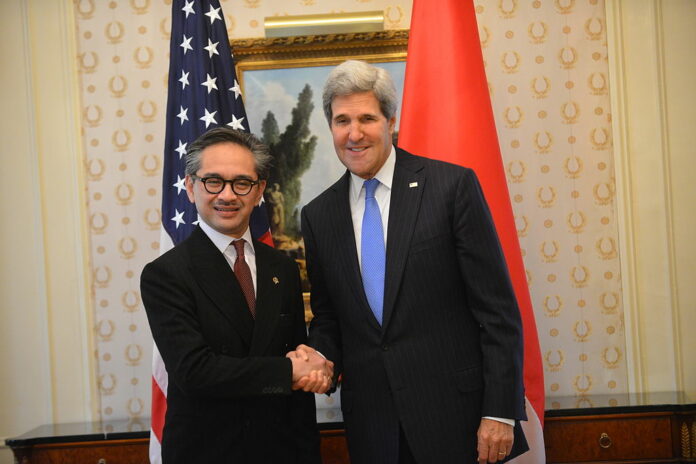
Former Indonesian Foreign Minister Marty Natalegawa, left, meets his American counterpart John Kerry in 2013 in New York. Photo: U.S. Department of State / Wikimedia Commons

BANGKOK — How ASEAN handles China’s rise will be a crucial test for a block which has failed to find its voice as a community on critical issues, a former Indonesian foreign minister said earlier this week.

The Association of Southeast Asian Nations, or ASEAN, has shown “perfect disharmony” in its handling of Myanmar’s anti-Rohingya attacks one year on and found no common position on China’s claims in the South China Sea, Marty Natalegawa said Thursday in Bangkok.

“The challenge in the next few years is how to address the rise of China,” Natalegawa said at the launch of a book at the Foreign Correspondents’ Club of Thailand.

Natalegawa said he hoped ASEAN could reboot itself and get Myanmar to take the necessary steps to handle the Rohingya crisis. Saturday marked one year since the Myanmar army launched a violent crackdown on Rohingya Muslims in the country’s Rakhine state, driving more than 700,000 of them to refugee camps in Bangladesh, which today host almost 900,000 people.

The former foreign minister said states such as the Philippines, Malaysia and Indonesia have urged the association to be more assertive in its handling of the crisis but have not been supported by the rest of nations. Thailand has not made its position clear over the issue.

As for China, Natalegawa said Cambodian resistance had prevented ASEAN from adopting a common stance in the South China Sea conflict, as Phnom Penh and Beijing develop closer economic ties.

This despite member states such as the Philippines, Malaysia, Brunei and Vietnam disputing China’s claims over the sea and several of its islands, a conflict that has held ASEAN in deadlock for decades. States such as Cambodia and Laos strongly back China due to its increasing investment in both countries as the West’s influence in the Mekong region wanes.

He added that it is in China’s interest to see a “strong and united” ASEAN, however.

Though jokingly saying ASEAN is “a super power in producing documents,” Natalegawa added that the association has been transformative in at least three ways.

First, he said that without ASEAN the region could have have been prone to open conflicts among its members. He however didn’t give examples of how the association had averted disputes.

Second, he said it has prevented the region from becoming a proxy for any super power.

Third, Natalegawa said the region has become more centered on its people, although he acknowledged that human rights are “an issue that needs very much progress.”

Advertisement

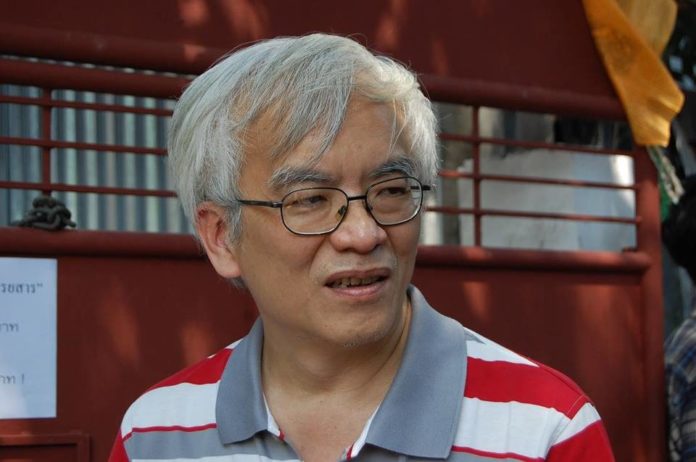
Fugitive Academic Suffers Stroke: Source

BANGKOK — An academic and former university professor, who fled to France shortly after the military seized power in 2014, reportedly suffered a stroke Sunday.

According to a Sunday morning Facebook post by Pavin Chachavalpongpun, also an academic in self-imposed exile in Japan, Somsak Jeamteerasakul suffered from a stroke and was partially paralyzed as a result.

“I got the news from Paris this morning that Somsak Jeamteerasakul fell down. The initial diagnosis is that he suffered a stroke and a paralysis on the right side of the body. Doctors are treating him to stop the brain hemorrhage,” Pavin wrote.

However, there was still no confirmation from Somsak’s family members about his condition.

Somsak is a renowned lese majeste critic and former history professor at Thammasat University. He fled the country to Paris, France, after the 2014 coup.

This is a developing story and may be updated without notice.

Advertisement

‘Crazy Rich Asians’ Draws Immigrant Parents to the Movies

This image released by Warner Bros. Entertainment shows Awkwafina, from left, Nico Santos and Constance Wu in a scene from the film
This image released by Warner Bros. Entertainment shows Awkwafina, from left, Nico Santos and Constance Wu in a scene from the film "Crazy Rich Asians." Image: Associated Press

When “Crazy Rich Asians” surpassed expectations and grabbed the top spot at the box office in its opening weekend, the film also pulled off another surprising feat: It put Asians of a certain age in theater seats.

Younger Asian-Americans have been flocking with their parents to see the first movie in 25 years with an all-Asian cast.

For many older, first-generation Asian immigrants, going to the movies doesn’t rank high among hobbies and interests. The crowds, the language barrier and ticket prices are often turnoffs.

But the appeal of “Crazy Rich Asians,” the story of a culture clash that erupts when an Asian-American woman from New York meets her boyfriend’s family in Singapore, has bridged a real-life generation gap.

Earning more than USD$40 million since its Aug. 15 release, the film already has a sequel in development.

An adaptation of Kevin Kwan’s bestselling novel, the rom-com is poised to hit the $100 million mark due to its popularity and a lack of strong competition in the next month, comScore senior media analyst Paul Dergarabedian said.

“The over-performance of ‘Crazy Rich Asians’ shows the power of a great movie with universal themes to draw all audiences and also to break down preconceived notions of what can constitute a box office hit,” Dergarabedian said.

Broken down by ethnicity, Asians made up nearly 40 percent of the film’s audience during its opening weekend, Warner Bros said. By comparison, Asian/Pacific Islanders comprised just 10 percent of the audience in the opening days of last year’s “Spider-Man: Homecoming,” according to an analysis done by comScore/Screen Engine’s PostTrak.

The jump can be partly credited to enthusiastic Asian-Americans who wanted their parents to be part of what the film’s star, Constance Wu, has called a “movement.”

Lie Shia Ong-Sintzel, 36, of Seattle talked her parents into coming along the second time she saw the movie. It was the first time in five years the couple – Chinese immigrants from Indonesia – had been to the cinema.

“They don’t really go to movies in the theater. I usually have to drag them,” Ong-Sintzel said. “I felt like this was a big occasion – a movie with an all-Asian cast.”

Looking at her parents, she cried because everything from the acting to the food seemed to resonate more. She wasn’t the only one.

“I looked over again, my dad was wiping tears from his eyes,” Ong-Sintzel said.

In Temple City, California, Catherine Fanchiang, 27, who is Taiwanese-American, went to see the film a third time to keep her parents company.

Fanchiang’s mother, Kao Han Fan, also wanted to see the movie because she recognized Michelle Yeoh, who plays a wary matriarch. But it was Wu’s character who touched the 64-year-old the most. Fan said she liked how the story depicted an “ABC,” (American-born Chinese) who showed Asian cultural values such as putting family first.

“When you grow up in an Asian family … it will be in your mind when you do something, you will always think about other people,” Fan said. “You are not really, really selfish, thinking about yourself.”

Fanchiang enjoyed watching her parents see an American film with Asians that wasn’t a period piece.

“It was just a regular movie that just happens to have Asian people in it. It’s not like we’re ninjas or we’re good at fighting. It’s Asians existing in the modern world,” Fanchiang said.

The stars and director Jon M. Chu have said they wanted the film to showcase Asians who weren’t stereotypes or little-used side-players.

In the case of Alice Sue and her daughter, Audrey Sue-Matsumoto, the 67-year-old mother saw the movie first. She went a second time Thursday in the San Francisco Bay Area suburb of Daly City with her daughter. Sue, who is Chinese, doesn’t go to the movies much but knew she had to see this one.

“It’s talking about Asian culture. It’s real Asians mixed with American-born Asians,” Sue said. “And I want to support the Asian movies.”

Sue-Matsumoto, 35, said there probably wasn’t a more fitting film for the two to see together.

“It was good to watch it with my mom because I feel like it was very relatable in our situation,” Sue-Matsumoto said. “She’s an immigrant, and I’m American-born. That movie has that generational distinction.”

For Mark Gadia, 36, of Chula Vista, California, the movie led to him learning more about his parents’ courtship in the Philippines. His parents related to Wu and Henry Golding’s star-crossed couple because of how his mother was treated by her future in-laws.

“She apparently wasn’t good enough for my dad. It took this movie to make this revelation of how they met,” Gadia said.

He did not expect to come away having enjoyed seeing the film alongside his parents as much as he did.

“As sappy as this sounds, it’s something I’ll always remember,” Gadia said. “It’s kind of sad it took 25 years, but I’m glad I had the opportunity to have this experience as an adult.”

Story: Terry Tang

Advertisement

John McCain, War Hero and Presidential Candidate, 81

Republican presidential candidate Sen. John McCain, R-Ariz., speaks in 2008 at a rally in Tampa, Florida. Photo: Carolyn Kaster / Associated Press

WASHINGTON — Sen. John McCain, who faced down his captors in a Vietnam prisoner of war camp with jut-jawed defiance and later turned his rebellious streak into a 35-year political career that took him to Congress and the Republican presidential nomination, died Saturday after battling brain cancer for more than a year. He was 81.

McCain, with his irascible grin and fighter-pilot moxie, was a fearless and outspoken voice on policy and politics to the end, unswerving in his defense of democratic values and unflinching in his criticism of his fellow Republican, President Donald Trump. He was elected to the Senate from Arizona six times but twice thwarted in seeking the presidency.

An upstart presidential bid in 2000 didn’t last long. Eight years later, he fought back from the brink of defeat to win the GOP nomination, only to be overpowered by Democrat Barack Obama. McCain chose a little-known Alaska governor as his running mate in that race, and turned Sarah Palin into a national political figure.

After losing to Obama in an electoral landslide, McCain returned to the Senate determined not to be defined by a failed presidential campaign in which his reputation as a maverick had faded. In the politics of the moment and in national political debate over the decades, McCain energetically advanced his ideas and punched back hard at critics – Trump not least among them.

The scion of a decorated military family, McCain embraced his role as chairman of the Armed Services Committee, pushing for aggressive U.S. military intervention overseas and eager to contribute to “defeating the forces of radical Islam that want to destroy America.”

Asked how he wanted to be remembered, McCain said simply: “That I made a major contribution to the defense of the nation.”

One dramatic vote he cast in the twilight of his career in 2017 will not soon be forgotten, either: As the decisive “no” on Senate GOP legislation to repeal the Affordable Care Act, McCain became the unlikely savior of Obama’s trademark legislative achievement.

Taking a long look back in his valedictory memoir, “The Restless Wave,” McCain wrote of the world he inhabited: “I hate to leave it. But I don’t have a complaint. Not one. It’s been quite a ride. I’ve known great passions, seen amazing wonders, fought in a war, and helped make a peace. … I made a small place for myself in the story of America and the history of my times.”

Throughout his long tenure in Congress, McCain played his role with trademark verve, at one hearing dismissing a protester by calling out, “Get out of here, you low-life scum.”

But it was just as notable when he held his sharp tongue, in service of a party or political gain.

Most remarkably, he stuck by Trump as the party’s 2016 presidential nominee even when Trump questioned his status as a war hero by saying: “I like people who weren’t captured.” McCain declared the comment offensive to veterans, but urged the men “put it behind us and move forward.”

His breaking point with Trump was the release a month before the election of a lewd audio in which Trump said he could kiss and grab women. McCain withdrew his support and said he’d write in “some good conservative Republican who’s qualified to be president.”

By the time McCain cast his vote against the GOP health bill, six months into Trump’s presidency, the two men were openly at odds. Trump railed against McCain publicly over the vote, and McCain remarked that he no longer listened to what Trump had to say because “there’s no point in it.”

By then, McCain had disclosed his brain cancer diagnosis and returned to Arizona to seek treatment. His vote to kill the GOP’s years-long Obamacare repeal drive – an issue McCain himself had campaigned on – came not long after the diagnosis, a surprising capstone to his legislative career.

In his final months, McCain did not go quietly, frequently jabbing at Trump and his policies from the remove of his Hidden Valley family retreat in Arizona. He opposed the president’s nominee for CIA director because of her past role in overseeing torture, scolded Trump for alienating U.S. allies at an international summit, labeled the administration’s zero-tolerance immigration policy “an affront to the decency of the American people” and denounced the Trump-Putin summit in Helsinki as a “tragic mistake” in which the president put on “one of the most disgraceful performances by an American president in memory.”

On Aug. 13, Trump signed into law a USD$716 billion defense policy bill named in honor of the senator. Trump signed the John S. McCain National Defense Authorization Act in a ceremony at a military base in New York – without one mention of McCain.

John Sidney McCain III was born in 1936 in the Panana Canal zone, where his father was stationed in the military.

He followed his father and grandfather, the Navy’s first father-and-son set of four-star admirals, to the Naval Academy, where he enrolled in what he described a “four-year course of insubordination and rebellion.” His family yawned at the performance. A predilection for what McCain described as “quick tempers, adventurous spirits, and love for the country’s uniform” was encoded in his family DNA.

On October 1967, McCain was on his 23rd bombing round over North Vietnam when he was shot out of the sky and taken prisoner.

Year upon year of solitary confinement, deprivation, beatings and other acts of torture left McCain so despairing that at one point he weakly attempted suicide. But he also later wrote that his captors had spared him the worst of the abuse inflicted on POWs because his father was a famous admiral. “I knew that my father’s identity was directly related to my survival,” he wrote in one of his books.

When McCain’s Vietnamese captors offered him early release as a propaganda ploy, McCain refused to play along, insisting that those captured first should be the first set free.

In his darkest hour in Vietnam, McCain’s will had been broken and he signed a confession that said, “I am a black criminal and I have performed deeds of an air pirate.”

Even then, though, McCain refused to make an audio recording of his confession and used stilted written language to signal he had signed it under duress. And, to the end of his captivity, he continued to exasperate his captors with his defiance.

Throughout, McCain played to the bleachers, shouting obscenities at guards to bolster the spirits of fellow captives. Appointed by the POWs to act as camp entertainment officer, chaplain and communications chief, McCain imparted comic relief, literary tutorials, news of the day, even religious sustenance.

Bud Day, a former cellmate and Medal of Honor winner, said McCain’s POW experience “took some great iron and turned him into steel.”

McCain returned home from his years as a POW on crutches and never regained full mobility in his arms and leg.

He once said he’d “never known a prisoner of war who felt he could fully explain the experience to anyone who had not shared it.” Still he described the time as formative and “a bit of a turning point in me appreciating the value of serving a cause greater than your self-interest.”

But it did not tame his wild side, and his first marriage, to Carol Shepp, was a casualty of what he called “my greatest moral failing.” The marriage to Shepp, who had been in a crippling car accident while McCain was imprisoned, ended amiably. McCain admitted the breakup was caused by “my own selfishness and immaturity.”

One month after his divorce, McCain in 1981 married Cindy Hensley, the daughter of a wealthy beer distributor in Arizona.

In one day, McCain signed his Navy discharge papers and flew west with his new wife to a new life. By 1982, he’d been elected to the House and four years later to an open Senate seat. He and Cindy had four children, to add to three from his first marriage. Their youngest was adopted from Bangladesh.

McCain cultivated a conservative voting record and a reputation as a tightwad with taxpayer dollars. But just months into his Senate career, he made what he called “the worst mistake” of his life. He participated in two meetings with bank regulators on behalf of Charles Keating, a friend, campaign contributor and savings and loan financier later convicted of securities fraud.

As the industry collapsed, McCain was tagged as one of the Keating Five – senators who, to varying degrees, were accused of trying to get regulators to ease up on Keating. McCain was cited by the Senate Ethics Committee for “poor judgment.”

To have his honor questioned, he said, was in some ways worse than the torture he endured in Vietnam.

In the 1990s, McCain shouldered another wrenching issue, the long effort to account for American soldiers still missing from the war and to normalize relations with Vietnam.

“People don’t remember how ugly the POW-MIA issue was,” former Democratic Sen. Bob Kerrey, a fellow Vietnam veteran, later recalled in crediting McCain for standing up to significant opposition. “I heard people scream in his face, holding him responsible for the deaths of POWs.”

Over three decades in the Senate, McCain became a standard-bearer for reforming campaign donations. He denounced pork-barrel spending for legislators’ pet projects and cultivated a reputation as a deficit hawk and an independent voice. His experience as a POW made him a leading voice against the use of torture. He achieved his biggest legislative successes when making alliances with Democrats.

But faced with a tough GOP challenge for his Senate seat in 2010, McCain disowned chapters in his past and turned to the right on a number of hot-button issues, including gays in the military and climate change. And when the Supreme Court in 2010 overturned the campaign finance restrictions that he’d work so hard to enact, McCain seemed resigned.

“It is what it is,” he said.

After surviving that election, though, McCain took on conservatives in his party over the federal debt and Democrats over foreign policy. McCain never softened on his opposition to the U.S. use of torture, even in the recalibrations of the post-9/11 world. When the Senate in 2014 released a report on the CIA’s harsh interrogation techniques at secret overseas facilities after the 9/11 attacks, McCain said the issue wasn’t “about our enemies. It’s about us. It’s about who we were, who we are and who we aspire to be. It’s about how we represent ourselves to the world.”

During his final years in the Senate, McCain was perhaps the loudest advocate for U.S. military involvement overseas – in Iraq, Syria, Libya and more. That often made him a critic of first Obama and then Trump, and placed him further out of step with the growing isolationism within the GOP.

In October 2017, McCain unleashed some his most blistering criticism of Trump’s “America first” foreign policy approach – without mentioning the president by name – in describing a “half-baked, spurious nationalism cooked up by people who would rather find scapegoats than solve problems.”

Few politicians matched McCain’s success as an author. His 1999 release “Faith Of My Fathers” was a million seller that was highly praised and helped launch his run for president in 2000. His most recent bestseller and planned farewell, “The Restless Wave,” came out in May 2018.

Story: Nancy Benac

Advertisement

‘I’m Not Part of the Elite,’ Says Billionaire Leader of Progressive Party

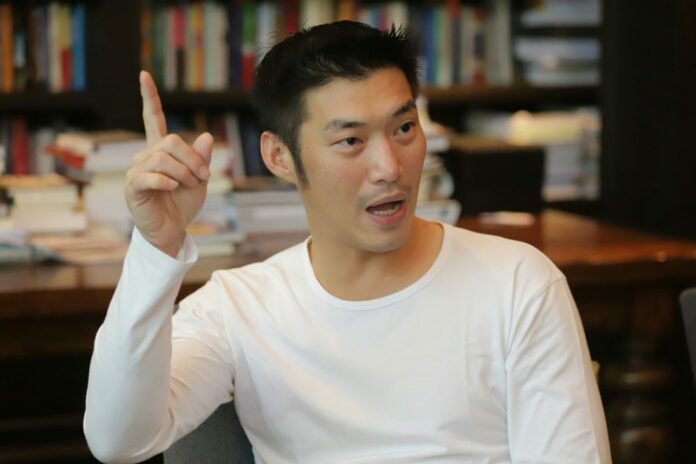
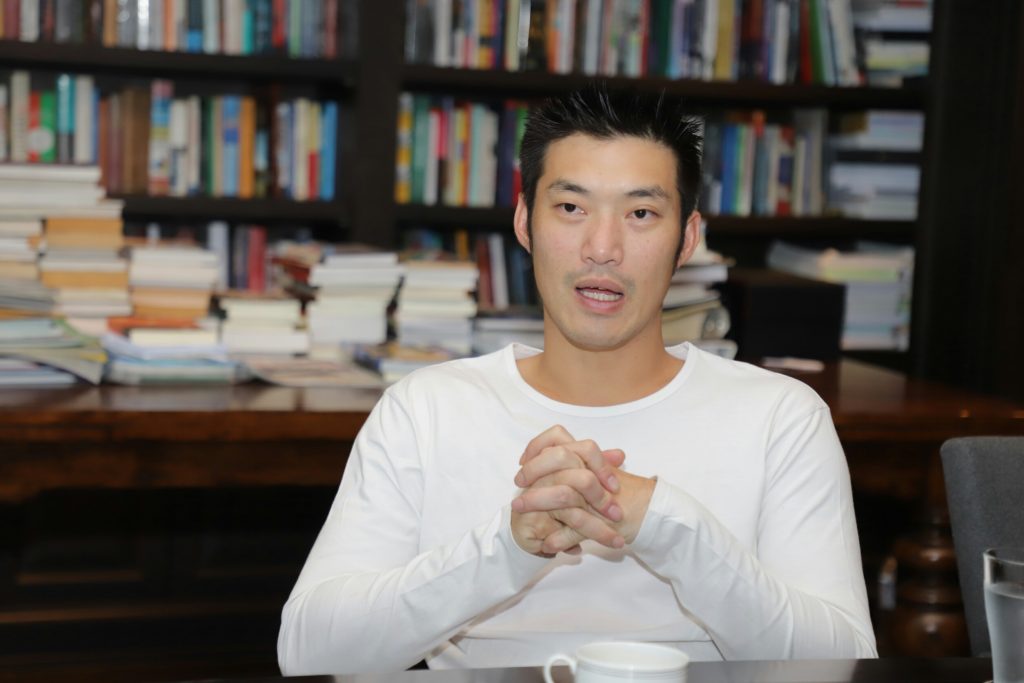
Thanathorn Juangroongruangkit sits for an interview in August at his southeastern Bangkok home.

BANGKOK — While ultra-wealthy and powerful leaders have risen the world over more often as populists than champions of democracy, Thanathorn Juangroongruangkit says he will be the exception.

In an exclusive interview, the Future Forward Party founder insisted Thursday that his liberal-leaning faction is a viable cure the ills of a divided country. He also said his wealthy background doesn’t disqualify him from speaking on behalf of the common people.

“I am not part of whatever term you might use: the elite, the ammart, the moneyed class, the 1 percent,” said Thanathorn, who until earlier this year headed Thai Summit Group, a family-owned auto supply company. “Having wealth and having privilege are different things.”

Thanathorn spoke a day after police summoned him over a criminal charge filed by the military junta, which accuses him of having “distorting facts” in an online video. Thanathorn sees the charge as the latest junta effort to silence its critics. He believes an activist assaulted the same day was attacked for the same reason.

“This society is now living in a dark age,” Thanathorn said. “They slap us with charges. If it doesn’t succeed, then they send someone to intimidate us.”

Asked whether he fears similar attacks on himself for defying the junta, Thanathorn said no, but added that he’s worried for those close to him. He has three young children, all of which are in school. His wife is expecting another child.

“If the threats are directed at me, I’d just give it a shrug,” Thanathorn said. “But I’m afraid that the intimidation will spread to my family.”

Not One of Them 

Reading a quick bio of Thanathorn, one would most likely place him in a typical Bangkokian middle class. His high school years were spent at St. Dominic’s, a Catholic all-boys college and Triam Udom, widely seen as a springboard to Chulalongkorn and Thammasat universities on their way to the levers of power.

Thanathorn, whose nickname is Ake, did end up at Thammasat and graduated with a degree in engineering. He went on to sit on the board of Thai Summit Group, owned by his family. His uncle, Suriya Juangroongruangkit, was a transport minister back in 2002.

52 5
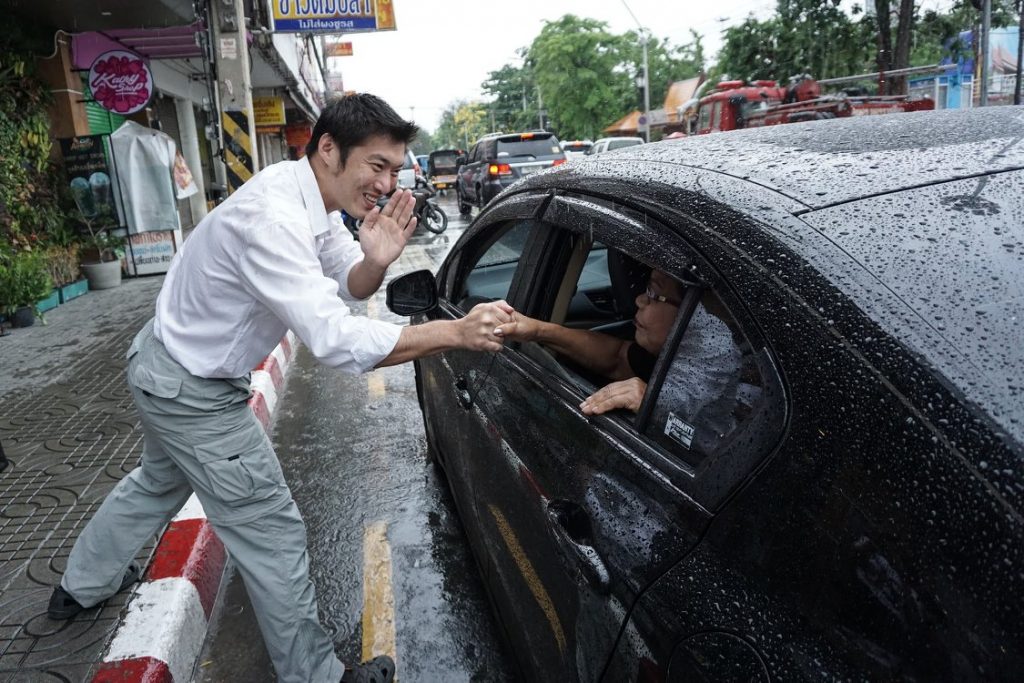
A file photo of Thanathorn campaigning for his party.

He also served as consultant to multiple companies, including Matichon Group, which owns Khaosod English. He said he stepped down from all of these positions five months ago to fully dedicate his time to the nascent Future Forward Party.

“I miss working in business,” said Thanathorn.

“I was very sad when I had to leave. My team just started working on our first AI,” he continued. “If I had stayed with them, six or seven months later, we’d have succeeded by now.”

As someone from a “new money” family, Thanathorn doesn’t see himself as part of the traditional elite. And the feeling is mutual, he added.

“I started to feel that I’m wealthier than the average of my classmates when I was in junior high,” he said. “That was when my parents started trying to be ‘One of Them.’ They tried entering that circle. But my dad left school when he was in the fourth grade. He went to a fancy dinner, and there were eight spoons in front of him. He didn’t know what to do.”

31466850 1494555043981730 4173752199236550656 n
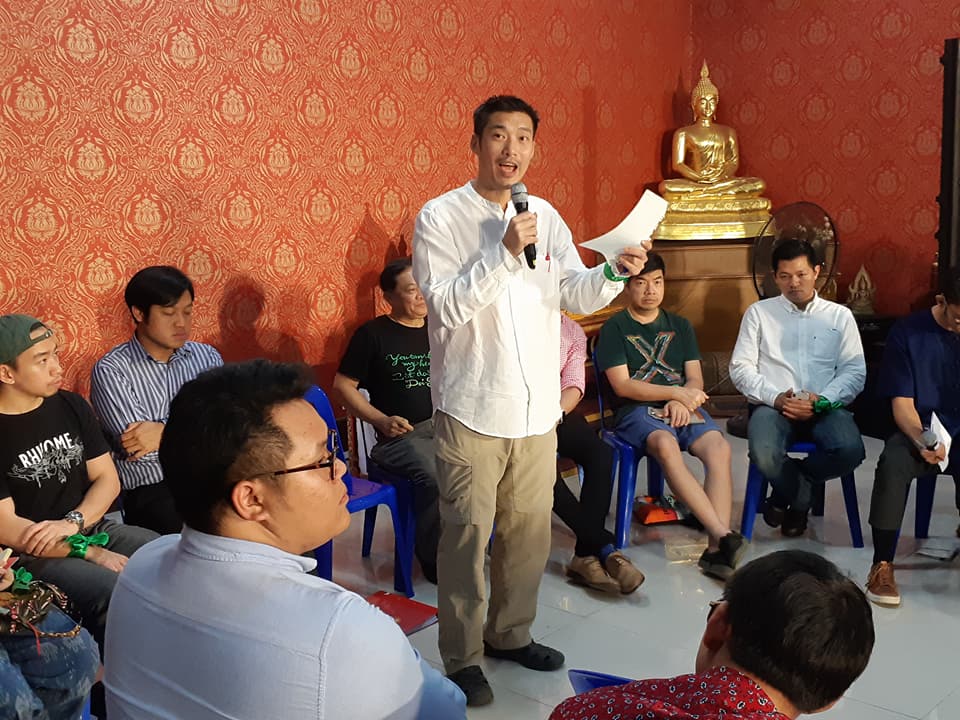
Thanathorn and Future Forward Party leaders on a campaign tour on April 29 in Chiang Mai province.

Not everyone is convinced Thailand needs another “benevolent billionaire.” A Thai Post column in May compared him to Thaksin Shinawatra, a former tycoon turned politician later convicted under a cloud of nepotism and fraud.

“Will he repeat Thaksin’s mistake?” columnist Phakkad Hom wrote. “No one knows the future, whether Future Forward under Thanathorn’s leadership comes to power, or whether Thanathorn will be the prime minister he says he will. But Thaksin said he’d get the premiership, and he did. It ended in corruption.”

Thanathorn says the nouveau riche who’ve worked for their wealth can’t be compared to those born with it.

“When they look at us, they do so with derision. They say to each other, ‘These people are just merchants.’ They insult us,” he said. “We have the money, but we don’t have big family names they do.”

Thanathornsongkran
Thanathorn poses for photos with Songkran festival revelers on April 14 in Udon Thani province.

Still, rich he is. Thai Summit Group, privately held by the Juangroongruangkit family, reportedly brings in about 60 billion baht annually.

Born or earned, that kind of wealth isn’t likely to put one in touch with the everyman. Asked if he risks being stuck in a bubble of his own, Thanathorn pointed out that he’s visited 41 provinces in recent months to hear people’s opinion on where the country should be headed.

“Being out of touch is never my concern,” Thanathorn said.

Justice for All? 

After months of speculation, Thanathorn in March unveiled the Future Forward Party. Styling it as the party for the progressives and disenfranchised youth, Thanathorn was soon voted chairman by the founding members.

It wasn’t his first foray into politics. Thanathorn got involved with activism in his university years, when he campaigned alongside a rural-based group called Assembly of the Poor. On a shelf in his library sit copies of “Same Sky,” a left-leaning magazine examining Thai politics and society.

One of them is the legendary red-cover issue on Thai monarchy which was banned from sale in 2006 due to “sensitive content.”

“The monarchy – I’m not talking about His Majesty the King but the entire institution – needs to evolve,” Thanathorn said. “It needs to have a constant dynamic, ever changing along with the world. What everyone wants to see is the monarchy as an important institution under the constitution.”

But Thanathorn stopped short of calling for reform of the lese majeste law, which has been used to jail people up to 15 years for any action or remark deemed critical of the monarchy. Rights groups have said it has become abused as a political weapon to silence and cow dissent.

สัมฯหน.พรรคอนาคตใหม่ ๑๘๐๘๒๓ 0005
Thanathorn Juangroongruangkit sits for a Thursday interview at his southeastern Bangkok home.

Its omission from Future Forward’s platform was met with disappointment from activists who believe the law should be amended. Thanathorn would not say why he refused to take up those calls.

“When we do an off-record interview, we’ll talk about it,” he said.

Asked what he’d do as head of the next government, Thanathorn pledged to reform the military, write a new constitution independent of the current junta and “bring justice” to all sides involved in past cycles of political violence which have plagued the country for over a decade.

Does that mean the kind of blanket amnesty that brought down the last civilian government? A trial for generals and political leaders? He would not discuss specifics, but stressed that Thailand must strike a balance between justice and reconciliation as there is no “defined formula” for the country.

“Every side has to come together and think,” he said. “We have to heal the wounds on all sides.”

Advertisement

Can ASEAN Netizens Guarantee Greater Freedom of Expression?

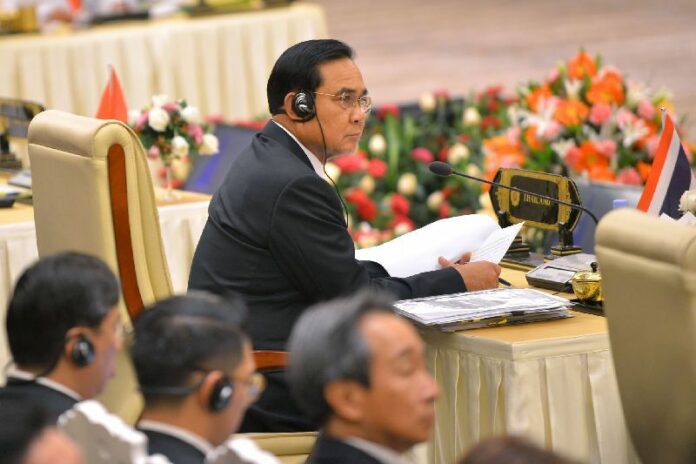
Gen. Prayuth at the ASEAN summit in 2014 in Myanmar.

Re•tention: Pravit Rojanaphruk

As ASEAN celebrates its 51st anniversary this month, I wonder whether freedom of expression and press freedom can become part of its values.

Looking around, the signs are not very promising.

According to the Reporters Without Border 2018 press freedom index, all ASEAN member states rank poorly in the bottom third of the world.

Of 180 countries, Indonesia was ranked 124 while the Philippines is at No. 133. From there, it’s a steep plunge. Myanmar is at 137 and Juntaland-Thailand ranks 140. Hun Sen’s Cambodia sits at 142 followed by Malaysia at 145, Singapore 151, Brunei 153 and Laos 170.

Vietnam – at 175 – is just two places better than Syria, while the country with the least press freedom – according to the Paris-based organization – is North Korea at 180.

In Vietnam, the press is state-owned and political bloggers are routinely arrested.

“In other developing countries where I’d worked, local journalists often turned out to be my best sources of information and most useful contacts. Vietnam was different. Reporters, who were licensed by the government, generally had chosen journalism because they wanted the security of a state job, not because they were curious about the world around them or had a calling to pluck a kernel of truth from a sack of lies,” Los Angeles Times journalist David Lamb wrote in his book “Vietnam Now: A Reporter Returns.”

Lamb added that he asked a reporter what her idea of a good story was, and the journalist replied: “A story that is in harmony with the people.”

“Like her colleagues, she had bought the official line that to question or criticize was to undermine the spirit of nationalism,” Lamb said.

In Cambodia, strongman Hun Sen’s long rule is casting an even longer shadow on the press and freedom of expression in general.

“As Hun Sen’s power grew and violence receded, the opposition Khmer-language press was brought to heel in the courts, where accusations of defamation or incitement were leveled by powerful people and then rubber-stamped by pliant judges,” wrote Sebastian Strangio, a former reporter and editor at the Phnom Penh Post, in the book “Hun Sen’s Cambodia.”

“With no chance of winning, the threat of jail or insurmountable fines fostered self-censorship and, by 2010, had forced the closure or co-optation of most significant opposition outlets,” he added.

In September 2017, the Cambodia Daily shut down under political pressure after two decades. Thomas Beller wrote on The New Yorker on Sept. 12 that year describing the situation in an article entitled “The Devastating Shutdown of the Cambodian Daily.”

“The days ticked down to the Monday, Sept. 4 deadline. There were many news items about the threat to the Daily and the authoritarian turn away from democracy. On Sunday, Sept. 3, the leader of the opposition party was arrested in the middle of the night, charged with treason, and taken to a remote prison.

The following edition of the paper carried the headline “Descent into Outright Dictatorship,” above the fold. At the bottom was an article titled “Cambodia Daily Faces Immediate Closure Amidst Threats.”

That was the last issue.

It was to be prophetic, for by May 2018, the Phnom Penh Post was sold to pay a mounting tax bill to a new owner, Sivakumar Ganapathy, which led to the firing and resignations of several senior journalists.

A BBC news story described the sale as coming “amid an increasing crackdown on independent media outlets” while Reporters Without Borders has accused the Hun Sen government of launching “an all-out war on independent media outlets with the aim of ensuring victory in the general elections scheduled for July.”

The government denied this, adding that the sale was a normal business transaction.

The Philippines’ vibrant media coexist with the fact that local journalists are often targets of assassination attempts.

In Indonesia, where there’s hope, God continues to be a taboo topic.

ASEAN values are more often about non-interference and consensus – not critical expression.

Can disruptive technologies such as social media be a boon for press freedom and freedom of expression in ASEAN? I am at least hopeful that there is a possibility that the spread of social media is already making a difference, particularly if used responsibly.

In Thailand, critical discussion on topics untouched by the majority of mainstream media – such as the monarchy – have moved to social media, bypassing self-censorship despite risking charges of lese majeste and breaching the Computer Crimes Act.

A few may have been arrested but the rest of the school of fish on social media continue to swim. The same goes with Vietnam, the control over traditional press has become increasingly irrelevant as younger generations seek to learn about their country’s politics and society through the internet and social media, despite the arrest of vocal bloggers.

Myanmar however, is where the ugly head of online freedom of expression rears in the form of anti-Rohingya hate speech. Facebook has been used by netizens to spread hate and incite violence.

That suddenly more and more people can access censored information and instantly talk to others in a new public sphere, to use German philosopher Jurgen Habermas’ term, is no guarantee that freedom of expression will advance and expand tolerance.

People could also end up trapped in the respective ghetto of their own narrow-mindedness, talking only to like-minded people, trapped in a cyber world where everyone shares the same political or social views instead of learning and conversing with those who think differently.

Advertisement

A Year After Flight to Safety, Rohingya Demand Justice

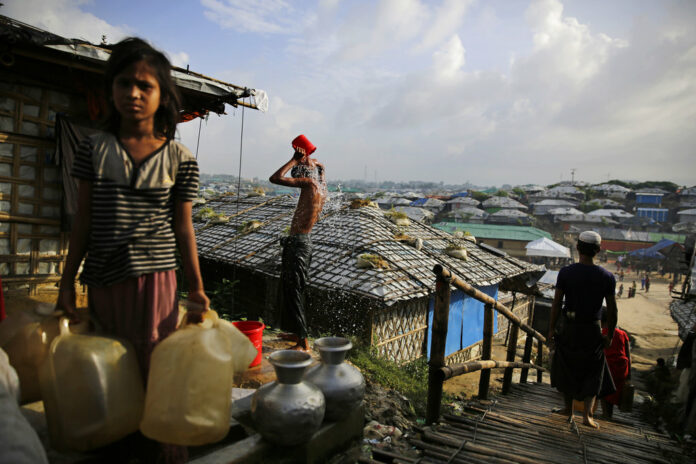
In this Wednesday, Aug. 22, 2018 photo, a Rohingya refugee bathes, as a girl waits to fill water from a hand pump at Kutupalong refugee camp, a ramshackle sprawl of camps built amid low rolling hills and endless monsoon-season mud, in Bangladesh. Photo: Altaf Qadri / Associated Press

KUTUPALONG, Bangladesh — Thousands of Rohingya Muslim refugees on Saturday marked the one-year anniversary of the attacks that sent them fleeing to safety in Bangladesh, praying they can return to their homes in Myanmar and demanding justice for their dead relatives and neighbors.

More than 15,000 gathered in the morning on a hilltop in the Kutupalong refugee camp, part of a sprawling web of settlements that are now home to nearly 900,000 Rohingya who have fled Myanmar.

“25th August – Black Day,” one banner announced. “We want justice,” said another.

The camps exploded in size last year when Myanmar’s army launched a wave of anti-Rohingya attacks about Aug. 25, and some 700,000 Rohingya began pouring across the border. Thousands were killed in the violence.

“We are Rohingya, we are Muslims, we have been driven away from our land, from our homes,” one speaker told the crowd. “We want justice. We want to go back to our homes.”

But many doubt they’ll ever be able to return despite more than a year of talks among Myanmar, Bangladesh, the United Nations and international aid agencies. Myanmar insists the Rohingya can return, and has built a series of camps for them, but few believe they would be safe there, or that they could finally be accepted as citizens.

While Rohingya have lived for centuries in Myanmar, they have long been treated as outsiders, Muslims in a largely Buddhist nation who are denied citizenship and many basic rights. Many in Myanmar ridicule them as “Bengalis” who came illegally from Bangladesh.

Most live in poverty in Myanmar’s Rakhine state, just across the border from Bangladesh. Over the past couple decades, over 100,000 have fled into Bangladesh in earlier waves of violence.

The latest violence began on Aug. 24, with a series of attacks on Myanmar police stations by a small Rohingya militant group that killed a dozen security personnel. In retaliation, the Myanmar military and Buddhist mobs launched waves of attacks, killing people and emptying villages in what many in the international community see as a calculated attempt to drive the Rohingya from the country.

Story: Julhas Alam

AP18236310952527
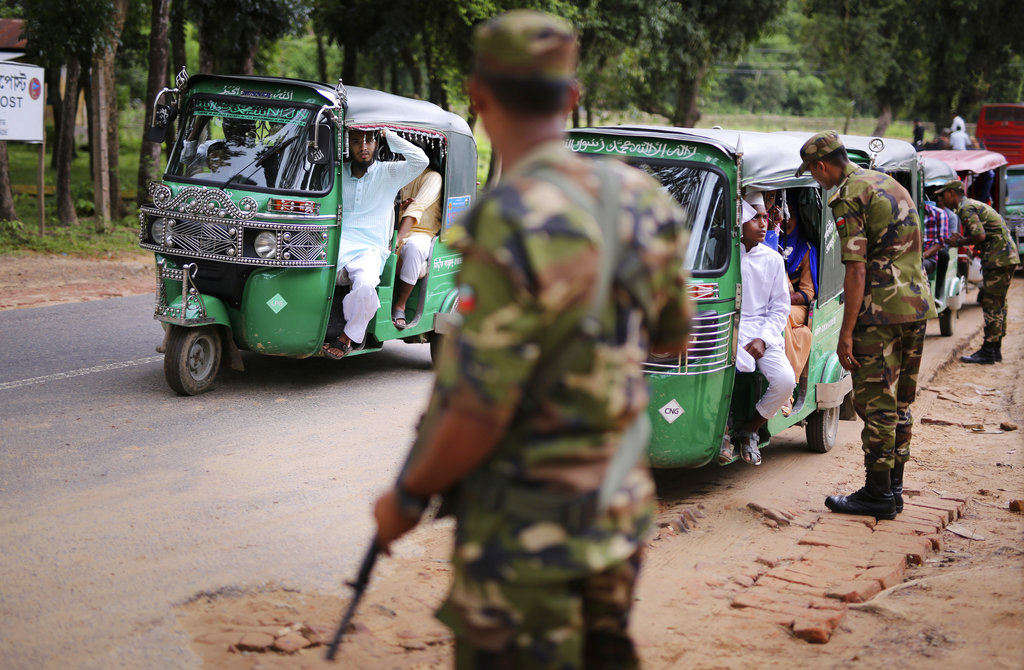
In this Thursday, Aug. 23, 2018 photo, Bangladesh military personnel check vehicles for Rohingya refugees on the road that connects refugee camps to the nearby tourist town of Cox’s Bazar, Bangladesh. Photo: Altaf Qadri / Associated Press
Advertisement

Mosque Ceremony for Rohingya Victims Forced Canceled by Authorities

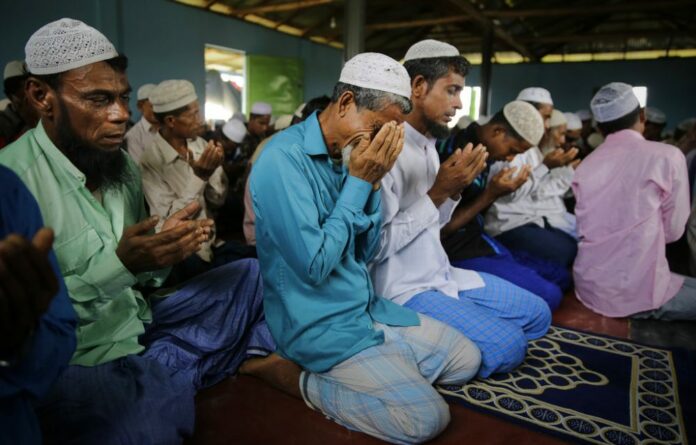
Rohingya refugees cry in August as they pray inside a mosque on Eid al Adha at Kutupalong refugee camp, Bangladesh. Photo: Altaf Qadri / Associated Press

PATHUM THANI — A Saturday event to mark the one-year anniversary since violence erupted in Myanmar’s Rakhine state was forced to cancel by authorities.

Hajee Ismail, the president of the Rohingya Peace Network of Thailand, said a “merit making” ceremony with about 50 attendees scheduled to take place today afternoon at a mosque in Pathum Thani province, north of Bangkok, was canceled after calls from the police and the military on Friday.

“Police called yesterday asking if our event will cause chaos,” Hajee said Saturday by phone. “Then the military, from which exact unit I don’t recall, called the Imam [Islamic leader in the community] telling us to cancel the event.”

“We’re sad about what happened,” Hajee said. “We only meant to perform salat and pray for the deceased. We meant to gather to make merit and then have lunch together. That’s it.”

On Aug. 25 last year Myanmar military forces attacked Rohingya people in the country’s northern Rakhine state. The atrocities resulted in thousands of Rohingya people being killed and forced about 700,000 Rohingya Muslims to flee to Bangladesh.

The military was accused of widespread human rights violations, including rape, murder, torture and the burning of Rohingya homes.

Related stories:

A Year After Flight to Safety, Rohingya Demand Justice

UN Council to Commemorate Myanmar Crackdown on Rohingya

Advertisement

Hot News

LATEST NEWS

Bangkok
overcast clouds
27.5 ° C
28.3 °
25.9 °
85 %
2.3kmh
100 %
Wed
29 °
Thu
34 °
Fri
34 °
Sat
31 °
Sun
31 °