JAKARTA — Indonesia say it’s blocking web versions of the Telegram instant messaging app and will block the app completely if it continues to be a forum for radical propaganda and violent militants.
The Ministry of Communications and Information Technology says in a statement it has asked internet companies to block access to 11 addresses that the web version is available through.
It says “this blocking must be done” because many channels in the service are used to recruit Indonesians into militant groups to spread hate and methods for carrying out attacks including bomb making.
Samuel Pangerapan, the director general of informatics applications at the ministry, says they are preparing for the complete closure of Telegram in Indonesia if it does not develop procedures to block unlawful content.
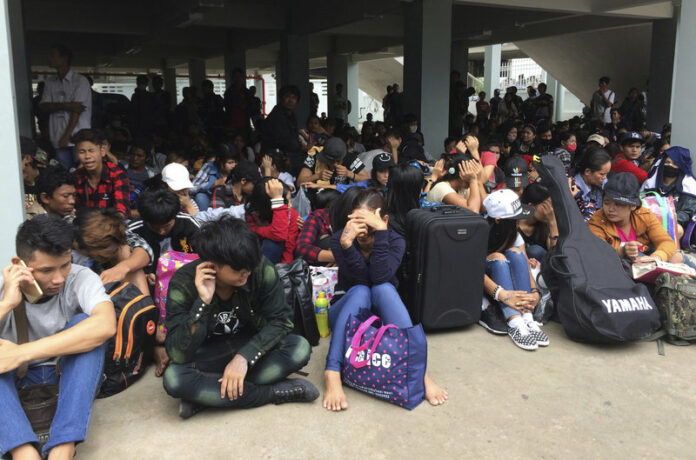
Myanmar workers wait July 3 before leaving Thailand at Mae Sot Immigration office in Tak province Thailand. Fearful that Thailand's new labor rules will get them into trouble, tens of thousands of migrant workers are returning to neighboring Myanmar, Cambodia and Laos, causing hardship to themselves and their Thai employers. Photo: Chiravuth Rungjamratratsami / Associated Press
It was chaos, confusion and pain for millions of migrant workers from neighboring countries, chiefly Myanmar, after much harsher penalties under the new Decree on Managing the Work of Aliens – passed by the junta-appointed rubber-stamp parliament – came to effect on June 23 with fines ranging 400,000 to 800,000 bahts.
Only after the exodus of tens of thousands of illegal migrant workers who feared severe prosecution and fines, (and reports of extortion against fleeing workers by corrupt Thai officials), began disrupting businesses such as fisheries in the south and construction projects in big cities, did the military regime backtrack.
Junta leader Gen. Prayuth Chan-ocha, the man who appointed members of his rubber stamp parliament exercised his absolute dictatorial power under Article 44 of the now-defunct 2014 charter to suspend key articles of the Migrant Labor Act. In effect he froze any prosecution that led to the exodus in the first place until the end of this year.
Damage has been done to the economy, however, as employers have difficulties finding new workers to replace those who fled. This is a classic autocratic shortfall as voices of dissent are hardly heard by the junta and the junta-appointed rubber stamp parliament filled with sycophants.
This turnaround looks as if it was done more out of concerns for the businesses affected and the economy than out of empathy for the migrant laborers from neighboring Myanmar, Cambodia and Laos, however.
For the past two decades, migrant workers from these country have been made invisible, voiceless and with little or no rights and integration.
On Wednesday, for example, Fortify Rights, an American human rights group with an office in Bangkok, issued a statement calling for a large factory to end its criminal complaints against 14 migrant workers from Myanmar who dared to accuse their employers – a Thai-owned poultry farm in Lopburi province Thammakaset Co. Ltd. – of paying workers less-than-minimum wages, failing to pay overtime wages, and confiscating their identity papers, including passports.
In response, the company accused the workers who complained to the National Human Rights Commission of Thailand in July last year of giving false information to officials “likely to cause injury of any person or the public” and “impair” the reputation of the plaintiff. Such a crime is punishable under Articles 137 and 326 of the penal code with a combined sentences of up to one year and six months in prison and a fine of up to 30,000 bahts or both.
Since migrant workers in Thailand have no rights to form a union by themselves and life is obviously difficult in a foreign land, one must wonder why these 14 workers would want to make a false claim at all.
Amy Smith, executive director of Fortify Rights, had this to say in the Wednesday statement.
“Migrant workers have a right to be protected in the workplace and should be able to speak out when these rights are not protected. Defamation should never be criminalized…” she said.
As if the struggle for labor rights was not hard enough for poorly-paid migrant workers from neighboring countries – particularly Myanmar – they also face xenophobia from some columnists on big Thai tabloids. Thai Rath columnist Kampanyok wrote on June 6 under the column named “Mudlek,” which translates to iron fist, portraying an imagined scenario involving the estimated 3 million migrant workers in Thailand from Myanmar.
“Just casually think with dark humor that if one day, Thailand would have to wage war with Myanmar, we may be easily taken hostages by these Burmese labors that infiltrate the houses of top soldiers, police, and ministers.”
That’s the mentality of some. The columnist said Thailand has been too welcoming to these workers already by shouldering the costs of their medical care and their children’s school education.
That’s one way of looking at it. My way of seeing is that these migrant workers have contributed greatly to the growth of the Thai economy, and not just in the industrial sector but the service sector, including working as waiters and waitresses, domestic helpers, and even – like it or not – sex workers.
Yet in the parlance of daily Thai usage, people often refer to them as raeng ngarn tarng daow or alien workers, while those from the West or even Japan, China and Korea are basically expats and never referred to as “alien workers” in daily conversation. This despite the fact that the official terminology refers to all foreign workers residing in Thailand as alien workers.
I say ditch the word alien in Thai in daily conversation and refer to them as migrant workers or workers from neighboring countries instead. It is more dignified. The official terminology will still be there for now but we can start by changing the way we converse in our daily life about these estimated three-million workers.
It’s not just the state and private sector that pose a challenge to a more humane and empathetic embracement of migrant workers but also some of those many well-educated and not-so-well-educated Thais who otherwise believe they are good and generous people unique in this world.
I end by quoting a migrant worker cited by the Mekong Migration Network, a regional NGOs working on the issue in the region based in Chiang Mai and Hong Kong. The network cited Ei Dhan Dar, 28, from Myanmar in an article in May this year. She has been working in Thailand for 12 years but complains about the rise in work permit registration fees – which now cost her 10,000 bahts, while she only earns a wage of 300 bahts per day.
“As I’ve lived in this country for a long time, I now feel that I have a bond with Thailand and always hope that one day I can live comfortably in this country, but now I am not sure about this dream.”
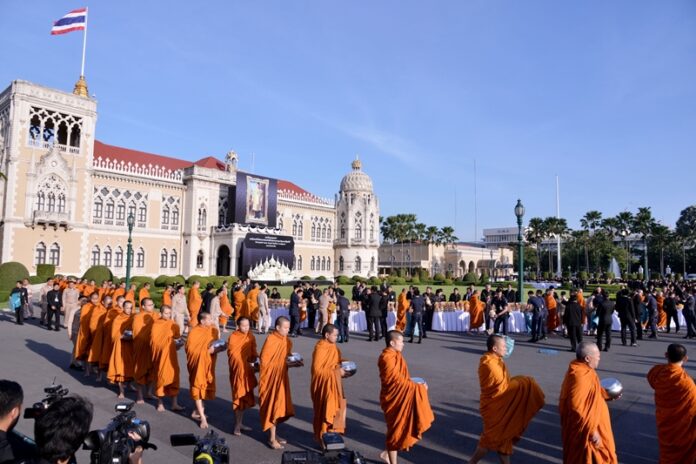
Monks gather alms at Government House on Dec. 1, 2016, during a Buddhist ceremomy to make merit for the late King Bhumibol.
BANGKOK — The deputy chairman of the junta on Saturday urged education officials to increase focus on religions in their teaching curriculum.
Education skill sets that lacked religious guidance risk being misused in corrupt manners, Gen. Prajin Jantong said at a seminar about religion and education at Parliament House. He’s the latest regime leader to make use of conservative rhetoric in the name of social cohesion under military rule.
“Religions and education are important and inseparable,” Gen. Prajin said. “So I would like to urge everyone and every relevant authority to develop our citizens to have both religions and education.”
The junta’s no. 2 was speaking at a panel organized by the regime’s rubber stamp parliament. He said a lack of morality and religion leads to corruption.
“Having only education to increase one’s knowledge, ability and talent is not enough,” he said. “Because they may use that knowledge in a wrong way and take advantage of other people, for example, engaging in corruption. So it necessary to also have religions.”
Thailand is overwhelmingly Buddhist, while Muslims, Hindus, Sikhs, Christians and other faiths comprise a minority. There’s also a small number of atheists and irreligious people.
Apart from a focus on religions, Prajin said schools should also teach their students to appreciate “Thainess.”
The junta routinely calls for morality campaigns to promote public order. Shortly after taking power in May 2014, junta chairman Prayuth Chan-ocha famously penned “Twelve Values” he wanted Thai children to follow.
Just last month, the general scoffed at an 18-year-old country singer for her signature twerking dance moves, saying they were against Thai culture.
Former Prime Minister Thaksin Shinawatra phoned his aides from Dubai to inquire about the result of 2011 general election in Thailand, 3 July 2011.
BANGKOK — A new legislation passed by the junta’s rubber stamp parliament could pave the way for former Prime Minister Thaksin Shinawatra to be tried on corruption charges in absentia, a senior official said Friday.
The bill, which was passed unanimously on Thursday, will allow the court to try political office holders on the run without requiring their presence. The deputy director of the Attorney General’s Office said it could be applied to Thaksin – whose corruption trial was suspended because he has fled the country.
“It could resume,” Khemchai Chutiwong told reporters when asked about Thaksin’s case. “But it does not mean this law would specifically target anyone.”
Thaksin, 67, fled Thailand shortly before the court convicted him of corruption in 2008. But there are still other corruption charges pending against him, including allegations he rigged regulations to favor his telecommunication firm in 2003. The trial has been put on hold by the court due to his absence.
But that may be changed with the passing of the bill on Thursday – which not a single member of the National Legislative Assembly voted against. It permits the court’s political office holders division to try fugitive defendants without needing their presence. The trial can be convened after the defendants have eluded capture for three months.
Under this legislation, the defendants can appoint lawyers to argue the case on their behalf.
Lawmakers said the bill is necessary to combat corruption and malfeasance in a timely manner. The bill is expected to be signed by the Cabinet at the end of the month.
Weng Tojirakarn, a former MP for the Thaksin-allied Pheu Thai Party, condemned the newly-drafted law as discriminatory against politicians.
“A law must be passed without discrimination,” Weng said by phone Friday. “This is already wrong. It specifically targets a certain group of people. It destroys the rule of law. So I don’t agree with it in this aspect. If they want to pass this law, it must be enforced to the entire country.”
Weng, a Redshirt leader, added that members of the junta and other bodies appointed by the regime should also be subject to this law.
It’s been 11 years since Thaksin was ousted in a Sept. 2006 coup, but he remains a divisive figure in Thailand. To his supporters he is a champion of the rural poor, while his critics see him as an elected autocrat who exploited populism for his own gain.
A former MP of the Democrat Party, which campaigned against Thaksin, praised the bill as a step toward better accountability.
“If we only use the usual Criminal Codes, we cannot hold influential politicians accountable,” Ongart Klampaiboon told reporters Friday.
“Therefore, this [law] would make politicians who think about engaging in corruption think harder. They can no longer use the money they got from corruption to live a luxurious life as a fugitive, because even if they flee, they can still be tried in their cases,” he added.
Nevertheless, Ongart said the law should also cover civil servants, and not only elected politicians.
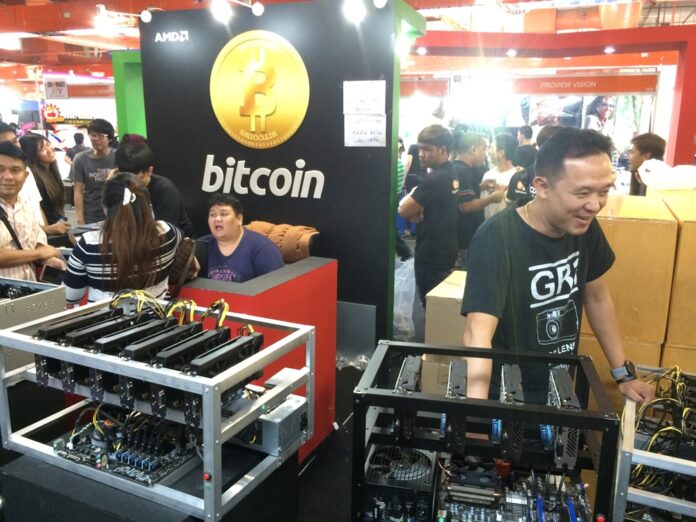
A booth selling equipment for mining cryptocurrency at Commart expo in Bangkok on June 22.
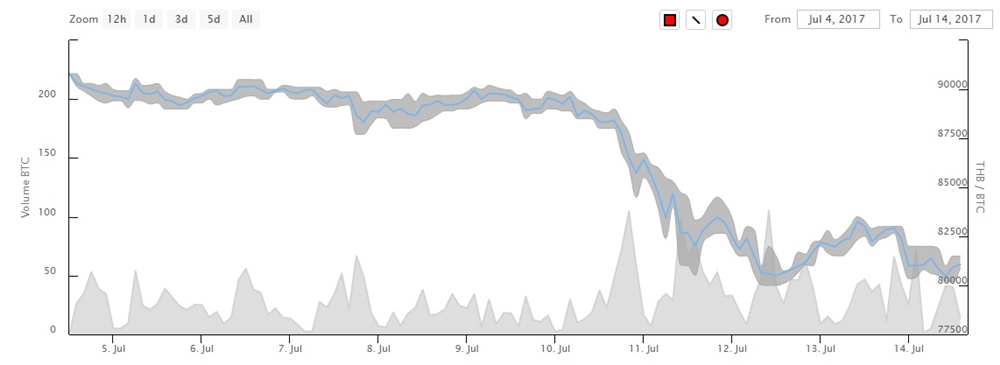
BANGKOK — A month ago, when it was trading at 96,000 baht per unit, bitcoin was the digital currency that launched a thousand geeks to snatch up equipment at a computer expo to “mine” it.
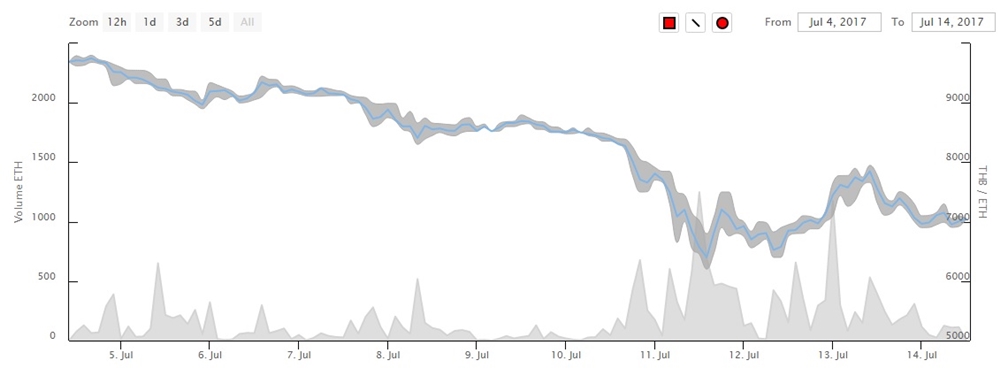
Since then, its value has steadily dropped, plummeting as low as 80,000 baht this week. Its decline has also dragged other major cryptocurrencies along with it. Ethereum – the second most popular cryptocurrency in Thailand – once traded at 13,000 baht. It fell to 9,100 baht last week before plunging to 6,400 baht by Tuesday.
Naturally, the tumble unnerves some miners.
“I just started mining three days ago, but now i’m starting to have doubt in my heart,” one user lamented in an online forum for cryptocurrency miners. “I should just deposit my 100,000 baht in the bank. I wouldn’t have to worry if I could get anything back from this 100,000 baht in the next 10 months.”
The user, Krisorn Wijky, wrote Monday that he only made 1,200 baht mining cryptocurrency for the last three days.
But despite the fluctuating value of the so-called cryptocoins in recent weeks, prospectors who profit from it in Thailand said they are still confident in their mining operation, while experts believe the shortfall is only temporary, and the technology behind it even has the potential to forever change the future of banking in the country.
“Every investment has its risks,” Bhume Bhumiratana, an IT consultant and observer of the cryptocurrency business, said Wednesday. “We can never look at it in a short term. It must go through ups and downs, stable and unstable. But personally, I believe in the long term it’s a technology that can benefit us.”
Although cryptocurrency has been around for some years now, its popularity only soared in Thailand toward May, when bitcoin skyrocketed and peaked at 100,000 baht per unit. The same month also saw the worldwide infection of a ransomware that demanded payment in bitcoin, further pushing its visibility into the mainstream.
Bitcoin is a household name and the most prominent cryptocurrency. Nearly half of the world’s cryptocoins are in bitcoin, and its market cap is estimated at USD$41 billion. But others such as ethereum, litecoin, zcash and ripple are also popular.
From Gold Rush to Gold Flush?
A number of Thais are profiting from the cryptocoin craze, either by speculating or mining it. The latter method involves processing and verifying financial transactions on an online distributed ledger known as blockchain.
By processing the information for a blockchain – similar to what clerks do for a bank – miners get rewards in cryptocurrency. The more their computers work, the more they receive, a process known colloquially as mining.
A growing number of Thais have begun mining these cryptocurrencies. In fact, certain computer components are out of stock nationwide because digital miners have hoarded them for cryptocurrency operations.
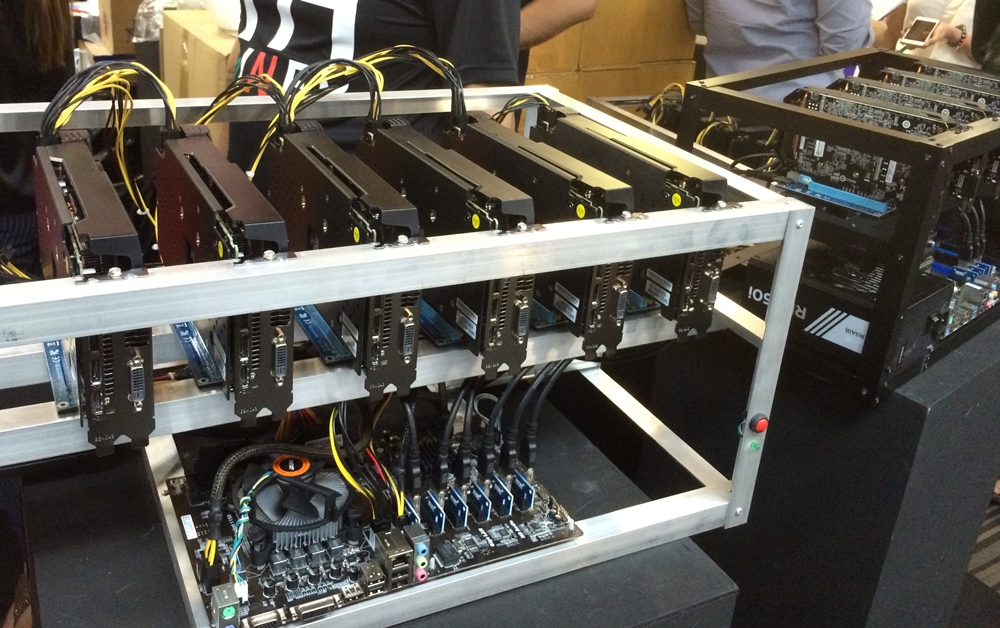
A typical rig for mining cryptocurrency consists of multiple graphic processing units, or GPUs.
They often converse on a Facebook group called BitCoin Thai Club, which has about 57,000 members. Despite its name, the community no longer mines bitcoin – the currency has become too difficult to mine due to technical limitations – but other types of cryptocurrency, chief among them is ethereum.
When ethereum took the plunge last week, some took to express their fear and regret on the online forum.
“Fun time is over,” one user wrote in response to the news.
Another user took it to another level by venting out his frustration in a poem.
“Two months ago, the old days, we were joyful; walking with smiles, arrogant, shoving others in our way; two months later, the days come, time changes, the slump is here,” Kasamapat Vithanwattana wrote.
There are causes for concern. Equipment for cryptocurrency mining costs a lot of money. A single computer rig for effective mining can cost from 60,000 baht to 100,000 baht. To maximize profits, the more rigs the better. Bhume, the tech expert, said he knows someone who’s put in a million baht into hardware.
Bitcoin value in baht for 10 days ending Friday. Image: http://bx.in.thEthereum value in baht for 10 days ending Friday. Image: http://bx.in.th
In an interview, the owner of a major computer parts vendor said he’s worried that the cryptocurrency price may go down to a level where miners abandon their operation and sell their equipment, flooding the market.
“The prices would be smashed,” said Somyot Chaowalit, who runs a firm called Jib.
Keep Calm and Dig On
However, the decline of ethereum and bitcoin values does not necessarily mean a “bubble burst” is coming, experts said. A bumpy graph is in fact the very character of cryptocurrency, they said.
“For me, the crash is part of its volatile nature,” Jittakorn Saengwisuth, a finance columnist who writes about cryptocurrency, said in a recent phone interview. “Bitcoin has suffered 100 percent loss before. Ethereum has suffered 1,000 percent loss before. But some people have also made themselves millionaires.”
Bhume, the consultant for G-Able Co. Ltd., said the ongoing drop in value of bitcoin and other major cryptocoins isn’t a big deal in the world of digital currency.
“I wouldn’t call it a bad decision to invest [in cryptocurrency]. I would not say that,” Bhume said. “It still has a chance to swing up. It’s only gone down by 20 percent. I look at things in the long term.”
Digital miners interviewed for this story also said they remain upbeat. One of them, Chitpol Wisutjai, said he used to make about 500 to 600 baht daily mining ethereum, but now it’s down to between 200 and 400 baht per day. Nevertheless, he pledged to keep digging.
“I’m not worried because I have traded many types [of cryptocurrency],” Chitpol wrote in a message.
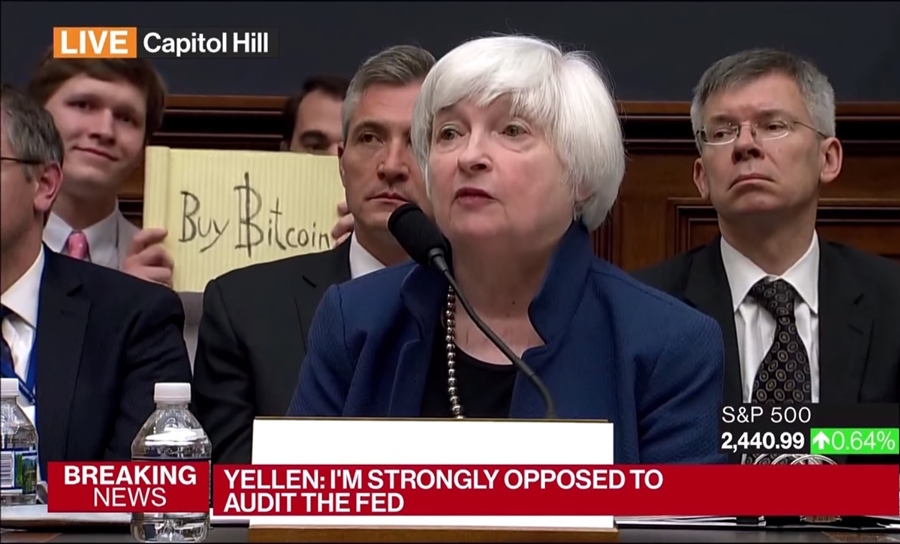
An unidentified man holds up a sign while United States Federal Reserve chairwoman Janet Yellen testifies to the Congress on July 12. Image: CNBC
Another miner, Supawich Pattanee, said he currently makes about 1,800 baht every day (after taking into account the electricity bill) mining three types of cryptocoin: ethereum, zcash and siacoin. He said he used to make as much as 3,000 baht at the peak of ethereum.
In an online chat, he said he’d been mining cryptocurrency for a year and that he’d recouped his investment since early this year.
“I have a bit of worry, but I still think it’s small issue,” Supawich when asked about his thought on the recent slump. “I’ve been through a period duing which I gained so much less, about 200 to 300 baht per day.”
Aekarad Borisut, who currently mines zec, would not disclose how much he makes but said he was satisfied with the yield so far.
“It’s been okay. So okay that equipment is in shortage worldwide,” Aekarad said in an online message.
King of Coins
Their confidence is partly bolstered by the conviction that if bitcoin or ethereum’s value collapsed, they could simply move to other emerging currencies.
“A crash means over 50 percent of miners stop mining, which I think is improbable,” miner Supawich said. “If by a crash you mean a drastic fall in value, which I think is possible, there are still many other cryptocurrencies waiting for me.”
Jittakorn, the columnist, said other cryptocurrencies, such as ethereum, are already competing to replace bitcoin as the new kid in town.
“Suppose there’s a crash, the confidence could transfer to other cryptocoins. They may gain their own market share. They’re competing already,” said Jittakorn, who also works as an investment consultant. “People can switch to other cryptocoins, but do other types hold as much credibility as bitcoin? That’s yet to be seen.”
Image: Lim Lao-ngow Bistro
As of Friday afternoon, values of bitcoin and ethereum had shot up slightly to rest at 81,000 baht and 7,000 baht, respectively.
Bitcoin undoubtedly remains the most important key player in the business, as evident in its ability to influence other cryptocurrencies. When its value goes up, so do many others, and the same is true when it goes down.
“Bitcoin is the most important currency, with the most investment,” Bhume said. “When bitcoin goes down, others go down.”
In fact, the latest plunge across cryptocoins is solely due to bitcoin as the currency goes through infighting between two factions over what changes should be implemented to it in order to speed up its transaction time. Decisions must be made within Aug. 1 – or the currency risks being split up in two.
Because of uncertainty over its fate, some bitcoin holders sold it, causing widespread panic in the market and driving down its value, Bhume said.
What’s Next for Cryptocurrency?
While it is a growing trend, cryptocurrency is still considered a fringe business in Thailand, a society that still largely relies on cash. In fact, Thailand became one of the first countries to officially denounce bitcoin back in 2013, when the Bank of Thailand pre-emptively declared the digital currency was not a sanctioned means of payment.
However, finance minister Somkid Jatusripitak urged the Bank of Thailand to reconsider its stance and study whether bitcoin could become an accepted payment tender.
In a speech June 14, he also said officials should learn from the fintech revolution – which gave birth to online financial institutions that bypass traditional banking – such as blockchain and cryptocurrencies.
Columnist Jittakorn said the technology is here to stay, regardless of what happens to bitcoin’s value, because it allows people to do banking without the usual hassle of banks.
“Bitcoin is merely a fraction of blockchain technology. Every bank around the world is watching it closely,” Jittakorn said. “Because it disrupts private banking. For example, when you transfer money, it’s become easy, and there is barely a fee. The banks are losing income.”
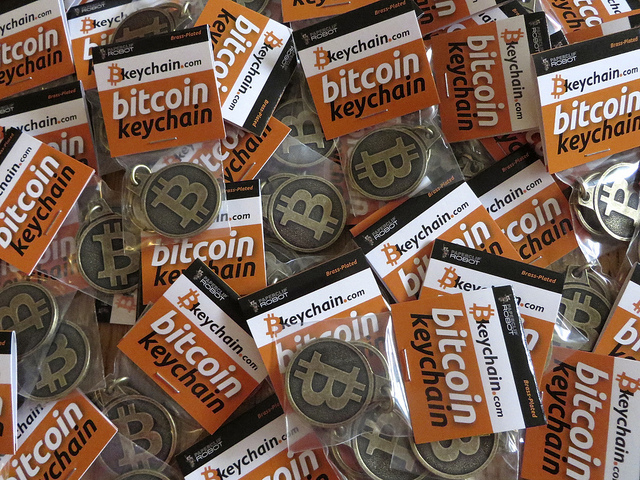
Image: BTC Keychain / Flickr
“It will be a long time before we accept this kind of thing. Thai people have many rules and regulations … but if private businesses start to accept it, the state may step in and take care of it. It’s possible,” he added.
The potential of blockchain technology also extends far beyond banking, Bhume the IT consultant said. By having hundreds of individuals storing and verifying information instead of relying on a single source, large scale businesses can make sure their ledger is tamper-proof.
“Using blockchain prevents fraud because it spread out the data,” Bhume said. “The potential to change the things we do is enormous.”
The United Nations is already reportedly using blockchain to pay for food and other necessary supplies for millions of refugees in the Middle East.
The number of restaurants and bars in Thailand which accept cryptocurrency is increasing. They include a bar in Pattaya, a noodles vendor in Bangkok’s Chinatown and a craft beer brewery in Nonthaburi.
Haeman Suchaleaw, 26 and Srisamon Lapluea, 34 are captured by the security camera while they are stealing fish from a concrete pond on June 24 in Bangkok’s Ladprao district.
BANGKOK — A couple confessed Friday to the theft of 25 fish in two stints – four on one occasion and 21 on the other – last month because they were hungry.
Haeman Suchaleaw, 26 and Srisamon Lapluea, 34 were charged with larceny and brought to apologize to the owner of the nishikigoi, or koi, carps they stole and subsequently ate. The two admitted being among three suspects captured in the security camera footage which shows them taking dozens of fish from a concrete pond at 00:53am on June 24 in front of a shophouse in Soi Ladprao 101.
“We were walking around to sell keychains,” said Haeman. “It was raining so we stopped to shelter ourselves there. We found them. We didn’t have anything to eat so we took them.”
The two said in tears that they grilled the koi fish and ate them with sticky rice.
Rawadee Kietkamchornpattana, 44, said she found out at about 8am on the same day when she went to feed the fish as usual. The owner said it is not about the price but the sentimental value, as she had kept them for more than 10 years.
The 21 fish from Rawadee’s pond stolen on June 24 were 20 Japanese carps and a Nile tilapia.
Another suspect, identified only as Jack, remains at large.
The couple confessed they had stolen four koi fish on June 21 from a pond in front of Promedia and Organizer company on Sukhonthasawat Road, also in Ladprao district.
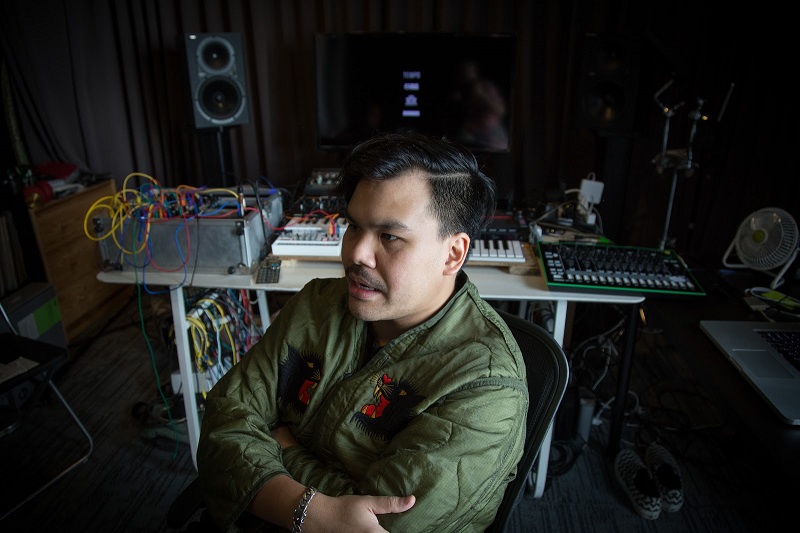
It seems as if every producer or DJ is dabbling with techno nowadays. But in the case of Bangkok drum n’ bass veteran DJ King Kong, or Kritsada Vadeesirisak, transitioning from that genre to techno came naturally after spending hours experimenting and tweaking sounds on his hardware synthesizers.
I witnessed this first hand, dropping in on one of his rehearsals at his recording studio on a monday afternoon.
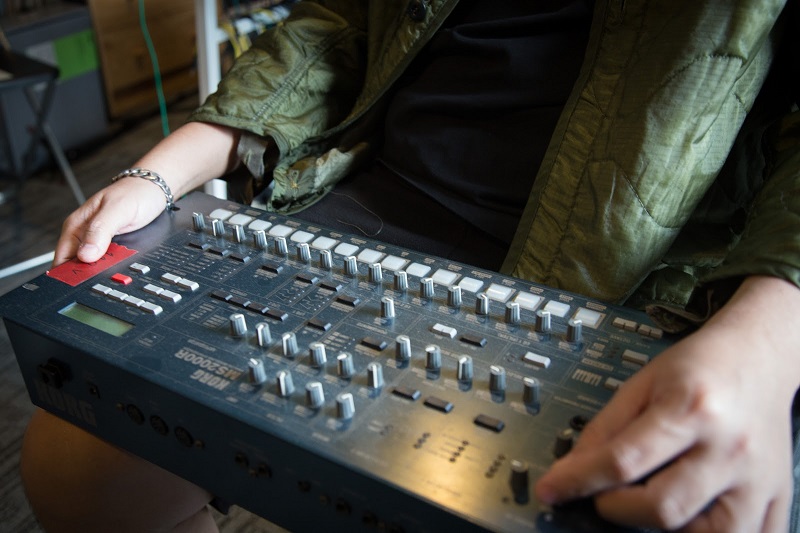
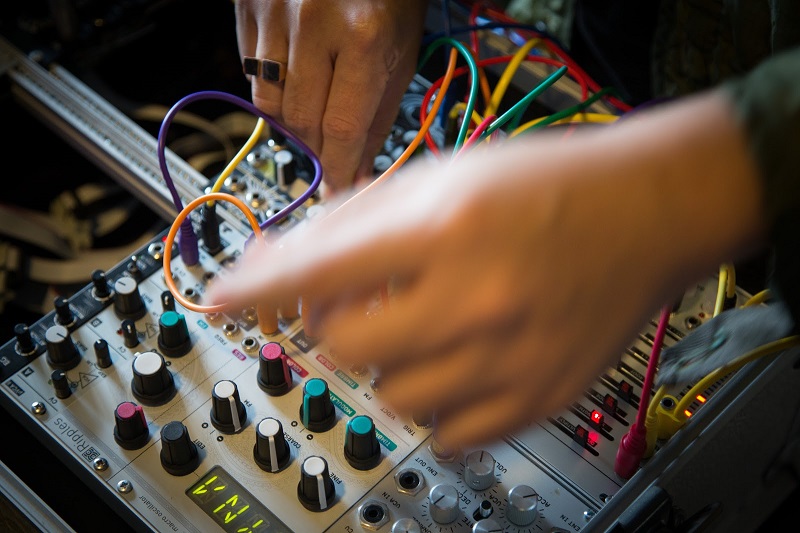
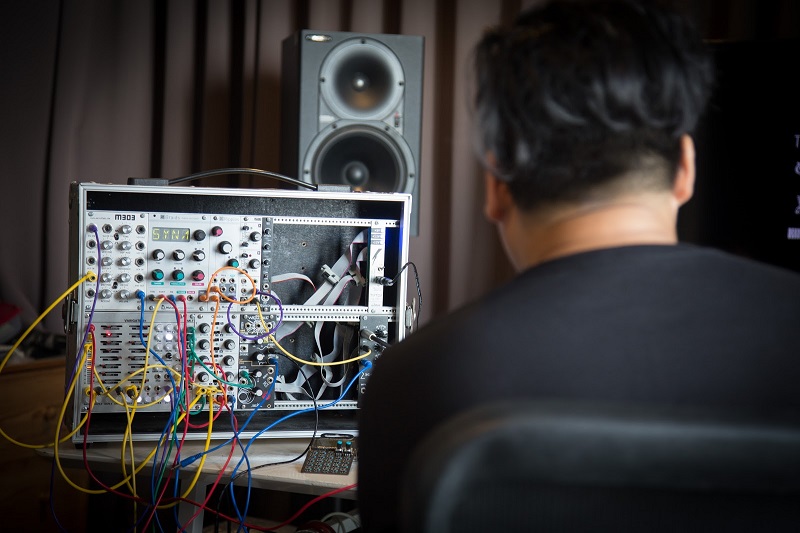
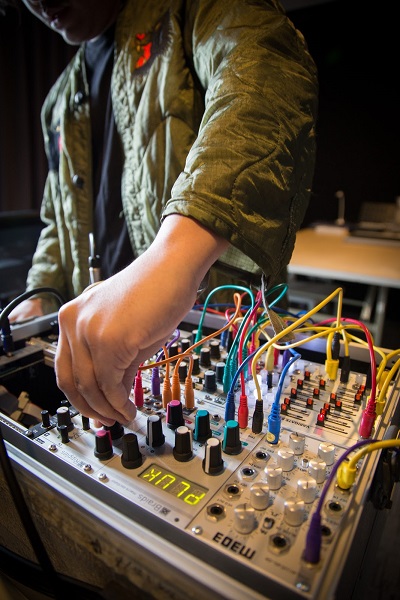
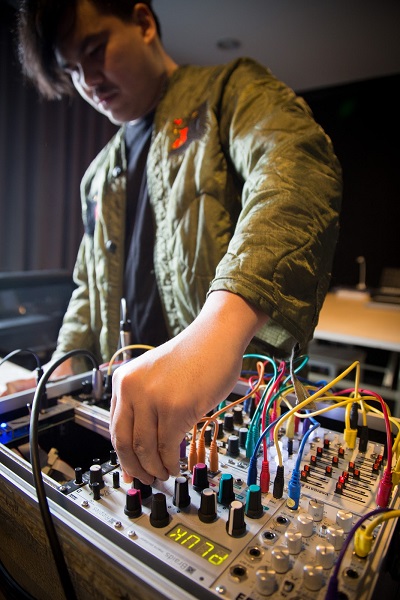
Inside the studio sequencers, drum machines and effects units are laid out on a desk. The heart of the setup is his modular synthesizer, a big metal box that looks similar to something from a science lab. Inside the box are filters, oscillators and tone generators connected together by an array of cables. Kritsada hovers above the machines improvising melodies on the keyboard, dropping drum loops and tweaking robotic bleeps by turning knobs and pressing various blinking buttons.
After the demonstration he turns down the music and says “it’s all about improvisation.”
“I was inspired by [Bulgarian DJ] Kink’s live sets, so I bought a drum machine and sequencer and had a lot of fun jamming with them,” Kritsada said smiling.
Before producing techno, Kritsada earned props in the scene as the frontman of Thai drum n’ bass band Animal Machine. He also produces music which he releases from his own label Zoo Studio, which he started in 2009.
He came up with his latest project “Marmosets” two years ago and focuses on producing and performing techno – which in April of this year saw him performing for the first time in Amsterdam and Berlin. So far Kritsada has released two tracks. One of them is a collaboration with Phuket’s house don Q Narongwate on Italian label SunClock. His second release saw the producer flipping the script on Netflix’s Stranger Things theme song and turning it into a dancefloor stormer.
“I’m a huge fan of Stanger Things, and I thought I’d remix the theme song because it sounds kinda cool, Mixmag heard it and decided to share it on their soundcloud,” Kritsada said.
I asked him if he’s ever going to get back to producing drum n’ bass music.
“I do want to get back to releasing drum n’ bass, but this year I want to focus on finishing my techno EP first” he said, referring to a project which he plans to release later this year.
On Saturday, Kritsada will ditch the turntables and bring his set up of synthesizers, sequencers and effects to perform at Kolour Live. Joining in the lineup are DangerDisko from Kuala Lumpur, Peking opera and Slum Disco Soundsystem.
Tickets are 750 baht at the door and include two beers. Doors open at 3pm at Quaint Bangkok on Sukhumvit Soi 61, which can be reached via a 10 minute walk from BTS Ekkamai.
BANGKOK — It’s a chance for ardent beer and cider fans to savor award-winning drinks imported from New Zealand.
For two nights, both joints of craft beer bar Craft will celebrate New Zealand’s beverages with a selection of eight taps of beer and cider – four varieties of 8 Wired beers and Zeffer ciders.
Fresh from winning the the International Cider Awards in March, Auckland-based Zeffer will be served in four flavors: Red Apple, Apple Crumble, Hopped and Ginger.
Microbrewery 8 Wired from the North Island will offer Hopwired IPA, Semiconductor Session IPA, Tall Poppy India Red Ale and the fruity Tropidelic IPA. The experimental brewery clinched first place in the Brewer Guild Awards in 2011.
The event will take place from 2pm until late on July 26 and July 27 at the two branches of Craft on Sukhumvit Soi 23 and at the Holiday Inn on Silom’s Surasak Road which can be reached by BTS Asok and BTS Surasak respectively.
Nate Bartling points to a state train he will use to flatten coins. Image: Darkside Social / Facebook
BANGKOK — A recent video of a controversial American YouTuber known as My Mate Nate flattening coins on train tracks drew criticism Friday for the hazards it involved.
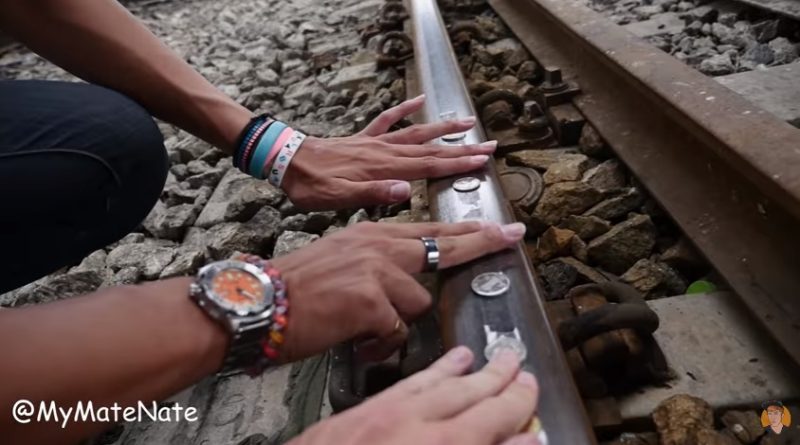
Footage of Nathan Bartling, 23 – an American YouTuber with more than 3 million subscribers who makes videos in Thai – in which he is seen trying to flatten coins by taping them to train tracks was criticized Friday by the state railway authority and netizens for being dangerous. A police summons for Bartling for a previous YouTube stunt in which he is seen pitting his cats against a scorpion is also pending.
State railway Gov. Anont Luangboriboon said Friday by phone that he had not yet seen the video, but added that obstructing rail tracks with objects is illegal and could end up derailing trains.
“Doing this is definitely wrong. Although [it] depends on the width of the tracks and the type of train wheel involved, there is still a chance of the trail derailing,” Anont said.
After a storm of online criticism, Barling posted on Facebook that he had done research on the possibility of a derailment before he shot the video.
“From what we have learned, coins cannot derail trains, because they are flat objects, and are made of material that’s softer than train wheels and tracks,” Bartling wrote in Thai.
He added that no Thai coins were used.
Nonetheless, Bartling said he had removed the video because of the controversy it generated.
According to the Thai Criminal Code Article 230, obstructing railways or tramways with obstacles in a manner which can cause danger to the operation of trains can be punished with six months to seven years in prison and a fine of 1,000 baht to 140,000 baht.
State Railway deputy director Thanongsak Pongpraset likewise chastised Bartling’s latest stunt.
“His actions are definitely inappropriate,” Thanongsak told reporters. “If his actions lead to a train derailing, he will be charged with both civil and criminal punishments. If he damages any trains, he will have to pay damages to state railway.”
Although the video has since been deleted from Bartling’s channel, copies of it exist on social media.
Thai Train Story, a Facebook page dedicated to trains, also criticized Bartling for his actions.
Bartling looks on as a train rushes by in his video. Image: Darkside Social / Facebook
“Nate, I’d like to warn you as a fellow social content producer… putting metal objects or stones on train tracks can cause the train to derail. Even if it doesn’t happen immediately, but the wheels can get damaged from it,” wrote the administrator in a post Friday. “Putting coins at some angles on the rails can cause them to fly into the train and injure passengers.”
The post added that the YouTuber’s pranks were “getting out of hand.”
“You have a lot of followers and many followers look up to you, and not all of them can analyze and differentiate. I support your good videos, but I have to criticize ones where you did wrong,” it wrote.
It’s not the first time that Bartling – known by his YouTube handle “My Mate Nate” – has irked Thais with his antics. In June, animal lovers filed an animal cruelty complaint about him to the police over a video in which he is seen confronting his cat against a scorpion. Police said they have summoned him for questioning over the matter.
“Don’t berate My Mate Nate too much,” tweeted Adam Bradshaw, a television personality and English teacher tweeted Friday. “How can his fans defend him? Primary school isn’t out yet.”
Bartling and his friends put coins onto train tracks. Image: Darkside Social / FacebookBartling and his friends hold coins to tape them to train tracks. Image: Darkside Social / FacebookBartling tapes coins to train tracks in his video. Image: Darkside Social / FacebookBartling holds up a flattened coin in his video. Image: Darkside Social / Facebook
Rescue workers carry the body of Suding Mamah, 29, after he was shot dead Wednesday during a raid by military officers in Pattani province.
PATTANI — A man was shot dead Wednesday after a confrontation between soldiers and a group of armed suspects, while two witnesses remained under custody as of Thursday evening.
Army officers shot a man dead and arrested another two at 2am on Wednesday during a raid on a house in Pattani they suspected was inhabited by insurgents plotting an attack, while two other suspects fled the scene.
The two men, Paoyee Tasamoh, 44 and Abdullah Jaemah, 70 were aprehended and taken for questioning, a local intelligence officer said. As of Thursday evening, the pair remained in detention at the Ingkhayut military base under the power of martial law – which allows the military to detain people up to seven days without charge.
Martial law is exclusively implemented in the Deep South, including Pattani province.
“The questioning could not be done right there. It has its process so we had to take them into custody,” said Sgt. Maj. 3rd Class Piyawat Tritrong on Thursday. “They will be released once officers get information.”
Piyawat said he believed the two men should be able to provide useful information as one of them is the owner of the house where the group met.
The early-morning raid was conducted after an informant reported there would be a gathering of insurgents in the area to plan an attack. When police arrived at the house behind Kahong Masjid, they found a group of three men sitting in front of it.
As they were fleeing into the jungle behind the house after spotting officers, one of the men allegedly fired three shots at soldiers. Officer then fired back, resulting in the death of Suding Mamah, a 29-year-old Pattani native, said Piyawat.
Piyawat said officers believed Suding had a link to the car bombing in front of Big C shopping center– which injured at least 61 people in May – because his motorcycle, left at the scene, appeared to be similar to the one on which the perpetrator hopped after parking the car.