






























30 C
Bangkok
Saturday, June 20, 2026
Home Blog Page 2298

Student Freed by N Korea Dies After Year in Coma

CINCINNATI — Otto Warmbier, an American college student who was released by North Korea in a coma last week after almost a year and a half in captivity, died Monday, his family said.

The 22-year-old “has completed his journey home,” relatives said in a statement. They did not cite a specific cause of death.

“Unfortunately, the awful, torturous mistreatment our son received at the hands of the North Koreans ensured that no other outcome was possible beyond the sad one we experienced today,” his parents said.

Doctors had described his condition as a state of “unresponsive wakefulness” and said he suffered a “severe neurological injury” of unknown cause.

His father, Fred Warmbier, said last week that he believed Otto had been fighting for months to stay alive to return to his family. The family said he looked uncomfortable and anguished after arriving June 13 but his countenance later changed.

“He was peace. He was home, and we believe he could sense that,” they said.

Warmbier was accused of trying to steal a propaganda banner while visiting with a tour group and was convicted of subversion. He was put before North Korean officials and journalists for a televised “confession.”

“I have made the worst mistake of my life!” he exclaimed, choking up as he begged to be allowed to reunite with his parents and two younger siblings.

He was sentenced to 15 years in prison with hard labor.

The University of Virginia student was held for more than 17 months. His family said it was told he had been a coma since soon after his March 2016 sentencing.

Doctors said he suffered extensive loss of brain tissue and “profound weakness and contraction” of his muscles, arms and legs. His eyes opened and blinked but without any sign that he understood verbal commands or his surroundings.

Unresponsive wakefulness is a new medical term for persistent vegetative state. Patients in this condition who have survived a coma can open their eyes, but they do not respond to commands. People can live in a state of unresponsive wakefulness for many years with the chances of recovery depending on the extent of the brain injury.

North Korea said Warmbier went into a coma after contracting botulism and taking a sleeping pill. Doctors in Cincinnati said they found no active sign of botulism or evidence of beatings.

His parents told The Associated Press the day of his release that they wanted “the world to know how we and our son have been brutalized and terrorized by the pariah regime.”

Fred Warmbier praised his son’s “performance” and President Donald Trump’s administration. He was critical of the approach to his son’s situation taken by former President Barack Obama’s administration.

In a White House statement, Trump said, “A lot of bad things happened, but at least we got him home to be with his parents.” He called North Korea a “brutal regime.”

Secretary of State Rex Tillerson said he offered his prayers as Warmbier’s parents “enter a time of grief no parent should ever know,” and U.S. Ambassador to the United Nations Nikki Haley said Warmbier’s death “touches the American heart like no other.”

The younger Warmbier grew up in the Cincinnati suburb of Wyoming. He was salutatorian of his 2013 class at a highly rated high school and was on the soccer team. He had had planned to study in China in his third year of college and heard about Chinese travel companies offering trips to North Korea.

Young Pioneer Tours described itself as providing “budget tours to destinations your mother would rather you stayed away from.” Its travel options also included Iran, Iraq and former Soviet countries.

Warmbier was leaving North Korea on Jan. 2, 2016, when he was detained at the airport.

The U.S. Department of State warns against travel to North Korea. While nearly all Americans who have been there have left without incident, visitors can be seized and face lengthy incarceration for what might seem like minor infractions.

Jeffrey Fowle, also from Ohio, was detained in 2014 when he intentionally left a Bible in a nightclub. Fowle was freed after six months. He said he was kept isolated most of the time but not physically abused. He and others freed from North Korea have said they were coached and coerced into giving confessions.

Three Americans remain held in North Korea. The U.S. government accuses North Korea of using such detainees as political pawns. North Korea accuses Washington and South Korea of sending spies to overthrow its government.

At the time of Warmbier’s release, a White House official said Joseph Yun, the U.S. envoy on North Korea, had met with North Korean foreign ministry representatives in Norway the previous month. Such direct consultations between the two governments are rare because they do not have formal diplomatic relations.

Yun learned about Warmbier’s condition in a meeting a week before the release from the North Korean ambassador at the U.N. in New York. Yun then was dispatched to North Korea and visited Warmbier June 12 with two doctors and demanded his release on humanitarian grounds.

Warmbier’s hometown rallied around his family, wrapping school-color ribbons around trees and utility poles lining Wyoming’s main road. People chanted “Otto Strong!” and “We love you!” after his father’s news conference last week at the high school.

Warmbier was “generous, outgoing, sweet, smart as a whip, just an overall good guy,” Danica White, his sophomore English teacher, recalled last week.

On Monday evening, she said: “Otto will be dearly missed.”

Story: Dan Sewell
Advertisement

Drawn-Out Goodbyes Made to Vanishing Bangkok

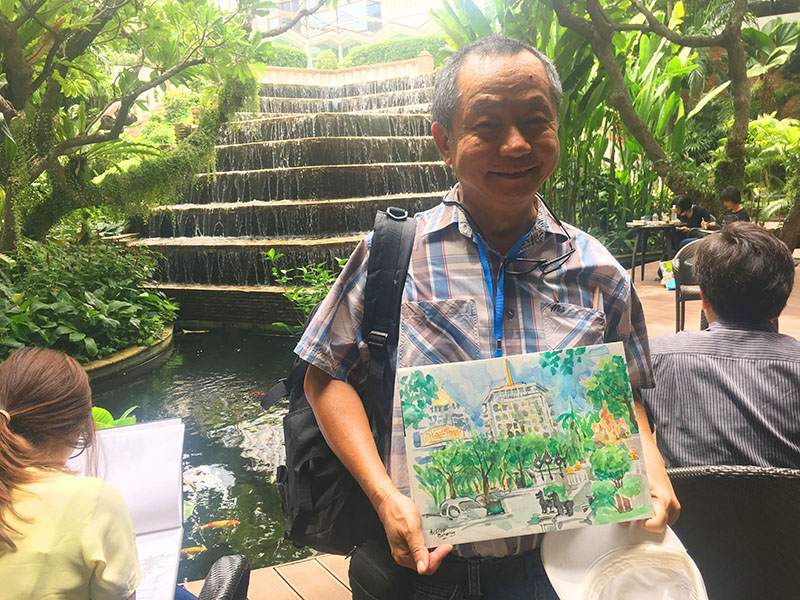
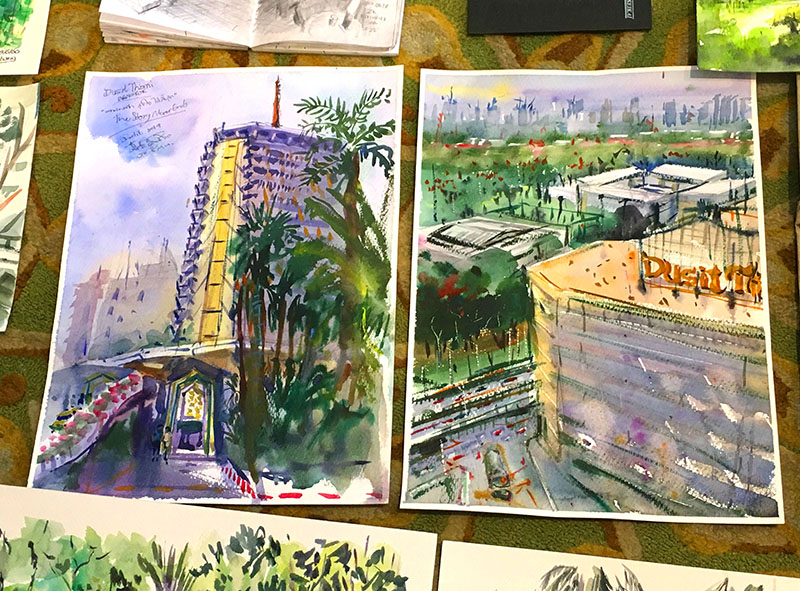
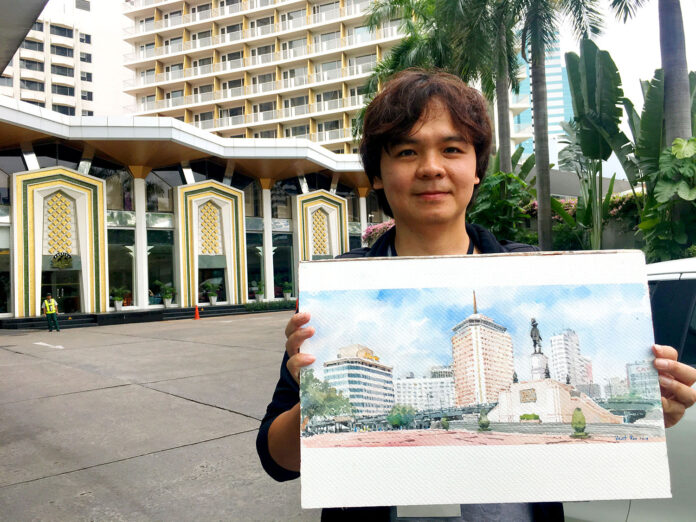
Vamont Ruksiriphong of Bangkok Sketchers shows off his watercolor of the Dusit Thani Hotel at the hotel on Sunday. Bangkok Sketchers, a group of artists who sketch sights around Bangkok, gathered to sketch at the 1970s-era hotel before its demolition in March 2018. Read: Drawn-Out Goodbyes Made to Vanishing Bangkok

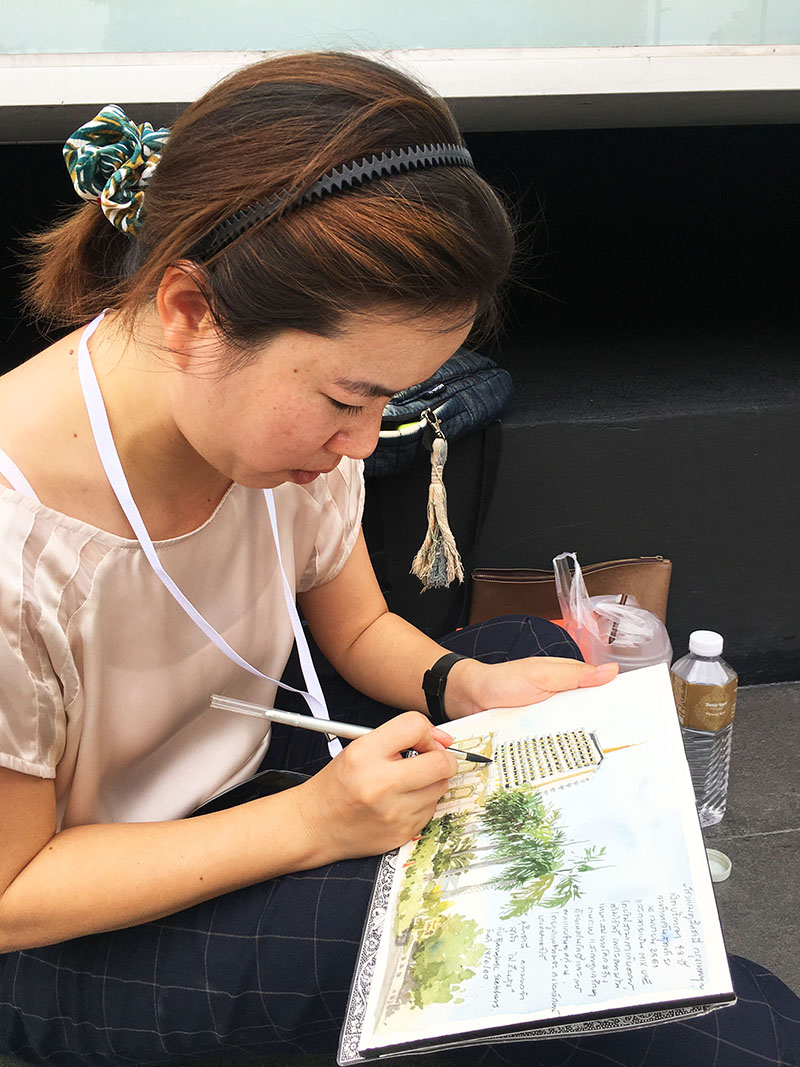
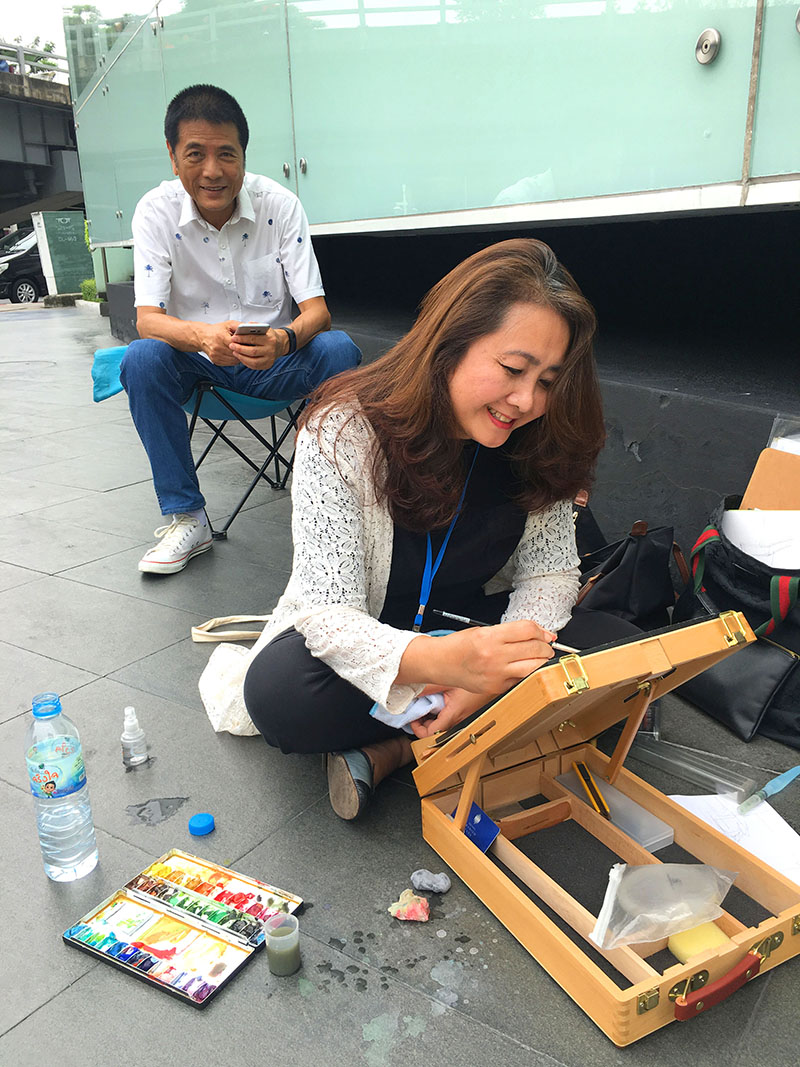
BANGKOK — Artists with a passion for the city gathered at the Dusit Thani Hotel on Sunday to commit its unique example of Thai modernism to their canvases Sunday before it is razed.

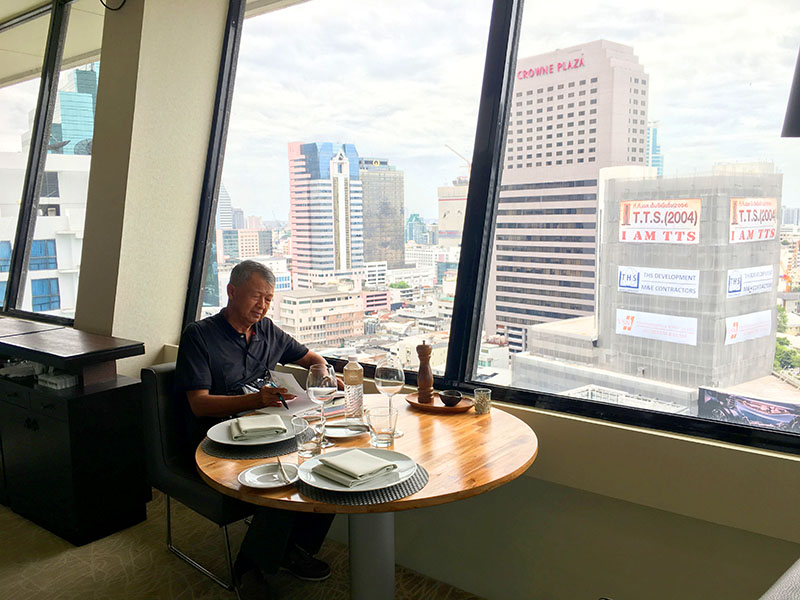
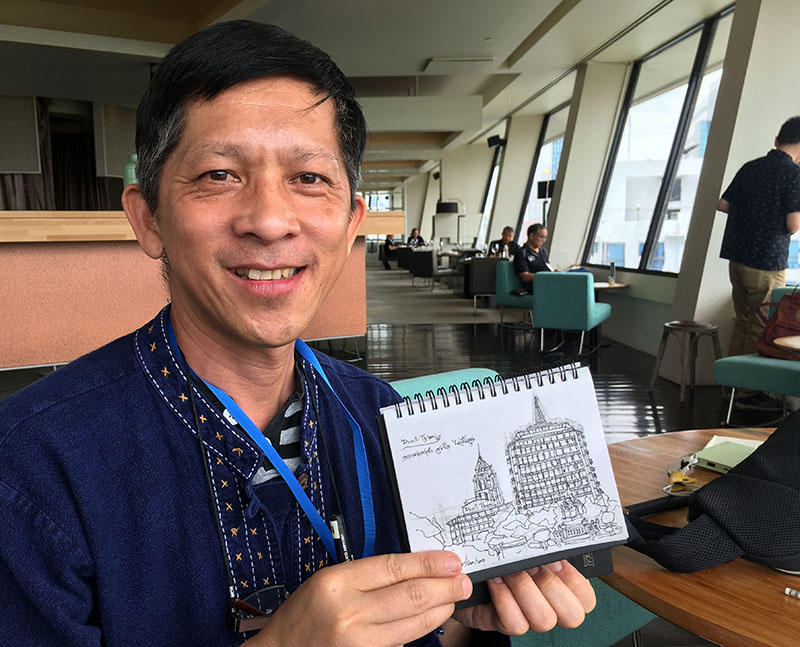
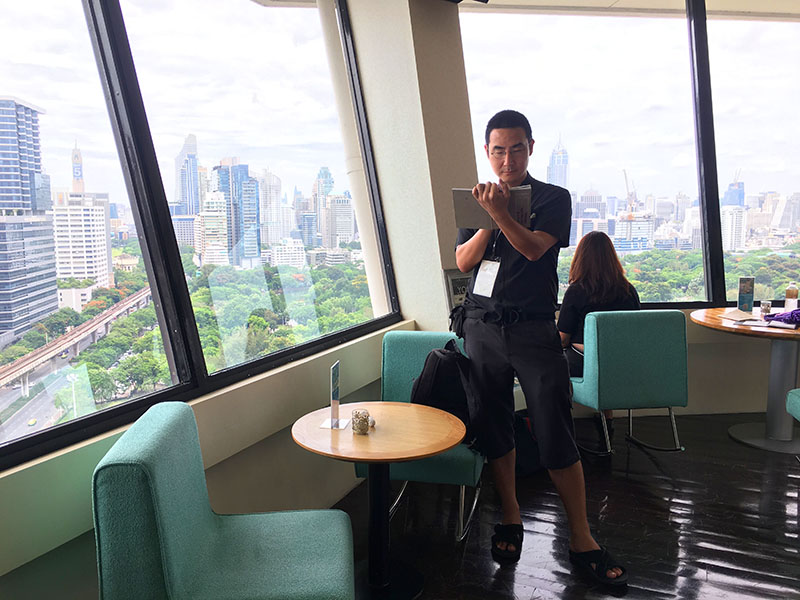
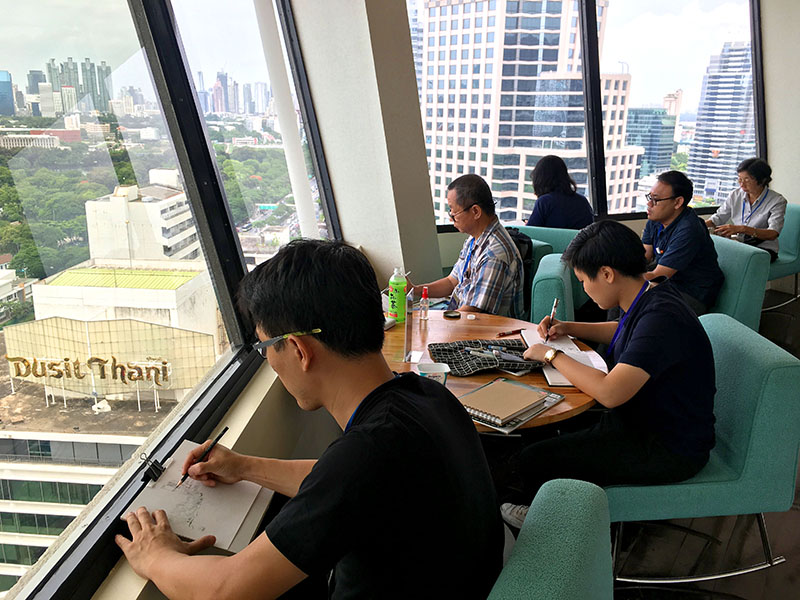
Some gathered across the street at Lumphini Park to get a good view, while others lounged around the terraced waterfall and sprawling plumeria tree in the hotel’s Benjarong Terrace. Still, others ascended to the hotel’s 22nd floor skybar to ruminate nostalgically about the hotel’s golden years in the 1970s and sketch the skyline.

“You can’t always keep old things but you can draw them,” said Pitirat Yoswattana, a 38-year-old member of Bangkok Sketchers. “We want to record parts of the city that are disappearing that we think are important, such as the Pom Mahakan community.”

Read: Bangkok’s Dusit Thani Hotel Gets Date With Wrecking Ball

After 48 years, the iconic hotel will close in March for demolition and remaking into a mixed-use property offering condos, shopping, green space and a new hotel. The hotel will reopen in 2022, according to Sukanya Janchoo, Dusit Thani general manager.

Once the tallest building in Thailand, the Dusit Thani has received foreign dignitaries and celebrities such as Margaret Thatcher, Frances Yip and Johnny Tillotson since its 1970 opening.

Read: Artists Invade Bangkok’s Swankiest Hotel (Video)

IMG 3112
Pitirat Yoswattana, 38.

“At that time Bangkok had few hotels and discotheques, and we had one of the first luxury ones,” Sukanya said. “I’m glad the sketchers are here to relive their memory of this place.”

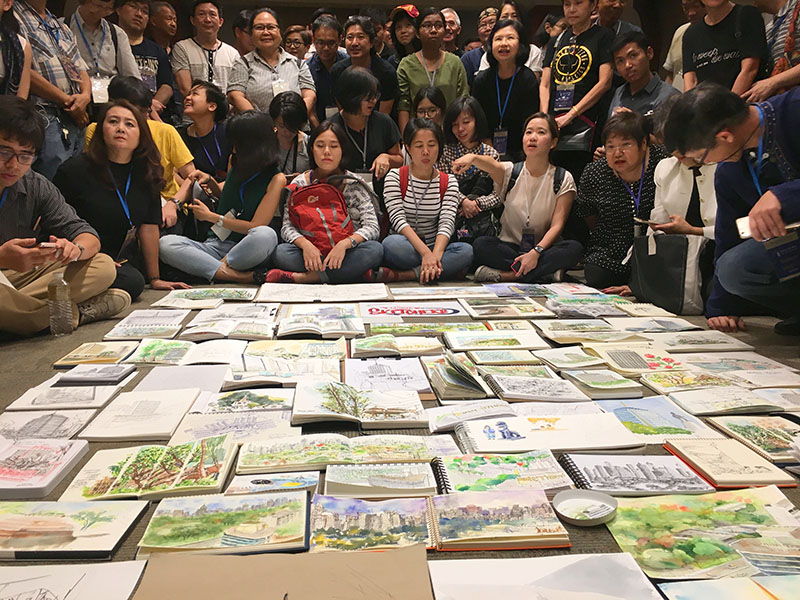
The artists there Sunday ranged from their early 20s to late 70s. They gather monthly to sketch various landmarks around the capital.

Pitirat said all are welcome to the events organized via Facebook.

“We’re a group that draws for happiness. You don’t need to be an artist with technical skills to join,” she said.

IMG 3135
Puchnong Saksureemongkol, 62, said the hotel’s impending demolition was a pity. “I’m worried it won’t be the same afterward.”
IMG 3186
“When this place was just built, it was something that was new and awesome in Bangkok,” Decha Charoenchai, 66, said. “You can see the greenness of Lumphini Park from here. Although most of the skyline has changed, the spirit is still the same. When I’m emotionally bound to a place in Bangkok, it becomes important to me.”
IMG 3217
“This hotel has always been a symbol of Bangkok to me. In Thairat cartoons of Bangkok, this would be part of the drawings,” Rangsan Nilprapa, 51, native of Phayao province said. “I’ve never had the courage to come in here before, since it’s a fancy hotel for rich people. Even today, I didn’t want to park in the hotel. I’m happy that at least once I get to come inside.”
IMG 3190
“This hotel is really important to my parents’ generation. I’ve only been here for a wedding or two, but I’ve checked in since last night so I can see what the hotel is really like,” said Kwin Krisadaphong, 40. “I’m glad the older people in our sketching group will get to draw it.”
IMG 3146
Muangmol Srithongthai, at center, said that the Dusit Thani reminds him of his days as an architecture student. “That was 20, 30 years ago. I would come draw here when I was a student. Even when I was drawing today, the building made me feel like a student again,” said the art teacher from Lampang province. “The building has be be improved; it makes commercial sense. But it will live on in photos, drawings and our memories.”
IMG 3229 e1497870058317
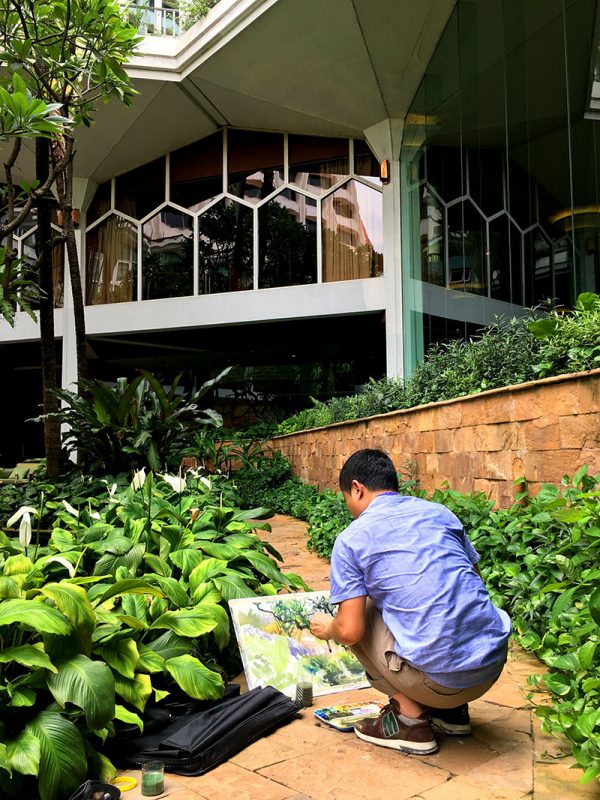
A Bangkok Sketchers member squats down to paint the Benjarong Terrace.
IMG 3239
Two young Bangkok Sketchers laugh as they ink the colors of the waterfall inside the Dusit Thani Hotel.

IMG 3104

IMG 3268
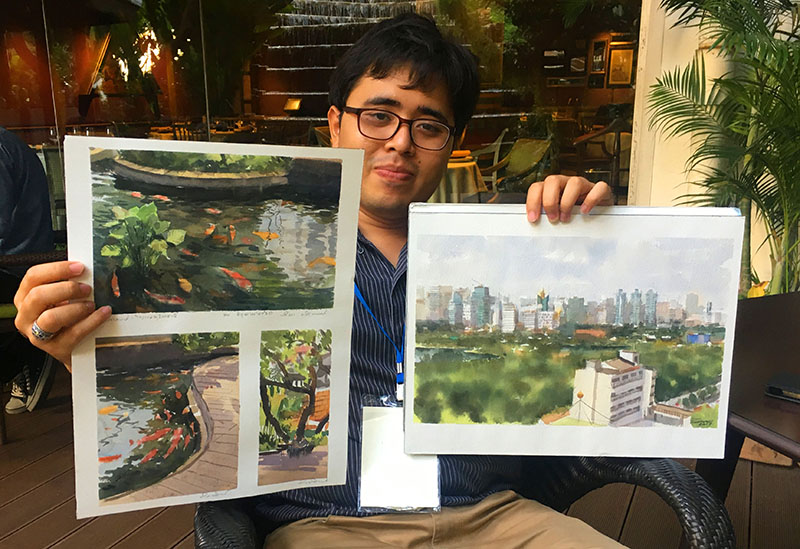
Tamra Chatikanon, 25, and his watercolors of the Dusit Thani Hotel’s Benjarong Terrace and skyline.
IMG 3269
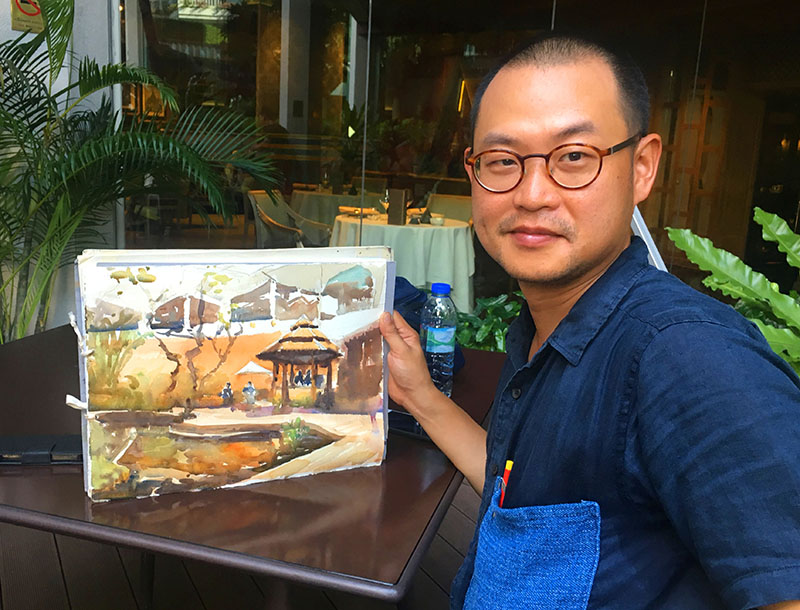
Yok Soonthornyankit, 38, displays his watercolor painting.
IMG 3133

Members of Bangkok Sketchers show off their sketches of the waterfall and pagoda inside Bangkok’s Dusit Thani Hotel.

IMG 3115

IMG 3172
Bangkok Sketchers lay out their sketches of the Dusit Thani Hotel on Sunday.
IMG 3156
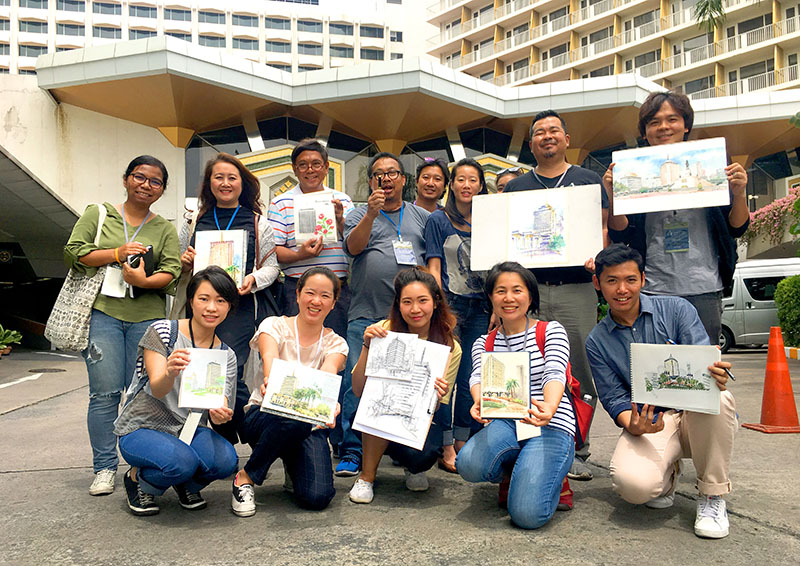
Bangkok Sketchers pose Sunday outside the Dusit Thani Hotel to show off their drawings of the hotel’s facade.

IMG 3180

IMG 3201
Sketchers diligently eke out the Bangkok skyline from the hotel’s 22nd floor bar.
IMG 3272
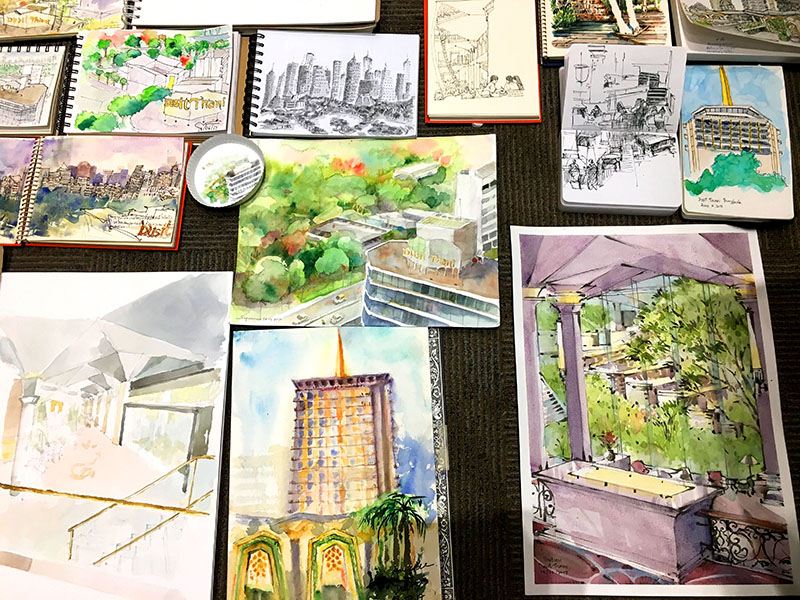
Some of the paintings by Bangkok Sketchers Sunday of Dusit Thani Hotel.
IMG 3280
Bangkok Sketchers and their paintings Sunday.

Related stories: 

Artists Invade Bangkok’s Swankiest Hotel (Video)

Bangkok’s Dusit Thani Hotel Gets Date With Wrecking Ball

Advertisement

79 Believed to Have Died in London High-Rise Fire

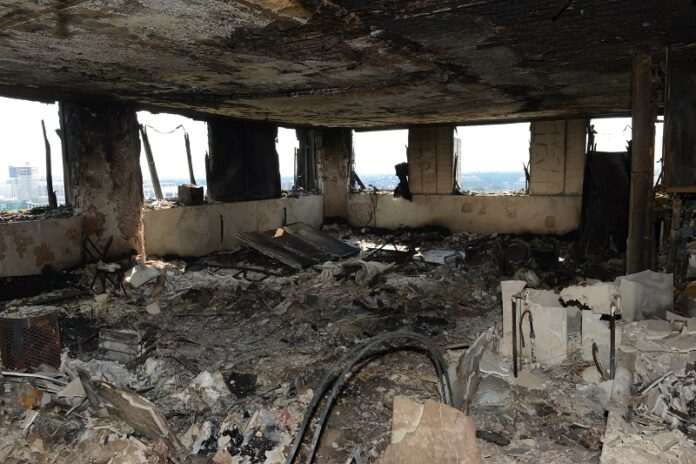
A photo released by the Metropolitan Police on Sunday showing a view of an apartment in the Grenfell Tower after fire engulfed the 24-storey building, in London. Photo: Metropolitan Police via Associated Press

LONDON — London police said Monday that 79 people were now believed to have died in the high-rise apartment building fire.

Police Commander Stuart Cundy gave the new figure during a statement outside Scotland Yard, saying it includes both people who were confirmed dead and others who are missing and presumed dead. It’s an increase from the previous number of 58.

The new total may change as the investigation continues, Cundy said. The search and recovery operation in the 24-story Grenfell Tower continues, he said, adding that it has been incredibly distressing for families.

“It’s hard to describe the devastation the fire has caused,” Cundy said, fighting back tears as he spoke.

He said it had been “incredibly emotional working in there … On Saturday, I went in myself and went to the top floor.”

Britain held a moment of silence for the victims on Monday, with emergency service workers bowing their heads in respect.

The fire ripped through the high-rise early Wednesday. Cundy told reporters the “awful reality” was that it might not be possible to identify all the victims.

He said that authorities were continuing to investigate whether any crimes had been committed in the inferno.

Two British officials have said that new exterior cladding used in a renovation of Grenfell Tower may have been banned under U.K. building regulations. Experts believe the new paneling, which contained insulation, helped spread the flames quickly up the outside of the public housing tower. Some said they had never seen a building fire advance so quickly.

Trade Minister Greg Hands said Sunday the government is carrying out an “urgent inspection” of the roughly 2,500 similar tower blocks across Britain to assess their safety, while an opposition lawmaker urged the government to quickly secure documents in the Grenfell renovation for the criminal investigation.

Late Sunday, the Metropolitan Police released three photos from inside Grenfell Tower, which showed in close detail how the fire charred the building that once housed up to 600 people in 120 apartments.

Frustration has been mounting in recent days as information about those still missing in the blaze has been scanty and efforts to find temporary housing for the hundreds of now-homeless tower residents have faltered.

British Prime Minister Theresa May, criticized shortly after the blaze for failing to meet with victims, says the public inquiry looking into the tragedy will report directly to her. She also says she will receive daily reports from the stricken neighborhood.

In addition, British health authorities will provide long-term bereavement counselling for those who lost loved ones in the tragedy.

Advertisement

Airport Rail Link to Install Barriers After Pregnant Woman’s Death

Rossarin Plianla, 30, in an image held over the scene of her death Monday at Airport Rail Link Ban Thap Chang.

BANGKOK — The operator of Bangkok’s Airport Rail Link system said all stations will be upgraded with security barriers after a train killed a pregnant woman who fell onto the tracks Monday morning.

Rossarin Plianla fell onto the tracks at the Ban Thap Chang station at 6:52am as a train was approaching and was killed instantly. She was six months pregnant, according to Suthep Boonpeng, deputy managing director of the State Railway of Thailand, or SRT.

Read: Woman Killed After Falling Onto Airport Rail Link

Suthep said the train – which requires 120 meters for an emergency stop – was 50 meters away when she fell.

The company did not comment on whether the incident was an accident or a suicide. Suthep deferred to police when asked.

Security camera footage of the incident is inconclusive. In it, Rossarin appears to take at least three steps toward the tracks before falling to land face down in the path of the oncoming train. She lies motionless while other commuters waiting on the platform attempt to signal the train, which hits her 13 seconds later.

At the Monday afternoon news conference, Suthep said the company would install glass walls and sliding doors on the platforms of all stations without them, starting with Phaya Thai and Lad Krabang.

Pressed for why there were not more than two staff on duty at the time of the incident, Suthep said they would add more to each station.

The company said it has a 400,000 baht insurance policy to compensate the family of the deceased.

Advertisement

Argentina Grassroots Movement Fights Violence Against Women

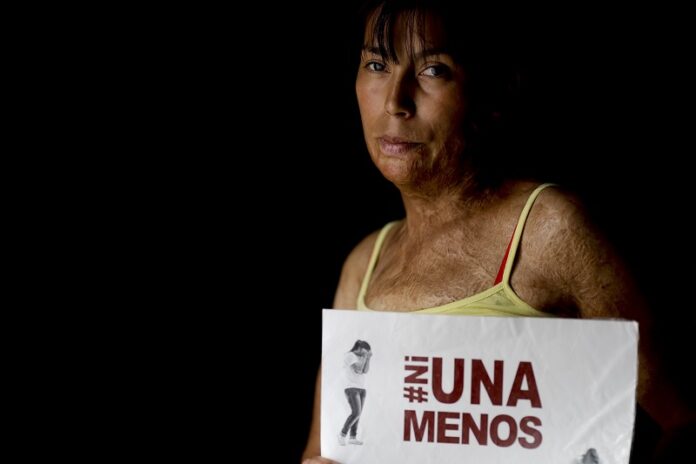
Maira Maidana poses for a portrait with the name of the women's movement "Not one Less" in Buenos Aires, Argentina. Photo: Natacha Pisarenko / Associated Press

BUENOS AIRES, Argentina — On Christmas Eve of 2011, Maira Maidana lit a candle to the patron saint of Argentina and closed her eyes in prayer – just like she did every time she feared a brutal beating by her partner.

But this time, instead of the usual blows, she felt her whole body catch on fire. When she turned around, she saw him staring at her with a bottle of alcohol in one hand. Ablaze, she ran to three faucets, but not a single drop of water came out.

Fifty-nine surgeries later, Maidana has finally found the courage to tell the truth about what happened to her that awful night. She says she owes that courage to a grassroots movement of tens of thousands of people across Argentina who have mobilized to fight violence against women. Called Ni Una Menos, or Not One Less, the movement has spread rapidly worldwide and now has branches in New York, Berlin, Italy, Brazil, Costa Rica, Ecuador and more.

“With Ni Una Menos, women are no longer hiding,” says Maidana, 29, who is scarred in her neck and chest and speaks in whispers. Maidana marched for hours during the latest Ni Una Menos protest earlier this month, holding a banner and beaming with pride.

“Before, we wouldn’t talk,” she says. “I don’t know if it was fear or shame, or feeling that justice was not on your side…I like it that it’s now out in the open.”

In 2016 alone, 254 Argentine women died from gender-based violence, according to a report released last month by the Supreme Court. That amounts to one woman killed every 34 hours. In 60 of those cases, the women had previously reported attacks, and some even had a restraining order.

Maidana feared the day would come when her partner would try to kill her.

They met in school in 2003, when he was 14 and she was 15. The first time he beat her up was in 2005. They were playing with schoolmates and he got jealous.

When they got back to her home, he punched her in the face. She went to school the next day with a bruise in one eye. A friend told her to break up with him, warning her that it would happen again and only get worse.

She was right. Over the course of the next eight years, he beat her up regularly, except when she was pregnant with their two children. He did drugs and would often come back home drunk or high.

When their children were young, they witnessed the fights. She would let him beat her up just so that he wouldn’t go after them. When he realized that Maidana no longer loved him, he threatened to kill himself. One day, he grabbed a kitchen knife and began cutting his wrists in front of the kids.

“I was scared,” she says. “The fear would not let me ask for help or escape.”

On the day he would set her on fire, she was helping her mother decorate a ballroom to celebrate her younger brother’s 17th birthday. His friends had been planning a hip-hop dance presentation, and she was excited about wearing a new white dress she had picked out with her partner.

But when he arrived back from work, he was drunk and no longer wanted to attend the party. She insisted, saying she had worked on the decorations the whole day. As soon as they arrived at the ballroom, he began telling her that her dress was too short. He was jealous and wanted to pick a fight.

Halfway through the party, he decided he wanted to leave. She gave in to avoid a scene in front of her family and friends. They called a cab and went back home with their two young children.

When they arrived, he asked his sister to lock the children in a room. He began screaming at Maidana.

The argument got heated. At one point, he threatened to leave her. But for the first time, after years of enduring his beatings, she confronted him and told him to go. She felt empowered.

It didn’t last.

One in three women worldwide has experienced physical or sexual violence, according to the United Nations. In most countries, fewer than 40 percent of those abused sought help of any sort.

In Argentina, there were 2,384 femicides between 2008 and 2016, according to La Casa del Encuentro, a local women’s rights group. While there are no accurate country-by-country numbers, violence against women in Costa Rica, Mexico and Guatemala is thought to be even higher, said Ada Rico, the head of La Casa del Encuentro.

The machismo culture is strong in Argentina, where women are often catcalled, hissed at and harassed on the street. Back in 2014, when he was the Mayor of Buenos Aires, Mauricio Macri said in a radio interview that “all women like to hear pickup lines,” among other sexist comments. He was heavily criticized, and since being elected Argentina’s president in 2015, he has pledged support for the Ni Una Menos movement and the protection of victims.

After she told her boyfriend to leave that night, Maidana went to the bathroom to remove her makeup. Then, with trembling hands, she lit a candle in the small altar to the Virgin of Lujan. It was about 2:45 a.m.

All of a sudden, she felt heat.

“I didn’t know what was going on,” she says. “I was in flames.”

Desperate, she tried the shower first, then the bathroom sink, and then the kitchen faucet. No water came out anywhere. He had either closed the taps or let the water run dry.

He followed her with a blanket in one hand and a bottle of alcohol in the other. The children heard her screaming.

She was on fire for maybe just minutes, but it seemed like hours. Finally, she ran to the garden and jumped into a kiddie pool filled with dirty water and mud. She felt like she was burning up inside.

Some minutes later, he told her the water was running again. She took a shower. By then, the ashes from her flowered dress – which she wore only to sleep because he complained about the cleavage – had melted into her charred chest.

He didn’t want to call an ambulance, but agreed to call police. He told them he was just a neighbor.

They took her to a small clinic, where she lost consciousness. Hours later, she was transferred to a hospital that treats severe burns.

She was at the hospital for four months, while her mother took care of her children. But one day, her partner picked them up from school. He kept them for more than 10 months, until Maidana got a lwyer’s help to bring them back home.

Even after dozens of surgeries and skin grafts, Maidana’s chest and parts of her face remained scarred. She had lost most of her hair, hearing in her right ear and sight in her left eye. She was down to 66 pounds (30 kilograms), less than half her usual weight, and looked skeletal. Her throat was badly damaged, and it was too painful to talk.

She slowly had to learn to eat and walk again with the help of her mother. Yet, fearing for her children’s lives, she never reported her boyfriend. Instead, she told family and police that she had doused herself with alcohol and set herself ablaze.

Her parents always doubted that she had tried to take her life. But she kept her story to herself – until the Ni Una Menos march.

Ni Una Menos was created by 20 artists, journalists and activists in 2015, after simmering outrage over a brutal spate of murders. The name came from a poem about a massacre of women in Ciudad Juarez by Mexican writer Susana Chavez, who was killed in 2011.

They began by organizing public readings about gender-based violence with family members of victims. But when Chiara Paez, a 14-year-old pregnant girl, was killed by her boyfriend in May 2015 and found buried in his family’s yard, they decided enough was enough.

The first call to protest started with a tweet by local radio journalist Marcela Ojeda: “Women: are we not going to raise our voices? THEY’RE KILLING US!” The public outcry that followed on social media inspired the first march on June 3, 2015.

The organizers thought it would be small. But on that day, millions of demonstrators flooded the streets of 70 cities across Argentina, demanding an end to the killings. The protests made headlines and prompted discussion throughout the country.

Maidana joined the march in front of the Congress building in Buenos Aires because she wanted to “feel alive” after so much pain. When she saw how the protests had united everyone, from women in strollers and schoolchildren to politicians from opposing parties, the tears began to roll down her cheeks. She embraced her mother and told her she was finally ready to tell the truth.

“I felt such an immense pain at seeing so many mothers, fathers, friends demanding justice for those girls who were gone,” she says. “And at the same time, I was demanding it for myself.”

The next day, she woke up and wrote a heartfelt letter thanking the demonstrators.

“I can’t stop crying,” she wrote. “Yesterday, I finally let out the anguish…Today, I’m thankful that I’m not just a banner, a photo, a name – and that I can fight for them. Today, I thank God that I can fight and scream: Not one less!”

The march grew quickly into a global movement, with the protest echoed by millions of women throughout Latin America. Argentine soccer star Lionel Messi joined the campaign with a message against femicides published on his Twitter account. During a visit to Buenos Aires, Michelle Obama praised the efforts by the Argentine women to fight against violence.

This year, Ni Una Menos helped organize a strike for International Women’s Day on March 8, drawing women from Thailand to Chile and Poland to South Korea. In some countries, members of Ni Una Menos have also joined forces with existing feminist movements, such as Vivas Nos Queremos in Mexico – We Want to Stay Alive.

Ni Una Menos’ demands range from the publishing of official statistics on sexual assaults and the protection of women to the inclusion of gender violence in school curricula. It has had some success. The Supreme Court announced that it would launch a task force to collect violence against women. Some months later, the government passed legislation to protect women who are verbally or physically abused on the streets. And the Reef clothing company ended the Miss Reef best buttocks contest, a 23-year-old summer tradition in the coastal city of Mar del Plata.

“Femicide is the tip of the iceberg, and it’s not solved with more police,” says Marta Dillon, a journalist and one of the founders of Ni Una Menos. “The movement seeks to be revolutionary.”

Argentina’s long tradition of feminist activism and its strong women have contributed to the movement’s success, Dillon said. She mentioned Evita Peron, the combative former first lady who helped get women the right to vote, and the human rights group Grandmothers of Plaza de Mayo.

Maidana is no longer with her boyfriend, but she has not yet garnered the courage to report him to the police. Still, she has kept the charred flowered dress she wore that night and the bottle of alcohol inside a plastic bag, in case one day she needs them as evidence.

“This is not something that is happening to one person,” she says. “It can happen to you, to your cousin, to your daughter. To everyone.”

Story: Luis Andres Henao, Debora Rey

Advertisement

Bangkok Buses to Finally Get Ticket Machines. Here’s How They Work.

A prototype Mangmoom card reader is displayed Thursday.

BANGKOK — Steely conductors rattling coin collectors and palming torn paper tickets may not be long for Bangkok’s buses.

Two types of ticketing systems will be installed on about 100 metro buses by October, according to the Bangkok Mass Transit Authority, or BMTA. One will sell bus tickets while the other will read the Mangmoom cards which one day will work for all of the capital’s public transportation.

The Transport Ministry said the machines would be installed on at least 800 of Bangkok’s roughly 2,600 buses by year’s end.

bus2
This prototype bus ticket machine only accepts coins.

Prototypes of the machines were shown Thursday at a contract-signing ceremony between BMTA and Cho Thavee Co. Ltd, which will lease the machines for the full bus fleet for five years at 1.6 billion baht.

The machines will become operable Oct. 1, the same date the government has promised to launch both the Mangmoom cards and welfare assistance cards that can be used by the registered poor to ride the bus gratis.

The card-reading machines will be able to read both cards, according to Phadet Praditphet, who oversees implementation of the common ticketing system.

The card readers will feed information to a monitor near the driver. They’ll be installed at both bus doors.

The second machine sells tickets for passengers who do not possess top-up cards. They will require commuters to select their destination and choose between child, adult and senior fares. The machine will accept all coins but not bills. It will print out barcoded tickets with details of passengers’ pick-up and drop-off points.

Automating ticketing is likely to make today’s bus conductors redundant, but acting BMTA director Somsak Hommuang said they would be kept on two years to instruct commuters on using the machines.

bus3
Mangmoom cards show Thursday at a news conference.

Phadet was unable to confirm when the multipurpose Mangmoon card would be operable across all transportation platforms.

He cited the same rationale – limited work hours – given by City Hall to explain why it could not install elevators at all BTS Skytrain stations within a year as ordered by the Supreme Court.

“We only have three to four hours a day after midnight to work on it,” he said. “And the old system is still being used, so it’s difficult and takes time.”

Phadet said he needed at least six months to install the system on each line. The most likely first candidate systems for the card are the Airport Rail Link, Purple Line, BTS skytrain and original MRT Blue Line.

Related stories:

Unified Transit Card Usable Between Few Stations at Launch

Final Extension of Free Bus And Train Service?

Hopes Snuffed For Single Transit Card Before 2017

House of Cards: MRT Rolls Out Yet Another Transit Fare Card

Advertisement

Phuket Vows Planespotting Beach Clean Up

Tourists pose for photos as a jet approaches on March 21, 2016, at Phuket’s Mai Khao Beach.

PHUKET — A beach famous not for its pristine white sands but screaming jet engines will get a much-needed cleaning following complaints from residents.

Countless people visiting Phuket’s Mai Khao Beach for an close-up encounter with landing passenger jets have left countless garbage, and on Tuesday local officials will visit the beach and remove it, according to Phuket Gov. Noraphat Plodthong.

Noraphat said the problem had gone ignored because of bureaucratic red tape. The beach sits in Sirinat National Park and is therefore off-limits to the jurisdiction of local authorities.

“As you know, it’s not easy for us to go onto national park land,” Noraphat said by telephone.

As the beach is near Phuket International Airport, beach-goers can see airplanes up close as they approach the runway, making the beach popular for photographers and planespotters.

But some residents complained to the media during the weekend that its fame has also brought trash left scattered over the area. Noraphat said the authorities are now aware of the complaints, hence tomorrow’s cleanup operation.

Noraphat, who was appointed to his position just two months ago, said public cleanliness would be one of his top priorities.

91461
Trashes at Mai Khao Beach on Sunday
Advertisement

Rescue Effort Fails to Save Wounded Dugong

A marine officer holds a dying dugong in his arms Sunday. The wounded male dugong beached onto Koh Phi Phi before dying that morning despite rescue efforts. Read: Rescue Effort Fails to Save Wounded Dugong

KRABI— A weak and wounded dugong who beached himself on Koh Phi Phi died in the arms of marine officials Sunday morning.

In the early hours of Sunday, the 44-kilogram dugong swam ashore with a stinking, rotting wound along his body. Residents quickly alerted marine officials, who treated the animals wounds and fed it antibiotics. It wasn’t enough to save the two-meter animal, who died a few hours later at 8:30am.

“We tried our best, but we couldn’t keep him alive,” local marine resources official Kongkiat Kittawattanawong said. “He was wounded by a sharp object across his back, most likely the propeller of a boat or fishing gear. He was sick for many days until he weakened so much that he couldn’t help himself.”

The dugong is undergoing autopsy to determine his exact cause of death. Kongkiat said that it was the 10th dugong to die along the Andaman Coast so far this year. Most have been killed by either boats or fishermen.

Dugongs are considered a vulnerable species, and their once-plentiful numbers around Thailand have crashed.

Once found abundantly in the waters off both coasts, the last known resident dugong in the Gulf of Thailand died in November 2016 just off Rayong province. The Andaman dugong population has dwindled to fewer than 200 animals.

IMG 8027 bsVFwka
Marine personnel hold the wounded dugong before it died Sunday on Koh Phi Phi.
IMG 8030 9mPa7dq
The male dugong is inspected for his wound across his back.
IMG 8031 TarC2Iu
A large wound is visible on the dugong’s back.

Related stories:

355 Threatened Marine Animals Killed in 2016

Task Force Weighed After 1,000-Year-Old Coral Stolen From Gulf Island

Giant Whale Killed by Boat Pulled Ashore in Prachuap Khiri Khan

Advertisement

Road Bomb Kills 6 Soldiers in Pattani

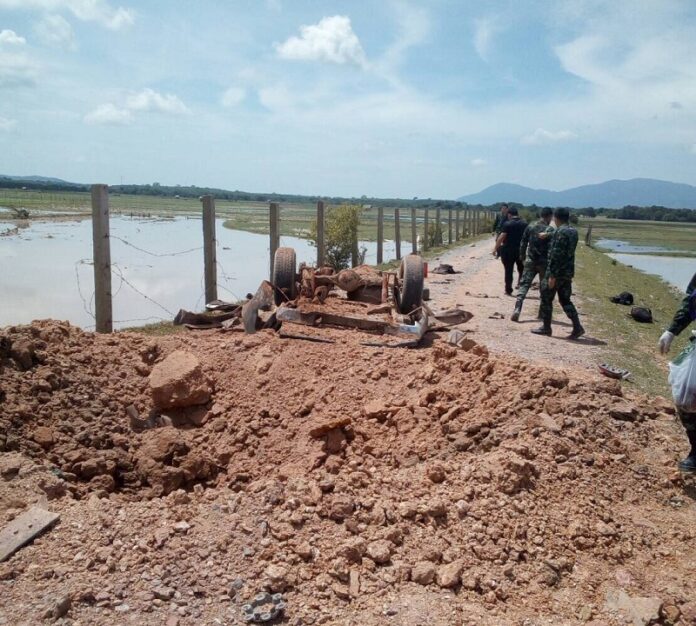
The remains of a pickup and crater left after a powerful bomb exploded Monday under a rural road in the southern border province of Pattani.

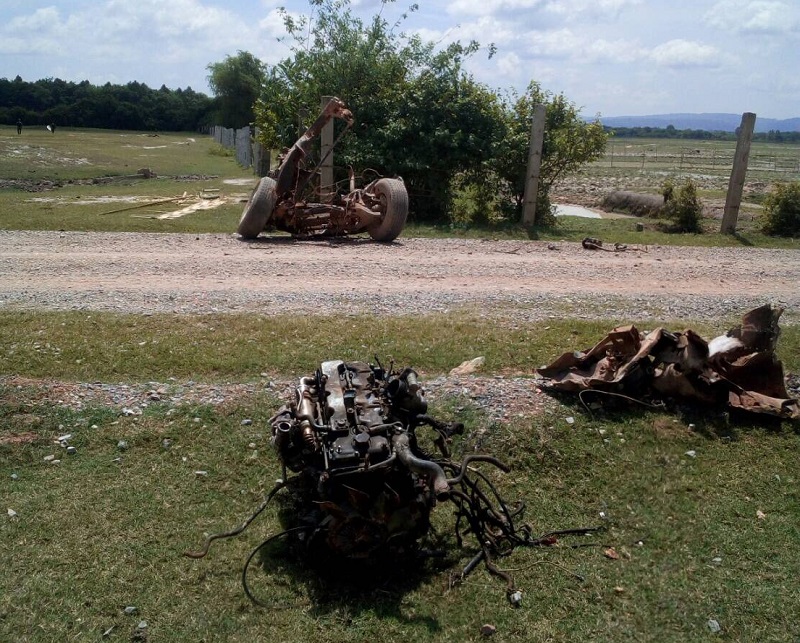
PATTANI — A powerful bomb hidden under a Pattani road killed six soldiers Monday.

Ten soldiers were patrolling on the pickup when the bomb, hidden beneath the road in a drainage pipe, exploded just before noon in Pattani’s Thung Yang Daeng district, according to a local police officer who did not give his name because he was not authorized to talk to the media.

Six soldiers were killed immediately while the other four were injured.

The area was ordered shut down for a search by ordnance disposal personnel.

truck
The remains of a pickup and crater left after a powerful bomb exploded Monday under a rural road in the southern border province of Pattani.
Advertisement

Joe Jonas & DNCE to Bring ‘Body Moves’ to Bangkok

Photo: DNCE / Facebook

BANGKOK — American singer Joe Jonas, formerly half of The Jonas Brothers, and his dance-oriented rock quartet will perform their first show in Bangkok this August.

Known for “Cake By The Ocean,” “Body Moves” and “Toothbrush,” the fashion-forward New York group DNCE will come to play Bangkok, organizer BEC-Tero Entertainment announced Monday.

Opening acts will include Japan’s Sekai No Owari and American MC Garrett Charles Nash, aka Gnash.

The concert will take place Aug. 10 at Muang Thai GMM Live House on the eighth floor of CentralWorld. Tickets are 1,500 baht and 2,500 baht. They go on sale June 25 at ThaiTicketMajor.

DNCE was founded in 2015 by Jonas and Jack Lawless, who drummed for Jonas Brothers. The quartet is signed to Republic Records and released its debut single “Cake By The Ocean” two years ago to commercial success.

Advertisement

Hot News

LATEST NEWS

Bangkok
overcast clouds
30 ° C
31.1 °
27.7 °
78 %
3.4kmh
100 %
Sat
32 °
Sun
35 °
Mon
37 °
Tue
36 °
Wed
36 °