31.1 C
Bangkok
Tuesday, June 9, 2026
Home Blog Page 2321

Civil Court Rejects City’s Challenge to BTS Accessibility Suit

Disabled rights activists and commuters rally along Ratchadapisek Road in Bangkok on their way to the Civil Court on Jan. 20, 2017, to file a class-action lawsuit against the city.

BANGKOK — The Civil Court said Thursday it has the authority to consider a class-action suit filed against City Hall for failing to make the BTS Skytrain system accessible to people with disabilities.

Rejecting a motion filed by the Bangkok Metropolitan Administration that the case did not fall within its purview, the Civil Court said it is the proper legal venue because the suit seeks financial compensation for violating the disabled welfare law and not for action by officials, which would have placed it in the Administrative Court.

“It calls for compensation, not for action,” said Sonthipong Mongkonsawat, the attorney representing the disabled rights group which brought the suit. “We don’t have the channel to seek compensation under the procedure of Administrative Court.”

In January, Transportation for All filed the class-action suit on the second anniversary of the landmark 2015 court decision decided in their favor. The suit demands compensation because City Hall failed to satisfy an Administrative Court giving it one year to install elevators at all of the original 23 BTS Skytrain stations.

It seeks 1,000 baht for each plaintiff to join the class for each day that passed since the court-ordered deadline for the work to be completed passed on Jan. 21, 2016. It seeks four times that amount, or 4,000 baht, for every day since they filed the suit on Jan. 21, plus 7.5 percent annual interest.

In March, a city lawyer filed a motion challenging the Civil Court as the proper arena for the suit. It said the dispute belonged back in the Administrative Court because it was between officials and private parties.

The Civil Court’s decision today will go to the Administrative Court who can register any objections before a final decision is rendered by the Adjudication Committee for Power and Duty of Court, which has authority over the courts.

Both City Hall and the activist group were due to go to the court again on Aug. 7 which Sonthipong believed the judgement should be made on which court is authorized to consider the suit.

As of Wednesday, only three of the original 23 BTS stations have a sable elevators, according to disabled rights group Accessibility is Freedom.

City Hall has promised that all stations would be fully equipped by the end of the year, citing problems with land ownership and underground infrastructure.

Related stories:

City Hall Challenge Delays Decision on BTS Accessibility Suit

Elevators Unveiled at Four BTS Stations – But Do They Work?

Disabled Plaintiffs Looking for More to Join BTS Lawsuit

How Long to Install BTS Elevators? City Hall Says 3 Years.

Wheelchair Rally to File Class-Action Lawsuit Over BTS Accessibility at Court

Disabled Activists to File Class-Action Lawsuit Over BTS Access

City Hall Fails to Make BTS Accessible 2 Years After Court Ruling

Broken Promises: BTS Still Off Limits to Disabled

Disabled Rights Group Weighs New Suit Over BTS Stations

BTS Stations Remain Inaccessible to Disabled, a Year After Landmark Ruling

Court Orders Skytrain to Accommodate Disabled Passengers

Advertisement

Chiang Mai Has Worst Small Particle Pollution in Thailand: Greenpeace

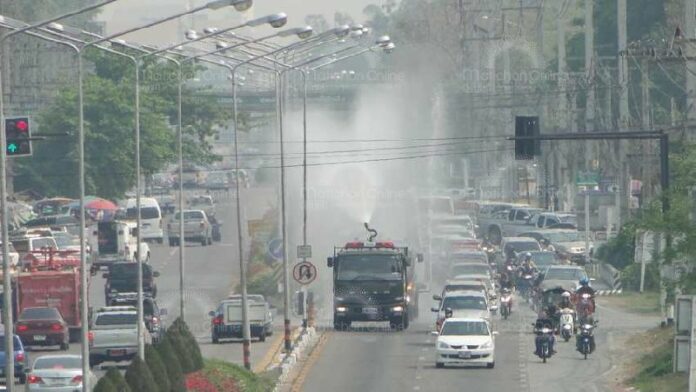
A truck sprays water to disperse haze in Chiang Mai in March 2012. Photo: Matichon

BANGKOK — Chiang Mai is Thailand’s most-polluted city in terms of dangerously small pollutants which kill tens of thousands in Thailand annually, Greenpeace announced Wednesday.

The northern city, famed for its mountain temples and annual slash-and-burn haze, had the highest levels last year of the fine particulate pollution that’s invisible to the naked eye and can be harmful to human health.

“Chiang Mai, specifically in city district, won because of outdoor burning and transportation within the city,” Chariya Sempong, climate and energy officer at Greenpeace Southeast Asia, said Thursday. “Most people think the most polluted city is Bangkok, but in Chiang Mai people spray water into the haze so that it drops to the ground and feels less polluted. In fact, the PM 2.5 lingers in the air.”

The study published May 11 looked at particles identified as “PM 2.5,” meaning they are 2.5 micrometers in diameter or smaller and invisible without an electron microscope.

“All the stations measured PM 2.5 levels that exceed world standards,” said Tara Buakamsri, director of Greenpeace Southeast Asia in Thailand said at a Wednesday event promoting the findings. “We ranked the cities so that we could raise awareness of the problem. Isn’t it high time to do something?”

According to the World Health Organization, such pollutants can travel into the respiratory system. Stroke, lung and heart disease can be caused or exacerbated by high levels. Greenpeace reported that in 2015, such pollution killed more than 37,500 people in Thailand.

“They’re smaller than red blood cells, so they can invade any organs the blood reaches, especially the lungs, heart and brain,” Chariya said.

pasted image 0
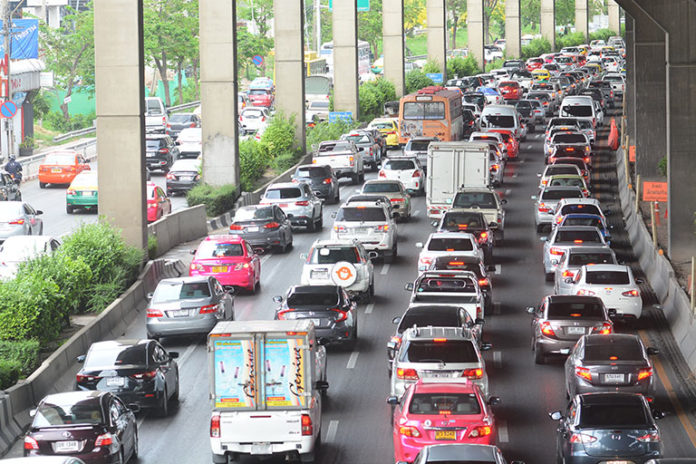
Cars commuting into Bangkok post-Songkran in April 2017.

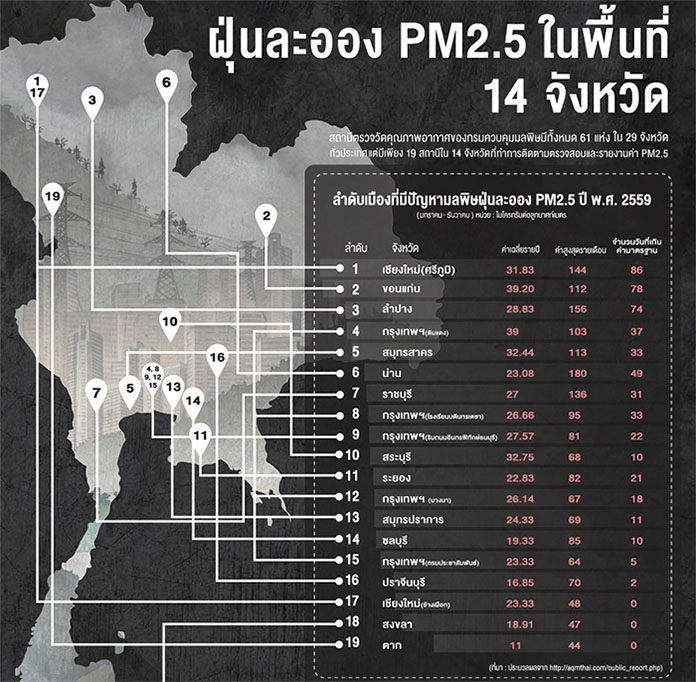
For its report, Greenpeace gathered data from stations in 14 provinces nationwide. While the World Health Organization recommends no more than 10 micrograms of fine particles per cubic meter of air, Greenpeace found levels reach into the high 20s and 30s at all 19 stations.

The most-polluted areas were ranked by which had the highest concentrations over time.

Chiang Mai topped the list with the most number of polluted days, followed by Khon Kaen, Lampang and Bangkok’s Din Daeng district. The least polluted area in Bangkok? In the Phaya Thai district, near BTS Ari.

In Thailand, over half of all micro pollution is caused by outdoor burning. Industrial factories emit the most fine particles (17 percent), followed fossil fuel combustion (13 percent), electrical production (9 percent) and residential and commercial use (7 percent).

All locations tested in Thailand exceeded safe levels. Here’s how they ranked in the Greenpeace report:

  1. Chiang Mai
  2. Khon Kaen
  3. Lampang
  4. Bangkok (Din Daeng area)
  5. Samut Sakhon
  6. Nan
  7. Ratchaburi
  8. Bangkok (Wang Thonglang)
  9. Bangkok (Thonburi)
  10. Saraburi
  11. Rayong
  12. Bangkok (Bang Na)
  13. Samut Prakan
  14. Chonburi
  15. Bangkok (Phaya Thai)
  16. Prachinburi
  17. Chiang Mai (Chang Phueak district)
  18. Songkhla
  19. Tak
Graphic excerpted from Greenpeace Southeast Asia report
Advertisement

Call for Rights at Annual Celebration of LGBT Advocacy (Photos)

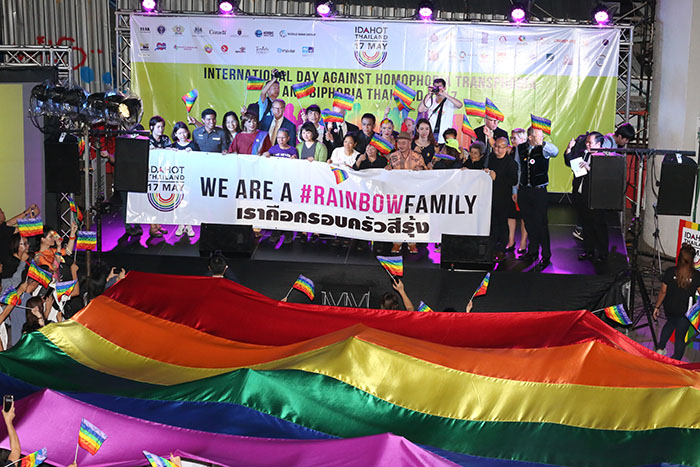
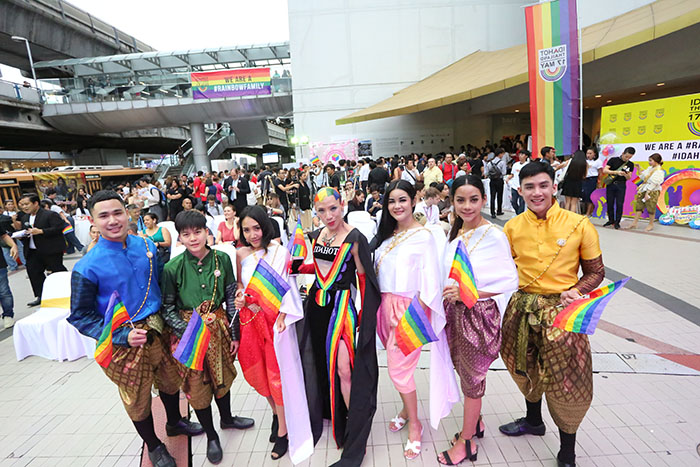
People celebrate 'IDAHOT' on Wednesday at the Bangkok Art and Culture Centre.

BANGKOK — Members of Bangkok’s LGBT community gathered Wednesday for the International Day Against Homophobia, Transphobia and Biphobia – aka IDAHOT – to show their pride and call for marriage rights.

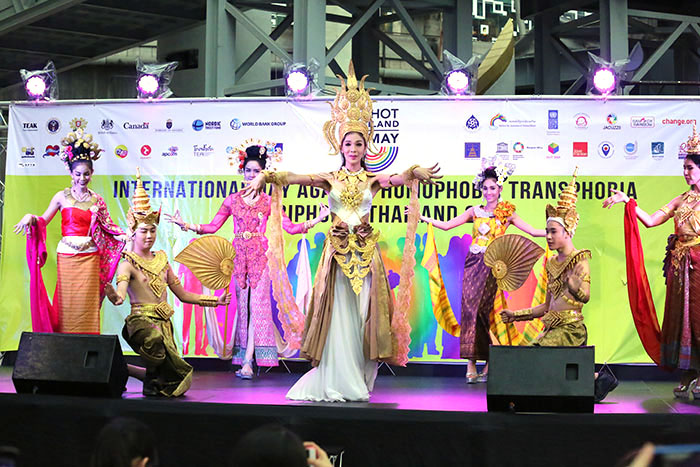
Celebrations and performances took place outside the Bangkok Art and Culture Centre after an afternoon of discussions on equality and LGBT families inside, all culminating in the presentation of a petition urging the military government to legalize same-sex marriage.

“I’m happy to attend the event,” said Sirisak Chaited, wearing a uniquely designed black dress fringed with rainbows and “IDAHOT” emblazoned across her chest. “Many ambassadors and members of the public sector also came this year. It’s good to see that they see our importance.”

Attendees were treated to “Queerness,” a photo exhibition by Piyarat Piyapongwiwat, as well as shows and music.

A representative from the justice ministry was on hand to receive a Change.org petition signed by 60,000 people in support of Thailand’s proposed Civil Partnership Bill.

“We are a #RainbowFamily” was the slogan of this year’s event, with participants promoting a message that love and family values strengthen bonds between LGBT children and parents.

idahot9

Sirisak said she has attended the event several times since it was first held in Chiang Mai. The 35-year-old businesswoman, who is also a member of the Thai Sexual Diversity Network, said she’s seen the LGBT Thais make gains since then. For example, the army stopped formally documenting transgenderism as a mental disorder in 2005.

“Government laws should be based on human rights, and that will lead to equality for all genders, not just for men or women or LGBT people,” Sirisak said. “Also, I’d like people to understand that we’re human beings, not a ‘community.’ True acceptance requires no conditions.”

Apart from the Civil Partnership Bill, which is idling in draft form at the justice ministry four years after being proposed, Sirisak thinks the laws should be changed to allow the use of prefered titles, prevent job discrimination and students to dress according to their gender identity.

idahot5
Sirisak Chaited of the Thai Sexual Diversity Network poses for a photo.

Among people to take the stage to share personal stories was Thanayuth Saosoong, a transgender police lance corporal from Chonburi’s Si Racha district, who became famous earlier this year in a viral clip for the contrast between her uniform and flamboyant personality.

“LGBT people can work in every career,” she said, adding that some limitations of the job – such as her chief telling her to mind her conduct and not wear a scarf while in uniform – didn’t stop her from being herself.

Singer Sillapin “Zymone” Gill, who performed at the event, spoke about being forced to perform as a drag queen and showgirl before realizing her dream of becoming a singer this year on reality competition show The Voice Thailand.

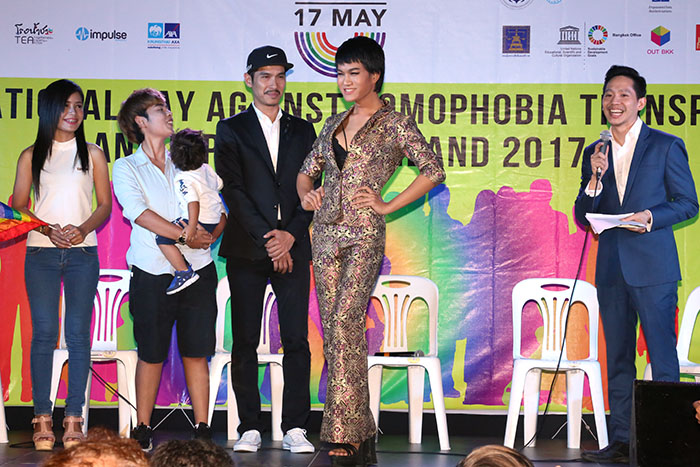
Natchanakarn “Yuno” Chonthimakorn brought her son Theo and wife to share their experiences, show they had a normal, warm family and call for advancement of their rights under the law.

“Although I’m with my wife, we have no right to take care of or fully support each other,” she said. “It’d be great if we could use the same surname and have equal access to medical care like in other countries.”

idahot12
Transgender model Apichet ‘Madaew’ Atirattana, at right, poses on stage.
idahot11
Natchanakarn ‘Yuno’ Chonthimakorn, right, with son Theo and wife.

idahot7

idahot3

idahot8
‘Queerness’ exhibition
idahot10
Thanayuth Saosoong, a police lance corporal from Chonburi’s Si Racha district, speaks on stage.
idahot1
Singer Sillapin “Zymone” Gill after her performance.

idahot4

Advertisement

Ariana Grande to Bring Her ‘Dangerous Woman’ to Bangkok

Update: Ariana Grande has suspended her tour in light of the Manchester terror attack through June 5, which should not affect her Aug. 17 appearance in Bangkok.

BANGKOK — American pop singer Ariana Grande is coming to Bangkok, a concert promoter announced Thursday afternoon.

Best known for “Dangerous Woman,” “Focus” and “Love Me Harder,” the 23-year-old pop singer will perform live for the first time in Bangkok as part of her swing through Southeast Asia on her Dangerous Woman Tour.

The concert will take place Aug. 17 at Impact Arena Muang Thong Thani. Tickets start at 2,500 baht and will go on sale on May 27 at ThaiTicketMajor.com.


Advertisement

Dangerously Funny Webcomic Satirizes Thai Politics

Kai Maew sent this original image to Khaosod English. Photo: Kai Maew / Courtesy

A square-jawed trickster who dominates or appears hidden in the background of almost every cartoon strip evokes a former Thai prime minister assigned blame for every problem in Thailand. He is the smirking foil of the uniformed general, with the unique ability to turn his beaming delight into squinting rage.

They’re the leads of “Kai Maew” (Cat’s Egg), a dark online comic featuring caricatures satirizing Thai politics and current events, from student reformer Netiwit Chotiphatphaisal and fugitive Red Bull heir Vorayuth Yoovidhya to figures familiar only to news junkies.

Without any speech balloons, it aptly reflects things rarely depicted and discussed openly. Its edgy humor has won it more than 330,000 fans in its first year.

Update: Master of Thai Satire ‘Kai Maew’ Disappears

The author agreed to be interviewed so readers could know more about the background of the page, his views on freedom of expression and whether Thaksin Shinawatra pays him to draw. He would only do so anonymously over chat messages, because he said going public might affect his ability to continue drawing.

“Agencies contact me to draw promotional stuff on the page every week, but I don’t accept any of it because ‘Jack Maew’ pays me monthly, so I’m already rich (do you believe me?)” wrote the author, who we will call Kai Maew.

kaimaew3He said he’s a 30-something Thai man and though some of his friends know he’s behind the popular page, he chooses to remain anonymous so he can continue drawing them.

“I draw them because I love drawing, and I’m happy when people see my drawings,” he said.

Although fans believe the title “Kai Maew” is a play on “Thaksin’s testicles” – a derogatory term used by Thaksin foes to describe his supporters – the author gave an anodyne explanation about his love for cats.

Despite the specificity of situations and events his cartoons address, he is reticent to address what it means or even who the characters represent. Asked why, he said he doesn’t want to get sued.

To readers however there is little nuance.

Jack of course is the square-faced, blue-suited businessman. He’s the troublemaker who’s always smirking from somewhere in the frame. Readers sometimes have to search each image for Jack. He may appear prominently to smirk about the “guns” the General has presented to the media or subtly take the form of a mind-reading alien to look into the General’s heart.

The admin admitted the character’s name comes from the Chinese businessman with a similarly shaped head – Jack Ma – and Thaksin Shinawatra’s unofficial nickname “Maew.”

“People often think Jack Maew is behind everything, so I draw him in every photo to end the story quickly,” he wrote.

There’s also regulars such as Hawaiian-shirt and submarine-loving junta deputy Gen. Prawit Wongsuwan. Gov. Spokesman Sansern Kaewkamnerd is a pinocchio-chicken created by the General to tell whopping lies.

Instead of writing rants on Facebook, Kai Maew said he releases his frustrations about society and politics through his satirical drawings. With good feedback from friends, he decided to launch Kai Maew in April 2016.

Most of the author’s inspiration comes from current news and movies and he said it takes less than an hour to draw each image using mobile phone app ArtStudio.

Apart from characters, the cartoon is also open for interpretation, as there’s no dialogue or description. That engages many readers to participate by sharing their own explanations for what is happening, similar to fans of Spanish cartoonist Joan Cornella.

“I’d like readers to imagine the conversation on their own, which must be more fun,” Kai Maew said. “And well, part of it is I’m afraid that I’ll get into trouble.”

As the government has moved to limit access to information online and has arrested those who satirize it, Kai Maew admitted he sometimes self-censors.

“Of course, I’m scared. But it’s not right that our access to information is limited like this. Are we going to live like this?” he said. “There are many dangerous issues that I wish to draw, but I gave up the idea, as I’m afraid those who share my drawing will be in trouble.”

During the year since he began drawing Kai Maew, he said society has changed a lot.

“More and more people now see the light,” he said. “They might be frustrated too with what’s going on, and that’s why they gather at my page.”

For him, art conveys more than aesthetics but also insights into society.

“If truths that are scarcely discussed are portrayed artistically to make people realize what’s right and wrong, I think this art form has realized its function,” he said.

Here are some recent selections, find more at Kai Maew on Facebook.

Related stories:

Secret ‘Kai Maew’ Satirist Won’t Make Exhibition Appearance

Elusive Satirist ‘Kai Maew’ to Host 1st Art Exhibit

Master of Thai Satire ‘Kai Maew’ Disappears (Updated)

Advertisement

Asian Funerals Go Green, High-Tech at Hong Kong Trade Fair

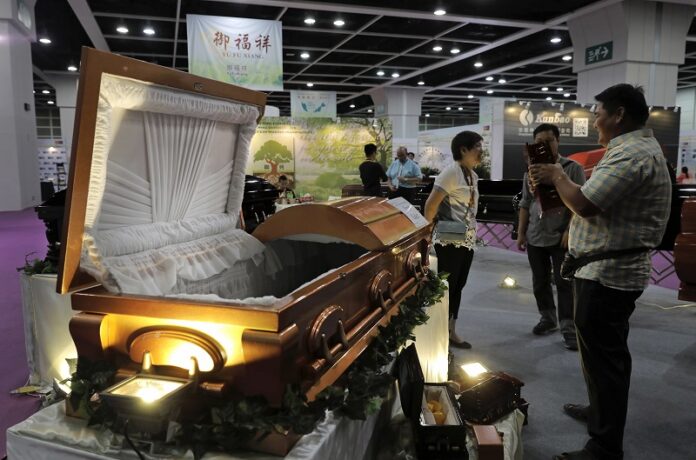
Visitors look at a paper casket at the Asia Funeral and Cemetery Expo & Conference on Thursday in Hong Kong. Photo: Vincent Yu / Associated Press

HONG KONG — Death is inevitable but it doesn’t have to be bad for the environment.

Caskets made of paper and wicker coffins on display at a recent Hong Kong funeral industry trade highlighted a trend toward “green burials” in an industry booming as Asia’s population rapidly ages.

Chinese businessman Alex Sun’s company, Shandong Ecoffin International, makes wicker and seagrass coffins, which first became popular in the West and are now catching on in Asia. Basket-weaving dates to the Tang Dynasty (618-907 AD) in northeast China’s Shandong province, where Sun’s factory uses fast-growing willow reeds to make caskets that are an eco-friendly alternative to wood.

“Eco funerals are a global trend,” said Sun. “European customers already know about this product, while Asian customers are also interested in it and would love to learn more,” he said. Interest is especially high in the Philippines, Malaysia and Vietnam as well as mainland China, he said.

The mood was bright, not funereal, as coffin makers, morticians, funeral home operators and entrepreneurs converged on Hong Kong this week for the Asia Funeral and Cemetery Expo & Conference, a trade fair held every other year.

Participants were pitching caskets for pets, Italian hearses, German cremators with high-tech filters and Japanese mobile embalming units. From China, Truthkobo Jewelry offered pendants made with ashes from deceased relatives or pets while Shenyang Roundfin was looking for international distributors for its autopsy tables, morgue fridges and body bags.

The death industry is a lucrative market: Asia’s aging population is projected to hit 923 million by midcentury, according to the Asian Development Bank, putting the region on track to become the oldest in the world.

The region’s funeral services market has been growing steadily and is now worth about USD $62.6 billion a year, with China accounting for nearly half of that, according to data from market research firm Euromonitor.

“This is a very promising industry in China,” said Gloria Chuang, marketing director at Yu Fu Xiang Memorial Group, a Chinese funeral services company.

But she said the industry in China needs to expand and to modernize. Most funeral home operators are family-run outfits selling one-size-fits all services. They’re not transparent about prices and other information for services and products like coffins and urns, she said.

That’s partly because, as in many places, talk of death is taboo.

“A lot of the funeral service industry is backwards,” she said. “Our culture dictates that Chinese people are very sensitive to talk about matters of death. Therefore this industry has become a very closed one.”

Under Mao Zedong, who ruled China until his death in 1976, elaborate funerals, like many other customs, were officially condemned as feudal superstition and fell out of favor, though they persisted in many rural areas. Such rituals have seen a revival in recent years as the economy boomed, as the newly rich use lavish funeral rites to show off their social status and the accumulation of wealth.

In 2013, the government banned Communist Party members from holding extravagant funerals for family members, seeking to curb waste, corruption and pomp.

On the Hong Kong show floor, Lee Jong-lan, South Korea’s top funerary beautician, demonstrated her airbrushing technique, which she said is better than conventional makeup for covering up discolored or damaged skin on corpses.

The Luen Hing Coffin Co.’s paper casket looked deceptively like a traditional one. It costs more because of a specialized manufacturing process for its honeycomb paper construction, but burns twice as fast as wood in a crematorium, saving funeral operators time and money, said General Manager Carol Chan.

On display at Yu Fu Xiang’s booth were custom-designed cremation urns adorned with faces of the deceased and an ornate “elite longevity costume” resembling robes worn by Chinese emperors. Chuang said attitudes are changing and demand is growing for more personalized service as the children of the older generation become wealthier and more tech savvy. Cultural sensitivities regarding death are starting to ease, making it more acceptable to talk about preparing for the afterlife, she said at one of the fair’s seminars.

Other speakers said that despite lingering resistance, there’s growing interest in online memorials that let family members upload pictures to the cloud and pay respects using their smartphones.

The prospect of a lucrative investment opportunity even drew investors from outside the industry to the fair.

Piyanuch Wattanasiritananwong and a friend came from Thailand, where they run a property business, after hearing about the show from a contact.

“We want to know what opportunities there are in this industry because everybody dies,” she said.

She pondered the possibility of starting a coffin business based on recycling  an elaborate outer shell is removed to be re-used while only a plain inner box is cremated with the body.

“I don’t want people to spend a lot of money but still have a nice farewell,” she said.

Story: Kelvin Chan

Advertisement

Korea King Pan Ordered to Stop Advertising

Television host Vuthithorn ‘Woody’ Milintachinda presents Korea King’s Diamond Series pan in an infomercial scene.

BANGKOK — The Consumer Protection Board on Wednesday ordered a halt to advertisements of an aggressively marketed frying pan for making false claims, prompting its distributor to threaten a lawsuit against the chemistry professor who brought attention to its deficiencies.

The consumer board said unofficial results of the Korea King pan found it was not coated in “eight layers” and no “marble” substance was found in any of them. It also said the company cannot prove the pan originally sold for 18,000 baht – part of its pitch of offering two for 3,300 baht – nor claims it is “300 percent” less sticky than other pans, said the office.

The office said while it was still waiting for the full and final results from three laboratories, it found sufficient cause to ban Wizard Solutions Co. Ltd. from advertising on all platforms immediately because their claims were considered “unfair advertising” under the 1979 Consumer Protection Act.

“We have yet consider the punishment,” said head direct marketing regulator Veerapong Boonyopas. “But we ordered a stop to the advertising to make it fair for consumers.”

Korea King, the most-advertised product in the country last year, was in hot water for false advertisement after a chemist last week posted a video testing some of the pan’s outlandish claims. In it, a handsaw easily cut through the pan’s coating, which the company claimed was comprised of eight layers which included fictitious substances such as “gold marble.”

The test by one of the three labs found the Korea King Gold Series was coated with five layers while the Diamond Series pan only had two.

According to testing by chemistry professor Weerachai Phutdhawong, the pan was polymer-coated aluminum and no marble was found in the coating.

The Consumer Protection Board was still waiting for results from the National Metal and Materials Technology Center and Department of Science Service.

Responding to accusations the Korea King invented an inflated retail price, the Customs Department said Wednesday the pan was imported from South Korea without paying duties under the ASEAN-Korea Free Trade Agreement.

The pan’s Thai distributor, Wizard Solutions, sent a legal representative to the board on Wednesday to submit documents provided by its South Korean parent company.

“Wizard Solutions advertises according to the documents provided by the manufacturer,” said lawyer Vipak Chusak.

The lawyer insisted the document has a proven reference for both its pricing and materials.

He also announced that the company already plans to sue Weerachai the chemist for defamation.

Related Stories:

Korea King Panned For False Advertising

Advertisement

Police Weigh Charges After Falling Ceiling at Central Pinklao Injures 3

Fallen ceiling pieces Wednesday afternoon at CentralPlaza Pinklao. Photo: @Dickyman96 / Twitter

BANGKOK — Central Group may be charged with recklessness, police said Thursday after a ceiling at one of its malls came crashing down, injuring three people.

Parts of the ceiling fell from the fifth floor of CentralPlaza Pinklao to the ground level Wednesday afternoon, injuring a customer and two employees.

“The ceiling parts didn’t hit the people directly, or else they would have been hurt more,” police Lt. Col. Supasak Poriyanont said Thursday morning. “The area was under construction, and parts of the ceiling, but not the entire ceiling, fell.”

Supasak, who was at the scene, said the falling debris hit a balcony on the fourth floor and broke into smaller pieces which rained down the people below. Some metal construction materials and ceiling supports also fell, damaging cars which were on display below.

“Central took the people to the doctor, and they will pay for all medical fees. The people got X-rays, too,” Supasak said. “Central may be charged with recklessness resulting in the injury of others, but the exact fine has yet to be determined.”

The mall remains open as usual.

Reached for comment Thursday morning, a Central spokeswoman who refused to give her name said management was discussing the issue in a meeting. She said that “whenever anyone gets hurt, Central usually takes care of the customers in every way.”

In a statement released last night, Tipapan Pattarawikrom of Central Group’s real estate investment and infrastructure department said the company was willing to take responsibility.

“We are ready and willing to take responsibility for any damages that might have been caused. Currently we are investigating what caused the ceiling to fall,” she wrote.

Advertisement

Special Prosecutor Abruptly Named to Probe Trump-Russia Ties

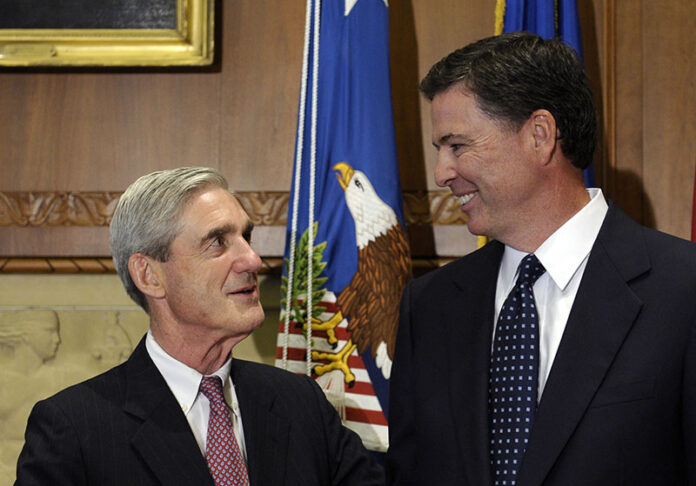
In a Sept. 4, 2013, file photo, then-incoming FBI Director James Comey talks with outgoing FBI Director Robert Mueller before Comey was officially sworn in at the Justice Department in Washington. Photo: Susan Walsh / Associated Press

WASHINGTON — The Justice Department abruptly appointed former FBI Director Robert Mueller Wednesday night as a special counsel to lead a federal investigation into allegations that Donald Trump’s campaign collaborated with Russia to sway the 2016 election that put him in the White House. Mueller will have sweeping powers and the authority to prosecute any crimes he uncovers.

The surprise announcement to hand the probe over to Mueller, a lawman with deep bipartisan respect, was a striking shift for Trump’s Justice Department, which had resisted increasingly loud calls from Democrats for an outside prosecutor. It immediately escalated the legal stakes — and the potential political damage — for a president who has tried to dismiss the matter as partisan witch hunt and a “hoax.”

The announcement, the latest in the shock-a-day Washington saga, was made by deputy Attorney General Rod Rosenstein. The White House counsel’s office was alerted only after the order appointing Mueller was signed, said a senior White House official, who was not authorized to speak publicly by name and commented only on condition of anonymity.

In a written statement, Trump insisted anew there were no nefarious ties between his campaign and Russia.

“A thorough investigation will confirm what we already know — there was no collusion between my campaign and any foreign entity,” he declared. “I look forward to this matter concluding quickly.”

Mueller’s broad mandate gives him not only oversight of the Russia probe, but also “any matters that arose or may arise directly from the investigation.” That would surely include Trump’s firing last week of FBI Director James Comey.

Mueller, a former federal prosecutor at the Justice Department, was confirmed as FBI director days before the Sept. 11, 2001, attacks that would ultimately shape his tenure. The FBI’s counterterror mission was elevated in those years, as the U.S. intelligence agencies adjusted to better position America to prevent another attack of such magnitude. He was so valued that President Barack Obama asked him to stay on two years longer than his 10-year term.

Comey succeeded him, appointed by Obama.

Mueller was appointed Wednesday by Deputy Attorney General Rod Rosenstein, who had faced criticism as the author of a memo that preceded Comey’s firing. Rosenstein said the appointment was “necessary in order for the American people to have full confidence in the outcome.”

Republicans have largely stood behind Trump in the first months of his presidency as FBI and congressional investigations into Russia’s election meddling intensified. But GOP lawmakers have grown increasingly anxious since Trump fired Comey, who had been leading the bureau’s probe — and after Comey associates said he had notes from a meeting in which Trump asked him to shut down the investigation into the Russia ties of former National Security Adviser Michael Flynn.

First reactions from Congress were mainly positive.

House Speaker Paul Ryan said the appointment was consistent with his goal of ensuring that “thorough and independent investigations are allowed to follow the facts wherever they may lead.”

Republican Jason Chaffetz of Utah, chairman of the House Oversight Committee, said Mueller was a “great selection. Impeccable credentials. Should be widely accepted.”

And not a moment too soon, Democrats said.

“I believe Mueller will be independent, he will be thorough and he will be fair and he’s not going to be easily swayed,” said Elijah Cummings of Maryland, top Democrat on the oversight panel. Cummings has vigorously urged such an appointment, suggesting it could lead to accusations of obstruction of justice.

In the 1990s, Democrats complained that independent counsel Kenneth Starr, who investigated President Bill Clinton, overstepped his authority.

The latest political storm, coupled with the still-potent fallout from Trump’s recent disclosure of classified information to Russian diplomats at the White House, has overshadowed all else in the capital and beyond. Stocks fell sharply on Wall Street Wednesday as investors worried the latest turmoil in Washington could hinder Trump’s pro-business agenda

Trump has repeatedly slammed the FBI and congressional investigations as a “hoax” and blamed disgruntled officials at intelligence agencies for leaking information related to the probes. During a commencement address Wednesday at the Coast Guard Academy, he complained bitterly about criticism he’s faced.

“No politician in history, and I say this with great surety, has been treated worse or more unfairly,” he said. “You can’t let the critics and the naysayers get in the way of your dreams. … I guess that’s why we won. Adversity makes you stronger. Don’t give in, don’t back down. … And the more righteous your fight, the more opposition that you will face.”

No less a commentator than Russia’s Vladimir Putin called the dramatic charges swirling around Trump evidence of “political schizophrenia spreading in the U.S.” He offered to furnish a “record” of the Trump-diplomats meeting in the Oval Office if the White House desired it.

There was no word on what that record might entail, a question many were likely to raise in light of Trump’s recent warning to Comey that he had “better hope” there were no tapes of a discussion they’d had.

The White House has disputed Comey’s account of his February conversation with Trump concerning Flynn but has not offered specifics. Several congressional Republicans said Wednesday that if Trump did suggest that Comey “let this go” regarding Flynn’s Russian contacts, it was probably just a joke, light banter.

Both of the explosive revelations — that the president pressed his FBI director to drop a federal investigation before later firing him, and that he disclosed classified information to senior Russian officials — came from anonymous sources, and the White House was quick to denounce the leaks and deny any impropriety. Trump aides said he never tried to squelch the Flynn investigation nor made inappropriate disclosures to the Russians.

On Capitol Hill, Comey was clearly the man in demand, with three committees working to seat him at their witness tables soon, two in the Senate and one in the House.

The Senate intelligence committee also asked acting FBI Director Andrew McCabe to turn over any notes Comey might have made regarding discussions he had with White House or Justice Department officials about Russia’s efforts to influence the election.

McCabe had other matters on his mind, too. He was one of four potential candidates to lead the FBI that Trump was interviewing. The others were former Connecticut Sen. Joe Lieberman, former Oklahoma Gov. Frank Keating and Richard McFeely, a former top FBI official.

Trump is preparing to leave town Friday on his first foreign trip, and aides have been hopeful the journey will be a chance for the administration to get back on track after weeks of chaos and distractions.

Sen. Lindsey Graham, R-S.C., speculated Trump was probably happy to get out of town — “and a lot of us are glad he’s leaving for a few days.”

His advice to the president: “Stay disciplined, stay focused and deliver on the world stage.”

Separately, McClatchy News Service reported Wednesday that before Trump took office, Flynn had blocked an Obama administration military plan, opposed by Turkey, against the Islamic State group. Unknown to the Obama administration, Flynn had been paid more than $500,000 to advocate for Turkey’s interests.

McClatchy says Flynn declined to OK a request from Obama officials to approve a military operation involving the IS stronghold of Raqqa, effectively delaying the operation. The Trump team had been asked since the operation was likely to be carried out after Trump took office. Turkey has long opposed U.S. forces working with Kurdish forces.

The plan was eventually approved by the Trump administration, but not until after Flynn had been fired.

Story: Eric Tucker, Julie Pace, Nancy Benac

Advertisement

5,000 Baht Bounty for Farang Who Beat Teen Toilet Attendant

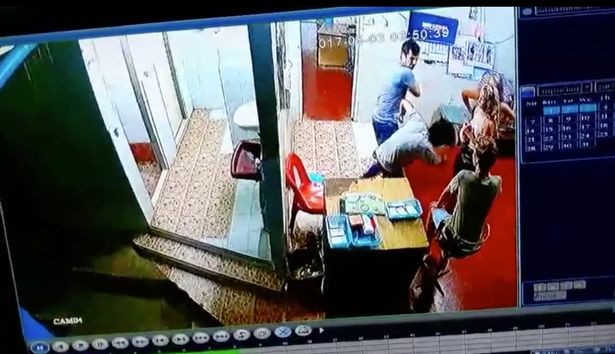
PHUKET — A 5,000 baht bounty has been set for a foreign man who was seen beating a toilet attendant in Phuket’s nightlife district earlier this month.

While police said they have yet to receive a formal complaint over the assault, footage of which went viral on social media, the father of the young man assaulted offered the bounty on Wednesday and said he hopes social media users will help locate the perpetrator.

The father, who spoke to local media without giving his name, said the incident took place May 3 at a toilet facility he owns on Bangla Street, a popular red-light area on Phuket.

Although the victim was widely reported to be 10, the man said his son is 19. He described the attacker as a male white tourist. The attacker refused to pay 10 baht for the toilet, which led to an argument between him and the toilet attendant, the father said.

In the video of the incident, the attacker is seen punching the victim several times, sending the attendant scurrying away.

A reward of 5,000 baht will be paid to anyone with information leading to the man’s identity and location, the father added.

Jessada Saengsuree, deputy head of Patong police station, said his force has not received any criminal complaint over the assault, but investigators are trying to identify the attacker.

“Investigative work is already proceeding,” Lt. Col. Jessada said.

Advertisement

Hot News

LATEST NEWS

Bangkok
overcast clouds
31.1 ° C
31.6 °
28.3 °
73 %
3.7kmh
100 %
Mon
29 °
Tue
35 °
Wed
34 °
Thu
34 °
Fri
28 °