32.8 C
Bangkok
Saturday, June 27, 2026
Home Blog Page 2465

Trump Proposes 20% Tax on Mexican Imports, Triggers Diplomatic Spat

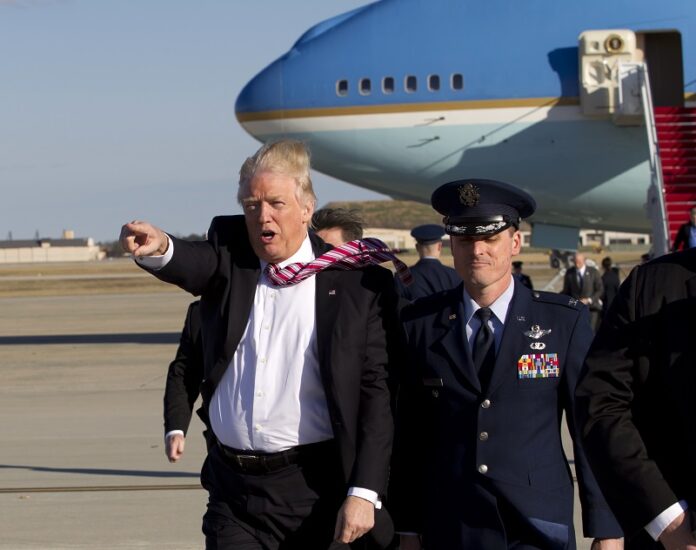
President Donald Trump walks on the tarmac as he waves to the crowd upon his arrival in January at Andrews Air Force Base, Maryland. Photo: Jose Luis Magana / Associated Press

WASHINGTON — Determined to wall off America’s border with Mexico, President Donald Trump triggered a diplomatic clash and a fresh fight over trade Thursday as the White House proposed a 20 percent tax on imports from the key U.S. ally and Mexican President Enrique Pena Nieto abruptly scrapped next week’s trip to Washington.

The swift fallout signaled a remarkable souring of relations between Washington and one of its most important international partners just days into the new administration. The U.S. and Mexico conduct some USD $1.6 billion a day in cross-border trade, and cooperate on everything from migration to anti-drug enforcement to major environmental issues.

At the heart of the dispute is Trump’s insistence that Mexico will pay for construction of the massive wall he has promised along the southern U.S. border. Trump on Wednesday formally ordered construction of the wall.

The plan was a centerpiece of Trump’s election campaign, though he never specified how Mexico would fund the project or how he would compel payments if Pena Nieto’s government refused.

The two leaders had been scheduled to discuss the matter at the White House next week. But Pena Nieto took to Twitter Thursday to say he had informed the White House he would not be coming.

In a speech in Philadelphia later Thursday, Trump cast the cancellation as a mutual decision. He said that “unless Mexico is going to treat the United States fairly, with respect, such a meeting would be fruitless, and I want to go a different route. We have no choice.”

On the flight back to Washington, Trump’s spokesman told reporters the president was considering the 20 percent import tax to foot the bill, the most specific proposal Trump has ever floated for how to cover a project estimated to cost between USD $12 billion and USD $15 billion.

“By doing that, we can do USD $10 billion a year and easily pay for the wall just through that mechanism alone,” Spicer said. “This is something that we’ve been in close contact with both houses in moving forward and creating a plan.”

Spicer said Trump was looking at taxing imports on all countries the U.S. has trade deficits with, but he added, “Right now we are focused on Mexico.”

But the announcement sparked immediate confusion across Washington, and the White House tried to backtrack. During a hastily arranged briefing in the West Wing, chief of staff Reince Priebus said a 20 percent import tax was one idea in “a buffet of options” to pay for the border wall.

A 20 percent tariff would represent a huge tax increase on imports to the U.S., raising the likelihood of costs being passed on to consumers. Half of all non-agricultural goods enter the U.S. duty free, according to the office of the U.S. Trade Representative. The other half face import tariffs averaging 2 percent.

Mexican Foreign Relations Secretary Luis Videgaray said Thursday, “A tax on Mexican imports to the United States is not a way to make Mexico pay for the wall, but a way to make the North American consumer pay for it through more expensive avocados, washing machines, televisions.”

Mexico is one of America’s biggest trade partners, and the U.S. is the No. 1 buyer from that country, accounting for about 80 percent of Mexican exports. A complete rupture in ties could be damaging to the U.S. economy and disastrous for Mexico’s. And major harm to Mexico’s economy would surely spur more people to risk deportation, jail or even death to somehow cross the border to the U.S.  undercutting Trump’s major goal of stopping illegal immigration.

House GOP lawmakers and aides interpreted Spicer’s comments on a 20 percent border tax as an endorsement of a key plank of their own tax plan, which Speaker Paul Ryan has been working to sell to the president. The House GOP “border adjustability” approach would tax imports and exempt exports as a way of trying to help U.S. exporters and raise revenue.

Earlier this month, Trump called that concept confusing. And during the White House’s clean-up efforts Thursday, Spicer wouldn’t say whether Trump agreed with the border adjustment tax being considered by the House GOP.

The new president has previously raised the prospect of slapping tariffs on imports, but had not suggested it as a way to pay for the border wall.

There’s also disagreement within his new administration over the effectiveness of tariffs in general. Wilbur Ross, Trump’s nominee for commerce secretary, dismissed tariffs for trade negotiations during his confirmation hearing, saying the 1930 Tariff Act “didn’t work very well then and it very likely wouldn’t work now.”

Pena Nieto has faced intense pressure at home over his response to Trump’s aggressive stance toward his country. Until this week, Mexico had tried its traditional approach of quiet, cautious diplomacy combined with back-room discussions, sending Cabinet officials for talks with the Trump administration.

But that changed when Trump decided to announce his border wall on Wednesday  the same day that two senior Mexican Cabinet ministers arrived in Washington for preliminary talks ahead of what was to be a presidential tete-a-tete. Many Mexicans were affronted by the timing, and Pena Nieto faced a firestorm of criticism at home.

The diplomatic row recalls the rocky days of U.S.-Mexico relations in the 1980s, prior to the North American Free Trade Agreement, a pact that Trump has vigorously criticized.

“There is a change in the understanding that had been in operation over the last 22 years, when Mexico was considered a strategic ally,” said Isidro Morales, a political scientist at the Monterrey Institute of Technology and Higher Education. “Trump has unilaterally broken with this way of doing things.”

Story: Julie Pace, Mark Stevenson

Advertisement

Mexican President Calls Off Meeting with Trump

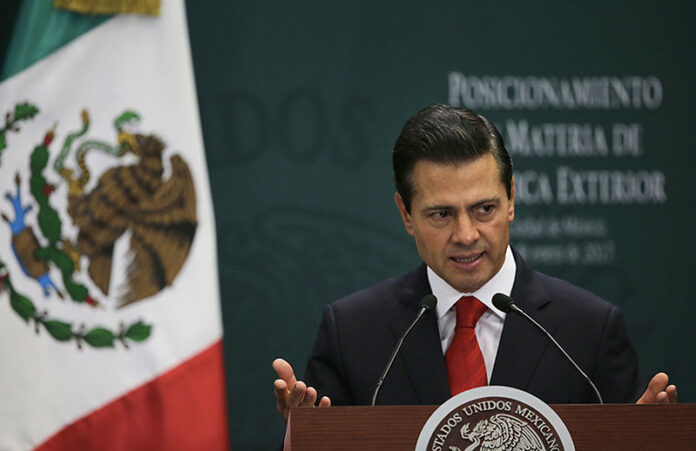
Mexico's then President Enrique Pena Nieto speaks in 2017 at Los Pinos presidential residence in Mexico City. Photo: Marco Ugarte / Associated Press

MEXICO CITY — Mexican President Enrique Pena Nieto said Thursday he will not attend a planned Jan. 31 meeting with President Donald J. Trump, hours after Trump tweeted that the meeting should be canceled if Mexico won’t pay for a border wall.

Pena Nieto’s message on Twitter ended days of uncertainty about how he would respond to Trump’s aggressive stance toward the country, and illustrated the challenges world leaders are likely to face in dealing with Trump’s voluble, Twitter-based diplomacy.

“This morning we have informed the White House I will not attend the working meeting planned for next Tuesday,” Pena Nieto tweeted.

“Mexico reaffirms its willingness to work with the United States to reach agreements that benefit both nations,” he added.

In Washington, White House press secretary Sean Spicer responded to the Mexican president’s announcement, saying: “We’ll look for a date to schedule something in the future. We will keep the lines of communication open.”

Earlier Thursday, Trump had tweeted that “If Mexico is unwilling to pay for the badly needed wall, then it would be better to cancel the upcoming meeting” in Washington D.C.

Trump said Wednesday he would start building a U.S.-Mexico border wall and has vowed to make Mexico pay for it. Mexico opposes the wall and has repeatedly said it won’t pay.

Officials had said Mexico was “considering” canceling after the border wall announcement, but Trump appeared to beat Mexico to the punch in that game of brinkmanship.

Former foreign relations secretary Jorge Castaneda told local media that after Trump’s tweet, “Pena Nieto has no other choice but to say ‘I’m not going.'”

Trump’s unpredictable style appeared to catch Mexico’s normally quiet and cautious diplomacy off guard.

“I think that, in general, diplomacy is not conducted via Twitter,” Finance Secretary Jose Antonio Meade told Radio Formula.

Mexico’s best-known opposition politician, leftist Andres Manuel Lopez Obrador, tweeted that “in the face of Trump’s latest outburst, don’t go to the meeting, and submit an urgent complaint to the U.N. for human rights violations.”


Story: Mark Stevenson

Advertisement

Ecology of Intrusion: Report Details Thai State’s Assault on Internet Privacy

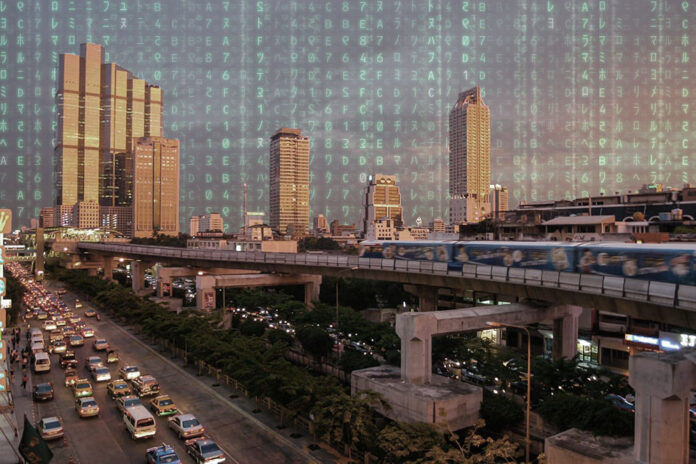
Original image: Diliff / Wikimedia Commons

BANGKOK — When Facebook abruptly vanished from virtual Thailand in 2014, it was as if the social media-addicted masses were exposed to the vacuum of space.

The gasping lasted about 30 minutes until access was restored, and suspicion immediately turned to the military, which only six days prior staged a coup d’etat and had long sought control of the internet.

Theories about why – and how – the new regime pulled the plug became widely debated, but the truth of what happened that day is laid out in a new report from a London-based nonprofit which lifts the veil on how online surveillance in the kingdom relies on control of the infrastructure and those who operate it, feeble rule of law and even indirect help from the world’s largest software company – Microsoft.

The author of the report published Thursday by Privacy International said it all adds up to willful disregard of the public’s expectation of privacy and legal obligations.

“When they can intercept communications without having a legal framework that allows companies to refuse this, it means they have open-door access to people’s information,” Eva Blum-Dumontet said. “It’s a clear violation of people’s rights to privacy and [the government’s] international agreements.”

Read: Thailand’s New Online Fad: Social Surveillance

The report relies on well-placed sources, media reports, government records and technical analyses to lay out the cultural, structural and technological means by which the authorities surreptitiously assault security.

Representatives of the government said they either could not or would not discuss the issues raised in the report.

‘You arrive in power, and the first thing you try to do is shut down Facebook? That reveals a poor understanding of the internet.’

The Facebook Experiment

Most alarming perhaps are indications the government has systematically sought to defeat the encryption used to keep web traffic private – what to most is the difference between an http or https in a URL.

That was the goal, the report alleges, when all of Thailand’s service providers secretly complied with a regime request to shut Facebook down on May 28, 2014.

It cites a source in the telecommunications sector, an account confirmed by someone then at the former ICT Ministry, who said the regime wanted Facebook traffic to be rerouted over http instead of its encrypted https connection.

“My source told them this was not something that could be done; this was not how it worked,” Blum-Dumontet said.

The attempt did not seem successful or well-conceived, she said.

“You arrive in power, and the first thing you try to do is shut down Facebook?” she said. “That reveals a poor understanding of the internet.”

In the immediate aftermath, the ICT Ministry’s permanent secretary was blunt in comments to the media: He said Facebook had been shut down until the regime could win its “cooperation” in censoring criticism.

Military reps quickly hand-waved those comments away, insisting it was the result of an unintended technical glitch.

The revised story unraveled two weeks later when the Norwegian owner of one of those ISPs, DTAC, disclosed its role in shutting down Facebook on order of the junta. Telenor Asia Vice President Tor Odland said the company was put in a difficult position between upholding human rights and complying with a government where it does extensive business.

Hill & Knowlton, which handles publicity for Facebook in Thailand, said the California-based social media giant did not respond to forwarded inquiries.

‘Door-Knocking Surveillance’

How did authorities so easily win the cooperation of private enterprise to act against their customers’ interests?

The report attributes that to incestuous public and private sectors in which the same well-connected people move between – or are appointed to – top government and corporate positions.

State-owned enterprises own and operate the nation’s international telecoms infrastructure, and the report notes even private telecommunications companies are entangled with the state.

“While CAT Telecom and TOT are state-owned, successive Thai governments over the past few decades have maintained close relationships with private telecommunication companies and ISPs through appointments which starkly exemplify the revolving door between the government and the private telecommunications sector,” the report reads.

No. 1 telecom AIS and other early data services firms were founded by Thaksin Shinawatra, who went on to become prime minister. After he was ousted by a 2006 coup, the military claimed telecoms had been used to spy on those investigating Thaksin for corruption.

No. 3 True Corp. is part of Charoen Pokphand, one of the world’s largest conglomerates. CP is in the hands of the Chearavanont family, which the report notes has close ties to the current regime.

It was No. 2 DTAC whose European parent company blew the lid off the secret shutdown order, which its CEO then had to grovel in apology for – without ever retracting the facts of what happened.

And recently the internet backbone has been further brought into the fold of the national security infrastructure.

In October 2015, after hacktivists first assaulted government servers to protest a plan to route all traffic through a single point of control, the government rebranded the effort as a business-friendly policy to promote a “digital economy.”

Just as CAT Telecom was to be handed the reins of that effort, the military’s top national security official, Gen. Thawip Netrniyom, was installed as board chairman. It was the first time the head of the National Security Council took such a position.

With friends and family holding the keys, the government, Privacy International says, doesn’t need to break down doors – just knock politely.

Junta spokesman Col. Winthai Suvaree could not be reached for comment Thursday.

Asked about the Privacy report, government spokesman Sansern Keawkamnerd said, “it’s not an issue in Thailand though a lot of people try to make it one.”

Told a reporter was calling from Khaosod English, Sansern declined to speak further.

“I am available to talk, but I won’t talk to you because I have no faith in your organization, the same way some of your editors have no faith in the government.”

In the past, officials have made the case that they need better tools to police the internet against threats to national security, mainly those who would defame the monarchy and cyber criminals who operate in or through Thailand. And everything, they routinely say, is done in according with the law.

‘Microsoft has not been keen to answering these questions’

Misplaced Trust?

One month after the Facebook outage, a fresh scandal erupted when Facebook users were redirected to a fake Facebook login screen which collected their usernames and passwords.

That shouldn’t be possible because of a security system by which sites and computer operating systems use independently signed digital certificates to attest to their validity. Go to Pantip.com and the website will present a certificate verified by Comodo Group, a so-called Certificate Authority that issues certificates worldwide.

While defeating the system should be impossible, it happened in Tunisia during the Arab Spring, when Privacy International said websites that “looked exactly like Facebook, Gmail and Yahoo were created to steal the username and passwords of Tunisian users.”

Tunisia did that by using a root certificate to trick people’s browsers into wrongly trusting the bogus sites.

The Thai government also has its own root certificate.
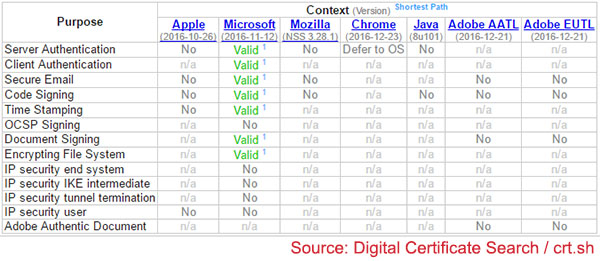
Source: Digital Certificate Search / crt.shNeither Apple, Firefox-maker Mozilla, nor Java automatically trusts it, however. The only widely used platform that does? Microsoft Windows.

That means trying to use a spoofed website signed with the government certificate would return an error for someone on a Mac while Windows users wouldn’t notice a thing.

Blum-Dumontet suggests users who get certificate warnings trying to access known websites should not dismiss the warnings and press on. She said they should stop and use another encryption layer provided by something like Tor. Those who’ve accepted dodgy certificates should change their passwords, she added.

No smoking gun connects the spoofed Facebook page with Thai authorities, and Privacy does not present any evidence of the government’s certificate being abused.

“We’re aware of the potential for abuse, and we know it’s been abused in other countries,” Blum-Dumontet said. “We think it’s significant that Apple and Mozilla have refused the certificate. Up to now, at least, Microsoft has not been keen to answering these questions.”

An inquiry with Michael Karimian, human rights program manager at Microsoft went unreturned. Afterward, Blum-Dumontet said she received a statement from the Redmond, Washington-based software company.

“Microsoft does not disclose its internal decision making process, but the overall process can be found on our website, http://aka.ms/rootcert,” read the forwarded statement. “Generally speaking, Microsoft looks at the [Certificate Authority’s] Certificate Policy, Certificate Practices, and then consider the benefits and risks to Microsoft’s customers.”

On Thursday, Microsoft issued a statement to the media saying it “only trusts certificates issued by organisations that receive Certificate Authority through the Microsoft Root Certificate Programme” in a process that is regularly audited by a third party.

“Thailand has met the requirements of our program and you can review the details of the latest audits here and here (PDF),” it continued. “This thorough review, backed by contractual obligations, is not reflected in Privacy International’s assessment of the risks.”

If the junta sees any charity on Microsoft’s part, it would be a rare accommodation by a tech world that has otherwise rebuffed its requests for special treatment.

Over the years, the regime’s repeated efforts to win cooperation of providers such as Facebook, Google and Line have been rebuffed.

After seizing power in the May 2014 coup, the junta dispatched Maj. Gen. Pisit Pao-in, formerly head of the Technology Crime Suppression Division, to win the cooperation of those three companies in censoring and gaining access to users’ social media accounts. He continued in similar roles into early 2016.

Reached for comment, Pisit, who currently serves on the National Reform Steering Assembly, said he was just a middleman helping the government reach out. He said he was unaware of any attempts at direct surveillance.

“You need to ask those in the government who is responsible for it,” he said Thursday.

Cache and Sniff

Privacy International, which in September released a report on the government’s use of “social surveillance,” said people should be concerned because smoking guns have been found of government attempts to defeat email encryption.

Analyses of the conversation that happens between an email client such as Microsoft Outlook, and a mail server in late 2014 found “the military government was conducting downgrade attacks” to force them to connect via an unencrypted channel.

“There was an active attempt to reroute the traffic,” Blum-Dumontet said.

She suggested a simple safeguard: “Just use webmail.”

More low-tech but effective tools have been acquired by Thai authorities over the years.

Between 2012 and 2015, Thailand has spent more than 62 million baht on International Mobile Subscriber Identity devices, , according to mandatory disclosures by the governments of Switzerland and the United Kingdom.

The devices mimic cell phone towers. When mobile phones are in range, they will begin talking and sharing their data which can then be recorded.

In its report, Privacy called on Thai authorities to live up to its obligations under Section 32 of the charter adopted by referendum in August and international agreements. The London-based organization’s work in Thailand began prior to the coup with the support of the Swedish International Development Cooperation Agency.

Additional reporting Sasiwan Mokkhasen

Advertisement

Memes Go Dank in Response to Hotel Painting Caper

Image: Basement Karaoke / Facebook

BANGKOK — We may never know what beautiful paintings prompted a senior Thai bureaucrat to steal them during his stay at a hotel in Japan as alleged earlier this week. But we can certainly appreciate the flurry of memes that burst forth like colors on a canvas.

Suphat Saguandeekul, 60, was arrested in Kyoto on Tuesday after he reportedly stole three paintings from the hallway of the hotel he was staying in an official business trip. Japanese media said Suphat confessed to the theft of the artefacts, which cost about 6,600 baht in total.

Even more than the absurdity of the theft of hotel paintings, what rubbed salt on the joke’s potential to wound was the fact Suphat is deputy director of the Intellectual Property Department, instantly unlocking infinite opportunity for dank, dank memes.
A screenshot of TNN24's post.
A screenshot of TNN24’s post.

While an Associated Press account said the paintings portrayed nondescript landscapes, that didn’t stop domestic media from more wild speculation.  Several news outlets picked up an account that one of the three paintings allegedly stolen by Suphat was that of AV star Saori Hara. TNN24 posted the claim on its Facebook, but took it down by Thursday afternoon.

Either way, the internet got busy almost as soon as the digital ink was dry on freshly published news accounts.


‘I really like this episode of Superman,’ – Pim Thai Mai Dai, a prolific commentator on Thai current affairs.


c3aukaexeaablv5
The Deputy Director didn’t steal. He already asked the Japanese. They said Hai!

In the tradition of Thai punnery, this manga suggests that it was the hotel staff who gave the paintings to Suphat upon his request. The word “give” in Thai is ‘hai,’ which sounds like a word of acknowledgment in Japanese.


Some people also tried to present “alternative facts” about what happened. This person said Suphat actually appreciated the art so much that he decided to take it back to Thailand physically, instead of snapping photos of it, because doing so would have violated copyright laws.


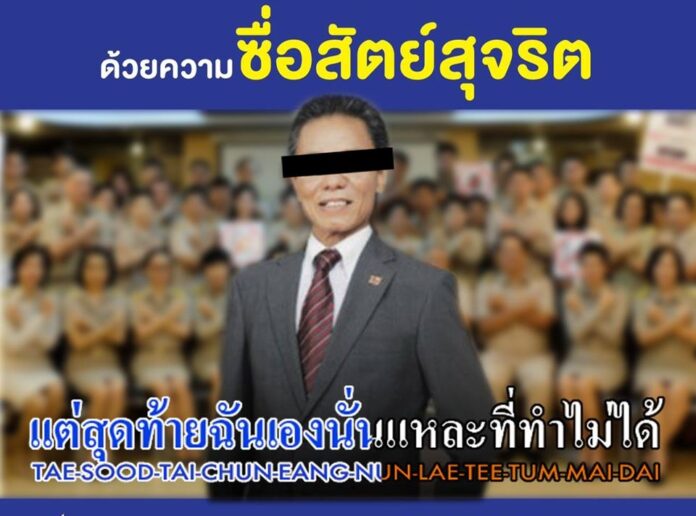
Meanwhile, Suphat’s department came under a barrage of criticism and ridicule, not least because its recently shared online its pledge to “work with honesty,” free of corruption.

“I heard your deputy director was arrested for theft in Japan?” wrote user Chartchai Tiamsanit on the thread. “It’s even more serious than infringing on intellectual property! How very honest!”


Basement Karaoke immediately jumped on the opportunity by posting a verse from a 2011 hit by boy band Season 5: ‘In the end, it was me who couldn’t do what I said.’


A cartoon by Society of 8-Bit Lovers likewise lampooned the department for rooting out counterfeit goods and copyright infringements, yet failing to stop a top official from allegedly stealing paintings.


"Deputy Director!! What the hell did you do!???"
“Deputy Director!! What the hell did you do!???”

User Weetaporn Munkongjaroenying posted a manga rendition of the department’s mascot cursing Suphat for bringing shame to his organization.

Advertisement

Radical Monk Sues Muslim Group for Calling Him Fake on Facebook

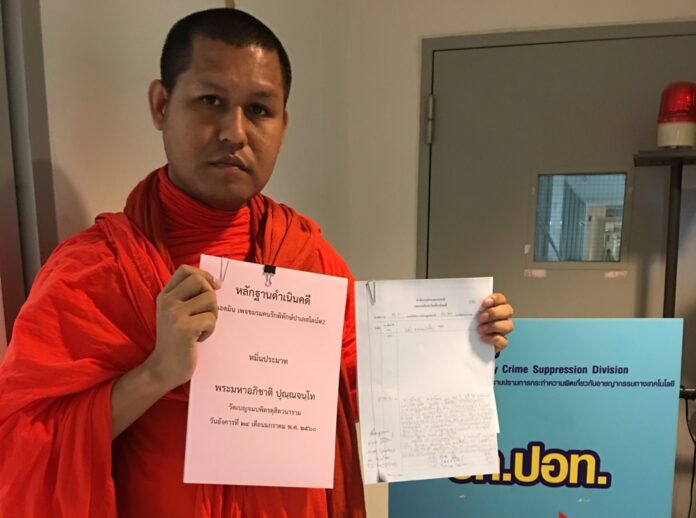
Phra Maha Aphichat Punnajantho shows his complaint on Wednesday at Technology Crime Suppression Division in Bangkok.

BANGKOK — A Buddhist monk whose called for a mosque to be destroyed every time a Buddhist is killed in the south of Thailand filed charges Wednesday against a Muslim group for calling him a “fake monk.”

In the latest spat between religious groups, Phra Maha Aphichat Punnajantho filed his complaint against Facebook page We Love and Defend Palestine under a cybercrime law that criminalizes any act of defamation or false information posted online or possessed on a computer.

Aphichat’s grievance was a Tuesday post condemning him as a “fake monk” for his anti-Muslim hate speech.

“That article [post] has caused damage to me,” Aphichat, 31, told reporters Wednesday. “It made people misunderstand that I am a fake monk.”

He added that if he won the criminal case, he would sue the page and “everyone who commented” on the post for 1 million baht in damages for libel.

“I will not show any mercy to the Muslims for doing this,” the monk said.

Police said they will investigate the case.

In response to the criminal complaint, the admin of “We Love and Defend Palestine” thanked its fans for support and vowed to continue to speak out against people who cause hatred between the two religions.

“I promise to keep walking and fighting those who exploit religious issues to incite hatred and divisions among our Thai Muslim and Buddhist brethrens,” the admin wrote.

A well-known preacher based at Benchamabophit Temple in Bangkok, Aphichat once said in an interview he wanted to emulate hardline Buddhist monks in Burma by organizing an anti-Islam movement in Thailand. He regularly uploaded videos of himself berating Muslims or calling for restrictions on Islam, such as putting a ban on new mosque constructions.

In perhaps the most infamous speech, Aphichat urged Buddhists in the southern border region of Thailand to band together and burn a mosque for each Buddhist killed by Muslim separatists.

After the speech drew widespread condemnation, the government reportedly asked Aphichat to deactivate his Facebook in early 2016. He did so, but returned to his social media platform earlier this month to coordinate a charity effort for the flood-stricken south.

“Because of the flood situation in the south, I had to come back,” Aphichat wrote.

Since then he had made no comment about Islam, but did congratulate security forces for killing a suspected insurgent on Jan. 16.

Related stories:

Thai School Director Transferred for Banning Hijab

BKK Airport Apologizes for Searching Muslim Cleric’s Headwear

Advertisement

Column of Bananas Worshipped for Lottery Luck (Photos)

Soontorn Saichue, crouching, and visitors make offerings to her lucky banana tree Thursday morning in Roi Et province.

ROI ET — A 77-year-old woman’s banana tree with an unusually ample supply of bananas has drawn worshippers hoping for some good luck.

Hours before winning national lottery numbers would be announced, people have gathered around a banana tree owned by Soontorn Saichue on Thursday morning in Roi Et province seeking better fortune.

“I’ll never cut it down,” Soontorn said. “It brings luck to my family. Since the banana tree started bearing fruit, my health has improved and I’ve never gotten sick. I feel as healthy as a young lady.”

Some offered the auspicious banana tree incense and flowers. Others wai-ed and prostrated, while others ran their hands over the nubs of the nascent bananas in search of numerological guidance.

Popular numbers gleaned from the tree included: 77 (Soontorn’s age), 33 (her house number) and 172 (the anticipated number of hands of bananas the tree will produce).

It’s no ordinary banana tree. The species of Set Tee Roi Whee Pun Loog, or Hundred Hands, Thousand Fruits Millionaire, banana tree has a two-meter bunch of bananas hanging from the stalk.

Soontorn said the lucky, two-year-old tree, bore hundreds of baby bananas just recently. She said neighbors who tried to plant offshoots of the lucky tree in their own yards failed.

Online, however, Thai netizens have responded with mixed reactions.

“Here they go again. Some experts should come out and say that it’s just typical of a species of banana tree,” Facebook User Aekkarin Muangthong wrote before giving in to his natural curiosity. “Anyway, what numbers did they get from the tree?”

Soontorn Saichue, 77, with her lucky banana tree Thursday morning in Roi Et.
People count the hands on Soontorn Saichue’s lucky banana tree Thursday morning in Roi Et.

Related stories:

Baby Golden Turtle Rubbed for Lucky Lottery Numbers

This Giant Snake Ate 5 Chickens. Now They Hope it Will Make Them Rich.

‘Chosen’ by Sun God, Man’s Quest for Lottery Wealth Ends in Melee (Video)

Lottery Winner Thanks The King’s Late Dog for Her Luck

Advertisement

Actor Shia LaBeouf Arrested on Camera During NYC Livestream

Shia LaBeouf arrives at the Los Angeles premiere of "Man Down" at ArcLight Cinemas Hollywood Nov. 30, 2016. Photo: Chris Pizzello / AP.

NEW YORK — Actor Shia LaBeouf was arrested in New York City early Thursday after he got into an altercation with another man during a performance art project that has seen him chanting “He will not divide us” in front of a live camera since Donald Trump’s first day as president.

Police said LaBeouf pulled the scarf of a 25-year-old man outside the Museum of the Moving Image in Queens, scratching his face in the process. They said he also pushed the man, who refused medical attention.

The tussle happened on the seventh day of a livestream that LaBeouf and two collaborators intend to have running 24 hours a day for the next four years.

They have invited the public to repeat the phrase “He will not divide us,” into a camera mounted on an outdoor wall.

It was unclear whether the camera captured any of Thursday’s confrontation, but it did show the aftermath, including LaBeouf being handcuffed and led off by police.

In the moments before his arrest, he issued a plea into the camera.

“Hey, be nice. Everybody be nice down here, man. Just be nice! That’s the only requirement. Be nice!” he said. “That’s all I ask. Be nice. Pro this, pro that. Cool. But be nice.”

The camera went live the morning of the inauguration. LeBeouf has been a frequent presence. Most of the time he is surrounded by enthusiastic supporters, but the cameras have also shown him getting aggressive with fellow participants.

In one instance, he shoved a man who said “Hitler did nothing wrong.”

In another, he bumped chests with a man who began reciting a white supremacist slogan.

Videos posted on social media show LaBeouf returning to the site before sunrise to resume chanting.

He faces a misdemeanor assault charge and is due in court April 4.

Advertisement

Aussie Open: Venus Williams Becomes Oldest Player to Reach Final

United States' Venus Williams celebrates after defeating compatriot Coco Vandeweghe during their semifinal Thursday at the Australian Open tennis championships in Melbourne, Australia. Photo: Aaron Favila / Associated Press

MELBOURNE, Australia — Venus Williams held up her end of the deal for another all-sisters Australian Open final with a 6-7 (3), 6-2, 6-3 win over CoCo Vandeweghe, becoming the oldest player to reach the final here in the Open era.

The 36-year-old Williams is back in a Grand Slam final for the first time since Wimbledon in 2009 and her first here since 2003, when she lost to her younger sister, Serena.

She could get a chance to avenge that loss  22-time major winner Serena Williams was playing 34-year-old Mirjana Lucic-Baroni later Thursday for a spot in the final.

Williams tossed her racket after clinching the 2-hour, 26-minute semifinal on her fourth match point and put her hands up to her face, almost in disbelief, before crossing her arms over her heart. She then did a stylish pirouette on the court, smiling broadly, as the crowd gave her a standing ovation.

“Everyone has their moment in the sun,” Williams said. “Maybe mine has gone on a while. I’d like to keep that going. I’ve got nothing else to do so let’s keep it going.”

Williams last reached a Grand Slam final at Wimbledon in 2009, the longest gap between major finals for any player in the Open era.

She’s also the oldest player to reach a women’s major final since Martina Navratilova, then 37 and 258 days, at Wimbledon in 1994.

The 25-year-old Vandeweghe was playing in the last four at a major for the first time and was the only semifinalist younger than 34. She’d advanced with back-to-back wins over top-ranked Anglique Kerber and French Open champion Garbine Muguruza and took charge against Williams in the first-set tiebreaker.

But Williams, a seven-time major winner, rallied after dropping a set for the first time in the tournament, breaking Vandeweghe four times over the final two sets and putting pressure back on her fellow American.

“It means so much, mostly because she played so well. She played so unbelievable,” Williams said. “I had to play defense the whole time, if felt like.

“There was never a moment of relaxation ever so to be able to get to the final through a match like this, I’m just excited about American tennis, as well.”

Vandeweghe said earlier in the tournament she’d admired the Williams sisters as an up-and-coming player, and once asked for Venus’ autograph. Williams said one of the best things about her longevity in the game was having an influence on other players.

“Growing up, all I wanted was to have an opportunity to play these tournaments. But then you get here and then you have an opportunity to inspire other people,” she said. “It’s more than a cherry on top. It’s more than I dreamed of.”

Earlier, Bob and Mike Bryan earned a shot at a seventh Australian Open doubles title after a rain-interrupted 7-6 (7-1) 6-3 semifinal win Friday over Pablo Carreno Busta and Guillermo Garcia-Lopez.

Story: John Pye

Advertisement

Bangkok Bus Blows Past Red Light, Smashes Car (Video)

BANGKOK — A bus driver was fined 500 baht Wednesday for running a red light and crashing into another car.

Authorities suspended Jirapat Pan-iet from driving for three days and ordered him to take driving lessons after a video posted online showed him speed through an intersection and plow his bus into the side of the car.

Dashcam footage captured Sunday night shows Jirapat accelerate his No. 27 minibus, which was headed to the Victory Monument, speed past a traffic light and collide with the car at the Nawamin-Happy Land junction in the eastern district of Bang Kapi.

After the video capturing the incident was posted online, the Bangkok Mass Transit Authority called Jirapat into question. The driver, who had no record of traffic violations, admitted fault.

“If he is found violating the law again, he will be punished harder,” said transit authority director Surachai Eamvachirasakul.

As much as the video drew criticism for the public bus driver, netizens also complained about the driver who filmed the incident for speeding up to also run the red light.

“This is a message to the owner of the clip. Please slow your car when you see the yellow light,” Facebook user Witchayut Dachasirasit wrote.

Another user said they should receive the same punishment.

“They should both have their licenses revoked, the minibus driver and the person who filmed the video,” wrote user Poonchai Thongsri. “Apparently they both intentionally ran a red light.”

Advertisement

Police ID Briton, South African as Killers of ‘Web Designer’

A still image from a security camera police say shows Miles Turner in front and Abel Bonito on the back of a motorcycle on Tuesday.

CHONBURI — A court issued arrest warrants Wednesday for two foreigners accused of gunning down a British businessman in broad daylight earlier this week.

Briton Miles Dicken Turner and South African Abel Caldeira Bonito were named by police as the perpetrators responsible for the execution-style killing of Tony Kenway, 39, in Chonburi province on Tuesday. Although police would not confirm any motive on record, officers privately said they suspect it to be a case of an illicit business dispute that turned deadly.

“The warrants were issued this morning for the suspects. They are both foreigners,” Somprasong Yentuam, commander of Chonburi police, said by telephone.

Read: No Suspects Yet in Murder of British Businessman

He said police are still trying to track down the two suspects, and it is unclear whether they have left the country as alleged in some media reports.

According to police briefing documents seen by Khaosod English, 23-year-old Bonito was the gunman who fatally shot Kenway in his parked Porsche while the 27-year-old Turner served as the driver of a getaway motorcycle.

Police said their movements were captured by security cameras.

Despite police description of Kenway as a website designer, the Briton owned a slew of luxury assets suggesting other means: a mansion in Pattaya’s Jomtien neighborhood and a fleet of high-end vehicles including the Porsche he was sitting in when he was shot in the head.

Maj. Gen. Somprasong said police had no information Kenway was involved in any illegal enterprise.

“I have not seen any details about that,” Somprasong said. “I don’t know where all these online news get the info from.”

However, investigators privately told reporters Kenway and his accomplices ran a boiler room scam for years, fleecing millions of baht from victims. The British man later fell out with his partners, which led to the killing, the police sources said.

Advertisement

Hot News

LATEST NEWS

Bangkok
overcast clouds
32.8 ° C
36.6 °
32.7 °
68 %
3.3kmh
100 %
Sat
37 °
Sun
36 °
Mon
35 °
Tue
34 °
Wed
33 °