27.8 C
Bangkok
Sunday, August 30, 2026
Home Blog Page 2979

Gen. Prayuth Meets US Ambassador Davies

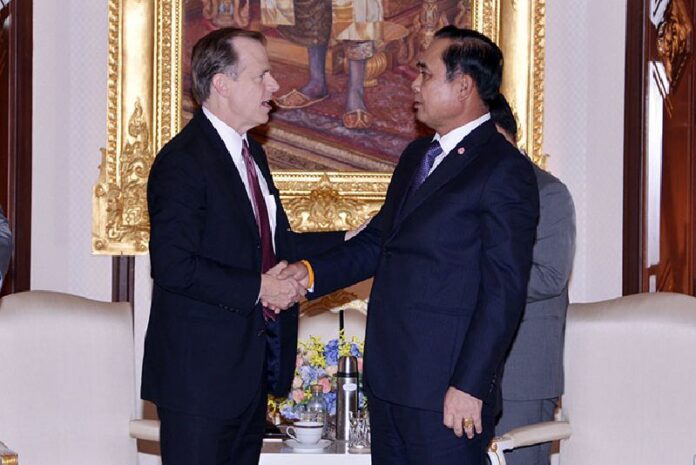
U.S. Ambassador Glyn Davies meets with junta chairman Gen. Prayuth Chan-ocha this afternoon at government house.

BANGKOK — Recently installed U.S. Ambassador Glyn Davies met with junta chairman Prayuth Chan-ocha this afternoon at Government House.

The two men made an introduction and discussed several issues such as democracy, the economy and public health in the first meeting between a top American envoy and Gen. Prayuth since the latter seized power in May 2014, straining relations between the two traditional allies.

“We hope that Thailand will follow the road map back to democracy” Davies said after the meeting, adding that he has urged the junta chairman to increase space for expression of opinion and political participation.

The meeting was said to last about 90 minutes.

A government spokesman said Prayuth spent nearly two hours explaining the past decade of Thai politics to Davies. 

\

“He wants him to look back at the history,” Weerachon said.

The spokesperson also said Prayuth defended his policy on free expression to Davies.

“We have been using Article 44 of the interim constitution constructively. We have never harmed or caused trouble to anyone, except those who are involved in criminal cases, which have to go through the system.” Weerachon said. “The prime minister has also insisted on [credibility of] Thai justice system, which has been discredited by some people.”

Advertisement

District Chief May Sue ‘Smart Ass’ Vendor Over Viral Clip

Screens from a cellphone video of an encounter between a citizen and a municipal enforcer at Bangkok's Saphan Lek Market. Image: Fortyfive Bikershop / Facebook

BANGKOK — A top city official today said he has advised the district chief of Phra Nakhon to sue the man who uploaded a video clip of a recent confrontation to the internet.

Responding to a viral clip filmed during the demolition of Saphan Lek in which a municipal enforcer threatened to have a vendor summoned by the junta for “attitude adjustment,” an adviser to Bangkok Gov. Sukhumbhand Paribatra said today the clip was edited down to defame the district chief and municipal enforcer, or tessakit, seen in the clip.


Bangkok 'Tessakit' Threatens to Attitude-Adjust 'Smart Ass' Citizen


Wichai said he had advised District Chief Somchai Tripittayakul to file a lawsuit at the Technology Crime Suppression Division against the cameraman.

The video posted yesterday showed a testy exchange between the officials and the impertinent vendor. The fight started when the vendor commented it was the first time in his 30 years there that he’d ever seen the district chief walking around.

“So, you are fortunate?” asked the chief.

“No, I am not fortunate. But it is fortunate for your feet to be walking here!”, answered the cameraman who also posted the clip on his Facebook account Fortyfive Bikershop.

The chief was angry and told the tessakit to take the man’s photo. The tessakit also asked for his full name and ID card. When the man refused, the angry tessakit threatened to send soldiers to bring him in for the kind of attitude adjustment session that has become customary following the May 2014 coup d’etat.


Wichai said the officers appeared in the clip went to inspect the demolition site every day since it began Oct. 20. He said the attitude adjustment mentioned in that argument actually referred only to a friendly chat to increase understanding, so they could provide suitable help.

Phra Nakhon District Chief Somchai said he was not available to answer questions today while the tessakit, Wasan Boonmuenwai, declined to answer questions when reached for comment.

The mood at Saphan Lek was tense again this morning as dissatisfied vendors shouted at the officers from the Metropolitan Electricity Authority who came to cut off the power.

On Oct. 20, the Bangkok Metropolitan Administration started clearing the decades-old Saphan Lek market, which was illegally built over Khlong Ong Ang on the western edge of Chinatown.

Authorities said after 10 days, they had removed 169 of 500 stalls from the area. The demolition is expected to finish Nov.15.


Related stories:

Bangkok 'Tessakit' Threatens to Attitude-Adjust 'Smart Ass' Citizen

Demolition Day: Dismantling of Saphan Lek Begins

One-Year Reprieve Sought for Saphan Lek Market

City Hall Denies Colluding With Developer to Demolish Saphan Lek

Vendors Revolt as BMA Moves to Demolish ‘Saphan Lek’


Advertisement

Yingluck Rice Subsidy Trial to Stretch Through End of Next Year

Former Prime Minister Yingluck Shinawatra receives flowers from her supporters at the Supreme Court in Bangkok today

BANGKOK — It will be November 2016 before the last witness testifies in the malfeasance trial of former Prime Minister Yingluck Shinawatra over her government’s subsidy for rice farmers, according to the details of an agreement reached today between the prosecution and defense.

Yingluck, who was at the Supreme Court today with her attorney to settle on a list of 43 witnesses who will be called to testify during the 11-month trial, plans to be present on each day of testimony.

“After that, Yingluck will deliver a closing statement of the case, and a judgment date will be appointed,” her lawyer, Norawit Lalang, said after emerging from the court today. “At this hour, we have to do our best. We cannot be worried about anything. We will prove that the scheme did not cause damage to the country, as many sides have alleged.”

Yingluck, who led the government from 2011 to 2014, is facing trial under the Supreme Court’s Criminal Division for Holders of Political Office on charge of negligence. Prosecutors accused her of causing billions of baht in damage to the state through a corruption-plagued rice price subsidy policy overseen by her government.

Under the subsidy program – a key policy of her administration – the government bought rice from farmers at above-market prices but then struggled resell it on the international market, accumulating stockpiles and resulting in huge financial loses.

According to the National Anti-Corruption Commission, the scheme was riddled with mismanagement and corruption that cost the country more than 500 billion baht in damages.

If guilty, she could face up to 10 years in prison.

The commission filed the lawsuit against Yingluck after her government was toppled by the military in the May 2014 coup d’etat. Apart from the lawsuit, the commission also successfully got Yingluck impeached and banned from politics for five years.

Read: Junta’s Legislature Votes Overwhelmingly to Impeach Former PM Yingluck 

Yingluck and her supporters, known as the Redshirts, argue that the legal action taken against her is politically driven.

Around 100 Redshirts showed up at the court today to show their support for Yingluck. The former PM thanked them for their support, but urged them to comply with orders issued by the ruling military junta.

“I’d like to thank everyone who sends their moral support to me,” Yingluck said. “However, I’d like to ask them to uphold orders of the NCPO [National Council for Peace and Order] so that there is stability, because I also want to see peace in the country.”

She declined to answer questions about a campaign by some Redshirts on social media calling for her supporters to wear red shirts in solidarity across the country on Sunday. Other Redshirt leaders have disavowed the campaign and government officials have threatened prosecution of any Redshirts who participate by wearing a red T-shirt.

Related stories:

Junta Asks Redshirts Not to Don Red Shirts

Advertisement

After Bombing, Ratchaprasong Boosts Security for New Year

Revelers celebrate the new year in a Dec. 31, 2013, photo at CentralWorld. Photo: Bangkok Countdown / CentralWorld

BANGKOK — Almost 900 private security cameras will be installed before year’s end in the commercial heart of Bangkok along with other measures to boost confidence after a bomb attack killed 15 tourists there in August.

Following the bombing of the Erawan Shrine, which killed 20 altogether and threatened to scare away tourists, the number of cameras covering the Ratchaprasong area will be doubled in hope of boosting confidence in the area, where many of the capital’s luxury malls are clustered and tens of thousands will gather New Year’s Eve.


Billions of Baht Later, Doubts Persist About Bangkok CCTV


Chai Srivikrom, president of the Ratchaprasong Square Trade Association, said the new cameras would be faster at helping law enforcement, who depend heavily on the technology.

“We expect that if anything occurs, we must be able to identify the culprit or suspect within 15 minutes,” Chai said. “In the bombing of the Erawan Shrine, it took around 45 minutes until we could capture an image of the suspect.”

The association paid for the cameras and did not disclose the cost.

About 80 of the new cameras will be Panasonic-built 4K systems, which record images at a resolution higher than most displays in common use.


A demo video of Panasonic 4K CCTV footage


Low-quality image from August captured a suspect in the Aug. 17 bombing of the Erawan Shrine

With the number of cameras increasing from 1,300 to 2,155 – along with 500 security guards hired to patrol the area – Chai said businesses were confident of regaining trust from visitors during the end-year season, when tourism peaks in the kingdom.

The usual 300,000 people or so visiting the area each day increases by more than 25 percent during the holidays, Maj. Gen. Anan Srihirunaccording of the metro police said. He said combined security forces from from patrol officers to special operations and the bomb unit will be sent to keep the area the safest part of the capital.

The Aug. 17 attack raised doubts about Bangkok’s expensive CCTV system when police said they were hampered in tracking the attacker by broken cameras. Other footage obtained from municipal cameras was of unusably low quality.

Chai believed the expensive new system was worth the investment and that he coordinated with City Hall to adjust some obstructed lines of sight as well as add more lighting for improved surveillance.

Though the number of CCTV cameras operated by the Bangkok Metropolitan Administration increased from 20,000 to 50,000 during the past five years, a recent study by a criminal justice professor found Bangkok residents did not feel any safer as they doubted the system worked properly.


Related stories:

Billions of Baht Later, Doubts Persist About Bangkok CCTV

Advertisement

Protected Gaur Loved by Locals Killed Near Wildlife Sanctuary

A photo of ‘Khai Dam’ the gaur after he was found dead in Krabi province yesterday. Photo: Chatree Sakunbunma / Facebook

KRABI — A 6-year-old wild gaur named Khai Dam was shot dead at a palm oil plantation during a crackdown on land encroachment yesterday.

Forest guards carried the 800-kilogram body of the animal, a protected species of which few remain, to an office in a nearby wildlife sanctuary after it was found dead Wednesday morning at a palm oil plantation in the southern province of Krabi. Nine gunshot wounds were found in its legs and body, with severe trauma injuries to his neck.

Head of the Khlong Phraya Wildlife Sanctuary, Meechai Aiyasoon, said he already had some clue as to the identity of the gunman, and said he would be tracked down and charged with illegally killing the protected animal. Gaurs are protected under the 1992 Wild Animal Reservation and Protection Act.

Khai Dam first traveled across the border from Surat Thani province to Krabi to feed about a year ago, a forest protection official said. A couple of weeks ago he was found feeding around palm oil and rubber plantations in Krabi’s Plai Phraya district, where his friendly personality had won the adoration of local villagers.

Prior to his death, forest guards at the Khlong Phraya Wildlife Sanctuary went to tear down property encroaching in Surat Thani’s Phrasaeng district, which shares a boundary in the same protected area. Meechai said he had arranged a team to monitor Khai Dam and told locals know not to annoy him as it could cause stress to the animal.

Few of the once-prolific and now endangered, gentle animals remain in Thailand. In 2014, dozens of gaurs turned up dead in Kui Buri National Park in Prachuap Khiri Khan province.


\


Advertisement

New Myanmar Nationalist Party Surges Into Election Race

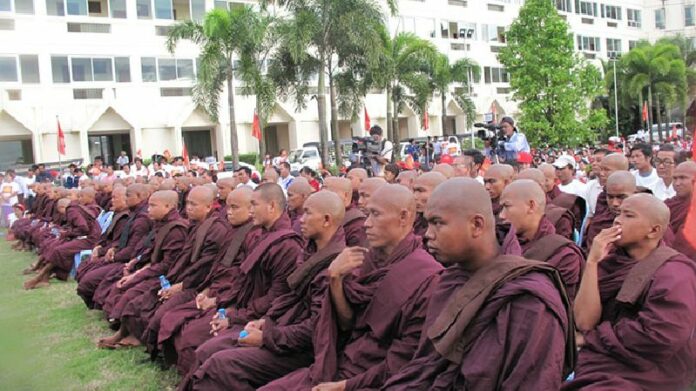
Monks listen to speakers at a National Development Party event in the Mon State capital of Mawlamyine on Oct. 12. The town's Maha Myaing Monastery and Myazedi (Yekyaung) Monastery are said to be the cradle of the radical Buddhist group Ma Ba Tha. Photo: Myanmar Now / Phyo Thiha Cho

MAWLAMYINE, Myanmar — With just weeks before Myanmar’s landmark elections, a fleet of cars covered with stickers of the National Development Party carrying flag-waving party supporters and Buddhist monks crawled through the streets of Mawlamyine, Mon state’s capital.

The convoy was heading to the Strand Hotel on the banks of the Thanlwin River. Most party faithful were wearing white T-shirts emblazoned with the NDP’s symbol – a golden dancing peacock – some of the shirts also bore the slogan “racial protection law has come into effect!”

The NDP only became an official political party in early July 2015, but the Buddhist nationalist party has surged into contention in Myanmar politics, ranking fourth among political parties in terms of both funding and numbers of candidates fielded for the Nov. 8 poll.

On the lawn of the Strand Hotel, some 60 monks were assembled, many from the Maha Myaing Monastery and Myazedi (Yekyaung) Monastery, believed to be the cradle of the radical Buddhist group Ma Ba Tha. Behind them gathered hundreds more people, listening intently to the speakers.

“Around the world, every country, its people and religions, focus on their own interest. So it is out of the question that we do not safeguard and protect our race and religion,” said Nay Zin Latt, former presidential adviser and founder of the party, to applause from the audience. He was clad in a traditional pale apricot Burmese taikpone coat and a string of jasmine flowers round his neck.


\

‘We completely endorse the race and religion protection bills!’ reads a typical slogan on a campaign bus for The National Development Party. Photo: Myanmar Now / Phyo Thiha Cho


Religious tensions are running high in Buddhist-majority Myanmar ahead of the election, largely stoked by Ma Ba Tha, which has emerged as a powerful force.

In late August, President Thein Sein signed onto the statute books the last of four controversial “Race and Religion Protection Laws” championed by radical Buddhists but decried by rights groups as aimed at discriminating against the country’s Muslim minority, as well as eroding the rights of women.

The NDP strongly supports the laws, but its leaders deny that they are stirring up animosity towards Myanmar’s Muslim minority for political gain.

Some 350 NDP candidates will contest 134 seats in Lower House, 60 seats in Upper House and 160 seats for state and regions parliament, trailing only the ruling Union Solidarity and Development Party, the main opposition National League for Democracy of Aung San Suu Kyi, and the National Unity Party, formerly known as Burma Socialist Programme Party.

So how has the party managed to shake up the political landscape in such a short space of time? Paik Tin, a political columnist and head of policy for the NDP, said the party had the backing of many wealthy members.

In an interview at a wooden house in Mawlamyine with the NDP signboard hung outside, Paik Tin outlined the party’s platform, which appeared to be centered on “defending” Buddhism.  

 “We are insisting to protect race and religion because majority of our party members are Buddhists. The existing situation demands us to do so,” said Paik Tin, as party members around him used their mobile phones to record the interview and take photographs.

 “As some said our country is the last stronghold of Theravada Buddhism, so we are responsible to take seriously the protection of our religion and nationality. But we reject the accusation that we are using religion for political influence.”


\

 National Development Party supporters listen to speakers at an Oct. 12 rally in the Mon State capital of Mawlamyine. Photo: Myanmar Now / Phyo Thiha Cho

New Kid on the Block

The NDP was formed in the early part of 2015 by presidential adviser and prominent businessman Nay Zin Latt, who resigned from his post to found the new political movement.

According to the Union Election Commission, the NDP applied for the formation of a party in March and for registration in early July. Aung Htwe, the party vice chairman, said it now counts members in the hundreds of thousands across the country.

The party says its platform is not only based on religious nationalism, it says it is seeking to grow national prosperity, improve education and healthcare and bring an end to armed conflicts in Myanmar.  But its opponents say its populist message will not appeal to better educated voters.

Thaung Hla, chairman of National Unity Party in Mawlamyine, said his party has instructed its 31 candidates in Mon state not follow the NDP’s populist approach and to keep religion out of political campaigning.

 “We do not accept mixing religion and politics. Religion should not be misused in politics,” he said, adding that his party had instructed its 31 candidates in Mon state not to use religion in political campaigning.

Although the NDP has made no secret of its support for the new laws, in speeches, campaign slogans and banners, Aung Ko Ko, a Lower House candidate for the NDP, looked irritated when asked if his party was an extension of the radical Buddhist Ma Ba Tha movement.

“We are accused of conducting campaigns in collaboration with Ma Ba Tha to use religion for politics. It is not true. But we have common objectives,” the 40-year-old ethnic Mon said.

He said his party received spontaneous support from young people who form the volunteer groups that organize alms donations for monks in Mawlamyine.

But many among the monks’ order reject the NDP’s campaign tactics.


Religion and Politics

Ven Silacara, deputy chief  Buddhist monk of Ramanya Nikaya, which has great influence on the Buddhists of Mon state, said while he supported the nationalistic laws, they should not be used in political campaigns.

The 70-year-old monk lectures to 800 monks and novices every day at a monastery in Mawlamyine.

“We appreciate the emergence of nationalistic law, but we will not take part in campaign of political parties,” he said.

Another prominent Mon monk, Venerable Okkansa, who was detained for over 15 years in the notorious Insein prison for political activities, agreed: “All political parties are conducting campaigns. But they do not use religion for attracting votes.”

Mi Kon Chan, an NLD candidate from Paung Township, said some politicians were whipping up fear among Buddhist voters, particularly in rural areas, who had been told their religion would be under threat if the NLD wins the election, after the party objected to the new “race and religion” laws in the last parliament.

 “I have experienced dirty campaigning,” said Mi Con Chan, a Buddhist woman, married to a Buddhist. “They said my husband is Kalar (Muslim) and I am not a Buddhist.”

Story: Phyo Thiha Cho

Advertisement

Fake Foreign Lovers, Including ‘David Cameron,’ Scam Women for 29M Baht

A fake passport purportedly used by one of the scammers as posted to the 'Thai Anti Scam' page on Facebook. Photo: Thai Anti Scam / Facebook

BANGKOK — A Thai woman who lost 23 million baht is among victims fleeced by online scammers who posed as foreign lovers, including one said to have used a photograph of British Prime Minister David Cameron.

Pornnapat Chartphuek, administrator of a Facebook page called Thai Anti-Scam, filed a police complaint on behalf of the victims yesterday claiming they had lost a total of 29 million baht to scammers, including one woman who gave 23 million baht to a man posing as a romantic interest online.

“These days, 15-20 victims complained to my page each day,” Pornnapat told police at the Crime Suppression Division. “Most of the scammers are Nigerians. They use Facebook and chat applications to befriend the victims. They used photos of good-looking farangs or foreign politicians, like David Cameron, the British Prime Minister.”

Pornnapat’s Facebook page is dedicated to raising awareness about the scams, reports of which have become increasingly common, among Thai women and taking legal action on behalf of victims.


\

An image posted to an online community dedicated to exposing scammers posted this photo of a Facebook profile which used photos of British PM David Cameron. Photo: Thai Anti Scam / Facebook


Scammers approached the victims on social media sites and posed as wealthy foreigners, according to Pornnapat. Once they secured the victims’ trusts, the scammers would promise to marry the victims in one or two weeks and claim to send gifts to the victims, she said.

After the bait was set, the scammers would reportedly convince the women into sending large sums of money, claiming their presents had been held by Thai Customs officials who demand taxes or fees to clear the goods. Once the money was transferred, the scammers would vanish.

Pornnapat added that some Thai women were involved in the scam.

“They would persuade the victims into believing these men were credible,” she said.

She also told reporters that one of the victims – the one who lost 23 million baht – has already filed a complaint to the Division of Special Investigation early this year, but the case has gone nowhere.

Police Lt. Col. Teerapat Thareethai, an officer at Crime Suppression Division, accepted Pornnapat’s complaint yesterday and said he would investigate the matter.

“We will summon related individuals to collect their testimony,” Teerapat said.


\

A fake passport purportedly used by one of the scammers as posted to the 'Thai Anti Scam' page on Facebook. Photo: Thai Anti Scam / Facebook

Related stories:

Suspected Member of 'Nigerian Scam' Arrested With 1.8 Million Baht

'Nigerian Email Scammer' Arrested By Thai Police


To reach us about this article or another matter, please contact us by e-mail at: [email protected].

Follow Khaosod English on and Twitter for news, politics and more from Thailand.

\

Advertisement

Bangkok 'Tessakit' Threatens to Attitude-Adjust 'Smart Ass' Citizen

Screens from a cellphone video of an encounter between a citizen and a municipal enforcer at Bangkok's Saphan Lek Market. Image: Fortyfive Bikershop / Facebook

BANGKOK — A video posted online today and currently making its way around the net seems to capture a brief encounter between a private citizen and public servant during the demolition of Saphan Lek Market.

In the video posted to Facebook by Fortyfive Bikershop, the inspection turns into a confrontation when a municipal enforcer known as tessakit decides to win an argument with the cheeky citizen by threatening to send soldiers to take him in for “attitude adjustment.”


A copy of the video uploaded to YouTube


Here's how it went down:


Cameraman: What are you doing ?

Technician: Removing the electricity meter.

A man believed to be the Phra Nakhon District chief walks past.

Cameraman: Oh, this is the first time I have ever seen you walking here. Are you the director of the district office? I have been living here for 30 years, and this is the first time I’ve seen you here.

District Chief: So, you are fortunate?

Cameraman: No, I am not fortunate. But it is fortunate for your feet to be walking here!

District Chief: Smart ass!  Take a photo of him. One day you will be visited!

District Chief walks off. The tessakit pulls out his phone and asks to take a photo of the cameraman. The guy refuses, but the tessakit takes it anyway.

Tessakit: What’s your name?

Cameraman: You already know me.

Tessakit: My name is Vasan. What’s your name?

Cameraman: My name is Note.

Tessakit: What’s your full name?

Cameraman: You don’t need to know my full name.

Tessakit: Let me see your ID card.

Cameraman: Oh, are you threatening me?

Tessakit: I’m not threatening. I’m asking to see it. Will you let me?

Cameraman: No.

Tessakit: OK. That’s all, and we will see, Note. Don’t be such a smart ass! You will fucking see me later!

The tessakit begins walking away, so the cameraman follows him.

Cameraman: So people can’t say anything?

Tessakit: This is too much. You will be called for attitude adjustment.

Cameraman: You can’t do that!

Tessakit: You will see if I can. I’ll bring the military to adjust your attitude.

They continue walking and arguing.


Deputy Bangkok Governor police Gen. Asawin Kwanmuang today said demolition of the market was now 33 percent completed since it started eight days ago.


Related stories:

Demolition Day: Dismantling of Saphan Lek Begins

One-Year Reprieve Sought for Saphan Lek Market

City Hall Denies Colluding With Developer to Demolish Saphan Lek

Vendors Revolt as BMA Moves to Demolish ‘Saphan Lek’

Advertisement

China Summons US Ambassador Over Destroyer in South China Sea

The guided-missile destroyer USS Lassen participates in a multinational naval exercise in waters to the south of the Korean Peninsula in a file photo. Photo: EPA / Naval Air Crewman Evan Kenny

Beijing — Beijing summoned the US ambassador to China to express its "strong discontent" after a US naval destroyer sailed close to islets occupied by China but claimed by the Philippines, state media reported.

Beijing said the USS Lassen illegally entered Chinese territorial waters when it sailed early Tuesday near the disputed Spratly, or Nansha, group of islands.

"China will do whatever necessary to oppose deliberate provocation from any country," Deputy Foreign Minister Zhang Yesui was quoted as saying by the Xinhua news agency late Tuesday, after summoning U.S. Ambassador Max Baucus.

Zhang dismissed US concerns that China's territorial claims in the region were a threat to transport or regional security.

"There has been and will be no obstruction to navigation and overflight freedom in the South China Sea," he said.

Rather, the American move was "a show of force that is very likely to trigger an accident, threatening the rights of navigation and overflight shared by all countries, and harming peace and stability in the South China Sea," he said.

The U.S. vessel passed within 12 nautical miles (22 kilometers) of the Mischief and Subi reefs in the Spratly archipelago on Tuesday.

China deployed the guided-missile destroyer Lanzhou and frigate Taizhou as a warning to the Lassen, the official People's Daily reported. 

The U.N. Convention on the Law of the Sea stipulates that a nation's territory normally extends 12 nautical miles out from its coastline.

In Washington, Defense Secretary Ashton Carter said the move would not be their last in the region, where the US has several formal allies.

"We will fly, sail and operate wherever international law permits," and whenever US operational needs require it, he said.

Jin Canrong, professor of international affairs at the People's University in Beijing, said the impact of the sail-by on U.S.-China relations is not clear at this point. 

"If it is only a one-time thing, the tension will pass over soon. But if the US navy sails close to the islands regularly, then China might respond by enlarging the scale of island construction and further set up military equipment on the islands," Jin said.  

Chinese construction in the Spratlys, including runways and lighthouses, has been criticized by several nations including the United States.

China's foreign ministry confirmed in June that it was building facilities on reclaimed land in the South China for purposes including military defence, scientific research and navigation safety.

Story: DPA

Advertisement

Thai Net More ‘Not Free’ Due to Military Suppression: Freedom House

A notice signaling content blocked by the government.

WASHINGTON — Thailand’s internet was rated “not free” due to increased suppression under military rule in the latest report from Freedom House, a U.S.-based NGO that monitors democracy and free expression around the world.

Record sentences of decades in prison for Facebook comments deemed insulting to the monarchy were among factors given for Thailand’s lower score in the annual “Freedom on the Net” index released Tuesday.

“More Thai internet users were harassed and arrested during the coverage period than ever before in the wake of the 2014 coup,” the report said.

It also cited demands that people detained by the military government disclose social media passwords as a condition of release, the proposed single gateway project and “digital economy laws” sought by the junta.

“It is attempting to pass a set of wide-ranging ‘digital economy’ laws, including the country’s first cybersecurity and personal data laws,” it said. “These draft laws came under heavy criticisms from academics and internet freedom activists, who argued that they would heavily impact privacy, curtail freedom of speech and hamper the growth of the digital economy, contrary to its name.”

Officials have said they need to govern the internet to rein in online crime, end criticism of the government, protect children from harmful content and defend the kingdom against threats.

Falling one point to 63 this year, Thailand was part of decreased freedom worldwide, the report said. At the bottom of the list was China with 88 points assigned for various abuses and limitations. Iceland is home to the most freedom, according to the index, with only six points.

Freedom House said 2015 is the fifth consecutive year internet freedom around the world declined, as more governments censored information, expanded surveillance and curtailed privacy tools.

Thailand scored equally to Myanmar, while Cambodia (48), Singapore (41) and Malaysia (43) were rated “partly free.”

Freedom House is a nonprofit founded in 1941. Much of its funding comes from the U.S. government.

Related stories:

‘Anonymous’ Declares War on Thai Junta

Advertisement

Hot News

LATEST NEWS

Bangkok
light rain
27.8 ° C
28.3 °
26.9 °
86 %
4.5kmh
100 %
Sun
30 °
Mon
31 °
Tue
31 °
Wed
30 °
Thu
34 °