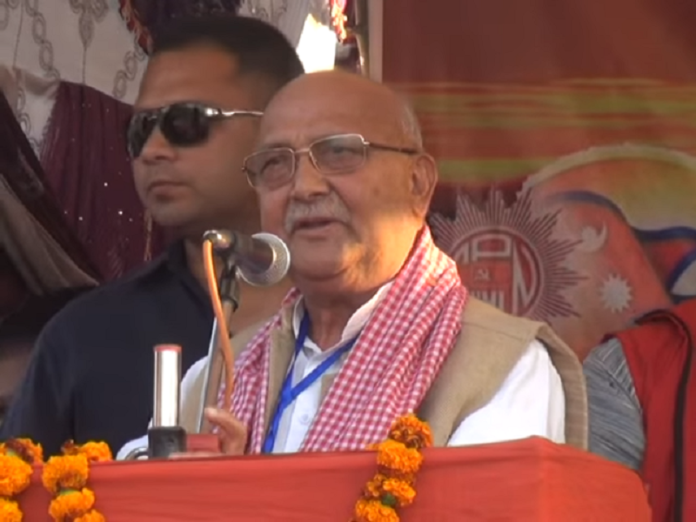
Khadga Prasad Oli speaks in 2016 during a Madhesi Nepalese Convention in Madhesh district, Nepal. Photo: Black Chapter / Wikimedia Commons
KATHMANDU, Nepal — The leader of Nepal’s communist party was named the Himalayan nation’s new prime minister Thursday, a day after the results of parliamentary elections were finalized.
Khadga Prasad Oli, who also served as prime minister in 2015, was to take the oath of office later Thursday, a spokesman for the president’s office said.
Oli will be leading a coalition government made up of his Communist Party of Nepal (Unified Marxist Leninist) and the Communist Party of Nepal (Maoist Center), which took the most seats in the November and December 2017 elections.
The poll results were made official Wednesday night, leading Prime Minister Sher Bahadur Deuba to resign earlier Thursday after eight months in office.
Oli’s biggest challenge as prime minister will be balancing Nepal’s relationship with its giant neighbors India and China, as well as managing lingering internal strife stemming from the country’s new constitution and transition from a monarchy.
The 2015 charter divided the nation into seven provinces that are now governed as a federal republic but sparked violent ethnic protests in southern Nepal that left more than 50 people dead and shut down the entire region for months.
The Madhesi ethnic group was unhappy with the constitution, believing they deserved more territory than assigned for their province. India supported the Madhesi and choked the supply of oil, medicine and other supplies to Nepal, resulting in severe shortages and making Oli’s first turn as prime minister a difficult one.
Landlocked Nepal is surrounded by India on three sides and imports all of its oil and most supplies from India. It also shares a border with China.
The protests eventually fizzled out, but relations between India and Nepal hit a low point.
India appears to be seeking a better relationship with Oli this time around. It sent Foreign Minister Sushma Swaraj to Nepal earlier this month in an apparent move to woo the incoming alliance government.
Oli, 65, was born in a village in east Nepal and has been involved in politics since he was young.
He worked up the ranks of the communist party and was jailed a total of 14 years for opposing the autocratic rule of Nepal’s monarchs. The monarchs banned political parties until 1990, when street protests forced then King Birendra to allow political parties to contest elections and turned him into a constitutional monarch.
The monarchy was formally abolished in 2008.
Oli has a kidney illness and has made regular trips to Thailand for medical treatment.
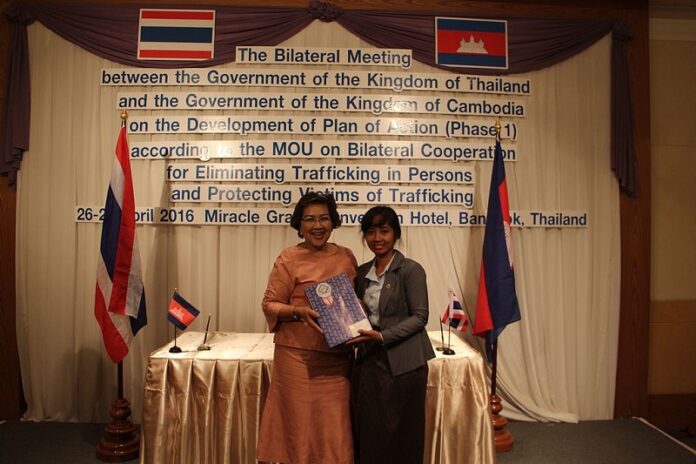
A bilaterial meeting between Thai and Cambodian officials on the Development of Plan of Action according to the MOU on Cooperation for Eliminating Trafficking in Persons held in 2016 in Bangkok. Photo: Inmean / Wikimedia Commons
PORTLAND, Oregon — An Oregon man originally from Thailand has admitted bringing four Thai nationals into the United States to provide cheap labor at his restaurants.
Paul Jumroon pleaded guilty Wednesday to federal charges of forced labor, visa fraud conspiracy and filing a false income tax return.
Prosecutors say Jumroon, of Depoe Bay, used threats of deportation, control over identification documents and other methods to force the victims to work about 80 hours a week for minimal pay.
He agreed Wednesday to pay the victims a combined USD$131,391.95 for their unpaid labor.
Jumroon is scheduled to be sentenced May 24. He faces up to 20 years in prison.
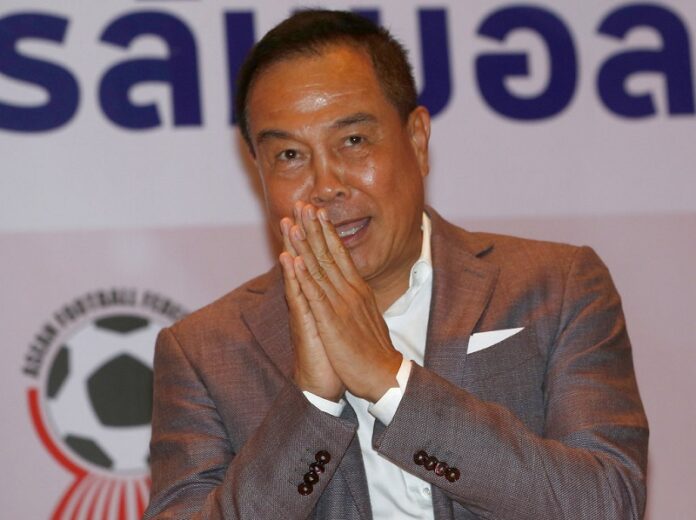
Football Association of Thailand President Somyot Poompanmuang gives a wai after a press conference in November in Bangkok. Photo: Sakchai Lalit / Associated Press
BANGKOK — A former national police chief, who currently heads the Thai Football Association, met with investigators Thursday to explain his financial links with a fugitive massage parlor owner accused of human trafficking.
Somyot Poompanmoung reported to the Department of Special Investigation after admitting that while he was police chief he borrowed 300 million baht (almost USD$9.5 million) from Kampol Wirathepsuporn.
Kampol owned the Victoria Secret massage parlor, which also operated as a brothel, and has been charged with at least 12 separate counts, many related to human trafficking and alleging he prostituted girls who were 15 to 18 years old.
Police raids in January revealed that the massage parlor employed teens and allegedly trafficked some of them into the sex trade. Investigators also discovered that police officers had received sexual favors from staff. Police have raided several other venues that Kampol owns.
Somyot told reporters he was interviewed by investigators as a witness, but declined to elaborate.
Supat Thamthanarug, director of the DSI’s anti-trafficking section, said Somyot’s large loan was under investigation but he declined to provide further details.
Somyot told the media that Kampol was an old friend who shared a love of sacred Buddhist amulets and had helped him out at a difficult time. He said he had repaid the loan and had declared it to the relevant authorities at the time.
The story provoked widespread comment about links between police and the criminal underworld. Newspaper opinion writers condemned the former police chief’s behavior as “shameless.”
Somyot sullied his image further by saying in a media interview that being the country’s police chief had only been a sideline and that his real job was speculating on the stock market.
Somyot made international headlines in 2015 when he announced a reward of 3 million baht (about USD$86,000 then) for information leading to the arrest of the perpetrators of a deadly Bangkok bomb attack, then awarded it to his own police officers once arrests had been made.
He became head of the Thai Football Association in 2016 after leaving his police post. He took over from Worawi Makudi, who was banned in 2016 from all national and international football-related activities for five years by FIFA, the international governing body of football, for ethical violations including forgery.
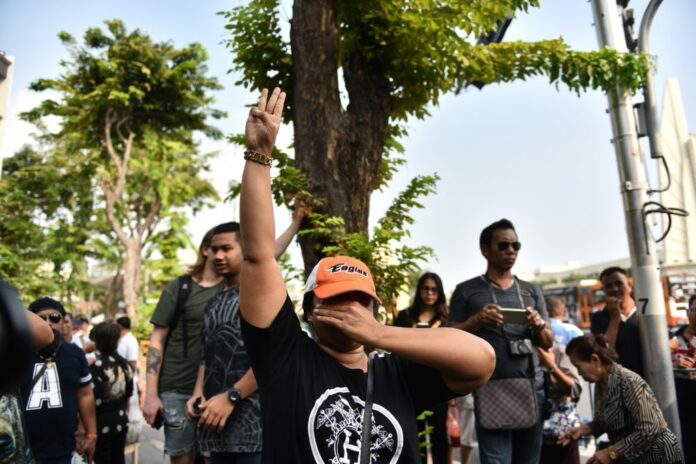
A protester flashes an anti-junta three-finger salute on Saturday
BANGKOK — The military junta followed through with its response to a recent pro-election rally Thursday by filing a fresh batch of criminal complaints.
The 50 complaints filed yesterday include seven leaders who allegedly organized the protest on Saturday and 43 people who joined it, Col. Burin Thongprapai, a junta legal representative, said in an interview. He did not identify any protesters by name, saying he didn’t have documents at hands.
The seven organizers are Nuttaa Mahatana, Chonticha Jaengrew, Rangsiman Rome, Sirawit Seritiwat, Arnon Nampa, Sukrid Peansuwan and Karn Pongpraphapan.
Burin filed sedition charges against the seven and said he wants the rest prosecuted for violating the junta’s ban on protests.
One of the activist leaders, Chonticha, said she’s not surprised by the junta’s move but added she’s disappointed because they already informed police of the protest.
“I am disappointed to a certain degree, because all of these activities were coordinated with security officers,” Chonticha said “just a minute” after she learned she was named in the complaints. “We didn’t break any laws. Section 4 of the constitution gives us the rights to assemble.”
Some of the leaders – Nuttaa, Rangsiman, Sirawit, Arnon and Sukrid – already faced trial for allegedly organizing an earlier pro-election protest on Jan. 27.
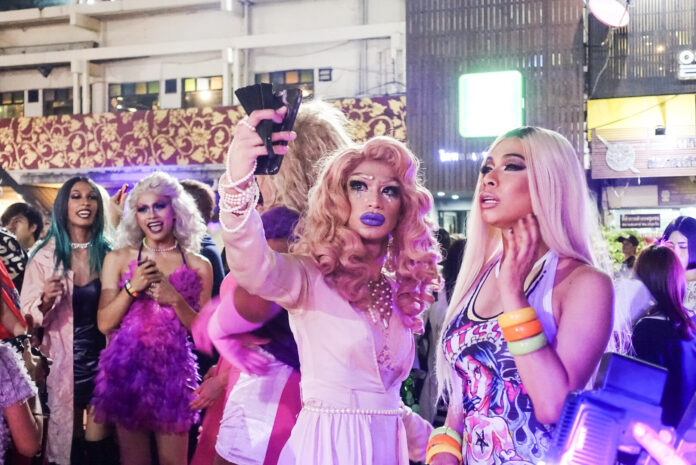
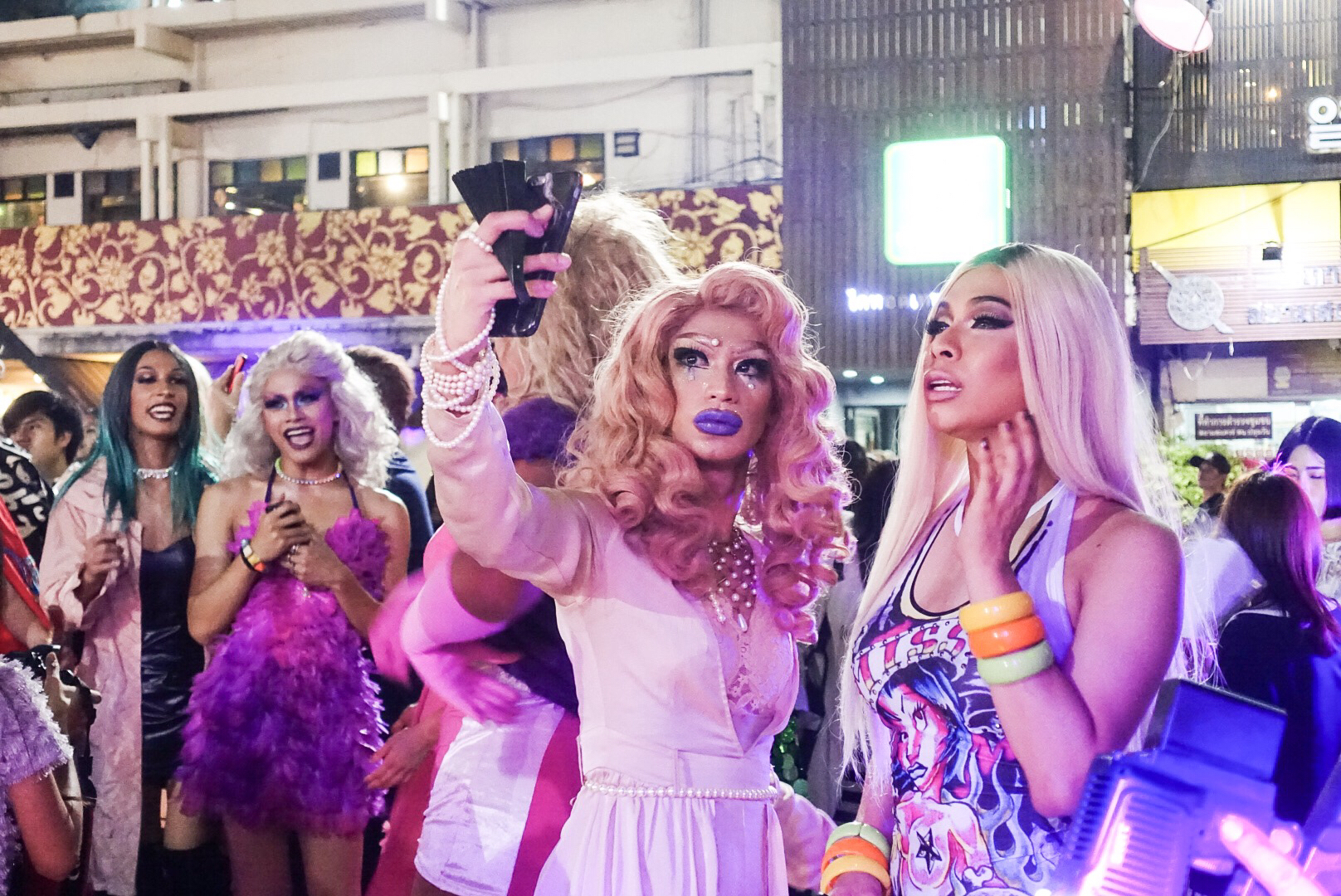
From left, drag queens Morrigan, Amadiva, Jaja and Meannie Minaj in Siam Square.
Top: From left, drag queens Morrigan, Amadiva,
Jaja and Meannie Minaj in Siam Square.
A skinny man with a stylish high fade walks in holding two tall Long Islands. He hands one off and sips the other. He is M.
“Okay, Zepee first, then Cher, Angele, followed by Chaka,” he instructs his colorful crew, who will soon take the stage in that order.
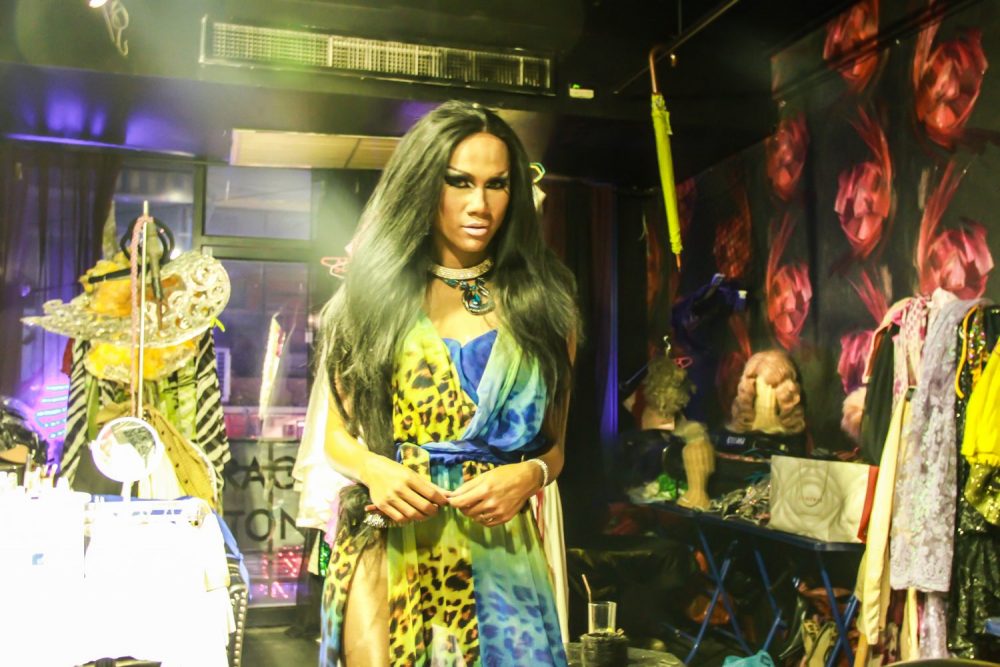
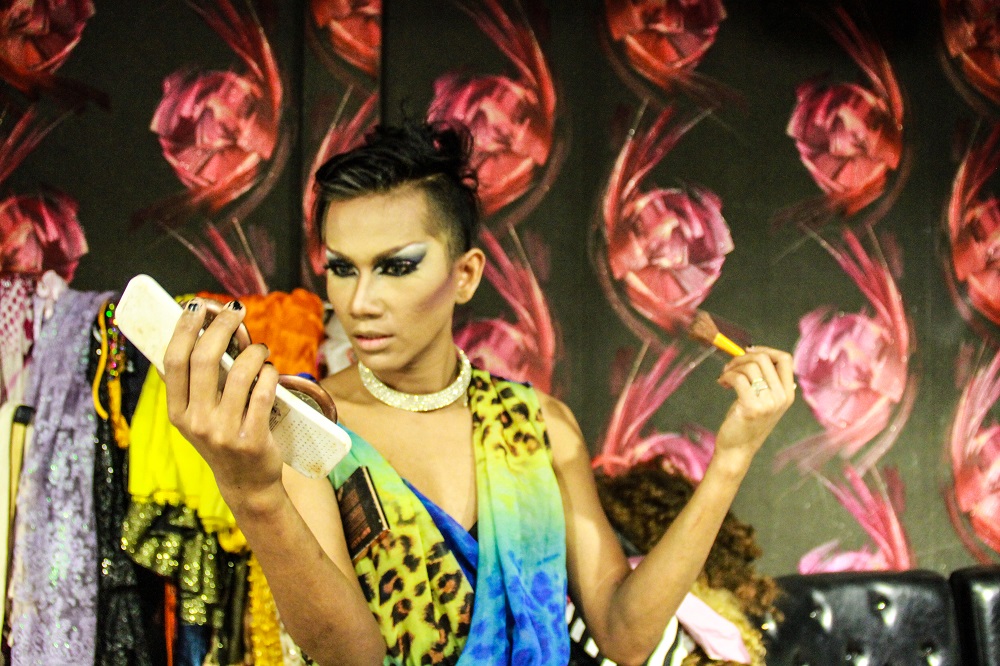
M then slips into a chiffon dress that’s blue and yellow and leopard print. Under a khaki-colored wig cap, he tilts his head down toward a table mirror and puts on a long black wig.
That’s exactly when Chakgai “M” Jermkwam ceases to exist. Now, she is M Stranger Fox.
It’s almost midnight backstage at a shophouse bar in a busy soi off Silom Road when M Stranger Fox leads her drag posse down dark narrow stairs to a mezzanine stage divided by red curtains.
She parts them a few inches to peek at the bar and audience below. Nodding to the DJ blaring a remix of Alaska Thunderfuck’s “Hieeee,” she wraps her fingers around a handheld microphone. She dashes out. The crowd cheers.
'IT'S 2018, MOTHERFUCKER'
M Stranger Fox
'I'M NOT DRUNK, I JUST LOOK LIKE I AM'
Amadiva
'SU SU NA KAA.'
Jaja
#LetThisEnd
#WhoYouLookin'at?
#SinceIt'sComeToThis
#AreYouBipolar?
Meannie Minaj
Zymone
'YOU GOIN' "CRAZY?"
I GO
"SHITTY SHITTY BOOM BOOM!"
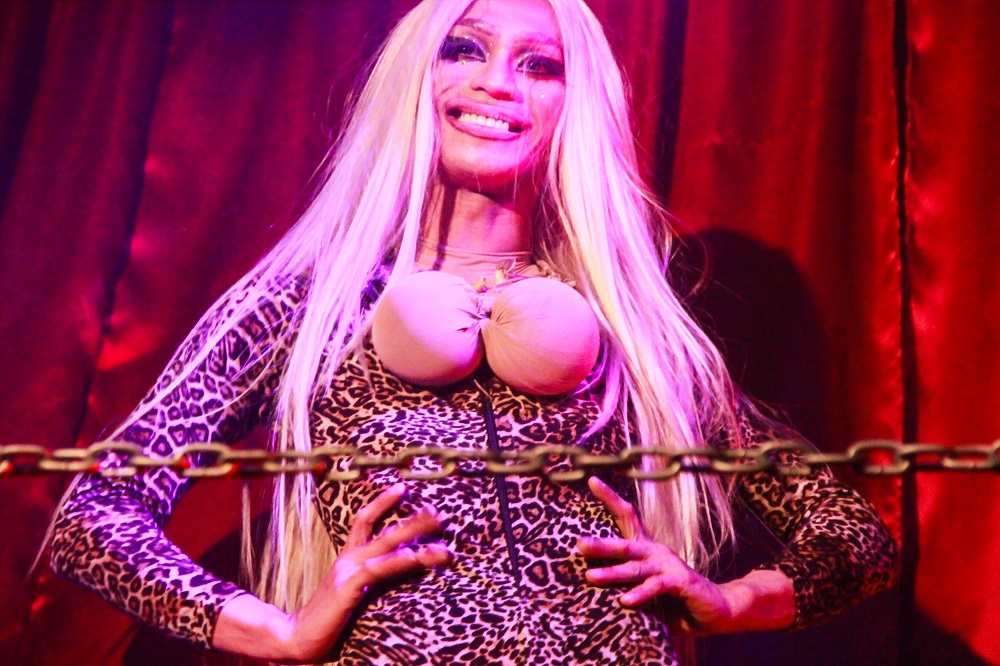
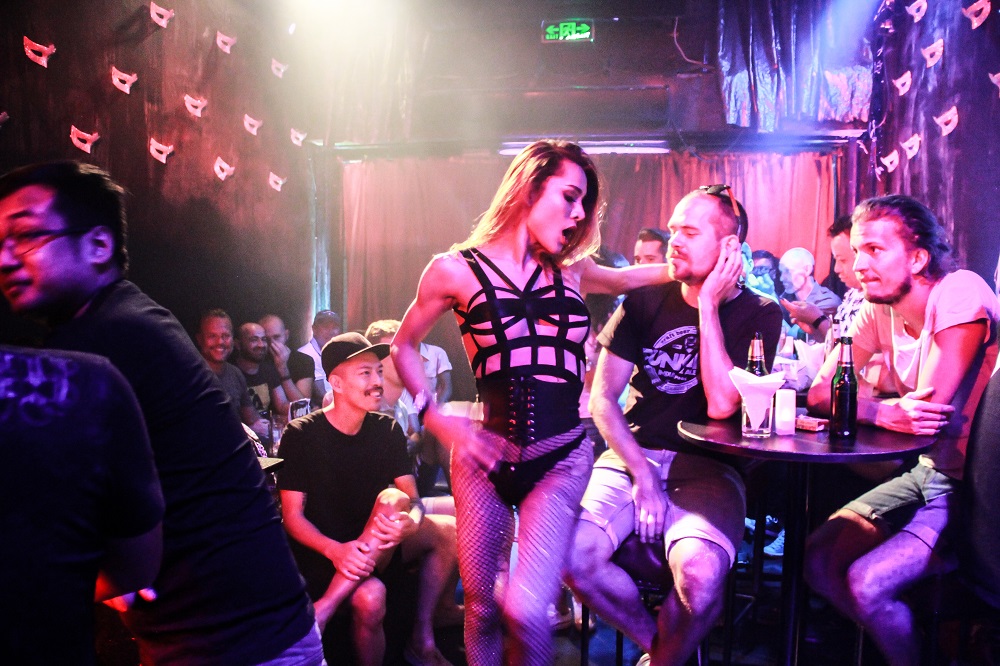
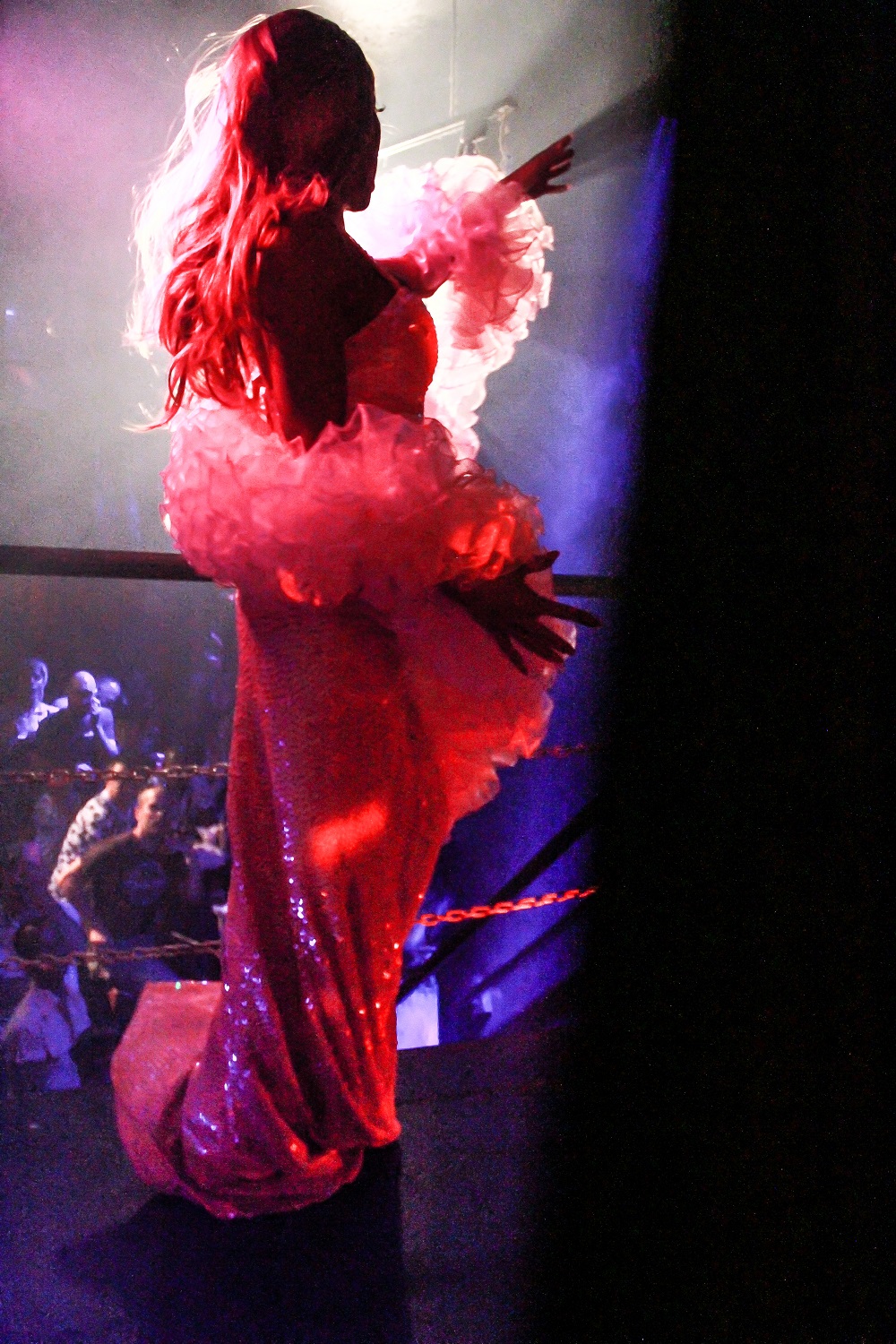
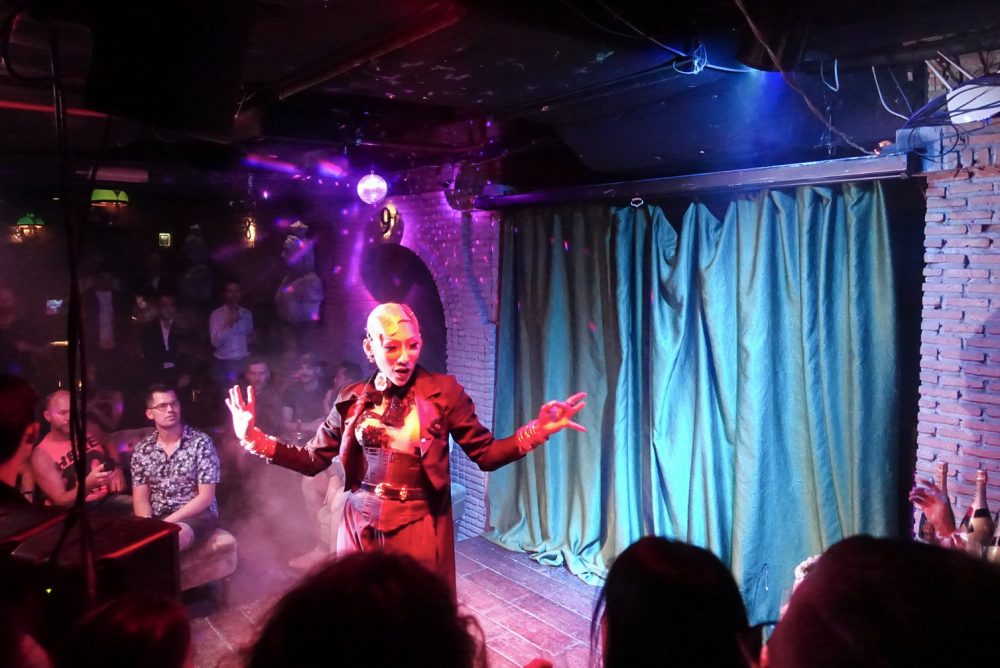
In the 120 minutes to follow at The Stranger Bar, the five drag queens would sashay in and out to deliver high-kicking dance numbers, impeccable lip-syncs, quick-witted jokes and thrown shade to earn some 100-baht tips.
While Thailand is famous for its kathoey, or ladyboys or transgender women, drag queen culture has little history in the kingdom. But it’s global rise as entertainment and identity comes as Thailand is reaching toward a new level of open-mindedness toward LGBT entertainers. Instead of playing the clown, they are seeking respect as artist-slash-geniuses and individuals.
“I never dressed up like a woman before, never wore high heels before. [The Stranger Bar] made me find drag,” M said over a messy pile of heels and boots in the dressing room before the show. “Being drag allows you to be more foul-mouthed. It’s the power of eyelashes, lipstick and high heels.”
M Stranger Fox hosts a Sunday night show.
Thailand stepped into the drag spotlight with the bombshell announcement last month that a show beloved by drag devotees is stomping its stilettos into Asia by way of Bangkok. Thai Drag queens suddenly came into the spotlight.
Although RuPaul won’t appear on “Drag Race Thailand,” it keeps to the original’s format with 10 drag personalities competing to become “Thailand’s Next Drag Superstar.” Licensed by Kantana Group, the show premieres tonight on the free Line TVservice.
“I want to present that we’re not clowns,” said Kantana President Piyarat “Tae” Kaljareuk, who refuses to identify firmly in any one spot on the sexuality spectrum. “We’re the people who have creative ideas, and sometimes we’re even more creative than those in other countries.”
An official announcement of ‘Drag Race Thailand’ on Feb. 2 at EmQuartier.
Consider it a coming out party for the already-out and the way-out. Kathoeys, who in entertainment are almost always cast as buffoons to be laughed at, will become drag superstars under the “Drag Race” values of empowerment, confidence and self-acceptance. They will be measured not as comic relief but, as RuPaul puts it, their “charisma, uniqueness, nerve and talent.”
Hopes are high for the show: Auditions have already opened for the second season.
Charisma
Compared to Western drag destinations such as New York, London, Paris and Sydney, Bangkok is less acquainted with drag queens. Gender-bending entertainers and performers are usually portrayed as showgirls or, in some corners, Weimar-style cabaret performers.
But that doesn’t mean the country is short of fabulous and talented drag performers. Among the aspiring and practicing drag queens, there are queens they look up to.
One is Madonna impersonator Sira Madon, aka Jai Sira, who started out in Australia while a student there. Sira, who offstage is Siravitch Kamonworawut, became in 2008 the only Asian to ever come out on top at a drag-off at Arq in Sydney, one of the drag capitals of the world.
However, drag queen culture has seeped into the mainstream in the past two or three years with the likes of homegrown queens such as Pangina Heals, or Pan Pan Nakprasert, who performs regularly at Maggie Choo’s, Sing Sing Theatre and other events.
Thai-Taiwanese Pan Pan studied fine arts at UCLA and only found drag after returning to Thailand.
“It’s about timeeee,” Pan Pan as Pangina Heals, who will co-host “Drag Race Thailand,” drawled into a mic at a launch event. “Thailand is ready to show off drag talents. We lose to no other.”
Pan Pan is credited with popularizing waacking, a very diva street dance from the ‘70s with a lot of arm-pumping. When he returned to Thailand, he participated in several competition shows and rose to fame by winning the country’s first drag reality competition “T Battle.”
Pangina Heals, middle, performs at a media launch for ‘Drag Race Thailand’
Uniqueness
Many still confuse showgirls and drag queens. To M, drag is about the individual.
“Drag is a solo act. It’s aesthetic and technical, you have to take it very seriously. But a showgirl has to work with others as a team,” M said. “I prefer drag because it can show the real deal. It’s like rap; we get to express all the feelings suppressed inside.”
His attitude informs the nascent scene too. M said he pioneered a system in which performers are not bound to work at only one place. Drag queens who perform at The Stranger can perform elsewhere.
“Venues in Thailand still use the system that restricts a performer to work at one place, but I don’t want that,” M said. “I think drag queens are artists. They can work at other venues. If they grow professionally, I’d be happy too.”
At The Stranger, impersonators of Cherilyn Sarkisian, Nicki Minaj, Beyonce, Rihanna switched in and out to show. Once they come out, with impeccable lip-sync and larger-than-life crowd work, they turned a small shophouse into a wild stage.
The Stranger isn’t the only venue for drag: Performances are sometimes staged at Maggie Choo’s, Sing Sing Theatre, DJ Station, Ce La Vi and a few other clubs.
“It’s like a small competition where they’re all frenemies,” M said. “They release the best of themselves.”
Talent
Pathavee “Aom” Thepkraiwan, or Amadiva, at press conference in Bangkok
Not every drag queen gets a start in bars or nightclubs. Some came by way of the stage.
Pathavee “Aom” Thepkraiwan, or Amadiva for “Drag Race,” is an occasional part of underground theatre troupe B-Floor. On the show, he admits to having a hard time.
“It is sooooo tough,” Amadiva, in a puffy pink dress, growled in an affected drawl. “What I’ve been struggling now is how to fight without losing who I am. I’m not a polished drag queen, but I have to find a way to represent who I am and at the same time get the judges’ approvals.”
Aom was a 17-year-old exchange student in Michigan when he was introduced to drag after coming out to his American host family.
After graduating in fine arts from Thammasat University three years ago, Aom debuted in “My Mermaid Dream” (“Pla Seeroong”) in which he performed solo in a flashy, scaly costume as Miss Ariel, a mermaid desperate for legs and a lover. The show, inspired by genderqueer rock musical “Hedwig and the Angry Inch,” got a theatre run of 18 engagements before and lives on at a bar in town.
Pathavee Thepkraiwan performs as Miss Ariel in ‘My Mermaid Dream’ in 2016 at Crescent Moon Studio. Photo: Beau Naphatrapee / Courtesy
“Why drag? Because I want to tell my own story, and drag is a medium that allows me to tell the story how I want it to be,” 25-year-old Aom said. “No show would offer me a role that is me anyway, so I created one of my own.”
“I like dressing up as a woman, but people have a perception that I have to pick between a masculine gay guy or an effeminate one or be transgender,” Aom said, denying that he’s either. “Not everyone can accept me being drag. I have dated guys who, once they found my Facebook [drag queen photos], they disappeared. But I cannot blame them because it’s about preferences.”
Nerve
“Mabuhay-ieeee,” called out the harlequin Barbie in large pearls and clashing colors, mixing Tagalog and English in one word.
Among the 10 drag personalities of “Drag Race,” Jaja is the only non-Thai.
Jaja, or Angeles R-Jay Carubio, did not come to Bangkok to resume his former drag star life. In fact, the 34-year-old Filipino landed in the city two years ago to teach English.
Being told by another Filipino friend to check out another off-Silom drag review, Jaja walked into The Stranger, applied for a job and got it.
“Then drag found me again,” Jaja said.
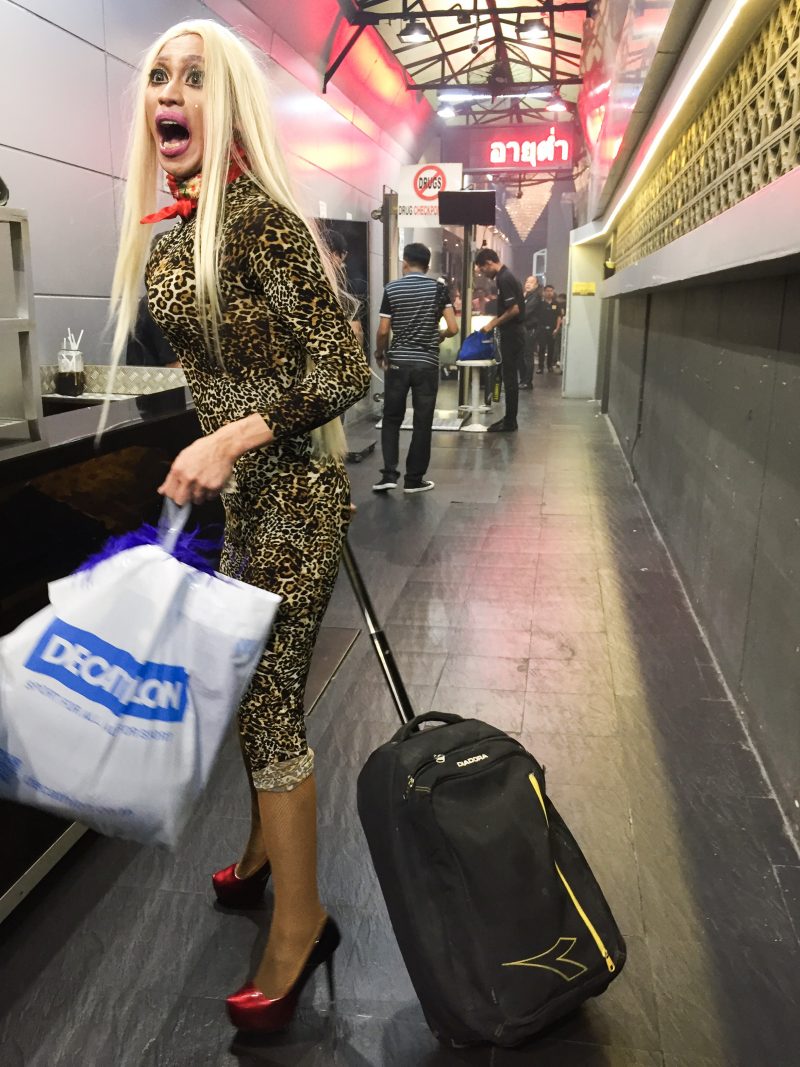
Jaja has a moment after work while hauling her kit into DJ Station on Soi Silom 2.
While RuPaul’s show has brought drag culture into the mainstream in many countries, Jaja said it’s been going strong in the Philippines long before the show first debuted a decade ago.
“The drag scene in the Philippines is really big. There are always new faces, drag queens are everywhere, especially in Davao and, of course, Manila,” Jaja said during a break in her performance at Maggie Choo’s.
Compared to her home country, she said the Land of Smiles is still beginner-mode.
“Thailand’s drag scene is very small. It lacks drag queens like Pangina Heals, Jai Sira and Ann Freeman,” she said. “I think Thailand needs some more of these people.”
As drag is all about fashion and entertainment, there is a spectrum of styles the queens can be. There’s The Diva, The Dancer, The Fashionista and others.
Jaja isn’t looking to stun audiences as a diamond-hearted diva nor make their jaws drop with her sex appeal. Naming RuPaul alums Bianca Del Rio, BenDeLaCreme and Jinkx Monsoon as her role models, Jaja defines herself as a Comedy Queen.
“When I was in elementary school, I used to be the clown of the school. I was like (scream)… so loud,” Jaja said. “Being [a comedy queen], I can say bad words to people and make it funny too… and not get punched.”
Consider carefully if Jaja says, “Su su na ka,” because she is not offering innocent encouragement in Thai. In Tagalog, “su su” can mean breasts, penis and blowjob.
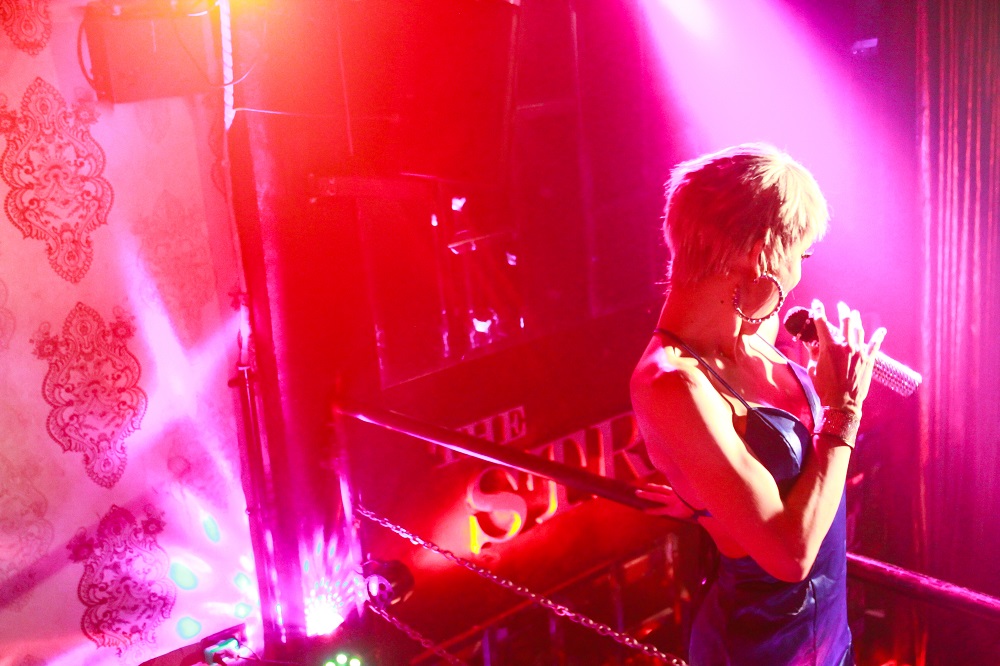
Jaja performs on a recent Tuesday night at The Stranger Bar
Let Them Decide
The definition of drag queens is often put as simple as guys – usually gay – who dress as women. It wasn’t until the ninth season of RuPaul’s show that an openly transgender woman was included. “Drag Race Thailand” hasn’t completely embraced the trans community either.
But as LGBT awareness expands globally, the drag queens who were way out ahead long ago are pushing the boundaries further today.
“Drag queens have to be gay men only? No, no, no. This is 2018, motherfucker,” M said.
Meannie Minaj, or Meantra Mananya Phuengmai, hasn’t yet gone through sex reassignment, but the 26-year-old contestant lives as a woman and identifies as transgender.
“The world today doesn’t have only four or five genders, but a hundred,” said Meannie. “Drag is an art that is free and has no boundaries. Drag queens can do whatever they want, and it shouldn’t be defined by any specific gender.”
The Nicki Minaj impersonator said she wants the show’s next season to allow transgender women with breasts to enter the show.
“I think the world has come to the point where we don’t need to label which gender can or can’t do something,” Amadiva said.
1 of 22
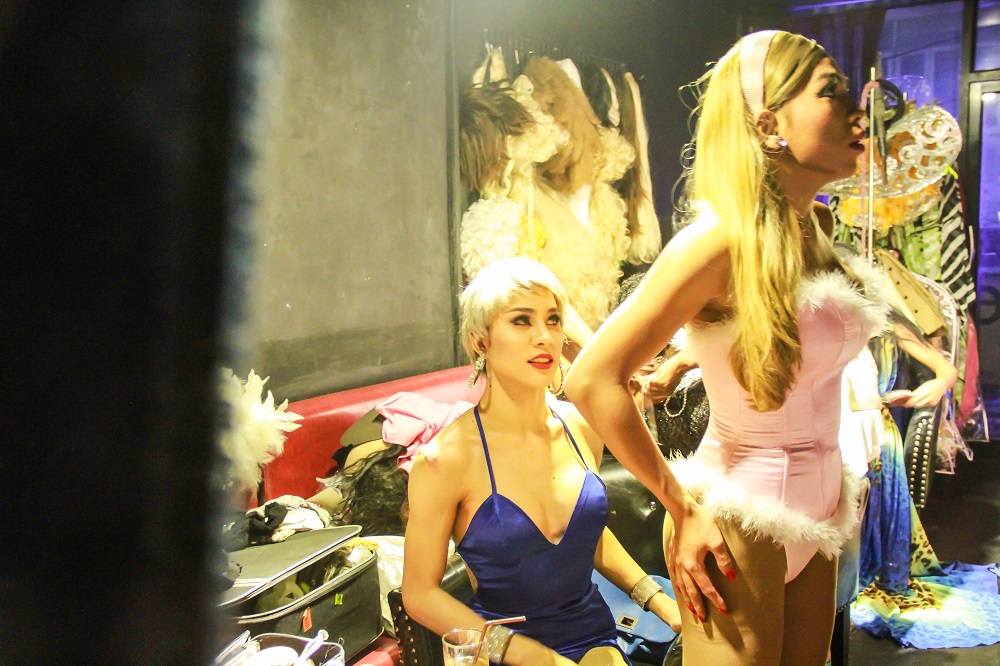
Zepee and Angele prepare for in The Stranger Bar’s dressing room.
Zepee dances inside The Stranger Bar
Zepee lip-syncs on a mezzanine
Zepee performs on a Sunday night at The Stranger Bar
Angele Anang performs to a Beyonce song
Angele Anang waits behind the curtain, ready to perform.
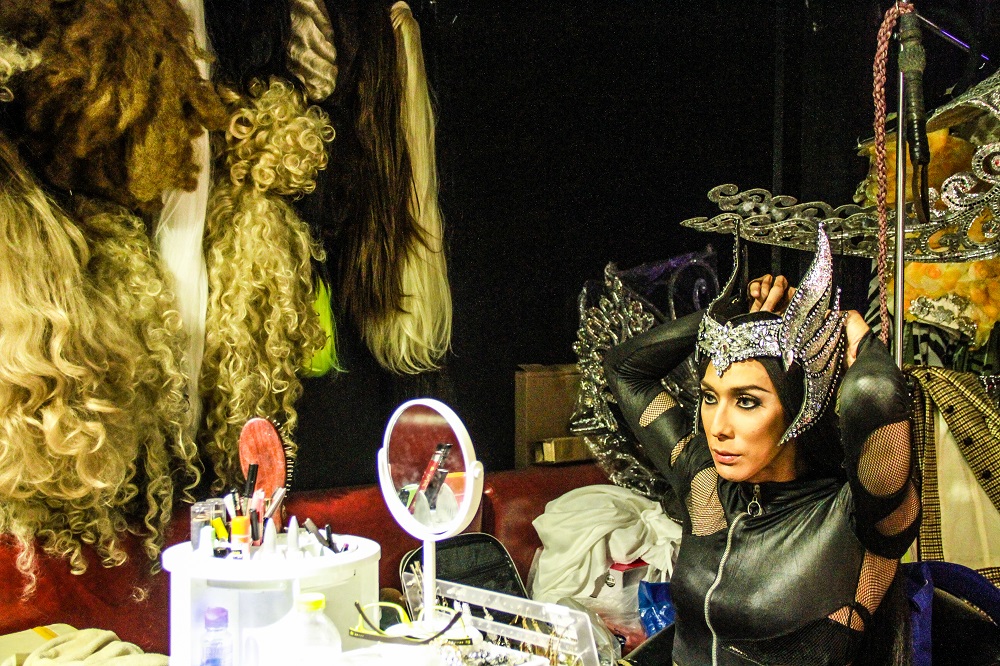
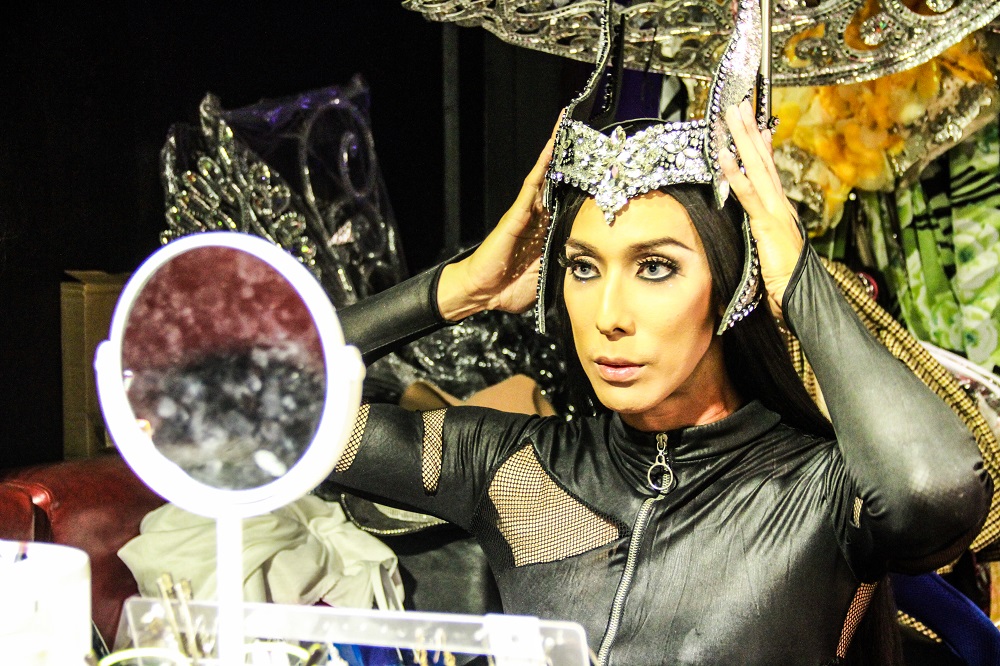
Cher impersonator Cherilyn Sarkisian, lowers her wicked queen headpiece into place.
Cher impersonator Cherilyn Sarkisian, lowers her wicked queen headpiece into place.
Jaja performs on a recent Tuesday night at The Stranger Bar
M Stranger Fox hosts a Sunday night show.
From left, drag queens Morrigan, Amadiva, Jaja and Meannie Minaj in Siam Square.
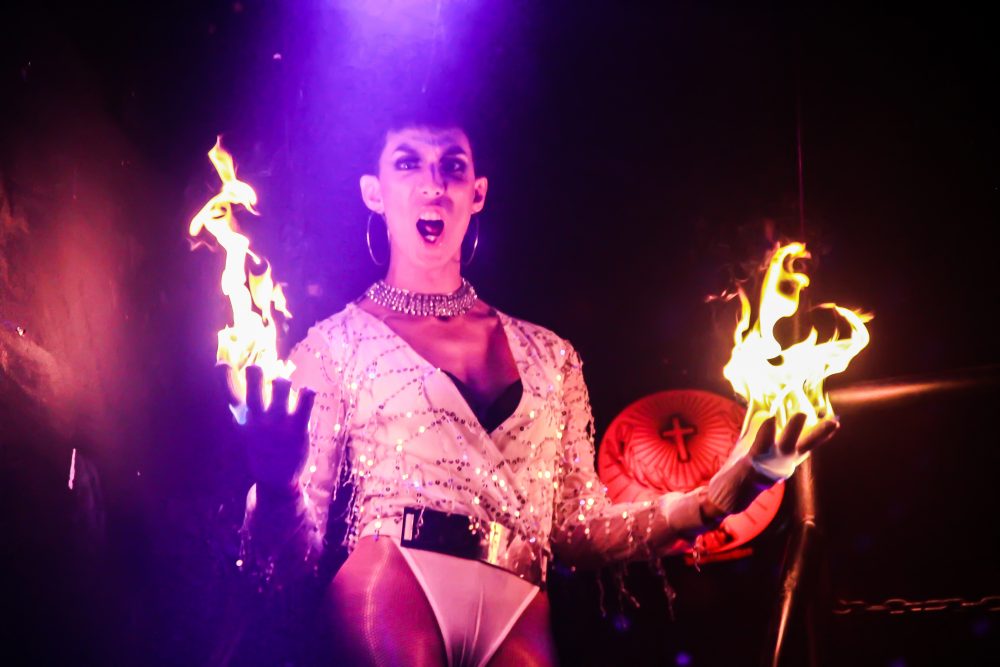
Cherilyn with flames on her hands performs at The Stranger Bar
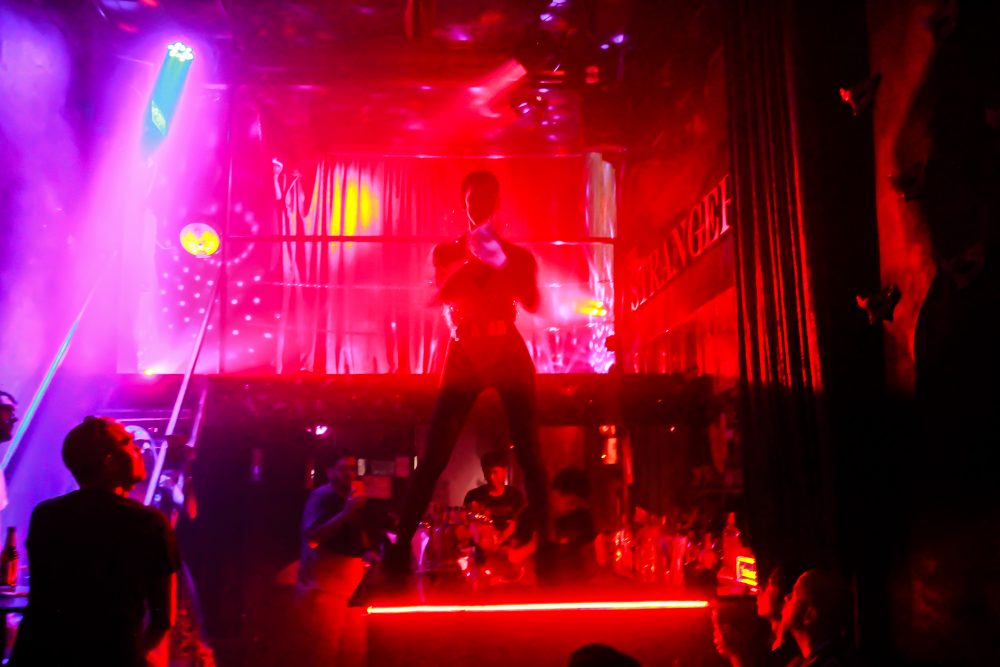
Cher hops onto the bar for the last show of the night
Chakgai “M” Jermkwan as M Stranger Fox.
Annee Maywong, one of ‘Drag Race Thailand’ contestants, performs at Maggie Choo’s event Sunday Gay Night.
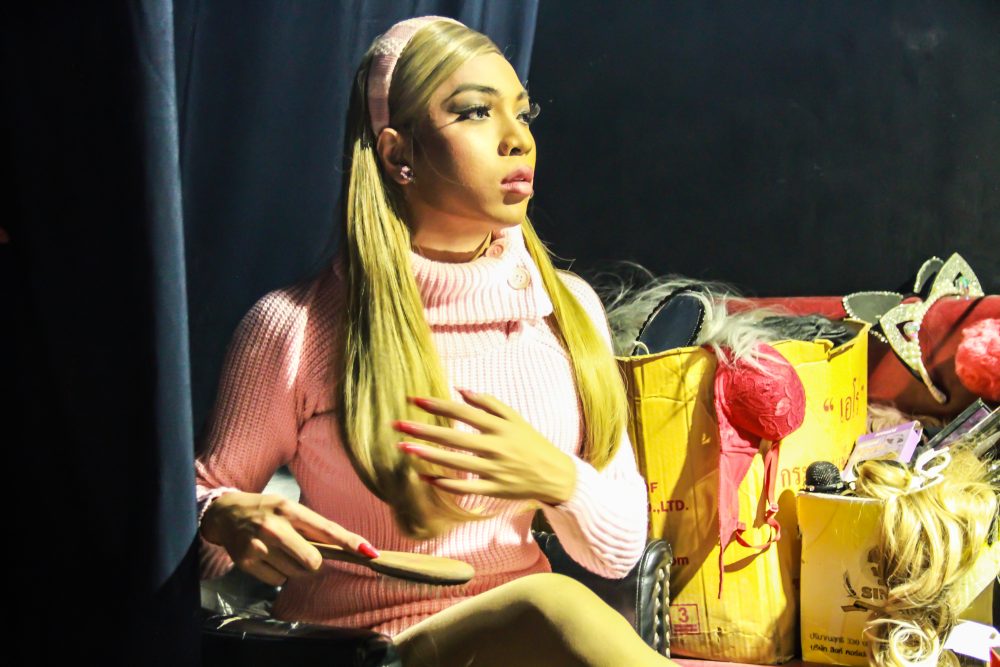
Angele Anang, a model and transgender drag queen, brushes her hair in the dressing room at The Stranger Bar.
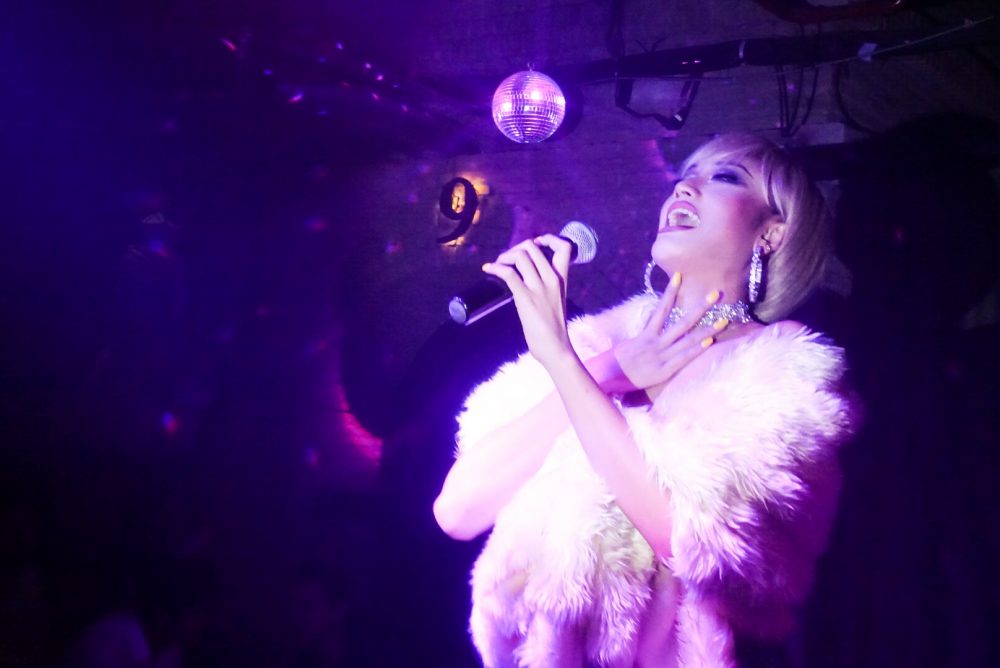
Angele Anang, a model and transgender drag queen, performs at Maggie Choo’s Sunday Gay Night.
Pangina Heals, middle, performs at a media launch for ‘Drag Race Thailand’
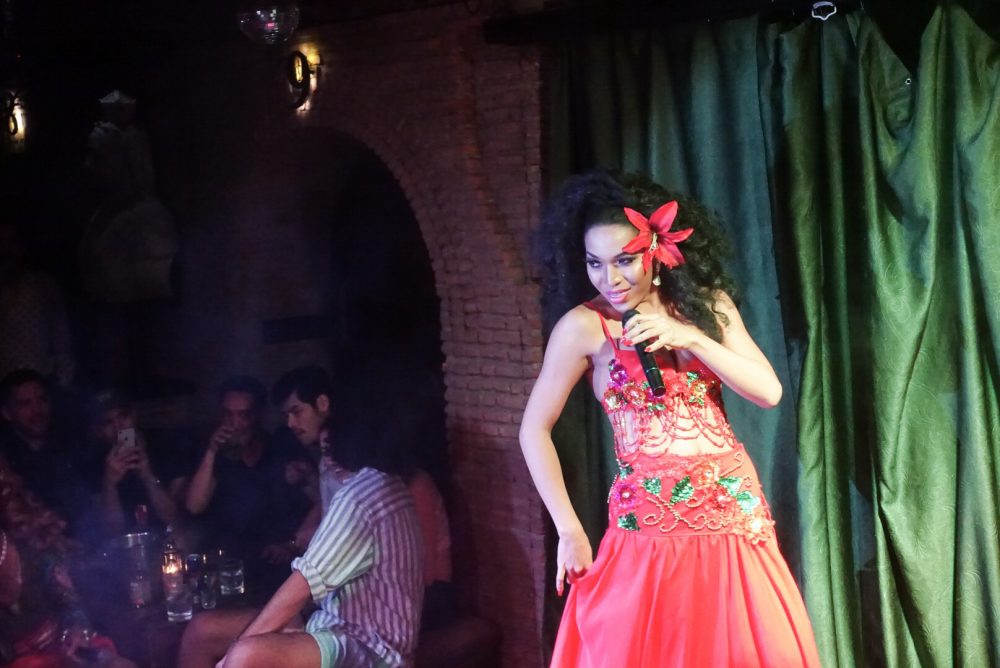
Zymone, the only transgender contestant, sings at one of Maggie Choo’s Sunday Gay Night.
Chakgai Jermkwan transforms into M Stranger Fox
Jaja has a moment after work while hauling her kit into DJ Station on Soi Silom 2.
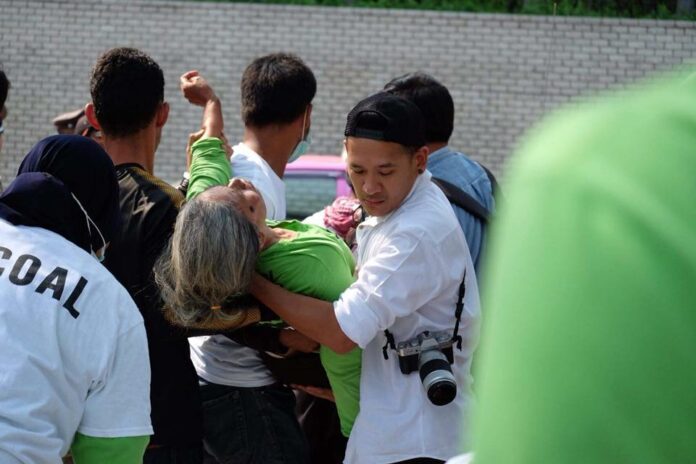
Anti-coal campaigners take a hunger striker away from the protest in front of the U.N. office in Bangkok
BANGKOK — The government said Thursday it is open to direct talks with hunger strikers opposed to the construction of coal-fired power plants in the south.
Speaking a day after eight strikers were hospitalized after fainting in front of the United Nations headquarters in Bangkok, Lt. Gen. Sansern Kaewkamnerd said Thursday that prime minister and junta chairman Prayuth Chan-ocha is aware of what happened and “worried” for the protesters’ well-being.
“Officials are worried about this. The prime minister is also worried,” Sansern said in an interview. “The government would rather see the matter resolved through discussion and the use of reason.”
Asked whether that means the regime is willing to negotiate with protesters, mostly from Songkhla province, the spokesman said yes.
“The government is willing to talk with every side at all time,” he said. “Even before they started the hunger strike, officials tried to talk to them.”
But protest leader Somnuek Klodsua said the government has yet to send anyone to meet with them. He said the United Nations has arranged a meeting between protesters and officials Friday at 10am where he hopes to see a government representative.
The protesters have been gathering since Monday to renew their opposition to construction of a coal power plant in their home province, citing health and environmental concerns.
Sixty-seven activists began a hunger strike Monday under the heat and smog to highlight their grievances. Somnuek said the eight strikers who fainted Wednesday are now in good health, and that other activists remain committed to the strike.
“We insist on our demands,” Somnuek said. “But as for the how, we will continue to evaluate the situation.”
But the government spokesman disputed the protesters’ assertions the regime is ignoring public opinion and pushing ahead with the construction project. The project’s impacts are still being studied and opinions being gathered, Sansern said.
“We are studying the good and the bad, the impacts on the environment and humans,” he said. “If it concludes that we shouldn’t build it, then we will accept it. But everyone will have to bear the risks of relying on energy sources such as oil and natural gas. How long can we do that?”
He also maintained that Prayuth would not resort to using his absolute power vested under the current constitution to push the project forward.
“The prime minister never had that thought,” Sansern said.
Plans by the government to construct power plants along the southern coast have long been a point of conflict pitting central authorities against local environmental activists and residents.
In February 2017, the regime announced it had stopped pushing for the construction of a coal power plant in Krabi province following a series of protests in Bangkok.
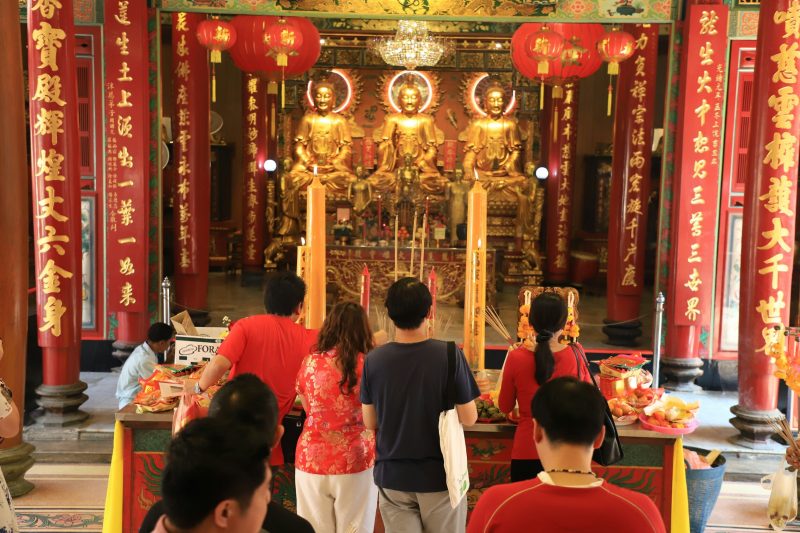
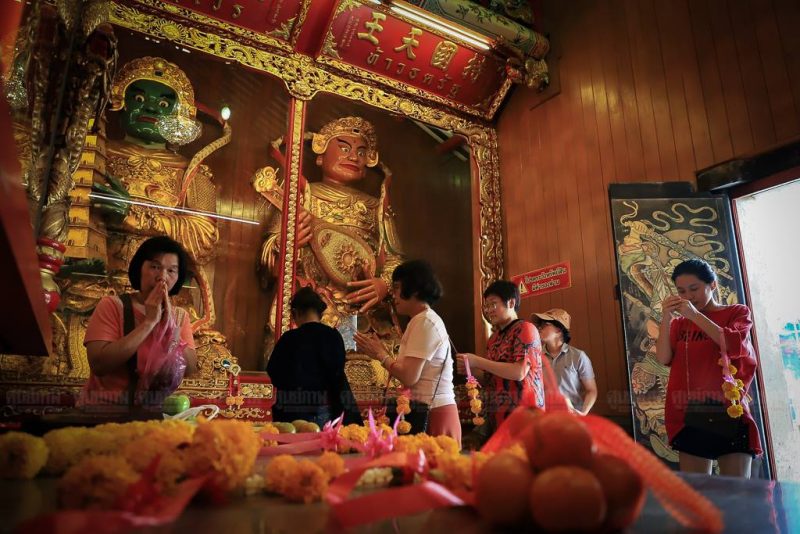
Worshipers pray at a temple in Chinatown on Thursday
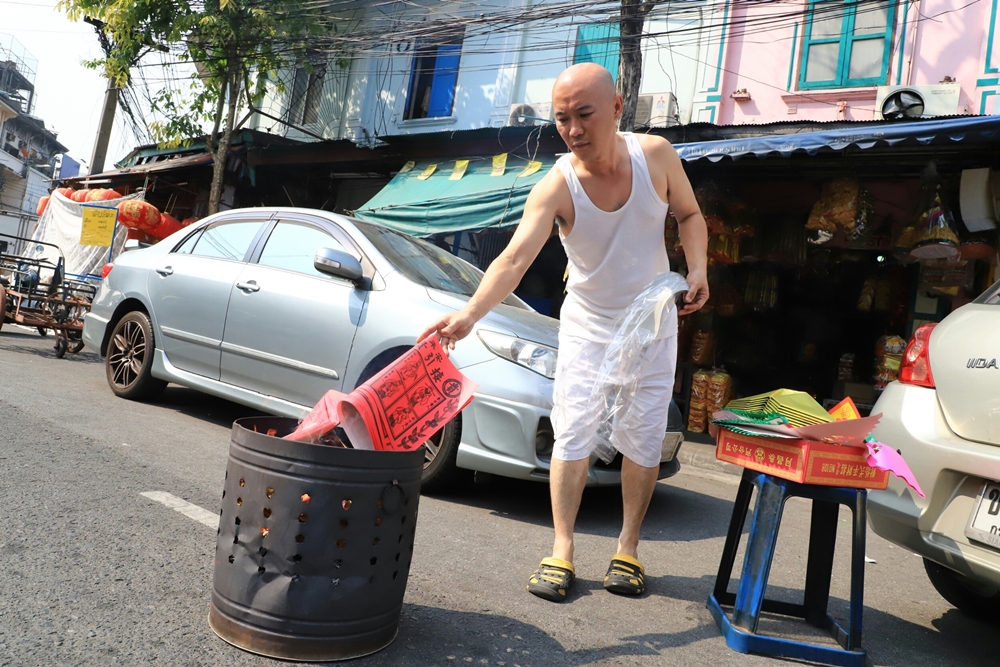
BANGKOK — Chinese New Year festivities began Thursday with wan wai, a day of worship which involves family members burning glittering “hell money” for their ancestors. But with Bangkok plagued by heavy smog, health officials warn the tradition may hasten their reunion with the dead.
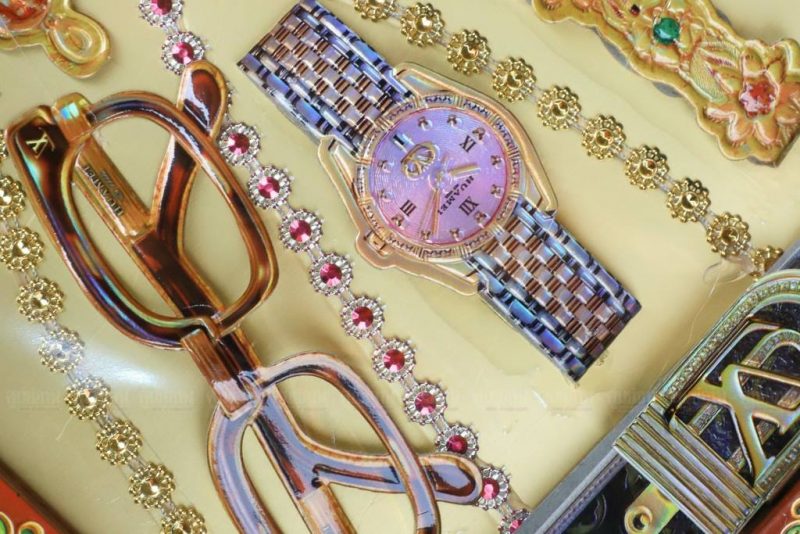
In gold and silver colors, this currency for the afterlife looks beautiful but contain toxic compounds – chromium, nickel, lead and manganese – that enter the air when combusted, city hall said Wednesday in a statement.
A Bangkok government official said Thursday that although the Sino-Thai community won’t abandon the tradition overnight, she hopes they will least burn less.
“It’s a belief that they practice every year. Telling them to stop now wouldn’t work,” said Suwanna Jungrungruang, deputy secretary of the Bangkok Metropolitan Administration. “But I want them to burn less or burn only what’s necessary. It’s unlikely things will change suddenly.”
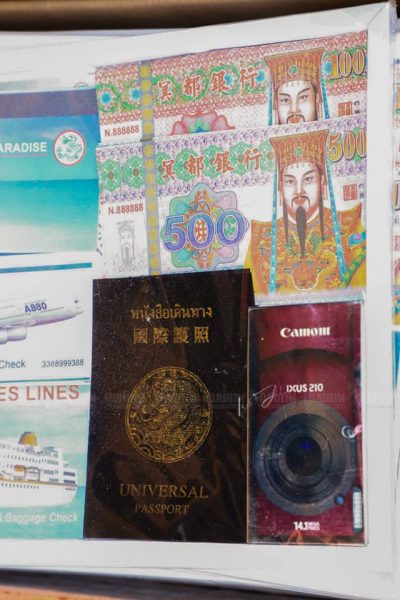
The health warning was issued a day before millions flocked to shrines to light incense for prayer and burn hell money along with extravagant paper imitations of houses, cars, phones and other luxury goods for the afterlife.
While the tradition started with natural materials such as bamboo and wood, it has evolved to include composite materials that are harmful when burned, Suwanna said.
Disease Control Department director Suwanchai Wattanayingcharoen said burning hell money harms worshipers and anyone in the area who breathe the fumes.
“The silver and gold paper burned causes the fumes of lead from the paper colors to spread, affecting the health of those who burn it and those nearby,” Suwanchai said in an email.
Inhaling the fumes can elevate blood lead levels and contribute to anemia. Dumping the ashes into the environment is another source of contamination, Suwanchai said.
Huyseng Sae-lim, a Chinese opera expert and professional medium, said he’s not troubled by the warning despite his job – which requires he breathe in toxic fumes all day today.
“I’m feeling so-so,” Huyseng said. “I’ve never had any problem about it.”
The medium, who makes regular appearance in temples and shrines for occasions such as the Chinese New Year, said he would prefer to see people burn less hell money, but he believes the tradition won’t change any time soon.
Suwanna, the Bangkok official, said she sees increasingly fewer people every year, especially the younger generations, practice the ritual.
“As far as I noticed, fewer people burn it, and the people who still do, burn it less,” said Suwanna, who identifies as Sino-Thai herself. “Take me for example, I prayed this morning and came to work right after. People don’t do it for three days straight like in the past anymore.”
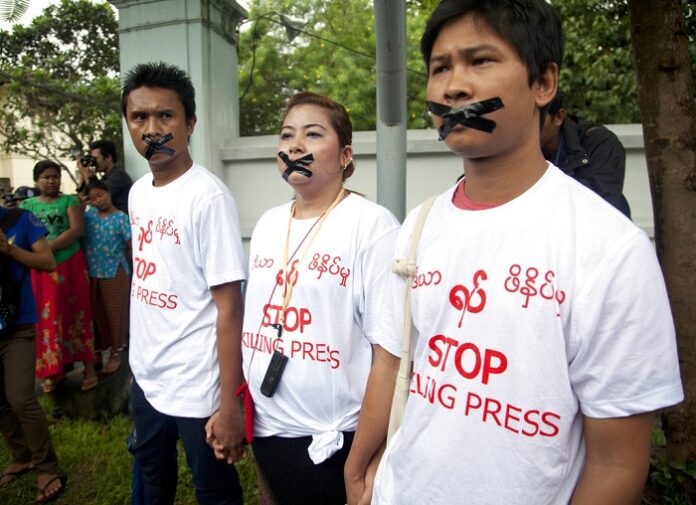
Myanmar journalist Wa Lone, right, stands with other journalists with their mouths taped to symbolize the government's crackdown on media in Yangon, Myanmar. Khin Maung Win / Associated Press
BANGKOK — When five Myanmar journalists were sentenced to decade-long prison terms for reporting the alleged existence of a military-run chemical weapons factory in Myanmar a few years ago, Aung San Suu Kyi – then an opposition lawmaker – condemned the harsh punishments as “very excessive.”
The journalists, from the now-defunct Unity publication, had been convicted for violating the nation’s Official Secrets Act – the same colonial-era law now being leveled against a pair of Reuters reporters who are facing a staggering 14 years behind bars each.
“It’s not that I don’t accept a concern over national security,” Suu Kyi told supporters during a July 2014 rally, according to an article published at the time in the Irrawaddy, a local media outlet. “But in a democratic system, security should be in balance with freedom.”
When “the rights of journalists (to report) are being controlled,” Suu Kyi said, the very notion of democratic reform in Myanmar is “questionable.”
Three and a half years on, the thinking of Suu Kyi, who now heads the government, has apparently changed dramatically. Rather than champion the press, she has presided over an administration whose courts have aggressively pursued legal charges against dozens of journalists, along with other attempts to suppress and discredit the media.
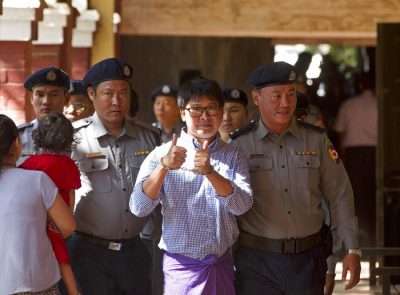
Reuters journalist Wa Lone gives a thumbs up as he is escorted by Myanmar police Photo: Thein Zaw / Associated Press
Police arrested Reuters reporters Wa Lone and Kyaw Soe Oo on Dec. 12 while they were investigating the massacre of 10 ethnic Rohingya Muslims. But when former U.N. ambassador Bill Richardson met the Nobel Peace prize laureate this month and brought up the case against the Reuters reporters, it “brought almost an explosion on her part,” Richardson said.
Suu Kyi’s spokesman, Zaw Htay, has said that Richardson exceeded his mandate by bringing up the issue. Richardson had been invited to the country to participate in an advisory panel on the Rohingya crisis; he withdrew, calling it a “whitewash.”
Htay did not answer his cell phone when AP attempted to reach him several times Wednesday for comment.
Hostility against the media, particularly international news agencies covering Myanmar, has risen markedly since a brutal army “clearance” operation began in August immediately after Rohingya insurgents staged an unprecedented wave of attacks. More than 700,000 Rohingya, a persecuted minority widely despised by the nation’s Buddhist majority, have been driven into Bangladesh since.
Reporters and human rights groups covering the crisis have documented grave atrocities, including mass rape, several massacres and widespread arson attacks that left hundreds of Rohingya villages burned to the ground. Earlier this month, The Associated Press reported the existence of at least five mass graves at Gu Dar Pyin village in Rakhine state.
Suu Kyi’s government has routinely denied atrocities and staunchly defended the military’s actions, portraying critical media reports as “fake news” in what analysts say is an effort to discredit independent media reports and limit reporting.
They’re “doing everything in their power to block the flow of news, to ensure that no damaging information comes to light,” said Shawn Crispin, Southeast Asia representative for the New York-based Committee to Protect Journalists.
“They’re using legal threats, they’re blocking access to areas where alleged abuses occurred, they’re making it harder for foreigners to get visas,” he said. “They’ve created a climate of fear among local reporters, too, and the message is clear. If you report critically, you risk going to jail.”
As the antagonism against foreign media has grown, some agencies pulled reporters from the country. AP correspondent Esther Htusan left Myanmar in late November after threats were made against her life on social media and unidentified men followed her to her Yangon home.
Not so long ago, the mood in the Southeast Asian nation was very different.
When the military, which ruled for half a century, ceded some power to a nominally civilian government in 2011 amid what was widely lauded as a long-awaited transition to democracy, journalists were bursting with optimism. The government abolished censorship in 2012, allowing local media outlets to flourish for the first time in decades. Foreign correspondents were granted visas, enabling them to report on what had been one of the most closed nations in the world.
The Associated Press was among those allowed in. The news cooperative maintained a presence in Myanmar and covered the nation for decades through local correspondents. But in 2013 AP became the first international news agency to officially open a bureau since the transition from military rule began.
The optimism reached its peak when Suu Kyi’s party swept elections in a 2015 landslide.
“There was so much hope that local journalists were finally going to be free to report, and Suu Kyi was to be their champion,” Crispin said. “But Suu Kyi has become a menace to the media, and she’s very much put her individual stamp on this wave” of repression.
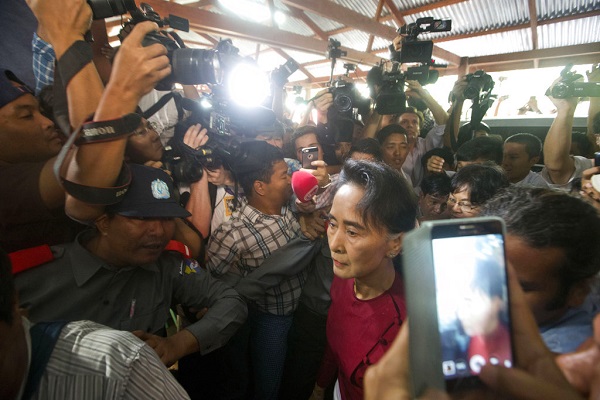
Aung San Suu Kyi is surrounded by the media as she arrives at a polling station in Yangon, Myanmar. Photo: Mark Baker / Associated Press
At least 33 reporters have been charged with crimes under various laws since Suu Kyi’s government assumed office in 2016, according to the local advocacy group We Support Journalists. The numbers are likely higher than during the era of military rule because many more journalists are operating today.
Besides the Official Secrets Act, reporters have been charged for violating the Unlawful Association Act, under which three were detained several months last year for covering a drug burning event organized by a small rebel group. Reporters have also been charged under Article 66(d) of the Telecommunications Law, which broadly defines defamation and carries a penalty of up to three years’ imprisonment.
The telecommunications law in particular has been employed to crush freedom of expression, said Maung Saungkha, an independent researcher with We Support Journalists. About 80 other people, including activists and protesters, have been charged under the law. Suu Kyi’s National League for Democracy party holds a majority in parliament and has the power to amend or abolish such legislation.
The government has also tried to cast doubt on media reports about the Rohingya. Last month, the AP published an investigation documenting the existence of five mass graves in the village of Gu Dar Pyin that witnesses said were filled with Rohingya corpses slaughtered by army soldiers with help from local Buddhists. The AP investigation relied on multiple interviews with more than two dozen survivors in Bangladesh refugee camps, time-stamped cellphone videos and satellite imagery that showed how the entire village had been wiped out.
The government launched its own investigation in response, and in a statement cited local villagers and community leaders declaring that “no such things happened.” Security forces, it said, killed 19 “terrorists” and “carefully buried” them.
In an editorial, the state-run Global New Light of Myanmar condemned the AP report, saying “the credibility of the media is lost when they fail to seek the truth and ensure accuracy in their reporting.” The editorial, however, did not mention that Myanmar does not allow independent media into northern Rakhine state. The only trips journalists are permitted to take part in are those occasionally allowed by the government, which often deploys minders to monitor them and curtail their movement.
“What the government doesn’t understand is how professional reporting happens,” Crispin said. “If they want to get the truth out, they need to open everything up, let reporters in, and let them publish what they find … They’re not doing that, and everyone knows they won’t have a shred of credibility until they do.”
Reporting in such an environment is difficult, but not impossible.
For example, when Rohingya women told of being raped by Myanmar’s military, the government dismissed their accounts as “fake rape.” But in November, AP reporter Kristen Gelineau documented the military’s methodical rape of the Rohingya by talking to 29 women and girls from different refugee camps in Bangladesh, interviewing them separately, extensively and often repeatedly. She found “a sickening sameness to their stories, with distinct patterns in their accounts, their assailants’ uniforms and the details of the rapes themselves.”
Gelineau also cross-checked the stories wherever possible. The mother of one young girl raped by 10 soldiers said her family had managed to get the girl to a hospital in Bangladesh for treatment. Gelineau examined X-ray documentation of the visit that bore the girl’s name and age and the date, and noted deep scarring on her legs where she said soldiers had dragged her across the ground. She also persuaded one doctor to show her his patient files to prove that the women were not making up their stories.
The importance of allowing the media the freedom to do its job was conveyed by one of those women, who had lost her husband, her country and her peace.
“I have nothing left,” she said. “All I have left are my words.”
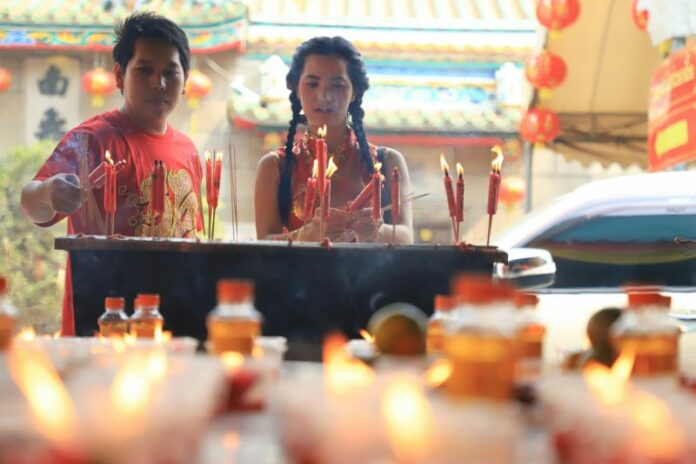
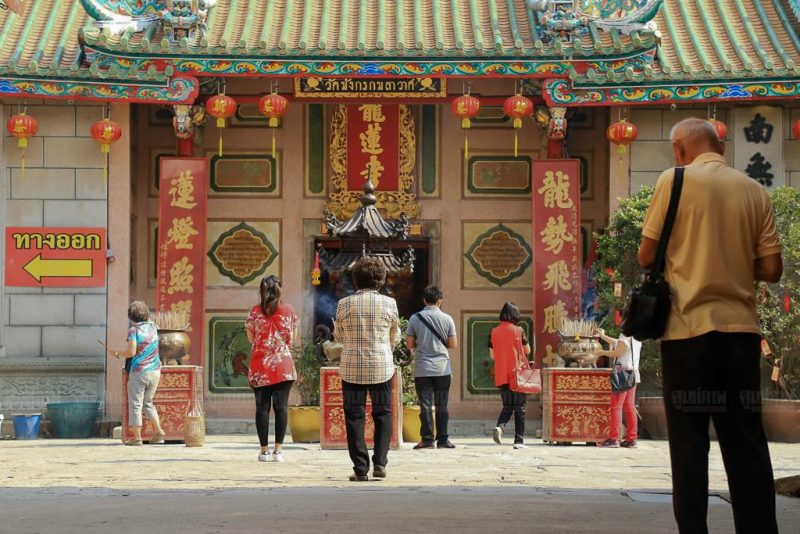
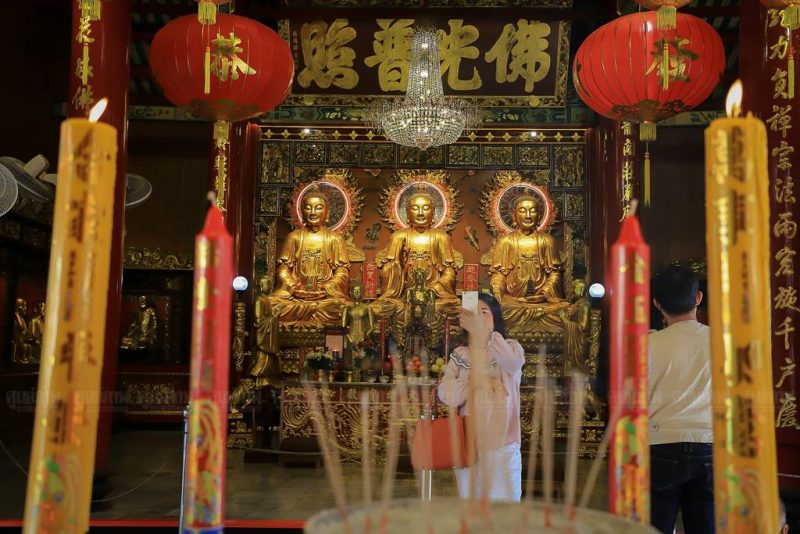
Two people burn incense Thursday at Wat Mangkon in Chinatown.
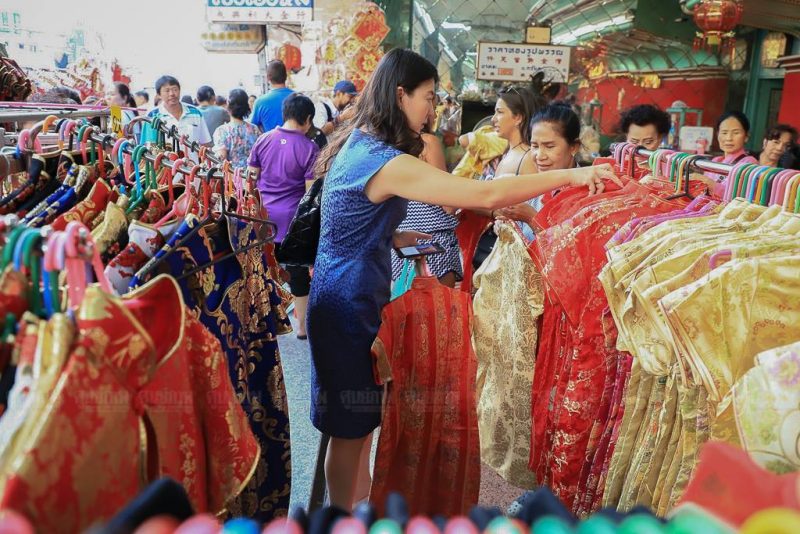
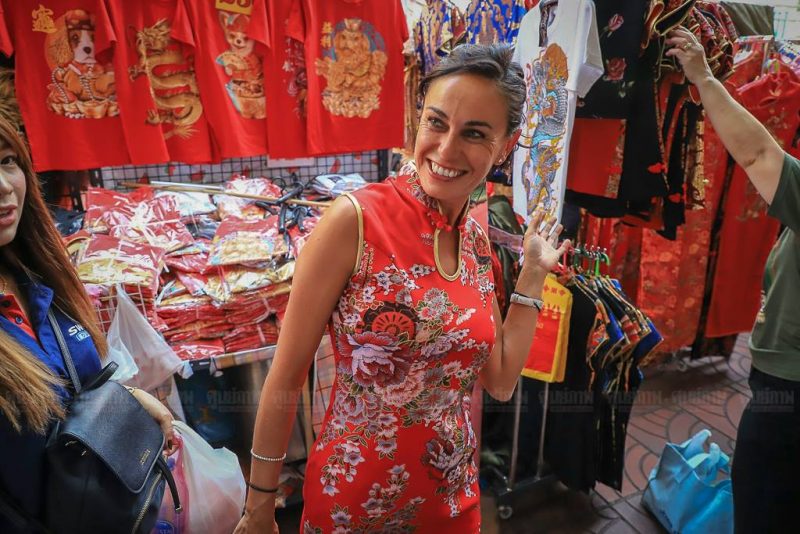
BANGKOK — It’s that time of the year again, when your friends Lin, Mei or O-tee take the day off, wear their qipaos and go to the temple with their clans.
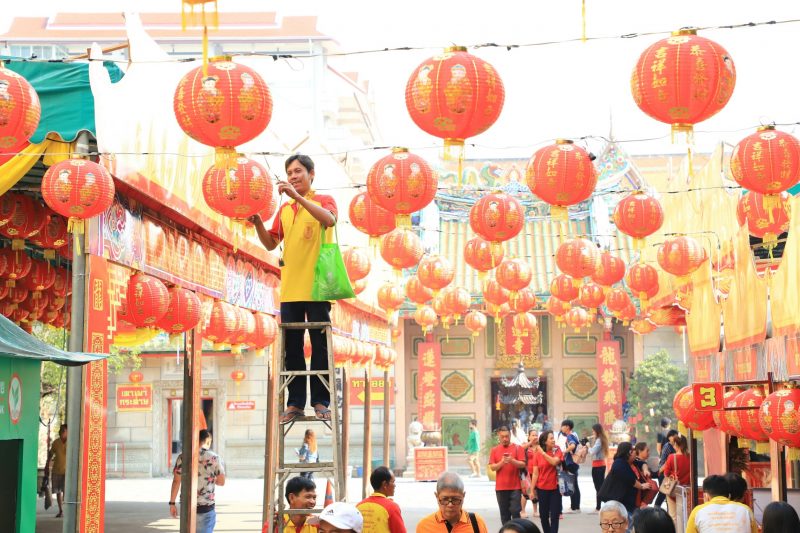
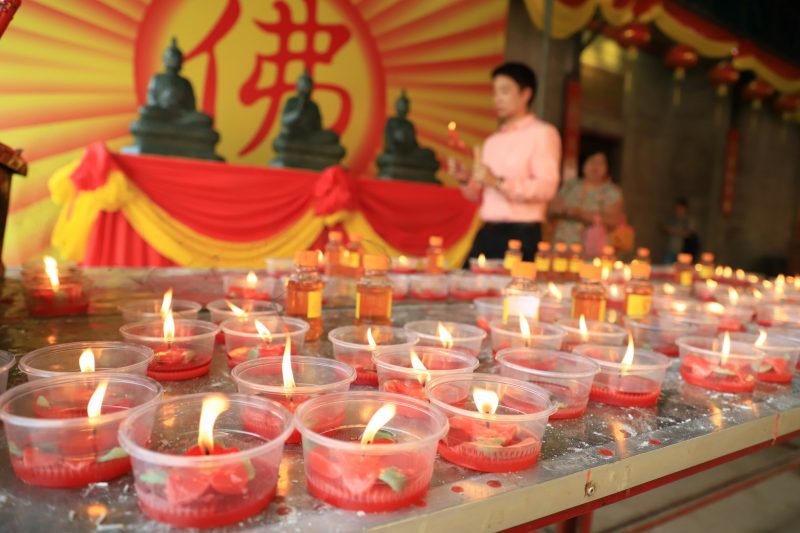
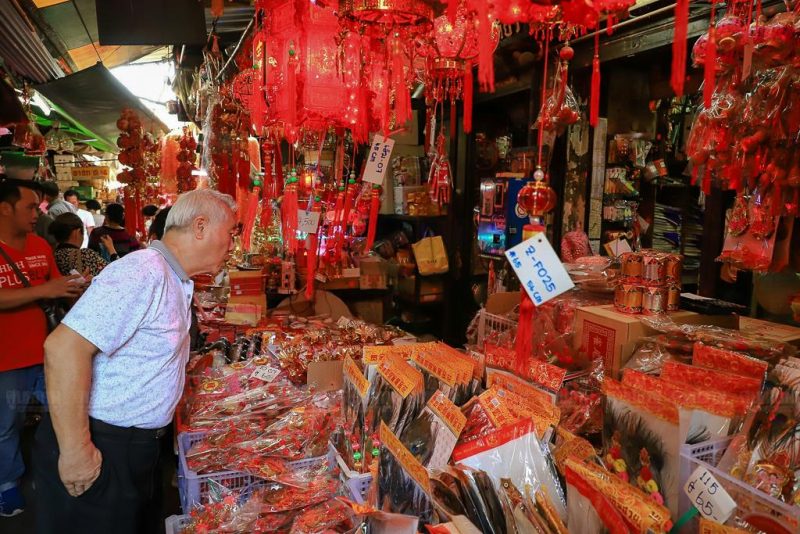
Sino-Thais nationwide were gathering with their blood relatives Thursday to celebrate the first day of Chinese New Year festivities by burning incense and commenting on family members’ lives. In Yaowarat or Chinatown especially, they flocked to pray in temples and find new year fare.
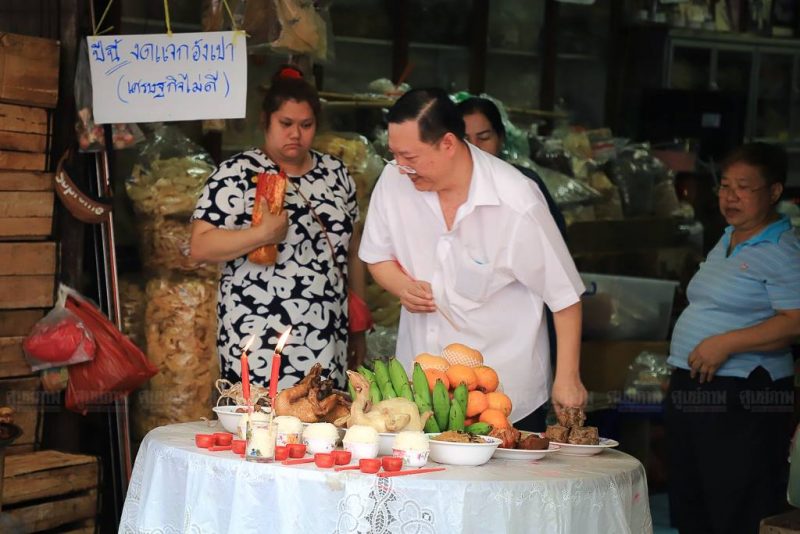
Although Chinese New Year begins Friday, Thursday is “pray day” when people burn alms and offer fruit for their ancestors and Chinese gods.
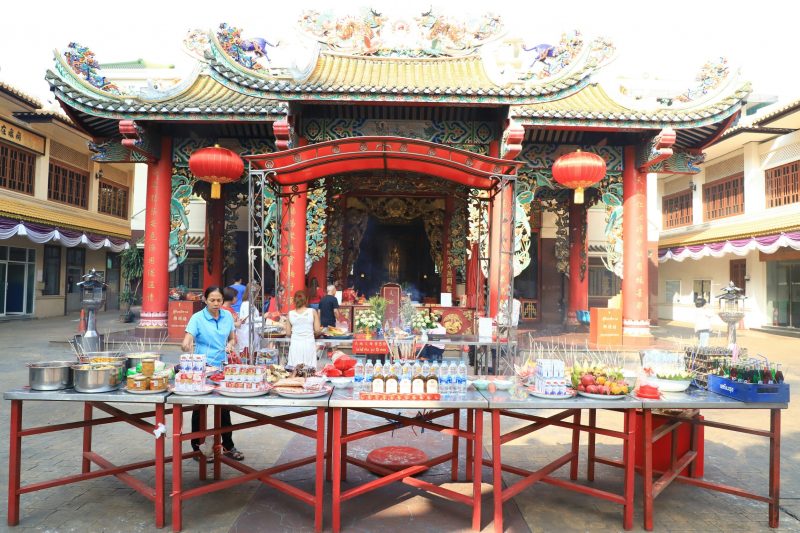
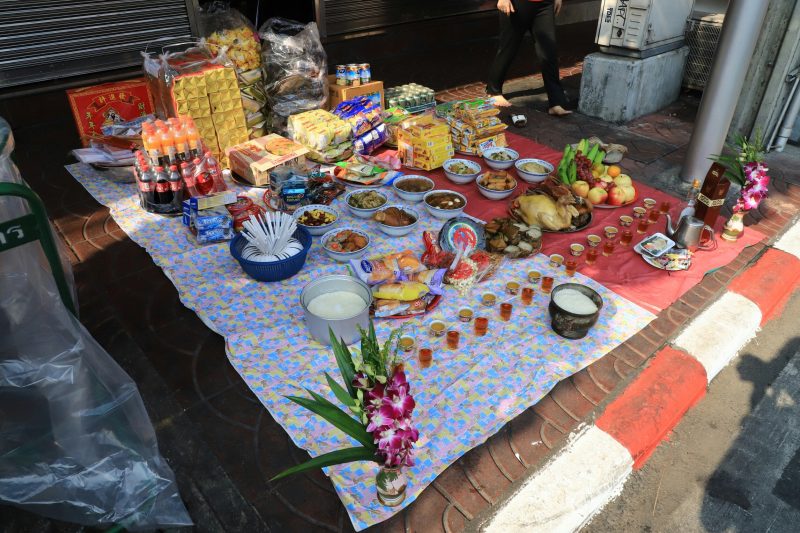
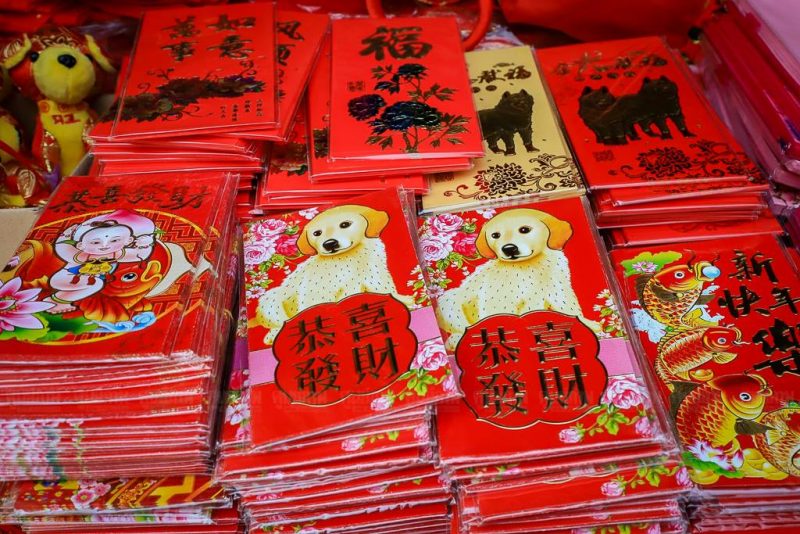
The day before “pray day” is “payday,” and Wednesday saw people buying fruit, pig heads, chicken and duck in preparation for today’s festivities. On Friday, the Thai-Chinese will give out angpao, or red envelopes filled with money, and gather with family.
A man hangs Chinese lanterns Thursday morning in Yaowarat.
Thai-Chinese give offerings Thursday at Wat Mangkon in Chinatown.
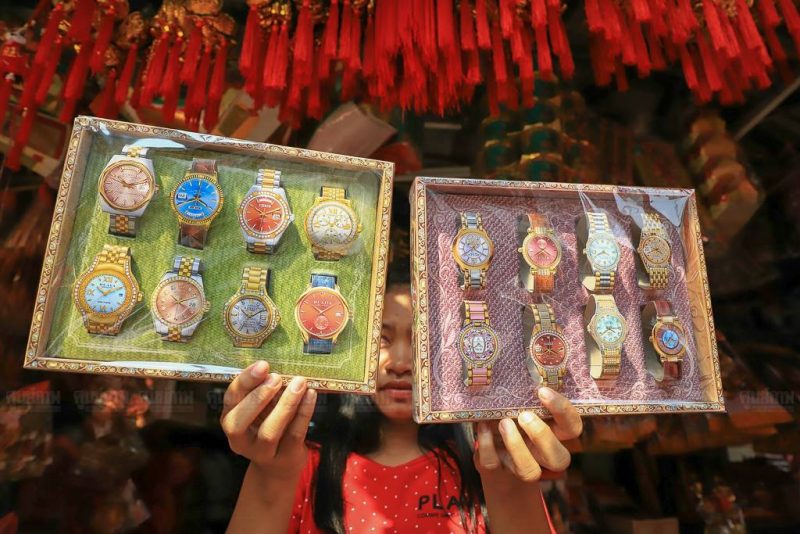
A woman Thursday holds up paper watches that people can burn, believing they are sent to ancestors in the afterlife.A woman browses for qipao Tuesday in Chinatown.
A woman poses in a qipao Tuesday in Yaowarat.Paper glasses and watches on sale for people to burn for their ancestors.A paper camera, money, airline tickets and a “universal passport” intended to be burned as offerings to ancestors.
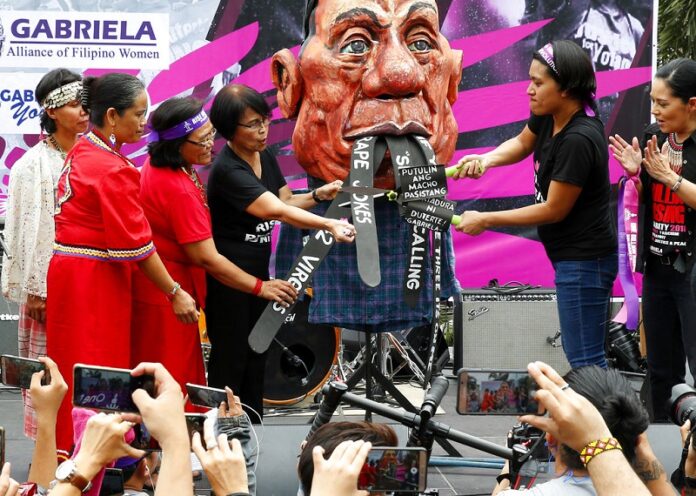
Philippine Protesters cut President Rodrigo Duterte's "tongues" which allegedly represent his often derogatory statements towards women during a Valentine's Day rally, on Wednesday. Photo: Bullit Marquez / Associated Press
MANILA — The Philippine president has offered a nearly USD$500 bounty for each communist rebel killed by government forces to save on anti-insurgency costs and says insurgents are easier to hit than birds because they have bigger heads.
President Rodrigo Duterte’s latest crass remarks, which the government issued to reporters late Wednesday, came after human rights groups condemned him this week for saying troops should shoot female communist guerrillas in the genitals to render them “useless.”
“You kill an NPA today and I’ll pay you 25,000” pesos, Duterte said in a speech at an air base in central Cebu city, referring to New People’s Army guerrillas.
“I was computing that if this drags on for four years, … it’ll be very expensive because it’s war. If I’ll just pay 25,000 for a life, I can save about 47 percent,” he said to laughter from the crowd.
There was no elaboration on how he came up with those figures and whether or how the government would pay for claimed kills. Backing up his offer, the brash-talking president encouraged state forces to go for the kill.
“If you work really hard to crawl across the forest, you’ll surely be able to shoot even just one. If you can shoot a bird above you, then how much more an NPA whose head is so big?” the brash-talking Duterte said, again eliciting laughter from the crowd.
Duterte’s incendiary remarks encourage government forces to commit war crimes instead of instilling a culture of accountability in accordance with international law, Human Rights Watch said.
“Duterte’s pronouncements normalize the idea that government security forces can do as they wish to defeat their enemies, including committing summary executions and sexual violence,” said Carlos Conde of the U.S.-based rights group.
The volatile president turned up the rhetoric against communist guerrillas after peace talks brokered by Norway collapsed last year when he protested continuing rebel attacks on government forces. When a rebel leader recently warned that the guerrillas could kill one soldier a day, Duterte countered by threatening to kill five rebels daily and offering to train tribesmen as militias and give them bounties to kill the insurgents.
Duterte is already under international criticism and is facing a preliminary investigation by the International Criminal Court for thousands of deaths in the war on drugs he initiated after become president two years ago.
He has lashed out in his response, including asking why the ICC was focusing on him when atrocities were unraveling elsewhere.
“There are Rohingyas who are being slaughtered, but they only chose to indict me. OK, you asked for it, let’s have a trial. I will cross-examine you,” Duterte, a former state prosecutor, said, referring to the Muslims fleeing from violence and persecution in Myanmar.