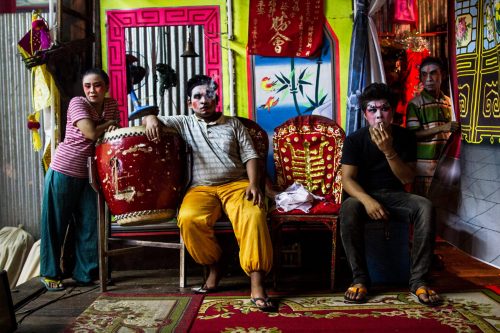
Ekachai Hongkangwan in an undated photo. Photo: Ekachai Hongkangwan
BANGKOK — A political activist was taken into military custody Saturday morning for attempting to place a replica of the plaque commemorating the June 24, 1932, revolt at the spot where the original mysteriously disappeared from earlier this year.
Ekachai Hongkangwan, a 42-year-old activist working with political prisoners and lese majeste detainees, contacted a reporter at 8:48am to say he had been taken away by half a dozen police inside a nondescript van and was about to enter the 11th Military Circle in Bangkok, where opponents of the military regime are held in a special prison on the army base.
Ekachai said he brought a life-size bronze replica of the plaque which sat undisturbed for decades until it was secretly removed and replaced in April with another bearing a royalist message. He said he planned to place the replica atop the new plaque.
“I’m feel really fed up. They don’t try to look for the old plaque and instead are protecting the new one. This is nonsense,” said Ekachai on the phone, sounding more frustrated than fearful.
Ekachai, himself a former lese majeste convict imprisoned nearly three years, said he had planned the move for some time, and someone donated him the life-size replica of the original plaque.
Ekachai said he arrived at the Royal Plaza where the original plaque was removed with the replica plaque and 10 kilograms of cement in a metal paint bucket but was spotted and apprehended by police while he was approaching the spot.
Asked whether he expected to be arrested, Ekachai said he thought so.
“I thought so too. They don’t search for the old plaque, and we don’t know who owns the new one,” he said, shortly before the phone conversation ended.
Junta spokesman Col. Winthai Suvari wasn’t immediately available for comment.
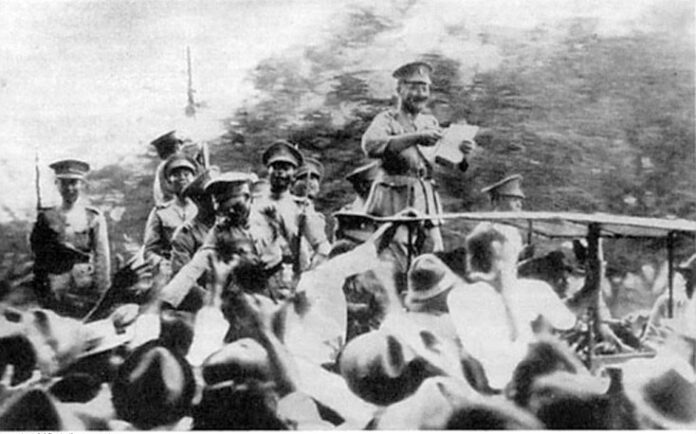
Soldiers hand out out the People's Party Declaration to a crowd of civilians in Bangkok on June 24, 1932.
Nearly every nation that went through a revolution has a founding manifesto. For the United States, it’s the Declaration of Independence. For France, it’s the Declaration of the Rights of Man and of the Citizen.
For Thailand, it might have been the leaflets handed out to curious onlookers on Bangkok streets in the morning of June 24, 1932, by the revolutionaries who brought down the absolute monarchy that day and replaced it with parliamentary democracy. Filled with fiery condemnations of the royal government, it even accused it of leaching the people’s blood.
“Those of royal blood do nothing, just go on sucking blood,” part of the statement reads. “Whatever money they have they deposit overseas and prepare to flee leaving the people hungry while the country decays. All this is certainly evil.”
But the statement, known as the People’s Party Declaration, never obtained the same regard and soon faded into obscurity, similar to so many other legacies of the revolution itself. This year, those legacies are more exposed than ever.
In April, the plaque marking the spot where the coup makers announced the end of the king’s direct rule went missing – a disappearance the media are discouraged from investigating. Because of the ever-harsher interpretation and enforcement of the royal defamation law, reading the People’s Party declaration aloud in public today seems unimaginable.
But it remains part of the historical record, and to mark the 85th anniversary of the revolution, the usual public observance of which has been banned, Khaosod English is publishing an English translation of the declaration in full.
Note: The translation is lifted from historian Chris Baker’s book “Pridi by Pridi,” with later improvements added by linguist Junya Lek Yimprasert.
All the people,
When this king succeeded his elder brother, people at first hoped that his government would bring peace and security, but matters have not turned out as they hoped. The king maintains his power above the law as before. He appoints court relatives and toadies without merit or knowledge to important positions, without listening to the voice of the people. He allows officials to use the power of their office dishonestly, to take bribes in public construction and procurement, and seek profit from changes in the prices of money, which squanders the wealth of the country. He elevates those of royal blood to have more privileged rights than the people. He governs without principle. The country’s affairs are left to the mercy of fate, as can be seen from the depression of the economy and the hardships of making a living – something the people know all about already.
The government of the king above the law is unable to bring about recovery. This inability to find solutions is because the government of the king has not governed the country for the people, as other governments have done. The government of the king has treated the people as slaves (or as they called them, peasants and serfs), as animals not as human beings. Therefore, instead of helping the people, it plants rice on the backs of the people. It can be seen that from the taxes that are squeezed from the people that the King is deducting many million of Baht per year for his own expenses, while the people must sweat blood in order to find just a little money. At the time for paying government tax or personal tax, if they have no money the government seizes their property or forces them into public works, while those of royal blood are sleeping and eating happily. No country in the world gave its royalty so much money as this, except the Tsar and the German Kaiser, whose nations have already overthrown their thrones.
The King’s government has governed by deceiving and not being straightforward with the people. For example, by saying the King’s government would improve livelihood in this way and that, but time has passed, people have waited, and nothing has happened, nothing has been done seriously. Furthermore the people who should be shown gratitude for paying the taxes that royalty eats have been told they cannot yet have a voice in politics because they are ignorant. Such words from government are unacceptable. If the people are ignorant, the King is ignorant too, as we are all from the same nation. That people do not know what royalty knows is because royalty blocks them from full education in fear that if the people have education they will know the evil of royalty and not allow them to plant rice on their backs.
Let all people know that our country belongs to the people – not to the king, as has been deceitfully claimed. It was the ancestors of the people who returned the independence of
the country from the hands of the enemy. Those of royal blood just reap where they have not sown and sweep up wealth and property worth many hundred millions. Where did all these monies come from? From the method of farming rice on the backs of the people.
The country is facing hardship. Farmers and soldier’s parents have to give up their paddy fields because cultivating brings no benefit. The government does not help. Everywhere the government lays off workers. Students who have completed their studies and soldiers released from the reserves have no employment, and go hungry according to fate. These things are the result of the government of the king above the law that oppresses minor civil servants, ordinary soldiers and clerks. They are not given pensions when discharged from service. In truth the monies that have been amassed by the government should used to run the country by providing work. This would be a fitting way to pay back the people who have been paying taxes for a long time to make royalty rich. But those of royal blood do nothing, just go on sucking blood. Whatever money they have they deposit overseas and prepare to flee leaving the people hungry while the country decays. All this is certainly evil.
Therefore the people, government officials, soldiers, and citizens who know about these evil actions of the government have joined together to establish the People’s Party and have already seized power from the government of the king. The People’s Party sees that to correct this evil it must establish government by assembly, so that many minds can debate and contribute, which is better than just one mind. As for the Head of State of the country, the People’s Party has no wish to snatch the throne. Hence it invites this king to retain the position. But he must be under the law of the constitution for governing the country, and cannot do anything independently without the approval of the assembly of people’s representatives.
The People’s Party has already informed the king of this view and at the present time is waiting for a response. If the king replies with a refusal or does not reply within the time set, for the selfish reason that his power will be reduced, it will be regarded as treason to the nation, and it will be necessary for the country to have a republican form of government, that is, the Head of State will be an ordinary person appointed by Parliament to hold the position for a fixed term. By this method the people can hope to be looked after in the best way, everyone will have employment because our country is a country of natural abundance. When we have seized the money which those of royal blood have amassed from planting rice on the backs of the people, and use these many hundreds of millions for nurturing the country, the country will certainly flourish. The People’s Party will govern and implement projects based on knowledge, not act like a blind man as the government of the king above the law has done. The People’s Party will:
1. maintain securely the independence of the country in all forms including political, judicial, and economic etc.;
2. maintain public safety within the country and greatly reduce crime;
3. improve the economic well-being of the people by the new government finding employment for all, and drawing up a national economic plan, not leaving the people to go hungry;
4. provide the people with equal rights (so that those of royal blood do not have more rights than the people as at present);
5. provide the people with liberty and freedom, as far as this does not conflict with the above four principles;
6. provide the people with full education.
All the people should be ready to help the People’s Party successfully to carry out its work which will be for eternity. The People’s Party asks everyone who did not participate in seizing power from the government of the king above the law to remain peaceful and keep working for their living. Do not do anything to obstruct the People’s Party. By doing thus, the people will help the country, the people, and their own children, grandchildren, and great-grandchildren. The country will have complete independence. People will have safety. Everyone must have employment and need not starve. Everyone will have equal rights and freedom from being peasants, serfs and slaves of royalty. The time has ended when those of royal blood can plant rice on the backs of the people. The things which everyone desires, the greatest happiness and progress which can be called si-ariya,
will arise for everyone.
BANGKOK — After the junta chief exempted the 179 billion baht, high-speed railway project from 10 laws and orders last week, questions have flown over who will be held accountable if something goes wrong.
A Chulalongkorn University law lecturer on Thursday gave a simple answer: “It depends on the boldness of the courts.”
“If we use the same standard as in the rice subsidy case, then when there are losses, those who approved it will have to take responsibility,” Narongdech Srukhosit said, comparing the project to the subsidy former Prime Minister Yingluck Shinawatra has been ordered to pay billions of baht to cover its losses.
Narongdech’s comments came Thursday at a panel discussion on the campus of Chulalongkorn University which touched on all aspects of the controversial project, from its legal issues and economic viability to China’s sharing of knowledge and technology.
One point of discussion was the order issued last weekunder Article 44, the absolute junta’s power clause preserved in the newly ratified constitution. The order gave legal cover to violating laws and regulations that had prevented the project, a high-speed rail line connecting Bangkok and Korat, from moving forward.
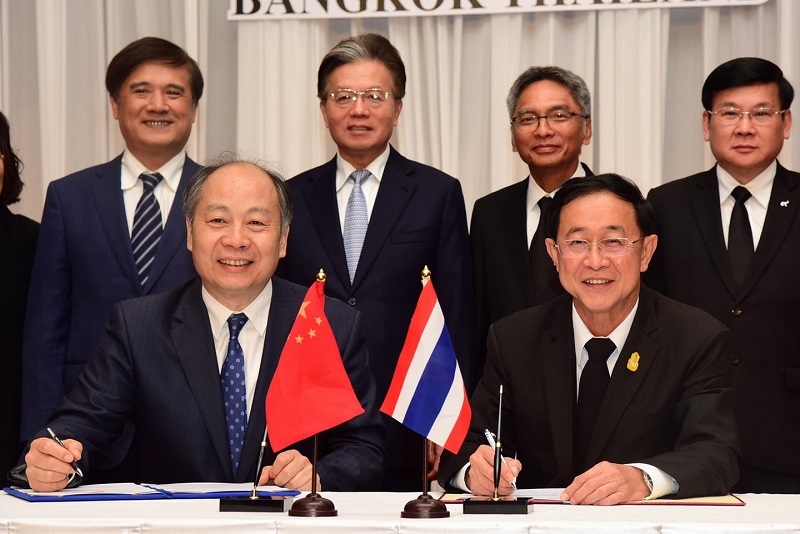
Minister Akhom Termpittayapaisit, at left, sits beside Wang Xiaotao, vice-chairman of the Chinese National Development and Reform Commission. Photo: Logisticnews / Facebook
Narongdech said the legal protection granted by the junta order closed all means of review, as the courts deemed it legitimate and constitutional – and refused to review numerous complaints filed challenging it.
Though the military government said it was just a procedural means to expedite the process by exempting the project from obligatory bidding and procurement processes, the law expert said its vague language has broader implications.
“They should have written specifically which articles they would like [the project] exempted from,” he said during a Thursday panel discussion. “What they wrote will exempt it from the whole inspection process.”
One of the rationales provided by the military government is that extralegal authority is needed to indemnify Thai officials from the legal consequences so they can take necessary actions to get the stalled project moving.
But, Narongdech contended, it had more to do with protecting the regime’s Chinese partners from legal accountability and only shielded Thai authorities from prosecution in matters of bidding and procurement.
“If the Thai staff is found to be corrupt in other steps, they can still face charges,” he said.
The government has argued that despite exempting the project from 10 laws and regs – including some junta orders – it also ordered that the project comply with the “Integrity Pact,” a set of principles from Transparency International.
Narongdech said that was an empty gesture, given that all the laws that would make punishment possible were voided by Prayuth’s use of Article 44.
Beyond the legal issues, Thursday’s panel included an array of experts dissecting the deal.
A university economics professor raised concerns about the transfer of technology and expertise, as well as the rail line’s actual financial benefits.
Thai junta chairman and Prime Minister Prayuth Chan-ocha with Chinese President Xi Jinping in Beijing, 9 November 2014
Economist Nuannoi Treerat said if the government does not think about the bigger picture of the national transport system and invests solely in one piece, it is unlikely to succeed.
For example, Nuannoi said she had yet to see real estimates of what fares would be and how they could compete with those of low-cost airlines.
She also asked: Why stop at Korat?
“Korat is just the gateway. How do people commute after they get there?” she said. “If they have to continue on another transportation system, they would probably just have taken the highway from the start.”
Engineering lecturer Sompong Sirisoponsilp said the government should have a specific plan for transferring the expertise needed to maintain this system and future ones.
A Chinese studies lecturer with a skeptical view of Thailand’s partner in the deal warned that the government must assure its contracts are well-written and include transfer of know-how.
“We have come this far,” Vorasak Mahatdhanobol said. “So I only wish the government see through China.”
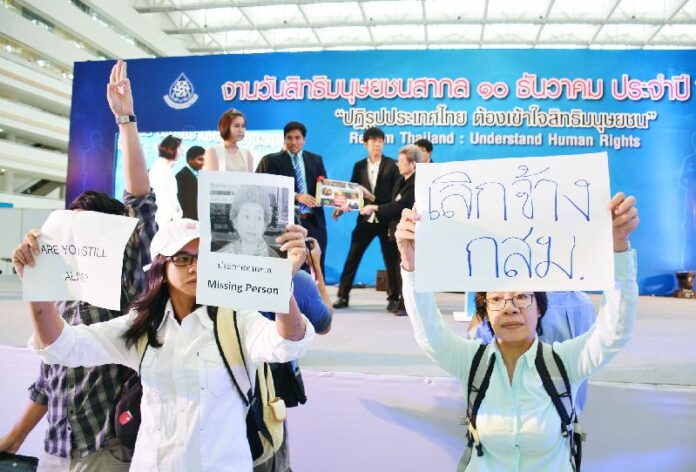
Anti-coup activists criticize National Human Rights Commission at a Dec. 12, 2014, awards ceremony.
BANGKOK — All six members of the National Human Rights Commission will likely be removed by the interim legislature in a move proponents say will strengthen the body and critics worry will see them replaced with junta-cozy appointees.
The Constitution Drafting Committee has submitted a bill for consideration by the National Legislative Assembly that would remove all commission members. While the interim legislature is evaluating the measure, it has already garnered mixed reactions.
Porpenh Khongkachonkiet, a prominent human rights activist and director of a human rights advocacy group focused on the Deep South, said removing the existing commissioners before their terms end in 2022 does not guarantee a more independent body, which has been criticized as flaccid in defending civil rights.
“Change is needed, but not through ‘set zero,’” said Porpen of the Cross Cultural Foundation, using a Thai neologism referring to the recent reconstitution of the Election Commission.
The new members would be nominated by a 10-person selection committee then approved by the the junta-appointed legislature if elections have not yet been held. If the replacements come after promised elections, the junta-selected senate would confirm their appointments.
It’s being presented as a fresh start and political reset in the same way dissolving the Election Commission earlier this month. The idea originated in the junta-appointed Constitution Drafting Committee. Their rationale was that the current commission members were not diverse enough and not as capable, as the organization was downgraded at the international level in January 2016 by the Global Alliance of National Human Rights Institutions.
The National Human Rights Commission is a nominally independent body established in 2001 nearly a decade after at least 52 people were killed in 1992’s Black May popular uprising against the military regime in power at the time. It’s status was downgraded last year by the international accreditation body from “A” to “B.”
Charter commission spokesman Norachit Sinhaseni said the process and committee that put in place the current membership were not “as varied as it should be under the Paris Principles,” which set the standards for human rights commissions.
Norachit said the reset is about setting higher standards and qualifications for independent bodies, including the rights commission. He acknowledged that they have been criticized for going too far “to the point where we have been ridiculed that the qualifications are too high.”
Those standards include, he said, a requirement that candidates must have resigned from active membership in a political party for a 10 years to qualify for the job.
Other criteria include having at least a decade of experience working in the human rights field and holding a university degree.
As to who will nominate new members, the selection committee will consist of three representatives from human rights organizations and one apiece from a public health organization, the Lawyers Council and a media association. The speaker of the House of Representatives and presidents of the Supreme and Supreme Administrative courts will also sit on the selection committee. Those nine members will appoint a human rights scholar to fill the 10th seat.
Asked how members selected by junta appointees could be trusted to act impartially and independently, Norachit suggested there would be accountability, though none of those involved in appointing members are publicly elected.
“Then we’re saying that those bodies responsible for selecting will be held responsible by the public,” he said.
The spokesman added that there’s his body of junta-appointed charter drafters could do about criticism their proposal will be decided by other junta appointees, free of public accountability.
“I don’t think we can do anything about that,” he said.
Higher Standards Questioned
On Tuesday, 157 human rights groups, activists and academics issued a joint letter to the charter commission and legislature citing perceived flaws in the bill.
It pointed out that the draft includes no guarantees on gender parity and called for removing health care and public health representatives from the selection committee, saying they are not directly relevant to the commission’s mission.
The group also stressed that it’s not the commission’s duty to defend Thailand’s human rights record in the international arena. Article 44 of the draft law states that the commission must take action “without delay” to defend Thailand if “there exists incorrect or unfair” information about the human rights situation in the kingdom.
Willing to Vacate But Uncertain About Future
Two of the current six commissioners said they are willing to leave their posts if the assembly passes the bill.
Tuanjai Deetes, a commissioner in charge of ethnic rights, said she’s ready to abide by any decision.
“If the rules are changed, I will embrace it,” said Tuanjai, who was appointed in November 2015. “It’s okay for me personally. I can continue to work [in the field] even without the position.”
Tuanjai does have her concerns. She cited Article 24, which bars commissioners from accepting free air travel, accommodation or a per diem from foreign states or foreign NGOs as a hindrance to occupational development for commission members. Tuanjai said the restriction would prevent them from accepting UN invitations to attend workshops and training, which would undermine the resource-limited commission. She said the draft bill also stipulates that subcommittees could only be set up when truly necessary, which may reduce expert participation and consultation made possible by the present array of subcommittees.
Angkhana Neelapaijit, the commissioner in charge of civil and political rights, was likewise critical of some provisions but ready to accept the assembly’s decision.
Angkha said if the selection process happens before elections are held and new members are approved by the junta-appointed assembly, it could lead to doubts about their independence.
“If they want to be impartial, they should wait until after elections,” she said.
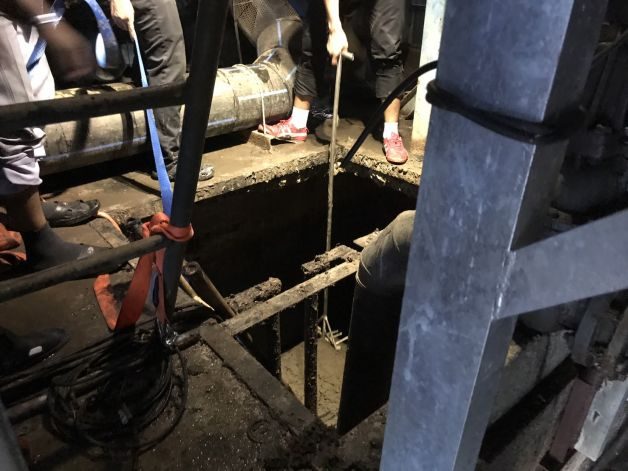
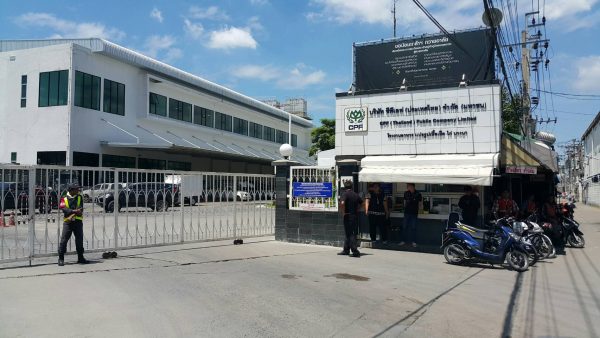
A wastewater treatment plant on Friday at a CP-owned meat processing plant in Bangkok’s Bang Na district.
BANGKOK — A university veterinary intern, plant worker and three security guards died Friday morning after falling into a wastewater treatment pond at a food processing plant belonging to the nation’s largest corporate conglomerate.
The bodies of three men and two women were pulled out of the treatment pond at about 11am. The incident began after Pantika Tasuwan, the Chulalongkorn University intern, fell into the pond and the other four attempted a rescue.
The employee and three security guards leaped into the pond but were overwhelmed by hydrogen sulfide and suffocated to death, Lt. Col. Phumwattana Ritthong of Bang Na police said.
The four would-be rescuers were identified as Pornchai Boonban, Charnchai Pantunakin, Lakchanok Saentaweesuk and Chatri Srisannakorn.
The Bang Na plant is owned by Charoen Pokphand Foods, a subsidiary of CP Group.
Four were pronounced dead on the scene while a fifth later died at the Bang Na 1 Hospital.
By Martin Sturzenegger (Translation by Rosemarie Graffagnini)
Tages-Anzeiger, Switzerland
Zurich — If the banana trees at Zoo Zurich are particularly lush, it’s thanks to a fertiliser with an unusual ingredient: human waste. In the spring of 2016, zoo employees cleared a bamboo grove in Zurich’s Masaola Rainforest to plant the trees. Within a few months the saplings had reached an impressive height and produced a cornucopia of yellow fruit. “We were really surprised how fast the plants put down roots,” says Martin Bauert, curator of the tropical area of Zoo Zurich.
The reason for this fast growth has a name – terra preta – which is Portuguese for black soil. It is a particularly fertile substrate created from compost, charcoal (biochar) and human faeces.
The zoo pioneered its use some 18 months ago and, as Bauert says, “the ground vegetation has hugely improved”. In the future, the entire artificial rainforest is to be based on terra preta. And soon the black soil will also fertilise the zoo’s elephant park. The animals will then roam grounds that contain human excrements. Not that they will take exception to it – terra preta smells anything but vile.
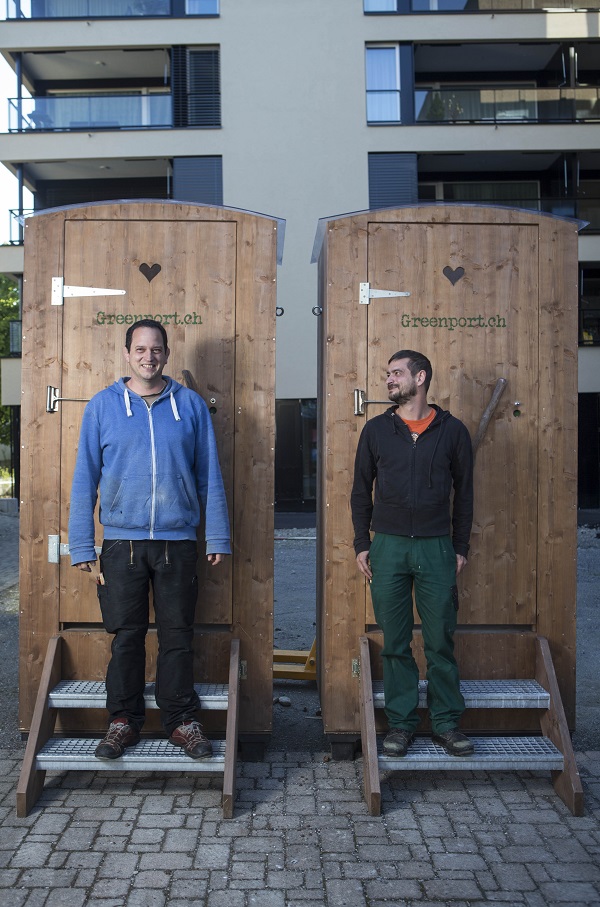
Torsten Much (left, blue hoodie) and Marc Haueter (right, black hoodie, beard) Greenport in Kreuzlingen, Switzerland
Tobias Müller knows this first-hand. In 2015, the carpenter, inventor, and jack of all trades joined forces with his friends Marc Haueter, Torsten Much, and Anja Lippuner to establish Greenport, the company that provides Zoo Zurich with the fertile substrate. “We wanted to break some taboos with our products,” Müller explains. It’s a totally natural cycle, he says. Faeces turn to soil and urine to fertiliser, which in turn provide the basis for producing food.
To obtain the raw material, the start-up team developed a mobile dry toilet, the Greenport. Müller, 38, leads the way through the company warehouse, an old barn in Birmensdorf near Zurich. Toilets are crowding the place. They come in a variety of models, from a single cabin to a dual-size urinal to a wheelchair-accessible version. They are rented out to open-air concerts, markets, food fairs, or weddings.
Handmade from fir logs, the toilets exude a certain rustic cosiness, which the cheaper plastic models of the competition are lacking. “We wanted to create a privy with a homely feel to it – a toilet with charm.”
The human waste drops into a container, which Team Müller carts to a pyrolysis facility. Pyrolysis is the chemical decomposition of organic materials through the application of heat. The nutrient-rich matter is exposed to temperatures of up to 800 degrees Celsius. This destroys toxic germs, viruses and hormones but leaves nutrients, trace elements and water intact. The process yields charcoal (biochar) with a high storage capacity, which extracts toxic substances from the soil and returns water or carbon dioxide to it. The biochar is then supplemented with compost and soil organisms to obtain the terra preta.
“We take human waste back to where it belongs – nature,” Tobias Müller says. Greenport practises in miniature what science has tried to work out on a much grander scale: how to recover valuable substances from sludge. The human race needs to find a way to make bodily waste more productive, Müller says.
In Switzerland alone, sewage treatment generates 200,000 tonnes of sludge each year. Sludge used to be utilised by farmers to fertilise their soils. But this meant that heavy metals such as lead or zinc, traces of detergents and medical drugs as well as germs and viruses made it into agrarian food production. Which is why the Federal Office for the Environment (BAFU) intervened in 2006. Now the potentially valuable raw material is incinerated.
According to a BAFU study, 6,000 tonnes of phosphorus – a high-grade nutrient for the production of fertilisers – could be recovered each year from sludge and sludge ash. However, the legal basis for recycling the sludge in large quantities does not exist so far. Müller calls this “an ecological lunacy”.
For the moment, the annual production of terra preta is limited to 200 cubic metres, though Müller’s start-up may well show a way for production on an industrial scale. One and a half years after Greenport’s foundation, initial investments into production have been amortized, and Müller envisages the creation of a partner-network-system with branches across Switzerland. “Rented toilets are a market of billions. If we can have a small part of it, we’re satisfied”, he says.
The idea for Greenport was born seven years ago, when Müller bought a piece of land that had lost its topsoil – dead land, in other words. “I wanted to regenerate it within a reasonable time frame.” Müller did some internet research and came upon a dark, fertile soil that once upon a time had secured the livelihoods of the indigenous peoples in the Amazon basin: terra preta de índio – Indian black soil. A mixture of charcoal, compost, bones, fish bones, and human faeces. Müller became inspired and began experimenting. “We are profiting from know-how that had been built across thousands of years but later was lost.”
However, the sustainability cycle was still incomplete– what to do with the urine? The answer was found last year, at the Swiss Federal Institute of Aquatic Science and Technology (Eawag) in Dübendorf, an offshoot of ETH Zurich. The institute launched a product called Aurin, a urine-based fertiliser, in February 2016. Greenport now provides the liquid raw material and Eawag takes care of the biological process. Ten litres of urine yield about 0.5 litres of high-quality plant fertiliser. “It was the one piece of the jigsaw puzzle that was still missing,” Tobias Müller says. And it helped create what is presumably the world’s most environmentally-friendly privy.
SAN FRANCISCO, California — Sisters Morgan and Caitria O’Neill never expected a tornado would hit their small hometown in Massachusetts — or that when it did, recovering from the disaster would change their lives.
On June 1, 2011, a pair of twisters ripped across western portions of the state, shocking residents with their suddenness and violence, and causing the state’s first tornado-related deaths in 16 years.
One of the tornadoes, categorized as a huge EF3 with winds estimated at 160 mph, roared through the O’Neills’ hometown of Monson, Mass., seriously damaging their house. Almost immediately, the devastation threw both Morgan, then 24, and Caitria, then 22, into the role of disaster recovery experts.
“We just started answering questions and making decisions, because someone, anyone, had to,” Morgan said. “On June 1, we weren’t disaster experts, but on June 3 of that year, we started faking it.” In those frantic first few days, “we built our recovery machine,” she said.
What began as a way to help their community get back on its feet after a disaster six years ago evolved into recovers.org, a free, easy-to-use “recovery-in-a-box” website to help other cities and towns quickly organize disaster relief.
It can be rolled out in minutes, helping local relief organizers turn interest in helping into organized action, said Chris Kuryak, the project’s chief operating officer. “It’s something that could be deployed after every disaster by any local organizer,” he said.
The sisters designed the website to help local folks manage volunteers and donations, track data about the disaster, and apply for grants and request aid through official channels such as FEMA, the Salvation Army or Red Cross.
Photo: Recovers / Facebook
It also links volunteers with victims, allowing both groups to alert the other of what’s needed and their ability to help.
But the site isn’t just for the locals: Often after a disaster, people around the nation and the world, moved by photos and news stories, seek to help but don’t know how. Recovers.org lets people everywhere know what’s needed most and how best to donate it.
What is key, the O’Neill sisters say, is to capture public attention immediately after the disaster, before attention turns to another event. After a natural disaster, there’s only a tiny window before the world turns its sympathy (and donations) elsewhere — so it’s important to be prepared for every aspect of recovery, they say.
“After a disaster, there’s a flood of goodwill,” Kuryak said. “There are people who want to donate and people who want to volunteer.”
Victims have seven days to capture 50% of the web searches about a disaster, according to Google Trends, said Caitria, now 28 and a researcher at Facebook. Recovers.org helps local populations respond immediately from disasters while waiting for government and other non-profit organizations to mobilize.
Some communities deploy the site as a preparation tool, but most places find the site after disaster strikes, Kuryak said.
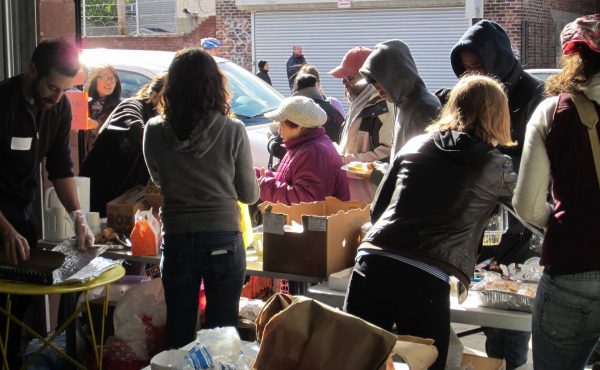
Recovers employees
The organization now hosts more than 200 recovers sites for communities around the world. Each website has all the functions needed in one place — from hot shower locations to hot meals, sign ups to donate or volunteer, and ways to privately request help.
The software has been used for large and small disaster recovery/organizing efforts both natural and man-made, from a flood in a small town in Alberta, Canada, to wildfires in Big Sur, to Superstorm Sandy.
Last month, when massive flooding struck Neosho, Mo., the town used a recovers.org site to organize its recovery effort.
In Lismore, Australia, following a direct hit from a tropical cyclone in March, Maddy Braddon of Lismore Helping Hands, a volunteer group in the city, said the website became an “instrumental tool” to help more than 1,000 people affected by the disaster.
“Having a purpose-built website that channels the immense number of requests for help and offers of help made our recovery job easier and more efficient,” she said.
Recovers.org sites also cover low-income countries such as Malawi, India and the Philippines, where some challenges exist, including reliable Internet connectivity and a language barrier, Kuryak said. “Though low connectivity does not preclude the usefulness of a Recovers site, it does make collecting needs, donations and volunteers through the site more difficult,” he said.
Another challenge can be local support and traction, Kuryak said. “Similar to a problem we’ve seen in U.S. communities, when a site in a low-income community does not have support from local organizations or government, then the effectiveness of the site is reduced,” he said. “Having ‘buy-in’ from local organizations and government increases both the awareness and trustworthiness of a Recovers site. Since Recovers is not an internationally recognized name, many new users are skeptical of using it.”
The site itself is a volunteer effort. The next goal is to transition to a non-profit organization. “We hope to fundraise such that we can again hire a small staff to be truly on-call, helping monitor and manage the platform during large and often international disasters,” Morgan, now 30 and an atmospheric scientist at the Weizmann Institute of Science in Israel, said.
“People should know that they can rely on these sites in their time of need,” she added. “If we can empower communities, and especially local residents within them, with the right tools after a disaster, they can become the experts.”
“This experience changed our lives, and now we’re trying to change the experience.”
Jan Victor R. Mateo
The Philippine Star, Philippines
MANILA — With over 7,000 islands situated in the tropics of the Pacific, the Philippines boast having some of the best beaches in the world.
Ironically, the country also ranks high in terms of the number of people – especially children – who die due to drowning. A recent study released by the World Health Organization (WHO) showed that an average of 2,496 people die in the Philippines due to drowning every year between 1980 and 2011. While the government is implementing various initiatives to address the issue, there is no denying that there is a lot to be done.
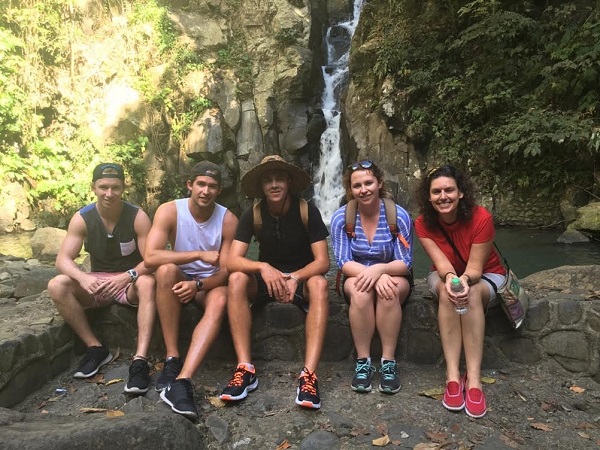
This is why, in 2015, a group of Australian students from Griffith University decided to come up with a drowning prevention program that will be implemented in various coastlines across the Philippines.
“We hope that after the implementation of this program lives will be saved on the local beaches,” says Andrew McLean, directing manager of FLOAT Philippines.
FLOAT Philippines, is an initiative that aims to harness engagement between international and local organizations – including the government – to come up with strategies that will lower the drowning mortality in the Philippines.
“Drowning prevention programs are commonplace in Australia and we grow up feeling safe when we are at the beach, both as a result of our swimming culture and the incredible job our surf lifesavers do patrolling the beach,” adds McLean.
The primary idea is to come up with a sustainable program that will raise drowning prevention awareness among those living in coastline communities. The organization envisions to implement “learn to swim” and “surf lifesaving” programs in the country to lower cases of drowning, particularly in tourist spots.
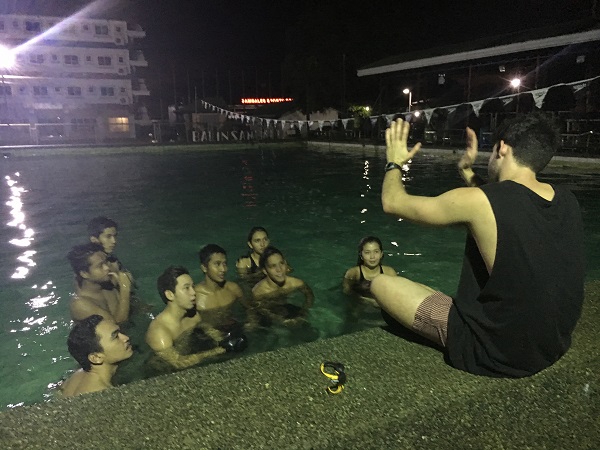
Andrew McLean discussing swimming strategies with the Zambales Swim Team.
Program implementation
Almost two years since they came up with the initial idea, McLean admits challenges in implementing a project in a location thousands of miles from where they are based.
He noted, that they had to go back to the drawing board after they visited the Philippines in January 2016 to conduct a needs assessment analysis, establish partnerships and meet with stakeholders.
But the group remains committed. FLOAT’S local coordinator Kina Santillan Pascua says they’re nearing the implementation phase of the project.
Pascua, a former coordinator for the Australian embassy, said she stayed on with the FLOAT project because she sees the importance of implementing a drowning prevention program in the Philippines.
“I work in a lot of development projects and everywhere I go, I see a lot of communities with kids playing near shorelines. It’s their backyard and we have to implement programs that will make their environment safer,” she says.
Following a second visit in July 2016, FLOAT was able to form partnerships with Zambles Surf Life Saving Inc. and the popular tourist hotel Charlie Does Inn, situated in the resort of Baler. Both organizations are committed to training lifeguards and to developing anti-drowning initiatives.
“FLOAT managed to raise the funds to train two Baler locals as lifesavers and our partners in Baler are currently trying to get a law passed by the government in hopes of securing funds for future employment and training of the surf lifesavers,” says McLean.
The organization also hopes to strengthen ties between Australia and the Philippines, and therefore further increase awareness of the project by meeting both the Australian and the Australian-New Zealand Chamber of Commerce Philippines, both situated in Manila.
Katelyn Pomroy reading a story about Australian Surf Lifesavers to the Baler Primary School
Sustainable, scalable program
While the long-term objective is to promote a culture of safer aquatic spaces in the entire Philippines, the team behind the projects understands that they have to limit their program to make it sustainable and scalable.
“We hope to ensure sustainability through training and developing skills of the local organizations we are working with. In addition to this, we want to provide local and international partnerships to these organizations running the project from the ground level to boost their knowledge and capabilities in the drowning prevention field,” says McLean.
The founding team of Float Philippines – BJ Doyle, Andrew McLean, Marc Bruneau, Tessa McKinnon and Kim Holmes.
FLOAT’s pilot project will be based in Baler, but the team are hoping that in the long term, they will be able to provide surf lifesaving training across the Aurora Province.
“For the ‘learn to swim’ project, we are hoping to partner with Baler Central Primary School to create a sustainable swimming program… By doing this, we hope to extend the current learn to swim teachers expertise and allow them to reach more swimmers,” notes McLean.
There is still much work to be done to address the problem of drowning in the Philippines. But for these Australian students, distance – and the difference in nationality and culture – is not going to be a hindrance to ensure that Filipino children are safe in the water.
“We think that everyone should have the ability to learn to swim and enjoy an aquatic environment,” ends McLean.
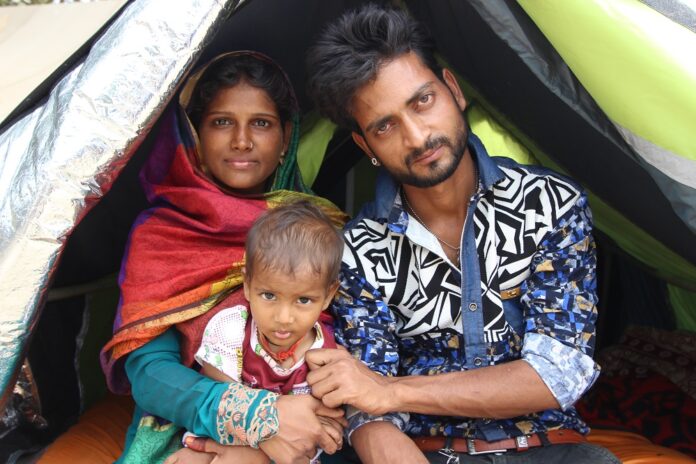
A homeless family on the streets of Mumbai with their recently received weatherHYDE
By Priscilla Goy
The Straits Times, Singapore
SINGAPORE – For six years, a married homeless couple were separated and forced to live apart in Delhi, India. The husband was in one gender-segregated communal shelter and the wife in another. Last year, for the first time, they were able to move into their own “home”.
Their new “home” is a tent, designed by Singapore-based, non-profit organization billionBricks. The tent can be set up by one person in 15 minutes without any tools. It is weather-resistant, offering protection from the city’s extreme temperatures which can range from 5 – 45 degrees Celsius (40 – 115 Fahrenheit). It is also spacious, with the ability to fit a family of two adults and three children. The couple even moved in a bed, explains billionBricks founder, Prasoon Kumar.
BillionBricks is a on-of-a-kind non-profit design studio that innovates shelter and infrastrucure solutions to end homelessness.
More than 20 homeless families pilot-tested the tent in Delhi and Mumbai. Mr. Kumar said homelessness is difficult to eradicate but considers the tents to be an important interim solution. “Time is required to find sustainable solutions, but there’s also a humanitarian need and as time passes, people are dying.”
The lack of adequate housing across the world is a huge problem, with the United Nations estimating that there were approximately 100 million people homeless in 2005, which was the last time a global survey was done. Many more die as a result of exposure to extreme temperatures.
The Singapore-designed weatherHYDE tent is made to be weatherproof. In the winter, the tent’s triple-layer, reversible cover provides insulation, while reflective material on the inside retains body heat. Conversely, in the summer, the other side can be used to reflect solar heat and help people inside the tent stay cool. “But that is only one of the benefits a weatherHYDE tent offers over other typical communal shelters and tents,” said Mr. Kumar.
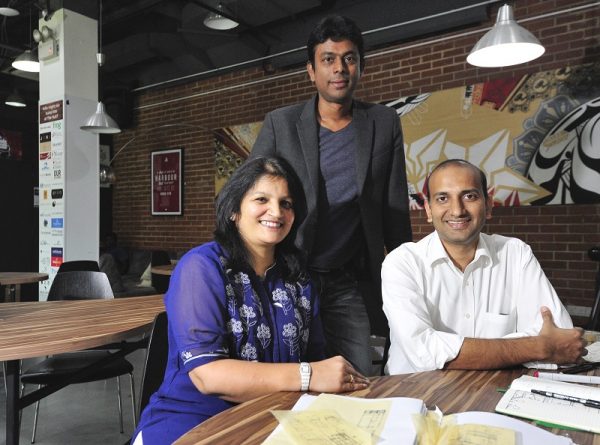
The BillionBricks team include (from left) founding trustee Snehal Mantri, founding trustee and founder Anurag Srivastava, and founder and CEO Prasoon Kumar. Staff and volunteers raise funds, contribute design plans and ensure that the buildings are safe. Photo: Dios Vincoy Jr / The Straits Times
Apart from battling the elements, the weatherHYDE tent provides more privacy because the triple-layer cover also blocks out light, so shadows from movement inside the tent cannot be seen. Its setup is easy and does not require anchoring to the ground with tent pegs, making its use possible in urban settings (areas often hit by natural disasters).
Its unique design has attracted global attention. In July of last year, videos about the tent garnered more than 23 million views within a month of being posted online. Even celebrities shared the videos. Well-known Hollywood actor Ashton Kutcher called it “innovation at its finest” and rapper Lil’ Wayne said it “could save millions of lives”.
Mr. Kumar had been working in architecture for 12 years when he decided to start billionBricks in 2013. Though originally from India, he has lived in Singapore for more than a decade. He sketched out the tent’s first design concept in 2014, after being troubled by an incident the year before. Riots in a town in northern India had left thousands of families homeless and more than 30 children died when temperatures fell to below freezing at night. “Several non-governmental organizations were there to help. The people were given tents, tarps, and blankets, but no one was thinking about the extreme temperatures,” he said. “Sleeping bags aren’t adequate– if a mother has a young child, how will the sleeping bag be big enough for the two of them sleep together? And even if they could squeeze themselves in, their heads would still be exposed to the cold.”
Last year, billionBricks also launched a crowdfunding campaign on Kickstarter and raised more than S$145,000 (just over 100,000 USD) in two months, enabling them to provide 500 tents to needy families. The tents cost S$279 (199 USD). The 500 pre-ordered tents are expected to be shipped from China to India and the US sometime this July.
WeatherHYDE was piloted in New Delhi, India in 2016
billionBricks, in its application for the internationally-acclaimed A’ Design Award’ stated that the tent “does not provide a poor solution to the poor; it provides a dignified solution”. The tent went on to be named one of 12 winners in the Social Design category in 2015.
Meanwhile, there have been several refinements to the tent’s design since the married couple gave it a test run. There are new locking mechanisms and both sides – not just the non-reflective layer – are now waterproof. billionBricks has also relaunched its weatherHYDEwebsite, with a section where donors can type in a tent’s unique ID number to learn more about the homeless family who received the tent they donated. Beyond providing shelter, billionBricks also hopes to offer jobs to the needy. They are in talks with US groups to create jobs for people with disabilities to have them manufacture the tents.
The organization has several sponsors, including DBS Bank’s corporate foundation, DBS Foundation, and Singapore-based design firm Space Matrix. Mr. Kumar hopes to continue to raise money through the weatherHYDE e-commerce platform, where the tents can be purchased and donated on a buy-one-give-one model and shipped anywhere in the world.
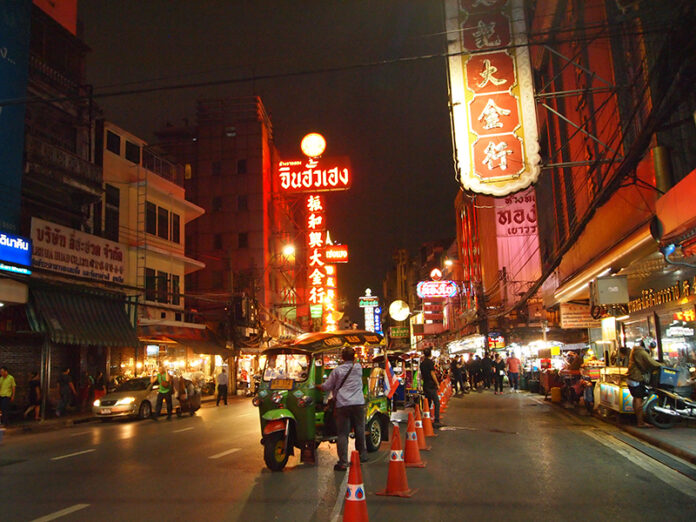
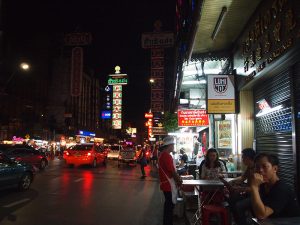
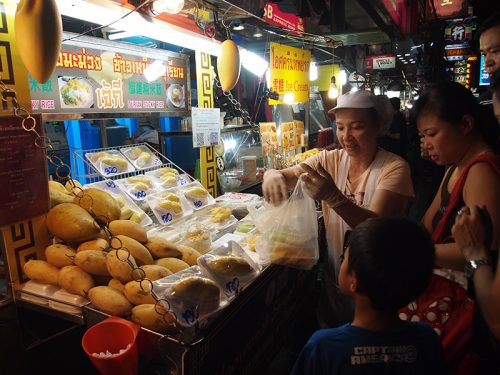
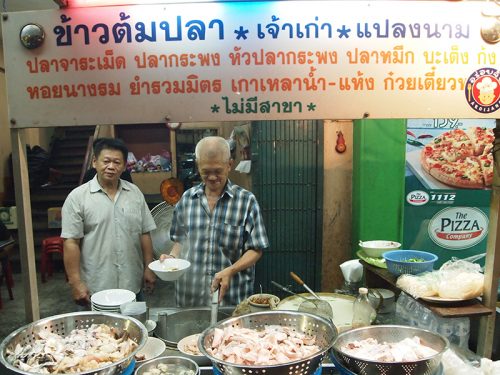
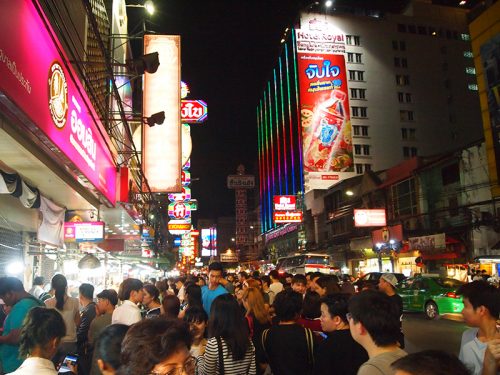
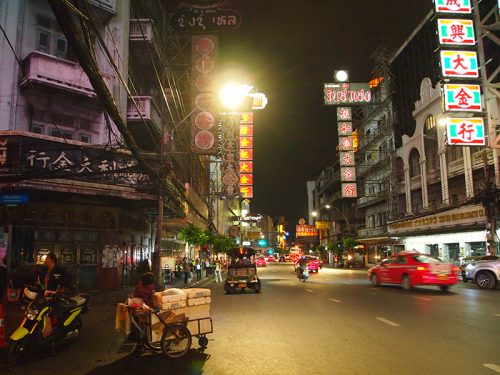
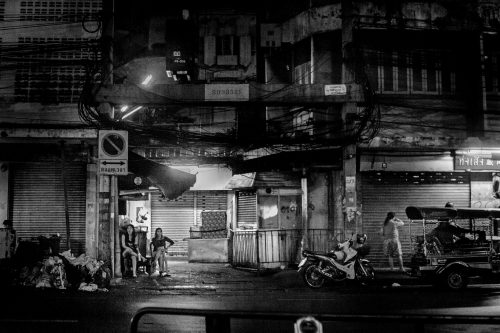
BANGKOK — Walk down Yaowarat Road on a given night and find the area known as Chinatown alive with tourists clamoring for street food unaware of the forces transforming the neighborhood.
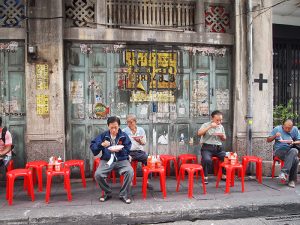
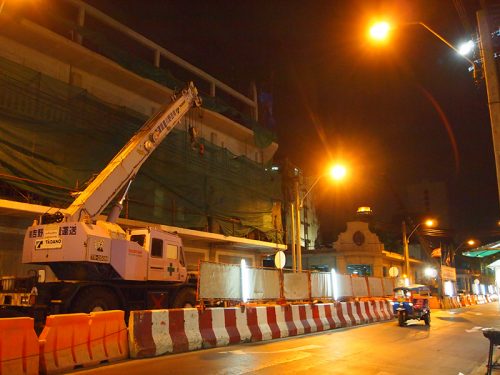
Change is afoot. On the streets, the vendors responsible for much activity and aroma are adjusting to new regulations on informal vendors. In the buildings, the working families that have kept it a living neighborhood are vulnerable to rising rents as new arrivals and a pending subway link bring the first wave of gentrification.
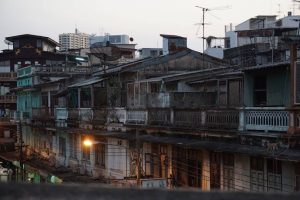
Since its construction a century ago, Yaowarat has remained a living Chinese community for trade, gold trade, finance and food. Some of the shophouses that housed big families are now empty, abandoned or converted into warehouses. Higher rents have driven people out to more affordable areas, while the youth prefer living downtown closer to their workplaces.
Yaowarat Road
“Development is in progress, with skyscrapers encroaching on the area to build hotels or stores. It’s endangering many historical sites which are part of Bangkok’s unique and historical record,” said Yongtanit Pimonsathean, an urban engineering professor at Thammasat University.
Something already driven to extinction? The shoemaking stores once frequented by king Rama VI, said Yongtanit, an expert on the history and development of the Charoen Krung community.
‘Fading’ Charm?
Before opening his traditional tea shop six years ago, Jongrak Kittiworakorn grew up in the area. He saw it rise and fall as a commercial center, and today says it is “fading.”
That loss became apparent when the neighborhood’s restaurants and street food stopped serving the community and instead aimed only for tourists.
Yaowarat Road at night
“The golden age of food in Yaowarat was during the ‘70s and ‘80s, when prices were graded according to quality,” said the owner of retro teahouse Double Dogs Tea Room.
“Its richness is now gone,” he continued. “They no longer aim at customers’ happiness and their pride, now they only seek profit. That is why its charm is fading.”
Another business owner, a third-generation local who wished to remain anonymous for fear of political repercussions, said the neighborhood’s future is in the wrong hands.
“All the government’s concerned with is orderliness. They never focus on the people,” he said. “There’s no master plan for the development. How will they retain Yaowarat’s unique traits after the MRT extension is finished, and more tourists come?”
‘Who’s Going to Build That Again?’
Radiating out from Yaowarat Road, Chinatown extends along Mangkon, Song Wat, Chakkrawat and Charoen Krung roads.
It’s on this fringe of Chinatown that a mix of priced-out, downtown-weary Thai and foreign creatives are bringing their cosmopolitan sensibilities.
Among the swanky bars and culturally woke venues on Soi Nana is Cho Why, a collaborative art space in a two-story, colonial-style shophouse.
An image of buildings in Yaowarat’s Soi Nana posted March 14, 2016. Photo: Cho Why / Facebook.
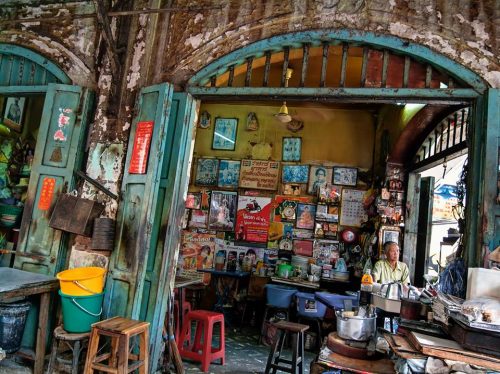
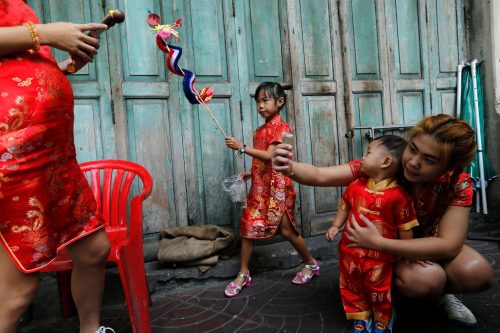
Somewhat ironically, the venue, despite being part of the change, has been hosting a photo exhibition on the endangered community called Bye Bye Chinatown. The photo exhibition features portraits of residents, images of local craftsmen and lots of stained, peeling paint. It ends June 29. On Saturday, people are invited to join a walking tour to explore the area.
Behind the exhibition is David Fernandez, Cho Why’s project manager, who moved into the space three years ago.
“I want to display the charm of people and neighborhood and create memories of what it is now before everything is gone,” he said.
From his observation during the past years, Fernandez found that there’s no plan to keep the old city’s heritage or the character of the district as he witnessed many rises of condominiums and locals moving out from their homes, leaving the buildings empty – or destroyed.
The sense of community that neighbors greet and talk to one another is what he holds precious. Now, their lives are under threat as they have to renew their real estate contracts each year, not knowing when the landowners will sell to developers.
‘Untitled’ by Graham Meyer exhibits at ‘Bye Bye Chinatown’ exhibition. Photo: Cho Why / Facebook.
“Who’s going to build that again?” he said. “They lose not only buildings and structures but people as well.”
It’s on Charoen Krung, the kingdom’s first paved street, that the Thailand Creative and Design Centre, or TCDC, recently relocated to inside a historically significant structure after giving up its longtime home on Sukhumvit Road.
Along with the Thai Health Promotion Foundation, TCDC has launched Co-Create Charoenkrung, a project meant to involve and engage the existing community in its economic and cultural development.
The project is intended to promote the emergence of boutique hotels, bars, restaurants, galleries and art spaces such as TCDC and the riverside artspace of Duangrit Bunnag’s Warehouse 30. Visitors will eventually be able to discover street art by artists from the Bukruk Urban Arts Festival and enjoy gallery-hopping events.
As with the people behind Cho Why, Speedy Grandma, Tep Bar and El Chiringuito, SoulBar owner Romain Dupuy rode in on the early wave. He said it was always his dream to open a business in what he calls “the only real district in Bangkok.”
He realized his dreams three years ago with SoulBar in Talad Noi. Inside, customers are treated to a decor of repurposed car parts acquired from local shops and nightly live music. More than 75 percent of his customers are Thai, with about 10 percent coming from the neighborhood.
“It’s necessary to know people and do something that’s affordable for the locals,” said the 40-year-old businessman, adding that it takes time for people in the community to visit his bar.
Bottom-Up Preservation
‘Untitled’ by Noah Shahar exhibits at ‘Bye Bye Chinatown’ exhibition. Photo: Cho Why / Facebook.
Plans to preserve the area began six years ago along with the MRT Blue Line extension project. Despite opposition, comments and research from both residents and experts, the project went on to bulldoze a number of historic buildings.
“There are more than 7,000 units of buildings with historical value in the Samphanthawong and Pom Prap Sattru Phai districts, and some of them were destroyed,” said Yongtanit, the Thammasat professor.
Those buildings were neither registered as historic sites nor afforded any protected status, he said, though they deserved to be saved.
From his research, Yongtanit said Yaowarat is one of the first places where different groups, such as the Chinese, Portuguese, Arabs and Indians settled down and set roots for over two centuries. The variety of the community can still be detected in its architecture that blends Thai, Chinese and Western styles. Moreover, those buildings are where very first toilets and fire-proof construction materials were used in edifications to comply with the Bangkok Sanitation Act of 1899.
According to Yongtanit, the Committee on the Conservation of Rattanakosin and Old Towns is looking at extending the preservation areas and will submit a proposal to the cabinet by the end of the year. It could result in the improvement to the principal city plan and enactment of site-specific conservation laws.
He also supports a proposal that would encourage local landowners in historic areas to sell development rights so they can continue earning from their properties and continue living and flourishing in the area.
‘Untitled’ by Raul Gallego exhibits at ‘Bye Bye Chinatown’ exhibition. Photo: Cho Why / Facebook.
Still, he thinks the community must play a part in the transformation.
Some have tried and failed; others have succeeded.
All residents of Werng Nakhon Kasem, aka the Thieves Market, were evicted against their will last year after the land was sold to TCC Land, a development firm owned by ThaiBev founder Charoen Sirivadhanabhakdi.
But a block away to the south, residents of Soi Luean Rit, a traditionally Chinese and Indian textiles district, banded together to avoid a similar fate.
Residents of more than 200 buildings in the neighborhood negotiated with the Crown Property Bureau to renovate historic sites there themselves and will move back in to resume their lives and livelihoods when the work is finished.
“The participation of local residents is very important, along with their pride in their dwellings, which will be beneficial in the long run, especially economic-wise” Yongtanit said.
What’s lacking now, he added, is participation from those without a voice and who are unable to submit heritage buildings for conservation status.
“Foreigners see mystic charms in those resources, which can never be rebuilt or renewed once destroyed, while some Thais don’t see their worth and turn them into lifeless storerooms,” Yongtanit said. “We have to adjust ourselves, or we’ll forever lose an economic opportunity.”
Yaowarat Road at nightSiripan Maneesatien or Je Kee selling mangoes and durian with sticky riceLeft, Hong Sae-Aiew, and his brother at their 80-year-old rice soup shopYaowarat Road at nightYaowarat Road at nightThe construction of MRT Blue Line extension on Charoen Krung Road‘Untitled’ by Landry Dunand exhibits at ‘Bye Bye Chinatown’ exhibition. Photo: Cho Why / Facebook.‘Untitled’ by Igor Prahin exhibits at ‘Bye Bye Chinatown’ exhibition. Photo: Cho Why / Facebook.‘Chinese New Year’ by Jorge Silva exhibits at ‘Bye Bye Chinatown’ exhibition. Photo: Cho Why / Facebook.‘Untitled’ by Biel Calderón exhibits at ‘Bye Bye Chinatown’ exhibition. Photo: Cho Why / Facebook.