28.3 C
Bangkok
Sunday, June 21, 2026
Home Blog Page 2289

Oil Extraction on Protected Land Resumes Under Junta’s Shield

Photo: PTTEP

BANGKOK — Oil companies resumed operations Monday after the junta chief used his self-granted absolute power to overturn a court order and give them permission to continue their activities on land reserved for farmers.

The PTT Exploration and Production Co. Ltd., or PTTEP on the stock market, said they recommenced their petroleum production Monday on land which had originally been allocated for agricultural use after halting operations for 23 days due to a court order.

Read: Junta to Order Oil Production Restarted on Protected Land

The pause was the result of a June 1 ruling by the Supreme Administrative Court, which deemed that land reserved under the 1975 Agricultural Land Reform Act could not be used for other purposes, in light of which the Agricultural Land Reform Office had revoked concessions granted to several companies.

Following the verdict, the company had to stop operations on June 3 in the Lan Krabue district of Kamphaeng Phet province – despite having been active there since 1982.

It triggered the largest decrease in the company’s market value in four months.

A government spokesman said last week the junta’s special power was needed in this case to restore the production of energy and investors’ confidence.

A Friday order issued by the junta’s extralegal authority permitted the usage of land reserved for the promotion of farmers’ rights to be used for energy production – including mining and the generation of wind energy.

It said companies that never sought the authorities’ permission – and are illegally operating on protected land – are also allowed to resume their activities while they seek official approval.

The order wrote that the reform office must compensate affected farmers.

Apart from the PTTEP – the majority of which is owned by state oil company PTT – the order also benefitted another six companies whose productions were also located on protected land.

The company said the 23-day halt of the petroleum production in Lan Krabue district resulted in a 0.4 percent loss of their expected annual sales.

Advertisement

Vets Look to Rehabilitate ‘Paley,’ Sea Turtle Pale From Captivity

Nantarika Chansue, vet, feeds Paley in a video posted to her Facebook Tuesday.

BANGKOK — Marine experts at Chulalongkorn University said Tuesday that they were rehabilitating a green sea turtle that had grown ill after living in captivity.

The young female green sea turtle – named Paley because of the discoloration in her skin and shell – was handed over to the care of Chulalongkorn University after its owner kept it in a freshwater pond where the animal had grown ill, said Natarika Chansue, a veterinarian at Chulalongkorn University.

“She’s pale because she doesn’t get sunlight and was kept in freshwater,” Nantarika said by phone Tuesday. “The owner bought her illegally.”

Nantarika posted two videos of Paley on her Facebook page in which she introduced the reptile to the world.

Unaware that Paley was a sea turtle, the owner had kept her in a freshwater pond and decided to hand her over to the authorities when she started weakening.

Keeping protected animals such as the green sea turtle in captivity without permission is illegal in Thailand, a crime punishable by up to a 30,000 baht fine or three years in jail – or both. The owner, who authorities did not identify, was not charged. Nantarika said she would work with the Department of Marine and Coastal Resources to rehabilitate Paley.

While the animal is eating better than before, Nantarika says “her blood and skin are still not strong enough” and that “her recovery could take months.”

Nantarika and her team is training Paley to be less familiar with humans and to dive for food in saltwater to survive in the ocean.

“Paley shows us that it’s possible to train turtles be returned to the ocean. Before, she wanted humans to scratch her back often, but now she can show us she doesn’t like it,” Nantarika says in the video, as the turtle splashes away from her hand.

Nantarika ends her post with a plea for people to stop bringing exotic marine animals into captivity.

“This is one more life that was brought to become part of humans’ lives, but soon she will go back to living her own life,” Nantarika said as she fed Paley lettuce.

Earlier this year, Nantarika operated on Piggy Bank, an older female green sea turtle who survived an operation that removed almost a thousand coins from her stomach in March, but later died from surgical complications.

Related stories:

Turtley Crowded: Temple Promises More Space for Reptile Residents (Photos)

Turtle Watch: Coins Found Inside Two of Piggy Bank’s Friends (Photos)

Piggy Bank’s Turtle Friends to be Checked for Coins

Nation Mourns Piggy Bank, Takes Hard Look At Self

Piggy Bank, Giant Sea Turtle Who Ate Too Many Coins, 25

Now Empty of Coins, ‘Piggy Bank’ in Terminal Decline

Chula Vets Divest Turtle’s Stomach of 915 Coins (Photos)

‘Piggy Bank’ Ate Too Many Coins. Now Chula Vets are Trying to Save Her

Advertisement

20-Pound Live Lobster Found in Luggage at Boston Airport

A TSA agent holding a live lobster that weighs roughly 20 pounds seen here Sunday at Boston's Logan International Airport. Photo: Associated Press

BOSTON — The Transportation Security Administration says a 20-pound (9-kilogram) live lobster has been spotted in a passenger’s luggage at Boston’s Logan International Airport.

TSA spokesman Michael McCarthy says the lobster found Sunday in the passenger’s checked luggage at the airport’s Terminal C is the “largest” he’s ever seen.

McCarthy says the TSA doesn’t prohibit transporting lobsters. The TSA website says a live lobster is allowed through security but must be transported in a “clear, plastic, spill-proof container.”

McCarthy says the lobster was in a cooler and “cooperated quite nicely with the screening process.”

He shared a picture of a TSA agent holding up the crustacean on social media.

Advertisement

CPF Treatment Pond Chief Charged with Negligence Over 5 Deaths

A wastewater treatment plant on Friday at a CP-owned meat processing plant in Bangkok’s Bang Na district.

BANGKOK — The manager of the wastewater treatment pond at a food processing plant turned himself in to police Monday evening and was charged with negligence following the death of five people on the Bang Na district premises.

After being questioned for several hours by police, Preecha Tamporn; head of the wastewater treatment pond inside the Charoen Pokphand Foods, or CPF, plant; was charged with negligence resulting in death. If convicted, he faces a maximum penalty of up to 10 years in jail and a 200,000 baht fine.

The 51-year-old was released on bail, city police chief Lt. Gen. Sanit Mahathavorn said.

According to Sanit, witnesses and the plant’s employees will be further questioned about the Friday incident, in which five people – including a veterinary studies intern from a prominent university and four plant employees – suffocated to death after falling into a wastewater treatment pond.

The Industrial Works Department ordered the plant’s wastewater system shut for 30 days on Monday afternoon until it undergoes improvements and meets required safety standards.

CPF, the company to which the plant belongs, is a subsidiary of multinational conglomerate CP Group.

Related stories:

CPF Plant’s Wastewater Pond Ordered Shut After 5 Deaths

Chula Intern, 4 Others Die at CP Plant in Bangkok


Advertisement

Activist Presses on With Petition Over Thai-Chinese Railway

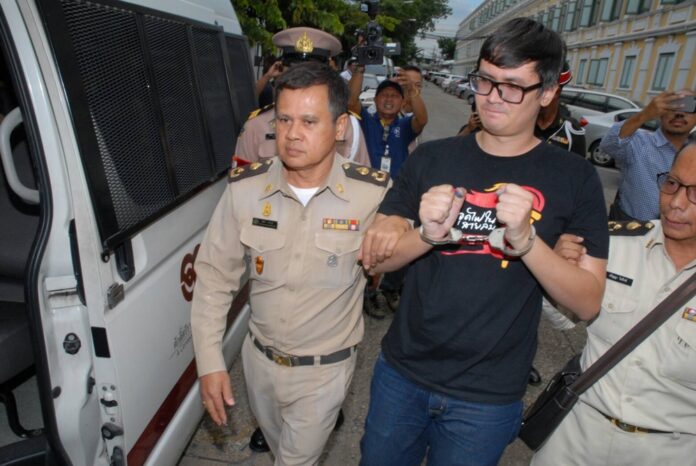
Police escort activist Rangsiman Rome from the military tribunal to be released at Bangkok Remand Prison on Monday afternoon

Update: Rangsiman Rome filed the petition 30 June. 

BANGKOK — Released after being detained overnight, pro-democracy activist Rangsiman Rome said Monday he would continue to demand transparency over a 179-billion baht rail project the Thai military government recently signed with China.

Rangsiman initially planned to submit a petition Monday asking the government to reveal details of the controversial Sino-Thai railway construction but was arrested by police a day prior. The 25-year-old activist, freed on bail by the military court yesterday, said his group would file the request soon.

“I would like to announce the date on our Facebook page. We will make a formal announcement,” Rangsiman, who leads activist network Democracy Restoration Group, said by phone. “I think we will find out the date soon.”

Read: Activist Cites Chinese Rail Project as Reason for His Arrest

A spokesman for the junta said Rangsiman is free to do so.

“To file a complaint or request to the government is a normal thing to do,” Col. Winthai Suvaree said Tuesday. “Any citizen can do that.”

He said he’s not aware of any attempt by security officers to deter Rangsiman from submitting his transparency request.

Police on Sunday arrested Rangsiman on the allegation that he ignored an August 2016 appointment with the prosecutor for a charge related to his campaign against the junta-backed charter draft two months earlier.

But Rangsiman said he never received any summon and accused authorities of fabricating the allegation to stop him from submitting his petition. The chief of Bang Sao Thong Police Station, which was responsible for the warrant, said Tuesday he was in a meeting and could not comment.

The activist was detained for a night at a police station holding cell before the military tribunal freed him on bail Monday night. The bail also came with the condition that he could not “incite unrest.” He was also barred from traveling abroad without permission.

Rangsiman said he believes his transparency campaign would not violate those conditions.

“I think requesting information does not fit that definition,” the activist said. “We only want facts about the agreement between the Thai and Chinese governments – which by principle, the public is entitled to know.”

Junta spokesman Winthai said whether security officers would take any action depended on Rangsiman’s action on the day he files the request.

“It’s not about who he is, it’s about what his behavior might be,” the colonel said.

Rangsiman’s group announced last week they will petition the government to publicly disclose details of the high-speed railway project the Thai government awarded to Chinese firms earlier this year.

Critics oppose the deal on grounds that it lacks accountability and may give the Chinese counterpart the upper hand over Thailand , an allegation the junta denied.

Related stories:

Did Thailand Get Railroaded by the Chinese? No Way, Govt Says

Junta Exempts Chinese from Thai Law to Build Railway

Junta to Sidestep 5 Laws to Move Stalled Railway Project

Prayuth Asked to Use Absolute Power to Let Chinese Build Railway

Advertisement

The Magic of Gestures: Bangkok Pantomime Preps Return

Kon Rak Mime Festival 2016. Photo: Konnakhao Mime Academy / Facebook

BANGKOK — Dive into excitement, laughter and smiles as an event of nonverbal, visual shows takes place for three days next month.

Dedicated to high-profile mime performances, the Kon Rak Mime Festival returns this year with mimics from Germany, Japan, Italy and Thailand.

Germany’s Taro Sladek will perform a solo act in four parts including Japanese folklore “Fox and the City” and famous ballet “Swan Lake” while Matteo Cionini from Italy will tell fantasy stories through his talented techniques.

Some of Japan’s best mime performers, Kita Kyoichi and Hiromi Hosokawa, will take to the stage along with Bangkok’s artists Wasu Wanlayangkoon, Paitoon Laisakul and Chalisa Donmon.

One-half of the event’s revenues will go to the Mime for Deaf Children – a performing arts project which hosts mime workshops in schools for deaf children in Bangkok.

Kon Rak Mime fest will take place July 21 through July 23 at the Thailand Cultural Centre. Tickets are 600 baht for the general public and 300 baht for students. They will be available at Happening Shop at the Bangkok Art and Culture Centre, Nong Taprachan and Syrup the Space.

Advertisement

Meet the Uni Student Working as a Mall Cop

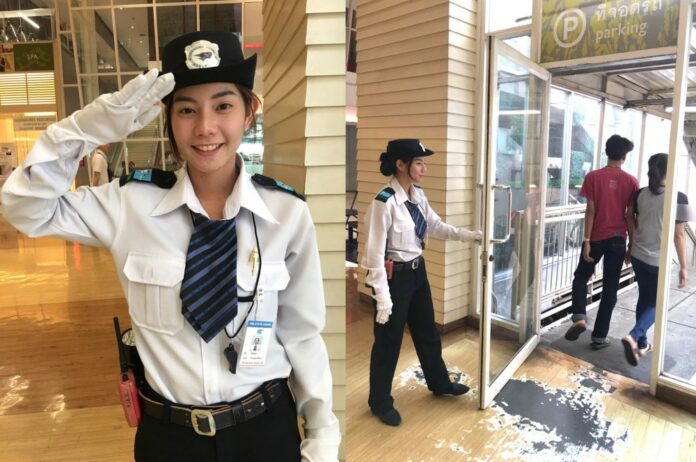
While many Bangkok university students take internships at companies or summer classes, Wanladar Kantaponjaruntorn, 21, instead opted to work as a security guard at Future Park Rangsit.

PATHUM THANI— While many Bangkok university students take internships at companies or summer classes, one young woman instead opted to work as a security guard.

Wanladar “June” Kantaponjaruntorn, 21, has been working since the beginning of June at the Future Park Rangsit shopping mall to make a little extra pocket money and learn about how other people live.

“I see the security guard at malls, and I want to go up to him and ask how much money he gets. I want to know if his job is hard and if I could take it,” Wanladar said. “I want to see different sides of society.”

S 374800390 e1498539770814
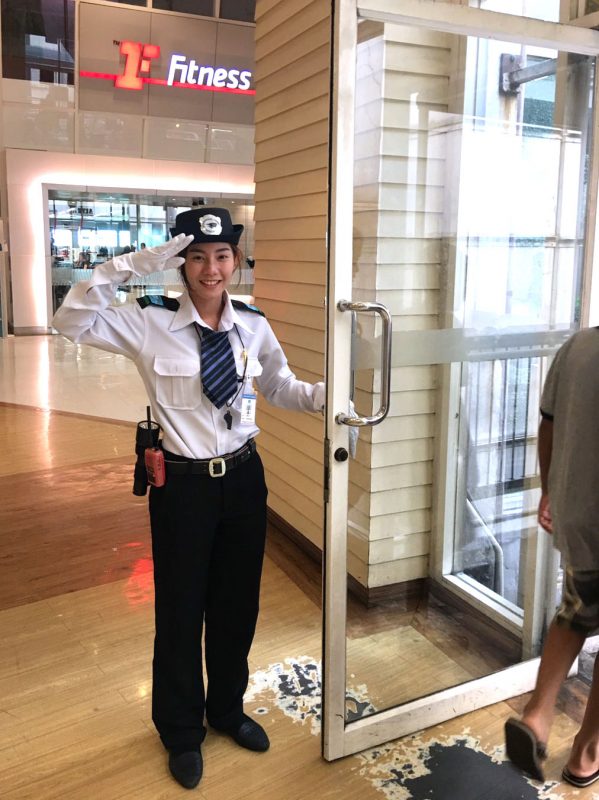
Wanladar poses next to the door of her post Sunday at Future Park Rangsit.

The third-year economics Bangkok University student, who often takes part-time jobs, said she wanted to challenge herself to see if she could handle the security guard job.

She said her job, and the security guard job in general, is an honorable profession.

“I think it’s an important job. We have to take care of the safety of the mall. It’s not degrading or embarrassing like some people might think because we put our physical effort into it. I feel good when I help out people and give them directions.”

Wanladar says her shift is from 10am to 10pm everyday, and that she had to be trained in the mall’s map and how to use the walkie talkie. She gets paid 465 baht per day.

“I want to be able to say that once, I did this job, and tell stories about it,” Wanladar said, who plans on becoming a broker. She’ll be working as a guard for her entire summer break, until the end of August.

Bangkok University’s Facebook page commented on her live interview video.

“Congratulations, we’re so happy and proud of you. One can’t have only academic knowledge…but also life and career skills,” it wrote.

See her interview in Thai with a Khaosod newspaper reporter below.

S 374800387 e1498539756666
Wanladar salutes in her security guard uniform.
S 374800391 e1498539778200
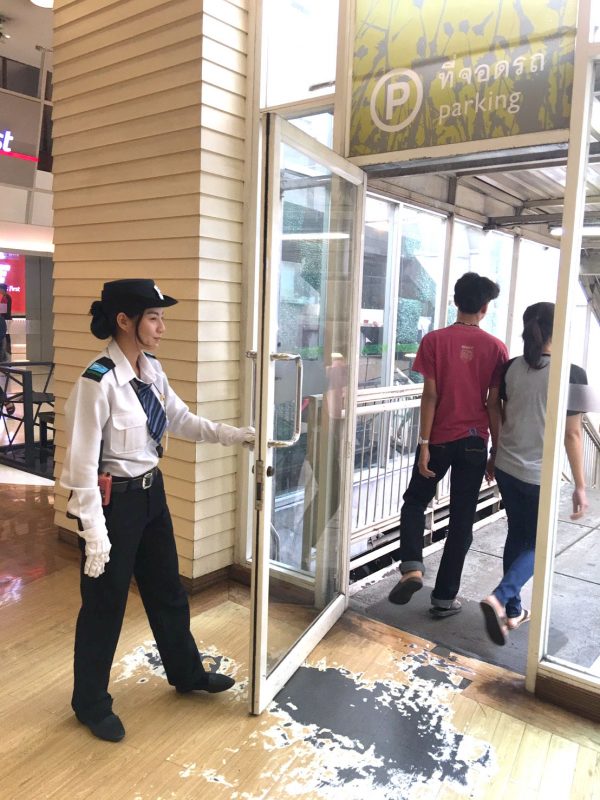
Wanladar opens a door for people at Future Park Rangsit.


Advertisement

Appeals Court Throws Out Conviction of ‘Popcorn Gunman’

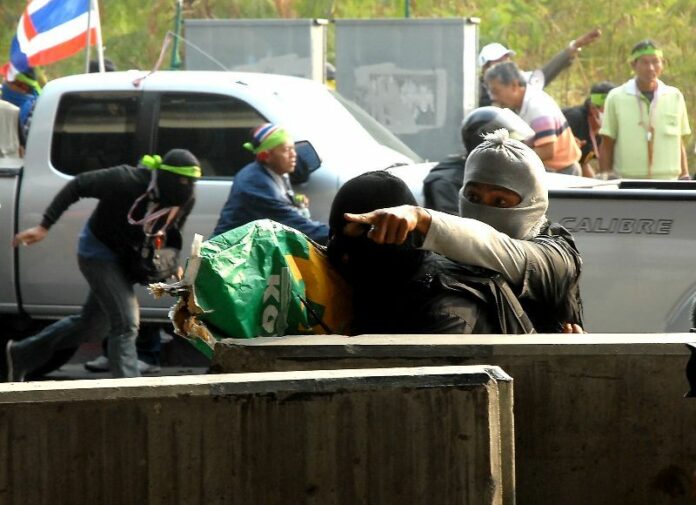
A man wearing a balaclava conceals a rifle in a bag bearing the printed logo of a popcorn company Feb. 1 2014 in Lak Si district.

BANGKOK — The Court of Appeals on Tuesday overturned the conviction of a man convicted of opening fire during the 2014 political unrest, wounding four people.

Despite his confession and conviction in a lower court, the appeals court acquitted Vivat Yodprasit due to a lack of witnesses who could identify him as the man captured in security camera footage wearing a balaclava and shooting at rival protesters in the northern Bangkok district of Lak Si.

Read: ‘Popcorn Gunman’ Gets 37-Year Prison Sentence

The shooter concealed his rifle inside a large bag bearing the logo of a popcorn company, earning him the pseudonym “Popcorn Gunman.”

Vivat’s lawyer said in 2014 he was tortured by police into giving a false confession.

The shooting wounded four people, among them a 72-year-old man who was left permanently paralyzed. He died seven months after the incident.

Vivat was serving a 37-year jail term after the Criminal Court had found him guilty of murder, attempted murder and illegal possession of weapons in March last year.

The shooting took place as members of People’s Committee for Absolute Democracy With the King as Head of State, or PCAD, marched to besiege the Lak Si District Office to prevent officials from distributing ballots in the area in February 2014.

It was one of many confrontations between groups who sought to block the election called by the government of then-Prime Minister Yingluck Shinawatra and pro-election supporters.

The PCAD successfully obstructed the election, the results of which were later voided, paving the way for military coup which ousted Yingluck in May 2014.

Vivat garnered support from the PCAD. Some of its members – sporting popcorn logo T-shirts –  staged a rally outside his prison cell as a show of solidarity after he was convicted and jailed last year.

The court said Vivat will remain in prison as the case will next go before the Supreme Court.

Related Stories:

PCAD Supporters Rally to Support Jailed Popcorn Gunman’

‘Popcorn Gunman’ Gets 37-Year Prison Sentence

Victim of Pre-Election Gunbattle Dies

‘Popcorn Gunman’ Claims He Was Tortured

‘Popcorn Gunman’ Linked To PCAD Guards Unit

Laksi Clash: 39 Shots Fired From Anti-Govt Position

Laksi Clash Victim’s Family Upset By NHRC’s ‘Negligence’

Advertisement

Brazil’s Crisis Deepens as President Accused of Corruption

Brazil's President Michel Temer waves as he exits after attending a ceremony Monday at the Planalto Presidential Palace, in Brasilia. Photo: Eraldo Peres / Associated Press

RIO DE JANEIRO — Brazil’s attorney general formally accused President Michel Temer of corruption on Monday, making him the first sitting president in Latin America’s largest nation to face criminal charges.

Attorney General Rodrigo Janot’s accusation is the latest salvo in an intensifying showdown between Temer and justice officials who are building a corruption case that reaches to the highest levels.

The case now goes to the lower Chamber of Deputies in Congress, which must decide whether it has merit. If two-thirds of the legislature decides that it does, then the president will be suspended for up to 180 days while a trial is conducted. House Speaker Rodrigo Maia, an ally of Temer, would be president in the interim.

In his decision, Janot said that Temer at some point between March and April of this year took a bribe of around $150,000 offered by Joesly Batista, former chairman of meat-packing giant JBS.

Janot opened an investigation last month into Temer for corruption, obstruction of justice and being part of a criminal organization. A recording emerged that apparently captured Temer, in a late-night conversation with Batista earlier this year, endorsing hush money to former House Speaker Eduardo Cunha, a former Temer ally who is serving a 15-year sentence for corruption. Batista reached a plea agreement with federal prosecutors.

Temer has denied wrongdoing and said he refuses to resign despite numerous calls for him to do so and plunging popularity. The office of the presidency said it would not have comment Monday night.

Janot’s decision to put forward only the corruption allegation may be a strategy to force the lower Chamber of Deputies to first deal with it before having to consider the other allegations.

Allies of Temer have been torn between whether to continue supporting the beleaguered leader or bail on him because of fears that association could be toxic during elections next year.

Janot’s 64-page decision was a blistering assessment of Temer and his actions as Brazil’s top leader. Janot said bribes to Temer could have reached about USD $12 million over nine months, and that in general Temer showed a total disregard for the office.

“The circumstances of this meeting (with Batista) – at night and without any register in the official schedule of the president of the Republic – reveal the intent of not leaving traces of the criminal actions already taken,” wrote Janot.

Earlier Monday, Temer sought to show his government conducting business as usual, defiantly saying he wasn’t going anywhere in his first comments since returning from a trip to Russia and Norway last week that was filled with gaffes and mounting bad news.

“Nothing will destroy us. Not me and not our ministers,” he said during the ceremonial signing of a bill in the capital of Brasilia.

Despite the optimism, Temer is facing risks to his mandate on several fronts, from tanking popularity to numerous calls, including from heavyweight politicians, for him to step down.

His trip last week to Russia and Norway ended up underscoring the president’s problems and Brazil’s diminished stature overseas thanks to a steady stream of corruption scandals the last three years.

Few people showed up at the reception at Brazil’s embassy in Moscow, no top Norwegian officials welcomed Temer at Oslo’s airport and the country’s prime minister, Erna Solberg, gave Temer a public lecture about the colossal “Car Wash” investigation that has upended Brazilian politics and could even jail Temer and several of his Cabinet ministers.

Launched in March 2014, the investigation into billions of dollars in inflated construction contracts and kickbacks to politicians has landed dozens of the country’s elite in jail and threatens many more.

“We are very concerned about the ‘Car Wash’ probe,” said Solberg, adding that it was important for Brazil to “clean up” corruption.

To top it off, during Temer’s visit, Norway announced a 50 percent cut in funds it pays into Brazil’s Amazon rainforest fund because of increased deforestation. The increased deforestation began before Temer took power last year, but environmentalists argue his policies are aggravating the situation.

“It was a trip to distract people from the problems in politics,” said Mauricio Santoro, a political scientist at the State University of Rio de Janeiro. “It ended up being a disaster.”

Temer, who took over in May of last year after President Dilma Rousseff was impeached and later removed from office, now also has the dubious distinction of having the lowest approval rating of a president since 1989.

The Datafolha polling institute showed over the weekend that just 7 percent of those questioned approved of Temer’s administration, the worst since the country was embroiled in a crisis of hyper-inflation on the watch of President Jose Sarney.

Even stalwart allies have begun to bail on Temer.

Former President Fernando Henrique Cardoso, who initially supported Temer and is a key leader of the junior coalition party, said in an article published by daily Folha de S.Paulo on Monday that the president could end the crisis by ushering in new elections sooner than the end of his mandate, which goes through 2018.

“I plead with the president to meditate over the opportunity of such a gesture of greatness,” said Cardoso.

Story: Peter Prengaman, Mauricio Savarese

Advertisement

Mongolia’s Presidential Election Tightens, Runoff Likely

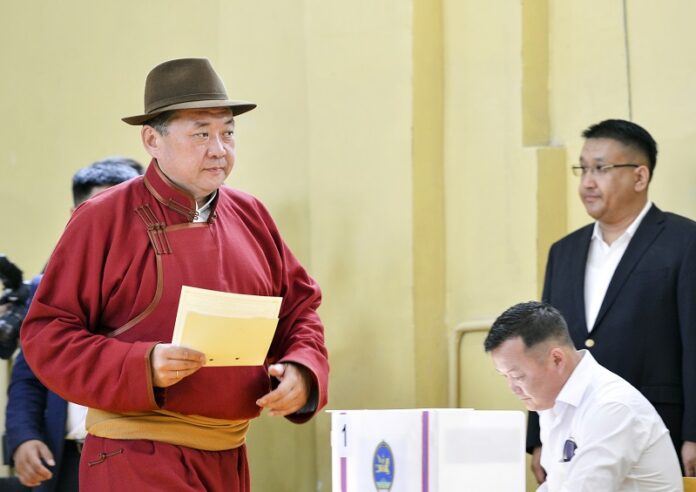
Speaker of Parliament and Mongolian People's Party presidential candidate Miyegombo Enkhbold, left, casts his vote at a polling station Monday at a school in Ulaanbaatar, Mongolia. Photo: Chadraabal Baramsai / Associated Press

ULAANBAATAR, Mongolia — Mongolia’s presidential election appeared headed for a runoff with the latest vote count early Tuesday showing a business tycoon leading the ruling party’s candidate and a nationalist wanting the country to benefit more from its mineral wealth.

Khaltmaa Battulga of the Democratic Party had a clear lead but less than the required 50 percent of the 1.3 million votes cast Monday to avoid a runoff, the General Election Commission said.

The Mongolian People’s Party’s Miyegombo Enkhbold, speaker of the parliament and a horse dealer, had looked to be shut out of the runoff in the early results but pulled into second place as votes from more remote areas of the landlocked Asian country were counted.

Enkhbold was around 1,700 votes ahead of nationalist Sainkhuu Ganbaatar of the Mongolian People’s Revolutionary Party, a vocal critic of mining giant Rio Tinto’s operations in the country, according to the latest data from the election commission.

Ganbaatar’s party protested the overnight turn in preliminary results that put their candidate, who had earlier been leading Enkhbold by 15,000 votes, in third place, accusing the election commission of fraud. The commission could not be reached for comment Tuesday.

While the nation of 3 million had been an oasis of democratic stability since the end of communist rule nearly three decades ago, its politics have grown increasingly fractious amid an economic crisis and accusations of corruption among the ruling class.

The candidates were seeking to succeed Tsakhia Elbegdorj of the Democratic Party, who has served the maximum of two four-year terms. The winner will become Mongolia’s fifth president since 1990.

Enkhbold, whose party won parliamentary elections last year by a landslide, had been widely seen as representing stability at a time when Mongolia is showing tentative signs of recovery from an economic crisis brought about by a dramatic drop in global commodity prices.

Battulga campaigned on a “Mongolia First” policy, borrowing the language of President Donald Trump. He promised to be “a patriotic president” seeking “equal cooperation” with neighbors like China, which he has criticized in the past.

Battulga’s company, Genco, is one of Mongolia’s largest, with businesses including hotels, media, banking, alcohol, horsemeat and a Genghis Khan-themed complex. He was agriculture minister between 2012 and 2014 and is a former member of parliament, as well as president of the Mongolian Judo Association.

Ganbaatar, a self-described feng shui master and “Robin Hood” for the masses, has claimed Mongolia should get a better deal with Rio Tinto and its copper and gold mine, Oyu Tolgoi.

Around two-thirds of nearly 2 million registered voters cast ballots, the election commission said.

Sandwiched between Russia and China, resource-rich Mongolia has been roiled by financial upheaval and the increasing draw of China’s economic and political influence that competes with its ties with the democratic West, especially the United States.

Foreign investment in Mongolia has slumped in recent years following weaker commodity prices and high-profile disputes between the government and large investors including Rio Tinto. Mongolia’s economy grew just 1 percent last year, down from 17.5 percent in 2011, when it was the world’s fastest-growing. It now has USD $23 billion in debt, more than double the size of its economy. Unemployment is roughly 9 percent, with about one in five Mongolians living in poverty.

The country recently secured a USD $5.5 billion International Monetary Fund-led bailout to stem its financial crisis, with a USD $500 million bond repayment due in January 2018. Enkhbold’s party pledges to continue the IMF’s program, including higher taxes and spending cuts, while Ganbaatar has criticized the IMF.

For 30-year old district government office worker and mother Tserendejid Bayanbaatar, restoring the economy and creating jobs for young people were top concerns in the election.

“I want the future president to support young people and young families, support their work environment and create conditions for stable incomes,” Bayanbaatar said.

Avirmed Dangaa, an accountant and former municipal official, said creating stability was important.

“Trust of foreign investors is restored if the government is stable,” said Dangaa, who favored Enkhbold.

Battulga has a large following among urban entrepreneurs and youth.

“I don’t like corruption and favoritism, which is prevalent everywhere in all levels of Mongolian government. I voted against these corrupt officials,” said Enkhmaa, a 28-year-old entrepreneur who gave only her first name.


Story: Ganbat Namjilsangarav, Grace Brown

Advertisement

Hot News

LATEST NEWS

Bangkok
broken clouds
28.3 ° C
28.3 °
24.4 °
86 %
1.5kmh
79 %
Sun
37 °
Mon
38 °
Tue
36 °
Wed
37 °
Thu
37 °