33.5 C
Bangkok
Monday, June 8, 2026
Home Blog Page 2329

Pepe Croaks: Cartoonist Kills off Frog Turned Hate Symbol

Photo: Matt Furie/ Tumblr.

The cartoonist who created Pepe the Frog has killed off the character in a rebuke to far-right extremists who transformed a benevolent internet meme into a racist, anti-Semitic symbol.

A Pepe cartoon released Saturday in comic book stores shows Matt Furie’s creation in an open casket. Furie didn’t immediately respond to an email seeking comment Monday.

In a Time magazine essay last year, Furie described Pepe as “chill frog-dude” who debuted in a 2006 comic book called “Boy’s Club” and became a popular online subject for user-generated mutations.

But internet trolls hijacked the character and began flooding social media with hateful Pepe memes more than a year before the 2016 presidential election. Pepe became a tongue-in-cheek symbol of the “alt-right” fringe movement and its loosely connected brand of white nationalism, neo-Nazism and anti-immigration.

Pepe memes promoting Donald Trump’s presidential campaign became so ubiquitous that Trump himself tweeted an image blending his likeness with the cartoon frog in October 2015.

The Anti-Defamation League branded Pepe as a hate symbol in September 2016 and promoted Furie’s efforts to reclaim the character, with a social media campaign using the “#SavePepe” hashtag.

“That’s a huge challenge,” said Oren Segal, director of the ADL’s Center on Extremism. “It just didn’t pick up.”

Segal said he doubts Pepe’s cartoon death will erode his iconic status with the “alt-right” movement.

Richard Spencer, a white nationalist who popularized the term “alt-right,” said it could have the opposite effect.

“The artist isn’t in control of his work once it enters the culture in the way it has,” Spencer said.

Kyle Bristow, a Michigan attorney who founded a self-described “alt-right” nonprofit educational group called the Foundation for the Marketplace of Ideas, said he already has seen a meme depicting Pepe as Jesus rising from the dead.

“The Republicans have an elephant. The Democrats have a donkey. The alt-right has a cartoon frog,” Bristow said with a laugh.

Furie wasn’t amused by how his creation became an “icon of hate,” calling it a “nightmare” in his Time essay.

“Before he got wrapped up in politics, Pepe was an inside-joke and a symbol for feeling sad or feeling good and many things in between,” Furie wrote. “I understand that it’s out of my control, but in the end, Pepe is whatever you say he is, and I, the creator, say that Pepe is love.”

Fantagraphics, which published “Boy’s Club,” also published the one-page strip in which Furie killed off Pepe. Fantagraphics spokeswoman Jacq Cohen said she would be surprised if Furie never draws Pepe again but she hadn’t discussed his plans for the character with him.

“This whole Pepe co-opting experience has been pretty rough on Matt as an independent artist,” Cohen said.

Story: Michael Kunzelman

Advertisement

Scientists in South Africa Reveal More on Human-Like Species

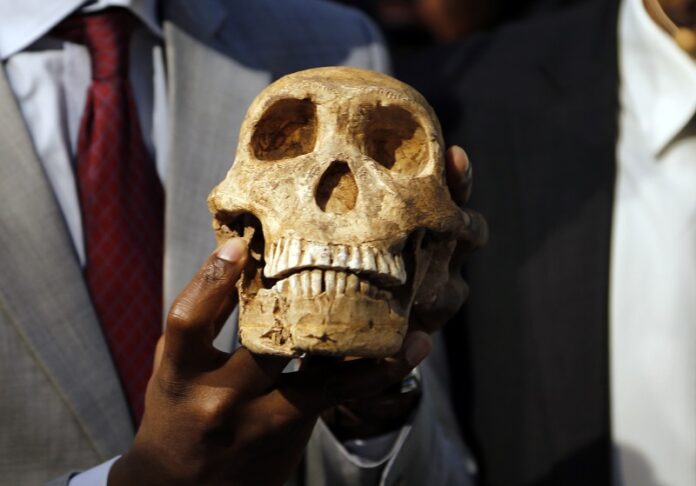
A replica skull of a species belonging to the human family tree whose remnants were first discovered in a South African cave in 2013 is held at the unveiling at the Maropeng Museum, Tuesday near Magaliesburg, South Africa. Photo: Denis Farrell / Associated Press

JOHANNESBURG — A species belonging to the human family tree whose remnants were first discovered in a South African cave in 2013 lived several hundred thousand years ago, indicating that the creature was alive at the same time as early humans in Africa, scientists said Tuesday.

A meticulous dating process showed that Homo naledi (nah-LEH-dee), which had a mix of human-like and more primitive characteristics such as a small brain, existed in a surprisingly recent period in paleontological terms, said Lee Berger of Wits University in Johannesburg. Berger led the team of researchers, which also announced that it had found a second cave with more fossils of the Homo naledi species, including a relatively well-preserved skull of an adult male.

The conclusion that Homo naledi was living between 236,000 and 335,000 years ago – and had not become extinct much earlier – shows that the human “Homo” family tree was more diverse than previously thought at that point in the evolution of our species, Homo sapiens, said John Hawks of the University of Wisconsin-Madison and Wits University.

The next step in research is to “sort the relationship of these different species to each other and also their role in our process of becoming human,” Hawks said during an announcement of the discoveries at the Cradle of Humankind, a site near the South African town of Magaliesburg where the fossils were found. The research was also published in the journal eLife.

The name of Homo naledi refers to the “Homo” evolutionary group, which includes modern people and our closest extinct relatives, and the word for “star” in the local Sotho language. The fossils were found in the Rising Star cave system, which includes more than 2 kilometers (1.25 miles) of underground, mapped passageways. The second chamber containing the more recent fossil discoveries is more than 100 meters (330 feet) from the cave where the original discoveries were made, and publicly announced in 2015.

Some experts who were not involved in the research also marveled at the age of the fossils, determined by dating Homo naledi teeth and cave sediments.

“This is astonishingly young for a species that still displays primitive characteristics found in fossils about 2 million years old, such as the small brain size, curved fingers, and form of the shoulder, trunk and hip joint. Yet the wrist, hands, legs and feet look more like those of Neanderthals and modern humans, and the teeth are relatively small and simple, and set in lightly built jawbones,” Chris Stringer of the Natural History Museum in London wrote in an email to The Associated Press.

Stringer said there were parallels with the late survival of the species Homo floresiensis – also known as the “hobbit” – in apparent isolation on an island in what is today Indonesia, and raised a key question: “How did a comparably strange and small-brained species linger on in southern Africa, seemingly alongside more ‘advanced’ humans?”

Richard Potts of the Smithsonian Institution’s National Museum of Natural History in Washington said it was likely that Homo naledi evolved and persisted in isolation from other species of Homo.

‘”Island habitats'” can occur on continents, too, in small environmental refuges that are sustained long term,” Potts said. “Yes, on continents it’s typically lizards, butterflies, fish, and small mammals that are susceptible to separation and isolated evolution, and the effects of that isolation can arise rapidly. To me, naledi and floresiensis are nature’s experiments of isolated evolution in two of our evolutionary cousins.”

Berger, the research team leader, said the discovery of a second chamber with Homo naledi remains gives more credence to the idea that the species deliberately disposed of its dead in pitch-black caves that are extremely difficult to reach. However, some experts who were not on the research team questioned whether the small-brained species was capable of such behavior and speculated that other ways to access the chambers may have existed in the past.

So far, there is no evidence that Homo naledi used stone tools or harnessed fire for its own uses.

The new discoveries offer a unifying message that counters populism, intolerance and ethnic prejudice sweeping many parts of the world, said Adam Habib, vice-chancellor of Wits University.

“This research shows that we come from common roots, that we represent a common humanity,” Habib said. “If we’re going to survive as a species, that’s what we need to remember.”

Story: Christopher Torchia

Advertisement

South Korea’s Newly Elected Liberal President Starts Duties

South Korea's presidential candidate Moon Jae-in of the Democratic Party waves as he arrives to give a speech on a stage Wednesday in Seoul, South Korea. Photo: Ahn Young-joon / Associated Press

SEOUL, South Korea — Hours after celebrating his election win with thousands of supporters in wet Seoul streets, new South Korean President Moon Jae-in on Wednesday was quickly thrown into the job of leading a nation deeply split over its future and faced with growing threats from North Korea and an uneasy alliance with the United States.

Moon, whose victory capped one of the most turbulent political stretches in the nation’s recent history and set up its first liberal rule in a decade, assumed presidential duties after the National Election Commission officially declared him as winner. He will be formally sworn in at noon, forgoing the usual two-month transition because he was chosen in a special election after the last elected office-holder was removed by a court and jailed on corruption charges.

After taking the oath of office at the National Assembly at noon, he is also expected to nominate a prime minister, the country’s No. 2 job that requires approval from lawmakers, and name his presidential chief of staff during the day.

Taking up his role as the new commander in chief, Moon received a call from Army Gen. Lee Sun-jin, chairman of South Korea’s Joint Chiefs of Staff, who briefed him on the military’s preparedness against North Korea.

A short time later, Moon stepped out of his private home and received an emotional send-off from hundreds of residents, who shook his hand, hanged flowers on his neck and asked him to pose with his children. He then left with his wife, Kim Jeong-sook, for a national cemetery in Seoul.

After bowing to honor the former presidents, independence fighters and war heroes at the cemetery, Moon wrote “A country worth being proud off; a strong and reliable president!” in a visitor book. He then visited the offices of opposition parties, seeking support in governing the country split along ideological lines and regional loyalties. His Democratic Party has only 120 seats in the 300-seat National Assembly, so he may need broader support while pushing his key policies.

“I had a telephone call with Liberty Korea Party candidate Hong Joon-pyo. I again offer him words of comfort,” Moon said during his visit to the conservative party, whose candidate Hong placed second. “I think I can work well with the Liberty Korea Party on the areas of the United States-South Korea alliance and on national security issues. … I promise to share important information about national security with opposition parties and will ask for cooperation on such issues.”

Chinese leader Xi Jinping congratulated Moon on his election win, according to state media reports that provided no further details.

Relations with China have sunk to one of their lowest points since the two countries established diplomatic relations in 1992. Beijing objects to the U.S. missile-defense system THAAD recently deployed in South Korea because it fears the system’s radar could be used to monitor the Chinese military’s flights and missile launches. Moon made a campaign vow to reconsider the THAAD deployment.

Other foreign policy areas under Moon may depart sharply from recent conservative governments. He favors closer ties with North Korea, saying hard-line approaches failed to prevent the North’s development of nuclear-armed missiles and only reduced South Korea’s voice in international efforts to counter North Korea.

This softer approach might put him at odds with South Korea’s biggest ally, the United States. The Trump administration has swung between threats and praise for North Korea’s leader.

Moon was declared president after the election commission finished counting the votes, saying Moon gathered 41 percent, comfortably edging conservative Hong Joon-pyo and centrist Ahn Cheol-soo, who gathered 24 percent and 21 percent, respectively.

“The National Election Commission, based on the first clause of Article 187 of the Public Official Election Law, determines that the Democratic Party’s Moon Jae-in, who gathered the largest number of valid votes, was elected as president,” NEC Chairman Kim Yong-deok said in the televised meeting.

The son of refugees who fled North Korea during the Korean War, Moon will lead a nation shaken by the scandal that felled Park Geun-hye, whose criminal trial is scheduled to start later this month.

Taking office without the usual two-month transition, Moon initially will have to depend on Park’s Cabinet ministers and aides, but he was expected to move quickly to replace them. He will serve the typical single five-year term rather than the remainder of Park’s term which was to end in 2018.

After exit polls indicated to his victory Tuesday night, Moon smiled and waved his hands above his head as supporters chanted his name at Gwanghwamun square in central Seoul, where millions of Koreans had gathered for months starting late last year in the peaceful protests that eventually toppled Park.

“It’s a great victory by a great people,” Moon told the crowd. “I’ll gather all of my energy to build a new nation.”

Moon was chief of staff for the last liberal president, the late Roh Moo-hyun, who sought closer ties with North Korea by setting up large-scale aid shipments to the North and by working on now-stalled joint economic projects.

The conservative Hong had pitched himself as a “strongman,” described the election as a war between ideologies and questioned Moon’s patriotism.

Park’s trial on bribery, extortion and other corruption charges could send her to jail for life if she is convicted. Dozens of high-profile figures, including Park’s longtime confidante, Choi Soon-sil, and Samsung’s de facto leader, Lee Jae-yong, have been indicted along with Park.

Moon frequently appeared at anti-Park rallies and the corruption scandal boosted his push to re-establish liberal rule. He called for reforms to reduce social inequalities, excessive presidential power and corrupt ties between politicians and business leaders. Many of those legacies dated to the dictatorship of Park’s father, Park Chung-hee, whose 18-year rule was marked by both rapid economic rise and severe civil rights abuse.

As a former pro-democracy student activist, Moon was jailed for months in the 1970s while protesting against the senior Park.

Many analysts say Moon likely won’t pursue drastic rapprochement policies because North Korea’s nuclear program has progressed significantly since he was in the Roh government a decade ago.

A big challenge will be U.S. President Donald Trump, who has proven himself unconventional in his approach to North Korea, swinging between intense pressure and threats and offers to talk.

“South Koreans are more concerned that Trump, rather than North Korean leader Kim Jong Un, will make a rash military move, because of his outrageous tweets, threats of force and unpredictability,” Duyeon Kim, a visiting fellow at the Korean Peninsula Future Forum in Seoul, wrote recently in Foreign Affairs magazine.

“It is crucial that Trump and the next South Korean president strike up instant, positive chemistry in their first meeting to help work through any bilateral differences and together deal with the North Korean challenge,” she said.

Story: Hyung-Jin Kim, Tong-Hyung Kim

Advertisement

Turtley Crowded: Temple Promises More Space for Reptile Residents (Photos)

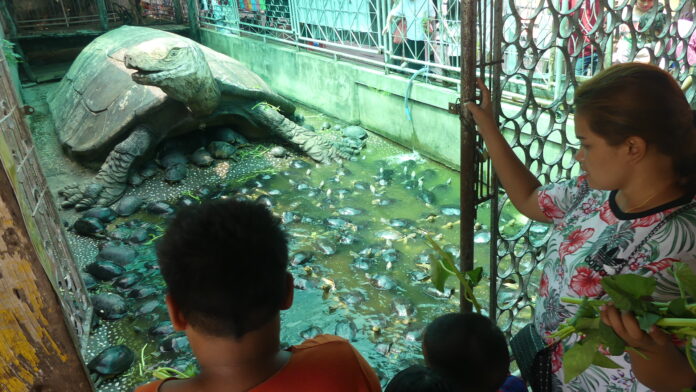
People feed vegetables to the turtles Sunday at a pond in Wat Chedi Hoi in Pathum Thani, where a fisherman alerted authorities to the presence of over 200 turtles crowded into a single pond. Read: Turtley Crowded: Temple Promises More Space for Reptile Residents (Photos)

PATHUM THANI — A temple housing more than 200 turtles in an overcrowded pond said Tuesday it would soon complete construction of a second pond after being criticized online and visited by fishery officials.

Officials at Wat Chedi Hoi said they would finish work on the pond by Saturday, nearly a week after a fisherman Chaliew Tienwan, a confessed turtle lover, said he was inspired by a social media rant to bring officials there to inspect its overcrowded pond.

Chaliew said the temple wasn’t as foul as described in a Sunday post by Facebook user Saranrat Panyahlek, who wrote that many sad-looking turtles were floating around in water filled with rotten fruit. The post was shared more than 1,400 times, bringing it to the eyes of Chaliew.

“After I went down there myself, it wasn’t as rotten as the Facebook post said. Still, it was way too crowded for the turtles,” Chaliew said Sunday.

The temple defended its reptile care, saying few had died in the name of improving people’s spiritual fortunes.

“By releasing turtles here, people can exorcise their bad luck and make merit. Very few turtles have died,” said Somjit Kanlaya, the nun who feeds them vegetables.

Abbot Tongklung Suntaro said the temple was being slandered.

“In the past, there have been people with bad intentions who came into the temple grounds to take photos of the pond right before it was cleaned, so the pond looked dirty in the photos. The smell is from the turtle feces,” he said. “If I didn’t care for them, they would all be dead by now.”

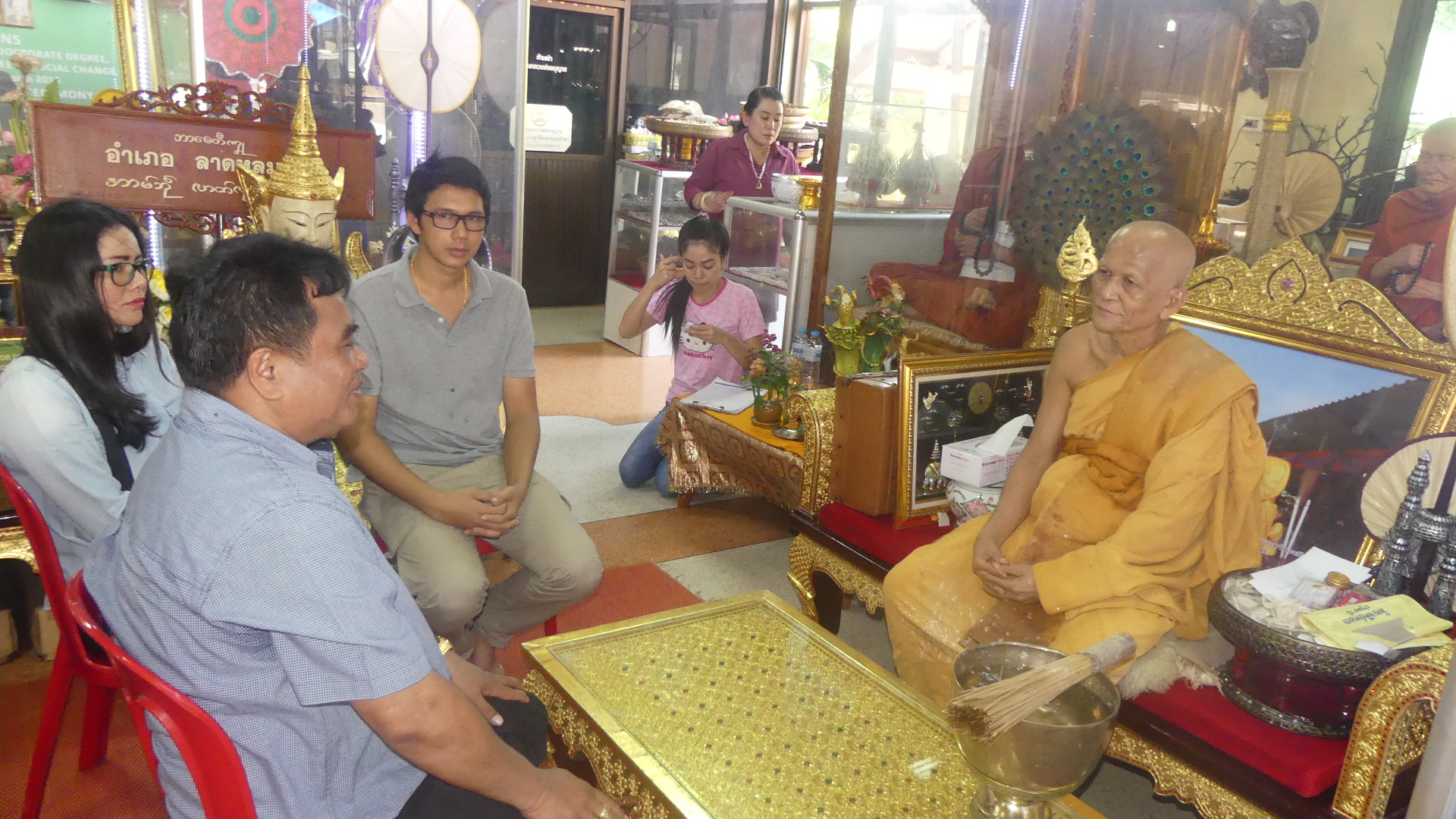
P1800138
Wat Chedi Hoi Abbot Tongklung Suntaro, seated at right, listens to some people.

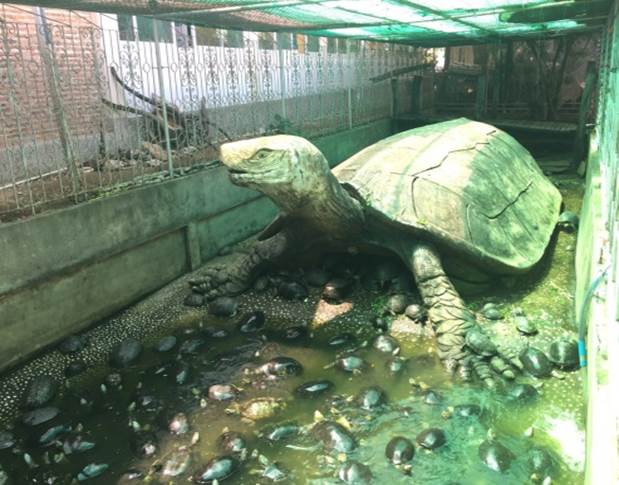
More than 200 red-eared sliders, Amboina box turtles, yellow-headed temple turtles and snail-eating Mekong turtles reside at the temple, which claims they’ve been there for 30 years.

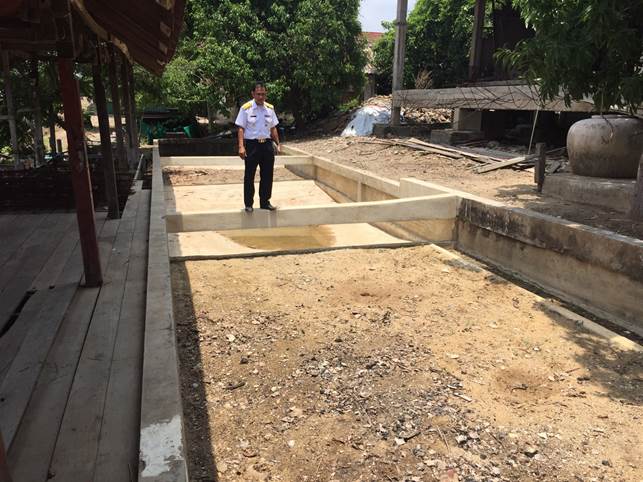
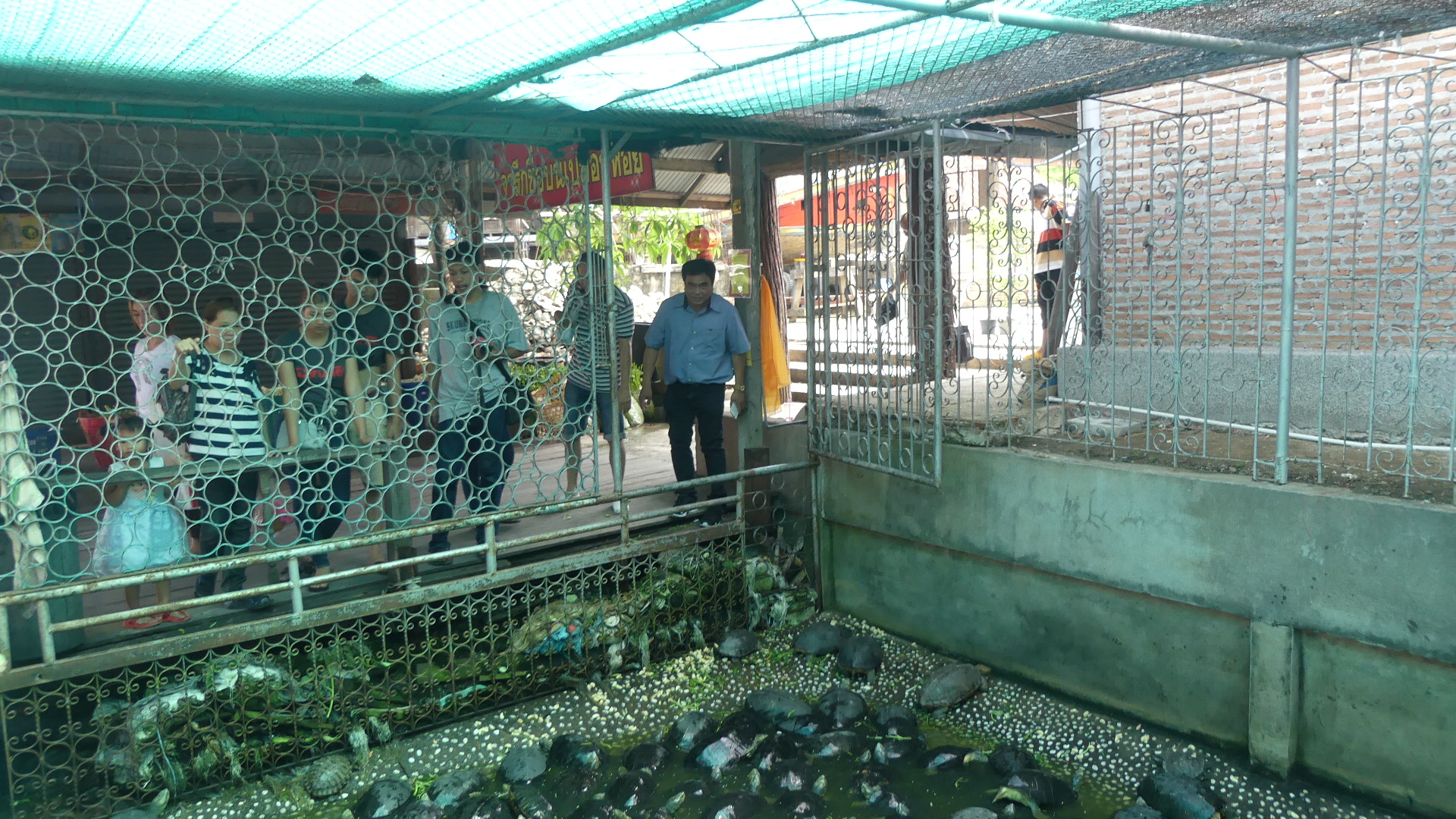
The pond is 4 meters by 30 meters, only a tenth of which contains water that is 40 centimeters deep, according to the officials who inspected it. It’s surrounded by a metal fence and covered by a green tarp.

People reportedly abandon turtles there for care, while others feed them to make spiritual merit.

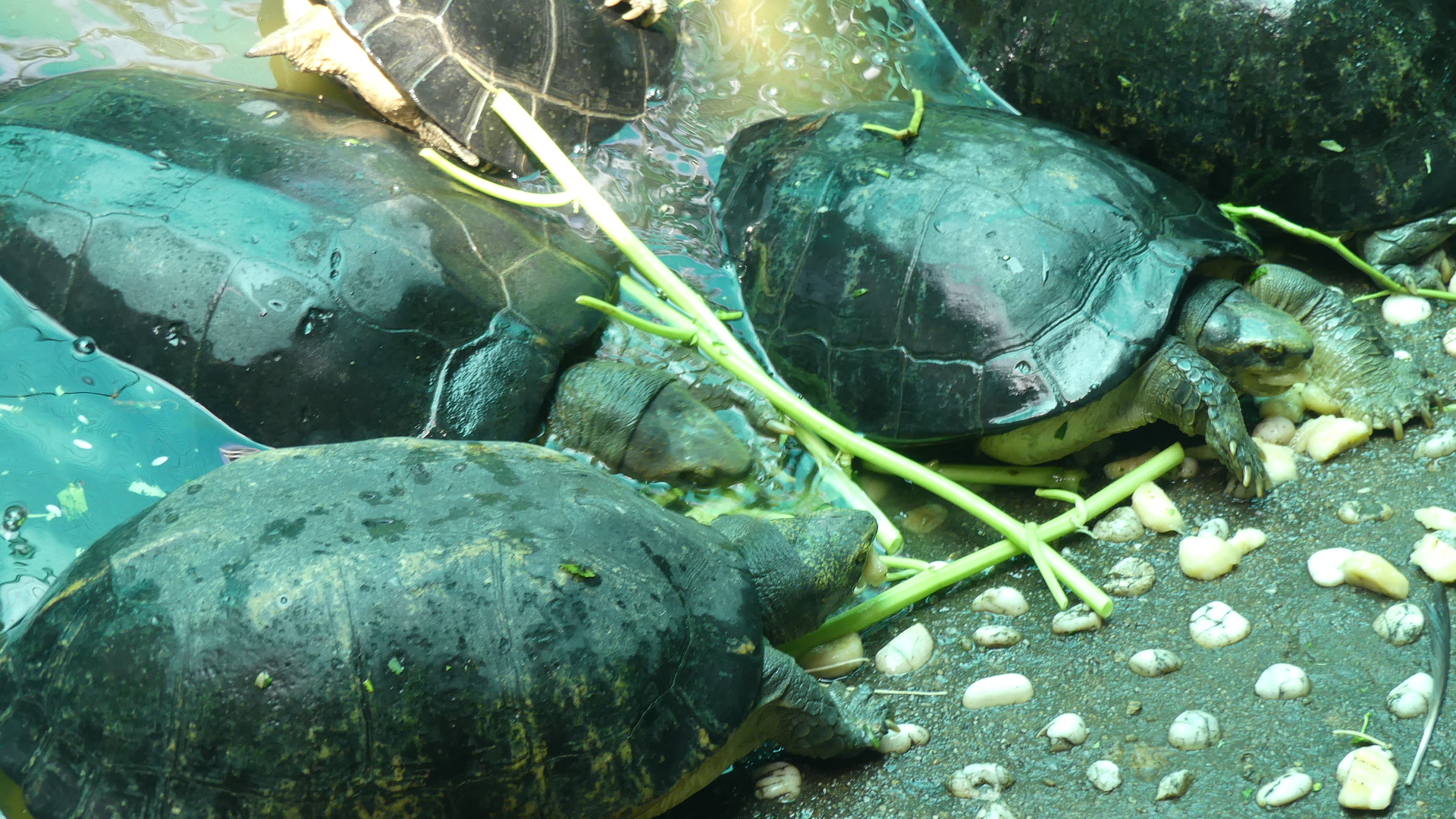
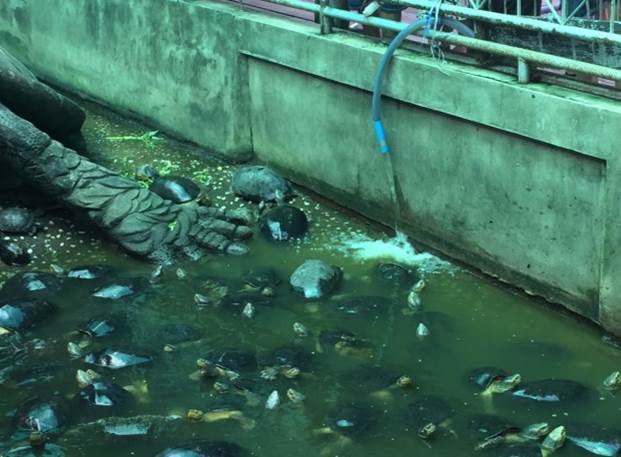
The temple also takes donations in exchange for vegetables to feed them. Most visitors chuck the veggies over the fence, causing turtles to crowd each other to eat the food and create the stink.

image012
A fishery department official inspects a new pond under construction to house the turtles of Wat Chedi Hoi in Pathum Thani. Photo: Department of Fisheries / Courtesy

The temple claims it changes the water twice a day.

Turtle welfare became an issue of national interest after the death of Piggy Bank, who had more than 900 coins surgically removed in March before dying of complications.

Temples in Thailand have a mixed reputation when it come to animal care. Many are sanctuaries for abandoned pets and animals, while others, such as Kanchanaburi’s popular Tiger Temple – now accused of actually trafficking them – and overcrowded venues such as Wat Suan Kaew in northwestern metro Bangkok.

Related stories:

Piggy Bank, Giant Sea Turtle Who Ate Too Many Coins, 25

Turtle Watch: Coins Found Inside Two of Piggy Bank’s Friends (Photos)

Nation Mourns Piggy Bank, Takes Hard Look At Self

Chula Vets Divest Turtle’s Stomach of 915 Coins (Photos)

Tiger Temple to Reopen 9 Months After Raid

Abbot of 22 Years Denies Knowing Tiger Temple’s Terrible Secrets

Horrible Discovery in Tiger Temple: Dozens of Dead Tiger Kittens (Photos)

P1800093
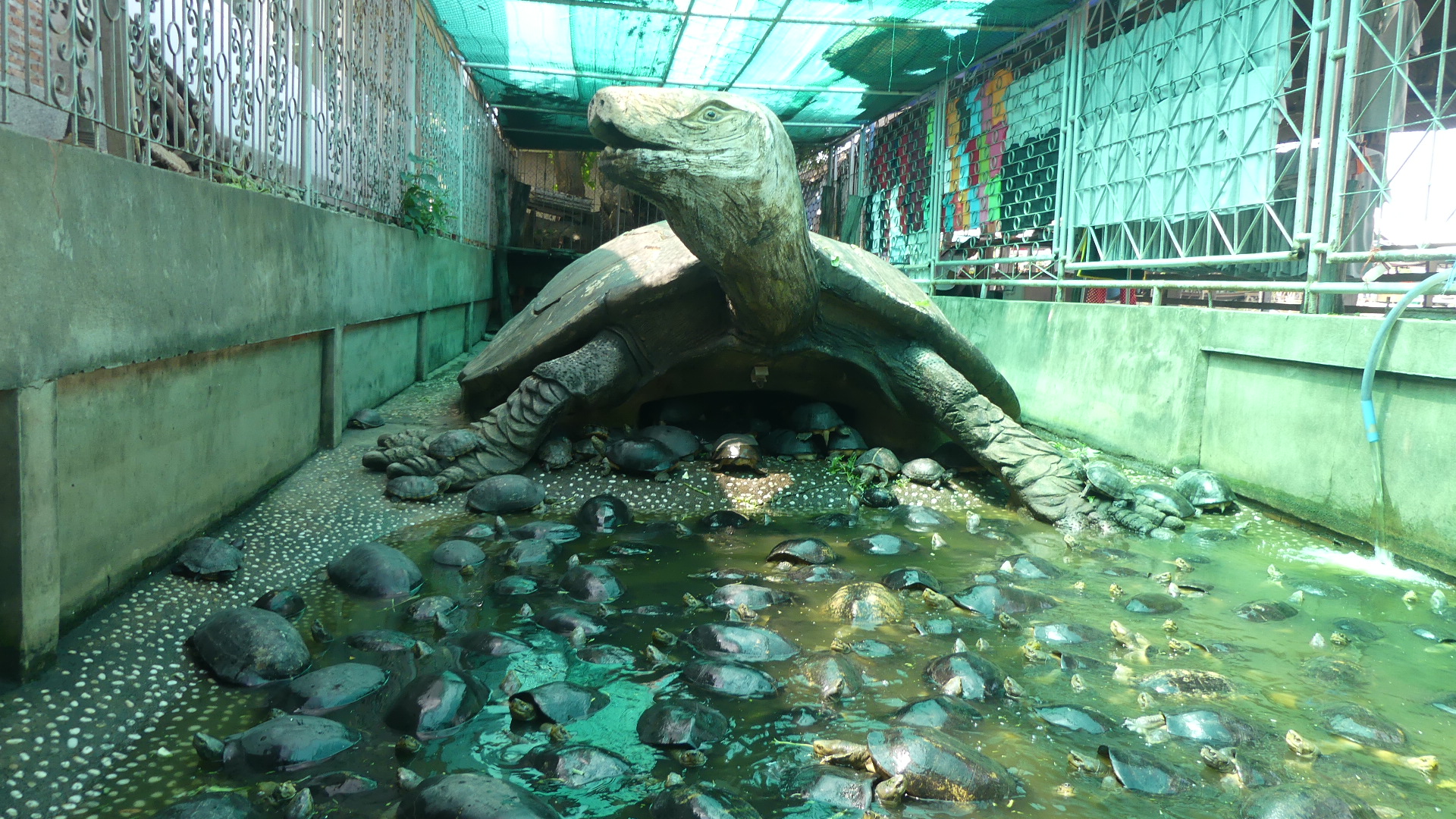
A large concrete turtle shelters its smaller, livelier versions at a turtle pond in Wat Chedi Hoi in Pathum Thani province.
P1800114
Turtles forage for tossed vegetables in their pond Sunday.
P1800097
A metal fence surrounds the concrete turtle pond at Pathum Thani’s Wat Chedi Hoi.
P1800134
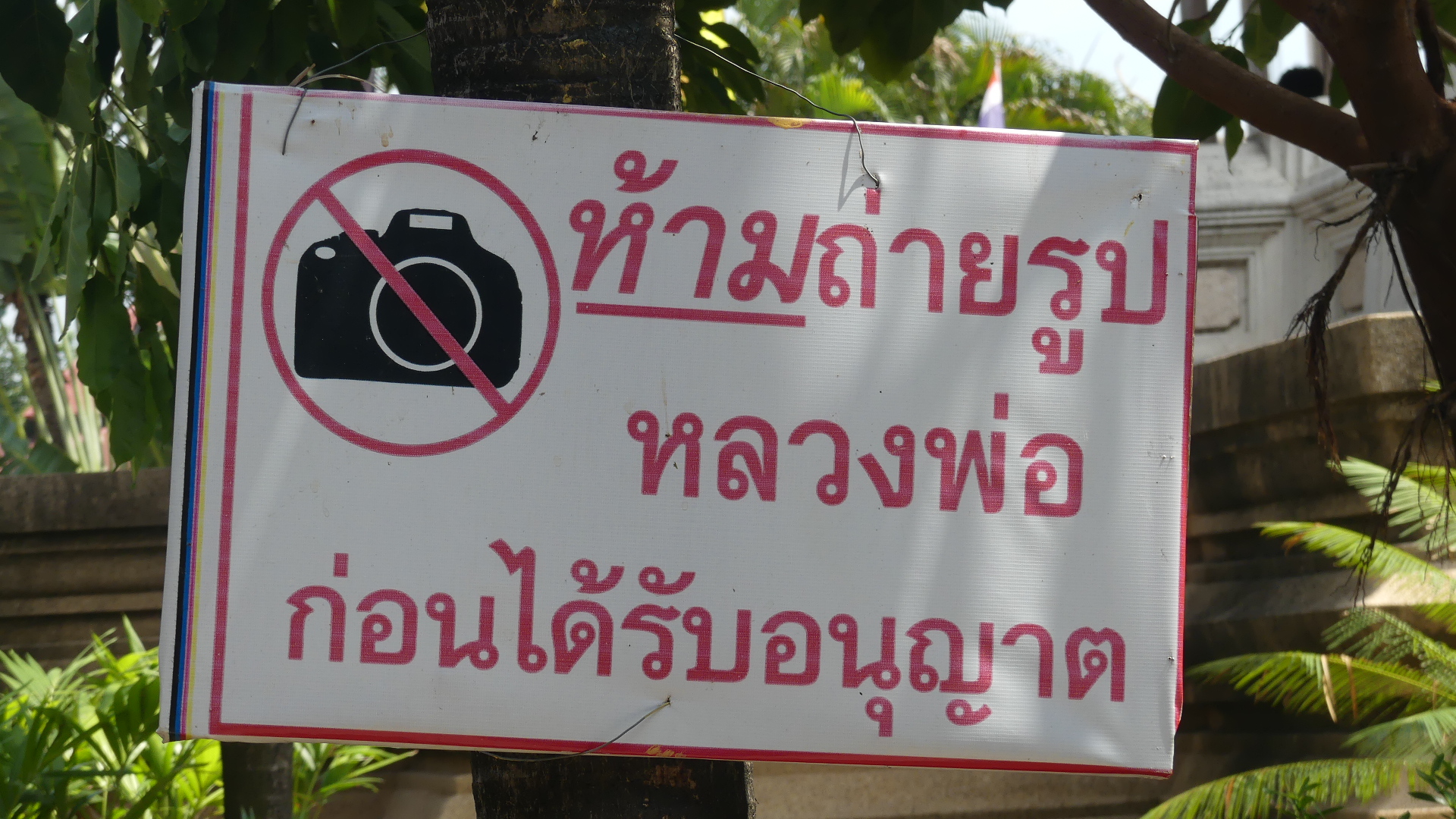
‘No photos of the abbot without permission,’ reads a sign at Wat Chedi Hoi in Pathum Thani.
image008
The turtle-choked waters at Wat Chedi Hoi on Sunday in Pathum Thani province. Photo: Department of Fisheries / Courtesy
image009
A tube trickles water into the turtle pond at Wat Chedi Hoi in Pathum Thani. Photo: Department of Fisheries / Courtesy
Advertisement

Final Extension of Free Bus And Train Service?

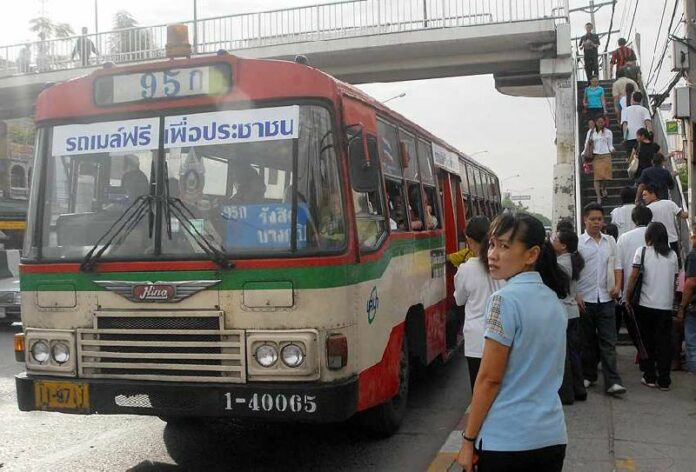
A free bus in Bangkok in an undated file photo. Photo: Matichon

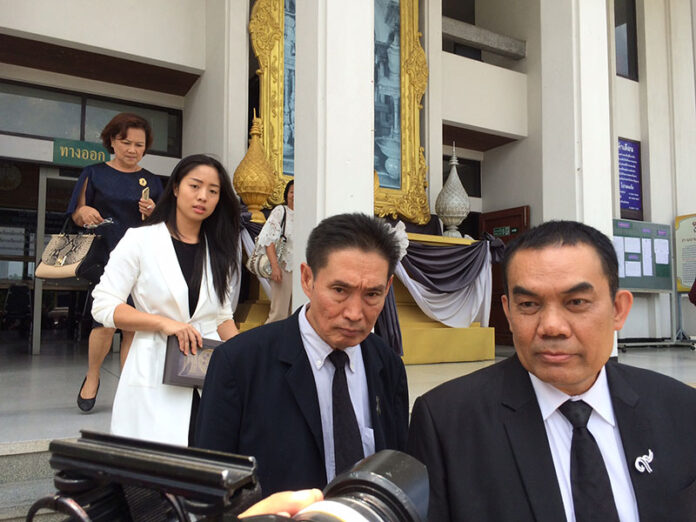
BANGKOK — Free bus and train services will be extended another five months before being made available only to the registered poor, the interim cabinet approved Tuesday.

Under a budget of nearly 2 billion baht, the free bus and train services will continue through September, after which only low-income citizens who register through the junta’s welfare program will be able ride gratis by presenting their welfare cards.
Though the free train service covers routes throughout the country, the free buses are only available in Bangkok.

This is the 22nd time the free bus and train services have been renewed since starting in 2008.

The program was initiated under the People’s Power Party’s government of Samak Sundaravej. Despite being derided as a populist policy, the program was adopted and reauthorized by all succeeding governments.

Since it came to power in 2014, the military government has extended the service several times. They last announced in November it would end last month, as its new welfare program was expected to be ready in May.

The cabinet today also approved in concept a 50 billion-baht fund to support those in the welfare program. Registration ends Monday.

Related stories:

Stricter Junta Welfare Program Unclear on Benefits

Gov’t Approves 3,000 Baht for Thailand’s Poorest

Advertisement

Top African Warlord Kony Eludes Justice As Manhunt Ends

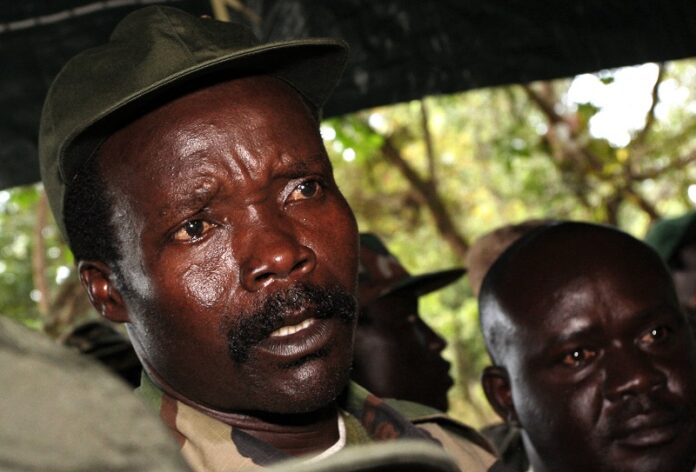
The leader of the Lord's Resistance Army Joseph Kony answers journalists' questions following a meeting with UN humanitarian chief Jan Egeland in 2006 at Ri-Kwangba in Southern Sudan. Photo: Stuart Price / Associated Press

KAMPALA, Uganda — Indicted for killing thousands and kidnapping children to become soldiers and sex slaves, Joseph Kony has been Africa’s most notorious warlord for three decades. Now that the United States and others are ending the international manhunt for him and his Lord’s Resistance Army, it appears Kony may never be brought to justice.

His elusiveness in the often lawless bush of central Africa is legendary. In one incident Ugandan military forces in hot pursuit raided Kony’s hideout deep in a Congo wildlife park in 2008 and seized little but a wig and guitar he left behind.

Despite the millions of dollars spent to catch him, Kony has outlasted his hunters. That’s a blow to victims who hoped he would stand trial at the International Criminal Court where he has been charged for war crimes and crimes against humanity.

“The yearning for justice is there,” said Judith Akello, a lawmaker who represents a community in northern Uganda once hit by Kony’s rebel insurgency. “Justice is what the people demand.”

Kony became internationally notorious in 2012 when the U.S.-based advocacy group Invisible Children made a viral video highlighting the LRA’s alleged crimes. The group is accused of killing over 100,000 people, according to the U.N.

The U.S. has offered up to $5 million for information leading to Kony’s capture.

Although scores of LRA fighters have recently surrendered or been killed, the whereabouts of Kony, now in his 50s, remain a mystery. Recent defectors from the rebel group suggest he is sick and hiding somewhere in the vast, ungoverned spaces of central Africa.

In pulling out of the military mission against the LRA, the U.S. in March said the rebel group’s active membership is now less than 100. The U.S. first sent about 100 special forces as military advisers to the mission in 2011, and in 2014 sent 150 Air Force personnel.

Echoing the U.S., Uganda’s military last month announced it was ending the manhunt and pulling out 1,500 troops because “the mission to neutralize the LRA has now been successfully achieved.”

The military withdrawal means Kony may never be caught, said some observers. Of the five LRA commanders indicted by the ICC in 2005, he is the only one still at large. One commander, Dominic Ongwen, is currently on trial at the ICC following his arrest in Central African Republic in 2015.

“Kony is the ultimate master of survival in the jungle,” said Kasper Agger, an independent researcher in Central African Republic who monitors LRA activities. “He has survived three decades of warfare and evaded capture from the most powerful and expensive military in the world.”

Kony’s rebels may continue as a “group of bandits” in sparsely populated areas of Congo and Central African Republic, where they may link up with other armed groups, said Agger. LRA rebels trade in wildlife products to support their activities, slaughtering elephants for ivory in Congo under Kony’s direct orders, according to The Enough Project.

The LRA remains a regional threat, according to a new U.N. report on sexual violence in conflict. “The Lord’s Resistance Army continued its decade-old pattern of abduction, rape, forced marriage, forced impregnation and sexual slavery” in Central African Republic and has a presence in Congo and South Sudan, it says.

Kony has proved difficult to capture “mainly because he hides in Sudan-controlled territory” in which other African forces are not permitted to operate, said Sasha Lezhnev of the Enough Project. Sudan has denied allegations by Uganda’s government that it actively supports the LRA.

A former Catholic altar boy whose rebel movement started as a tribal uprising with aspirations of ruling Uganda according to the biblical Ten Commandments, Kony is an almost mythical figure. LRA fighters have said he has paranormal powers to read the minds of disloyal commanders.

Under military pressure, the LRA fled Uganda in 2005, moving first to Congo and then to parts of Central African Republic in a vast jungle area about the size of France. By then vastly degraded, the LRA splintered into small groups that were constantly on the move.

The rebels were up against a poorly organized Ugandan military, whose commanders in the anti-Kony campaign were accused of creating phantom soldiers on the payroll and abusing civilians.

“Kony and LRA’s nine lives were the result of their discipline,” said Angelo Izama, an analyst in Uganda who runs a think tank on regional security called Fanaka Kwawote.

Although Kony could appear bizarre, “he presided over a formidable, well-armed and loyal outfit that was quite capable of running rings around the supposedly superior soldiers sent to hunt him down,” said Matthew Green, author of “Wizard of the Nile,” a 2008 book about the LRA.

“While many people in (northern Uganda) reviled Kony for the atrocities he ordered, they were also subject to repression and abuses by (Ugandan) President Museveni’s security forces,” Green said. “Kony survived in part because there was often a deep-seated ambiguity in attitudes toward his movement among his own people, even though they were his principal victims.”

Story: Rodney Muhumuza

Advertisement

Oh, Nelly: American Rap Concert Postponed

Photo: Nelly / Facebook

BANGKOK — Organizers of a performance by American rapper Nelly had yet to announce Tuesday – one week before the concert – that it has been postponed until next month.

Golden Axe, who announced the Nelly show in March after failing to deliver on Wu Tang Clan, has made no mention of the fact the rapper and R&B star will play in Bangkok in June instead of May 17, according to the singer’s page and ticket-seller Thai Ticket Major.

The singer’s official Facebook page posted an image Monday night with words announcing a June 13 date.

ThaiTicketMajor published a statement confirming the show has been postponed.

“The customers can use purchased tickets for the June 13 concert or get a refund by May 31,” it said.

Neither Golden Axe nor its representatives responded to questions about what had happened.

Back in March, Wu Tang Clan fans were disappointed when the Golden Axe Music Festival announced members of the legendary group were in fact not coming to Bangkok as previously advertised.

Related stories:

Nelly Coming to Bangkok in May

‘Wu Tang Clan’ Show Postponed Indefinitely


Advertisement

Rainbows and Pride to Soar Over Bangkok Next Week

Photo: IDAHOT Thailand / Facebook

BANGKOK — Powerful stories, LGBT luminaries and fabulous events are coming to the capital with the return of an annual event dedicated to celebrating gay pride and ending discrimination.

Next week is IDAHOT, an event known less concisely as the International Day Against Homophobia, Transphobia and Biphobia. On May 17, the LGBT community and its friends will come together at a contemporary art space to show the power of diversity and support under the slogan “We are a #RainbowFamily.” Talks, exhibitions, performances and more events will be held all day.

Powerful stories will be passed along via talks with LGBT youth and their families from throughout the realm: A Chiang Rai mother and her trans daughter, a Bangkok trans parent and a bisexual academic and single mom from the Deep South province of Pattani.

Art exhibitions and performances will include photo exhibition “Queerness” by Piyarat Piyapongwiwat and a cabaret show by the talented cast of Golden Dome.

Jazz duo Johnnifer Panot and Sillapin “Zymone” Gill will perform live at about 5:30pm before an LGBT-themed sketch takes place.

Teen fashion sensation Apichet “Madaew” Atirattana and Hirankrit “Som-o” Pattaraboriboonkul, who designed the 2015 Miss Universe tuk-tuk costume, will talk about their lives and the support they get from their families.

The full schedule is available online. The event will take place at the Bangkok Art and Culture Center, best reached by skywalk from BTS National Stadium.

Advertisement

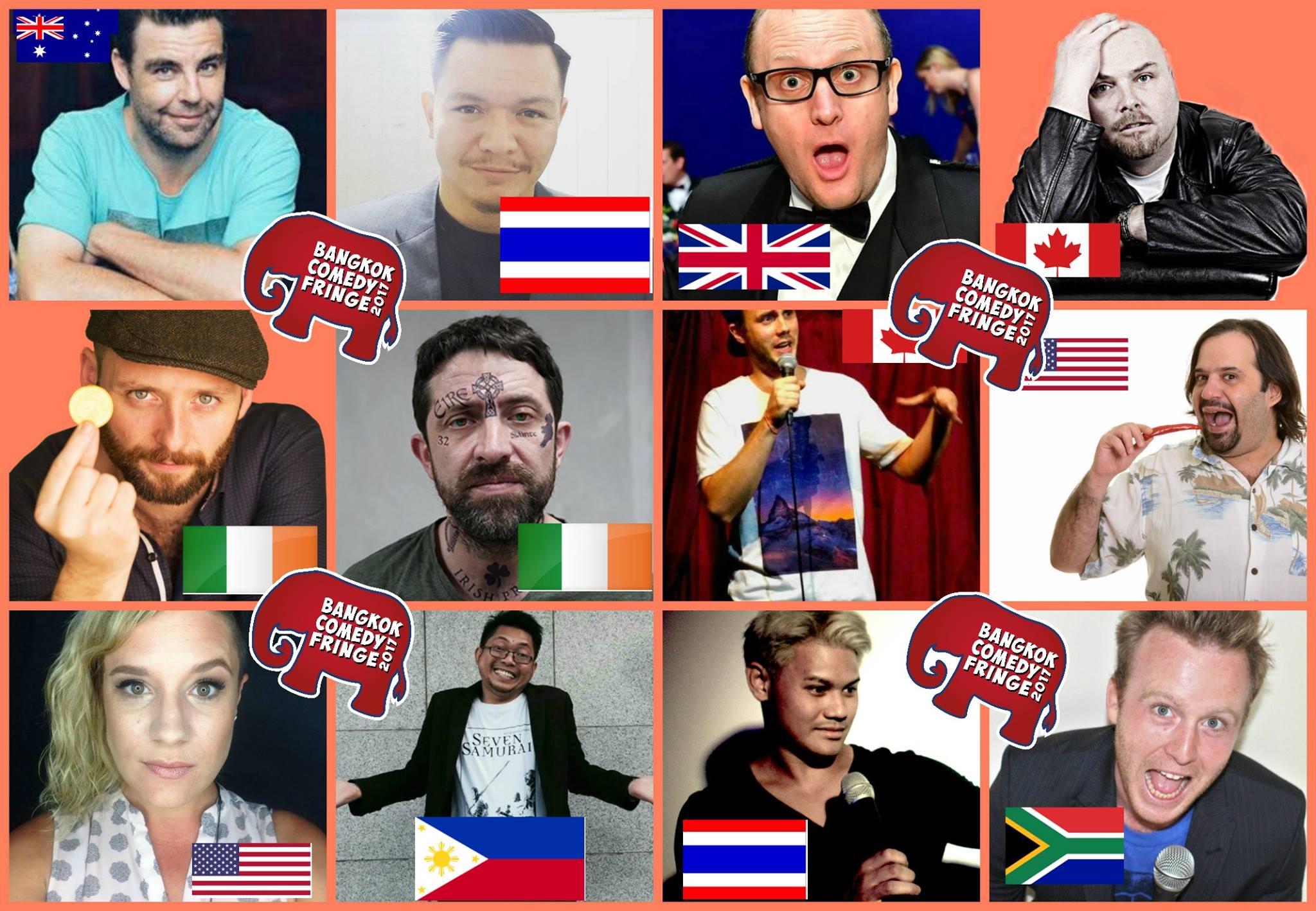
LOL All Weekend With 12 Comedians on the ‘Comedy Fringe’

A comedian performs at the Khaosan Comedy Club in an image posted Feb. 10. Photo: Khaosan Comedy Club / Facebook

BANGKOK — Binge on five days of laughs starting Thursday when stand-up comedians from around the world take over a Khaosan Road bar.

Twelve comedians from different parts of the world will gather at the Bangkok Comedy Fringe to put smiles on faces with a couple of shows daily through Monday.

Irish rogues Aiden Killain and Andrew Gilmore will join forces as the Dirty Rotten Irish Scoundrels from 7pm to 8:30pm, Thursday through Monday. From 9pm to 10pm, catch the Best of Bangkok show featuring 2016 Canadian Comedy Award-winner Brian Aylward and Jonathan Samson, who’s billed as the godfather of stand-up in Thailand.

On Saturday and Sunday, comedians from Thailand, Ireland, Canada, Scotland, Philippines, the United Kingdom and United States will take the stage starting at 3pm.

Tickets for the Best of Bangkok show are 100 baht and can be purchased at the door. All other shows are free. Visit Bangkok Fringe for more information.

The event starts Thursday and runs through Monday at the Khaosan Comedy Club in the 999 West Bar on Khaosan Road.

18216460 554656044704956 7938639864114915004 o

18121251 551807954989765 8723448560653424330 o

18076763 550973918406502 6237430962568439805 o
Photo: Bangkok Fringe / Facebook

Advertisement

Accepting Compensation, Families Still Demand Jenphop’s Prosecution

From left, the mother and sister of Thantaphat Horsaengchai leave the court on Tuesday with their attorneys, at right, in Ayutthaya.

AYUTTHAYA — Having settled a dispute over compensation for the death of their daughter, a family of one of two graduate students killed by fatal crash suspect Jenphop Viraporn said Tuesday they are ready to see justice done.

Jenphop, the 39-year-old scion of a luxury car dealership, was due to give his testimony today in an Ayutthaya court about the events that led to him crashing his Mercedes-Benz into another vehicle in March 2016, killing graduate students Krissana Thaworn and Thantaphat Horsaengchai.

Prolonged negotiations between Jenphop and Thantaphat’s family only ended this afternoon, forcing the court to reschedule what was to be the last day of the trial for May 19. The sister of Thantaphat said the sum – said to be in the millions of baht – would not change her family’s resolve in pursuing justice.

“We will fight to the utmost, because this is about upholding the law,” Kanchana Horsaengchai said after the session was adjourned.

Read: Testimony Postponed Over Payout, Jenphop Opens up Outside Court

Families of both victims would not disclose the sum offered by Jenphop, but a source close to the matter said Krissana’s family will receive 8 million baht, while Thanaphat’s will get 9 million. The former initially asked for 19 million baht and the latter asked for 110 million baht, said the source, who requested anonymity because it involved sensitive deliberations.

An attorney representing Thantaphat’s family said the compensation had to be settled in order to move the case forward quickly, and it will not affect the criminal prosecution. The lawyer, Wichien Chubthaisong, said he will ask prosecutors to seek the maximum punishment for Jenphop in his closing statements.

Wichien added that part of the compensation will be used to set up foundations in memory of Thantaphat to promote Buddhism and road safety.

For the March 2016 crash, Jenphop is being tried on seven charges, including driving under the influence and fatal reckless driving. If convicted, he faces up to 10 years in prison. The DUI charge was automatically filed against him because he refused a sobriety test. The defendant confessed to speeding and reckless driving but disputed the other counts.

Jenphop did not speak to reporters about the case, but his family friend said the defendant felt remorseful and tried to remedy what happened.

“He’s willing to take responsibility. He entered the process, instead of fleeing like some famous cases,” said Charoen Yodkaewlah, who also served as Jenphop’s lawyer for several months.

Local police did not immediately charge Jenphop for the crash. He was not only permitted to leave the crime scene and go to hospital with his family, but also allowed to forego mandatory sobriety testing.

After video of the crash, which showed Jenphop’s Mercedes-Benz slamming into the back of the Ford at tremendous speed, surfaced on social media, it ignited public outrage and prompted action from the police.

Kanchana, the sister of Thantaphat, said she hopes that justice in Jenphop’s case will set an example that no one is above the law in Thailand, regardless of their wealth or status.

“His reckless driving had consequences that affected so many lives,” she said.

Related stories: 

Eyewitnesses Describe Fatal Crash at Opening of Jenphop Trial

Fresh Charge Against Jenphop as Model Student Victims Laid to Rest

Jenphop Faces Fresh Lawsuit Over Fatal Crash

Cops Reprimanded for Bungling Fatal Benz Crash Case

Advertisement

Hot News

LATEST NEWS

Bangkok
overcast clouds
33.5 ° C
35 °
31.1 °
73 %
4kmh
100 %
Mon
34 °
Tue
34 °
Wed
35 °
Thu
31 °
Fri
30 °