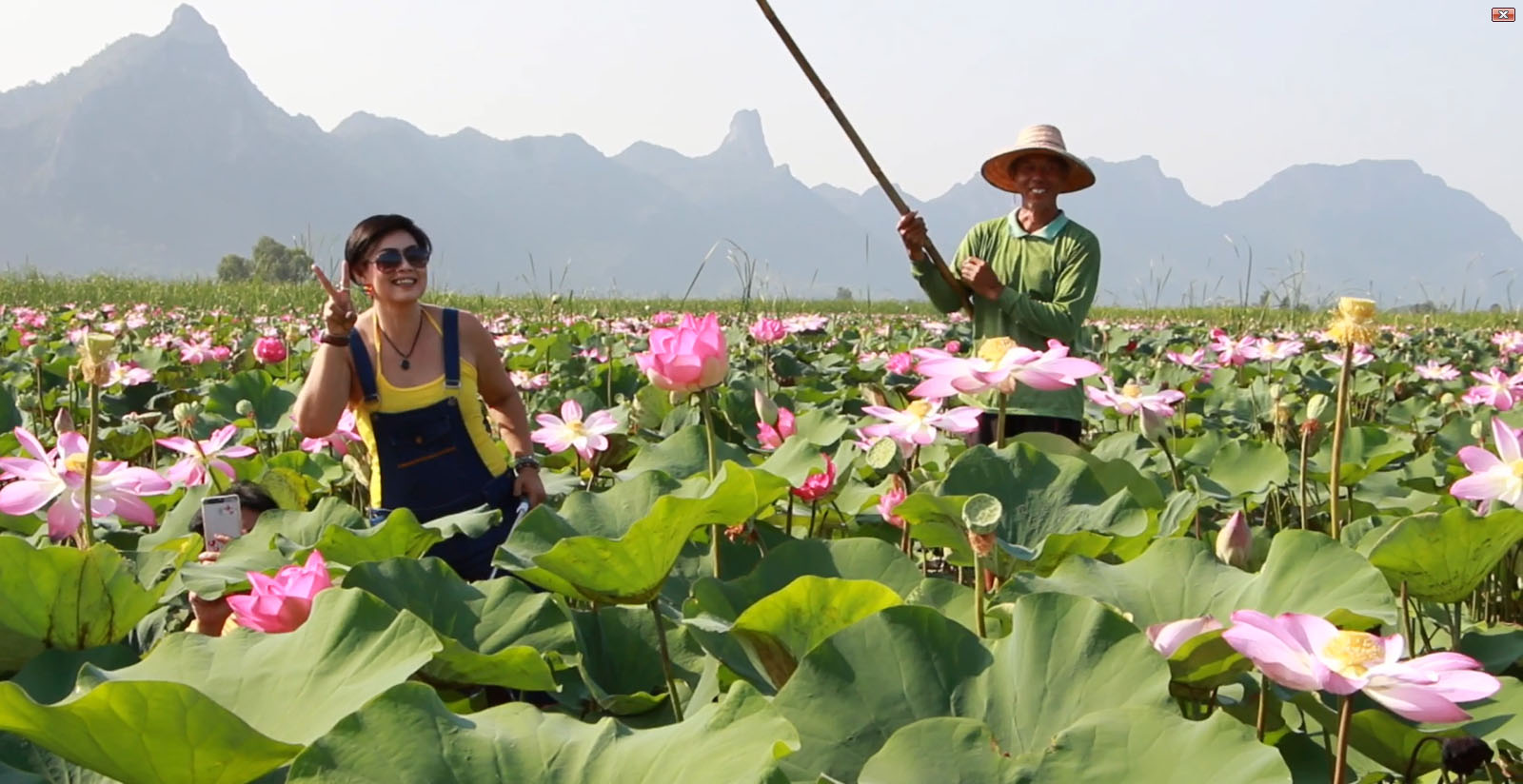
PRACHUAP KHIRI KHAN — A swamp of pink sacred lotuses in Khao Sam Roi Yot National Park were blooming as of Thursday, a phenomenon which occurred for the first time in 10 years.
Among cattails and reeds, pink sacred lotuses were blooming as far as the eye could see in the lotus swamp at a national park located in western Thailand.
On Thursday, a group of local environmentalists paddled three kilometers into the swamp at Khao Sam Roi Yot with tourism officials and journalists to show off the spectacle.
Tourist Saengdao Todsanit poses in the field of sacred lotuses Wednesday in Khao Sam Roi Yot National Park while her tour guide smiles.
Most nulumbo nucifera, or sacred lotus, fields have dried up for over a decade, residents said, adding that most existing lotus fields are those of the smaller nymphaea nouchali, or blue lotus blooms. In fact, the 43,260 rai (69 square kilometers) of swamp in Khao Sam Roi Yot in 2016 was at its worst state in over 30 years due to drought. The lack of water led the ground to crack dry and all the lotuses died.
“Right now the lotuses are rejuvenating and growing again, but it will take some time for them to be beautiful,” Nisakorn Tongprong, head of an environmentalist group at the national park said. “This year, the water level came back up to two meters in some areas, but now mostly they’ve decreased to 50 to 80 centimeters because of the heat and the wind. Still, I’m confident that the swamp won’t dry up because summer is almost over and the lotuses are strong, new plants.”
Nisakorn Tongprong, head of an environmentalist group in Prachuap Khiri Khan, paddles a boat Wednesday in Khao Sam Roi Yot swamp.
During the decade-long dearth of lotuses, locals who made their living off paddling tourists through the swamp and fishing had to turn to other ways to make money. With the delicate pink blooms appearing again, tourists have been visiting the marsh, advertised through social media or word of mouth.
According to Nisakorn, the best times to head out are 6am and 10am and travelers are advised to bring sunscreen and hats.
Rungrote Atsawakultarin, head of Khao Sam Roi Yot said Thursday that only one section of the swamp, at the Bung Baw Nature Study Center, is open to tourists to protect the flowers.
Sacred lotuses bloom for the first time in a decade Wednesday at Khao Sam Roi Yot National Park.Tourist Saengdao Todsanit takes a selfie with the field of sacred lotuses Wednesday in Khao Sam Roi Yot National Park.Tourist Saengdao Todsanit poses in the field of sacred lotuses Wednesday in Khao Sam Roi Yot National Park while her tour guide smiles.Tourism official Orasa Awutkom sniffing a sacred lotus Wednesday.A tourist shades herself with a lotus leaf while Nisakorn Tongprong paddles the boat Wednesday in Prachuap Khiri Khan.
Besides the heat, April’s brought us quite a few interesting events. So far this month, we’ve set sail on Sunju Hargun’s Karma Kruise, bass music pioneer Addison Groove rocked Beam on Songkran, and Highland’s third 420 Festival was a complete success. But before we head into the month of May, this month still has a few extra events left for us to enjoy. So be sure to work up a sweat rocking out at either one of these events below.
It’s common for DJs to get into arguments about which genre they think is best. The folks over at Casio watches tapped into this beef and now have come up with their latest event called the Culture Shock: The Master of Sound Battle. This event sees DJ Pichy’s Quay Records (underground) vs Bangkok Invaders (hip hop) vs Lazerface (EDM) battle it out for supremacy and bragging rights. This isn’t your usual hour long DJ scratchathon either. What makes this event different is that besides DJs, all three teams will have three 15-minute sets to throw down their audiovisual spectacular, as they will compete and perform with their own VJs and MCs on a G-shock custom rotating 360-designed stage with a towering 12-meter-high projection mapping screen.
G-shock culture shock master of sound battle takes place April 27 at Oasis Garden Jaturatid Road. Entry is free.
South Korea’s Peggy Gou has proven herself a force to be reckoned with in the international electronic music scene. Peggy’s start came when she moved from her native South Korea to study fashion in London. There she caught the buzz of the city’s thriving techno scene and was soon making her own mixtapes which dazzled listeners with her unique style of house, techno to abstract electronica.
In 2016 she released her first EP titled “The Art of War” which further cemented her place as a top contender in the Europe’s techno scene, and since then has had a string of dancefloor-destroying tracks. This Friday the South Korean DJ takes over the booth at Beam and is set to rock the crowd with her beats.
Beam is located at 72 Courtyard, on Soi Thonglor 55, Tickets are 300 baht.
The world-renowned festival goes off this weekend with a huuuuuuge line up of the best of the best in the world EDM scene. Think soaring LED screens, laser light shows, state-of-the-art sound and of course an all star line up that includes Martin Garrix, Armin van Buuren and even a guy called Marshmello that DJs with a bucket on his head.
Together Festival takes place at Bitec Bangna, tickets are available online.
DJ Lowe’s and Boogie G’s event Nite Ride has become an institution for disco, funk and boogie music. To date they’ve had guests like Gramaphone Children, Dam Funk rock and the one and twos. This weekend they welcome local guy Tek Harrington to the DJ booth. Tek’s nu disco beats have made him a favorite among clubbers and he has graced crowds at events such as Kolour in the Park.
The event takes place at Studio Lam from 9pm to 2am, 200 baht at the door. Studio Lam is located on Soi Sukhumvit 51.
Fresh from his debut performance in Europe, Bangkok’s very own Marmosets or DJ King Kong, sets up his synths, samplers and sequencers this weekend at Drive with a promise of 100% pure techno. The event will also feature guests Arch from Poland and WinkieB. All the beats are going down at Moustache Bar so you can be sure they’ll be some late night grooving going on here.
Once described as “the aural equivalent of sipping an ice-cold Pimms on the balcony of your council estate flat,” is U.K. Production duo Bondax. The duo have achieved chart-topping success when their R&B flavoured house tracks were played on heavy rotation in BBC Radio One’s Annie Mac. Their 2016 debut in Bangkok was a success and the duo plans to bring back those vibes when they return for their second round Sunday at Live RCA. The event is also supported by DJs Walt Mattson and Rory Roketto.
Psychedelic rock meets indie is the best way I can explain the magnificence of Malaysian experimental rockers SpeakZodiac. Their album release Northern Drug is the kind music you’d expect to hear in a Tarantino film and is pure awesomeness. The band will play their debut show this Saturday at Soy Sauce Bar and will also be joined by Kuala Lumpur band Janitor and locals Hope the Flowers and Phy.
BANGKOK — Thailand has plunged deeper when it comes to press freedom this past year, a report published Wednesday said.
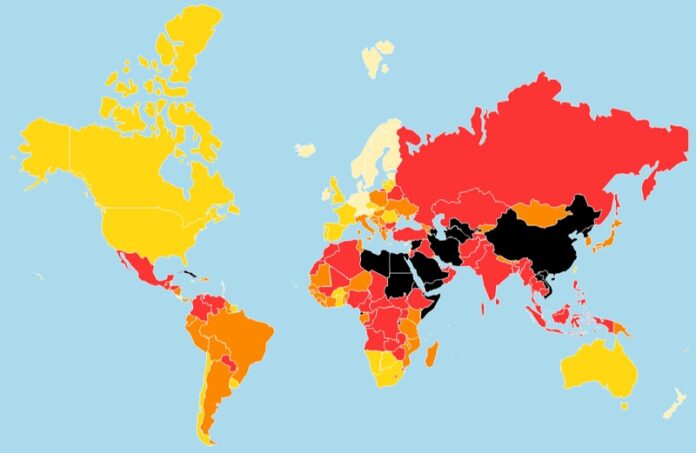
Paris-based organization Reporters Without Borders, or RSF, ranked Thailand 142nd out of 180 countries around the world in the 2017 World Press Freedom Index, a fall of six places since last year.
The authors attributed this to the military junta’s role in keeping permanent surveillance on journalists and detaining some arbitrarily. Junta spokesman Col. Winthai Suvari was not available for comment on the ranking as of press time Thursday.
Thailand fell from 136th to 142nd position, with next year potentially seeing a further drop if the proposed media-reform bill – which includes a criminal penalty of three years of imprisonment and a 60,000 baht fine – receives hands of support from the junta-appointed National Legislative Assembly. The assembly is believed to deliberate on the matter as soon as early next month.
“Thailand is ruled by a military junta called the National Council for Peace and Order. Ubiquitous, all-powerful, and led by press freedom predator Prime Minister [Gen.] Prayuth Chan-ocha, the council keeps journalists and citizen journalists under permanent surveillance, often summons them for questioning, and detains them arbitrarily,” RSF stated in English on its website.
“Any criticism of the junta is liable to lead to violent reprisals made possible by draconian legislation and a justice system that follows orders,” it said referring to the Computer Crime Act, assuring it was reinforced in 2016 and gave authorities more control over censorship.
RSF said that the passing of His Majesty the Late King Bhumibol’s passing had not curtailed the use of lese majeste charges, qualifying Article 112 as a ”weapon of mass deterrence for journalists, bloggers, and online activists.”
Countries ranking higher than Thailand include Sri Lanka at 141, India at 136 and Pakistan at 139.
Thailand performed better than South Sudan at 145 and Russia at 148, however.
Out of 180 countries, Norway was ranked as having the most free press in the world at number 1, followed by Sweden and Finland, respectively. France stood at 39 followed by the United Kingdom at 40 and the United States at 43. In Asia, South Korea ranked highest at number 63. Japan was ranked at 72 while China was placed at 176.
At ASEAN level however, Thailand continues to rank above most of its neighbors. Malaysia is two ranks behind at 144. Laos stands at number 170 and Vietnam at 175. Brunei is at 156, a few ranks behind Singapore at 151. Indonesia, the Philippines and Myanmar scored higher than Thailand at 124, 127 and 131 respectively.
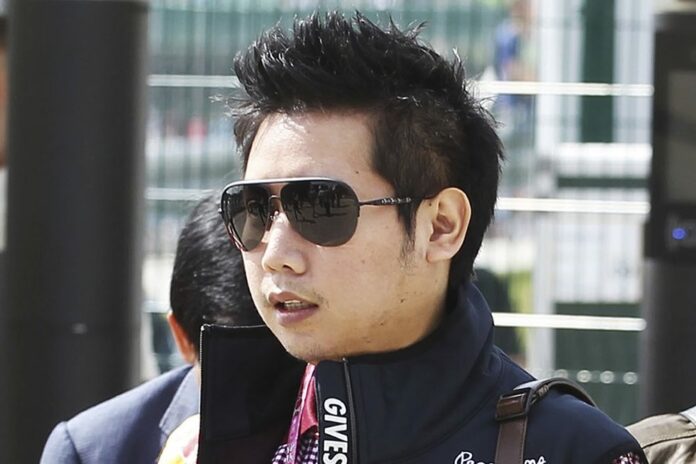
Vorayuth 'Boss' Yoovidhya, who has evaded justice for years in the death of a Thonglor police officer, spotted in 2013 at the British Formula 1 Grand Prix in Silverstone, England, in a photo provided by XPB Images. Photo: XPB Images / AP
BANGKOK — After more than four years of inaction, authorities on Thursday said they would seek an arrest warrant and an extradition order for a wealthy businessman accused of a hit-and-run that killed a policeman in 2012.
The latest deadline for Vorayuth “Boss” Yoovidhya to appear before the prosecutors expired Thursday without sign of the 32-year-old grandson of the man who started the Red Bull energy drink empire. He has repeatedly disregarded nearly all summonses since he crashed his Ferrari into a policeman’s motorcycle in Bangkok’s nightlife area in September 2012.
“Just before this news conference, I checked with the South Bangkok Court whether the suspect has reported himself there,” Somnuek Siangkong, a spokesman for the Office of Attorney-General, told reporters. “The court informed me that he has not showed up.”
“The next step is, we will issue a letter to Thonglor Police Station, asking them to apply for an arrest warrant with the court. We will begin this process tomorrow,” he added.
Once the warrant is issued, the next step is extradition, said Amnat Chotchai, director of the prosecutor’s foreign affairs office. Amnat said media reports indicated that Vorayuth is residing in the United Kingdom, which has maintained an extradition treaty with Thailand since 1912, but the prosecutors must still confirm whether that is his current residence.
No matter how poor or rich people are, we facilitate justice for them all
He said Vorayuth does not meet any special condition in the Thai – UK treaty that would disqualify efforts to send him back to Thailand.
“We have worked with the Home Office in many cases,” Amnat said.
For killing Sgt. Maj. Wichian Klanprasert and fleeing the crime scene in 2012, the businessman is charged with fatal reckless driving, hit-and-run, speeding and property damage. The two latter charges have already expired, while hit-and-run is due to expire in September. The statute of limitations for the most serious charge – fatal reckless driving – is valid until 2027.
The last time Vorayuth was ordered to appear before the Office of Attorney-General was on March 30. That summons, like others, was ignored and no arrest warrant has ever been issued for the Red Bull heir.
Interest in the case was reignited after a report by The Associated Press showed Vorayuth to be openly living a jet-setting life and traveling in and out of Thailand without repercussion.
The prosecutors previously insisted Vorayuth has the right to delay his previous summonses because he filed a complaint of unfair treatment, which halted all prosecution efforts against him until they are thoroughly investigated. Those complaints were ruled to be groundless last month by the Office of Attorney-General, a spokesman said.
Few will be surprised by Vorayuth’s refusal to appear today. Due to the reluctance of the authorities to prosecute the Red Bull heir, Vorayuth’s name has become the epitome of frozen justice when it involves Thailand’s well-connected and the wealthy.
Those attending Thursday’s news conference include former politician Chuwit Kamolvisit who criticized the prosecutors for their failure in bringing Vorayuth to court. He also asked the Office of the Attorney-General what they propose to fix “this failure of justice system” in the future.
Spokesman Somnuek defended the prosecutors’ inaction on the grounds that they had to wait until complaints of unfair treatment were resolved.
“No matter how poor or rich people are, we facilitate justice for them all,” Somnuek said.
BANGKOK — Daily decision-making can lead down one life path or another. Illustratrator Wisut Ponnimit reflects human’s determination with animations featuring his signature character Mamuang.
After opening Bangkok CityCity Gallery with his solo “Melo House” in 2015, the cartoonist Wisut Ponnimit still keeps the concept of allowing visitors to have fun exploring the space in which he exposes his works.
Instead of entering a maze to follow paintings of Wisut’s famous characters to nine different exits, this time those characters will come alive in the form of animated characters the artist drew and directed, and the music to which he composed and performed.
Through the “LR” exhibition, guests will be shown that the actions taken in their lives shouldn’t be taken for granted, as they are taken through a tour in which their decisions will lead the story they’re following to a variety of outcomes, giving it a variety of possible endings.
The 40-year-old artist is famous for his comic series “Hesheit” in which the roughly-sketched drawings reflect dark humor and life philosophy. His well-known drawing includes Mamuang – the Thai word for “mango” – a girl whose face shape resembles that of the fruit.
The exhibition will launch at 1pm from May 6 and run through June 25 at Bangkok CityCity Gallery on Sathorn 1 Road. It’s a few minutes walk from MRT Lumphini’s exit No. 2.
PRACHUAP KHIRI KHAN — A crying man climbed up a utility pole early Thursday morning due to what he described to be poverty woes, having to be coaxed down by local police.
At about 3am, police received calls that Athit Baanyuu, 31, had climbed up an electricity pole in front of Tamonglai Resort and was wailing for local residents to hear about how his wage of 300 baht a day was not enough for him to send back to his mother.
“Now, he’s sleeping at the precinct. He’s still not making sense and is in a very confused state so we can’t question him yet,” Senior Sgt. Maj. Suechart Noimuang of Muang Prachuap Khiri Khan police said, when asked of Athit’s motive. “The insurance company came, as did people from a local psychiatric hospital.”
Police Lt. Col. Yotsawarit Tongsongsoam, local electricity officials, air force officers and disaster prevention officials went to the scene with an electric lift to try to coax Athit down from the 12-meter structure. Officials cut the power to the high-voltage utility pole for Athit’s safety, causing the power to go out in several neighborhoods in the area.
Officials set up an emergency inflatable pad under Athit and a bucket truck with a rescue official in it to bring him down.
Athit told the officer who rode up to him that he had climbed up so he could call his mother. Athit, a native of Ubon Ratchathani, said he had gone to Prachuap Khiri Khan to find a job but that his daily salary of 300 baht was too little to send any back to her. He said he would have to find work on a fishing boat, so his mother wouldn’t have to work in the fields.
After three hours of unsuccessful coaxing, officials decided to call to Athit’s relatives by phone to try and convince him. Affected by thirst and fatigue Athit agreed to come down with the officer in the cherry picker as officials below clapped and cheered.
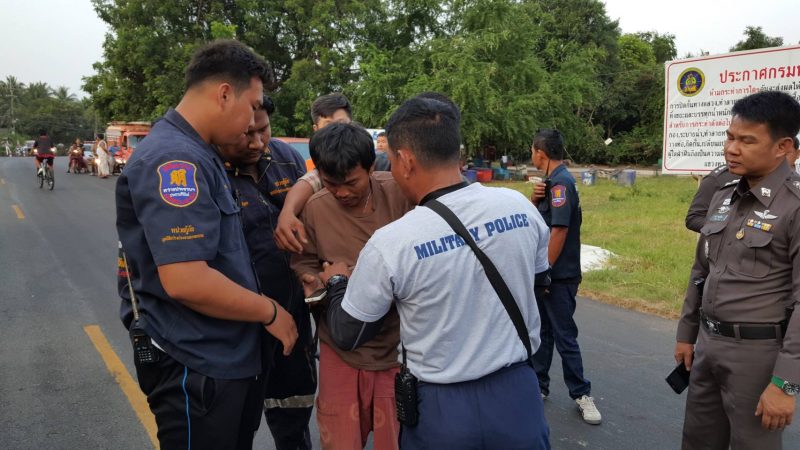
Athit Baanyuu, 31, climbs on electric wires 12-meters high Thursday morning in Prachuap Khiri Khan as an emergency official coaxes him down from a bucket truck.Athit Baanyuu in the bucket truck Thursday morning with an emergency official.Athit Baanyuu seen here Thursday morning after coming down from the utility pole.
Kamkooncharoen Konchaturat (third from right) on Wednesday being taken to the scene in Suphan Buri province for a police reenactment.
SUPHAN BURI — A taxi driver who stands accused of raping a Brazilian woman Wednesday was revealed to have been convicted of rape twice before, police say.
Korat native Kamkooncharoen Konchaturat was arrested and charged with rape and confinement Wednesday afternoon after he allegedly raped a 23-year-old Brazilian woman he picked up from Don Muang Airport on Tuesday.
Kamkooncharoen, 44, was found to have been convicted of rape in 2008 and again in 2013. His victims were a Thai woman and a Burmese woman respectively, according to Capt. Somkiat Srisangwan.
The Brazilian national hailed Kamkooncharoen’s yellow-green taxi from Don Mueang Airport and asked him to take her to Thonglor. However, Kamkooncharoen took detours and took her to Nakhon Pathom instead, where he allegedly beat and assaulted the woman before fleeing.
An image posted to the Instagram account of Porpeer Salin Suyarnsettakorn on July 2, 2015, shows Vorayuth "Boss" Yoovidhya, whose grandfather co-founded energy drink company Red Bull, standing next to a black Porsche with customized license plates in London. (Photo via AP)
BANGKOK — Thursday marks the day the millionaire heir to an energy drink empire wanted for a fatal car accident five years ago must turn himself to the authorities.
Vorayuth “Boss” Yoovidhya has disregarded all previous summonses since he crashed his Ferrari into a policeman’s motorcycle in Bangkok’s nightlife district in 2012. Despite media reports Vorayuth – whose grandfather started the Red Bull brand – was traveling openly in and out of Thailand, authorities never made any attempt to apprehend him, much to the public’s chagrin.
For killing Sgt. Maj. Wichian Klanprasert and fleeing the crime scene, the 32-year-old businessman is charged with fatal reckless driving, hit-and-run, speeding and property damage. The two latter charges have already expired.
The last time Vorayuth was ordered to appear before the Office of Attorney-General was on March 30. That summons, like others, was ignored. A spokesman for the prosecutors said it was okay for Vorayuth not to appear because he was on a business appointment in the United Kingdom.
Prosecutor spokesman Prayuth Petchkhun also said Vorayuth has the right to delay his previous summonses because he filed a complaint of unfair treatment, which halted all prosecution efforts against him until they are thoroughly investigated.
He was given another deadline, April 27. Vorayuth has not been seen at the Office of Attorney-General so far.
Prayuth told reporters on Wednesday that his office will convene a news conference about the matter at about 2pm. Prayuth and another spokesman could not be reached for comment on Thursday morning.
At a previous news conference in March, the spokesman said Vorayuth could not postpone another summons on the ground of unfair treatment.
“I don’t think that would be the case. Please, dear members of the press, don’t speculate like that,” Prayuth replied when someone quipped that Vorayuth could just come up with another excuse.
Due to reluctance of the authorities to prosecute the businessman, Vorayuth’s name has become synonymous among Thais with delays of justice when it involves influential, wealthy figures.
Ekachai Hongkanwan seen here Tuesday morning as he is taken into a nondescript vehicle in front of Government House. Photo: Piyarat Chongthep / Facebook
BANGKOK — While the military junta has eased off on its most aggressive tactics, recent cases and observers say it has replaced them with micro-managing resistance to its rule. Two cases occurred Tuesday, nearly three years after the May 2014 coup, and the details suggest the coup-makers are still very active when it comes to keeping a firm lid on dissent.
Political activist Ekachai Hongkanwan was dragged into a nondescript car Tuesday by four plainclothes security officers in front of the Government House as he sought to enter it to present a petition to junta leader Prayuth Chan-ocha.
Ekachai wanted Gen. Prayuth, who serves as prime minister, to find the owner of a mysterious, royalist plaque which earlier this month replaced another one had long commemorated the 1932 Revolution. In the letter signed from Ekachai, a former lese majeste convict who served nearly three years in prison, called for Prayuth to remove the plaque if no owner was found within seven days.
A dozen men were waiting when Ekachai arrived to the Government House at about 9am. None of them identified themselves, though Ekachai said he deduced who they were by their uniforms. He shouted in an attempt to resist being forced into a white car.
“They dragged both my arms and forced my head down [to put me into the vehicle],” Ekachai said on Wednesday, the day after the incident.
‘It Was Disturbing’
Ekachai said a dozen bystanders simply looked on – some filming the encounter – but none did anything as he was dragged off his feet and into the vehicle, which eventually took him to the 11th Army Circle for “talks.”
“It was disturbing,” he said, of what he described as a public kidnapping in broad daylight. While inside the vehicle, he said they snatched his phone from him. Along the way, the men who engaged in small talk, handed Ekachai a piece of pink cloth and instructed him to blindfold himself before entering the military compound, “as the boss required.”
Not all have been treated that badly. On the same day, just hours away, Redshirt activist Anurak Jeantawanich or Ford Red Path, was picked up by a military Humvee at his residence in Samut Prakarn province southeast of Bangkok. The arrival of the armored vehicle driven by two uniformed soldiers was preceded by a phone call from representatives of the junta at the province, saying the boss would like to meet him for “talks.”
They were apparently upset by Anurak’s Facebook posting, making fun of economic hardship suffered by people under junta leader Gen. Prayuth. Anurak did not resist, unlike Ekachai. Anurak has over the years developed some rapport with the local junta representatives, and on the way back he even took some selfies and posted them on his Facebook account.
A selfie taken by Anurak Jeantawanich on Tuesday inside a military Humvee which he later uploaded to Facebook before being asked to take it down by junta representatives. Photo: Anurak Jeantawanich / Facebook
Conditions and Deception
After six hours of interrogation and being told he could be detained incommunicado for seven days under Article 44 of the now-defunct interim 2014 constitution, Ekachai was told to sign a Memorandum of Understanding, or MoU, before being released late Tuesday afternoon. The “agreement” entailed him accepting not to engage in future political activity and seeking permission from the National Council for Peace and Order or NCPO, before traveling abroad. If Ekachai violates the terms of agreement, he will be prosecuted.
“I didn’t ask for a copy of the MoU. I reckon they wouldn’t give me one anyhow,” said Ekachai. The 42-year-old man, who now works to assist political prisoners, asked the officers what would happen if he was to be found engaging in public political activities in the future.
“Just do it quietly. But if you were caught, you would be taken back here again,” said one officer. They also told him not to touch on issues related to the monarchy. None of the officers ever formally introduced themselves to Ekachai. After consulting with his human rights lawyer on Wednesday, Ekachai was told to file a police complaint saying he had been misled into signing the MoU because it wasn’t specify what the punishment would be if he violated the terms.
“My lawyer told me I could face a maximum of two years imprisonment term if I violated the conditions, as stated under NCPO order 44/2014, but I had no clue about that when I signed,” Ekachai said. “The lawyer told me to report to police that I was misled into signing it.”
Before signing, Ekachai recalled being engaged in a near-shouting bout with an off-uniform police officer who told him to leave Thailand if he’s not content about what’s happening. “Thai society has this frame. It’s how it is,” Ekachai said trying to recall the police’s wording as accurate as possible. “If you’re not content, you should go live abroad!”
The officer suggested that the majority of Thais, over 60 million, do not have a problem with the current situation. Ekachai argued back, asking the officer how he could be so sure about it.
For Anurak, the deal appears straightforward. Soldiers whom he met for “friendly talks” after the ride to the junta’s ad hoc office in the province asked him to remove a Facebook post making make fun of alleged economic hardship people are suffering under Prayuth. They told Anurak that was too harsh.
Hours after being dropped back home, Anurak was surprised to receive yet another phone call in the evening. This time the soldier on the phone asked him to delete a selfie photo he had taken inside the Humvee on his way back – which was eventually posted on his Facebook.
“They don’t want society to know about it,” said Anurak, adding that it reflects their sense of insecurity. He reluctantly obliged and deleted it – but not before some managed to save the photo and share it on social media.
Come Tuesday night, Anurak posted on his Facebook account that he was fed up of receiving numerous phone calls from junta representatives and that he would not attend any more calls from them for the night.
Ekachai posted on Facebook later on Wednesday saying that Thailand is increasingly resembling the society described by George Orwell in his novel 1984.
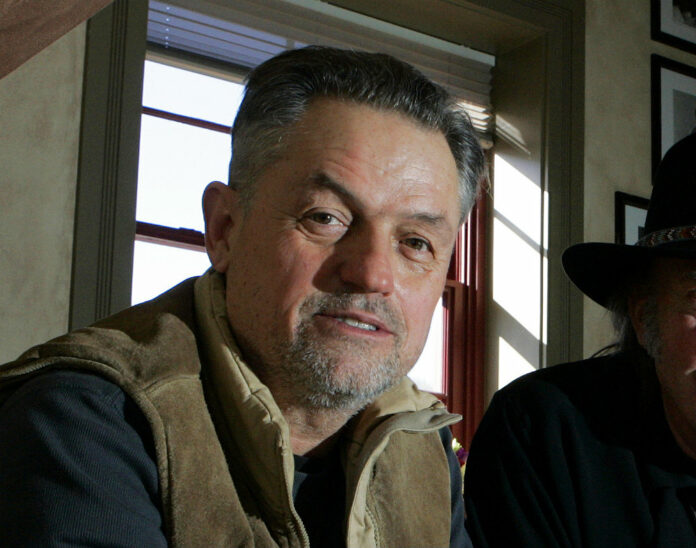
FILE - In this Jan. 24, 2006 file photo, filmmaker Jonathan Demme appears at the Sundance Film Festival in Park City, Utah. Photo: Carolyn Kaster / AP.
NEW YORK — Through Jonathan Demme’s freewheeling filmmaking life sounded a steady rock ‘n’ roll beat.
Music was his first love and his first credit. Long before he was an Oscar-winning director, he was music coordinator for a little-seen 1970 thriller called “Sudden Terror.”
And Demme’s death Wednesday morning at the age of 73 means that the final scenes he shot in his adventurous, hopscotching career were musical, too. His last full-length documentary was a Justin Timberlake concert film. The last scene of his final feature, “Ricki and the Flash,” was Meryl Streep, as an aging rocker, bringing down the house with Tom Petty’s “American Girl.”
Few filmmakers have been so drawn to the marrying of music and image the way Demme, a self-avowed “fanatical rock ‘n’ roller,” was. He stuffed 49 songs into “Something Wild.” Springsteen’s “The Streets of Philadelphia” gave his “Philadelphia” its melancholy heart. And, of course, his seminal Talking Heads concert film, “Stop Making Sense,” deftly captured the swell of David Byrne’s art-funk spectacular.
Demme, and his films, were never so alive as when the music was playing — and playing loud.
“I’ve come to believe, and I kind of felt this when we did ‘Stop Making Sense,’ that shooting live music is kind of like the purest form of filmmaking,” Demme told The Associated Press last year. “There’s no script to worry about. It’s not a documentary, so you don’t have to wonder where this story is going and what we can use. It’s just: Here come the musicians. Here come the dancers. The curtain goes up. They have at it and we get to respond in the best way possible to what they’re doing up there.”
The filmmaker died Wednesday morning of complications from esophageal cancer in his New York apartment, surrounded by his wife, Joanna, and three children, said Demme’s publicist, Annalee Paulo.
Demme broke into moviemaking under the B-movie master Roger Corman in the early 1970s, and his prodigious, wide-ranging body of work always kept the agile curiosity of a low-budget independent filmmaker. His career spanned documentaries, screwball comedies and tales of social justice. Yet his most famous films were a pair of Oscar-winners.
“The Silence of the Lambs,” the 1991 thriller starring Anthony Hopkins as Hannibal Lecter and Jodie Foster as an FBI analyst, earned him a directing Oscar, as well as best picture. He followed that up with “Philadelphia” (1993), with Tom Hanks and Denzel Washington, the first major Hollywood film to confront the AIDS crisis. It remains a landmark film in the portrayal of gay life and injustice, subjects Hollywood has previously largely turned a blind eye toward.
Hopkins, Foster and Hanks all earned Academy Awards for their performances in those films. Demme’s sensitive, alert eye help produce countless other acclaimed performance, too, from Melanie Griffith (“Something Wild”) to Anne Hathaway (“Rachel Getting Married”).
“Just as passionate about music as he was about art, he was and will always be a champion of the soul,” said Foster. Hanks called him “the grandest of men.” ”Jonathan taught us how big a heart a person can have, and how it will guide how we live and what we do for a living,” said the actor.
FILE – Director Jonathan Demme, left, holds his award for best director, actress Jodie Foster holds her award for best actress, and actor Anthony Hopkins holds his award for best actor for their work on “Silence of the Lambs,” at the 1992 Academy Awards in Los Angeles. Photo: Reed Saxon / AP.
Martin Scorsese, in remembering “my young friend,” praised Demme’s use of music, from Buddy Holly to Miklos Rozsa. “His pictures have an inner lyricism that just lifts them off the ground — even a story like ‘The Silence of the Lambs.'”
If there was one commonality in Demme’s varied filmography, it was music. He made films with Neil Young, the Pretenders and Robyn Hitchcock. (He also memorably documented Spalding Grey performing a monologue in “Swimming to Cambodia.”)
“I can’t play any instrument and I have a hideous voice,” Demme said. “But I’ve discovered that when I shoot music, I actually feel like I’ve become part of the band and I have something to do with the creation of music, which is a very good feeling for someone who loves music as much as I do.”
Byrne said he was originally drawn to Demme for the way he’d “slip a reggae artist’s song or a Haitian recording into a narrative film in ways that were often joyous and unexpected.”
On the making of 1984’s “Stop Making Sense,” Byrne said: “Jonathan’s skill was to see the show almost as a theatrical ensemble piece, in which the characters and their quirks would be introduced to the audience, and you’d get to know the band as people, each with their distinct personalities. They became your friends, in a sense.”
Robert Jonathan Demme was born on Long Island on Feb. 22, 1944. After his family moved to Miami, he attended the University of Florida where he wrote movie reviews for the school paper. In 1971, he went to work for Corman, first as a unit publicist on “Von Richthofen and Brown” and later directing his own films: the women’s prison movie “Caged Heart”; “Crazy Mama” with Cloris Leachman; and “Fighting Mad,” with Peter Fonda as a farmer.
Demme’s breakthrough came with the Oscar-nominated “Melvin and Howard” (1980), starring Jason Robards as Howard Hughes. It’s about a Nevada service station owner who claims to be the beneficiary of the billionaire. From early on, music played a central role in his films, especially in 1986’s music-stuffed road-trip comedy “Something Wild,” in which Jeff Daniels starred a tax consultant drawn into the wilder orbit of Melanie Griffith.
Some films were misfires. Demme’s 1988 adaptation of Toni Morrison’s “Beloved,” didn’t click with critics, nor did his 2004 big-budget remake of “The Manchurian Candidate.”
But 2008’s “Rachel Getting Married,” starring Hathaway playing a young woman released from rehab for her sister’s wedding, was a return to form that seemed to combine many of Demme’s talents — his buoyant, natural humanism, his joy in music performance, his fondness for troubled outsiders.
Demme most recently directed an episode of the Fox police drama “Shots Fired,” scheduled to air Wednesday, and a film for the Rock and Roll Hall of Fame, to debut July 1.
Demme was initially married to Evelyn Purcell, before divorcing. He is survived by his second wife, artist Joanne Howard, and their three children: Brooklyn, Ramona and Jos. His family requests that in lieu of flowers, donations be made to the Americans for Immigrant Justice.