28.8 C
Bangkok
Saturday, June 27, 2026
Home Blog Page 2676

Spaniard Accused of Dismembering Associate Pleads Not Guilty

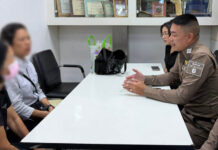
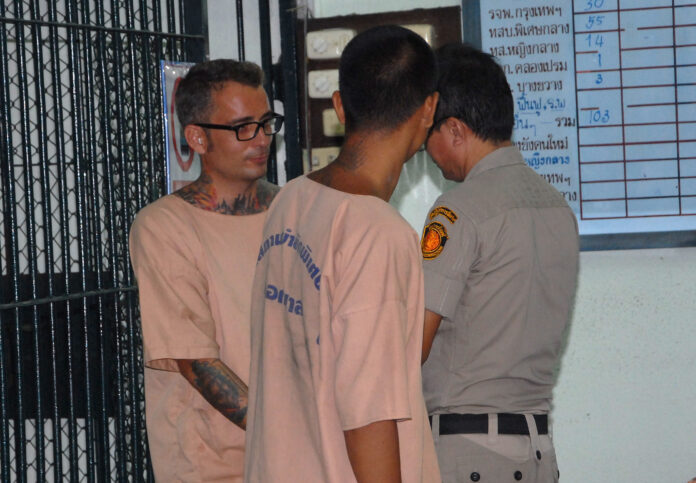
Artur Segarra, 37, is brought from Bangkok Remand Prison to the Criminal Court on Monday morning where he denied all charges involving the murder of, David Bernat. Both men are Spanish nationals.

BANGKOK — The trial of a Spanish man accused of murdering and brutally dismembering another Spaniard in Bangkok will go forward after he plead not guilty to all charges in court Monday.

Artur Segarra, 37, was brought from Bangkok Remand Prison to the Criminal Court where he entered his plea after formally hearing charges including premeditated murder stemming from the death of fellow countryman David Bernat, 39, whose body parts were found in the Chao Phraya river in January.

Representatives from the Spanish Embassy were present at the hearing, and Segarra himself testified to the court through a Spanish interpreter that he had no connection to Bernat’s murder.

Segarra is being represented by a court-appointed lawyer.

The suspected killer acknowledged having stayed at the PG Rama 9 Condominium, where police believe Bernat was killed before being cut into pieces and dumped into the river.

Segarra was arrested Feb. 7 in Sihanoukville province, Cambodia. Police believe he and possibly others were motivated by theft to abduct, torture, murder and dismember Bernat.

Segarra reportedly made large cash withdrawals from a number of ATMs in at least two provinces after gaining access to an account belonging to Bernat which held about 37 million baht.

On Monday, the prosecution told the court they have 95 witnesses to testify against Segarra, who so far had none forthcoming to testify.

The next court date to review evidence was set for July 25.


Related stories:

Police Say Slain Spaniard’s DNA Found in Suspect’s Home

5,000 Baht Reward for Box of Murder Knives

Police Trace Steps of Suspected Spanish Killer

Spanish Embassy to Attend Segarra Questioning

Cambodia to Hand Over Spanish Murder Suspect

Police Seek Spanish Murder Suspect

Spanish National Identified as Dismembered Man

Police Puzzled After Body Parts Fished Out of Chao Phraya

Advertisement

Journalist Associations Demand Release of Reporter

Taweesak Kerdpoka exits a police vehicle outside a Ratchaburi provincial courthouse on Monday.

Update: The Ratchaburi provincial court Monday afternoon freed all five suspects, including Taweesak, on bonds of 140,000 baht to await trial.

BANGKOK — The kingdom’s two leading press clubs issued a joint statement Monday afternoon demanding the immediate release of a reporter detained by authorities.

The Thai Journalists Association and Thai Broadcast Journalists Association said Prachatai reporter Taweesak Kerdpoka was performing his duties when he was detained Sunday in Ratchaburi province along with four pro-democracy activists.

“Taweesak has always identified himself as a journalist and was in the area to carry out his duties, but police deemed him to be a collaborator because he was in the car with the New Democracy Movement group,” said the statement, signed by Pramase Lekpetch of the Thai Journalists Association and Supan Rakchuea of the broadcast guild.

Taweesak and the activists were in a Ratchaburi provincial court on Monday afternoon for a hearing on whether they would be held.

Taweesak, 25, was arrested along with the activists after local police said they found campaign materials critical of the junta-supported charter draft in the vehicle belonging to Pakorn Areekul, a member of the group. Taweesak has said he was getting a ride back to Bangkok with them.

They were all accused of violating a recent law passed to criminalize most forms of criticism and campaigning in the run-up to the Aug. 7 referendum on the proposed constitution written by junta appointees.

A human rights lawyer said he had been notified all five did not intend to seek bail. Prachatai Director Chiranuch Premchaiporn said Monday afternoon that they had advised their reporter to post a bond and seek bail if the court did not release him.

The associations’ statement said initial reviews of what happened found no evidence he had broken any law.

“We demand the Prachatai reporter be quickly released without charge because it cannot be argued the journalist violated the law by hitching a ride with news sources, because reporters must be timely in their work and travel, there may be a need to travel in a source’s vehicle, which is common.”

The statement urged the junta, formally known as the National Council for Peace and Order, to recognize freedoms enshrined in the constitution and the need to maintain a climate of liberty in reporting news about the charter referendum process, so people can make their own decisions.

Related stories:

Activists, Reporter Won’t Seek Release on Bail: Lawyer

Court Frees 7 Activists

Reporter Arrested While Reporting on Referendum in Ratchaburi

Advertisement

Cambodian PM Promises Vigorous Probe into Critic’s Killing

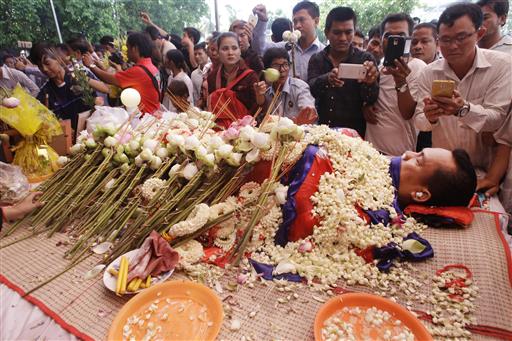
The body of Cambodian government critic Kem Ley is covered by the Cambodian National flag as flowers are placed during a funeral ceremony in Phnom Penh, Cambodia, Monday, July 11, 2016. Photo: Heng Smith / Associated Press

PHNOM PENH, Cambodia  — Cambodia’s prime minister said Monday that authorities will conduct a vigorous investigation to uncover any conspiracy behind the shooting death of a government critic, and urged the opposition not to use the assassination to incite people.

Kem Ley, 45, was killed at a gas station mini-mart complex in Phnom Penh on Sunday and his attacker was arrested shortly afterward. Police said the suspect claimed to have shot Kem Ley, a high-profile political analyst, because he failed to pay him back for a loan.

But Cambodia’s opposition, which has long been suppressed by Prime Minister Hun Sen, have suggested that Kem Ley, 45, was a victim of a conspiracy for his outspoken views about government corruption. His friends and supporters have decided to keep his body at a Buddhist temple for 10 days before holding the funeral to allow people to pay their respects.

Speaking at the inauguration of a new military police headquarters, Hun Sen condemned the killing and offered his condolences to Kem Ley’s family.

“I have ordered the competent authority to conduct a vigorous investigation into the attacker and the conspirators to face justice,” he said.

The killing comes at a time of political tension that began last year with legal and other pressures on the opposition Cambodia National Rescue Party by Hun Sen’s government.

Kem Ley was often critical of the government, and was widely known because he was frequently heard on the popular Cambodian-language services of Radio Free Asia and Voice of America, U.S. government-funded services that are among the few independent news sources in Cambodia. He was also frequently quoted in the country’s handful of independent newspapers.

One of his most recent commentaries was about a report issued last week by the London-based research and advocacy group Global Witness that alleged that Hun Sen and his family have enriched themselves and kept power through corruption.

The Interior Ministry identified the attacker as Chuob Samlap, 38, one of the many migrant Cambodian farm workers in neighboring Thailand.

Hun Sen said he hoped the killing is not used to incite the public.

“Hopefully, our people will give authorities time to perform their duties by not turning this tragedy into something politically motivated,” he said.

Violence has long played a prominent part in Cambodian politics, though it often is carried out in the countryside, where it gets little attention. Activists and members of the political opposition are frequent targets, and attackers are rarely brought to justice.

Kem Ley is the most prominent Cambodian government critic to be killed since trade union leader Chea Vichea in 2004.

Kem Ley’s body will be moved from the Buddhist temple in Phnom Penh on July 19 and taken to his hometown Takeo in the south for cremation, said Sum Po, one of the funeral organizers.

For now, his body was placed on a bed covered by a Cambodian flag up to his neck. Buddhist monks sat nearby to pray for his soul.

Story: Sopheng Cheang
Advertisement

Three Teens Killed During Bangkok Police Chase

BANGKOK — Three teens died in a motorcycle wreck after police officers giving chase collided with them early Sunday morning.

Police Lance Cpl. Yannapat Preechasonthikul, 25, said he and a colleague at Phetkasem Police Station spotted a group of teens riding 10 motorcycles along Bang Khae Road, some of whom lacked helmets and license plates on their bikes.

When Yannapat and his partner, 25-year-old Lance Cpl. Pipatporn Kaoeian ordered them to stop, the teens sped up and attempted to flee, he said. The two officers gave chase, and at one point their motorcycle collided into one carrying two teen boys and one teen girl, sending it crashing and killing all three.

Those killed were Wanlop Khotpali, 17; Asada Chandahan, 14; and one girl, 18-year-old Benjamas Baikhaew.

The officers involved said it was an accident. Yannapat broke his shoulder and nose while officer Pipatporn suffered broken teeth and neck trauma. They were all taken to Phetkasem 2 Hospital after the crash.

Police Lt. Col. Pairote Traitham said the two officers under his supervision insist they were following procedures. He believed the teens died because they were not wearing helmets.

No criminal complaint has been filed in the case. Pairote said he has ordered an investigation into whether the officers used excessive force.

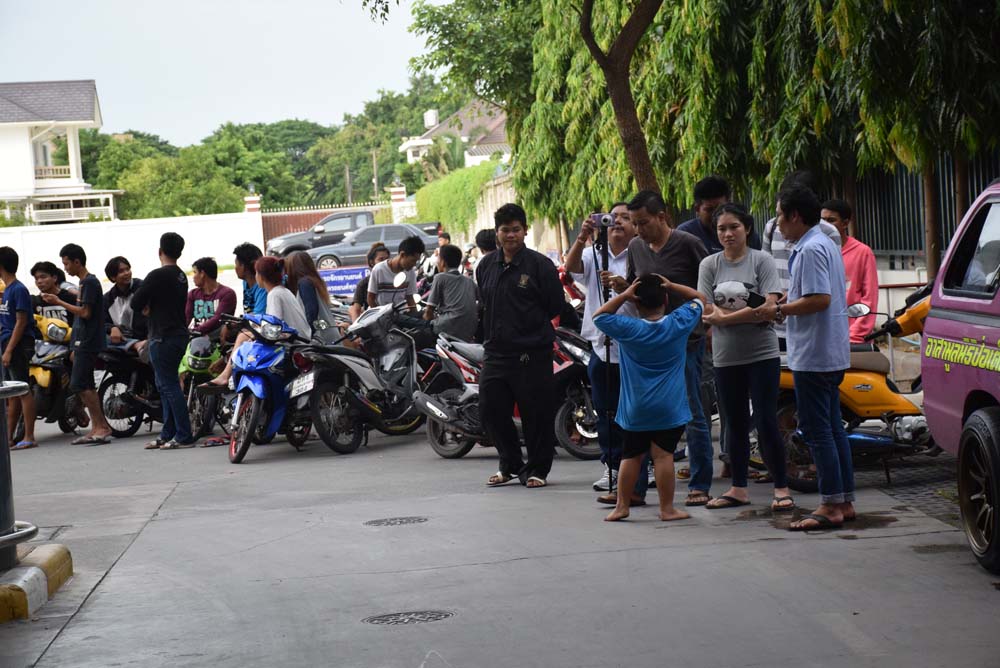
Friends of three teens killed during a police chase gathered in front of Phetkasem 2 Hospital on Sunday in Bangkok.
Advertisement

Activists, Reporter Won’t Seek Release on Bail: Lawyer

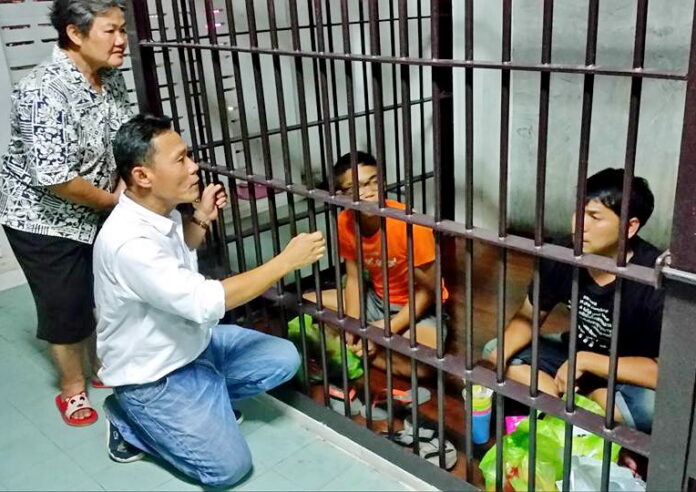
New Democracy Movement activists Anan Loked, in orange, and Anucha Rungmorakot, in black, are visited Sunday night at a Ratchaburi province police jail.

Update: The Ratchaburi provincial court Monday afternoon freed all five suspects on bonds of 140,000 baht to await trial.

BANGKOK — A human rights lawyer said four activists and a reporter arrested on suspicion of intending to violate a recent law which criminalized public criticism of the junta-backed charter will not seek bail and instead demand their release Monday.

Attorney Arnon Nampa said the five, arrested Sunday in Ratchaburi province and accused of violating the Referendum Act by spreading false information and vulgar messages about the charter, told him through messages Monday morning that they would insist on their innocence when they were taken before a provincial court.

“The five will not seek bail, as they insist they’re innocent,” he said. “The Prachatai.com reporter will insist on his freedom to carry out his work.”

Arnon was referring to 25-year-old reporter Taweesak Kerdpoka, who was arrested at about 11.30am on Sunday while traveling in a vehicle with three members of the New Democracy Movement: Pakorn Areekul, Anucha Rungmorakot and Anan Loked. Searching the vehicle, authorities found booklets they deemed critical of the charter, which goes to a public vote Aug. 7 in a vote increasingly viewed as a referendum on the junta.

All five people held on suspicion of intending to violate the Referendum Law were led from Ratchaburi’s Banpong Police Station on Monday to be taken to the provincial court.

Taweesak, a reporter for activist news organization Prachatai, was only in the car with the activists for a ride back to Bangkok, according to Director Chiranuch Premchaiporn.

A fourth student activist, Panuwat Songsawatchai of Maejo University in Chiang Mai was also arrested in Ratchaburi at about 8pm on Sunday after police reportedly saw footage of him carrying a box out of the car, which belonged to Pakorn.

Arnon said the five could still change their minds on whether to seek bail.

Rangsiman Rome, a student leader of the activist group, said it had no policy on whether its activists should refuse bail, saying it was up to each individual. Rome was among seven activists to be freed this past Tuesday after being imprisoned for 12 days and refusing bail in a challenge to the military tribunal. They still face trial on charges of violating the referendum law and a junta-imposed ban on political gatherings.

“No one is being forced. If you are willing and you think you can handle it then it’s okay. I think they feel they’re not really getting justice,” he said. “Normally people seek bail to fight the case, but in this case, they feel they are not getting any justice. They haven’t done anything yet and just got arrested.”

Defense attorney Arnon, a member of Thai Lawyers for Human Rights, said he would take 1 million baht in donation legal funds with him as possible bond money.

“I have to prepare because they can always change their minds,” he said. Ratchaburi is about one hour’s drive west of Bangkok.

Prachatai Director Chiranuch said the organization would not use funds donated to Arnon’s group for political activists and has prepared its own bond money should Taweesak seek release.

“We think what he did was not wrong, so we respect his decision not to seek bail,” Chiranuch said.

Taweesak suffers from mild asthma and requires regular medication, she said.

The five were held overnight at Ratchaburi’s Banpong Police Station and were due to be taken to Ratchaburi Provincial Court on Monday afternoon. If convicted under the Referendum Law, they face up to 10 years in prison.

Related stories:

Court Frees 7 Activists

Reporter Arrested While Reporting on Referendum in Ratchaburi

Advertisement

Sydney Schanberg, Reporter of ‘Killing Fields,’ 82

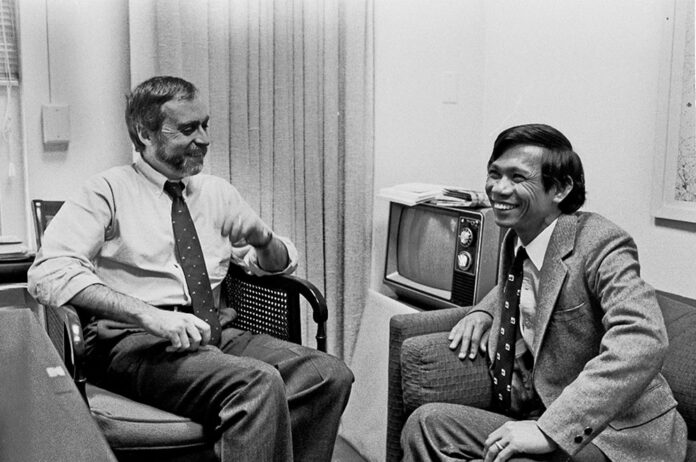
Sydney Schanberg, left, talks with Dith Pran in The New York Times office on 43rd Street in New York City on Jan. 15, 1980. Photo: The New York Times

NEW YORK — Sydney H. Schanberg, a former correspondent for The New York Times awarded a Pulitzer Prize for his coverage of the genocide in Cambodia in 1975 — and whose story of the survival of his assistant inspired the film “The Killing Fields” — has died. He was 82.

The Times reported Schanberg died Saturday in Poughkeepsie, New York. The newspaper cited Charles Kaiser, a friend and former Times reporter who said Schanberg had a heart attack on Tuesday.

“Sydney Schanberg was an historic and courageous correspondent,” Dean Baquet, executive editor of The Times, said in a statement. “He was part of a generation of war correspondents who made America understand what was truly happening in Vietnam and Cambodia.”

When Communist guerrillas overran the Cambodian capital of Phnom Penh in the spring of 1975, The Times said, Schanberg and his assistant Dith Pran refused pleas by their editors to evacuate.


Schanberg and Dith were briefly captured by the guerrillas, but later fled to the French Embassy. Dith then was expelled and joined civilians fleeing into the countryside. Two weeks later, Schanberg evacuated to Thailand, reporting on massacres and the displacement of millions of people along the way.

Dith was not heard from for several years until he escaped to Thailand in 1979. After being reunited in New York, Schanbergwrote a cover story for The New York Times magazine about Dith’s harrowing experience, surviving beatings, starvation and backbreaking labor.

That story was later turned into the 1984 film, “The Killing Fields,” starring Sam Waterston and Dr. Haing S. Ngor as Dith. Ngor, a Cambodian who also survived the horrors, won an Academy Award for best supporting actor.

With Schanberg’s help, Dith was hired as a photographer for The Times. Dith died in 2008.

“I’m a very lucky man to have had (Dith) Pran as my reporting partner and even luckier that we came to call each other brother,” Schanberg said after Dith’s death, according to The Times. “His mission with me in Cambodia was to tell the world what suffering his people were going through in a war that was never necessary. It became my mission too. My reporting could not have been done without him.”

Schanberg joined The Times in 1959 as a copy boy and remained there for 26 years. He later wrote a column for New York Newsday.

Besides the Pulitzer, he won two George Polk Memorial awards, two Overseas Press Club awards and Sigma Delta Chi’s distinguished journalism prize.

Advertisement

Portugal Stuns France to Lift 1st Cup Despite Ronaldo Injury

Portugal's Cristiano Ronaldo holds the trophy after winning the Euro 2016 final soccer match between Portugal and France at the Stade de France in Saint-Denis, north of Paris, Sunday, July 10, 2016. Photo: Martin Meissner / Associated Press

SAINT-DENIS, France  — Portugal’s players crowded around Cristiano Ronaldo as he sat on the turf, but their tearful captain couldn’t withstand the pain of his injury any longer.

The Portuguese had to win their first major trophy the hard way on Sunday, stunning France 1-0 after extra time in the European Championship final – having played without Ronaldo from the 25th minute.

Two hours after being carried off on a stretcher, the three-time world player of the year returned a champion for the first time with his country.

“I had bad luck because I had a small injury in the beginning of the game, but my colleagues did their part — they run, they fight,” said Ronaldo, who has already won every major club honor. “Nobody believed in Portugal but we won”.

An unlikely scorer secured the pre-tournament outsiders a title at last.

It could be an uncomfortable few months ahead for Eder, the unheralded striker who will return shortly to French club Lille after breaking French hearts with his 109th-minute goal.

“The ugly duckling became beautiful,” Portugal coach Fernando Santos said.

A second-half substitute, Eder scored only his fourth goal in 29 appearances for Portugal with a low shot from 25 meters (yards) past goalkeeper Hugo Lloris.

“Cristiano told me I would be scoring the winning goal,” Eder said. “He gave me strength and positive energy.”

In doing so, Portugal denied the French a third final victory on home soil to add to Euro ’84 and the 1998 World Cup.

“Football can be very cruel,” said Lloris, France’s captain. “The overriding emotion is a lot of sadness.”

Twelve years after losing to Greece on home soil in their last appearance in the final, it was Portugal’s turn to spoil the host nation’s party. And they achieved it after winning only one of their seven games at Euro 2016 inside 90 minutes, and after losing the inspirational Ronaldo midway through the first half.

“It was tough because we lost our main man and we had all our hopes pinned on him because he’s a player who can score a goal at any minute,” Portugal defender Pepe said. “When he said he couldn’t go on, I tried to tell my teammates that we have to win it for him. That we were going to fight for him.”

It was a mostly dull and stodgy final but the record books will only show that Portugal went from third-place in its group to champion, and with little help from Ronaldo in its last match.

The championship’s first 24-team tournament became a reality over the last month, but the quality of football deteriorated. Such a sterile showpiece — the first European Championship final to be scoreless after 90 minutes — seemed a fitting climax.

“We weren’t clinical enough,” said France coach Didier Deschamps, who lifted the World Cup in the stadium as a player in 1998. “We weren’t cool-headed enough.”

Even France forward Antoine Griezmann, the tournament’s leading scorer, couldn’t rise to the big occasion. There was no seventh goal of Euro 2016 from the Atletico Madrid forward, who also lost out in the Champions League final six weeks ago to Ronaldo’s Real Madrid.

Griezmann was the first player to find the target, but his header was tipped over by Rui Patricio, who was formidable in thePortugal goal. When an inviting cross from Kingsley Coman was delivered in the 66th, Griezmann missed with a free header.

Only once was Patricio beaten, when Andre-Pierre Gignac’s shot hit the inside of the post but it came back out.

Luck was on Portugal’s side, and Eder was able to strike the decisive blow.

It didn’t seem to be going Portugal’s way in the ninth minute when Dimitri Payet’s right knee clattered into Ronaldo’s standing left leg.

Ronaldo went down in agony — writhing, grimacing and screaming. He was able to return, but this was one injury he could not run off.

Ronaldo fell to the turf again in the 17th. One of the moths infesting the national stadium fluttered over Ronaldo’s tearful right eye. Teammates tried to help in vain to help, with Nani tending to the knee.

Ronaldo watched the game forlornly on the touchline as strapping was attached before dragging himself back onto the field.

But Ronaldo’s mobility was restricted. Battling through the pain, regularly reaching down to check on the injury, Ronaldo realized there would be no miracle recovery.

The clock hit 23 minutes and Ronaldo ripped off his captain’s armband and tossed it on the turf. Slumping to the ground again, Ronaldo was consoled by Nani, who embraced his former Manchester United teammate as the armband was transferred.

The stretcher came on and in the 25th minute Ronaldo became a spectator. But thanks to Patricio’s array of saves and dogged defending, Ronaldo left a champion.

Unlike his great rival Lionel Messi, the Argentina and Barcelona forward, the 31-year-old Ronaldo has now filled the medal void on the major international stage. It’s a rapid turnaround for a national team that exited the 2014 World Cup in the group stage.

“It’s something unbelievable in my career,” Ronaldo said. “Something I deserve.”

Story: Rob Harris 

Advertisement

Reporter Arrested While Reporting on Referendum in Ratchaburi

A sign outside the Bangkok newsroom of Prachatai. Photo: Prachatai / Courtesy

RATCHABURI — A reporter for a pro-democracy news website was detained by police this morning in Ratchaburi province.

Taweesak Kerdpoka, a journalist for Prachatai.com, a Bangkok-based bilingual news website was detained Sunday morning along with three members of student activist group New Democracy Movement (NDM).

Taweesak was detained along with three NDM activists; Pakorn Areekul, Anucha Rungmorakot and Anan Loked.  

At the time Taweesk was reporting on the three NDM activists who, in a show of support, were at the police station where 18 other activists were being questioned by police on suspicion of participating in an illegal political assembly.

They were arrested after police searched a car belonging to one NDM member and found booklets believed to contain information critical of the draft charter, according to Prachatai.

Chiranuch Premchaiporn, director of Prachatai said at 5:45 Sunday that Taweesak is still being held at Baan Pong police station in Ratchaburi province and that they had sent a lawyer to the station.

“This shows there’s no freedom in Thailand today and the risk faced by journalists reporting about the [political] situation,” said Chiranuch, adding that the reporter could be charged with violating the junta’s ban on political gatherings of five or more persons and also with violating the referendum law.

In October an editor of Prachatai English was summoned by the junta over an infographic.

Additional reporting Simon Duncan

Advertisement

Aung San Suu Kyi: Falling Star or Beacon of Hope

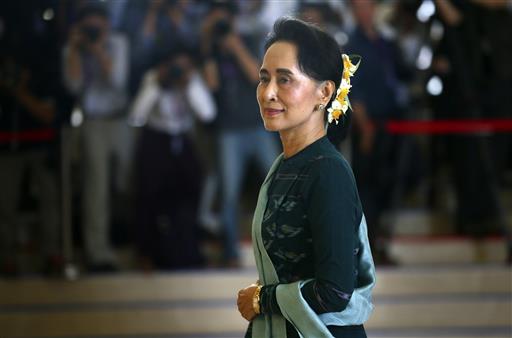
In this March 15, 2016 file photo, National League for Democracy party leader Aung San Suu Kyi arrives in Myanmar's parliament in Naypyitaw, Myanmar. Photo: Gemunu Amarasinghe / Associated Press

NAYPYITAW, Myanmar  — For nearly 30 years, Aung San Suu Kyi starred as arguably the world’s most prominent and revered political prisoner, a courageous champion of human rights and democracy in her military-ruled nation.

As she completes her first 100 days in power, the Nobel Prize laureate’s halo has all but vaporized on the global stage: Suu Kyi is being assailed for ignoring the plight of the oppressed Rohingya Muslims, failing to stop atrocities against other ethnic minorities and abetting moves to erase from collective memory the bloody history of the generals she replaced.

Some have even labelled her a “democratic dictator,” an increasingly aloof one-person show who surrounds herself with close friends and loyalists without nurturing a vitally needed new generation of leaders. Gone are the days when the elegant hostess would charm visitors over informal teas and reduce hard-bitten reporters to voicing soft-ball questions.

Even her supporters find it hard to cite concrete achievements of her government during the 100-day period, which ends this week, except for the freeing of most but not all political prisoners and initial efforts to stop rampant land grabs.

The Lady

However, to the country’s Burman majority, The Lady, as the charismatic 71-year-old Suu Kyi is affectionately known, remains a beacon of hope, one who will eventually surmount an array of troubles that would buckle the best of leaders — from the world’s longest running insurgencies to abysmal health care and China’s rampant exploitation — while somehow breaking the still-powerful grip of the military.

“We should give her 1,000 not 100 days given the legacy of a half century of military oppression. People are still patient, at least the majority of Burmans. But of course, for the ethnics it is different,” said Ye Naing Moe, a prominent journalist and educator.

In an interview with The Associated Press, Information Minister Pe Myint cited the government’s main achievement to date as progress toward a twofold “national reconciliation” — between civilians and military, the majority Burman people and the ethnic minorities, which make up about 40 percent of the population.

“I believe we are moving in a positive direction,” he said. “The main aim is to build a democratic federal union.”

The Rohingya

But criticism from foreign quarters has been withering, focused on Suu Kyi’s refusal to act on the Rohingya Muslims, who were driven into squalid camps amid waves of killings in 2012, and continue to flee on perilous sea voyages from a country that denies them citizenship despite historic proof of centuries-long residence.

Meanwhile, the generals continue to wage war against several ethnic groups, who rose up against the central government following Myanmar’s independence from Britain in 1948. Mark Farmaner, director of Burma Campaign UK, said his group has received more reports of atrocities by the military in Kachin and Shan states in recent months than similar periods last year under the military-dominated government.

The U.N. High Commissioner for Human Rights last month said that the new government “has the responsibility and opportunity to halt these violations” and called for an end to “discriminatory policies and practices by repealing discriminatory laws.” A New York Times editorial said “a woman whose name has been synonymous with human rights for a generation has continued an utterly unacceptable policy of the military rulers she succeeded.”

Suu Kyi has countered that she needs “space” to sort out such problems as the Rohingya and maintains that she has always stood for human rights and the rule of law.

The question of maneuvering space seems to be key to Suu Kyi’s power, or lack thereof. Despite her party’s sweeping victory in last November’s election, a 2008 constitution guarantees the military 25 percent of parliamentary seats, control of three key security ministries and a constitutional veto. The armed forces also have cornered large chunks of the economy.

“People were expecting miracles (after Suu Kyi’s victory). But first of all it is important to remember that this is a government with very limited power,” said Bertil Lintner, an author of several books on Myanmar. “The government has hobbled along and been blamed for actions which are beyond its control.”

Some observers say Suu Kyi, descending from the high moral ground of a political prisoner, has simply become a pragmatic politician, one who fears that pushing the military too far on human rights and other contentious issues could stop her in her tracks — if not spark a military coup — and never make her laudable end-game possible.

She has not taken up the cause of the Muslims, this line of argument goes, because this would alienate a key segment of her electorate, the Burman Buddhists among whom a virulent anti-Islamic movement has been growing. In another upsurge of violence, Buddhist mobs have recently burned down a mosque and attacked Muslims in several areas of the country.

A less charitable view says that given her massive popular mandate and international backing, Suu Kyi has enough political space in which she could afford to alienate radical anti-Muslims and the generals, who don’t appear keen for any breaks with Suu Kyi’s government.

Systematic Problems

Farmaner said that while Myanmar’s deeply systemic problems are obviously going to take a long time to solve, “it doesn’t take time to release political prisoners. This can be done immediately. Or lift humanitarian aid restrictions on the Rohingya, Kachin and the Shan. That can be done immediately, and this has not been done.” More than 60 political prisoners are still behind bars with 140 awaiting trial.

“She is so different from what she was before. People are really questioning who she really is now,” said Tun Kyi, once an ardent Suu Kyi supporter imprisoned for 10 years following the 1988 uprising against the military which propelled Suu Kyi to prominence.

The answer for many ethnics and Muslims like Tun Kyi is that while trying to resolve internal conflicts at heart, Suu Kyi views Myanmar as a Burman Buddhist country and will put Burman interests first. And despite her nearly 15 years under house arrest at the hands of the military regime, Suu Kyi retains an abiding fondness for the army — something she herself has acknowledged, noting that her father, independence hero Gen. Aung San, founded the institution.

Some also question the leadership mantle she has assumed.

“She only wants to give orders. She is not interested in listening to those who have opinions other than her own. She has equated her own destiny to the destiny of the country,” said Tun Kyi, who works with the Former Political Prisoners Society.

Barred by the constitution from serving as head of state, Suu Kyi said she would “be above the president,” and took on the newly created post of state counsellor. She also serves as foreign minister, minister of the president’s office and heads the National League for Democracy party. President Htin Kyaw is a close friend and her personal physician Dr. Tin Myo Win acts as the inexperienced negotiator with ethnic groups.

“It has got to be tempting for a woman with a huge to-do list to accumulate power in her own hands, to ignore the niceties of consultation and drive-through solutions: that would be a mistake in a brittle young democracy like Myanmar,” said Tim Johnston, Asia program director of the think tank International Crisis Group.

Her to-do list seems endless and it remains unclear on how some of the challenges will be dealt with since the government has yet to issue a comprehensive policy platform.

Myanmar remains one of the world’s least developed countries, the second largest producer of opium and this month was listed among the worst offenders in human trafficking by the U.S. State Department. Rife with corruption, it ranks 147 out of 168 countries on the latest index of Transparency International.

With one-third of the population having access to electricity, the government must decide whether to pursue dam construction by China, which has wreaked massive deforestation and other environmental degradation, or risk alienating its northern neighbor by axing Chinese projects. Beijing is currently on a charm offensive to restart construction of the USD$3.6 billion Myitsone dam, which was suspended by the previous government after nationwide protests.

“For the next generation, peace is the best legacy to pass on. Our country will develop only if it has peace,” Suu Kyi said last month, as preparations began for the “Panglong 21st Century Conference” in late August to persuade more than 20 insurgent groups to lay down their weapons.

The information minister said peace will be some time in coming with a key barrier the highly centralized, military-crafted constitution, which Suu Kyi and ethnic groups want amended to give greater autonomy to minorities. For some ethnic leaders, the conference will prove a non-starter unless such amendments are made and the army halts its ongoing attacks against the Kachin, Shan and others.

“We want to see Suu Kyi publicly condemn the current fighting and war crimes of the past. Without this the talks will fail,” said Charm Tong, a leading Shan human rights activist. She has done neither, with her government at least tacitly going along with military efforts to ban public discourse about the army’s decadeslong abuses.

“The main success of the government is that it is there. Although with limited powers, it is the first civilian government since 1962. And that gives the people some hope,” said Lintner.

The information minister described Suu Kyi’s victory as a “dream come true, but people expected something more, something perfect, so they are not 100 percent happy or satisfied.”


Story: Dennis D. Gray and Esther Htusan

Related stories: 

Rohingya Voices Silenced on Occasion of Suu Kyi Visit

High Hopes and Deep Doubts Await Suu Kyi in Thailand

Advertisement

Junta Spokesman Says NDM Students Should Stick to Classrooms

An undated file photo of Junta spokesman Col. Piyapong Klinphan talking to the press. Photo: Matichon

BANGKOK Junta spokesman Col. Piyapong Klinphan said on Saturday that members of the New Democracy Movement (NDM) should return to school and cease political activities, adding that the group’s financial transactions will be scrutinized to check for any “irregularities.”

Rangsiman Rome, a key member of NDM said he and other university student members of the group are still attending class but they will continue campaigning against the junta-sponsored charter draft during their free time.
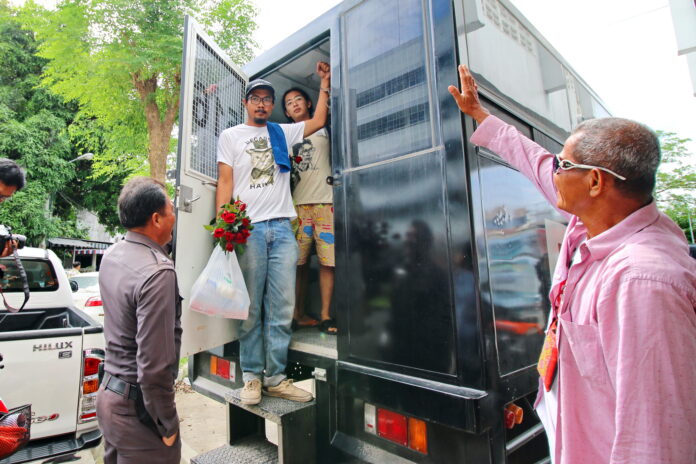
Piyapong also warned the parents of NDM members to “take care” of their children, adding that he doesn’t believe that campaigning by the NDM is successful in convincing the public.

“The truth is that some students are interested in democracy but their campaign is under the support of some political group,” said Piyapong.

“I don’t think the public are swayed by them because they are beginning to realize that the group is fanning the same old issues, inciting and distorting. What’s more, they’re the same old faces, same group and if they continue to carry out their campaign, the public will become fed up and not fall for becoming their tools.”

The spokesman said the junta has allowed referendum-related activities to take place inside universities in order to ease the situation.

“Students should know their duties, however, that is to say they ought to study,” he said, adding that even if the students want to carry out political activities, they should not became a tool of anyone.

Rangsiman, who’s a postgraduate law student at Thammasat University, insisted however that he and his peers are still attending classes.

“We’re not abandoning our studies,” said Rangsiman who was recently detained for 12 days along with six others and still faces charges of violating both the referendum law and the junta’s ban on political gatherings of five or more persons.

“Studying alone can’t make society have a better future,” said Rangsiman, adding that his group will launch another major campaign on July 17 at Thammasat University. He refused to provide further details of the campaign just yet.

As for the National Council for Peace and Order scrutinizing the money trail of the group, Rangsiman, who claims he lost 13 kilograms in prison, said he and his colleagues have nothing to hide.

“In principle [bank accounts] are a private matter. This is clearly another rights violation but let them do what they want. We’re pure in our intentions.”

Advertisement

Hot News

LATEST NEWS

Bangkok
overcast clouds
28.8 ° C
28.8 °
28.8 °
83 %
3.2kmh
100 %
Fri
29 °
Sat
37 °
Sun
36 °
Mon
36 °
Tue
33 °